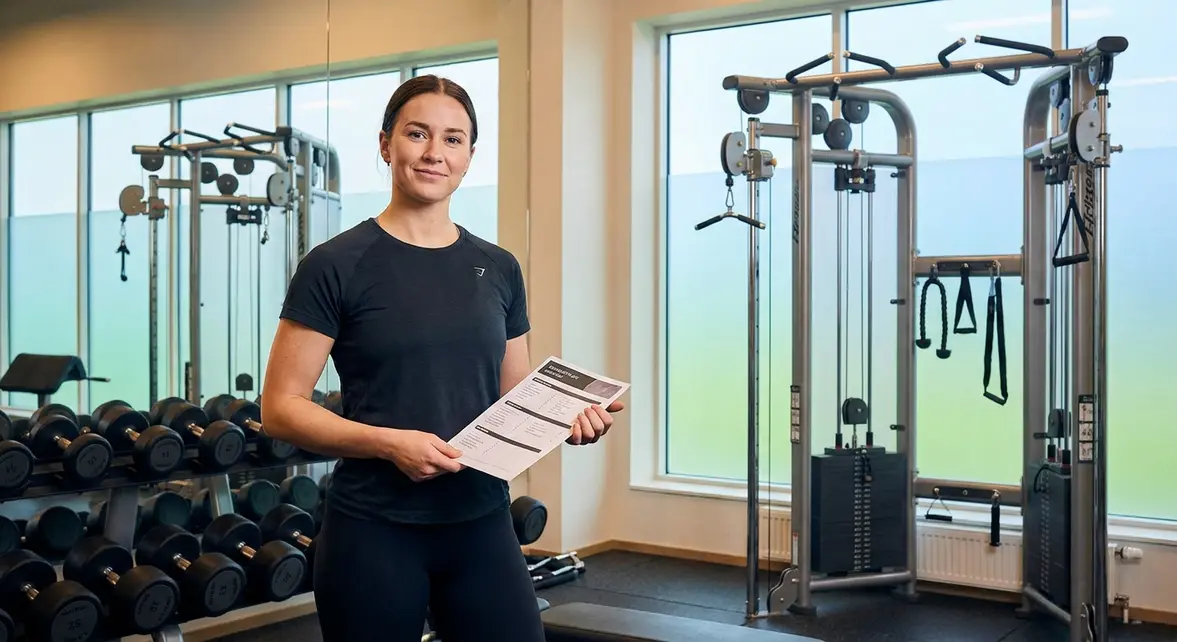
“Gym routine? Complete Noob — how do you know where to start…”
That comment shows up in fitness forums every single day. And honestly? It perfectly captures how most beginners feel standing in a gym for the first time — surrounded by machines they’ve never touched, people who look like they’ve been training since birth, and absolutely no idea what to do first.
Here’s the truth: most beginners don’t quit because they lack motivation. Research from the American College of Sports Medicine (ACSM) consistently shows that the #1 reason new gym-goers drop out in the first six weeks is a lack of a structured plan — not laziness, not lack of time. They walk in, feel overwhelmed, do a few random machines, and never come back. You won’t be one of them.
This beginner gym workout routine gives you everything you need: a clear 3-day schedule, a step-by-step full-body workout, a 4-week progression plan, and a proven framework called The Machine-to-Movement Progression — a CPT-backed system that starts you safely on machines before gradually introducing free weights. The result? You build real strength and real confidence at the same time.
⚕️ Medical Disclaimer: This article is for informational purposes only and does not constitute medical advice. Consult your doctor or a qualified healthcare professional before beginning any new exercise program, especially if you have a pre-existing health condition, injury, or have been sedentary for an extended period.
This beginner gym workout routine uses a 3-day-per-week structure that matches ACSM guidelines for new exercisers, starting on machines before progressing to free weights.
- The Machine-to-Movement Progression: Start on machines for guided form, then earn your way to free weights — this removes the fear of injury on Day 1.
- 3 days per week is the sweet spot: Enough stimulus for real strength gains; enough rest for your muscles to actually recover and grow.
- Full-body workouts beat splits: For beginners, training each muscle group three times a week produces faster results than isolating muscle groups on separate days.
- Progress is built in: A 4-week plan adds reps and weight gradually so you never plateau in your first month.
- Gym anxiety is normal — and solvable: Structure is the cure. Walk in with a plan, and the anxiety disappears within two to three sessions.
Before You Start: Your Beginner Gym Checklist
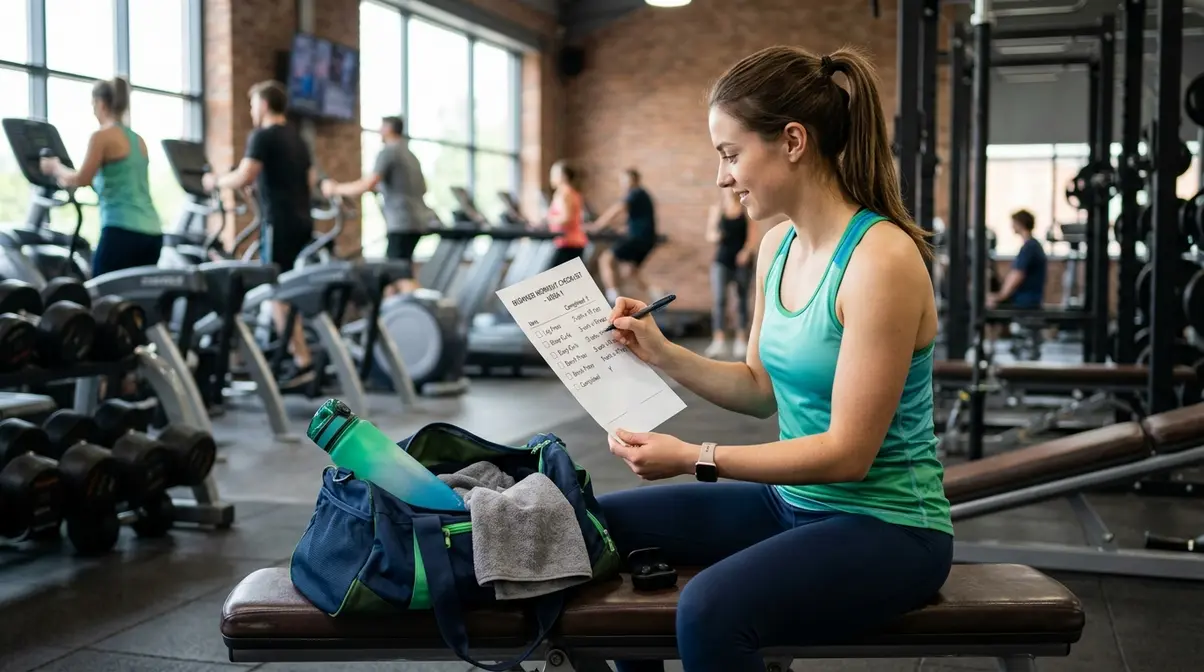
According to Harvard Medical School, a structured strength training routine is crucial for building muscle, controlling weight, and improving balance. Walking into a gym prepared — mentally and physically — is half the battle. As a Certified Personal Trainer, I’ve worked with dozens of beginners who arrived on Day 1 without water, without a plan, and without a clue what they wanted to achieve. Every single one of them struggled more than they needed to. A little preparation goes a long way.
What to Pack for Your First Gym Session
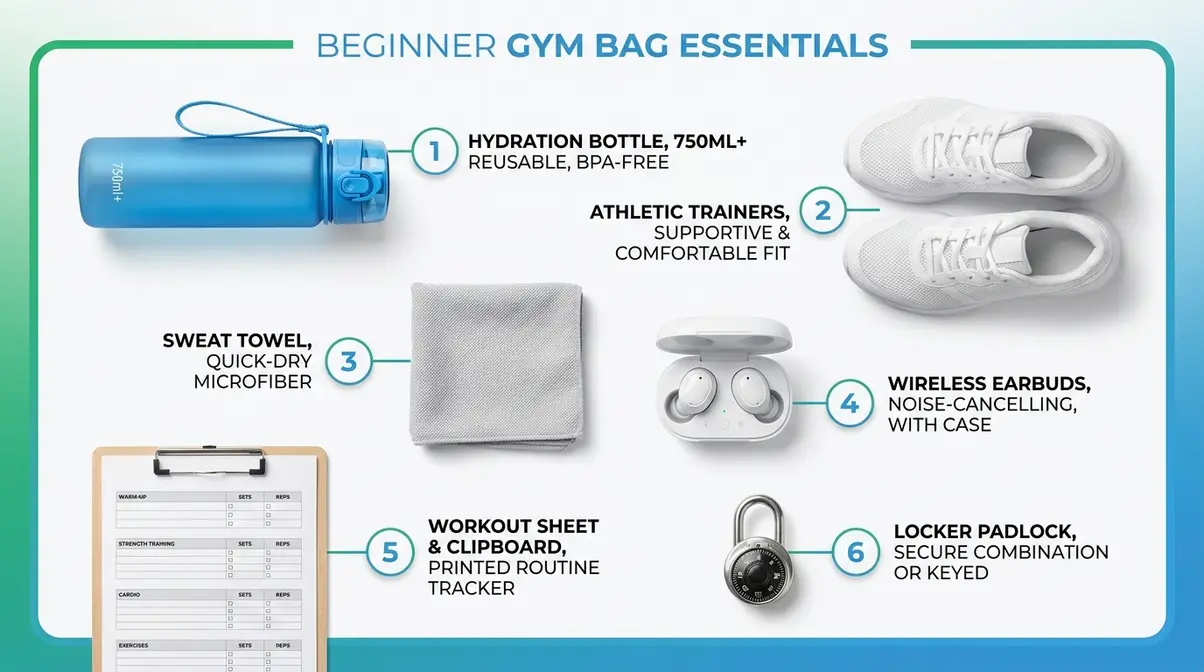
You don’t need expensive gear to get started. Here’s a simple checklist of what actually matters:
- Water bottle (at least 750ml) — dehydration kills performance and focus faster than anything else
- Gym shoes with lateral support (cross-trainers or running shoes — not sandals or fashion sneakers)
- Comfortable, non-restrictive clothing — shorts or leggings, a breathable t-shirt or tank top
- Small towel — most gyms require you to wipe down equipment after use; it’s basic gym etiquette
- Earbuds or headphones — music measurably improves workout performance and helps drown out self-consciousness
- Phone or printed workout sheet — you need your plan in front of you, not in your head
- Lock (if your gym has lockers) — leave valuables secured, not on the gym floor
That’s genuinely it. You do not need a gym bag the size of a suitcase. Keep it simple, and you’ll feel less like you’re performing and more like you’re just working out.
Setting Your First-Month Goals
Before you touch a single machine, spend two minutes answering one question: What does success look like after 30 days?
The most effective first-month goals are behavioral, not physical. Instead of “lose 10 pounds,” try “complete all 12 scheduled workouts this month.” Research published in the British Journal of Health Psychology shows that process-based goals (showing up consistently) produce better long-term outcomes than outcome-based goals (hitting a specific weight or size) for new exercisers — because you control the process, not the outcome.
Here are three realistic 30-day goals that set beginners up for success:
- Consistency goal: Complete all 12 workouts (3 per week × 4 weeks) without skipping
- Technique goal: Learn the correct form for all 5 core exercises before adding weight
- Confidence goal: Be able to navigate the gym floor without needing to ask where anything is
Write these down. Tape them to your mirror. They matter more than any number on a scale right now.
Your 3-Day Beginner Gym Workout Schedule
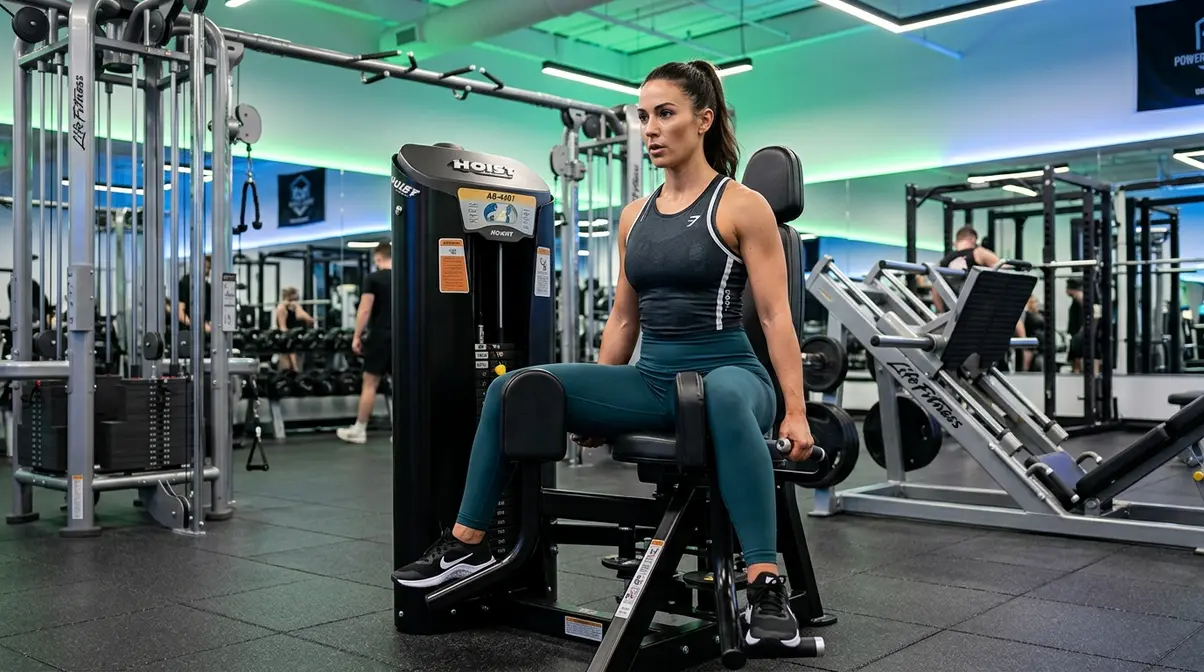
A well-designed beginner gym workout routine doesn’t ask you to live at the gym. Three focused days per week is not a compromise — it’s the optimal starting frequency, backed by exercise science.
Why 3 Days a Week Is the Sweet Spot
The CDC’s Physical Activity Guidelines for Americans recommend that adults perform muscle-strengthening activities on two or more days per week. The ACSM builds on this for beginners specifically, recommending 2-3 days of resistance training per week with at least 48 hours of rest between sessions targeting the same muscle groups.
Three days hits both benchmarks perfectly. Here’s why it works so well for beginners:
- Muscle protein synthesis (the biological process that builds new muscle) peaks 24-48 hours after a workout and returns to baseline within 72 hours. Three weekly sessions keep this process active without overlapping recovery windows.
- Neural adaptation — the real mechanism behind beginner strength gains — requires repeated practice. Three sessions per week gives your nervous system enough repetition to wire movement patterns efficiently.
- Psychological sustainability. Four or five days a week sounds impressive but burns out most beginners within three weeks. Three days is achievable even during busy or stressful periods.
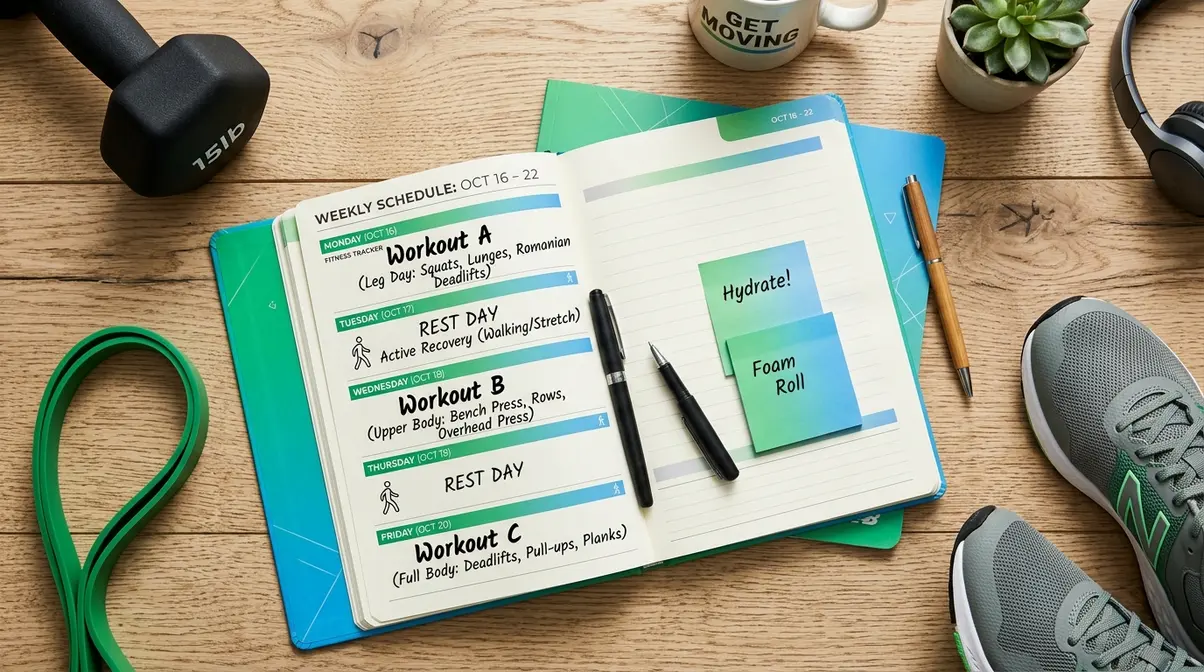
Your 3-day schedule looks like this:
| Day | Session | Focus |
|---|---|---|
| Monday | Workout A | Full-body strength (machines) |
| Wednesday | Workout B | Full-body strength (machines) |
| Friday | Workout C | Full-body strength + light cardio |
| Tuesday, Thursday, Saturday, Sunday | Rest / Active Recovery | Walking, stretching, sleep |
The Monday-Wednesday-Friday split is the most popular for good reason: it spaces workouts evenly and keeps weekends flexible. However, any three non-consecutive days work just as well. Tuesday-Thursday-Saturday is equally valid.
4-Week Gym Progression Plan
The Machine-to-Movement Progression is built around one principle: earn your complexity. Machines first, free weights later. This isn’t about being cautious to the point of timidity — it’s about building a foundation that makes free weights feel easy when you get there, usually around Week 3 or 4.
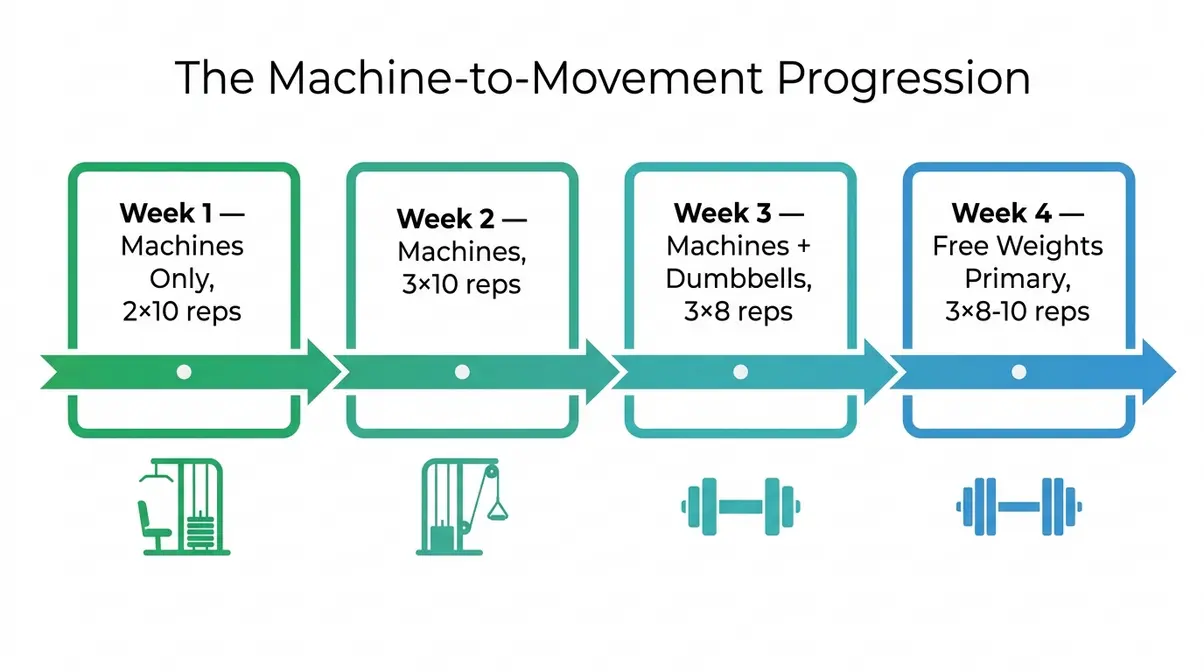
| Week | Sets × Reps | Equipment | Rest Between Sets | Focus |
|---|---|---|---|---|
| Week 1 | 2 × 10 | Machines only | 90 seconds | Learn the movement |
| Week 2 | 3 × 10 | Machines only | 90 seconds | Build consistency |
| Week 3 | 3 × 8 | Machines + intro dumbbells | 60-90 seconds | Add load gradually |
| Week 4 | 3 × 8-10 | Free weights primary | 60 seconds | Own the movement |
Progressive overload (gradually increasing the challenge over time) is the single most important principle in strength training. According to a PubMed review of resistance training adaptations, beginners who follow a structured progressive overload model gain strength 2-3× faster than those who train at a fixed weight and rep range. Add one small increase — one extra rep, or 2.5-5 lbs — each week.
Machines vs. Free Weights
This is where The Machine-to-Movement Progression earns its name. Machines and free weights are not competitors — they’re stages in a progression.
Machines (cable stacks, leg press, chest press, lat pulldown) guide your movement along a fixed path. This means your muscles do the work without your stabilizer muscles having to compensate for poor balance or coordination. For a complete beginner, this is a safety feature, not a limitation.
Free weights (dumbbells, barbells, kettlebells) require your stabilizer muscles to activate simultaneously. This makes them more effective long-term — but also more technically demanding. Attempting a barbell squat on Day 1 without coaching is how most beginners get hurt or embarrassed.
Start on machines. Learn the movement pattern. Build the muscle. Then graduate to free weights in Week 3-4. PureGym’s beginner training research supports this machine-first approach for reducing injury risk in new exercisers.
Step-by-Step: The Full-Body Beginner Workout
Estimated Time: 45-60 minutes
Tools and Materials Needed: Gym access (machines and free weights), water bottle, towel, printed workout plan.
This is the core of your beginner gym workout routine. Follow these three steps in order, every session, for all four weeks. Do not skip Step 1. Do not rush Step 3.
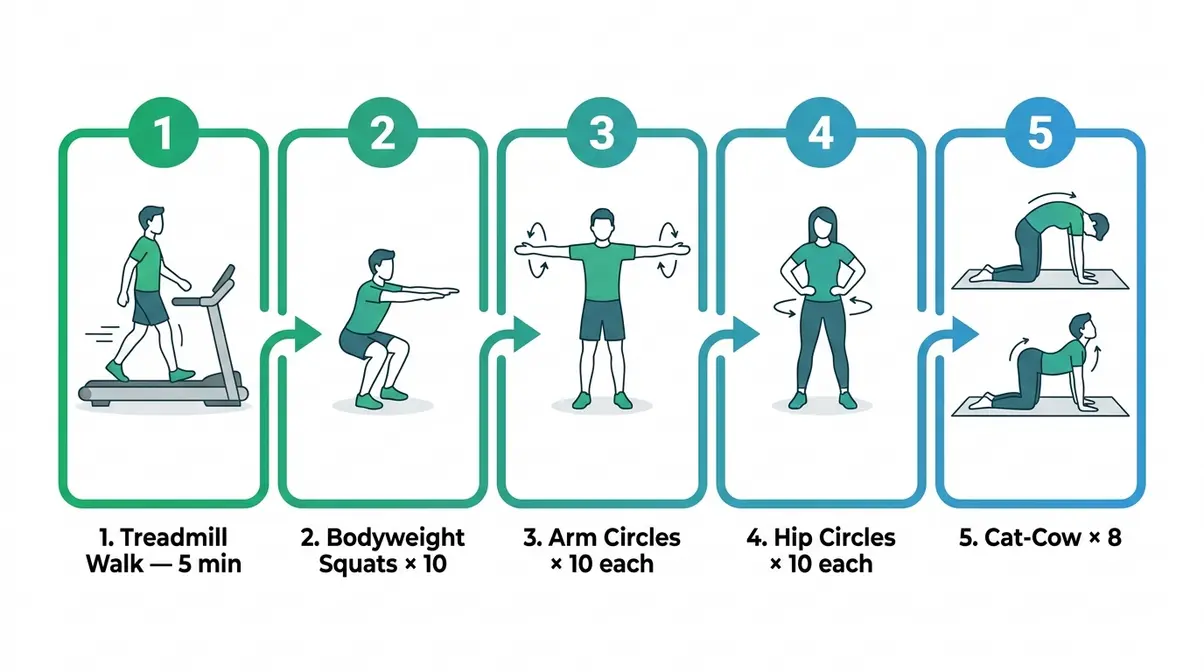
Step 1 — Warm-Up (5-10 Minutes)
Never skip your warm-up. The Mayo Clinic recommends warming up for at least 5-10 minutes before any strength training session. A proper warm-up increases blood flow to muscles, raises core body temperature, improves joint range of motion, and — critically for beginners — activates the neural pathways you’re about to use during your workout.
A beginner warm-up does not need to be complicated:
- 5 minutes of light cardio — treadmill at a brisk walk (3.5-4 mph), stationary bike at easy resistance, or elliptical at low intensity. You should be able to hold a conversation but feel your heart rate rising.
- Bodyweight squats × 10 — slow and controlled, feet shoulder-width apart. This primes your hips, knees, and ankles for the leg work ahead.
- Arm circles × 10 each direction — loosens shoulder joints before any upper-body pressing or pulling.
- Hip circles × 10 each direction — activates hip flexors and glutes.
- Cat-cow stretches × 8 — mobilizes the thoracic spine, which takes a beating from daily sitting.
Step 2 — Muscle-Building Circuit
This is the heart of your workout. Five compound exercises (movements that work multiple muscle groups at once) hit your entire body in under 30 minutes. In Weeks 1-2, perform 2 sets of 10 reps on machines. In Weeks 3-4, progress toward 3 sets of 8-10 reps using the free-weight variations.
💡 Health Tip: If you experience sharp pain (not muscle fatigue — actual pain) during any exercise, stop immediately. Muscle burn is normal; joint pain is not. Consult a trainer or physician before continuing.
Exercise 1: Leg Press (Machine) → Goblet Squat (Free Weight)
The leg press is the safest introduction to quad-dominant lower-body training. It builds the quadriceps (front thighs), hamstrings, and glutes with no balance requirement. Sit in the machine, place feet shoulder-width apart at mid-pad height, push until legs are nearly straight (don’t lock knees), and lower slowly.
Exercise 2: Chest Press (Machine) → Dumbbell Bench Press (Free Weight)
The chest press machine teaches the horizontal push movement pattern — essential for chest, shoulder, and tricep development. Sit upright with the handles at chest height. Push forward until arms are nearly extended, then return slowly. Keep your back flat against the pad throughout.
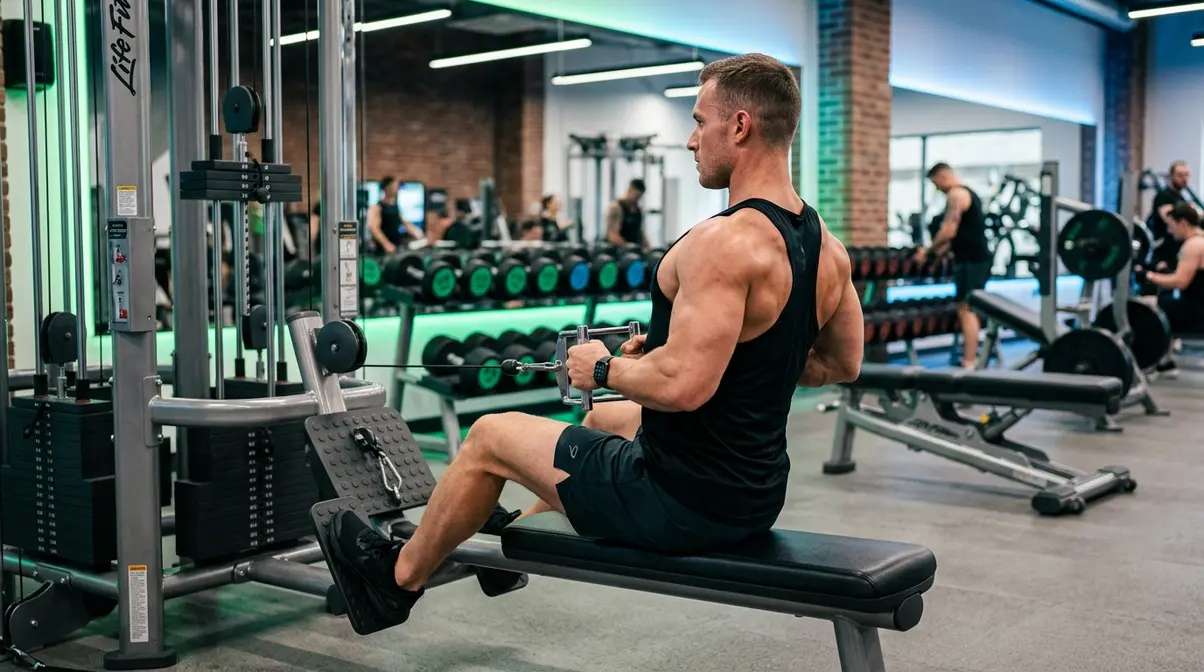
Exercise 3: Seated Cable Row (Machine) → Dumbbell Row (Free Weight)
The cable row teaches the horizontal pull — the counterpart to the chest press that keeps your posture balanced and your back strong. Sit at the cable row station, grip the handle with both hands, pull toward your lower ribs, and squeeze your shoulder blades together at the peak. Avoid leaning back excessively.
Exercise 4: Lat Pulldown (Machine) → Assisted Pull-Up (Free Weight)
The lat pulldown builds the latissimus dorsi (the broad muscle that gives your back a V-shape) and biceps simultaneously. Grip the bar slightly wider than shoulder-width, lean back slightly (about 15 degrees), and pull the bar to your upper chest. Avoid pulling behind the neck — this stresses the cervical spine unnecessarily.
Exercise 5: Dumbbell Romanian Deadlift
This exercise begins in Week 1 with dumbbells because no machine replicates the hip-hinge pattern as effectively. It trains the hamstrings, glutes, and lower back — the posterior chain — which most beginners neglect entirely. Stand with feet hip-width apart, hold a dumbbell in each hand in front of your thighs, push your hips back (not down), lower the weights along your legs until you feel a stretch in your hamstrings, then drive your hips forward to return upright.
Your Full-Body Circuit Summary:
| # | Exercise | Machine Version | Free Weight Version | Sets × Reps |
|---|---|---|---|---|
| 1 | Leg Press → Goblet Squat | Leg Press | Goblet Squat (dumbbell) | 2-3 × 10 |
| 2 | Chest Press → Bench Press | Chest Press Machine | Dumbbell Bench Press | 2-3 × 10 |
| 3 | Cable Row → Dumbbell Row | Seated Cable Row | Single-Arm Dumbbell Row | 2-3 × 10 |
| 4 | Lat Pulldown → Pull-Up | Lat Pulldown Machine | Assisted Pull-Up | 2-3 × 10 |
| 5 | Romanian Deadlift | (No machine equivalent) | Dumbbell RDL | 2-3 × 10 |
Step 3 — Cardio and Cool-Down
After your strength circuit, spend 10-15 minutes on light cardio followed by 5 minutes of static stretching. This combination accelerates recovery, improves cardiovascular fitness, and prevents next-day muscle soreness from becoming debilitating.
- Light cardio options (pick one):
- Treadmill walk at 3.5-4 mph for 10 minutes
- Stationary bike at easy resistance for 12 minutes
- Elliptical at low resistance for 10 minutes
- Cool-down stretches (hold each for 20-30 seconds):
- Standing quad stretch (each leg)
- Seated hamstring stretch
- Cross-body shoulder stretch (each arm)
- Chest doorway stretch
- Cat-cow spinal release
Beginner Gym Workout for Women
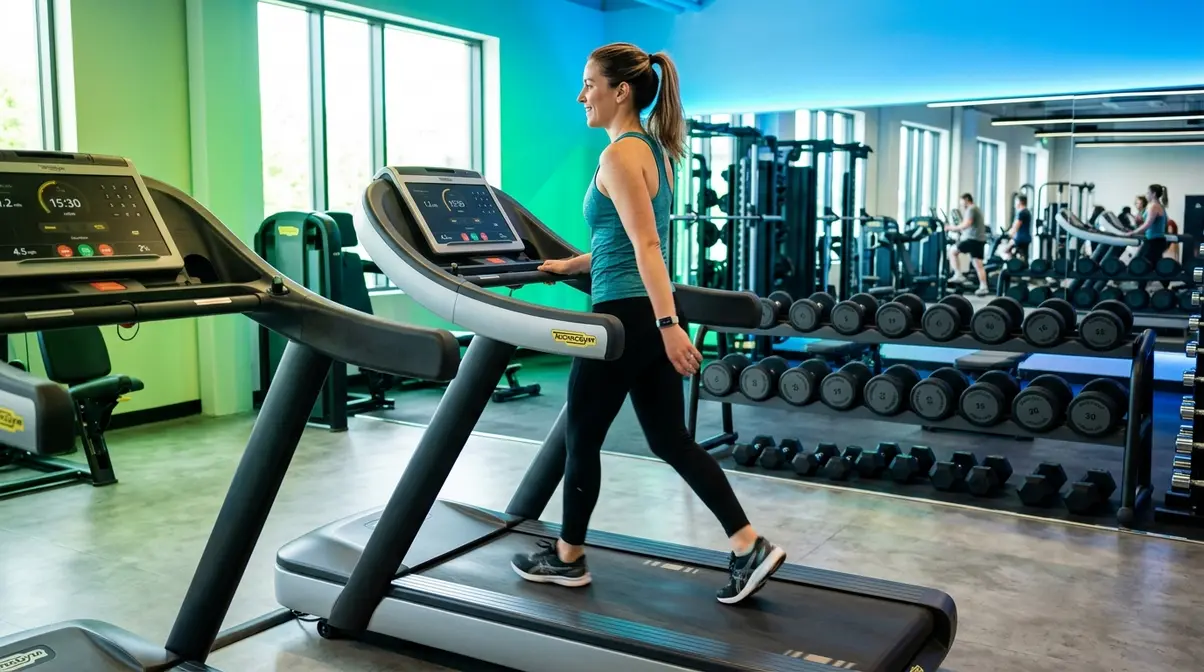
Women are underrepresented in the free weight section of most gyms — but they belong there just as much as anyone. Women’s Health Magazine’s fitness research consistently shows that women who incorporate resistance training see faster body composition changes than those who stick exclusively to cardio. The same 3-day beginner plan outlined above works equally well for women, but a few machine recommendations and one persistent myth are worth addressing directly.
Best Gym Machines for Women
These five machines are particularly effective for the goals most women report when starting out — building strength in the glutes, legs, and core while improving overall body composition:
- Hip Abductor/Adductor Machine — targets the outer and inner thighs and glute medius, the muscle responsible for hip stability and the “lifted glute” appearance
- Glute Kickback Machine — isolates the gluteus maximus with zero lower back strain; excellent starting point before progressing to barbell hip thrusts
- Leg Press — safe, adjustable quad and glute builder that allows significant load without balance demands
- Cable Machine (Low Row / Face Pull) — improves posture and builds the upper-back muscles that counteract desk-sitting posture
- Assisted Pull-Up Machine — builds lat and bicep strength that most beginners (of any gender) lack at the start
Start here. Build confidence. Within 4-6 weeks, you’ll have the strength and body awareness to use free weights effectively.
Toning vs. Bulking: The Truth
Let’s address this directly: lifting weights will not make you “bulky” unless you are specifically training and eating to achieve that result over months or years. Women have significantly lower testosterone levels than men — roughly 15-20 times lower, according to research published in the Journal of Clinical Endocrinology & Metabolism. Testosterone is the primary hormonal driver of large muscle mass gains. Without a significant caloric surplus and a specific hypertrophy-focused program, the “toning” you’re looking for is strength training.
What strength training actually does for women: increases lean muscle mass, raises resting metabolic rate (so you burn more calories at rest), improves bone density (critical for long-term health), and creates the defined, firm appearance most women describe as their goal. Gold’s Gym’s beginner strength research supports resistance training as the most effective approach for body recomposition in new female exercisers.
For a deeper dive into women-specific programming, see our complete guide to gym workouts for women.
Beginner Gym Workout for Men
Men starting the gym often have one primary goal: build muscle, particularly in the chest, back, and arms. That’s a completely valid starting point. However, the most common mistake male beginners make is jumping straight to isolation exercises (bicep curls, tricep pushdowns) and neglecting the compound movements that actually produce the fastest results.
Building Your Foundation
According to Muscle & Fitness’s beginner training guide, the most effective approach for male beginners is a compound-first strategy: prioritize movements like the bench press, row, and overhead press before adding isolation work. Here’s why this matters.
Compound movements recruit more total muscle fibers, trigger greater hormonal responses (including testosterone and growth hormone release), and build the structural foundation that makes isolation exercises more effective later. A bicep curl trains one muscle. A row trains your biceps, lats, rear deltoids, rhomboids, and core simultaneously.
When you focus on compound lifts, you are teaching your nervous system to coordinate multiple muscle groups at once. This structural balance prevents the common beginner mistake of developing a strong chest with a weak back, which often leads to poor posture and shoulder injuries. Furthermore, compound movements trigger a more significant central nervous system response, which is essential for overall muscle hypertrophy.
Recommended compound foundation for men (first 4 weeks):
- Horizontal push: Chest press machine → Dumbbell bench press
- Horizontal pull: Cable row → Dumbbell row
- Vertical pull: Lat pulldown → Assisted pull-up
- Knee-dominant lower body: Leg press → Goblet squat
- Hip-dominant lower body: Dumbbell Romanian deadlift
Once you master the foundational movements in Weeks 1 and 2, you can strategically introduce isolation exercises in Weeks 3 and 4. For example, after completing your seated cable rows, you might add two sets of dumbbell bicep curls to fully exhaust the arms. After your chest presses, tricep pushdowns can help build arm thickness. However, these isolation movements should never replace your main compound lifts; they are simply the finishing touches on a well-structured routine. For a complete muscle-building progression, explore our gym workout plan for men.
Beginner Gym Routine for Weight Loss
If weight loss is your primary goal, strength training should be a core part of your plan — not an afterthought after your cardio. This is one of the most persistent misconceptions in beginner fitness.
Cardio vs. Weights for Fat Loss
Here’s the honest answer: *cardio burns more calories during the session; strength training burns more calories after the session.* A 30-minute moderate cardio session burns approximately 200-300 calories. But strength training elevates your resting metabolic rate for up to 24-48 hours post-workout through a process called excess post-exercise oxygen consumption (EPOC).
EPOC essentially turns your body into a calorie-burning engine long after you’ve left the gym floor. Because strength training creates micro-tears in your muscle fibers, your body must expend significant energy to repair them over the next two days. This means you are actively burning calories while sitting at your desk, driving home, or sleeping. When you rely solely on cardio, that calorie burn stops the moment you step off the treadmill.
More importantly, strength training builds lean muscle. Every pound of muscle burns approximately 6-10 additional calories per day at rest, according to research from Harvard Medical School. Over months and years, this metabolic advantage compounds significantly. A person who gains 5 lbs of lean muscle burns an additional 30-50 calories per day without doing anything extra.
The most effective weight loss approach for beginners combines both: strength training as the foundation (3 days/week) with moderate cardio as the supplement (2-3 days/week of walking, cycling, or swimming). This is also the approach recommended by the WHO’s physical activity guidelines for adults.
Best 3-Day Weight Loss Split
| Day | Session | Duration | Priority |
|---|---|---|---|
| Day 1 (Monday) | Full-body strength (machines) | 45 minutes | Strength |
| Day 2 (Wednesday) | Moderate cardio (brisk walk, bike) | 30-40 minutes | Fat burn |
| Day 3 (Friday) | Full-body strength + 15 min cardio | 50-60 minutes | Combined |
| Active Recovery Days | 20-30 min walk | 20-30 minutes | NEAT boost |
NEAT (Non-Exercise Activity Thermogenesis) — the calories you burn through everyday movement like walking, standing, and fidgeting — often contributes more to total daily calorie expenditure than formal exercise sessions. Increasing your daily step count to 8,000-10,000 steps on rest days is one of the highest-impact, lowest-effort fat-loss strategies available to beginners.
To maximize your NEAT boost on active recovery days, look for simple behavioral swaps. Park your car at the back of the grocery store lot, take the stairs instead of the elevator, or commit to a 15-minute brisk walk immediately after lunch. You can also incorporate light mobility work or gardening. These small bursts of activity don’t feel like formal exercise, but they accumulate rapidly. For a beginner, adding just 3,000 extra steps a day through NEAT can accelerate fat loss without increasing hunger or fatigue, which are common pitfalls of excessive cardio.
For more on optimizing workouts around weight loss goals, see our beginner weight loss workout plan.
The 3-2-1 Method, 3-3-3 Rule, and Gym Confidence
Two trending workout frameworks are worth knowing as a beginner — not because you need to follow them immediately, but because understanding them helps you make sense of workout structures you’ll encounter everywhere from gym classes to fitness apps.
What Is the 3-2-1 Method?
The 3-2-1 Method is a workout structure that divides each session into three segments based on training type: 3 minutes of strength training, 2 minutes of cardio conditioning, 1 minute of core work — repeated for the duration of the session. Originally popularized by fitness instructor Lara Barry and widely adopted in group fitness settings, the 3-2-1 method is particularly effective for beginners because it prevents any single training modality from feeling overwhelming.
A beginner-adapted 3-2-1 session (30 minutes total) might look like this:
| Round | Strength (3 min) | Cardio (2 min) | Core (1 min) |
|---|---|---|---|
| Round 1 | Leg press × 12 reps | Treadmill jog | Plank hold |
| Round 2 | Chest press × 12 reps | Jumping jacks | Dead bug × 8 |
| Round 3 | Cable row × 12 reps | Stationary bike | Bicycle crunch × 10 |
| Round 4 | Lat pulldown × 12 reps | Elliptical | Mountain climbers |
| Round 5 | Dumbbell RDL × 12 reps | Brisk walk | Side plank (each side) |
The 3-2-1 method works well as a variation session on Day 3 of your weekly schedule, once you’ve built a foundation in Weeks 1-2.
What Is the 3-3-3 Rule for Working Out?
The 3-3-3 Rule is a beginner-friendly structure that stands for: 3 exercises, 3 sets each, 3 days per week. It’s a minimalist framework designed to prevent overwhelm — the exact problem most beginners face when they see 50-exercise workout plans online.
Applied to The Machine-to-Movement Progression, the 3-3-3 rule for beginners looks like this:
- 3 exercises per session: Choose one lower-body compound, one upper-body push, one upper-body pull
- 3 sets per exercise: 10 reps each, with 60-90 seconds rest between sets
- 3 days per week: Monday, Wednesday, Friday (or any three non-consecutive days)
The 3-3-3 rule is not the most comprehensive program you’ll ever follow — but it’s the most sustainable one for your first four weeks. Consistency beats complexity every time, especially at the beginning.
Essential Gym Etiquette Rules
Gym etiquette is unwritten — and nobody teaches it. Here’s what you actually need to know:
- Wipe down every machine after use — use the spray bottles and paper towels provided; this is non-negotiable
- Re-rack your weights — return dumbbells and plates to where you found them, in the right place
- Don’t occupy equipment during rest sets if the gym is busy — step away or let someone work in with you
- Earbuds in = don’t disturb — this is universally understood gym language
- Ask before working in — “Mind if I work in between your sets?” is always welcome
- Keep phone use brief at machines — scrolling for five minutes between sets on a busy chest press machine is genuinely inconsiderate
- Mirrors are for form checks, not selfies — (well, a quick selfie is fine — just don’t block others)
How to Overcome Gymtimidation
Gymtimidation — the anxiety of feeling watched, judged, or out of place at the gym — affects a significant majority of new gym-goers. A 2026 survey by fitness platform Hussle found that over 50% of gym members felt intimidated when they first joined. The good news: it fades almost entirely within 2-3 weeks for people who arrive with a plan.
The Cleveland Clinic emphasizes that having a structured workout plan is one of the most effective ways to combat gymtimidation. Here’s what actually works:
- Arrive with a written workout plan. Uncertainty is the root of anxiety. When you know exactly what you’re doing next, the anxiety drops dramatically.
- Go during off-peak hours. Most gyms are quietest between 10am-12pm and 2pm-4pm on weekdays. Avoid 5pm-7pm for your first few sessions.
- Wear headphones. They signal focus, reduce social pressure, and make the space feel more private.
- Remember: everyone started exactly where you are. The intimidating person doing pull-ups with ease was once a complete beginner who had no idea what they were doing. Every single one of them.
For more on managing gym anxiety, explore our complete guide to overcoming gym anxiety.
Common Beginner Gym Mistakes & Fixes
In my experience training beginners, the same five mistakes appear over and over. None of them are permanent — but all of them slow progress and increase injury risk if left uncorrected.
5 Mistakes That Slow Your Progress
Mistake 1: Skipping the warm-up to “save time”
What goes wrong: Cold muscles tear more easily. Skipping the warm-up increases injury risk and reduces performance in the actual workout. Fix: Treat the warm-up as the first exercise of your session, not optional prep work. Five minutes is all it takes.
Mistake 2: Using too much weight, too soon
What goes wrong: Ego loading (choosing a weight that’s too heavy to control) forces your body to compensate with poor mechanics, putting stress on joints instead of muscles. Fix: Start lighter than you think you need to. If your form breaks down before completing 10 reps, the weight is too heavy. Reduce it by 20% and rebuild.
Mistake 3: Ignoring rest days
What goes wrong: Muscle growth happens during recovery, not during the workout. Training the same muscles on consecutive days prevents the repair process from completing. Fix: Respect the Monday-Wednesday-Friday structure. Active recovery (walking, light stretching) on rest days is fine — another strength session is not.
Mistake 4: Doing only cardio
What goes wrong: Cardio improves cardiovascular fitness and burns calories, but does not build muscle or significantly improve resting metabolism. Beginners who do only cardio often plateau within 4-6 weeks. Fix: Follow the combined approach — strength training as the foundation, cardio as the supplement.
Mistake 5: Inconsistent progressive overload
What goes wrong: Doing the same weight and reps every session for weeks produces no new stimulus. Your muscles adapt and stop growing. Fix: Follow the 4-week progression plan above. Add one rep or 2.5-5 lbs each week, even if the increase feels small.
When to Ask a Trainer for Help
The DIY approach works well for the 5-exercise program above. But there are specific situations where asking a certified personal trainer for guidance is the right call — not a sign of weakness, but a sign of smart training.
- Ask a trainer if:
- You experience recurring pain (not muscle soreness) in the same joint during an exercise
- You can’t feel the target muscle working during an exercise, no matter how you adjust
- You’ve been training for 4 weeks and haven’t noticed any strength improvement
- You want to transition to barbell exercises (squat, deadlift, bench press) — these benefit significantly from in-person technique coaching
- You have a pre-existing injury or health condition that affects your movement
Most gyms include a free introductory session with a trainer when you join. Use it. For ongoing guidance beyond the beginner phase, see our guide to finding the right personal trainer.
Frequently Asked Questions
What is a good beginner gym schedule?
A good beginner gym schedule is 3 days per week on non-consecutive days, such as Monday, Wednesday, and Friday. This structure matches ACSM guidelines for new exercisers and allows 48 hours of recovery between sessions. Each session should last 45-60 minutes: 5-10 minutes warm-up, 30-35 minutes of full-body strength training on machines, and 10-15 minutes of light cardio and stretching. Avoid training the same muscle groups on back-to-back days — recovery is when your muscles actually grow.
Best gym exercises for beginners?
Beginners should prioritize compound exercises — movements that train multiple muscle groups simultaneously. The five most effective beginner exercises are: the leg press (quads, hamstrings, glutes), chest press machine (chest, shoulders, triceps), seated cable row (back, biceps), lat pulldown (lats, biceps), and dumbbell Romanian deadlift (hamstrings, glutes, lower back). These five exercises hit your entire body in under 30 minutes and build the foundation for every more advanced program you’ll ever follow.
How many days a week should I gym?
3 days per week is the optimal starting frequency for beginners. The CDC recommends adults perform muscle-strengthening activities on 2 or more days per week; the ACSM specifies 2-3 days for beginners with at least 48 hours between sessions. Three days provides enough training stimulus to build strength and muscle while giving your body adequate recovery time. Beginners who train 5-6 days per week in their first month typically experience faster burnout and higher injury rates than those who train 3 days.
What is the 3/2/1 rule in gym?
The 3-2-1 method is a workout structure that alternates 3 minutes of strength training, 2 minutes of cardio, and 1 minute of core work in repeating cycles throughout a session. Originally popularized in group fitness settings, it prevents any single training type from becoming overwhelming and keeps heart rate elevated throughout the session. A 30-minute 3-2-1 session typically includes 5 rounds of the cycle. It works well as a variation session for beginners once they’ve completed 2 weeks of the standard machine-based program.
What is the 3-3-3 rule for working out?
The 3-3-3 rule means: 3 exercises, 3 sets each, 3 days per week. It’s a minimalist framework designed specifically for beginners who feel overwhelmed by complex programs. Choose one lower-body compound exercise, one upper-body push, and one upper-body pull — then perform 3 sets of 10 reps on each, three times per week. This simple structure produces measurable strength gains in the first 4-6 weeks while keeping the mental load of planning to an absolute minimum.
What muscle is hardest to grow?
The calves are widely considered the hardest muscle group to grow, largely because they are composed of a high proportion of slow-twitch muscle fibers that are naturally resistant to hypertrophy (muscle growth). Genetics play a significant role — some people have naturally large calves with minimal training, while others train them consistently for years with modest results. The hip abductors and rear deltoids are also notoriously slow to develop. For beginners, focusing on compound movements first produces the most visible early progress.
Lose 10 lbs in 3 weeks by walking?
Losing 10 pounds in 3 weeks through walking alone is not realistic or safe for most people. A pound of fat represents approximately 3,500 calories, according to the Mayo Clinic. Losing 10 pounds in 21 days would require a daily deficit of roughly 1,667 calories — far beyond what walking alone can produce without severe dietary restriction, which is not recommended. Walking is genuinely effective for gradual, sustainable weight loss: 30-45 minutes of brisk walking daily (approximately 3,000-4,000 extra steps) can contribute to a 200-300 calorie daily deficit. Combined with strength training and a moderate dietary adjustment, losing 1-2 pounds per week is a healthy, achievable target.
Putting It All Together: Your Next Step
You now have everything a complete beginner needs to walk into a gym with confidence: a 3-day schedule backed by CDC and ACSM guidelines, a step-by-step full-body workout, a 4-week progression plan, and the knowledge to avoid the five most common beginner mistakes. The Machine-to-Movement Progression isn’t just a catchy name — it’s a framework that removes the two biggest beginner barriers (fear of injury and fear of looking incompetent) by starting you exactly where you should start: on machines, with guided movement, at manageable weights.
The Machine-to-Movement Progression works because it mirrors how real strength is built — from controlled, predictable movements to increasingly complex, full-body patterns. By Week 4, you won’t be a beginner anymore. You’ll have 12 workouts under your belt, real strength gains, and the body awareness to tackle free weights with genuine competence.
Here’s your specific next step: print this workout, pack your bag tonight, and show up Monday. Don’t wait for the “perfect time” or the “right gear” or until you “feel ready.” You’ll feel ready after the first session. Book that first gym visit right now — even if it’s just to walk in, look around, and leave. That’s still a win. For a deeper dive into periodization and your next 8-week phase, explore our intermediate gym training guide when you’re ready.
*For more beginner fitness guidance, explore our complete home workout guide for beginners — ideal for days when the gym isn’t accessible.