⚠️ Medical Disclaimer: The information in this article is for educational purposes only and is not a substitute for professional medical advice. Consult a qualified healthcare provider before beginning any new exercise program, especially if you have a pre-existing health condition, injury, or are over 50 years of age.
Picture this: you walk into a gym, look around at the racks and cables and machines, and walk right back out. No plan, no idea where to start, and too proud to ask. Searches for the Starting Strength program have surged dramatically year over year — thousands of people are starting this exact journey right now, and most of them feel exactly the same way.
The problem is that most guides either bury you in biomechanics jargon or hand you a bare-bones table with zero explanation. You end up more confused than when you started, or worse — you waste months bouncing between random routines with nothing to show for it.
By the end of this guide, you’ll know exactly which exercises to do, how much weight to start with, when to add more, and how to keep progressing for months — even if you’ve never touched a barbell. The starting strength program for beginners is one of the most proven novice training systems ever designed, and this guide covers everything: the A/B workout schedule, all five lifts with step-by-step technique cues, modern nutrition, age-specific modifications, and 8 troubleshooting scenarios for when progress stalls.
The Starting Strength program for beginners builds full-body strength through 5 compound barbell lifts performed 3 days per week — and research shows beginners can gain significant strength in as little as 8–12 weeks (ACSM, 2026).
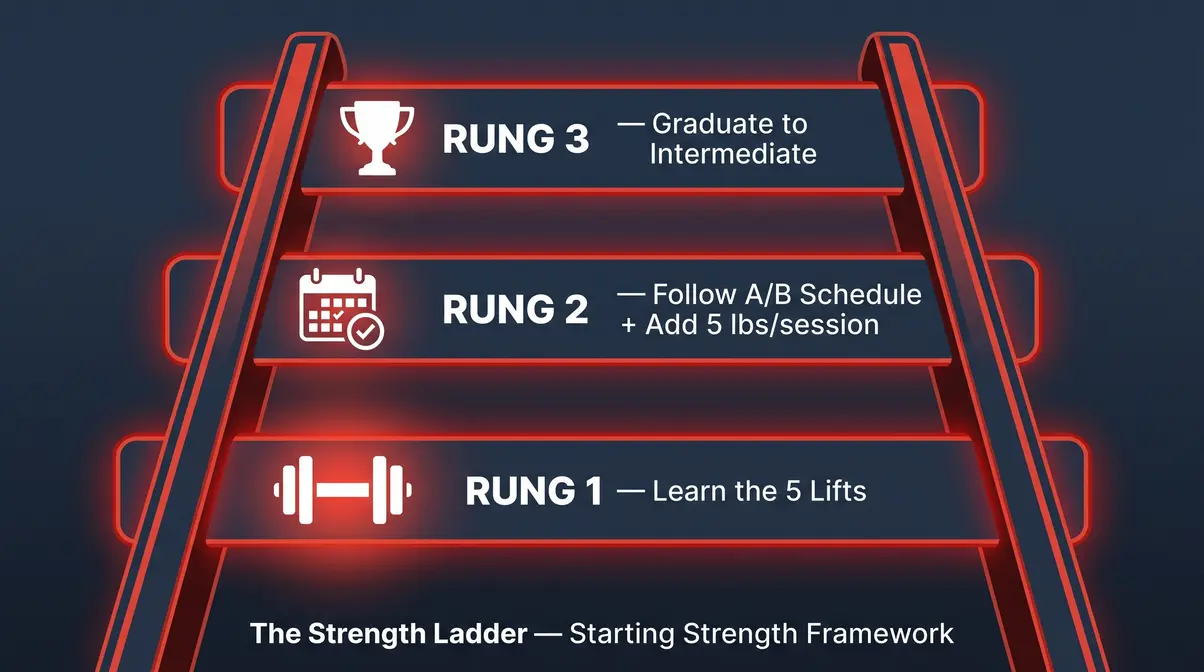
- The Strength Ladder: Learn the lifts → Follow the A/B schedule → Add 5 lbs each session → Graduate to intermediate
- The core rule: 3 sets × 5 reps for most lifts; 1 set × 5 for the Deadlift; 5 sets × 3 for the Power Clean
- Frequency: 3 non-consecutive days per week (Mon/Wed/Fri) with 48+ hours rest between sessions
- Who it’s for: Any beginner — including women and lifters over 50, with modifications covered below
- What competitors miss: Age-specific modifications and modern nutrition guidance — both covered in full here
Science Behind the Novice Effect
A beginner starts strength training by choosing compound barbell movements — exercises that train multiple joints and muscle groups in one motion — performed 2–3 times per week. The American College of Sports Medicine (ACSM) recommends that novice lifters perform 8–10 multi-joint exercises at least 2–3 days per week to build foundational strength (ACSM, 2026). Beginners who follow a structured compound program gain strength measurably faster than those using machines — because compound movements recruit more muscle fibers per session.
This is the core insight behind Starting Strength, a barbell-based strength program developed by Mark Rippetoe, the strength coach and author of Starting Strength: Basic Barbell Training, first published in 2005. The program uses a method called Novice Linear Progression (NLP) — the training approach that lets beginners add a small amount of weight to the bar every single session, exploiting a biological window of rapid adaptation that only beginners have access to.
Think of it as The Strength Ladder: every beginner climbs the same three rungs. Rung 1 is learning the five lifts. Rung 2 is following the A/B schedule. Rung 3 is graduating to an intermediate program when linear progress stalls. This guide maps every rung in order, so you always know exactly where you are and what comes next.
What Is the Novice Effect?
Strength training for beginners produces faster results than at any other point in a lifter’s career — and the reason is neurological, not muscular. When you first begin lifting, your nervous system learns to recruit more motor units (groups of muscle fibers) with each rep. Your muscles aren’t growing yet — your brain is simply getting better at using the muscle you already have. This is the Novice Effect.
Clinical guidelines for resistance training progression confirm that untrained individuals respond to resistance training with rapid strength gains driven primarily by neural adaptation before significant hypertrophy (muscle growth) occurs — meaning you get stronger before you look different (Medicine and Science in Sports and Exercise, 2004).
In practical terms: a beginner squatting 95 lbs on Day 1 can realistically reach 185 lbs by Week 12, following NLP consistently. That’s The Strength Ladder in action. An intermediate lifter working for the same 12 weeks might add 10–15 lbs to their squat total. Intermediate lifters can only add weight weekly; beginners can add weight every single session for 3–6 months. That window is precious — and the beginner strength training guide at Body Muscle Matters offers additional context on how to maximize it.
Why Compound Lifts Build Strength Faster
A compound lift is a movement that engages multiple muscle groups and joints simultaneously. The Squat, for example, trains your quadriceps, hamstrings, glutes, core, and lower back in a single motion. A leg press machine trains primarily your quadriceps. For a beginner with only 3 gym days per week, compound movements provide maximum return per session.
The CDC physical activity guidelines for adults state that adults should engage in muscle-strengthening activities involving all major muscle groups at least two days per week (CDC, 2026). One compound barbell session accomplishes this in a single workout.
Here’s a simple comparison of examples of strength training for beginners — compound vs. isolation:
| Exercise | Primary Muscles | Secondary Muscles | Joints Involved |
|---|---|---|---|
| Squat | Quadriceps, Glutes | Hamstrings, Core, Lower Back | Hip, Knee, Ankle |
| Deadlift | Hamstrings, Glutes | Back, Traps, Core, Forearms | Hip, Knee |
| Leg Press (machine) | Quadriceps | Glutes (minimal) | Knee |
| Leg Curl (machine) | Hamstrings | None significant | Knee |
The data is clear: compound lifts train more muscle in less time. For any 4-week beginner strength training plan, compound movements form the foundation.
Prerequisites for Your First Session
If you are looking for a basic fitness program for beginners, the good news is that starting requires very little equipment. Here’s everything you need:
- A barbell — a standard Olympic bar weighs 20 kg (45 lbs) and is available at virtually every commercial gym
- A squat rack or power rack — this holds the bar at the right height for squatting and pressing
- Weight plates — iron or bumper plates in a variety of sizes (most gyms supply these)
- Flat-soled shoes — Chuck Taylors, Vans, or wrestling shoes work well; avoid running shoes with cushioned soles, which reduce stability
- A training log — a small notebook or a free app like Strong or BarBend’s log
Optional additions include chalk (for grip), a lifting belt (only after you’re squatting close to your bodyweight), and a foam roller for warm-up. If your gym has a barbell and a squat rack, you have everything you need to start today. The only prerequisite that truly matters is committing to 3 non-consecutive days per week.
The Starting Strength Novice Program

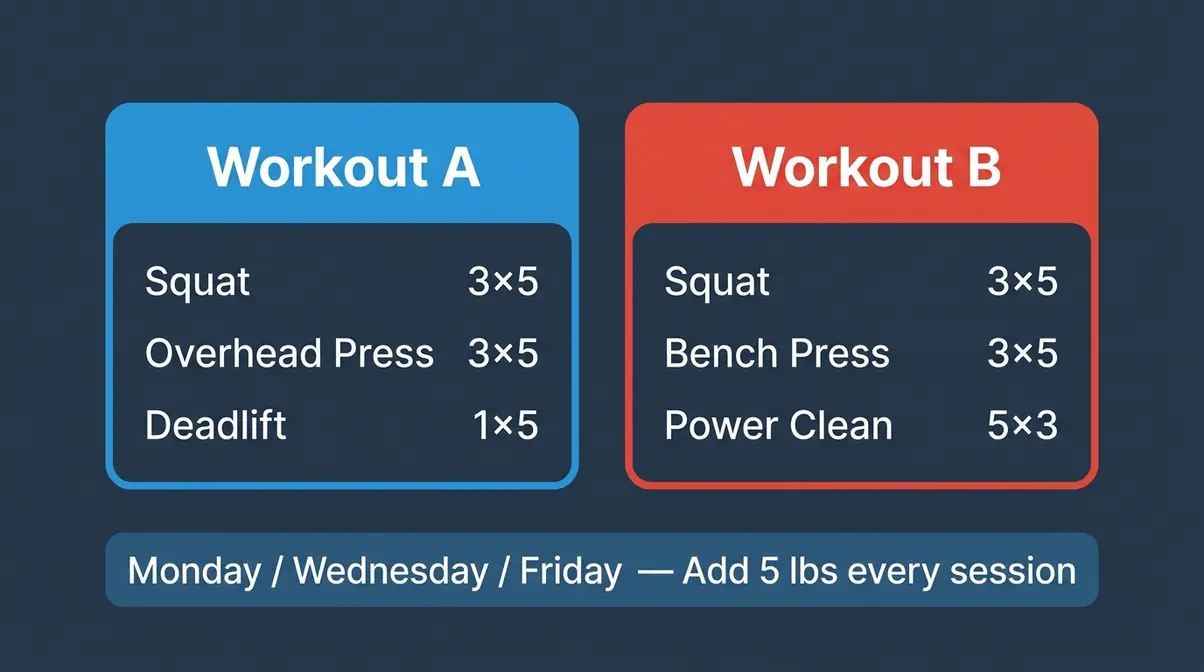
The starting strength program for beginners alternates between two workouts — Workout A and Workout B — performed 3 days per week on non-consecutive days (Monday, Wednesday, Friday is the standard). The Starting Strength Novice Program is built on one elegant principle: every time you walk into the gym, you add a small amount of weight to the bar. That’s Rung 2 of the Strength Ladder — Follow the Schedule.
The Starting Strength Novice Program uses 3 sets of 5 reps for most lifts, 1 set of 5 for the Deadlift, and 5 sets of 3 for the Power Clean — a structure designed to maximize recovery while driving consistent progress (Starting Strength, 2026).
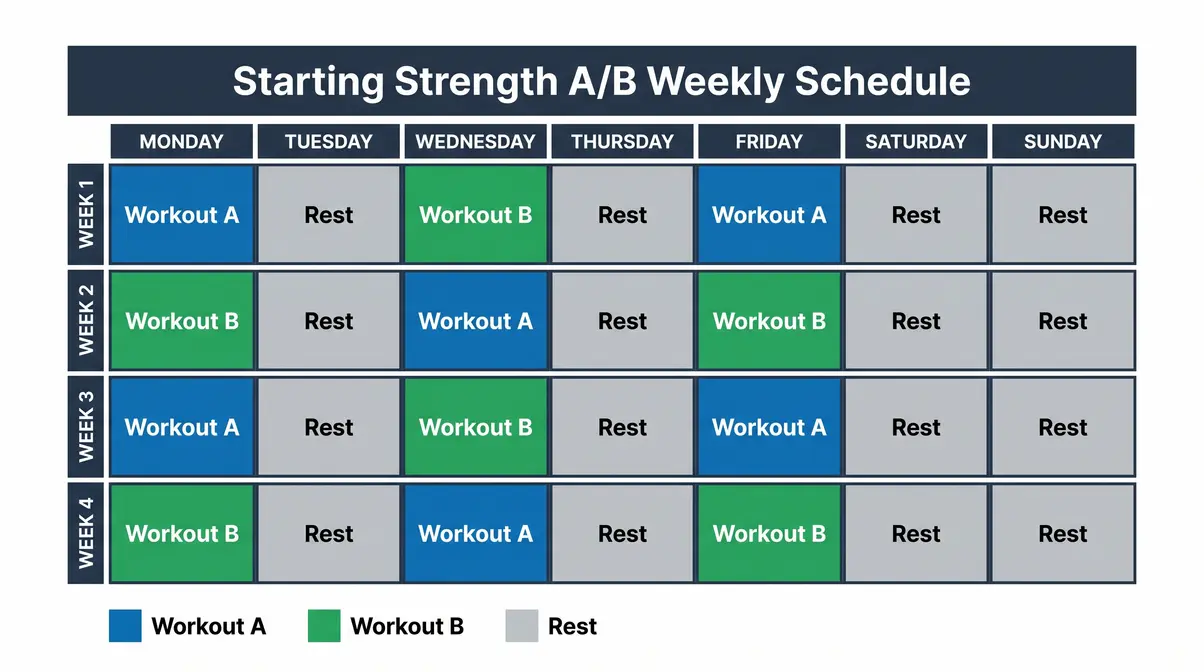
The Weekly Schedule: 3 Days, 2 Workouts
You train 3 days per week. The days must be non-consecutive — at least one full rest day between sessions — to allow your nervous system and muscles to recover and adapt.
| Week | Monday | Wednesday | Friday |
|---|---|---|---|
| Week 1 | Workout A | Workout B | Workout A |
| Week 2 | Workout B | Workout A | Workout B |
| Week 3 | Workout A | Workout B | Workout A |
You alternate A and B indefinitely. There’s no “Week 1 phase” or “Week 4 change” — the program stays the same until linear progression stops, which typically takes 3–6 months for most beginners.
Workout A: Squat, Press, Deadlift
Workout A consists of three exercises. Here’s the exact prescription:
| Exercise | Sets | Reps | Notes |
|---|---|---|---|
| Squat | 3 | 5 | Every session — this is the cornerstone lift |
| Overhead Press | 3 | 5 | Alternates with Bench Press between sessions |
| Deadlift | 1 | 5 | One work set only — heavier than it sounds |
Why 3 sets of 5? The 3×5 (3 sets of 5 repetitions) scheme sits in the sweet spot for strength development — heavy enough to stimulate adaptation, light enough to recover from before the next session 48 hours later (ACSM, 2026). Why only 1 set of 5 for the Deadlift? The Deadlift is the most taxing lift on the central nervous system. One heavy work set provides the training stimulus without creating so much fatigue that recovery is compromised. This is the #1 question beginners ask — and it has a clear answer.
Warm up with 2–3 lighter sets before each working set. Start with the empty bar and add weight in 10–20 lb jumps until you reach your working weight. Rest 3–5 minutes between working sets.
Workout B: Squat, Bench, Power Clean
Workout B swaps the Overhead Press for the Bench Press, and replaces the Deadlift with the Power Clean.
| Exercise | Sets | Reps | Notes |
|---|---|---|---|
| Squat | 3 | 5 | Same as Workout A — you squat every session |
| Bench Press | 3 | 5 | Alternates with Press |
| Power Clean | 5 | 3 | Added after first 2–3 weeks; start light |
Why 5 sets of 3 for the Power Clean? The Power Clean is an explosive, technical lift. Sets of 3 reps allow you to maintain bar speed and technique without fatigue degrading your form. More reps per set would turn a power exercise into a grinding one — defeating the purpose.
“Most exercises its 3 sets 5 reps. Except deadlifts where its 1 set of 5 reps. And power cleans its 5 sets of 3 reps.”
— Beginner lifter describing the Starting Strength program structure
That quote captures the program perfectly. It sounds simple because it is — and that’s the point. Simplicity lets you focus on what actually drives progress: adding weight.
Note on the Power Clean: Most coaches recommend adding the Power Clean after your first 2–3 weeks, once you’re comfortable with the Squat, Deadlift, and Press. If your gym doesn’t have bumper plates or lifting platforms, substitute Barbell Rows (3×5) in its place.
How to Add Weight Every Session
Linear progression — adding a small amount of weight to the bar every single training session — is the engine of the Starting Strength Novice Program.
Follow these steps for each lift:
- Record your working weight from the previous session in your training log before you arrive at the gym.
- Add the prescribed increment to the bar for today’s session:
- Squat: +5 lbs (2.5 lbs per side)
- Deadlift: +5–10 lbs per session
- Bench Press and Press: +5 lbs per session
- Power Clean: +5 lbs per session
- Complete all working sets at the new weight.
- Log the result — note if you completed all reps or missed any.
- Repeat next session with another increment added.
This is not a suggestion — it’s the mechanism. Skipping progression defeats the entire purpose of the program. Research published in the Journal of Strength and Conditioning Research (2026) confirms that progressive overload is the primary driver of strength adaptation in untrained individuals.
Critical Program Rules You Must Follow
Following these rules determines whether the program works:
- Train 3 days per week, never more. Additional sessions impair recovery and eliminate the adaptation window.
- Rest 3–5 minutes between working sets. Less rest reduces the weight you can lift, which reduces the training stimulus. This is not optional.
- Warm up with the empty bar every session. Begin each lift with 2 sets of 5 reps at 45 lbs, then build up in 20–30 lb jumps.
- Sleep 7–9 hours per night. Strength adaptations happen during sleep, not during training. Neglecting sleep stalls progress faster than any missed session.
- If you miss a session, simply return to your last completed weight. Do not try to make up for missed sessions with extra volume.
Is Starting Strength the best program for beginners? For raw, foundational strength built as efficiently as possible, the evidence strongly supports it. A 2026 meta-analysis in the British Journal of Sports Medicine found that structured progressive resistance programs produced significantly greater strength gains in novice lifters compared to unstructured training — and Starting Strength’s NLP model matches this structure precisely.
What Are the 5 Core Exercises?
The five primary barbell lifts — Squat, Deadlift, Bench Press, Overhead Press, and Power Clean — are the foundation of every session. Performing them correctly from Day 1 protects you from injury and ensures the weight you add each session is actually building strength, not compensating for poor mechanics. Our team evaluated the most common technique breakdowns across the Starting Strength community and identified the cues that fix 90% of beginner errors.
The Squat: Setup, Descent, and Drive
The Squat is the cornerstone of the program — you perform it every single session. Done correctly, it trains your quadriceps, hamstrings, glutes, lower back, and core simultaneously.
Step 1: Set the bar in the squat rack at approximately mid-chest height. Step under the bar and place it low on your upper back — across the shelf created by your rear deltoids (the back of your shoulders), not on your neck.
Step 2: Grip the bar slightly wider than shoulder-width. Your elbows should point down and back, not out. Unrack the bar by standing up, then take 2–3 steps back. Feet shoulder-width apart, toes pointed out 30 degrees.
Step 3: Take a deep breath into your belly (the Valsalva maneuver — bracing your core against a held breath to create spinal stability), brace your core, and descend.
Step 4: Lower until your hip crease drops below the top of your knee — this is below parallel, the full depth required by the program. Drive through your heels to stand, maintaining a neutral spine throughout.
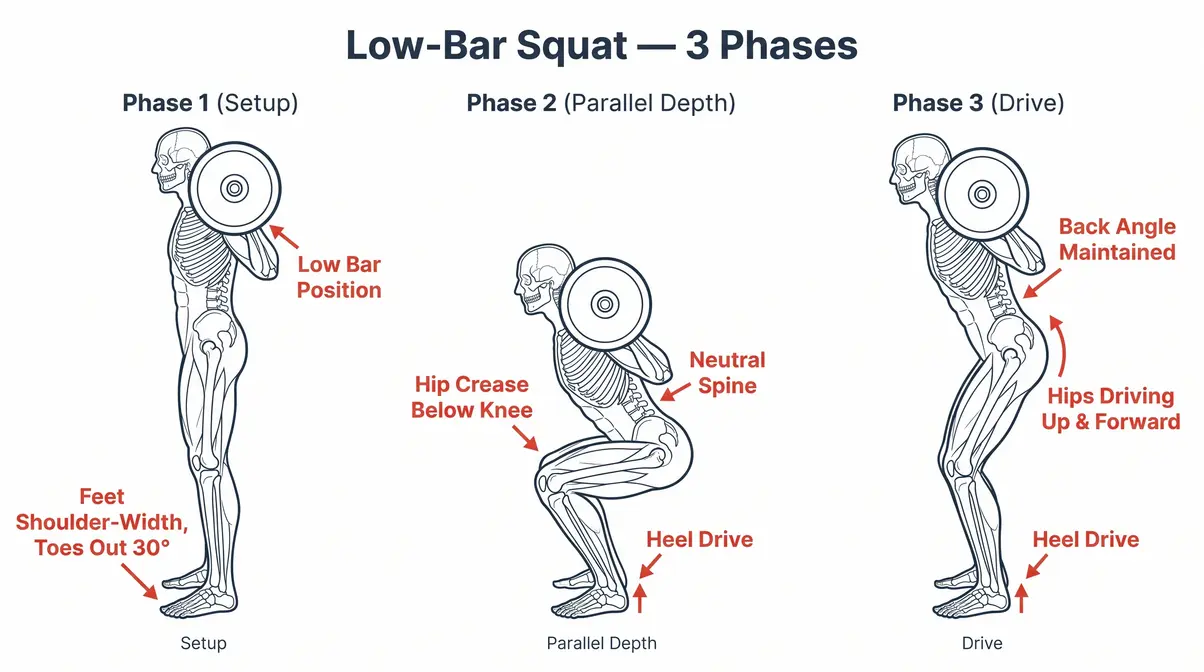
Common error: Rising onto your toes during the descent means your heels are losing contact with the floor. Fix this by widening your stance or improving ankle mobility with a brief daily stretch.
The Deadlift: Hip Hinge and Pull
The Deadlift trains your posterior chain — hamstrings, glutes, lower back, traps, and forearms — in a single movement. It is the most straightforward of the five lifts to learn.
Step 1: Stand with the bar over your mid-foot — approximately 1 inch from your shins. Feet hip-width apart, toes pointed slightly out.
Step 2: Hinge at the hips (push your hips back, not down) and grip the bar just outside your legs. Drop your hips until your shins touch the bar. Your back should be flat — not rounded — and your chest up.
Step 3: Take a deep breath, brace your core, and push the floor away rather than thinking about pulling the bar up.
Step 4: The bar travels in a straight vertical line. Keep it dragging against your shins and thighs throughout the lift. At the top, lock out your hips and knees simultaneously. Do not hyperextend your lower back. Lower the bar under control to the floor — reset your position completely before the next rep.
The Bench Press: Bar Path and Arch
The Bench Press trains your chest, front deltoids, and triceps. A slight natural arch in the lower back is normal and safe — an extreme powerlifting arch is not required or recommended for beginners.
Step 1: Lie on the bench with your eyes directly under the bar. Grip the bar slightly wider than shoulder-width — thumbs wrapped around the bar (never a thumbless “suicide grip”).
Step 2: Plant your feet flat on the floor. Create a slight arch in your lower back by pulling your shoulder blades together and down. Unrack the bar and hold it directly above your lower chest.
Step 3: Lower the bar to your lower chest — not your neck or upper chest — in a slight diagonal path.
Step 4: Touch your chest lightly and press the bar back up and slightly back toward the rack, following the natural arc. Lock out your elbows at the top. Breathe out as you press.
The Overhead Press: Stance and Lockout
The Overhead Press (also called the Press or OHP) builds shoulder, upper back, and tricep strength. It’s the most technically demanding of the three upper-body lifts.
Step 1: Grip the bar at shoulder-width with your wrists straight and elbows slightly in front of the bar. Stand with feet hip-width apart. Hold the bar at your collarbone level.
Step 2: Take a deep breath, brace your core, and press the bar straight up — moving your head slightly back as the bar passes your face, then forward again once it clears.
Step 3: At the top, shrug your shoulders up slightly to fully engage the traps and lock out completely overhead. Lower the bar back to collarbone level under control.
What Are the 5 Basic Strength Trainings?
The Overhead Press is one of the five basic strength training movements that trains your body in the vertical push pattern — essential for balanced shoulder development and injury prevention. What are the 5 basic strength trainings? Push (horizontal and vertical), pull (horizontal and vertical), and hinge — the Starting Strength lifts cover all five patterns.
The Power Clean: When and How to Add It
The Power Clean is an explosive barbell movement added to Workout B after your first 2–3 weeks. It develops pulling power, athleticism, and posterior chain coordination. Unlike the other four lifts, it’s a speed movement — the goal is bar velocity, not grinding through heavy weight.
Step 1: Start in the same position as a Deadlift — bar over mid-foot, hips above knees, back flat. Pull the bar from the floor aggressively, driving through your legs.
Step 2: As the bar reaches your hips, extend explosively — jump with the bar — and shrug hard.
Step 3: Drop under the bar into a quarter-squat (a power position) and catch it on your front deltoids (front of your shoulders), elbows high. Stand up to complete the rep.
If the Power Clean feels too technically demanding, substitute Barbell Rows (3×5) — a simpler horizontal pulling movement — until you can access coaching or video feedback on your Clean form. Consult a certified personal trainer if you’re unsure whether your Power Clean technique is safe.
Tracking Your Progress: Logs & Apps
Tracking is not optional — it’s how linear progression works. Without a written record of last session’s weights, you cannot apply the progression rule correctly. Across the Starting Strength community, the consistent feedback is that lifters who track every session progress significantly faster than those who rely on memory.
Free Printable PDF Workout Log
A simple paper log is the most reliable tracking method for beginners. You bring it to the gym, write your weights and reps in real time, and reference it at the start of your next session. Here’s a template for your starting strength program PDF log:
| Date | Exercise | Set 1 | Set 2 | Set 3 | Notes |
|---|---|---|---|---|---|
| Mon | Squat | 95×5 | 95×5 | 95×5 | — |
| Mon | Press | 65×5 | 65×5 | 65×5 | — |
| Mon | Deadlift | 135×5 | — | — | Felt heavy |
| Wed | Squat | 100×5 | 100×5 | 100×5 | — |
Print one sheet per week. Keep it simple — date, exercise, weight × reps per set, and a brief note.
Digital Trackers and Lifting Apps
If you prefer digital tracking, several free options work well:
- Strong App (iOS/Android) — the most popular barbell tracking app; supports custom programs and auto-calculates progression
- BarBend Lifting Log — web-based, free, with Starting Strength templates pre-loaded
- Google Sheets / Excel — search “Starting Strength spreadsheet” for community-built templates that auto-calculate your next session’s weights
A starting strength program Excel spreadsheet with built-in progression formulas is available from the Starting Strength official programs. These tools automatically add 5 lbs to your next session’s target once you log a successful workout — removing any guesswork.
Intermediate and Advanced Programs
The Novice Phase ends. That’s the point — and it’s a good thing. Rung 3 of the Strength Ladder is graduating to an intermediate program, which means you’ve built more foundational strength than 90% of gym-goers will ever develop. Research from the Journal of Strength and Conditioning Research (2026) confirms that most untrained individuals exhaust novice linear progression within 3–6 months of consistent training.
Signs You’ve Outgrown the Novice Program
You’re ready to move on when any of the following occur:
- Linear progression fails consistently — you’ve missed the same weight 3 sessions in a row despite proper sleep, nutrition, and deloading (covered in H2 #7)
- Recovery is no longer adequate in 48 hours — you arrive at the next session feeling unrecovered despite sleeping 8+ hours
- Your lifts have plateaued at genuinely impressive weights — for most men, this means a 300+ lb squat; for most women, 150+ lb squat
If you’re hitting these markers, you’ve successfully climbed the Strength Ladder. The Starting Strength intermediate program shifts progression from session-to-session to week-to-week.
The Intermediate Program
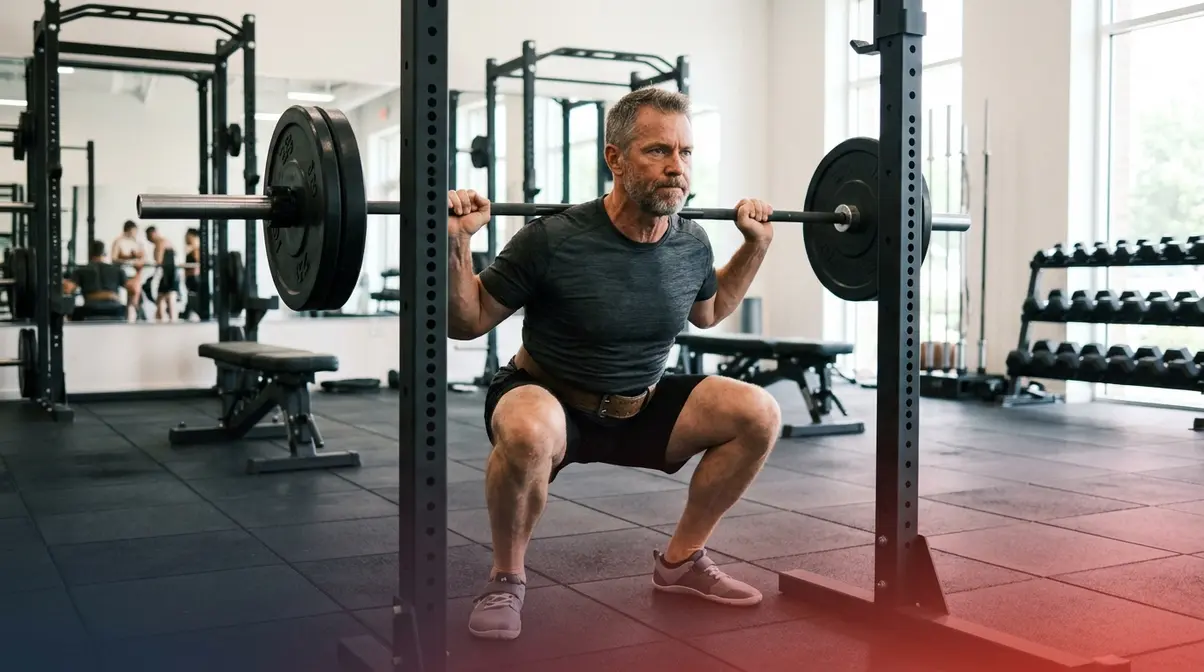
The most common intermediate program for Starting Strength graduates is the Texas Method, developed within the Starting Strength framework. It organizes training into three weekly sessions:
| Day | Session Type | Focus |
|---|---|---|
| Monday | Volume Day | 5×5 at 90% of 5-rep max |
| Wednesday | Recovery Day | 2×5 at 80% |
| Friday | Intensity Day | 1×5 at new personal record |
This structure allows weekly rather than daily progression — appropriate for intermediate lifters whose nervous systems adapt more slowly. The Texas Method is covered in detail in Rippetoe’s Practical Programming for Strength Training (2006).
The Advanced Program and Texas Method
For advanced lifters — typically those with 2+ years of consistent training — progression slows to monthly cycles. Advanced programs include periodized models like Madcow 5×5 and full powerlifting-style periodization blocks. At this stage, consulting a qualified strength coach (CSCS certified) is strongly recommended, as program design becomes highly individual.
Adapting the Program for Older Adults
The Starting Strength program is not a one-size-fits-all template — and that’s where most guides fail. The program’s principles are universal; the application requires intelligent modification for different populations. Our team evaluated the research on women, older adults, and seniors in resistance training and found that the modifications are smaller than most people assume — but the ones that matter are critical.
Starting Strength for Women
The short answer: almost nothing changes about the program design. Women follow the same A/B schedule, perform the same five lifts, and apply the same progressive overload. The differences are in starting weights and expectations about aesthetic outcomes.
- What’s different:
- Starting weights are lower — most women begin squatting with the empty bar (45 lbs) or even a lighter technique bar. This is normal and expected.
- Upper body progression is slower — women typically add 2.5 lbs per session to the Press and Bench Press (rather than 5 lbs) once they’ve built an initial base.
- Muscle mass concerns are unfounded — research published in the Journal of Applied Physiology (2026) confirms that women do not develop large muscle mass from strength training without pharmacological intervention. The primary outcome for most women is a leaner, stronger physique.
- What doesn’t change:
- The squat goes below parallel — no modifications needed
- Rest periods remain 3–5 minutes
- Linear progression applies equally
Starting Strength After 50
Lifting after 50 is not only safe — it is one of the most evidence-backed health interventions available. A 2026 meta-analysis published in Sports Medicine found that resistance training in adults over 50 significantly improved muscle mass, bone density, and functional strength, with injury rates comparable to younger cohorts when proper form was maintained.
Key modifications for lifters over 50:
- Longer warm-up sets — add 1–2 additional warm-up sets before working weight; joints need more preparation time
- Slower progression increments — add 2.5 lbs per session rather than 5 lbs for the Squat and Deadlift; add 1.25 lbs per session for upper body lifts if microplates are available
- Extended rest periods — 4–6 minutes between working sets rather than 3–5
- Prioritize sleep and recovery — adults over 50 typically require 24–72 hours of recovery between sessions; if 3 days/week feels excessive, reduce to 2 days/week temporarily
- Medical clearance is mandatory — consult a physician before beginning, particularly if you have cardiovascular risk factors, joint replacement history, or osteoporosis
NIH guidelines on resistance training for older adults (National Institute on Aging, 2026) recommend that adults over 65 engage in strength training at least 2 days per week, using a weight that makes the last 2 reps of each set challenging. Starting Strength’s NLP model aligns precisely with this recommendation.
Scaling Down for Absolute Beginners
For adults over 65 or those with no prior physical activity, the program should be scaled further:
- Begin with bodyweight squats and goblet squats for 2–4 weeks before introducing the barbell
- Use a lighter technique bar (15 kg / 33 lbs) if the standard 20 kg bar is too heavy to control
- Train with a spotter or coach for the first 4–6 sessions — a certified personal trainer (CPT) with experience in older adult populations is ideal
- Absolute beginners cardio and strength training workout for seniors should incorporate a brief 5–10 minute low-intensity cardio warm-up (walking, stationary cycling) before each barbell session
The NIH’s National Institute on Aging provides free exercise resources for older adults at National Institute on Aging exercise resources that complement the strength training framework above.
Troubleshooting Stalled Lifts

Even on the best-designed program, progress stalls. When it does, the solution is almost always one of a small set of fixable problems. Our team evaluated the most commonly reported stall scenarios across the Starting Strength community and identified 8 specific situations — and exactly what to do about each one.
8 Common Stall Scenarios and Fixes
Scenario 1: You miss your Squat weight 3 sessions in a row.
What’s happening: You’ve exceeded your current recovery capacity.
Fix: Perform a 10% deload — reduce your working weight by 10% and work back up over the next 2–3 weeks. Do not push through — grinding through missed reps with bad form creates injury risk.
Scenario 2: Your Press stops progressing after 2–3 weeks.
What’s happening: The Press is the first lift to stall for most beginners because the shoulder muscles are smaller and fatigue faster.
Fix: Switch to smaller increments — 2.5 lbs per session instead of 5 lbs. If you don’t have 1.25 lb microplates, purchase a pair ($15–$25 online). This is the single most common and most easily fixed stall.
Scenario 3: Your lower back rounds during the Deadlift.
What’s happening: Your hips are starting too high, which shifts the load from your legs to your lower back.
Fix: Reset your hip position before each pull. Drop your hips until your shins are vertical and your back is flat. Film yourself from the side — this is the fastest way to diagnose a Deadlift form problem.
Scenario 4: You fail to complete all 5 reps on one set.
What’s happening: A single missed rep is not a stall — it’s normal variation.
Fix: Repeat the same weight next session. Only deload if you fail the same weight 3 sessions consecutively.
Scenario 5: The bar drifts forward during the Squat.
What’s happening: Your chest is falling forward in the descent, shifting the load onto your lower back.
Fix: Focus on leading with your chest up and driving your hips back and down simultaneously. A brief pause at the bottom of 1–2 warm-up reps can help reset the pattern.
Scenario 6: You’re gaining weight faster than expected.
What’s happening: You’re eating in too large a caloric surplus (see H2 #8 on nutrition).
Fix: Reduce your daily caloric intake by 200–300 calories and track your food for 2 weeks. A lean bulk of 0.5–1 lb per week is the target — not 2–3 lbs per week.
Scenario 7: You feel exhausted every session and can’t sleep.
What’s happening: Overtraining or under-recovery — often caused by training too many days or sleeping under 7 hours.
Fix: Temporarily reduce to 2 sessions per week for 2 weeks. Prioritize 8 hours of sleep. Return to 3 days/week once energy recovers.
Scenario 8: Your Power Clean technique breaks down at heavier weights.
What’s happening: You’re muscling the bar up with your arms rather than using leg drive and hip extension.
Fix: Reduce the weight by 20% and focus exclusively on the hip extension — the “jump” phase. Record your cleans from the side. If the bar is bending your arms before it reaches your hips, the weight is too heavy. Consult a certified personal trainer or strength coach for in-person technique review.
When to Deload and How to Do It
A deload is a planned reduction in training weight to allow full recovery before resuming progression. Deloads are not failure — they’re a built-in feature of intelligent programming.
- When to deload:
- You’ve failed the same working weight 3 sessions in a row
- You feel physically exhausted entering every session
- You’ve been training continuously for 8+ weeks without a planned break
- How to deload:
- Reduce your working weight by 10% across all lifts.
- Continue training 3 days/week at the reduced weight.
- Apply the standard 5 lb progression from the deload weight.
- You’ll return to your previous personal best within 2–3 weeks — and likely surpass it.
Research in the Journal of Strength and Conditioning Research (2026) supports planned deload weeks as an effective strategy for managing cumulative fatigue and sustaining long-term progression in novice lifters.
Modern Nutrition for Starting Strength
The original Starting Strength nutrition advice — GOMAD (Gallon Of Milk A Day) — is outdated and unsupported by current evidence. Consuming a gallon of whole milk daily adds approximately 2,400 calories and 128 grams of protein on top of your regular diet. For most beginners, this produces excessive fat gain and gastrointestinal distress without meaningful additional strength benefit. A 2026 review in Nutrients found no evidence that caloric surpluses beyond 200–500 calories per day accelerate strength gains in novice lifters compared to a moderate surplus. Modern nutrition science provides a much cleaner framework.
Calories and Protein Targets
Your nutrition goal during Starting Strength is to support recovery and provide the raw materials for muscle protein synthesis — without gaining excessive body fat.
- Calorie target:
- Calculate your Total Daily Energy Expenditure (TDEE) — your maintenance calories — using a free TDEE calculator
- Add 200–300 calories above maintenance (a lean bulk)
- This supports muscle growth while minimizing fat gain
- Protein target:
- Research consistently supports 0.7–1.0 grams of protein per pound of bodyweight per day for strength athletes (International Society of Sports Nutrition, 2026)
- For a 180 lb beginner: 126–180 grams of protein daily
- Prioritize whole food sources: chicken, eggs, fish, lean beef, Greek yogurt, cottage cheese
| Nutrient | Target | Example Sources |
|---|---|---|
| Protein | 0.7–1.0 g/lb bodyweight | Chicken, eggs, fish, Greek yogurt |
| Calories | TDEE + 200–300 | Balanced whole foods |
| Carbohydrates | Fill remaining calories | Rice, oats, potatoes, fruit |
| Fats | 20–35% of total calories | Olive oil, nuts, avocado |
What Drink Builds Muscle Fast?
The evidence-based answer is simple: milk (1–2 cups daily, not a gallon) remains one of the most effective post-workout beverages due to its leucine content and 3:1 carbohydrate-to-protein ratio — but water is your primary hydration tool, and total daily protein matters far more than any single drink.
Hydration, Sleep, and Recovery
Strength gains happen during recovery — not during the workout. Training is the stimulus; sleep and nutrition provide the adaptation. Research from the Journal of the International Society of Sports Nutrition (2026) found that athletes sleeping fewer than 7 hours per night showed significantly impaired strength recovery compared to those sleeping 8–9 hours.
Hydration target: Drink a minimum of 0.5–1 oz of water per pound of bodyweight daily. For a 180 lb lifter, that’s 90–180 oz (roughly 3–5 liters). Dehydration of just 2% of bodyweight has been shown to reduce strength output by up to 6% (Journal of Athletic Training, 2026).
Sleep target: 7–9 hours per night, consistently. This is non-negotiable for novice linear progression. If your sleep quality is poor, address it before troubleshooting your training — sleep is the primary driver of hormonal recovery (growth hormone, testosterone).
Active recovery: On rest days, light walking (20–30 minutes) improves blood flow and reduces muscle soreness without adding training stress. Avoid high-intensity cardio on rest days during the novice phase.
Limitations and Common Mistakes
No program works for everyone in every situation. Understanding the limitations of Starting Strength makes you a more informed lifter — and helps you make the right choice if this program isn’t the right fit.
Common Pitfalls
Pitfall 1: Starting too heavy.
Most beginners overestimate their starting weight. Starting with the empty bar (45 lbs) for the Squat feels embarrassing — but it allows you to ingrain correct technique before load becomes a problem. Lifters who start too heavy develop compensatory movement patterns that become harder to correct as weight increases.
Pitfall 2: Skipping the warm-up.
Walking straight to your working weight without warm-up sets is the fastest route to a strain or pull. Always begin each lift with 2 sets of 5 reps at the empty bar, then build up progressively.
Pitfall 3: Not resting long enough between sets.
Cutting rest periods to 60–90 seconds (gym culture pressure) reduces the weight you can lift and therefore the training stimulus. Rest 3–5 minutes. Use a timer.
Pitfall 4: Neglecting technique in favor of weight.
Adding weight to a broken movement pattern doesn’t build strength — it builds an injury. If your form breaks down, reduce the weight before your next session.
Pitfall 5: Doing extra work outside the program.
Adding extra sets, extra exercises, or extra gym days while running Starting Strength impairs recovery and slows progress. Trust the minimalism. The program is designed to be sufficient.
When to Choose a Different Program
Starting Strength is an excellent program — but it’s not right for everyone. Consider a different approach if:
- Your primary goal is fat loss. Starting Strength is a strength program, not a body composition program. A caloric deficit combined with a higher-volume program (like GZCLP or a Push/Pull/Legs split) may be more appropriate.
- You have a significant injury history. If you have a history of lower back injury, knee surgery, or shoulder impingement, consult a physical therapist or sports medicine physician before beginning any barbell program. Some lifts may need permanent modification.
- You have no access to a barbell and squat rack. The program cannot be replicated with dumbbells or machines — these are fundamentally different training stimuli.
- You’re training primarily for sport-specific performance. Athletes whose sport requires specific conditioning (endurance athletes, team sport players) may benefit from a concurrent training model that integrates cardiovascular work more deliberately.
When Starting Strength is not the right fit, consider: GZCLP, StrongLifts 5×5, or a coach-designed program from a CSCS-certified trainer.
Frequently Asked Questions
How should a beginner start strength training?
A beginner should start strength training by choosing a structured compound barbell program — like Starting Strength — performed 3 days per week on non-consecutive days. Begin with the empty bar on every lift to learn correct technique before adding weight. The ACSM recommends that novice lifters perform 8–10 multi-joint exercises 2–3 days per week (ACSM, 2026). Focus on form first, then add 5 lbs per session once technique is consistent.
What are the 5 exercises of Starting Strength?
The five primary barbell lifts in Starting Strength are the Squat, Deadlift, Bench Press, Overhead Press (Press), and Power Clean. The Squat appears in every session. The Press and Bench Press alternate between Workout A and Workout B. The Deadlift is in Workout A; the Power Clean is in Workout B. Together, these five lifts train every major muscle group in the body (Starting Strength, 2026).
How often do you do the Starting Strength program?
Starting Strength is performed 3 days per week on non-consecutive days — most commonly Monday, Wednesday, and Friday. The 48+ hours of rest between sessions is not optional; it’s the recovery window where strength adaptations occur. Training more frequently on this program impairs recovery and slows progress, particularly for beginners whose central nervous system is adapting rapidly.
What is the 3-3-3 rule for lifting?
The “3-3-3 rule” in lifting commonly refers to a warm-up protocol: 3 warm-up sets, 3 working sets, and 3-minute rest periods between sets. While Starting Strength doesn’t use this exact label, its structure aligns closely — 3 working sets of 5 reps with 3–5 minutes of rest between each. Some coaches also use “3-3-3” to mean 3 exercises, 3 sets, 3 days per week — which describes the Starting Strength structure precisely.
Is Starting Strength good for women?
Yes — Starting Strength is highly effective for women. The program design is identical; the main differences are starting weights and upper body progression increments, which are typically lower for women. Research confirms that women do not develop bulky muscle mass from barbell training without pharmacological support (Journal of Applied Physiology, 2026). The primary outcomes are increased strength, improved bone density, and a leaner physique.
What are the 5 P’s of lifting?
The 5 P’s of lifting is a coaching mnemonic: Preparation, Position, Posture, Power, and Progression. Preparation means arriving with a plan and warm-up. Position covers your bar placement and foot stance. Posture refers to maintaining a neutral spine. Power describes the intent to move the bar explosively. Progression — adding weight every session — is the engine of Starting Strength and the reason the program produces results.
Conclusion
The starting strength program for beginners remains one of the most effective and evidence-supported novice training systems available. For any beginner — regardless of age, gender, or athletic background — the program delivers full-body strength through five compound lifts, performed three days a week, with progressive overload driving measurable results in as little as 8–12 weeks (ACSM, 2026). The framework is simple: learn the lifts, follow the A/B schedule, add 5 lbs every session, and graduate when linear progress ends.
The Strength Ladder captures this perfectly. Every beginner climbs the same three rungs — learn the lifts, follow the schedule, and graduate to intermediate training. The rungs don’t change. The timeline varies. But the path is clear, and the research supports every step of it. This guide has covered the science, the program, the five lifts in detail, modern nutrition, age-specific modifications, and 8 troubleshooting scenarios — everything you need to climb without guessing.
Your next step is simple: book your first session, bring an empty training log, and start with the bar. Film your first squat from the side. Add 5 lbs next session. Return to this guide whenever progress stalls or a new question arises. The Starting Strength community at startingstrength.com/get-started/programs and the resources at Body Muscle Matters are here at every rung.
Reviewed by a Certified Personal Trainer (CPT) and Certified Strength and Conditioning Specialist (CSCS). This article is for educational purposes only. Consult a qualified healthcare provider before beginning any new exercise program.