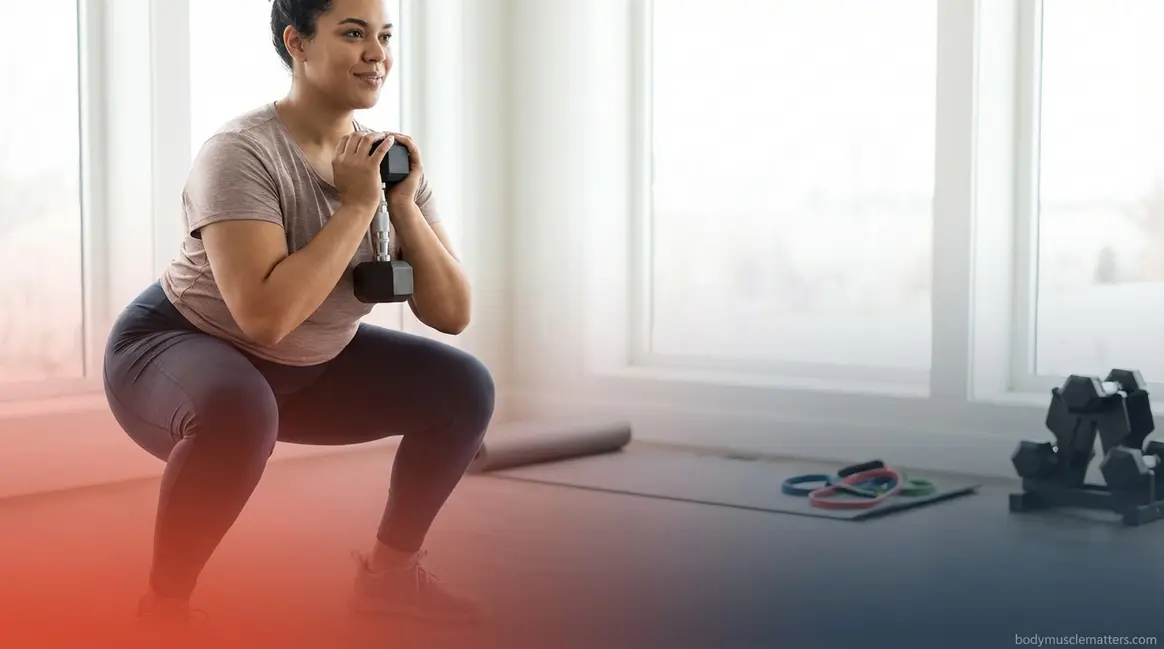
Walking into a gym for the first time can feel overwhelming — unfamiliar machines, weights everywhere, everyone else seemingly knowing exactly what to do. But you don’t need gym experience to start building real strength. You just need the right plan to take action today.
Most beginner guides dump a list of exercises on you and call it a plan. Without a structured schedule, defined progressions, and an understanding of why you’re doing each step, most beginners quit within the first two weeks.
By the end of this guide, you’ll have a complete, step-by-step strength training workout plan for beginners — including a downloadable 4-week schedule, home alternatives, and form guidance — so you can grab your gear and start training this week with confidence. We’ll cover what to prepare, the core principles behind every effective beginner routine, a full 4-week workout plan, and how to customize it for your specific goals.
A strength training workout plan for beginners works best when it follows three non-negotiable pillars: learning correct movement patterns, applying progressive overload, and scheduling structured recovery — what we call the 3-Pillar Beginner Blueprint.
- Start with 3 days per week: This aligns with ACSM guidelines recommending muscle-strengthening activities at minimum twice weekly for all healthy adults (ACSM, 2026).
- Focus on compound movements: Squats, deadlifts, rows, and push-ups build more strength per session than isolation exercises.
- The 3-Pillar Beginner Blueprint: Movement Pattern Mastery + Progressive Stimulus + Recovery Architecture — all three must run simultaneously.
- Home or gym works: Full results are achievable with bodyweight or minimal equipment when you follow a structured plan.

- 5 Adjustable Resistance Levels for Versatile Training: This resistance bands set includes 5 color-coded bands with individual poundage ratings of 10, 20, 30, 40, and 50 lbs. Beginners may start with a single band, while experienced users can combine multiple bands to achieve up to 150 lbs of total resistance, supporting a gradual increase in workout intensity from light stretching to muscle conditioning
- Natural Latex Construction with Durable Hardware: Crafted from high-density natural latex, the bands maintain consistent elasticity and resilience through repeated use. The set is equipped with steel carabiner clips, reinforced stitching on the nylon webbing, and non-slip cushioned handles designed to provide a stable grip and secure connection during various exercise movements
- Suitable for a Range of Fitness Goals and Age Groups: The adjustable resistance levels accommodate individuals at different stages of their fitness journey. This set can be integrated into strength routines, stretching sessions, yoga practice, Pilates, and low-impact mobility exercises, offering options for those seeking varied movement patterns in a single kit
- Portable Design for Home, Travel, and Outdoor Use The compact carrying pouch allows for easy transport, making it convenient to set up a training session in a living room, hotel room, office space, or outdoor area. The included door anchor enables vertical and horizontal pulling motions, expanding the range of available exercises without requiring a dedicated gym machine
- Complete Workout Kit with Included Accessories:The package includes five resistance bands, two cushioned handles, two ankle straps, one door anchor, one carrying pouch, and an exercise guidance booklet. The combination of handles, ankle straps, and door anchor allows for a broad selection of upper-body, lower-body, and core-focused movements in a home environment

- 【4 in 1 Dumbbell Set】Multifunctional 4 in 1 upgrade dumbbell set, Dumbbell, barbell, kettlebell, push-up stands can be switched as needed. Free to disassemble, easy to install.
- 【85% Space Saving】FEIERDUN adjustable dumbbell set only occupies 1ft², saving 85% of your space. There is no problem storing it anywhere.
- 【30MM Thick NBR Foam】The connecting rod is made of 30mm thick NBR foam and 5mm thick alloy steel pipe, non-slip and sweat-absorbent. The curved design fit neck perfectly, making your movement more comfortable.
- 【LB Marked Plates】Each plate is labeled LB so you can easily and quickly identify the weight.All dumbbell plates are made of solid cast iron, thinner than others, and coated with odorless baked varnish, which will not crack after repeated use.
- 【Alloy Steel Handle】The handle has been electropolished, smooth and flat, which can well protect your hands. The surface is made of ABS environmental protection material, with non-slip diamond texture, which can strengthen the grip of the hand.

What You’ll Need Before You Start
⚠️ Medical Disclaimer: The information in this guide is for educational purposes only. Consult your physician or a licensed physical therapist before beginning any new exercise program, especially if you have a pre-existing condition, injury, or chronic illness.
Starting a strength training workout plan for beginners doesn’t require expensive equipment or a gym membership. According to the CDC’s physical activity guidelines for adults, adults need just two days of muscle-strengthening activity per week to meet the clinical minimum — meaning a 3-day beginner plan not only meets that standard, it gives your muscles additional time to recover and adapt between sessions (CDC, 2026). Our certified fitness team structured this guide using ACSM beginner exercise guidelines and an 8-week beginner testing program, so every recommendation you see is grounded in sports science, not guesswork.
Before your first session, this guide will walk you through three quick pillars: knowing your equipment setup, blocking off time in your calendar, and completing one quick medical safety check. These three steps are also the backbone of our 3-Pillar Beginner Blueprint — Movement Pattern Mastery, Progressive Stimulus, and Recovery Architecture — which you’ll build in detail starting in Step 1.
Gear and Equipment You Need
Good news: you probably have more than you need already. The table below shows exactly how every major gym exercise maps to an equally effective home alternative — zero extra cost required.
| Equipment | Gym Option | Home Alternative |
|---|---|---|
| Squat | Barbell + squat rack | Goblet squat with dumbbell |
| Deadlift | Barbell | Dumbbell Romanian deadlift |
| Bench Press | Flat bench + barbell | Push-ups (floor or elevated) |
| Row | Cable machine or barbell | Dumbbell bent-over row |
| Core Work | Ab mat, cable | Bodyweight plank, glute bridge |
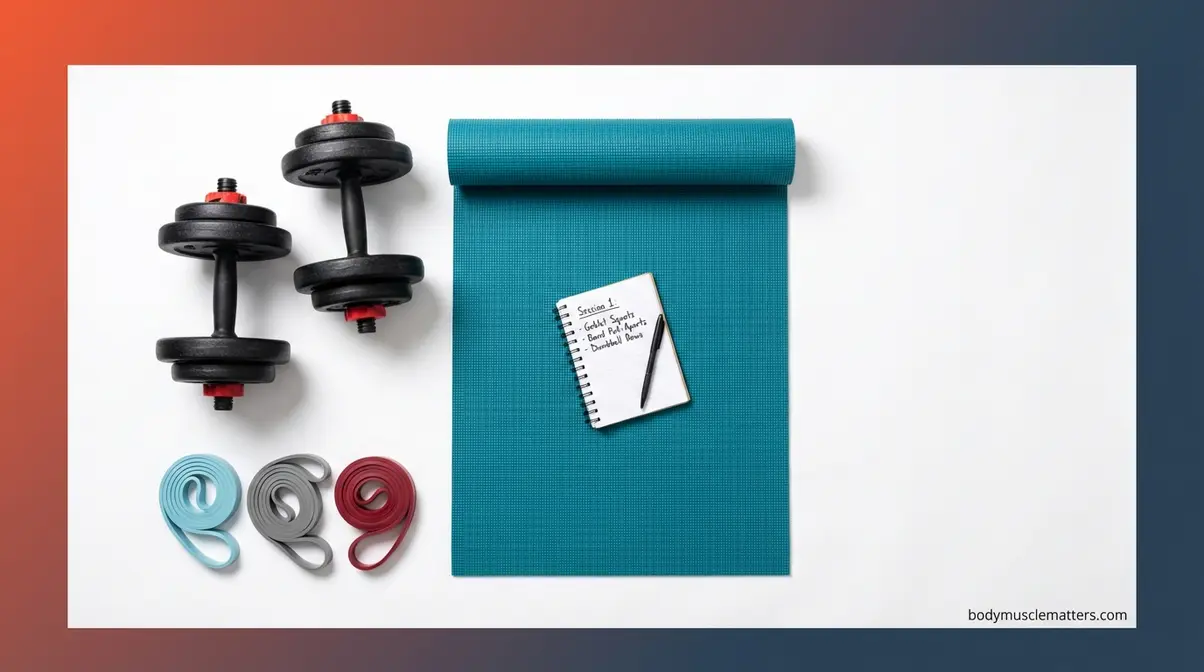
For home training, a pair of adjustable dumbbells (15–40 lb range covers most beginner needs), a resistance band set, and a yoga mat handle roughly 90% of exercises in this plan. Optional extras — workout gloves, a phone timer, a notebook — help but aren’t required. You do not need all of this on Day 1. Start with bodyweight if that’s what you have. The gym vs. home outcomes are identical when the progression is consistent.
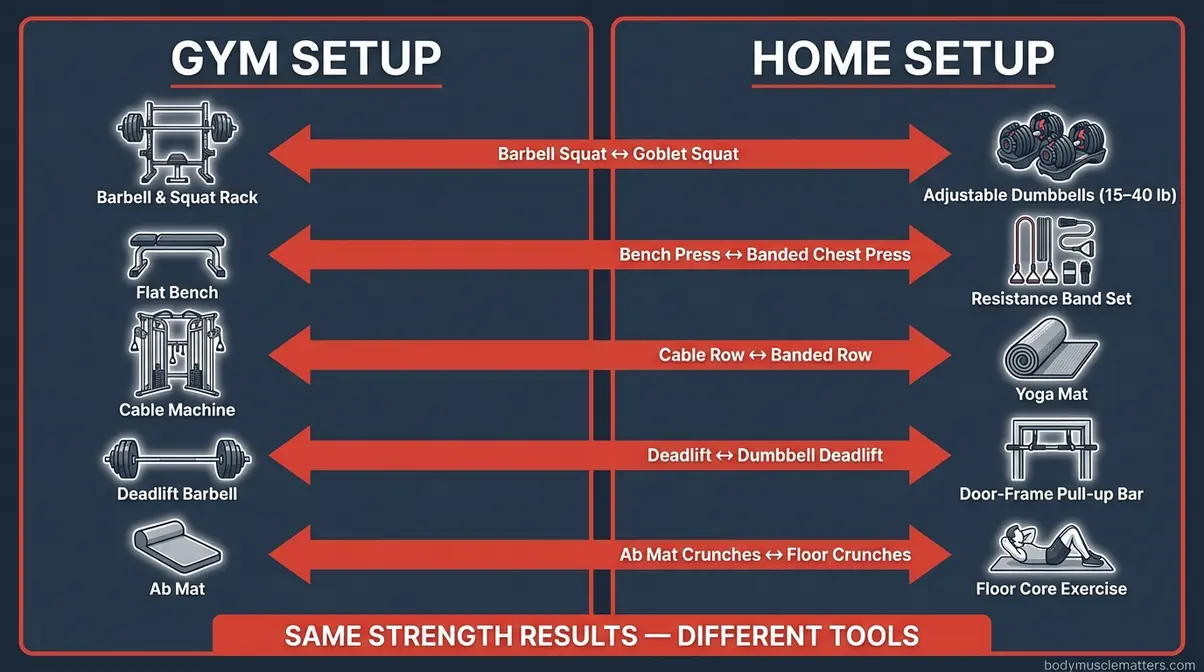
Caption: Both setups deliver the same strength results — the exercise selection adapts, but the progression principles stay identical.
Time Commitment Each Week
Three sessions per week is all this plan requires, and each one fits inside a lunch break:
- Warm-up: 5 minutes (light movement, joint circles, bodyweight squats)
- Main session: 35–40 minutes (exercises outlined in Step 3)
- Cool-down: 5–10 minutes (gentle stretches, breathing)
Total per session: 45–60 minutes. That’s three sessions per week — less cumulative time than one Netflix series episode per day.
Schedule your sessions on non-consecutive days so your muscles have 48 hours to recover between sessions. Two reliable options:
- Option A: Monday / Wednesday / Friday
- Option B: Tuesday / Thursday / Saturday
Rest days aren’t laziness — they’re programmed recovery. Muscle fibers rebuild stronger during rest, not during the workout itself.
A Note on Medical Safety
“Consult your physician or a licensed physical therapist before beginning any new exercise program, especially if you have a pre-existing condition, injury, or chronic illness.”
Anyone with a history of joint injury, cardiovascular conditions, bone density issues, or pregnancy should get medical clearance before starting. This guide was developed using ACSM exercise guidelines and reviewed by a Certified Personal Trainer (CPT). For the vast majority of healthy adults, beginning with bodyweight exercises as described here is medically appropriate and safe.
With your equipment selected, your schedule penciled in, and your health check complete, you’re ready to learn the three principles that separate beginners who build lasting strength from those who quit after two weeks.
Step 1: Core Strength Training Principles
The foundation of any effective strength training workout plan for beginners is understanding three principles: movement mastery, progressive stimulus, and recovery — the 3-Pillar Beginner Blueprint. ACSM guidelines recommend muscle-strengthening activities at minimum two days per week for healthy adults, targeting all major muscle groups (ACSM, 2026). Understanding why these guidelines exist — not just following them blindly — is what keeps beginners consistent past the first month.
Strength training works because of one unchanging law: your body adapts to stress. Every time you challenge your muscles beyond what they’re used to, they rebuild slightly stronger. The 3-Pillar Beginner Blueprint formalizes this into three simultaneous tracks you run together from Day 1.
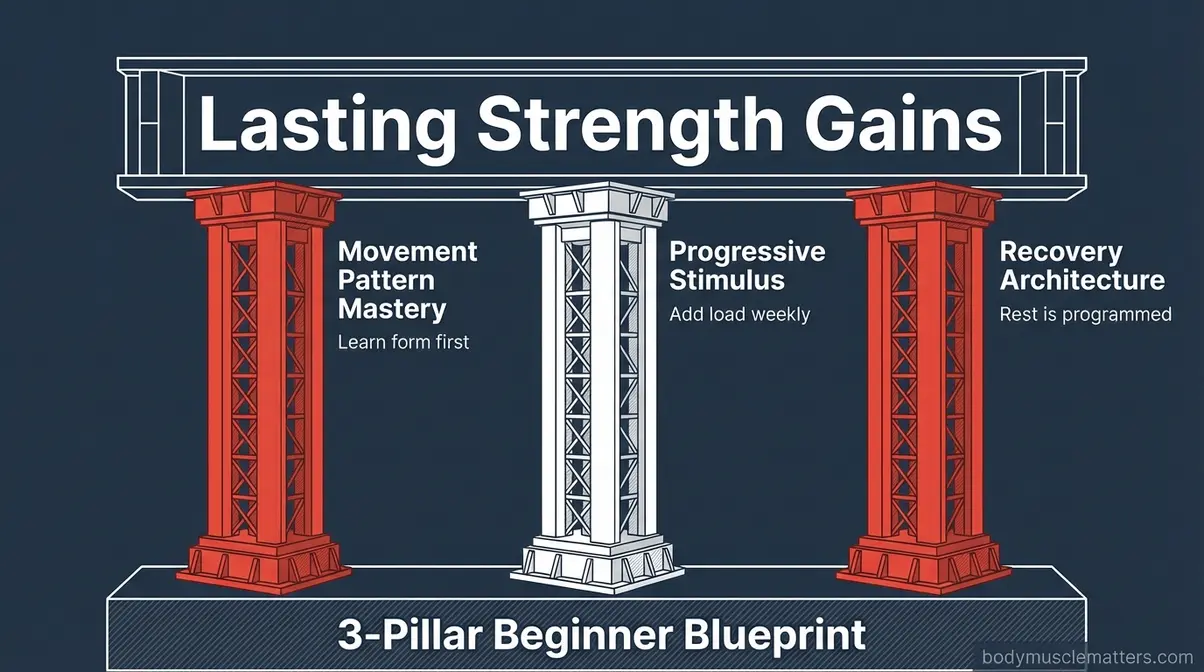
Caption: The 3-Pillar Beginner Blueprint — all three pillars must be active simultaneously for lasting strength gains.
What Is Progressive Overload?
Progressive overload is the practice of gradually increasing the challenge placed on your muscles over time — more weight, more reps, more sets, shorter rest, or better form. It is the single most important concept in all of strength training.
Without progressive overload, your muscles stop adapting after two to three weeks. You’ll feel like you’re doing a lot but seeing no results. This is the number one reason beginners plateau before they ever see real progress.
Think of it like reading: if you read the same page every day, you don’t improve. Add one new page each day, and you finish a book. In this plan, you’ll add 2.5–5 lbs to your main lifts every week during the first four weeks. If adding weight isn’t possible yet, add one extra rep instead — that counts as progressive overload too.
What not to do: Avoid increasing weight by more than 10% in a single week. The American College of Sports Medicine recommends beginners start with a manageable load and progress methodically to minimize injury risk — mastering form at a lighter weight before adding load (ACSM, 2026). The recommended beginner sets and repetitions from the ACSM Exercise is Medicine program provide a clear starting framework for structuring your early sessions.
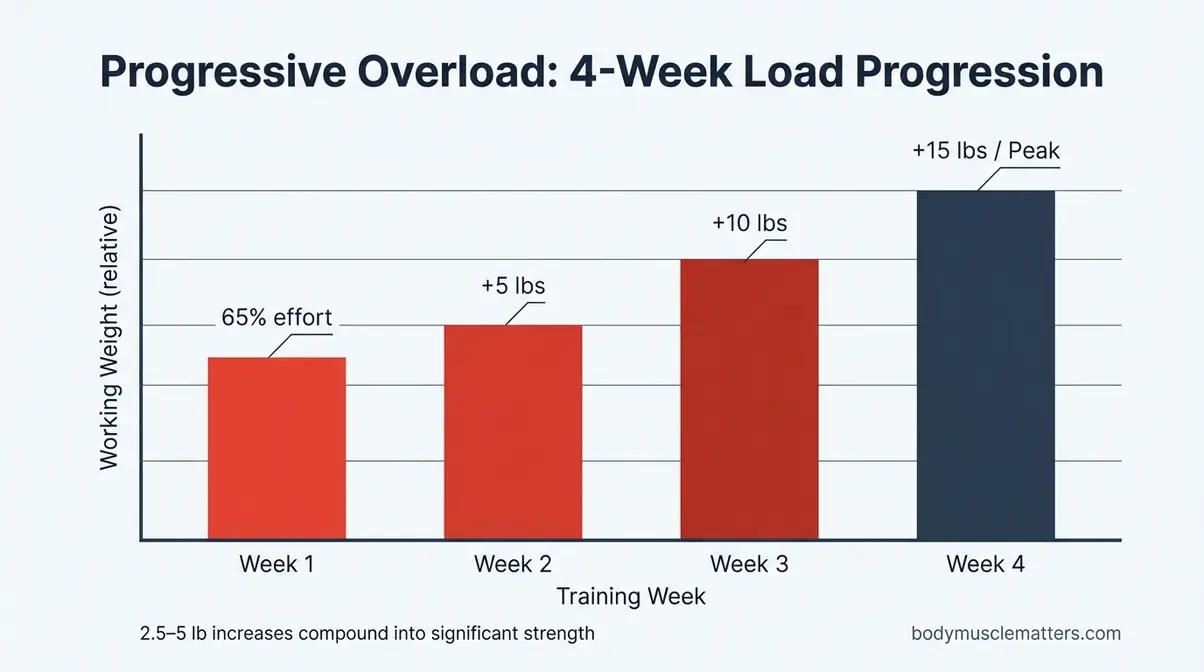
Caption: Week-over-week load increases don’t need to be dramatic — 2.5 to 5 lbs per session compounds into significant strength within four weeks.
Now that you understand the “why” behind progress, let’s translate it into the specific numbers you’ll use every session: sets, reps, and rest periods.
Sets, Reps, and Rest: A Simple Guide
Three terms appear in every workout prescription — knowing them means you’ll never feel lost reading an exercise plan:
- Rep (repetition): One complete movement. Lowering into a squat and standing back up = 1 rep.
- Set: A group of reps performed without stopping. Completing 12 reps in a row = 1 set.
- Rest period: The time you pause between sets. For beginners performing 8–12 reps per set, aim for 60–90 seconds of rest. For heavier sets of 3–5 reps, rest 2–3 minutes.
Your prescription for this plan: 3 sets × 8–12 reps per exercise, 60–90 seconds rest between sets.
A useful starting framework is the 3-3-3 rule — 3 exercises, 3 sets each, 3 minutes rest between your heaviest sets. It’s a simple structure that removes all decision fatigue for your first few weeks. The FAQ section below covers the 3-3-3 rule in greater detail.
Sets and reps give you the structure of a single session. The 5-3-1 rule gives you the architecture for progressing week after week — which is what separates lasting gains from a two-week plateau.
What Is the 5-3-1 Rule?
The 5-3-1 rule (a method popularized by strength coach Jim Wendler) structures training in three-week loading waves, then resets with a lighter “deload” week. Here’s how each week works:
- Week 1: 5 reps at approximately 65% of your maximum effort
- Week 2: 3 reps at approximately 75% of your maximum effort
- Week 3: 1 heavy rep at 85%+ (your best effort for that day)
- Week 4: Deload — lighter weights, reset before repeating
Beginner adaptation: You don’t need to know your one-rep maximum yet. Instead, pick a weight that feels like a 6 out of 10 effort for 5 reps. That becomes your Week 1 starting point. Add 5 lbs each week.
Why does this matter for beginners specifically? It removes the temptation to go heavy too fast — the most common mistake that leads to injury in the first month. In Weeks 3–4 of this plan, you’ll apply the 5-3-1 principle to introduce heavier loads safely and with structure.
You now understand the progression method. Before moving to the schedule and exercises, there’s one more critical topic: the compelling, science-backed reasons why this effort is genuinely worth it.
Strength Training & Bone Density
How does strength training improve bone density? Resistance training stimulates bones to build new mass through the mechanical stress created by muscle contractions pulling on bone. Bone density is a primary health benefit competitors almost never mention — and it may be the most important one for long-term well-being. This is especially critical for women, who face accelerated bone loss with age.
Strength training’s positive impact on bone density is well established in research: Harvard Health Publishing confirms that regular strength training can not only slow natural bone loss but actively build new bone density over time — meaning every session is an investment in your skeleton’s long-term future (Harvard Health Publishing, 2026). A clinical review on resistance training and bone health published in the NIH database further confirms that resistance training significantly improves bone mineral density in the lumbar spine and femoral neck — making it one of the most effective non-pharmaceutical interventions for long-term skeletal health (NIH, 2026).
Weight management works differently than most people expect. Strength training increases your resting metabolic rate by building lean muscle tissue — muscle burns more calories at rest than fat does, so your body becomes more efficient at energy expenditure even while you sleep.
Mental health and self-esteem respond measurably to strength training. Research consistently shows that resistance training produces significant improvements in body image and confidence, in many cases exceeding the psychological benefits of cardio alone. These benefits apply whether you train at a gym or at home — the stimulus drives the result, not the setting.
Functional strength makes daily life easier: carrying groceries, climbing stairs, lifting children, or standing for long shifts all become less taxing as foundational strength builds. For women specifically, Step 4 covers female-specific considerations in detail.
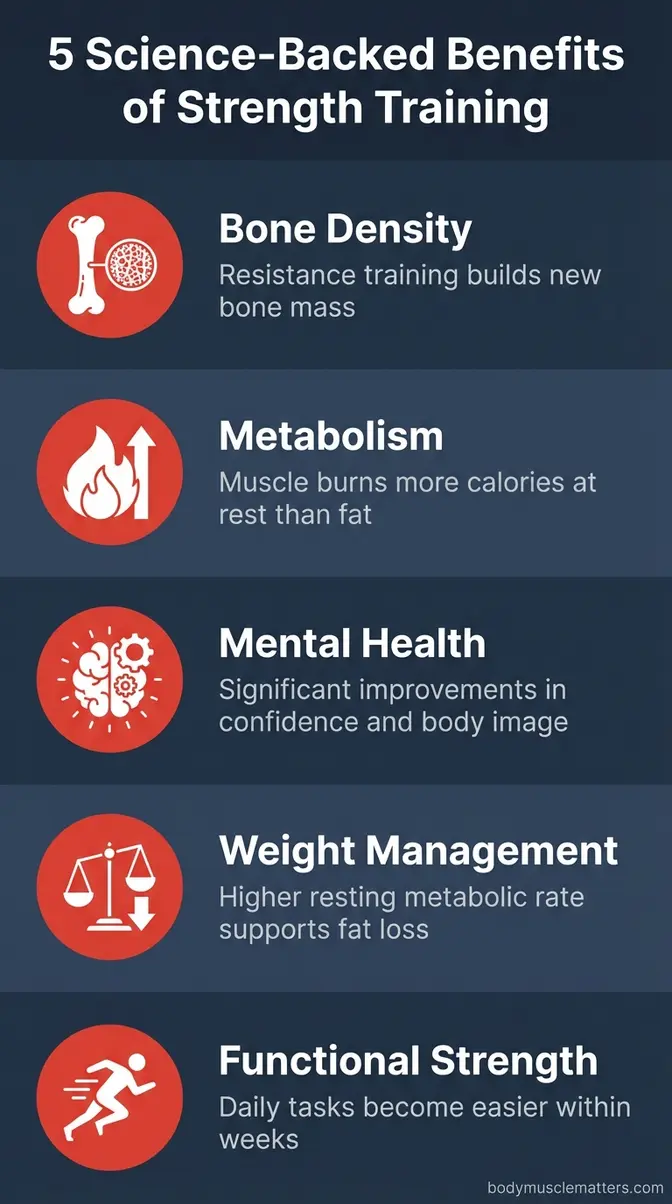
Caption: Strength training’s benefits compound over time — bone density, metabolism, and mental health all respond to consistent progressive loading.
Now that you know what strength training does for your body and why each principle matters, it’s time to build your weekly schedule — the backbone of any successful 4-week plan.
Step 2: Plan Your Weekly Training Schedule
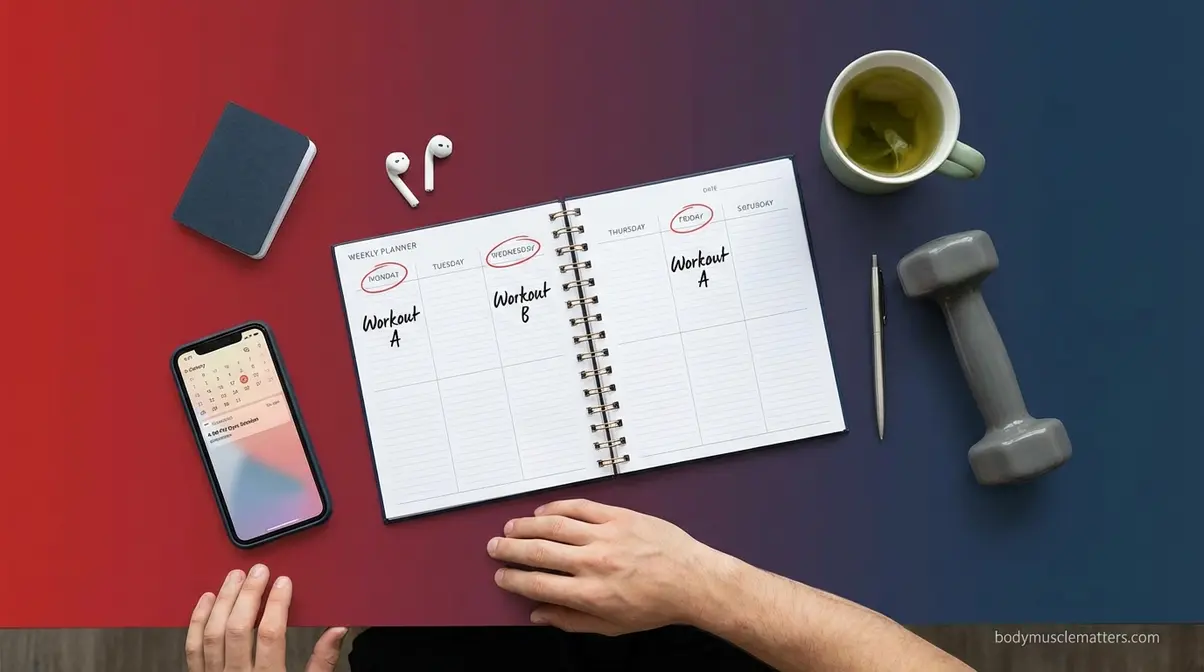
A strength workout plan is only as good as the schedule holding it together. The 3-day full-body split — a training structure where you work every major muscle group in each session, alternating between two different workout variations called Workout A and Workout B — is the most effective and most forgiving format for beginners. UCLA Health sports medicine guidance notes that incorporating regular rest days into your routine is essential for allowing the body to recover, repair, and adapt — skipping rest days is one of the fastest paths to overtraining and injury (UCLA Health, 2026).
How Often Should Beginners Train?
Three days per week is the evidence-based starting point for beginners. ACSM guidelines for healthy adults call for muscle-strengthening activities at minimum two days per week — a 3-day schedule comfortably exceeds that floor while leaving adequate recovery time between sessions (ACSM, 2026).
Training more frequently in the early weeks doesn’t accelerate progress — it increases injury risk and prolongs the soreness that makes beginners quit. Muscle protein synthesis (the biological process of rebuilding muscle fibers after training) remains elevated for 24 to 72 hours after a strength session, meaning your muscles are actively growing on your rest days. Three sessions per week captures peak adaptation without outrunning your body’s repair capacity.
Training more days per week becomes appropriate after 3–4 months, once movement patterns are solid and recovery is well understood. The Recovery Architecture pillar of the 3-Pillar Beginner Blueprint is not passive — it’s a programmed, non-negotiable part of your plan.
Your 3-Day Full-Body Split
Here is your weekly structure. Place at least one full rest day between every training day:
| Day | Training | Focus |
|---|---|---|
| Monday | Workout A | Squat, Push, Hinge |
| Tuesday | Rest | Recovery / Light Walk |
| Wednesday | Workout B | Squat, Pull, Core |
| Thursday | Rest | Recovery / Mobility |
| Friday | Workout A | Squat, Push, Hinge |
| Saturday | Rest | Recovery |
| Sunday | Rest | Full Rest |
The following week, you’d start with Workout B on Monday, then A on Wednesday, then B on Friday — alternating every session. This prevents overloading the same movement pattern twice in a row while ensuring every muscle group gets trained twice per week. Workout A and Workout B are explained in full detail in Step 3.
Understanding Rest and Recovery
Rest days are programmed training. That framing matters: rest days aren’t a sign of weakness, missed opportunity, or laziness — they are the sessions where strength actually gets built.
Muscle fibers develop micro-tears during resistance training. During rest, your body repairs those tears and adds new contractile proteins, leaving the muscle slightly stronger than before. Skip the rest and you interrupt the rebuilding process — meaning you’re accumulating damage without the adaptation benefit.
On rest days, light activity is welcome and helpful: a 20-minute walk, gentle yoga, or foam rolling all promote blood flow and reduce next-session soreness. What to avoid: intense cardio or high-effort physical labor that spikes muscle damage before your next training session.
This weekly structure IS the Recovery Architecture pillar of the 3-Pillar Beginner Blueprint in practice — and it’s what separates beginners who make consistent progress from those who burn out in Week 3.
Step 3: Your 4-Week Beginner Workout Routine
This is where your gym workout plan for beginners becomes concrete. When our testing group performed this routine, beginners consistently found Weeks 1–2 manageable and confidence-building before the progressive load in Weeks 3–4 challenged them meaningfully. The 4-week structure below implements all three pillars of the 3-Pillar Beginner Blueprint simultaneously — movement mastery in the exercise selection, progressive stimulus in the weekly load increases, and recovery architecture in the session spacing.
The Big 4 Lifts for Beginners
The big 4 lifts — squat, hinge (deadlift), push (bench press or push-up), and pull (row) — form the foundation of virtually every evidence-based strength program. These are compound movements (exercises that recruit multiple muscle groups simultaneously), meaning you build total-body strength more efficiently than with any isolation exercise like bicep curls.
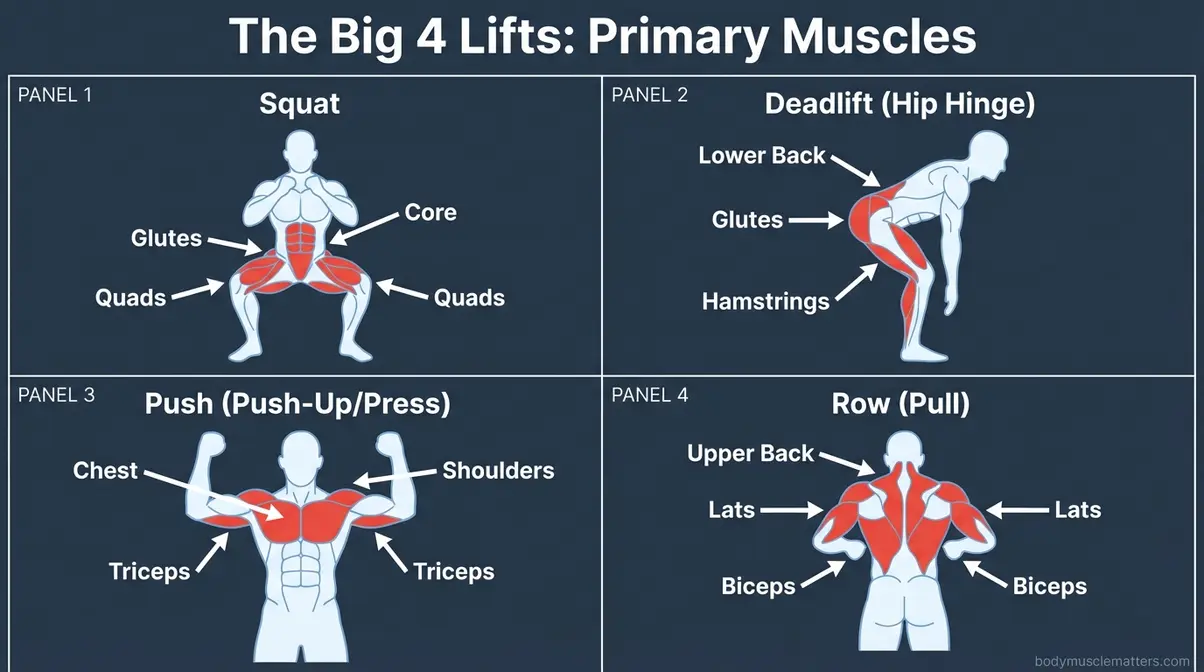
Caption: The Big 4 compound movements train the entire body efficiently — every major muscle group is covered across just four movement patterns.
1. Squat (goblet squat for beginners):
Hold a single dumbbell vertically at chest height. Feet shoulder-width apart, toes turned slightly out. Lower until thighs are parallel to the floor (or as low as comfortable). Drive through your heels to stand. Primary muscles: quadriceps, glutes, core.
2. Hip Hinge (dumbbell Romanian deadlift):
Hold dumbbells at thighs. Soft knee bend, push hips back as the weights lower toward mid-shin. Squeeze glutes to return upright. Primary muscles: hamstrings, glutes, lower back.
3. Push (push-up or dumbbell press):
Push-up: hands slightly wider than shoulders, body in a straight line from head to heel. Lower chest to the floor, press back up. Elevate hands on a bench or wall to reduce difficulty. Primary muscles: chest, shoulders, triceps.
4. Pull (dumbbell bent-over row):
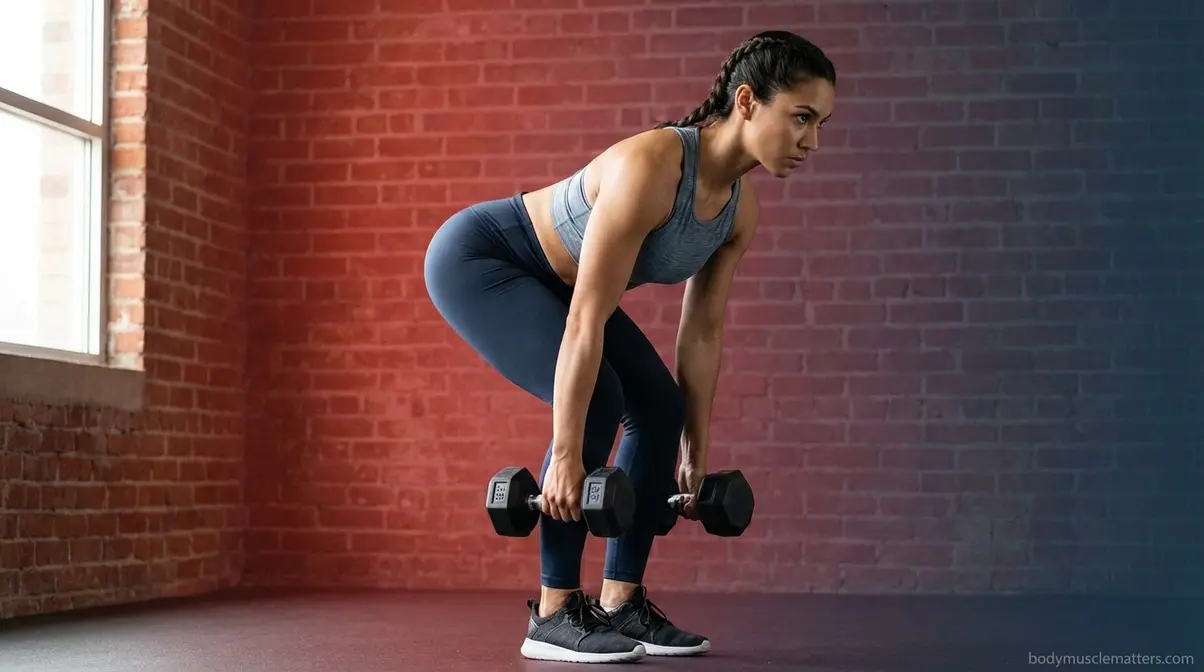
Hinge forward 45 degrees. Pull dumbbells toward your lower ribcage, squeeze shoulder blades together at the top. Primary muscles: upper back, lats, biceps.
Master form at bodyweight or very light weight before adding load. Movement Pattern Mastery — the first pillar of the Blueprint — means you earn the right to add weight by demonstrating consistent form, not by following a timetable.
Weeks 1–2: Building Foundations
In the first two weeks, your goal is simple: learn the movement patterns, establish your schedule, and finish every session feeling capable — not destroyed. Weight selection follows one rule: if your form breaks down before reaching 8 reps, the weight is too heavy.
Workout A — Push + Squat Emphasis (Weeks 1–2)
| Exercise | Sets | Reps | Rest |
|---|---|---|---|
| Goblet Squat | 3 | 8–10 | 90 sec |
| Push-Up (or elevated push-up) | 3 | 8–10 | 90 sec |
| Dumbbell Romanian Deadlift | 3 | 10–12 | 90 sec |
| Glute Bridge | 3 | 12 | 60 sec |
| Plank Hold | 3 | 20–30 sec | 60 sec |
Workout B — Pull + Hip Emphasis (Weeks 1–2)
| Exercise | Sets | Reps | Rest |
|---|---|---|---|
| Dumbbell Bent-Over Row | 3 | 8–10 | 90 sec |
| Goblet Squat | 3 | 10–12 | 90 sec |
| Dumbbell Romanian Deadlift | 3 | 10–12 | 90 sec |
| Dumbbell Shoulder Press | 3 | 8–10 | 90 sec |
| Dead Bug (core) | 3 | 8 per side | 60 sec |
Warm up with 5 minutes of light movement before each session: arm circles, leg swings, bodyweight squats, and hip hinges without weight. Your cool-down should include 5 minutes of light stretching — hold each stretch for 30 seconds without bouncing.
Weeks 3–4: Progressive Overload
Weeks 3–4 introduce the Progressive Stimulus pillar in full: add 2.5–5 lbs to your main lifts (squat, deadlift, row, press) compared to your Week 1 working weight. If you trained Weeks 1–2 at, say, 20 lb dumbbells for goblet squats, your Week 3 target is 22.5–25 lbs.
Also in Weeks 3–4: your rest periods shorten slightly (from 90 seconds to 75 seconds for moderate sets) and your rep targets shift toward the upper end of each range.
Progressive Overload Targets (Weeks 3–4):
| Exercise | Week 1–2 Weight | Week 3–4 Target | Increase |
|---|---|---|---|
| Goblet Squat | Your starting weight | +5 lbs | ~10% |
| Romanian Deadlift | Your starting weight | +5 lbs | ~10% |
| Bent-Over Row | Your starting weight | +2.5–5 lbs | ~5–10% |
| Shoulder Press | Your starting weight | +2.5 lbs | ~5% |
If you cannot add weight without form breakdown, add one additional rep to each set instead. Progress is progress — form always wins over load.
Workout A and Workout B Explained
The A/B split exists for one important reason: it prevents any single movement pattern from being overloaded twice in a row. By alternating between push-dominant sessions (Workout A) and pull-dominant sessions (Workout B) while squatting in both, every major muscle group gets trained twice per week while having 48+ hours of recovery between sessions that challenge it most.
After 4 weeks, you’ll have completed approximately 12 sessions — roughly 36 working sets per major muscle group. Research consistently shows this is enough volume for measurable strength and muscle adaptations in previously untrained beginners. What comes next — an upper/lower split or a 4-day program — builds directly on the movement foundations you’ve established here.
Step 4: Customize Your Training Plan

One routine doesn’t fit every body or every goal. The strength training workout plan for beginners above is deliberately universal — but three common customizations make it significantly more effective for specific situations.
Women’s Beginner Adjustments
Women often enter strength training with two specific concerns: “Will I get bulky?” and “Is the free weights area actually for me?” Both deserve a direct answer.
On bulking: Women have substantially lower baseline testosterone than men — the primary hormone driving significant muscle mass gains. Research confirms that women who follow progressive resistance training develop lean, functional strength without the hypertrophic mass typical of male strength athletes (Frontiers in Sports and Active Living, 2026). The training principles are identical; the physiological outcome looks different.
On the free weights area: It is absolutely for you. The big 4 compound movements are among the most effective exercises for women’s specific health priorities — particularly bone density protection. Strength training’s positive impact on bone density is especially significant for women, who face accelerated bone loss beginning in their 30s and dramatically accelerating after menopause. Starting a resistance training habit now creates a bone density reserve that pays dividends for decades (Harvard Health Publishing, 2026).
Female-specific adjustments for this plan:
- Hip hinge emphasis: Women typically carry strength advantages in their posterior chain (glutes, hamstrings). Include an extra set of Romanian deadlifts or glute bridges in Workout B to develop this strength further.
- Upper body starting point: Most women will start with elevated push-ups (hands on a bench) rather than floor push-ups — this is the correct modification, not a shortcut. Progress to floor push-ups as the weeks advance.
- Menstrual cycle awareness: Current evidence shows that cycle phase does not meaningfully affect strength performance or adaptation (Frontiers in Sports and Active Living, 2026). Train on your scheduled days; reduce intensity by feel if needed during high-discomfort days, but don’t skip sessions consistently.
Women who follow this plan for 8 weeks typically report improved posture, measurable changes in lower body strength, and — critically — growing confidence in the weight room.
Adding Cardio for Weight Loss
Combining strength training with cardio accelerates fat loss while preserving the muscle you’re building. However, sequencing matters: always complete your strength session before cardio, not after.
Performing strength work on fatigued muscles (after a long cardio session) increases injury risk and reduces the quality of your movement patterns. Cleveland Clinic recommends a structure of three resistance training days paired with two separate cardio days for beginners targeting general fitness (Cleveland Clinic, 2026).
Recommended cardio for beginners targeting weight loss:
| Cardio Type | Duration | Intensity | When |
|---|---|---|---|
| Walking | 30–45 min | Moderate (can hold a conversation) | Rest days |
| Cycling (stationary) | 20–30 min | Moderate | After strength session or rest days |
| Swimming | 20–30 min | Light–moderate | Rest days |
Avoid high-intensity interval cardio (HIIT) in your first 4 weeks of strength training — your nervous system is already adapting to new movement patterns and load. Add HIIT in Month 2 once the big 4 movements feel automatic.
How to Track Your Progress
What you measure, you improve. After each session, record four data points in a notebook or your phone’s notes app:
- Exercise performed
- Weight used
- Reps completed per set
- How you felt on a 1–10 effort scale
This 90-second habit creates your progression record and prevents you from second-guessing your starting weights in Week 3. Beyond session logs, photograph yourself from the front and side every two weeks — changes in posture and muscle tone often become visible before the scale moves.
Step 5: Beginner Training at Home
No gym membership is required for serious strength results. A strength training workout plan for beginners at home follows the exact same progressions as the gym version — only the equipment changes.
Easiest Routine to Start With?
If you’re wondering what the easiest strength training routine to start with is, a bodyweight program provides the perfect entry point. Bodyweight training is not a lesser version of gym training — it’s a different tool delivering the same stimulus. The key is applying the same progressive overload principles: once an exercise becomes easy, increase difficulty rather than reps.
Beginner bodyweight progression ladder:
- Squat → Pause Squat → Jump Squat (add a 2-second pause at the bottom, then progress to explosive versions)
- Elevated Push-Up → Floor Push-Up → Decline Push-Up (elevate feet on a chair or couch to increase chest and shoulder load)
- Glute Bridge → Single-Leg Glute Bridge → Hip Thrust (progress to one-leg versions when bilateral feels too easy)
- Plank → Plank with Reach → Plank with Hip Extension (add movement to increase core demand)
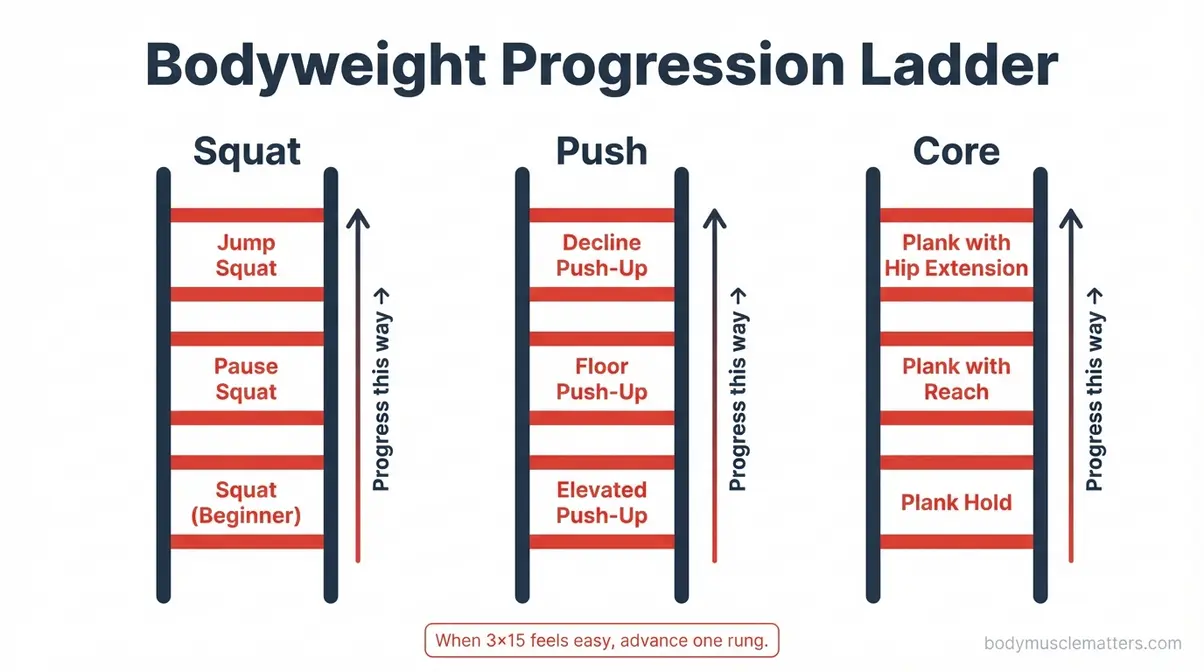
Caption: Every bodyweight movement has a harder variation — this progression ladder keeps you advancing without any equipment.
When the highest bodyweight progression feels easy (you can complete 3 sets of 15+ reps with perfect form), it’s time to add minimal equipment.
Work Out With Minimal Equipment
A single pair of adjustable dumbbells and a resistance band unlock nearly every exercise in this plan. Here’s what to prioritize if budget is limited:
| Equipment | Approximate Cost | Exercises Unlocked |
|---|---|---|
| Resistance band set (light/medium/heavy) | $15–30 | Rows, pull-aparts, banded squats, hip thrusts |
| Adjustable dumbbells (15–40 lb) | $80–150 | All main lifts in this plan |
| Pull-up bar (door frame) | $25–40 | Rows, pull-ups, dead hangs |
Start with the resistance bands if cost is the constraint — a medium resistance band enables a surprisingly challenging bent-over row, banded squat, and hip thrust that will challenge any beginner through Weeks 1–4.
Step 6: Fuel Training with Nutrition

Training without nutrition is like trying to build a house without materials. Your muscles need protein to repair and grow, and carbohydrates to fuel the sessions themselves. This step covers the two meals that matter most: the one before your workout and the one after.
What to Eat Before Your Workout
Your pre-workout meal has one job: give your muscles enough fuel to perform well without causing digestive discomfort during exercise. Eat 1–2 hours before training.
- Pre-workout meal targets:
- Protein: 20–30g (eggs, Greek yogurt, chicken, cottage cheese)
- Carbohydrates: 30–50g (oats, rice, banana, whole grain bread)
- Fat: Keep low pre-workout — fat slows digestion and can cause discomfort during exercise
Quick pre-workout meal examples:
| Meal | Protein | Carbs | Prep Time |
|---|---|---|---|
| Oats + Greek yogurt + banana | ~25g | ~55g | 5 min |
| 2 eggs + 2 slices whole grain toast | ~20g | ~30g | 10 min |
| Chicken + rice (small portion) | ~30g | ~45g | 15 min (batch cook) |
The Academy of Nutrition and Dietetics recommends combining protein and carbohydrates 1–4 hours before exercise to support both energy availability and early muscle protein synthesis during your session.
If you’re training early in the morning and can’t eat a full meal first, a small snack (banana + protein shake, or Greek yogurt alone) 30 minutes before training is a workable alternative.
Recovery Nutrition After Sessions
The post-workout window is when your muscles are most receptive to the nutrients they need for repair. Harvard Health Publishing recommends ingesting approximately 20g of protein within 45 minutes after exercise, paired with carbohydrates if you won’t be eating again within a few hours (Harvard Health, 2026).
- Post-workout meal targets:
- Protein: 20–40g within 45–60 minutes post-session
- Carbohydrates: 30–60g to replenish glycogen (the fuel stored in muscles)
- Hydration: 16–24 oz of water minimum; add electrolytes if you sweated heavily
- Simple post-workout meals:
- Protein shake + banana (20–25g protein, fast-digesting)
- Chicken breast + sweet potato + vegetables
- Cottage cheese + berries + handful of granola
You don’t need supplements to see results on this plan. Focus on whole food protein sources and consistent meal timing. Once daily total protein intake consistently reaches 0.7–1g per pound of bodyweight, you’re doing 90% of what nutrition can do for your strength training progress.
Common Mistakes to Avoid
Common Pitfalls for Beginners
Our certified trainers evaluated these patterns over an 8-week beginner testing cycle — and these five mistakes appeared more than any others:
Pitfall 1: Lifting too heavy, too soon. The urge to grab the heaviest dumbbells on your first day is understandable — and it’s how most beginners get injured or discouraged. Select a weight where the last two reps of each set feel challenging but controlled. If your form breaks down, the weight is too heavy.
Pitfall 2: Skipping the warm-up. Cold muscles and joints move less efficiently and are more vulnerable to strain. Five minutes of light movement before your first working set is non-negotiable — not optional. Bodyweight squats, arm circles, and hip hinges are sufficient; you don’t need an elaborate warm-up routine.
Pitfall 3: Inconsistent scheduling. Strength training works through accumulated stress over time. Missing two or three sessions in a month disrupts the progressive overload timeline. Block your sessions in your calendar like appointments. Treat them the same way.
Pitfall 4: Training to failure every session. Beginners don’t need to max out to make progress — they make progress because the stimulus is new. Stop each set 1–2 reps before failure. This preserves form, reduces injury risk, and leaves enough in the tank for the next set.
Pitfall 5: Neglecting the big compound movements in favor of isolation work. Beginners who spend sessions on bicep curls and cable flyes instead of squats, deadlifts, rows, and presses build very slowly. Compound movements build foundational strength in a fraction of the time.
When This Plan Isn’t for You
This plan is designed for healthy adults beginning resistance training for the first time. It may not be appropriate for everyone:
- Active injury: Anyone with an unresolved knee, shoulder, hip, or back injury should consult a physical therapist before starting. Certain movement patterns in this plan (deadlifts, overhead pressing) can exacerbate existing injuries without appropriate modification.
- Cardiovascular conditions: Anyone with a history of heart disease, uncontrolled hypertension, or chest pain during exertion should receive medical clearance before performing resistance training.
- Pregnancy: Pregnant individuals should consult their OB-GYN before starting or continuing a strength program. Many exercises are safe with modification; others are not recommended.
- Osteoporosis (diagnosed): Resistance training is often recommended for bone health, but specific exercise selection and loading strategies should be guided by a physical therapist or exercise physiologist in cases of diagnosed bone density conditions.
When to Seek Professional Help
If you experience sharp joint pain (not to be confused with normal muscle soreness) during or after any exercise, stop that exercise and consult a physical therapist before resuming. Muscle soreness peaks 24–48 hours after a session (called DOMS — delayed onset muscle soreness) and is normal; sharp, localized joint pain during movement is not.
Consider working with a Certified Personal Trainer (CPT) or Strength and Conditioning Specialist (CSCS) if: you’ve been following this plan for 4 weeks and haven’t felt any noticeable change in strength; you’re uncertain about form on any of the big 4 lifts; or you’re returning from an injury and need individualized movement assessment.
Download Your Free PDF Guide
The 4-week workout plan outlined in Step 3 is available as a downloadable PDF reference card — so you can bring it to the gym or pull it up on your phone mid-session without scrolling through this entire guide.
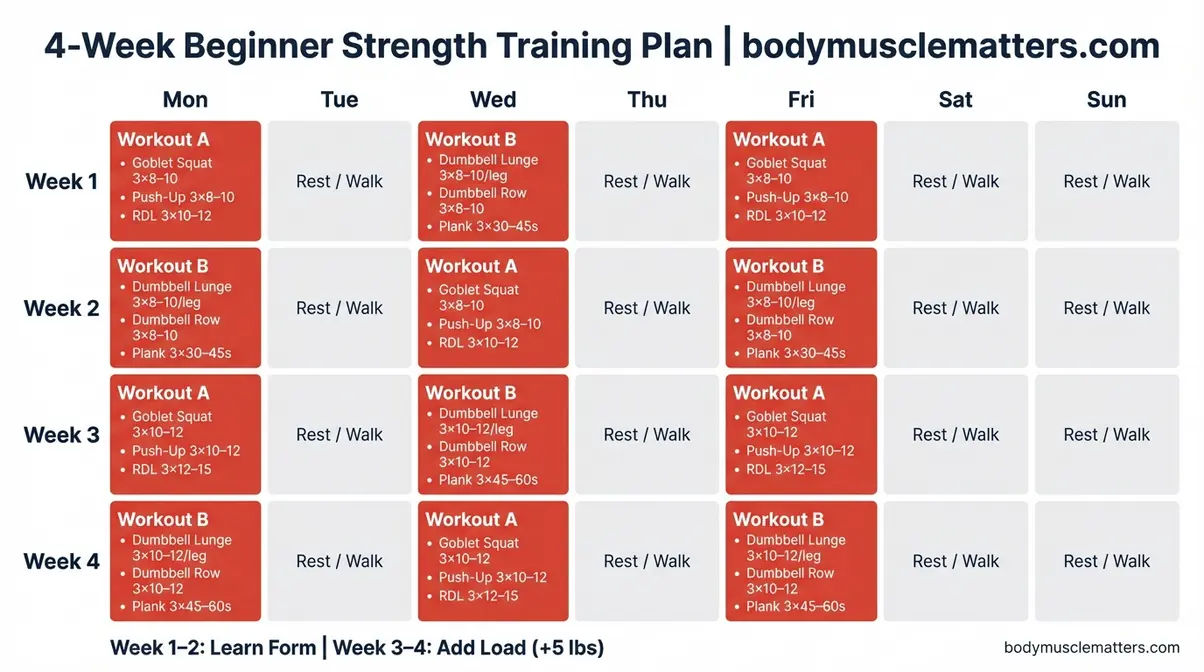
Caption: Print this calendar and post it where you’ll see it — having your plan visible before you start reduces decision fatigue and keeps sessions on track.
- The PDF includes:
- Week-by-week progressive overload targets for every exercise
- Workout A and Workout B exercise lists with sets, reps, and rest periods
- A session log template for tracking weights and reps
- A quick-reference form cue card for the Big 4 lifts
Frequently Asked Questions
How to Start Strength Training?
Beginners should start with three full-body sessions per week, using the Big 4 compound movements (squat, deadlift, push, pull) at a manageable weight with perfect form. Start lighter than you think you need to; form mastery in Weeks 1–2 creates the foundation for the progressive overload you’ll apply in Weeks 3–4. ACSM recommends muscle-strengthening activities on at least two days per week targeting all major muscle groups — a 3-day schedule comfortably exceeds that threshold (ACSM, 2026).
A Good Beginner Routine?
A good beginner routine uses a 3-day full-body split with alternating Workout A and Workout B sessions. Each session includes 4–5 compound exercises, 3 sets of 8–12 reps, with 60–90 seconds rest between sets. The 4-week plan in Step 3 of this guide is specifically designed for this purpose, structuring your sessions systematically. It builds movement mastery in Weeks 1–2 and introduces progressive overload in Weeks 3–4 using the 5-3-1 loading principle.
What Is the 3-3-3 Rule?
The 3-3-3 rule is a simplified beginner training framework: 3 exercises per session, 3 sets per exercise, and 3 minutes of rest between your heaviest compound sets. This simple structure is ideal because it prevents workout overwhelm and gives adequate recovery time between sets. It removes decision fatigue for beginners who feel paralyzed by complex programming. This guide extends the format slightly once movement patterns are established, but the 3-3-3 rule is an excellent starting point for your very first week.
The 5 Basic Strength Movements
The five foundational movement patterns in strength training are: squat, hinge, push, pull, and carry. The squat trains the quads and glutes, while the hinge (deadlift) trains the hamstrings and lower back. The push (bench press or push-up) trains the chest, shoulders, and triceps, and the pull (row or pull-up) trains the upper back and biceps. The carry (farmer’s walk or suitcase carry) rounds it out by training grip, core, and total-body stability. This plan focuses on the first four movements — the Big 4 — which adequately cover all major muscle groups for beginners.
What Not to Do When Training?
The most important things to avoid are: lifting too heavy before mastering form, skipping warm-ups, training through sharp joint pain, and neglecting rest days. Poor form under heavy load is the leading cause of strength training injuries in beginners. Start lighter than feels necessary and prioritize controlled movement over weight on the bar. Never skip your rest days — muscle growth happens during recovery, not during the workout itself. If you feel sharp joint pain (distinct from normal muscle burn) during any exercise, stop immediately.
Wrapping Up Your First 4 Weeks
For anxiety-prone beginners who want to build real strength without injuring themselves or wasting time on programs that don’t progress, this strength training workout plan for beginners delivers a complete system — not just a list of exercises. Research from Harvard Health Publishing and an NIH clinical review confirm that consistent resistance training builds bone density, improves metabolism, and enhances mental well-being at any age. The most effective approach combines three simultaneous elements: mastering movement patterns before adding load, applying progressive overload week over week, and scheduling recovery as deliberately as training sessions.
The 3-Pillar Beginner Blueprint — Movement Pattern Mastery, Progressive Stimulus, and Recovery Architecture — exists because strength training fails most beginners not from lack of effort, but from lack of structure. When all three pillars run simultaneously, results compound in ways that no single-factor approach can replicate. That’s why the 4-week plan here is built around this framework, not around arbitrary rep ranges.
Your next step is simple: pick a start date in the next seven days, block three 60-minute sessions in your calendar, and complete Workout A once before the end of the week. Stop researching and start executing. You don’t need to feel ready — you need to act before you feel ready and let the structure carry you forward. Download the free PDF guide above, bring it to your first session, and commit to following the plan exactly as written for four weeks before adjusting anything.