How to Go to the Gym Alone: Beginner’s 3-3-3 Plan
Figuring out how to go to the gym alone for the first time is genuinely nerve-wracking. You’re not being dramatic. Research confirms that roughly 60% of people feel anxious about working out in a gym — and even 47% of regular gym-goers still feel intimidated walking through the door (Muscle and Brawn, 2026). That tight chest, that urge to turn around in the parking lot — it has a name: gymtimidation. And it’s completely normal.
The good news? That feeling has a fix. This guide walks you through The Solo Stack — a three-layer system built specifically for beginners going to the gym alone. Layer one resets your mindset. Layer two gets you prepared before you ever set foot inside. Layer three gives you a concrete, copy-paste workout plan so you never stand around wondering what to do next.
No vague advice. No “just be confident.” Everything you need, in one place.
The Solo Stack makes figuring out how to go to the gym alone manageable: reset your mindset, prepare like a pro, and follow the simple 3-3-3 Plan.
- Gymtimidation is universal: 60% of people feel gym anxiety — you are not alone, and it fades fast.
- Preparation kills panic: Packing the right bag, arriving at off-peak hours, and booking a free induction tour removes most first-visit fears.
- The 3-3-3 Plan: 3 days a week, 3 exercises, 3 sets each — a complete beginner framework you can start this week.
- Etiquette is simple: Wipe equipment, re-rack weights, wear headphones, and respect space — four rules cover 95% of situations.
Why Going to the Gym Alone Feels Scary
Going to the gym alone feels scary because your brain is doing exactly what it’s designed to do: scan for social threat. When you are figuring out how to go to the gym alone, understanding why it happens is the first step toward defusing it. The anxiety you feel before a solo gym session isn’t a personal weakness — it’s a well-documented psychological response. If you need an extra push, reviewing these 10 tips for staying motivated on your fitness journey can help maintain your momentum as you build confidence.
The Science Behind Gym Anxiety
Social physique anxiety (SPA) is the discomfort people feel when they believe others are evaluating their body or physical performance. A 2023 study published in PMC (NIH) found that individuals who exercise in a gym environment report significantly higher SPA scores than those who play team sports — largely because gyms involve mirrors, exposed bodies, and visible effort.
The practical consequence is important: high social physique anxiety directly predicts lower exercise participation (a 2022 study by PMC, NIH). In other words, the anxiety doesn’t just feel bad — it actively stops people from going. Recognising it as a named, studied phenomenon helps you treat it as a solvable problem rather than a personal failing.
The fix isn’t willpower. It’s information, structure, and a little exposure. Each visit you complete, your SPA drops measurably. Gymshark’s guide on building gym confidence reinforces this: the anxiety spike almost always peaks on the first visit, then drops sharply by the third.
Why Everyone Is Too Busy to Notice You
Here’s the most reassuring piece of psychology you’ll read today: you are not the centre of attention — your brain just thinks you are.
Psychologists Thomas Gilovich, Kenneth Savitsky, and Victoria Medvec at Cornell University named this the spotlight effect — the consistent tendency for people to overestimate how much others notice their appearance and actions (Gilovich et al., Journal of Personality and Social Psychology, 2000). In their experiments, participants dramatically overestimated how many people noticed what they were wearing or how they performed. The actual number was roughly half what they predicted.
At the gym, this effect is amplified. Every other person is focused on their own workout, their own form, their own playlist. User consensus across Reddit’s r/beginnerfitness confirms this repeatedly — first-timers almost universally report that nobody looked at them, let alone judged them.
One Reddit user put it perfectly:
“Just get some head phone play some good instrumental music and do a nice work out routine. Pretend you’re alone. Everyone around you is blind.”
That’s not just reassurance — it’s accurate. The spotlight effect means the audience you fear is largely imaginary.
Set Goals That Keep You Coming Back
Anxiety thrives in vague situations. One of the fastest ways to reduce gym anxiety is to replace “I want to get fit” with a specific, measurable target. Micro-goals — small, session-by-session wins — give your brain a concrete task to focus on instead of scanning for social threat.
Examples of useful micro-goals for a first solo gym session:
- Complete 15 minutes on the treadmill at a comfortable pace
- Try two machines you’ve never used before
- Finish the full 3-3-3 Plan (covered in Section 3)
A 2025 study from PMC (NIH) found that regular physical activity significantly reduces social physique anxiety over time — partly because goal-oriented exercise shifts attention inward toward performance rather than outward toward perceived judgment. The goal isn’t just fitness. It’s a psychological anchor that keeps you coming back.
How to Prepare for Your First Solo Visit
Preparation is the most underrated part of going to the gym alone. A major part of mastering how to go to the gym alone is preparation. Most beginners walk in underprepared, feel lost within minutes, and never come back. This section is your prerequisites checklist — complete it before your first visit and you’ll walk in feeling ready, not panicked.
Pack the Right Gym Bag (Checklist)
Packing your bag the night before removes one decision from a morning that might already feel nerve-wracking. These are the absolute essentials for a gym bag to ensure you are fully prepared. Here’s exactly what you need:
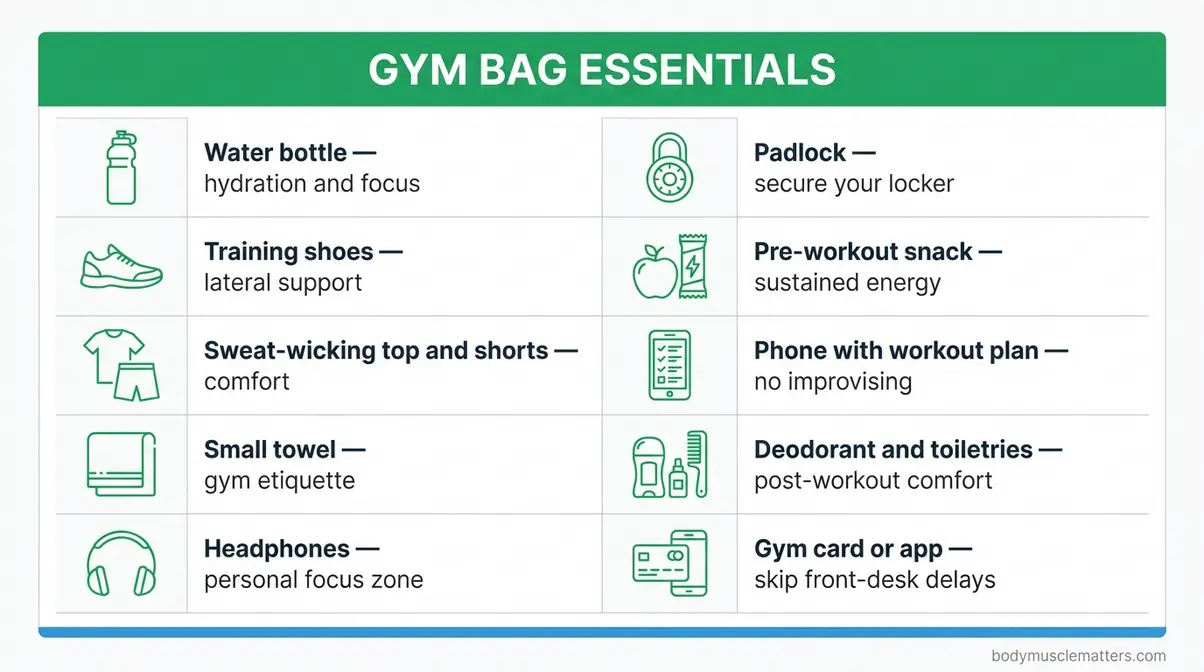
Gym Bag Checklist:
| Item | Why You Need It |
|---|---|
| Water bottle (at least 750ml) | Hydration affects energy and focus |
| Gym shoes (flat-soled or training shoes) | Running shoes lack lateral support for lifting |
| Sweat-wicking t-shirt and shorts/leggings | Cotton holds sweat and chafes |
| Small towel | Required at most gyms for wiping equipment |
| Headphones | Your social shield — more on this in Section 4 |
| Lock (for locker) | Most gyms don’t provide them |
| Snack (banana, bar, or rice cakes) | Eat 60–90 minutes before your session |
| Phone with workout plan saved | So you’re not improvising mid-session |
| Deodorant and basic toiletries | For post-workout comfort |
| Gym card or app (if required) | Avoid the awkward front-desk scramble |
Eating before you go matters more than most beginners realise. A small carbohydrate-based snack 60–90 minutes before your session gives you the energy to complete the workout and reduces the light-headed feeling that makes new gym-goers want to leave early.
Choose the Right Time (Off-Peak Hours)
Your first solo gym session will feel dramatically easier if the gym is quiet. Fewer people means fewer perceived eyes, more available equipment, and more space to figure things out without pressure.
Typical off-peak hours at most commercial gyms:
- Weekday mornings: 10 a.m. – 12 p.m. (after the early-morning rush)
- Weekday afternoons: 1 p.m. – 4 p.m.
- Weekend mornings: Before 9 a.m. or after 11 a.m.
Peak hours to avoid for your first few sessions:
- Weekdays 6–9 a.m. and 5–8 p.m. (commuter rush)
- Monday evenings (the busiest time of the week at almost every gym)
Many gym apps and websites now show live or predicted busyness — check before you go. Peloton’s guide to starting gym sessions alone recommends treating your first three sessions as “recon missions” rather than peak-performance workouts: the goal is familiarity, not intensity.
Book a Free Gym Induction Tour
Most gyms offer a free induction (a guided tour of the equipment and facilities) when you sign up. If you haven’t had one yet, book it before your first solo session. This one step removes the single biggest source of beginner anxiety: not knowing how anything works.
During your induction, ask the gym staff these three questions:
- “Which machines are best for a complete beginner?” — They’ll point you to the safest starting points.
- “Are there any rules I should know about?” — Covers etiquette before you accidentally break it.
- “What are your quietest hours?” — Staff know the real pattern, not just the general guideline.
If your gym doesn’t offer an induction, spend 10 minutes walking around the space before your first workout. Locate the water fountains, the toilets, the free weights area, and the cardio machines. Familiarity reduces anxiety. You can’t be scared of something you’ve already mapped.
Your First Solo Gym Session: The 3-3-3 Plan
The most common reason beginners feel lost at the gym isn’t shyness — it’s not having a plan. You walk in, see rows of equipment, and freeze. The 3-3-3 Plan solves this entirely. It’s the cornerstone of The Solo Stack: a simple, repeatable structure that tells you exactly what to do from the moment you walk in to the moment you walk out. This framework serves as an excellent beginner gym workout routine that you can rely on.
What Is the 3-3-3 Rule at the Gym?
The 3-3-3 Rule at the gym is a beginner-friendly workout framework built on three simple numbers: 3 days per week, 3 exercises per session, 3 sets (groups of repetitions) per exercise. That’s it. No complicated programming. No intimidating spreadsheets.
Here’s why it works for beginners going to the gym alone:
- 3 days per week gives your muscles 48 hours of recovery between sessions — the minimum required for a beginner’s body to adapt and grow stronger (based on standard exercise science guidelines for novice trainees).
- 3 exercises keeps the session short enough to finish (around 45 minutes including warm-up) without overwhelming you.
- 3 sets per exercise provides enough volume (total work) to trigger adaptation without risking injury from overtraining.
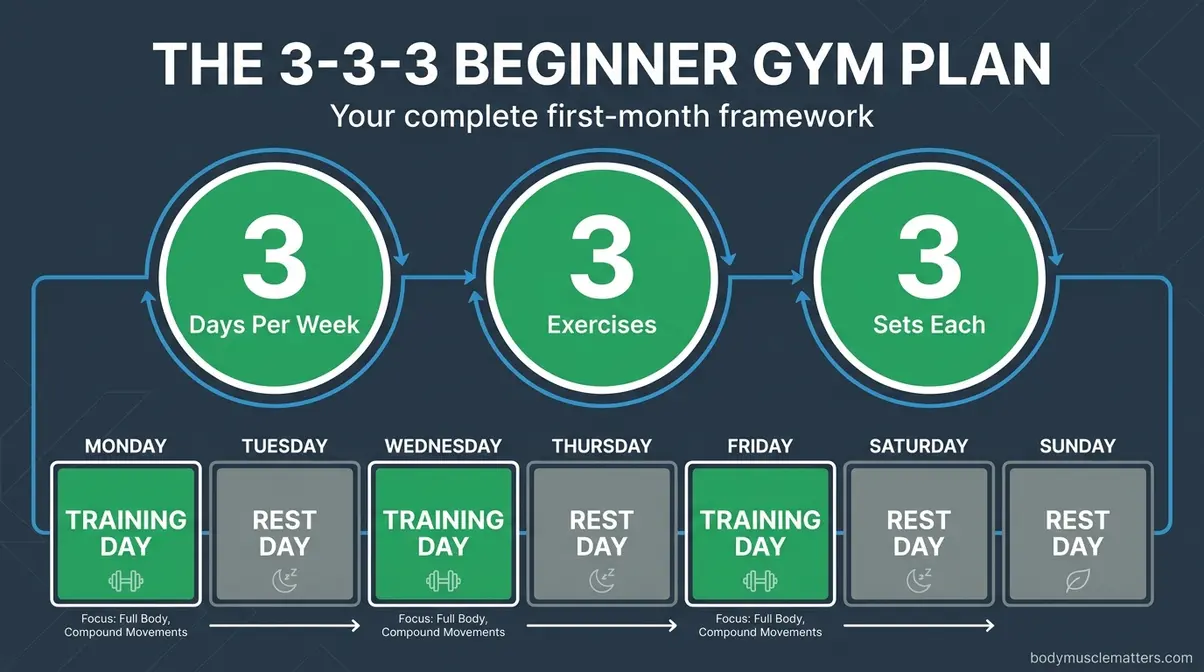
Research consistently supports 3-day full-body routines as the most effective structure for beginners. A comprehensive beginner workout guide from Bony to Beastly notes that 3-day full-body programs outperform split routines for new gym-goers because they allow more frequent practice of each movement pattern, accelerating skill development alongside muscle growth.
Step 1 — Your Warm-Up (15 Minutes)
Never skip your warm-up. A cold muscle is a vulnerable muscle — and an injury on your first solo session is the fastest way to never go back.
Your warm-up has two jobs: raise your heart rate and loosen your joints. You don’t need a complex routine. Follow these steps:
- 5 minutes of light cardio — Choose a treadmill, stationary bike, or rowing machine. Set it to an easy pace where you can hold a conversation. This raises your body temperature and gets blood moving to your muscles.
- 5 minutes of dynamic stretching — “Dynamic” means moving stretches, not held ones. Try:
- Leg swings (forward and sideways, 10 each leg)
- Arm circles (10 forward, 10 backward)
- Hip circles (10 each direction)
- Bodyweight squats (10 slow reps)
- 5 minutes of practice reps — Do one light set of each exercise you plan to use, with no weight or very light weight. This teaches your body the movement pattern before you add load.
Estimated time: 15 minutes. What changes: Your body temperature rises, joints feel fluid, and your brain shifts into “workout mode.” Most people feel noticeably calmer and more focused after a proper warm-up.
Step 2 — Your Main Workout
Here is your actual 3-3-3 workout. These three exercises cover your whole body, use equipment available at every gym, and are safe to perform without a spotter.
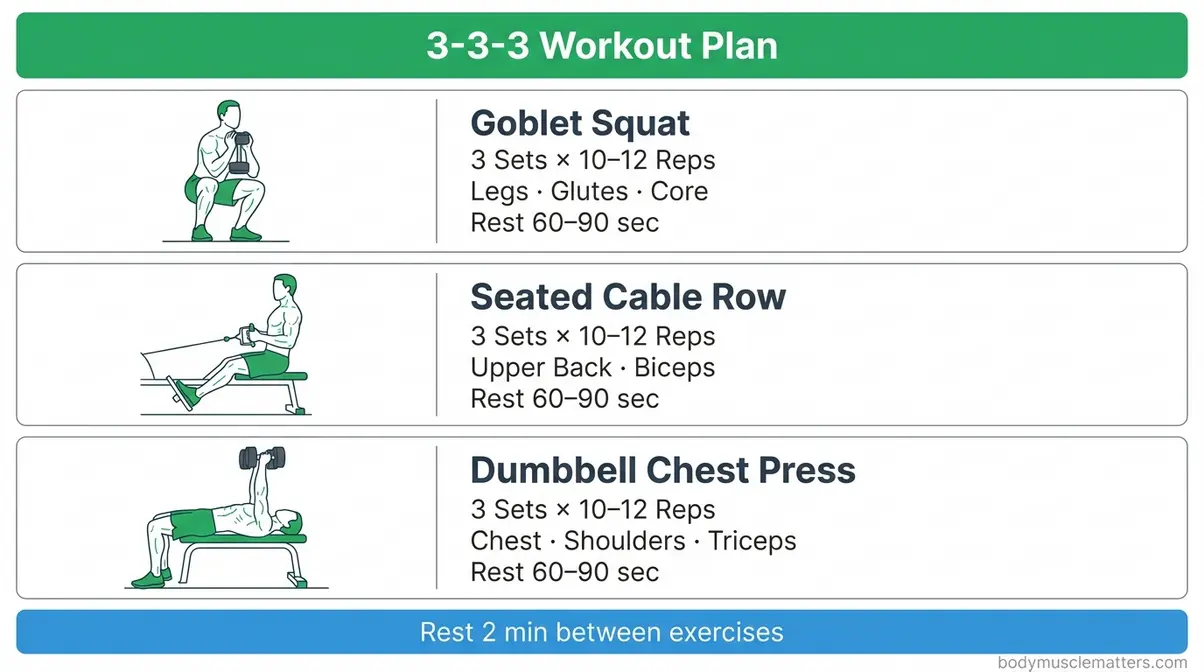
Your 3-Exercise Beginner Workout:
| Exercise | Sets | Reps | Rest Between Sets | What It Works |
|---|---|---|---|---|
| Goblet Squat (with a dumbbell) | 3 | 10–12 | 60–90 seconds | Legs, glutes, core |
| Seated Cable Row (or dumbbell row) | 3 | 10–12 | 60–90 seconds | Upper back, biceps |
| Dumbbell Chest Press (on bench) | 3 | 10–12 | 60–90 seconds | Chest, shoulders, triceps |
- Key terms defined:
- Sets = a group of repetitions performed back-to-back
- Reps (repetitions) = one complete movement of the exercise (e.g., one squat up and down)
- Rest between sets = the pause you take before starting the next set
How to choose the right weight: Pick a weight where the last 2–3 reps of each set feel genuinely challenging, but your form stays clean. If you can breeze through 12 reps without effort, go slightly heavier. If your form breaks down by rep 8, go lighter. Getting this right takes 1–2 sessions — that’s completely normal.
Rest between exercises: Take 2 minutes between switching to a different exercise. This gives your nervous system time to reset for a new movement pattern.
Step 3 — Cool Down and Stretch
Your cool-down is not optional. Skipping it is one of the most common beginner mistakes — and it’s the reason many people feel unusually sore and stiff the day after their first session.
Follow these steps after your last set:
- 5 minutes of slow cardio — Drop the treadmill or bike to a very easy pace. This gradually lowers your heart rate instead of stopping abruptly, which can cause light-headedness.
- 5 minutes of static stretching — “Static” means held stretches (30 seconds each). Focus on:
- Quad stretch (standing, hold ankle behind you)
- Hamstring stretch (seated, reach toward your toes)
- Chest stretch (clasp hands behind back, open chest)
- Shoulder cross-body stretch
Why it matters: Static stretching after exercise — not before — improves flexibility and reduces next-day muscle soreness (commonly called DOMS, or delayed onset muscle soreness). A 10-minute cool-down today means you’ll be able to walk normally tomorrow, which means you’ll actually come back for your next session.
Unwritten Gym Etiquette for Solo Beginners
Fear of breaking unwritten gym rules is one of the top anxieties reported by first-time solo gym-goers. The good news: there are really only four rules that matter. Learn these and you’ll never accidentally upset anyone.
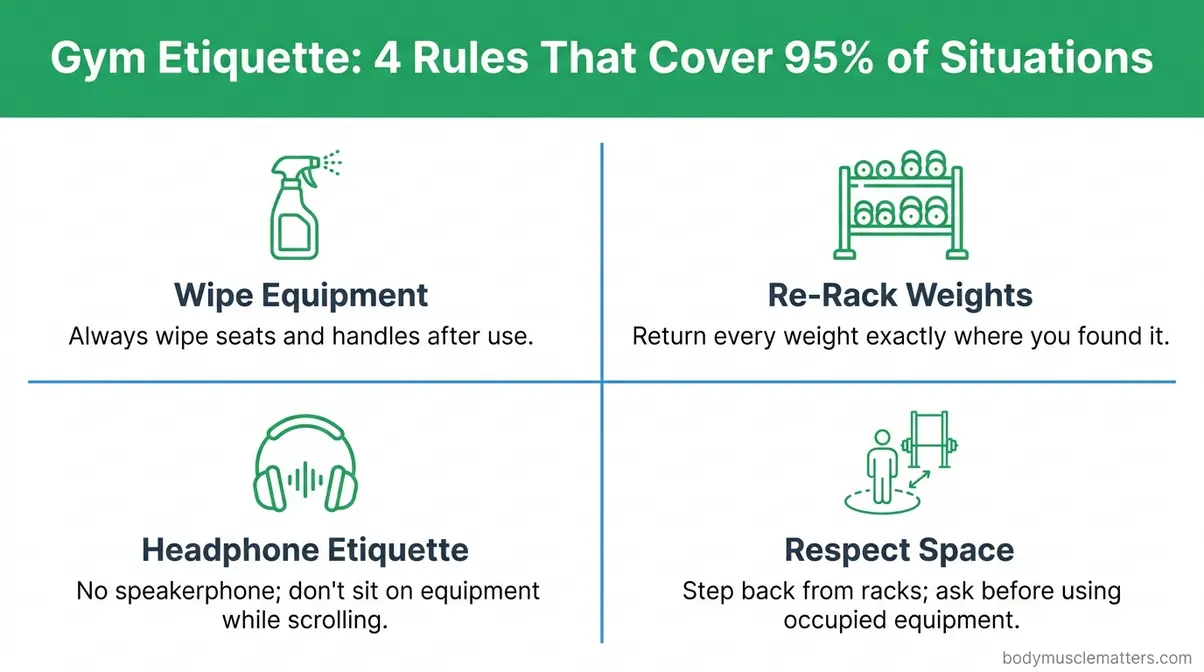
Wipe Down Equipment After Every Use
Always wipe the equipment you use before you move on. Most gyms have spray bottles and paper towels placed throughout the floor — use them. Wipe down the seat, handles, and any surface you touched.
This is the single most important etiquette rule. Forgetting it is the quickest way to earn a disapproving look from staff or other members. Think of it as a two-second courtesy that earns you goodwill with everyone in the room. Memorial Hermann’s gym safety guide notes that wiping down equipment also protects you from skin infections — so it’s as much about your health as it is about respect.
Re-Rack Your Weights After Every Set
Put every weight back exactly where you found it. Dumbbells go back on the rack in the correct slot (they’re numbered). Barbell plates go back on the storage pegs. Resistance bands go back on the hook.
Nothing frustrates experienced gym-goers more than hunting for a 10kg dumbbell that someone left under a bench. Re-racking is simple, takes 15 seconds, and signals that you belong there. It’s also a safety issue — weights left on the floor are a trip hazard for everyone.
If you loaded a barbell with plates, strip all the plates off when you’re done, even if you think someone else might want to use the same weight. Let the next person load it fresh.
Headphone and Phone Etiquette
Headphones are your best friend as a solo gym-goer. Pop them in, play your playlist, and you instantly create a personal bubble that signals “I’m in workout mode” to everyone around you. You don’t have to talk to anyone. You don’t have to make eye contact. You can pretend you’re alone — because for all practical purposes, you are.
A few phone rules to keep in mind:
- Don’t sit on equipment while scrolling. If you’re resting between sets, step off the machine so others can use it.
- Keep calls private. If you need to take a call, step outside or into a quiet corner.
- No videos of other people. Ever. This is a firm rule at virtually every gym, for obvious privacy reasons.
- Speakerphone is a hard no. Your music is for your ears. Everyone else has their own playlist.
Spatial Awareness and Equipment Sharing
Being aware of your space prevents the awkward moments that make beginners most self-conscious. Follow these simple guidelines:
- Don’t stand directly in front of someone else’s dumbbell rack while doing your exercises. Step back 1–2 metres so others can access the weights.
- If someone is clearly using a piece of equipment (even if they’ve stepped away briefly), check with a simple “Are you still using this?” before taking it.
- Working in means sharing equipment during rest periods. If someone asks to “work in” (use the machine while you rest between sets), it’s polite to say yes. You just alternate sets.
- Don’t hover. If a machine you want is in use, find an alternative exercise rather than standing close and waiting impatiently.
Olaben’s guide to solo gym sessions reinforces that spatial awareness is the etiquette skill beginners underestimate most — and the one that experienced gym-goers notice first.
Special Situations for Solo Gym-Goers
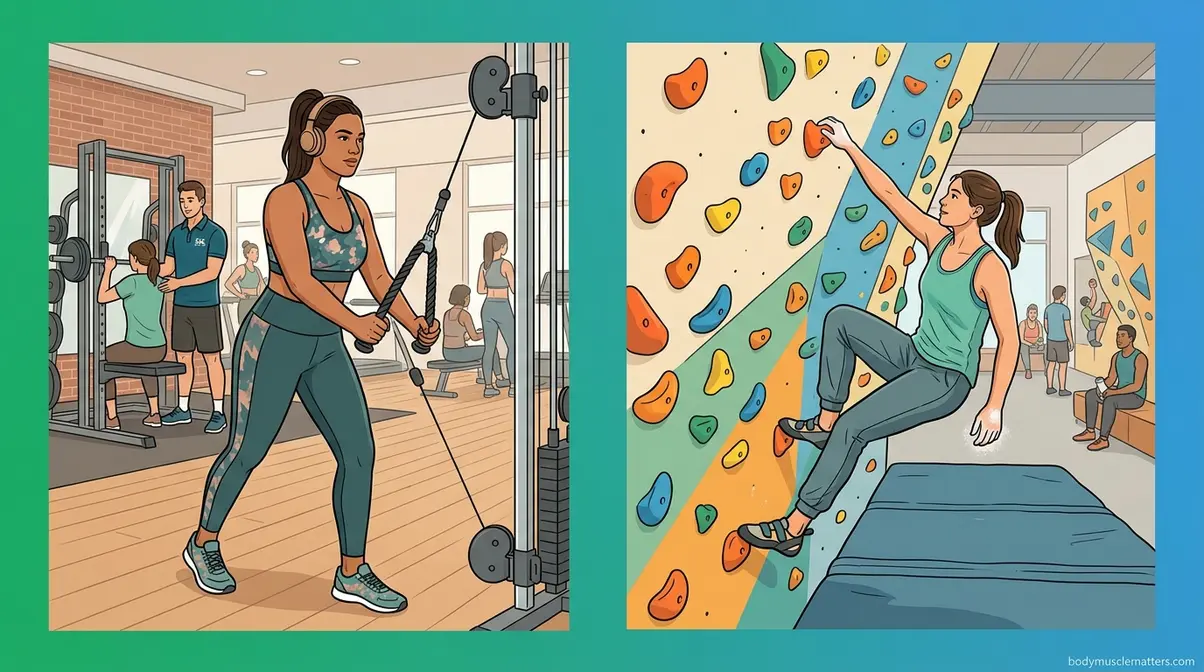
Most gym advice is written for a generic, unspecified audience. But your experience of going to the gym alone might be shaped by factors that generic advice doesn’t cover. This section addresses two specific situations: going to the gym alone as a woman, and visiting a climbing gym solo for the first time.
Tips for Women Going to the Gym Alone
Going to the gym alone as a woman comes with legitimate additional considerations — not just social anxiety, but genuine safety awareness. If your goal is strength, review this guide on muscle building for women to structure your progression. Common concerns reported by women training alone include unwanted attention, feeling unsafe in car parks at night, and uncertainty about how to handle uncomfortable interactions.
Here’s practical, specific guidance:
- Before you go:
- Choose a well-lit, busy gym if possible. Read Google reviews and filter for mentions of atmosphere and how staff handle complaints.
- Tell someone your schedule. A quick text — “I’m at the gym, back by 8pm” — means someone knows where you are.
- Scope the car park. If you’re going in the evening, park close to the entrance and note where the lighting is.
- During your session:
- Headphones signal boundaries. Wearing headphones is universally understood as “I’m not available to chat.” Use them.
- Trust your instincts. If someone makes you uncomfortable, move to a different area of the gym. You don’t owe anyone an explanation.
- Use machines in sightlines. For your first few sessions, stick to areas where staff or other members are visible.
- You are allowed to say no. If someone offers unsolicited advice about your form, a simple “Thanks, I’m good” is a complete sentence.
Know your rights: Every legitimate gym has a code of conduct. Harassment — verbal or physical — is grounds for immediate staff intervention and membership termination for the offender. You can always walk to the front desk and report something without drama.
Many women find that going to the gym alone becomes genuinely enjoyable once the first few sessions are done. The anxious first visit gives way to a sense of ownership: this is my space too.
First Time at a Solo Climbing Gym
Climbing gyms have a reputation for being one of the friendliest fitness communities — and that reputation is mostly earned. But going to a climbing gym alone for the first time still comes with a specific learning curve. For a deeper dive into the physical benefits, see how to build every muscle rock climbing works.
Start with bouldering. Bouldering (climbing short walls without ropes or harnesses) is the easiest entry point for solo climbers. You don’t need a partner, you don’t need specialist gear beyond climbing shoes (which most gyms rent), and the routes are short enough that falls are low-risk when you land correctly.
The Bouldering Project’s beginner guide recommends this approach for solo first-timers: start on V0 or V1 problems (the easiest grade), focus on foot placement rather than arm strength, and watch experienced climbers to learn movement patterns.
Practical tips for your first solo climbing session:
- Book an intro class — Most climbing gyms offer a 1-hour introductory session that covers safety, falling technique, and basic movement. Book this before your first solo visit.
- Start on low traverses — Traversing (moving sideways along the wall close to the ground) lets you practice grip and footwork with minimal risk.
- Ask questions freely — Climbing gym communities are notably welcoming to beginners. Asking “how do I read this route?” will almost always get a friendly, helpful answer.
- Rest between attempts — Finger tendons fatigue faster than muscles and take longer to recover. Climb for 2–3 minutes, rest for 5.
Common Mistakes and When to Seek Extra Help
Even with the best preparation, first-time solo gym-goers run into predictable problems. Knowing them in advance means you can sidestep them — or recover quickly when they happen.
Common Pitfalls
Pitfall 1: Choosing too heavy a weight on your first session.
What goes wrong: Your form breaks down, you feel embarrassed, and you risk injury. How to avoid it: Start lighter than you think you need to. A weight that feels almost too easy on set one will feel appropriately challenging by set three. You can always increase next session.
Pitfall 2: Skipping the cool-down because you feel fine.
What goes wrong: You wake up the next morning unable to walk properly (DOMS), miss your next session, and break momentum. How to avoid it: Treat the cool-down as non-negotiable — it’s part of the session, not an optional extra.
Pitfall 3: Going at peak hours on your first visit.
What goes wrong: The gym is packed, every machine is taken, and the sensory overload sends your anxiety through the roof. How to avoid it: Check the gym’s busy-hours data and schedule your first three sessions during off-peak times.
Pitfall 4: Not having a plan and improvising.
What goes wrong: You wander between machines, feel self-conscious and aimless, and leave after 20 minutes feeling worse than when you arrived. How to avoid it: Use the 3-3-3 Plan. Have it saved on your phone before you walk in.
Pitfall 5: Comparing yourself to experienced gym-goers.
What goes wrong: You watch someone deadlifting twice your bodyweight and feel inadequate. How to avoid it: Remember that every experienced gym-goer was once a confused beginner. They’re not judging you — they’re too focused on their own session.
When to Choose Alternatives
If group classes feel more appealing: A structured class like Body Pump, spin, or yoga might suit you better than solo floor sessions. Classes remove the “what do I do next?” anxiety entirely — an instructor guides every minute. Many beginners find that a few months of classes builds enough confidence to transition to solo training.
If you consistently feel unsafe at your gym: Switch gyms. Not all facilities are equal in how they handle harassment or maintain a welcoming environment. A women-only gym or a smaller boutique studio might be a better fit for your first few months.
If anxiety remains severe after 4–6 sessions: Gym anxiety that doesn’t improve with repeated exposure may warrant a conversation with a GP or therapist. Social anxiety disorder is a clinical condition, and effective treatments exist. Going to the gym is a goal worth pursuing — but not at the cost of your mental health.
When to Seek Expert Help
If you have a pre-existing injury, chronic pain, or a condition like scoliosis or a cardiovascular issue, book a session with a personal trainer (PT) before starting any self-directed program. A single session is often enough to get a customised movement screen and exercise modifications that keep you safe. Many gyms include one free PT session with a new membership — use it.
Frequently Asked Questions
Is it okay to go to the gym alone?
Yes — going to the gym by yourself is completely normal and very common. Most gym members train alone the majority of the time. You don’t need a partner to use cardio equipment, weight machines, or dumbbells safely. The main exception is heavy barbell lifts like bench press or squats with a loaded bar, where a spotter (someone to assist if you fail a rep) adds a safety layer. For beginners, dumbbell and machine-based exercises — like those in the 3-3-3 Plan — are entirely safe to do solo.
What is the 3-3-3 rule at the gym?
The 3-3-3 rule at the gym is a beginner framework: 3 days per week, 3 exercises per session, 3 sets per exercise. It gives you a complete, repeatable workout structure without overwhelming programming complexity. Each session takes around 45 minutes including warm-up and cool-down. Research supports 3-day full-body routines as the most effective structure for beginners — frequent enough to build skill and strength, with enough recovery time between sessions to avoid overtraining.
What is the 3-3-3 rule for working out?
The 3-3-3 rule for working out is the same principle applied to general fitness: train 3 days per week, perform 3 exercises, complete 3 sets of each. Some fitness coaches extend the framework to include 3 reps of breathing exercises before a session (to reduce anxiety and centre focus), making it a mental and physical preparation tool. For beginners going to the gym alone, the core version — 3 days, 3 exercises, 3 sets — is the most practical starting point.
Do 90% quit the gym after 3 months?
The “90% quit after 3 months” figure is widely cited but not precisely verified by a single peer-reviewed source. What research does confirm is that gym dropout rates are high in the early months: a 2026 survey by Athletech News found that 31% of new exercisers report losing motivation within the first few weeks. The pattern is real even if the exact percentage varies by study. The most effective counter-strategy is habit stacking — anchoring your gym visit to an existing routine (like going directly from work) — and keeping sessions short and achievable, which is exactly what the 3-3-3 Plan is designed to do.
Lifting weights while on Zepbound?
This is a medical question — please consult your prescribing doctor before combining any GLP-1 medication (like Zepbound) with a new exercise programme. Generally speaking, resistance training is considered beneficial alongside weight-loss medications because it helps preserve muscle mass during caloric deficit. However, dosage, individual health factors, and potential side effects (like nausea or fatigue) can affect your capacity to exercise. Your GP or a registered dietitian is the right person to advise you on this specifically.
Exercises to avoid with scoliosis?
If you have scoliosis (a curvature of the spine), exercise selection should be guided by a physiotherapist or orthopaedic specialist, not a general gym guide. Some movements — particularly heavy axial loading like barbell back squats or deadlifts — may be contraindicated depending on the severity and type of your curve. Many people with scoliosis exercise regularly and safely with appropriate modifications. Book a session with a qualified physiotherapist before starting a self-directed gym programme.
Your First Step Starts Before You Walk In
Learning how to go to the gym alone is a process, but the hardest part is rarely the workout itself — it’s the mental barrier before you open the door. The Solo Stack addresses that barrier at every layer: the mindset reset shows you why the fear is overblown, the preparation checklist removes the practical unknowns, and the 3-3-3 Plan ensures you always know what to do once you’re inside. Research shows that 60% of people feel anxious at the gym — but that anxiety drops significantly after just a few completed sessions (Muscle and Brawn, 2026).
The Solo Stack works because it replaces vague encouragement with concrete action. You don’t need to “just be confident.” You need a packed bag, an off-peak time slot, and three exercises written on your phone. That’s the whole system.
Pick your first session time right now — not “this week,” but a specific day and hour. Put it in your calendar. Pack your bag tonight. Show up with the 3-3-3 Plan saved on your phone, headphones charged, and the knowledge that everyone else in that gym is too focused on their own workout to notice you. Your first solo session is closer than you think.
Related posts:
StrongLifts 5x5 for Beginners: Complete Guide 2026
How to Get a Bigger Bum Without Exercise: 3-Tier Guide
What Muscles Does the StairMaster Work? 6 Groups
Olympic Weightlifting vs Powerlifting: 2026 Guide
What Kills Muscle Gains? 7 Proven Saboteurs to Fix Now
Best Strength Training Apps for Women: Top 7 Picks
Callum
Hi, I'm Callum, the founder of Body Muscle Matters. I'm not a certified trainer, I'm a self taught lifter who started this site to share what I've learned from my own training and a lot of trial and error. Everything here comes from real experience and honest research, written the way I'd explain it to a friend who is just getting started. My goal is simple: practical, no hype fitness advice you can actually use.