Muscle Building for Women Beginners: Get Strong, Not Bulky
⚕️ Medical Disclaimer: This article is for informational purposes only and does not constitute medical advice. Consult a licensed physician or qualified healthcare professional before starting any new exercise or nutrition program, especially if you have an existing health condition, are pregnant, or are taking medication. Individual results vary.
Written by , CPT, CSCS | Women’s Strength Specialist | 10+ years coaching female beginners
You’ve decided you want to feel stronger, look more defined, and finally stop dreading the gym — but somewhere between “I should lift weights” and actually doing it, fear crept in. What if you bulk up? What if you’re doing it wrong? What if everyone stares?
Here’s the truth: those fears are the #1 thing stopping women from the single most effective body-composition tool available. Muscle building for women beginners doesn’t require a bodybuilder’s diet, a fancy gym membership, or even a full hour of your day. It requires three things done consistently — and that’s exactly what this guide is built around.
“If you’re a working woman doing 9-to-5 and trying fat loss, strength training will NOT make you bulky — it will fix your metabolism, posture, and shape.”
Whether you’re training at home with a pair of dumbbells or stepping into a weight room for the first time, this guide gives you a complete, step-by-step plan you can start this week.
Muscle building for women beginners works through three pillars — training, nutrition, and recovery — called The Female Strength Trifecta.
- Lifting won’t bulk you up: Women lack the testosterone levels required for dramatic size gains — estrogen promotes lean, defined muscle instead.
- Progressive overload is the mechanism: Gradually increasing the challenge each week is how your muscles grow — and how you keep seeing results month after month.
- Protein is your foundation: Aim for 0.7–1.0 grams per pound of bodyweight daily to support muscle repair and growth.
- Recovery is non-negotiable: Muscle is built during rest, not during the workout itself — sleep and rest days are part of the plan, not a break from it.
Busting the Biggest Myths About Lifting Weights
Every beginner woman deserves an honest conversation about the fears that almost kept her from the weight room. Before you plan a single workout, these three myths need to go.
Why Lifting Won’t Make You Bulky
The fear of “getting bulky” is the most common reason women avoid the weights section — and it’s based on a genuine misunderstanding of biology.
Women have, on average, 10–20 times less free testosterone than men (PMC, 2026). Testosterone is the primary hormone responsible for the dramatic muscle hypertrophy (growth in muscle size) you see in in male bodybuilders. Without those testosterone levels, your body simply cannot build muscle mass at that rate — no matter how hard you train.
What women do have is estrogen. And estrogen, according to a 2026 review published on PMC, actively promotes muscle protein synthesis while reducing muscle breakdown — the result is lean, defined muscle rather than large, bulky mass (PMC, 2026). The women you’ve seen with very large physiques have typically trained for 5–10 years with highly specific diets and, in many cases, hormonal support that falls outside normal physiology.
Certified trainers working with beginner female clients consistently report the same pattern: within the first 90 days of consistent lifting, women describe their bodies as feeling “firmer” and “more defined” — not bigger. That’s the hormonal reality working in your favor.
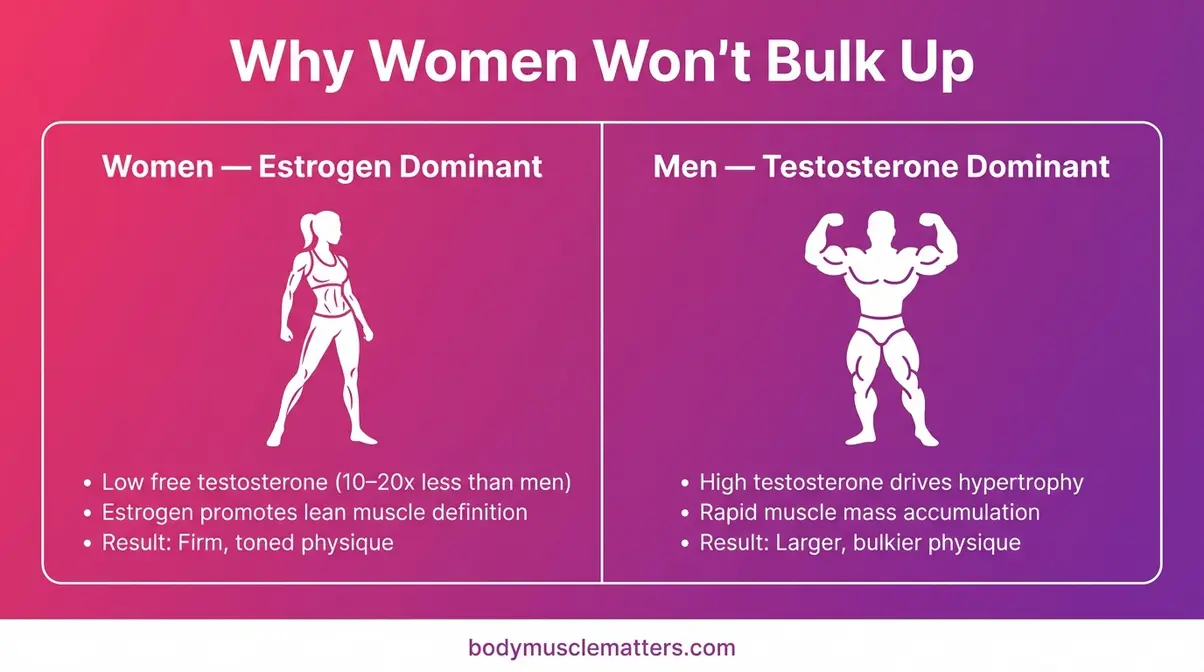
Caption: Women’s lower testosterone levels make the “getting bulky” outcome physiologically unlikely — estrogen promotes lean definition instead.
Cardio vs. Weights for Body Composition
Both cardio and strength training burn calories. Only one of them builds the lean tissue that changes your shape and boosts your resting metabolism long-term.
When you do steady-state cardio (think: a 45-minute jog), your body burns calories during the session and then largely returns to baseline. When you do resistance training, you create microscopic damage in muscle fibers. Your body then spends the next 24–48 hours repairing and reinforcing those fibers — a process called hypertrophy — which burns additional calories even at rest. This is often called the “afterburn effect.”
A 2026 meta-analysis found that women achieve comparable relative gains in muscle mass and strength to men through resistance training, confirming that the process works just as effectively in female physiology (PMC, 2026). For body composition — the ratio of muscle to fat — resistance training is the more direct tool.
This doesn’t mean cardio is useless. Walking, cycling, and yoga all support cardiovascular health and active recovery. The key insight is that strength training should be the anchor of your plan, with cardio as a complement — not the other way around.
What “Toned” Actually Means
“Toned” is one of the most misused words in women’s fitness, but what you’re actually describing is a very real and achievable goal.
Muscle tone refers to the slight tension your muscles maintain even at rest. When you build muscle through resistance training and reduce body fat through nutrition, that resting tension becomes visible. The “toned” look is simply: visible muscle beneath less fat.
You cannot “tone” a muscle without building it. Low-weight, high-rep workouts won’t give you a different type of muscle than heavier lifting — they’ll just build muscle more slowly. The fastest path to the look most women describe as “toned” is progressive strength training paired with adequate protein intake. That’s the foundation of everything that follows.
The Female Strength Trifecta: 3 Pillars
Certified trainers who work exclusively with female beginners tend to find that confusion — not effort — is the real obstacle. Women try cardio, then protein shakes, then a new class format, without a system connecting it all. The Female Strength Trifecta is that system: three pillars that work together to produce consistent, visible results.
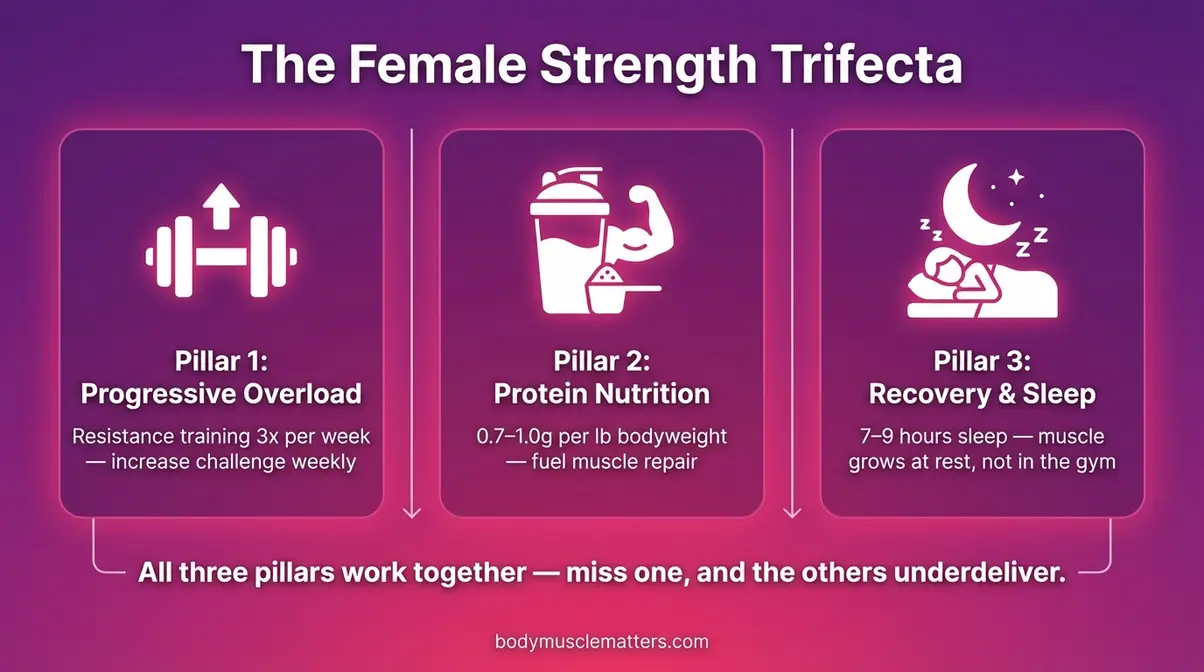
Caption: The Female Strength Trifecta connects training, nutrition, and recovery into one cohesive system — each pillar reinforces the others.
Pillar 1 — Progressive Overload
Progressive overload means gradually increasing the demand you place on your muscles over time. It is the single mechanism that drives muscle growth — everything else supports it.
Here’s why it matters: your muscles adapt to whatever you ask them to do. If you do 10 squats with 15 pounds every session for eight weeks, your muscles will get comfortable at that demand and stop growing. Progressive overload prevents that plateau by giving your muscles a new challenge each week, forcing continued adaptation.
For beginners, this is actually good news. Because your nervous system isn’t yet efficient at recruiting muscle fibers, you’ll experience newbie gains — rapid strength improvements in the first 8–12 weeks that come as much from neurological adaptation as from actual muscle growth. Your first results come fast.
- Practical ways to apply progressive overload:
- Add 2.5–5 lbs to an exercise when you can complete all reps with good form
- Add 1–2 reps to each set before increasing weight
- Decrease rest time between sets by 15–30 seconds
- Progress from bodyweight to a light dumbbell for the same movement
Small, consistent increases compound into significant strength over months. “The Female Strength Trifecta works precisely because progressive overload gives beginners a measurable signal of progress — not just a feeling, but a number going up every week.”
Pillar 2 — Protein-Forward Nutrition
Muscle is built from protein. Specifically, your body uses amino acids from dietary protein to repair and reinforce the muscle fibers you break down during training. Without sufficient protein, your body cannot complete that repair — and the workout goes to waste.
For women building muscle, the research-backed target is 0.7–1.0 grams of protein per pound of bodyweight per day (UCI Susan Samueli Integrative Health Institute, 2026). For a 140-pound woman, that means 98–140 grams of protein daily. This is likely more than you’re currently eating — and that gap is exactly why many women train consistently but don’t see the results they expect.
Protein works best distributed across meals. Research from Mass General Brigham suggests your body can optimally use 20–40 grams of protein per meal for muscle synthesis, with at least 15–25 grams within two hours after your workout (Mass General Brigham, 2026). Spacing your intake — rather than getting all your protein at dinner — gives your muscles a steady supply of building material throughout the day.
| Bodyweight | Minimum Daily Protein | Maximum Daily Protein |
|---|---|---|
| 120 lbs | 84g | 120g |
| 140 lbs | 98g | 140g |
| 160 lbs | 112g | 160g |
| 180 lbs | 126g | 180g |
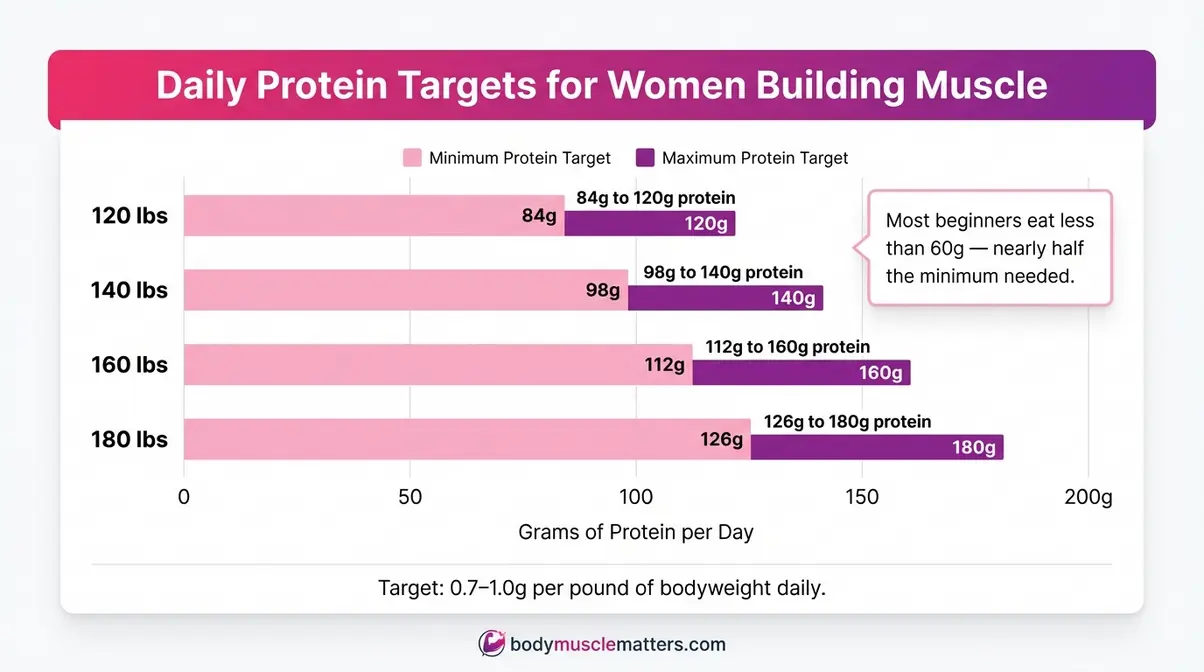
Caption: Use your bodyweight in pounds to find your daily protein target — most beginners fall short of even the minimum range.
Pillar 3 — Recovery and Sleep

Here’s the counterintuitive truth about muscle building: the actual growth happens when you’re not training. Your workout creates the stimulus. Recovery is when your body responds to it.
During sleep, your body releases growth hormone, which drives the repair and reinforcement of muscle tissue. Shortchanging sleep doesn’t just make you tired — it actively limits your results. Research suggests that adults need 7–9 hours of sleep for optimal hormonal function and muscle recovery. For women, sleep also plays a critical role in managing cortisol (your primary stress hormone), which at chronically elevated levels can inhibit muscle protein synthesis (Houston Methodist, 2026).
Rest days are not lazy days. They are biological necessity days. A beginner schedule of 3 training days per week with 4 rest or light activity days gives your muscles enough stimulus to grow and enough time to repair before the next session.
- On your rest days, try:
- A 20–30 minute yoga session (gentle stretching reduces DOMS — delayed-onset muscle soreness — and keeps blood flowing to recovering muscles)
- A 30-minute walk
- Foam rolling tight areas for 10 minutes
Yoga for muscle building is often overlooked as a recovery tool, but it supports flexibility, reduces injury risk, and keeps you moving on non-lifting days without adding stress to the body.
How Females Can Build Muscle Fast
The fastest path to muscle growth for women combines three elements: consistent progressive overload (training 3 days per week and increasing the challenge weekly), adequate protein intake (0.7–1.0g per pound of bodyweight daily), and sufficient sleep (7–9 hours). Research from a 2026 meta-analysis confirms women achieve comparable relative muscle gains to men through resistance training — meaning the process works just as effectively in female physiology. The mistake most beginners make is optimizing one variable (usually protein) while neglecting the others. All three pillars of The Female Strength Trifecta must work together for maximum results.
What to Expect in Your First 90 Days
A common experience for beginners in week one is frustration: the movements feel awkward, your muscles are sore, and the weight feels impossibly light or impossibly heavy. This is normal, and it passes.
Here’s a realistic timeline of what muscle building for women beginners looks like:
| Weeks | What’s Happening | What You’ll Notice |
|---|---|---|
| 1–2 | Nervous system learning new movement patterns | Soreness, some coordination struggles |
| 3–4 | Neural efficiency improving rapidly | Movements feel smoother, strength increasing |
| 5–8 | Newbie gains in full effect | Noticeably stronger; clothes may fit differently |
| 9–12 | First visible muscle definition appearing | Body composition shifting, energy levels up |
Across beginner fitness communities, the consistent feedback is that the biggest transformation in the first 90 days is mental — the gym stops feeling scary, movements become familiar, and strength becomes a source of identity. Physical changes accelerate in months two and three as the body adapts.
Your 3-Day Beginner Workout Plan for Women
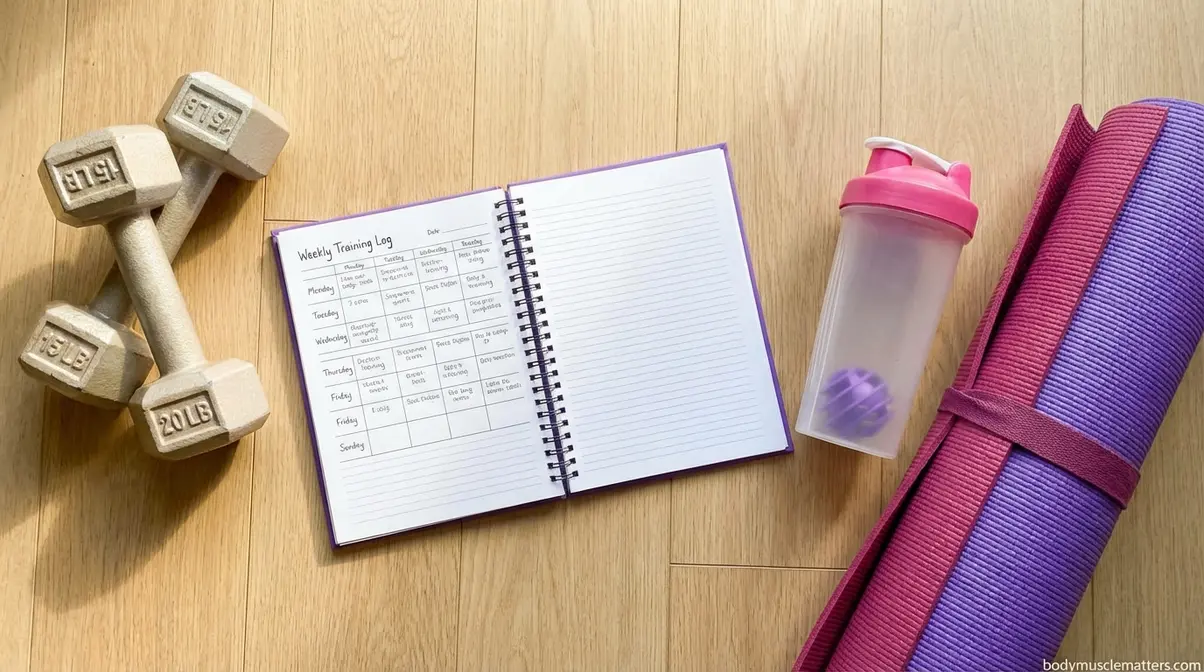
This is the practical core of your muscle-building plan. Three days per week, full-body emphasis, equipment accessible (dumbbells or bodyweight). Each session takes 40–50 minutes.
Structuring Your Training Week
Before the exercises, you need to understand the framework that makes them work.
Sets are groups of repetitions. Reps (repetitions) are the number of times you perform a single movement. For beginners building muscle, the research-supported sweet spot is 3 sets of 10–12 reps per exercise at a weight that challenges you by the final 2–3 reps — but doesn’t cause your form to break down.
Rest between sets: 60–90 seconds. This gives your muscles enough recovery to perform the next set with proper form while maintaining enough metabolic stress to stimulate growth.
The 3-3-3 rule is a simple beginner framework: 3 days per week, 3 sets per exercise, with 3 key compound movements (movements that work multiple muscle groups at once) per session. Compound movements — like squats, hinges, and presses — give beginners the best return on time invested because each movement trains several muscle groups simultaneously.
- Your training week structure:
- Day 1 (e.g., Monday): Lower Body Strength
- Day 2 (e.g., Wednesday): Upper Body Strength
- Day 3 (e.g., Friday): Full Body + Core
- Days 4–7: Active recovery (walking, yoga, rest)
How We Selected These Exercises
Every exercise in this plan was evaluated against three criteria: (1) compound movement priority — each exercise trains two or more muscle groups simultaneously, maximizing training efficiency for beginners with limited gym time; (2) beginner safety — all movements can be performed with bodyweight or light dumbbells before any barbell is introduced, reducing injury risk during the neurological learning phase; and (3) equipment accessibility — every exercise has a home-friendly modification requiring no equipment, ensuring gym intimidation is never a barrier to getting started. This approach aligns with guidance from health institutions like UC Davis Health, which emphasize proper form with manageable weights for beginners.
Certified trainers working with beginner female clients over multiple years consistently recommend this compound-first, bodyweight-before-barbell approach as the foundation for sustainable strength gains.
Day 1 — Lower Body Strength Workout
Warm-up: 5 minutes of light walking or marching in place, then 10 bodyweight squats and 10 hip circles each side.
- Goblet Squat — 3 sets × 10–12 reps
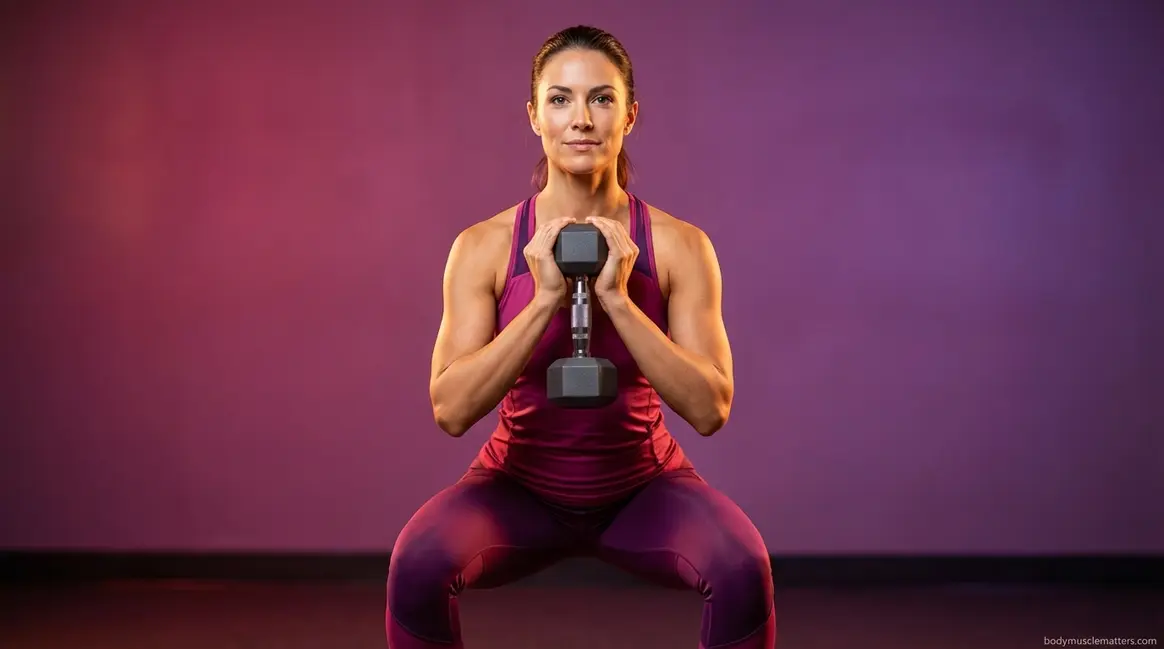
- How: Hold one dumbbell vertically at your chest, feet shoulder-width apart, toes turned slightly out. Push your hips back and down until your thighs are parallel to the floor. Press through your heels to stand.
- Why it matters: Trains your quadriceps (front of thigh), glutes, and core simultaneously. The goblet hold keeps your chest tall and teaches proper squat mechanics.
- At home: Perform without the dumbbell (bodyweight squat).
- Rest: 60–90 seconds between sets.
- Romanian Deadlift (RDL) — 3 sets × 10 reps
- How: Hold dumbbells in front of your thighs, feet hip-width apart. Hinge at your hips — not your waist — pushing them back while keeping your back flat. Lower the weights toward your shins until you feel a stretch in your hamstrings (back of thigh), then drive your hips forward to stand.
- Why it matters: The hip hinge pattern is foundational for back health and targets the hamstrings and glutes — the muscles most women want to develop.
- At home: Slow, controlled bodyweight good mornings (same hinge movement, hands behind your head).
- Rest: 90 seconds.
- Reverse Lunge — 3 sets × 10 reps each leg
- How: Stand tall, step one foot back and lower your rear knee toward the floor (don’t let it slam down). Keep your front shin vertical. Push through your front heel to return to standing.
- Why it matters: Trains each leg independently, correcting strength imbalances, while also training balance and stability.
- At home: Same movement — no equipment needed.
- Rest: 60 seconds.
- Glute Bridge — 3 sets × 15 reps
- How: Lie on your back, knees bent, feet flat on the floor hip-width apart. Press through your heels and squeeze your glutes to lift your hips until your body forms a straight line from knees to shoulders. Hold 1 second at the top, then lower slowly.
- Why it matters: Directly targets the glutes in a beginner-safe position with zero spinal loading.
- At home: Same — no equipment needed.
- Rest: 60 seconds.
Cool-down: 5 minutes of hip flexor stretches and seated hamstring stretches.
Day 2 — Upper Body Strength Workout
Warm-up: 5 minutes of arm circles, shoulder rolls, and 10 band pull-aparts (or gentle resistance with a towel).
- Dumbbell Chest Press — 3 sets × 10–12 reps
- How: Lie on a bench or the floor, dumbbells in each hand at chest height, elbows at roughly 45 degrees from your body. Press the dumbbells up until your arms are nearly straight, then lower slowly.
- Why it matters: Trains the chest (pectorals), front shoulders, and triceps — your primary pushing muscles.
- At home: Floor press (same movement on the floor).
- Rest: 60–90 seconds.
- Dumbbell Row — 3 sets × 10–12 reps each arm
- How: Place your opposite knee and hand on a bench for support (or stand bent forward at the hips). Hold a dumbbell in the working hand, let it hang, then drive your elbow straight back and up, squeezing your shoulder blade at the top. Lower slowly.
- Why it matters: Builds the back muscles (latissimus dorsi and rhomboids), directly improving posture — one of the most noticeable early results women report.
- At home: Bent-over row from standing position.
- Rest: 60 seconds.
- Dumbbell Overhead Press — 3 sets × 10 reps
- How: Sit or stand with dumbbells at shoulder height, palms facing forward. Press straight up until arms are extended overhead, then lower slowly.
- Why it matters: Trains the deltoids (shoulders) and triceps, building the shoulder definition that creates a more athletic silhouette.
- At home: Same movement — just needs dumbbells.
- Rest: 60–90 seconds.
- Dumbbell Bicep Curl — 3 sets × 12 reps
- How: Stand with dumbbells at your sides, palms facing forward. Curl both weights toward your shoulders, keeping your elbows pinned to your sides. Lower slowly.
- Why it matters: Directly targets the biceps — and teaches controlled eccentric (lowering) movement, which is where significant muscle damage and adaptation occurs.
- At home: Same movement.
- Rest: 60 seconds.
Cool-down: 5 minutes of chest-opener stretches and doorway pec stretches.
Day 3 — Full-Body and Core Workout
This session ties everything together and includes movements that build core strength (your abdominal and lower back muscles working as a unit) — the base for all other strength.
Warm-up: 5 minutes light cardio, then 10 cat-cow stretches.
- Dumbbell Sumo Deadlift — 3 sets × 10 reps
- How: Stand with feet wider than shoulder-width, toes turned out at 45 degrees, holding one dumbbell with both hands between your legs. Hinge at the hips and bend your knees to lower the weight toward the floor, back flat. Drive through your heels to stand, squeezing your glutes at the top.
- At home: Wide-stance bodyweight squat.
- Rest: 90 seconds.
- Push-Up — 3 sets × 8–10 reps (or as many as possible with good form)
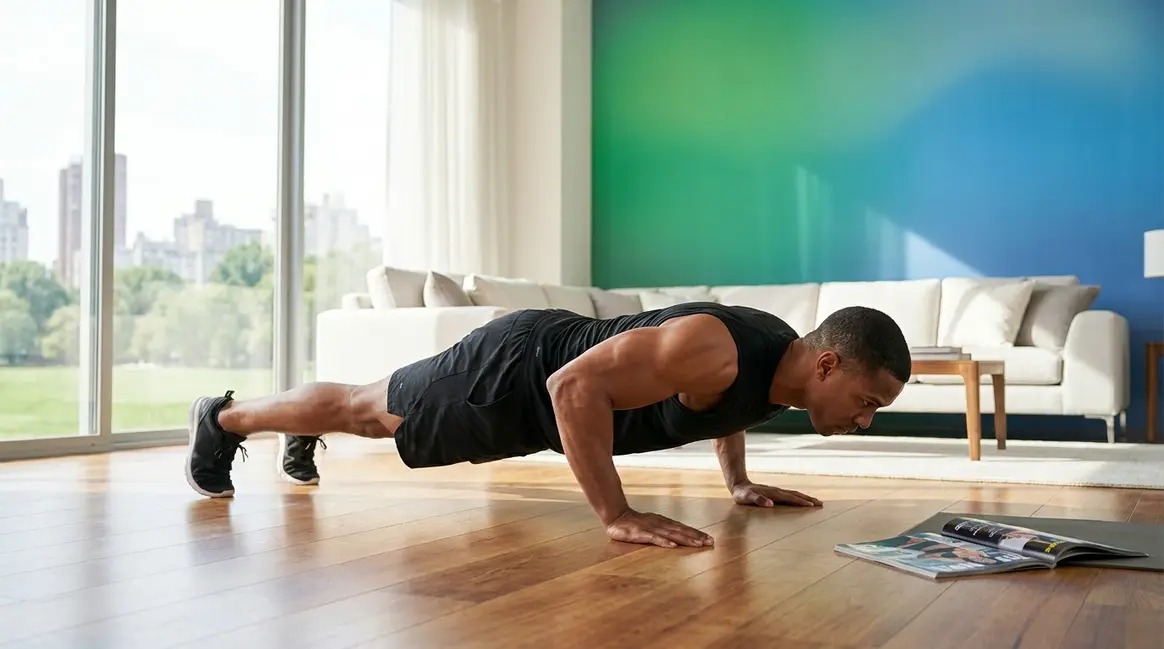
- How: Hands slightly wider than shoulders, body in a straight line from head to heels (or from head to knees for a beginner modification). Lower your chest toward the floor, then push back up.
- At home: Same — zero equipment needed.
- Rest: 60 seconds.
- Plank — 3 sets × 20–30 seconds
- How: Forearms on the floor, elbows under your shoulders, body in a straight line. Brace your core (think: tighten your abs as if someone is about to poke your stomach) and hold.
- Why it matters: Trains the entire core as a stabilizing unit — the foundation of every compound lift.
- At home: Same.
- Rest: 60 seconds.
- Dead Bug — 3 sets × 8 reps each side
- How: Lie on your back, arms extended toward the ceiling, knees bent at 90 degrees in the air. Slowly lower your right arm and left leg toward the floor simultaneously — keeping your lower back pressed flat to the floor — then return. Alternate sides.
- Why it matters: Trains deep core stability and the coordination between opposite limbs, reducing lower back strain during all other exercises.
- At home: Same.
- Rest: 60 seconds.
Cool-down: 5 minutes of full-body stretching, focusing on hips and thoracic spine.
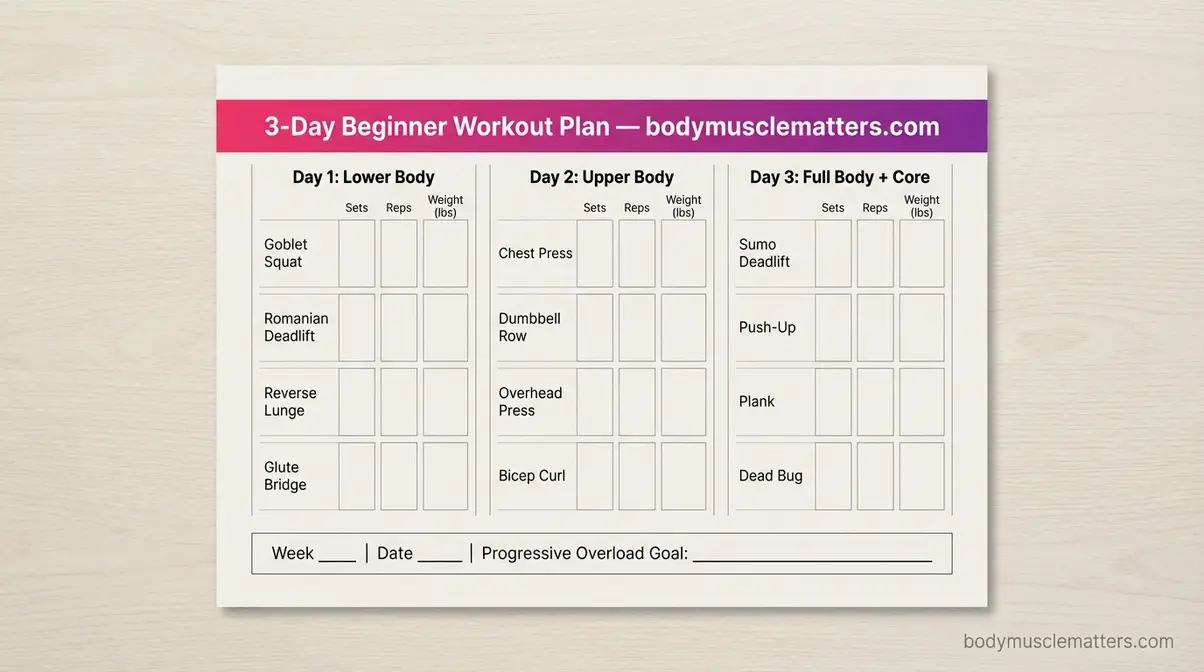
Caption: Print this 3-day plan and track your sets, reps, and weights each session — progress tracking is what turns workouts into results.
Weekly Progression: Applying Overload
Knowing the plan is half the equation. Knowing how to advance it week by week is what separates women who plateau from women who keep getting stronger.
Use this simple rule: when you can complete all sets and reps with good form, and the last 2 reps of the final set feel manageable, add 2.5–5 lbs at your next session. If you’re using bodyweight movements, add a rep or slow down the tempo (a 3-second lowering phase instead of 1 second doubles the difficulty without adding load).
Track your workouts. Even a simple note in your phone — “Goblet squat: 20 lbs × 3 sets × 12 reps” — creates the data you need to progress consistently. Without tracking, it’s almost impossible to apply progressive overload intentionally.
Nutrition for Muscle Growth: What Women Need
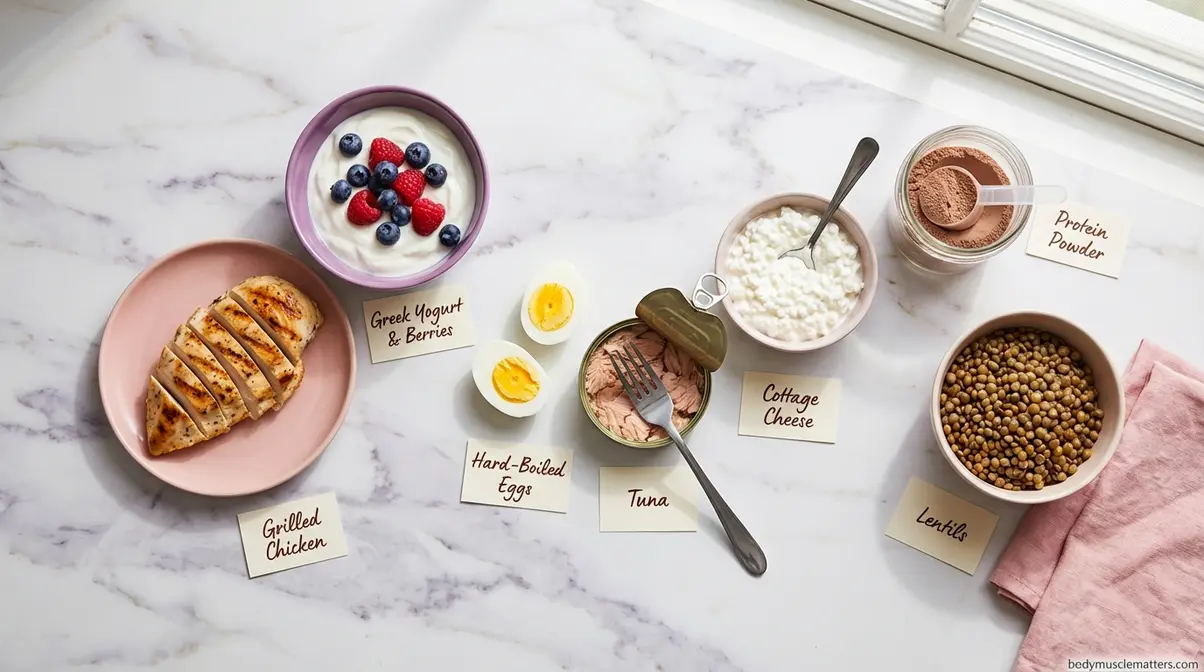
Training breaks your muscles down. Nutrition builds them back up. Get the training right and the nutrition wrong, and your results will stall. This section covers what actually matters — and why it’s simpler than most fitness content suggests.
How Much Protein Do Women Need?
Protein is the most important nutritional variable for women building muscle — and most beginners are significantly under-eating it.
The research-backed recommendation for active women aiming to build or preserve muscle is 0.7–1.0 grams of protein per pound of bodyweight daily (UCI Susan Samueli Integrative Health Institute, 2026). The standard dietary minimum of 0.36 grams per pound is designed to prevent deficiency — not to support muscle growth. For building muscle, you need roughly double that minimum.
Practical protein sources that are easy to hit consistently:
| Food Source | Serving Size | Protein |
|---|---|---|
| Chicken breast | 4 oz (cooked) | ~35g |
| Greek yogurt | 1 cup | ~17g |
| Eggs | 2 large | ~12g |
| Canned tuna | 3 oz | ~20g |
| Lentils | ½ cup cooked | ~9g |
| Cottage cheese | ½ cup | ~14g |
| Protein shake | 1 scoop | ~20–25g |
Aim to include one protein source at every meal and at least one snack. Distributing your protein — rather than front-loading it at dinner — helps your muscles receive a steady supply of amino acids throughout the day (Harvard Health, 2026).
Carbs, Fats, and Hormonal Health
Protein gets most of the attention in muscle-building nutrition. But carbohydrates and fats play equally critical roles — particularly for women’s hormonal health.
Carbohydrates are your muscles’ preferred fuel source during strength training. When you lift weights, your muscles burn glycogen (stored carbohydrate) for energy. Going into a session with depleted glycogen — common among women following low-carb or keto diets — leads to weaker performance, earlier fatigue, and reduced training volume. Less volume means less stimulus for growth.
Beyond performance, carbohydrates play a direct role in regulating hormones like insulin and cortisol. The official Dietary Guidelines for Americans suggest that carbohydrates should make up 45-65% of total daily calories to support energy and bodily functions. Chronically low carbohydrate intake in women has been associated with elevated cortisol and disruption of the menstrual cycle — a signal that the body perceives it’s under stress. For women focused on body comp, this is counterproductive.
Dietary fat is essential for producing hormones — including estrogen and progesterone, the primary female sex hormones. Diets too low in fat (below roughly 20% of total calories) can suppress estrogen production, which impairs both mood and muscle-building potential. Healthy fat sources like avocado, olive oil, nuts, seeds, and fatty fish support hormonal balance while providing fat-soluble vitamins your body needs.
“Women who restrict both carbs and fat simultaneously in an effort to lose weight are often unknowingly suppressing the very hormonal environment that makes muscle growth possible.”
Should You Eat in a Calorie Surplus?
The short answer for most beginners: a modest calorie surplus helps — but it’s not always necessary, and it’s not as large as you might fear.
A calorie surplus means eating slightly more than your body burns in a day. The extra calories provide the raw material for building new muscle tissue. For beginners, a surplus of 200–300 calories per day above maintenance is sufficient for steady muscle gain without significant fat accumulation.
However, women new to lifting often experience “body recomposition” — simultaneously building muscle and losing fat — particularly in the first 3–6 months. This is possible even at maintenance calories, and sometimes even in a small deficit, because the body is highly responsive to the new stimulus of strength training. If you’re starting from a place of higher body fat, you don’t necessarily need to eat more to start seeing muscle growth.
The most important signal to watch: if you’re consistently losing strength from week to week despite training hard, you’re likely underfueling. Add 150–200 calories per day from whole-food sources and reassess over two weeks.
Sample 7-Day Muscle-Building Meal Plan
This plan provides approximately 130–160 grams of protein per day and is designed for a woman in the 130–160 pound range. Adjust portion sizes up or down based on your weight and appetite.
Daily Protein Target: ~130–160g | Approx. Calories: 1,900–2,300
| Day | Breakfast | Lunch | Dinner | Snack |
|---|---|---|---|---|
| Mon | Greek yogurt + berries + granola | Chicken + quinoa + roasted veggies | Salmon + sweet potato + green beans | Cottage cheese + apple |
| Tue | 3-egg omelet + whole grain toast | Tuna salad wrap + side salad | Ground turkey stir fry + brown rice | Protein shake + banana |
| Wed | Protein oats + almond butter | Lentil soup + whole grain bread | Chicken thighs + roasted broccoli | Hard-boiled eggs x2 |
| Thu | Greek yogurt parfait + nuts | Turkey + avocado wrap | Shrimp + zucchini noodles + marinara | Cottage cheese + cucumber |
| Fri | Scrambled eggs + smoked salmon | Chicken + farro + kale salad | Baked cod + roasted potatoes | Protein shake |
| Sat | Protein pancakes + berries | Ground beef taco bowls + veggies | Grilled chicken + whole grain pasta | Edamame + string cheese |
| Sun | 3-egg omelet + avocado toast | Lentil + vegetable curry + rice | Pork tenderloin + roasted Brussels sprouts | Greek yogurt + walnuts |
Hormonal health note: Include fatty fish (salmon, mackerel) 2–3 times per week to support estrogen metabolism. Cruciferous vegetables (broccoli, Brussels sprouts, kale) support liver detoxification of excess estrogen — particularly relevant for women experiencing PMS symptoms.
Common Beginner Strength Training Mistakes
Even motivated beginners fall into predictable patterns that slow their progress. Recognizing these pitfalls early can save weeks of frustration.
Common Pitfalls
1. Avoiding progressive overload because “the weight feels good”
Comfort in the gym is a signal that you’re not growing. If your last set of 12 reps doesn’t feel challenging by rep 10, the weight is too light. Many women choose weights based on what feels manageable on rep 1 — not what challenges them at rep 12. Increase the weight before you feel completely ready.
2. Prioritizing cardio over strength training when pressed for time
When time is short, most women default to cardio and skip lifting. This habit compounds over weeks: the training that drives body composition change gets cut most often. If you have 30 minutes, do strength training. A 30-minute full-body lifting session outperforms a 30-minute treadmill walk for muscle building.
3. Undereating protein while eating in a calorie surplus
Eating more calories but not enough protein means the surplus primarily goes to fat storage, not muscle building. The quality of your calorie surplus matters. Prioritize hitting your protein target before adding any additional calories from carbs or fat.
4. Skipping rest days because “more is better”
A common experience for beginners in week three or four: energy drops, motivation slumps, and soreness stops fading between sessions. This is overreaching — training before the body has recovered. More training days do not accelerate results when recovery is incomplete. Rest is where results happen.
5. Expecting visible results in two weeks
Muscle protein synthesis is a slow biological process. You will likely feel stronger within two weeks, but visible changes typically appear at the 6–12 week mark. The beginner mistake is abandoning the program at week three because the mirror hasn’t changed yet. Progress is happening at the cellular level — stay consistent.
When to Choose Alternatives
If you have a joint injury (knee, shoulder, hip): A standard beginner lifting program may not be appropriate without modification. Work with a physical therapist or certified trainer to identify safe exercise substitutions before starting independently.
If you’re currently in a very high-stress period (new job, major life event, significant sleep deprivation): Adding an intense training stimulus on top of elevated cortisol can be counterproductive. A gentle walking-and-yoga program for 2–4 weeks to stabilize cortisol, followed by gradual introduction of strength training, may serve you better.
If you’re newly postpartum: Core and pelvic floor rehabilitation should come before general strength training. Consult a women’s health physical therapist before returning to any strength program.
When to Seek Expert Help
- Consider working with a certified personal trainer (CPT) or strength and conditioning specialist (CSCS) if:
- Your form consistently breaks down despite slow, conscious practice
- You experience pain (not soreness — pain) during any exercise
- You’ve been lifting for 12+ weeks without measurable strength progress
- You have a medical condition that affects how you should train
Consulting a registered dietitian is recommended if you’re navigating strength training alongside a specific health condition, hormonal imbalance diagnosis, or disordered eating history.
Frequently Asked Questions
How Can a Beginner Build Muscle?
Muscle building for women beginners starts with three foundational practices: resistance training 3 days per week, hitting 0.7–1.0 grams of protein per pound of bodyweight daily, and getting 7–9 hours of sleep per night. Begin with compound movements — squats, deadlifts, rows, and presses — using bodyweight or light dumbbells. Focus on progressive overload: add small amounts of weight or additional reps each week. Most beginners see measurable strength gains within 2–4 weeks and visible body composition changes by weeks 8–12.
What is the 3-3-3 rule at the gym?
The 3-3-3 rule is a beginner training framework built around three threes: train 3 days per week, perform 3 sets per exercise, and anchor each session around 3 compound movements (exercises that work multiple muscle groups simultaneously). For women starting out, this structure prevents overtraining, builds a sustainable habit, and ensures each session delivers enough stimulus for muscle growth. It’s a practical starting point — not a permanent ceiling. Most women progress to 4 training days after 3–6 months.
Can I build muscle while on Zepbound?
Building muscle while on Zepbound (tirzepatide) is possible, but it requires deliberate effort. GLP-1/GIP medications like Zepbound reduce appetite significantly — making it harder to hit protein and calorie targets. Research suggests that up to 30–40% of weight lost on GLP-1 medications can come from lean mass (not fat), making resistance training and high protein intake essential countermeasures (Sword Health, 2026). Aim for at least 0.7–1.0 grams of protein per pound of bodyweight daily and perform strength training a minimum of 2–3 days per week. Consult your prescribing physician before making any changes to your exercise or nutrition program while on Zepbound.
Can you build muscle with high cortisol?
Chronically elevated cortisol — your body’s primary stress hormone — impairs muscle growth by breaking down muscle protein and reducing the effectiveness of anabolic hormones. A 2021 Mendelian randomization study published in the Journal of Clinical Endocrinology found that elevated cortisol is causally associated with reduced muscle strength and lean mass, with stronger associations observed in women than men (PubMed, 2021). You can still build muscle with high cortisol, but addressing the root cause — chronic stress, poor sleep, overtraining — will accelerate your results significantly. Resistance training itself, done moderately, actually helps regulate cortisol over time (Stanford Lifestyle Medicine, 2026). If you suspect a cortisol imbalance related to a medical condition, consult your doctor before starting a new training program.
What to avoid while building muscle?
The most common muscle-building mistakes for women include: undereating protein (the single biggest limiter); skipping rest days, which prevents muscle repair; neglecting progressive overload by staying at the same weights indefinitely; doing excessive cardio at the expense of strength training; and expecting results faster than the biological timeline allows. Alcohol consumption also impairs muscle protein synthesis — even moderate amounts can blunt the recovery response after training. Sleep deprivation below 6 hours per night consistently ranks as one of the most effective ways to limit muscle growth, regardless of how perfect your training and nutrition are.
What is the 30-30-30 rule for women?
The 30-30-30 rule is a morning wellness habit popularized on social media: eat 30 grams of protein within 30 minutes of waking up, then do 30 minutes of low-intensity exercise (like walking or yoga). The Cleveland Clinic notes that while direct studies on the exact protocol are limited, the underlying components have individual research support — morning protein intake boosts satiety and muscle protein synthesis, while light exercise supports blood sugar regulation and cortisol management (Cleveland Clinic, 2026). For muscle building, the 30-gram morning protein target is well-supported. The low-intensity movement pairs well with rest days or as a warm-up habit before your actual strength sessions.
Is There an Age Limit to Build Muscle?
There is no age at which women can no longer build muscle. While natural muscle loss (sarcopenia) accelerates after age 50 — declining approximately 1–2% per year (Anti-Aging Journal, 2026) — resistance training remains effective at stimulating muscle growth at every age. Research consistently shows that women in their 60s, 70s, and beyond respond positively to strength training. The mechanisms are slower, and the protein requirements may be slightly higher, but hypertrophy remains achievable. Starting strength training at any age reduces sarcopenia risk, improves bone density, and supports metabolic health. Starting earlier simply means more time to build the foundation.
Your Strongest Chapter Starts Here
For women building muscle, the science is clear: estrogen supports lean muscle growth, testosterone levels make the “bulky” outcome physiologically unlikely, and resistance training is the most effective tool for body composition change available — outperforming cardio for every goal most women actually have. A 2026 PMC meta-analysis confirmed that women achieve the same relative muscle gains as men through resistance training, meaning the biology works in your favor more than the fitness industry has ever told you.
The Female Strength Trifecta — resistance training, protein-forward nutrition, and consistent recovery — is the framework that makes this manageable. You don’t need a complicated program, a perfect diet, or an expensive gym. You need three honest training sessions per week, a protein target to hit, and enough sleep to let your body do its job. These three pillars don’t work independently; they compound. Miss one consistently, and the other two underdeliver. Keep all three in place, and beginner gains arrive faster than most women expect.
Your next step is specific: choose your starting day this week, complete Day 1 of the lower body workout above, and log your weights. Don’t wait until you feel “ready” or until the gym feels less intimidating — both of those feelings fade after the first session, not before it. If questions come up about your individual health, exercise modifications, or whether a strength program is appropriate for your current situation, consult a qualified healthcare professional before beginning. This plan is built for you — the woman who’s motivated, a little nervous, and done waiting.
Related posts:
Benefits of Yoga for Fitness: The Science-Backed Guide
Home Workouts to Build Muscle Without Weights (2026)
CrossFit Strength Training for Beginners: 2026 Guide
Home Workout Plan for Beginners: 30-Day Step-by-Step
How to Self Massage Calves: The 4-Layer Method Guide
Strength Training for Beginners: Complete Workout Plan 2026

Callum
Hi, I'm Callum, the founder of Body Muscle Matters. I'm not a certified trainer, I'm a self taught lifter who started this site to share what I've learned from my own training and a lot of trial and error. Everything here comes from real experience and honest research, written the way I'd explain it to a friend who is just getting started. My goal is simple: practical, no hype fitness advice you can actually use.