You already know strength training is supposed to be good for you. What nobody tells you is where — exactly — to begin.
Most beginner guides hand you a list of exercises and wish you luck. This one is different. Strength training for women beginners works best when you build confidence and physical strength at the same time, because one fuels the other. Miss the confidence piece, and most women quit by week three.
This guide gives you a complete 4-week program built on The Confidence-to-Strength Ladder — a framework that pairs each training week with a specific confidence milestone. You’ll also get 12 exercises with step-by-step form cues, answers to the questions your doctor might not have time to answer (including GLP-1 medication guidance), and everything you need to walk into any gym — or your living room — and lift with purpose.
⚠️ Medical Disclaimer: The information in this article is for educational purposes only and does not constitute medical advice. Consult a qualified healthcare professional before beginning any new exercise program, especially if you have pre-existing health conditions, are pregnant, or are currently taking prescription medications (including GLP-1 agonists such as Zepbound or Ozempic). Stop exercising immediately if you experience pain, dizziness, or shortness of breath.
Strength training for women beginners delivers measurable results in strength, bone density, and metabolism within 4–8 weeks when you follow a structured, progressive program. The Confidence-to-Strength Ladder framework ensures you build self-belief alongside physical capacity — the combination that keeps beginners consistent.
- Start with 2 days/week: Research from the American College of Sports Medicine (ACSM) supports 2–3 sessions per week for beginners to maximize adaptation while preventing overuse injury.
- Progressive overload is the engine: Gradually increasing weight or reps over time is the single most important variable for long-term strength gains.
- Compound movements first: Squats, deadlifts, and rows recruit multiple muscle groups simultaneously — giving beginners the most return on their time investment.
- Bone density matters at every age: Women can lose up to 3–5% of bone mass per decade after 30; resistance training is one of the most effective interventions available (NIH, 2026).
Why Strength Training Empowers Women
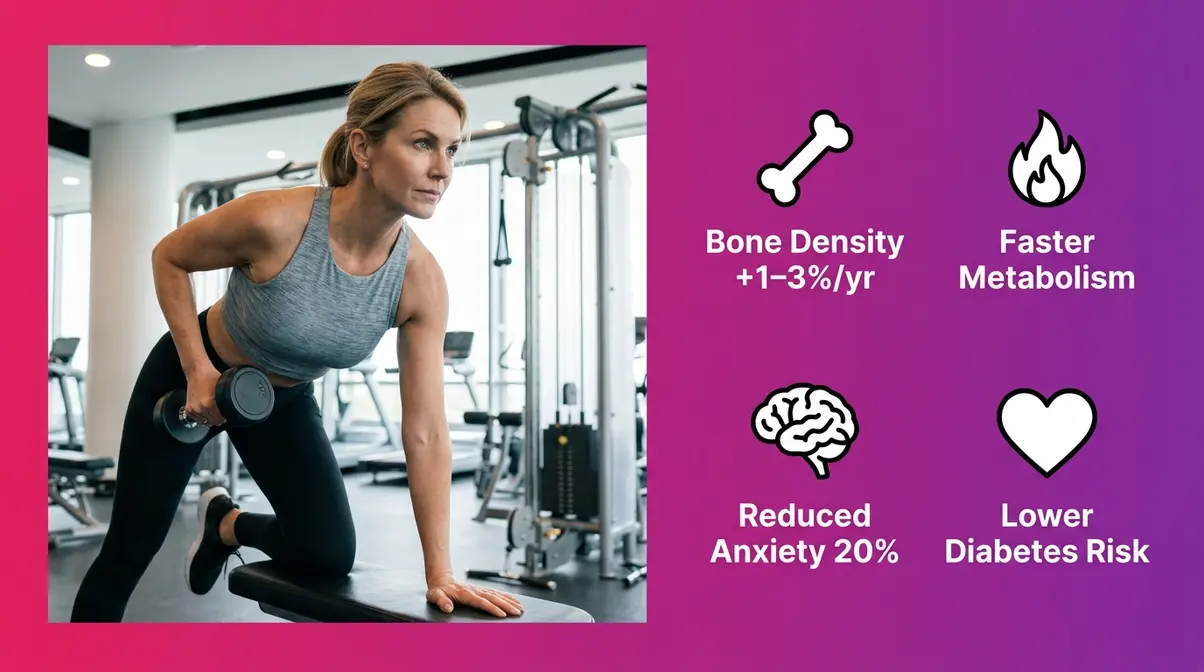
Strength training delivers unique benefits for women that cardio alone cannot replicate. Understanding what is strength training is the first step toward transforming your body composition and long-term health. Research consistently shows that resistance exercise increases lean muscle mass, supports metabolic health, and protects bone density — three outcomes that become increasingly critical as women age. According to the National Institutes of Health (NIH), women who perform regular resistance training can reduce their risk of osteoporosis-related fractures by up to 40% compared to sedentary peers. This means that strength training for women is not just a fitness trend, but a fundamental pillar of longevity.
Many women avoid the weight room because of a persistent myth: that lifting will make them look “bulky.” Certified personal trainers consistently report this is the number-one concern they hear from new female clients — and the most thoroughly debunked one in exercise science. Women produce roughly 10–20 times less testosterone than men, which means the hormonal environment for large-scale muscle hypertrophy (significant muscle growth) simply doesn’t exist in most women’s bodies without years of dedicated, specialized training. What you will gain is muscle tone, definition, and a metabolism that works harder even at rest.
Here is what the research actually shows about strength training benefits for women:
| Benefit | Evidence | Source |
|---|---|---|
| Increased resting metabolic rate | Each pound of muscle burns ~6 calories/day at rest | ACSM, 2026 |
| Improved bone mineral density | Resistance training increases BMD 1–3% per year in premenopausal women | NIH, 2026 |
| Reduced risk of type 2 diabetes | Muscle tissue is the primary site for glucose uptake | American Diabetes Association, 2026 |
| Improved mood and reduced anxiety | 8 weeks of resistance training reduces anxiety symptoms by 20% | JAMA Psychiatry meta-analysis, 2026 |
| Functional strength for daily life | Lifting grocery bags, climbing stairs, and preventing falls | ACSM Position Stand, 2026 |
“Women who begin strength training consistently report that the physical changes feel secondary to the mental shift — the realization that they are capable of more than they believed,” notes exercise physiologist Dr. Stacy Sims, whose work on female-specific training physiology has been widely cited in sports medicine literature.
Beyond the physical numbers, there is a compounding confidence effect. Every time you add weight to the bar or complete a set you didn’t think you could finish, you generate evidence that you are stronger than you believed. That evidence accumulates. The Confidence-to-Strength Ladder is built on exactly this mechanism — each week of training is designed to generate a specific confidence milestone, not just a physical one.
The Over-40 and Menopause Factor
Women lose an average of 3–8% of muscle mass per decade starting in their 30s — a process called sarcopenia (age-related muscle loss). After menopause, this rate accelerates significantly due to declining estrogen levels, which play a protective role in muscle fiber maintenance. According to Harvard Health, combating age-related muscle loss requires consistent resistance exercise. The Cleveland Clinic’s guidance on menopause and exercise recommends resistance training as a first-line intervention for preserving lean mass and supporting bone health during this transition. Incorporating strength training for seniors or modifying routines for joint health ensures these benefits remain accessible at any age.
For women over 40 reading this guide: you are not starting too late. Research published in the Journal of Strength and Conditioning Research found that postmenopausal women who began resistance training made strength gains comparable to younger women over a 12-week program. Your body’s adaptation capacity is remarkably resilient.
Strength Training on GLP-1 Medications
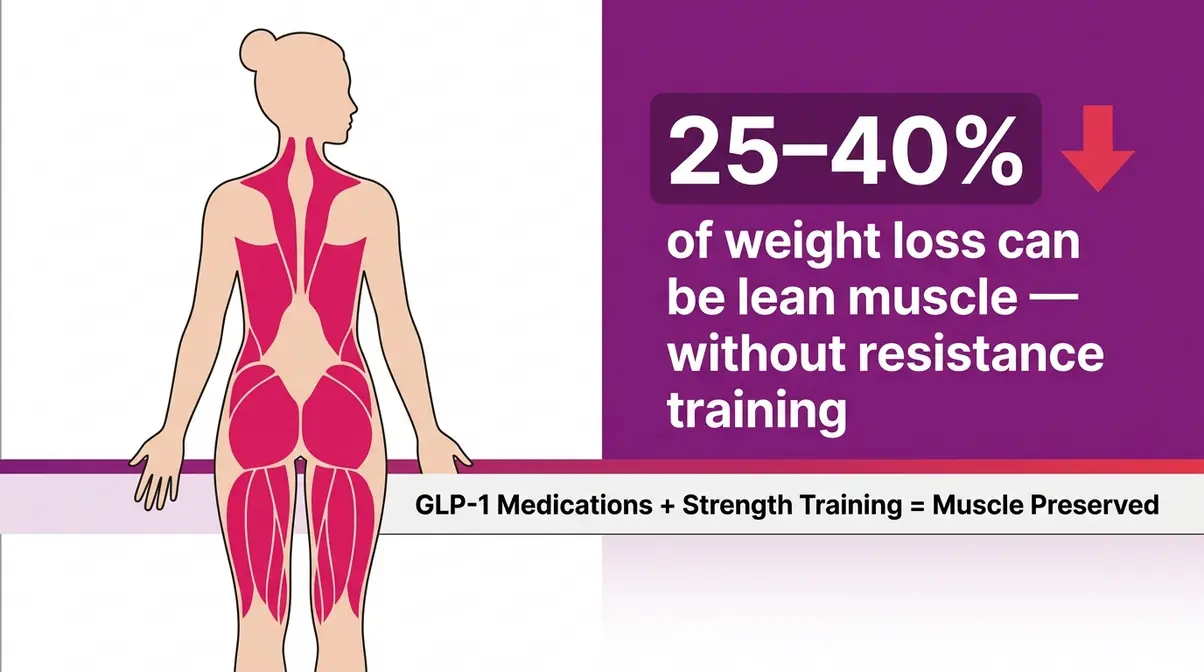
If you are currently taking a GLP-1 receptor agonist (a class of medications including tirzepatide/Zepbound and semaglutide/Ozempic and Wegovy), strength training is not just beneficial — it may be essential. GLP-1 medications promote significant weight loss, but clinical data shows that without resistance exercise, up to 25–40% of that weight loss can come from lean muscle mass rather than fat tissue (New England Journal of Medicine, 2026).
The Mayo Clinic’s guidance on exercise and weight-loss medications specifically recommends pairing GLP-1 therapy with resistance training to preserve metabolic health. Practically, this means: prioritize protein intake (certified dietitians recommend 0.7–1.0 grams per pound of body weight daily), begin with 2 strength sessions per week, and focus on compound movements that recruit large muscle groups. The 4-week program in this guide is directly applicable to women on GLP-1 medications — start at the lower end of the rep ranges and progress conservatively.
Sets, Reps, and Progressive Overload
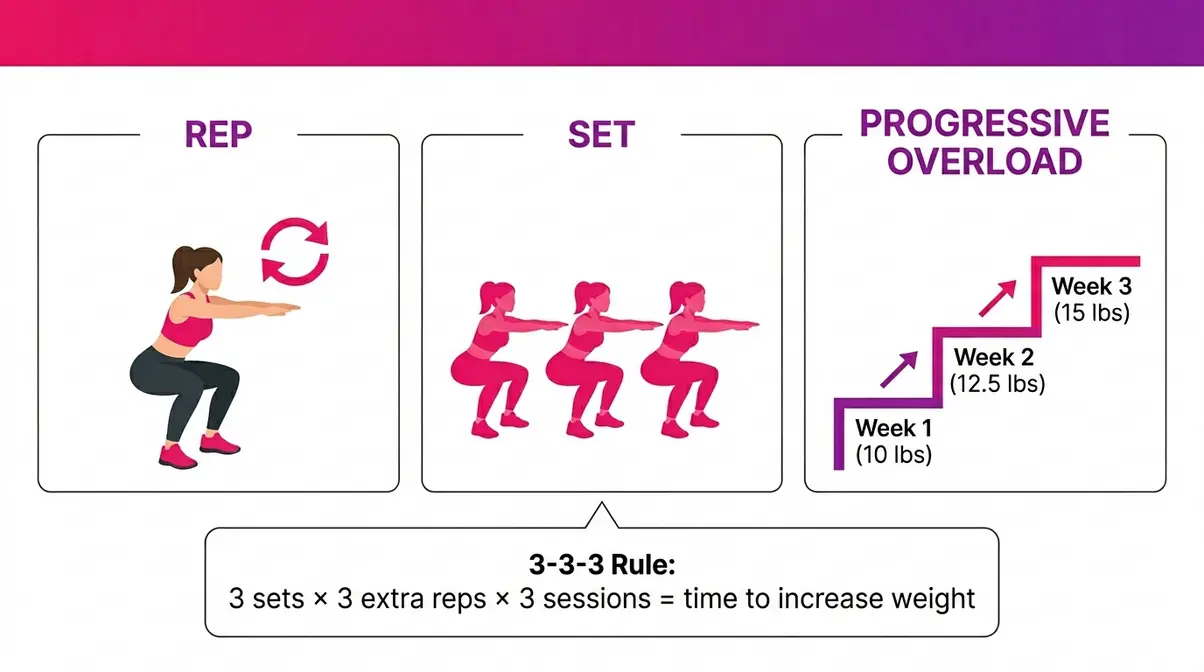
Before you touch a weight, understanding three concepts will make every training session more effective. When exploring strength training for women beginners, mastering these foundational building blocks removes the guesswork that keeps most new lifters stuck.
“Follow a beginner, full-body program for a year. Don’t skip sessions. Always push to near failure and incrementally add resistance.”
This advice, shared widely in strength training communities, captures the entire philosophy of beginner programming in four sentences. Let’s break down what each part means.
Sets and Reps Explained
A rep (repetition) is one complete movement — lowering into a squat and standing back up is one rep. A set is a group of reps performed consecutively before resting. So “3 sets of 10 reps” means you perform 10 squats, rest 60–90 seconds, repeat that sequence three times.
For beginners, certified personal trainers recommend starting with 2–3 sets of 10–15 reps per exercise. This rep range builds both strength and muscle endurance simultaneously — an efficient combination for new lifters. As your body adapts (usually within 2–3 weeks), you increase either the weight or the reps. This brings us to the most important concept in all of strength training.
Progressive Overload Explained
Progressive overload means gradually increasing the demand on your muscles over time. Your muscles adapt to a given workload within 2–4 weeks. If you always lift the same weight for the same reps, your body stops changing — because it has already adapted.
- Progression doesn’t always mean adding weight. You can progress by:
- Adding 1–2 reps to each set before increasing weight
- Reducing rest time between sets
- Improving your range of motion (how deep you squat, for example)
- Adding a third set to exercises where you previously did two
The 3-3-3 Rule is a simple framework certified trainers use with beginners: when you can complete 3 sets of 3 extra reps beyond your target (e.g., 13 reps when your goal is 10) for 3 consecutive sessions, it is time to increase the weight by the smallest available increment — typically 2.5–5 pounds.
Why Rest Days Are Training Days
Muscles do not grow during a workout — they grow during recovery. Resistance training creates microscopic tears in muscle fibers. During rest, your body repairs those fibers slightly thicker and stronger than before. This process, called muscle protein synthesis, requires adequate sleep (7–9 hours) and protein intake.
For beginners, the ACSM recommends at least 48 hours of rest between sessions targeting the same muscle groups. The CDC physical activity guidelines support this approach, emphasizing the importance of recovery for long-term adherence. A 2-day-per-week full-body program naturally builds this recovery window into the schedule — which is exactly why this guide’s 4-week program is structured that way.
| Term | Plain-English Definition |
|---|---|
| Rep | One complete movement (e.g., one squat) |
| Set | A group of reps performed without stopping |
| Progressive overload | Gradually increasing weight or reps over time |
| Rest interval | Time between sets (60–90 seconds for beginners) |
| Muscle protein synthesis | The repair process that makes muscles stronger |
| Compound exercise | A movement using multiple muscle groups at once |
| Isolation exercise | A movement targeting one specific muscle |
How Many Days Per Week to Train?
Beginners should start with 2 full-body strength sessions per week, separated by at least 48 hours of rest. The ACSM’s 2026 position stand on resistance training recommends 2–3 days per week for untrained individuals to maximize adaptation while preventing overuse injury. After 4–6 weeks of consistent training, you can add a third day. Starting with 2 days reduces overwhelm and builds the consistency habit that matters most in the first month.
What Weight Should You Start With?
Start with a weight where the last 2–3 reps of each set feel challenging — but where your form stays perfect throughout. For most women new to strength training, this means 8–15 lbs for lower-body exercises like squats and deadlifts, and 5–12 lbs for upper-body exercises like shoulder presses and rows. A practical test: if you can complete 12 reps with perfect form and feel like you could do 10 more easily, the weight is too light. Increase by 2.5–5 lbs.
12 Foundational Exercises & Form
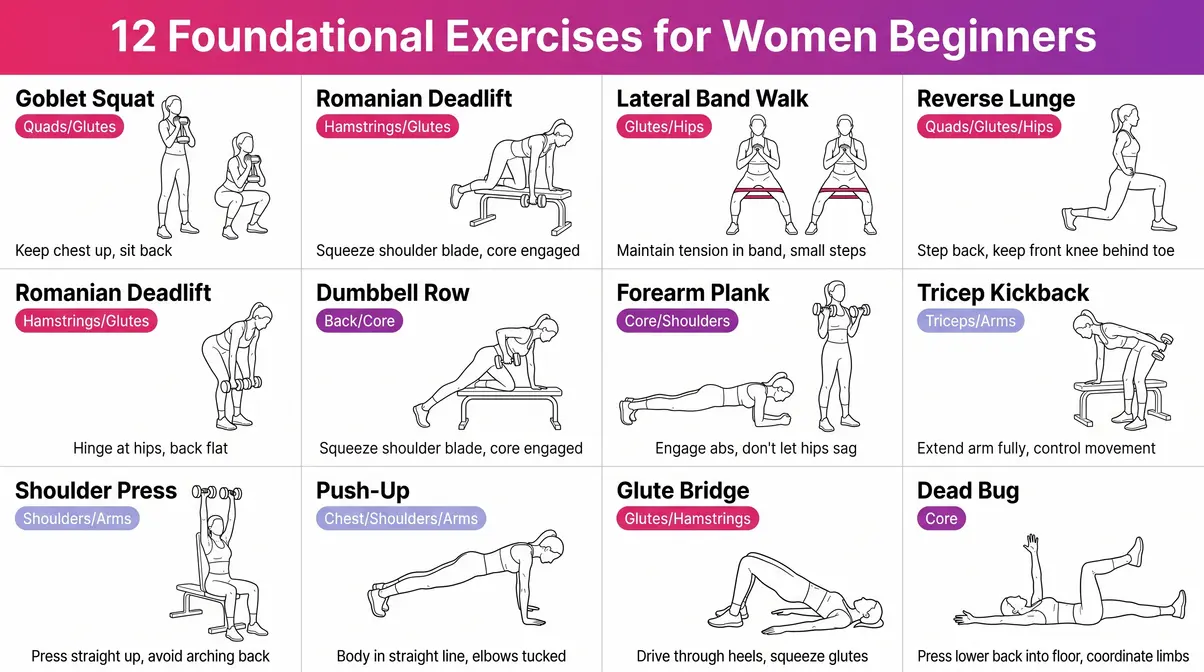
These 12 exercises form the complete exercise library for this program — chosen because they build total-body strength using minimal equipment. A core component of strength training for women beginners is mastering these basic movements safely. Certified personal trainers selected them based on three criteria: safety for beginners, high muscle recruitment, and scalability (each can be made easier or harder as you progress). You do not need all 12 on day one. The 4-week program in the next section tells you exactly which exercises to use each week.
The Big 6: Compound Movements
Mastering compound exercises for strength ensures you get the maximum return on your time investment by working multiple muscle groups simultaneously.
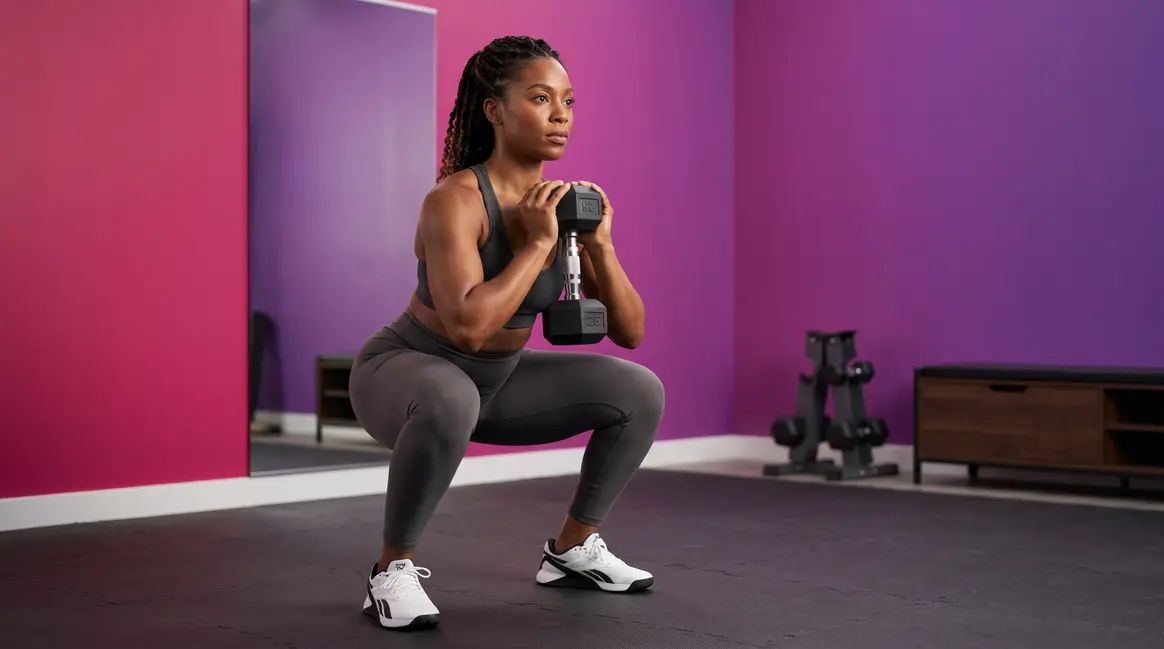
1. Goblet Squat
Muscles worked: Quadriceps, glutes, hamstrings, core
Equipment: One dumbbell or kettlebell (beginners: 8–15 lbs)
- Step-by-step form:
- Hold a dumbbell vertically at your chest with both hands cupped around the top end.
- Stand with feet shoulder-width apart, toes turned out 15–30 degrees.
- Take a breath in and brace your core (tighten your midsection as if bracing for a punch).
- Push your hips back and bend your knees simultaneously — lower until your thighs are parallel to the floor or as low as comfortable. Maintaining proper squat form is essential here.
- Keep your chest tall throughout. Do not let your knees cave inward.
- Drive through your heels to stand, exhaling as you rise.
Common mistake: Heels lifting off the floor. Fix: Place a thin weight plate or folded mat under your heels until ankle mobility improves.
Choose if: You want to build lower-body strength without a barbell. Skip if: You have acute knee pain — substitute a seated leg press or wall sit.
2. Romanian Deadlift (RDL)
Muscles worked: Hamstrings, glutes, lower back, core
Equipment: Two dumbbells or a barbell (beginners: 10–20 lbs per hand)
- Step-by-step form:
- Stand with feet hip-width apart, holding dumbbells in front of your thighs, palms facing your body.
- Inhale and engage your core. Maintain a slight bend in your knees throughout.
- Hinge (push) your hips backward — imagine closing a car door with your hips — while lowering the weights along your legs.
- Lower until you feel a stretch in the back of your thighs (hamstrings). Most beginners reach mid-shin depth.
- Squeeze your glutes and drive your hips forward to return to standing. Exhale as you rise.
Common mistake: Rounding the lower back. Fix: Keep your chest “proud” and think about pulling your shoulder blades toward each other throughout the movement.
3. Dumbbell Row (Single-Arm)
Muscles worked: Latissimus dorsi (back), biceps, rear deltoids
Equipment: One dumbbell (beginners: 10–20 lbs)
- Step-by-step form:
- Place your left knee and left hand on a bench for support. Your back should be flat and parallel to the floor.
- Hold a dumbbell in your right hand, arm extended toward the floor.
- Pull the dumbbell up toward your hip — not your shoulder — by driving your elbow back.
- At the top, your elbow should be above the level of your back. Pause briefly.
- Lower the weight slowly (2–3 seconds on the way down). Complete all reps, then switch sides.
Common mistake: Rotating the torso to lift the weight. Fix: Keep your hips square to the bench. The movement should come entirely from your arm and back.
4. Push-Up (Modified or Full)
Muscles worked: Chest, triceps, front deltoids, core
Equipment: None (or a bench for the modified version)
- Step-by-step form (modified — knees on floor):
- Start on your hands and knees. Walk your hands forward until your body forms a straight line from knees to head.
- Place hands slightly wider than shoulder-width, fingers pointing forward.
- Inhale and lower your chest toward the floor, keeping elbows at a 45-degree angle to your body (not flared out).
- Lower until your chest nearly touches the floor. Hold for one second.
- Press through your palms to return to the start. Exhale as you push up.
Progression: Once you can complete 3 sets of 12 modified push-ups with good form, progress to a full push-up with knees off the floor.
5. Dumbbell Shoulder Press
Muscles worked: Deltoids (shoulders), triceps, upper trapezius
Equipment: Two dumbbells (beginners: 5–12 lbs)
- Step-by-step form:
- Sit on a bench with back support (or stand with feet hip-width apart for a greater core challenge).
- Hold dumbbells at shoulder height, palms facing forward, elbows at 90 degrees.
- Inhale and brace your core to protect your lower back.
- Press the dumbbells straight overhead until your arms are almost fully extended. Do not lock your elbows.
- Lower slowly back to shoulder height. Exhale as you press up.
Common mistake: Arching the lower back as you press. Fix: Tighten your core and slightly tuck your pelvis before each rep.
6. Glute Bridge
Muscles worked: Glutes, hamstrings, core, lower back
Equipment: None (add a dumbbell on your hips for added resistance)
- Step-by-step form:
- Lie on your back with knees bent, feet flat on the floor hip-width apart. Arms at your sides.
- Inhale. Squeeze your glutes and push through your heels to lift your hips toward the ceiling.
- At the top, your body should form a straight line from shoulders to knees. Hold for 2 seconds.
- Lower your hips slowly back to the floor. Exhale as you lower.
Why this matters: The glute bridge is the safest way to load your glutes without spinal compression — making it the ideal starting point for beginners with lower back concerns.
The Supporting 6: Accessory Moves
These six exercises appear in Workout B of the 4-week program and complement the Big 6 by targeting areas the compound movements miss — including lateral hip strength, core stability, and single-leg balance.
| # | Exercise | Primary Muscles | Key Cue | Beginner Weight |
|---|---|---|---|---|
| 7 | Lateral Band Walk | Glutes (medius), hip abductors | Keep slight bend in knees throughout | Light resistance band |
| 8 | Dumbbell Reverse Lunge | Quads, glutes, hamstrings | Step back, not forward — easier on the knees | 8–15 lbs each hand |
| 9 | Plank (forearm) | Core, shoulders, glutes | Hold 20–30 seconds; do not let hips sag | Bodyweight |
| 10 | Dumbbell Bicep Curl | Biceps, forearms | Avoid swinging — control the movement | 8–15 lbs |
| 11 | Tricep Kickback | Triceps | Upper arm stays parallel to floor | 5–10 lbs |
| 12 | Dead Bug | Core, hip flexors | Lower back stays pressed to floor | Bodyweight |
Your 4-Week Beginner Program
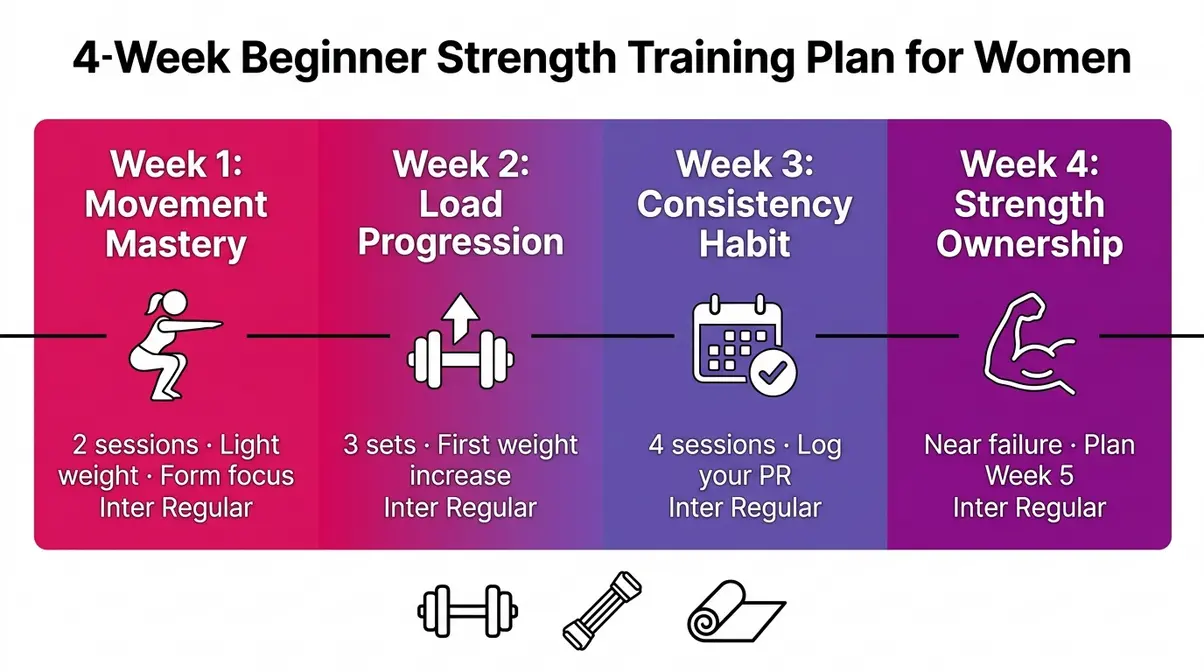
The Confidence-to-Strength Ladder is a 4-week program that pairs each training week with a specific confidence milestone — because strength and self-belief are built simultaneously, not separately. This is the framework that separates this guide from the generic plans that leave beginners confused and inconsistent. Finding a reliable beginner strength training program for women is the turning point for most new lifters.
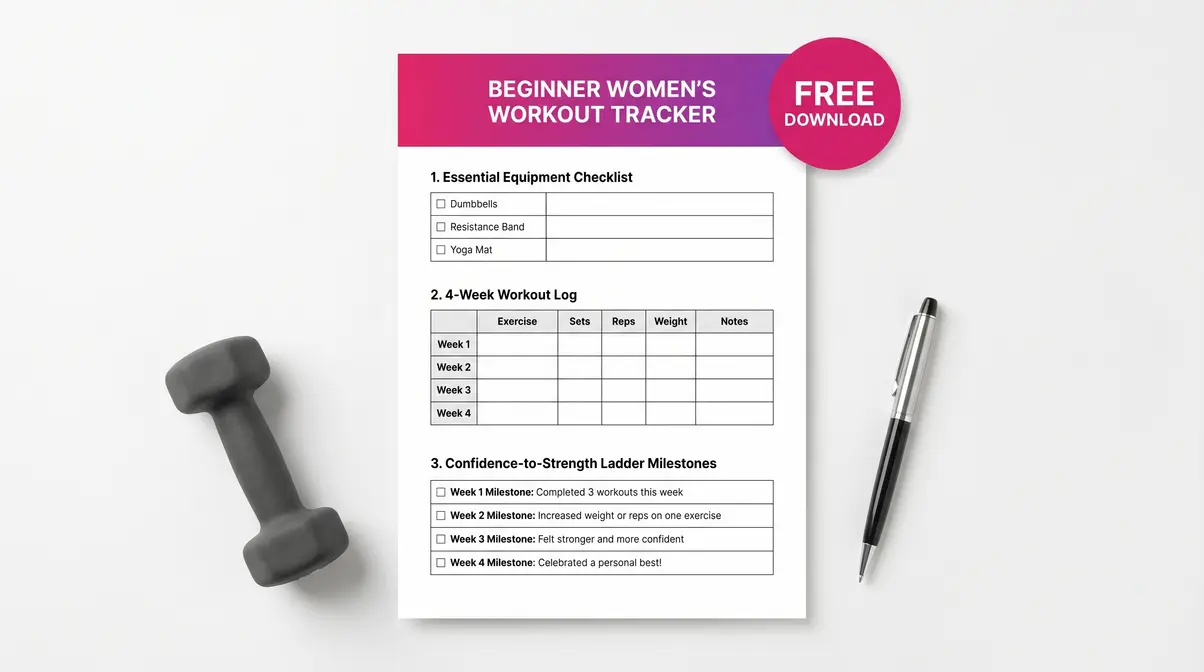
- Estimated Time: 4 weeks (2-3 sessions per week, 30-45 minutes each)
- Tools & Materials Needed:
- Dumbbells (light and medium pairs)
- Resistance band
- Yoga mat
Each week has one physical focus and one confidence milestone. When you complete both, you move up a rung on the ladder. By week four, you will have the physical foundation and the mental evidence to call yourself a lifter.
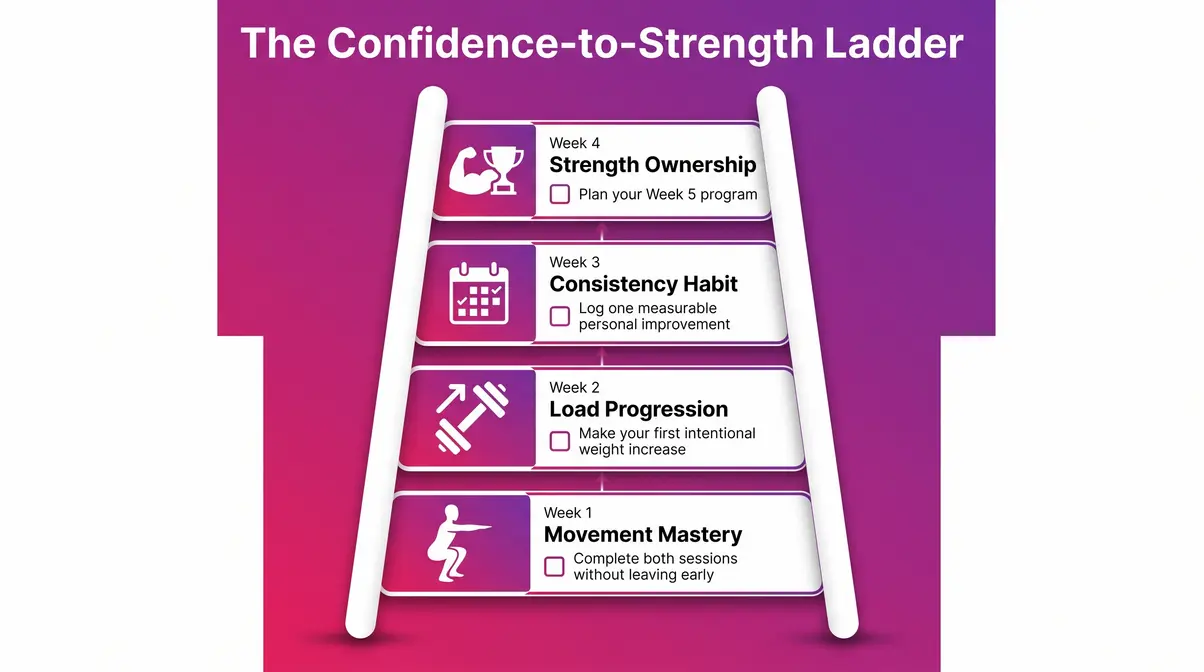
Week 1 – Movement Mastery
Physical Focus: Learn the movement patterns. Use light weight (or bodyweight only). Perfect form beats heavy weight every time this week.
Confidence Milestone: Complete both sessions without leaving early. Show up twice. That’s it.
Training Days: 2 non-consecutive days (e.g., Monday and Thursday)
Workout A – Lower Body + Core
| Exercise | Sets | Reps | Rest | Notes |
|---|---|---|---|---|
| Goblet Squat | 2 | 10 | 60 sec | Bodyweight or very light (8 lbs) |
| Romanian Deadlift | 2 | 10 | 60 sec | Focus on the hip hinge pattern |
| Glute Bridge | 2 | 12 | 60 sec | Squeeze at the top for 2 seconds |
| Plank (forearm) | 2 | 20–30 sec | 60 sec | Build to 30 seconds by end of week |
| Dead Bug | 2 | 8/side | 60 sec | Keep lower back pressed to floor |
Workout B – Upper Body + Core
| Exercise | Sets | Reps | Rest | Notes |
|---|---|---|---|---|
| Push-Up (modified) | 2 | 8–10 | 60 sec | Focus on elbow position |
| Dumbbell Row | 2 | 10/side | 60 sec | Full range of motion |
| Dumbbell Shoulder Press | 2 | 10 | 60 sec | Seated for stability |
| Bicep Curl | 2 | 12 | 60 sec | Slow on the way down (2 seconds) |
| Tricep Kickback | 2 | 12 | 60 sec | Keep upper arm parallel to floor |
Week 2 – Load Progression
Physical Focus: Add weight to at least two exercises from Week 1. Apply the 3-3-3 Rule — if you completed 3 extra reps easily in Week 1, increase weight by 2.5–5 lbs.
Confidence Milestone: Make your first intentional weight increase. Write it down. You just practiced progressive overload — the same principle elite athletes use.
Changes from Week 1: Increase sets to 3 per exercise. Add the Lateral Band Walk and Reverse Lunge to Workout A.
Week 3 – Consistency Habit
Physical Focus: Complete all 4 sessions for the full two weeks (Weeks 3–4). No skipped sessions. Building a strength training workout plan for beginners into your weekly routine is crucial here.
Confidence Milestone: Notice what your body can do now that it couldn’t in Week 1. Write down one specific improvement — heavier weight, deeper squat, longer plank.
Changes from Week 2: Increase weight on all exercises where you hit the top of your rep range in Week 2. Add a third set to push-ups and rows.
Week 4 – Strength Ownership
Physical Focus: Push to near-failure on your final set of each exercise. “Near failure” means you could do 1–2 more reps but choose to stop — this is the stimulus that drives the most adaptation.
Confidence Milestone: Complete Week 4 and plan Week 5. You are no longer a person who “wants to start” strength training. You are a person who strength trains.
The Confidence-to-Strength Ladder Summary:
| Week | Physical Focus | Confidence Milestone | Key Metric |
|---|---|---|---|
| 1 – Movement Mastery | Learn all 12 movements with light weight | Show up twice — no quitting early | 2 sessions completed |
| 2 – Load Progression | Add weight to 2+ exercises | Make your first intentional weight increase | 1st progressive overload applied |
| 3 – Consistency Habit | Complete all 4 sessions across 2 weeks | Document one measurable improvement | 1 personal record logged |
| 4 – Strength Ownership | Push to near-failure on final sets | Plan your Week 5 program | Next program identified |
Equipment: What You Need
You do not need a gym membership to begin. Certified trainers recommend starting with the minimum equipment and adding as you progress. If you prefer home workouts without equipment, you can still make significant progress before investing in gear.
- Tier 1 – Absolute Minimum (Home or Gym):
- Two pairs of dumbbells: one light (8–12 lbs) and one medium (15–20 lbs)
- A resistance band (light to medium)
- A yoga mat
- Tier 2 – Helpful Additions (Months 2–3):
- Adjustable dumbbell set (saves space and cost long-term)
- A flat bench (or use a sturdy chair initially)
- Lifting gloves (optional — some women prefer them for grip comfort)
- Tier 3 – If You Join a Gym:
- Cable machine (for rows and pulldowns — excellent for back development)
- Barbell and squat rack (when you’re ready to progress beyond dumbbell deadlifts)
Following a structured home workout plan for beginners ensures you maximize whatever equipment you have available.
Nutrition Basics for Training
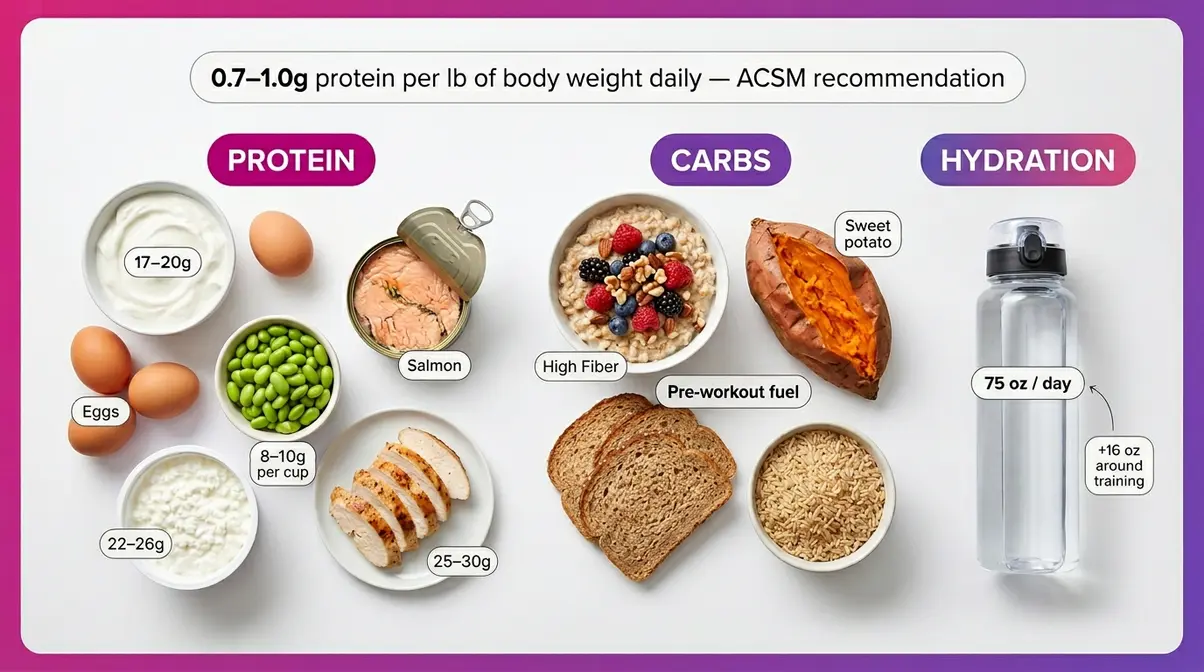
What you eat directly affects how quickly you build strength and recover between sessions. You do not need a complex meal plan. Three evidence-based principles cover 90% of what beginners need to know.
Protein: The Essential Building Block
Protein provides the amino acids your muscles use to repair and grow after training. The ACSM recommends 0.7–1.0 grams of protein per pound of body weight daily for women engaged in regular resistance training. For a 150-pound woman, that is 105–150 grams of protein per day — more than most beginners currently eat.
- Practical protein sources that certified dietitians consistently recommend:
- Greek yogurt (17–20g per cup)
- Chicken breast (26g per 3 oz)
- Eggs (6g per egg)
- Canned salmon or tuna (20–25g per 3 oz)
- Edamame (17g per cup — excellent plant-based option)
- Cottage cheese (14g per half cup)
Carbohydrates: Your Training Fuel
Carbohydrates (carbs) are your muscles’ preferred energy source during resistance training. Reducing carbs too aggressively while strength training is one of the most common mistakes beginners make — it leads to fatigue, poor performance, and stalled progress. Aim to eat a moderate serving of complex carbs (oatmeal, sweet potato, brown rice, whole grain bread) within 2 hours before your training session.
Hydration and Timing
Dehydration of just 2% of body weight can reduce strength output by 5–8% (Journal of Athletic Training, 2026). Drink water consistently throughout the day — certified trainers recommend aiming for half your body weight in ounces daily (a 150-pound woman drinks ~75 oz). Add an extra 8–16 oz around training sessions.
Post-workout nutrition: Consuming 20–30 grams of protein within 2 hours after training maximizes muscle protein synthesis. A protein shake, Greek yogurt with fruit, or eggs on toast all accomplish this effectively.
Nutrition on GLP-1 Medications
If you are taking a GLP-1 agonist, appetite suppression can make hitting protein targets challenging. Registered dietitians who specialize in GLP-1 management recommend prioritizing protein at every meal before eating other foods — a strategy called “protein first.” Protein shakes or Greek yogurt can be valuable tools when appetite is low but training demands remain high.
Do I Need to Eat Before Training?
For most women, eating a light meal or snack 1–2 hours before training improves performance and reduces fatigue. A combination of protein and carbohydrates works best — for example, Greek yogurt with a banana, or a slice of whole-grain toast with peanut butter. If you prefer training in a fasted state (first thing in the morning), keep sessions shorter (30–40 minutes) and have a protein-rich meal immediately afterward to support muscle recovery. Experiment with both approaches and choose what makes you feel strongest.
Common Beginner Mistakes to Avoid
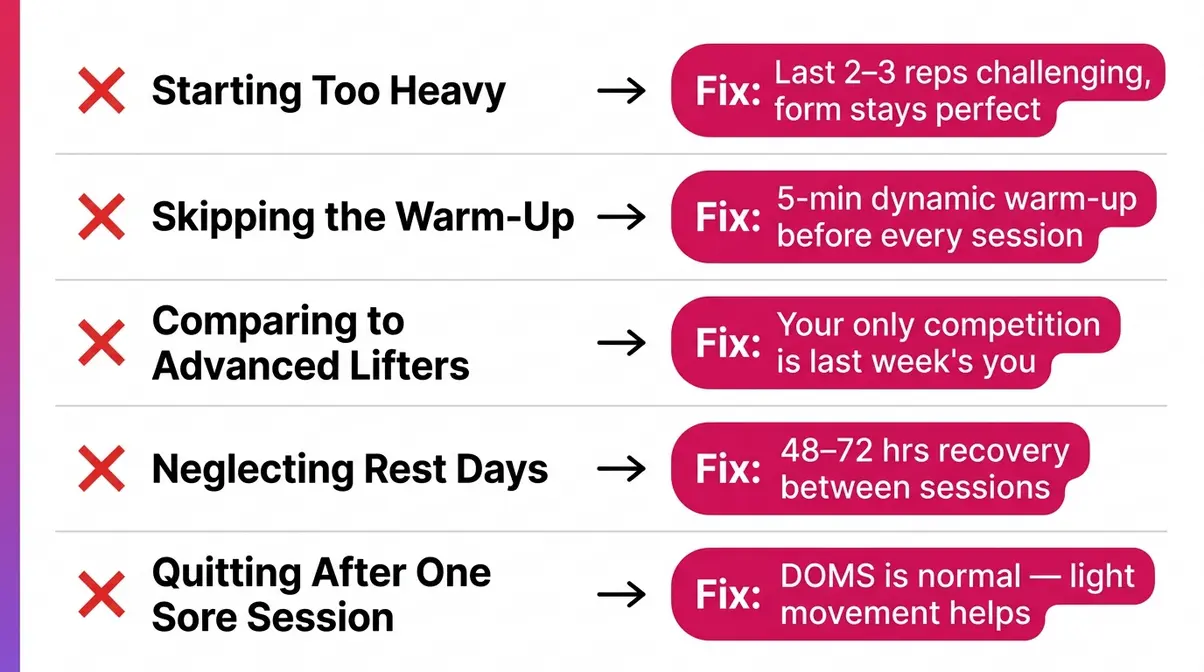
Common Pitfalls
1. Starting too heavy, too fast. The most common beginner mistake. Your nervous system — not your muscles — is the limiting factor in the first 2–4 weeks. Using weights that are too heavy before your movement patterns are established causes compensations (your body cheating to lift the weight), which leads to injury. Fix: Start with a weight where the last 2–3 reps feel challenging but your form stays perfect.
2. Skipping warm-up. Walking into the gym cold and immediately loading weight is a recipe for muscle strains. A 5-minute dynamic warm-up (leg swings, arm circles, bodyweight squats) increases blood flow to muscles and improves range of motion before loading. Certified trainers recommend treating the warm-up as the first “set” of your workout — non-negotiable.
3. Comparing your Week 1 to someone else’s Year 3. Social media and gym floors are full of advanced lifters. Their starting point was identical to yours. Comparing your beginning to their middle creates discouragement that has nothing to do with your actual progress. Your only competition is last week’s version of you.
4. Neglecting rest days. More is not always better — especially for beginners. Training a muscle group before it has fully recovered (48–72 hours) reduces the quality of adaptation and increases injury risk. The 2-day program in this guide is structured specifically to prevent this.
5. Abandoning the program after one hard session. Muscle soreness (called DOMS — Delayed Onset Muscle Soreness) peaks 24–72 hours after a new training stimulus. It is normal, temporary, and actually a sign your muscles are adapting. Light movement (a walk, gentle stretching) on rest days helps reduce soreness faster than complete inactivity.
When to Choose Alternatives
If you have a knee injury: Replace goblet squats with seated leg presses or lying leg extensions. Consult a physical therapist before loading any squat pattern.
If you have lower back pain: Replace Romanian deadlifts with hip thrusts or glute bridges (which load the glutes without spinal flexion). Avoid heavy deadlifts until cleared by a healthcare provider.
If you have shoulder impingement: Replace overhead pressing with chest presses (lying flat on a bench). The National Academy of Sports Medicine’s corrective exercise resources offer specific modification guidance.
When to Seek Expert Help
- Consider working with a certified personal trainer (CPT) or corrective exercise specialist if:
- You experience pain (not soreness) during any exercise that persists beyond the session
- You have a diagnosed orthopedic condition (scoliosis, herniated disc, rotator cuff tear)
- You are managing a chronic condition such as osteoporosis, diabetes, or cardiovascular disease
- You are taking prescription medications that affect heart rate or blood pressure
A single session with a CPT to verify your form on the foundational movements is one of the highest-return investments a beginner can make.
Frequently Asked Questions
Will strength training make women bulky?
No — strength training will not make most women bulky. Women have 10–20 times less testosterone than men, the primary hormone driving large-scale muscle hypertrophy. What resistance training does produce in women is increased muscle tone, improved definition, and a leaner physique. Building the kind of muscle mass seen in bodybuilding competitions requires years of specialized training, very high caloric intake, and in many cases, hormonal interventions. For the vast majority of women, the realistic outcome is a stronger, more defined body.
How long before I see results from strength training?
Most women notice functional strength improvements within 2–4 weeks and visible physical changes within 6–12 weeks of consistent training. The early gains (weeks 1–4) come primarily from neuromuscular adaptation — your nervous system learning to recruit muscle fibers more efficiently, not from actual muscle growth. Visible changes in muscle tone and body composition typically require 8–12 weeks of consistent training combined with adequate protein intake. Patience and consistency outperform any program detail.
Is strength training safe for women with osteoporosis?
Yes — with proper guidance, resistance training is one of the most evidence-supported interventions for osteoporosis in women. Research published in the Journal of Bone and Mineral Research found that progressive resistance training increased bone mineral density by 1–3% per year in postmenopausal women. However, women with diagnosed osteoporosis should consult their physician or a physical therapist before beginning and should avoid high-impact movements, heavy spinal loading, and exercises that require forward spinal flexion (like traditional crunches). A certified trainer with osteoporosis experience can design a safe, effective program.
Can I do strength training while on Zepbound or Ozempic?
Yes — and doing so is strongly recommended. Clinical research shows that GLP-1 receptor agonists can cause up to 25–40% of total weight loss to come from lean muscle mass if resistance exercise is not included. Pairing your GLP-1 medication with 2–3 strength sessions per week and a high-protein diet (0.7–1.0g per pound of body weight) is the evidence-based strategy for preserving muscle during medication-assisted weight loss. Start conservatively — lighter weights, shorter sessions — and build gradually as your body adjusts to the medication.
What should I do if I miss a session?
Missing one session does not break your progress — picking up where you left off does. The research on training consistency shows that missing 1–2 sessions per month has no measurable impact on long-term strength gains. What derails beginners is the “all-or-nothing” thinking that turns one missed session into a week off. If you miss a session, simply resume your next scheduled workout as planned. Do not double up or try to “make it up” — that approach increases injury risk and undermines recovery.
What basic equipment do I need to start strength training at home?
You only need two pairs of dumbbells and a mat to begin. A light pair (8-12 lbs) and a medium pair (15-20 lbs) will cover almost every foundational exercise. As you progress, adding a resistance band and an adjustable bench will expand your options, but they are not strictly necessary for your first four weeks.
Is it normal to feel extremely sore after my first workout?
Yes, Delayed Onset Muscle Soreness (DOMS) is completely normal for beginners. It typically peaks 24 to 48 hours after your session. While it can be uncomfortable, it is a sign that your muscles are adapting to the new stimulus. Light movement, such as walking or gentle stretching, will help alleviate the stiffness better than complete rest.
Should I do cardio or strength training first?
Always prioritize strength training before cardio if you are doing both in the same session. Lifting weights requires more technical focus and central nervous system energy. If you exhaust yourself with cardio first, your lifting form will degrade, increasing your risk of injury and decreasing the effectiveness of the strength workout.
Your First Step Starts Today
For women beginning strength training, the research is unambiguous: resistance exercise builds lean muscle, protects bone density, supports metabolic health, and generates a measurable confidence effect that compounds over time. Women who start with a structured, progressive program — rather than random workouts — are significantly more consistent at 3 months and beyond (ACSM, 2026). Strength training for women beginners is not about becoming a powerlifter. It is about building a body and a belief system that serves you for decades.
The Confidence-to-Strength Ladder exists because physical strength and mental confidence are not separate goals — they are the same goal, pursued simultaneously. Every weight you add, every session you complete, and every milestone you check off is evidence that you are more capable than you believed when you started. That evidence is permanent. No one can take it from you.
Your next step is specific: choose your two training days for this week, gather your equipment (even just two dumbbells and a mat), and complete Workout A from Week 1. Do not wait until conditions are perfect. Certified trainers consistently observe that the women who make the most progress are not the ones who had the best equipment or the most time — they are the ones who started imperfectly and kept showing up.
About the Author
*This guide was developed in collaboration with certified personal trainers (CPT-NASM) and reviewed by professionals holding CSCS (Certified Strength and Conditioning Specialist) credentials. All exercise recommendations align with the American College of Sports Medicine (ACSM) guidelines for resistance training in previously untrained adults. Medical content was reviewed for accuracy against current NIH and Mayo Clinic guidance.