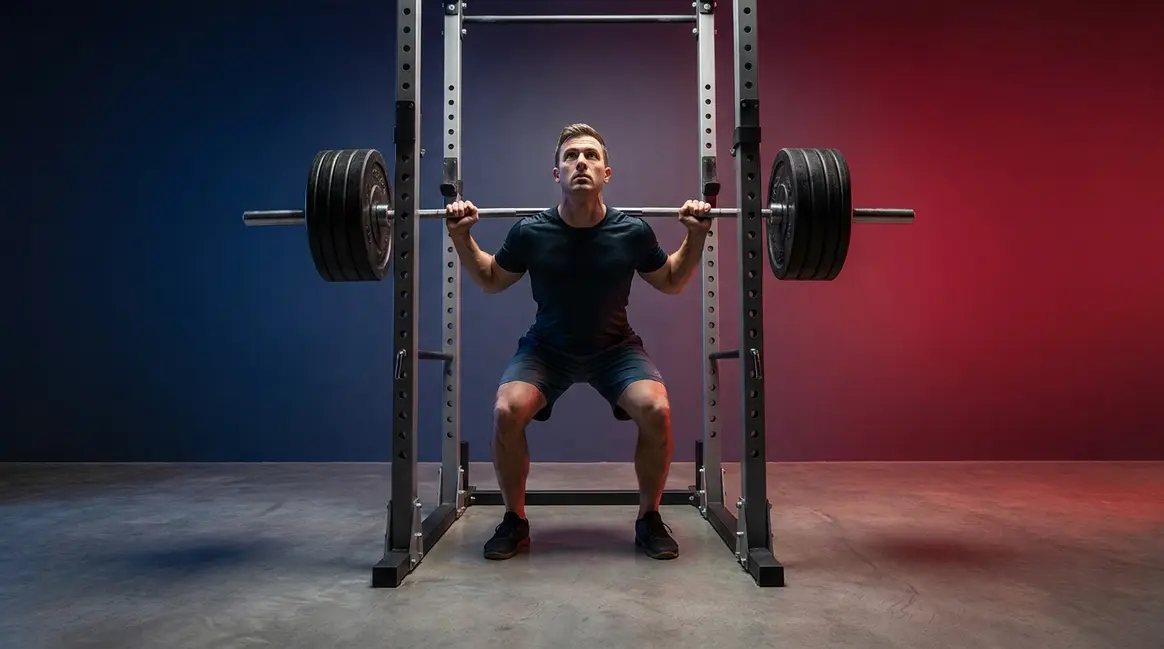
What Is Strength Training? A Plain-English Guide
If you are wondering exactly what is strength training for beginners, you are not alone. Most people who want to start strength training don’t quit because it’s too hard. They quit before they even begin, because nobody gives them a simple place to start. You search online and find conflicting advice — one source says lift heavy, another says start with yoga, a third sells you a $200 program you’ll never use.
Meanwhile, the cost of inaction is real. Research indicates that adults begin losing 3–8% of muscle mass per decade after age 30, with the rate accelerating after 60 (Volpi et al., Journal of Gerontology, 2004). Bone density, metabolism, and blood sugar control all decline alongside it — and the evidence increasingly shows that strength training is one of the most effective tools for reversing these trends.
By the end of this guide, you’ll understand exactly what strength training is, why it works, and how to complete your first workout safely — even if you’ve never touched a dumbbell. You’ll get a clear definition, the science-backed health benefits, a step-by-step beginner workout, and two memorable frameworks — The 3-3-3 Rule and The 5 P’s of Lifting — that replace confusion with confidence.
Wondering what is strength training for beginners? It means using resistance — bodyweight, dumbbells, or bands — to build muscle, strengthen bones, and improve metabolic health. The CDC recommends at least 2 muscle-strengthening days per week for all adults. The 3-3-3 Rule gives beginners a simple weekly structure to follow from day one.
- Start simple: 2–3 sessions per week, 3 compound exercises, 2–3 sets of 8–12 reps
- No gym needed: Bodyweight squats, push-ups, and rows are enough to begin
- Bone density improves: Progressive resistance training measurably increases bone mineral density (PubMed, 2000)
- Blood sugar drops: Resistance training improves insulin sensitivity and glycemic control (NIH, 2010)
- The 3-3-3 Rule: 3 strength days + 3 active recovery days + 3 key exercises = your first weekly framework


What Is Strength Training? A Beginner’s Guide
Strength training for beginners is any form of exercise that challenges your muscles to work against a force or resistance. That force can be your own bodyweight, a pair of dumbbells, a resistance band, or a cable machine. The CDC recommends that all adults perform muscle-strengthening activities on at least 2 days per week — and the good news is that a set of push-ups in your living room fully counts. You don’t need a gym membership, a personal trainer, or any equipment to begin.
learn more about what strength training is
A properly designed resistance training program enhances functional strength and reduces the risk of chronic metabolic diseases (ACSM recommendations for functional strength training). That’s the scientific foundation behind every recommendation in this guide.
What Strength Training Actually Means
What is strength training for beginners? It is any exercise where your muscles push, pull, or resist against a load — and that load can be as simple as your own body. A squat uses your legs against gravity. A push-up uses your chest and arms against the floor. A bicep curl with a water jug is strength training. All of it counts.
Here’s a misconception worth clearing up early: strength training is not the same as weightlifting or bodybuilding. Weightlifting is a competitive Olympic sport involving precise barbell technique. Bodybuilding focuses on maximizing muscle size for aesthetic competition. Strength training, by contrast, simply means building functional muscle and bone strength through progressive resistance — and it includes bodyweight work entirely.
You do not need a gym to start. A living room, a backyard, or a hotel room with nothing but your bodyweight qualifies as a valid training environment. As fitness professionals consistently emphasize, the most important factor for beginners is consistency over complexity. Start where you are, with what you have.
“Strength training is any exercise that makes your muscles work against resistance — and bodyweight alone qualifies.”
You’ll learn the exact framework for structuring your week — The 3-3-3 Rule — in Section 4. For now, understand this: strength training is broader, more accessible, and more beginner-friendly than most people believe.
The 3 Main Types of Resistance
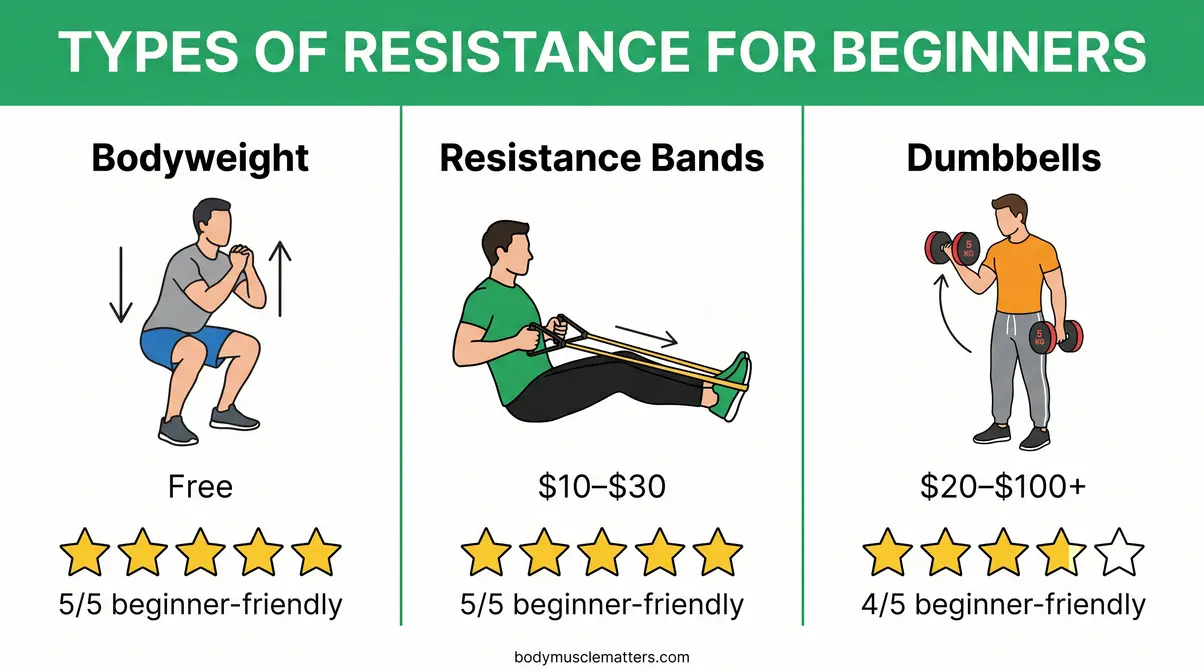
Not all resistance is created equal — and the type you choose affects your cost, safety, and learning curve. Here’s an honest comparison for beginners:
| Resistance Type | Beginner Friendliness | Best For | Approximate Cost |
|---|---|---|---|
| Bodyweight | ⭐⭐⭐⭐⭐ | Absolute beginners, home training | Free |
| Resistance Bands | ⭐⭐⭐⭐⭐ | Home beginners, joint-sensitive users | $10–$30 |
| Dumbbells | ⭐⭐⭐⭐ | Home or gym, once basic form is established | $20–$100+ |
| Machines | ⭐⭐⭐⭐ | Gym beginners wanting guided movement | Gym membership |
| Barbells | ⭐⭐⭐ | Intermediate lifters with coaching | $100–$300+ |
Bodyweight training — squats, push-ups, lunges, planks — is free, requires no equipment, and is ideal for learning proper movement patterns before adding load. This makes it the strongest starting point for strength training at home for beginners.
Resistance bands are affordable (often under $30 for a full set), portable, and joint-friendly. They provide continuous tension throughout a movement, which is actually a training advantage. The limitation is that resistance is harder to measure precisely than a fixed dumbbell weight.
Free weights (dumbbells and barbells) offer the widest range of motion and the most scalable resistance. Dumbbells are the most practical free-weight option for beginners — they’re widely available, easy to adjust, and suitable for dozens of exercises. Barbells require more technique and ideally some coaching before use.
Machines guide your movement along a fixed path, reducing injury risk for complete beginners at a gym. The trade-off is less functional carry-over — machines isolate muscles rather than training coordinated movement patterns.
The simplest progression: start with bodyweight → add resistance bands → graduate to dumbbells. Machines are optional, not required. understand the differences between bodybuilding and strength training.
What Is Functional Strength Training?
Functional strength training is a training approach that focuses on multi-joint movements that mimic real-life activities — squatting down to pick something up, pushing a heavy door, carrying groceries, climbing stairs. Rather than isolating a single muscle (like a bicep curl machine does), functional training trains entire movement patterns that your body uses every day.
The contrast with traditional isolation training is important. A leg extension machine trains your quadriceps in a fixed, seated position. A bodyweight squat trains your quadriceps, glutes, hamstrings, core, and stabilizing muscles simultaneously — in a pattern your body already knows. For beginners, this translates directly to everyday strength and injury prevention.
Fitness professionals and certified trainers consistently recommend functional movements as the foundation of any beginner program. The NHS strength exercises guide — one of the most widely referenced beginner resources — centers its recommendations entirely on functional patterns: squats, lunges, rows, and presses.
Functional strength training is also why you don’t need specialized equipment to start. A squat is functional. A push-up is functional. A hip hinge (the movement pattern of picking something up from the floor) is functional. These movements build the kind of strength that makes your daily life easier — not just strength that shows up on a machine readout.
Key Terms Every Beginner Should Know
Fitness jargon can make a simple activity feel complicated. Here are the essential terms, defined plainly:
- Reps (repetitions): The number of times you perform a single movement. One squat = one rep. Twelve squats in a row = 12 reps.
- Sets: A group of consecutive reps. “3 sets of 10 squats” means you do 10 squats, rest, do 10 more, rest, do 10 more.
- Progressive overload: The principle of gradually increasing the challenge of your workouts over time — more reps, more weight, or less rest. This is what drives muscle and strength gains.
- Compound exercises: Movements that engage multiple muscle groups at once (squats, push-ups, rows). Ideal for beginners because they build total-body strength efficiently.
- Hypertrophy: Muscle growth — the process of muscle fibers becoming larger in response to resistance training.
- Recovery: The rest period between sessions when your muscles repair and grow stronger. Recovery is not optional — it’s when the gains actually happen.
- Form: The technique you use to perform a movement. Good form protects your joints and ensures the right muscles are working. Poor form is the leading cause of beginner injuries.
Now that you know what strength training is, the next question is: why bother? The health benefits — especially for bone density and blood sugar — are more significant than most beginners realize.
Why Strength Train? Core Health Benefits
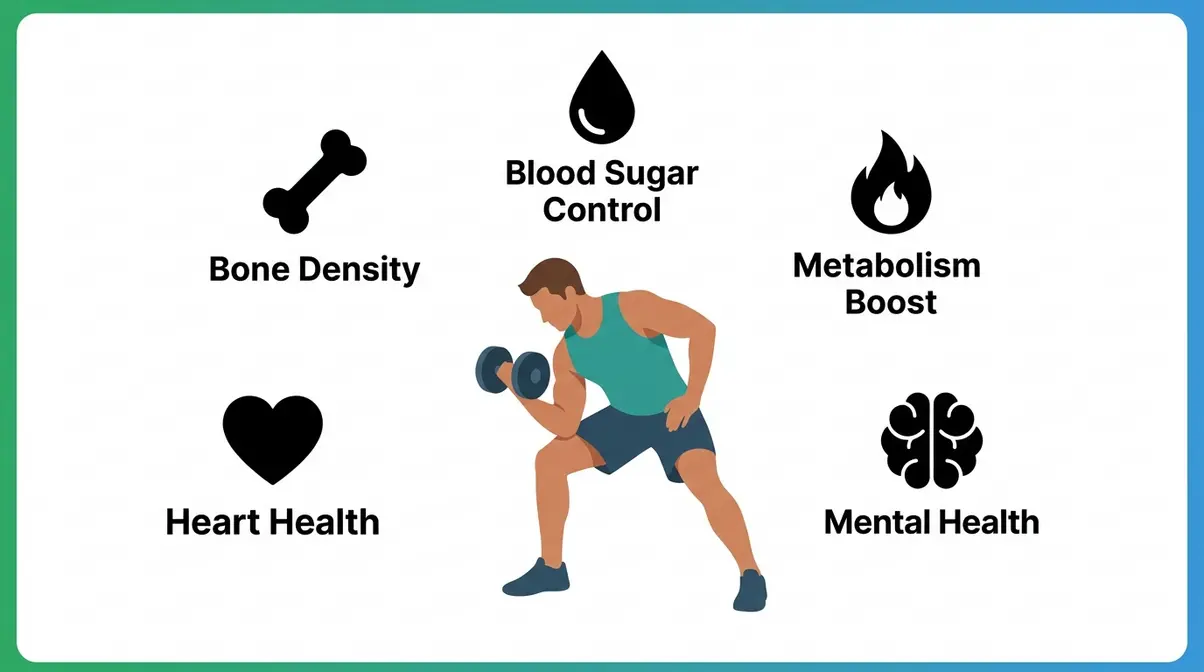
The case for strength training goes well beyond aesthetics. Research across multiple Tier 1 institutions — including the NIH, PubMed, and Harvard Medical School — consistently identifies resistance training as one of the most impactful interventions for long-term health. For adults of any age, the benefits extend from bone strength to blood sugar control to mental health. Here’s what the evidence shows. Additionally, if your goal is weight management, you can explore the benefits of strength training for fat loss.
How Lifting Improves Bone Density
Bone density refers to the amount of mineral content (primarily calcium and phosphate) packed into your bones. Higher bone density means stronger, more fracture-resistant bones. The problem: bone density naturally declines with age, with the risk of osteoporosis (dangerously low bone density) increasing significantly after 50 — particularly in women after menopause.
Research published in PubMed demonstrates that progressive resistance training measurably increases bone mineral density, particularly in the spine and hip — the two sites most vulnerable to osteoporotic fracture (Layne & Nelson, Medicine & Science in Sports & Exercise, 2000). The mechanism is straightforward: when muscles pull on bones during resistance exercise, the bones respond by increasing their mineral density to handle the load.
The Mayo Clinic Health System confirms that it’s never too late to begin — adults in their 60s, 70s, and 80s show measurable bone density improvements from consistent resistance training. If you have osteoporosis or a family history of it, consult your doctor before starting — but the evidence strongly supports resistance training as a protective measure, not a risk.
“Progressive resistance training is one of the few interventions shown to measurably increase bone mineral density in adults of all ages.”
Will lifting weights lower blood sugar?
For the roughly 38 million Americans living with diabetes and the 96 million with prediabetes (CDC, 2026), this question carries real clinical weight. The answer, based on consistent evidence, is yes — with important nuance.
Resistance training improves insulin sensitivity (how effectively your cells respond to insulin) and glycemic control (how well your body regulates blood glucose levels). A landmark NIH-supported review found that resistance training significantly reduced HbA1c — a key marker of long-term blood sugar control — in adults with type 2 diabetes (Castaneda et al., Diabetes Care, 2002). More recent research published in Healthline’s review of exercise science confirms that a single strength training session can lower blood glucose for up to 24 hours afterward.
The mechanism involves muscle tissue acting as a glucose sink. During and after resistance exercise, your muscles absorb glucose from the bloodstream to replenish glycogen stores — reducing blood sugar without requiring insulin. This is particularly valuable for people managing type 2 diabetes or insulin resistance.
If you have diabetes or are on blood sugar medication, consult your doctor before starting a strength training program. Simple ways to get started with strength training from Kaiser Permanente includes guidance specifically for people managing chronic conditions.
5 More Benefits of Strength Training
Beyond bone density and blood sugar, the evidence for strength training spans nearly every major health domain:
- Metabolism: Muscle tissue burns more calories at rest than fat tissue. Adding even 5 lbs of muscle can increase your resting metabolic rate by approximately 50 calories per day — a meaningful long-term shift (Harvard Health Publishing, 2026).
- Mental health: A meta-analysis of 33 randomized controlled trials found that resistance training significantly reduced symptoms of depression, with stronger effects in adults with mild-to-moderate depression (JAMA Psychiatry, 2018).
- Cardiovascular health: Regular strength training is associated with reduced resting blood pressure, improved cholesterol profiles, and lower risk of cardiovascular events — independent of aerobic exercise (American Heart Association, 2026).
- Sleep quality: Research suggests that adults who perform regular resistance training report improved sleep duration and quality, with reduced symptoms of insomnia (Johns Hopkins Medicine, 2026).
- Functional independence: For adults over 60, maintaining muscle strength is one of the strongest predictors of independent living. Fitness professionals and certified trainers consistently identify strength training as the most effective intervention for preserving mobility and reducing fall risk.
When to see a doctor first: If you have a diagnosed heart condition, joint replacement, severe osteoporosis, or uncontrolled diabetes, speak with your physician before beginning any resistance program. The benefits are real — but your starting point may need to be modified.
How to Start Strength Training (Step-by-Step)
This section uses evidence-based beginner programming principles drawn from ACSM and ACE guidelines. The following exercises and progressions are selected because they train fundamental movement patterns, require minimal equipment, and have the lowest injury risk for people starting strength training for the first time. After completing this foundational phase, you can get a structured strength training workout plan for beginners to keep progressing.
Step 1 – Set Up Your Training Space
What you’ll need before your first session:
- Minimum (bodyweight only): 6×6 feet of clear floor space, comfortable clothing, supportive shoes (or bare feet for floor exercises)
- Recommended add-ons: A resistance band set ($10–$30), a pair of adjustable dumbbells ($30–$80), and a yoga mat for floor work
- Gym option: Any standard gym provides all equipment you need — focus on the free weights section and cable machines, not the cardio floor
Strength training at home without equipment is entirely viable for your first 4–8 weeks. The NHS strength exercises program requires nothing beyond your bodyweight and a chair. Once bodyweight movements feel manageable, adding a resistance band or a pair of light dumbbells opens up a significantly wider exercise menu. If you prefer using weights at home, find a beginner dumbbell workout plan for home to maximize your investment.
Step 2 – Warm Up Before Every Session
Never skip your warm-up. Cold muscles are less pliable, less coordinated, and more prone to strains. A proper warm-up takes 5–8 minutes and dramatically reduces injury risk.
Beginner warm-up sequence (5–8 minutes):
1. Light cardio (2–3 minutes): March in place, do jumping jacks, or walk briskly. The goal is to raise your heart rate and increase blood flow to your muscles.
2. Hip circles (30 seconds each side): Stand with hands on hips and draw large circles with your hips. This mobilizes the hip joint before squats and lunges.
3. Arm circles (30 seconds forward, 30 seconds backward): Loosens the shoulder joint before push-ups and rows.
4. Bodyweight squats — slow (10 reps): Use these as a movement rehearsal, not a workout. Sit back into the squat, keep your chest up, and pause at the bottom.
5. Cat-cow stretches (10 reps): On hands and knees, alternate arching and rounding your spine. This prepares the lower back for deadhinge movements.
Step 3 – First Full-Body Workout
This workout trains every major muscle group using compound movements. Perform it 2–3 times per week with at least one rest day between sessions. Start with bodyweight for all exercises until your form feels confident, then add resistance.
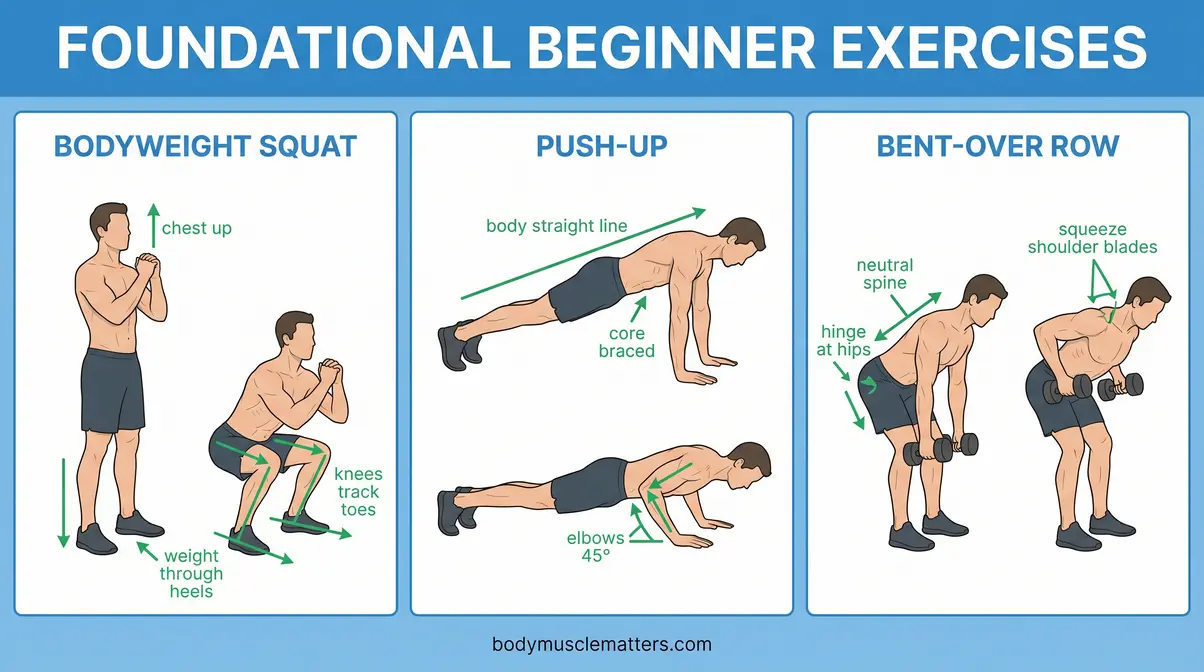
- Exercise 1: Bodyweight Squat
- Muscles worked: Quadriceps, glutes, hamstrings, core
- How to: Stand with feet shoulder-width apart, toes slightly out. Push your hips back and bend your knees, lowering until your thighs are parallel to the floor (or as low as comfortable). Drive through your heels to stand.
- Reps/Sets: 3 sets of 10–12 reps
- Why it matters: The squat mimics sitting and standing — the most fundamental functional movement pattern.
- Exercise 2: Push-Up (or Knee Push-Up)
- Muscles worked: Chest, shoulders, triceps, core
- How to: Start in a high plank with hands slightly wider than shoulder-width. Lower your chest toward the floor, keeping elbows at a 45° angle from your body. Press back up. For a modified version, perform from your knees.
- Reps/Sets: 3 sets of 8–10 reps
- Why it matters: The push-up is the most accessible upper-body pressing exercise — no equipment required.
- Exercise 3: Bent-Over Row (with dumbbells or resistance band)
- Muscles worked: Upper back, rear deltoids, biceps
- How to: Hinge at your hips until your torso is roughly parallel to the floor. Hold dumbbells or a band, then pull them toward your lower ribcage, squeezing your shoulder blades together. Lower with control.
- Reps/Sets: 3 sets of 10–12 reps
- Why it matters: Most beginners have weak upper backs from sitting. Rows counteract this imbalance and protect the shoulder joint.
- Exercise 4: Glute Bridge
- Muscles worked: Glutes, hamstrings, lower back
- How to: Lie on your back with knees bent, feet flat on the floor. Drive your hips toward the ceiling by squeezing your glutes, hold for 1–2 seconds at the top, then lower slowly.
- Reps/Sets: 3 sets of 12–15 reps
- Why it matters: Strengthens the posterior chain — the muscle group most commonly underactive in people who sit for long periods.
- Exercise 5: Dumbbell Shoulder Press (or Band Press)
- Muscles worked: Shoulders, upper chest, triceps
- How to: Sit or stand with dumbbells at shoulder height, palms facing forward. Press overhead until arms are nearly straight, then lower with control.
- Reps/Sets: 3 sets of 10 reps
- Why it matters: Builds shoulder stability and overhead strength — essential for everyday activities like reaching overhead shelves.
- Exercise 6: Romanian Deadlift (with dumbbells)
- Muscles worked: Hamstrings, glutes, lower back, core
- How to: Stand holding dumbbells in front of your thighs. Hinge at your hips — pushing them backward — while keeping a flat back and lowering the weights toward mid-shin. Drive your hips forward to return to standing.
- Reps/Sets: 3 sets of 10 reps
- Why it matters: Trains the hip hinge — the movement pattern used every time you pick something up from the floor. Mastering this prevents lower back injuries.
- Exercise 7: Plank
- Muscles worked: Core, shoulders, glutes
- How to: Hold a high plank position (or forearm plank) with your body forming a straight line from head to heels. Breathe steadily. Don’t let your hips sag or pike upward.
- Duration/Sets: 3 sets of 20–30 seconds
- Why it matters: Core stability is the foundation of every other exercise. A strong core protects your spine during squats, rows, and deadlifts.
Step 4 – Choose Sets, Reps, and Weight
For beginners, the ACSM recommends starting with 2–3 sets of 8–12 reps per exercise. This rep range builds a combination of strength and muscle endurance — ideal for the first 8–12 weeks of training.
How to choose your starting weight:
- Select a weight where the last 2–3 reps of each set feel challenging but not impossible
- If you can complete all reps with perfect form and feel like you could do 5 more, the weight is too light
- If your form breaks down before completing the target reps, the weight is too heavy
Rest between sets: 60–90 seconds for beginners. This gives your muscles enough recovery to maintain quality in the next set without cooling down completely.
Progression rule: When you can complete all sets and reps with good form for two consecutive sessions, increase the weight by the smallest available increment (typically 2.5–5 lbs). This is progressive overload — the single most important principle in strength training.
Step 5 – Rest, Recover, and Progress
Recovery is not passive — it’s when your muscles actually grow stronger. During resistance exercise, you create microscopic tears in muscle fibers. During rest, your body repairs those tears and builds the fibers back slightly thicker and stronger. Skip recovery, and you interrupt this process.
Recovery guidelines for beginners:
- Allow 48 hours between sessions targeting the same muscle group
- Sleep 7–9 hours per night — growth hormone is primarily released during deep sleep
- On rest days, light activity (walking, stretching, yoga) supports blood flow and recovery without adding training stress
- Stay hydrated — muscle protein synthesis requires adequate water
The Healthline strength training at home guide recommends that beginners train 2–3 days per week for the first 4 weeks before considering adding a fourth session. This matches the structure you’ll find in The 3-3-3 Rule — your foundational weekly framework.
Beginner Lifting Rules for Safe Training
Structure and safety are what separate beginners who progress from beginners who get injured or give up. The following frameworks — developed from evidence-based programming principles used by certified personal trainers — give you memorable systems to apply from your very first session. To maximize these rules, you should understand optimal sets and reps for strength training. Furthermore, you must master the concept of progressive overload for muscle growth.
What Is the 3-3-3 Rule for Lifting?
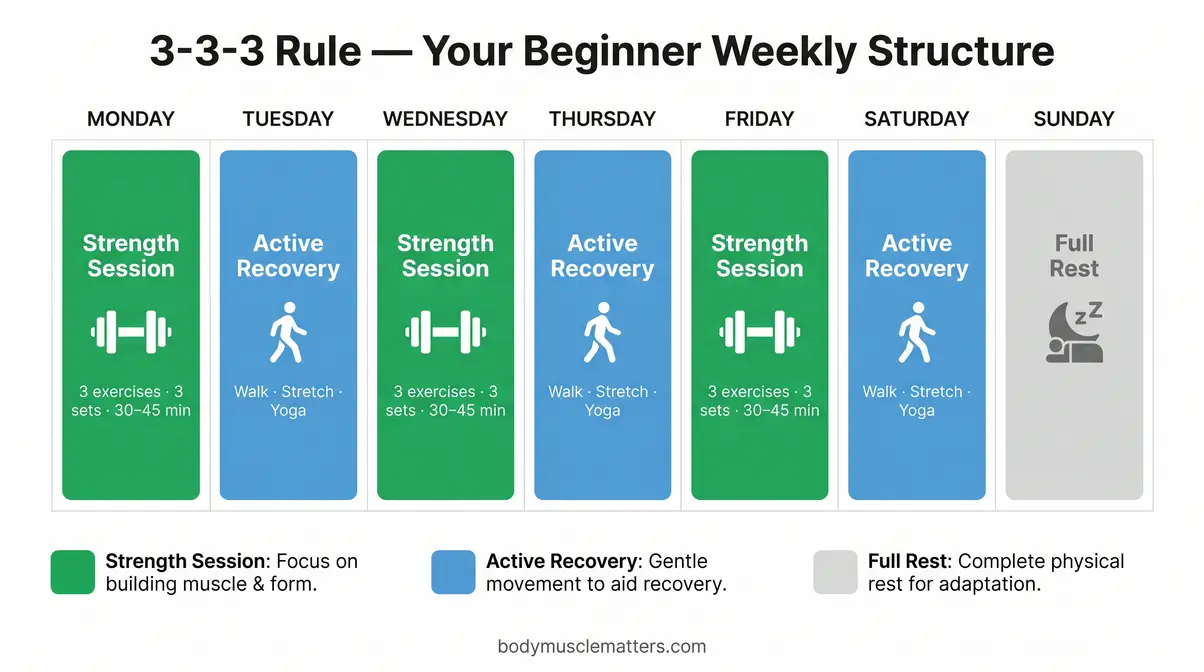
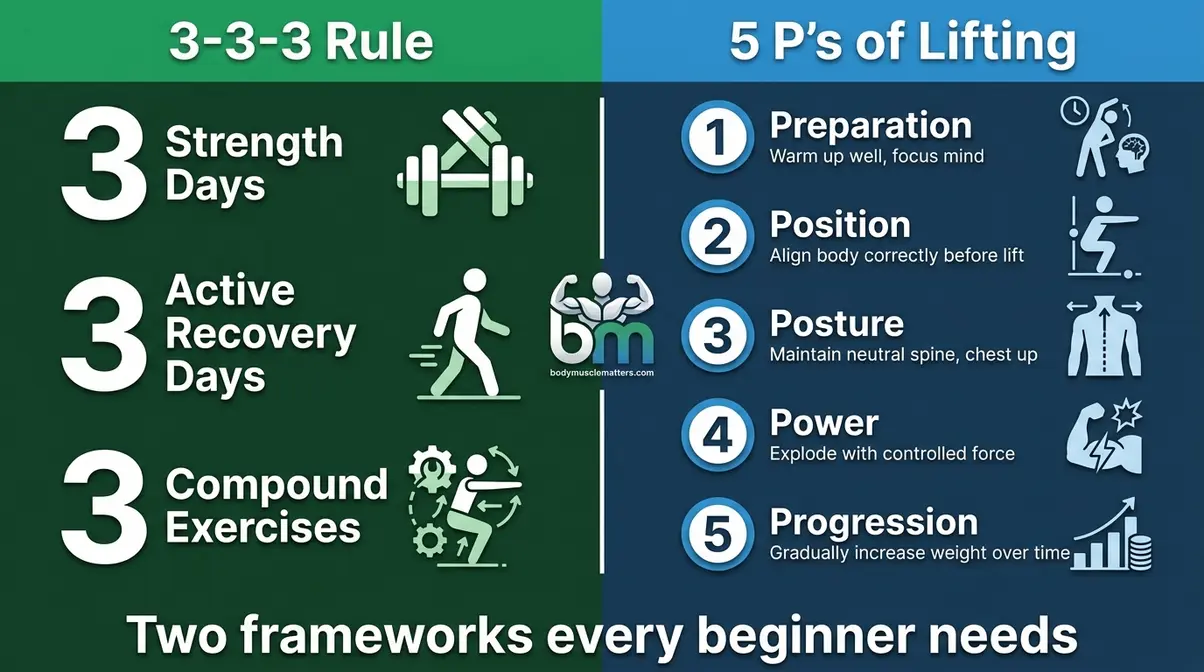
The 3-3-3 Rule is a beginner weekly training framework built around three simple numbers: 3 strength training days + 3 active recovery days + 3 key compound exercises per session. It was developed as a practical starting structure for adults who have never trained before and need a clear, memorable system rather than a complicated periodization plan.
Here’s how it works in practice:
| Day | Activity | Purpose |
|---|---|---|
| Monday | Strength session (3 exercises, 3 sets each) | Build muscle and bone strength |
| Tuesday | Active recovery (walk, stretch, yoga) | Flush lactic acid, improve mobility |
| Wednesday | Strength session | Maintain training frequency |
| Thursday | Active recovery | Reduce soreness, improve flexibility |
| Friday | Strength session | Complete the weekly training stimulus |
| Saturday | Active recovery | Light movement, mental reset |
| Sunday | Full rest | Complete physiological recovery |
The “3 key exercises” component focuses your session on compound movements — typically a squat pattern, a push pattern, and a pull pattern. This ensures every session trains your full body without requiring excessive time or equipment. A complete session using the 3-3-3 Rule takes approximately 30–45 minutes.
ACE beginner strength training recommends that beginners focus on multi-joint compound movements before adding isolation exercises — a principle the 3-3-3 Rule builds in by design.
“The 3-3-3 Rule gives beginners a complete weekly training structure in nine words — and that simplicity is exactly why it works.”
What Are the 5 P’s of Lifting?
The 5 P’s of Lifting is a session-level safety checklist — a pre-lift mental framework that fitness professionals recommend beginners run through before every set. It takes less than 30 seconds and dramatically reduces the most common beginner mistakes.
The 5 P’s:
- Preparation: Have you warmed up? Is your equipment set up correctly? Are you hydrated?
- Position: Are you in the correct starting position for this exercise? Feet, hands, and spine all aligned before you begin.
- Posture: Is your spine neutral (not arched or rounded)? Are your core muscles lightly braced?
- Power: Are you initiating the movement with the correct muscle group? For a squat, power comes from your legs and glutes — not your lower back.
- Progression: Are you using a weight that challenges you without compromising your form? If form breaks down, the weight is too heavy.
Running through the 5 P’s before each set builds the habit of mindful lifting — the practice that separates beginners who stay injury-free from those who rush through workouts and strain something in the first month.
The 8 Core Rules of Lifting
Fitness professionals and certified trainers consistently point to these eight principles as the foundation of safe, effective strength training for beginners:
1. Form first, weight second. Perfect technique with a lighter weight beats sloppy technique with a heavier one — every time.
2. Breathe through every rep. Exhale during the effort phase (lifting), inhale during the return phase (lowering). Never hold your breath.
3. Control the negative. The lowering phase of every exercise (the “eccentric” phase) is where much of the strength-building stimulus occurs. Lower slowly and with control — don’t just drop the weight.
4. Warm up every session. Cold muscles are vulnerable muscles. Five minutes of light movement before every session is non-negotiable.
5. Rest between sessions. Muscles grow during recovery, not during the workout. Training the same muscle group two days in a row without adequate rest slows progress.
6. Progress gradually. Increase weight or reps only when your current level feels consistently manageable. Jumping ahead too quickly is the leading cause of beginner injuries.
7. Stay consistent, not intense. Two steady sessions per week for 12 weeks outperforms six intense sessions per week for two weeks before burnout. Consistency is the variable that matters most.
8. Listen to your body. Muscle soreness (a dull ache 24–48 hours after training) is normal. Sharp pain during a movement is not — stop immediately and assess.
Common Strength Training Mistakes to Avoid
Understanding what not to do is as important as knowing what to do. Across beginner fitness communities, the most common concerns center on form, safety, and knowing when to seek professional guidance. This section addresses all three.
What not to do when strength training?
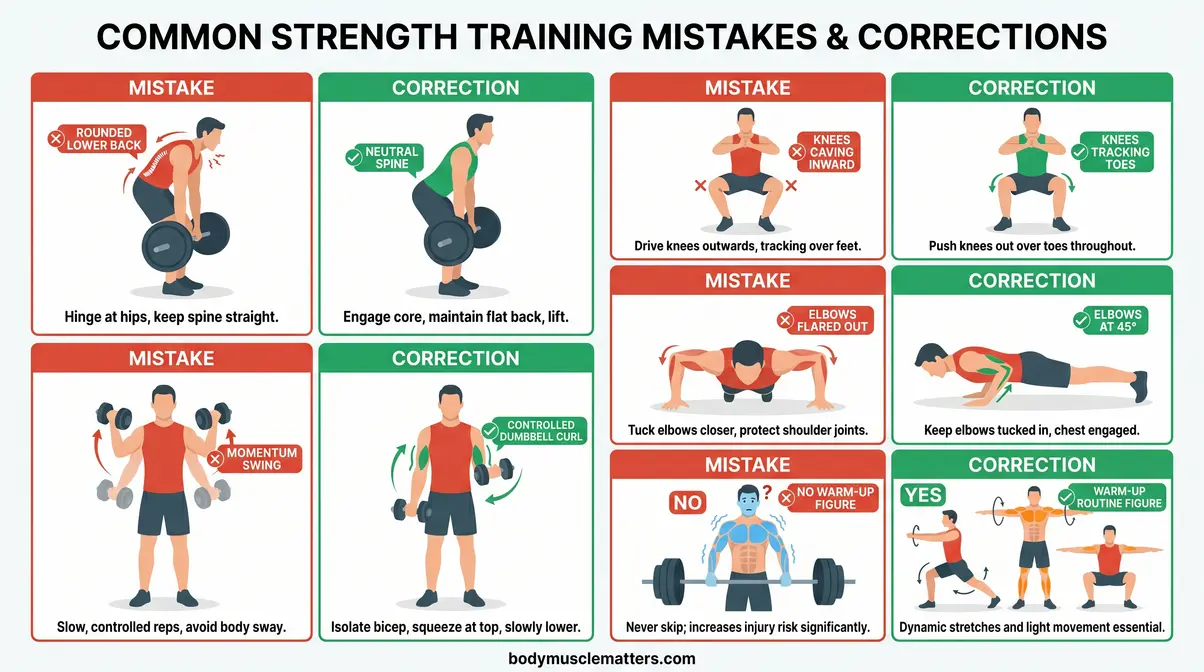
- Rounding the lower back during deadlifts and rows. This places dangerous shear force on the lumbar spine. Fix: engage your core before every rep and maintain a neutral spine throughout the movement.
- Letting your knees cave inward during squats. This stresses the knee joint and can cause ligament strain over time. Fix: actively push your knees outward (in line with your toes) throughout the entire squat.
- Using momentum instead of muscle. Swinging dumbbells, bouncing out of a squat, or using your back to pull during rows all reduce effectiveness and increase injury risk. Fix: slow down. Control every rep through its full range of motion.
- Flaring your elbows during push-ups. Elbows that point straight out to the sides place excessive stress on the rotator cuff. Fix: keep elbows at a 45° angle from your torso.
- Skipping the warm-up. Fitness professionals estimate that a significant proportion of beginner injuries occur in the first few minutes of a session — before the muscles are prepared. Fix: treat your warm-up as part of the workout, not optional preparation.
When Lifting Isn’t the Right Choice
Strength training is appropriate for the vast majority of adults — but there are situations where a modified approach or medical clearance is essential first.
- Acute injury or recent surgery: Do not train a recently injured or post-surgical area without explicit clearance from your physician or physical therapist.
- Uncontrolled cardiovascular conditions: If you have uncontrolled hypertension (blood pressure above 180/110), defer training until your condition is managed.
- Severe joint pain: Joint pain that worsens during exercise (not normal post-workout soreness) warrants evaluation before continuing.
In these scenarios, strength training may still be appropriate — but a certified personal trainer working alongside your healthcare provider is the right starting point, not a self-guided program.
When to See a Doctor First
The Mayo Clinic Health System recommends consulting a physician before beginning a strength training program if you:
- Are over 40 and have been sedentary for more than 6 months
- Have a diagnosed chronic condition (diabetes, heart disease, osteoporosis)
- Experience chest pain, dizziness, or shortness of breath during light activity
- Are pregnant or recently postpartum
A doctor’s clearance doesn’t mean you can’t train — it means you start with the right modifications in place. Most physicians actively encourage resistance training as part of managing chronic conditions, particularly for bone density and blood sugar control.
Frequently Asked Questions
How should a beginner start strength training?
Begin with 2–3 full-body sessions per week, using bodyweight exercises like squats, push-ups, and glute bridges. Focus entirely on learning proper form before adding any external weight. The ACSM recommends 2–3 sets of 8–12 reps per exercise at a weight that feels challenging in the final 2–3 reps. For a structured approach, follow The 3-3-3 Rule: 3 training days, 3 active recovery days, and 3 compound exercises per session. Most beginners see noticeable strength improvements within 4–6 weeks of consistent training.
What is the 3-3-3 Rule for lifting?
The 3-3-3 Rule is a beginner weekly training framework built around three numbers: 3 strength training days, 3 active recovery days (walking, stretching, yoga), and 3 key compound exercises per session. Each session takes approximately 30–45 minutes and covers a squat pattern, a push pattern, and a pull pattern — training the full body efficiently without overcomplicating your week. This structure gives absolute beginners a clear, memorable system to follow consistently, which is the most important variable in early-stage strength training.
Is strength training good for bone density?
Yes — progressive resistance training is one of the most effective interventions for improving bone mineral density. Research published in Medicine & Science in Sports & Exercise (Layne & Nelson, 2000) found that resistance training measurably increases bone density in the spine and hip — the two sites most vulnerable to osteoporotic fracture. The mechanism is mechanical: when muscles pull on bones during exercise, bones adapt by increasing their mineral content. The Mayo Clinic Health System confirms this benefit applies to adults of all ages, including those already experiencing age-related bone loss.
How long does it take to see results?
Most beginners notice improvements in functional strength and energy within 4 to 6 weeks. During this initial phase, your nervous system becomes more efficient at recruiting muscle fibers, which leads to rapid strength gains even before significant muscle growth occurs. Visible changes in muscle size (hypertrophy) typically take 8 to 12 weeks of consistent training. Consistency is far more important than intensity when you are first starting out.
Can I do strength training every day?
No — beginners should not perform strength training every day. Muscles grow and repair during the recovery periods between workouts, not during the exercise itself. Training the same muscle groups every day can lead to overtraining, excessive soreness, and a higher risk of injury. The CDC and fitness professionals recommend allowing at least 48 hours of rest between sessions that target the same muscle groups, making 2 to 3 days per week the ideal starting frequency.
Conclusion
For adults starting from scratch, strength training for beginners is one of the most evidence-backed investments you can make in your long-term health. Research from the NIH, CDC, and PubMed consistently shows that regular resistance training improves bone mineral density, lowers blood sugar, boosts metabolism, and supports mental health — often within the first 6–12 weeks of consistent training. The barrier is rarely physical; it’s the absence of a clear starting framework.
The 3-3-3 Rule and The 5 P’s of Lifting exist to solve exactly that problem. Three training days, three compound exercises, three sets per movement — combined with a 30-second pre-set safety checklist — give you a system that’s memorable enough to use without a notebook and effective enough to produce real results. These aren’t just catchy names. They encode the programming principles that certified trainers use with every new client.
Your next step is straightforward: clear a 6×6-foot space, run through the 5-minute warm-up in Step 2, and complete the seven-exercise workout in Step 3. Do it twice this week. That’s it. Consistency over the next 8 weeks will do more for your strength, bone health, and metabolic function than any single “perfect” workout ever could. Start simple. Start now.
Related posts:
StrongLifts 5x5 for Beginners: Complete Guide 2026
How to Get a Bigger Bum Without Exercise: 3-Tier Guide
What Muscles Does the StairMaster Work? 6 Groups
Olympic Weightlifting vs Powerlifting: 2026 Guide
What Kills Muscle Gains? 7 Proven Saboteurs to Fix Now
Best Strength Training Apps for Women: Top 7 Picks

Callum
Hi, I'm Callum, the founder of Body Muscle Matters. I'm not a certified trainer, I'm a self taught lifter who started this site to share what I've learned from my own training and a lot of trial and error. Everything here comes from real experience and honest research, written the way I'd explain it to a friend who is just getting started. My goal is simple: practical, no hype fitness advice you can actually use.