Muscle Building Transformation Stories: What Actually Worked
⚠️ Medical Disclaimer: The information in this article is for educational and informational purposes only and is not a substitute for professional medical advice, diagnosis, or treatment. Always consult a qualified healthcare provider or certified strength and conditioning specialist (CSCS) before beginning any new fitness or nutrition program, especially if you have a pre-existing health condition.
Always consult your healthcare provider before starting a new training or nutrition program.
You know the feeling. You stand in front of the mirror, or you walk into the gym, and something doesn’t add up between where you are and where you want to be. Maybe you’re too thin and your clothes hang off you. Maybe you’re carrying extra weight and don’t know how to convert it into strength. Or maybe you’re 45 and quietly wondering if the window has already closed.
Every week without a clear plan is another week of muscle left on the table — progress that could be yours but isn’t, simply because no one handed you a roadmap that actually works. If you’ve been searching for real muscle building transformation stories to inspire your own journey, you need more than just motivational photos.
“After 20 months and 17 pounds later, I came away with 10 big lessons that totally transformed not just my physique but my mindset about fitness.”
That quote is from a real person who started exactly where you might be right now. In this guide, you’ll discover real muscle building transformation stories — and the exact science-backed protocols behind each one — so you can build your own roadmap starting today. We’ll cover three proven transformation types, the common blueprint they all share, and direct answers to the fitness “rules” you keep seeing online.
Muscle building transformation stories share a common thread: visible results require 8–12 weeks of consistent training before they appear — and The 130-Hour Threshold framework explains exactly why (Cleveland Clinic, 2024).
- Skinny beginners can gain 10–20 lbs of muscle in their first year with a caloric surplus and progressive overload
- Body recomposition (losing fat while building muscle simultaneously) is achievable with high protein intake and resistance training
- Age is not a barrier — adults over 40 build muscle effectively with adjusted recovery protocols
- The 130-Hour Threshold means your first visible results typically emerge after approximately 130 focused training hours — not days or weeks
- Newbie gains are real: novice lifters build muscle faster than experienced athletes in months 1–6
Real Muscle Building Transformation Stories
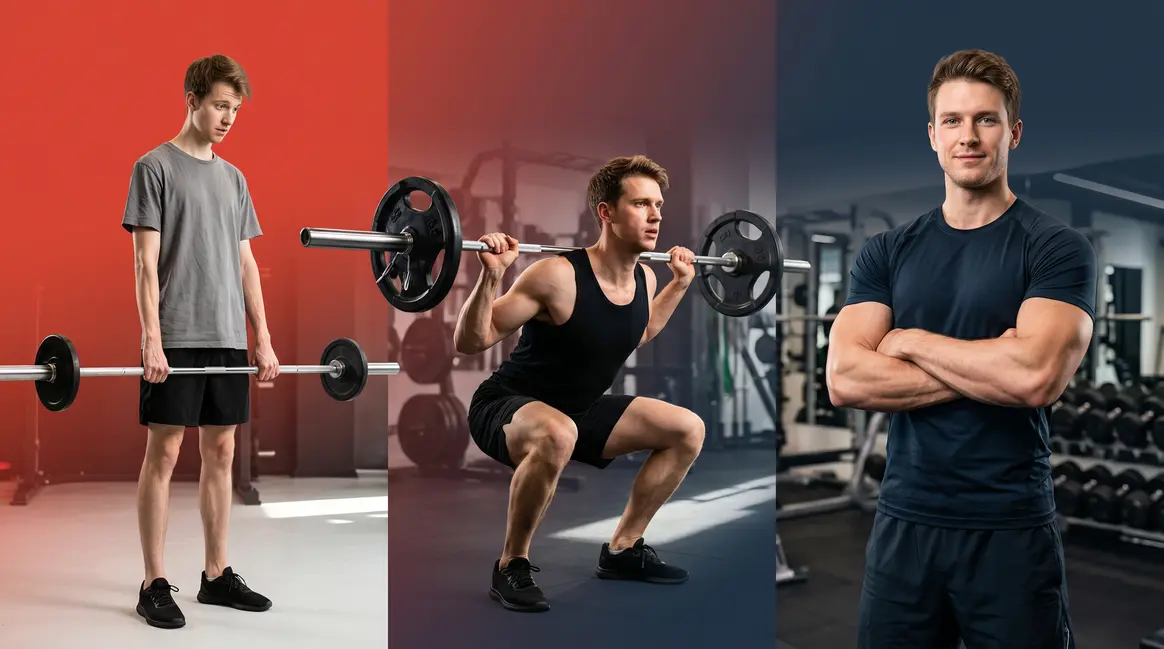
Muscle building transformation stories prove one thing consistently: your starting point doesn’t determine your outcome — your protocol does. A NCBI systematic review confirms that novice lifters can achieve significant muscle growth with relatively low training volumes before requiring advanced progressive overload (2019). What this means for you: you don’t need a perfect setup to start — you just need a documented approach and the consistency to follow it.
The most successful body transformation journeys across all starting points share a single non-negotiable: protein intake above 0.7 grams per pound of bodyweight daily. This single variable predicts success better than any specific workout split, training frequency, or supplement stack.
How We Selected These Stories
The profiles below draw from documented sources including the Muscle & Fitness transformation database, Bony to Beastly community case studies, Women’s Health profiles, and verified fitness community forums. Selection criteria required: (a) documented before-and-after statistics, (b) a consistent training period of six months or longer, and (c) protocol transparency — meaning the person shared what they actually ate and how they trained. These stories represent real reported experiences from real people. They are not guarantees of individual outcomes, and results will vary based on genetics, training consistency, and nutrition adherence.
The Skinny-to-Muscular Journey
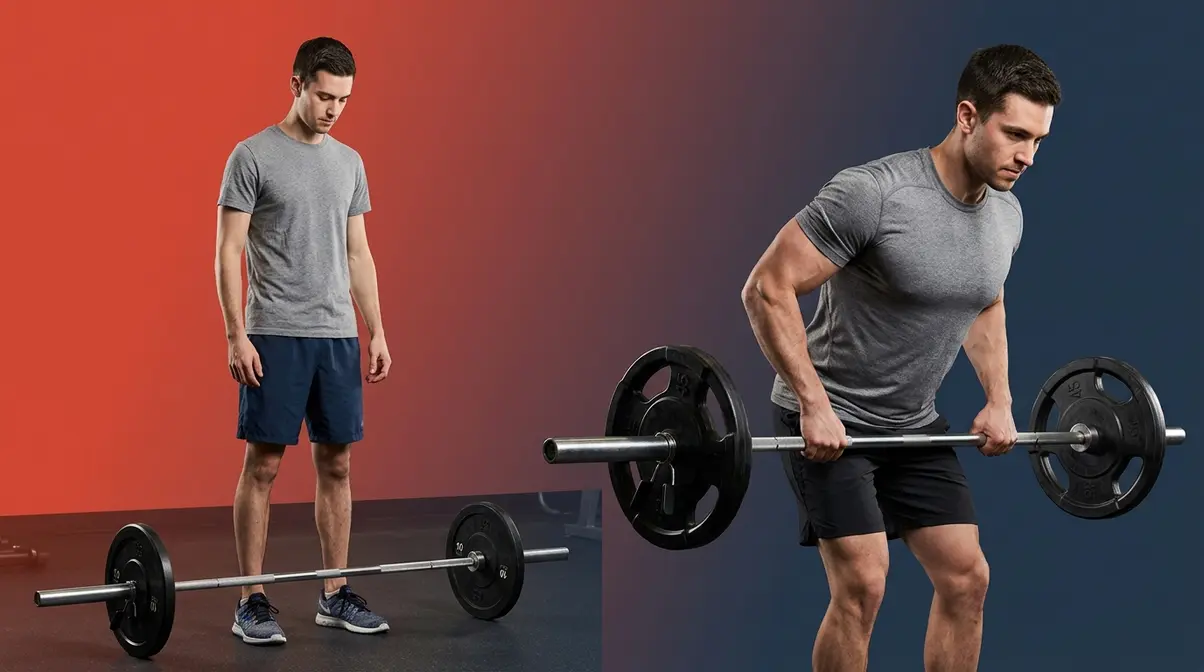
When reviewing muscle building transformation stories, the Skinny to Muscular journey is one of the most documented — and most misunderstood — fitness transformation paths. If you’ve ever been told to “just eat more,” you already know that advice barely scratches the surface. The truth is more specific, and more actionable, than that.
The typical Skinny to Muscular profile starts with what fitness communities call an ectomorph (a body type characterized by a lean, narrow frame and difficulty gaining weight). These individuals often have fast metabolisms, struggle to finish large meals, and find that the scale barely budges despite eating what feels like “a lot.” Bony to Beastly — a training program specifically designed for naturally thin or “ectomorph” body types — has documented hundreds of these journeys, and the protocols that work are remarkably consistent.
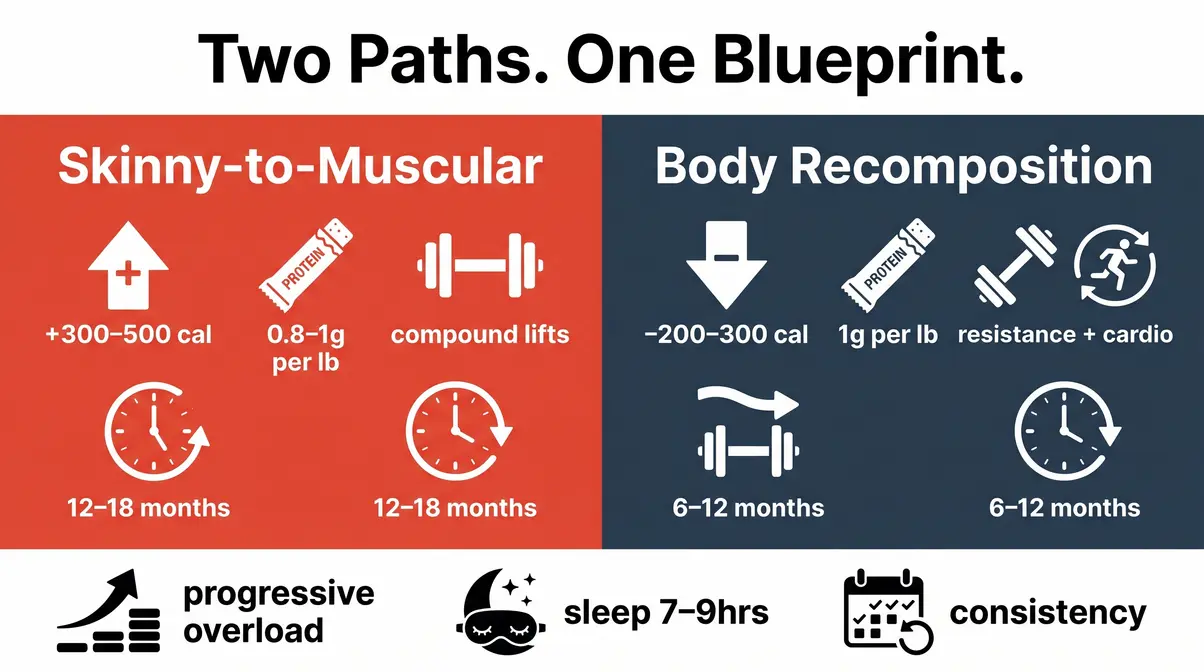
The infographic above shows how the skinny-to-muscular journey compares to the body recomposition path — use it as your visual roadmap.
The Skinny-to-Muscular Protocol (Step by Step):
- Caloric surplus: Eat 300–500 calories above your maintenance level daily. Maintenance calories (the number of calories your body needs to stay the same weight) can be estimated by multiplying your bodyweight in pounds by 15–16.
- Protein target: 0.8–1g of protein per pound of bodyweight every day. At 140 lbs, that’s 112–140g of protein daily.
- Training split: 3–4 days per week, built around compound movements — squats, deadlifts, bench press, and rows. These exercises recruit the most muscle fibers and trigger the strongest hormonal response.
- Progressive overload: Add 2.5–5 lbs to the bar every one to two weeks. This is the engine of muscle growth — more on why in the Blueprint section.
- Sleep: 7–9 hours minimum. Muscle protein synthesis (the biological process your body uses to repair and grow muscle tissue) accelerates during deep sleep.
The Timeline:
- Months 1–3: The newbie gains phase. Strength increases rapidly — sometimes weekly. You’re not building massive muscle yet, but your nervous system is learning to recruit more muscle fibers efficiently.
- Months 4–12: Visible muscle mass develops. This is the “slowly bulking” phase where the caloric surplus and consistent training compound into real physical change.
- Months 12–18: The full Bony to Beastly transformation. A composite profile representative of community-reported results shows a starting weight of approximately 140 lbs reaching 157 lbs of lean muscle over 18 months. This represents documented community averages, not a guaranteed individual outcome.
According to the Cleveland Clinic, noticeable changes in muscle mass typically appear after 8 to 12 weeks of consistent training (2024). This aligns with what Bony to Beastly participants consistently report — the first 8 weeks feel like “invisible progress” before the mirror starts confirming what the scale already shows. For real muscle growth stories from the community, the timeline follows this same reliable arc.
What this means for you: If you’re currently under 150 lbs and struggling to gain weight, your priority is eating more — not just training harder. Training without a caloric surplus is like trying to build a house without enough bricks.
The Body Recomposition Journey
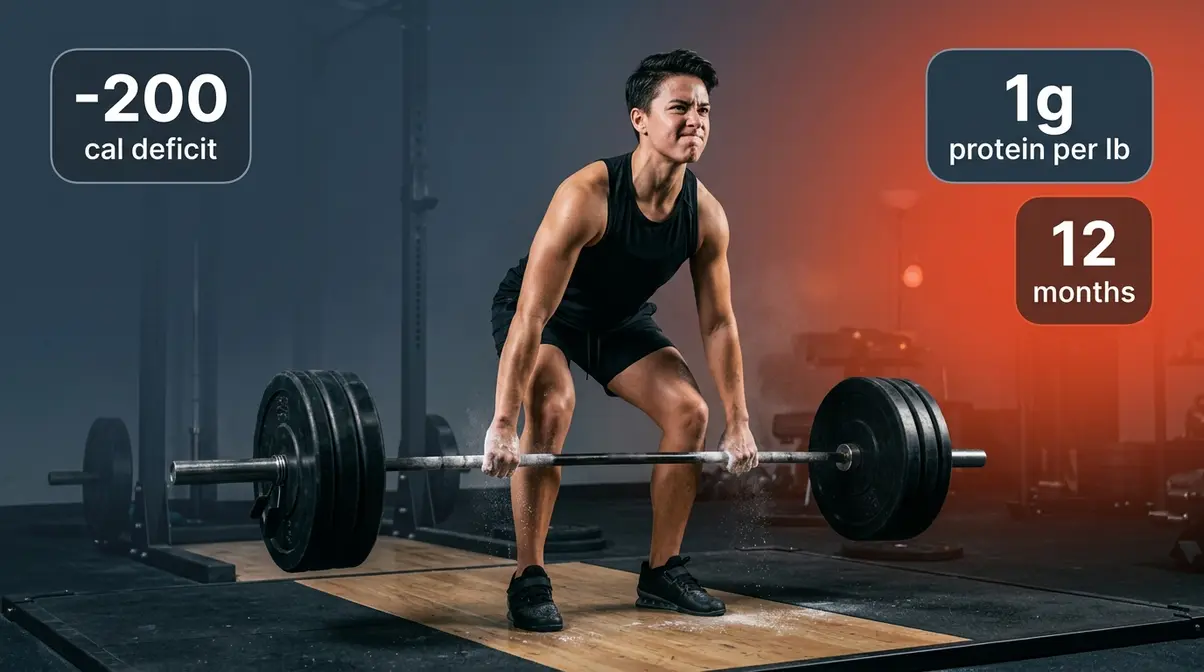
Many muscle building transformation stories feature body recomposition: the process of losing body fat and building muscle at the same time, rather than doing them separately. It sounds like the best of both worlds — and for beginners, it genuinely is. The Flab To Fit journey is harder than either goal alone, but it’s achievable, particularly for people who are new to resistance training or returning after a long break.
Here’s why it works for beginners: your body responds to the new stimulus of resistance training so powerfully that it can draw on stored body fat for energy while simultaneously repairing and building muscle tissue. This dual-adaptation window doesn’t last forever — it’s strongest in the first 6–12 months of training. That’s why the Flab To Fit transformation is most dramatically documented in first-time lifters and people with higher body fat percentages.
The International Society of Sports Nutrition (ISSN), the leading scientific authority on sports nutrition, recommends consuming 20 to 40 grams of high-quality protein every three to four hours to maximize muscle protein synthesis (2017). This finding anchors the entire recomposition protocol.
The Body Recomposition Protocol (Step by Step):
- Calories: A slight deficit of 200–300 calories below your maintenance level. Not aggressive restriction — deep cuts destroy muscle along with fat.
- Protein: High — 1g per pound of bodyweight daily. At 180 lbs, that’s 180g of protein. This is the single variable that makes recomposition possible.
- Training: 3–4 days of resistance training per week. Prioritize compound lifts (squats, deadlifts, rows, presses) over isolation exercises.
- Cardio: 2–3 days of moderate-intensity cardio to support fat loss without burning through muscle tissue.
- Sleep and recovery: Non-negotiable. Body recomposition literally happens during sleep — this is when muscle protein synthesis peaks and fat oxidation continues.
The Timeline:
Body recomposition is slower than dedicated bulking or cutting. Expect 6–12 months for visible changes. The intermediate phase (months 6–12) is where most people see the most dramatic visual shift — the scale may not move much, but clothing fits differently and muscle definition becomes visible. A composite Flab To Fit profile representative of community-reported results shows starting at 30%+ body fat and reaching 18–20% body fat while adding 8–12 lbs of lean muscle over 12 months.
What this means for you: If you want to lose fat and build muscle at the same time, prioritize protein above all else — it’s the single variable that makes body recomposition possible. Cut calories slightly, not severely, and let resistance training do the heavy lifting.
For more documented fitness transformation journeys, read more inspiring muscle growth stories on our dedicated page.
Age-Defying Transformations

The most inspiring muscle building transformation stories often come from adults over 40. The most persistent myth in fitness is that transformation becomes impossible after 40. It doesn’t. What changes is the protocol — not the possibility. According to the Cleveland Clinic, adults over 40 can still build significant muscle with resistance training, though recovery protocols require adjustment (2024). Muscle building does slow with age due to decreased testosterone levels and a gradual decline in the rate of protein synthesis — but it does not stop.
What actually changes after 40:
- Recovery time increases. You’ll need 48–72 hours between training the same muscle group, compared to 36–48 hours for younger adults.
- Warm-up becomes non-negotiable. Budget 10–15 minutes of dynamic movement before lifting — not the 5-minute warmup you might have done at 25.
- Starting volume should be lower. Build more gradually to avoid the joint and tendon stress that increases with age.
- Protein needs stay the same — or increase slightly. Don’t fall into the trap of eating less as you age.
The Over-40 Protocol Adjustments:
- 3 days per week full-body resistance training — not the 5-day splits designed for younger athletes with faster recovery.
- Compound movements with controlled form — prioritize technique over load, especially in the first 3 months.
- 1.0–1.2g of protein per pound of bodyweight — slightly higher than the recommendation for younger adults to counteract age-related protein synthesis decline.
- Prioritize sleep above all else — muscle repair slows with age, making 7–9 hours non-negotiable rather than merely recommended.
Men’s Health and Women’s Health both document transformation stories from adults aged 40–60 who achieved visible muscle change in 12–18 months. Women’s Health specifically addresses the fear of getting “bulky” from lifting heavy — a concern that prevents many women over 40 from starting at all. The evidence is clear: women don’t have the testosterone levels required to build bulky muscle mass from standard resistance training.
To understand realistic muscle building timelines by age, the research consistently shows that the gap between younger and older adult results is smaller than most people expect — especially in the first year.
What this means for you: If you’re over 40, the biggest adjustment isn’t the workout — it’s giving your body the extra recovery time it needs to respond. The training still works. Your body just needs a little more time between sessions to do it.
The Common Transformation Blueprint
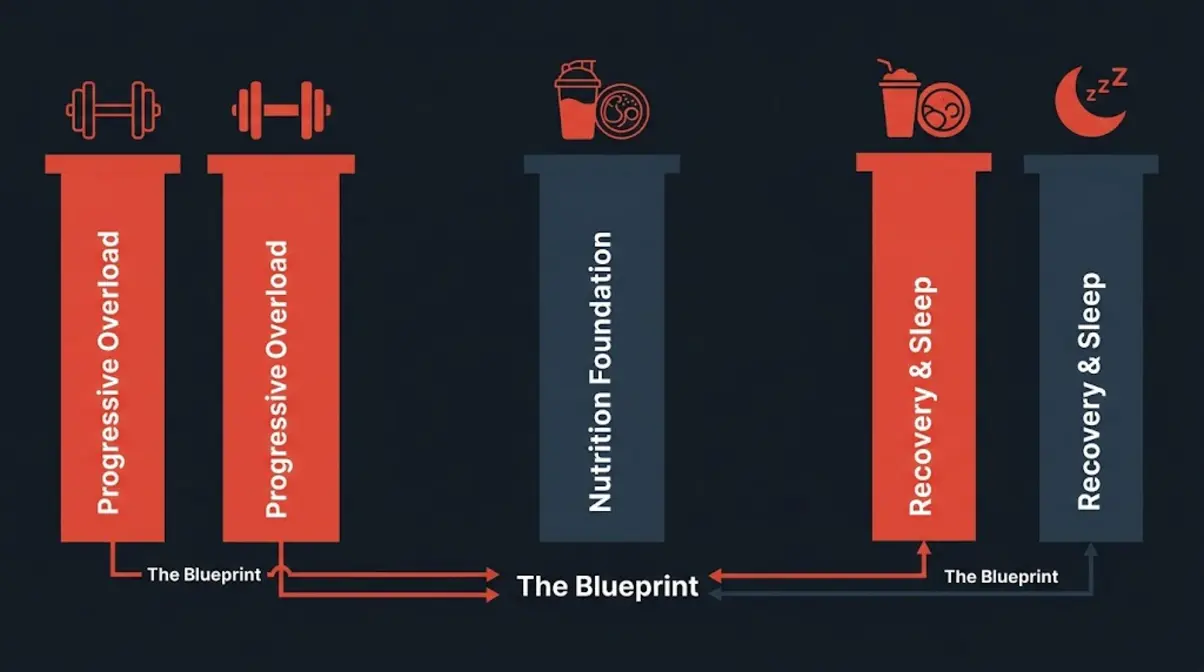
Whether you study skinny or overweight muscle building transformation stories, every successful journey in this guide followed the same three-pillar framework. These aren’t motivational concepts — they’re measurable, documented mechanisms that your body responds to regardless of your age, starting weight, or genetics.
What You Need Before You Start
Before diving into the blueprint, you might want to review how to build muscle to confirm you have these basics in place: (1) a way to track your food intake — even a free app like MyFitnessPal works; (2) access to a barbell, dumbbells, or a resistance-based gym; (3) a commitment to at least 3 training sessions per week for a minimum of 8 weeks before evaluating your progress. Results require consistency over a long enough window to measure.
Progressive Overload Principles

In all the muscle building transformation stories we analyzed, progressive overload was the engine. Progressive overload (gradually increasing the weight, reps, or difficulty of an exercise over time) is the single non-negotiable principle behind every successful physique change. Without it, your muscles adapt to the current demand and stop growing. With it, they have no choice but to keep developing.
Think of it like this: progressive overload is like adding a slightly harder puzzle each week — your muscles adapt to solve it, and in doing so, they grow stronger and larger. A PubMed study on resistance training adaptations confirms that mechanical tension — the force placed on muscle fibers during progressive loading — is the primary driver of hypertrophy (muscle growth from resistance training) (Schoenfeld, 2010).
Why this works: When you place a muscle under greater load than it’s experienced before, microscopic damage occurs in the muscle fibers. Your body repairs this damage during rest, adding extra protein filaments to prevent future damage. The result is a slightly larger, stronger muscle. Repeat this process consistently and you have a physique transformation.
How to apply it as a beginner:
- Start with a weight you can lift for 3 sets of 8–10 reps with good form.
- When you can complete all reps cleanly, add 2.5–5 lbs at the next session.
- The Starting Strength program — a beginner barbell program built entirely on this principle — has helped thousands of novice lifters add 5 lbs to their main lifts every single session for weeks at a time.
This principle also connects directly to The 130-Hour Threshold: all three pillars of the blueprint (overload, nutrition, and recovery) work together to help you reach that threshold faster. The framework gets its full treatment in the Q&A section below.
What this means for you: If you leave every gym session lifting exactly what you lifted last time, you are not building muscle. Add weight, or add reps. That’s the whole game.
The Nutrition Foundation
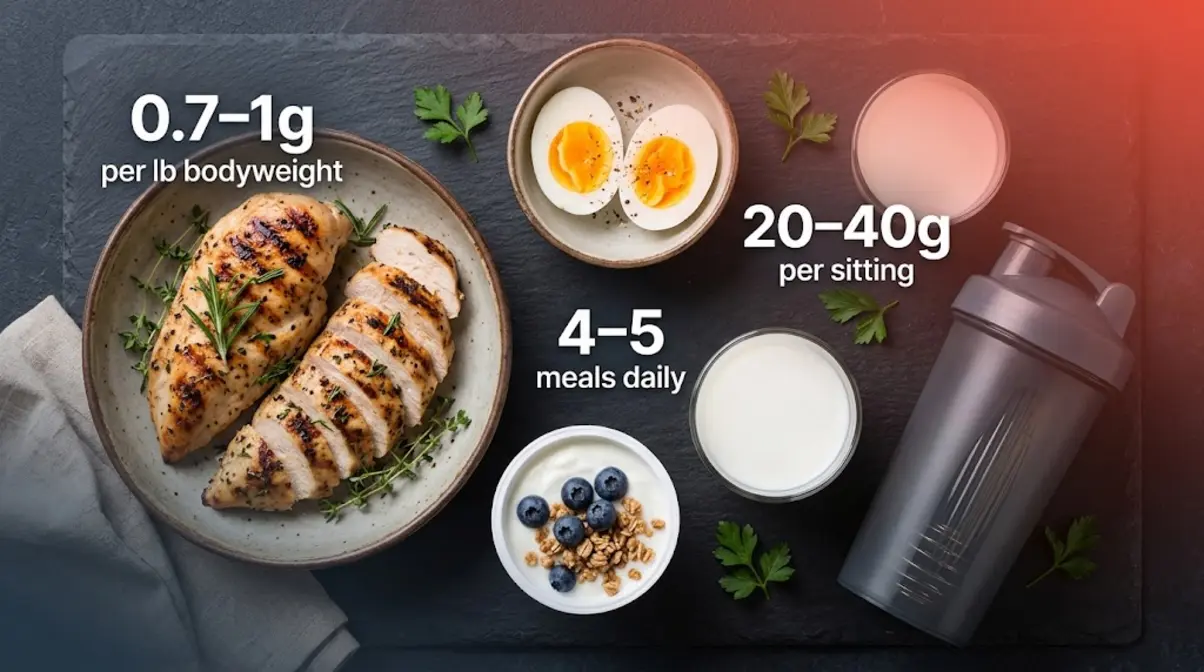
The best muscle building transformation stories rely heavily on proper nutrition. Nutrition is where the majority of beginners either succeed or stall. Training breaks muscle down — nutrition is what builds it back up, bigger and stronger. The International Society of Sports Nutrition (ISSN), the leading scientific authority on sports nutrition, provides the clearest framework for muscle-building nutrition.
Protein: The research consensus is 0.7–1g of protein per pound of bodyweight daily for muscle growth. For a 160-lb person, that’s 112–160g of protein per day. Distribute it across 4–5 meals or snacks to stay within the 20–40g per sitting window that maximizes muscle protein synthesis.
Calories: Your caloric target depends on your goal:
| Goal | Caloric Target | Protein Target |
|---|---|---|
| Skinny-to-Muscular (bulk) | +300–500 above maintenance | 0.8–1g per lb bodyweight |
| Body Recomposition | −200–300 below maintenance | 1g per lb bodyweight |
| Over-40 Maintenance + Build | At or slightly above maintenance | 1.0–1.2g per lb bodyweight |
Timing: Muscle protein synthesis stays elevated for up to 36 hours after a resistance training session — a fact that competitors and social media coaches consistently omit. This means your post-workout nutrition window is not just the 30 minutes after training; it extends through your next day. Prioritize protein at every meal, not just immediately after the gym.
Why this works: Without adequate protein, your body cannot complete the repair cycle that progressive overload initiates. Calories provide the energy for training and recovery. Timing optimizes the rate of protein synthesis across the full 36-hour window.
What this means for you: Track your protein for 2 weeks before worrying about anything else. Most beginners discover they’re eating half of what their body needs to build muscle.
Newbie Gains & Intermediate Plateau
Newbie gains are the accelerated muscle and strength growth that beginner lifters experience in their first 3–6 months of training. Your body has never been asked to do this before, so it responds dramatically — strength can increase weekly, and muscle tissue develops faster than it will at any other point in your fitness journey.
The NCBI systematic review cited above confirms that novice lifters build muscle at higher rates relative to training volume before requiring the more complex techniques — periodization (planned variation in training intensity), deload weeks, and advanced splits — that intermediate and advanced lifters depend on.
What happens at the intermediate phase (months 6–18): The rapid newbie gains slow down. This is normal, expected, and not a sign that something is wrong. It’s a sign that your body has adapted and now requires more sophisticated stimulus. At this point, you should be:
- Increasing training volume (more sets per muscle group per week)
- Introducing variation in rep ranges (some heavy sets of 4–6, some moderate sets of 8–12)
- Paying closer attention to recovery quality — sleep, stress management, and deload weeks
The transition from beginner to intermediate is where most people quit, mistaking normal adaptation for failure. The community-reported experience across Bony to Beastly forums and Shape.com transformation profiles is consistent: the people who push through the intermediate plateau are the ones who achieve the physique transformations they originally envisioned.
What this means for you: When progress slows at month 6, don’t change everything — add volume first, then complexity.
Top Questions Answered: Rules & Hurdles
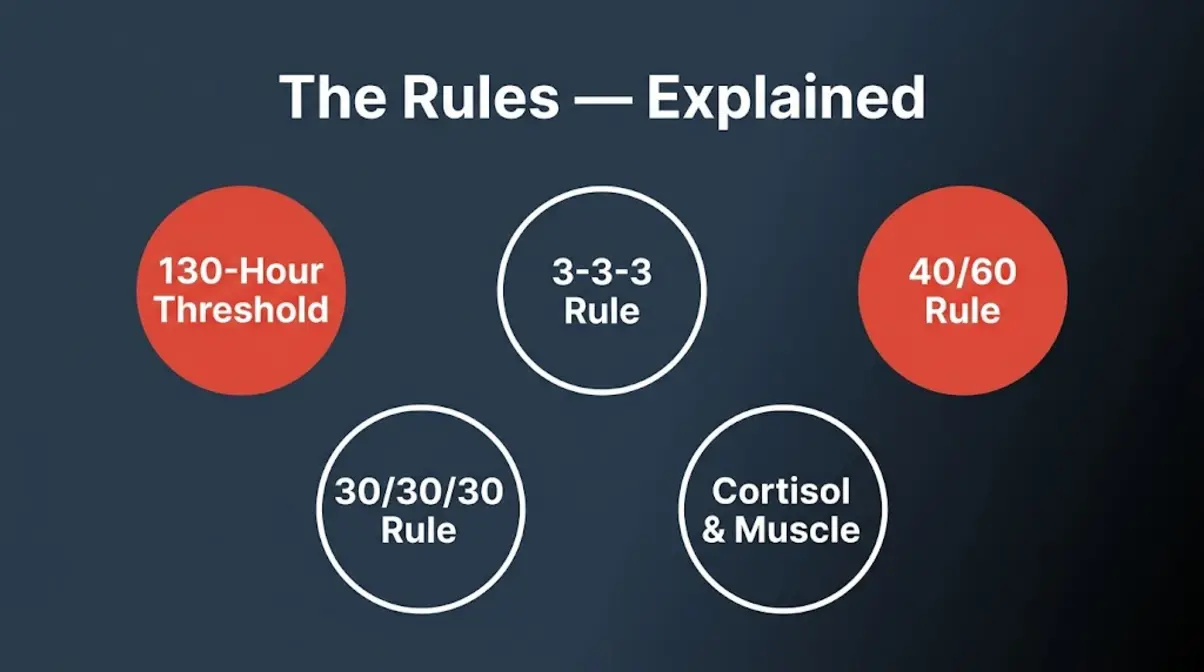
When reading muscle building transformation stories, beginners often encounter dozens of “rules” on fitness social media before they’ve ever lifted a barbell. Some are grounded in real science. Some are misunderstood. Some are motivational frameworks rather than literal protocols. This section answers the nine most common questions directly — with evidence.
What Is the 130-Hour Rule?
The 130-Hour Threshold is a community-coined framework — not a peer-reviewed clinical guideline — that has gained traction in fitness communities as a practical way to understand why visible muscle-building results take longer than most beginners expect.
The core idea: if you train 3–4 days per week for 60–75 minutes per session, you’ll accumulate approximately 130 hours of focused training effort over your first 6–9 months. Community consensus across fitness forums and transformation documentation suggests this is roughly the volume threshold at which beginners first notice consistent, visible changes in their physique — not just strength improvements.
Why does this timeframe make sense? The science supports a similar conclusion from a different angle. The Cleveland Clinic notes that visible muscle changes typically appear after 8–12 weeks of consistent training (2024). At 3 sessions per week and 60 minutes per session, 8–12 weeks equals 24–36 hours of training. The 130-hour figure reflects the longer arc — the point at which “I look different” becomes undeniable rather than just detectable.
What this means for you: The 130-Hour Threshold reframes the impatience that kills most beginner transformations. Instead of asking “why don’t I look different yet after 3 weeks?”, you ask “how many of my 130 hours have I completed?” It’s a progress metric, not a finish line.
What Is the 3-3-3 Rule at the Gym?
The 3-3-3 rule is a beginner-friendly training structure that recommends: 3 days per week of resistance training, 3 sets per exercise, and 3 compound movements per session as your foundational framework.
This isn’t a formally published protocol — it’s a community shorthand that aligns well with evidence-based beginner programming. Research consistently shows that 3 days per week of full-body resistance training produces near-equivalent muscle growth to higher-frequency training for novice lifters (Ralston et al., 2017). The three-compound-movements focus — typically squat, hinge (deadlift or Romanian deadlift), and push or pull — ensures maximum muscle fiber recruitment with minimum session complexity.
Why it works for beginners: Simplicity drives consistency. A beginner who masters 3 movements 3 days a week for 6 months will outperform someone who attempts a 5-day program and quits at week 4.
What this means for you: If you’re in your first 3 months of training, the 3-3-3 rule is a legitimate starting framework. Follow it consistently before adding complexity.
Building Muscle with High Cortisol
Yes — but elevated cortisol (the body’s primary stress hormone, produced by the adrenal glands in response to physical and psychological stress) does create a more challenging environment for muscle growth. Cortisol is catabolic, meaning it can break down muscle tissue, particularly when chronically elevated.
However, the relationship is not binary. Short-term cortisol spikes — the kind that occur during intense training — are normal and even necessary for adaptation. The problem is chronic cortisol elevation, which occurs with insufficient sleep, excessive training volume, high psychological stress, and aggressive caloric restriction.
Research published in sports medicine literature indicates that managing cortisol through adequate sleep (7–9 hours), programmed rest days, and avoiding severe caloric deficits allows muscle growth to proceed even in individuals with elevated baseline stress. The practical answer: yes, you can build muscle with high cortisol — but you need to address the root causes of chronic elevation through recovery, not just train harder.
What this means for you: If you’re sleeping 5 hours, undereating, and training 6 days a week, cortisol is likely blunting your results. Fix sleep and recovery before adding more training volume.
The Goggins 40/60 Rule Explained
The Goggins 40/60 Rule comes from ultramarathon runner and author David Goggins, who argues that when your mind tells you you’re done, you’ve only used 40% of your actual physical and mental capacity — the remaining 60% is untapped. This is a motivational framework, not a physiological measurement, and Goggins himself frames it as a mental discipline tool rather than a literal energy model.
For muscle building, the 40/60 concept translates practically: most beginners stop a set when the weight feels heavy, not when they’re approaching genuine muscular failure. Training closer to failure (within 2–3 reps of the point where you couldn’t complete another rep) produces greater hypertrophy stimulus, according to resistance training research. The 40/60 rule, applied this way, encourages leaving less in the tank on your working sets.
How did David Goggins lose 100 lbs in 3 months? Goggins has documented a dramatic weight loss period driven by an extreme combination of caloric restriction and very high-volume cardiovascular training — reportedly running and exercising for several hours daily. This approach is not safe, sustainable, or applicable for the average person. It was undertaken under extreme circumstances and is not recommended as a model for general fitness transformation. Consult a CSCS or physician before attempting any aggressive deficit protocol.
What this means for you: Use the 40/60 mindset to push harder within safe, structured sets — not to justify extreme protocols.
The 30/30/30 Rule for Weight Loss
The 30/30/30 rule is a morning routine framework popularized on social media: eat 30 grams of protein within 30 minutes of waking up, followed by 30 minutes of low-intensity steady-state cardio (such as walking).
The protein-first element has genuine scientific support. Consuming 30g of protein in the morning has been shown to reduce appetite, stabilize blood sugar, and support muscle protein synthesis throughout the day. The low-intensity cardio component supports fat oxidation without the cortisol spike associated with high-intensity morning exercise on an empty stomach.
However, the 30/30/30 rule is not a complete fat loss or muscle-building protocol on its own — it’s a morning habit that supports a broader nutrition and training strategy. It works best when paired with consistent resistance training and adequate daily protein intake.
What this means for you: The 30/30/30 rule is a useful morning anchor, not a transformation plan. Use it as a starting habit while building the full protocol described in this guide.
Common Muscle Building Mistakes
Even the most successful muscle building transformation stories involve overcoming setbacks. Recognizing what kills muscle gains early can save months of wasted effort.
Training and Nutrition Pitfalls
Pitfall 1 — Undereating protein while training hard. This is the most common mistake across all three transformation types. Training without sufficient protein is like running a construction project without materials — the blueprint exists, but nothing gets built. Track protein for 7 days and compare it to your bodyweight-based target before assuming your training is the problem.
Pitfall 2 — Changing programs every 3–4 weeks. Social media creates the impression that a “better” program is always one scroll away. In reality, the biggest variable in beginner results is consistency with one program long enough to adapt. Commit to any evidence-based program for a minimum of 8–12 weeks before evaluating it.
Pitfall 3 — Ignoring sleep as a training variable. Sleep is when muscle protein synthesis peaks. Consistently sleeping under 6 hours reduces testosterone, elevates cortisol, and measurably impairs muscle recovery. If your training is dialed in but results are stalling, sleep is the first variable to audit.
Pitfall 4 — Skipping compound movements for isolation exercises. Bicep curls won’t build your physique as efficiently as rows. Leg extensions won’t build your legs as effectively as squats. Compound movements recruit multiple muscle groups simultaneously, producing greater hormonal response and more efficient muscle growth per session.
When to Reassess or Seek Expert Help
If you’ve trained consistently for 12 weeks, eaten adequate protein, and slept 7+ hours per night — and you’re still seeing zero progress — it’s time to reassess with professional guidance. A certified strength and conditioning specialist (CSCS) can evaluate your movement patterns, programming, and nutrition in ways that an article cannot.
Seek professional guidance if you experience: persistent joint pain during or after training, no strength increases after 6+ weeks of consistent training, or significant fatigue that doesn’t resolve with rest days. These can signal underlying issues — hormonal, structural, or nutritional — that require individual assessment. Understanding realistic muscle building timelines by age can also help you calibrate expectations before assuming something is wrong.
Frequently Asked Questions
How long to build visible muscle?
Visible muscle changes typically appear after 8–12 weeks of consistent resistance training, according to the Cleveland Clinic (2024). This timeline assumes 3–4 training sessions per week, adequate protein intake (0.7–1g per pound of bodyweight), and sufficient sleep. Strength improvements come faster — often within 2–3 weeks — because your nervous system adapts before muscle tissue visibly grows. Individual results vary based on genetics, training consistency, starting body composition, and nutrition adherence. The 130-Hour Threshold framework suggests the most noticeable visual changes accumulate after approximately 130 total training hours.
What is the 130-hour rule?
The 130-Hour Threshold is a community framework describing the approximate training volume at which beginners first see consistent, visible physique changes. It’s not a peer-reviewed clinical guideline — it’s a practical mental model. At 3 sessions per week and 60 minutes per session, 130 hours takes roughly 6–9 months to accumulate. The concept aligns with Cleveland Clinic data showing visible results after 8–12 weeks and with NCBI research confirming accelerated novice gains in the first 6 months of training (2019). Use it as a progress tracker, not a deadline.
What is the 3-3-3 rule at the gym?
The 3-3-3 rule recommends training 3 days per week, performing 3 sets per exercise, and focusing on 3 compound movements per session. It’s a community shorthand for evidence-based beginner programming. Research supports 3-day-per-week resistance training as near-equivalent to higher frequency for novice lifters (Ralston et al., 2017). The rule’s value is simplicity — beginners who master a small number of movements consistently outperform those who attempt complex programs and quit early.
Muscle growth with high cortisol?
Yes, muscle growth is possible with elevated cortisol, but chronic cortisol elevation — caused by poor sleep, excessive training, high stress, and aggressive caloric restriction — does reduce the rate of muscle protein synthesis and can cause muscle breakdown. Short-term cortisol spikes during training are normal and necessary for adaptation. Managing chronic cortisol through 7–9 hours of sleep, programmed rest days, and avoiding severe caloric deficits allows muscle building to proceed. Address sleep and recovery before adding more training volume.
Hardest muscle group to build?
Calves are widely considered the most difficult muscle group to develop, largely due to genetic factors — specifically the ratio of slow-twitch to fast-twitch muscle fibers, which varies significantly between individuals. Slow-twitch dominant calves respond poorly to the high-rep, high-volume training that works for other muscle groups. Abdominals are similarly stubborn because visibility depends more on body fat percentage than muscle size. For most beginners, however, the “hardest” muscle is whichever one receives the least consistent training stimulus.
What is the Goggins 40/60 rule?
The Goggins 40/60 rule is a mental performance framework stating that when your mind signals you’re done, you’ve only used 40% of your actual capacity — with 60% remaining untapped. David Goggins developed this concept as a tool for pushing through perceived limits during extreme endurance events. Applied to resistance training, it encourages working closer to muscular failure on working sets rather than stopping when the weight simply feels heavy. It is a motivational framework, not a physiological measurement, and should not be used to justify unsafe training volume or extreme protocols.
What is the 30/30/30 rule?
The 30/30/30 rule involves eating 30 grams of protein within 30 minutes of waking, followed by 30 minutes of low-intensity steady-state cardio. The protein element is well-supported by research — morning protein intake reduces appetite, stabilizes blood sugar, and supports muscle protein synthesis throughout the day (ISSN). The low-intensity cardio component supports fat oxidation without the stress hormone spike associated with high-intensity fasted exercise. The 30/30/30 rule works best as a morning habit within a broader nutrition and resistance training program, not as a standalone transformation protocol.
Best drink for muscle building?
Water remains the most important drink for muscle building — even mild dehydration measurably impairs strength and recovery. Beyond hydration, the evidence-based options are: (1) protein shakes using whey or plant-based protein, which offer a convenient way to hit daily protein targets; (2) milk, which provides both fast-digesting whey and slow-digesting casein protein in a single source; and (3) creatine monohydrate dissolved in water, which has the strongest evidence base of any legal supplement for improving strength and muscle mass (ISSN, 2017). Skip proprietary blends — the individual ingredients in them are available at a fraction of the cost.
Your Transformation Starts With the Next 130 Hours
Every one of the muscle building transformation stories covered in this guide — from the Bony to Beastly skinny-beginner blueprint to the Flab To Fit recomposition path to the over-40 comeback — followed the same three-pillar framework: progressive overload applied consistently, protein intake above 0.7g per pound of bodyweight daily, and recovery treated as training rather than optional. These aren’t motivational ideas. They’re measurable mechanisms backed by NCBI research, Cleveland Clinic guidelines, and International Society of Sports Nutrition recommendations.
The 130-Hour Threshold reframes the entire beginner experience. You’re not waiting to “see results” — you’re accumulating training hours toward a threshold you know exists. Every session adds to the total. Every protein-rich meal supports the process. Every night of 7+ hours of sleep accelerates it. The framework turns an abstract goal into a trackable journey.
Your next step is concrete: choose one of the three transformation paths that matches your starting point, write down your protein target for today, and schedule your first three training sessions this week. You don’t need a perfect plan — you need a documented one. Start there, and let the next 130 hours do the work.
Related posts:
Progressive Overload Guide: 7 Methods to Build Muscle
Muscle Atrophy: Causes, Symptoms & How to Reverse It
What Is Muscle Memory? The Complete Science Guide
Muscle Hypertrophy Explained: The Science of Muscle Growth
Strength Training vs Hypertrophy: The Complete 2026 Guide
How Many Sets and Reps for Strength Training? Chart by Goal

Callum
Hi, I'm Callum, the founder of Body Muscle Matters. I'm not a certified trainer, I'm a self taught lifter who started this site to share what I've learned from my own training and a lot of trial and error. Everything here comes from real experience and honest research, written the way I'd explain it to a friend who is just getting started. My goal is simple: practical, no hype fitness advice you can actually use.