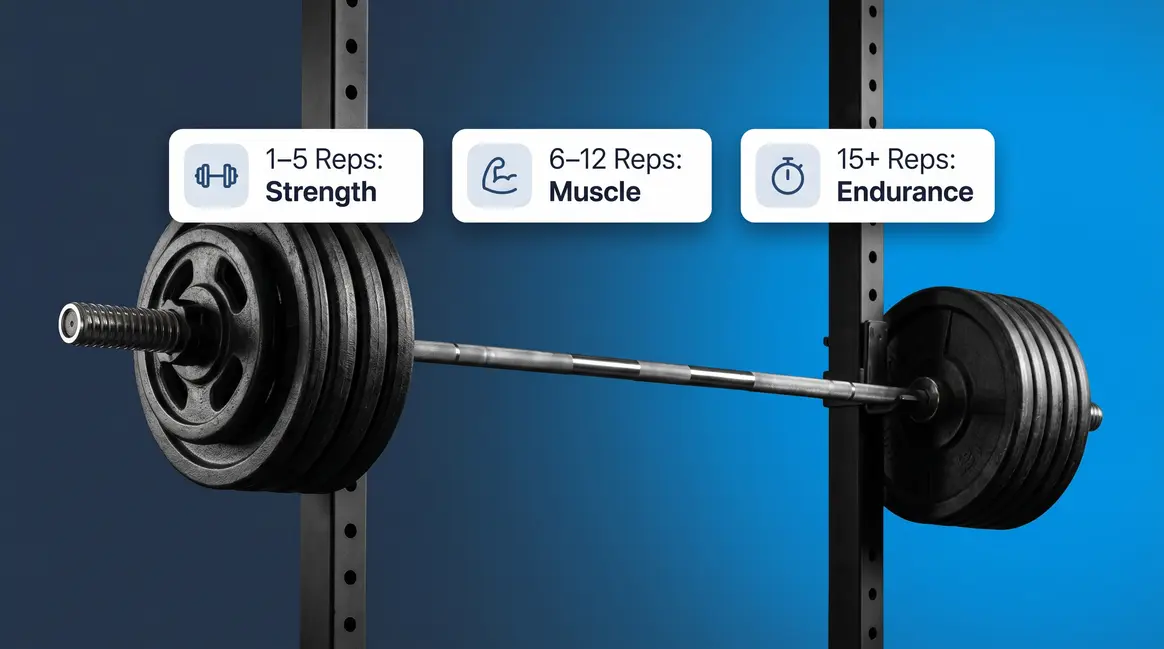
You’ve probably heard it before: “Do 3 sets of 10 reps.” But then someone else says “5 sets of 5 for strength” — and suddenly you’re Googling how many sets and reps for strength training at midnight, more confused than when you started.
That confusion is normal. The fitness world throws numbers at beginners without explaining the logic behind them. This guide fixes that. You’ll learn the exact sets and reps for your specific goal — strength, muscle growth, or endurance — plus the simple science that makes the numbers click. By the end, you’ll have a clear, actionable plan you can take to the gym tonight.
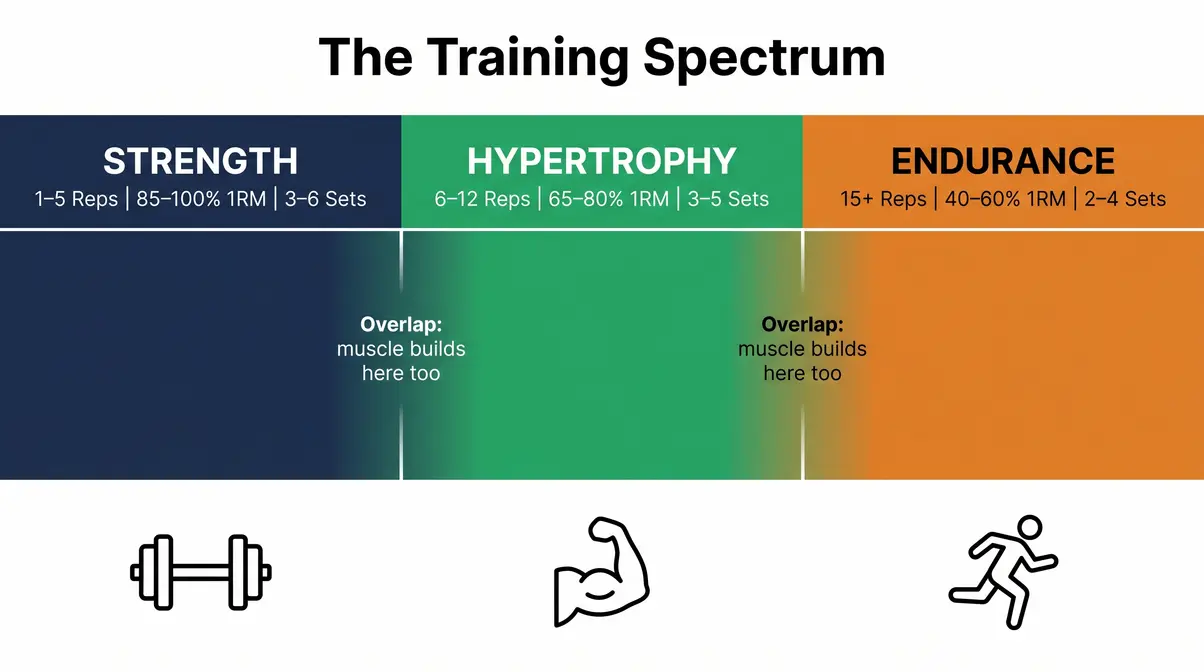
The framework that ties it all together is called The Training Spectrum — a single continuum that shows how strength, muscle growth, and endurance training are connected, not separate silos. Once you understand it, the conflicting advice you’ve seen online stops being confusing and starts making sense.
⚠️ Medical Disclaimer: The information in this article is for educational purposes only and does not constitute medical advice. Consult a qualified doctor or certified personal trainer before beginning any new exercise program, especially if you have pre-existing health conditions, injuries, or are new to resistance training.
Bestseller No. 1 FDS1 Adjustable dumbbell set, 45lbs Free Weights set with upgraded nut, 5 in 1 Weight Set Used as Kettlebells, Barbell, Push up Stand, Fitness Exercise for Home Gym Suitable Men/Women
- 【5 in 1 Multifunctional Dumbbell Set】This versatile dumbbell set 45lb total (22.5lb each) quickly converts into dumbbells, barbells, kettlebells, and push-up stands, making it suitable for a range of exercises, including bench presses, squats, and more. Enjoy multifaceted fitness!
- 【Enhanced Safety with Double Nut】Upgraded double-lock nuts enhance safety beyond that of regular multi-purpose dumbbells. Suitable for all ages and experience levels, these dumbbells allow you to focus completely on your workout. Exercise with added peace of mind.
- 【Innovative Dumbbell Plates】Innovative dumbbell plates feature dual KG & LB units, eliminating the hassle of weight conversion. Constructed from high-quality PE, these plates absorb shock and protect floors. Deep grooves ensure easy grip. The rust-free and odor-free interior is made from a mix of cement and iron sand.
- 【Free Choice of Weight】The set’s detachable design increases the flexibility of use. Each individual dumbbell can be adjusted to 6.5/8/10/13.5/15.5/17/22.5lbs, barbells: 8-47 lbs, and kettlebells: 5-23lbs. Effectively meeting your different exercise needs during various stages.Installation is simple.
- 【Storage Space < 2Ft²】Taking up less than 2 square feet, our dumbbells boast a compact design that enables convenient workouts anytime, anywhere!
Bestseller No. 2FEIERDUN Adjustable Dumbbells, 20lbs Free Weight Set with Connector, 4 in1 Dumbbells Set Used as Barbell, Kettlebells, Push up Stand, Fitness Exercises for Home Gym Suitable Men/Women
- 1 set. 5 Functions: No more buying dumbbells, kettlebells, barbells, push-up stands, and plates separately. This all-in-one adjustable dumbbell set replaces them all. High value, zero hassle. Easily build your home gym
- Custom Weight for Every Routine: The dumbbell pieces feature a detachable design, and the adjustable weight range for the single dumbbell is 5 lbs-10 lbs, the kettlebell is 3.5 lbs-11.5 lbs, and the barbell is 7 lbs-21 lbs. Suitable for beginners to professionals, it meets your exercise intensity needs in different stages in just one device. Installation is easy
- Solid Iron-Sand Construction: Our plates are integrally molded with high-density iron sand, not loose river sand. Zero shaking, zero rattling, and zero dust leakage—even after years of use. Just solid weight set that lets you focus entirely on your form and explode through every rep with confidence
- 15MM Thickened Foam: Thin padding flattens fast and digs into your neck. Our 15*430 mm high-density foam wraps a 5mm steel core, curved to fit your neck naturally — plush, breathable, sweat-absorbent. Keep the bar off your neck and your mind on the move. An upgrade you’ll feel from rep one to rep one thousand
- Premium Eco-Friendly Materials: Breathe easy while you train. Our dumbbell set is crafted from high-quality, non-toxic, eco-friendly materials that contain zero harsh chemicals. No gasoline smell, no off-gassing, no sticky residue on your hands. Just a clean, fresh workout experience that’s safe for you, your family, and your home
Bestseller No. 3Fitvids 150LB Rubber Coated Hex Dumbbell Weight Set with Storage Rack, 5-25LB Free Weights with Anti-Slip Handle for Home Gym
- 150-Pound Dumbbell Set: Includes a 5-tier A-frame dumbbell rack, a foam mat, and pairs of 5lbs, 10lbs, 15lbs, 20lbs, and 25lbs dumbbells. Fitvids dumbbells and the dumbbell rack will be sent in multiple boxes
- Durable and Sturdy: Rubber-coated dumbbell heads with solid steel handles featuring anti-slip knurling ensure a secure grip. The hexagonal design prevents rolling during workouts, protecting floors and equipment
- Space-saving: Upgraded A-frame dumbbell rack features a wide base design with rubber anti-slip feet and protective mats for enhanced stability and floor protection. An efficient 5-tier vertical design accommodates all weights in the set, saving floor space while keeping dumbbells easily accessible
- Versatile Training: Dumbbells support full-body workouts or targeted muscle group exercises. Suitable for beginners and advanced users alike, enabling movements like curls, presses, and squats
- Scenarios: Ideal for gyms and home training, helping you organize home gyms, garages, or apartment spaces
Bestseller No. 4POWER GUIDANCE Barbell Squat Pad – Neck & Shoulder Protective Pad – Great for Squats, Lunges, Hip Thrusts, Weight Lifting & More – Fit Standard and Olympic Bars Perfectly,Black
- ✅ Reduce The Risk of Injury – Distribute weight & and relieve painful pressure on your neck, shoulder, or hips, allowing you to perform the heaviest squats in comfort.
- ✅ Anti-slip – Advanced material ensures the pad will not shift or roll around from the bar, designed for utmost comfort.
- ✅ Ergonomic Design – The middle groove is ergonomically designed to reduce the stress caused by the barbell. The interior is made of high-quality high-density sponge to achieve true pain-free.
- ✅ Multi Exercise – Our barbell pad has a high grip surface, perfect for exercises like squats, lunges, and hip thrusts.
- ✅ Portable – Lightweight design, perfect for carrying in gym bags without extra weight. Easy to install and remove, but remains fastened during workouts.
Bestseller No. 5COFOF Weight Lifting Wrist Strap,Double Layer Leather Weightlifting Wrist Strap for Deadlift and Powerlifting, Adjustable Neoprene Padded Gym Workout Lifting Wrist Hooks for Men/Women(Pair)
- Upgraded Weightlifting Wrist Strap: Our lifting wrist straps are made of double layers soft leather which is high quality and ergonomically designed to fit your hands and provide better grip. Adding extra padding around the D-shaped metal ring clasp keep your wrist from being squeezed and feel painful. Weightlifting strap with high-density hook and loop can be easily worn on the wrist, and take off and put on freely by yourself. Widened neoprene pad makes you feel comfortable.
- Enhanced Grip: Professional leather deadlift straps can protect your hands from not only preventing calluses, but also peeling off existing calluses on your hands. Lifting straps take the pressure off your wrists and hands and help you lift heavier weights. More importantly, it improves your ability to exercise larger muscle groups.
- Perfect Size Weightlifting Wrist Straps: Leather of our gym wrist hooks straps is 8.07 inches long and fits Palm Circumference 8.11 inches and above. Leather with double layers of sewing design thickness of 0.19 inches, not only soft but also safe and comfortable. The neoprene padding is 7.48 inches long, 2.56 inches wide and 0.2 inches thick to better protect the wrist from injury. The adjustable high-density hook and loop length is 16.7 inches and fits wrist circumferences of 6.3 to 8 inches.
- Perfect fitness partner: Wrist workout straps are great for weightlifting, strength training, bodybuilding, pull-ups, hard pulls, shrugs, barbell rowing and upright rowing. Not only is the cow suede sweat-wicking and non-slip, but it is also constructed to last and resist up to 480 lbs without tearing. The wrist straps weighs only 0.5 pounds, so you can carry it with you, using it at home, in the gym or in the outdoors.
- Wrist Wraps Strap Brand: Our gym weight lifting straps includes 1 pair of weightlifting workout wrist strap, 1 Instruction Manual. We are committed to providing a satisfactory experience. If you have any questions, please feel free to reach out to us.


Understanding how many sets and reps for strength training depends entirely on your goal — and The Training Spectrum framework shows exactly how each goal maps to specific numbers.
- Strength (1–5 reps): Heavy loads, low reps, and longer rest periods build maximal force production.
- Muscle growth (6–12 reps): Moderate weight and higher rep ranges maximize hypertrophy (muscle cell growth).
- Endurance (15+ reps): Lighter loads and shorter rest periods build muscular stamina.
- Weekly volume matters: Aim for 10–20 sets per muscle group per week for consistent progress.
- Beginners win with 3 sets: Research supports 3 sets per exercise as the most efficient starting point for new lifters.
What Are Sets and Reps?
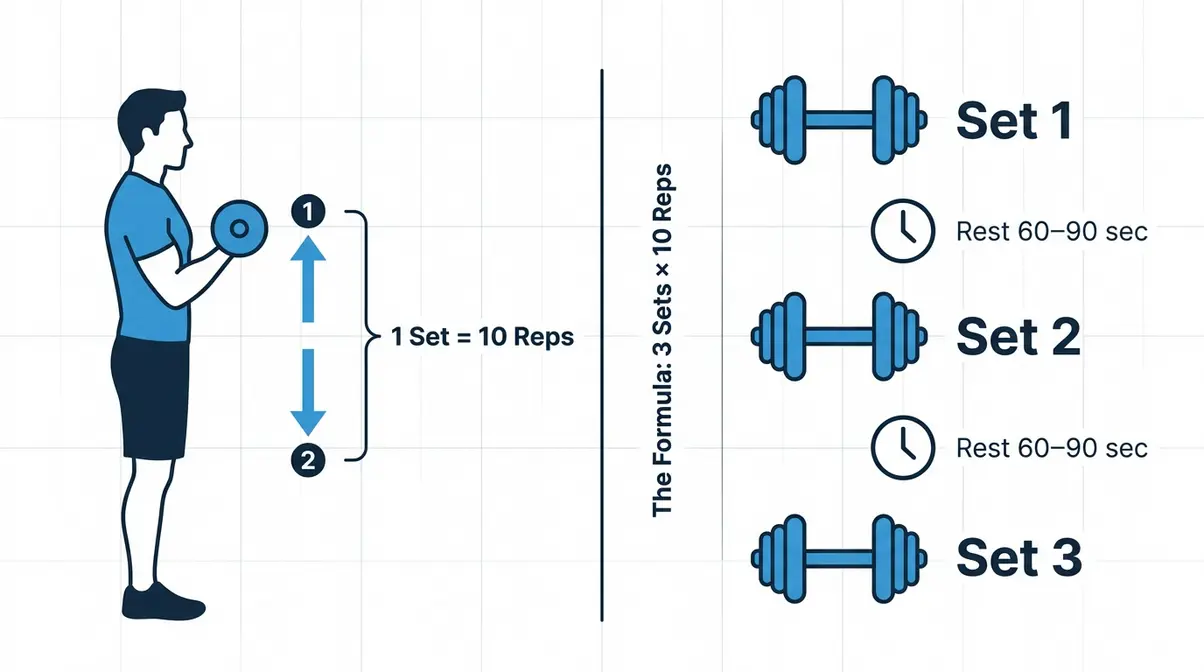
A rep (short for repetition) is one complete movement — lifting the weight up and lowering it back down counts as one rep. A set is a group of consecutive reps performed without stopping. So “3 sets of 10 reps” means you perform 10 reps, rest, then repeat that group two more times.
Simple enough. But here’s where most beginners go wrong: they treat sets and reps as arbitrary numbers rather than as levers that control what your body adapts to. The number of reps you perform changes the training stimulus — the specific signal you send your muscles. Change the stimulus, and you change the result. That’s the entire science of programming, distilled to one sentence. Understanding the core principles of strength training vs hypertrophy is the first step to building an effective routine.
Research from the National Institutes of Health confirms that different rep ranges produce meaningfully different physiological adaptations. Low reps under heavy load primarily develop neural efficiency and force production. Moderate reps under moderate load maximize muscle fiber hypertrophy (the process of muscle cells growing larger). High reps under light load build muscular endurance. Knowing which lever to pull — and when — is the difference between a program that works and one that wastes your time.
Strength vs. Muscle Growth
Strength and muscle size are related, but they are not the same thing. Strength is a skill — specifically, your nervous system’s ability to recruit and coordinate muscle fibers efficiently. Training for strength teaches your brain to activate more motor units (groups of muscle fibers) at once, producing more force.
Hypertrophy (muscle growth) is a structural change. Your muscle fibers actually increase in cross-sectional area, like adding more engine cylinders. More muscle mass generally means more potential strength, but a highly trained powerlifter can often out-lift a larger bodybuilder because their nervous system is better calibrated for maximal force production.
This distinction matters for your training because the two goals require different rep ranges, different rest periods, and different intensities. A strength-focused program uses heavier loads and lower reps to stress the nervous system. A hypertrophy-focused program uses moderate loads and moderate reps to create enough metabolic stress and mechanical tension to trigger muscle fiber growth. Both work. Your goal decides which path you take.
What Is Junk Volume?
Junk volume refers to sets and reps that add fatigue without adding a meaningful training stimulus. Think of it this way: your muscles adapt to challenges they haven’t fully recovered from yet. Sets performed when you’re too fatigued to maintain proper tension — or sets that are so easy they barely challenge you — don’t earn their place in your program.
Certified strength coaches commonly identify junk volume as one of the top mistakes beginners make. It usually happens in two ways. First, you do too many sets per session, and the last few sets are performed with poor form and minimal effort. Second, you use weights so light that the movement never genuinely challenges your muscles. Both scenarios accumulate fatigue without delivering a proportional stimulus for growth or strength.
The fix is straightforward: keep your working sets (the sets that actually count) challenging enough that the last 2–3 reps feel genuinely difficult, but not so exhausting that your form breaks down. This concept is called training close to failure — the point where you can no longer complete another rep with good form. Staying 1–3 reps away from failure on most sets is the sweet spot research consistently supports.
The Training Spectrum Framework
Here is the core idea this entire guide is built on:
The Training Spectrum is a single continuum that runs from pure strength at one end to pure muscular endurance at the other, with hypertrophy (muscle growth) sitting in the middle. Every rep range you’ve ever heard about fits somewhere on this spectrum.
“‘8 to 12 reps for muscle.’ ‘1 to 5 reps for strength.’ That’s the simplified version most people hear. And to be fair, lower rep ranges absolutely are better for maximizing strength… But the idea that lower reps are only for strength, while moderate reps are only for muscle growth, is where things become misleading.”
That quote captures exactly why the “strength OR muscle” framing confuses beginners. The spectrum model corrects it. You can build muscle at 5 reps. You can build strength at 12 reps. The rep range shifts the emphasis, not the outcome entirely. Understanding this gives you enormous flexibility to design a program around your schedule, equipment, and preferences — without feeling locked into a single rigid formula.
How Many Sets and Reps for Strength Training
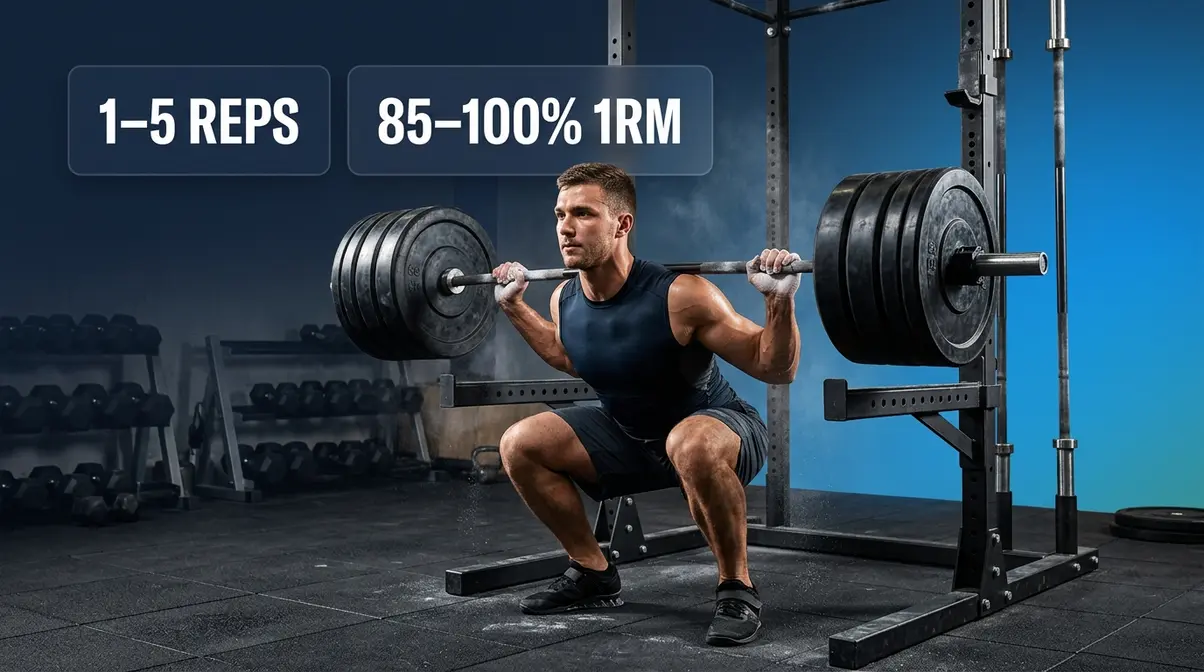
Strength training uses 1–5 reps per set, performed at 85–100% of your 1RM (your one-rep max — the heaviest weight you can lift once), for 3–6 sets per exercise. This high-intensity, lower-volume approach is the most evidence-backed method for developing maximal force production. According to the American College of Sports Medicine (ACSM), heavy-load, low-rep training is the primary driver of neuromuscular adaptations — the nervous system improvements that make you stronger.
The ACSM’s position stand on resistance training established that loads above 85% of 1RM, combined with adequate rest, consistently produce superior strength gains compared to moderate-load training. A 2023 meta-analysis in the Journal of Strength and Conditioning Research further confirmed that the 1–5 rep range produces the greatest increases in maximal strength across trained and untrained populations. For beginners, the good news is that your nervous system is highly responsive — you’ll see strength gains quickly even before your muscles visibly change.
The 1-5 Rep Rule for Raw Power
Low reps build strength because they force your nervous system to recruit the largest, most powerful muscle fibers — called Type II (fast-twitch) fibers — that your body normally keeps in reserve. Your brain only calls on these fibers when the demand is high enough to require them. Lifting a heavy weight that limits you to 1–5 reps creates exactly that demand.
Think of it like this: your muscles are a workforce. For light tasks, you only need a small crew. For heavy tasks, the whole team shows up. Heavy compound lifts — movements like the squat, deadlift, and bench press that work multiple muscle groups at once — are the best tools for recruiting that full workforce. Over time, your nervous system gets better at activating that full team faster and more efficiently. That’s strength.
The practical takeaway: choose a weight that makes completing your target reps genuinely challenging. If you’re aiming for 3 reps, the weight should feel very heavy. If you could easily do 6–7 reps, the load is too light for strength-focused training.
How Many Sets Per Session for Strength
For strength development, research and certified trainer consensus support 3–6 working sets per exercise, with most beginners starting at 3–4 sets. The NSCA (National Strength and Conditioning Association) recommends that novice lifters begin with 3 sets per exercise and progress to higher volumes as their recovery capacity improves. Programs like the Starting Strength program utilize this exact set and rep scheme to maximize early strength adaptations.
A practical strength session for a beginner typically includes:
- 2–3 main compound exercises (e.g., squat, bench press, row)
- 3–4 sets each
- Total working sets per session: 6–12
More sets per session is not always better. Because heavy lifting places significant stress on your nervous system — not just your muscles — excessive volume in a single session can impair recovery and reduce the quality of subsequent sessions. Certified trainers consistently recommend prioritizing quality over quantity: fewer sets performed with full intent and proper technique outperform high-volume sessions with sloppy form.
Rest, Weight, and Frequency
Rest periods are a non-negotiable part of strength training. For sets in the 1–5 rep range at near-maximal effort, you need 3–5 minutes of rest between sets. This isn’t laziness — it’s biology. Your muscles use a high-energy compound called ATP (adenosine triphosphate) for explosive, heavy efforts. Full ATP replenishment takes approximately 3 minutes. Cutting rest short means your next set starts with a depleted energy system, reducing the quality of your work.
Weight selection: A useful rule of thumb is to choose a load you can lift for your target reps but not for 3–4 more. If you’re targeting 3 reps, pick a weight where rep 4 would be impossible with good form. Many beginners underestimate their capacity — start slightly heavier than feels comfortable, not lighter.
Weekly frequency: For strength development, training each major movement pattern (push, pull, hinge, squat) 2–3 times per week is the evidence-based standard. Harvard Health recommends at least 2 resistance training sessions per week for meaningful strength adaptations.
What Are the 5 Essential Exercises?
No single list of “5 exercises” covers every training goal, but the 5 fundamental movement patterns cover the whole body: squat (e.g., back squat, goblet squat), hinge (e.g., deadlift, Romanian deadlift), push (e.g., bench press, push-up), pull (e.g., row, pull-up), and carry (e.g., farmer’s walk). Building a program around these five patterns — rather than a list of specific exercises — ensures balanced muscle development, functional strength, and injury resilience. Certified coaches consistently recommend mastering these movement patterns before adding isolation work like curls or extensions.
Sample Strength Day Workout
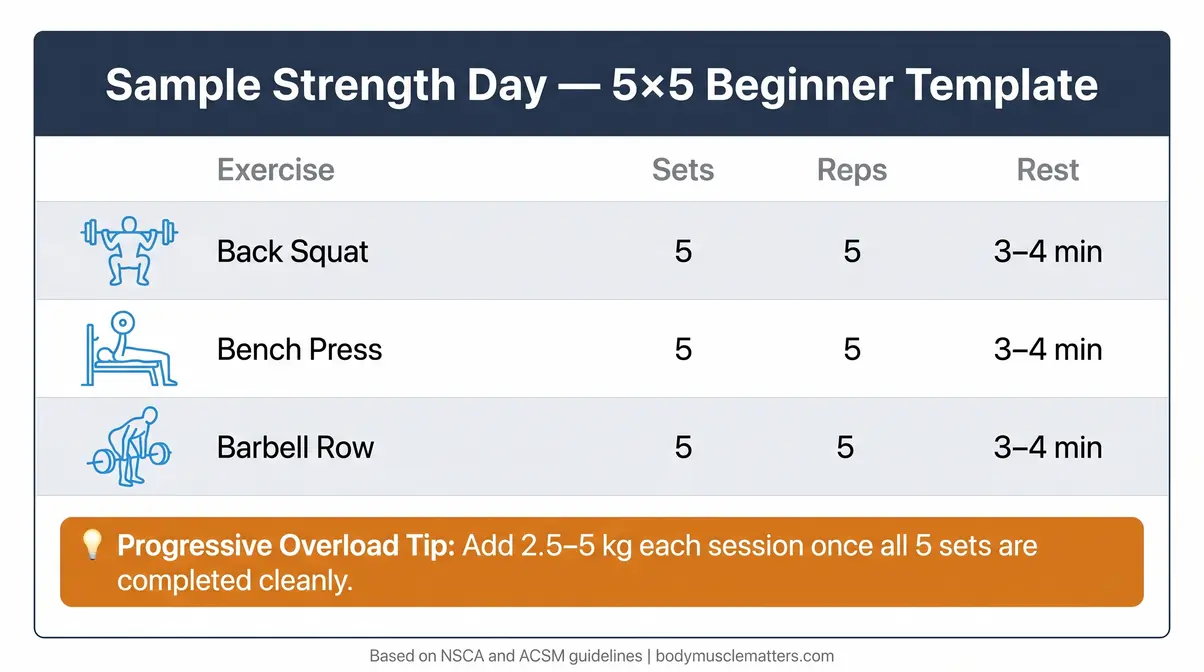
This beginner strength template uses a classic 5×5 structure (5 sets of 5 reps), similar to the StrongLifts program, which is one of the most time-tested approaches in strength training.
Tools needed: Barbell, squat rack, bench. Estimated time: 45–60 minutes.
| Exercise | Sets | Reps | Rest | Intensity |
|---|---|---|---|---|
| Back Squat | 5 | 5 | 3–4 min | ~80% 1RM |
| Bench Press | 5 | 5 | 3–4 min | ~80% 1RM |
| Barbell Row | 5 | 5 | 3–4 min | ~75% 1RM |
How to run this workout:
- Warm up for 10 minutes — 2 light sets of each movement at 50% of your working weight.
- Load your working weight — for beginners, start conservatively (you can always add weight next session).
- Perform 5 reps with full control. The weight should feel heavy but not cause form breakdown.
- Rest 3–4 minutes before your next set. Use a timer — most people underestimate how long 3 minutes feels.
- Log your weights. Next session, add 2.5–5 kg (5–10 lbs) to the bar if all 5 sets were completed cleanly.
This is progressive overload — gradually adding more challenge to your workouts over time — and it is the single most important principle in all of strength training.
How Many Sets and Reps to Build Muscle
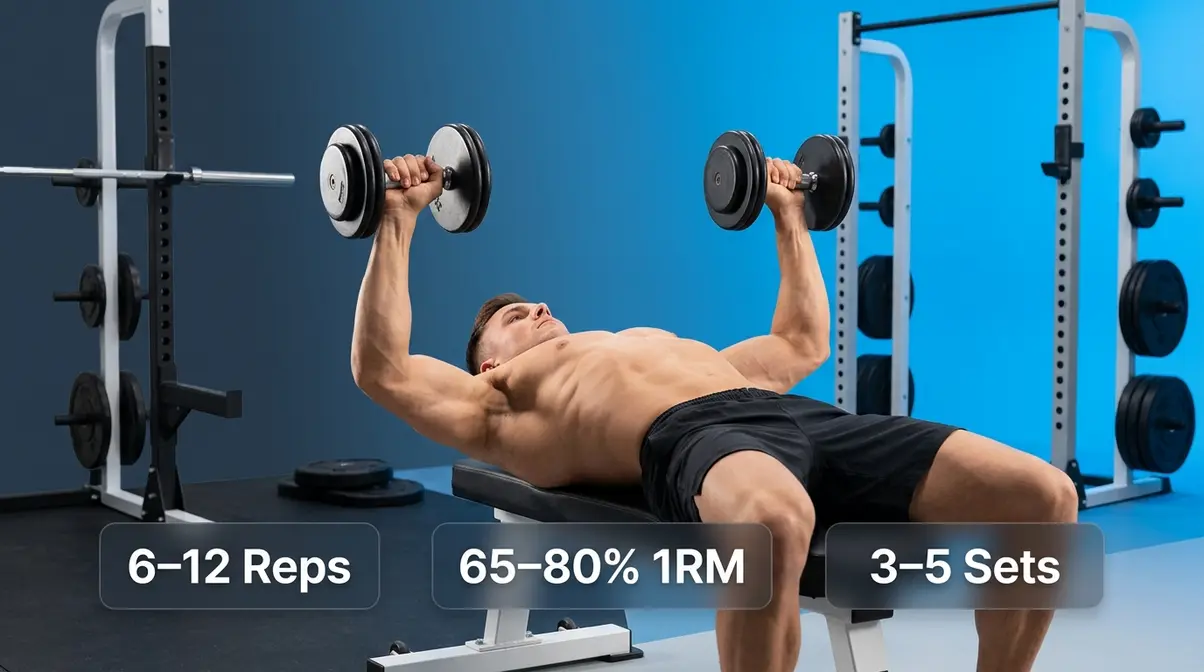
To build muscle, perform 6–12 reps per set at 65–80% of your 1RM, for 3–5 sets per exercise. This rep range — often called the “hypertrophy space” — creates the ideal combination of mechanical tension and metabolic stress that signals your body to build new muscle tissue. A 2021 systematic review published in the Journal of Human Kinetics (available via PubMed Central) confirmed that moderate rep ranges in this zone produce the greatest hypertrophic response across a wide range of training populations.
The reason this range works is straightforward. Sets of 6–12 reps last long enough to create significant metabolic stress (the “burn” you feel) while still using heavy enough loads to generate substantial mechanical tension on muscle fibers. Both mechanisms independently stimulate muscle protein synthesis — the biological process of building new muscle tissue. Together, they are more effective than either mechanism alone.
The 6-12 Rep Range for Muscle
The 6–12 rep range for muscle growth is not a rigid rule — it is a target zone that can flex. Research shows muscle growth occurs across a wide rep spectrum (as low as 5 reps and as high as 30 reps), provided sets are taken close to failure. However, the 6–12 zone consistently emerges as the most efficient range because it balances load, time under tension, and recovery cost.
A key principle for beginners learning how many sets and reps to build muscle: proximity to failure matters more than the exact rep number. A set of 12 reps where the last 2 reps are genuinely hard produces a better hypertrophic stimulus than a set of 12 reps where you stop with 5 more reps in the tank. Certified trainers commonly recommend stopping 1–2 reps short of failure on most sets — this maximizes the stimulus while minimizing injury risk and recovery demand.
Isolation work — exercises that target a single muscle group, like bicep curls or leg extensions — often responds particularly well to the higher end of the hypertrophy range (10–15 reps). Heavy compound lifts like squats and deadlifts are typically programmed in the 6–8 rep range for muscle-building purposes, since the technical demand makes very high reps risky.
Is 3 Sets of 10 Enough for Muscle?
Yes — 3 sets of 10 reps is a highly effective muscle-building protocol, especially for beginners. The 10-rep range sits squarely within the hypertrophy zone (6–12 reps), and 3 sets per exercise delivers sufficient weekly volume when combined with 2–3 training sessions per week. Research confirms that moderate rep ranges like this produce significant hypertrophic responses in untrained populations. The key variable is progressive overload — you must gradually increase the weight or difficulty over time for continued growth.
Optimal Weekly Sets Per Muscle?
If you are wondering, “how do I optimize my workout routine for maximum muscle gain?” total weekly volume is the answer. Weekly volume — the total number of sets you perform for a muscle group across an entire week — is one of the most important variables in hypertrophy training. The research on exact weekly volume isn’t fully settled, but the current best evidence points to a clear range.
A 2022 meta-analysis by Dr. James Krieger found that 10–20 sets per muscle group per week produces optimal hypertrophy for most trained individuals. For beginners, even 6–10 sets per muscle group per week is sufficient to drive significant growth, because untrained muscles respond strongly to any new training stimulus.
Here’s what that looks like in practice:
| Muscle Group | Beginner Weekly Sets | Intermediate Weekly Sets |
|---|---|---|
| Chest | 6–10 | 12–16 |
| Back | 6–10 | 12–16 |
| Legs (quads/hamstrings) | 6–10 | 12–18 |
| Shoulders | 4–8 | 8–14 |
| Biceps / Triceps | 4–6 | 8–12 |
Why this matters for your planning: If you train your chest twice per week with 3–5 sets per session, you hit the lower end of the beginner range (6–10 sets) — which is exactly where you should start. Resist the urge to train every muscle group every day. Muscles grow during recovery, not during the workout itself.
Sample Muscle-Building Workout
This upper/lower split template hits each muscle group twice per week — the minimum frequency research supports for hypertrophy. This ensures proper progressive overload for muscle growth.
Upper Body Day (Muscle Focus):
| Exercise | Sets | Reps | Rest | Notes |
|---|---|---|---|---|
| Dumbbell Bench Press | 4 | 8–10 | 90 sec | Last 2 reps should feel hard |
| Seated Cable Row | 4 | 8–10 | 90 sec | Squeeze shoulder blades |
| Dumbbell Shoulder Press | 3 | 10–12 | 75 sec | Control the descent |
| Dumbbell Bicep Curl | 3 | 12 | 60 sec | Isolation work |
| Tricep Pushdown | 3 | 12 | 60 sec | Isolation work |
Lower Body Day (Muscle Focus):
| Exercise | Sets | Reps | Rest | Notes |
|---|---|---|---|---|
| Goblet Squat or Leg Press | 4 | 10–12 | 90 sec | Full range of motion |
| Romanian Deadlift | 4 | 10–12 | 90 sec | Feel the hamstring stretch |
| Leg Curl | 3 | 12–15 | 60 sec | Isolation for hamstrings |
| Leg Extension | 3 | 12–15 | 60 sec | Isolation for quads |
| Calf Raise | 4 | 15–20 | 45 sec | Higher reps work well here |
Alternate Upper and Lower days across the week (e.g., Monday Upper / Tuesday Lower / Thursday Upper / Friday Lower) for optimal frequency and recovery.
Master Summary Table of Sets and Reps
This table gives you every number you need, at a glance. Whether your goal is raw strength, building muscle, or muscular endurance, match your goal to the row and follow the prescription. This is the clearest answer to how many sets and reps for strength training — and every other resistance training goal.
| Goal | Rep Range | Sets Per Exercise | Rest Between Sets | Intensity (% of 1RM) | Weekly Sets/Muscle |
|---|---|---|---|---|---|
| Maximum Strength | 1–5 reps | 3–6 sets | 3–5 minutes | 85–100% | 6–12 |
| Muscle Growth (Hypertrophy) | 6–12 reps | 3–5 sets | 60–90 seconds | 65–80% | 10–20 |
| Muscular Endurance | 15–25 reps | 2–4 sets | 30–60 seconds | 40–60% | 8–15 |
| Power/Explosiveness | 1–5 reps (explosive) | 3–5 sets | 2–4 minutes | 30–70% (speed focus) | 6–10 |
| General Fitness / Beginner | 8–15 reps | 2–3 sets | 60–90 seconds | 60–70% | 6–12 |
How to read this table: Find your primary goal in the left column. The numbers in that row are your prescription. If you’re a beginner, start with the lower end of every range — fewer sets, shorter rest, and moderate intensity — and progress gradually over 4–8 weeks.
Decoding Popular Workout Rules
Popular workout rules circulate on social media constantly, but most gym-goers never learn what they actually mean or whether they’re worth following. If you’re confused by body building vs strength training explained in different magazines, these viral rules can muddy the waters further. This section breaks down the most common ones so you can evaluate them yourself — rather than following them blindly or dismissing them unfairly.
What Is the 3-3-3 Rule in the Gym?
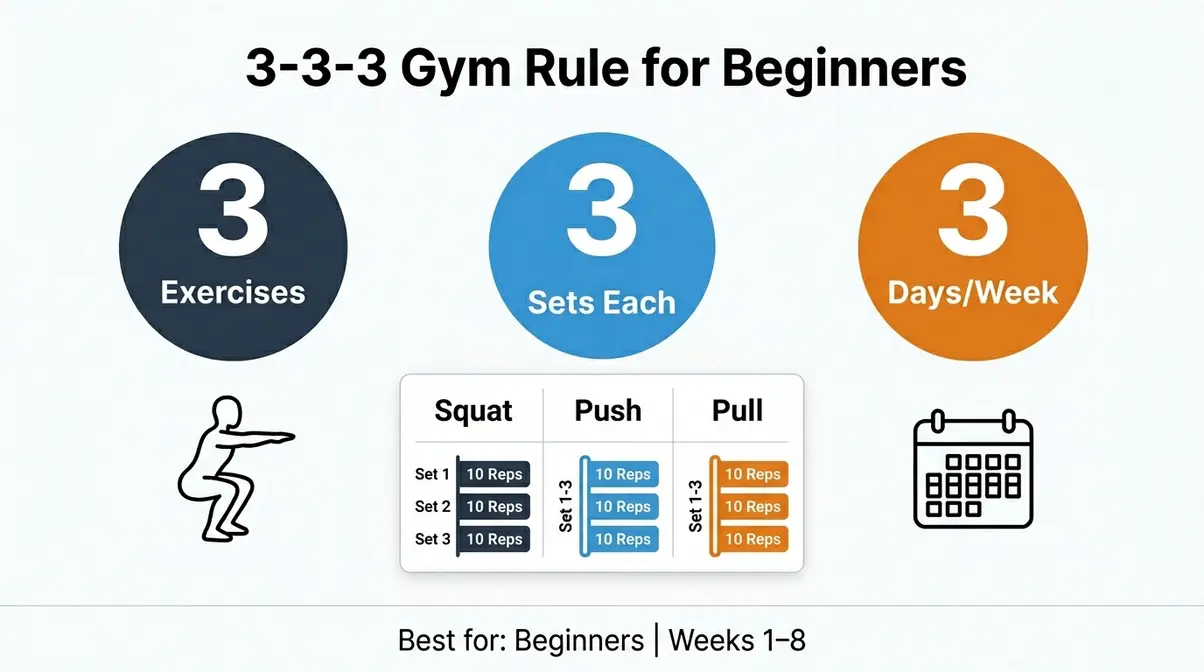
The 3-3-3 rule is a beginner-friendly training structure: 3 exercises, 3 sets each, 3 days per week. It is not a scientifically validated protocol with a formal name — it’s a practical heuristic that coaches and trainers use to give new lifters a simple, manageable starting point.
The appeal is obvious: three numbers are easy to remember, and the structure creates a full-body routine that hits every major muscle group without overwhelming a beginner’s recovery capacity. A classic 3-3-3 setup might look like this:
- Squat (lower body) — 3 sets × 8–10 reps
- Push-Up or Bench Press (upper body push) — 3 sets × 8–10 reps
- Row or Pull-Up (upper body pull) — 3 sets × 8–10 reps
Performed 3 days per week with a rest day between sessions, this hits the evidence-based minimum for strength and hypertrophy stimulus. It is a legitimate starting point — not a long-term program, but a solid foundation for the first 4–8 weeks of training. After that, progressive overload demands more variety and volume than the 3-3-3 rule provides.
Community consensus from strength training forums and certified coaches is consistent: the 3-3-3 rule is a starter framework, not a ceiling. Use it to build the habit, then graduate to a structured program.
What Is the 2-2-2 Rule in Weightlifting?
The 2-2-2 rule is a progressive overload guideline: if you can complete all your target sets and reps for 2 consecutive sessions, add weight to the bar. The “2-2-2” refers to two consecutive successful sessions as the trigger for progression.
This rule solves one of the most common beginner problems: not knowing when to increase the weight. Many beginners either add weight too aggressively (risking injury and form breakdown) or never add weight at all (stalling their progress). The 2-2-2 rule provides a clear, objective trigger.
Here’s how it works in practice:
- Session 1: Complete all sets and reps with your current weight. ✓
- Session 2: Complete all sets and reps again with the same weight. ✓
- Session 3: Increase the weight by the smallest increment available (typically 2.5 kg / 5 lbs for upper body, 5 kg / 10 lbs for lower body).
This conservative approach to progression aligns well with the principle of progressive overload and is particularly useful for beginners who are still learning to gauge their effort level. NerdFitness and other evidence-informed fitness resources recommend similar “earn the weight increase” frameworks to prevent premature loading.
Is 3 or 5 Sets Better for Strength?
Both 3 and 5 sets are effective for strength development — the right answer depends on your training age and recovery capacity. For beginners, 3 sets per exercise is sufficient and often preferable. Your nervous system is highly responsive to any new strength stimulus, so you don’t need large volumes to see progress. Three quality working sets deliver the necessary signal without overtaxing your recovery.
For intermediate and advanced lifters, 5 sets per exercise provides a higher dose of the training stimulus, which becomes necessary as the nervous system adapts and requires greater challenge to continue improving. Research published in the Journal of Strength and Conditioning Research found that multiple-set protocols (4–6 sets) produced significantly greater strength gains than single-set protocols in trained individuals, though the difference was smaller in beginners.
The practical takeaway: start with 3 sets. Graduate to 5 sets after 8–12 weeks when your current volume no longer feels challenging enough to drive progress.
Common Mistakes and How to Avoid Them
Even with the right numbers, beginners frequently make errors that slow their progress or increase injury risk. Understanding these pitfalls before you hit the gym is one of the most valuable things this guide can offer.
Common Pitfalls
1. Using the same rep range for every exercise, every session.
The Training Spectrum exists for a reason. Staying exclusively in the 8–10 rep zone for months limits your development. A well-designed program cycles through different rep ranges — a concept called periodization (systematically varying your training over time) — to develop strength, muscle, and endurance simultaneously.
How to avoid it: Every 4–8 weeks, shift your primary rep range. Spend a block in the 4–6 rep range for strength, then return to 8–12 for hypertrophy. This prevents adaptation plateaus and develops a more complete athlete.
2. Ignoring rest periods.
Rest periods are not optional. Cutting rest short because you’re impatient or self-conscious at the gym is one of the most common — and most costly — beginner mistakes. Inadequate rest reduces force production on subsequent sets, turning your strength workout into an accidental endurance session.
How to avoid it: Use a phone timer. No exceptions. 3 minutes for strength sets. 60–90 seconds for hypertrophy sets.
3. Adding weight before form is solid.
Progressive overload requires that the base movement pattern is established first. Adding weight to a broken squat pattern doesn’t build strength — it reinforces a movement fault that will eventually cause injury.
How to avoid it: Spend your first 2–4 weeks mastering movement patterns with light or bodyweight loads before adding significant resistance.
4. Underestimating warm-up sets.
Working sets are only as good as the preparation that precedes them. Cold muscles under heavy load are injury-prone. Warm-up sets — performed at 50–60% of your working weight for 2 sets of 5 reps — prepare your joints and nervous system without fatiguing you.
5. Chasing soreness as a measure of success.
DOMS (delayed onset muscle soreness — the stiffness you feel 24–48 hours after training) is not a reliable indicator of training quality. Research consistently shows that soreness does not correlate with muscle growth or strength gain. Beginners who chase soreness often overtrain and under-recover.
When to Choose Alternatives
When you have a specific injury or joint limitation: Standard barbell movements may not be appropriate. A certified personal trainer (CPT) can substitute movements that achieve the same training stimulus with reduced joint stress — for example, goblet squats instead of back squats for those with lower back concerns.
When you train at home without a barbell: Resistance bands and dumbbells can replicate most rep range prescriptions effectively. The principles of The Training Spectrum apply regardless of equipment. Research shows that band and dumbbell training produces comparable hypertrophy to barbell training when taken close to failure.
When you’re over 60 or returning from a long break: General fitness guidelines from the CDC recommend muscle-strengthening activities at least 2 days per week for adults, but the loading should be more conservative. Starting in the 10–15 rep range at lower intensities reduces injury risk while still stimulating meaningful adaptation.
When to Seek Expert Help
If you experience sharp joint pain (not muscle fatigue) during any exercise, stop immediately and consult a sports medicine physician or physiotherapist before continuing. Similarly, if you have cardiovascular disease, hypertension, or diabetes, get medical clearance before beginning a strength training program. A certified personal trainer can design a program specifically around your health history and limitations — this is money well spent for anyone starting from scratch.
Frequently Asked Questions
How many sets and reps should a beginner do?
Beginners should perform 3 sets of 8–12 reps per exercise as a starting point for general fitness and muscle growth. This range is recommended by the ACSM as the most effective entry point for untrained individuals. Three sets provide enough training stimulus to drive adaptation without overwhelming recovery capacity. For strength-focused beginners, 3 sets of 5 reps at heavier loads is equally valid. Most beginners benefit from 2–3 training sessions per week, targeting the full body each session, for the first 8–12 weeks.
How many reps should I do for strength vs. muscle?
For strength, perform 1–5 reps per set at 85–100% of your maximum effort. For muscle growth, perform 6–12 reps per set at 65–80% of maximum effort. The distinction is rooted in different physiological mechanisms: low reps develop neuromuscular efficiency (your brain-muscle communication), while moderate reps maximize mechanical tension and metabolic stress in muscle fibers — the two primary triggers for hypertrophy. Both goals benefit from progressive overload, adequate rest, and consistent training frequency of 2–3 sessions per week per muscle group.
What is the best time of day to exercise?
The best time to exercise is the time you will consistently show up for. Research on circadian rhythms suggests that afternoon sessions (between 2–6 PM) may offer a slight performance advantage — body temperature, testosterone levels, and reaction time peak in the afternoon for most people. However, a Harvard Health review notes that consistency far outweighs timing in determining long-term results. Morning exercisers consistently show higher adherence rates in population studies, likely because early sessions are less susceptible to schedule disruption. Train when you will actually train.
What is Jennifer Aniston’s 15-15-15 workout?
The 15-15-15 workout is a cardio routine consisting of 15 minutes on a spin bike, 15 minutes on an elliptical, and 15 minutes of running. Popularized by Jennifer Aniston, it is an effective way to break up 45 minutes of steady-state cardio to prevent boredom and repetitive stress injuries. While excellent for cardiovascular health and endurance, it is not a strength training protocol. To build muscle or raw strength, you must incorporate resistance training using the rep ranges outlined in the Training Spectrum.
What muscle is hardest to grow?
The calves and forearms are widely considered the hardest muscles to grow. This is largely due to their high proportion of slow-twitch (Type I) muscle fibers, which are highly fatigue-resistant and less prone to hypertrophy than fast-twitch fibers. Additionally, these muscles are used constantly in daily life for walking and gripping, meaning they require significant, targeted progressive overload to experience a novel stimulus. To force adaptation, trainers often recommend training these stubborn muscles with higher frequencies (3-4 times per week) and a mix of heavy low reps and high-volume burn sets.
Putting It All Together: Your Next Step
Strength training progress comes down to one repeating cycle: choose the right rep range for your goal, perform enough sets to create a stimulus, recover fully, and then return and do slightly more. That is the entire science of getting stronger and building muscle — and every number in this guide serves that cycle.
The Training Spectrum framework makes this concrete. You are not choosing between “strength training” and “muscle building.” You are choosing where on the spectrum to focus your energy right now. Beginners benefit most from spending their first 8–12 weeks in the general fitness zone (8–15 reps, 3 sets, moderate intensity) to build movement quality and baseline conditioning. From there, you can shift toward the strength end or the hypertrophy end depending on what matters to you.
Ready to get started? Pick one goal from the Master Summary Table above. Use the corresponding rep range, set count, and rest period. Train 2–3 days per week. Apply the 2-2-2 rule to progress your weights. Revisit the table in 8 weeks and reassess. That plan — straightforward as it sounds — is what the research actually supports. If you want personalized guidance beyond what any guide can provide, consult a certified personal trainer who can assess your movement quality and design a program around your specific body, schedule, and goals.