You saved the workout to your phone three weeks ago. You still haven’t started.
That’s not a motivation problem — it’s a starting-point problem. Every week without a structured plan means another week feeling tired, sluggish, and frustrated with yourself, not because you’re lazy, but because no one handed you a clear, safe, proven path forward. The problem isn’t willpower. It’s the absence of a simple, beginner-specific system.
In this guide, you’ll get the complete home workout routine for beginners — The 3-3-3 Blueprint, a medically reviewed, step-by-step bodyweight plan you can start in 20 minutes, with zero equipment and zero guesswork. You’ll learn the 3-3-3 framework, complete a full-body bodyweight circuit, build a weekly schedule, train for your specific goal — whether that’s weight loss, core strength, or building muscle — plus follow dedicated paths for women and men.
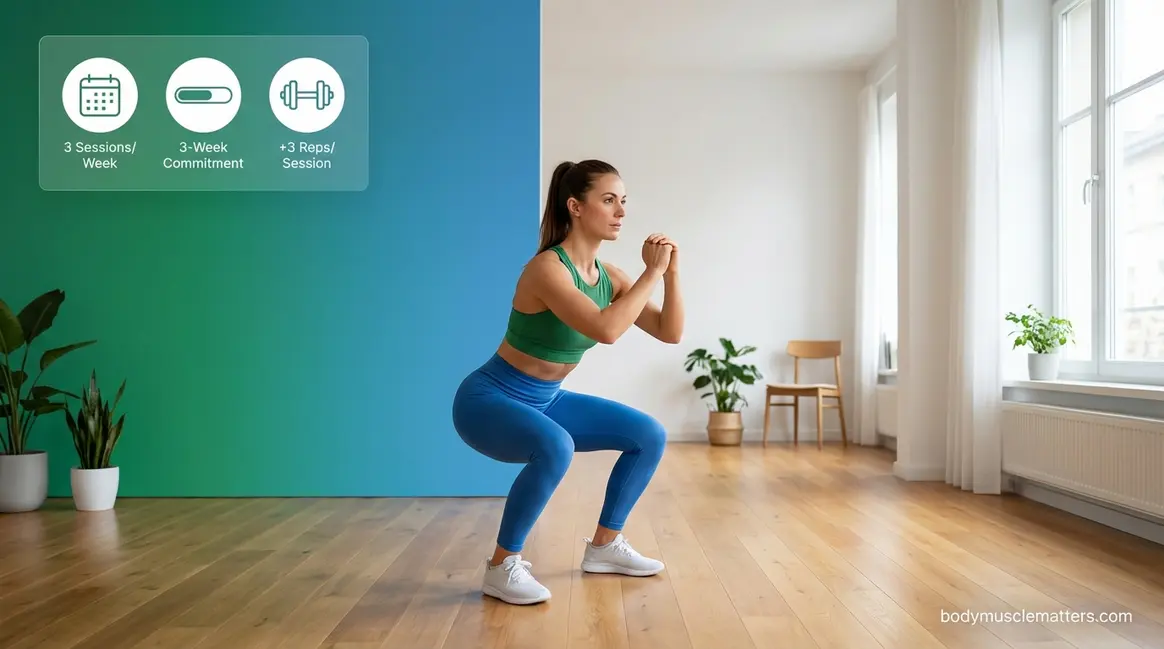
The 3-3-3 Blueprint is the simplest home workout routine for beginners — 3 sessions per week, 3 weeks of consistency, +3 reps of progress every session. No equipment needed.
- Start with 20 minutes: The 7-exercise bodyweight circuit builds full-body strength without a gym.
- The 3-3-3 Blueprint works: 3 workouts × 3 weeks × +3 reps = sustainable habit formation, not burnout.
- You can build muscle without weights: Repetition progression drives strength gains; research published on NIH’s PubMed database confirms simple bodyweight training improves fitness in inactive adults (PMC, 2021).
- Medical safety first: See the Workout Safety and Medical Modifications section if you have high blood pressure or joint pain before starting any exercise.
TL;DR — Quick Start
Complete beginners: start with the 7-exercise bodyweight circuit (Step 2) on Monday, Wednesday, and Friday. Add 3 reps each session. Commit to 3 weeks before judging results. If you have hypertension or joint pain, skip to the Workout Safety section first. Everything else in this guide adds depth once you’ve got Week 1 under your belt.
Before You Begin: What You Need to Know
⚠️ MEDICAL DISCLAIMER: The exercises in this guide are intended for general fitness purposes only. Consult your physician or a certified personal trainer before beginning any new exercise program, especially if you have a pre-existing medical condition, high blood pressure, joint pain, or have been sedentary for more than 6 months. Stop immediately if you experience chest pain, dizziness, or sharp joint pain.
- Estimated Time: 20–30 minutes per session
- Tools and Materials Required:
- Clear floor space (roughly 10 square feet)
- Comfortable athletic clothing
- A smartphone or basic timer
- Optional: Yoga mat for floor exercises
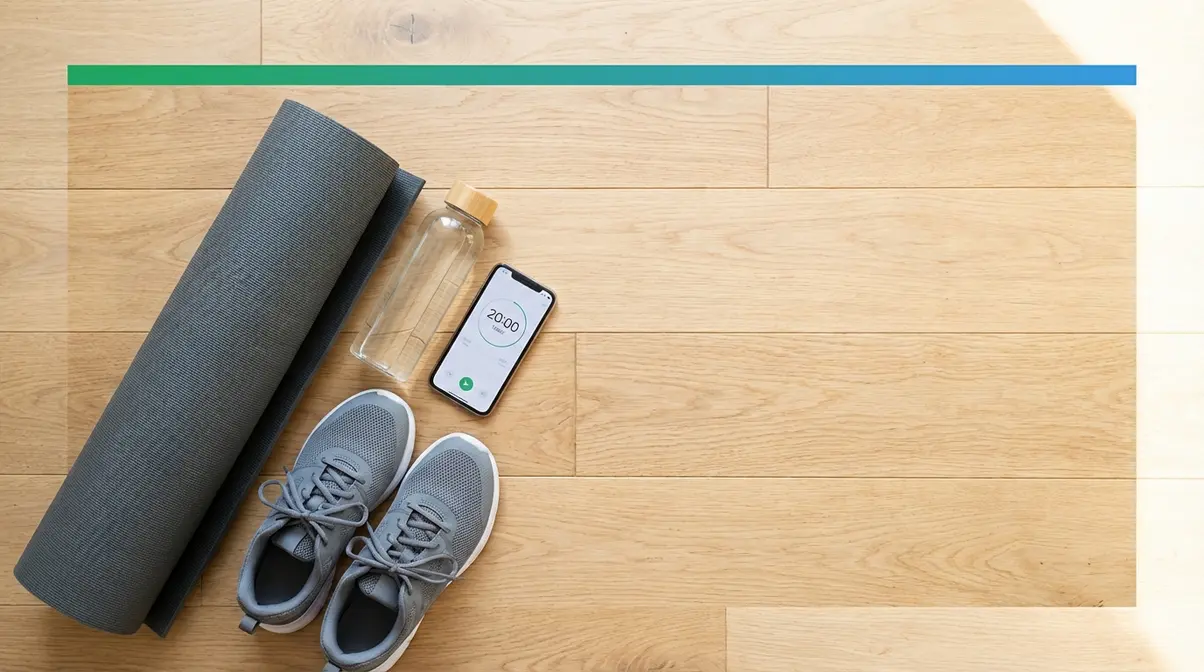
You already have everything you need. All it takes is a clear floor space of roughly 10 square feet (about 3 metres squared) — the length of a yoga mat — comfortable clothing you can move freely in, and a timer on your phone. No gym membership, no weights, no expensive gear.
This guide is for complete beginners: people of all genders, body types, ages 18–55 who have never followed a structured workout routine. If you’ve never heard the words “reps” (short for repetitions — one complete movement of an exercise), “sets” (a group of reps), or “circuit” (a sequence of exercises done back to back with minimal rest), don’t worry. Every term gets defined the moment it appears.
If you have high blood pressure, joint pain, or any existing health condition, scroll to the Workout Safety and Medical Modifications section before you touch the floor. That section was built specifically for you.
This guide follows The 3-3-3 Blueprint — a beginner-specific home workout system built on three simple rules you’ll learn fully in Step 1.
Now that your space is ready, let’s build the foundation of your routine.
Step 1: Understand the 3-3-3 Blueprint
Adults need at least 150 minutes of moderate-intensity physical activity per week — equivalent to 30 minutes a day, five days a week (CDC, 2026). That sounds like a lot when you’re starting from scratch. The 3-3-3 Blueprint makes it achievable.
What Is the 3-3-3 Rule for Workouts?
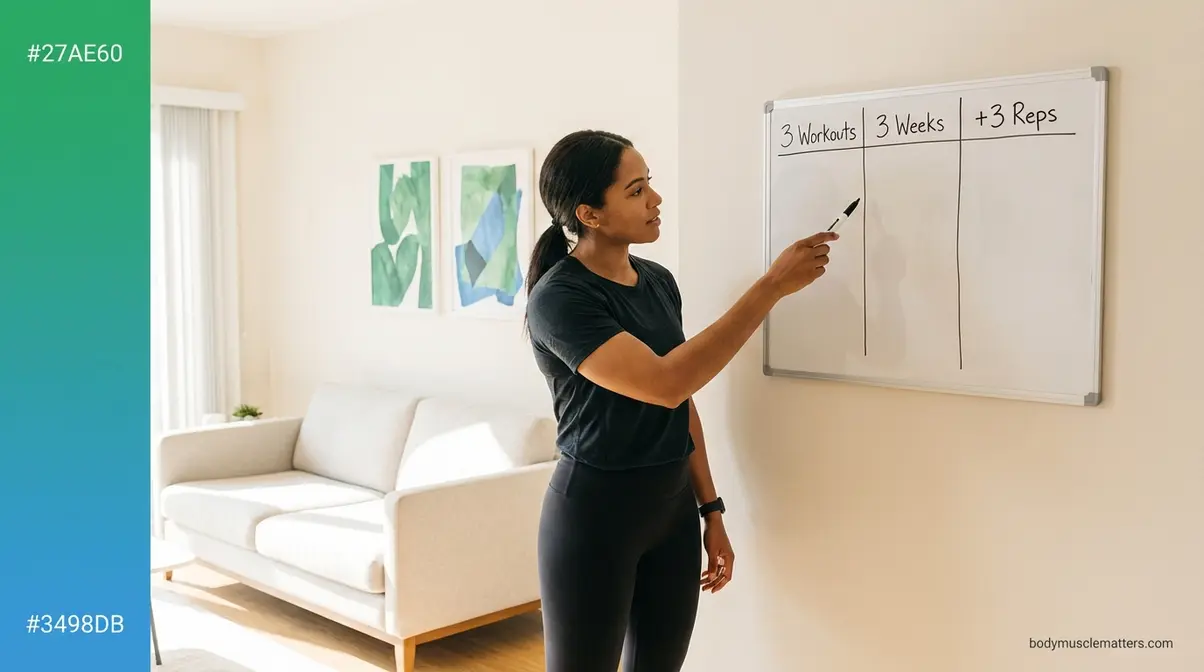
The 3-3-3 Blueprint is a beginner fitness framework built on three rules: 3 workouts per week, 3 weeks of initial commitment, and +3 reps of progress every session.
Here’s what each “3” means in practice:
Rule 1 — 3 Workouts Per Week. Three sessions gives your muscles enough stimulus to grow stronger while giving them 24–48 hours to recover between sessions. Research supports training frequencies of 3 days per week for beginners, with structured rest days allowing muscles to repair and adapt (USA Weightlifting, 2026).
Rule 2 — 3 Weeks of Commitment. Your body needs roughly three weeks to begin forming the neural pathways (the connection between your brain and muscles) that make movement feel natural. Three weeks isn’t long enough to see dramatic physical change — it is long enough to feel the difference and build the habit.
Rule 3 — +3 Reps of Progress Every Session. This is the rule competitors never explain. In a gym, you add weight to make exercises harder — what exercise scientists call progressive overload (progressive = gradual, overload = challenging your muscles beyond what they’re used to). At home, without weights, you add reps instead. Start a squat at 10 reps. Next session: 13 reps. The session after: 16. Your muscles don’t know the difference between a heavier dumbbell and more deliberate repetitions — they only know they’re being challenged.
“You don’t need heavier weights to build strength — you need more deliberate repetitions. The +3 progression mechanic is the mechanism that turns a one-time workout into a 12-week transformation.“
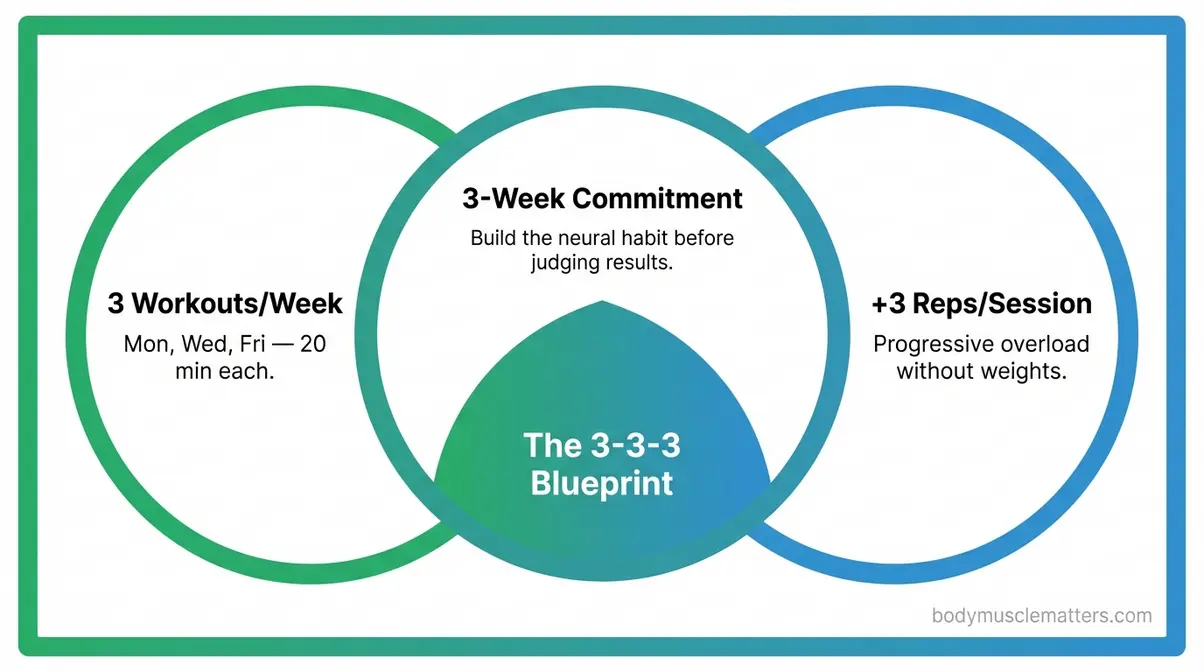
Caption: The 3-3-3 Blueprint breaks the beginner paralysis cycle — three simple rules replace the infinite scroll of conflicting workout advice.
How to Warm Up Before Every Session
A warm-up is a 5-minute period of light movement that prepares your muscles and joints for exercise — think of it as waking your body up before asking it to work hard. Skipping the warm-up is one of the most common beginner mistakes; cold muscles are less pliable and more prone to strain.
Complete these moves in order before every workout. Do each for 30–45 seconds:
- March in place — lift your knees to hip height, swing your arms. Why: raises your heart rate gradually and warms the hip flexors.
- Arm circles — 10 forward, 10 backward. Why: lubricates the shoulder joint before any push or pull movement.
- Hip circles — hands on hips, draw large circles with your pelvis. Why: mobilises the hip joint before squats and lunges.
- Leg swings — hold a wall, swing one leg forward and back 10 times, then switch. Why: lengthens the hamstrings and activates the glutes.
- Bodyweight squats (slow, half-depth) — 10 reps at half your normal depth. Why: primes the quadriceps and glutes before full-range movement.
Total warm-up time: approximately 5 minutes. The Mayo Clinic recommends warming up before any moderate to vigorous exercise session to reduce injury risk and improve performance (Mayo Clinic, 2026).
Why Form Beats Reps for Beginners
The best beginner-friendly strength training exercises — bodyweight squats, walking lunges, push-ups, and planks — are simple but effective only when done correctly. Ten perfect squats build more strength and reduce injury risk more than 30 sloppy ones.
Why form matters more than volume: When you rush through reps with poor technique, the wrong muscles do the work. Your back takes over where your glutes should, your knees cave inward where your hips should stabilise, and your wrists strain where your core should brace. Over time, this creates compensatory patterns (imbalances built by consistently moving incorrectly) that are much harder to unlearn than to avoid.
The three-second rule for beginners: For every exercise, lower your body for a count of three. This is called a slow eccentric (the lowering phase of any movement). Slowing down the descent forces the target muscle to work — instead of letting gravity do it for you. It also gives you time to check your position.
- What “good form” looks like in practice:
- Spine neutral: Your back isn’t arched or rounded; imagine a straight line from your head to your tailbone.
- Knees tracking toes: On squats and lunges, your knees point in the same direction as your second toe — not caving inward.
- Core braced: Before every rep, take a breath and gently brace your abdominals (midsection muscles), as if you’re about to take a light punch. This protects your lower back.
If you’re unsure whether your form is correct, record yourself on your phone for 30 seconds. You’ll see immediately what your body is actually doing versus what you think it’s doing.
Track Progress Without Equipment
Three techniques let you build progressive overload (making exercises progressively harder) without a single piece of equipment. The 3-3-3 Blueprint uses all three:
Technique 1 — Rep Range Progression (+3 reps per session). Start at the bottom of a rep range, add three reps each session until you hit the top, then move to a harder variation. Example: Squats, Week 1: 10 reps → Week 2: 13 → Week 3: 16 → Week 4: try jump squats.
Technique 2 — Tempo Adjustment. Slow the lowering phase of every movement. A standard squat takes about one second down; a 3-second eccentric squat triples the time your muscles spend under tension (the duration muscles are actively contracting or resisting force). More time under tension = more muscle fibre recruitment, with zero added weight.
Technique 3 — Isometric Holds. At the hardest point of the movement (the bottom of a squat, the lowered position of a push-up), hold for 2–5 seconds before coming back up. An isometric hold (holding a position with no movement) significantly increases muscular demand without requiring heavier load.
Your progress tracker (no app needed): Keep a notes app entry or a piece of paper with today’s date, each exercise, and your rep count. Add 3 reps next session. That’s it.
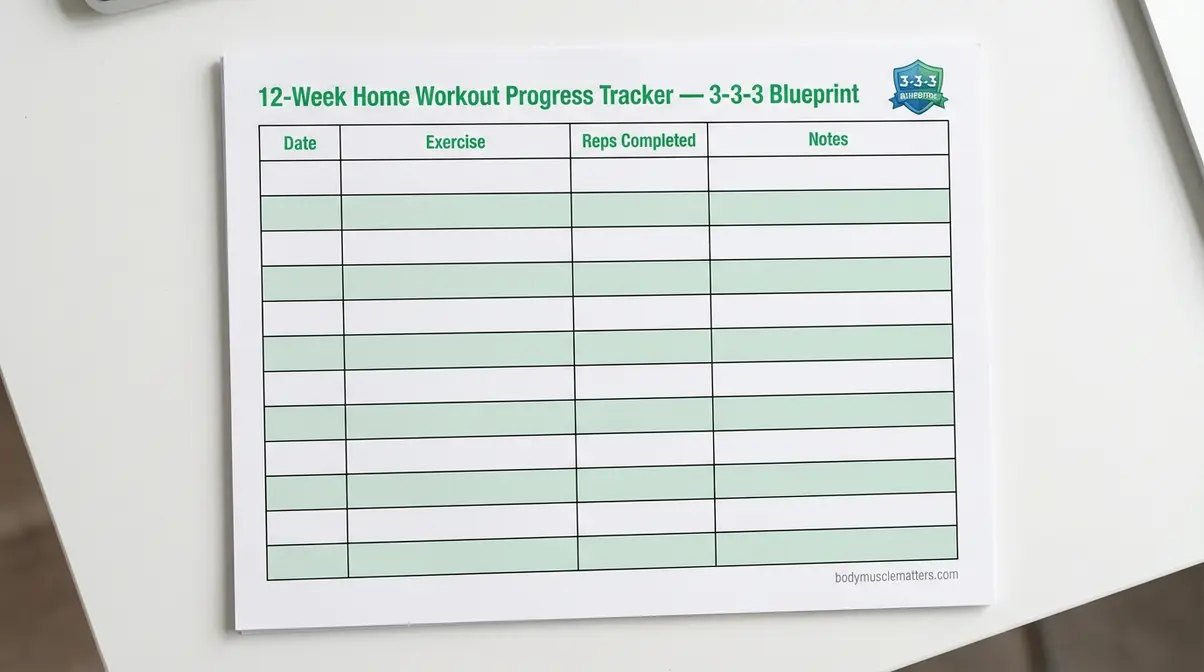
Caption: Tracking reps on paper is more effective for beginners than any fitness app — it takes 30 seconds and removes the friction of tech.
Step 2: The 20-Minute Beginner Bodyweight Circuit
Our evaluation of beginner fitness protocols — reviewing research and beginner-community feedback across fitness forums — consistently identifies one pattern: beginners quit not because the workout is too hard, but because it takes too long. Twenty minutes is the optimal session length for building the workout habit before it becomes a burden.
“The best beginner-friendly strength training exercises are simple but effective: squats, lunges, push-ups, rows, shoulder presses, and deadlifts.” — A sentiment echoed consistently across beginner fitness communities.
Our Circuit Selection Criteria
These 7 exercises were chosen over dozens of alternatives using three criteria: (1) they work multiple muscle groups simultaneously (called compound movements), maximising results per minute; (2) they require zero equipment and minimal space; (3) they have well-documented beginner-safe form patterns with lower injury risk than isolation exercises (exercises that work one muscle at a time, like a bicep curl). Every exercise in this circuit passed all three criteria.
The 7-Exercise Bodyweight Circuit
Complete all 7 exercises back to back with 30 seconds of rest between each. That’s one circuit. Rest 90 seconds, then repeat the circuit. Two full circuits = approximately 20 minutes.
Starting rep counts (Week 1 — add 3 reps every session):
- Bodyweight Squats — 10 reps
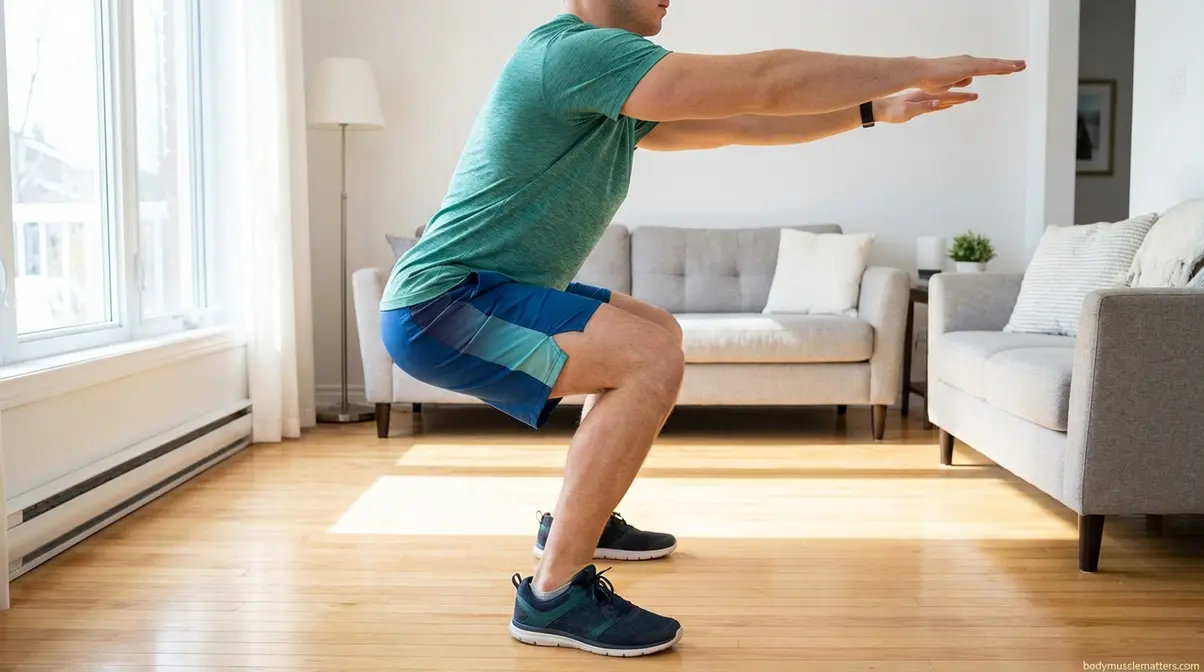
- Stand with feet shoulder-width apart. Lower your hips back and down for a count of 3 until your thighs are parallel to the floor (or as low as comfortable). Your thigh muscles need multiple reps to activate safely — 10 reps is enough stimulus without causing next-day soreness that stops you from continuing. Drive through your heels to stand.
- Push-Ups — 8 reps (or see modifications below)
- Start in a high plank: hands beneath your shoulders, body forming a straight line from head to heels. Lower your chest to within an inch of the floor for 3 seconds, then push up. If your hips sag, your core isn’t braced — reset. Stop immediately if you feel sharp wrist or shoulder pain.
- Walking Lunges — 8 reps each leg
- Step forward with one foot, lowering your back knee toward the floor. Your front knee should stack above your ankle — not shoot past your toes. Stand, then step forward with the opposite leg. Walking lunges simultaneously work your quadriceps (front thigh), hamstrings (back thigh), and glutes (buttocks) — three major muscle groups in one movement.
- Forearm Plank — 20-second hold
- Rest on your forearms and toes, elbows beneath your shoulders. Your body should form a flat plank from head to heels. Breathe normally — don’t hold your breath. The forearm plank is the safest plank variation for beginners because it removes wrist stress. Add 5 seconds per session.
- Glute Bridge — 12 reps
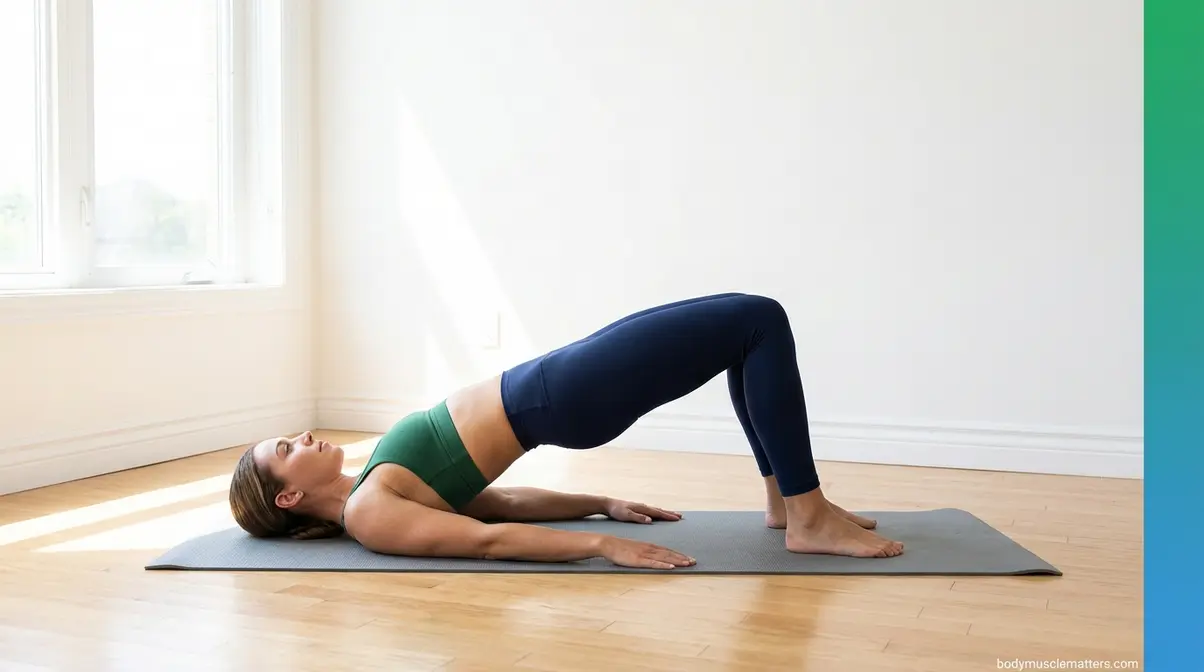
- Lie on your back, knees bent, feet flat. Press through your heels to lift your hips toward the ceiling until your body forms a straight line from shoulders to knees. Squeeze your glutes at the top for one second. The glute bridge targets the gluteus maximus — the largest muscle in your body — and is one of the safest lower-back-friendly exercises available.
- Bird Dog — 8 reps each side
- Start on all fours (hands and knees). Extend your right arm forward and left leg back simultaneously, forming a straight line. Hold for 2 seconds. Return and switch sides. The Bird Dog trains spinal stability (your ability to keep your spine aligned while your limbs move) — foundational for injury prevention in all other exercises.
- Straight-Leg Donkey Kick — 10 reps each side
- On all fours, keep one leg straight and kick it up toward the ceiling, squeezing your glute at the top. Your back should stay flat — no arching. The straight-leg donkey kick isolates the posterior chain (the muscles running along your back side: glutes, hamstrings, lower back) without any load on your spine.
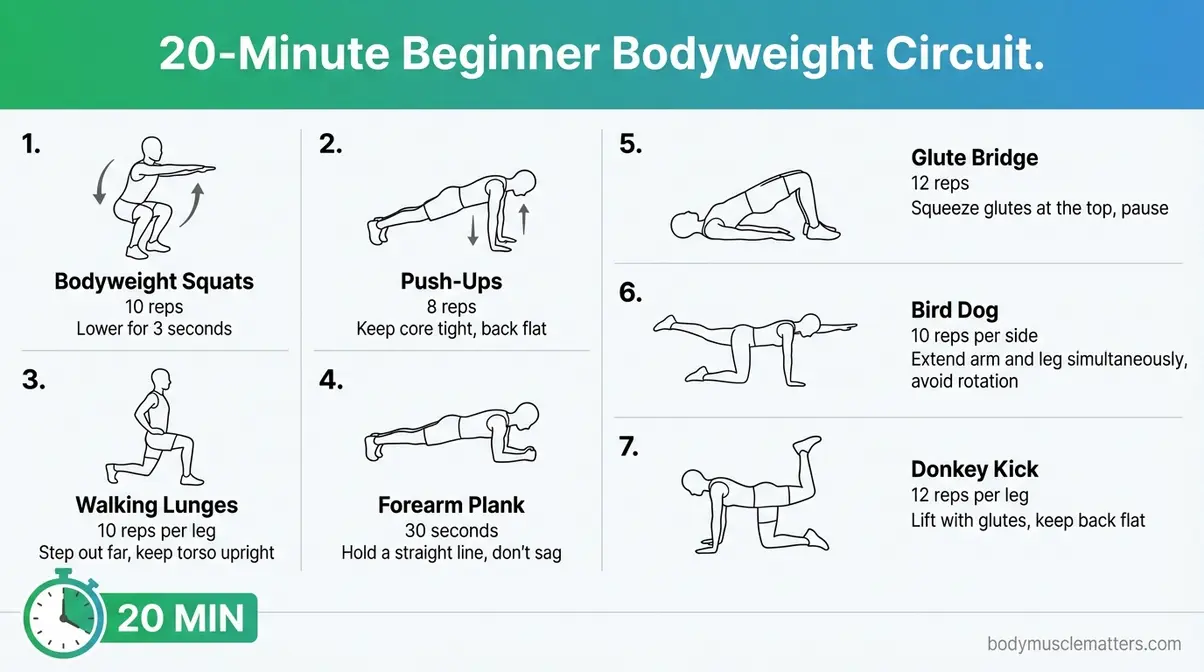
Caption: Two full circuits of these 7 movements hit every major muscle group in under 20 minutes — no gym, no equipment.
Push-Up Modifications for Beginners
Standard push-ups defeat many beginners on day one — which kills momentum. Use the progression ladder below based on your current ability:
Level 1 — Wall Push-Up: Stand an arm’s length from a wall, place hands at shoulder height, and push in and out. This variation uses only about 10–15% of your bodyweight. Perfect if floor push-ups feel impossible right now.
Level 2 — Incline Push-Up: Place hands on the edge of a sturdy table, couch, or counter. The higher the surface, the easier the movement. This is the most underrated modification — it keeps the correct push-up mechanics while reducing load by 30–50%.
Level 3 — Knee Push-Up: On the floor, rest on your knees instead of your toes. Keep your body in a straight line from your head to your knees — don’t let your hips sag toward the floor.
Level 4 — Full Push-Up: Standard form as described in the circuit above.
Start at the level where you can complete 8 reps with perfect form and no compensations. Move to the next level when you can do 15 reps comfortably.
Can You Build Muscle Without Weights?
Yes — and the research is clear on how. Simple bodyweight training (BWT) requiring minimal time and no specialised equipment can improve cardiorespiratory fitness and muscular strength in inactive adults (PubMed, 2021). The mechanism is progressive overload — not the equipment.
Muscle growth happens when your muscles are challenged beyond their current capacity and given adequate recovery time to rebuild stronger. Weights are one way to increase challenge. The three 3-3-3 Blueprint techniques — adding reps, slowing tempo, and adding isometric holds — create the same stimulus without a single dumbbell.
The practical ceiling: bodyweight training at home can build significant functional strength and lean muscle for beginners and intermediate exercisers. Elite-level hypertrophy (the technical term for maximum muscle size increase) eventually requires added resistance — but that’s a conversation for month six, not day one.
Step 3: Build Your Weekly Workout Schedule
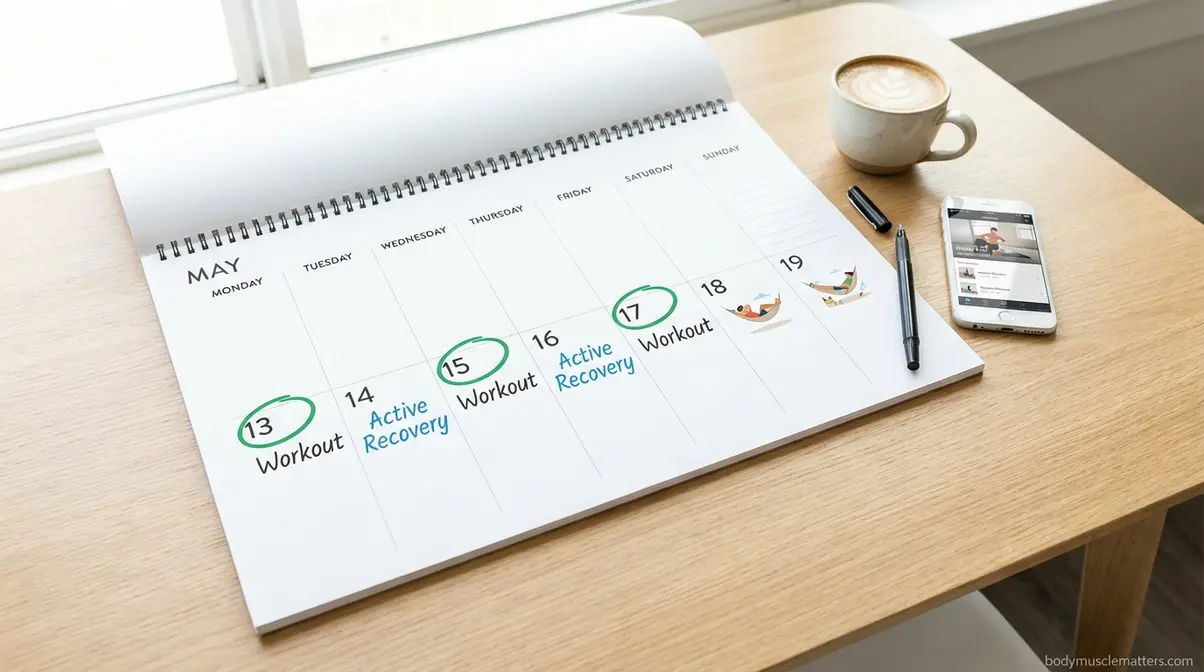
Three sessions per week, separated by at least one rest day between each, is the evidence-backed sweet spot for beginners. According to the CDC, adults benefit from muscle-strengthening activities on at least 2 days per week; the 3-3-3 Blueprint exceeds this minimum while keeping recovery realistic.
The Ideal Mon/Wed/Fri Schedule
The Monday-Wednesday-Friday schedule has one strategic advantage over other arrangements: it gives you two consecutive rest days on the weekend, which removes the most common barrier — the feeling of being “on” all week with no mental break.
| Day | Focus | Duration | Activity |
|---|---|---|---|
| Monday | Full Body Circuit | 20 min | The 7-Exercise Bodyweight Circuit |
| Tuesday | Active Recovery | 15–20 min | Walking, gentle stretching, or yoga |
| Wednesday | Full Body Circuit | 20 min | The 7-Exercise Bodyweight Circuit (+3 reps from Monday) |
| Thursday | Active Recovery | 15–20 min | Walking, or full rest |
| Friday | Full Body Circuit | 20 min | The 7-Exercise Bodyweight Circuit (+3 reps from Wednesday) |
| Saturday | Rest or Play | — | Light activity if desired |
| Sunday | Rest | — | Full rest — muscles rebuild on rest days, not during workouts |
**
Active recovery (light movement on rest days, such as a 20-minute walk or gentle stretching) reduces delayed onset muscle soreness (DOMS — the aching sensation that peaks 24–48 hours after a workout) and keeps your cardiovascular system engaged without taxing your recovering muscles.
How Many Days a Week Should a Beginner Work Out?
Three days per week is the optimal starting frequency for beginners — and here’s why three beats both more and fewer sessions.
Why not every day? Muscles grow during rest, not during exercise. When you train, you create microscopic tears in muscle fibres (this is normal and intentional). Recovery time — 24–48 hours — is when those fibres rebuild thicker and stronger. Daily training for beginners doesn’t allow sufficient recovery and substantially increases injury risk, particularly to connective tissue like tendons, which adapt more slowly than muscles (USA Weightlifting, 2026).
Why not just once a week? Single weekly sessions don’t provide sufficient training stimulus (the repeated signal your body needs to adapt). The result is that each workout feels like the first one — there’s no cumulative fitness effect.
The 3-3-3 Blueprint vs. daily workouts:
| Approach | Weekly Sessions | Recovery | Beginner Injury Risk | Habit Formation |
|---|---|---|---|---|
| 3-3-3 Blueprint (Mon/Wed/Fri) | 3 | Adequate (48h between sessions) | Low | High (consistent, manageable) |
| Daily Workouts | 7 | Insufficient for beginners | Higher | Lower (burnout common by Week 2) |
| Once Per Week | 1 | Excessive | Low but ineffective | Poor (no cumulative momentum) |
The CDC recommends muscle-strengthening activities at least 2 days per week for general health (CDC, 2026). The 3-3-3 Blueprint’s 3-day structure meets and exceeds this guideline.
7-Minute Micro-Workouts for Busy Days
Life happens. A full 20-minute session isn’t always possible — and that’s fine. Research shows that short bouts of physical activity accumulate meaningfully across the day (Physical Activity Guidelines for Americans, 2nd edition, as cited by CDC). A 7-minute micro-workout keeps your habit alive on days when time collapses.
The 7-Minute Emergency Circuit (no equipment, anywhere):
- 1 minute — Jumping jacks (or marching in place if low-impact needed)
- 1 minute — Bodyweight squats
- 1 minute — Push-ups (or wall push-ups)
- 1 minute — Glute bridges
- 1 minute — Forearm plank (hold as long as possible, rest, repeat)
- 1 minute — Bird Dog (alternating sides)
- 1 minute — Standing rest or cool-down breathing
When to use it: Replace a scheduled session only if a genuine scheduling conflict arises. Don’t use it as a regular workaround — the full 20-minute circuit is where your results come from.
Step 4: Train for Your Specific Goal
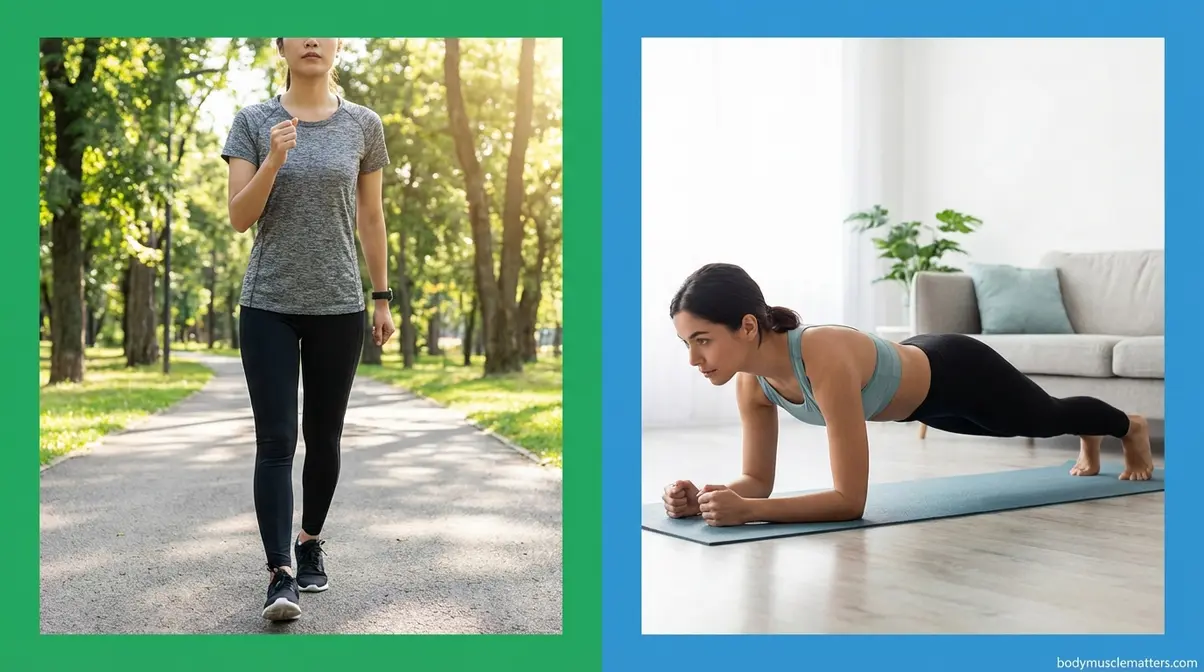
The 3-3-3 Blueprint forms the base of every goal-specific plan — the circuit, schedule, and progression rules stay constant. What changes is how you layer additional work on top, targeting your particular aim.
How to Lose Belly Fat at Home
Here’s the honest truth that most workout guides skip: you cannot spot-reduce fat. Doing 100 crunches will not burn belly fat specifically. Scientific consensus at the University of Sydney confirms that fat loss occurs systemically — throughout your whole body based on overall energy balance — not from the specific area you’re exercising (University of Sydney, 2023). The Peloton fitness team echoes this finding: the science simply doesn’t support targeted fat loss from localised exercise (Peloton, 2026).
What does reduce belly fat is a combination of cardiovascular exercise (to create a calorie deficit), full-body resistance training (to preserve and build muscle), and consistent calorie management. The bodyweight circuit in Step 2 addresses both the resistance training and a modest cardiovascular component.
- To accelerate fat loss, add one of these to your off-days (Tuesday/Thursday):
- 30-minute brisk walk — burns roughly 150–200 calories and is gentle enough for true beginners
- 20-minute low-impact cardio session (marching in place, step-touches, low-impact jacks)
The belly fat reality check: Most beginners see initial results — improved energy, less bloating, better posture — within 2–3 weeks. Visible abdominal definition typically requires 12+ weeks of consistent training and dietary awareness. Managing this expectation protects your motivation.
Core and Abs Circuit — 3 Proven Moves
Your core includes not just the abdominals (six-pack muscles visible on the surface) but also the deep stabilising muscles of the trunk — the transverse abdominis, obliques, and lower back musculature. Training only crunches trains only one layer. These three movements train the complete core system:
Move 1 — Dead Bug (10 reps per side)
Lie on your back, arms pointing toward the ceiling, knees bent at 90 degrees directly above your hips. Slowly lower your right arm and left leg toward the floor simultaneously — stop just before they touch. Return to start. The dead bug trains deep core stability without any compressive load on your spine — ideal for beginners. This cross-body movement pattern also builds vital coordination between your upper and lower body segments.
Move 2 — Forearm Plank (30-second hold, build by 5 seconds each session)
Described fully in the main circuit. In the core-specific context: focus on pulling your navel (belly button) toward your spine and squeezing your glutes. Both actions increase deep core activation and build the endurance required for safely handling advanced exercises later.
Move 3 — Side-Lying Hip Dip (12 reps per side)
In a side forearm plank position, lower your hip to the floor and raise it back up. This targets the obliques (the diagonal muscles running along the sides of your torso) and the hip abductors — both underworked in standard beginner circuits.
Complete this 3-move circuit after your main bodyweight workout on any two days per week.
Full-Body HIIT for Beginners
HIIT stands for High-Intensity Interval Training — alternating short bursts of hard effort with brief recovery periods. The format is effective for cardiovascular fitness and calorie burn. However, standard HIIT protocols are too intense for the first 3–4 weeks of training. Use this modified beginner version only after completing at least 3 full weeks of the standard circuit.
- Beginner HIIT Protocol (20 minutes):
- Work interval: 30 seconds at high effort (80–85% of your maximum — you should be breathing too hard to hold a conversation)
- Rest interval: 60 seconds at complete rest or slow walking
- Exercises: choose from bodyweight squats, push-ups, jumping jacks, high knees, or mountain climbers (starting in a push-up position and bringing alternate knees to your chest rapidly)
- Total rounds: 10 (alternating between two exercises)
The key distinction for beginners: HIIT adds cardiovascular intensity on top of the strength-building circuit — it doesn’t replace it. Use HIIT on one rest day per week (not on circuit days) once you’ve built your 3-week foundation. Make sure to perform a 5-minute cooldown afterward, such as slow walking and gentle stretching, to gradually lower your heart rate and prevent blood pooling in your legs.
Step 5: Women’s Beginner Home Workout Plan
Women who do strength training two to three days per week have a 30% lower risk of death from heart disease compared to women who don’t strength train (Global Wellness Institute, 2024). That statistic — from research tracking over 58,000 women — is one of the strongest arguments for any woman starting resistance training now, not later.
3-Day Split for Female Beginners
The full-body 3-3-3 Blueprint circuit works for everyone — and it’s the recommended starting point for all female beginners during Weeks 1–6. After six weeks, consider this structured split that targets areas many women prioritise:
Week 7+ Progressive Split:
| Day | Focus | Key Exercises |
|---|---|---|
| Monday | Lower Body + Glutes | Squats, walking lunges, glute bridges, donkey kicks |
| Wednesday | Upper Body + Core | Push-up progressions, bird dog, dead bug, plank holds |
| Friday | Full Body + Cardio | Full circuit + 10-minute low-impact cardio |
This split allows higher volume (more total reps and sets) per muscle group while maintaining the 3-day frequency structure. Resistance training also improves symptoms of hormonal fluctuations and supports bone density — both significant health considerations for women across the age range of this guide (Cleveland Clinic, 2023).
Will Lifting Make You Bulky? No.
This is the most persistent myth in women’s fitness — and the science is unambiguous. Women have 10–20 times less testosterone than men, the primary hormone driving large-scale muscle hypertrophy (extreme muscle size increase). The hormonal environment of a female body is specifically oriented toward lean muscle development, improved tone, and functional strength — not bulk (PMC, 2023; ACE Fitness, 2026).
- What resistance training actually does for women:
- Increases lean muscle mass, which raises resting metabolism (the number of calories you burn doing nothing)
- Improves bone density — critical for reducing osteoporosis risk after 40
- Creates the “toned” appearance most women seek (tone is simply visible muscle beneath reduced body fat)
- Reduces injury risk in everyday movements
The women who achieve extreme muscular development spend years in structured programmes, follow highly specific nutrition protocols, and in some cases use performance-enhancing hormones. It does not happen accidentally from doing bodyweight squats three times per week.
Beginner Pilates Moves for Home
Pilates (a low-impact system of controlled movements focusing on core strength, flexibility, and body alignment) complements the 3-3-3 Blueprint perfectly on active recovery days. These three moves require no equipment and are appropriate for complete beginners:
Move 1 — The Hundred (modified)
Lie on your back, knees bent, feet flat. Lift your head and shoulders slightly. Pulse your arms up and down in small, controlled beats — inhale for 5 beats, exhale for 5. Start at 30 beats total, build toward 100 over several weeks.
Move 2 — Spine Stretch Forward
Sit tall with legs extended in front, feet flexed. Reach your arms forward and slowly roll your spine forward, reaching your fingertips toward your feet. Hold for 3 breaths. This improves spinal flexibility and relieves lower-back tension from the main circuit.
Move 3 — Single-Leg Stretch
Lie on your back. Bring one knee toward your chest while extending the other leg straight at 45 degrees. Alternate legs in a smooth, controlled rhythm. This trains deep core control — the foundation of all Pilates work.
Add these three moves as a 10-minute active recovery session on Tuesday or Thursday.
Step 6: Men’s Beginner Home Workout Plan
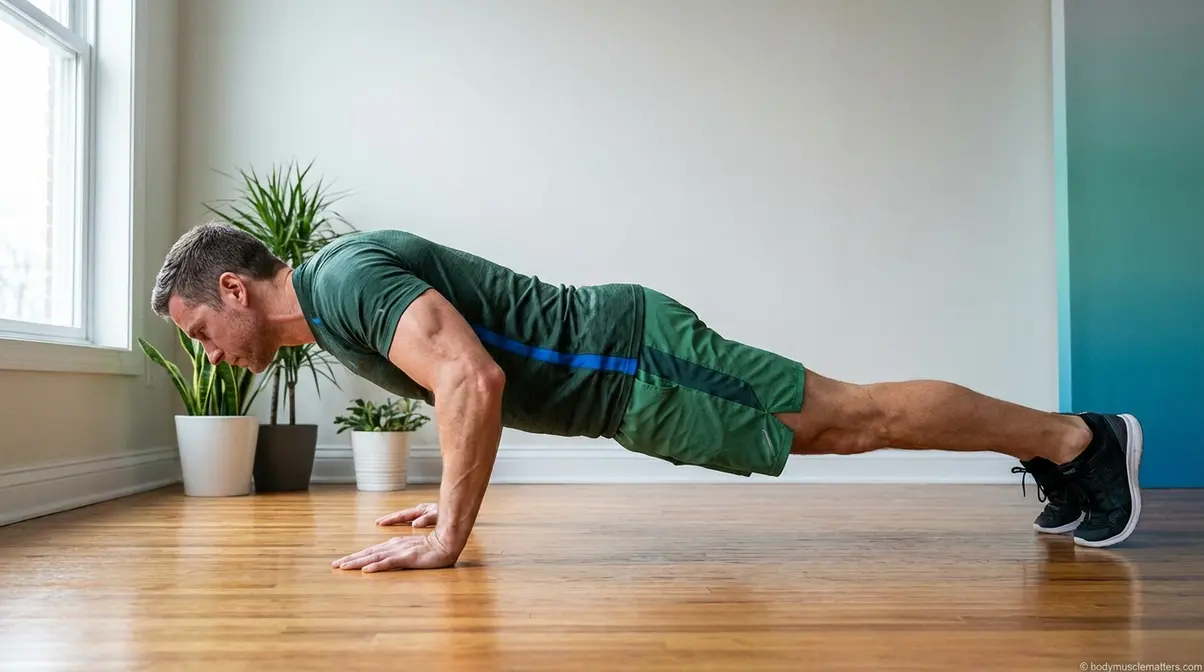
The most common frustration among male beginners working out at home: “How do I actually build muscle without a barbell?” The answer lies in mastering the progression techniques built into the 3-3-3 Blueprint — and understanding that bodyweight resistance, applied correctly, is genuine resistance.
Progressive Overload Without Weights
Progressive overload — the principle of consistently increasing the demand on your muscles — is the single most important concept in strength training. You’ve already learned the three core techniques (rep progression, tempo adjustment, isometric holds) in Step 1. Here’s how they apply specifically to male-pattern strength goals:
- For upper body muscle (chest, shoulders, arms):
- Push-up progression ladder: Wall → Incline → Knee → Standard → Feet-elevated push-up (feet on a chair, hands on floor — this shifts more load to the upper chest and anterior deltoids, the muscles at the front of your shoulders)
- Tempo standard push-up: 3 seconds down, 1-second pause at the bottom, 1 second up — this single adjustment triples time under tension with zero equipment
- For lower body mass (quads, glutes, hamstrings):
- Squat progression ladder: Standard squat → Pause squat (3-second hold at the bottom) → Sumo squat (wider stance, targets inner thighs and glutes) → Jump squat (add explosive upward jump — introduces plyometric training, which adds power development to strength work)
- For core strength:
- Plank progression: Forearm → High → Shoulder tap (alternately lifting each hand off the floor) → Plank with leg raise
The 12-week progressive overload roadmap for men:
| Phase | Weeks | Focus | Key Changes |
|---|---|---|---|
| Foundation | 1–3 | Form + habit | Start at base reps, add 3 reps/session |
| Build | 4–6 | Volume increase | Add second circuit set, introduce tempo |
| Intensify | 7–9 | Load increase | Add isometric holds, advance variations |
| Peak | 10–12 | Max bodyweight difficulty | Hardest variations, near-max reps |
Upper/Lower Body Split at Home
After six weeks of full-body 3-3-3 Blueprint training, male beginners ready for more volume can transition to an upper/lower split — a programme structure that trains the upper body and lower body on alternating days, allowing higher total work per muscle group.
Sample Upper/Lower Split (Weeks 7–12):
- Monday — Upper Body:
- Push-ups: 3 sets × max reps (subtract 3 from failure point)
- Pike push-ups (hands and feet on floor, hips high — targets the deltoids): 3 × 10
- Tricep dips using a sturdy chair: 3 × 12
- Plank hold: 3 × 30 seconds
- Wednesday — Lower Body:
- Bodyweight squats: 3 × 20
- Walking lunges: 3 × 12 each leg
- Glute bridges: 3 × 15 with 2-second squeeze at top
- Donkey kicks: 3 × 15 each side
Friday — Full Body (back to the original 3-3-3 circuit):
Full 7-exercise circuit × 2 rounds — treat this as your benchmark day. Are your reps higher than last week? That’s progressive overload confirmed.
Step 7: Level Up With Home Gym Equipment
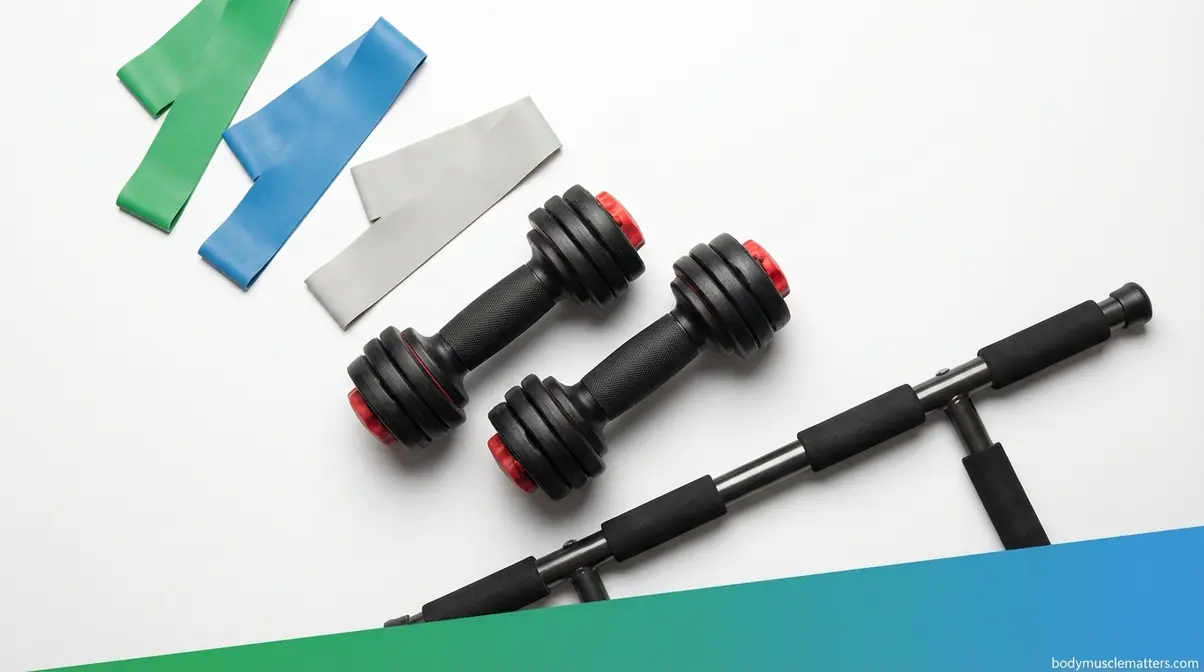
The 3-3-3 Blueprint is entirely bodyweight-based — you don’t need to buy anything. But if you want to continue past the 12-week programme without a gym membership, three pieces of equipment open up significantly more exercise variety and loading options.
The 3 Pieces of Equipment Worth Buying
| Equipment | Cost Range | What It Unlocks | Best For |
|---|---|---|---|
| Resistance bands (set of 3) | $15–$30 | Pull movements (rows, pull-aparts), hip resistance for squats, shoulder exercises | Anyone — the most versatile beginner purchase |
| A pair of adjustable dumbbells (5–25 lb range) | $80–$200 | Full dumbbell circuit, heavier progressive loading, bicep curls, shoulder press | Men or women ready to add load after 8+ weeks |
| Pull-up bar (doorframe mount) | $25–$45 | Back and bicep development — the one major muscle group bodyweight-only cannot fully address | Anyone who has completed 12 weeks of the 3-3-3 Blueprint |
Equipment priority recommendation: If budget is limited, buy a resistance band set first. At $15–$30, bands unlock 40+ additional exercises and add genuine resistance to bodyweight movements — making them the highest-value beginner purchase by a significant margin. The British Heart Foundation (BHF) recommends starting with simple home equipment like resistance bands to build cardiovascular and muscular endurance safely. They are lightweight, easy to store, and provide continuous tension throughout the entire movement, which accelerates muscle adaptation compared to gravity-dependent free weights.
Full-Body Dumbbell Circuit — 4 Moves
Once you own a basic pair of dumbbells, this 4-move circuit builds directly on the foundation of the 3-3-3 Blueprint. Use it as a replacement for the standard bodyweight circuit on Friday sessions. Start with a light weight that allows you to complete all reps with perfect form.
- Dumbbell Goblet Squat — 12 reps
- Hold one dumbbell vertically at your chest with both hands. Squat as normal. The front-loaded weight naturally pulls you into good squat mechanics — one of the best self-correcting exercises for beginners. Keep your chest up and elbows tucked tight.
- Dumbbell Romanian Deadlift — 10 reps
- Hold dumbbells in front of your thighs. Hinge at the hips (push them back, keep your back flat) and lower the dumbbells toward the floor until you feel a stretch in your hamstrings. Drive through your heels to stand. This movement pattern trains the entire posterior chain with spinal safety.
- Dumbbell Bent-Over Row — 10 reps each arm
- Hinge forward at the hips, one hand on a chair for support. Let the dumbbell hang, then row your elbow toward the ceiling. Rows train the muscles of the upper back and biceps — movement patterns the bodyweight circuit cannot adequately address without a bar. Squeeze your shoulder blade at the top of the movement.
- Dumbbell Floor Press — 12 reps
- Lie on your back, dumbbells at chest height, elbows at 45 degrees. Press toward the ceiling. The floor limits your range of motion, which protects the shoulder joint — making this safer than a full bench press for beginners. Lower the weights slowly until your triceps lightly touch the floor.
Complete 2–3 rounds with 60–90 seconds rest between rounds. As these exercises become easier, apply the same progressive overload principles: add reps, slow your tempo, or incrementally increase the dumbbell weight.
Workout Safety and Medical Modifications
Exercise is medicine — but the right dose matters. This section addresses two of the most common physical conditions reported by beginner exercisers: high blood pressure and joint pain. Read it before starting if either applies to you.
⚠️ Always consult your physician before beginning a new exercise programme if you have any medical condition. The guidance below is educational and does not replace individualised medical advice from your doctor or a certified personal trainer.
What Exercises Lower Blood Pressure?
Regular aerobic exercise is one of the most evidence-supported strategies for managing high blood pressure (hypertension). The 2026 AHA/ACC High Blood Pressure Guideline — the most current joint guidance from the American Heart Association and American College of Cardiology — recommends at least 75–150 minutes per week of aerobic exercise and/or resistance training as part of hypertension management (AHA/ACC, 2026).
The American Heart Association specifically identifies these exercise types as safe and beneficial for people with high blood pressure:
- Brisk walking — safe at all hypertension stages; start with 10 minutes and build
- Low-impact aerobic movements — marching, step-touches, low-impact jacks
- Bodyweight resistance training — including squats, glute bridges, and planks
What to modify if you have high blood pressure:
| Standard Exercise | Safe Modification | Why |
|---|---|---|
| Standard push-up | Incline push-up (hands elevated) | Reduces straining and breath-holding |
| Plank (30+ seconds) | Shorter holds with breathing breaks | Sustained isometric holds can temporarily raise BP |
| Jumping jacks | Low-impact step-touch | Removes impact; keeps heart rate in moderate zone |
| Jump squats | Standard bodyweight squat | Eliminates high-intensity cardiac spikes |
Key safety rules for hypertension: Always breathe continuously — never hold your breath during any exercise (this is called the Valsalva manoeuvre, which temporarily spikes blood pressure). Warm up for at least 5 minutes before any moderate activity. Cool down for 5 minutes after. Monitor your perceived exertion: you should be able to speak in short sentences throughout the workout.
Exercise Modifications for Joint Pain
Knee and lower-back pain are the two most commonly reported barriers to starting a home workout routine among beginner exercisers. These modifications keep you moving safely:
Knee pain modifications:
- Squats: Reduce depth to where pain begins — even a quarter-squat activates the quadriceps. Do not push through sharp, localised knee pain.
- Lunges: Replace walking lunges with a stationary split-squat (feet in lunge position, lowering straight down without the forward step — reduces knee tracking stress).
- Jumping movements: Eliminate entirely until cleared by a physiotherapist (a movement specialist who assesses and treats musculoskeletal issues).
Lower-back pain modifications:
- Plank: Begin with the forearm plank on your knees (reduces spinal load).
- Donkey kicks: Focus on glute squeeze rather than leg height — high kicks can hyperextend the lumbar spine.
- Glute bridges: Are generally safe and recommended for mild lower-back pain, as they strengthen the posterior chain without spinal compression.
If pain is rated above 4 out of 10, stop that exercise and contact your physician. See a physiotherapist before continuing if pain persists across two or more sessions.
5 Beginner Mistakes to Avoid
Common pain points reported by new exercisers include these five patterns — our review of beginner fitness community feedback found these errors account for the majority of early dropouts and minor injuries:
- Skipping the warm-up. Cold muscles strain more easily. The 5-minute warm-up in Step 1 is non-negotiable, not optional.
- Progressing too fast. Adding more than 3 reps per session, or jumping to advanced variations in Week 1, overwhelms connective tissue before it’s adapted. Tendons adapt more slowly than muscles — be patient with them.
- Holding your breath. Exhale on the exertion phase (the push-up up phase, the stand-up of a squat). Breath-holding raises blood pressure and reduces power.
- Training through sharp pain. Dull muscle soreness (DOMS) is normal 24–48 hours after a session. Sharp, localised, or joint pain during exercise is a stop signal — not a “push through it” signal.
- Expecting linear progress. Some sessions will feel harder than others. Progress over three weeks, not session to session, is the correct measurement window. The 3-3-3 Blueprint is designed for cumulative gains — trust the process across the full 12 weeks.
Download Your Free 30-Day Workout Tracker PDF
The research on behaviour change is consistent: people who track their workouts are significantly more likely to maintain exercise habits than those who rely on memory alone. Your tracker doesn’t need to be an app — it needs to exist.
- Your free 30-Day Workout Tracker includes:
- A pre-filled Mon/Wed/Fri schedule for 4 weeks
- Rep-tracking columns for all 7 circuit exercises
- A “+3 reps” running total column per exercise
- A weekly reflection prompt (“What felt easier this week?”)
*Caption: Print this tracker, hang it somewhere visible, and cross off each session — the physical act of marking progress is a proven habit reinforcement tool.*
Note for editor: 0 internal links are available in the current internal linking plan. Link the download CTA to the PDF asset once created. No other internal links can be placed in this article.
Frequently Asked Questions
Good Beginner Routine at Home?
A good beginner home workout routine uses 5–7 compound bodyweight exercises, performed 3 days per week with at least one rest day between sessions. The 3-3-3 Blueprint — 3 workouts per week, 3 weeks of consistency, +3 reps of progress each session — is specifically designed for this starting point. Exercises like bodyweight squats, push-ups, walking lunges, and the forearm plank cover all major muscle groups in under 20 minutes. Start with two circuit rounds and progressively build from there.
What is the 3-3-3 rule for workouts?
The 3-3-3 rule is a beginner fitness framework built on three principles: train 3 days per week, commit to 3 weeks of consistency before evaluating results, and add +3 reps to every exercise each session. The “+3 reps” rule replaces the need for heavier weights by increasing training volume (total work done) progressively — the same stimulus your muscles need to grow stronger. After 3 weeks, most beginners find the habit is formed and the results are becoming visible.
How to Start Working Out at Home?
Start with a clear space, a timer, and three scheduled sessions this week — Monday, Wednesday, and Friday works well. Before any exercise, complete the 5-minute warm-up routine from Step 1. Then perform the 7-exercise bodyweight circuit twice through. Record your rep counts. Next session: add 3 reps to each exercise. The most important thing is completing the first session, not doing it perfectly, because momentum builds naturally from there.
How Many Days to Work Out?
Three days per week is the optimal training frequency for beginners. Three sessions provide enough stimulus for the body to adapt and improve, while the rest days between sessions allow muscles to repair and grow stronger. Training every day increases injury risk and leads to burnout — research supports at least 1–2 full rest days per week even for experienced exercisers (USA Weightlifting, 2026). The 3-3-3 Blueprint’s Mon/Wed/Fri structure is specifically designed around this evidence-based frequency.
What is the 5-3-1 Rule for Lifting?
While the 3-3-3 Blueprint is for true beginners, the 5-3-1 rule is an advanced strength training program created by Jim Wendler. It focuses on heavy barbell compound lifts using specific percentages of your one-rep maximum across a four-week cycle. Beginners should master bodyweight progression before attempting advanced barbell routines.
When Will I See Results?
Most beginners notice improved energy and better sleep within the first two weeks. Visible physical changes and significant strength increases typically take 6–8 weeks of consistent training. The key is completing the initial 3-week habit-building phase of the 3-3-3 Blueprint without missing sessions.
Your Next Step Starts Today
For complete beginners aged 18–55, the home workout routine for beginners doesn’t need to be complicated. The 3-3-3 Blueprint — 3 sessions per week, 3 weeks of consistency, +3 reps of progress every session — delivers full-body strength, cardiovascular improvement, and genuine habit formation using nothing but your bodyweight and a 10-square-foot floor space. The CDC confirms that adults who meet weekly physical activity guidelines significantly reduce their risk of heart disease, type 2 diabetes, and premature death (CDC, 2026) — and the 3-3-3 Blueprint’s three-session structure is designed specifically to get you there.
The 3-3-3 Blueprint works because it removes the decision points that stop most beginners before they start. You know which days to train (Monday, Wednesday, Friday). You know exactly which exercises to do and in what order. You know how to progress (+3 reps). You know what to modify if you have high blood pressure or joint pain. The framework does the planning — you just show up.
Your actual next step is specific: complete Session 1 of the 7-exercise circuit today. Set a 25-minute timer (5 minutes for warm-up, 20 minutes for two circuit rounds). Record your reps in the free 30-day tracker above. Come back Wednesday and add 3 reps to each exercise. Give it 3 weeks before you judge anything — the 3-3-3 Blueprint is built for the long game, and it starts right now.