⚠️ Medical Disclaimer: This article is for informational purposes only and does not constitute medical advice. Consult a qualified healthcare professional or certified personal trainer before beginning any new exercise program, especially if you have a pre-existing condition or injury.
Reviewed by , CPT/CSCS
Resistance bands do build real muscle—not “toned” muscle, not “lean” muscle, but genuine hypertrophy. A 2019 meta-analysis published in the National Library of Medicine found that elastic resistance training produces similar strength gains to conventional resistance training. Most guides stop there. They confirm the headline, hand you three exercises, and leave you without a plan for next week, next month, or the moment you hit a plateau. That gap—between knowing bands work and knowing how to make them work for resistance bands for muscle growth—is where most people’s progress stalls.
This guide closes that gap. You’ll learn the science behind why bands build muscle, how they compare honestly to free weights, and how to follow a complete 6-month progressive overload plan built for real hypertrophy.
Resistance bands for muscle growth work through three biological forces—Mechanical Tension, Progressive Overload, and Metabolic Stress—the same mechanisms that make free weights effective. Research confirms bands produce comparable strength and hypertrophy gains to conventional equipment.
- The science is settled: A landmark meta-analysis confirms similar strength gains to weights across diverse populations (National Library of Medicine, 2019).
- Bands have a unique edge: Variable resistance increases tension as a muscle lengthens, maximizing activation where it matters most for growth.
- A plan matters more than equipment: Without progressive overload, neither bands nor weights produce meaningful hypertrophy.
- The 3-Force Framework is a model that identifies the three levers you must activate—and how to dial in bands to hit all three for optimal results.
- Timeline: Measurable hypertrophy is typically visible within 8–12 weeks with consistent, progressive programming.
Do Bands Build Muscle? The Science Explained
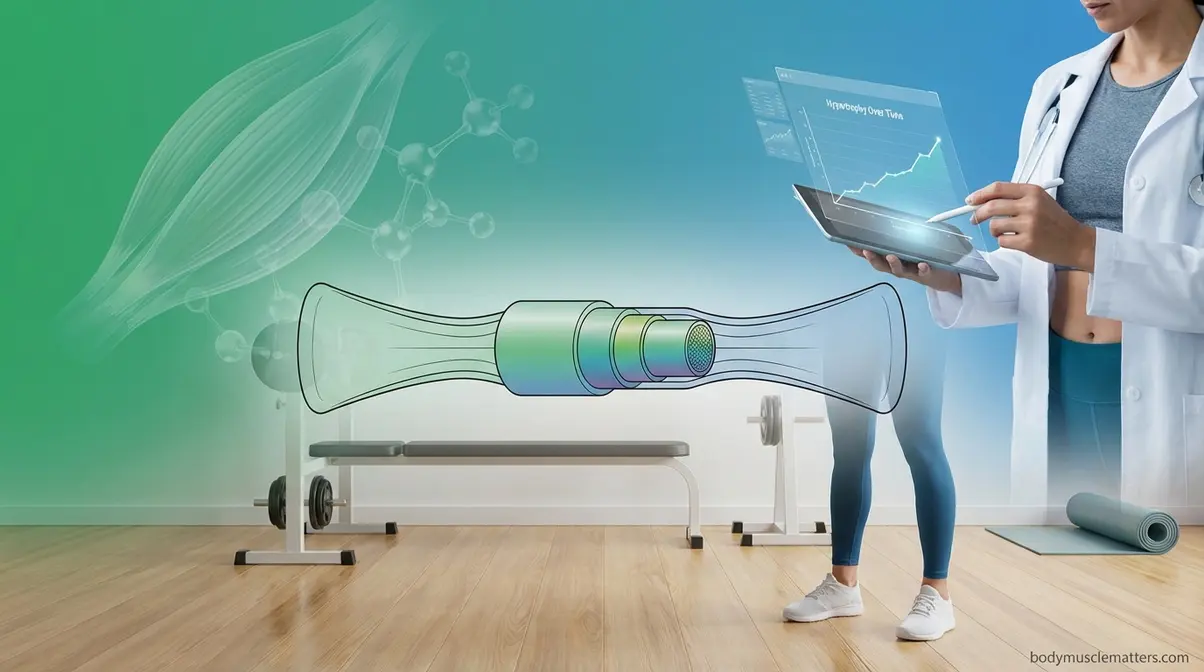
Resistance bands build muscle using the same biological mechanisms as free weights, and the research is more definitive than most people realize. The key 2019 meta-analysis found no significant superiority between elastic resistance and conventional training for either upper or lower limb strength. Understanding why bands work allows you to train with the intentionality that produces results.
The answer lies in three biological forces that drive every meaningful hypertrophy response. Exercise physiologists call them the primary drivers of muscle growth, and resistance bands—used correctly—activate all three.
The 3-Force Framework for Hypertrophy
The 3-Force Framework identifies the three biomechanical forces that resistance bands activate for muscle hypertrophy: Mechanical Tension, Progressive Overload, and Metabolic Stress.
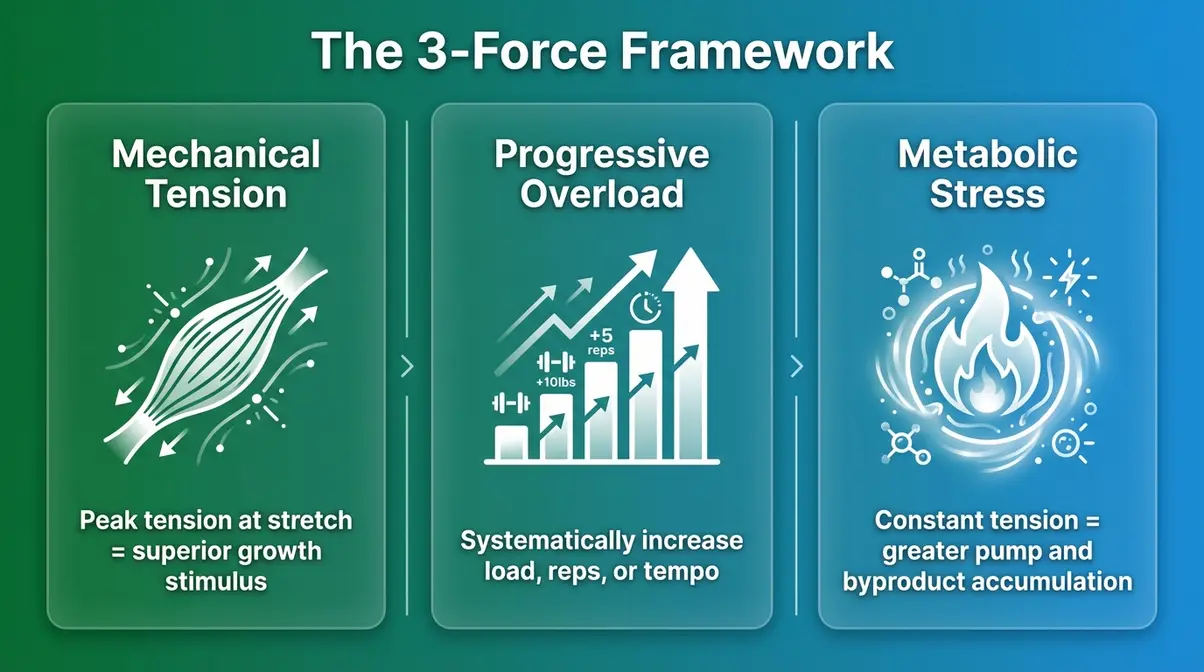
- Mechanical Tension: The primary driver of muscle growth, this is the force your muscle fibers experience as they resist the band’s pull. Bands hold an advantage here: peak tension occurs when the muscle is lengthened (or stretched), which may produce a superior growth stimulus.
- Progressive Overload: The non-negotiable principle of systematically increasing the training stimulus over time. With bands, this means using a heavier band, slowing your tempo, or adding reps.
- Metabolic Stress: The “pump” and burn you feel during high-rep training. Because bands maintain near-constant tension, they create a greater accumulation of metabolic byproducts that signal growth. An umbrella review in Frontiers in Sports and Active Living confirms volume and progressive load as key variables.
“Elastic resistance training is able to promote similar strength gains to conventional resistance training, in different population profiles and using diverse protocols.”
— National Library of Medicine Meta-Analysis (PubMed, 2019)
Toning vs. Hypertrophy: A Quick Reframe
“Toning” is not a physiological process—it’s a marketing word. Muscles either grow (hypertrophy) or they don’t. The “toned look” comes from a combination of modest muscle growth and reduced body fat. The stimulus for hypertrophy is identical regardless of the tool: progressive mechanical stress taken close to muscular failure.
How Long Does It Take to Build Muscle?
Exercise physiologists observe a predictable timeline for muscle growth that mirrors conventional training:
- Weeks 1–3: Neural adaptations dominate. Strength improves, but visible size changes are minimal.
- Weeks 4–8: Initial hypertrophy begins. Muscle definition improves, and strength increases meaningfully.
- Weeks 8–12: Visible, meaningful hypertrophy becomes apparent.
- Months 3–6: Compound gains accelerate with proper periodization.
Resistance Bands vs. Free Weights: A Comparison
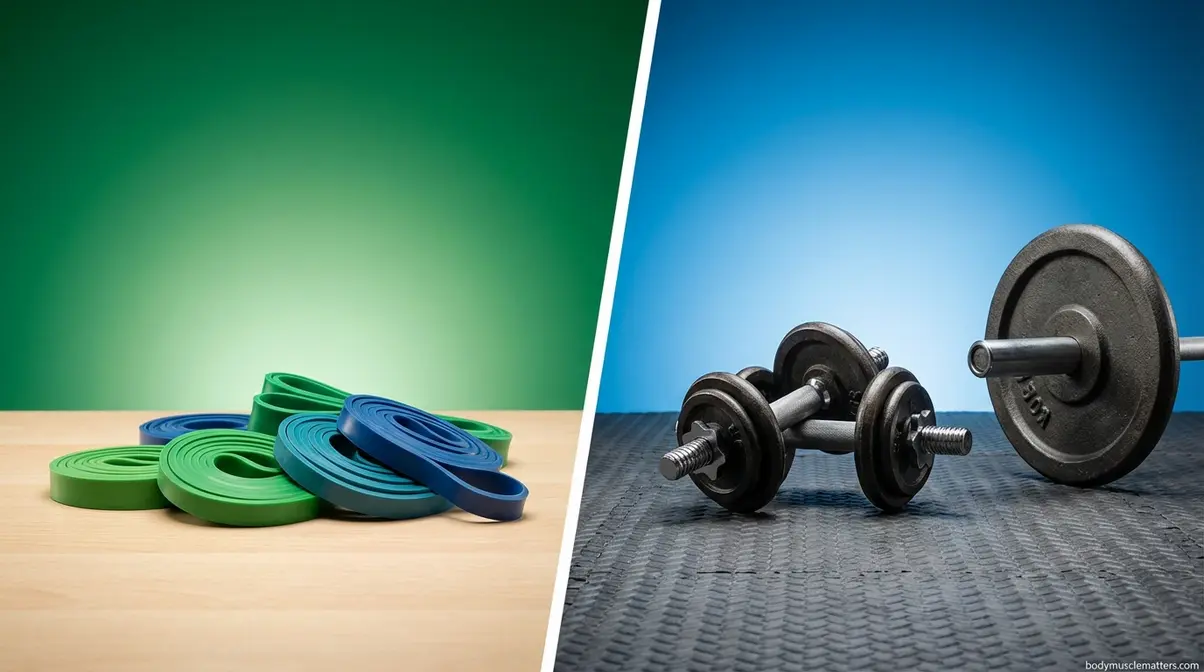
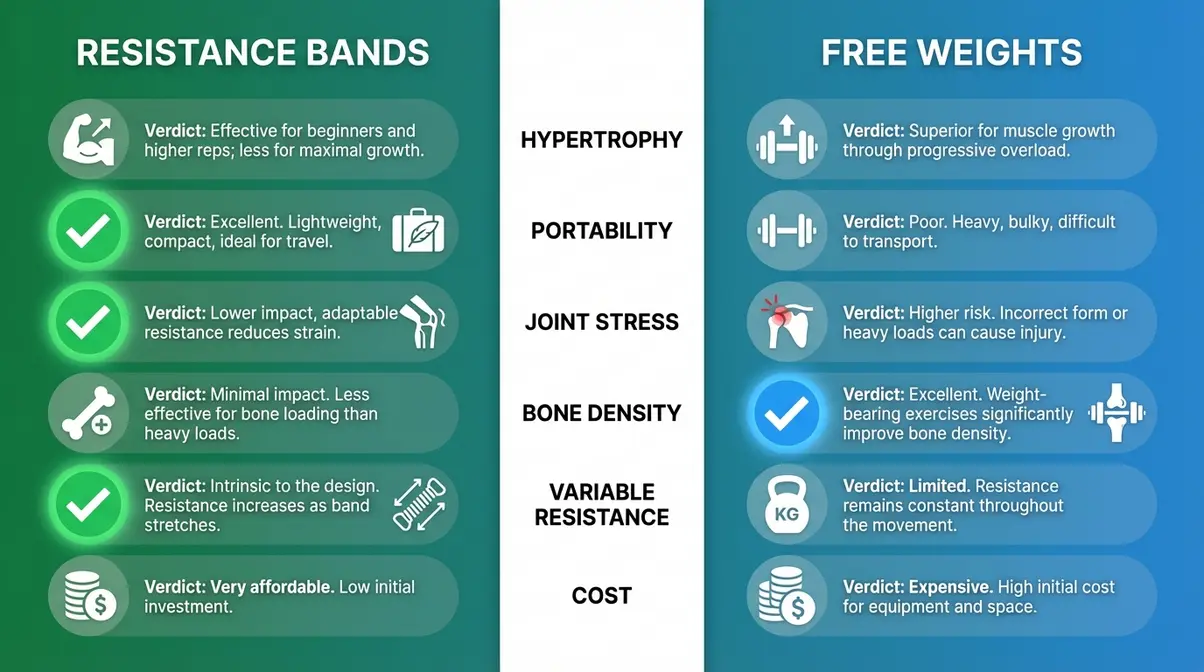
Resistance bands do not build muscle faster than free weights, nor do free weights build muscle faster than bands when training volume and effort are matched. A 2021 systematic review confirms hypertrophy gains are achievable independent of the load, provided proximity to muscular failure is sufficient. The real question is which tool is better for a specific goal.
| Criteria | Resistance Bands | Free Weights |
|---|---|---|
| Muscle Hypertrophy | Comparable gains with matched effort | Comparable gains; edge in maximal strength |
| Portability | High — train anywhere | Low — gym or home setup required |
| Joint Stress | Lower — variable resistance is gentler | Higher — fixed load stresses joints |
| Bone Density | Moderate stimulation | Superior — heavy loading is best |
| Variable Resistance | Yes — matches the strength curve | No — gravity is constant |
| Cost | $15–$150 for a complete set | $200–$1,000+ for a comparable setup |
Where Bands Have a Mechanical Advantage
The edge for bands comes from variable resistance, where tension increases as the band stretches. At the bottom of a squat, where you’re weakest, band tension is lower. At the top, where you’re strongest, tension peaks. This means you’re working near your limit throughout the entire range of motion, not just at the sticking point. This property, combined with their portability and lower joint stress, makes them a powerful and sustainable tool for hypertrophy.
Where Free Weights Still Have the Edge
Free weights maintain an advantage in two areas. For bone density, the high mechanical load of heavy barbell squats and deadlifts creates greater skeletal stress, making them the gold standard for osteoporosis prevention. For maximal absolute strength, those needing to express high one-rep maximums (1RM) for sports like powerlifting will need the heavy loads only free weights can provide.
The Smartest Approach: Combining Both
For decades, elite strength coaches have used bands with free weights, wrapping them around a loaded barbell to create ascending resistance. This forces maximum effort through the full range. For glute development, adding a loop band above the knees during a barbell hip thrust combines the barbell’s absolute load with the band’s terminal tension for peak activation.
A 6-Month Resistance Band Training Plan

This plan follows the non-negotiable rule of all effective hypertrophy programs: progressive overload. It synthesizes findings from peer-reviewed meta-analyses and ACSM guidelines, using the 3-Force Framework as its organizing principle.
Estimated Time: 45-60 minutes per session.
Tools & Materials: A set of loop bands (light, medium, heavy), a set of tube bands with handles, and a door anchor.
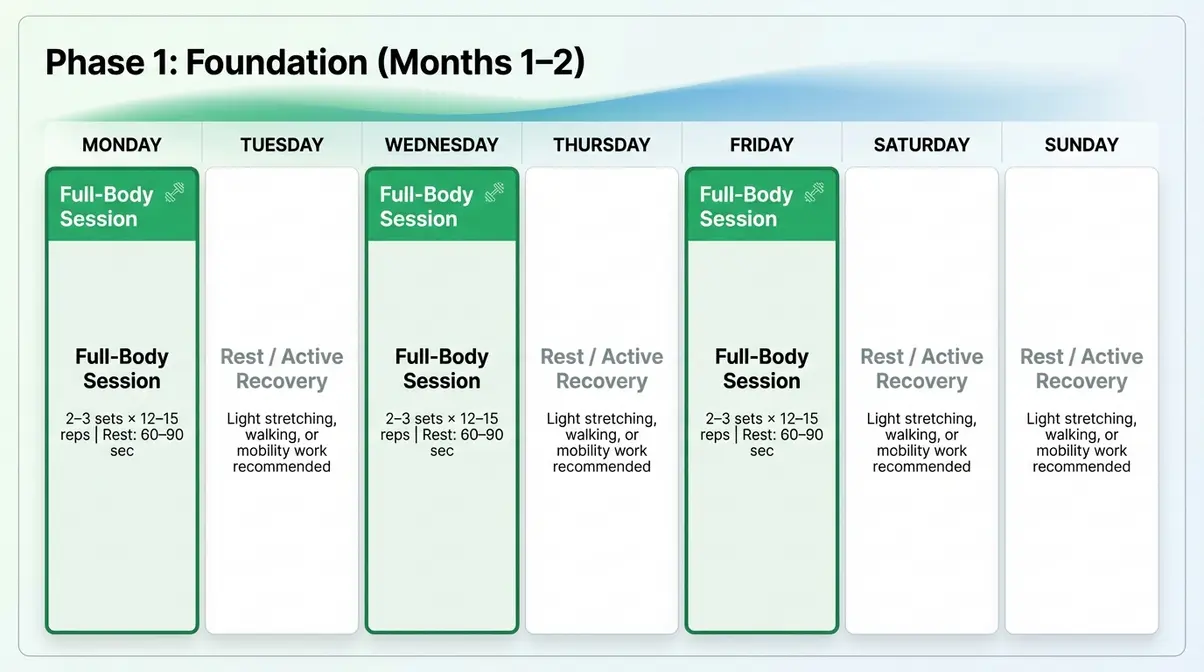
Phase 1 (Months 1–2): Foundation
- This phase prioritizes Mechanical Tension—learning correct form and band setup to ensure every session delivers the needed stimulus.
- Frequency: 3x per week, full-body sessions (e.g., Mon/Wed/Fri).
- Sets & Reps: 2–3 sets of 12–15 reps. Choose a band where the final 2 reps are challenging.
- Rest: 60–90 seconds between sets.
- Progression: When you complete 3 sets of 15 reps with clean form for two consecutive weeks, advance to Phase 2.
ACSM strength guidelines recommend targeting all major muscle groups, which this schedule delivers.
Phase 2 (Months 3–4): More Volume
- Phase 2 focuses on Progressive Overload by systematically increasing the training stimulus to force adaptation.
- Frequency: 4x per week (Upper/Lower split; e.g., Mon/Tues/Thurs/Fri).
- Sets & Reps: 3–4 sets of 8–12 reps.
- Rest: 60–75 seconds.
- Tempo: Introduce a 3-second eccentric (lowering phase) on all exercises to increase time under tension.
- Progression: When 4 sets of 12 reps feel manageable for two weeks, move to the next resistance band level and advance to Phase 3.
Phase 3 (Months 5–6): Advanced Hypertrophy
- This phase targets all three forces of the 3-Force Framework simultaneously, using advanced loading techniques.
- Frequency: 4–5x per week (Push/Pull/Legs split).
- Sets & Reps: 4–5 sets of 6–10 reps.
- Rest: 45–60 seconds to amplify Metabolic Stress.
- Techniques: Implement supersets, drop sets, and isometric pauses (holding the contracted position for 2-3 seconds).
- Advanced Goal (Muscle-Up): Use a thick loop band for assistance, placing a knee or foot in the loop. Progress by moving to a thinner band as strength increases.
15 Core Resistance Band Exercises
- Upper Body
- Banded Row: (Lats, Rhomboids) Anchor band low, grip handles, and pull elbows to hips.
- Banded Overhead Press: (Deltoids, Triceps) Stand on the band and press handles overhead to full extension.
- Banded Bicep Curl: (Biceps) Stand on the band and curl handles toward shoulders, controlling the 3-second lowering phase.
- Banded Tricep Pushdown: (Triceps) Anchor band high and press handles down until arms are fully extended.
- Banded Chest Press: (Pectorals, Deltoids) Anchor band behind you and press handles forward with control.
- Banded Face Pull: (Rear Deltoids) Anchor band at face height and pull toward your forehead with elbows high and wide.
- Banded Lateral Raise: (Lateral Deltoids) Stand on the band and raise your arms out to the side to shoulder height.
- Lower Body and Core
- Banded Squat: (Quads, Glutes) Stand on the band with handles at your shoulders (or a loop band above knees).
- Banded Romanian Deadlift: (Hamstrings, Glutes) Stand on the band and hinge at the hips, keeping a slight bend in the knees.
- Banded Glute Bridge: (Glutes, Hamstrings) Lie on your back with the band across your hips, and drive through your heels.
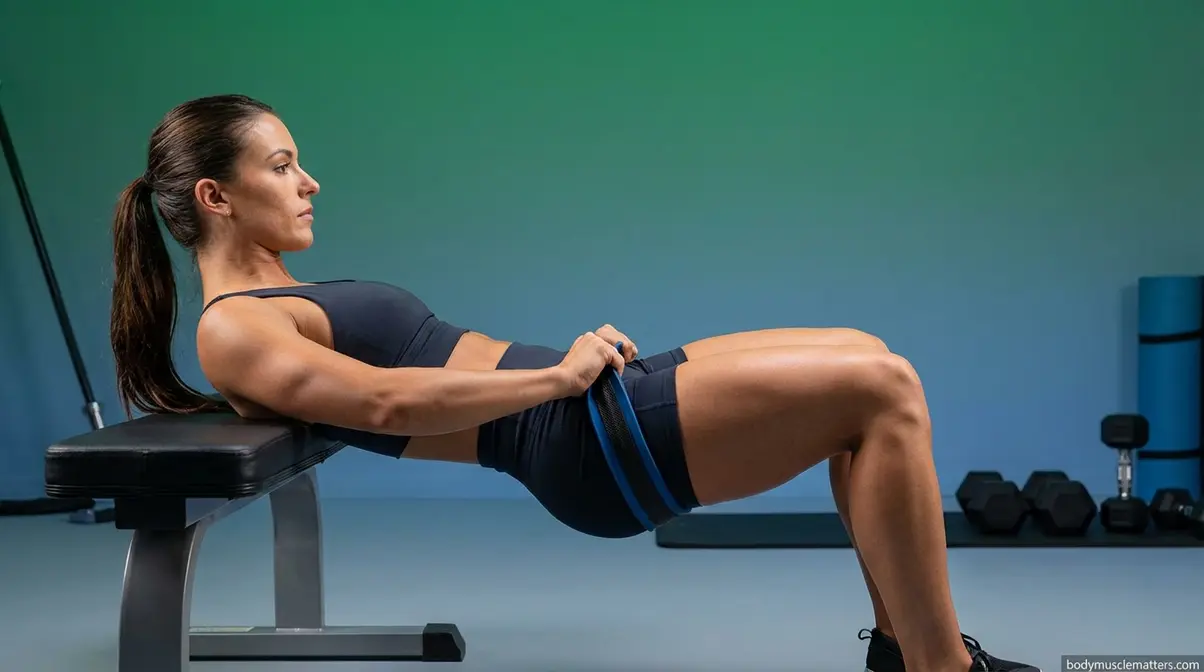
- Banded Hip Thrust: (Glutes) With your upper back on a bench, drive your hips upward until your body is in a straight line.
- Banded Leg Press (Seated): (Quads, Glutes) Sit on the floor with the band looped around your feet and press forward.
- Banded Clamshell: (Glute Medius) Lie on your side with a band above your knees and open the top knee without rotating your pelvis.
- Banded Monster Walk: (Glutes, Abductors) With a band above your ankles, take lateral steps in a half-squat position.
- Banded Hamstring Curl (Prone): (Hamstrings) Anchor band low, lie face down, and curl your heels toward your glutes.
“Resistance bands for muscle growth provide a complete training stimulus, making a full-body program achievable with equipment that fits in a backpack.”
Safety, Form, and Common Mistakes
Band training is lower-risk for joints, but equipment failure is a unique risk. Before every session: Inspect, anchor, test.
- Band Inspection: Check for cracks, nicks, or wear. Replace any damaged bands.
- Anchor Security: Ensure your anchor point is a fixed, load-bearing structure. Test it before each set.
- Stretch Limits: Do not stretch bands beyond 2.5 times their resting length to avoid snapping.
- Proper Progression: Never jump more than one resistance level. Gradual increases are key to progressive overload.
Avoid common errors like letting bands snap back, using momentum, or choosing a band that’s too light. The final reps of every set should be a struggle.
Choosing the Right Resistance Bands
Band Types for Hypertrophy
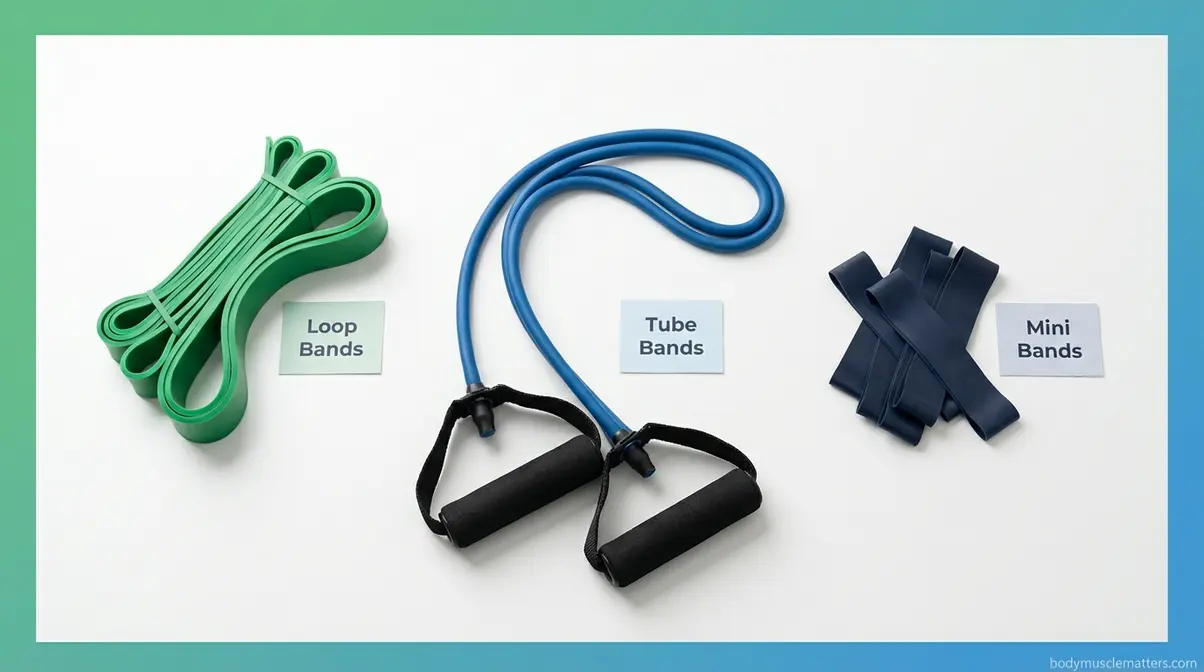
- Loop bands (flat): The most versatile for lower-body and compound movements. These are the primary tool for the 6-month plan.
- Tube bands (with handles): Better for upper-body isolation work like rows and curls where a handle improves grip.
- Mini bands (short loops): Used for activation work like clamshells and monster walks to target hip stabilizers.
For a complete program, a starter kit should include 3-5 loop bands, 1 tube band set, and 2 mini bands.
Matching Resistance to Your Phase
- The hypertrophic signal requires proximity to muscular failure.
- Phase 1 (12-15 reps): The last 2 reps should be challenging.
- Phase 2 (8-12 reps): You should be near failure by the last rep.
- Phase 3 (6-10 reps): Use heavier or doubled bands; failure should occur by rep 10.
Durability and Safety
Look for natural latex, layered construction (multiple thin layers bonded together), and reinforced connectors on tube bands. A quality set providing a range from 5-150 lbs is sufficient to complete the entire 6-month plan.
Building Legs and Glutes with Bands
Why Bands Excel for Glute Activation
The gluteus maximus reaches peak contraction at full hip extension—exactly where bands deliver their highest tension. A 2023 study in the International Journal of Strength and Conditioning confirmed that adding band-resisted abduction during hip thrusts measurably increases upper gluteus maximus activation. This makes bands uniquely effective for targeting the glutes.
Why Banded Squats are So Effective
Squatting with a resistance band is highly effective for glute development. Placing a loop band just above the knees forces hip external rotation, increasing gluteus medius activation and discouraging the inward knee collapse that limits glute recruitment. For those who “don’t feel squats in their glutes,” this simple addition can produce a more complete lower-body stimulus.
5 Best Exercises for Legs and Glutes
- Banded Hip Thrust: The primary driver of glute growth, offering maximum tension at full hip extension.
- Banded Romanian Deadlift: Targets the hamstring and glute connection through a full hip-hinge pattern.
- Banded Squat (loop band above knees): Forces hip external rotation, recruiting the often-undertrained glute medius.
- Banded Clamshell: Isolates the gluteus medius, a key hip stabilizer.
- Banded Monster Walk: Provides dynamic loading for the glute medius and abductors.
Limitations, Plateaus & When to Get Help
Common Resistance Band Plateaus
- The Resistance Ceiling: You eventually max out the heaviest band. Solution: Combine bands with free weights or use advanced techniques like pauses and slow eccentrics.
- Grip Fatigue: Your hands give out before the target muscle. Solution: Use lifting straps or switch to loop bands that don’t require grip strength.
- Overload Stagnation: Progress stalls. Solution: Implement drop sets (moving to a lighter band mid-set) or reduce rest intervals.
When to Combine with Weights or Seek a Trainer
Combine bands with weights when your primary goal shifts to maximum absolute strength (1RM) or bone density is a medical concern. Seek a certified trainer (CPT or CSCS) if you experience joint pain, struggle with form, or have a pre-existing orthopedic condition. Always consult a physician before starting any new exercise program if you have underlying health conditions.
Frequently Asked Questions
Can you gain muscle mass using resistance bands?
Yes, resistance bands build genuine muscle mass through the same mechanisms as free weights. A landmark 2019 meta-analysis found no significant difference in strength gains between elastic and conventional resistance training (PubMed, 2019). The key is applying progressive overload and training close to muscular failure.
Does strength training improve bone density?
Yes, all resistance training improves bone density compared to being sedentary. However, high-load free weight movements like heavy squats produce stronger bone density adaptations than bands at equivalent effort. For preventing osteoporosis, a combination of both is often recommended.
Is 3 sets of 3 exercises enough to build muscle?
It can be, but only if total weekly volume is sufficient. The ACSM recommends 10 or more sets per muscle group per week for meaningful hypertrophy. A 3×3 session provides 9 sets, which might be enough for one or two muscle groups, but it falls short as a full-body program. For a 2-3 day routine, 4-5 exercises of 3-4 sets each produce better outcomes.
Conclusion
For adults seeking a portable, evidence-backed path to hypertrophy, resistance bands deliver measurable results. Research confirms they produce comparable strength gains to conventional equipment. The key is applying a structured plan.
The 3-Force Framework—Mechanical Tension, Progressive Overload, and Metabolic Stress—is the principle that separates effective training from aimless exercise. This guide’s 6-month program is designed to cycle through these forces with increasing intensity. Your next step is to start Phase 1 this week. Choose bands where the final two reps are a genuine challenge, and track your progress. The equipment fits in a bag; the plan is in front of you.