
What Is Muscle Maturity? Science, Signs & Timeline
Picture a 50-year-old lifter standing next to a 25-year-old who outweighs him by 20 pounds. The younger guy is bigger — no question. But the older lifter looks denser. Harder. More capable. His muscles have a dry, grainy quality that size alone can’t explain. That contrast has a name: muscle maturity. As the bodybuilding community puts it:
“Muscle maturity is how hard and grainy you look while lean, usually from years and years of lifting and dieting, hence ‘maturity’.”
Most people assume bigger automatically means better-looking. It doesn’t. Without maturity, even a large physique can appear smooth or puffy — impressive on a scale, but lacking the dense, striated quality that actually turns heads. That’s the gap this guide is designed to close.
By the end of this guide, you’ll know exactly what muscle maturity is, the physiology that drives it, and the long-term principles that build it — covering the definition, the science, a practical roadmap, and the most common questions people ask.
⚠️ Disclaimer: This article is for informational purposes only and is not a substitute for professional medical or fitness advice. Consult a certified personal trainer or healthcare professional before starting any new training program.
Understanding what is muscle maturity is the first step to building a dense, hard, and striated look that develops after a decade or more of consistent training — and it’s completely different from simply being big. Closing “The Maturity Gap” between size and density takes time, science, and strategy.
- Maturity ≠ size: A smaller, leaner, experienced lifter often looks more “mature” than a bigger beginner
- The timeline is real: Research links long-term resistance training to measurable changes in muscle fiber density, myofibril count, and skin thickness
- Training age matters more: It’s about years of consistent work, not your birthday
- The Maturity Gap: The measurable distance between how big your muscles are and how mature they actually look — and it can be closed with the right approach
- Patience is the strategy: Most elite natural lifters report 10-15 years before achieving a visibly mature physique
What Is Muscle Maturity? The Complete Definition
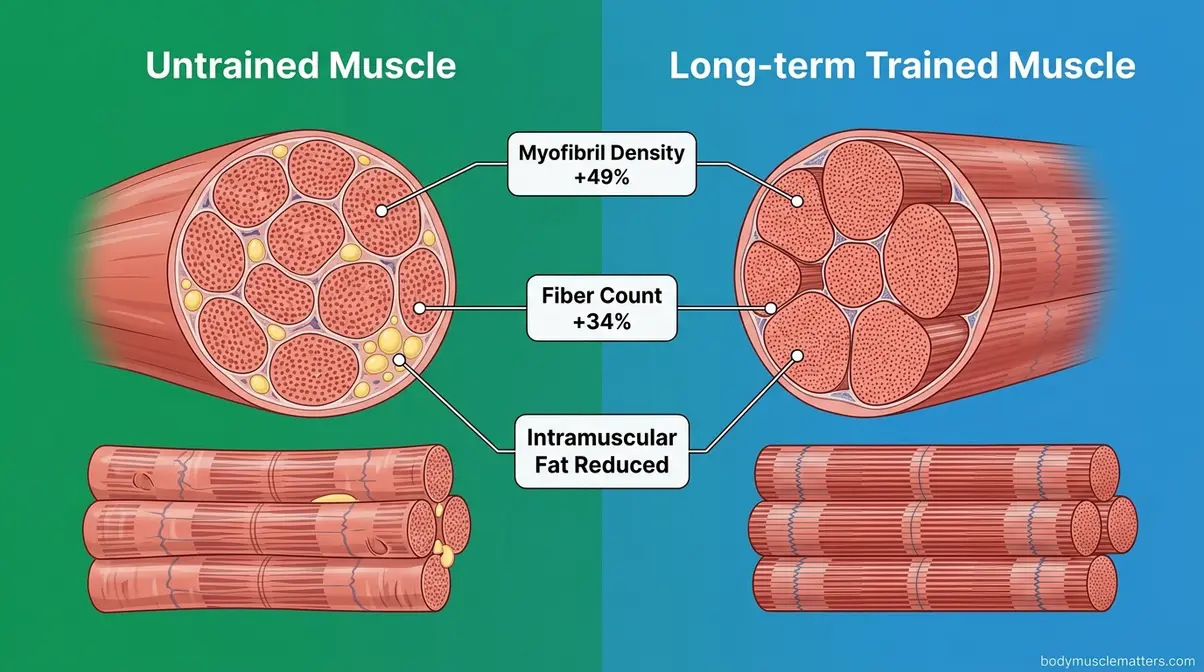
Muscle maturity is the bodybuilding term for the dense, hard, and grainy quality that muscles develop after a decade or more of consistent training. Unlike hypertrophy (muscle growth in size), muscle maturity refers to how a muscle looks and feels — the visible striations (the grooves running through a flexed muscle), the dry and defined appearance, and the resting hardness that comes from years of progressive training, low body fat, and accumulated structural adaptation. Muscle maturity describes what happens inside the muscle over time, not just how big it grows.
In bodybuilding circles, muscle maturity refers to a specific set of aesthetic qualities that size alone cannot produce — and that no shortcut can replicate. Muscle maturity describes the dense, hard, and striated look of muscles developed through 10 or more years of consistent resistance training — and it cannot be rushed.
Is Muscle Maturity Different From Size?

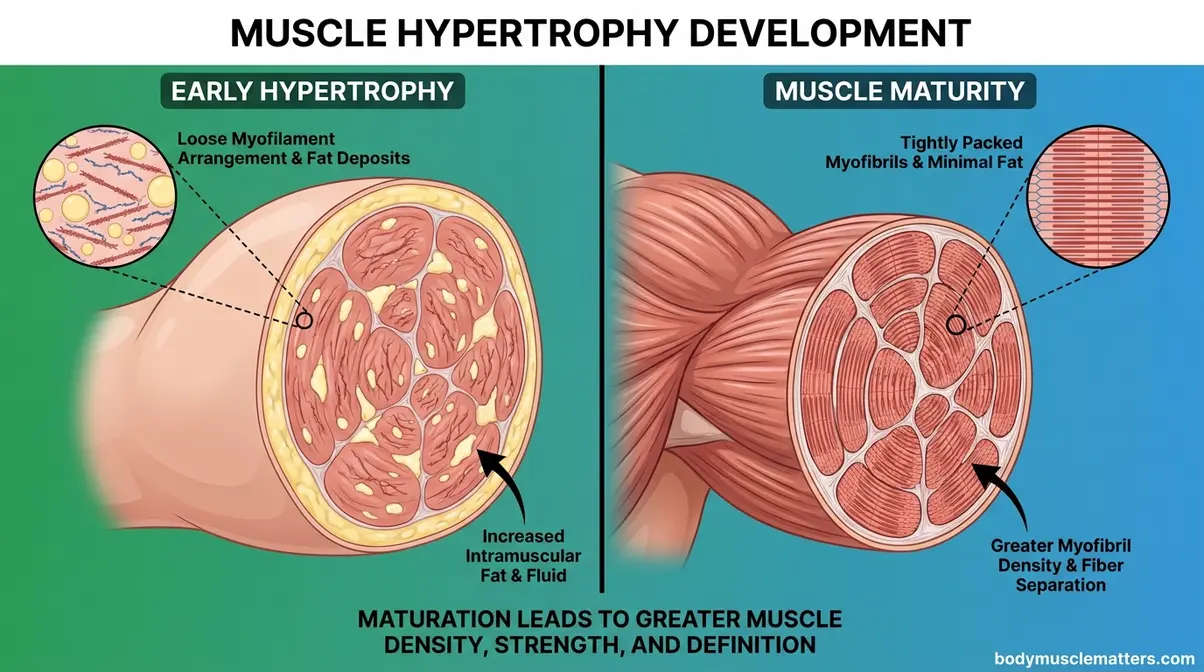
Yes — muscle maturity and muscle size are distinct qualities that develop through different mechanisms. Hypertrophy is your muscle getting bigger. More contractile proteins, more fluid, more volume. A dedicated beginner can achieve significant hypertrophy in 6 to 12 months — it’s the most visible early reward of consistent training.
Muscle maturity is about quality, not quantity. It’s the structural changes that accumulate over years — thicker individual fibers, denser connective tissue, lower intramuscular fat (the fat stored between muscle fibers), and tighter myofilament packing — that create the hard, grainy look. Research on long-term resistance-trained individuals found they had 34% more muscle fibers, 49% more myofibrils per fiber, and significantly tighter myofilament packing compared to untrained individuals (PubMed, 2026). That’s not just a bigger muscle — that’s a structurally different one.
Here’s where The Maturity Gap becomes clear. You can have a 17-inch arm that looks puffy, and a 15-inch arm that looks like granite. Same measuring tape result. Completely different appearance. That gap between size and appearance is exactly what this article is about.
Picture a water balloon versus a dense rubber ball. Same circumference. Completely different feel. The water balloon is full and round — but press it, and it gives. The rubber ball is firm and unyielding. That’s the difference between early hypertrophy and mature muscle. Long-term skeletal muscle adaptations from heavy resistance training include increased muscle cross-sectional area and density, confirming that these changes are real and measurable (NIH PubMed, 1988).
So now you know the difference between size and maturity. But what does a mature muscle actually look like in practice? Here are the specific physical signs to recognize.
The Physical Signs of a Mature Muscle
A mature muscle has five qualities that beginners rarely develop in their first few years. Knowing what to look for helps you understand where you’re headed.
Dense and hard at rest. A mature muscle doesn’t feel soft when you’re not flexing it. Press your forearm right now — if you’ve been training for 10 or more years consistently, there’s a firmness there even at rest. This comes from increased muscle fiber density and a significant reduction in intramuscular fat (the fat stored between individual muscle fibers). Research confirms that resistance training reduces intramuscular fat content, contributing to that characteristic hardness (PMC, 2026).
Grainy and striated. Striations — the visible grooves that run through a flexed muscle — become more pronounced as training age increases. These aren’t just visible when body fat is very low; experienced lifters show deeper, more defined striations at the same body fat percentage as a beginner because the underlying fiber structure is denser.
Dry appearance. Mature muscles tend to look “dry” — not flat, but lacking the water-retention puffiness common in newer lifters. This is partly body composition, partly the structural shift away from water-holding intramuscular fat.
Resting muscle tone. Even when relaxed, a mature physique carries visible muscle shape. Neuromuscular efficiency — how effectively your brain recruits muscle fibers — improves with years of training, contributing to this resting tone.
Deeper definition under load. When a mature lifter flexes or performs a movement, the detail visible in the muscle is dramatically more pronounced than in a beginner of the same size.
Why Your Muscles Look Smooth or Puffy When You’re New
New lifters often make strong early progress — and then feel confused when their physique looks “smooth” or “puffy” despite months of hard work. This is completely normal, and it has a physiological explanation.
Early muscle growth is driven largely by fluid retention, glycogen storage (your muscles’ stored carbohydrate), and initial fiber thickening. Your muscles are literally soaking up more water and fuel as they adapt. The connective tissue — tendons, fascia (the fibrous sheaths surrounding your muscles) — hasn’t yet undergone the long-term remodeling that creates firmness and definition.
Additionally, intramuscular fat levels tend to be higher in untrained individuals. As you accumulate training years and maintain a leaner body composition, that intramuscular fat gradually decreases — revealing the denser, harder tissue underneath. Think of it like a block of marble still encased in rough stone. The sculpture is in there. It just takes years of consistent work to reveal it.
For a deeper look at how to recognize these qualities in your own physique, see our guide to understanding muscle maturity in detail.
The Science Behind Muscle Maturity
When people ask what is muscle maturity, they are often questioning if it is a real biological phenomenon. The science behind muscle maturity is more robust than most gym conversations suggest. Several distinct physiological processes — operating simultaneously over years — are responsible for the mature look. These aren’t theoretical; they’re documented in peer-reviewed research. Understanding the science of progressive overload for muscle growth is essential here.
Exercise scientists define training age as the number of years a person has trained consistently with progressive resistance. A higher training age correlates directly with more advanced physiological adaptations — not just in muscle size, but in structure, efficiency, and even skin quality. The distinction matters because The Maturity Gap only begins to close when these deeper structural changes accumulate.
Training Age vs. Chronological Age
Your chronological age is how old you are on your birthday. Your training age is how many years you’ve spent consistently and progressively lifting weights. These two numbers are completely independent — and training age is the one that actually determines muscle maturity.
A 30-year-old who has trained consistently for 12 years will typically display more muscle maturity than a 45-year-old who started lifting seriously at 40. The body doesn’t care about your birth year. It responds to accumulated mechanical stress, progressive overload, and the years of structural adaptation that follow.
Exercise scientists recognize training age as a key variable in predicting physiological adaptation. Elite athletes show superior neuromuscular efficiency compared to recreational athletes — refined motor unit recruitment, more force generated per unit of muscle activation, and architectural changes in the muscle itself (PMC, 2026). These adaptations develop gradually over years, not months.
The practical implication: don’t compare your physique to someone with 15 years of training experience if you’re 2 years in. You’re not at the same point in the process. And that’s not discouraging — it’s clarifying.
What Actually Changes in Your Muscles Over Time
This is where the science gets genuinely fascinating. Long-term resistance training doesn’t just make your muscles bigger — it fundamentally changes their internal architecture.
A landmark 2026 study published in Medicine & Science in Sports & Exercise compared long-term resistance-trained individuals to untrained controls and found striking differences beyond simple size (PubMed, 2026):
- +34% more muscle fibers total
- +29% larger individual fiber cross-sectional area
- +49% more myofibrils (the contractile units inside each fiber) per fiber
- Tighter myofilament packing — the contractile proteins are arranged more densely
This means a long-term lifter’s muscle isn’t just a scaled-up version of a beginner’s muscle. It’s structurally different at the microscopic level. More fibers. Denser fibers. More contractile machinery packed into each fiber. That structural density is a major driver of the mature, “granite” look.
Beyond fiber architecture, connective tissue adapts significantly. Tendons become stiffer and more efficient at transmitting force. Fascia — the fibrous sheaths surrounding muscle groups — thickens and tightens over years of loading. This is the science behind muscle striations that many lifters strive for. These changes contribute to the firm, capable appearance of a mature physique. Additionally, intramuscular fat decreases with sustained training and lean body composition, further revealing the dense tissue underneath (PMC, 2026).
The Role of Neuromuscular Efficiency
Neuromuscular efficiency is how effectively your nervous system recruits muscle fibers during a contraction. Think of it as the quality of the signal your brain sends to your muscles — and how many fibers actually respond to that signal.
In a beginner, the nervous system is still learning to activate muscle fibers efficiently. Early strength gains — the rapid progress most new lifters experience in their first few months — are driven primarily by neuromuscular adaptation, not muscle growth. Your brain is simply getting better at using the muscle you already have.
Over years of training, this efficiency improves substantially. Elite athletes demonstrate lower muscle activation levels for the same relative force output, meaning they generate more force with less neural “noise” (PMC, 2026). This refined recruitment pattern contributes to the resting muscle tone and the precise, controlled look of a mature physique.
A 2026 study found that participants who used an internally focused mind-muscle connection during resistance training achieved 12.4% greater muscle thickness increases compared to 6.9% in externally focused participants. Developing this connection — which takes years of deliberate practice — is one of the mechanisms through which training age translates into muscle maturity.
How Skin Quality Affects the Mature Look
Skin quality is an underappreciated component of the mature physique — and it’s not just about genetics or age. Long-term resistance training measurably improves the skin over the muscle.
A 2026 randomized controlled trial published in Scientific Reports (PMC10290068) found that a 16-week resistance training program significantly increased dermal thickness and improved skin elasticity in middle-aged women. The mechanism: resistance training increased dermal biglycan (a protein that prevents collagen degradation) and suppressed inflammatory factors that break down collagen gene expression. Only resistance training — not aerobic exercise alone — produced this specific protective effect.
Thicker, more elastic skin sits differently over muscle. It reveals striations more clearly. It doesn’t obscure definition the way thinner, less resilient skin does. Over years of consistent training, the skin overlying well-developed muscle becomes an active contributor to the mature look — not just a passive covering. Resistance training rejuvenates aging skin by reducing circulating inflammatory factors and increasing collagen-protective proteins (Scientific Reports, 2026).
Natural vs. Enhanced Lifters: Timeline Comparison
One of the most honest conversations in fitness is the difference in timelines between natural lifters (who rely solely on food, sleep, and training) and enhanced lifters (who use performance-enhancing drugs such as anabolic steroids). Both groups can achieve muscle maturity — but the timelines and risk profiles differ significantly.
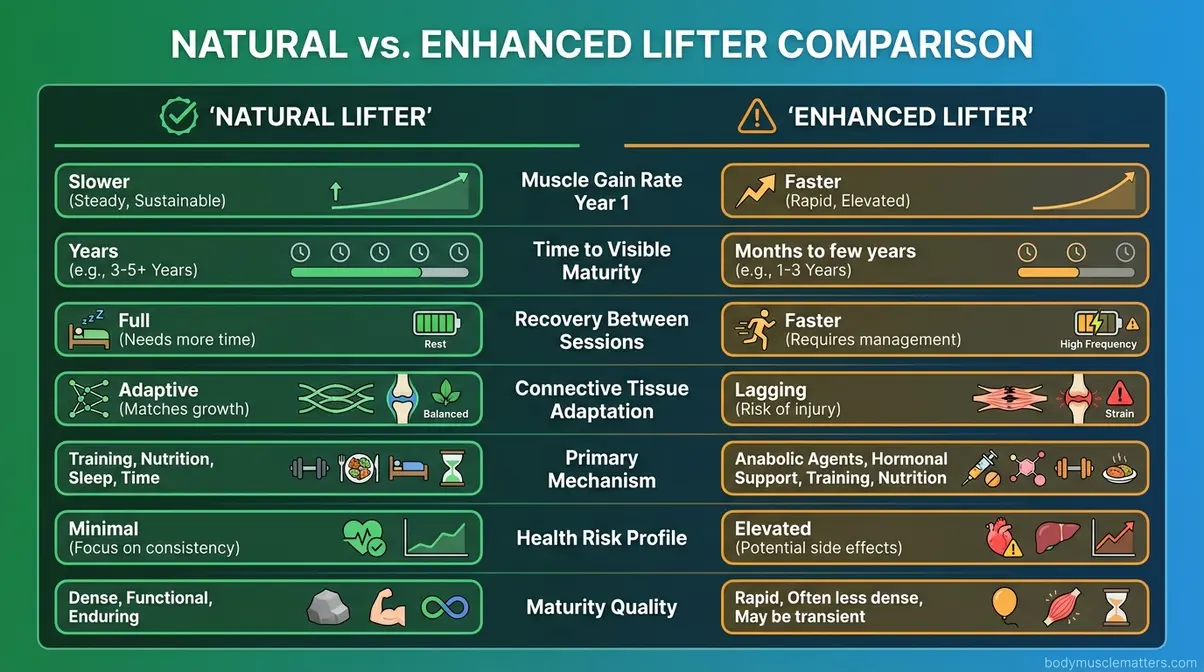
| Factor | Natural Lifter | Enhanced Lifter |
|---|---|---|
| Muscle gain rate (Year 1) | 10–20 lbs lean mass | 20–30+ lbs lean mass |
| Time to visible maturity | 10–15 years | 3–5 years (estimated) |
| Recovery between sessions | 48–72 hours per muscle group | 24–48 hours (or less) |
| Connective tissue adaptation | Gradual, proportional to load | May lag behind rapid size gains |
| Primary mechanism | Progressive structural adaptation | Accelerated protein synthesis + hormonal environment |
| Health risk profile | Low (when trained progressively) | Significant — cardiovascular, hormonal, hepatic risks |
| Maturity quality | Develops in proportion to structural changes | Size can outpace structural maturity |
Research from a 100-day experiment found that enhanced lifters gained approximately 13 lbs of muscle — roughly 3 times the 3.7 lbs gained by natural beginners over the same period (Built With Science, 2026). The accelerated size gain is real. However, connective tissue adaptation, neuromuscular efficiency, and the structural density changes documented in long-term natural lifters take time regardless of hormonal environment.
The bottom line: enhanced training can accelerate size and some aspects of conditioning, but the deep structural adaptations that create true muscle maturity still require years of accumulated training. The Maturity Gap doesn’t disappear with a shortcut — it just gets bigger faster if the structural work isn’t done.
How to Develop Muscle Maturity: Roadmap
Knowing what muscle maturity is and why it happens is useful. Knowing how to build it is what actually matters. The roadmap isn’t complicated — but it requires a specific mindset shift: you’re playing a long game, not a 12-week program. For a foundational approach, check out a practical guide to building muscle.
The principles below aren’t secrets. But most lifters underestimate how consistently and for how long they need to apply them to close The Maturity Gap.
Principle 1: Consistent Progressive Overload
Progressive overload means gradually increasing the demands placed on your muscles over time — more weight, more reps, more sets, or reduced rest. It’s the single most important driver of every adaptation discussed in this article.
Without progressive overload, your body has no reason to continue adapting. The fiber density increases, the myofibril proliferation, the connective tissue stiffening — all of these require a sustained, gradually increasing training stimulus. A 2026 meta-analysis found that resistance training programs significantly increase skeletal muscle thickness across populations (PMC, 2026), confirming that the stimulus-adaptation relationship is reliable and consistent.
Practically, this means:
- Track your lifts. Know what you lifted last week.
- Aim to add weight, reps, or sets every 1-3 weeks on your main movements.
- Prioritize compound movements — squats, deadlifts, rows, presses, dips, pull-ups — as your primary overload vehicles.
- Don’t chase soreness. Chase progressive performance.
Consistency over years matters more than any single training block. The lifters who look the most mature are almost always the ones who never stopped showing up.
Principle 2: Stay Lean Year-Round
Intramuscular fat is one of the primary barriers between you and the mature look. The less of it you carry, the more the underlying density of your muscle tissue is visible. Staying within a reasonable body fat range year-round — rather than cycling between extreme bulking and cutting phases — accelerates the reduction of intramuscular fat and preserves the structural adaptations you’ve built.
Research confirms that resistance training combined with a caloric deficit reduces intermuscular adipose tissue significantly more than training alone (PMC, 2026). The practical implication: extended periods of high body fat don’t just obscure your physique temporarily — they slow the process of intramuscular fat reduction that’s central to the mature look.
This doesn’t mean staying shredded 365 days a year. It means avoiding excessive bulk phases that push body fat well above 15-18% for men or 25-28% for women. A moderate surplus during growth phases — sometimes called a “lean bulk” — builds the muscle density you want without burying it in fat that takes years to remove.
Principle 3: Vary Your Training Styles
Your muscles adapt to whatever stimulus you consistently provide. If you only ever train in the 3-5 rep strength range, you’ll develop strength and some hypertrophy — but you’ll miss the adaptations that come from higher-rep, metabolic-stress-focused training, and vice versa. Varying your training style over the years exposes your muscles to a broader range of stimuli and drives more comprehensive structural adaptation.
Effective variation includes:
- Heavy compound work (3-6 reps): Drives myofibrillar density and connective tissue adaptation
- Moderate hypertrophy work (8-15 reps): Maximizes muscle fiber cross-sectional area
- High-rep metabolic work (15-25 reps): Promotes muscle endurance adaptations and capillary density
- Isolation work: Develops the neuromuscular efficiency in specific muscles that contributes to resting tone and definition
Over a training career, periodically shifting emphasis between these styles — rather than staying locked in one rep range forever — builds the layered structural complexity that characterizes a mature physique.
Can Women Develop Muscle Maturity?
Yes — women develop muscle maturity through the same physiological processes as men, including fiber densification, intramuscular fat reduction, and connective tissue adaptation. The physiological principles of muscle maturity apply equally to women and men. However, the timeline and aesthetic expression differ.
Women typically carry a higher baseline body fat percentage and have lower circulating testosterone, which means the rate of muscle hypertrophy is slower. The result: closing The Maturity Gap takes at least as long for women as for men — and the mature look in women is characterized more by visible muscle shape, definition, and firmness than by the deep striations more common in highly conditioned male physiques.
The good news: the same principles apply. Consistent progressive overload, staying lean, varying training styles, and accumulating training years are the drivers for both sexes. Women who train consistently for 8-12 years develop a distinctly mature quality — firm, defined, and capable-looking — that no amount of beginner training can replicate.
Setting Realistic Expectations: The 10-Year Rule
The most honest thing anyone can tell you about muscle maturity is this: it’s a marathon, not a sprint. Most elite natural bodybuilders report that a visibly mature physique takes between 10 and 15 years of consistent, progressive training. That’s not a discouraging number — it’s a clarifying one.
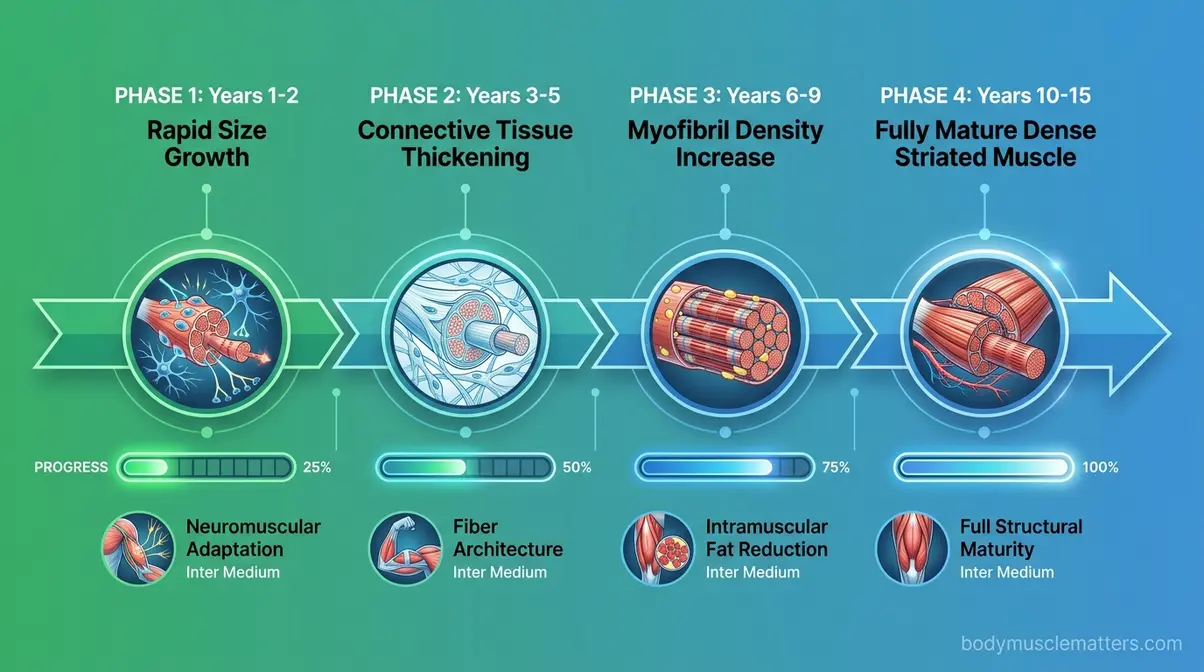
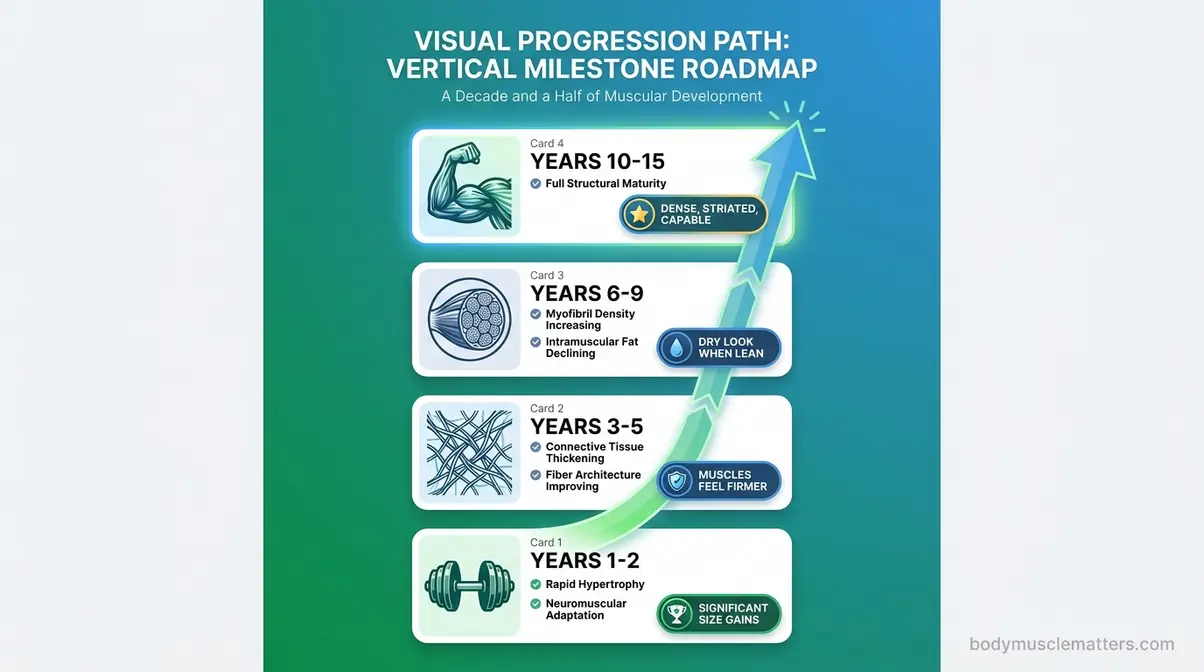
Here’s a rough milestone framework for natural lifters:
| Training Year Range | What’s Happening Physiologically | What You’ll Notice |
|---|---|---|
| Years 1-2 | Rapid hypertrophy, neuromuscular adaptation | Significant size gains, strength jumps |
| Years 3-5 | Connective tissue thickening, fiber architecture improving | Muscles feel firmer, definition improves at low body fat |
| Years 6-9 | Myofibril density increasing, intramuscular fat declining | “Dry” look when lean, improved resting tone |
| Years 10-15 | Full structural maturity accumulating | Dense, striated, capable look at moderate body fat |
These timelines assume consistent training, adequate nutrition, and progressive overload throughout. Gaps in training, extended periods of high body fat, or inconsistent effort slow the process. Evidence suggests that even 3 weeks of detraining does not significantly decrease muscle thickness in trained individuals (PMC, 2026) — so a vacation won’t undo your progress. But years of inconsistency will extend the timeline significantly.
Common Pitfalls and Realistic Expectations
Even lifters who understand the science can fall into predictable traps on the road to muscle maturity. Here’s what to watch for — and when to get help.
Shortcuts That Don’t Work
The fitness industry sells impatience. Twelve-week transformations. “Maturity-accelerating” supplements. Training programs promising the dense, grainy look in 90 days. None of these deliver what they promise — and here’s why.
Excessive bulk phases feel productive but often just add intramuscular fat that takes years to remove. You’re not building maturity during a 30-pound bulk — you’re obscuring the structural changes you’ve already made.
Anabolic steroids accelerate size, but as the timeline comparison shows, they don’t shortcut the connective tissue adaptation, neuromuscular efficiency, and skin quality changes that are central to true maturity. They also carry serious cardiovascular, hormonal, and hepatic risks that are well-documented in the medical literature.
Program hopping — constantly switching routines before the current one has time to produce results — is one of the most common ways lifters stall their training age development. Progressive overload requires continuity. Jumping programs every 4-6 weeks prevents the sustained adaptation that drives structural change.
Neglecting body composition is perhaps the most underrated mistake. You can have exceptional muscle density and structural maturity — but if it’s covered by excess body fat, none of the mature qualities are visible. Staying reasonably lean year-round isn’t optional if you want the mature look.
When to Seek Expert Guidance
Some situations genuinely call for professional support — not because you’re doing something wrong, but because the complexity exceeds what general principles can address. Research indicates that over 60% of lifting injuries stem from poor load management. Training through these injuries significantly delays the connective tissue adaptations required for true maturity.
Work with a certified personal trainer if: You’ve been training for more than 2 years and your progress has stalled completely, you’re experiencing recurring joint pain or injury that limits your training consistency, or you’re unsure how to structure progressive overload for your specific goals and schedule.
Consult a registered dietitian if: You’re struggling to maintain a lean body composition despite consistent training, you’re considering a significant caloric deficit alongside your training program, or you want a personalized nutrition strategy to support both muscle development and intramuscular fat reduction.
See a sports medicine physician if: You experience sharp joint pain, persistent tendon discomfort, or any symptom that limits your range of motion — because connective tissue adaptation is central to muscle maturity, and training through injury slows the entire process.
The goal of muscle maturity is a decade-long project. Protecting your ability to train consistently is the single most important variable in that timeline.
Frequently Asked Questions About Muscle Maturity
How long does it take to achieve muscle maturity?
Muscle maturity typically takes 10 to 15 years of consistent, progressive resistance training for natural lifters to fully develop. The timeline isn’t arbitrary — it reflects the time required for measurable structural changes: increased fiber density, connective tissue remodeling, intramuscular fat reduction, and skin quality improvements. Beginners will notice meaningful improvements in density and definition after 5-7 years of consistent training, but the full, distinctly “mature” look that experienced bodybuilders describe takes the full decade or more. Genetics, training consistency, and body composition management all influence exactly where you land in that range.
Does taking time off training reverse muscle maturity?
Short breaks — up to 2-3 weeks — do not significantly reverse muscle maturity. The deep structural adaptations, like fiber density and connective tissue stiffness, are highly durable and resistant to rapid detraining.
What does muscle maturity look like in practice?
A mature muscle looks dense, dry, and striated — with visible grooves running through the muscle even at moderate body fat levels. At rest, it has a firmness that untrained or beginner muscles lack. Under load or when flexed, it shows deep separation between muscle groups and visible fiber detail. The overall appearance is often described as “hard and grainy” rather than smooth or puffy. This quality is visible even through clothing in well-developed physiques — a certain solidity and shape that signals years of accumulated structural adaptation, not just a recent training peak.
At what age do muscles stop growing?
Muscles do not completely stop growing at a specific age, but the rate of hypertrophy slows significantly after age 40. Many wonder at what age do muscles stop growing because of sarcopenia, the natural age-related loss of muscle mass. However, consistent resistance training can combat this decline, allowing older adults to build and maintain impressive muscle density well into their 60s and beyond.
How long does it take to build muscle initially?
Beginners can see noticeable muscle growth within 8 to 12 weeks of consistent training. When considering how long it takes to build muscle, remember that initial gains are largely driven by fluid retention and neuromuscular adaptation, while true maturity takes years.
The Long Game Is the Only Game
Muscle maturity is one of the most honest concepts in fitness. It doesn’t promise shortcuts. It doesn’t respond to hacks. It rewards consistency, patience, and a clear understanding of what’s actually happening inside your muscles over years and decades of deliberate work.
The research is clear: long-term resistance training produces structural changes — more fibers, denser myofibrils, reduced intramuscular fat, thicker and more resilient skin — that simply cannot be accelerated beyond the body’s adaptive timeline (PubMed, 2026; PMC, 2026). The Maturity Gap between how big your muscles are and how mature they look closes gradually, measurably, and only through accumulated training age.
That framework — understanding that size and maturity are separate targets requiring separate timelines — changes how you approach every training year. You’re not just chasing bigger numbers. You’re building the structural foundation that makes those numbers look the way you actually want them to look. If you have ever wondered what is muscle maturity, the answer lies in this long-term structural transformation.
Start today. Train progressively. Stay lean. Give it the decade it deserves. The physique you’re picturing is built on the other side of consistency — not on the other side of a supplement stack or a 12-week program.
Related posts:
StrongLifts 5x5 for Beginners: Complete Guide 2026
How to Get a Bigger Bum Without Exercise: 3-Tier Guide
What Muscles Does the StairMaster Work? 6 Groups
Olympic Weightlifting vs Powerlifting: 2026 Guide
What Kills Muscle Gains? 7 Proven Saboteurs to Fix Now
Best Strength Training Apps for Women: Top 7 Picks

Callum
Hi, I'm Callum, the founder of Body Muscle Matters. I'm not a certified trainer, I'm a self taught lifter who started this site to share what I've learned from my own training and a lot of trial and error. Everything here comes from real experience and honest research, written the way I'd explain it to a friend who is just getting started. My goal is simple: practical, no hype fitness advice you can actually use.