You want bigger muscles but your schedule makes gym trips impossible. Or maybe you don’t want to pay for equipment you’ll barely use. Either way you’re stuck wondering if you can actually build real muscle at home without dumbbells barbells or fancy machines. The truth is most people have the same question and they assume they need weights to see real results.
Here’s what matters. You can build serious muscle using nothing but your bodyweight and smart programming. This guide breaks down 13 proven home workouts that target every muscle group from beginner friendly starter routines to advanced conditioning circuits. You’ll get complete exercise lists clear form cues and progression strategies that work whether you’re brand new to training or already strong. Each workout shows you exactly what to do how to do it and how to make it harder as you get stronger so you can start building muscle today without stepping foot in a gym or buying a single piece of equipment.

- Rey, Neila (Author)
- English (Publication Language)
- 210 Pages – 11/06/2013 (Publication Date) – New Line Publishing (Publisher)

- Pilates Exercise is Everywhere: Do you want to have a perfect hip? Do you want to have an enviable and impressive figure? This professional pilates bar kit with resistance bands allows you to achieve twice the result with half the effort, it can offer more targeted and challenging squat training approaches. you can just toss it in the storage bag and take it everywhere. It is not just a glute workout equipment, but also a silent companion for pursuing a healthy lifestyle
- Multifunctional Pilates Equipment:With the resistance bands and Pilates bar, it offers a full body workout that can be customized to suit individual fitness levels and preferences. And this glute workout equipment can work together with home gym fitness equipment such as exercise bands, pilates ball, pilates reformer, pilates mat, pilates ring, hip training machine and physical therapy equipment to achieve excellent squat workout results
- Adjustable Resistance Bands Workout Equipment:Our multifunctional pilates bar comes with adjustable resistance bands, allowing you to customize the length according to your height. You’ll receive a pair of 30lb and a pair of 40lb bands, giving you the flexibility to use them individually or combine them for up to 70lb of resistance. Whether focusing on exercise her Hip, Arms, back, abdomen, glute, etc, or improving flexibility and squat training, this glute workout equipment delivers help.
- Softer and Safer:Our pilates bar sticks are wrapped in comfortable and non slip foam pads, providing a softer grip and preventing slipping caused by sweat. The screw in assembly method ensures safety by avoiding finger pinching accidents. Stay focused on your workout without any worries
- Perfect Replacement for Traditional Exercise Equipment:Whether you’re someone who exercises regularly or someone who just wants to add a bit of exercise to your daily routine this pilates bar kit a great workout option. it’s very light and portable, Can perfectly replace bulky dumbbell sets, They have the same function as resistance bands, yoga sets, etc., and can perfectly replace large exercise equipment such as rowing machines, pulley systems, squat rack and squat machine for women

- [NOONCRAZY ARM TRAINER] Twister arm trainer regarded as powerful assistants for upper body muscle training. Whether it’s the biceps, triceps, deltoids, pectoralis major, forearm, or even leg muscles, etc, they can all receive effective stimulation and exercise, helping you shape a solid, strong, and well-defined upper body.
- [CHEST EXERCISER FOR MEN] Our twister arm trainer for men & women has a unique two-stage adjustment function and is equipped with 2 sets (4 spring workout bars) with different resistance, which can form 30/60/90/120 pound four stage resistance exercise. Easily meet your diverse exercise needs. From basic warm-up, rehabilitation therapy to advanced muscle shaping, our twister arm exercise set that meets all your needs. Height above 5’7″ is required to exercise all actions of the inner handle.
- [TWISTER ARM TRAINER EQUIPMENT] Our carefully crafted poster that present every detail clearly, from the starting posture to the process of exerting force, guiding you to accurately master exercise movements. Detailed installation/adjustment instruction with clear steps. The two complement each other, making exercise smoother and more efficient. The detachable twister arm trainer is easy to store and carry, whether it’s in the gym, office, or traveling, it won’t delay the training process.
- [MULTIFUNCTIONAL ARM TRAINER] Each spring workout bar is wrapped with an elastic leather cover, which not only effectively reduces safety risks during exercise and prevents pinch injuries, but also significantly extends the service life of the spring, avoids rust, and brings you a more reliable and durable exercise experience. Arm Trainer with high resilience and no deformation. Long term use still has strong resistance.
- [NOONCRAZY FOREARM STRENGTHENER] You will receive 2 handles, 4 spring fitness bars, and 1 poster & instruction manual. We have a professional and caring product consultation, always ready to help you solve problems. Allowing you to shop worry free and use our arm trainer set with confidence.

- Access to thousands of on-demand fitness classes, including strength, yoga, running, and more
- Join live classes for the feel of a studio class in your own home
- Filter by your favorite instructor, class type, music genre, difficulty level and more to find workouts that fit your goals
- Classes taught by our 30+ world-class instructors
- Killer music with curated playlists

- Protected Pedal Band with Handle: Dual-layer sleeve covers latex tubing to prevent snapback during workouts. Suitable for safe home and office use, with reinforced latex tubing connections and heavy-duty stitching for secure attachment to handles and pedals
- Ergonomic Comfort for Long Workouts: Features foam non-slip handles that stay comfortable and sweat-resistant. Wide fabric foot pedals allow stable barefoot use on mats, avoiding hard-plastic discomfort during sit-ups and leg lifts
- 60 Lbs Full-Body Toning Band: Delivers steady 60 lbs of tension to target abs, arms, legs and more. The all-in-one design ensures balanced resistance for shaping muscle, burning fat, and consistent progress without uneven pull from multiple bands
- Ready-to-Use Portable Fitness Band: Compact and lightweight, works right out of the box with no setup needed. Works well for quick desk stretches, home workouts, or travel. Easily fits in a bag so you can stay active anywhere
- Versatile Full-Body Trainer: This equipment activates multiple muscle groups for a comprehensive full-body routine. Supports toning arms, defining legs, strengthening the back, and sculpting glutes, helping you efficiently build a balanced, athletic physique
1. Body Muscle Matters full body starter
This routine gives you a complete muscle building foundation using zero equipment. You hit every major muscle group in under 45 minutes three times per week with enough recovery between sessions to actually grow. Most beginners waste months switching between random workouts but this starter plan removes all guesswork so you can focus on getting stronger and building consistency.
Workout focus and who it helps
This workout targets your chest back shoulders legs and core in one balanced session. You’ll use fundamental movement patterns that teach your body how to create tension and control your own bodyweight before you ever touch external resistance. Beginners who have never trained consistently will build a solid strength base here while people returning after a break can use this to rebuild lost muscle and relearn proper form without risking injury from jumping back in too heavy.
Exercises and session structure
Your session includes push ups for chest and triceps, bodyweight rows using a sturdy table edge for back and biceps, squats for legs, glute bridges for your posterior chain, planks for core stability, and reverse lunges to build single leg strength. Perform three sets of eight to twelve reps for each exercise with 90 seconds rest between sets. This takes about 40 minutes including transitions and you complete this workout three non consecutive days each week like Monday Wednesday Friday to allow full recovery.
Home workouts to build muscle work best when you follow a structured plan instead of random daily exercises.
Warm up and cool down for all your home workouts
Spend five minutes before every session doing arm circles leg swings and bodyweight squats to increase blood flow and prepare your joints. After your workout dedicate another five minutes to static stretching hitting your chest shoulders quads hamstrings and lower back while your muscles are still warm. This routine prevents injury and improves your mobility over time which helps you perform each exercise through a fuller range of motion for better muscle growth.
How to progress this plan over eight weeks
Week one through two you learn the movements and establish your baseline reps. Weeks three through four you add one extra rep to each set while maintaining perfect form. During weeks five through six you reduce rest periods to 60 seconds between sets to increase workout density. Finally in weeks seven through eight you advance to harder variations like decline push ups or single leg glute bridges to keep challenging your muscles as they adapt.
2. Upper body push strength workout
This push focused session builds your chest triceps and shoulders using variations that let you progress without weights. You’ll create serious muscle tension through strategic angle changes and tempo control while developing the pressing strength that carries over to every upper body movement. Push workouts form half of your upper body training split so you can dedicate full attention to these muscles without fatiguing your back or biceps.
Muscles you target and key benefits
Your chest receives the primary stimulus from every pressing variation while your triceps handle the lockout portion and your front deltoids stabilize throughout each rep. Building balanced push strength prevents shoulder imbalances that cause poor posture and reduces injury risk when you eventually add external load. Strong pressing muscles also improve your ability to perform daily tasks like lifting objects overhead or pushing furniture across rooms.
Step by step push focused routine
Start with standard push ups for three sets of eight to fifteen reps focusing on controlled movement. Move to pike push ups for two sets of six to ten reps to shift emphasis toward your shoulders. Finish with diamond push ups for two sets of eight to twelve reps to isolate your triceps. Rest 60 to 90 seconds between sets and perform this routine twice per week with at least two days between sessions for recovery.
Home workouts to build muscle require you to maximize tension on target muscles through deliberate movement quality not rushing through reps.
Form cues to protect your shoulders
Keep your shoulder blades packed down and slightly retracted throughout every rep instead of letting them wing out or hunch forward. Your elbows should track at a 45 degree angle from your torso rather than flaring straight out to the sides which stresses your shoulder joints. Maintain a straight line from your head through your heels by bracing your core and squeezing your glutes so your hips don’t sag or pike upward.
Progressions when push ups feel easy
Add pause reps by holding the bottom position for three seconds before pressing back up to increase time under tension. Elevate your feet on a chair or couch to shift more bodyweight onto your upper body and make each rep harder. Try archer push ups where you shift your weight mostly onto one arm per rep or move to pseudo planche push ups by placing your hands farther back toward your hips to challenge your shoulders and core simultaneously.
3. Upper body pull and posture workout
This pulling routine builds your back and biceps while correcting the forward shoulder slouch that comes from too much sitting and screen time. You’ll strengthen the muscles responsible for pulling your shoulder blades together and keeping your spine aligned throughout the day. Pull work balances out all the pushing movements you do and creates the foundation for a strong healthy upper body that looks as good as it performs.
Why pull work matters for balance and posture
Your back muscles control scapular movement and thoracic extension which directly impacts how you carry yourself when standing walking or sitting. Most people develop overdominant chest muscles from daily activities like driving typing and texting which pulls their shoulders forward into a rounded position. Strengthening your lats rhomboids and rear delts through consistent pulling movements reverses this imbalance and reduces neck and upper back pain that plagues desk workers.
Exercise list and pulling variations
Perform inverted rows under a sturdy table for three sets of eight to twelve reps to hit your entire back. Add doorway rows using a towel looped around a doorknob for two sets of ten to fifteen reps per arm to work each side independently. Finish with reverse snow angels lying face down for two sets of fifteen to twenty reps to target your rear delts and upper back. Complete this workout twice weekly with 48 hours recovery between sessions.
Home workouts to build muscle in your back require creative equipment solutions but deliver the same results as gym machines when you maintain proper tension.
Setup tips with minimal home equipment
Use a thick towel or bedsheet looped around a sturdy closed door for single arm rows or find a table that supports your bodyweight for horizontal pulling. Position yourself at an angle that challenges you for the target rep range without compromising form. Test all furniture stability before loading it with your full weight to prevent accidents.
Easier and harder options for every level
Beginners should elevate their body angle during inverted rows by using a higher table surface or placing feet closer to the anchor point. Advanced trainees can slow the tempo to four seconds down and two seconds up or add pauses at peak contraction. Try single arm variations or archer rows where you shift most of your weight onto one side per rep for maximum difficulty.
4. Lower body strength and size workout
Your legs contain the largest muscle groups in your body which means they have massive potential for growth even without weights. This lower body routine creates the mechanical tension and metabolic stress needed to build thick quads powerful hamstrings and defined calves using nothing but strategic bodyweight exercises. You’ll develop functional strength that improves your athletic performance and everyday movement while adding noticeable size to your legs over the next eight to twelve weeks.
Build strong quads hamstrings and calves
Your quads respond best to high rep squat variations that keep constant tension on the front of your thighs while your hamstrings grow from hip hinge movements like single leg deadlifts and glute bridges. Calves require dedicated isolation work through standing and seated calf raises since they get minimal stimulation from compound movements alone. This workout hits all three muscle groups in one session by alternating between quad dominant exercises hamstring focused patterns and direct calf training to maximize overall leg development without creating excessive fatigue in any single area.
Squat and lunge focused routine outline
Start with bodyweight squats for four sets of fifteen to twenty reps maintaining a controlled tempo throughout. Move to Bulgarian split squats using a chair or couch for three sets of ten to fifteen reps per leg to isolate each quad individually. Perform reverse lunges for three sets of twelve to fifteen reps per side focusing on depth and balance. Add single leg Romanian deadlifts for two sets of eight to twelve reps per leg to target your hamstrings. Finish with standing calf raises for three sets of twenty to twenty five reps using a step or thick book for extra range of motion.
Home workouts to build muscle in your legs demand high volume and perfect execution since you cannot simply add weight to increase difficulty.
Common lower body mistakes to avoid
Never let your knees cave inward during squats or lunges as this stresses your knee joints and reduces quad activation. Avoid rushing through reps by maintaining a two second descent and one second ascent for every repetition. Stop cutting depth short on squats since shallow reps leave gains on the table and pattern poor movement habits.
How to add volume safely over time
Add one extra set per exercise every two weeks until you reach five sets for your main movements. Increase reps by two to three per set when you can complete all prescribed sets with good form. Progress to harder variations like pistol squat progressions or deficit Bulgarian split squats once standard versions feel too easy.
5. Athletic leg power workout
This explosive routine transforms your raw leg strength into functional power that helps you jump higher sprint faster and move more athletically in sports and daily life. You’ll train your muscles to produce maximum force in minimum time through plyometric exercises that challenge your nervous system differently than slow controlled strength work. Power training builds muscle through high intensity bursts that recruit your fastest twitch muscle fibers while improving your coordination balance and reactive ability.
Turn strength into speed and explosiveness
Your muscles generate power by contracting rapidly against resistance which creates a different growth stimulus than grinding through slow reps. This workout teaches your neuromuscular system to fire all available muscle fibers simultaneously instead of recruiting them gradually like during strength exercises. You’ll notice improvements in your vertical jump broad jump distance and acceleration off the line within four to six weeks while also adding visible muscle definition to your quads glutes and calves from the high intensity contractions.
Jump focused leg workout structure
Perform broad jumps for five sets of three to five reps with full recovery between sets. Add box jumps or step jumps for four sets of five to eight reps landing softly each time. Include squat jumps for three sets of eight to twelve reps maintaining explosive intent throughout. Finish with single leg hops for two sets of six to ten reps per leg to build unilateral power. Rest two to three minutes between sets to allow complete nervous system recovery and maintain maximum power output.
Home workouts to build muscle and power require full recovery between explosive sets so you can maintain peak performance on every single rep.
Land softly and protect your joints
Always land with soft knees and engaged quads to absorb impact forces through your muscles instead of jamming them into your joints. Your feet should touch down toe to heel in a controlled rolling motion rather than flat footed or heel first. Avoid letting your knees collapse inward by keeping them aligned over your toes throughout the landing phase.
Who should use or skip this workout
This workout benefits intermediate to advanced trainees who have built a solid strength foundation through at least eight weeks of consistent lower body training. Skip explosive work if you have active knee or ankle injuries current joint pain or less than three months of training experience since plyometrics demand both strength and body control to perform safely.
6. Glutes and hamstrings builder
This focused routine isolates your posterior chain muscles through targeted movements that force your glutes and hamstrings to work harder than they do during regular squats or lunges. You’ll build a stronger more powerful backside while improving your hip extension strength which directly translates to better sprinting jumping and overall athletic performance. Most people neglect dedicated glute and hamstring work but these muscles form the foundation of lower body power and deserve their own training session.
Why strong glutes change everything
Your glutes are the largest muscle group in your body and they control hip movement during virtually every lower body activity from walking up stairs to standing from a seated position. Weak glutes force your lower back and hamstrings to compensate which leads to chronic pain and injury over time. Building powerful glutes improves your posture eliminates back pain and creates a more athletic physique while boosting your performance in every other leg workout you perform.
Bridge hinge and kickback routine
Start with glute bridges for four sets of fifteen to twenty reps squeezing hard at the top of each repetition. Move to single leg Romanian deadlifts for three sets of ten to twelve reps per side maintaining balance throughout. Add single leg glute bridges for three sets of eight to twelve reps per leg to increase difficulty. Finish with standing kickbacks for two sets of fifteen to twenty reps per leg using a controlled tempo.
Home workouts to build muscle in your glutes require deliberate squeezing at peak contraction since you cannot rely on heavy weights to create tension.
Mind muscle connection for your backside
Focus on actively contracting your glutes at the top of every bridge and kickback instead of just moving through the range of motion. Pause for two full seconds at peak contraction while squeezing your glutes as hard as possible before lowering back down. This intentional connection ensures your target muscles do the work rather than letting your lower back take over.
Progressions when bodyweight feels light
Elevate your shoulders during bridges to increase range of motion and make each rep more challenging. Hold the top position for five to ten seconds during single leg variations to build isometric strength. Progress to single leg hip thrusts with your back elevated or add pulse reps at the peak contraction point for extra metabolic stress.
7. Core stability and abs finisher

This short intense routine strengthens your entire core system through movements that challenge your ability to resist unwanted motion and maintain spinal alignment under stress. You’ll build real world functional strength that protects your lower back during heavy lifting and improves your performance in every other workout instead of just chasing visible abs through endless crunches. This finisher takes only ten to fifteen minutes but delivers serious results when you add it to the end of any training session or use it as a standalone workout on recovery days.
Build a braced spine not just a six pack
Your core muscles exist to stabilize your spine and transfer force between your upper and lower body during movement rather than just creating visible definition. This workout trains your abs obliques and lower back muscles to work together as a coordinated unit that keeps your spine safe under load. You’ll develop the kind of strength that prevents injury during daily activities like lifting groceries or playing with kids while also building the foundation for heavier strength training when you eventually progress to weighted exercises.
Plank crawl and rotation exercise list
Perform front planks for three sets of thirty to sixty seconds focusing on total body tension. Add side planks for two sets of twenty to forty seconds per side to target your obliques. Include dead bugs for two sets of ten to twelve reps per side to teach coordinated movement. Finish with bird dogs for two sets of eight to ten reps per side maintaining perfect balance throughout each repetition.
How to slot this finisher into other workouts
Add this routine to the end of any strength session after you complete your main exercises but before your cooldown stretching. Your core muscles assist during nearly every compound movement so training them when already fatigued teaches them to maintain proper bracing under stress. Use this as a standalone session on days between heavier workouts to maintain training frequency without creating excess recovery demands.
Home workouts to build muscle in your core require you to create and maintain tension throughout entire sets rather than relying on momentum or speed.
Breathing and bracing cues for core work
Take a deep breath into your belly at the start of each plank or hold then maintain about seventy percent of that air pressure throughout the entire set. Your core muscles work hardest when you create internal pressure against your abdominal wall so avoid holding your breath completely or breathing too shallowly. Exhale slowly through pursed lips during dynamic movements like dead bugs while maintaining that braced feeling in your midsection.
8. Full body EMOM strength builder
This structured routine uses every minute on the minute intervals to build muscle through repeated high quality sets with built in rest periods. You perform a specific number of reps at the start of each minute then rest for whatever time remains before the next minute begins. EMOM training creates a perfect balance between work and recovery that lets you accumulate serious training volume without grinding yourself into complete exhaustion.
What EMOM training is and why it builds muscle
EMOM stands for every minute on the minute which means you start a new set at the top of each minute regardless of when you finished your previous set. This format forces you to maintain consistent work quality across multiple rounds since you cannot slow down or take longer breaks between sets. Your muscles experience repeated bouts of tension with just enough recovery to clear fatigue and perform the next set well which creates the perfect stimulus for growth.
Sample full body EMOM session at home
Set a timer for twenty minutes total and rotate through four exercises in order. Minute one perform ten push ups. Minute two complete fifteen squats. Minute three do eight inverted rows. Minute four hold a thirty second plank. Repeat this cycle five times through for a complete session that hits your entire body.
Home workouts to build muscle through EMOM training teach you to work efficiently under time pressure while building both strength and conditioning simultaneously.
How to choose reps so you stay challenged
Select a rep count that takes you thirty to forty seconds to complete with perfect form leaving twenty to thirty seconds rest before the next minute starts. Your last few reps should feel moderately challenging but never so hard that your form breaks down or you cannot maintain the pace for the full duration.
Ways to scale this workout for time or level
Beginners should start with twelve to fifteen minute sessions using easier exercise variations and lower rep counts. Advanced trainees can extend to thirty minutes add harder movements or increase reps per set to match their fitness level.
9. Full body AMRAP conditioning circuit
This high intensity format challenges you to complete as many rounds as possible within a fixed time limit while building muscle and cardiovascular capacity simultaneously. You push through repeated circuits of exercises that target your entire body creating metabolic stress and mechanical tension that force your muscles to adapt and grow. AMRAP workouts deliver serious results in short time blocks making them perfect for busy days when you need maximum efficiency.
Use AMRAP sessions to build muscle and engine
AMRAP training builds muscle by forcing you to accumulate high training volume in a compressed time frame while your conditioning improves from the minimal rest between movements. Your muscles face repeated tension as you cycle through exercises faster than traditional strength training while your heart rate stays elevated throughout the entire session. This combination creates a powerful growth stimulus that develops both size and work capacity so you can handle more volume in future workouts.
Exercise pairings and work to rest ratios
Set a timer for fifteen to twenty minutes and rotate through five to six exercises like push ups squats rows lunges planks and burpees. Complete eight to twelve reps per movement then move immediately to the next exercise with no planned rest between exercises. Rest only when you absolutely need it then jump back in and keep accumulating rounds until time expires.
Home workouts to build muscle through AMRAP training teach your body to maintain performance under fatigue which builds both mental toughness and physical capacity.
How to pace yourself so you do not burn out
Start at seventy to eighty percent intensity during your first few rounds so you can maintain consistent output throughout the full time block. Your goal is to complete similar rounds each cycle rather than crushing yourself early and crawling through the final minutes. Break up exercises into smaller sets if needed instead of grinding to failure on every single movement.
When to use this workout in your week
Program AMRAP sessions once or twice weekly on days when you want to combine strength and conditioning without running separate workouts. Place them at least 48 hours away from your heaviest strength sessions to avoid interfering with recovery from higher intensity training.
10. Total body ladder workout
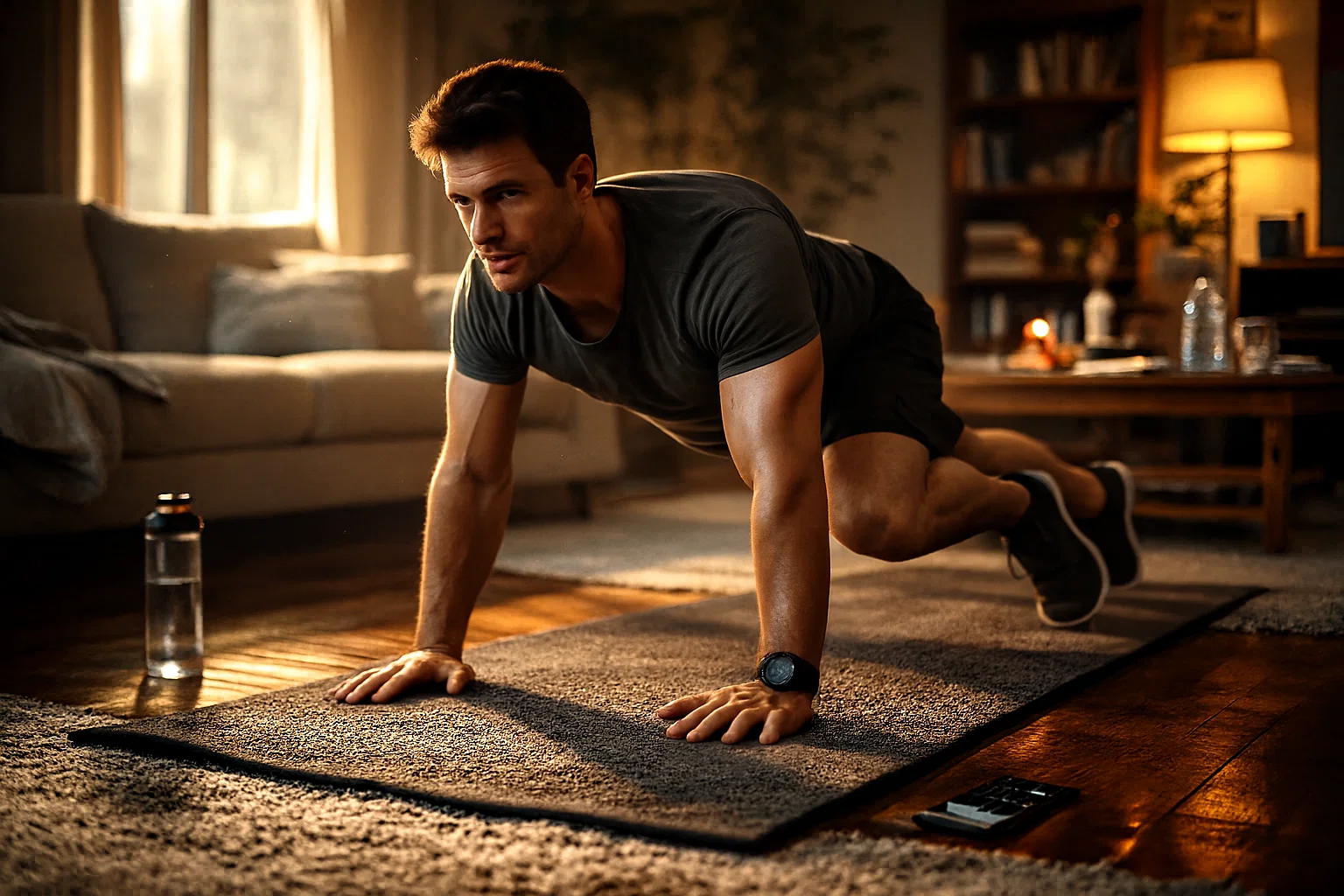
This ascending rep scheme lets you accumulate massive training volume while keeping your mind engaged through constantly changing set structures. You start with a low rep count and increase by one or two reps each round until you hit your target number then work your way back down. Ladder workouts prevent the mental fatigue that comes from grinding through identical sets while building muscle through progressive overload within a single session.
Why ladder sets boost volume without boredom
Your brain stays locked into each set when the rep count keeps changing instead of zoning out during repetitive training. You perform more total reps than traditional straight sets without feeling like you are suffering through endless identical rounds. Each ascending step feels achievable since you only add one or two reps at a time while the descending ladder gives you a psychological reward as sets get easier toward the end.
Example ladder using classic bodyweight moves
Start with one push up one squat and one inverted row then rest thirty seconds. Next round perform two of each movement and rest again. Continue adding one rep per exercise each round until you reach ten reps then reverse the ladder back down to one. This creates a 100 rep total per exercise in a single session that takes about 25 minutes to complete.
Home workouts to build muscle through ladders teach your nervous system to handle increasing demands while maintaining perfect movement quality under accumulating fatigue.
Grease the groove and keep your form clean
Your technique must stay crisp and controlled on every single rep regardless of how high the numbers climb. Stop the ladder early if your form starts breaking down instead of grinding through ugly reps that pattern poor movement habits. Rest as needed between rounds to maintain quality since this workout rewards consistency over speed.
Turn this ladder into a monthly challenge
Track your highest successful ladder each week and try to add one extra rep to your peak before descending. Progress to harder exercise variations once you complete a full one to ten to one ladder with perfect form maintaining the same rep scheme but increasing difficulty through movement selection.
11. Slow tempo muscle builder
This routine extends your time under tension by slowing down every rep until your muscles burn from sustained contraction. You’ll take four to five seconds to lower and two to three seconds to push back up which forces your muscles to work harder and longer than normal speed reps. Slow tempo training builds muscle by maximizing the mechanical tension your fibers experience without requiring external weight.
Use time under tension to grow with no weights
Your muscles grow when they experience enough tension for sufficient duration to trigger adaptation. Slowing your reps increases total contraction time from 20 seconds per set to 40 or 50 seconds which creates deeper fatigue and metabolic stress. This method makes bodyweight exercises brutally hard since you cannot rely on momentum or bounce to help you through difficult portions.
Slow motion full body workout template
Perform push ups for three sets of six to eight reps using a five second descent and three second ascent. Add squats for three sets of eight to ten reps with the same tempo. Include inverted rows for two sets of six to eight reps and finish with lunges for two sets of eight to ten reps per leg.
Home workouts to build muscle through slow tempo training teach you to control your body perfectly while building serious strength without weights.
Counting tempo and avoiding momentum
Count out loud or in your head during every rep to maintain consistent speed instead of rushing through easy portions. Your muscles should stay under continuous tension from the first rep to the last without any pause at the top or bottom. Eliminate all jerking bouncing or explosive phases that let momentum assist you.
Combine this with faster sessions for balance
Use slow tempo workouts once per week alongside your regular speed training to add variety without overtaxing recovery. Your nervous system needs different speeds to develop complete strength so mixing tempos prevents adaptation plateaus. Place this session at least two days away from your heaviest training.
12. Isometric hold strength routine
This static workout builds raw strength through sustained muscle contractions that require zero movement and minimal space. You’ll hold challenging positions for extended periods which forces your muscles to produce maximum tension without the dynamic component of regular exercises. Isometric training strengthens your muscles at specific joint angles while teaching your nervous system to recruit more motor units simultaneously making this an efficient method for building strength when you cannot perform traditional reps.
How holds build strength in small spaces
Isometric exercises require nothing more than your body and a wall or floor making them perfect for tiny apartments hotel rooms or anywhere you lack equipment. You produce force by pushing or pulling against an immovable object which creates the same muscle activation as lifting heavy weights without needing actual resistance. This training method develops incredible strength at the specific angles you hold while improving your ability to generate and maintain tension which carries over directly to making your dynamic exercises stronger.
Full body wall and floor based isometric plan
Perform wall sits for three sets of thirty to sixty seconds with your back against a wall and thighs parallel to the floor. Add plank holds for three sets of thirty to sixty seconds maintaining a rigid body position. Include wall pushes for two sets of twenty to thirty seconds per angle pressing your hands into a wall as hard as possible. Finish with glute bridge holds for two sets of forty to sixty seconds squeezing your glutes at the top position throughout each set.
Home workouts to build muscle through isometric holds teach your body to produce maximum force without movement which builds strength that translates to every other exercise you perform.
Breathing and tension tips during long holds
Take a deep breath before starting each hold then breathe slowly through your nose while maintaining about eighty percent of your maximum tension. Never hold your breath completely during long isometric contractions since this spikes blood pressure dangerously and cuts oxygen to working muscles. Focus on creating steady sustained force rather than explosive bursts.
Progress by changing angles and time
Lower your position during wall sits by dropping your hips closer to the floor to increase difficulty. Extend hold durations by five to ten seconds every two weeks once current times feel manageable. Progress to single leg variations or less stable positions like elevated planks to challenge your muscles through different ranges.
13. Fast 10 minute full body blast
This compact routine proves you can build muscle in minimal time when you strip away unnecessary fluff and focus on movement quality over duration. You’ll hit every major muscle group through strategically paired exercises that maximize your training effect while fitting into the tightest schedules. Ten minute sessions work when you cannot manage longer workouts and they keep your momentum alive on days when motivation runs low or your schedule explodes.
Why micro workouts still move the needle
Short intense sessions create real muscle building stimulus when you push hard enough during the available time window. Your muscles respond to tension and effort not just duration so a focused ten minute blast delivers better results than a distracted thirty minute session where you scroll your phone between sets. These quick workouts also boost your weekly training frequency since you can slot them into lunch breaks early mornings or late evenings without disrupting your entire day.
Ten minute high intensity circuit outline
Perform five exercises back to back with no rest between movements. Complete push ups for fifteen reps followed immediately by squats for twenty reps then move to inverted rows for twelve reps. Continue with lunges for ten reps per leg and finish with a thirty second plank. Rest one minute after completing the full circuit then repeat for a second round to fill your ten minute block.
Home workouts to build muscle in short time blocks demand maximum intensity and zero wasted movement so every second counts toward your progress.
Ways to warm up quickly but safely
Spend two minutes performing jumping jacks arm circles and bodyweight squats to elevate your heart rate and prepare your joints. Skip extended mobility work and static stretching since brief dynamic movement provides enough preparation for short high intensity sessions where you never use extreme ranges of motion.
How to use this on busy days without overdoing it
Deploy this workout when your schedule permits nothing longer but avoid using it as your only training method since ten minutes cannot replace dedicated strength sessions. Limit these quick blasts to two or three times weekly as supplements to your main workouts rather than complete replacements to prevent undertraining your muscles.
Keep building from here

You now have 13 complete routines for home workouts to build muscle without buying equipment or joining a gym. Each workout targets specific goals from building raw strength to developing explosive power while the variety prevents boredom and keeps your muscles adapting. Pick two or three workouts that match your current fitness level and run them for four weeks before switching to different combinations or harder variations.
Your results depend on consistency not perfection so commit to training at least three days per week even when motivation drops. Track your reps hold times and exercise variations in a simple notebook to measure progress over months instead of days. When you need more guidance on nutrition recovery strategies or advanced training methods visit Body Muscle Matters for expert advice that helps you break through plateaus and keep growing stronger.