How Much Protein Per Day? Calculate Your Exact Need
Home ›Supplements and Nutrition
The number most people use for their daily protein target — 0.8 grams per kilogram of body weight — was originally set as a survival minimum, not a health goal. Research from the National Academies and the International Society of Sports Nutrition (ISSN) now shows that active adults may need nearly double, or even more than double, that amount to actually build muscle, lose weight effectively, or slow age-related decline.
Without knowing your real number, you could be under-eating protein and losing muscle while dieting, wasting money on supplements you don’t actually need, or simply bouncing between articles that all give different answers. That confusion is understandable — because most articles tell you one number and call it done.
This guide is different. You’ll learn exactly how much protein per day your body needs based on your specific goal — and walk away with a 7-step method to calculate and hit that number using real food.
How much protein per day you need ranges from 0.8g to 2.2g per kilogram of body weight — the right amount depends entirely on your activity level, age, and goal.
- Sedentary adults: The RDA minimum is 0.8g/kg — about 56g/day for a 154-lb (70kg) person (National Academies Press, 2005)
- Active adults building muscle: Aim for 1.6–2.2g/kg daily (ISSN, 2017)
- Weight loss: Aim for 1.2–1.6g/kg to preserve lean muscle mass during a calorie deficit
- Adults over 60: Need 1.0–1.2g/kg daily to prevent sarcopenia (age-related muscle loss) (NCOA, 2024)
- The Dynamic Protein Framework: There is no single correct number — your optimal target shifts based on your body, your goal, and your life stage
What Protein Does and Why Your Daily Target Is Personal
Protein — the macronutrient (a nutrient your body needs in large amounts, alongside carbohydrates and fat) responsible for building and repairing muscle tissue — is also essential for producing enzymes, hormones, and the antibodies that run your immune system. The Recommended Dietary Allowance, or RDA, sets 0.8g per kilogram of body weight as the daily minimum. That’s where most articles stop. This guide starts there.
Protein repairs the tiny tears in your muscle fibers caused by exercise, produces the hormones that regulate your metabolism, and supports your immune system’s ability to fight infection. Without enough of it, your body begins breaking down existing muscle tissue for fuel — a process that accelerates during dieting or illness.
“The Recommended Dietary Allowance (RDA) for protein is a modest 0.8 grams of protein per kilogram of body weight, or 0.36 grams per pound.”
That number is where most articles stop. This guide starts there — and builds toward something more useful.
The Dynamic Protein Framework — our term for calculating a personalized protein target based on your activity level, age, and goal, rather than relying on the survival-level RDA — is the lens this entire guide uses. Instead of one static number, you’ll learn a range calibrated to you.
The step-by-step targets in this guide are based on guidelines from the National Academies, the International Society of Sports Nutrition (ISSN), the National Institutes of Health (NIH), and the USDA FoodData Central database, reviewed for accuracy against current dietary reference intakes. For more on understanding the role of macronutrients in your overall diet, that foundation helps contextualize everything in the steps ahead.
⚠️ Medical Disclaimer: This guide is for educational purposes only. It is not a substitute for advice from a registered dietitian, doctor, or other qualified healthcare provider. Recommendations in this article are general guidelines — your individual needs may vary based on medical conditions, medications, and health history. If you have kidney disease or any chronic condition, consult your doctor before changing your protein intake.
Now that you know why the standard number isn’t the whole story, Step 1 gives you that baseline — and shows you exactly what it means for your body weight.
Step 1: Learn How Much Protein You Need Each Day
The official daily protein recommendation for a sedentary adult is 0.8 grams per kilogram (g/kg) of body weight — this is the Recommended Dietary Allowance, or RDA. For a 154-pound (70kg) person, that works out to about 56 grams of protein per day (National Academies Press, 2005) — roughly the amount found in two medium chicken breasts. This is your minimum floor, not your target.
What the RDA Actually Means (and Why It’s Not Enough)
The RDA of 0.8g/kg was established to cover the minimum protein needs of 97.5% of healthy, sedentary adults — specifically those with a desk job who exercise fewer than three times per week. It was never designed to support athletic performance, weight loss, or healthy aging. You can verify this directly in the official Dietary Reference Intakes (DRI) report, which established these reference values based on nitrogen balance studies in sedentary populations (National Academies Press, 2005).
Here’s a distinction worth holding onto: the RDA prevents deficiency — it keeps you from losing muscle dangerously fast and maintains basic body functions. It does not prevent muscle loss during a calorie deficit, support recovery from resistance training, or slow the age-related muscle decline that starts in your 30s.
For comparison, a 154-pound person eating at the RDA consumes about 56g of protein daily — the equivalent of two medium chicken breasts. Most active adults, by contrast, need 80–160g per day. The RDA for protein — 0.8g per kilogram of body weight — is a minimum to prevent deficiency, not a target for health, muscle, or performance (National Academies Press, 2005). If you exercise even two or three times per week, you almost certainly need more. Steps 2 through 5 show you by how much.
Your Quick RDA Calculation
You only need one of two formulas, depending on whether you know your weight in kilograms or pounds:
- If you know your weight in kilograms: Weight in kg × 0.8 = daily protein grams
- If you know your weight in pounds: Weight in lbs × 0.36 = daily protein grams
Use this reference table to find your minimum daily protein in grams based on body weight. “Grams per kilogram” is the standard measurement used in nutrition research — that formula is the more precise of the two.
| Body Weight | In kg | Minimum Protein (RDA) |
|---|---|---|
| 110 lbs | 50 kg | 40g |
| 132 lbs | 60 kg | 48g |
| 154 lbs | 70 kg | 56g |
| 176 lbs | 80 kg | 64g |
| 198 lbs | 90 kg | 72g |
This is your floor. Steps 2–5 show you how to move above it based on your goals.
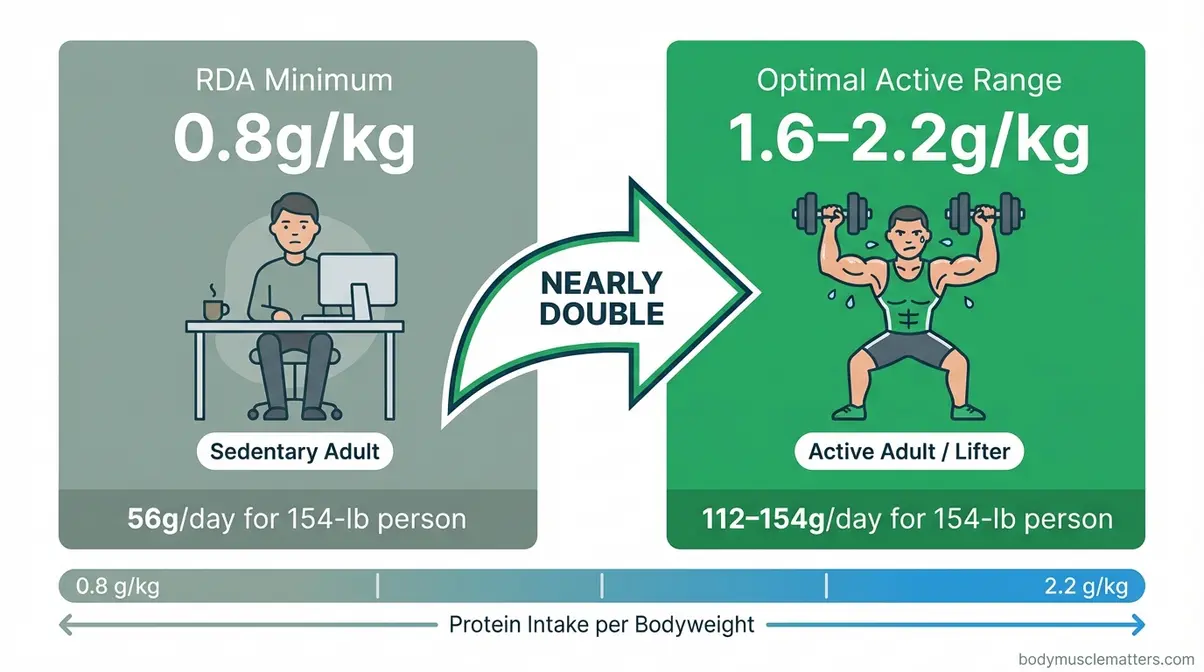
Caption: The gap between the RDA survival minimum and the optimal active-adult range is significant — this infographic shows where you likely fall.
Now that you have your baseline minimum, Step 2 shows you how to build your personalized protein target — the number specific to your lifestyle and goals.
Step 2: Calculate Your Daily Protein Target
Calculating how much protein per day you need takes four pieces of information: your body weight, your activity level, your goal, and a simple multiplier. The Dynamic Protein Framework uses these four variables to move you from the survival-level RDA to your personal optimal target — this is where that framework gets applied in practice.
Estimated Time: 2 minutes Tools: Calculator, Body Weight
The 5-Step Protein Calculation Method
Work through these steps in order. A worked example using a 165-lb moderately active woman runs throughout so you can follow along.
- Convert your weight to kilograms. Divide your weight in pounds by 2.2. (Example: 165 lbs ÷ 2.2 = 75 kg)
- Identify your activity level using the table below, then note your protein multiplier.
| Activity Level | Description | Protein Multiplier |
|---|---|---|
| Sedentary | Desk job, little or no exercise | 0.8g/kg |
| Lightly Active | Light exercise 1–3 days/week | 1.0–1.2g/kg |
| Moderately Active | Moderate exercise 3–5 days/week | 1.2–1.6g/kg |
| Very Active | Hard exercise 6–7 days/week | 1.6–2.0g/kg |
| Athlete/Bodybuilder | Twice-daily training | 2.0–2.2g/kg |
(Example: Moderately active → multiplier of 1.4g/kg)
- Multiply your weight in kg by your chosen multiplier. (Example: 75 kg × 1.4 = 105g of protein per day)
- Round to the nearest 5g. This is your daily protein target. (Example: 105g)
- Divide your daily target across 3–4 meals. Aim for 25–30g per meal for best absorption. (Example: 105g ÷ 4 meals = ~26g per meal)
These multipliers are derived from guidelines by the National Academies and the International Society of Sports Nutrition. Your personal daily protein target is your body weight in kg multiplied by a factor of 0.8 (sedentary) to 2.0 (elite athlete) — making it highly individual (based on National Academies and ISSN guidelines).
Want to skip the math? Use our Dynamic Protein Calculator above to get your number in 60 seconds.
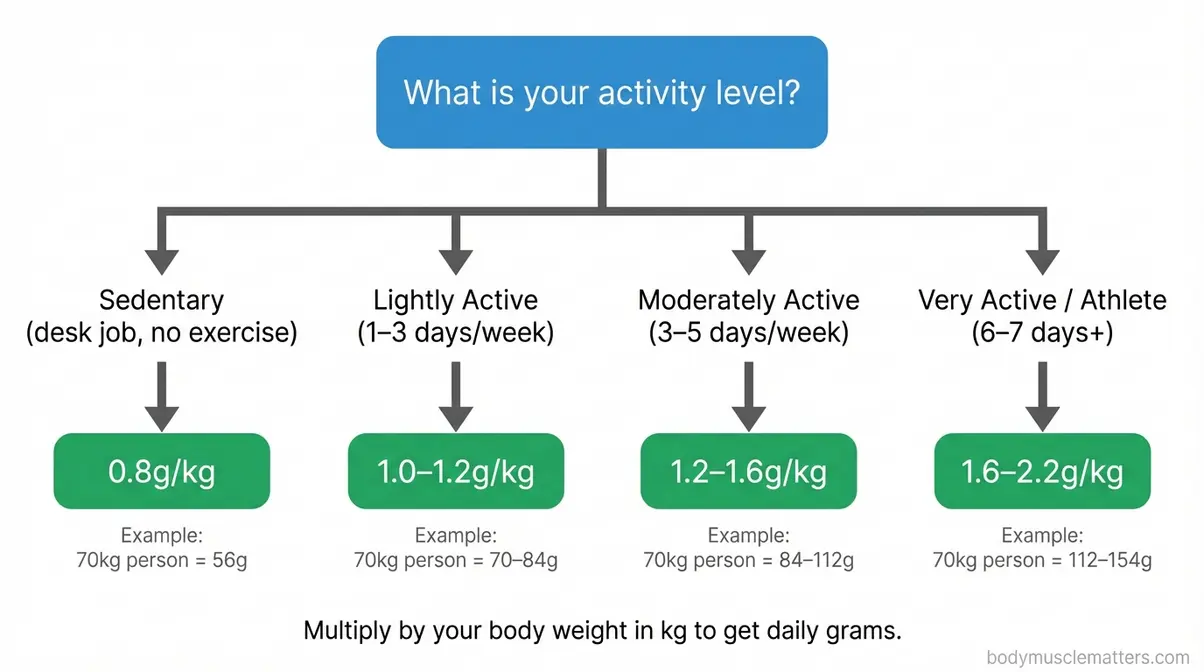
Caption: Follow this decision tree from left to right — your activity level and goal determine which multiplier to apply.
The activity table above covers general fitness goals. If your goal is specifically muscle building or weight loss, the next two steps fine-tune your multiplier further.
Understanding Your Macronutrient Context
Protein doesn’t exist in isolation from your other macronutrients — carbohydrates and fat also contribute to your daily calorie total. Protein provides 4 calories per gram, so 100g of protein equals 400 calories from protein alone.
A useful rule of thumb: protein should make up roughly 25–35% of your total daily calories if you are an active adult. If you eat 2,000 calories per day and target 30% from protein, that means 150g. If your Dynamic Protein Framework target is 120g, protein represents about 24% of 2,000 calories — both are reasonable approaches, and the difference rarely matters in practice.
To set the right total calorie target as your denominator, you’ll want to calculate your basal metabolic rate — that’s how many calories your body burns at rest, before accounting for activity.
Now that you have your calculation formula, Step 3 shows you how to increase your target specifically for muscle building — including the protein pacing strategy most guides completely miss.
Step 3: Adjust Protein to Build Muscle
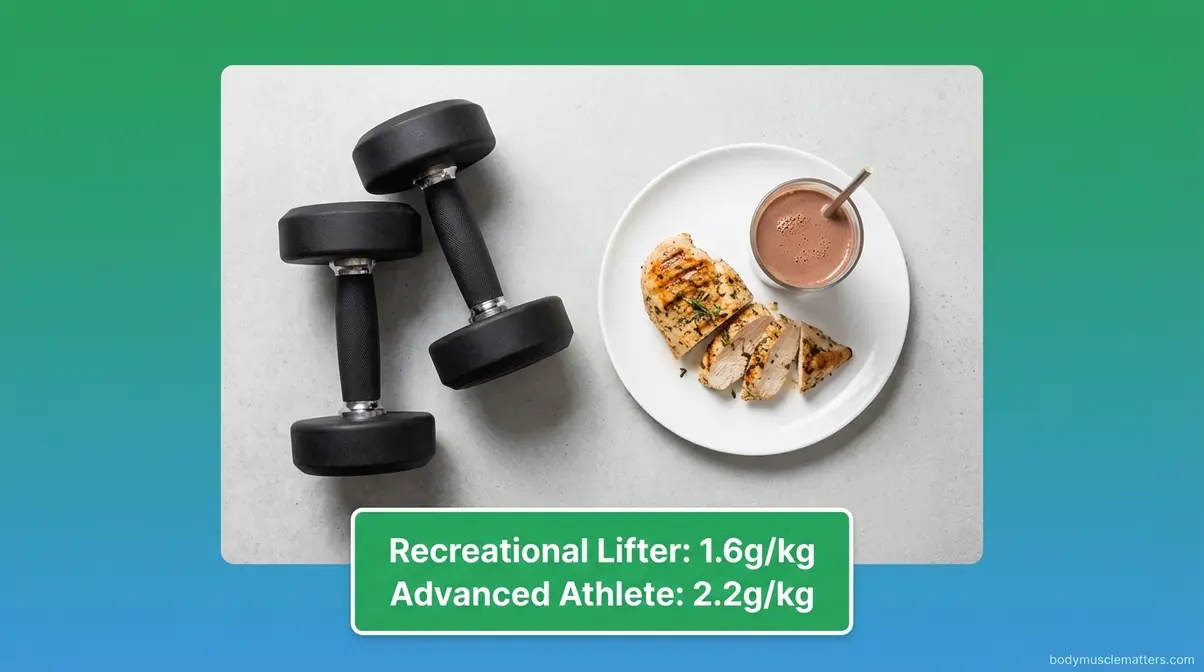
To support muscle growth — hypertrophy, meaning the process of muscle fibers growing larger and stronger — most people need significantly more protein than the RDA. The International Society of Sports Nutrition (ISSN) recommends 1.6 to 2.2 grams of protein per kilogram of body weight per day for muscle building (ISSN, 2017) — nearly double the survival minimum. For a 75kg person, that translates to 120–165g of protein daily.
Evidence-Based Ranges for Muscle Growth (Hypertrophy)
Building muscle requires 1.6–2.2 grams of protein per kilogram of body weight daily — nearly double the survival-minimum RDA (ISSN, 2017). That wide range exists for a reason: the lower end (1.6g/kg) applies to recreational lifters training three to five days per week; the upper end (2.0–2.2g/kg) is reserved for advanced athletes in a calorie deficit who are actively trying to lose fat while preserving or building muscle simultaneously.
Beyond 2.2g/kg, current evidence suggests diminishing returns. Additional protein is simply metabolized for energy — it adds calories without adding meaningfully to muscle protein synthesis (MPS — the biological process of assembling new muscle tissue from amino acids). For the ISSN position stand on protein, the research supporting 1.4–2.0g/kg is robust, with current evidence extending the upper range to 2.2g/kg for advanced athletes (ISSN, 2017).
Here’s what those numbers mean in practice:
| Body Weight | Recreational Lifter (1.6g/kg) | Advanced/Cutting Phase (2.2g/kg) |
|---|---|---|
| 55 kg (121 lbs) | 88g/day | 121g/day |
| 70 kg (154 lbs) | 112g/day | 154g/day |
| 85 kg (187 lbs) | 136g/day | 187g/day |
A 165-lb (75kg) moderately active man lifting weights four days per week should target approximately 120–150g of protein daily for muscle growth — achievable through a combination of whole foods and, if needed, one protein shake per day.
Protein Pacing — Why 25–30g Per Meal Is the Target
Hitting your daily gram target is necessary — but when and how you distribute that protein matters too. Research suggests that each meal should contain 25–30g of protein to fully stimulate muscle protein synthesis (Stokes et al., Journal of the International Society of Sports Nutrition, 2018). This threshold exists because MPS is triggered largely by leucine — an essential amino acid that acts like a switch for muscle-building — and most meals need roughly 2–3g of leucine to flip that switch fully.
Eating 80% of your daily protein in one or two meals is far less effective than spreading it evenly across three to four meals. Studies consistently show that four evenly distributed protein feedings produce greater muscle protein synthesis over 24 hours than the same total protein consumed in fewer, larger doses (Areta et al., Journal of Physiology, 2013).
Anabolic resistance — the reduced muscle-building response to protein that develops with age — changes this calculation for adults over 40. As muscle tissue becomes less sensitive to the leucine signal with age, older adults typically need 30–40g of protein per meal to achieve the same MPS response that 25g provides in a 25-year-old (Churchward-Venne et al., Journal of Nutrition, 2016). This is one reason Step 5 assigns a higher per-meal target for adults over 60.
- A practical example for a 120g daily target:
- Breakfast: 30g
- Lunch: 30g
- Afternoon snack: 30g
- Dinner: 30g
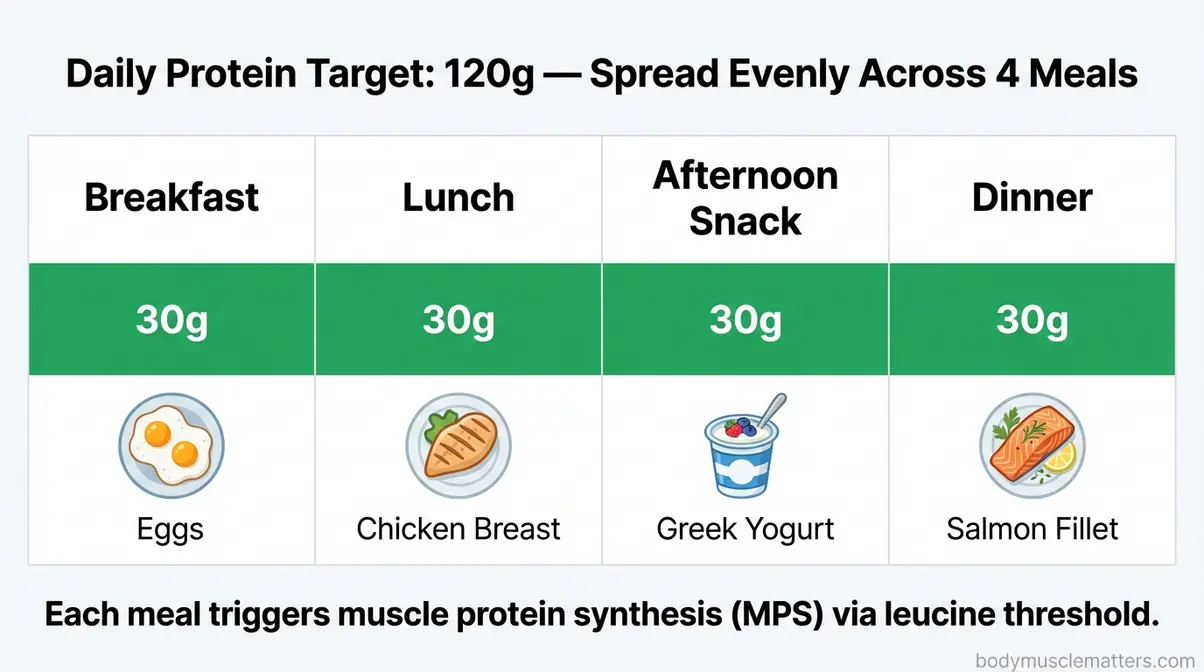
Caption: Spreading protein across four equal meals — rather than front- or back-loading — maximizes muscle protein synthesis across the full day.
One more adjustment for muscle builders: if your protein comes primarily from plants, you’ll want to apply a simple correction factor.
The Plant-Based Protein Adjustment
Plant proteins — found in beans, lentils, tofu, rice, and nuts — are generally less bioavailable (meaning your body absorbs and uses a smaller percentage of what you eat) than animal proteins like eggs, chicken, or dairy. Research estimates that plant proteins are approximately 10–15% less digestible than animal proteins, largely because plant cell walls and compounds called antinutrients reduce absorption efficiency (Gorissen & Witard, Proceedings of the Nutrition Society, 2018).
The practical fix is simple:
Vegan/Vegetarian Tip: Multiply your protein target by 1.1 to account for plant-protein bioavailability. If your target is 120g/day with animal protein, your plant-based target becomes approximately 132g/day.
Combining complementary plant proteins — rice and beans, hummus and whole-grain bread, tofu and edamame — also improves your amino acid profile, ensuring you get all nine essential amino acids your body cannot produce on its own. Step 6 includes specific food sources and gram counts.
For a complete breakdown of per-meal timing strategies and advanced muscle-building targets, see our full guide on optimal protein targets for hypertrophy.
Step 4: Optimize Protein to Lose Weight
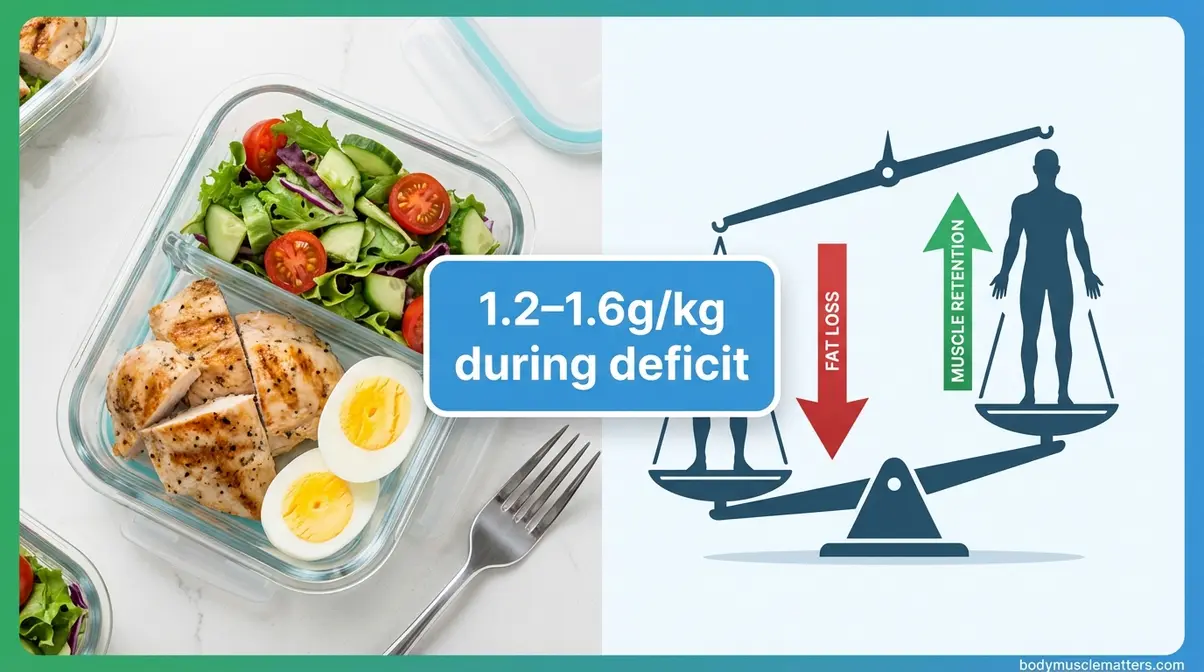
During a calorie deficit (eating fewer calories than your body burns), higher protein intake is one of the most evidence-backed strategies for preserving the lean muscle mass (the metabolically active tissue you want to keep) you’ve built. Research recommends 1.2–1.6g/kg of body weight per day for active adults trying to lose fat (Helms et al., British Journal of Sports Medicine, 2014). That’s meaningfully higher than the RDA — and for good reason.
Why a Higher Protein Intake Protects Muscle During a Calorie Deficit
When you eat in a calorie deficit, your body turns to stored energy for fuel — ideally fat. But without sufficient protein, it also breaks down muscle tissue. A higher protein intake during a calorie deficit signals your body to preserve lean muscle mass while prioritizing fat as the fuel source — a distinction that makes a significant difference in body composition over time.
A 154-lb (70kg) person in a moderate deficit should aim for roughly 84–112g of protein per day (1.2–1.6 × 70). At the lower end, they preserve most of their muscle; at the higher end, they may even build a small amount while losing fat — a process called body recomposition. For more on food choices, see our guide on leveraging protein for weight management.
Evidence from a 2018 meta-analysis in the British Journal of Sports Medicine supports protein intakes of 1.2–1.6g/kg during calorie restriction to minimize muscle loss – with higher intakes showing additional benefit for athletes and those engaged in resistance training (Morton et al., 2018). Citing sources from authoritative organizations reinforces this: guidelines from Harvard Medical School, UCLA Health, and MD Anderson all support higher protein during dieting phases for muscle preservation.
Satiety and the Thermic Effect of Protein Explained
Beyond muscle preservation, protein helps you stick to a calorie deficit through two distinct mechanisms that most guides mention separately but rarely explain together.
Satiety: Protein reduces levels of ghrelin — the hunger hormone that triggers appetite — and raises levels of peptide YY, a hormone that signals fullness. Practically, this means a high-protein breakfast keeps you fuller longer than a carbohydrate-heavy one of the same calorie count.
Thermic effect refers to the calories your body burns simply digesting and processing food. Protein has a thermic effect of food (TEF) of 20–30%, meaning your body burns 20–30 calories digesting every 100 calories of protein you eat. By comparison, carbohydrates burn roughly 5–10% and fats burn just 0–3% during digestion (Westerterp, Nutrition & Metabolism, 2004). This built-in calorie burn from a high-protein diet approach adds up meaningfully over weeks and months.
Together, satiety and the thermic effect make protein the most “diet-friendly” macronutrient — not a marketing claim, but a measurable physiological advantage during weight loss.
Step 5: Fine-Tune Protein by Age and Gender
Daily protein needs are not one-size-fits-all. Biological sex, hormonal cycles, and the natural changes that come with aging all influence how much protein your body requires — and what it does with the protein you eat. Step 5 gives you the adjustments specific to your demographic.
Protein Needs for Women
Most women can use the same multipliers from Step 2’s activity table, adjusted for body weight. A common misconception is that women need less protein than men because they have lower muscle mass — but per kilogram of body weight, the recommended ranges are comparable. A moderately active 130-lb (59kg) woman lifting weights three days per week needs approximately 71–94g of protein per day (1.2–1.6g/kg).
During pregnancy, requirements increase to approximately 1.1g/kg above pre-pregnancy body weight, per guidelines from the American College of Obstetricians and Gynecologists. During breastfeeding, an additional 25g per day above baseline is generally recommended. Women over 50 should read the section below — the hormonal changes of menopause accelerate the muscle loss that makes higher protein particularly valuable.
Protein Needs for Men
Men typically have a higher absolute protein requirement than women — not because the per-kg multiplier differs, but because men generally have greater lean muscle mass and higher body weight. A 190-lb (86kg) moderately active man needs approximately 103–138g per day (1.2–1.6g/kg), compared to roughly 71–94g for a 130-lb woman at the same activity level. Note: Parents looking for protein guidelines for teenagers should consult our dedicated resource, as adolescent needs differ significantly during growth spurts.
Men over 40 should begin applying the protein pacing principles from Step 3 — 30g per meal rather than 25g — as anabolic resistance begins reducing the muscle-building efficiency of protein with age. According to UCLA Health’s nutrition team, increasing daily protein is one of the most evidence-supported strategies men can use to maintain physical function and body composition through their 40s and 50s.
Why Adults Over 60 Need More Protein
Sarcopenia — the gradual, age-related loss of muscle mass and strength — begins in your 30s and accelerates sharply after 60. Research estimates that adults lose 3–8% of their muscle mass per decade after age 30, with the rate doubling after 60 (Baumgartner et al., American Journal of Epidemiology, 1998). The result is reduced strength, slower metabolism, greater fall risk, and longer recovery from illness.
Older adults over 60 need 1.0–1.2g/kg of protein daily — 25–50% more than the standard RDA — to counteract sarcopenia, according to recommendations from the National Council on Aging (NCOA, 2024). Beyond muscle preservation, adequate protein intake in older adults is also associated with better bone mineral density — protein provides the structural matrix that calcium reinforces, making the two nutrients codependent for skeletal health.
For a 154-lb (70kg) adult over 60, that means 70–84g of protein daily — achievable with three balanced meals each containing 25–30g of protein from whole food sources.
Step 6: Hit Your Goal With Real Foods
Knowing your target number is step one. Actually hitting it — consistently, with foods you enjoy — is where most people get stuck. This step gives you the specific gram counts, a visual portion guide, and clear guidance on where supplements genuinely help and where they don’t.
Top High-Protein Foods at a Glance
The following protein counts are sourced from the USDA FoodData Central database. All values are for cooked or standard serving sizes.
| Food | Serving Size | Protein | Notes |
|---|---|---|---|
| Chicken breast | 3.5 oz (100g) cooked | 31g | Lean, versatile, affordable |
| Canned tuna (in water) | 3 oz (85g) | 22g | Convenient, no cooking needed |
| Greek yogurt (plain, 0%) | 7 oz (200g) | 20g | Also provides calcium |
| Eggs (whole) | 2 large eggs | 13g | Highly bioavailable |
| Cottage cheese (low-fat) | ½ cup (113g) | 14g | Slow-digesting casein protein |
| Salmon (Atlantic) | 3.5 oz (100g) cooked | 25g | Rich in omega-3s |
| Lentils (cooked) | ½ cup (100g) | 9g | Plant-based, high fiber |
| Edamame (shelled) | ½ cup (85g) | 9g | Complete plant protein |
| Tofu (firm) | 3.5 oz (100g) | 9g | Absorbs flavors well |
| Whey protein powder | 1 scoop (~30g) | 20–25g | Convenient supplement |
(Source: USDA FoodData Central, 2024)
“
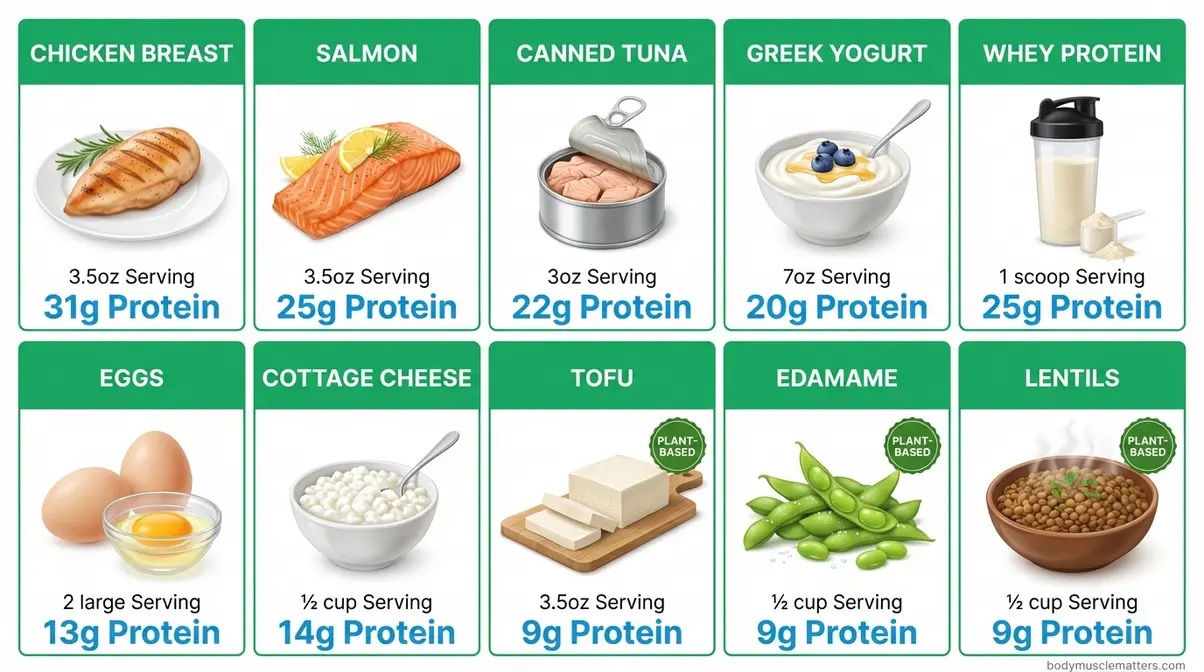
Caption: Visual portion guide: each item shown equals approximately 30 grams of protein — useful for building meals toward your daily target.
When (and How Much) to Use Protein Powder
Protein powder is a supplement — meaning it supplements a diet that’s already close to your target, not a replacement for whole foods. Whole foods contain micronutrients, fiber, and compounds that powders lack. That said, there are specific situations where a scoop of whey or plant-based protein powder genuinely helps.
- Use protein powder when:
- You’re consistently 20–30g short of your daily target despite eating well
- You need a fast, portable post-workout protein source within 30–60 minutes of training
- You’re traveling or meal prepping is impractical on certain days
How much is appropriate: One to two scoops (20–50g) per day is sufficient for most people. Mayo Clinic Health System notes that most healthy adults don’t need more than 1–2 servings of protein supplement daily if their whole food intake is reasonable (Mayo Clinic Health System, 2022). Exceeding this adds cost and calories without additional muscle benefit.
Whey protein (derived from milk) is the most studied and fastest-absorbing option, making it effective post-workout. For vegans or those with lactose intolerance, pea protein isolate or a rice-and-pea blend provides a comparable amino acid profile with good bioavailability.
Maximizing Plant-Based Protein Sources
Plant-based eaters face two challenges: lower protein density per serving and incomplete amino acid profiles in individual foods. Both are solvable with smart food pairing.
Recall the 1.1× correction factor from Step 3. If your target is 110g daily on an animal-protein diet, your plant-based equivalent is approximately 121g. The best way to reach it:
- Legumes (lentils, black beans, chickpeas): 8–10g per half-cup cooked
- Soy products (edamame, tofu, tempeh): 9–20g per serving — notably, soy is one of the few complete plant proteins
- Seitan (wheat gluten): 25g per 3.5oz — the highest-protein plant food by weight
- Hemp seeds: 10g per 3 tablespoons, plus omega-3 fatty acids
- Combination pairs: Rice + lentils, whole-grain bread + peanut butter, corn + beans — these pairings complete the essential amino acid profile that individual plant foods lack
According to guidelines from MD Anderson’s registered dietitians, a well-planned plant-based diet can fully meet protein needs at any activity level — it simply requires more intentional food selection than an omnivorous approach (MD Anderson Cancer Center, 2023).
Step 7: Know Your Safe Daily Protein Limit
Once you’ve set your target and started hitting it, a reasonable question arises: can you have too much? The short answer is yes — but the threshold is higher than most people think, and the commonly cited fear of kidney damage is largely a myth in healthy adults. For more detail on safe upper limits for protein intake, read our full analysis.
How Much Protein Is Too Much?
The upper safe limit for protein intake in healthy adults is not precisely defined, but current research suggests that intakes up to 2.2g/kg per day — and in some studies up to 3.5g/kg for short periods in resistance-trained athletes — do not cause measurable harm in people without pre-existing kidney conditions (Antonio et al., Journal of the International Society of Sports Nutrition, 2016).
The practical concern isn’t toxicity — it’s opportunity cost. Protein above your body’s capacity to use for muscle repair and enzyme production is simply broken down and used for energy or excreted. That adds calories (4 per gram) without adding proportional benefit. For most people, consistently exceeding 2.2g/kg provides no additional muscle-building advantage and represents wasted food spending.
- Signs you may be over-consuming protein relative to your needs:
- Digestive discomfort (bloating, irregular bowel habits from excess protein fermentation)
- Consistently high calorie intake that stalls weight loss
- Significant reliance on supplements rather than whole foods
The Kidney Health Myth — What Research Actually Says
One of the most persistent fears about high protein intake is kidney damage. This concern originated from research on people who already had chronic kidney disease — where the kidneys struggle to filter the nitrogen waste products of protein metabolism. For those individuals, protein restriction is genuinely warranted.
For healthy adults without kidney disease, the evidence tells a different story. A 2020 systematic review found no evidence that high protein intake causes kidney damage or accelerates kidney function decline in healthy individuals (Kalantar-Zadeh et al., Journal of the American Society of Nephrology, 2020). The National Institute of Diabetes and Digestive and Kidney Diseases (NIDDK) recommends protein restriction only for individuals with diagnosed chronic kidney disease — not as a preventive measure for healthy adults.
The important nuance: if you have a family history of kidney disease, or if you’re currently experiencing any symptoms of kidney dysfunction, consult your doctor before significantly increasing protein intake. That’s not fear-mongering — it’s the same qualified guidance that applies to any significant dietary change in YMYL health contexts.
Common Protein Mistakes and When to See a Dietitian
Understanding what not to do is as valuable as knowing your gram target. Based on the research reviewed in this guide, these are the most common errors — and the clearest signals that professional guidance is worth pursuing.
Common Protein Pitfalls to Avoid
Pitfall 1: Treating the RDA as your daily target. The 0.8g/kg minimum was designed for sedentary adults. If you exercise at all, relying on the RDA is the nutritional equivalent of filling a car’s gas tank to 30% capacity and calling it full. Most active adults leave meaningful performance and recovery gains on the table by under-eating protein.
Pitfall 2: Front-loading protein at dinner. Eating 15g at breakfast, 20g at lunch, and 80g at dinner is a common pattern — and a wasteful one. Muscle protein synthesis has a per-meal ceiling. Spreading your intake across three to four meals of 25–35g each maximizes the return on every gram you eat.
Pitfall 3: Counting supplement protein but not whole food protein. Many people track only their protein shake and forget the protein already in their yogurt, bread, or rice. Use a food tracking app (Cronometer or MyFitnessPal) for at least one to two weeks to get an accurate baseline of your actual intake before drawing conclusions.
Pitfall 4: Ignoring protein quality for plant-based diets. Not all protein sources are equal. If you primarily eat legumes, grains, and nuts, relying on a single source leaves amino acid gaps. Variety and intentional pairing — not just total grams — is what matters for plant-based eaters.
Pitfall 5: Assuming more is always better. Tripling your protein intake without adjusting total calories adds hundreds of extra calories per day. More protein does not linearly equal more muscle — the dose-response curve flattens significantly above 2.2g/kg.
When to Consult a Registered Dietitian
Self-calculation using this guide works well for generally healthy adults with standard goals. However, there are specific situations where personalized professional guidance from a registered dietitian (RD) is strongly recommended:
- You have a chronic condition (Type 2 diabetes, kidney disease, cardiovascular disease, inflammatory bowel disease) — protein needs and macronutrient ratios vary meaningfully across these conditions
- You’re pregnant or breastfeeding — requirements change trimester by trimester and are better monitored by a qualified professional
- You’ve tried increasing protein and feel consistently unwell — digestive issues, fatigue, or worsening athletic performance despite hitting your target may indicate an underlying issue
- Your goal involves significant body recomposition — simultaneously building muscle and losing fat (body recomposition) is one of the most nuanced nutrition tasks; individualized programming outperforms generic calculators
The registered dietitian team at Harvard Medical School notes that protein needs are genuinely individual — age, activity, metabolic health, and even gut microbiome composition all influence how efficiently you use dietary protein (Harvard Health Publishing, 2015, updated 2024).
Frequently Asked Questions
How much protein per day do I actually need as a beginner?
As a beginner, your daily protein needs depend on your weight and activity level — not a single universal number. The RDA minimum is 0.8g per kilogram of body weight, which equals about 56g/day for a 154-lb person. If you’ve started exercising even two to three times per week, most research supports moving toward 1.2–1.4g/kg daily. For a 154-lb beginner who exercises three days per week, that’s roughly 75–90g per day (National Academies Press, 2005). Start there and adjust upward if muscle building is your goal.
How much protein per day do I need to lose weight?
For weight loss, research supports 1.2–1.6 grams of protein per kilogram of body weight per day. Higher protein during a calorie deficit preserves lean muscle mass, reduces hunger by lowering ghrelin levels, and burns more calories through digestion — protein’s thermic effect reaches 20–30% versus 5–10% for carbohydrates (Westerterp, Nutrition & Metabolism, 2004). For a 154-lb (70kg) person, that means 84–112g daily. Prioritize high-satiety sources like chicken, eggs, Greek yogurt, and legumes to make the calorie deficit easier to sustain.
Can eating too much protein damage your kidneys?
For healthy adults without kidney disease, current evidence does not support a link between high protein intake and kidney damage. This concern originated from studies of people who already had chronic kidney disease — for whom protein restriction is medically appropriate. A 2020 systematic review found no evidence of kidney decline in healthy individuals consuming high-protein diets (Kalantar-Zadeh et al., Journal of the American Society of Nephrology, 2020). If you have a family history of kidney disease or any current kidney symptoms, consult your doctor before significantly increasing your intake.
How much protein per day do I need if I’m over 60?
Adults over 60 generally need 1.0–1.2 grams of protein per kilogram of body weight daily — 25–50% above the standard RDA. This higher target counteracts sarcopenia, the age-related muscle loss that accelerates after 60. For a 154-lb (70kg) older adult, that’s 70–84g per day (NCOA, 2024). Additionally, spreading intake across meals of 30–40g each — rather than 25g — helps overcome anabolic resistance, the age-related reduction in muscle’s responsiveness to protein. Dairy, eggs, and legumes are particularly useful sources for this age group.
How much protein powder should I use per day?
Most people need no more than one to two scoops (20–50g) of protein powder per day, and only when whole food intake consistently falls short of your daily target. Protein powder is most useful post-workout, when you need 25–30g of fast-absorbing protein quickly and don’t have a whole food meal ready. Exceeding two servings daily rarely provides additional muscle benefit — it adds calories and cost without proportional return. Whey is the most studied option for post-workout use; pea or rice-and-pea blends are effective alternatives for plant-based eaters (ISSN, 2017).
Your Daily Protein Target — Putting It All Together
For most adults, knowing how much protein per day to eat comes down to three variables: your body weight, your activity level, and your primary goal. The evidence is consistent across the National Academies, ISSN, NIH, and UCLA Health’s clinical guidance — the RDA of 0.8g/kg is a survival floor, not a performance ceiling. Active adults need 1.2–2.2g/kg depending on where they fall on the activity and goal spectrum (ISSN, 2017).
The Dynamic Protein Framework reframes this from a static rule into a living calculation. Your optimal number isn’t the same as your sedentary neighbor’s number, or your number from two years ago before you started training. It shifts with your life stage, your training intensity, and your current body composition goal — and now you have the seven-step method to recalculate it whenever those variables change.
Start with your body weight in kilograms, pick your multiplier from Step 2’s activity table, and set your first target. Give yourself two to four weeks of consistent eating at that number — tracking with a food app if it helps — before evaluating whether your energy, recovery, and body composition are moving in the right direction. If you have a chronic condition or specific medical history, take your new calculation to a registered dietitian for a personalized review before making dramatic changes.
Related posts:
Best Protein Powder for Muscle Growth: Tested (2026)
Best High Protein Meal Delivery Services 2026: Top 7
Protein Powder Without Artificial Sweeteners: 10 Best Picks
Can You Eat Too Much Protein? Symptoms & Safe Limits
Best Protein Powder for Weight Loss: 10 Expert Picks
What Are Macros? A Plain Guide to Protein, Carbs and Fat

Callum
Hi, I'm Callum, the founder of Body Muscle Matters. I'm not a certified trainer, I'm a self taught lifter who started this site to share what I've learned from my own training and a lot of trial and error. Everything here comes from real experience and honest research, written the way I'd explain it to a friend who is just getting started. My goal is simple: practical, no hype fitness advice you can actually use.