CrossFit Strength Training for Beginners: 2026 Guide
⚠️ Medical Disclaimer
CrossFit involves high-intensity exercise that carries inherent risk. Consult a qualified physician or certified CrossFit coach before beginning any new fitness program, especially if you have pre-existing medical conditions, injuries, or have been sedentary. The information in this guide is for educational purposes only and does not constitute medical advice. Always prioritize safety and proper form over speed or weight.
Most beginners who search “CrossFit workouts” land on pages packed with WODs (Workouts of the Day) they cannot safely attempt — exercises that assume you already know how to snatch, kip, or string together double-unders. That gap is dangerous. Starting CrossFit without a proper foundation puts you at risk of injury, burnout, or quitting before you ever see results.
“I’m looking for a clear roadmap or plug-and-play style program that will help me to gradually build up my skills and strength.”
That quote captures exactly what this guide delivers. Here, you’ll find a step-by-step introduction to crossfit strength training workouts for beginners — including 5 foundational movements, 5 starter WODs, a 12-point scaling system, and a safe 4-week training schedule built around The 3-Phase Foundation Method. The structure is simple: foundations first, movements second, workouts third, schedule fourth, safety throughout.
Effective crossfit strength training workouts for beginners work best when you build movement mechanics before intensity — beginners who follow a structured 3-phase approach reduce injury risk and build lasting strength.
- The 3-Phase Foundation Method sequences learning into Movement Mastery, WOD Introduction, and Progressive Overload for safe, consistent progress
- Start with 2–3 sessions per week with at least one rest day between sessions to allow muscle recovery
- Every movement scales: Ring rows replace pull-ups, knee push-ups replace full push-ups — no exercise is out of reach
- The CDC recommends muscle-strengthening activities on 2+ days per week for baseline health benefits — CrossFit meets and exceeds this threshold
- Form beats speed: Mastering air squat and push-up mechanics in weeks 1–2 prevents the most common beginner injuries
Why CrossFit Strength Training Works
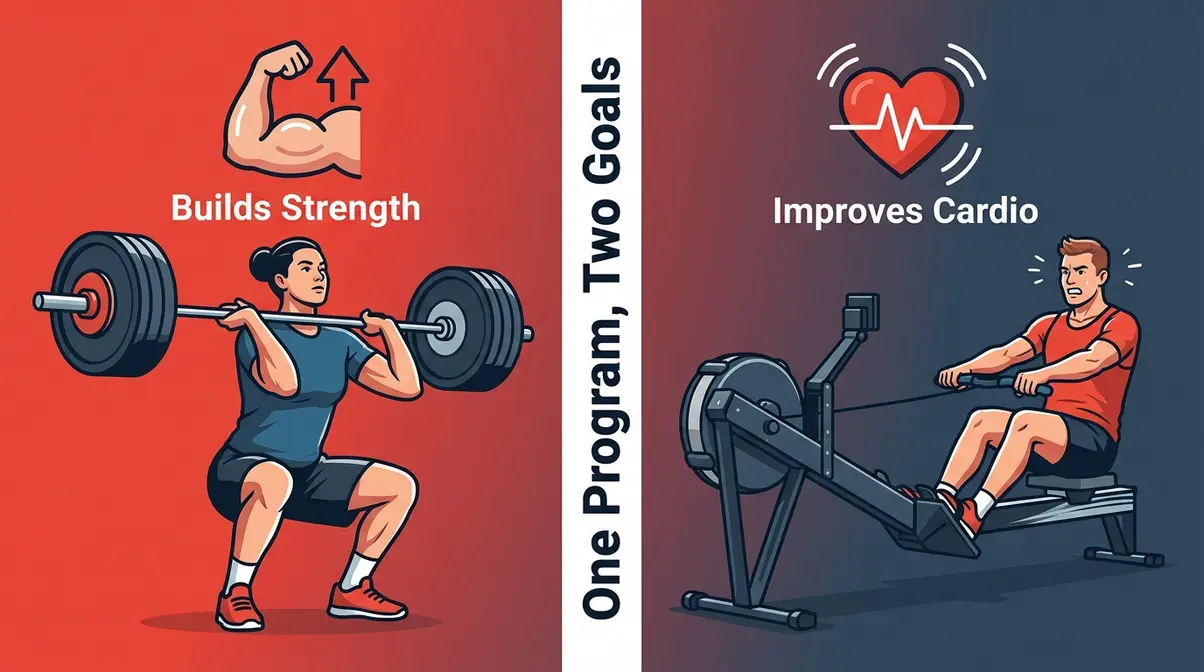
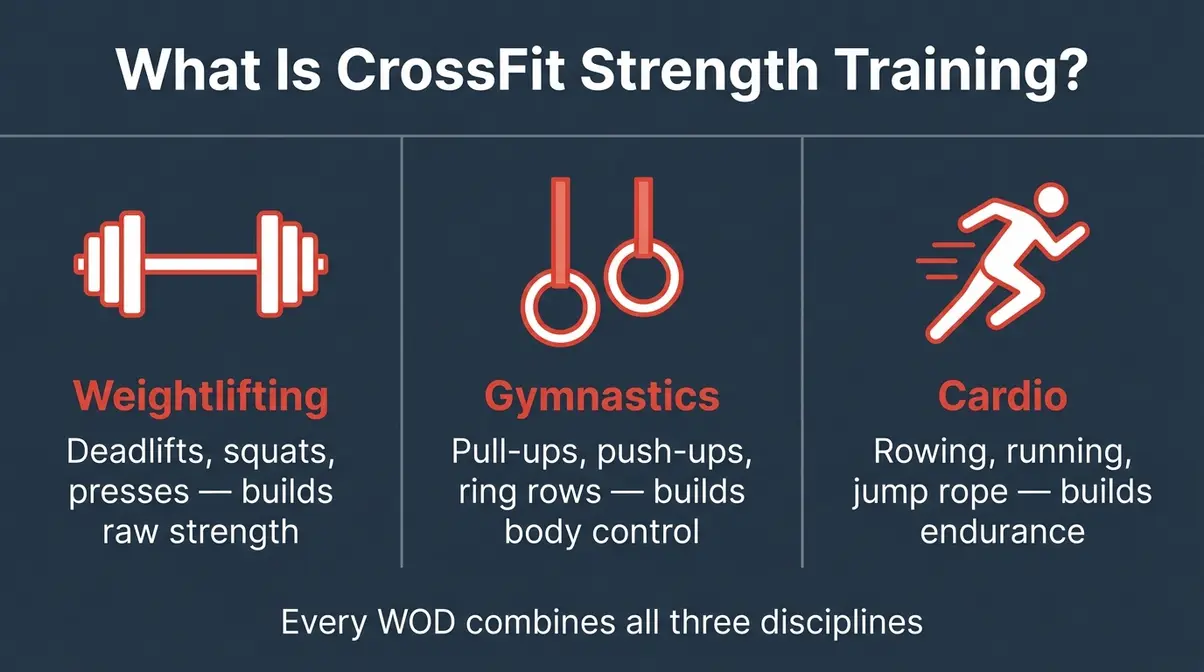
CrossFit strength training is a high-intensity functional fitness methodology that combines weightlifting, gymnastics, and cardiovascular conditioning into short, scalable workouts. The CDC’s Physical Activity Guidelines for Americans recommend muscle-strengthening activity on 2 or more days per week — CrossFit’s programming meets and exceeds that threshold in every weekly training cycle. For beginners, this matters because CrossFit delivers full-body strength gains, improved cardiovascular fitness, and community accountability in a single, structured program. If you are completely new to lifting, exploring a dedicated guide on strength training for beginners can provide a solid baseline before tackling high-intensity functional movements.
What Is CrossFit Strength Training?
CrossFit is a high-intensity functional fitness program developed in 2000 by Greg Glassman, now practiced in more than 13,000 affiliated gyms worldwide. Unlike traditional gym workouts built around isolated machines, CrossFit uses functional movements — exercises that mimic real-life actions like squatting, pushing, pulling, and lifting. Think of the difference this way: a leg press machine trains your quads in isolation, while an air squat trains your quads, glutes, core, and balance simultaneously — the way your body actually moves.
Every CrossFit session is built around a WOD (Workout of the Day) — a prescribed workout, typically 10–30 minutes, that the entire gym completes together. The key point for beginners: every WOD has scaled versions. You are never expected to perform the “Rx” (as prescribed) version until your mechanics are solid. As a certified fitness coach working with beginners, the most consistent observation is this — athletes with zero gym experience complete their first WOD in week one because every movement has a regression that matches their current level.
To understand the fundamentals of strength training before diving into CrossFit-specific programming, it helps to know that the scientific definition of High-Intensity Functional Training describes HIFT as utilizing multi-joint movements that can be safely modified for any fitness level while eliciting greater muscle recruitment than traditional isolated exercises (NCBI, 2018).
Science-Backed Strength Benefits
Why choose CrossFit over a standard gym program? The evidence gives a clear answer. Resistance training — the core of every CrossFit session — increases metabolism and assists in weight management by helping the body burn more calories at rest, according to the National Institute on Aging. This metabolic effect compounds over time, making consistent strength training one of the most efficient tools for long-term body composition change.
CrossFit’s compound movements — squats, deadlifts, presses — recruit multiple muscle groups simultaneously, producing faster strength gains than isolated exercises (NCBI, 2018). Research published in the Journal of Strength and Conditioning Research found that participants in structured CrossFit programs showed significant improvements in maximal oxygen uptake (VO₂ max) and body composition within 10 weeks (JSCR, 2021). For a beginner, this means you are building cardiovascular fitness and muscular strength at the same time — two goals, one program.
“CrossFit’s multi-joint functional movements meet CDC muscle-strengthening guidelines for all major muscle groups — on 2 or more days per week — while simultaneously building cardiovascular fitness” (CDC Physical Activity Guidelines, 2023).
This is where The 3-Phase Foundation Method becomes your roadmap. Rather than jumping straight into high-intensity WODs, this framework guides you through three sequential phases: Phase 1 (Movement Mastery, weeks 1–2), Phase 2 (WOD Introduction, weeks 3–4), and Phase 3 (Progressive Overload, beyond week 4). Each phase builds on the last, so you never advance faster than your body is ready for.
CrossFit vs. Traditional Gyms
Traditional gym training typically isolates one muscle group per session — chest day, leg day, arm day. CrossFit takes a completely different approach. Every session trains your whole body using functional movements at varied intensities. The workout changes daily, which keeps your body adapting and prevents the plateau effect that causes many gym beginners to stall after 6–8 weeks.
The community structure is another key difference. In a standard gym, you train alone. In CrossFit, everyone in the class completes the same WOD together — coaches scale each movement to each athlete’s level. That shared experience creates accountability and encouragement that solo training simply cannot replicate. For beginners who worry about embarrassment, this is actually a protective factor: everyone in the gym remembers their first WOD, and the culture rewards showing up over performing perfectly.
CrossFit Terminology: Beginner Glossary
Walking into a CrossFit gym without knowing the language feels like arriving in a foreign country. Terms get thrown around — AMRAP, RFT, EMOM, 1RM — and if you don’t know what they mean, you cannot follow the workout. This section decodes the essential vocabulary so you walk in confident. As CrossFit’s official programming resources confirm, understanding the structure of a WOD is the prerequisite for executing it safely.
Essential CrossFit Acronyms Decoded
These are the six terms you will encounter in your first week:
- WOD (Workout of the Day): The daily prescribed workout. Every CrossFit gym posts a WOD, and every WOD has scaled versions for beginners.
- AMRAP (As Many Rounds As Possible): You complete a set of exercises as many times as you can within a fixed time window (e.g., 10 minutes). Your goal is to beat your own previous score, not anyone else’s.
- RFT (Rounds For Time): Complete a fixed number of rounds as fast as possible. The clock measures your finish time.
- EMOM (Every Minute on the Minute): At the start of each minute, perform a set number of reps. Whatever time remains in that minute is your rest. A 10-minute EMOM means 10 working sets.
- Rx (As Prescribed): The standard, unscaled version of the workout. As a beginner, you will rarely — if ever — train Rx. That is completely normal and expected.
- 1RM (One-Rep Maximum): The heaviest weight you can lift for a single rep of a given movement. Beginners should not test their 1RM without coach supervision.
Key Beginner Performance Terms
Beyond acronyms, a few performance terms come up constantly:
- Scaling: Modifying a movement or weight to match your current fitness level. Every movement in CrossFit has at least two scaled options. Scaling is not weakness — it is the mechanism that keeps you progressing safely.
- Posterior Chain: The muscles along the back of your body — glutes, hamstrings, lower back. CrossFit deadlifts and kettlebell swings specifically target this chain, which is chronically underdeveloped in people who sit at desks.
- Midline Stability: Your core’s ability to hold a neutral spine under load. This is the foundation of every CrossFit movement — without it, you cannot safely lift heavy or move fast.
- PR (Personal Record): Your best-ever performance on a specific movement or WOD. In CrossFit, your competition is always your previous self.
Understanding this vocabulary removes the intimidation factor immediately. You are not behind — you simply needed the translation.
5 Foundational CrossFit Movements
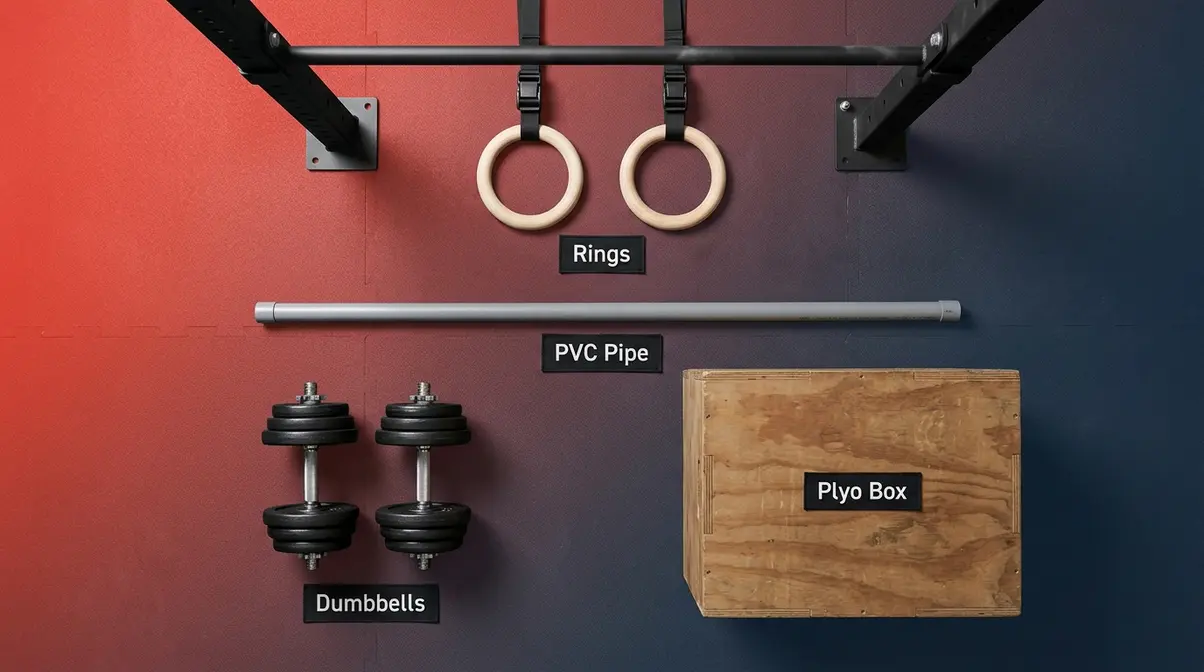
Before you attempt a timed WOD, you need movement competency in five patterns. Certified coaches consistently report that beginners who master movement mechanics first progress significantly faster and experience fewer injuries than those who rush into intensity. These five movements form the non-negotiable foundation of beginner CrossFit training. GarageGymReviews’ CrossFit exercise guide confirms these patterns as the cornerstone of foundational CrossFit programming.
- Estimated Time: 30-45 minutes per session
- Tools Needed:
- PVC pipe or light empty barbell
- Gymnastics rings or suspension trainer
- Plyometric box or sturdy chair
- Adjustable dumbbells
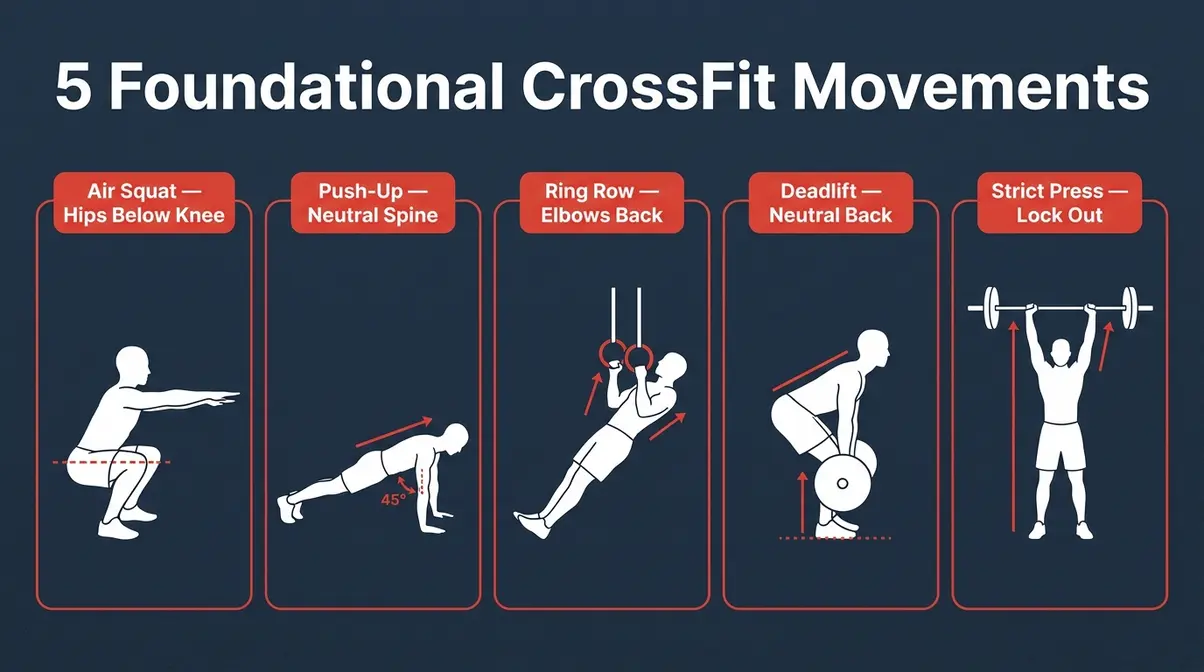
Air Squat: The Beginner King
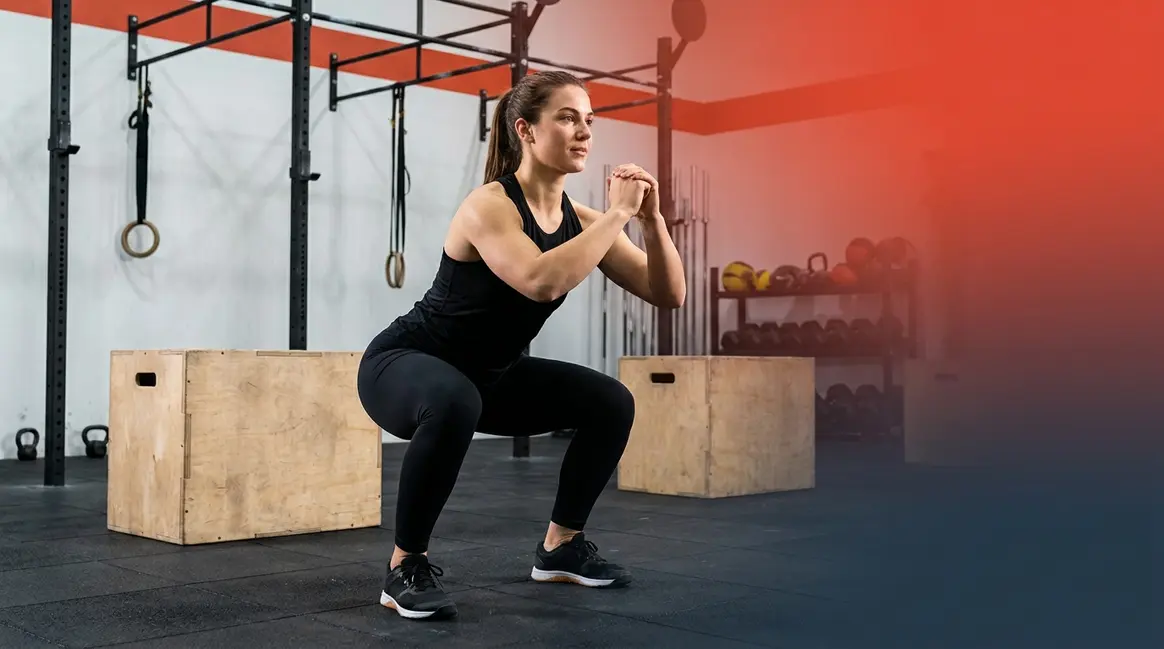
The air squat is the most fundamental CrossFit movement — and the most commonly performed incorrectly. Getting this right in week one prevents knee pain, lower back strain, and poor lifting mechanics that compound into serious injury later. Learning how to use proper squat form is critical for protecting your knees and maximizing glute activation.
How to perform a correct air squat:
- Stand with feet shoulder-width apart, toes turned out 15–30 degrees.
- Extend your arms straight in front of you for counterbalance.
- Push your hips back and down — as if sitting into a chair behind you.
- Keep your chest tall and your knees tracking over your toes (not caving inward).
- Descend until your hip crease passes below your knee (full depth).
- Drive through your heels to stand, squeezing your glutes at the top.
Why this matters: The squat pattern transfers directly to deadlifts, thrusters, and cleans — mastering it now accelerates every other movement you learn. Scaling option: If full depth is painful, squat to a box or chair and gradually lower the target height over 2–3 weeks.
Push-Up and Scalable Progressions
The push-up tests upper-body pressing strength and midline stability simultaneously. Many beginners cannot perform a strict push-up with correct form — and that is perfectly fine. The goal is to start at the right regression and build from there.
How to perform a correct push-up:
- Place hands slightly wider than shoulder-width, fingers pointing forward.
- Set your body in a rigid plank — head, hips, and heels in one straight line.
- Lower your chest to the floor, keeping elbows at roughly 45 degrees from your torso.
- Press back to the top without letting your hips sag or pike.
- Scaling progressions (easiest to hardest):
- Incline push-up: Hands on a box or bench — reduces load by 30–40%.
- Knee push-up: Knees on the floor — reduces load by approximately 50%.
- Full push-up: Standard floor position.
Ring Row: Beginner Pulling
The ring row is the safest and most scalable pulling movement in CrossFit — the foundation you build toward pull-ups. Unlike pull-ups, ring rows allow you to control the difficulty by adjusting your body angle.
How to perform a ring row:
- Set gymnastics rings (or a suspension trainer) at roughly hip height.
- Grip the rings with palms facing each other and walk your feet forward until your body is at an angle — the more horizontal you are, the harder the movement.
- Hang with arms fully extended, body in a straight line.
- Pull your chest to the rings, keeping your elbows close to your body.
- Lower with control — do not drop.
Why this matters: Ring rows build the lat, bicep, and upper-back strength that eventually transfers to pull-ups. Beginners who skip this step and attempt kipping pull-ups risk shoulder impingement.
Light Deadlift: Posterior Chain
The deadlift is the single most effective movement for building posterior chain strength — the glutes, hamstrings, and lower back that most beginners have never intentionally trained. Start with a PVC pipe or empty barbell (45 lbs) until the pattern is automatic.
How to perform a beginner deadlift:
- Stand with the bar over your mid-foot, feet hip-width apart.
- Hinge at the hips and grip the bar just outside your legs — arms straight.
- Set your back flat, chest up, and take a deep breath into your belly.
- Drive your feet into the floor and push the ground away — the bar rises in a straight vertical path.
- Stand tall at the top, hips and knees fully extended.
- Hinge back down with control, maintaining a flat back throughout.
Scaling option: If a barbell is unavailable, use two dumbbells held at your sides — the movement pattern is identical. Start light: 2 × 10 reps at a weight where form stays perfect on every rep.
Strict Press: Overhead Strength
The strict press develops shoulder and upper-back strength essential for safe overhead loading. “Strict” means no leg drive — pure upper-body pressing power. This movement is the prerequisite for push presses, jerks, and thrusters.
How to perform a strict press:
- Hold a barbell (or dumbbells) at shoulder height, grip just outside shoulder-width.
- Brace your core and squeeze your glutes — your whole body acts as a stable base.
- Press the bar directly overhead, moving your head slightly back to let the bar pass your face, then forward again once the bar clears.
- Lock out your elbows at the top with your biceps by your ears.
- Lower with control back to shoulder height.
Scaling option: Use dumbbells instead of a barbell — each arm works independently, which corrects left-right strength imbalances common in beginners.
5 Beginner CrossFit Strength WODs
When searching for crossfit strength training workouts for beginners, you need routines that prioritize safety while still delivering a cardiovascular and muscular stimulus. These five WODs were selected based on CrossFit Level 1 foundational programming standards and beginner progression research — specifically, movements with low technical complexity, scalable load, and time domains short enough to maintain form throughout. Once you master these basics, you can explore more advanced crossfit strength training workouts to continue challenging your fitness. Each WOD targets multiple muscle groups, fits within a 10–20 minute window, and requires no technical Olympic lifting skill. The Wodify beginner WOD resource supports this selection criteria: effective beginner WODs use simple movement patterns at moderate intensity.
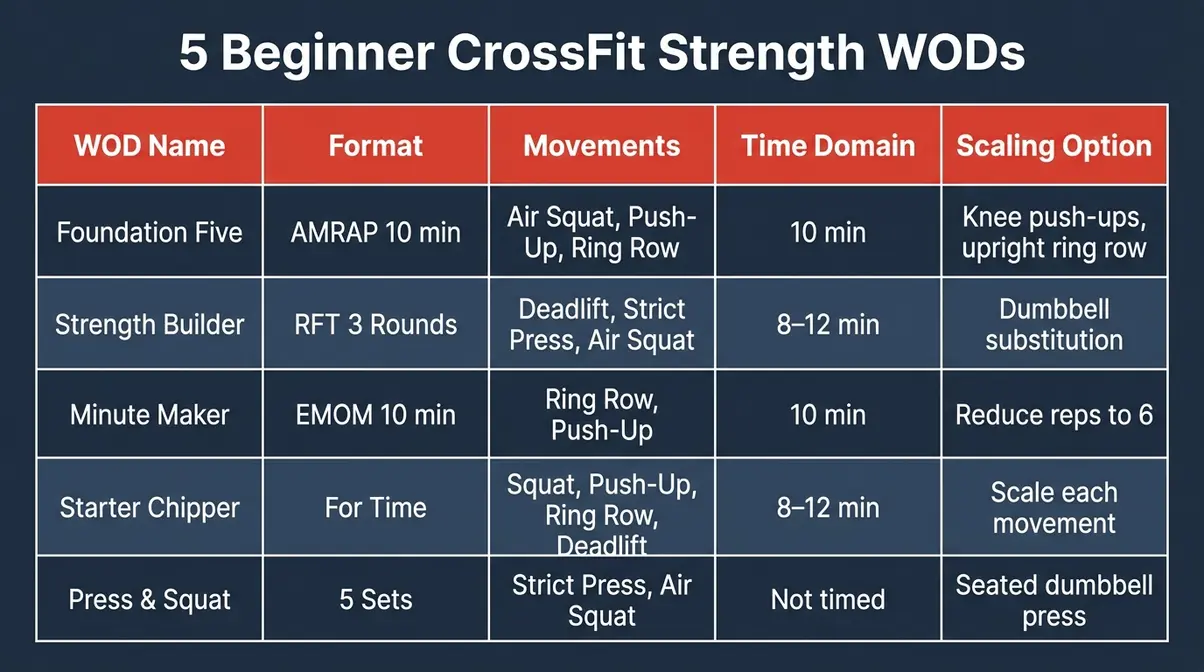
WOD 1: Foundation Five (AMRAP)
- Format: AMRAP (As Many Rounds As Possible) — 10 minutes
- Movements:
- 10 Air Squats
- 5 Push-Ups (scale: knee push-ups or incline push-ups)
- 5 Ring Rows (scale: adjust angle to make horizontal or more upright)
- Instructions:
- Set a 10-minute timer.
- Complete all three movements in sequence — that is one round.
- Rest only when necessary. Record your total rounds completed.
- Target: 4–6 rounds for a beginner. If you complete fewer, that is your baseline — beat it next time.
Why this WOD: It combines all three primary movement patterns (squat, push, pull) in a low-stakes, self-paced format. AMRAP removes the pressure of a clock countdown and lets you work at your own pace.
WOD 2: Strength Builder (RFT)
- Format: RFT (Rounds For Time) — 3 Rounds
- Movements:
- 10 Deadlifts (light barbell or two dumbbells — choose a weight you can lift 15 times fresh)
- 8 Strict Press (barbell or dumbbells)
- 10 Air Squats
- Instructions:
- Start the clock.
- Complete all three movements for 3 full rounds.
- Rest as needed between movements — form is the priority, not speed.
- Target time: 8–12 minutes. If you finish under 8 minutes, the weight was too light.
Why this WOD: Introduces barbell mechanics in a low-pressure, time-based format. Three rounds is enough to practice the movements repeatedly without accumulating so much fatigue that form breaks down.
WOD 3: Minute Maker (EMOM)
- Format: EMOM (Every Minute on the Minute) — 10 Minutes
- Structure: Alternate between two movements each minute.
- Odd minutes (1, 3, 5, 7, 9): 8 Ring Rows
- Even minutes (2, 4, 6, 8, 10): 8 Push-Ups (scaled as needed)
- Instructions:
- At the top of minute 1, perform 8 ring rows. Rest for the remainder of that minute.
- At minute 2, perform 8 push-ups. Rest for the remainder.
- Continue alternating for 10 minutes — 5 sets of each movement.
- If 8 reps per minute feels easy, increase to 10. If you cannot finish in 40 seconds, reduce to 6 reps.
Why this WOD: The EMOM format builds work capacity and introduces structured rest — the foundation of interval training. It is forgiving for beginners because built-in rest prevents complete fatigue.
WOD 4: The Starter Chipper
- Format: For Time — complete all reps in sequence
- Movements:
- 20 Air Squats
- 15 Push-Ups (scaled as needed)
- 10 Ring Rows
- 5 Deadlifts (moderate weight — 60–70% of what you can lift for 10 reps)
- Instructions:
- Start the clock.
- Complete each movement fully before moving to the next — this is a chipper (you “chip away” at the list).
- Rest as needed. Record your finish time.
- Target: under 8 minutes. Beginners often take 10–12 minutes on their first attempt — that is normal.
Why this WOD: Chippers teach pacing strategy — a critical CrossFit skill. You must manage your effort early to have energy left for the final movements.
WOD 5: Press and Squat (Strength)
- Format: 5 Sets of the following — not for time
- Movements:
- 5 Strict Press (increase weight slightly each set if form holds)
- 10 Air Squats (bodyweight — focus on depth and control)
- Instructions:
- Complete 5 strict presses, then immediately perform 10 air squats.
- Rest 90 seconds between sets.
- Track your press weight for each set — the goal is to find a challenging but technically perfect load.
- Complete all 5 sets. This is a strength session, not a conditioning workout — move deliberately.
Why this WOD: Strength-focused sessions without a clock teach beginners to prioritize quality over speed — the most important habit to build in Phase 1 of The 3-Phase Foundation Method.
Scaling Movements and Home Training
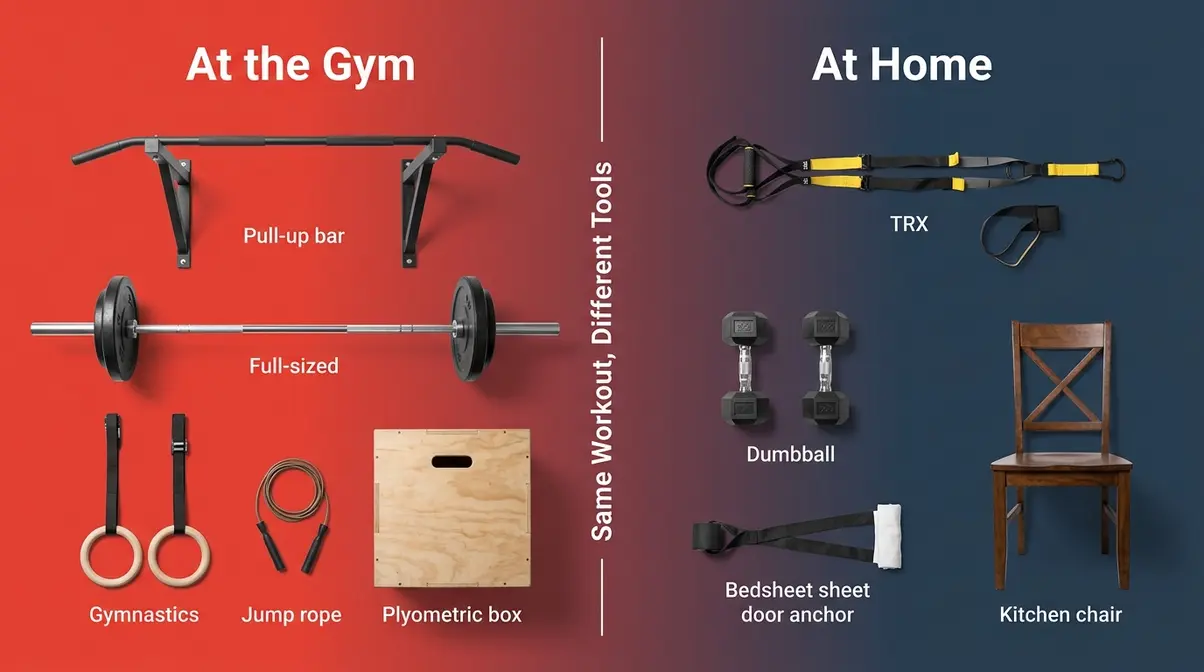
Scaling is not a shortcut — it is the mechanism that makes CrossFit work for everyone. Across CrossFit communities, the consistent coaching advice is: “Scale before you fail.” Performing a movement incorrectly under fatigue is how injuries happen. Scaling correctly means you finish every workout with good form on every rep. The r/crossfit community’s beginner advice thread consistently reinforces this: beginners who scale appropriately in months 1–3 outlast and outperform those who attempt Rx too early.
12-Point Movement Scaling Blueprint
Use this reference every time a movement feels too difficult. Work at the level where you can complete all reps with correct form on the last set.
| Movement | Scale 1 (Easiest) | Scale 2 (Intermediate) | Full Version (Rx) |
|---|---|---|---|
| Pull-Up | Ring Row (upright angle) | Ring Row (horizontal) | Strict Pull-Up |
| Push-Up | Incline Push-Up (box) | Knee Push-Up | Full Push-Up |
| Air Squat | Box Squat (to chair) | Partial Depth Squat | Full Depth Air Squat |
| Deadlift | Dumbbell Deadlift (light) | Barbell Deadlift (empty bar) | Barbell Deadlift (loaded) |
| Strict Press | Dumbbell Press (seated) | Dumbbell Press (standing) | Barbell Strict Press |
| Burpee | Step-Out Burpee (no jump) | Burpee (no push-up) | Full Burpee |
How to use this chart: Find the movement in the left column. Start at Scale 1 if you are in week 1–2. Move to Scale 2 when you can complete 3 sets of 10 reps with perfect form. Progress to the full version when Scale 2 feels controlled and consistent across multiple sessions.
Home CrossFit Equipment Swaps
You do not need a CrossFit gym to start. Most beginner WODs can be replicated at home with minimal equipment. If you lack gear, you can also supplement your routine with home workouts without equipment to maintain your cardiovascular conditioning.
| Gym Equipment | Home Substitution | Notes |
|---|---|---|
| Pull-Up Bar | Suspension Trainer (TRX) or sturdy table for ring rows | Adjust height to control difficulty |
| Barbell | Two Dumbbells or a Backpack with books | Match the load to the barbell weight |
| Gymnastics Rings | Bedsheet loops over a door frame | Use cautiously — test stability first |
| Jump Rope | Simulated jump rope (jump without rope) | Counts reps the same way |
| Plyometric Box | Sturdy chair or couch cushion stack | Test stability before loading |
| Kettlebell | Dumbbell held vertically by one end | Identical movement pattern |
The four beginner WODs in the previous section require only a pull-up bar or suspension trainer, a set of dumbbells, and floor space. You can run a complete beginner program from your living room for the first 4 weeks before deciding whether a gym membership makes sense.
Required Home CrossFit Equipment
The minimum equipment for beginner CrossFit at home is a pull-up bar or suspension trainer and a pair of adjustable dumbbells. With these two items, you can perform all five foundational movements and complete every WOD in this guide. A jump rope ($10–$20) adds cardio variety. A gymnastics mat protects your wrists during floor work. You do not need a barbell, plates, or a rack to run a complete 4-week beginner program — those become relevant in Phase 3 when loads increase.
4-Week Beginner CrossFit Schedule
A structured schedule removes decision fatigue. Instead of wondering what to do each day, you follow the plan and focus entirely on execution. The 3-Phase Foundation Method divides your first four weeks into two distinct learning phases, each with a specific goal and training structure. Research suggests that 2–3 sessions per week is optimal for recovery in beginner athletes — the ACSM recommends allowing 48 hours between resistance training sessions targeting the same muscle groups (ACSM Guidelines for Exercise Testing and Prescription, 2022).
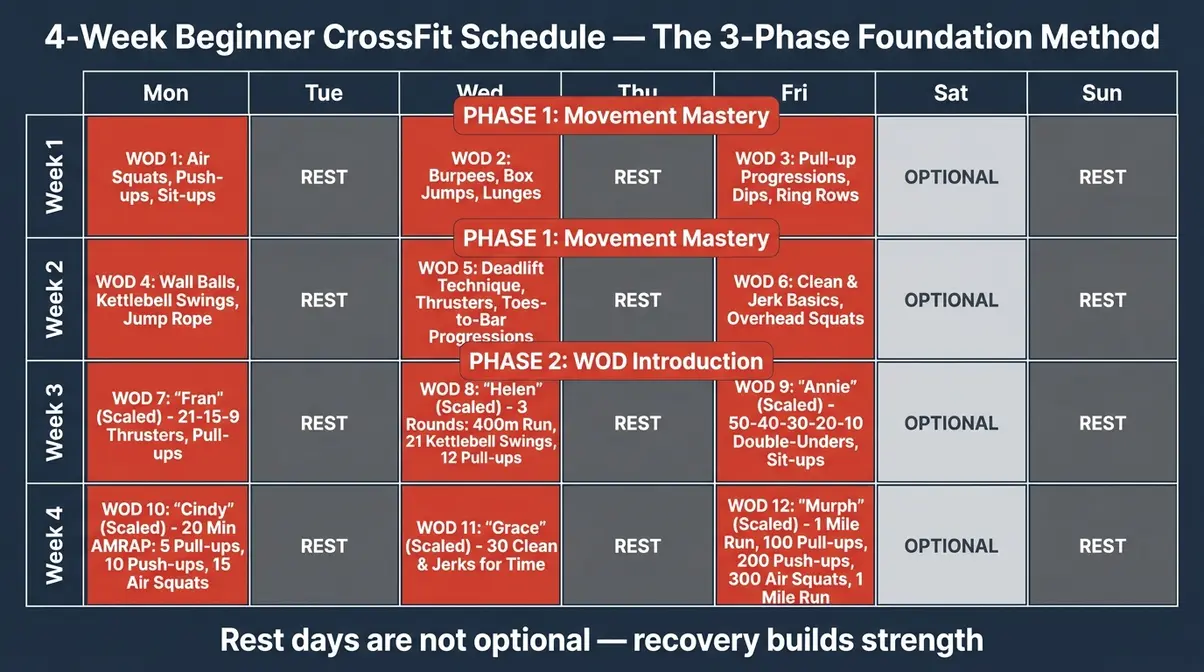
Weeks 1–2: Movement Mastery Phase
Phase 1 Goal: Learn the 5 foundational movements with correct form. Speed and intensity are irrelevant in this phase — mechanics are everything.
| Day | Session | Focus |
|---|---|---|
| Monday | WOD 5 (Press & Squat) | Strict Press + Air Squat — strength, no clock |
| Tuesday | Rest | Active recovery: 20-min walk |
| Wednesday | WOD 1 (Foundation Five) | AMRAP — Air Squat, Push-Up, Ring Row |
| Thursday | Rest | Active recovery: light stretching |
| Friday | WOD 5 (Press & Squat) | Repeat — aim to add 5 lbs to press |
| Saturday | Optional: 20-min walk | Light movement only |
| Sunday | Full Rest | No training |
- Phase 1 Rules:
- Never sacrifice form for reps. If your squat depth decreases, stop and rest.
- Record every session — weight used, rounds completed, how you felt.
- Do not add a fourth training day in weeks 1–2, regardless of how good you feel.
Weeks 3–4: WOD Introduction Phase
Phase 2 Goal: Apply your movement skills to timed WODs. Introduce AMRAP, RFT, and EMOM formats so the workout structure becomes familiar.
| Day | Session | Focus |
|---|---|---|
| Monday | WOD 2 (Strength Builder) | RFT — Deadlift, Strict Press, Air Squat |
| Tuesday | Rest | Active recovery: 20-min walk |
| Wednesday | WOD 3 (Minute Maker) | EMOM — Ring Row + Push-Up |
| Thursday | Rest | Light stretching or yoga |
| Friday | WOD 4 (Starter Chipper) | For Time — all 4 movements |
| Saturday | Optional: WOD 1 repeat | Beat your week 1 AMRAP score |
| Sunday | Full Rest | No training |
- Phase 2 Rules:
- Compare your times and scores to your own Phase 1 results — not to anyone else’s.
- If a WOD leaves you unable to move properly the next day, you went too hard. Scale back.
- After week 4, you are ready for Phase 3 (Progressive Overload) — adding load, increasing volume, or joining a CrossFit gym’s beginner track.
Weekly Beginner Training Frequency
Beginners should train CrossFit 2–3 times per week, with at least one full rest day between sessions. The ACSM recommends 48 hours of recovery between resistance training sessions targeting the same muscle groups (ACSM, 2022). Starting with 3 sessions per week — Monday, Wednesday, Friday — gives your muscles adequate time to repair and grow. Most beginners who train more than 4 days per week in their first month report increased soreness and stalled progress, not faster gains.
Recovery and Sleep Protocols
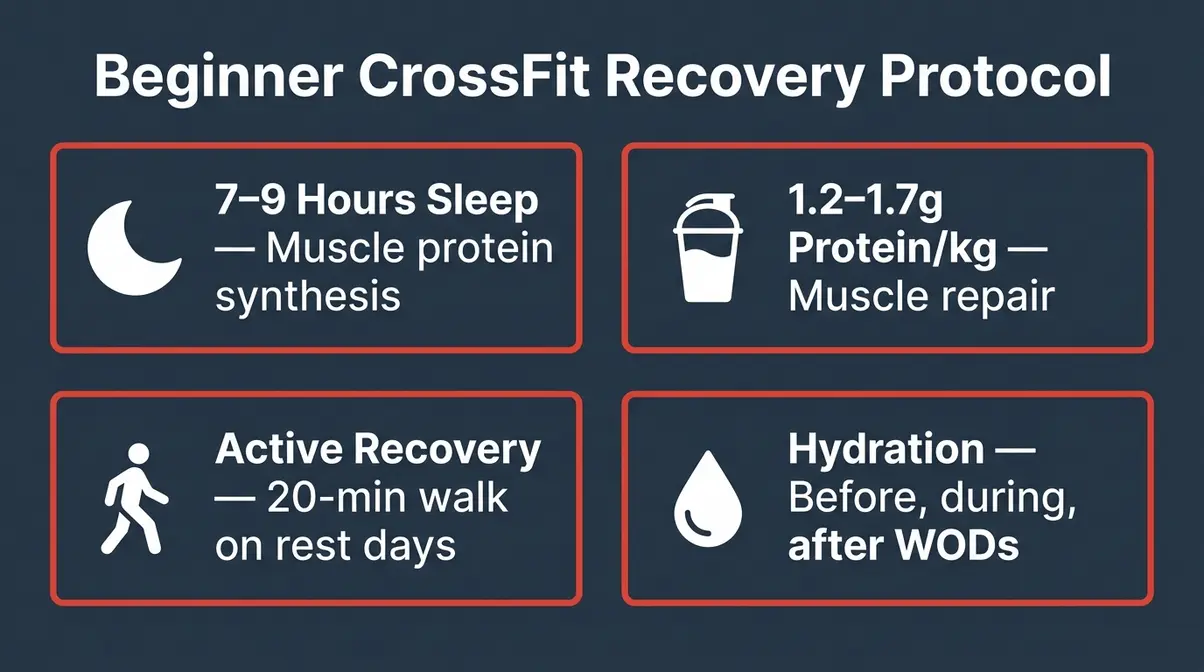
Rest is not the absence of training — it is training. Muscle growth happens during recovery, not during the workout itself. User reports in r/crossfit consistently indicate that beginners who rest 48 hours between sessions report fewer injuries and better performance gains than those who train daily.
Recovery protocol for beginner CrossFit athletes:
- Sleep 7–9 hours per night. The NIH identifies sleep as the primary driver of muscle protein synthesis — without it, your training produces minimal adaptation (NIH Sleep Research, 2021).
- Eat enough protein. The ACSM recommends 1.2–1.7 grams of protein per kilogram of bodyweight for individuals engaged in regular resistance training (ACSM, 2022).
- Active recovery on rest days. A 20-minute walk increases blood flow to sore muscles without adding training stress. Avoid sitting completely still on rest days.
- Hydrate before, during, and after workouts. Even mild dehydration (2% body weight loss) measurably reduces strength performance (ACSM, 2022).
- Track soreness. Muscle soreness (DOMS — Delayed Onset Muscle Soreness) peaks 24–48 hours after a session. If soreness prevents normal daily movement, take an extra rest day.
Injury Prevention and Mistakes
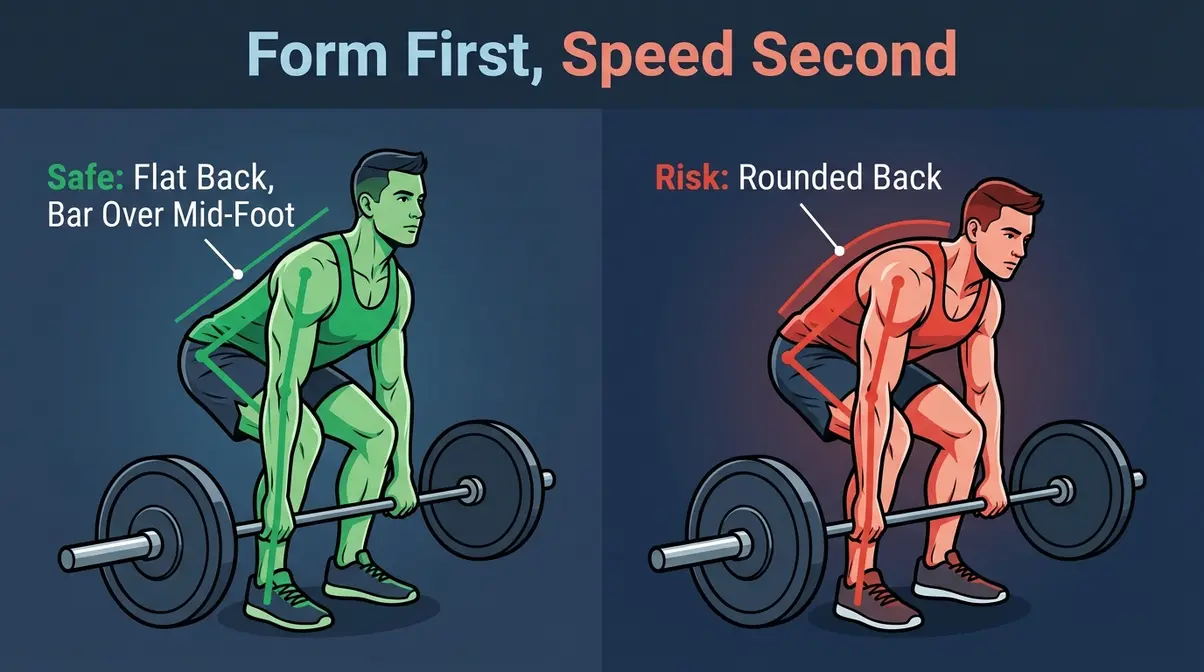
CrossFit has a strong safety record when practiced correctly — but beginners who skip the foundational phase or ignore scaling options face real risks. A study published in the Orthopaedic Journal of Sports Medicine found that CrossFit-related injury rates are comparable to other high-intensity sports and significantly reduced when athletes follow structured progression and coach supervision (OJSM, 2014). Understanding how to avoid injury when exercising is essential for long-term progress, especially when mixing gymnastics with weightlifting.
5 Common Beginner Mistakes
Mistake 1: Training at Rx weight before mechanics are solid
What goes wrong: Heavy loads amplify movement errors — a deadlift with a rounded back at 95 lbs causes far more damage than the same error at 45 lbs.
Fix: Use the 12-Point Scaling Blueprint above. Stay at Scale 1 or Scale 2 until your coach or a video review confirms your mechanics are correct.
Mistake 2: Skipping rest days
What goes wrong: Without 48 hours of recovery between sessions, muscle tissue does not fully repair. Performance decreases and overuse injuries accumulate.
Fix: Follow the 4-week schedule exactly. If you feel the urge to train on a rest day, go for a walk instead.
Mistake 3: Comparing yourself to experienced athletes
What goes wrong: Ego-driven training leads beginners to attempt Rx weights or skip scaling — the fastest route to injury or burnout.
Fix: Your only competition is last week’s version of you. Record your scores and compare only to your own history.
Mistake 4: Ignoring pain signals
What goes wrong: Muscle soreness is normal. Sharp, localized joint pain is not. Beginners who push through joint pain often convert a minor issue into a months-long injury.
Fix: Learn the difference — soreness feels diffuse and dull; injury pain is sharp, specific, and worsens with movement. Stop immediately if you feel the latter.
Mistake 5: Doing too much too soon
What goes wrong: Rhabdomyolysis (severe muscle breakdown leading to kidney stress) is a rare but real risk when beginners dramatically exceed their conditioning level. It typically occurs when someone attempts an extremely high-volume workout without building base fitness first.
Fix: Follow the Phase 1 schedule strictly. The 4-week plan is specifically calibrated to avoid this risk.
Injury Prevention Research
The most effective injury prevention strategy in CrossFit is structured progression — the exact principle behind The 3-Phase Foundation Method. A PubMed meta-analysis of CrossFit injury rates found that injury incidence in CrossFit (2.1–3.1 injuries per 1,000 training hours) is comparable to recreational weightlifting and lower than many team sports (PubMed, 2017). The shoulder, lower back, and knee are the most commonly affected areas — all of which are protected by proper scaling and movement mechanics.
Certified coaches consistently report that beginners who complete a structured foundational phase before advancing to high-intensity WODs report significantly fewer overuse injuries in their first three months. The evidence points to one conclusion: the risk is not CrossFit itself — it is unstructured CrossFit.
When to See a Doctor or Coach
- Consult a physician before starting this program if you:
- Have a history of cardiovascular disease, hypertension, or diabetes
- Have had a joint surgery or chronic musculoskeletal injury in the past 12 months
- Have been completely sedentary for more than 6 months
- Experience chest pain, dizziness, or shortness of breath during light activity
- Hire a certified CrossFit coach (CrossFit Level 1 Trainer or higher) if:
- You are unsure whether your movement mechanics are correct after 2 weeks of practice
- You experience recurring pain in a specific joint during training
- You want to progress beyond the 4-week beginner schedule into structured programming
A single coach session for movement assessment is one of the highest-value investments a beginner can make. One hour of coaching in week 1 prevents months of correcting bad habits later.
Frequently Asked Questions
Can I do CrossFit with no gym experience?
Absolutely — CrossFit is designed to scale to any fitness level, including complete beginners. Every movement in CrossFit has a scaled version that reduces load, range of motion, or complexity. The air squat, push-up, ring row, deadlift, and strict press covered in this guide require no prior gym experience. Following a structured beginner program like The 3-Phase Foundation Method ensures you build mechanics before intensity, which is the safest and most effective starting point regardless of your current fitness level.
What should I eat before my first CrossFit class?
Eat a light meal containing easily digestible carbohydrates and a moderate amount of protein about 60 to 90 minutes before your workout. A banana with a small scoop of peanut butter or a slice of toast with hard-boiled eggs provides excellent sustained energy. Avoid heavy, high-fat meals immediately before training, as the high-intensity nature of the WODs can cause stomach upset.
Is CrossFit safe for beginners?
CrossFit is safe for beginners when practiced with proper scaling and structured progression. A PubMed meta-analysis found CrossFit injury rates (2.1–3.1 injuries per 1,000 training hours) are comparable to recreational weightlifting and lower than many team sports (PubMed, 2017). The key safety factors are: starting with scaled movements, following a progressive schedule like the 4-week plan in this guide, resting 48 hours between sessions, and consulting a certified CrossFit coach for movement assessment. Attempting Rx weights before mechanics are established is the primary cause of beginner injuries.
Will lifting weights in CrossFit make me bulky?
No, lifting weights 2-3 times per week will not automatically make you bulky. Building significant muscle mass requires a specific, high-calorie diet and years of dedicated heavy lifting protocols. For most beginners, CrossFit promotes lean muscle development, improved body composition, and a more toned appearance rather than excessive bulk.
How long before I see results from CrossFit?
Most beginners notice measurable strength improvements within 3–4 weeks of consistent training. Research published in the Journal of Strength and Conditioning Research found significant improvements in body composition and aerobic capacity within 10 weeks of structured CrossFit training (JSCR, 2021). In the first 2–4 weeks, gains are primarily neuromuscular — your brain learns to recruit muscle more efficiently, which is why movements feel easier even before visible muscle develops. By week 8, most beginners report visible strength gains and improved endurance.
Build Your Foundation, Then Strength
For beginners, CrossFit strength training delivers what no isolated gym program can — simultaneous strength, conditioning, and community accountability in workouts that scale to your exact starting point. The CDC recommends muscle-strengthening activity on 2+ days per week; this 4-week plan meets that threshold from day one while teaching you the movement patterns that underpin every CrossFit workout you will ever attempt.
The 3-Phase Foundation Method exists for one reason: to ensure you never advance faster than your body is ready for. Phase 1 builds the mechanics. Phase 2 applies them under time pressure. Phase 3 — which begins after week 4 — is where progressive overload drives the strength gains that keep most CrossFit athletes training for years. The framework is not complicated. The discipline is in following it.
Your next step is simple. Pick one WOD from this guide — start with WOD 1, the Foundation Five — and complete it this week. Record your score. Come back next session and beat it. That single habit, repeated consistently over 4 weeks, is how every experienced CrossFit athlete started. Finding the right crossfit strength training workouts for beginners is about prioritizing form over intensity and consistency over speed. Consult a certified CrossFit coach if you want your movement mechanics assessed before adding load — one session in week one is worth more than a month of self-correction later.
Related posts:
Benefits of Yoga for Fitness: The Science-Backed Guide
Home Workouts to Build Muscle Without Weights (2026)
Home Workout Plan for Beginners: 30-Day Step-by-Step
How to Self Massage Calves: The 4-Layer Method Guide
Strength Training for Beginners: Complete Workout Plan 2026
Strength Training for Seniors at Home: 15 Safe Exercises

Callum
Hi, I'm Callum, the founder of Body Muscle Matters. I'm not a certified trainer, I'm a self taught lifter who started this site to share what I've learned from my own training and a lot of trial and error. Everything here comes from real experience and honest research, written the way I'd explain it to a friend who is just getting started. My goal is simple: practical, no hype fitness advice you can actually use.