
Time Under Tension: Does It Really Matter for Muscle Growth?
You’ve been told to slow down your reps to build more muscle. But then you watch powerlifters — athletes with some of the most developed physiques on the planet — moving heavy bars as fast as possible. So which approach actually works?
If you’ve been obsessing over stopwatch time, you might be asking yourself about time under tension: does it really matter for muscle growth? Counting seconds isn’t the same as triggering growth — and confusing the two can mean months of wasted effort in the gym.
In this guide, you’ll learn exactly what time under tension is, what the science actually says about its role in muscle growth, and get 8 specific tempo prescriptions you can use in your next workout. The guide covers the definition, the science, the hierarchy of muscle growth, and practical application — in that order.
Time under tension (TUT) does contribute to muscle growth — but it is not the main driver. Mechanical tension is the primary stimulus, and TUT only works when it serves that goal.
- TUT is a tool, not a foundation: It amplifies mechanical tension — it doesn’t replace it
- The Tension Hierarchy matters: Mechanical tension → training to near-failure → TUT/metabolic stress
- Optimal rep tempo: A 2–3 second eccentric (lowering) phase is the most evidence-backed TUT application
- Myth busted: More seconds under load does not automatically equal more muscle growth
- Best approach: Combine controlled tempo with sufficient mechanical load for maximum hypertrophy (muscle growth)
What Is Time Under Tension (TUT)?
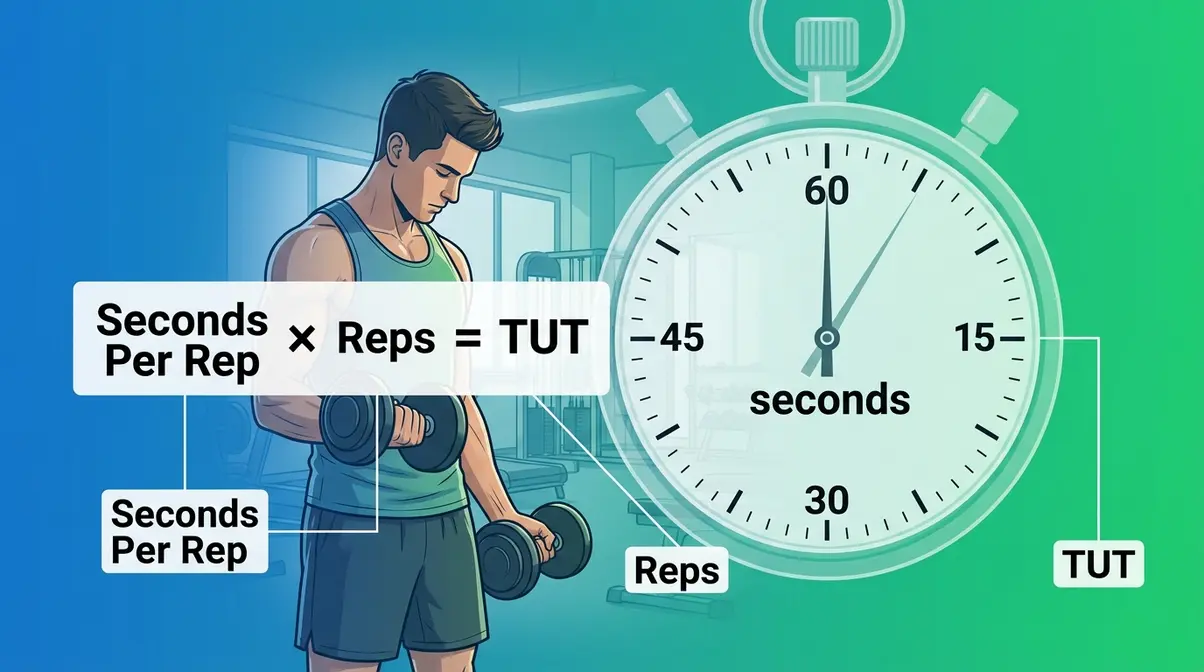
Time under tension (TUT) is the total number of seconds your muscles are under load during a single set — calculated by multiplying the seconds per rep by the total number of reps performed. If you do 10 bicep curls and each rep takes 6 seconds, your TUT for that set is 60 seconds. Understanding what TUT actually measures — and what it doesn’t — is the foundation for everything that follows.
What TUT Means in Practice
Time under tension describes how long your muscle is actively working against resistance within a single set. Here’s how the math works in practice.
Take a standard bicep curl. If you lower the weight over 3 seconds (the eccentric, or lowering phase), hold for 1 second at the bottom, then lift over 2 seconds (the concentric, or lifting phase), that’s 6 seconds per rep. Multiply by 10 reps and you get 60 seconds of TUT for that set.
The formula: seconds per rep × number of reps = total TUT per set.
You can manipulate TUT in three ways: slow the lowering phase, add a pause at the bottom or top of the movement, or slow the lifting phase. Each approach changes the total duration — but not all three produce the same effect on your muscles, which is why tempo selection matters.
TUT applies to every resistance exercise, not just curls. Squats, rows, bench press, deadlifts — every set has a TUT value. To understand why TUT matters, it helps to first understand the core principles of hypertrophy and strength training.
Now that you know what TUT is, the bigger question is: why does it matter — and what exactly does it do to your muscles? That comes down to three biological mechanisms.
The Three Mechanisms of Muscle Growth
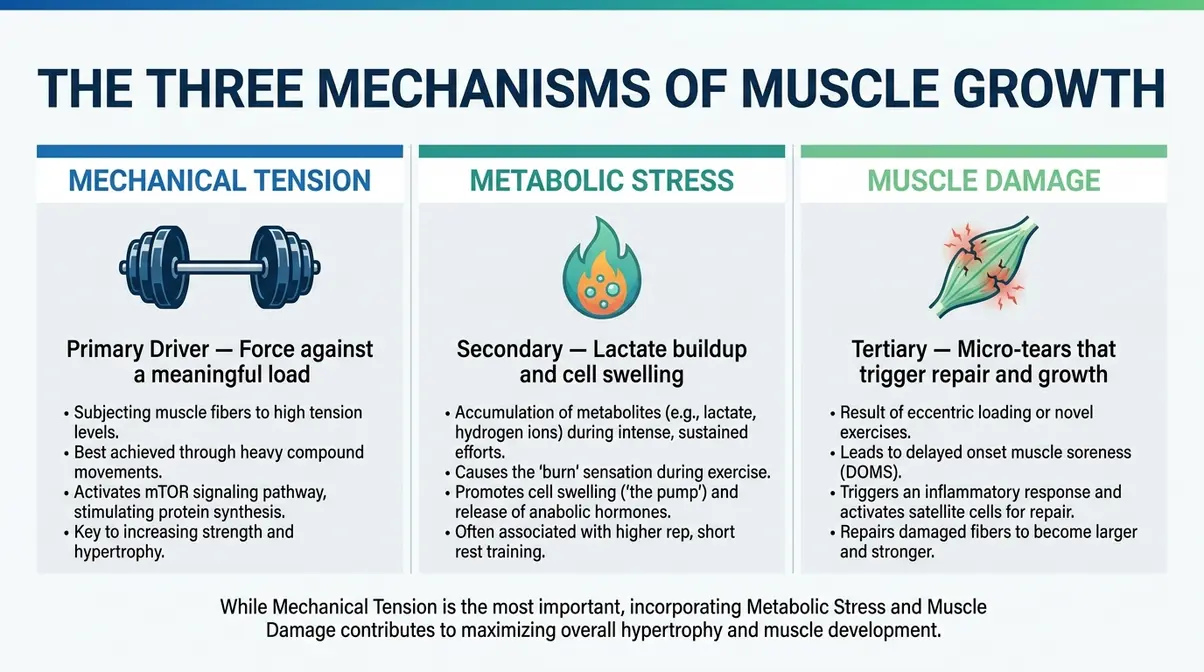
Hypertrophy — the scientific term for muscle growth — is driven by three distinct biological signals. TUT interacts with all three, but it doesn’t contribute equally to each.
1. Mechanical Tension
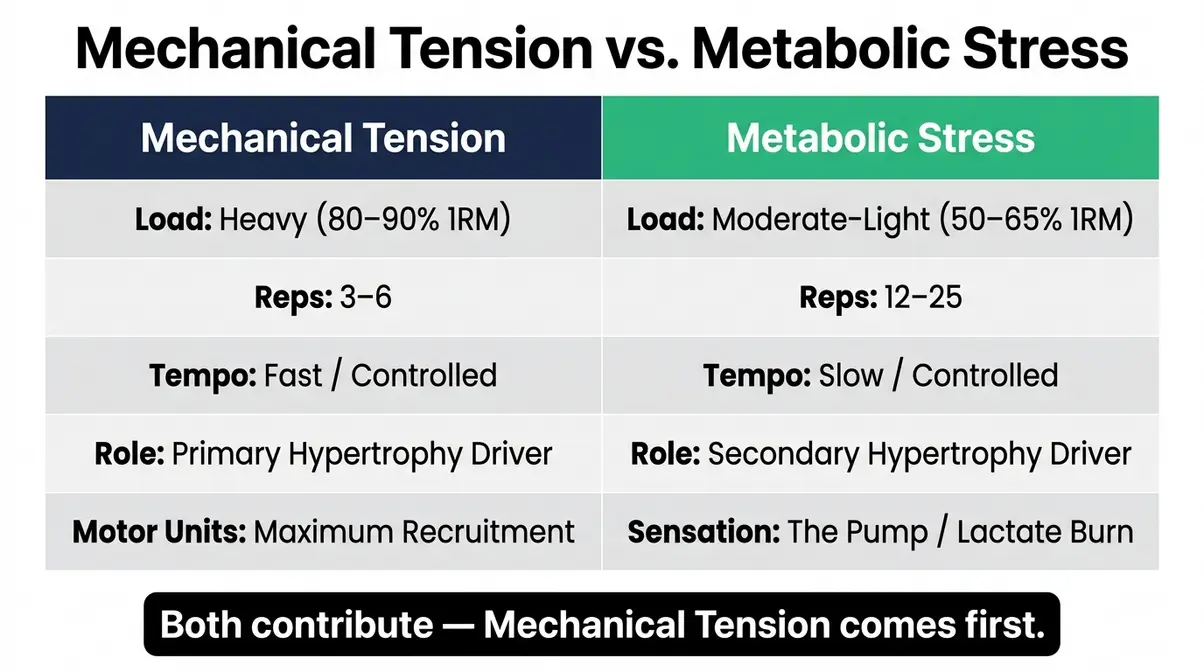
Mechanical tension is the force a muscle fiber produces when it contracts against a load. Think of it as the pull-and-stretch stress your muscle fibers experience when you push or pull against resistance. This is the primary driver of hypertrophy. When muscle fibers are stretched under load — particularly during the lowering phase of a lift — high-threshold motor units (the largest, most growth-prone fibers) are recruited. Why this matters: without sufficient mechanical tension, the other two mechanisms produce limited results.
2. Metabolic Stress
Metabolic stress is the buildup of waste products like lactate and hydrogen ions when your muscles work hard for an extended period. Think of it as the “burn” you feel at the end of a hard set of 15–20 reps. This signal contributes to hypertrophy through cell swelling and hormonal responses, but research suggests it plays a secondary role compared to mechanical tension.
3. Muscle Damage
Muscle damage refers to the micro-tears that occur in muscle fibers during intense exercise — especially during the eccentric (lowering) phase. This damage triggers a repair process that can lead to growth. It’s why you feel sore 24–48 hours after a hard session.
TUT primarily amplifies metabolic stress and muscle damage. It can enhance mechanical tension — but only if the load is heavy enough to create meaningful force in the first place. We’ll break down exactly where TUT fits in the hierarchy of muscle growth in the next section.
Does Time Under Tension Build Muscle?
Time under tension does contribute to muscle growth — but the evidence reveals important nuance. A controlled set duration can enhance hypertrophic signaling, particularly through metabolic stress pathways. However, TUT is not an independent growth driver. It works because it extends the period your muscles are exposed to mechanical tension and metabolic challenge — not simply because more seconds elapsed.
What the Research Actually Says
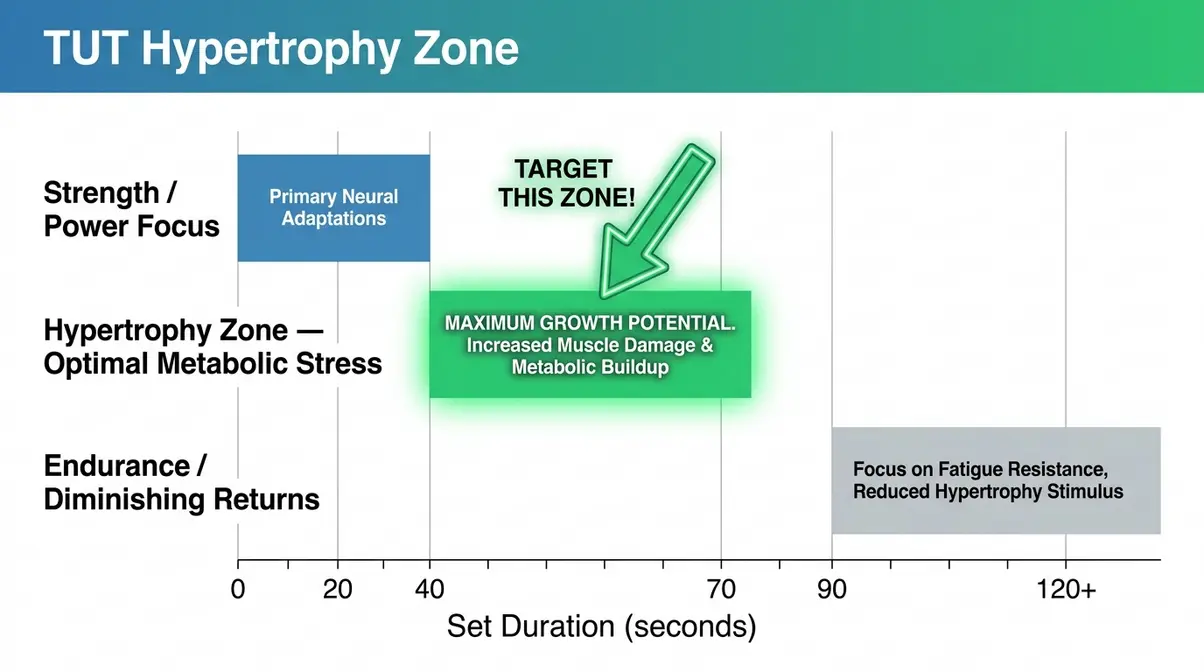
Research on TUT and hypertrophy has produced consistent but often misunderstood findings. A widely cited review published in the Journal of Strength and Conditioning Research found that sets lasting between 40 and 70 seconds — the so-called “hypertrophy zone” — were associated with greater metabolic stress responses compared to very short sets (under 20 seconds) or excessively long sets (over 90 seconds) (PMC, 2012).
However, later research complicated this picture. A 2015 meta-analysis by Schoenfeld and colleagues found that muscle hypertrophy can occur across a wide range of rep ranges and set durations — provided sets are taken close to muscular failure. The key variable wasn’t time; it was the level of effort and the mechanical tension generated. Sets of 5 reps and sets of 30 reps produced comparable growth when effort was equated.
Our analysis of the current evidence base shows that TUT is a useful proxy for training volume and effort — not a standalone growth trigger. The research supports using TUT as a guide, not a goal.
The Muscle Protein Synthesis Connection
Muscle protein synthesis (MPS) — the biological process by which your body builds new muscle tissue — is the downstream result of hypertrophic training. Understanding how to build muscle requires looking at how TUT connects to MPS, which helps explain why the relationship between time and growth is more complex than social media suggests.
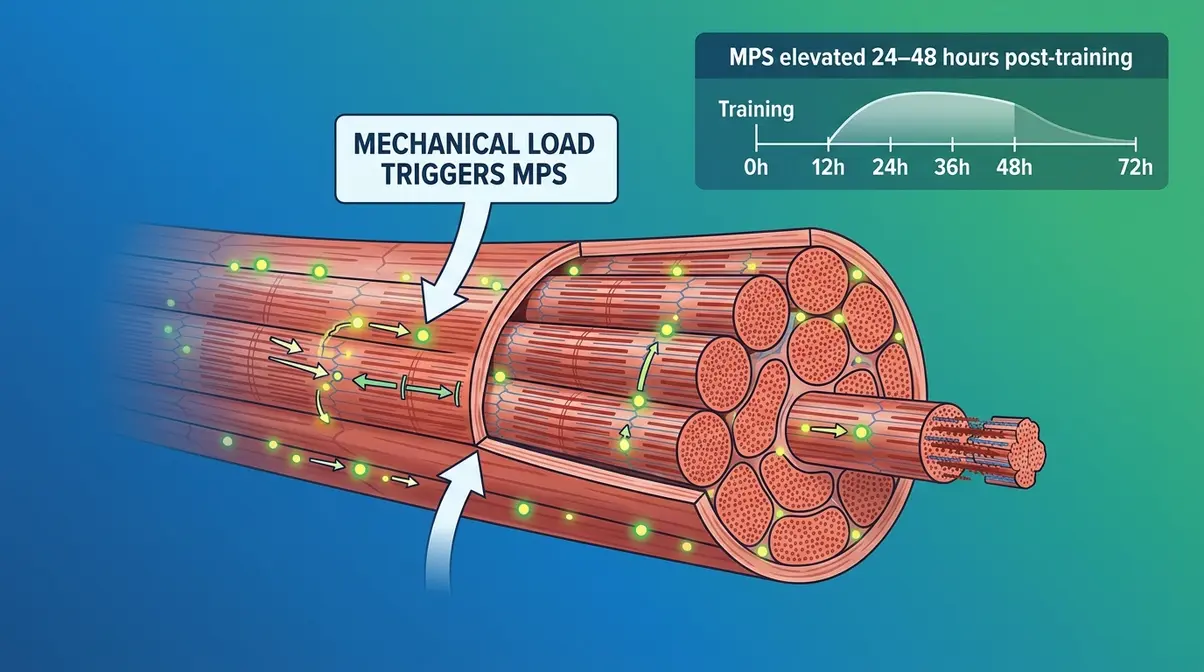
Research from the University of Western Ontario found that MPS is elevated for up to 24–48 hours following resistance exercise, and that the magnitude of this response is most strongly correlated with the mechanical load placed on the muscle — not the duration of the set (Burd et al., 2010). Longer sets at lighter loads can produce MPS elevations, but they tend to be smaller and shorter-lived compared to sets performed with heavier mechanical tension.
This is why bodybuilders who train with moderate-to-heavy loads and controlled tempos consistently outperform those who use only light, high-rep “pump” work. The pump (largely a metabolic stress effect) feels productive — and it does contribute to growth — but it doesn’t replicate the MPS spike that comes from loading your muscle fibers under genuine mechanical challenge.
Practical implication: TUT-focused training using very light loads (where you’re just “feeling the burn”) produces less MPS than moderate-load training with controlled tempo. The load has to be there first.
The ‘More TUT = More Growth’ Myth
“A common misconception is that more time under tension = more muscle growth.”
This belief leads many beginners to use excessively light weights for very slow, 10-second reps — believing the extended duration compensates for the reduced load. It doesn’t. When load drops below roughly 30% of your one-rep maximum, mechanical tension becomes insufficient to recruit high-threshold motor units — the large, fast-twitch fibers most responsible for hypertrophy — regardless of how long the set lasts.
There’s also a ceiling effect. Research suggests that sets exceeding 90 seconds at submaximal loads begin to shift toward muscular endurance adaptations rather than hypertrophy. You get better at sustaining low-level contractions — not bigger muscles.
The misconception also ignores how time accumulates. Ten reps with poor form and momentum generate less productive TUT than 8 reps with controlled, full-range-of-motion movement — even if the stopwatch reads the same. Quality of tension matters more than quantity of seconds. According to Healthline’s review of TUT research, the eccentric (lowering) phase is where the most meaningful tension is generated — making a slow, controlled lowering phase more valuable than adding seconds to the concentric (lifting) phase.
TUT vs. Mechanical Tension

Mechanical tension is the primary driver of hypertrophy, and TUT is one tool for enhancing it — not an alternative to it. The distinction matters because it determines how you structure your training. Treating TUT as the goal leads to underloading; treating mechanical tension as the goal and TUT as a modifier leads to optimal programming.
The Tension Hierarchy Explained
The Tension Hierarchy is a framework for understanding which training variables drive muscle growth in order of priority — so you never sacrifice a higher-tier variable chasing a lower one.
The hierarchy works like this:
Tier 1 — Mechanical Tension: The force your muscle produces against a meaningful load. This is non-negotiable. Without sufficient load, no amount of TUT manipulation produces optimal growth. High-threshold motor units — the large muscle fibers with the greatest growth potential — only activate when the load demands it.
Tier 2 — Training to Near-Failure: How close you take a set to the point where you can no longer complete a rep with good form. Research consistently shows that proximity to failure is a stronger predictor of hypertrophy than rep range or set duration. A set of 12 reps taken to near-failure beats a set of 20 reps stopped at 15 reps of perceived effort.
Tier 3 — TUT and Metabolic Stress: Once Tier 1 and Tier 2 are in place, tempo manipulation and set duration become meaningful amplifiers. Extending the eccentric phase, adding pauses, or structuring sets in the 40–70 second range adds metabolic stress on top of mechanical tension — producing a synergistic stimulus for growth.
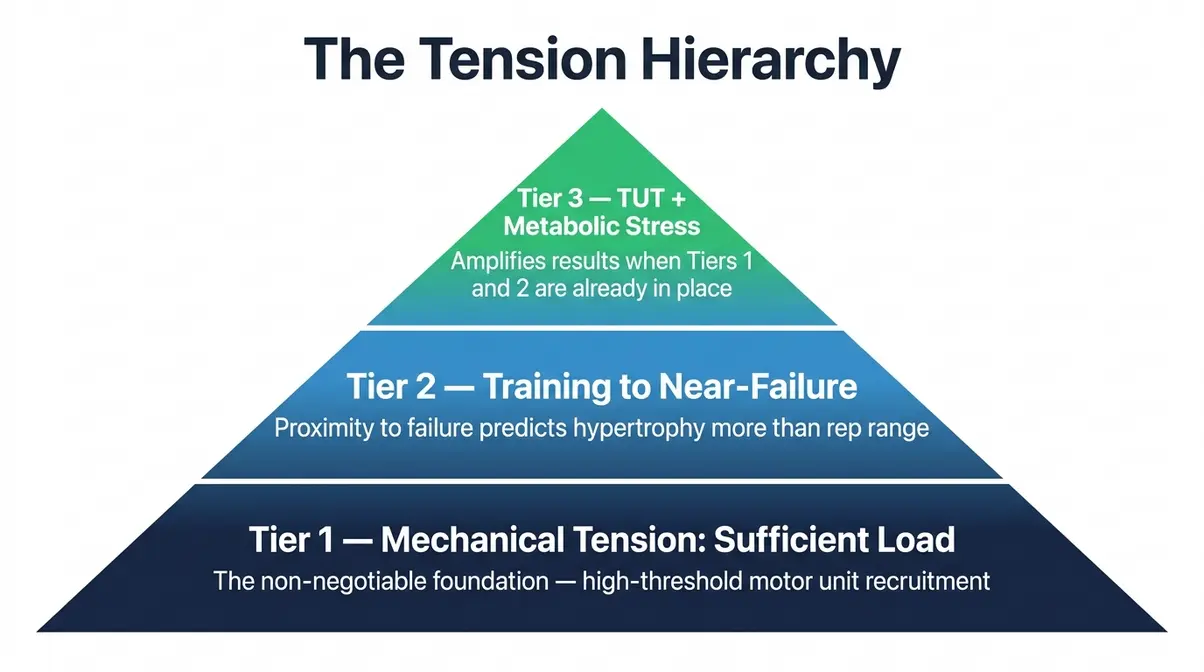
The practical takeaway: before you think about slowing your reps, make sure you’re using a challenging load and training close to failure. If those two conditions are met, tempo becomes a powerful fine-tuning tool.
When Heavy Lifting Beats Slow Reps
Heavy lifting — working in the 1–6 rep range with loads above 80% of your one-rep maximum — prioritizes Tier 1 of The Tension Hierarchy above all else. When looking at what is strength training, the focus is often on this exact principle. The mechanical tension generated by near-maximal loads recruits virtually every available motor unit, including the high-threshold fibers that respond most dramatically to training.
In this context, TUT is naturally short (a heavy set of 5 reps might last only 20–30 seconds), but the hypertrophic stimulus is substantial because mechanical tension is maximized. Powerlifters and Olympic weightlifters demonstrate this principle constantly: fast, heavy sets produce significant muscle mass alongside strength gains.
According to GymAware’s analysis of TUT and training velocity, velocity-based training research consistently shows that intent to move fast — even when the bar moves slowly under heavy load — maximizes motor unit recruitment. The muscle doesn’t “know” the stopwatch; it responds to the force demand.
- Heavy lifting wins when:
- Your goal is maximal strength alongside hypertrophy
- You’re training compound movements (squat, deadlift, bench, row)
- You’re in a strength-focused training phase (4–8 weeks of lower rep, higher load work)
- You’ve been doing high-rep, controlled-tempo work for several weeks and need a new stimulus
When TUT Gives You an Edge
TUT manipulation earns its place in a well-designed program in specific, evidence-backed scenarios. You don’t need velocity-based training equipment or a laboratory to benefit — you need to know when the tool fits the job.
TUT works best when:
- Training isolation movements: Bicep curls, lateral raises, leg extensions, and cable flyes involve smaller muscles where mechanical overload is harder to achieve. A controlled 3-second eccentric dramatically increases the stimulus without requiring dangerously heavy loads.
- Training around joint pain or injury: Slow eccentrics reduce the compressive forces on joints while maintaining meaningful muscle tension — useful for trainees managing knee, shoulder, or elbow discomfort.
- Breaking a plateau: If you’ve been training at the same load and rep range for 4+ weeks, introducing a tempo change (slowing the eccentric from 1 second to 3 seconds) creates a new stimulus without adding weight.
- Building mind-muscle connection: Research suggests that deliberately slowing the movement improves the ability to feel the target muscle working — a skill that pays off across all rep ranges over time.
- Accumulating volume without adding load: Near the end of a training cycle, when joints are fatigued and adding weight isn’t appropriate, increasing TUT is a productive way to maintain training stimulus.
Is TUT better than heavy lifting?
Neither is universally better — they serve different tiers of The Tension Hierarchy. Heavy lifting (80–90% of your one-rep maximum) maximizes mechanical tension and motor unit recruitment, producing strong hypertrophic and strength adaptations. TUT-focused training with controlled tempos maximizes metabolic stress and muscle damage — effective for hypertrophy but less effective for maximal strength. The most effective programs combine both: heavy compound work for mechanical tension, and controlled-tempo isolation work for metabolic stress.
How to Apply Time Under Tension in Your Workouts

The practical gap in most TUT content is the absence of specific numbers. “Slow down your reps” is not a training prescription. Here are 8 specific tempo protocols — with the notation format, the target TUT, and the best use case for each — so you can implement them in your next session.
Tempo notation uses four numbers: Eccentric – Pause at bottom – Concentric – Pause at top. Example: 3-1-2-0 means 3 seconds lowering, 1 second pause, 2 seconds lifting, 0 seconds pause at top.
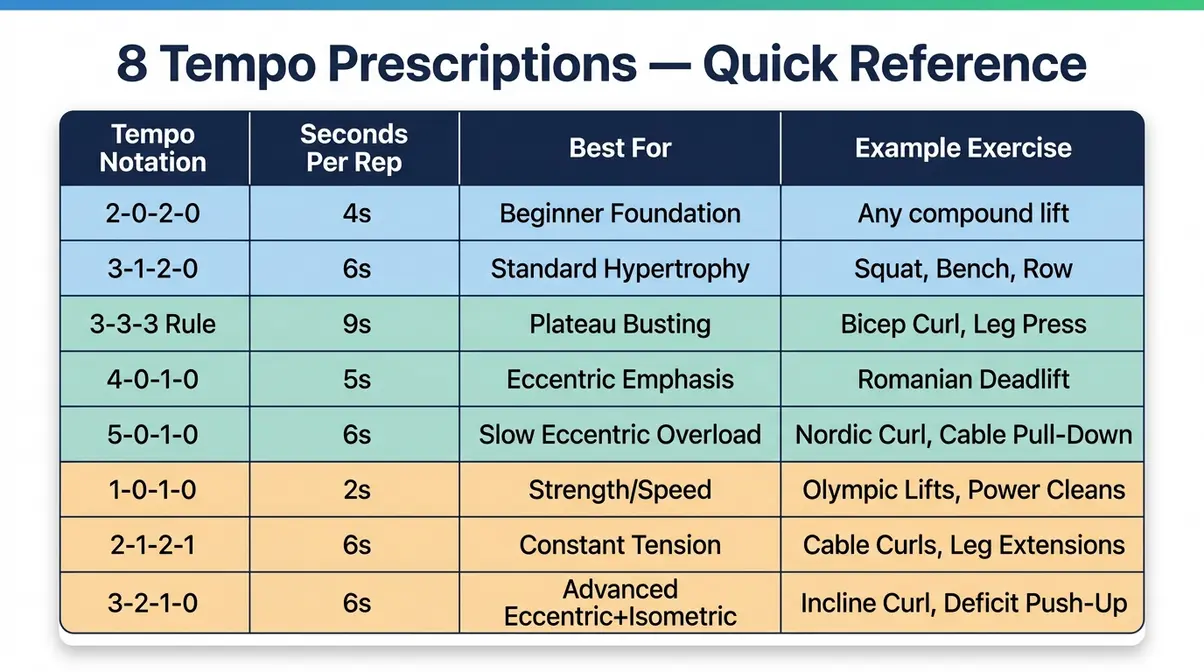
8 Actionable Tempo Prescriptions
Tempo is a great tool for applying progressive overload for muscle growth. Here are the most effective methods:
1. 3-1-2-0 — The Standard Hypertrophy Tempo
6 seconds per rep | 10 reps = 60 seconds TUT
The most research-supported general hypertrophy tempo. The 3-second eccentric creates meaningful muscle damage and tension; the 1-second pause eliminates momentum; the 2-second concentric maintains control. Use for compound lifts (squat, bench, row) during dedicated hypertrophy phases. This tempo keeps you squarely in the 40–70 second TUT hypertrophy zone across 8–12 reps.
2. The 3-3-3 Rule
9 seconds per rep | 6 reps = 54 seconds TUT
The 3-3-3 rule means 3 seconds eccentric, 3 seconds pause at the bottom, 3 seconds concentric. It is a plateau-busting tempo that combines eccentric tension with an isometric (static hold) challenge. The extended pause eliminates all elastic energy from the muscle — meaning every rep starts from a dead stop under load. Best for isolation movements like bicep curls, leg press, and dumbbell flyes when you’ve stalled on standard tempos.
3. 4-0-1-0 — The Eccentric Emphasis Tempo
5 seconds per rep | 10 reps = 50 seconds TUT
A slow eccentric with a fast concentric. This is the most evidence-backed single modification you can make to a set. Research consistently shows the eccentric phase generates the greatest mechanical tension and muscle damage — the two signals most strongly linked to hypertrophy. The fast concentric preserves power output. Use for any exercise where eccentric control is practical: Romanian deadlifts, pull-ups, dumbbell press.
4. 2-0-2-0 — The Beginner Foundation Tempo
4 seconds per rep | 10 reps = 40 seconds TUT
A controlled but not excessively slow tempo that teaches proper movement patterns without causing excessive soreness or fatigue. Sits at the lower boundary of the hypertrophy zone. Ideal for beginners in their first 4–8 weeks of training, or when learning a new exercise. The even tempo makes it easy to count and maintain consistency across all reps.
5. 5-0-1-0 — The Slow Eccentric Overload
6 seconds per rep | 8 reps = 48 seconds TUT
An extended eccentric with a fast concentric. Used specifically to maximize eccentric overload — the most growth-stimulating phase of a lift. Best reserved for experienced trainees on isolation movements (Nordic curls, cable pull-downs, incline curls). Expect significant delayed-onset muscle soreness (DOMS) for 48–72 hours after first use. Introduce gradually — one exercise per session before progressing.
6. 1-0-1-0 — The Strength/Speed Tempo
2 seconds per rep | 5 reps = 10 seconds TUT
A fast, controlled tempo that prioritizes mechanical tension through load rather than duration. This is the tempo of strength work — used with 80–90% of your one-rep maximum. TUT is low, but motor unit recruitment and mechanical tension are maximized. Use during strength-focused phases or for compound movements where speed of movement is part of the skill (Olympic lifts, power cleans).
7. 2-1-2-1 — The Constant Tension Tempo
6 seconds per rep | 10 reps = 60 seconds TUT
A balanced tempo with pauses at both the top and bottom of the movement. The pauses prevent the muscle from resting at either end of the range — maintaining constant tension throughout. Particularly effective for cable exercises and machines where the resistance curve allows tension at both ends (cable curls, leg extensions, lat pull-downs).
8. 3-2-1-0 — The Advanced Eccentric + Isometric Tempo
6 seconds per rep | 10 reps = 60 seconds TUT
A slow eccentric followed by a 2-second isometric hold at peak stretch — the point of maximum muscle length under load. Research suggests that training in the lengthened position (muscle fully stretched) produces superior hypertrophic signaling compared to training in the shortened position (Men’s Health, 2026). Use for exercises with a strong stretch position: Romanian deadlifts, incline curls, deficit push-ups, single-leg calf raises.
Controlling the Eccentric Phase
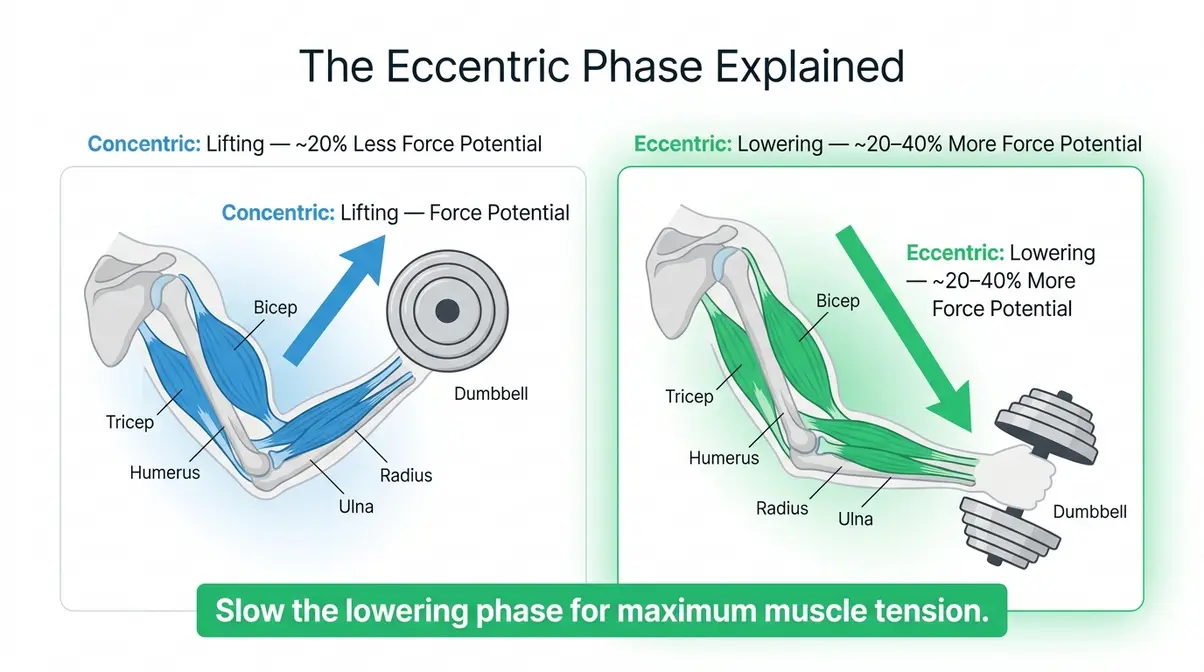
Of all the TUT modifications available, controlling the eccentric phase produces the most consistent evidence of enhanced hypertrophy. The eccentric phase — the lowering portion of any lift — generates greater force per motor unit than the concentric phase, causes more micro-damage to muscle fibers, and triggers a stronger muscle protein synthesis response.
Research from McMaster University found that eccentric-emphasized training produced significantly greater muscle cross-sectional area increases compared to concentric-emphasized training at matched volumes. The mechanism: your muscle can handle approximately 20–40% more load eccentrically than concentrically — meaning a controlled lowering phase subjects the muscle to a higher relative stress than the lifting phase ever could.
To apply eccentric control effectively:
- Start with a 2-second eccentric if you’re new to tempo training. Count “one-one-thousand, two-one-thousand” as you lower.
- Progress to 3 seconds once the 2-second tempo feels natural across all reps of a set.
- Maintain full range of motion. A slow eccentric through a partial range is less effective than a controlled eccentric through the full movement.
- Don’t sacrifice load. If slowing the eccentric forces you to drop to a weight that feels effortless, find the middle ground — a moderately slow eccentric at a challenging weight beats a very slow eccentric at a trivial weight.
- Prioritize compound movements first. Eccentric control on squats, rows, and press movements builds the habit across your entire program before you refine it on isolation work.
How Much Time Under Tension Per Set?
The popular claim that “40–70 seconds per set is the hypertrophy zone” has a basis in research — but it’s been oversimplified to the point of becoming misleading. Here’s the nuanced picture.
The 40–70 second range was identified in early metabolic stress research as a window where lactate accumulation and hormonal responses were meaningfully elevated. However, subsequent research showed that hypertrophy occurs across a much wider range — from sets as short as 20 seconds (heavy, 4–6 rep work) to sets as long as 90+ seconds (high-rep, lighter load work) — provided effort is high.
Practical guidelines based on current evidence:
| Goal | Recommended TUT Per Set | Rep Range | Load |
|---|---|---|---|
| Maximal Strength | 15–30 seconds | 3–6 reps | 80–90% 1RM |
| Hypertrophy (primary) | 40–70 seconds | 8–15 reps | 65–80% 1RM |
| Hypertrophy (metabolic) | 60–90 seconds | 15–25 reps | 50–65% 1RM |
| Endurance/Conditioning | 90+ seconds | 25+ reps | Under 50% 1RM |
The key takeaway: aim for the 40–70 second range as a starting point for hypertrophy, but don’t abandon sets that fall outside this window. A heavy set of 5 reps at high effort produces hypertrophy. A light set of 25 reps at near-failure produces hypertrophy. The clock is a guide, not a law.
TUT Mistakes That Kill Your Gains
Our evaluation of the most frequent training errors related to tempo reveals four patterns that consistently undermine results — even when lifters think they’re applying TUT correctly.
Mistake 1: Dropping the load to chase the clock
This is the most damaging error. If you’re dropping to a weight you could lift with your eyes closed just to hit 60 seconds, you’ve sacrificed Tier 1 of The Tension Hierarchy for Tier 3. A shorter set with a challenging load outperforms a longer set with a trivial load every time. The fix: use a load that’s challenging for 8–12 reps before you add tempo modifications.
Mistake 2: Only slowing the concentric (lifting) phase
Many lifters slow their upward movement and rush the lowering. This is backwards. The eccentric phase is where the greatest mechanical tension occurs. Rushing the lowering phase to set up a slow lift wastes the highest-value portion of the rep. The fix: prioritize a 2–3 second eccentric before modifying any other phase.
Mistake 3: Inconsistent tempo across a set
Reps 1–5 at a controlled 3-second eccentric, reps 6–10 at a rushed 1-second eccentric. This is common when fatigue sets in — and it means your actual TUT is far lower than intended. The fix: use a lighter load if you can’t maintain tempo across all reps. Consistency beats speed.
Mistake 4: Applying TUT to every exercise, every session
Slow tempos are fatiguing — particularly for the tendons and connective tissue around a joint. Applying 3-4-second eccentrics to every exercise every session increases injury risk and limits the load you can use on primary compound lifts. The fix: apply tempo modifications selectively — typically to 2–3 isolation exercises per session, while keeping compound lifts at a standard controlled tempo (2-0-1-0 or 2-0-2-0).
What kills muscle gains the most?
If you are wondering what kills muscle gains the most, insufficient mechanical tension is the most common growth killer — typically caused by using loads that are too light to recruit high-threshold motor units, regardless of how long the set lasts. Other major inhibitors include consistently stopping sets far from failure (low effort), inadequate training volume over time, and poor sleep and nutrition undermining recovery. From a TUT perspective, the biggest mistake is trading load for tempo — sacrificing Tier 1 of The Tension Hierarchy to hit an arbitrary time target.
Safety, Limitations, and When TUT Isn’t the Answer
TUT is a legitimate training tool — but it’s not appropriate for every lifter, every exercise, or every phase of training. Applying it without context can lead to injury, stalled progress, or misplaced priorities. Here’s when to use it with caution, and when to set it aside entirely.
When TUT May Not Be the Right Focus
New lifters (under 3 months of consistent training): Before tempo becomes meaningful, you need to develop basic movement competency. Attempting to count a 3-second eccentric while also learning to squat safely splits your attention in a way that increases injury risk. Focus on learning the movement pattern first. A standard, controlled rep tempo (2-0-2-0) is sufficient for the first 8–12 weeks.
During strength-focused phases: If your primary goal for a training block is building maximal strength (working at 80–90% of your one-rep maximum), slow tempos are counterproductive. They reduce the load you can handle, limit power output, and shift the training stimulus away from the neuromuscular adaptations that drive strength gains. Save TUT modifications for hypertrophy blocks.
When training with joint pain or acute injury: Slow eccentrics are effective for rehabilitation in controlled clinical settings — but self-prescribing slow eccentric loading on a painful joint without professional guidance can worsen tissue damage. If you have persistent joint pain, consult a physiotherapist before modifying your tempo.
When your training volume is already high: Adding slow eccentrics to a high-volume program increases cumulative mechanical stress on tendons and connective tissue. If you’re already training 5–6 days per week with significant volume, introducing aggressive TUT modifications across multiple exercises may increase overuse injury risk. Add tempo work gradually — one or two exercises per session — and monitor recovery.
Medical Disclaimer & Expert Advice
⚠️ Exercise and Health Disclaimer: The information in this article is for educational purposes only and does not constitute medical or professional fitness advice. Individual responses to exercise training vary significantly based on age, training history, health status, and other factors. Before beginning any new exercise program or significantly modifying your current training, consult a certified personal trainer (CPT), a certified strength and conditioning specialist (CSCS), or a licensed physician — particularly if you have any pre-existing musculoskeletal conditions, cardiovascular concerns, or are returning from injury.
The tempo prescriptions and guidelines in this article are general recommendations based on current research and are not a substitute for personalized programming from a qualified fitness professional. If any exercise causes sharp pain, joint discomfort, or unusual fatigue, stop immediately and seek professional guidance.
This article has been reviewed for accuracy against current exercise science literature. For personalized programming, work with a certified fitness professional.
Time Under Tension FAQs
Does TUT actually build muscle?
Yes, time under tension contributes to muscle growth — but it works as an amplifier, not a primary driver. Research shows TUT enhances metabolic stress and muscle damage, two of the three hypertrophy mechanisms. However, mechanical tension (the force generated against a meaningful load) is the dominant signal for muscle protein synthesis. TUT produces the best results when combined with sufficient load and proximity to failure, not as a replacement for challenging weight.
How much TUT does a muscle need?
A set duration of 40–70 seconds is the most commonly cited hypertrophy range, based on metabolic stress research (Journal of Strength and Conditioning Research). In practice, this corresponds to roughly 8–12 reps with a controlled 3–5 second tempo per rep. However, hypertrophy occurs outside this window too — heavy sets of 5 reps (20–30 seconds) and high-rep sets of 20+ reps (90+ seconds) both produce growth when effort is high. The range is a guideline, not a law.
Is time under tension debunked?
TUT is not debunked — it’s been refined. Early research oversimplified the concept into “longer sets = more growth,” which subsequent studies disproved. The current scientific consensus is that TUT is a useful training variable that enhances metabolic stress and eccentric muscle damage, particularly when the load is sufficient. What’s been debunked is the idea that slowing down reps with light weights produces superior hypertrophy. The load still has to be there.
What is the 3-3-3 rule for gym?
The 3-3-3 rule means performing each rep with a 3-second eccentric, a 3-second pause at the bottom, and a 3-second concentric — totaling 9 seconds per rep, a standard recognized by fitness experts at Men’s Health. At 6 reps, that produces 54 seconds of TUT per set. The extended pause at the bottom eliminates elastic energy from the muscle, forcing every rep to begin from a dead stop under load. It’s particularly effective for isolation exercises like bicep curls, leg press, and cable flyes when standard tempos stop producing results.
Does a slow eccentric build more muscle?
Yes, controlling the eccentric phase is highly effective for muscle growth. The eccentric (lowering) phase generates greater force per motor unit and causes more micro-damage to muscle fibers than the lifting phase. This triggers a stronger muscle protein synthesis response, making a 2-3 second eccentric one of the most reliable ways to apply time under tension effectively.
Can you build muscle with light weights?
Yes, but only if you take the set close to muscular failure. Research shows that light weights can build muscle if the set is extended to near-failure, which maximizes metabolic stress. However, if the load drops below 30% of your one-rep maximum, mechanical tension becomes insufficient to recruit high-threshold motor units, regardless of how long the set lasts.
The Verdict: TUT Is a Tool – Use It Like One
Time under tension is a legitimate and evidence-supported training variable. The research confirms it contributes to hypertrophy through metabolic stress and eccentric muscle damage. But the science is equally clear that it is not the primary driver of muscle growth — mechanical tension holds that position.
The Tension Hierarchy gives you a clear decision framework: build your training on sufficient load and proximity to failure first. Once those foundations are in place, tempo manipulation — particularly a 2–3 second eccentric phase — becomes a meaningful amplifier of your results. Skipping the foundation to chase the clock is the most common and most costly mistake in TUT training.
The 8 tempo prescriptions in this guide give you specific tools to apply immediately. Start with the 2-0-2-0 beginner tempo or the 3-1-2-0 standard hypertrophy tempo, focus on maintaining that tempo across every rep of every set, and only add more complex protocols (the 3-3-3 rule, the 5-0-1-0 overload) once the basics feel natural.
Your next workout doesn’t need a stopwatch. It needs a challenging load, controlled movement, and the understanding that the seconds matter — but only after the weight does.
Related posts:
How Long to Build Muscle? Your Evidence-Based Timeline
Calorie Deficit Too Large? 5 Warning Signs to Fix It
Compound vs Isolation Exercises: Which Builds More Muscle?
Best Collagen Protein Powder: 9 Expert Picks (2026)
How Fast to Lose Fat: Safe Rate, Timeline & Science
Testosterone Muscle Growth Science: Complete Guide

Callum
Hi, I'm Callum, the founder of Body Muscle Matters. I'm not a certified trainer, I'm a self taught lifter who started this site to share what I've learned from my own training and a lot of trial and error. Everything here comes from real experience and honest research, written the way I'd explain it to a friend who is just getting started. My goal is simple: practical, no hype fitness advice you can actually use.