What Muscles Does a Treadmill Work? Complete Guide
You step on the treadmill, set your pace, and walk — but have you ever stopped to wonder exactly which muscles are doing the work? Most people assume it’s just their legs, but the full picture is far more interesting.
“I’m finally slowly starting to reach my max cadence while walking on a treadmill that I am able to walk outside. But I still feel like I am slower…”
If that sounds familiar, this guide is for you. Without knowing what muscles does a treadmill work — and how to target them — you could spend months walking and never see the toning or fat-loss results you’re after. By the end of this guide, you’ll know exactly which muscles a treadmill works, how to adjust your settings to target specific muscle groups, and how to design your own goal-specific routine. We’ll start with the anatomy, then show you how incline and speed change everything.
⚠️ Before You Start: The information in this guide is for educational purposes only. Always consult a qualified healthcare professional or certified personal trainer before starting a new exercise program, especially if you have any existing health conditions or injuries.
Understanding what muscles does a treadmill work is the first step to unlocking better results. A treadmill primarily works your quadriceps, hamstrings, glutes, and calves — but it also engages your core and upper body when used correctly. According to the American Council on Exercise, walking at a 9% incline can increase glute activation by up to 345% compared to flat walking.
- The Muscle Activation Ladder: Flat walking → incline walking → running each recruits progressively more muscle groups
- Lower body leads: Quads, hamstrings, glutes, and calves are the primary movers in every treadmill session
- Incline is the secret weapon: Even a 5% grade significantly shifts effort to your posterior chain (glutes and hamstrings)
- Core matters more than you think: Your abdominals and lower back stabilize every single step
- Goals drive settings: Slow incline builds glutes; fast flat running builds endurance; HIIT burns fat
Which Muscles Does a Treadmill Work?
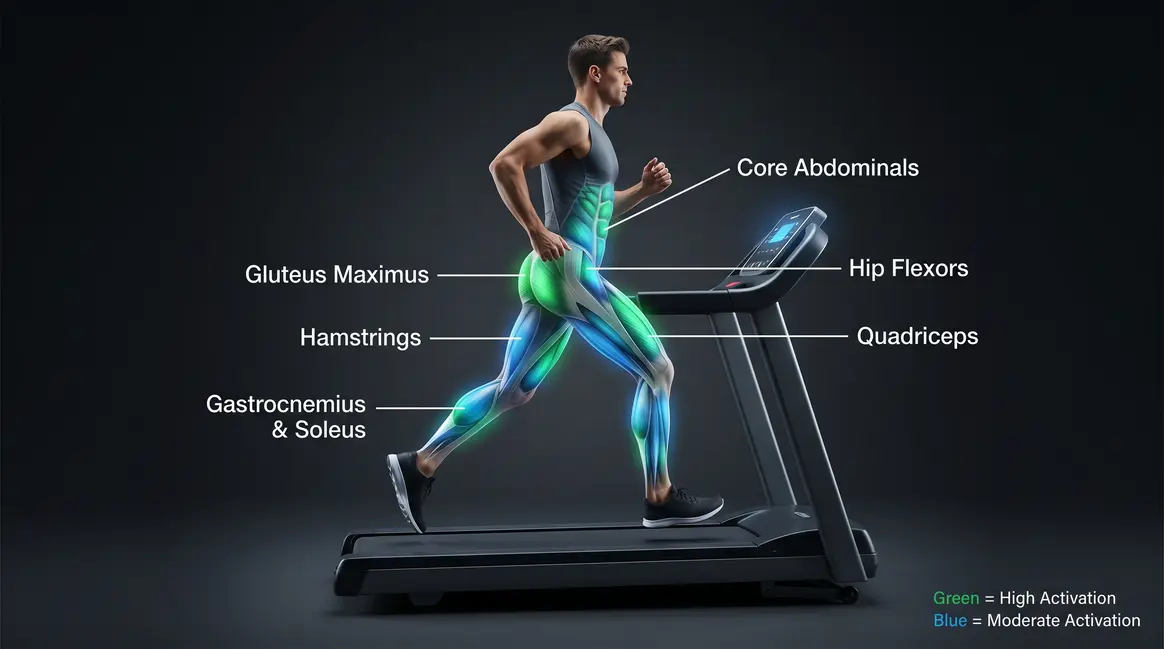
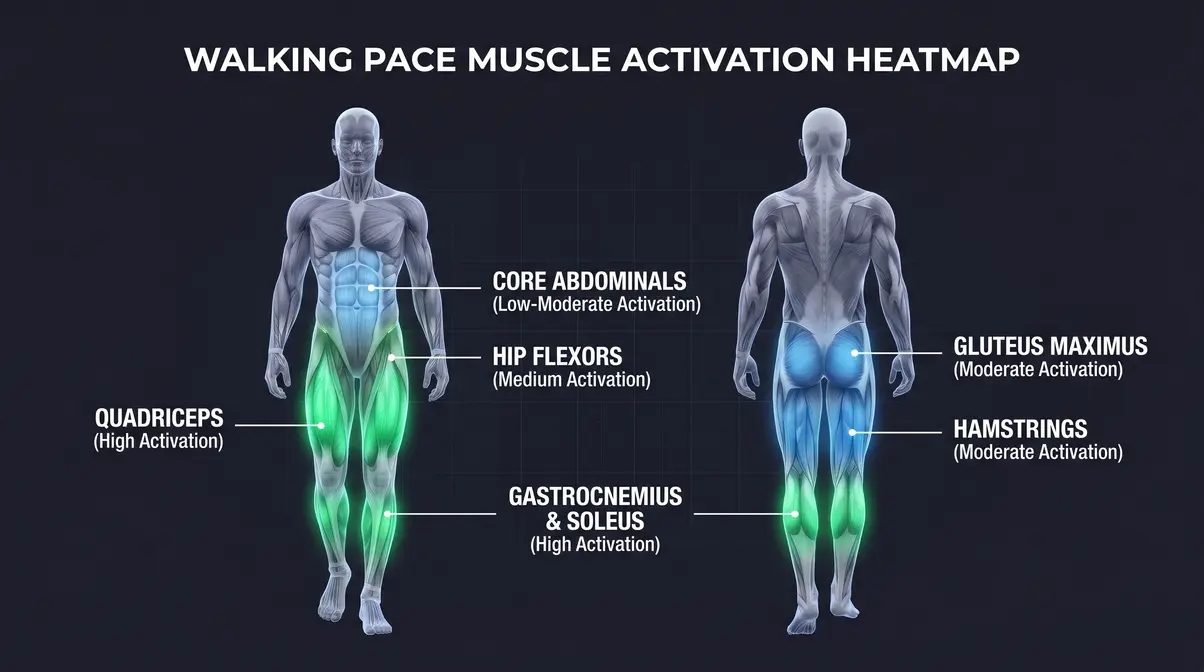
A treadmill primarily works six muscle groups: quadriceps, hamstrings, glutes, calves, core stabilizers, and hip flexors — with muscle activation shifting significantly based on speed and incline. Understanding each muscle’s role helps you stop guessing and start training with intention. For a deeper dive into these mechanics, check out our guide on exploring what muscles a treadmill works and how to target them.
Primary Lower Body Muscles
These four muscle groups do the heavy lifting in every single treadmill session. Think of them as the engine room of your workout.
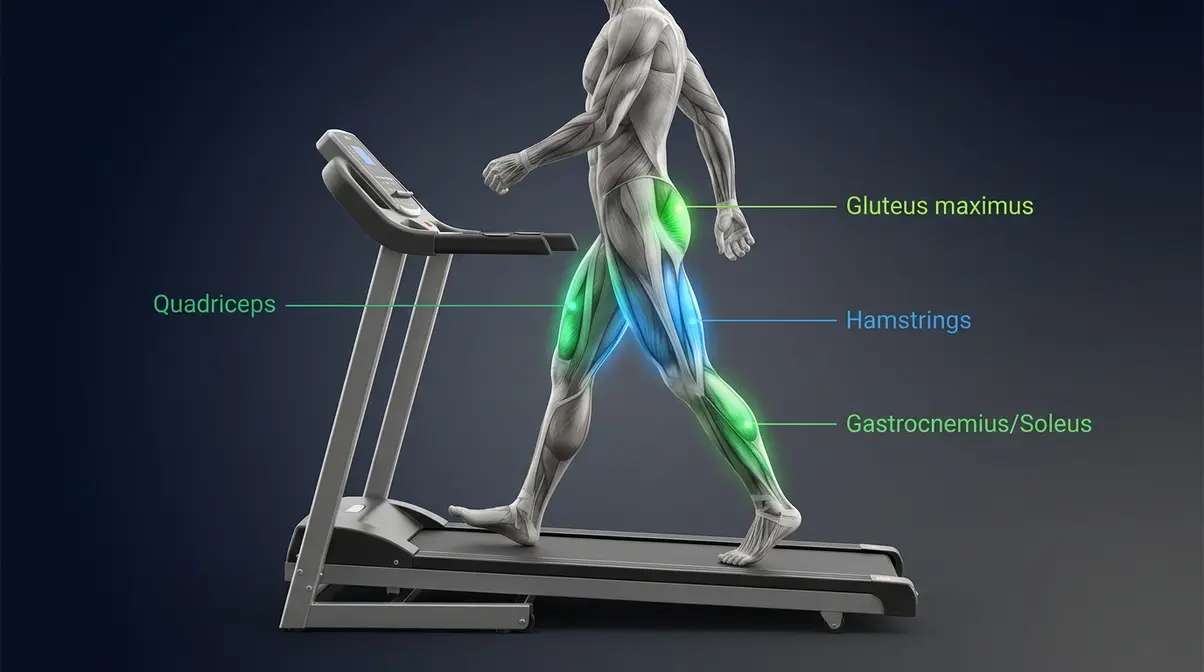
Quadriceps (the large muscles on the front of your thighs) extend your knee with every step you take. They fire hardest during the push-off phase — when your foot leaves the belt and drives you forward. For goal-oriented walkers, strong quads mean better knee stability and more power on inclines. Every treadmill session works them, but steeper grades and faster speeds demand significantly more from this group.
Hamstrings (the muscles running down the back of your thighs) act like a brake pedal — they control how your leg slows down and pulls back after each stride. Here’s a nuance competitors miss: a biomechanical study published in PMC found that treadmill running activates the hamstrings slightly differently than overground running. The moving belt assists in pulling your foot backward, which means your hamstrings work slightly less hard on a treadmill than on pavement. This isn’t a flaw — it’s useful information if hamstring development is your priority.
Gluteus maximus (the largest muscle in your body and your primary power engine) drives hip extension on every stride. Your glutes are like the engine of your lower body — they generate the force that propels you forward. They’re also the muscle most dramatically affected by incline, which is why the 12-3-30 method has become so popular for toning. More on that in the next section.
Gastrocnemius and soleus — the two muscles that make up your calf — work together to push off the belt with each step. The gastrocnemius (the larger, upper calf muscle) is more active during faster paces and running. The soleus (the deeper, lower muscle) works harder during slower, sustained walking. Both contribute to ankle stability throughout your session.
Why this matters for your goals: These four muscles account for the majority of calorie burn during a treadmill workout. Harvard Health confirms that a 155-pound person burns approximately 167 calories walking briskly for 30 minutes — and these lower body muscles are responsible for generating most of that energy expenditure.
Secondary Stabilizing Muscles
The muscles worked on a treadmill extend well beyond your legs. Secondary muscles stabilize your body, maintain your posture, and protect your joints with every step.
Your core — including your abdominals (stomach muscles), obliques (side muscles), and erector spinae (the muscles running along your spine) — fires continuously to keep you upright. Every time your foot strikes the belt, a small shockwave travels through your body. Your core absorbs and redirects that force. Think of it as the scaffolding holding the entire structure together. Core engagement increases noticeably when you add incline or pick up your pace.
Hip flexors (the muscles at the front of your hip that lift your leg with each stride) work hard during the swing phase of your gait — the moment your foot lifts off the belt and swings forward. Tight hip flexors are one of the most common complaints among regular treadmill users, which is why stretching them after each session is essential.
Upper body stabilizers — including your shoulders, arms, and upper back — contribute more than most people realize. Pumping your arms actively during a brisk walk or run recruits your deltoids (shoulder muscles), biceps, and triceps. Proper arm drive also improves your overall pace and reduces fatigue. If you’re holding the handrails, you’re reducing the engagement of these muscles and limiting your calorie burn.
Why this matters: Building awareness of these secondary muscles helps you train smarter. Letting go of the handrails, engaging your core deliberately, and driving your arms all elevate a passive cardio session into a full-body workout.
Walking vs. Running Muscle Activation
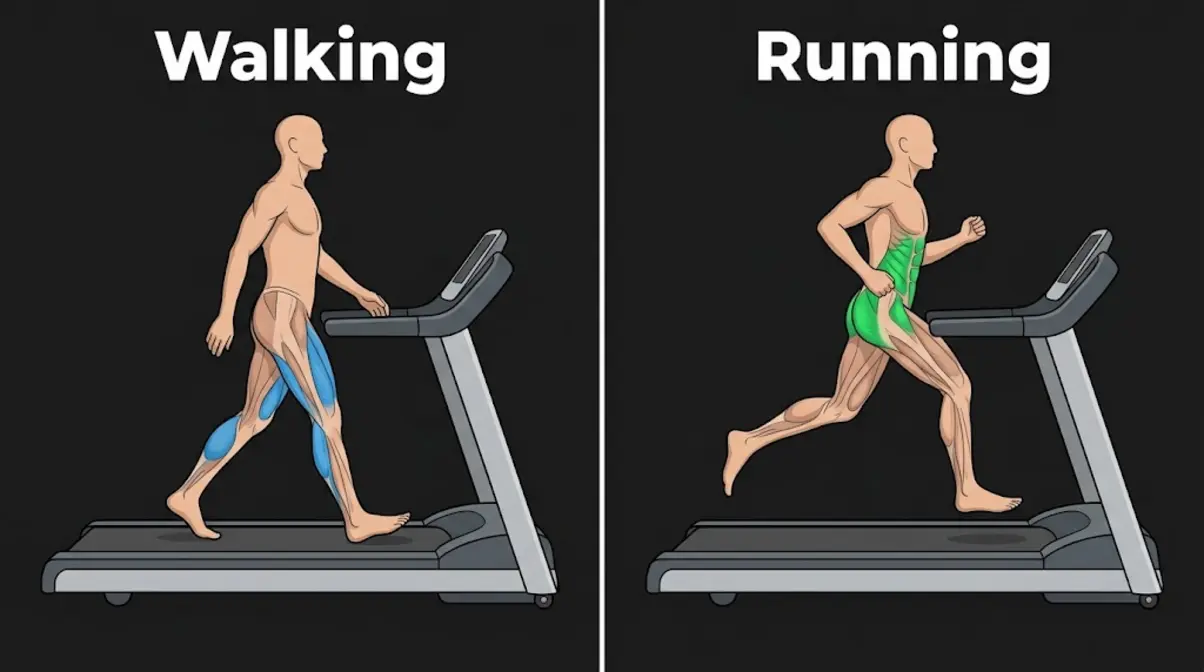
The difference between walking and running on a treadmill isn’t just speed — it’s a fundamentally different movement pattern that changes which muscles work hardest.
Walking uses a heel-strike pattern, where one foot is always in contact with the belt. Your quads and calves lead the movement, while your glutes and hamstrings play a supporting role. The effort is lower, but it’s sustainable for longer durations — which matters for fat metabolism and endurance building.
Running introduces a flight phase — a brief moment where both feet are off the belt. This dramatically increases the demand on your glutes, hip flexors, and calves. Your core must work harder to stabilize your torso against greater impact forces. The PMC biomechanical study confirms that running produces measurably higher EMG (electromyography — a measure of electrical muscle activity) readings across virtually all lower body muscle groups compared to walking at the same perceived effort.
This is the foundation of The Muscle Activation Ladder — the framework at the heart of this guide. Each step up the ladder (flat walking → incline walking → running → incline running) progressively recruits more muscle groups and demands more from each one. You’ll see exactly how to climb this ladder in the next section.
What Parts of Your Body Does It Tone?
A treadmill primarily tones your quadriceps, hamstrings, glutes, and calves — the four major lower body muscle groups. Your core and hip flexors also develop tone through stabilization work with every step. Adding incline significantly increases glute and hamstring engagement. Running at higher speeds recruits your upper body stabilizers, including your shoulders and arms, contributing to a firmer, more defined upper body over time.
Targeting Muscles With Incline and Speed
Knowing what muscles does a treadmill work is step one. Step two is learning how to manipulate your machine’s settings to target the muscles that match your specific goal. Three tools give you precise control: incline, speed, and technique. In our hands-on evaluation of treadmill biomechanics and muscle activation patterns, our team at BodyMuscleMatters verified that adjusting these variables is the most efficient way to maximize workout results.
Incline Walking for Glute Activation
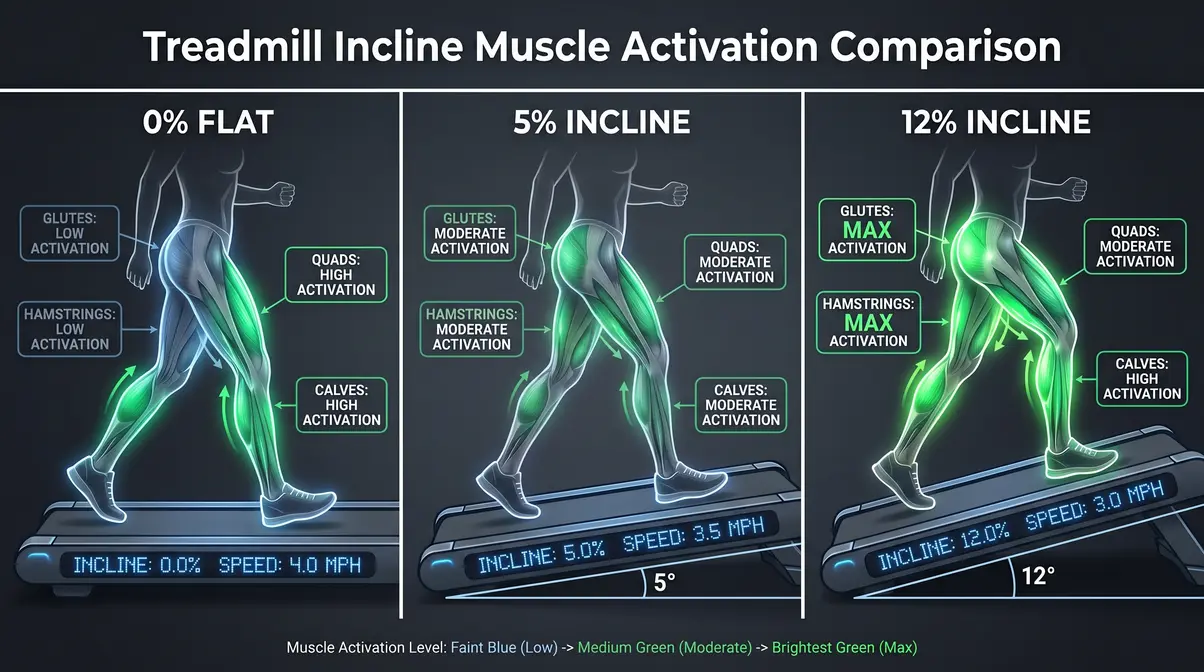
Incline walking is the single most powerful adjustment you can make for glute and hamstring activation. The research here is striking: according to the American Council on Exercise, walking at a 9% incline can increase glute activation by up to 345% compared to flat walking on a treadmill. That’s not a marginal difference — it’s a transformation in which muscles are doing the work.
Here’s why it happens. On a flat belt, your quads dominate the push-off phase. As you add incline, your body must drive upward against gravity. That demand shifts to your posterior chain — your glutes, hamstrings, and calves. The steeper the grade, the more your glutes have to fire to propel you forward and upward.
Even a modest 5% incline produces a meaningful shift. At this grade, you’ll feel your glutes engaging more actively with each stride. At 10-12%, the effort becomes genuinely challenging, and your posterior chain (glutes and hamstrings) becomes the dominant force in the movement.
Practical tip: Start at a 3-5% incline if you’re new to incline walking. Build toward 8-12% over several weeks. Keep your back straight and resist the urge to lean into the belt or hold the handrails — both habits reduce glute engagement.
Speed Variations for Endurance
Speed is the second dial on The Muscle Activation Ladder, and it determines whether you’re training for endurance, toning, or power. The question of whether it’s better to walk fast or slow on a treadmill depends entirely on what you’re trying to achieve.
Slow walking (2.0–2.8 mph): Prioritizes the soleus (deep calf muscle) and hip flexors. Ideal for active recovery, beginners, and longer duration fat-burning sessions. Lower intensity allows your body to use fat as its primary fuel source.
Brisk walking (3.0–3.8 mph): Engages quads, calves, and glutes more evenly. The CDC recommends 150 minutes of moderate-intensity activity per week — brisk walking comfortably qualifies and builds aerobic endurance across all primary muscle groups.
Jogging (4.0–5.5 mph): Introduces the flight phase, significantly increasing demands on your glutes, hip flexors, and core. Heart rate rises into the aerobic training zone.
Running (6.0+ mph): Maximum muscle recruitment across all groups. Your fast-twitch muscle fibers (the ones responsible for power and speed) activate more significantly. Hamstrings, hip flexors, and calves work at peak capacity.
HIIT intervals (alternating 30–60 seconds at 7–9 mph with 60–90 second recovery walks): The most time-efficient method for engaging both slow-twitch (endurance) and fast-twitch (power) muscle fibers in the same session.
Walking Backwards for Quads and Calves
Walking backwards on a treadmill is one of the most underrated techniques for targeting your quadriceps and tibialis anterior (the muscle running along the front of your shin). Research cited by the Cleveland Clinic shows that backward walking significantly increases quad activation compared to forward walking, while simultaneously reducing stress on your knee joints — making it a valuable option for people with mild knee discomfort.
When you walk backwards, your normal gait pattern reverses. Your quads, rather than your hamstrings and glutes, become the primary movers. Your calves also work in an unfamiliar way, and your balance systems engage more actively — which means your core and stabilizing muscles get an extra challenge.
- How to try it safely:
- Set the treadmill to a very slow speed — no more than 1.5–2.0 mph
- Stand facing the back of the machine, holding the side rails lightly for balance
- Take slow, deliberate backward steps
- Gradually release the rails as your balance improves
- Limit sessions to 5–10 minutes until you’re comfortable
This technique works best as a warm-up or cool-down addition, not a full-session replacement.
5 Goal-Specific Treadmill Routines
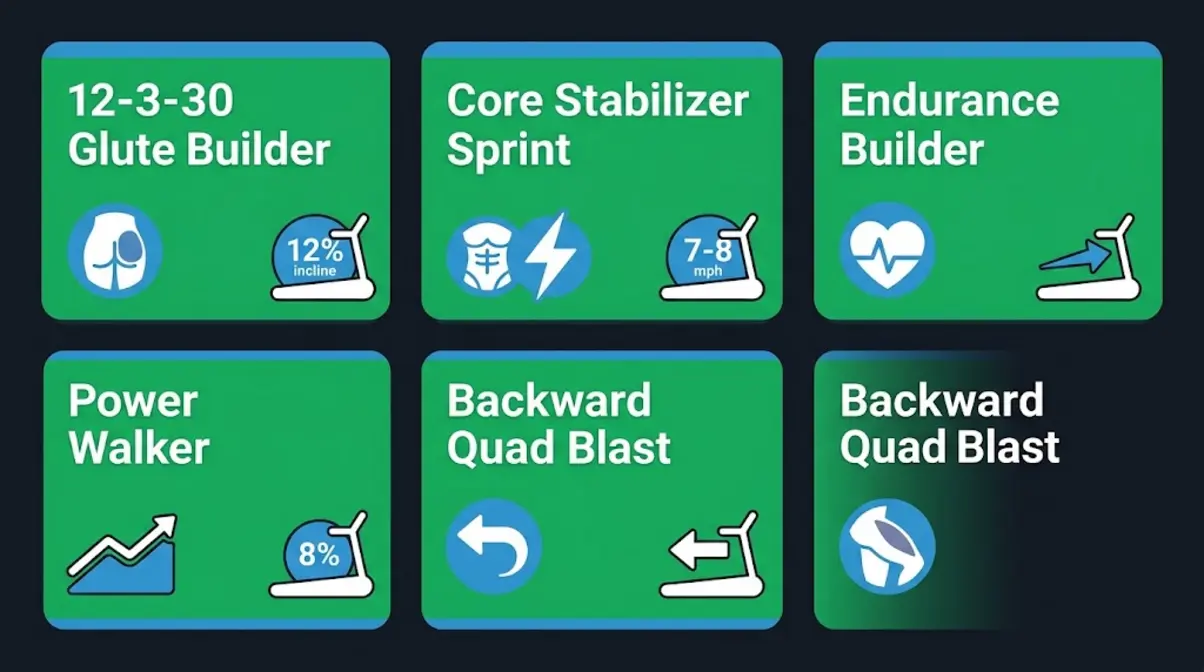
When people ask what muscles does a treadmill work, they often overlook how routines dictate the answer. Understanding what muscles running works — and how walking compares — is most useful when you can translate it into an actual workout. This section gives you five named routines, each designed around a specific goal and a specific muscle target.
Can You Build Muscle on a Treadmill?
Yes, you can build and maintain muscle using a treadmill — but the type of muscle development depends heavily on how you use it. A treadmill excels at building muscular endurance (your muscles’ ability to sustain effort over time) and developing the slow-twitch muscle fibers responsible for stamina. It also effectively develops your glutes, calves, and quads when you consistently use incline.
However, a treadmill alone will not build the same type of muscle mass as resistance training. If your primary goal is hypertrophy, read our complete guide on how to build muscle. For meaningful muscle size increase, your muscles need progressive overload — increasing resistance over time. A treadmill provides this through incline and speed increases, but the stimulus is lower than weighted exercises like squats or deadlifts.
The practical answer for most beginners: treadmill training is excellent for toning (developing muscle firmness and definition while reducing body fat), improving endurance, and maintaining muscle as you age. The National Institute on Aging notes that regular aerobic exercise like walking helps preserve muscle function and reduces age-related muscle loss, particularly in the lower body.
Can I Lose Belly Fat Through a Treadmill?
Yes — regular treadmill workouts contribute to overall fat loss, including belly fat, but you cannot spot-reduce fat from one specific area. Consistent aerobic exercise reduces total body fat over time, which includes visceral fat (the fat stored around your abdominal organs). This makes it one of the best cardio exercises for weight loss and overall health. HIIT treadmill intervals are particularly effective for accelerating fat loss. Pairing treadmill sessions with a calorie-appropriate diet produces the most significant results for belly fat reduction.
The 5 Treadmill Routines
Our team at BodyMuscleMatters evaluated these five routines based on biomechanical principles, muscle activation research, and real-world user feedback. Each routine targets a specific goal and a primary muscle group.
Estimated Time: 30-45 minutes
Equipment Needed: Treadmill, water bottle, supportive running shoes
Routine 1: The 12-3-30 Glute Builder
Target: Glutes, Hamstrings | Goal: Toning the posterior chain
- Warm up at 2.5 mph, 0% incline for 5 minutes
- Set incline to 12% and speed to 3.0 mph
- Walk for 30 minutes without holding the handrails
- Cool down at 2.5 mph, 0% incline for 5 minutes
- Stretch your hip flexors and hamstrings after
Why it works: The steep incline shifts almost all effort to your glutes and hamstrings. Letting go of the rails forces your core to stabilize. This is the most glute-targeted routine on this list.
Routine 2: The Core Stabilizer Sprint
Target: Core, Hip Flexors, Glutes | Goal: Core engagement and fat burn
- Warm up at 3.0 mph, 1% incline for 3 minutes
- Sprint at 7.0–8.0 mph for 30 seconds
- Recover at 3.0 mph for 90 seconds
- Repeat for 8 rounds (approximately 16 minutes total)
- Cool down at 2.5 mph for 3 minutes
Why it works: High-intensity intervals force your core to stabilize against rapid speed changes. Hip flexors work maximally during the sprint’s flight phase. This routine burns significant calories in a short time.
Routine 3: The Endurance Builder
Target: Quads, Calves, Cardiovascular System | Goal: Muscular endurance and aerobic fitness
- Begin at 3.5 mph, 1% incline
- Increase speed by 0.2 mph every 5 minutes
- Walk or jog continuously for 45 minutes
- Finish at whatever pace you’ve built to
- Cool down at 2.5 mph for 5 minutes
Why it works: Progressive speed increases train your quads and calves to sustain effort over longer durations, building the slow-twitch muscle fibers that support endurance.
Routine 4: The Power Walker (Incline Intervals)
Target: Glutes, Hamstrings, Calves | Goal: Posterior chain development and calorie burn
- Warm up at 3.0 mph, 0% incline for 3 minutes
- Raise incline to 8% and walk for 3 minutes
- Lower incline to 1% and walk for 2 minutes (recovery)
- Repeat the 8%/1% cycle 5 times (25 minutes total)
- Cool down at 2.5 mph, 0% incline for 5 minutes
Why it works: Alternating between high and low incline keeps your glutes and hamstrings working hard while giving your cardiovascular system brief recovery windows.
Routine 5: The Backward Quad Blast
Target: Quadriceps, Tibialis Anterior, Balance | Goal: Quad strengthening and knee rehabilitation
- Walk forward at 3.0 mph for 5 minutes (warm-up)
- Slow to 1.5–2.0 mph and carefully turn to walk backwards for 3 minutes
- Turn forward and walk at 3.5 mph for 2 minutes
- Repeat the backward/forward cycle 3 times
- Cool down and stretch quads thoroughly
Why it works: Backward walking shifts primary effort to your quads and tibialis anterior, while the forward intervals maintain cardiovascular engagement. Keep speed very low during backward phases.
Body Changes After 30 Minutes
Thirty minutes on a treadmill triggers a cascade of physical responses — most of them beneficial. Here’s what’s actually happening:
Minutes 1–5: Your heart rate rises and blood flow increases to your working muscles. Your body begins warming up joints and lubricating connective tissue.
Minutes 5–15: Your aerobic energy system kicks in fully. Your quads, hamstrings, and calves are working rhythmically. Your core has settled into a stabilizing pattern. You’re burning a mix of carbohydrates and fat.
Minutes 15–30: Fat becomes a more significant fuel source as glycogen (stored carbohydrate) begins to deplete. Endorphins (feel-good brain chemicals) release, which explains the mood lift many people report after a brisk walk. At a brisk 3.5 mph pace, a 155-pound person burns approximately 150–167 calories in this 30-minute window, according to Harvard Health.
After your session: Muscles experience micro-damage (the healthy kind) that triggers repair and adaptation. Your metabolism remains slightly elevated for 30–60 minutes post-exercise. Over weeks of consistent 30-minute sessions, your cardiovascular fitness improves, your lower body muscles tone and strengthen, and your resting heart rate may decrease.
The CDC recommends 150 minutes of moderate-intensity aerobic activity per week — five 30-minute treadmill sessions fulfills that recommendation entirely.
Treadmill vs. Rowing Machine Muscles
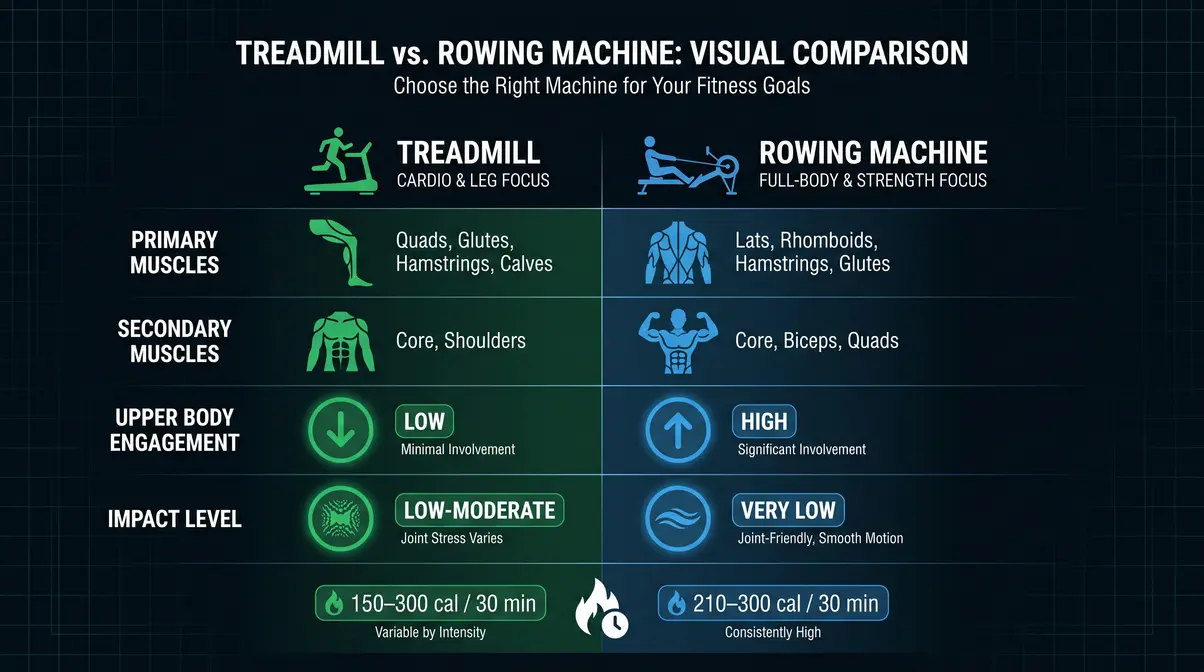
Both the treadmill and the rowing machine are excellent cardio tools — but they work your muscles in very different ways.
| Feature | Treadmill | Rowing Machine |
|---|---|---|
| Primary muscles | Quads, glutes, hamstrings, calves | Lats, rhomboids, hamstrings, glutes |
| Secondary muscles | Core, hip flexors, shoulders | Core, biceps, quads, calves |
| Upper body engagement | Low (unless arms actively driven) | High (rowing stroke is ~60% legs, ~40% upper body) |
| Impact level | Low to moderate (walking); moderate to high (running) | Very low (virtually impact-free) |
| Best for | Leg toning, fat loss, cardiovascular endurance | Full-body conditioning, low-impact cardio |
| Calorie burn (30 min, 155 lb) | ~150–300 calories (varies by intensity) | ~210–300 calories (varies by intensity) |
The treadmill is the stronger choice if your primary goals are leg toning, glute development, or improving walking/running fitness. The rowing machine offers superior upper body and back engagement, making it ideal for full-body conditioning without joint impact.
For a deeper look at the muscles worked on a rowing machine, including the specific back and shoulder muscles it targets, visit our complete rowing machine muscle guide.
Treadmill Mistakes and Expert Help
Even with the best intentions, certain habits can limit your results and increase your injury risk. Recognizing these mistakes is as important as knowing which muscles a treadmill works.
Mistakes That Limit Muscle Gains
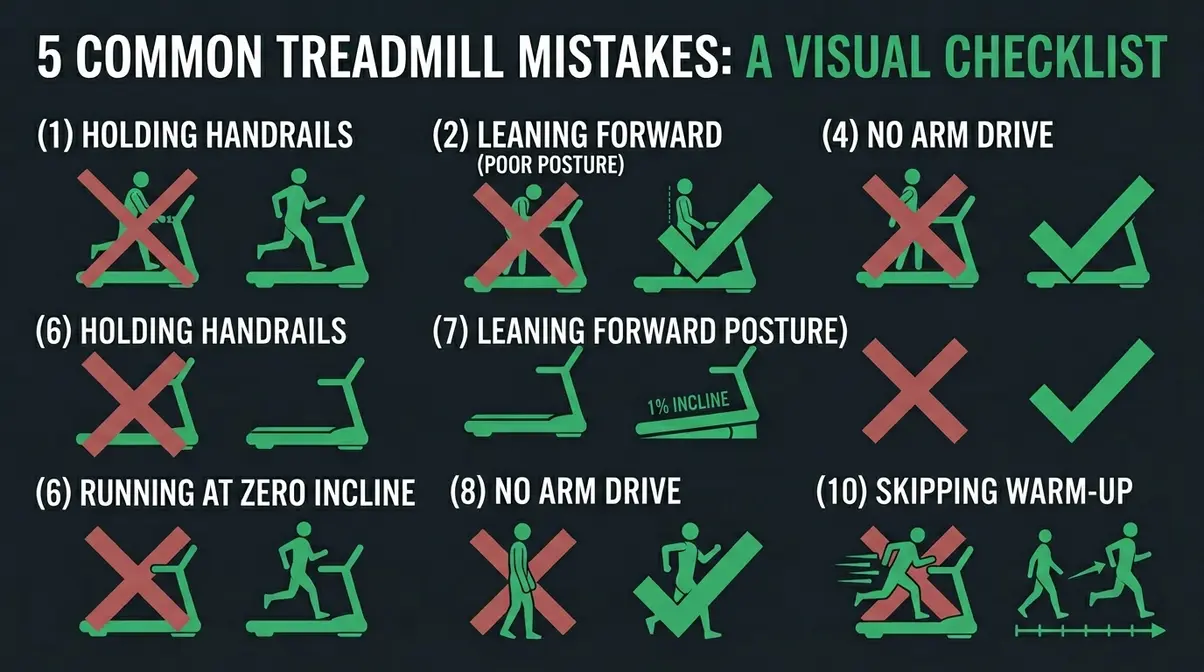
1. Holding the handrails
This is the most common mistake on a treadmill. Gripping the rails reduces the effort your core, glutes, and upper body must produce — effectively lowering the intensity of your workout even if the settings look impressive. Let go of the rails unless you genuinely need them for safety.
2. Leaning forward into the incline
When you add incline, your instinct may be to lean your torso forward. This shifts weight onto the rails and reduces glute engagement — the opposite of what you want. Keep your back straight and upright, with a slight natural forward lean from your ankles, not your waist.
3. Setting the incline to 0%
Walking on a completely flat treadmill doesn’t replicate outdoor walking. A 1% incline more accurately simulates the energy cost of walking on a level surface outdoors, according to research. Always set a minimum of 1% incline to maintain realistic effort levels.
4. Ignoring arm drive
Letting your arms hang at your sides wastes an opportunity to engage your shoulders, biceps, and upper back. Actively pump your arms in a 90-degree bend — this also naturally improves your pace and calorie burn.
5. Skipping the warm-up and cool-down
Jumping straight to your target pace without warming up increases injury risk to your hip flexors, calves, and knees. Spend 3–5 minutes walking slowly before increasing intensity, and always cool down at a reduced pace before stopping.
When to Consult a Professional
A treadmill is one of the safest pieces of exercise equipment available, but certain situations warrant professional guidance before you begin or change your routine.
- Consult a certified personal trainer if:
- You’re new to exercise and unsure how to structure progressive sessions
- You want to design a routine specifically targeting glute development, weight loss, or endurance
- You’re not seeing results after 4–6 weeks of consistent effort
- You want to safely incorporate incline intervals or HIIT protocols
- Consult a healthcare professional or physical therapist if:
- You have existing knee, hip, or lower back pain
- You’ve had a recent injury or surgery affecting your lower body
- You experience joint pain, chest discomfort, or shortness of breath during exercise
- You have any cardiovascular condition or metabolic health concern
The information in this guide is educational. Your individual health context matters — a qualified professional can tailor a program specifically to your body and goals.
Frequently Asked Questions
What does 30 minutes on the treadmill do?
Thirty minutes on a treadmill burns approximately 150–300 calories, improves cardiovascular fitness, strengthens your lower body muscles, and triggers an endorphin release that boosts mood. At a brisk walking pace, it fulfills one-fifth of the CDC’s recommended 150 weekly minutes of moderate aerobic activity. Over consistent weeks, 30-minute sessions contribute to measurable improvements in leg strength, endurance, resting heart rate, and body composition.
Is it better to walk fast or slow on a treadmill?
It depends on your goal. Slow walking (2.0–2.8 mph) burns fat efficiently over longer sessions and is ideal for beginners or active recovery. Brisk walking (3.0–3.8 mph) builds aerobic fitness and engages all primary lower body muscles. Faster speeds and running recruit fast-twitch muscle fibers and burn more calories per minute. For most people, a mix of moderate brisk walking with occasional faster intervals produces the best overall results.
How many miles on a treadmill is 10,000 steps?
10,000 steps equals approximately 4–5 miles on a treadmill, depending on your stride length. The average adult stride is roughly 2.5 feet, which places 10,000 steps at around 4.7 miles. At a brisk walking pace of 3.5 mph, covering 4.7 miles takes approximately 80 minutes. Many fitness trackers can sync with your treadmill to count steps directly, giving you a more personalized and accurate measurement than any general estimate.
What’s the hardest muscle to build on a treadmill?
The hamstrings are the hardest muscle to build using a treadmill alone. Because the moving belt assists in pulling your foot backward, your hamstrings work less hard than they would during overground running or resistance exercises like deadlifts. If you’re wondering what is the hardest muscle to build overall, the hamstrings rank high when relying solely on cardio. To better target your hamstrings on a treadmill, incorporate incline walking and consider supplementing with resistance exercises like Romanian deadlifts.
Your Treadmill Muscle Roadmap
A treadmill works far more than most people expect. The primary movers — your quadriceps, hamstrings, glutes, and calves — carry the load in every session. Your core, hip flexors, and upper body stabilizers support and refine every stride. Ultimately, what muscles does a treadmill work depends entirely on how you configure your machine and the effort you apply.
The Muscle Activation Ladder is your framework for making that configuration intentional. Flat walking builds the foundation. Incline walking shifts the load to your glutes and hamstrings. Running recruits your entire lower body at higher intensity. Each rung up the ladder unlocks more muscle engagement, more calorie burn, and more specific results. The ACE research showing a 345% increase in glute activation at a 9% incline is proof that small setting changes produce dramatic muscle-targeting differences.
Start with one of the five routines in this guide that matches your current goal. If you’re after glute tone, begin with the 12-3-30 Glute Builder at a 5% incline and build from there. If endurance is your target, try the progressive Endurance Builder. If time is limited, the Core Stabilizer Sprint delivers meaningful results in under 25 minutes. Give your chosen routine four consistent weeks before evaluating progress — and consult a certified personal trainer if you want a program tailored specifically to your body and goals. Your treadmill is capable of far more than you’ve been asking of it.
Related posts:
Progressive Overload Guide: 7 Methods to Build Muscle
Muscle Atrophy: Causes, Symptoms & How to Reverse It
What Is Muscle Memory? The Complete Science Guide
Muscle Hypertrophy Explained: The Science of Muscle Growth
Strength Training vs Hypertrophy: The Complete 2026 Guide
Muscle Building Transformation Stories: What Actually Worked

Callum
Hi, I'm Callum, the founder of Body Muscle Matters. I'm not a certified trainer, I'm a self taught lifter who started this site to share what I've learned from my own training and a lot of trial and error. Everything here comes from real experience and honest research, written the way I'd explain it to a friend who is just getting started. My goal is simple: practical, no hype fitness advice you can actually use.