Muscles Used in Basketball: What Powers Your Jump and Shot
⚠️ Disclaimer: The information in this article is for educational purposes only and is not a substitute for professional medical or fitness advice. Consult a certified trainer or healthcare professional before beginning any new exercise program.
You’ve been hitting the gym. Squats, bench press, curls — the usual routine. But when you step onto the court, your jump still falls short, your shot still lacks range, and your legs are dead by the third quarter. Sound familiar?
Here’s what’s happening: basketball demands a very specific chain of muscle actions, and generic gym training doesn’t replicate it. Every game you play without understanding your muscle map, you’re leaving vertical inches and shooting range on the table. The muscles used in basketball don’t just fire in isolation — they fire in a sequence, each zone feeding the next.
In this guide, you’ll learn exactly which muscles power every basketball action — jumping, shooting, dribbling, and defense — and the drills that will make them stronger. We cover three zones: the lower body Power Base, the core Energy Link, and the upper body Control System. We also cover shooting mechanics, dribbling, and endurance. We define every anatomical term as we go — no prior anatomy knowledge needed.
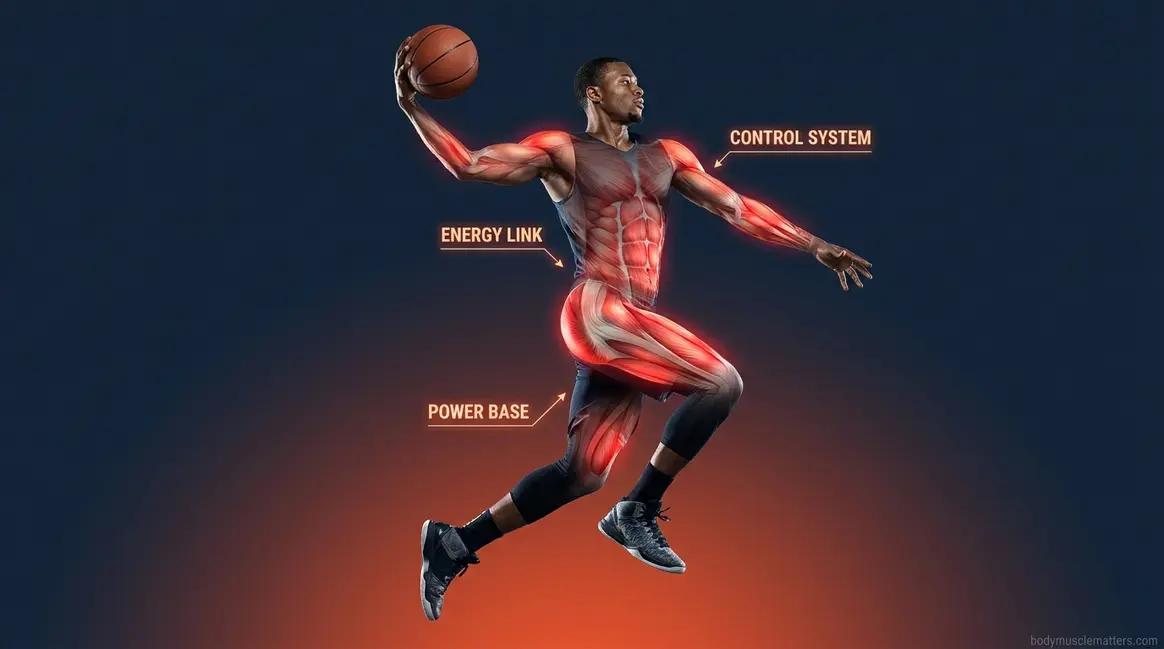
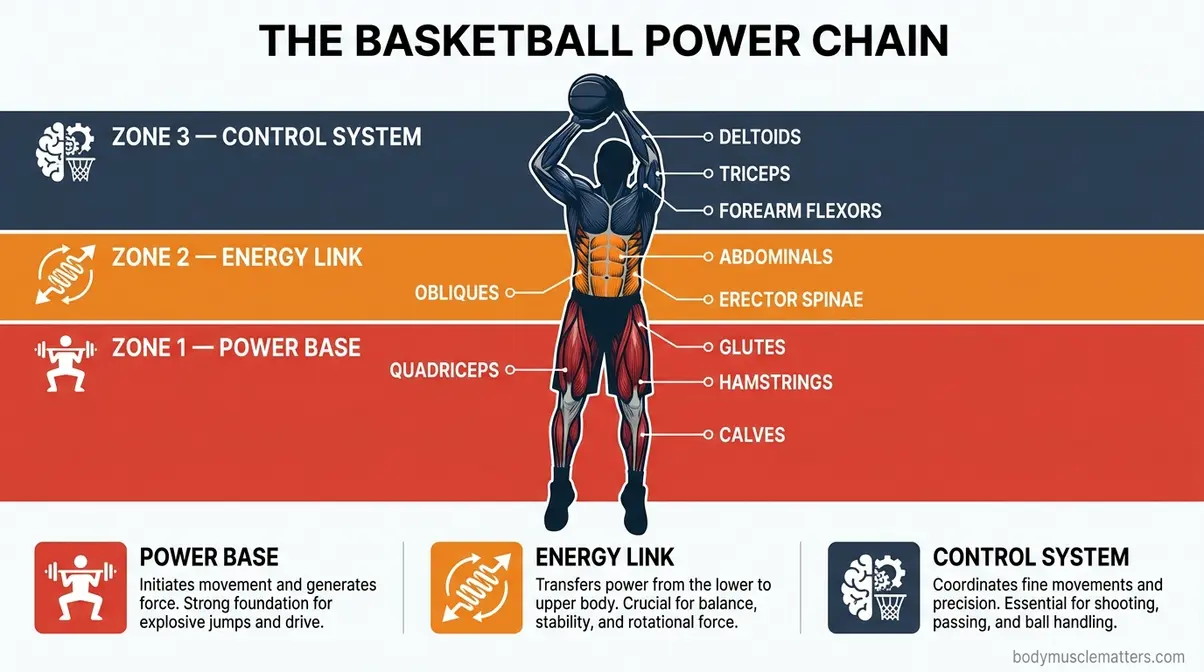
Basketball is a full-body sport that uses muscles across three zones: the Power Base (lower body), the Energy Link (core), and the Control System (upper body) — a framework we call The Basketball Power Chain.
- Lower body (quads, glutes, hamstrings, calves) generates explosive jumping and running power
- Core (abs, obliques, lower back) transfers that power efficiently to your upper body — a weak core creates energy leaks
- Upper body (shoulders, triceps, forearms, wrists) delivers accuracy, spin, and control on every shot and pass
- All three zones must be trained together — NIH research confirms neuromuscular coordination across muscle groups determines shooting effectiveness
Basketball Muscles: A Quick Overview
Basketball activates muscles across the entire body simultaneously — from the quadriceps generating jump force to the wrist flexors delivering the final ball spin. Most people think about quads and glutes and stop there. The real picture is more connected than that.
The key muscles used in basketball are organized into three functional zones by a framework we call The Basketball Power Chain. Think of your body as a machine with three departments: the Power Base (lower body) generates force, the Energy Link (core) transfers that force upward without waste, and the Control System (upper body) delivers it with precision. Each department feeds the next. A breakdown in any one zone creates an energy leak — and energy leaks cost you inches, range, and stamina.
A (https://pmc.ncbi.nlm.nih.gov/articles/PMC8008295/) confirms basketball places simultaneous demands on muscle groups across the entire body (NIH PMC, 2026). Before we break down each zone in detail, here’s your quick reference guide:
| Action | Primary Muscles | Supporting Muscles |
|---|---|---|
| Jumping (rebound/layup) | Quadriceps, Glutes, Calves | Hamstrings, Core |
| Shooting | Shoulders, Triceps, Wrist Flexors | Quads, Core, Biceps |
| Dribbling | Forearms, Wrist Flexors | Biceps, Shoulders |
| Defensive Stance | Glutes, Quads, Core | Calves, Hip Adductors |
| Running/Sprinting | Quads, Hamstrings, Calves | Glutes, Hip Flexors |
Use this table as your cheat sheet. The rest of this guide is a deep dive into each zone — starting with the foundation of every explosive play on the court: your lower body.
Lower Body Muscles: Your Power Base in Basketball
Your lower body is the engine room. Every jump, sprint, cut, and defensive slide starts from the ground up. Without a strong Power Base, the rest of The Basketball Power Chain has nothing to work with. A dedicated lower body home workout can help you build this foundational strength even without gym access.
“This is easy dude… quads, hams and glutes. Yes your core is also very important for any athletic activity definitely don’t neglect it but if…” — Reddit community consensus on basketball muscle priorities
The basketball community is right to start here. Research using electromyography (EMG — a method of measuring electrical activity in muscles) on NCAA Division I players confirms that centers, guards, and forwards all show position-specific dominance in the lower body, with hamstrings and glutes playing especially large roles during competition (PMC, 2026).
Quadriceps: Your Primary Jumping Engine
The quadriceps (the large muscle group on the front of your thigh) are the single most important muscles for explosive jumping. When you bend your knee and then drive upward off the floor for a rebound or layup, your quads are doing the primary work of extending your knee and propelling you skyward.
Research from Physio-Pedia confirms that lower body muscle strength is responsible for generating the explosive power required for jump shots and layups. Interestingly, mid-range standing shots demand significantly higher quad activation than jump shots — meaning even your “stationary” shooting moments are quad-intensive. Train your quads specifically for basketball explosiveness, not just general strength.
Glutes & Hamstrings: Power & Brakes
Your gluteus maximus (commonly called the glutes — the largest muscle in your body, located in your buttocks) and hamstrings (the muscles running down the back of your thigh) work as a power-generating pair. The glutes drive your hips forward when you explode upward or push off in a sprint. The hamstrings control deceleration — they’re the brakes that let you cut sharply without blowing out a knee.
Plyometric training research published in PMC (2026) found that enhanced recruitment of the gluteus maximus and gastrocnemius (calf muscle) is a key neuromuscular adaptation that improves jump height in athletes. Strong glutes and hamstrings aren’t just about jumping higher — they’re your primary injury prevention system for the knee and hip.
Calves: The Final Push-Off
Your gastrocnemius (one of the two main calf muscles, the larger one you can see at the back of your lower leg) provides the final push-off force at the end of every jump and sprint. Think of it as the last link before the ground. When your quads and glutes have done their work, your calves transmit that force through your foot and into the floor, giving you that extra elevation on a layup or the burst of speed on a fast break.
The calves also absorb landing impact repeatedly throughout a game — a function that matters just as much for injury prevention as it does for performance.
Lower Body Drill: Jump Squat Circuit
Target muscles: Quadriceps, glutes, hamstrings, calves
Equipment: Bodyweight (add weight vest or light dumbbells when ready)
Learning proper squat form is the first step before adding weight to this circuit.
- Stand with feet shoulder-width apart, toes slightly turned out.
- Lower into a squat until your thighs are parallel to the floor — keep your chest up and knees tracking over your toes.
- Explode upward as powerfully as possible, leaving the ground completely.
- Land softly on the balls of your feet, immediately absorbing the landing by bending your knees.
- Reset your position and repeat.
Parameters: 4 sets × 8 reps | Work-to-pause ratio: 20 seconds of work, 40 seconds of rest between sets | Rest 2 minutes between sets. This ratio mimics basketball’s short explosive burst pattern.
Which muscles help you jump higher?
The quadriceps, gluteus maximus, and calves are the primary muscles for jumping high in basketball. The quads extend the knee with explosive force, the glutes drive the hips forward and upward, and the calves provide the final push-off from the floor. Research using plyometric training interventions confirms that enhanced recruitment of the gluteus maximus and gastrocnemius produces measurable increases in jump height (PMC, 2026). Hamstrings support deceleration and landing safety.
Core Muscles: The Energy Link
Your core is the bridge between your Power Base and your Control System. A powerful lower body connected to a weak core is like a high-performance engine attached to a broken transmission — most of that force never reaches its destination.
A 2026 systematic review and meta-analysis published in PMC found that core training significantly improves basketball players’ strength, sprinting, balance, agility, and skill performance — including shooting accuracy and dribbling. This isn’t optional conditioning. A strong Energy Link is what separates players who have raw athleticism from those who can actually use it.
Abs & Obliques: Rotational Power
Your abdominals (the muscles covering the front of your stomach, including the rectus abdominis — the “six-pack” muscles) and obliques (the muscles running diagonally along the sides of your torso) generate and control rotational force. Every time you pivot, pass, or rotate your upper body to shoot over a defender, these muscles are firing.
The obliques are especially important for basketball because almost no movement on the court is perfectly straight. Cutting left while looking right, rotating your torso for a hook shot, or twisting to grab a rebound all require oblique strength and control.
Lower Back & Hips: Core Stability
Your erector spinae (the group of muscles running along either side of your spine, commonly called the lower back muscles) and hip flexors (the muscles at the front of your hip that lift your knee toward your chest) maintain your posture and stability during high-speed, high-contact situations.
When you’re in a defensive stance for an extended possession, or boxing out under the basket, your lower back and hip flexors are working continuously to keep you low and stable. Research from Frontiers in Physiology (2026) confirms that core training improves force transfer through the lumbopelvic-hip complex — the anatomical hub connecting your lower body to your upper body.
Core Drill: Plank with Rotation
Target muscles: Abdominals, obliques, lower back, hip flexors
Equipment: Bodyweight only
- Start in a high plank position — hands directly under your shoulders, body in a straight line from head to heel.
- Keeping your hips level, rotate your right arm upward toward the ceiling, opening your chest to the right side.
- Hold for one second at the top, then return to the start position.
- Alternate sides with control — do not let your hips drop or rotate excessively.
Parameters: 3 sets × 10 reps per side | Work-to-pause ratio: 30 seconds of work, 30 seconds of rest | Focus on control over speed. This drill directly trains the rotational stability you use in every shot and pass.
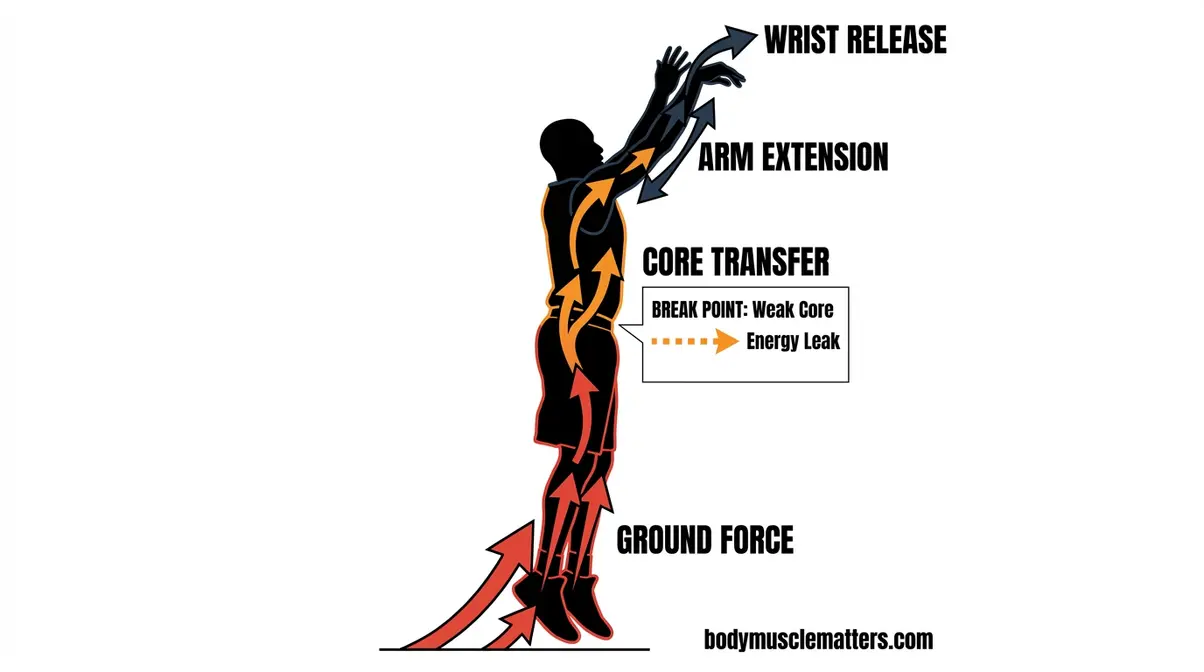
Why is core strength important?
Core strength helps in basketball by transferring force from your lower body to your upper body without energy loss. A weak core is the most common energy leak in the Power Chain — powerful legs generate force that simply dissipates before reaching your arms. A 2026 PMC systematic review found that core training significantly improved basketball players’ shooting accuracy, dribbling speed, and agility. The core’s rotational muscles (obliques) also power every pivot, pass, and shot over a defender.
Upper Body Muscles: Control and Accuracy
Your upper body — the Control System — is where power becomes precision. By the time force travels up through your Power Base and Energy Link, your upper body’s job is to direct it accurately. These are the muscles used in basketball for shooting, passing, and ball handling. Incorporating an upper body home workout focused on shoulder stability and triceps extension will directly translate to a more consistent jump shot.
Shoulders: The Shooting Foundation
Your deltoids (the triangular shoulder muscles capping the top of your arm — divided into front, side, and rear portions) are the foundation of your shooting motion. They position and elevate your shooting arm, create the platform for elbow extension, and stabilize the entire upper-body shooting structure.
According to Physio-Pedia’s analysis of jump shot biomechanics, the shoulders play a critical role in arm elevation and stability during the shooting motion. Weakness in the deltoids forces compensations elsewhere in the kinetic chain — often leading to inconsistent release points and reduced range.
Triceps & Biceps: Arm Extension
Your triceps brachii (the three-headed muscle on the back of your upper arm — the one that straightens your elbow) are the primary driver of shot distance. When you extend your elbow in the release phase of a jump shot or free throw, your triceps are the engine doing that work.
A 2026 PMC study found that partial range-of-motion triceps strength training directly improved stationary three-point shooting accuracy in basketball players. The medial head of the triceps is most active at the shoulder angles used during shooting — meaning targeted triceps training at the right joint angles translates directly to more makes.
Your biceps brachii (the muscle on the front of your upper arm) plays a stabilizing and control role — it decelerates the arm after release and helps control the shooting arc.
Forearms & Wrists: The Final Touch
Your forearm flexors (the muscles running along the inside of your forearm) and wrist flexors (the muscles controlling wrist movement) are the last link in the kinetic chain. They impart backspin on the ball and control the release angle that determines whether your shot swishes or clangs. To improve this, you need to build forearm muscles through targeted wrist curls and farmer’s walks.
Research confirms that wrist flexor activity rises during the projection phase of a shot to maintain control — even as the rest of the arm is completing its extension. Weak forearms and wrists are a common, underdiagnosed cause of poor ball control and inconsistent shooting touch.
Shooting Muscles: The Kinetic Chain
Shooting a basketball is not an arm movement. It’s a whole-body event that travels through every zone of The Basketball Power Chain — from the floor to the fingertips — in under one second.
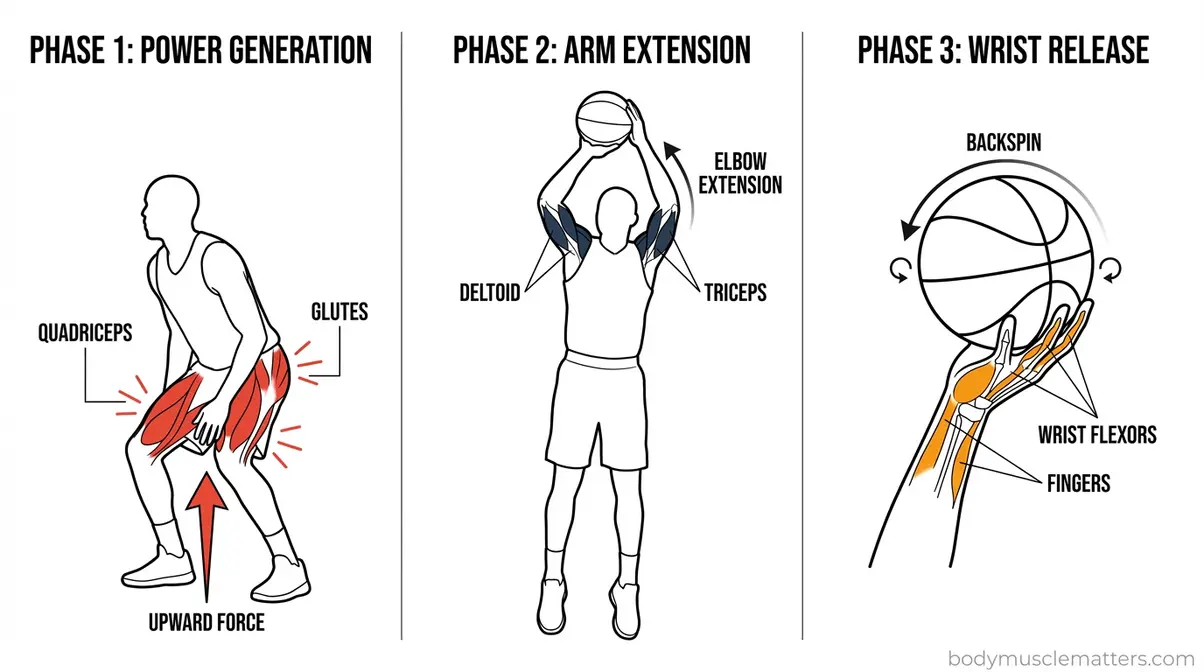
Phase 1: Power Generation
The shot begins before your hands ever move. As you catch the ball and prepare to shoot, your quadriceps, glutes, and core pre-load with tension. Then you dip and drive upward — your legs generate the vertical force that will travel up through your body.
Research from Frontiers in Sports and Active Living (2026) found that proficient three-point shooters exhibit significantly greater hip and knee angular velocity during the jump phase compared to less proficient shooters. In plain terms: better shooters use their legs more effectively. The force your legs generate here is what gives your shot its range — without it, your arms have to do all the work, and your accuracy suffers.
Phase 2: Arm Extension
As you reach the peak of your jump, your shooting arm extends. Your deltoids elevate and stabilize the arm. Your triceps extend the elbow in a smooth, controlled motion. This is the phase that determines shot direction and arc.
Electromyography studies on basketball players confirm that triceps activation timing is highly consistent in expert shooters and highly variable in novices — the difference between a player who “finds their shot” and one who stays inconsistent often comes down to triceps coordination, not just arm strength. According to Physio-Pedia’s biomechanics analysis, stability in the shooting arm extension phase is a primary determinant of shooting accuracy.
Phase 3: The Release
At the top of your extension, your wrist snaps forward and your fingers — particularly the index and middle fingers — guide the ball off the fingertips with backspin. This snap is controlled by your wrist flexors and the small intrinsic muscles of the hand.
The backspin your wrist snap creates is not cosmetic. Physics research on free throws shows that backspin increases the probability of the ball bouncing into the basket rather than bouncing out on near-misses. Your wrist strength and flexibility directly affect how much useful backspin you can consistently generate.
Free Throw vs. Jump Shot Muscles
The same muscles fire in both shots — but the activation pattern differs. In a free throw, you have no vertical jump component. Your legs provide a gentle dip and rise for rhythm, but your shoulders, triceps, and wrists do more relative work. Consistency is everything, and research shows that free throw specialists develop highly repeatable neuromuscular patterns in their triceps and wrist flexors.
In a jump shot, the legs contribute a larger share of total power. Your core becomes more critical as a stabilizer because your body is in motion. According to a physiologic profile of basketball athletes published by the Gatorade Sports Science Institute, the muscular demands of basketball shooting vary significantly based on shot distance and whether the player is stationary or in motion.
Muscles Used in Dribbling and Defensive Stance
Dribbling and defense are often treated as skill-only activities. In reality, they’re strength activities — and the muscles used in dribbling a basketball and maintaining a defensive stance are specific enough to warrant targeted training.
Forearms & Wrists: Ball Control
Dribbling is a forearm and wrist endurance exercise disguised as a skill drill. Your forearm extensors (the muscles on the top of your forearm that lift your hand backward) and wrist flexors work in rapid alternation to push the ball down and receive it back up, hundreds of times per game.
When a defender tries to poke the ball away, your forearms and wrists are what resist that pressure. Weak forearms mean loose dribbles under contact — a direct cause of turnovers. Research on shooting biomechanics confirms that wrist and elbow joint range of motion correlates with ball-handling performance in young players, not just shooting accuracy (DergiPark, 2026).
Lower Body: Defensive Stance Power
A proper defensive stance requires your hip adductors (the muscles on the inner thigh that pull your legs together and maintain lateral balance), glutes, quads, and calves to work isometrically — meaning they hold a contracted position without moving.
Staying low in a defensive stance for extended possessions is one of the most underrated strength demands in basketball. Your glutes and quads are essentially performing a continuous partial squat. According to research on basketball neuromuscular training, a structured warm-up and strength program was associated with a 36% lower rate of ankle and knee injuries in basketball players — most of which occur during defensive lateral movements (JOSPT, 2026).
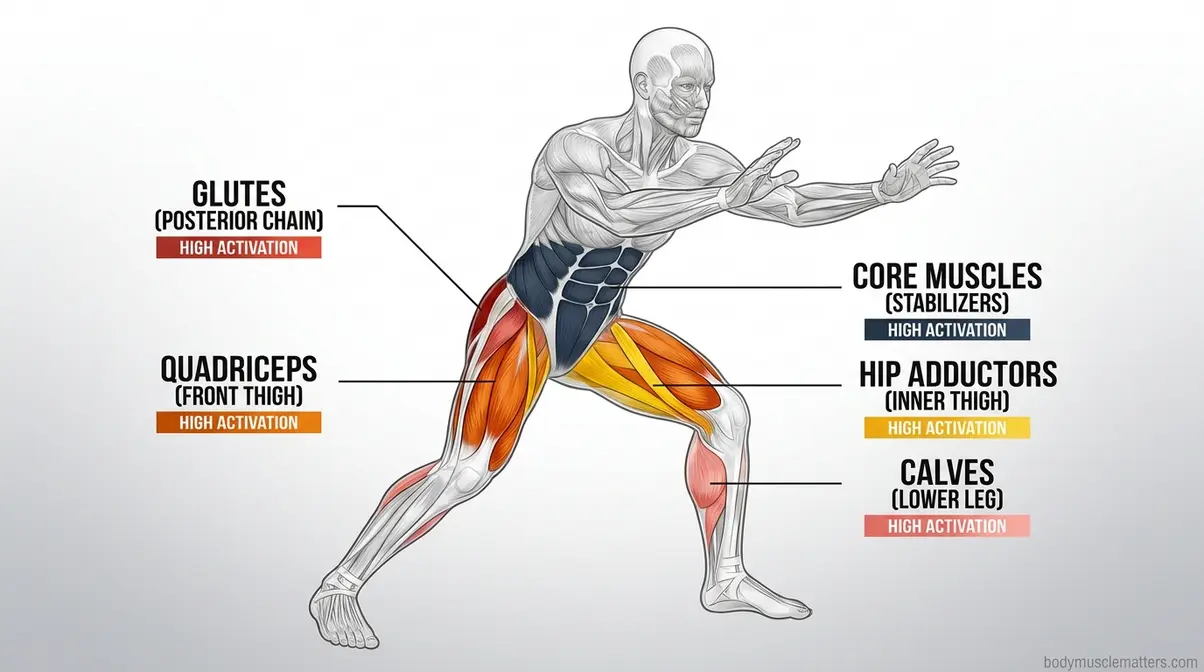
Muscular Endurance for All Quarters
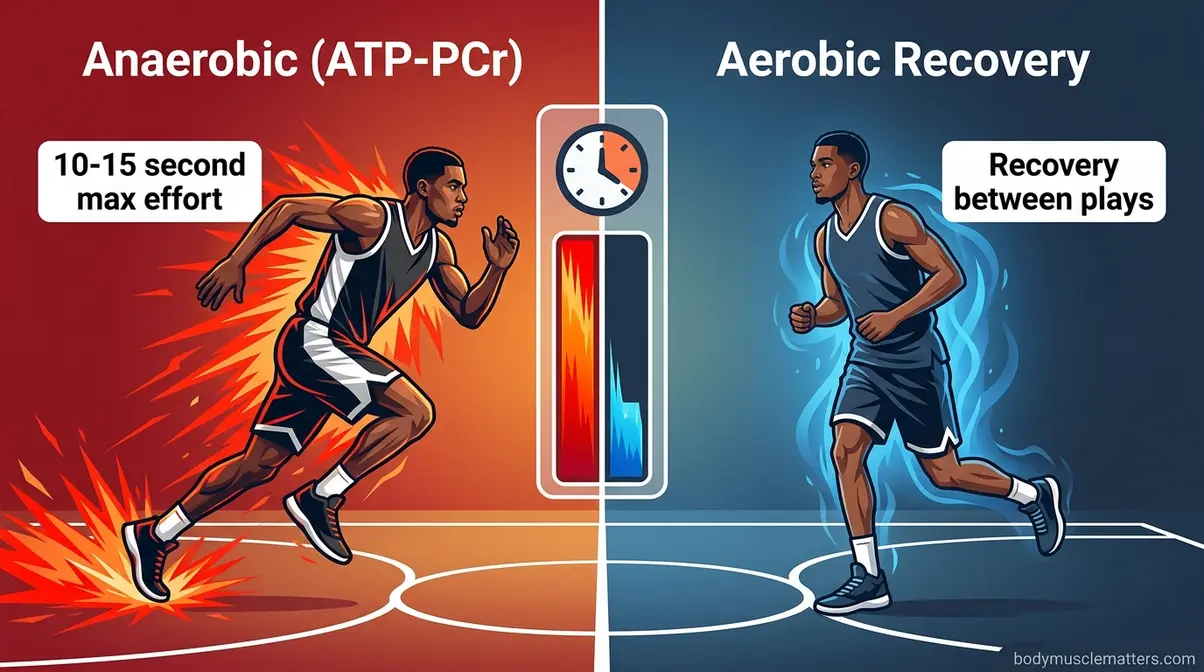
You can be strong in the first quarter and useless in the fourth if you haven’t trained your muscles for basketball’s specific endurance demands. This is where The Basketball Power Chain either holds together or falls apart under fatigue. The benefits of high-intensity interval training (HIIT) align perfectly with basketball’s stop-and-go nature to prevent this drop-off.
Basketball’s Main Energy System
Basketball is primarily an anaerobic sport powered by the phosphagen (ATP-PCr) and glycolytic energy systems, supported by aerobic metabolism for recovery. Your body stores a small amount of adenosine triphosphate (ATP — your muscles’ direct fuel source) and phosphocreatine (PCr — a compound that rapidly regenerates ATP). These stores power explosive movements for approximately 10–15 seconds before they need to recharge.
This is why basketball feels like repeated sprints rather than a steady jog. Every possession, fast break, or defensive scramble draws on your anaerobic system. Between those efforts, your aerobic system (which uses oxygen to metabolize fuel) works to recharge your PCr stores so you can go again.
Aerobic vs. Anaerobic Systems
The Gatorade Sports Science Institute’s physiologic profile of basketball athletes confirms that basketball’s high-intensity moments are powered by the ATP-PCr system and anaerobic glycolysis, while the aerobic system enables recovery between those efforts. Research published in PMC found that elite basketball games (40–48 minutes of play) require a high level of aerobic metabolism to drive the resynthesis of creatine phosphate between explosive efforts (PMC, 2026).
In practical terms: your aerobic fitness determines how quickly you recover between plays. A player with a weak aerobic base will have their explosive power degraded by the third quarter because their PCr stores never fully recharge. Both systems must be trained.
Drills for Basketball Endurance
While steady-state jogging has its place, the best cardio exercises for weight loss and overall health for basketball players involve sprint intervals.
Drill: Suicide Sprints (Anaerobic + Aerobic Combined)
Target: Quads, hamstrings, calves, cardiovascular system
- Start at the baseline of the court.
- Sprint to the near free-throw line, touch it, and sprint back to the baseline.
- Sprint to half court, touch it, and sprint back.
- Sprint to the far free-throw line, touch it, and sprint back.
- Sprint to the far baseline, touch it, and sprint back.
Parameters: 4–6 sets | Work-to-pause ratio: 30–35 seconds of work, 60–90 seconds of rest | The rest period mimics real game recovery time between possessions. Shorter rest = more aerobic demand. Longer rest = more anaerobic power per rep.
Drill: Defensive Slide Intervals
Target: Glutes, hip adductors, quads, calves
- Start in a low defensive stance — feet wide, hips back, knees bent.
- Slide laterally across the paint (the 16-foot wide area under the basket) without crossing your feet.
- Touch the far edge of the paint, immediately slide back.
Parameters: 3 sets × 45 seconds of continuous sliding | Rest 45 seconds between sets | This directly trains the muscles used in defensive stance under fatigue conditions.
Training Mistakes & Expert Help
Even motivated players can sabotage their own progress. Here are the most common energy leaks — and how to seal them.
3 Energy Leaks Killing Performance
Energy Leak 1: Skipping single-leg training.
Most gym exercises are bilateral (both legs at once). Basketball is almost entirely unilateral — you push off one leg for a layup, plant one foot for a cut, land on one leg constantly. Training only bilateral movements leaves your single-leg strength underdeveloped. Fix it: Add single-leg Romanian deadlifts and Bulgarian split squats to every lower-body session.
Energy Leak 2: Neglecting the core as a transfer zone.
Players who only do crunches are training the core for appearance, not function. Basketball requires rotational and anti-rotational stability — the ability to resist twisting forces while maintaining power transfer. Fix it: Replace crunches with Pallof presses, plank rotations, and cable chops that mimic on-court movement patterns.
Energy Leak 3: Training for size instead of speed.
Heavy, slow-tempo lifting builds muscle mass but not the fast-twitch fiber recruitment basketball requires. Fix it: Include plyometric and ballistic training (jump squats, medicine ball throws) at least twice per week. Research on plyometric training confirms it enhances neuromuscular function and improves stretch-shortening cycle efficiency in the quadriceps, glutes, and calves (PMC, 2026).
A note on limitations: Position-specific muscle demands vary significantly — a point guard’s conditioning differs substantially from a center’s. This guide covers universal basketball muscle demands. Position-specific programming is beyond its scope and is best addressed with a position coach or strength specialist.
When to See a Physical Therapist
Some situations require professional guidance. Consult a certified strength and conditioning specialist (CSCS) or physical therapist if you experience:
- Persistent knee pain during squats or jumping — this may indicate patellar tendinopathy or tracking issues that require individualized assessment.
- Lower back pain during core exercises or after games — poor hip flexor mobility or lumbar instability needs professional evaluation before training continues.
- Recurring ankle sprains — lateral ankle instability requires a specific rehabilitation and proprioception protocol, not just rest.
- Plateaued performance despite consistent training — a CSCS can identify compensations and muscle imbalances that generic programming misses.
Research confirms that a structured neuromuscular training program reduced ankle and knee injury rates in basketball players by 36% (JOSPT, 2026). A qualified professional can build that structure for your specific body and position.
Frequently Asked Questions
What are the main basketball muscles?
The most important muscles used in basketball are the quadriceps, glutes, hamstrings, and core — collectively forming the Power Base and Energy Link of The Basketball Power Chain. These muscles generate and transfer the explosive force behind every jump, sprint, and cut. Upper body muscles (shoulders, triceps, wrist flexors) then deliver that force with accuracy. No single muscle dominates — basketball requires coordinated activation across all three zones simultaneously.
What upper body muscles power a shot?
The primary upper body muscles for shooting are the deltoids (shoulders), triceps brachii, and wrist flexors. The deltoids position and elevate the shooting arm. The triceps extend the elbow to propel the ball. The wrist flexors snap the wrist forward to add backspin and control the release angle. A 2026 PMC study found that targeted triceps strength training at shooting-specific joint angles directly improved three-point shooting accuracy in basketball players.
Does playing basketball build muscle?
Playing basketball builds muscle endurance and lean functional strength, particularly in the lower body and core. The constant sprinting, jumping, and defensive sliding act as a form of high-intensity interval training. However, to build significant muscle mass, players must supplement on-court time with dedicated resistance training.
What muscles get sore after playing basketball?
The calves, quadriceps, and glutes are the most common muscles to get sore after playing basketball. This soreness is typically caused by the repeated eccentric contractions required to decelerate your body when landing from jumps or cutting sharply. Proper cool-down routines and targeted stretching can help mitigate this post-game soreness.
Building Your Power Chain: Next Steps
Every muscle used in basketball fits into a connected system — and now you have the map. Your quadriceps, glutes, hamstrings, and calves build the Power Base. Your abdominals, obliques, and lower back form the Energy Link that transfers force without waste. Your shoulders, triceps, forearms, and wrists complete the Control System, turning raw power into accurate, repeatable skill. This is The Basketball Power Chain, and training it as a system — not as isolated muscles — is what separates players who get stronger in the gym from players who get better on the court.
The framework matters because energy leaks are invisible until you look for them. A player with strong legs but a weak core is leaving vertical inches on every jump. A player with powerful arms but underdeveloped wrist flexors is giving away shooting touch on every release. Identifying your weakest zone and addressing it directly is the fastest path to measurable on-court improvement.
Start with the drills in this guide — the Jump Squat Circuit, the Plank with Rotation, and the Suicide Sprint intervals. Run each drill for four weeks before adding load or complexity. If you experience pain, plateau early, or want a position-specific program, consult a certified strength and conditioning specialist who works with basketball athletes. The science is clear on the muscles. Your job now is to train them.
Related posts:
StrongLifts 5x5 for Beginners: Complete Guide 2026
How to Get a Bigger Bum Without Exercise: 3-Tier Guide
What Muscles Does the StairMaster Work? 6 Groups
Olympic Weightlifting vs Powerlifting: 2026 Guide
What Kills Muscle Gains? 7 Proven Saboteurs to Fix Now
Best Strength Training Apps for Women: Top 7 Picks

Callum
Hi, I'm Callum, the founder of Body Muscle Matters. I'm not a certified trainer, I'm a self taught lifter who started this site to share what I've learned from my own training and a lot of trial and error. Everything here comes from real experience and honest research, written the way I'd explain it to a friend who is just getting started. My goal is simple: practical, no hype fitness advice you can actually use.