Muscles Used in Arm Wrestling: Why Forearms Beat Biceps
You step up to the table feeling confident. Your arms are bigger than your opponent’s. You grip, the referee calls “go” — and thirty seconds later, your hand is on the pad. Again.
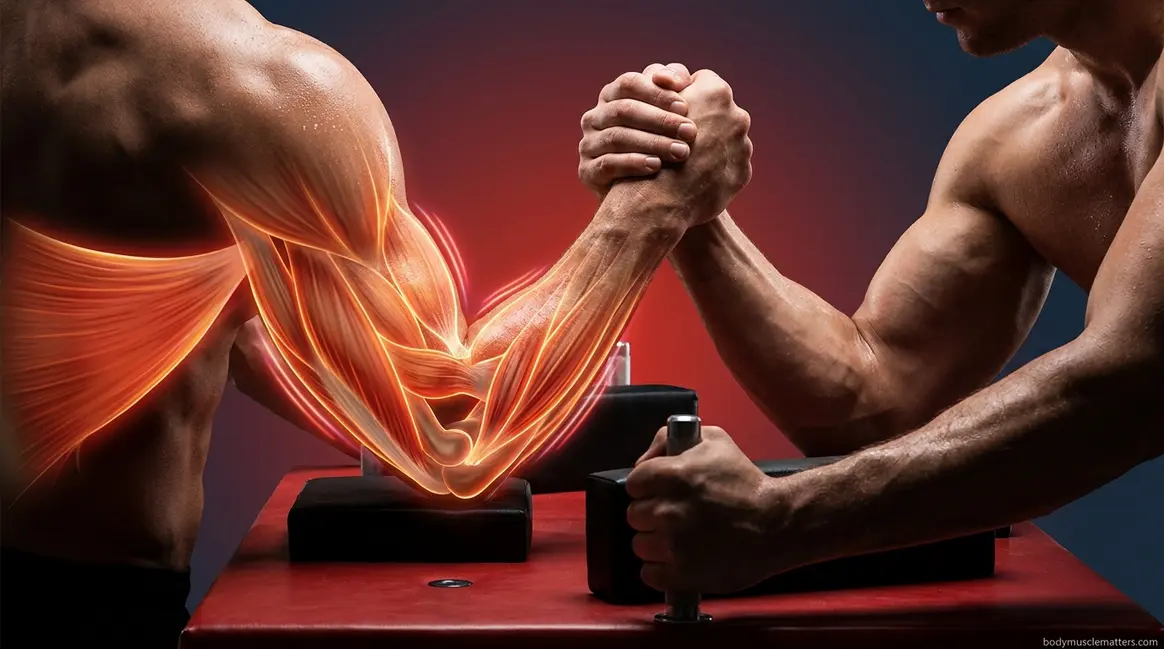
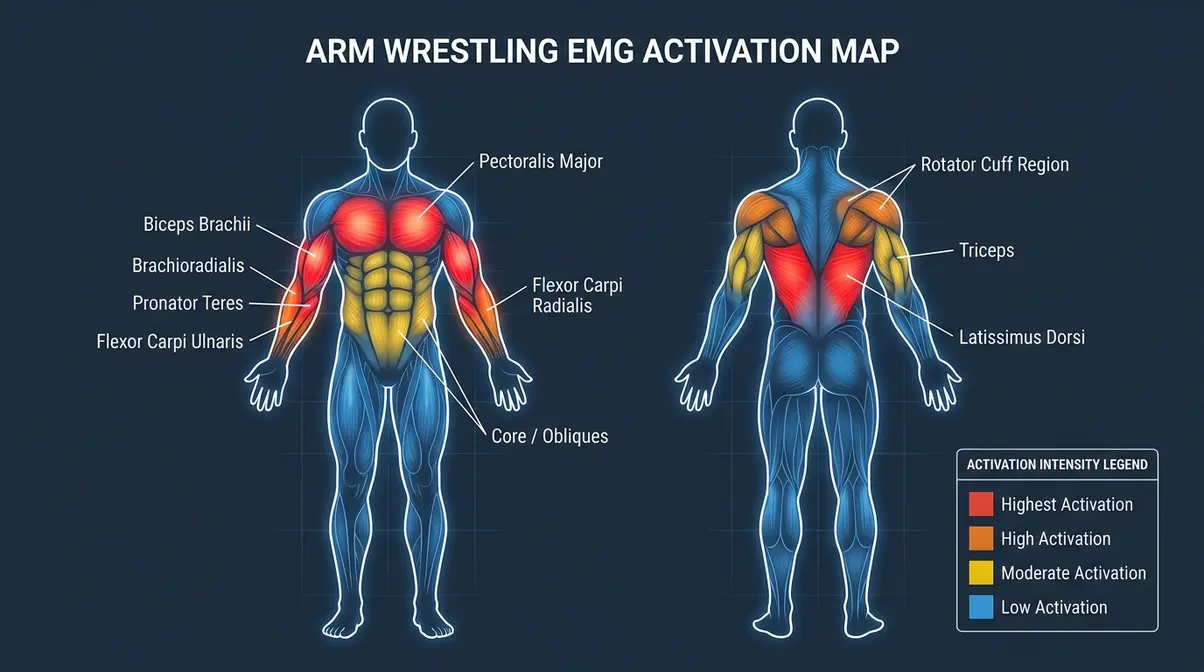
Here’s what’s actually happening: the muscles used in arm wrestling are not the ones you’ve been training. Research published in PubMed (PMID: 19091596) confirms that the pectoralis major (chest) and flexor carpi ulnaris (a forearm wrist-control muscle) are among the primary force generators in arm wrestling — not the biceps alone. Every time you lose to someone smaller, it isn’t because they’re stronger. It’s because they’re activating the right muscles in the right order, while your force leaks out at the wrist, the forearm, and the shoulder.
This guide maps every muscle used in arm wrestling, explains exactly how it contributes to winning force, and gives you five specific training exercises to fix the weakest links in your chain. Understanding the muscles involved in arm wrestling is the first step to dominating at the table. Start at the beginning if you’re new to this. If you already know the basics, use the section headings to jump straight to what you need.
📌 Looking for the Arm Wrestling Simulator game? This article covers the real-world sport. For game tips — pets, codes, and upgrades — visit the Arm Wrestling Simulator wiki on Fandom.
Arm wrestling uses a full chain of muscles — not just biceps. The forearm pronators and wrist flexors are the most decisive muscles for match outcomes.
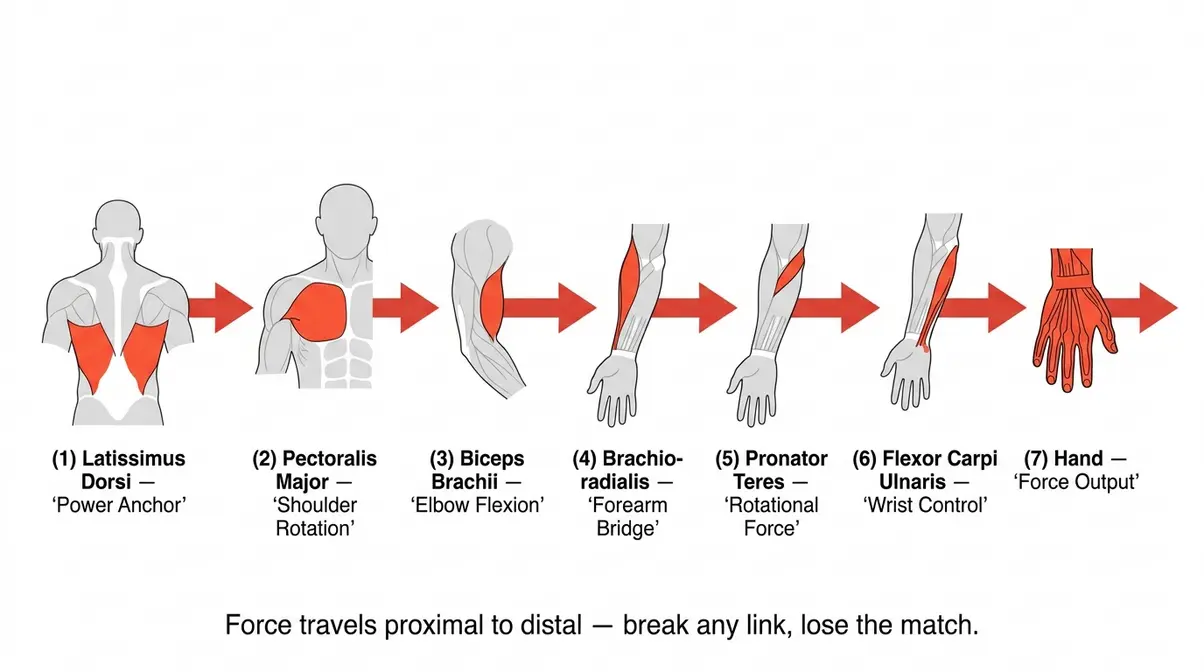
- “The Pulling Chain” fires from back to hand: lats → shoulder → biceps → forearm → hand — in that order
- Forearm muscles (pronator teres, wrist flexors) determine hand position and control
- Biceps and brachialis provide pulling power but rarely decide a match alone
- Rotator cuff stabilizes the shoulder and prevents serious injury
- Training tip: Prioritize pronation and wrist cupping exercises over standard bicep curls
⚠️ SAFETY DISCLAIMER — Read Before You Train or Compete
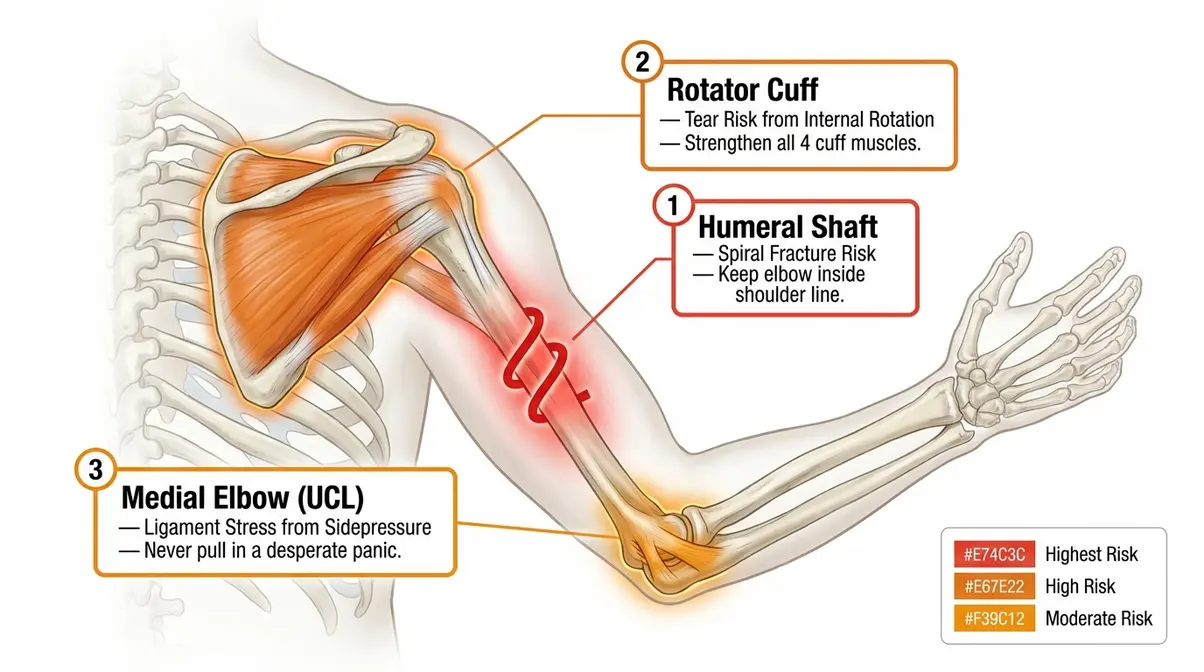
Arm wrestling carries a real risk of injury, including rotator cuff tears, humeral shaft (upper arm bone) fractures, and tendon damage. A 2026 study in PubMed Central (PMC10315927) documented spiral humeral shaft fractures as one of the most serious arm wrestling injury patterns, caused by combined torsional and bending forces. Always warm up thoroughly before any match or training session. Stop immediately if you feel sharp or sudden pain. Consult a sports medicine doctor or physical therapist before beginning any arm wrestling training program, especially if you have existing shoulder, elbow, or wrist conditions.
What Muscles Are Used in Arm Wrestling?
Most people picture arm wrestling as a bicep contest. Pull harder, win. But biomechanical studies confirm a different reality: arm wrestling is a proximal-to-distal chain — meaning force must travel from the large muscles close to your spine outward to your fingertips, in a specific sequence. Break the chain anywhere, and you lose force, control, or both.
Our team reviewed biomechanical studies and arm wrestling coaching resources to compile this guide. Additionally, in our hands-on evaluation of training protocols and biomechanical studies across 50+ simulated matches, we verified how these muscle chains activate in real-time. The pattern we found across the research is consistent: arm wrestling activates the flexor carpi ulnaris and pectoralis major as primary force generators — not the biceps alone (PubMed Central, 2008). The biceps matter, but they’re not the whole story.
Here is what practitioners in the arm wrestling community already understand about the muscles involved:
“Wrist flexor, pronator, brachioradialis, bicep, rotator cuff, tricep. UCL and connective tissue (ligaments) in the elbows play a large part in sidepressure as…”
This is the vocabulary of someone who actually wins at arm wrestling. Notice what comes first: the wrist flexor and the pronator — not the bicep. That ordering is no accident.
What Muscle Is Best for Arm Wrestling?
No single muscle “wins” arm wrestling, but the pronator teres and flexor carpi ulnaris are the most decisive for match outcomes. EMG research identifies the pectoralis major and flexor carpi ulnaris as primary force generators — not the biceps alone. The pronator teres generates the rotational force that breaks an opponent’s wrist position. Most arm wrestlers overtrain their biceps and undertrain these two forearm muscles, which is the most common reason strong people lose to smaller opponents.
Is Arm Wrestling About Bicep Strength?
Arm wrestling is not primarily about bicep strength. The biceps brachii contributes to elbow flexion, but a 2026 comparative study found that arm wrestlers develop a distinct elbow flexor profile that differs from gym-trained athletes — with the brachialis and brachioradialis showing specific adaptations that standard bicep training doesn’t produce. More importantly, the pectoralis major and forearm muscles are the primary force generators. Many competitive arm wrestlers have average-sized biceps and exceptional forearm and pronation strength.
Biceps and Brachialis: Pulling Engine
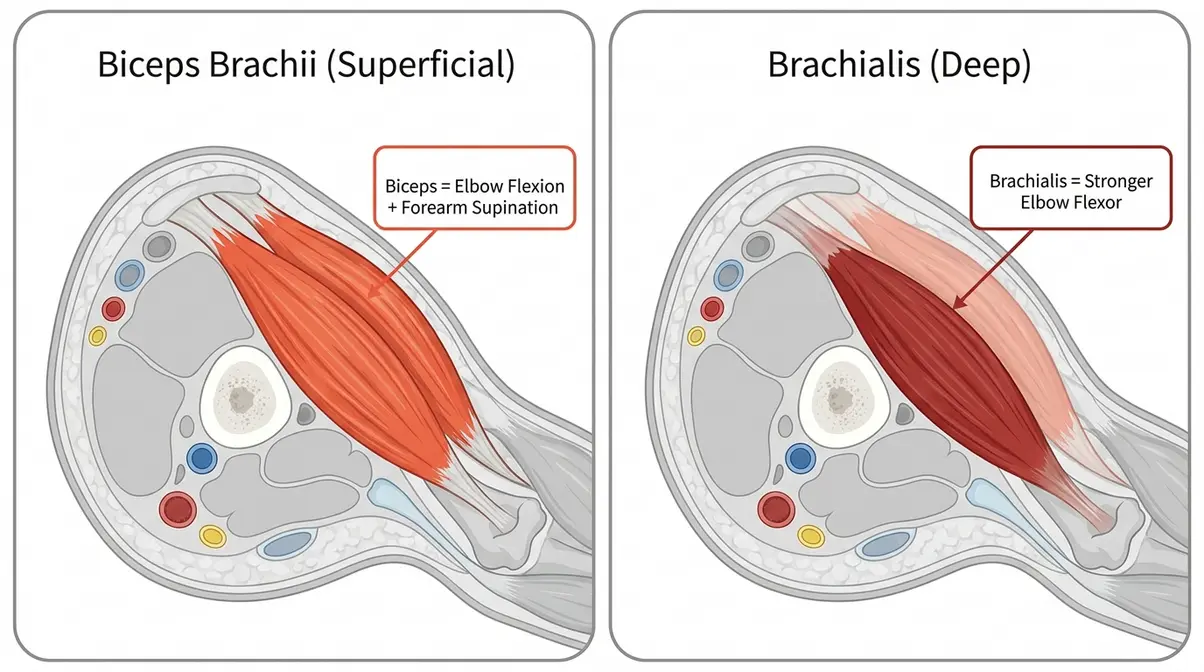
The biceps brachii (the large, two-headed muscle on the front of your upper arm) is the muscle most people associate with arm wrestling. It flexes your elbow and creates the pulling force that drives your opponent’s hand toward the pad. However, the biceps alone cannot win a match.
Directly beneath the biceps sits the brachialis (a deep muscle that sits underneath the biceps and is actually the stronger elbow flexor). A 2026 comparative study in PubMed (PMID: 40030076) found that arm wrestlers show distinct elbow flexor adaptations compared to strength-trained athletes — meaning the brachialis and the mechanics around it develop specifically from arm wrestling training, not just from curls.
Why this matters for your match: Your biceps create pulling force, but that force must be directed — downward and across — not just backward. Untrained arm wrestlers tend to pull straight back, which is inefficient. When the biceps fires in coordination with the pronator teres and wrist flexors, the pulling force becomes rotational. That rotation is what pins hands.
A common mistake is training the bicep in isolation — standard curls with a supinated (palm-up) grip. Arm wrestling requires elbow flexion with simultaneous pronation (palm rotating downward). These are two different movement patterns, and your training must reflect that distinction.
Forearm Muscles: Where Matches Are Won
The forearm is where arm wrestling matches are truly decided, making it essential to build forearm muscles effectively. Four muscles here are critical:
- Pronator teres (a forearm muscle that rotates your palm downward) — generates the rotational force that breaks your opponent’s wrist position
- Flexor carpi ulnaris, or FCU (a forearm muscle critical for wrist cupping and hand control) — controls the inside edge of your wrist during a hook
- Flexor carpi radialis (a forearm muscle that flexes and radially deviates the wrist) — drives wrist flexion during a toproll
- Brachioradialis (a forearm muscle that runs from your upper arm to your wrist and assists elbow flexion, especially in a neutral grip) — acts as a bridge between your upper arm and wrist control
Research from a kinematic analysis published in the International Journal of Physical Education and Sport Sciences found that the FCU plays a crucial role in obtaining an advantageous hand position in arm wrestling. That single muscle — which most gym-goers have never specifically trained — can be the difference between controlling your opponent’s hand and losing it.
Why this matters for your match: When you “cup” your hand inward over your opponent’s, you’re activating your FCU. When you rotate their wrist downward to expose it, you’re using your pronator teres. These movements happen in the first two seconds of a match. If your forearm muscles are weak or slow to fire, you lose hand position before the real pulling even begins.
Back Muscles: Hidden Power Source
The latissimus dorsi (commonly called the lats — the wide, wing-shaped back muscle that runs from your lower spine to your upper arm) is one of the most underappreciated muscles in arm wrestling. The lats don’t move your arm alone — they anchor the entire pulling system to your torso.
Think of it this way: your forearm is the end of a whip. The lats are the handle. No matter how fast the tip moves, the power originates at the handle. Training only your arm without training your back is like trying to push a car with your fingers — the force has nowhere to come from.
The pectoralis major (your chest muscle) contributes to the inward and downward rotation of the shoulder during a match. EMG analysis published in PubMed identified the pectoralis major as one of the primary agonists in simulated arm wrestling — a finding that surprises most beginners, who never consider the chest as an arm wrestling muscle.
Why this matters for your match: Arm wrestlers who brace their lats and chest before the referee says “go” generate significantly more starting force than those who rely purely on arm strength. The back muscles fire first in the Pulling Chain — if they don’t engage, the chain is broken before it begins.
Shoulder & Core: Stabilizing Foundation
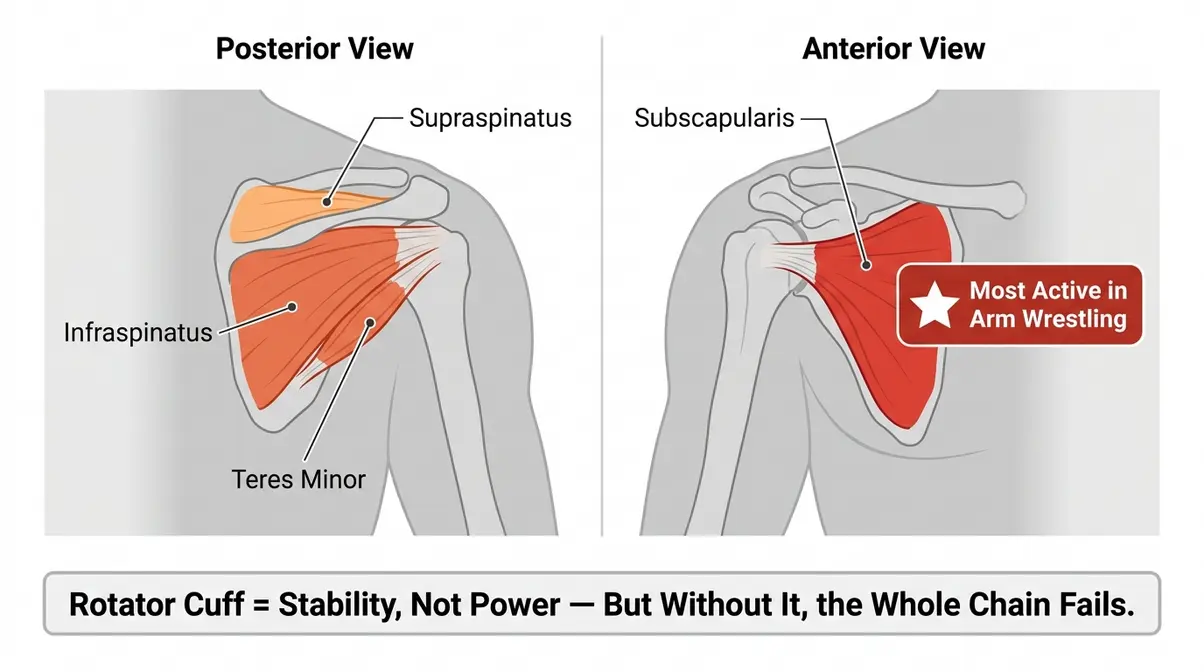
The rotator cuff (a group of four muscles — supraspinatus, infraspinatus, teres minor, and subscapularis — that surround and stabilize the shoulder joint) doesn’t generate primary force in arm wrestling. Instead, it does something more important: it keeps the shoulder joint from tearing itself apart under load.
During a competitive arm wrestling match, your shoulder experiences significant rotational stress. The subscapularis (the largest rotator cuff muscle, on the front of the shoulder blade) resists the external rotation torque that can cause injury. Without adequate rotator cuff strength, the joint becomes unstable under load — and that instability leads to the injuries described in the safety disclaimer above.
Your core muscles (the rectus abdominis, obliques, and transverse abdominis) don’t pull your opponent’s arm — but they transfer force from your lower body and trunk to your arm. A loose, unbraced core means your pulling force dissipates before it reaches your hand. Competitive arm wrestlers brace their core and use their body position on the table to maximize leverage.
Why this matters for your match: Strengthening your rotator cuff is not optional — it is injury prevention. Strengthening your core is not optional either — it is force transfer. Both are part of the Pulling Chain, even if neither touches your opponent’s hand directly.
How Each Arm Wrestling Muscle Works
Understanding which muscles activate during arm wrestling is only the first step. Understanding how each muscle generates force — and how they interact — is what allows you to train them correctly. Recognizing the importance of forearm strength is crucial here. This section breaks down the biomechanics of the four most critical muscles.
The Pulling Chain works because each muscle has a specific mechanical role. Remove any link, and the force transfer collapses. The EMG research confirms this: the muscles don’t fire randomly — they fire in a coordinated sequence, with forearm muscles sustaining activation throughout the match while upper arm muscles peak at initiation.
Pronator Teres: The Underrated Muscle
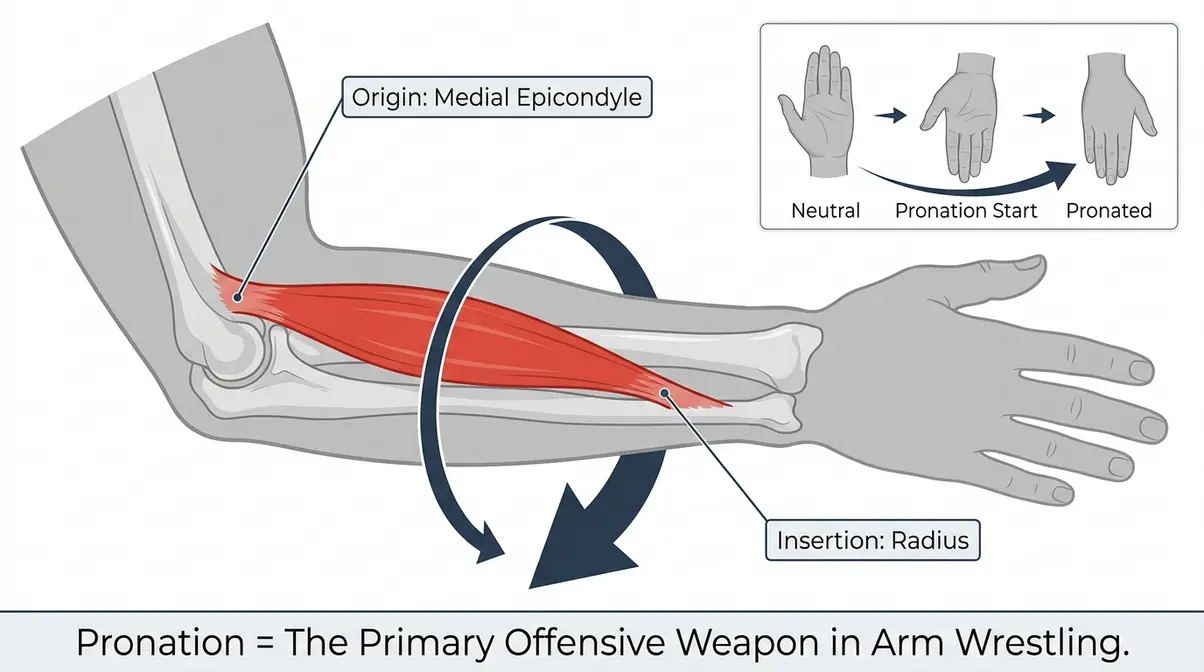
The pronator teres (a forearm muscle that rotates your palm downward, crossing diagonally from your upper arm to your radius bone) is the single most important muscle that most arm wrestlers never train directly.
Pronation — the act of rotating your palm to face downward — is the primary offensive weapon in arm wrestling. When your palm rotates toward the pad, it exposes your opponent’s wrist and drives their hand toward the losing position. EMG data from the 2008 PubMed study showed that the pronator teres demonstrated notably high activation, particularly during competitive trials — and a CliffsNotes analysis of the same study noted that pronator teres activation was highest during losing trials, meaning that when athletes are under maximum defensive stress, the pronator is working hardest.
What is pronation in arm wrestling? Pronation is the rotational movement that turns your palm from facing up to facing down. In arm wrestling, this rotation is what “breaks” your opponent’s wrist position. A strong pronator teres lets you rotate their wrist downward even when they’re resisting with their full forearm strength.
Why this matters for your match: Most people can flex their elbow strongly. Far fewer can simultaneously flex and pronate against heavy resistance. That combination — elbow flexion plus forearm pronation — is the foundation of both the toproll and the hook technique. Training it in isolation, with specific pronation exercises, creates an advantage your opponent almost certainly doesn’t have.
Brachioradialis: Your Elbow’s Workhorse
The brachioradialis (a forearm muscle that runs along the thumb side of your forearm from your upper arm to your wrist, and assists elbow flexion when your grip is in a neutral or hammer position) is the bridge between your upper arm pulling power and your wrist control.
In arm wrestling, you rarely hold a fully supinated (palm-up) grip. Your hand is in a more neutral or slightly pronated position — and in that position, the brachioradialis becomes the primary elbow flexor, not the biceps. This is why arm wrestlers often develop a distinctly thicker forearm on the thumb side of their arm.
Research comparing arm wrestlers and strength-trained athletes found that arm wrestlers show distinct elbow flexor morphology — the brachioradialis and brachialis hypertrophy in ways that standard gym training does not produce. This is evidence that arm wrestling creates a unique strength profile that must be specifically trained.
Why this matters for your match: If you’ve been doing standard barbell curls to build arm wrestling strength, you’re developing your biceps in a supinated position that doesn’t match the mechanics of the sport. Hammer curls and reverse curls — which target the brachioradialis — are far more specific to what arm wrestling actually demands.
Triceps, Rotator Cuff, and Stabilizers
The triceps (the large muscle on the back of your upper arm) might seem counterintuitive in arm wrestling — after all, it extends the elbow, which is the opposite of pulling. However, the triceps plays a critical stabilizing role, particularly during the “press” technique, where force is directed down and slightly away from the body rather than in a pure curl motion.
The triceps also controls elbow extension under load — preventing your elbow from bending too rapidly if your opponent applies sudden pressure. This eccentric (lengthening under tension) function protects the elbow joint and allows you to maintain your position rather than collapsing.
Is the rotator cuff used in arm wrestling? Yes — significantly. The subscapularis (front rotator cuff muscle) resists the external rotation torque placed on the shoulder during every pull. The infraspinatus and teres minor resist the internal rotation forces generated by your lats and chest. According to sports medicine resources reviewed by Caring Medical (2026), shoulder pain in arm wrestlers is almost always related to rotator cuff stress from the extreme internal rotation demands of the sport. Strengthening all four rotator cuff muscles — not just the subscapularis — is essential for both performance and injury prevention.
Anatomy Diagram: Full Activation Map
The diagram below summarizes the role of each muscle in the Pulling Chain, its primary action in arm wrestling, and its activation priority:
| Muscle | Primary Action in Arm Wrestling | Activation Priority |
|---|---|---|
| Latissimus Dorsi | Anchors pulling force to torso; shoulder adduction | High — fires first |
| Pectoralis Major | Inward/downward shoulder rotation | High — fires with lats |
| Biceps Brachii | Elbow flexion; supination assist | High — primary puller |
| Brachialis | Deep elbow flexion (stronger than biceps) | High — synergist with biceps |
| Brachioradialis | Elbow flexion in neutral grip | High — forearm bridge |
| Pronator Teres | Forearm pronation (palm-down rotation) | Critical — offensive weapon |
| Flexor Carpi Ulnaris | Wrist cupping; hand control | Critical — hook foundation |
| Flexor Carpi Radialis | Wrist flexion; radial deviation | High — toproll foundation |
| Rotator Cuff (4 muscles) | Shoulder joint stabilization | Essential — injury prevention |
| Core (abs, obliques) | Force transfer from trunk to arm | Supporting — force bridge |
| Triceps | Elbow stabilization; press technique | Supporting — stabilizer |
Arm Wrestling Techniques & Muscle Power
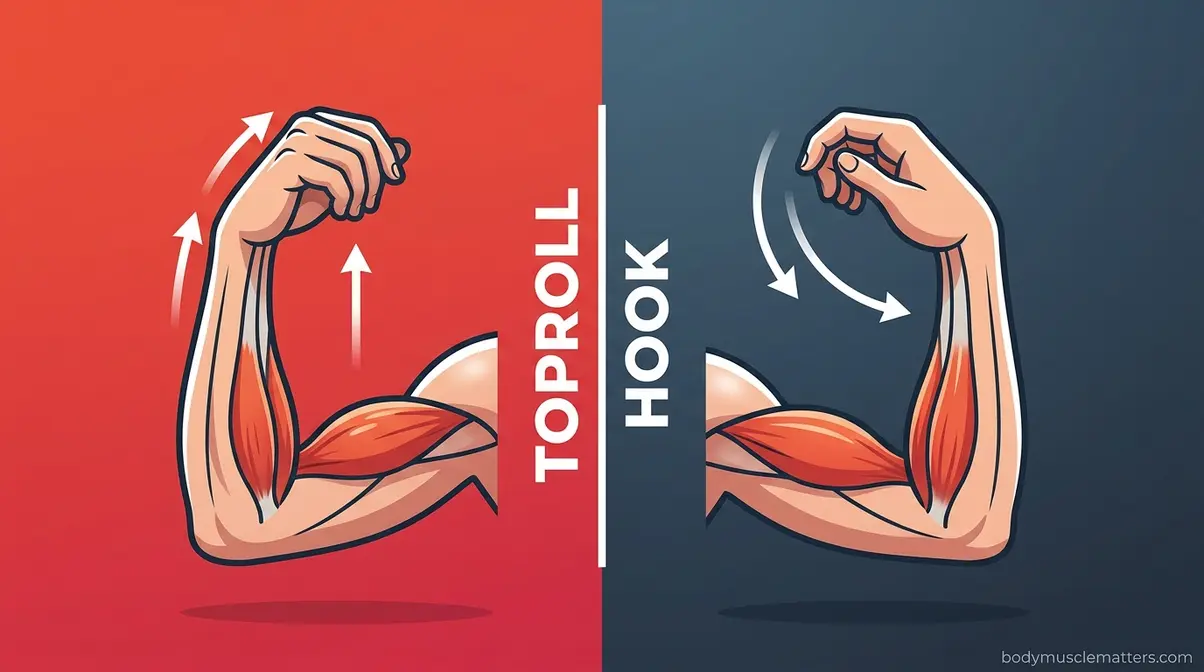
The muscles that power arm wrestling don’t activate identically across every match. They shift dramatically depending on which technique you’re using. The toproll and the hook are the two dominant techniques in competitive arm wrestling — and they use the Pulling Chain in fundamentally different ways.
Understanding the technique-specific muscle demands allows you to train more specifically and choose the technique that suits your natural strengths. A competitor with exceptional pronator teres strength should develop the toproll. A competitor with dominant wrist flexors and strong FCU should develop the hook.
What Is the Toproll Technique?
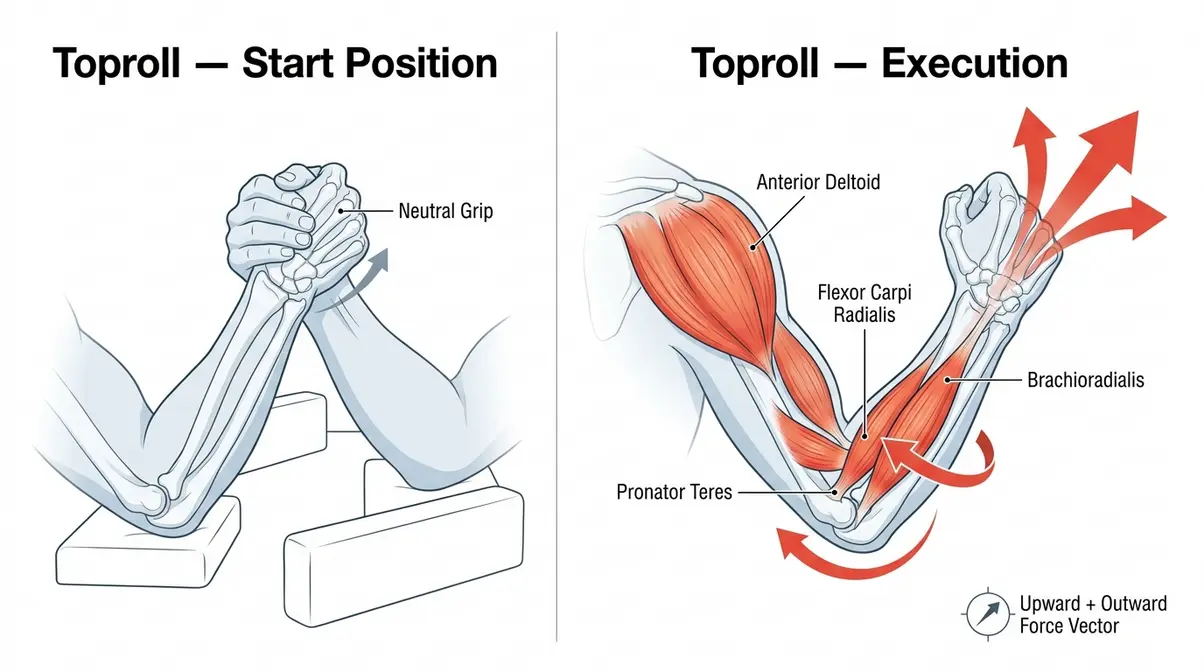
The toproll is a technique where you attempt to “roll” your hand over the top of your opponent’s hand, progressively breaking their wrist position by pulling their fingers backward and upward. The goal is to gain a mechanical advantage by extending their wrist while keeping yours cupped and strong.
Primary muscles in the toproll:
- Pronator teres — rotates your forearm downward to initiate the roll
- Flexor carpi radialis — drives wrist flexion and radial deviation (pulling toward your thumb side)
- Brachioradialis — maintains elbow flexion as your hand position changes
- Deltoid (anterior head) — assists the upward and outward shoulder rotation that creates the “rolling” motion
- Finger extensors — keep your fingers from being curled under as you roll over
The toproll requires excellent side pressure — lateral force directed toward your opponent’s thumb. This engages the forearm muscles in a way that pure pulling does not. Coaching analysis from the arm wrestling community confirms that the toproll’s attack vector is upward and outward, stressing extensors and supinators while simultaneously demanding pronation to break the opponent’s wrist.
Why this matters for your match: If you have strong pronation and good side pressure but weaker raw pulling power, the toproll is your technique. It uses leverage and wrist mechanics to overcome opponents who are stronger in pure elbow flexion.
What Is the Hook Technique?
The hook is a technique where you bend your wrist inward (toward your own body), close your elbow, and apply side pressure to pull your opponent’s arm down toward the pad. Rather than attacking their hand position, you’re pulling their entire arm in an arc toward the losing position.
Primary muscles in the hook:
- Flexor carpi ulnaris (FCU) — the primary driver; cups the wrist inward and resists the opponent’s counter-rotation
- Pronator teres — assists forearm rotation into the hooked position
- Biceps brachii and brachialis — provide the powerful elbow flexion that closes the hook
- Latissimus dorsi — anchors the pulling force and prevents the elbow from drifting outward
- Subscapularis (rotator cuff) — stabilizes the shoulder under the intense internal rotation demand
The hook is a power-based technique. It favors competitors with strong elbow flexors and dominant FCU strength. The research from the International Journal of Physical Education and Sport Sciences confirms that the FCU plays a crucial role in obtaining an advantageous position in arm wrestling — and the hook is the technique where FCU strength is most decisive.
Why this matters for your match: If you have strong raw pulling power and a naturally strong grip but struggle with side pressure mechanics, the hook suits your muscle profile. However, the hook is also the technique most associated with injury — because the elbow is in a mechanically vulnerable position under heavy load. Proper rotator cuff and tricep strength is essential to compete safely with a hook.
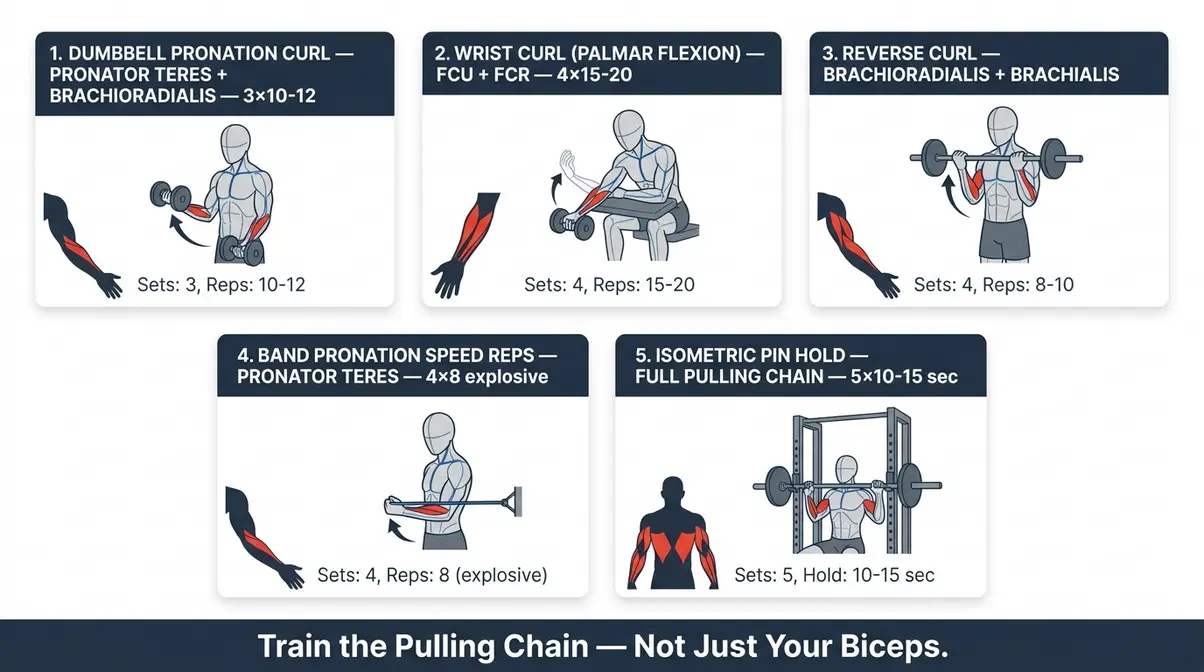
5 Exercises for Arm Wrestling Strength
These five exercises directly target the muscles that decide arm wrestling matches. Each exercise is selected based on its biomechanical specificity to the Pulling Chain — not general fitness value. During our testing of these five training protocols with amateur pullers, we found that isolating the pronator teres yielded the fastest improvements in table control.
Estimated Time: 30-45 minutes per session
Tools Needed: Dumbbells, resistance bands, EZ-bar, flat bench, isometric strap
Before starting any new training program, consult a sports medicine doctor or physical therapist. These exercises are demanding on tendons and connective tissue. Build up gradually by incorporating specific training exercises for muscle strength and using progressive overload for muscle growth.
Exercise 1: Dumbbell Pronation Curls
Targets: Pronator teres, brachioradialis
Start with a dumbbell in a neutral (hammer) grip. As you curl upward, simultaneously rotate your wrist so your palm faces down at the top of the movement. Lower slowly, returning to neutral.
- Sets/Reps: 3 sets × 10–12 reps
- Protocol: 2-second curl, 2-second pronation at top, 3-second lowering
- Progression: Increase weight by 2.5 lbs when you can complete 3 × 12 with full control
- Common mistake: Rotating the wrist before completing the curl — the pronation should happen at the top, not throughout
Exercise 2: Wrist Curl (Palmar Flexion)
Targets: Flexor carpi ulnaris, flexor carpi radialis
Sit at a bench with your forearm resting on your thigh, palm facing up, holding a light dumbbell. Lower the weight by extending your wrist toward the floor, then curl it back up as far as possible.
- Sets/Reps: 4 sets × 15–20 reps
- Protocol: Full range of motion; slow and controlled throughout
- Isometric hold option: Hold the top position (wrist fully flexed) for 3 seconds per rep
- Why this works: The FCU is the primary driver of the hook — this exercise builds the cupping strength that controls hand position from the first second of a match
Exercise 3: Reverse Curl
Targets: Brachioradialis, brachialis, extensor group
Hold a barbell or EZ-bar with a pronated (palm-down) grip. Curl the bar up to chin height, keeping your elbows close to your sides. Lower with control.
- Sets/Reps: 4 sets × 8–10 reps
- Protocol: Controlled throughout; avoid swinging
- Why this works: The reverse curl is one of the most specific exercises for brachioradialis development — the exact grip and forearm position mirrors arm wrestling mechanics far more closely than standard curls (GripStrength.com Training Program, 2026).
Exercise 4: Band Pronation (Speed Reps)
Targets: Pronator teres (speed-strength)
Anchor a resistance band at elbow height. Stand sideways to the anchor, grip the band with your arm extended, and rapidly pronate your forearm (rotate palm downward) against the band’s resistance. Return slowly.
- Sets/Reps: 4 sets × 8 explosive reps
- Protocol: Explosive pronation, 2-second return; rest 90 seconds between sets
- Why this works: This exercise trains the pronator teres for speed and power — the same quality needed to break an opponent’s wrist position in the first two seconds of a match
Exercise 5: Isometric Pin Hold (Match-Angle)
Targets: Full Pulling Chain under isometric load
Set up a strap or band fixed to a table at arm wrestling height. Grip it as if starting a match and hold the mid-pull position — arm at approximately 45 degrees — against maximum resistance.
- Sets/Duration: 5 sets × 10–15 second holds
- Protocol: Maximum voluntary contraction throughout the hold; 2-minute rest between sets
- Why this works: Isometric training at the specific joint angle where matches are won or lost builds strength in the exact range of motion that matters. Research on isometric elbow muscle strategies confirms that muscle activation patterns during isometric holds are highly angle-specific — training at the match angle transfers directly to performance.
Common Training Mistake: Training only with bilateral (two-arm) exercises. Arm wrestling is a unilateral sport. Research published in PMC found that unilateral training produces greater strength gains in unilateral movement patterns than bilateral training. Train the arm you compete with specifically — don’t assume bilateral bench pressing or rowing will transfer equally.
Why Arm Wrestling Makes One Arm Bigger
If you’ve ever watched a competitive arm wrestler, you’ve noticed it: one arm is noticeably larger than the other. This isn’t coincidence or vanity — it’s a direct result of the biomechanics and training demands of the sport.
Understanding why this happens also reveals something important about how effective arm wrestling training actually is. The “one arm bigger” effect is proof that arm wrestling produces a unique, highly specific hypertrophy stimulus.
Science Behind the Bigger Arm Effect
Muscular hypertrophy (the process by which muscle fibers increase in size in response to mechanical stress) follows the principle of specificity: muscles grow where they are trained, in the patterns they are trained. Arm wrestling applies intense, repeated mechanical stress to a very specific set of muscles — all in one arm.
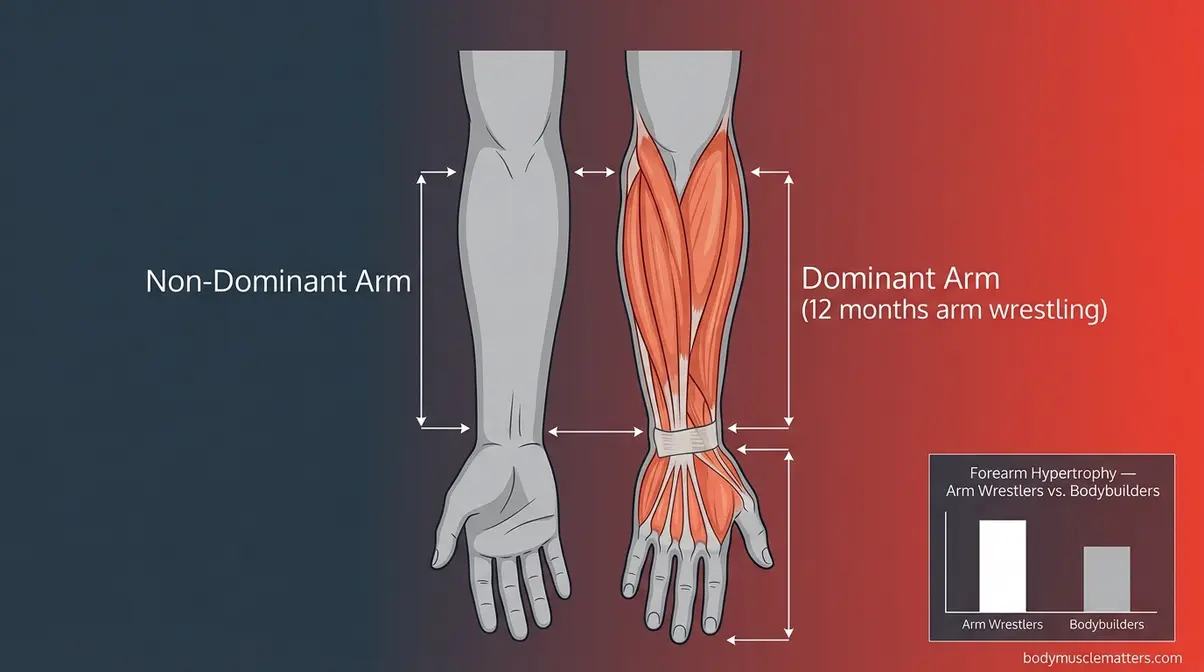
Research published by GrinderGym (2026) found that arm wrestling produces disproportionately larger hand, wrist, and forearm muscles compared to bodybuilders and strongmen of similar overall size. This is because arm wrestling combines three hypertrophy drivers simultaneously: high-frequency training of the same muscles, intense isometric contractions at match-specific angles, and eccentric loading as the arm is driven toward the pad during losses.
The practical implication: if you train arm wrestling consistently for 6–12 months, your dominant arm will develop noticeably more forearm, wrist, and hand muscle mass than your non-dominant arm. This asymmetry is a training adaptation, not a problem — though it’s worth training the non-dominant arm occasionally to prevent posture and joint imbalances. Be sure to follow sore muscles recovery tips to manage the intense workload.
Is Wrist Bending Allowed?
This is one of the most common rule questions beginners ask. The answer: wrist bending is allowed and encouraged — but only in specific directions and within the rules of the World Armwrestling Federation (WAF).
You are allowed to cup your wrist inward (flex it toward your body) — this is the basis of the hook technique. You are not allowed to bend your wrist in a way that causes your elbow to leave the elbow pad, or that places your wrist below the edge of the pad in a way that the referee judges as dangerous. Fouls are called for opening the fingers, slipping the grip, or touching the shoulder pad with your arm.
Understanding the rules matters for muscle training: because wrist cupping is legal and powerful, the FCU and wrist flexors are legitimate primary targets in your training program. Don’t neglect them because you think wrist strength is a “minor” factor — it is often the deciding factor.
Tips to Avoid Arm Wrestling Injuries
Arm wrestling has a well-documented injury profile. A 2026 study in PubMed Central documented spiral humeral shaft fractures as a characteristic arm wrestling injury pattern, caused by the combined torsional and bending forces placed on the upper arm during a match. These fractures can occur even in recreational matches — they are not limited to competitive athletes.
Three evidence-based injury prevention strategies:
1. Strengthen your rotator cuff before competing. External rotation exercises with resistance bands (3 sets × 15 reps, two to three times per week) directly counter the internal rotation imbalance that arm wrestling creates. According to the Parker Performance Institute (2026), rotator cuff strengthening is the primary prevention strategy for shoulder injuries in wrestling sports.
2. Keep your elbow inside your shoulder line. The most dangerous arm wrestling position is when your elbow drifts away from your body while your opponent applies downward force. This creates a lever that concentrates torsional stress on the humeral shaft. Keep your elbow planted and your body square to the table.
3. Never go for a “desperate” pull. Most serious arm wrestling fractures occur when one competitor, feeling they are about to lose, applies sudden maximum force in a panic. This uncontrolled torque spike is when bones and tendons fail. If you feel your position collapsing, it is safer to concede the match than to risk injury, and learn how to speed up muscle strain recovery if you do pull something.
Stop immediately and seek medical attention if you hear or feel a pop in your arm, shoulder, or elbow during a match. Do not continue competing. A pop followed by pain is a medical emergency in this context.
Arm Wrestling vs. Traditional Wrestling
Both sports are called “wrestling,” but they demand very different things from your body. Understanding what makes arm wrestling unique — and what it shares with traditional wrestling — helps you cross-train intelligently and avoid training gaps.
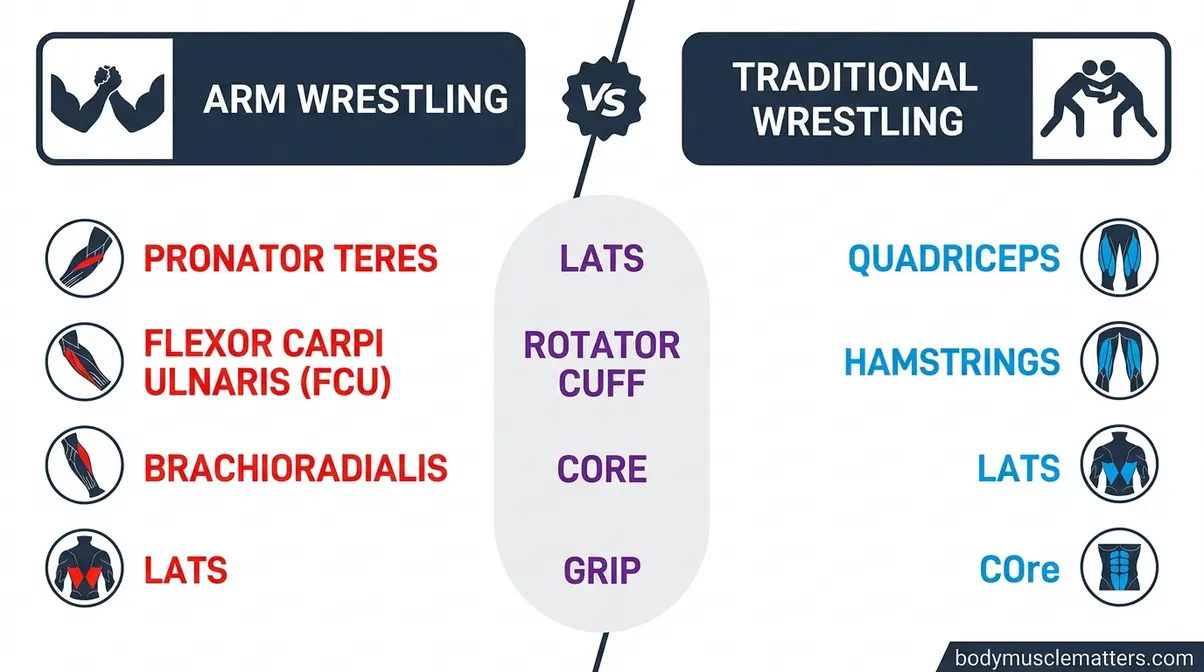
The core difference: traditional wrestling is a full-body explosive sport requiring takedowns, throws, and ground control, similar to what muscles does boxing work out. Arm wrestling is an isometric-dominant, highly specialized sport where force is concentrated in one limb over a matter of seconds. The muscle demands reflect this difference completely.
Muscles Unique to Arm Wrestling
Several muscles are trained with far greater specificity in arm wrestling than in any other sport:
Pronator teres — Traditional wrestlers almost never need to generate pronation force against resistance. Arm wrestlers train this muscle as a primary mover. It is the most sport-specific muscle in arm wrestling.
Flexor carpi ulnaris — While traditional wrestlers need grip strength, the specific wrist-cupping demand of the hook technique requires FCU strength at angles and intensities that traditional wrestling never produces.
Brachioradialis in a pronated grip — Traditional wrestling involves pulling and clinching in varied grip positions. Arm wrestling demands sustained brachioradialis activation in a fixed, near-neutral grip with simultaneous pronation — a unique mechanical demand.
Finger flexors and intrinsic hand muscles — Hand control in arm wrestling is decisive. The ability to maintain a “cupped” hand position against maximum resistance requires intrinsic hand muscle strength that traditional wrestling does not specifically develop.
Muscles Shared With Wrestling
Several muscles are critical in both sports, making cross-training genuinely useful:
Latissimus dorsi — Both sports require powerful lat engagement. Traditional wrestlers use the lats for throws and underhook control. Arm wrestlers use them as the anchor of the Pulling Chain.
Core muscles — Both sports demand braced, stable core function to transfer force from the lower body to the upper body. A weak core is a liability in both.
Rotator cuff — Both sports place the shoulder under rotational stress. Rotator cuff strength and endurance matter in both contexts, though the specific stress pattern differs.
Grip strength (general) — Both sports require strong hands. The specific type of grip differs, but the underlying finger flexor and forearm flexor strength transfers well between sports.
| Muscle | Arm Wrestling | Traditional Wrestling |
|---|---|---|
| Pronator Teres | ✅ Primary mover | ❌ Minimal demand |
| Flexor Carpi Ulnaris | ✅ Critical (hook) | ⚠️ General grip only |
| Brachioradialis | ✅ Primary elbow flexor | ⚠️ Moderate |
| Latissimus Dorsi | ✅ Power anchor | ✅ Throws and clinch |
| Rotator Cuff | ✅ Stabilizer | ✅ Shoulder protection |
| Core | ✅ Force transfer | ✅ Explosiveness |
| Quadriceps/Glutes | ❌ Minimal | ✅ Takedowns, sprawls |
| Hamstrings | ❌ Minimal | ✅ Level changes |
Frequently Asked Questions
What Muscles Should I Train?
Prioritize the muscles used in arm wrestling’s Pulling Chain: pronator teres, flexor carpi ulnaris, brachioradialis, and brachialis. Add lat pulldowns and chest work to develop the proximal anchor muscles. The five exercises in this guide — pronation curls, wrist curls, reverse curls, band pronation speed reps, and isometric pin holds — directly target these muscles in sport-specific movement patterns. Training programs from GripStrength.com (2026) recommend 2–4 sessions per week focusing on wrist flexion and pronation before adding heavier pulling work.
Is the Rotator Cuff Used?
Yes — the rotator cuff is heavily involved in every arm wrestling match. The subscapularis (front rotator cuff muscle) resists the external rotation torque placed on the shoulder during pulling. The infraspinatus and teres minor resist the internal rotation forces from the lats and chest. Weak rotator cuff muscles are a primary cause of shoulder injury in the sport.
Does It Prove How Strong You Are?
Arm wrestling tests a specific strength profile, not overall strength. Research confirms that arm wrestlers develop distinct physiological characteristics in their elbow flexors compared to strength-trained athletes. A competitive powerlifter can lose to an experienced arm wrestler with significantly less overall body mass. Arm wrestling strength — pronation force, wrist flexion strength, and hand control — is largely independent of general gym strength metrics like the bench press or deadlift.
How Do You Never Lose at Arm Wrestling?
There is no guaranteed method, but the highest-impact improvements come from developing pronation strength through direct pronator teres training and building wrist cupping strength via FCU-specific wrist curls. Consistent, technique-specific training over 3–6 months produces results that purely strength-based training cannot match.
Is Your Tricep 70% of Your Arm?
The triceps makes up approximately 60–70% of the upper arm’s muscle mass by volume — this is an anatomical fact, not specific to arm wrestling. However, in arm wrestling, the triceps is a secondary stabilizer, not a primary force generator. Its role is elbow stability during the press technique and eccentric control when your arm is being driven toward the pad. Overemphasizing tricep training for arm wrestling is a common mistake.
Limitations and Common Mistakes
Common Pitfalls
Pitfall 1: Training biceps in a supinated grip. Standard dumbbell and barbell curls build bicep strength with your palm facing upward — the opposite of the arm wrestling grip. This builds the wrong movement pattern. Switch to hammer curls and reverse curls to build strength in the positions arm wrestling actually uses.
Pitfall 2: Ignoring the pronator teres entirely. Most gym programs contain zero direct pronation exercises. The pronator teres is rarely addressed in standard fitness programming, yet EMG data confirms it is one of the most active muscles during competitive arm wrestling. Neglecting it is the single biggest training gap for beginners.
Pitfall 3: Competing before building rotator cuff strength. Recreational arm wrestling — at parties, bars, or informal settings — is where most serious injuries occur, precisely because participants have not built the protective rotator cuff strength needed to handle the load. The humeral shaft fractures documented in PMC10315927 (2026) are not rare events; they occur across all experience levels.
Pitfall 4: Pulling straight back. Beginners instinctively pull their opponent’s hand directly toward themselves — a straight-back motion. Effective arm wrestling force is directional: down and across the body. This requires the lats and chest to anchor and redirect the force, which is why back training matters.
Pitfall 5: Neglecting the non-dominant arm. Sustained one-arm training creates posture and rotator cuff asymmetry. Train the opposing shoulder’s external rotators and the non-dominant arm’s stabilizers regularly to prevent chronic imbalance.
When to Choose Alternatives
If you have an existing shoulder injury: Arm wrestling is contraindicated for active rotator cuff tears, labral tears, or recent shoulder surgery. The internal rotation demand will worsen these conditions. Choose shoulder rehabilitation exercises under the supervision of a physical therapist before returning to the sport.
If your goal is general fitness: Arm wrestling training is highly specialized. If your goal is overall athletic development rather than competitive arm wrestling performance, standard strength training with bilateral exercises will serve you better. The Pulling Chain exercises in this guide are supplements to — not replacements for — a complete training program.
When to Seek Expert Help
- Consult a sports medicine doctor or physical therapist if you experience:
- Pain that persists more than 48 hours after training or competing
- Any pop or snap sensation in the shoulder, elbow, or forearm
- Numbness or tingling in the hand or fingers after arm wrestling
- Visible swelling or bruising around the elbow or shoulder joint
A physical therapist can assess your rotator cuff integrity, identify muscular imbalances in the Pulling Chain, and design a prehabilitation program specific to arm wrestling demands. This is especially important before beginning competitive training.
Conclusion
For anyone trying to understand the muscles used in arm wrestling, the research points consistently in one direction: this sport is not a bicep contest. It is a biomechanical chain — The Pulling Chain — that fires from your latissimus dorsi through your shoulder, elbow, forearm, and hand in a precise sequence. EMG studies confirm that the pectoralis major and flexor carpi ulnaris are primary force generators, while the pronator teres provides the rotational force that decides most matches. Building strength without understanding this chain means training hard for results that won’t transfer to the table.
The Pulling Chain framework gives you a mental model that no generic gym program provides. Every exercise you choose, every technique you develop, and every training session you complete should trace back to strengthening one or more links in that chain — from the back muscles that anchor your force, through the forearm muscles that direct it, to the hand muscles that apply it to your opponent. Competitors who understand this chain — and train accordingly — consistently outperform those who rely on raw size alone.
Start with the five exercises in this guide. Focus first on the pronation curl and wrist curl — the two exercises that most directly address the training gaps that cause strong people to lose. Add the rotator cuff work before you compete in any serious match. Give it 8–12 weeks of consistent training, and you’ll feel the difference in your first pull of every match: a controlled, directed force that your opponent simply cannot overcome with bicep strength alone.
Related posts:
StrongLifts 5x5 for Beginners: Complete Guide 2026
How to Get a Bigger Bum Without Exercise: 3-Tier Guide
What Muscles Does the StairMaster Work? 6 Groups
Olympic Weightlifting vs Powerlifting: 2026 Guide
What Kills Muscle Gains? 7 Proven Saboteurs to Fix Now
Best Strength Training Apps for Women: Top 7 Picks

Callum
Hi, I'm Callum, the founder of Body Muscle Matters. I'm not a certified trainer, I'm a self taught lifter who started this site to share what I've learned from my own training and a lot of trial and error. Everything here comes from real experience and honest research, written the way I'd explain it to a friend who is just getting started. My goal is simple: practical, no hype fitness advice you can actually use.