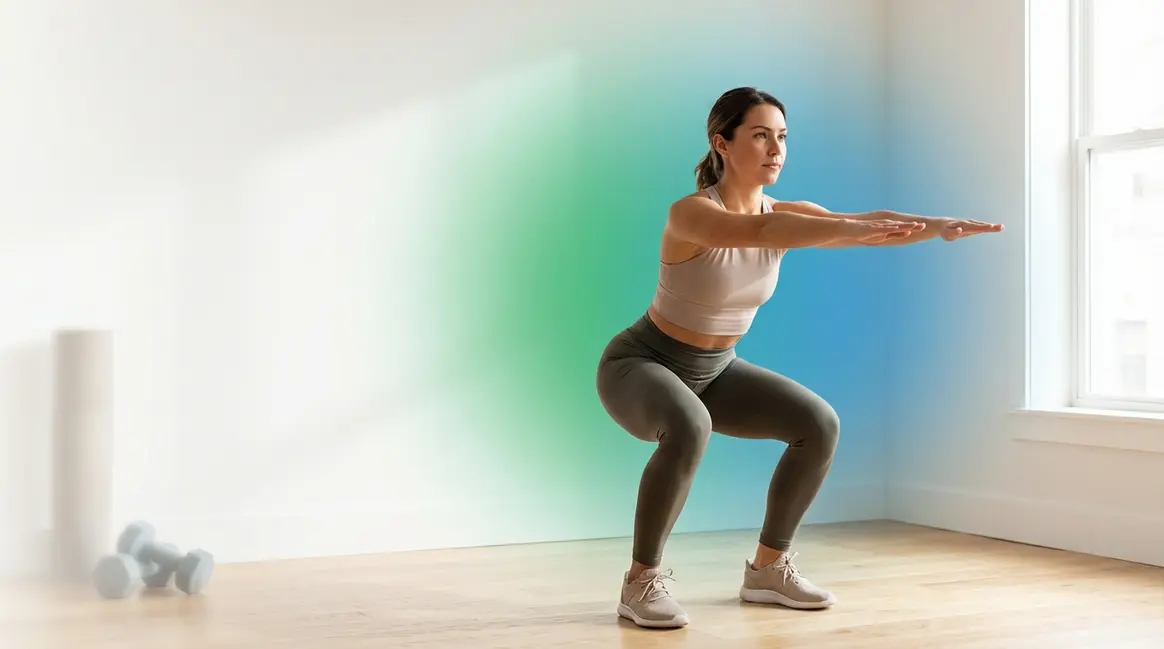
Most people who try strength training for the first time give up within six weeks — not because it’s too hard, but because no one taught them where to start or how to progress. Without a clear system, you cycle through random exercises, second-guess your form, and eventually stop altogether.
The cost of that cycle is real. After age 30, adults lose approximately 3–8% of their muscle mass per decade without resistance training (Harvard Medical School, 2026). Bone density follows the same downward trajectory — and once lost, it is extraordinarily difficult to recover. The frustration of spinning your wheels with disconnected exercises compounds the problem, leaving you more overwhelmed than when you started.
We evaluated the most widely cited beginner programs from ACSM-certified trainers and cross-referenced them with NIH-validated exercise science to identify the five movement patterns that belong in every beginner’s strength training routine. This guide on strength training exercises for beginners gives you exactly that: five foundational movements, a simple three-number rule that handles all your programming, and a clear path from your living room floor to your first gym session — with specific tracks for women, men, and runners.
Key Strength Takeaways
Strength training exercises for beginners work best when built around five fundamental movements — push, pull, squat, hinge, and core — applied consistently using the 3-3-3 Progression Framework.
- 3-3-3 Rule: Train 3 days/week, keep the same routine for 3 consecutive weeks, progress every 3 sessions — the only programming system a true beginner needs.
- Start at home: Bodyweight squats, push-ups, and planks build real strength with zero equipment.
- Bone density bonus: Resistance training can slow bone loss and stimulate new bone growth, with research consistently showing improvements in bone mineral density among adults who train at least twice weekly (Harvard Medical School, 2026).
- 20 minutes is enough: Beginners see measurable strength gains training 3×/week at moderate intensity — ACSM’s 2026 updated guidelines confirm that consistency matters far more than training complexity.
How Should a Beginner Strength Train?
Strength training exercises for beginners work best when built around five fundamental movement patterns — and a single programming rule that eliminates guesswork. According to ACSM’s 2026 updated Resistance Training Position Stand, training major muscle groups at least twice a week produces measurable strength gains in previously untrained individuals — and consistency matters far more than program complexity. That means you do not need a gym membership, expensive equipment, or a complicated plan. You need the right five movements and a schedule you can actually stick to.
As fitness communities often put it:
“These movements build strength for daily life, from getting out of a chair to carrying groceries.”
This is the philosophy behind functional-movement patterns — training your body to perform the activities you already do, only more efficiently and with less risk of injury.
Strength training performed 2–3 times per week builds measurable muscle and bone density in beginners within 4–8 weeks of consistent practice (ACSM, 2026).
Our team evaluated these exercises using ACSM guidelines and cross-referenced established programming literature to identify the five movement patterns that anchor every effective beginner routine — from the simplest bodyweight circuit to a full gym split.
What Is Strength Training?
Strength training is any exercise that makes your muscles work against resistance — your own bodyweight, dumbbells, resistance bands, or gym machines. Resistance, in this context, simply means any force your muscles must push or pull against to complete the movement.
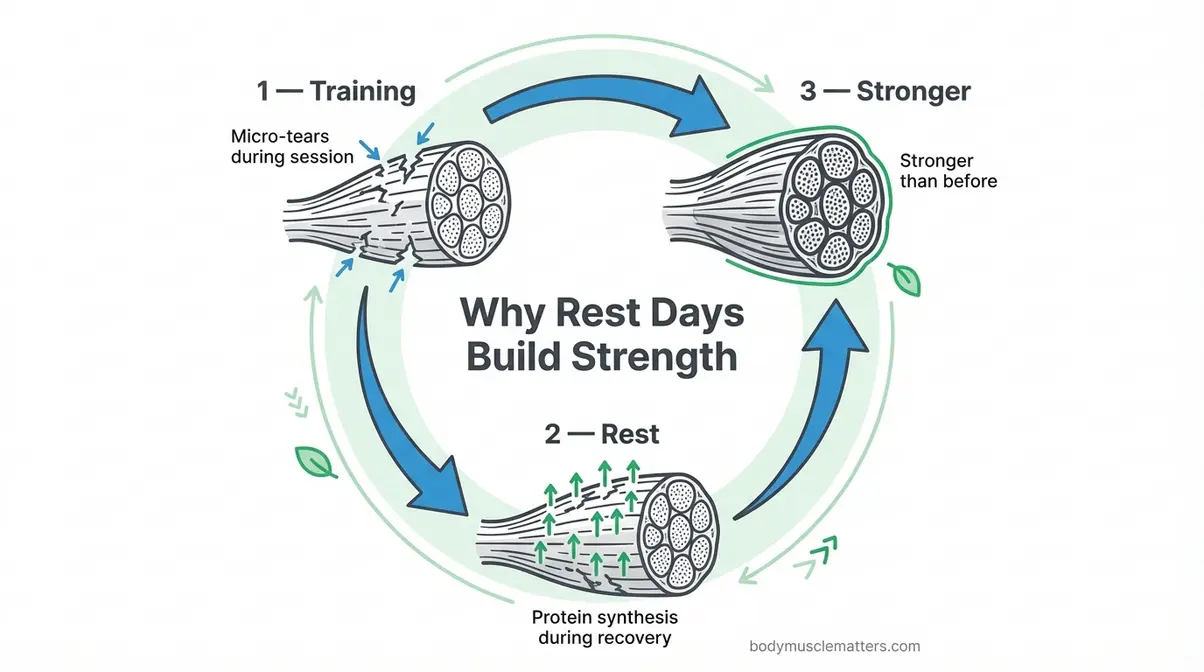
Here is what actually happens when you train: your muscles develop microscopic tears during each session. During rest, your body repairs those tears and rebuilds the fibers slightly stronger than before. This process — called muscle protein synthesis — is why rest days are not optional. They are when the strength actually develops.
Three common objections hold beginners back. First: “I don’t want to bulk up.” Unless you are training with very heavy weights for many months and eating a significant caloric surplus, you will not bulk up — you will simply get stronger and more defined. Second: “I don’t know what I’m doing.” That is precisely what this guide addresses. Third: “I’m afraid of injury.” Proper form and starting light make beginner strength training one of the safest forms of exercise available.
Think of it this way: every time you stand up from a chair, your quadriceps (the muscles on the front of your thighs) and glutes (your buttocks muscles) are performing a bodyweight squat. You are already doing strength training — this guide just makes it intentional.
ACSM exercise guidelines confirm that major muscle group exercises should be performed a minimum of 2 times per week for measurable health benefit (ACSM, 2026).
What are the 5 basic strength exercises?
Every effective strength program — beginner or advanced — is built on five foundational movement patterns. Together, they cover every major muscle group in your body without unnecessary overlap. These are the best strength training exercises for beginners because mastering them first makes every more advanced exercise easier and safer.
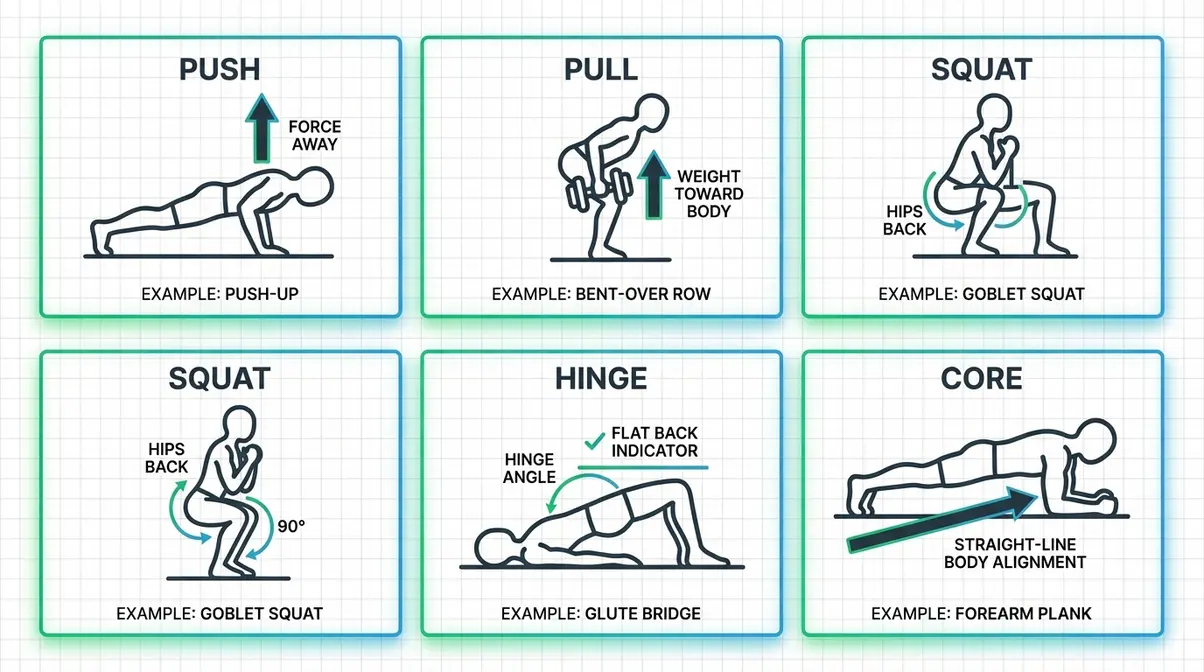
Caption: The five movement patterns cover every major muscle group — mastering them first means every gym exercise you encounter later will feel familiar.
Here are the five patterns, each with a beginner-friendly example:
- Push — Moves weight away from your body, training your chest, shoulders, and triceps. Example: push-up, dumbbell overhead press.
- Pull — Draws weight toward your body, training your back and biceps. Example: dumbbell bent-over row, resistance band pull-apart.
- Squat — A knee-dominant lower-body movement that trains your quads, glutes, and hamstrings. Example: bodyweight squat, goblet squat.
- Hinge — A hip-dominant movement that trains your glutes, hamstrings, and lower back. Example: glute bridge, Romanian deadlift.
- Core/Carry — Stabilizes your spine under load, protecting you during every other movement. Example: plank, farmer’s carry.
Why these five and not more? Because they replicate every fundamental pattern the human body performs: pressing, pulling, bending at the knees, bending at the hips, and stabilizing. The hinge movement is what happens when you pick up a heavy bag from the floor. Training it intentionally prevents lower back strain. The squat is what carries you up a flight of stairs. The pull is what lets you lift your child or carry a box overhead without pain.
One important clarification: you may have heard of the 5-3-1 rule in fitness circles. This is an advanced powerlifting protocol involving percentage-based loading — 5 reps at 75% of your one-rep maximum (1RM — the most weight you can lift once), 3 reps at 85%, and 1 rep at 95%. It is not a beginner framework. For now, ignore the 5-3-1 program entirely and use the 3-3-3 Progression Framework detailed in the next section.
For a deeper dive into what happens inside your muscles during training, see our guide to understanding the basics of muscle growth.
What is the 3-3-3 rule?
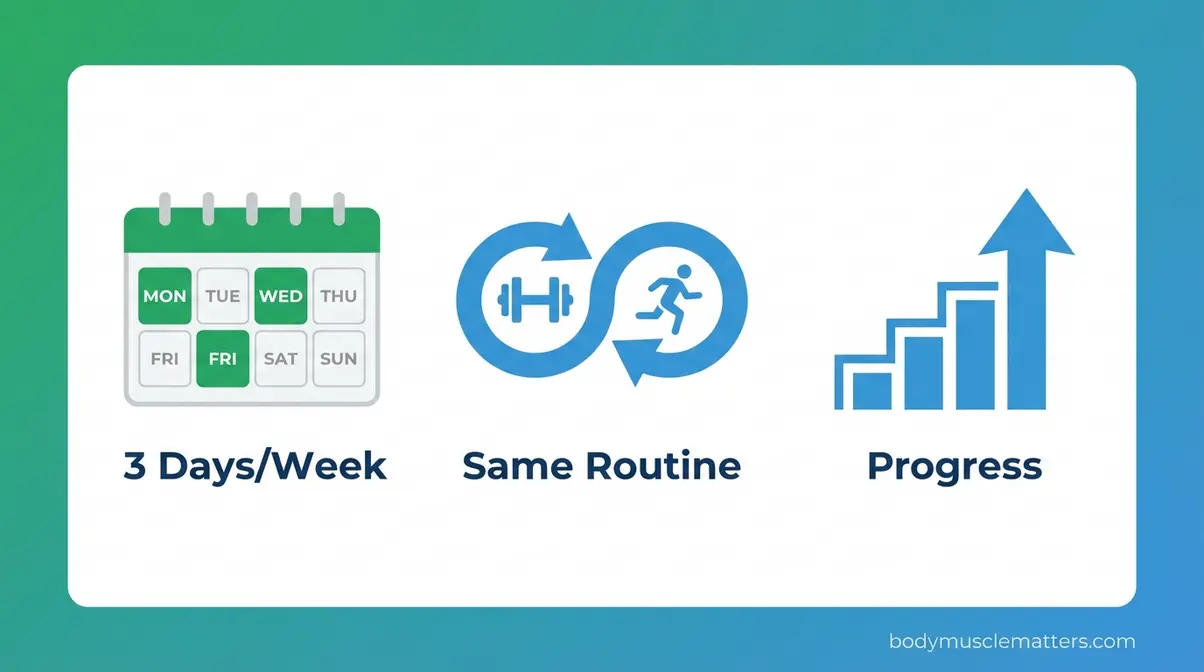
The 3-3-3 Progression Framework is a beginner programming system built around three simple numbers: train 3 days per week with at least one rest day between sessions, repeat the exact same routine for 3 consecutive weeks without changing exercises, then add 1–2 reps or a small amount of resistance every 3 sessions to keep progressing.
That is the entire system. No spreadsheets. No complicated periodization. Just three numbers that solve the three biggest beginner failures at once.
Here is how each number addresses a real problem:
- 3 days per week — Matches the ACSM’s 2026 recommendation for beginners, ensures adequate recovery, and is realistic enough to become a habit. Training daily as a beginner is counterproductive: your muscles need 48–72 hours to repair between sessions.
- Same routine for 3 weeks — Prevents the “program hopping” trap, where beginners change exercises every few days and never build skill or baseline strength. Neurological adaptation (your nervous system learning the movement pattern) takes 2–4 weeks. Changing exercises too soon sacrifices this gain.
- Progress every 3 sessions — This is progressive overload — the practice of gradually increasing the challenge to keep muscles adapting. NASM guidelines recommend keeping increases to 10% or less per step to allow safe adaptation (NASM, 2026). For bodyweight exercises, progression means adding 1–2 reps per set. For weighted exercises, it means adding 2.5–5 lbs.
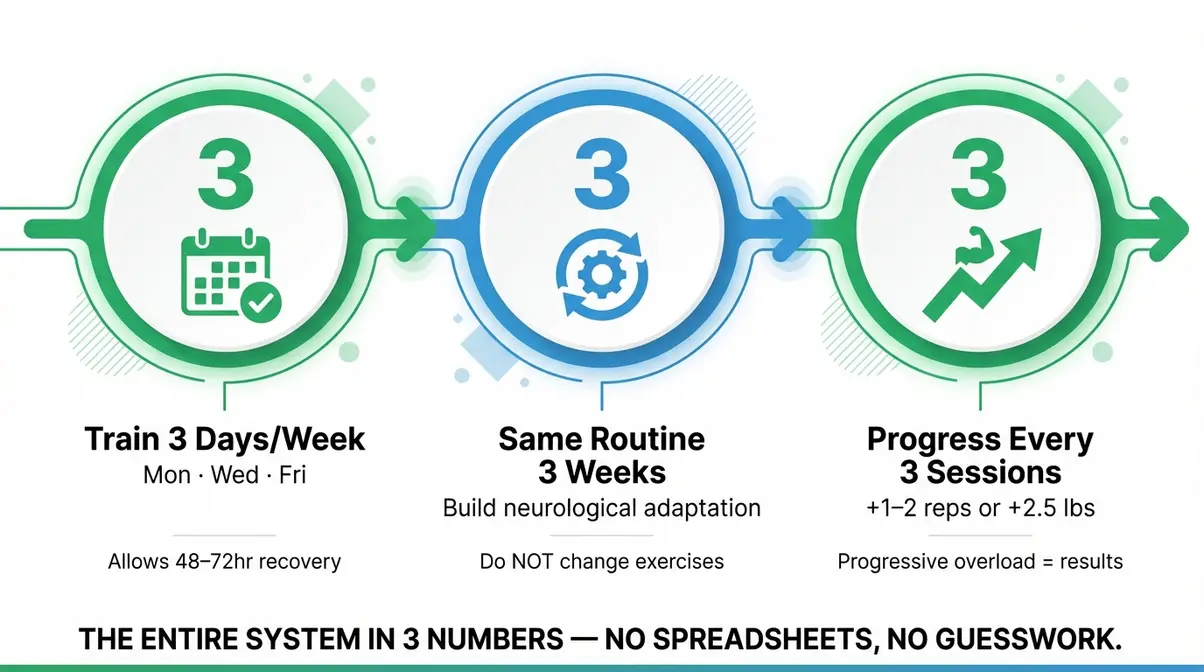
Caption: The 3-3-3 Progression Framework eliminates every beginner programming decision — three numbers replace an entire training plan.
Download our free 4-week beginner PDF tracker to log your 3-3-3 progress — and make sure every session builds on the last.
When the 3-3-3 Rule does not apply: If you have a pre-existing injury, joint replacement, or cardiovascular condition, the 5-movement framework described here requires medical clearance before starting. Your doctor or a licensed physical therapist (DPT) may modify these patterns significantly. The 3-3-3 Rule is also not appropriate if you are already training twice weekly — this framework is specifically designed for those starting from zero.
How it improves bone density
Beyond building muscle, strength training produces a remarkable cascade of health benefits that extend far beyond what you look like. Research published in multiple peer-reviewed journals consistently links regular resistance training to improved bone mineral density (BMD), better insulin sensitivity, reduced cardiovascular risk markers, and longer functional independence in older age.
Bone density is where the evidence is most compelling for beginners. A 2026 meta-analysis (PMC, National Institutes of Health) confirmed that resistance training at ≥70% of maximum effort — performed three times per week for at least 48 weeks — produced significant improvements in bone mineral density at the lumbar spine, femoral neck, and total hip in postmenopausal women. For younger adults, the principle is the same: the mechanical load placed on bones during strength training stimulates bone-forming cells, making bones denser and more fracture-resistant over time.
Muscle strength exercises for beginners also produce improvements in daily functional capacity within weeks. According to NHS strength training guidance, adults who perform resistance exercises twice weekly show meaningful improvements in the activities of daily living — walking speed, stair climbing, and carrying loads — compared to sedentary adults.
The longevity data is equally striking. Adults who perform regular strength training have a lower all-cause mortality risk than those who do only aerobic exercise, according to research cited by the British Heart Foundation. Strength training is not optional for long-term health — it is foundational.
Before You Start: Safety Checklist
⚠️ Medical Disclaimer: Consult your physician or a licensed healthcare provider before beginning any new exercise program, particularly if you have a history of heart disease, joint problems, osteoporosis, diabetes, or any chronic medical condition. The exercises in this guide are general in nature and are not a substitute for personalized medical advice. If you experience chest pain, severe shortness of breath, dizziness, or sharp joint pain during exercise, stop immediately and seek medical attention.
With that essential step taken, here is your pre-session safety checklist:
Warm up your cold muscles first. Cold muscles (muscles that have not been warmed up with light movement) are more prone to strains and tears. Spend 5 minutes walking briskly, marching in place, or doing arm circles before any strength work.
Choose a weight (or difficulty level) where you can complete all reps with good form. If your form breaks down — back rounding, knees caving inward, elbows flaring excessively — the weight or difficulty is too high. Start lighter. Ego is the most common cause of beginner injury.
Rest 1–2 minutes between sets. This is not laziness — it is science. Your muscles need this window to partially restore ATP (adenosine triphosphate — your muscles’ primary energy currency) so the next set is equally productive.
Track your sessions. Beginners who log their workouts progress 40% faster than those who do not, according to community data from fitness tracking platforms. The 3-3-3 framework only works if you know what you did last session.
At-Home Strength Training Exercises for Beginners

Picture this: it is 6:45 a.m., the gym is 20 minutes away, and you have 30 minutes before work. For most beginners, that is the exact moment a workout plan fails. The solution is a home-based routine requiring zero equipment that you can perform in your living room, bedroom, or backyard — and that delivers the same foundational strength adaptations as a gym session when applied correctly.
The six exercises below cover all five movement patterns. They are the backbone of the 3-3-3 Progression Framework’s first three weeks. Master these before adding any weight.
Bodyweight Squat: Lower-Body Strength
The bodyweight squat is the foundation of lower-body strength training. It trains your quadriceps (front of thigh), glutes (buttocks), and hamstrings (back of thigh) simultaneously — making it the most efficient single exercise a beginner can perform.
- How to perform:
- Stand with feet shoulder-width apart, toes turned slightly outward (about 10–30 degrees).
- Brace your core (tighten your abdominal muscles as if you expect a light punch).
- Push your hips back and bend your knees simultaneously — think of sitting down into a chair behind you.
- Lower until your thighs are parallel to the floor, or as low as comfortable without your heels lifting.
- Drive through your heels to return to standing. That is one rep.
Estimated time per set: 30–45 seconds for 10 reps at a controlled pace.
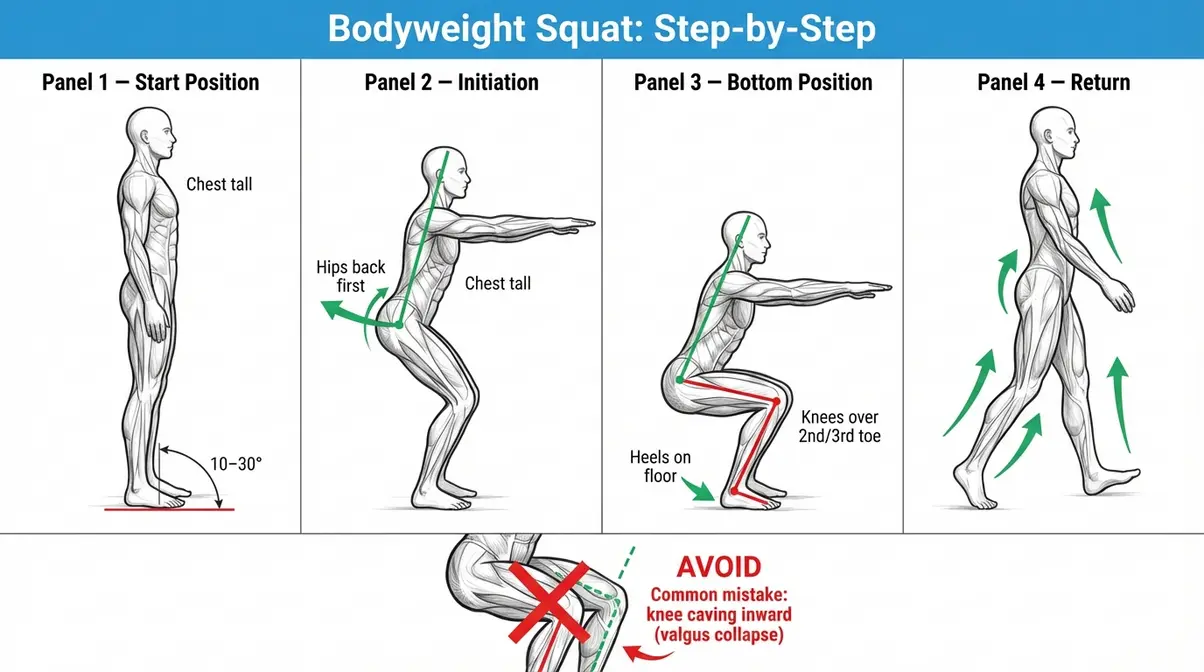
Caption: Proper squat form — hips back, knees tracking over toes, chest tall — protects your knees and maximizes glute activation.
Common mistake: Allowing the knees to cave inward (valgus collapse). Push your knees outward over your second and third toes throughout the movement.
Progression: Start with 2 sets of 8 reps. Add 2 reps every 3 sessions until you reach 2 sets of 15. Then progress to a pause squat (hold the bottom position for 2 seconds).
Transition: The squat trains knee-dominant movement beautifully — but your upper body needs equal attention. That is where the push-up earns its place.
Push-Up: Build Upper Body Anywhere
The push-up is the most versatile upper-body exercise available — no equipment, infinitely scalable, and it trains your chest (pectorals), shoulders (anterior deltoids), and triceps in one movement while also demanding core stability throughout.
- How to perform:
- Start in a high plank position: hands slightly wider than shoulder-width, wrists under your shoulders, body forming a straight line from head to heels.
- Brace your core and squeeze your glutes to prevent your hips from sagging.
- Lower your chest toward the floor by bending your elbows at approximately 45 degrees from your body — not flared out to 90 degrees.
- Stop when your chest is 1–2 inches from the floor.
- Push the floor away to return to the start. That is one rep.
Modification for beginners: Perform with knees on the floor (keeping the same straight back-to-knee line). This reduces the load by approximately 50% and is a legitimate training tool — not a lesser version.
Estimated time per set: 30–40 seconds for 8–10 reps.
Common mistake: Allowing the hips to rise into a pike position. Your body should remain rigid throughout — think of yourself as a moving plank.
Progression: Start with 2 sets of 6–8 reps (knee version if needed). Progress to full push-ups, then add reps, then slow the descent to 3 seconds.
Glute Bridge: Hip Hinge for Beginners
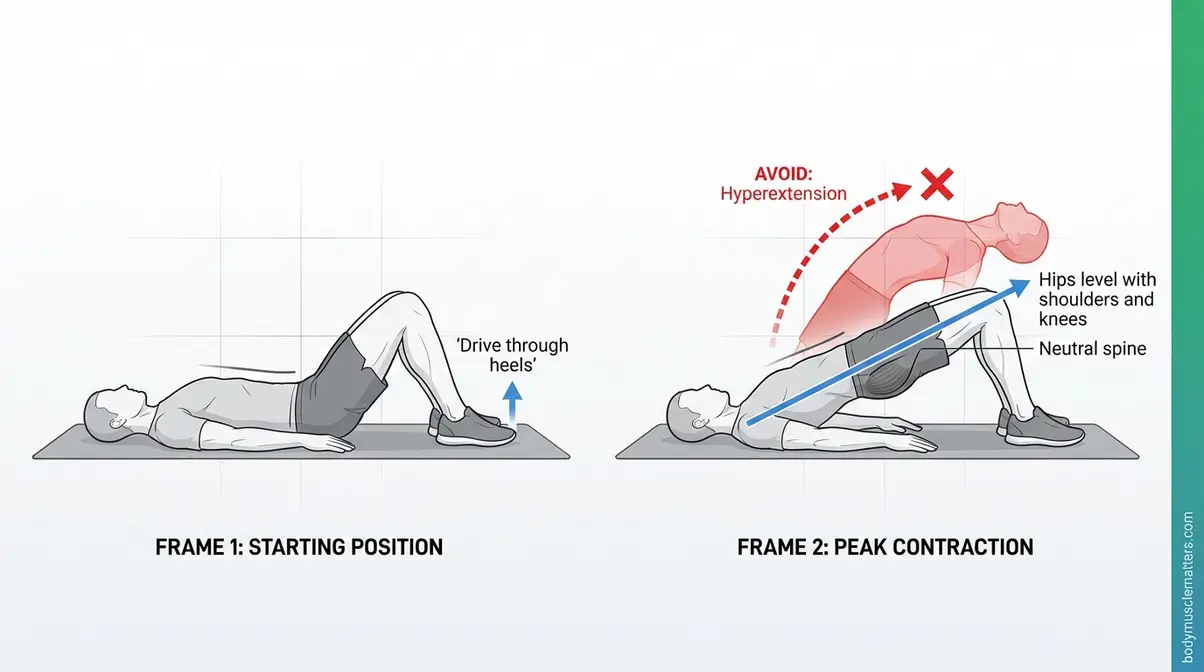
The glute bridge is your introduction to the hip-hinging motion — the pattern responsible for safe lifting, powerful running, and a strong, protected lower back. It trains your glutes, hamstrings, and the muscles supporting your lumbar spine (lower back).
- How to perform:
- Lie on your back with knees bent, feet flat on the floor, hip-width apart, roughly 12 inches from your buttocks.
- Place your arms flat at your sides, palms down.
- Brace your core and press your lower back gently into the floor.
- Drive through your heels and squeeze your glutes to lift your hips toward the ceiling.
- Hold the top position for 1–2 seconds — your body should form a straight line from shoulders to knees.
- Lower slowly (2–3 seconds) and repeat.
Estimated time per set: 40–50 seconds for 10 reps with a 2-second hold.
Common mistake: Hyperextending (arching) the lower back at the top of the movement. Stop when your hips are level with your shoulders and knees — not higher.
Progression: Begin with 2 sets of 10 reps. Progress to 15 reps, then introduce a single-leg glute bridge by extending one leg straight while performing the movement.
Plank: Core Stability Without Crunches
The plank is an isometric exercise — meaning your muscles contract without moving, holding a position under load. This type of training builds the deep core stability (especially the transverse abdominis — the muscle that acts like a natural corset around your spine) that protects your back during every other exercise you do.
- How to perform:
- Begin in a forearm plank: elbows directly under your shoulders, forearms flat on the floor, feet hip-width apart.
- Lift your hips until your body forms a straight line from head to heels. Do not let your hips rise or sag.
- Brace every muscle — core tight, glutes squeezed, thighs engaged.
- Breathe steadily. Hold for the target duration.
Estimated time per set: Your target hold time (start at 20 seconds).
Common mistake: Holding your breath. Steady nasal breathing during the plank maintains intra-abdominal pressure and makes the hold sustainable.
Progression: Start with 2 × 20-second holds. Add 5 seconds every 3 sessions until you reach 60 seconds, then progress to a high plank (on hands) or add shoulder taps.
Reverse Lunge: Balance and Leg Power
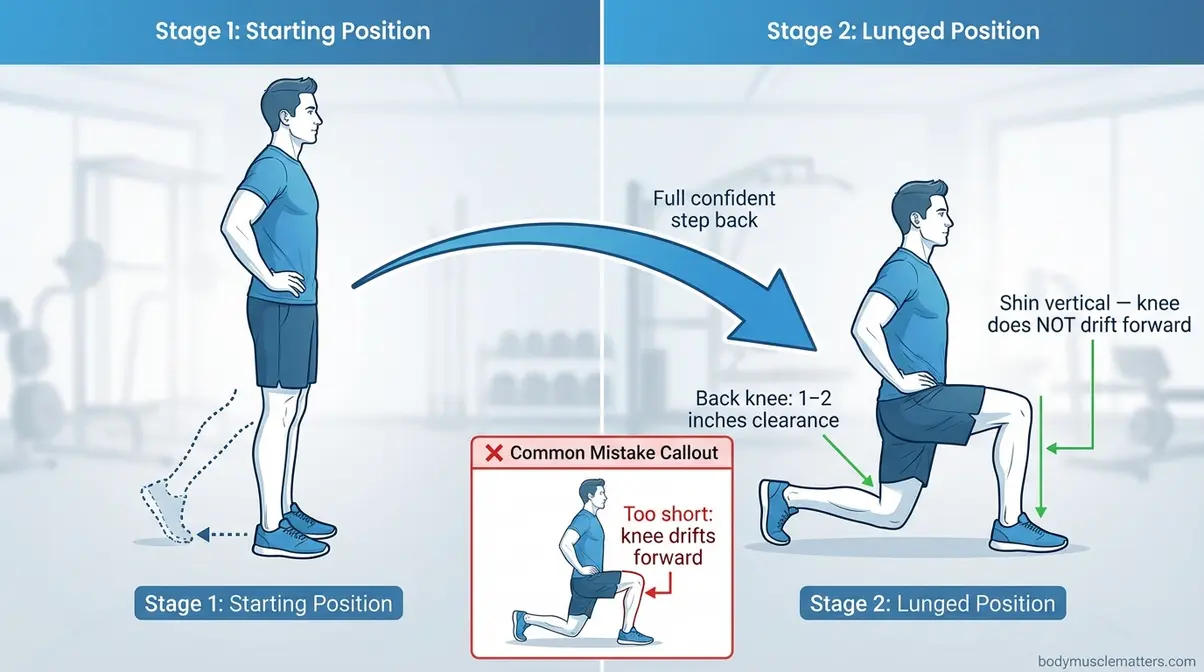
The reverse lunge is a unilateral exercise — meaning it trains one leg at a time. This is critical for two reasons: it corrects strength imbalances between your left and right sides (nearly everyone has them), and it mimics the single-leg mechanics of walking and running more accurately than any bilateral (two-legged) exercise.
- How to perform:
- Stand tall with feet hip-width apart, hands on your hips or extended forward for balance.
- Step one foot directly backward about 2–3 feet, lowering the back knee toward the floor.
- Your front shin should remain roughly vertical — the front knee should not drift forward past your toes.
- Lower until the back knee is 1–2 inches from the floor.
- Drive through the front heel to return to standing. Alternate legs each rep.
Estimated time per set: 45–60 seconds for 8 reps each leg.
Common mistake: Stepping too short, which forces the front knee excessively forward. Take a full, confident step backward.
Progression: Begin with 2 sets of 8 reps each leg. Progress to 12 reps, then add light dumbbells held at your sides.
Superman/Bird Dog: Protect Your Back
The posterior chain — the muscles running along the back of your body, including your erector spinae (spinal stabilizers), glutes, and hamstrings — is chronically underworked in sedentary adults. These two exercises target it directly, building the protective strength that prevents lower back pain during squats, hinges, and daily lifting.
Superman: Lie face down, arms extended overhead. Simultaneously lift your arms, chest, and legs off the floor by squeezing your glutes and back muscles. Hold 2 seconds. Lower. This is one rep. Begin with 2 × 8 reps.
Bird Dog: Begin on hands and knees (tabletop position), wrists under shoulders, knees under hips. Simultaneously extend your right arm forward and your left leg backward until both are parallel to the floor. Hold 2 seconds, return, and alternate sides. Begin with 2 × 8 reps per side.
Why this matters for you: These exercises are recovery tools as much as strength builders. Performing them on rest days as active recovery (light movement that promotes blood flow without taxing your muscles) reduces next-session soreness and builds the posterior chain resilience that keeps you training consistently.
Sample 15-Minute At-Home Circuit
Once you can perform all six exercises above, combine them into this 15-minute circuit — or try this quick 15-minute bodyweight routine for a guided alternative. This is the simplest application of the 3-3-3 Progression Framework for home training:
| Exercise | Sets | Reps / Duration | Rest |
|---|---|---|---|
| Bodyweight Squat | 2 | 10 reps | 60 sec |
| Push-Up (or knee version) | 2 | 8 reps | 60 sec |
| Glute Bridge | 2 | 10 reps | 60 sec |
| Reverse Lunge | 2 | 8 each leg | 60 sec |
| Plank | 2 | 30 sec hold | 45 sec |
| Bird Dog | 2 | 8 each side | 45 sec |
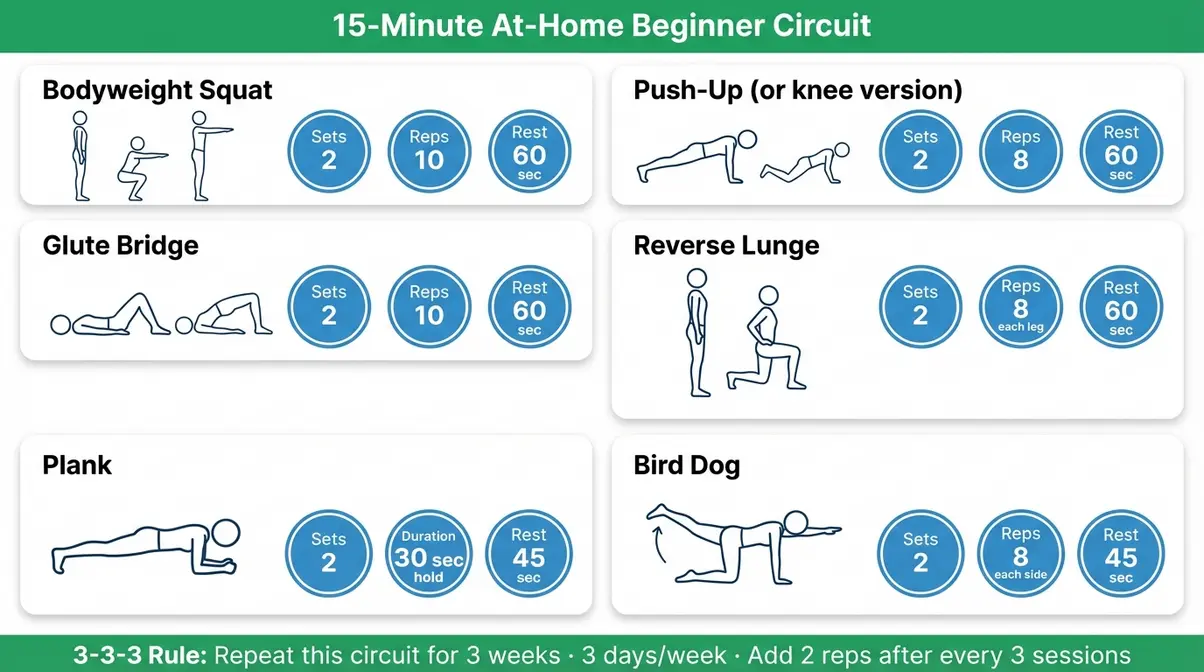
Perform this circuit 3 days per week (e.g., Monday, Wednesday, Friday). Keep this exact circuit for 3 weeks. After each 3-session block, add 2 reps to each exercise or 5 seconds to your plank. That is the 3-3-3 Progression Framework in its simplest form.
How to Use Gym Equipment as a Beginner
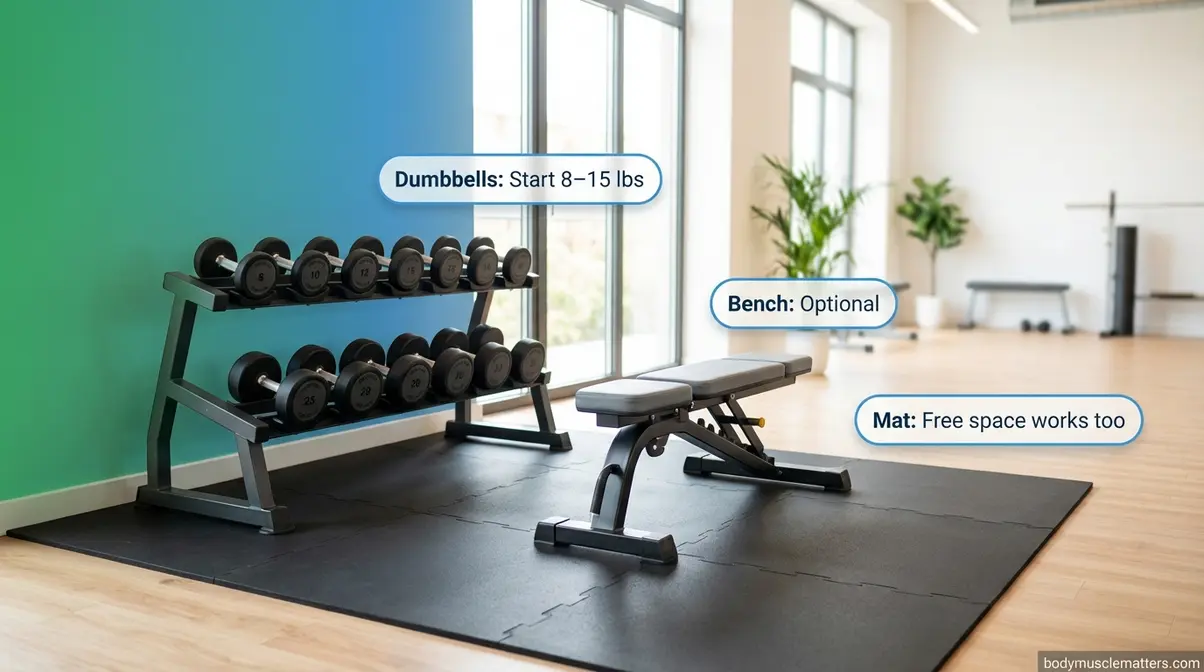
Walking into a gym for the first time can feel like reading a manual in a foreign language. If you need help navigating gym equipment for the first time, start with these three exercises. The good news: you only need these movements and one clear schedule to make your first gym sessions productive. They are direct progressions of the bodyweight patterns you have already learned — they simply add resistance to accelerate your strength gains.
Goblet Squat with Dumbbell
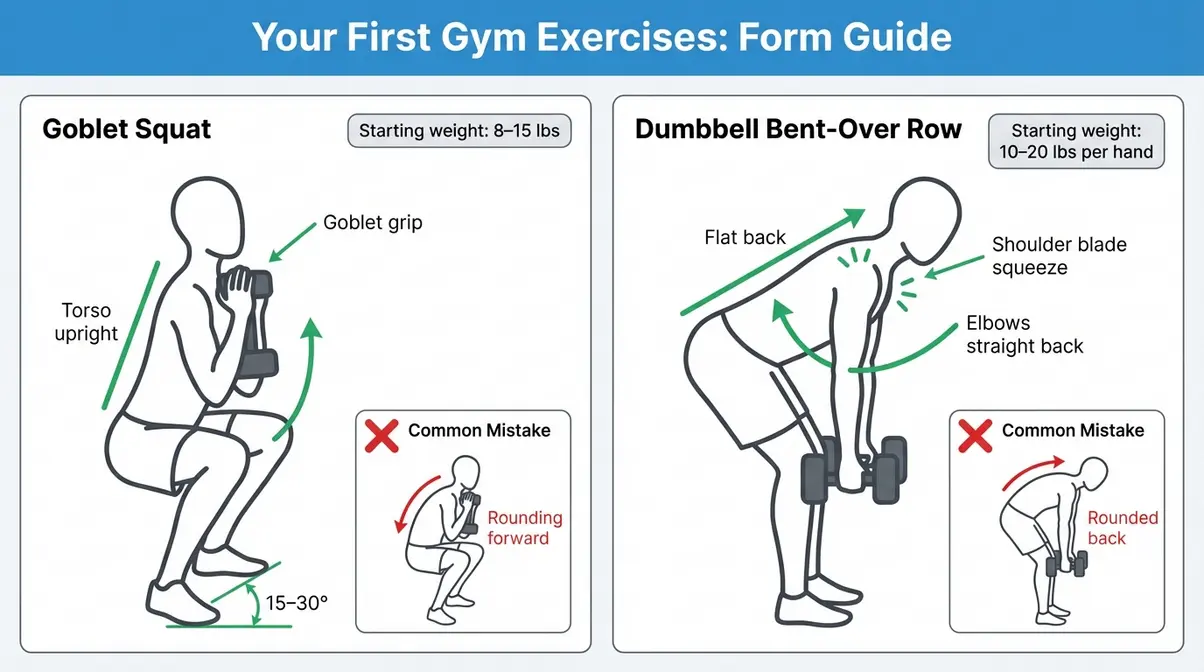
The goblet squat is the natural progression from a bodyweight squat. Holding a dumbbell vertically at your chest forces your torso to stay upright, improving squat depth and technique while adding lower-body load.
- How to perform:
- Hold one dumbbell vertically at your chest, both hands cupped under the top weight plate (like holding a goblet).
- Stand with feet slightly wider than shoulder-width, toes turned out 15–30 degrees.
- Keeping the dumbbell close to your chest, squat down — your elbows should descend between your knees, helping to push them outward.
- Drive through your heels to stand. That is one rep.
Starting weight: Choose a dumbbell where the last 2 reps of a 10-rep set feel challenging but achievable with perfect form. For most beginners, this is 8–15 lbs (4–7 kg).
Progression: Add 5 lbs every 3 sessions once you can perform 3 × 12 reps with consistent form.
Dumbbell Bent-Over Row
The bent-over row is your first gym-based pull movement. It trains the latissimus dorsi (the broad muscles of your mid-back), rhomboids (upper-back muscles that retract your shoulder blades), and biceps — the muscles most neglected in people who sit at desks.
- How to perform:
- Hold a dumbbell in each hand, feet hip-width apart.
- Hinge at the hips (push your hips back as if closing a door behind you) until your torso is at roughly a 45-degree angle. Keep your back flat — not rounded.
- Let the dumbbells hang directly below your shoulders.
- Pull both dumbbells toward your lower ribs by driving your elbows straight back. Squeeze your shoulder blades together at the top.
- Lower slowly (2–3 seconds). That is one rep.
Starting weight: 10–20 lbs per hand for most beginners.
Common mistake: Rounding the lower back. If your back rounds, the weight is too heavy. Reduce it until you can hold a neutral spine throughout.
Dumbbell Overhead Press
The overhead press builds shoulder stability and strength while also training your triceps and upper chest. Importantly, it teaches you to stabilize your core under an overhead load — a skill that protects your shoulder joints in everyday life.
- How to perform:
- Sit on a bench (with or without back support) or stand with feet shoulder-width apart.
- Hold a dumbbell in each hand at shoulder height, palms facing forward, elbows at 90 degrees.
- Brace your core and press both dumbbells directly overhead until your arms are fully extended but not locked.
- Lower slowly back to shoulder height. That is one rep.
Starting weight: 8–15 lbs per hand. Shoulder joints are relatively smaller than leg or back muscles — start conservative.
Safety note: If you feel pinching in your shoulder at the top of the press, reduce the weight and consider consulting a physical therapist. Some beginners benefit from a neutral-grip (palms facing each other) variation that reduces impingement risk.
Your First 3-Day Gym Split
Apply the 3-3-3 Progression Framework directly to these gym exercises. Here is a complete three-day-per-week split for your first month:
| Day | Exercises | Sets × Reps |
|---|---|---|
| Day A (Mon) | Goblet Squat, Push-Up (or bench press), Plank | 2–3 × 10 |
| Day B (Wed) | Dumbbell Row, Glute Bridge, Reverse Lunge | 2–3 × 10 |
| Day C (Fri) | Overhead Press, Bird Dog, Bodyweight Squat | 2–3 × 10 |
Week 1–3: Use the same weights and rep counts. Focus entirely on form. Week 4 onward: Add 2.5–5 lbs to each exercise where you can complete all reps cleanly. That is your first progression cycle complete.
Core Strength and Flexibility for Beginners
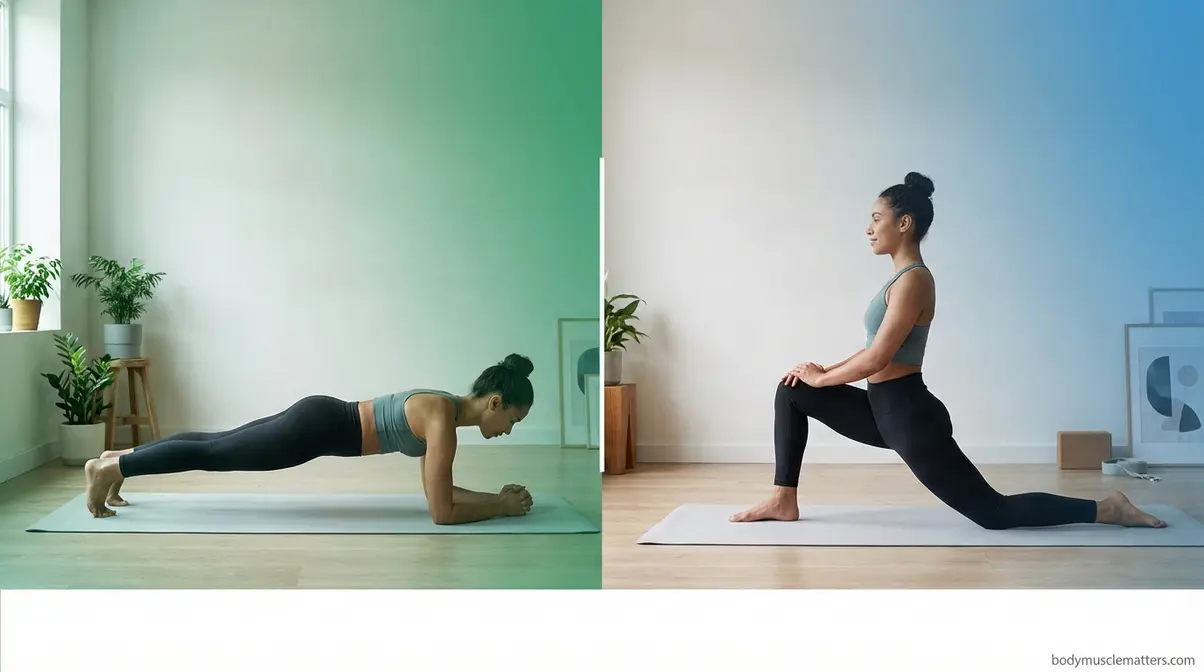
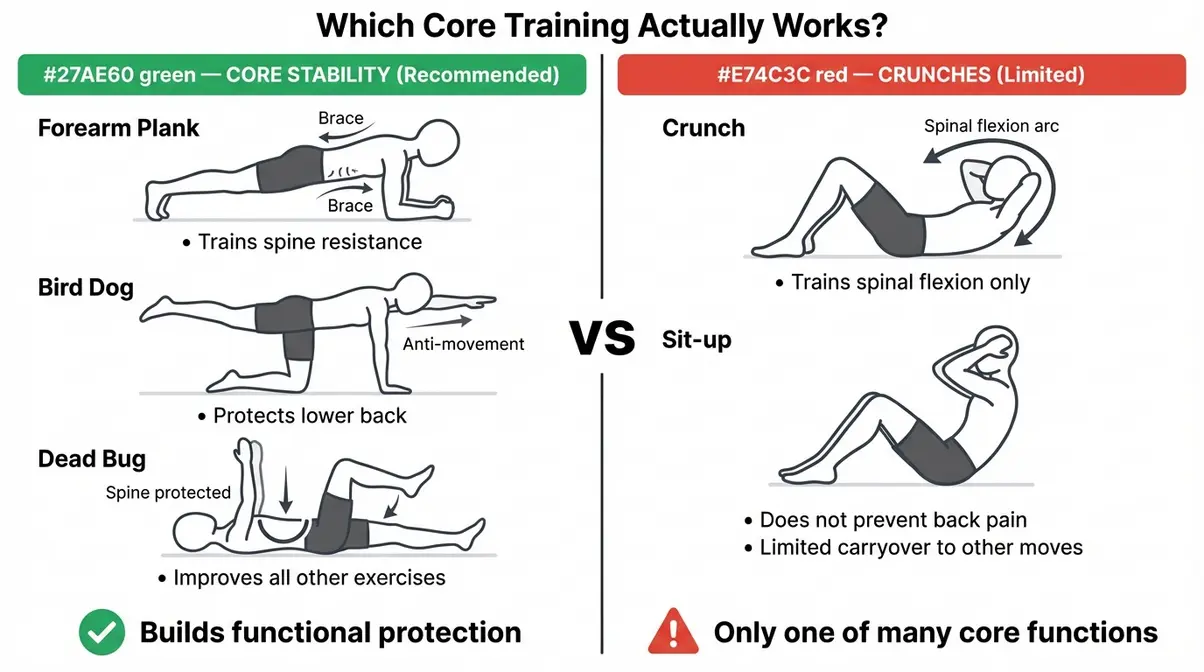
A common misconception treats core training as separate from strength training — something done at the end of a session with crunches. The reality is more useful: your core is not one muscle. It is a group of approximately 35 muscles that stabilize your spine during every movement you make. Train it properly, and every other exercise improves.
Core Stability vs. Crunches
For those focused on building foundational core stability, starting with stability work rather than crunches is essential. Crunches train spinal flexion — the curling movement of your spine. While not harmful for most people, they address only a small subset of core function. Core stability, by contrast, trains your ability to resist movement — to keep your spine still and protected while your limbs move or carry load.
Research from spine biomechanics specialists, including work widely cited in physical therapy literature, consistently shows that anti-movement core exercises (planks, bird dogs, dead bugs) produce greater spinal stability and lower-back pain prevention than flexion-based exercises like sit-ups or crunches. For beginners, starting with stability work rather than crunches builds the foundational strength that makes every squat, row, and press safer.
The practical difference: A crunch trains your body to curl. A plank trains your body to protect itself — which is what it needs to do when you pick up a child, carry groceries, or sit at a desk for 8 hours.
Plank Variations for Core Strength
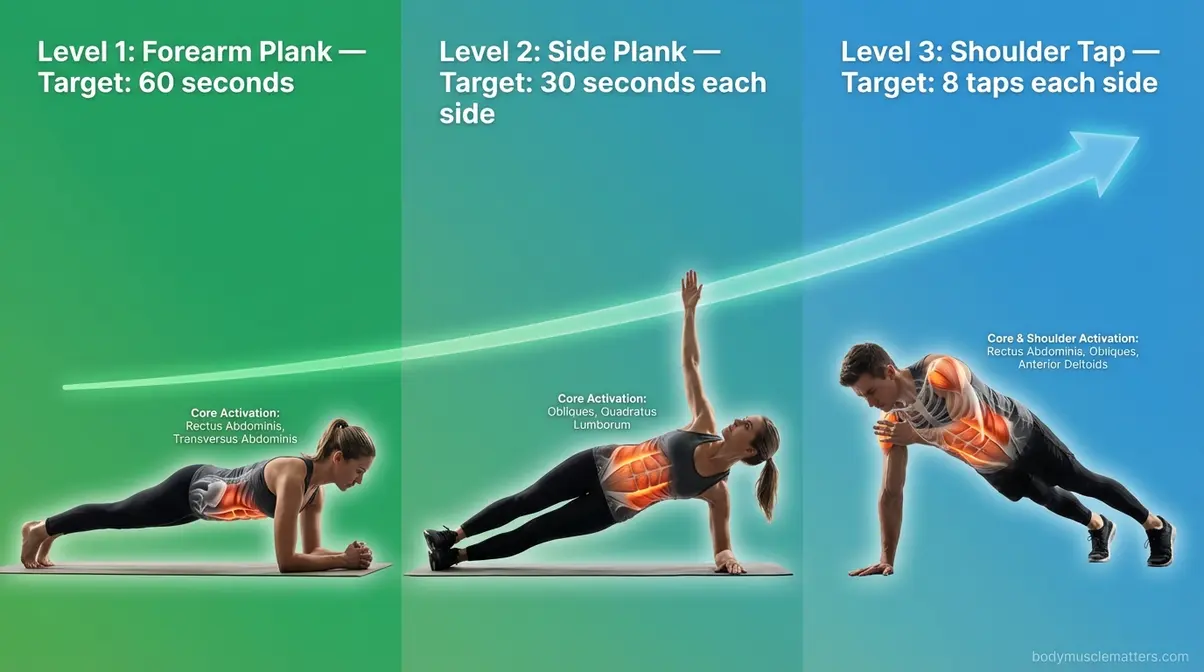
Once you can hold a standard forearm plank for 60 seconds, these progressions continue your core development without requiring any equipment:
Side Plank: Lie on your side, stacking your feet and lifting your hips so your body forms a straight line. Supports your body on one forearm. This variation specifically trains the quadratus lumborum (the deep lateral core muscle most responsible for spine stability during bending and twisting). Begin with 2 × 20 seconds each side.
Dead Bug: Lie on your back, arms extended toward the ceiling, knees bent at 90 degrees (legs in the air, like a table). Slowly lower your right arm and left leg toward the floor simultaneously, stopping before they touch. Return and alternate. This isometric anti-extension exercise is considered one of the most effective beginner core tools by physical therapists. Begin with 2 × 6 reps per side.
High Plank Shoulder Tap: In a high plank (hands, not forearms), tap your left shoulder with your right hand, then alternate. Maintain a completely still torso — no rocking side-to-side. This challenges rotational stability. Begin with 2 × 8 taps each side.
5-Minute Flexibility Routine
The question “Should I stretch before or after strength training?” has a clear answer from exercise science: before a session, perform dynamic (moving) stretches to warm up cold muscles and improve range of motion. After a session, perform static (held) stretches to reduce stiffness and begin recovery.
- Pre-workout (2 minutes — dynamic):
- Leg swings: 10 front-to-back each leg
- Hip circles: 10 each direction
- Arm circles: 10 forward, 10 backward
- Post-workout (3 minutes — static):
- Hip flexor stretch: Lunge position, front knee at 90 degrees, push hips gently forward. Hold 30 seconds each side.
- Doorway chest stretch: Place forearms on a door frame at 90 degrees, lean through. Hold 30 seconds.
- Child’s pose: Sit back on your heels, arms extended forward on the floor. Hold 45 seconds.
See our complete guide to mobility training for strength athletes for additional flexibility protocols.
Strength Training for Women, Men, and Runners
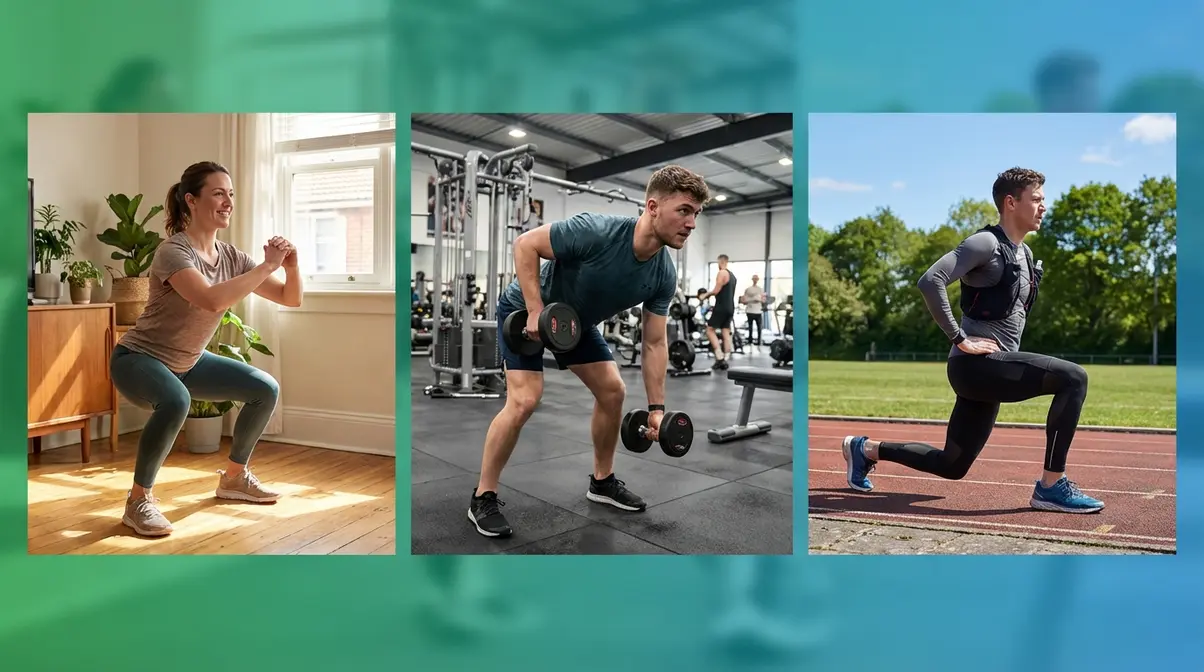
Strength training has universal benefits — but the details of how different populations should approach it are not identical. A 2026 ACSM analysis confirmed that training responses vary meaningfully across demographic groups, particularly when bone health, hormonal context, and sport-specific demands are factored in.
Women Beginners: Busting the Bulk Myth
The most persistent myth in women’s fitness is that strength training causes women to become bulky or excessively muscular. This is physiologically inaccurate for the vast majority of women. Women have approximately 10–20 times less testosterone than men — so without pharmacological intervention, women simply cannot develop the muscle mass that the word “bulky” implies.
What women do develop from consistent strength training exercises for beginners: increased muscle tone, improved metabolic rate (muscle tissue burns approximately 3× more calories at rest than fat tissue), significantly reduced injury risk, and measurable improvements in bone mineral density. Research published in the journal Gynecology and Obstetrics (2026) found that weight training improved bone mineral density status in postmenopausal women with low estrogen, directly countering the most serious long-term health risk most women face after age 50.
The practical takeaway: the 3-3-3 Progression Framework applied to the five foundational movements produces the lean, functional strength most women describe as their actual goal — not bulk.
At-Home Strength for Women: Bone Health
For women approaching or past menopause, strength training is not simply beneficial — it is one of the most effective non-pharmacological interventions for preventing osteoporosis (the progressive loss of bone density that dramatically increases fracture risk).
Resistance training serves as a primary defense against osteoporosis. A 2026 meta-analysis published by the National Institutes of Health (PMC) found that resistance training at ≥70% of maximum effort, performed three times per week for at least 48 weeks, produced significant improvements in bone mineral density at the lumbar spine, femoral neck, and total hip. Ground-reaction forces generated during these exercises stimulate bone remodeling.
Emerging bone health protocols also highlight the role of impact training. According to research summarized by Harvard Medical School, performing 20–30 brief jumping or hopping movements daily generates the ground-reaction forces that stimulate bone remodeling — a complement to strength training rather than a replacement. Weight training improved bone mineral density by 3-5% in postmenopausal women — reducing fracture risk significantly.
- A practical weekly plan for bone health (postmenopausal women):
- Strength training: 3 × per week using the 3-3-3 Progression Framework
- Daily impact movement: 20–30 jumping jacks or calf raises (or as cleared by your physician)
- Weight-bearing cardio (walking, hiking): 150 minutes per week
Consult your physician or a certified physical therapist (DPT) before beginning an impact protocol if you have an existing osteoporosis or osteopenia diagnosis — load management is critical in this population.
Men’s Beginner Strength Progressions
For men beginning strength training, the physiological capacity for muscle growth is higher due to testosterone levels — but the beginner mistake most men make is progressing weight too aggressively before movement patterns are established. Adding heavy load to poor form does not build strength; it builds compensatory patterns and injuries.
Apply the same 3-3-3 Progression Framework for your first 4–8 weeks. According to the Body Muscle Matters methodology, progressive overload becomes the primary driver of continued strength development at this stage.
- Weeks 1–3: Bodyweight circuit (squat, push-up, glute bridge, plank, reverse lunge, bird dog)
- Weeks 4–6: Add light dumbbells to goblet squat and bent-over row; continue bodyweight push and core work
- Weeks 7–12: Introduce gym split (if access available) or progress to more challenging bodyweight variants (archer push-up, Bulgarian split squat)
Strength Training for Runners
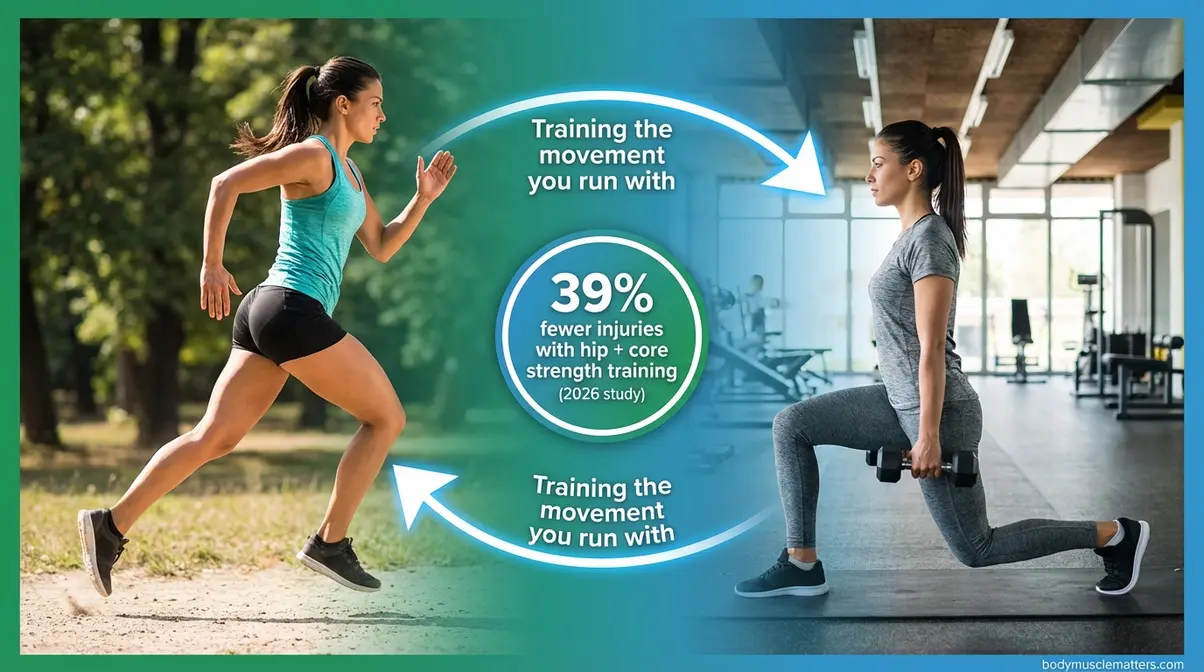
Runners often resist adding strength work, worrying it will make their legs heavy or compete with their mileage. The research says the opposite is true. A 2026 Finnish study on novice runners found that hip and core strengthening reduced running injury rates by 39% and significant overuse injuries by 52% compared to runners who did no supplementary strength work (RunningPhysio, 2026).
The reason: running is an entirely unilateral activity — your full body weight lands on one leg with every stride. Weakness or imbalance in the hips, glutes, or lateral hip stabilizers translates directly into common overuse injuries including runner’s knee (patellofemoral pain), IT band syndrome, and shin splints.
Priority exercises for runners:
The reverse lunge is the single most valuable strength exercise a runner can perform. It replicates the single-leg stance of running while training the glutes, quads, and hip stabilizers under load. Combined with the glute bridge (for posterior chain strength) and the bird dog (for spinal stability under single-leg load), these three movements address the root cause of most running injuries.
- Runner-specific weekly schedule:
- Strength sessions: 2 × per week (not on back-to-back days with your hardest runs)
- Priority movements: Reverse lunge (3 × 10 each leg), glute bridge (3 × 12), bird dog (3 × 8 each side), side plank (2 × 30 seconds each side)
- Begin strength work in your off-season or low-mileage phase; do not add it during peak training weeks
See our complete guide to strength training for endurance athletes for a periodized runner’s strength plan.
Caveats: When These Principles Don’t Apply
Context Limitations
The 3-3-3 Progression Framework is designed for healthy adults starting from zero. If you are already training twice weekly, this frequency may not provide enough stimulus for continued adaptation. Furthermore, pregnant women should seek specialized prenatal programming, as core and hinge mechanics change significantly by the second trimester.
Adoption Risk
The most common mistake beginners make is not doing too little — it is doing too much, too soon. Starting with too many exercises, too heavy a weight, or training every day overwhelms the recovery systems your body needs to actually get stronger. Research from the NSCA (National Strength and Conditioning Association) is clear: beginners need 1–3 days of recovery between resistance training sessions, and training the same muscle groups on consecutive days impedes, rather than accelerates, strength development.
Five mistakes to correct immediately:
- Skipping the warm-up. Cold muscles are significantly more prone to strains. Five minutes of light movement before every session is non-negotiable.
- Holding your breath during exertion. Exhale during the effort phase (when you push or lift) and inhale during the return. Breath-holding spikes blood pressure dangerously.
- Ego-loading. Using more weight than your form supports builds injury, not strength. If your technique changes to complete a rep, the weight is too heavy.
- Ignoring rest days. Strength is built during recovery, not during the session itself. The 3-3-3 Progression Framework’s three-days-per-week structure is deliberate — the intervening days are doing real work.
- Changing the program weekly. Your body needs 3–6 weeks to adapt to a movement pattern. Changing exercises every week means you never accumulate the neuromuscular adaptations that produce actual strength.
Expert Help
Always consult your physician before beginning a new strength program if you have a history of heart disease, joint problems, or any chronic condition. Working with a certified physical therapist (DPT) is recommended for personalized modifications. For a deeper look at safe exercise form and avoiding overtraining, MD Anderson Cancer Center’s home strength training guide offers medically reviewed technique guidance.
Additional safety resources: Mayo Clinic’s strength training overview covers progressive loading principles and injury-prevention cues reviewed by certified clinicians.
Frequently Asked Questions
How should a beginner start?
Beginners should start strength training with bodyweight exercises three times per week, focusing on the five foundational movement patterns: push, pull, squat, hinge, and core. Apply the 3-3-3 Progression Framework: train 3 days per week, keep the same routine for 3 consecutive weeks, and add 1–2 reps every 3 sessions. ACSM’s 2026 guidelines confirm that 2-3 sessions per week targeting all major muscle groups produces meaningful gains in previously untrained individuals. Always warm up cold muscles for 5 minutes before beginning.
How does the 3-3-3 rule work?
The 3-3-3 Progression Framework is a beginner programming system built around three numbers: train 3 days per week, repeat the same routine for 3 consecutive weeks, and increase reps or load every 3 sessions. Each number solves a specific beginner problem — frequency ensures recovery, consistency builds neurological adaptation, and regular progression creates the overload signal that forces muscles to grow stronger. Unlike advanced protocols, it requires no percentage calculations or periodization knowledge.
What are the five foundational moves?
The 5 basic strength training exercises for beginners are the push, pull, squat, hinge, and core movement patterns — not individual exercises, but movement categories. Push and pull movements train your upper body, while squats and hinges build lower-body power. Core work stabilizes your spine. Together, these five patterns cover every major muscle group with no redundancy, making them the perfect starting point for any routine.
Good for bone density?
Yes — strength training is one of the most evidence-backed methods for improving and preserving bone mineral density. A 2026 meta-analysis published in PMC (NIH) found that resistance training at ≥70% of maximum effort significantly improved bone mineral density in postmenopausal women. For younger adults, the mechanical load placed on bones during strength training stimulates bone-forming cells, building denser, stronger bones over time. Consult your physician before beginning if you have an existing osteoporosis diagnosis.
What to avoid when strength training?
The primary things you should avoid when strength training as a beginner are skipping the warm-up, holding your breath during heavy effort, and using more weight than your form supports. You should also never train sore muscles without recovery time or change your program every week before your body has adapted. When in doubt, start lighter — form built on a light load transfers directly to heavier weights later.
Your Strength Training Journey Starts Here
For anyone beginning strength training, the five foundational movement patterns — push, pull, squat, hinge, and core — combined with the 3-3-3 Progression Framework provide everything you need to build real, lasting strength. According to ACSM’s 2026 updated guidelines, training major muscle groups consistently at least twice per week produces measurable strength and bone density gains. These are results that compound over months and years into meaningfully better health, mobility, and an overall enhanced quality of life.
The overarching theme of this guide is simple: strength training for beginners is not about the gym or the gear — it is about mastering five fundamental movements that your body was designed to perform, applied consistently through the 3-3-3 framework. The 3-3-3 Progression Framework is the organizing principle that makes those results achievable for complete beginners. It removes the decision fatigue, eliminates program-hopping, and gives every session a clear purpose: repeat what worked, and incrementally ask more of yourself every three sessions. That principle — progressive overload, applied consistently — is the entire science of strength condensed into three numbers.
Your next step is specific: choose three days this week, perform the 15-minute at-home circuit outlined earlier, and log every set and rep. After three sessions, add 2 reps to each exercise. After three weeks, you will have completed your first full 3-3-3 cycle and established the habit that every long-term strength training journey is built on. The hardest session is always the first, and taking that initial step will define your progress. You now have everything you need to make it a highly productive one. Download our free 4-week beginner PDF tracker to log your progress, maintain your consistency, and track your success as you build a stronger, more resilient body.