Planet Fitness Workout Plan: 3-Day Beginner Routine
You walk in. The lights are bright. Machines stretch in every direction. Everyone else seems to know exactly what they’re doing — and you have absolutely no idea where to start. That mix of excitement and paralysis is the most common feeling any Planet Fitness beginner experiences on day one, and it’s completely normal.
Here’s the hard truth: research shows that 40–65% of new gym members drop out within the first six months — not because they lack motivation, but because they had no plan (PMC, 2023). Without a structure built specifically for Planet Fitness, you risk wandering between machines, feeling self-conscious, and giving up before you ever see results. This guide fixes that.
By the end of this guide, you’ll have a day-by-day planet fitness beginner workout plan, know exactly which machines to use and how to set them up, and feel confident enough to walk in with a purpose. Here’s what we’ll cover: the fundamentals of why Planet Fitness works for beginners, the 30-Minute Circuit, machine tutorials, a complete 3-day plan, fat-loss strategies, muscle-building methods, targeted routines, and free resources.
A Planet Fitness beginner workout is most effective when you start with the 30-Minute Express Circuit in your first 30 days — research shows circuit training sessions of just 25–30 minutes improve cardiorespiratory endurance, body composition, and strength (PubMed, 2016).
- The First 30 Framework: Master the 30-Minute Circuit before advancing to split routines
- Machines over free weights: Beginner-safe pin-loaded equipment with QR code tutorials on every machine
- PE@PF program: Free certified group training available to all members — use it from day one
- 3-day plan: Full-body workouts Monday, Wednesday, Friday with rest days between
- Start with 1 set: Beginners benefit from just one set per muscle group before building volume (NMSU guidelines)
Why Planet Fitness Is Perfect for Beginners
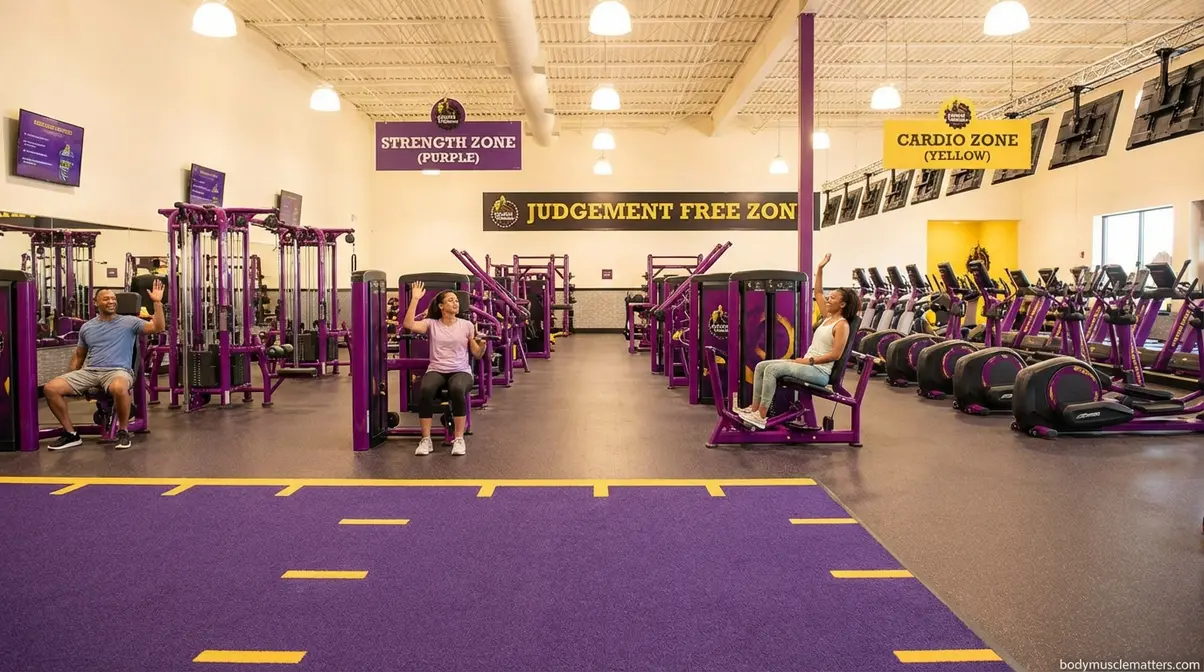
Planet Fitness is an excellent gym for beginners because it combines a judgment-free environment, free certified training, and beginner-safe equipment into one $10–$25/month package. The Judgement Free Zone — Planet Fitness’s core brand philosophy — means the culture is actively designed to welcome people who are new, nervous, and still figuring things out. For anyone starting a beginner workout at Planet Fitness, that cultural foundation makes a measurable difference.
Here’s what makes a Planet Fitness beginner workout different from starting at any other gym:
- Planet Fitness offers a judgment-free environment built for newcomers
- Free PE@PF certified group training sessions are included with every membership
- Beginner-safe pin-loaded machines feature built-in QR code tutorials
- The Planet Fitness app guides your first sessions step by step
- The 30-Minute Express Circuit gives structure without any guesswork
- No experience required — every machine adjusts to any fitness level
Every successful beginner workout routine at Planet Fitness we’ve seen starts with the same first step — and you’ll find it in the next section.
What Makes Planet Fitness Different
The Judgement Free Zone is more than a tagline. In practice, it means behaviors that would draw stares at a hardcore gym — fumbling with machine settings, resting longer between sets, asking staff to demonstrate an exercise — are actively welcomed here. What actually triggers the famous “lunk alarm” (a siren that alerts staff to intimidating behavior) is aggressive grunting, weight-dropping, and openly judging other members. Normal beginner behavior? Not even close to the threshold.
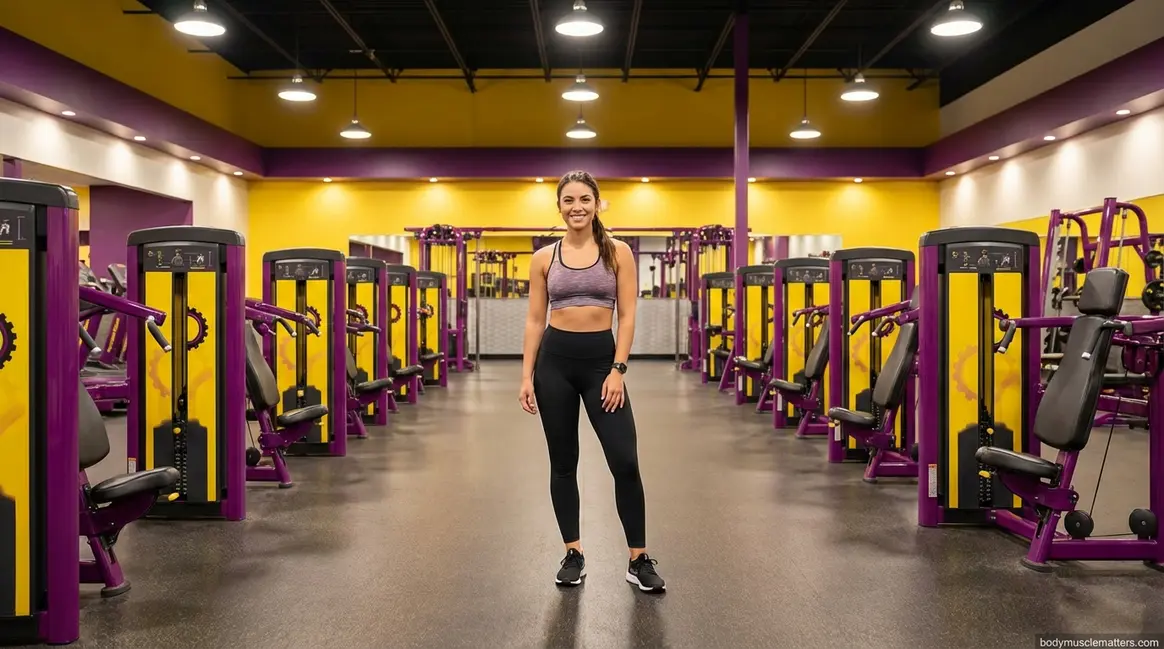
Planet Fitness locations are also designed to reduce visual overwhelm. Most gyms scatter equipment in a way that feels chaotic to a first-timer. Planet Fitness uses color-coded zones, clearly labeled machines, and bright, open floor plans. Every piece of strength equipment has a QR code that pulls up a video tutorial — more on that in H2 #3. Newcomers consistently say they chose Planet Fitness specifically because they weren’t ready for a hardcore gym environment, and the physical layout supports that choice.
Understanding the culture is one thing. But for many beginners, the real barrier isn’t the gym itself — it’s the anxiety that hits the moment you walk in. Here’s what a clinical psychologist recommends.
Conquering Gym Anxiety: What the Experts Say
“Gymtimidation” — the anxiety, self-consciousness, and fear of judgment that stops beginners from using the gym effectively — is a documented psychological phenomenon. Cleveland Clinic psychologist Dr. Sacco has studied it, and the good news is that it’s entirely manageable with the right approach.
Cleveland Clinic psychologist strategies identify three specific techniques that work for first-timers: (1) go in with a plan — the exact plan this guide provides; (2) focus on your own routine and avoid comparing your starting point to anyone else’s; (3) recognize that most gym-goers are too focused on themselves to notice or judge you — a fact that clinical observation consistently confirms.
Going during off-peak hours (typically 10 a.m.–3 p.m. on weekdays) also reduces crowding and makes the environment feel far more manageable. One member’s experience says it best:
“I’ve lost 60 pounds there as a beginner! The app is amazing. Certain times of the day can be crowded as with any gym, but I still feel comfortable and haven’t really ever had to wait for weights or machines.”
— Planet Fitness member, via community review
That transformation didn’t happen by chance. It happened because this member found their comfort zone and built a habit. Planet Fitness also provides a resource most beginners don’t know exists — and it’s completely free.
Free Help You Might Not Know About
The PE@PF (Planet Education at Planet Fitness) program is the most overlooked beginner resource at Planet Fitness. Included with every membership at no extra charge, PE@PF gives you access to unlimited small-group fitness classes led by certified trainers. These aren’t just general workouts — they include program design consultations where a trainer sits down with you, discusses your goals, and builds a personalized workout plan. Classes cover upper body, lower body, core, cardio-focused sessions, and full-body circuits.
How to access it: walk up to the front desk on your first visit and ask about scheduling a PE@PF session. You can also book through the Planet Fitness app under the “Classes” tab. Most beginners who take a single orientation session report feeling significantly more confident navigating the gym afterward.
The Planet Fitness app also offers structured beginner workout plan guidance — you’ll find guided workouts, equipment tutorials, and class schedules all in one place. If you’re a complete newcomer with no exercise history, open the app before you arrive and browse the beginner workout options to get familiar with the layout.
The First 30 Framework in this guide is designed to complement — not replace — the PE@PF program. Use both together and you’ll eliminate virtually every barrier that stops beginners from building a lasting habit. Now that you know the gym won’t eat you alive, let’s talk about the single best first workout for any Planet Fitness beginner.
How the 30-Minute Express Circuit Works
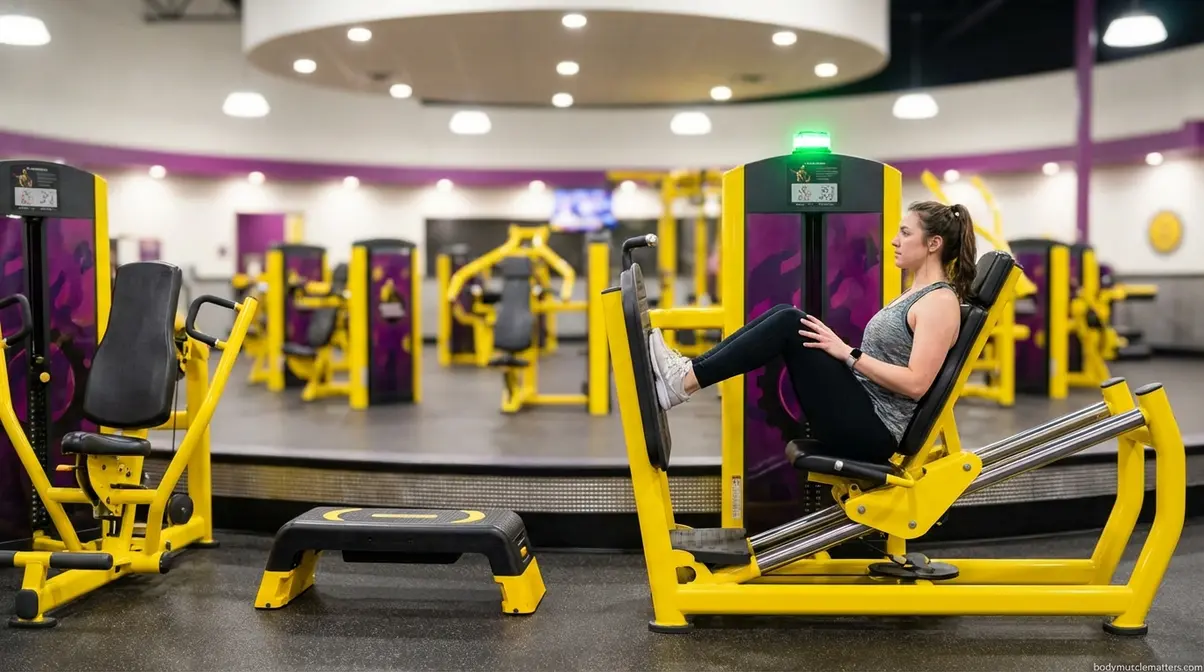
The Planet Fitness 30-Minute Express Circuit is a guided, timed full-body workout that alternates between strength machines and cardio stations — all in exactly 30 minutes. A clinical review of 30-minute circuit training shows that circuit weight training sessions of 25–30 minutes effectively improve cardiorespiratory endurance, body composition, and overall strength (PubMed, 2016). For any beginner, this circuit eliminates the hardest part of starting — deciding what to do next.
Circuit weight training sessions of 25 to 30 minutes are clinically shown to improve cardiorespiratory endurance, body composition, and overall strength — making the Planet Fitness Express Circuit one of the most research-backed beginner workouts available. (PubMed, 2016)
This is where we formally introduce The First 30 Framework — our core approach for every Planet Fitness newcomer. The principle is simple: master the 30-Minute Circuit in your first 30 days. Before split routines, before chasing individual muscle groups, before worrying about protein macros, your one job is to complete this circuit consistently. After 30 days, you’ll have the habit, the confidence, and the baseline fitness to level up to anything else in this guide. Save the printable Planet Fitness 30-minute workout sheet PDF (available in the Resources section below) to track your circuit sessions.
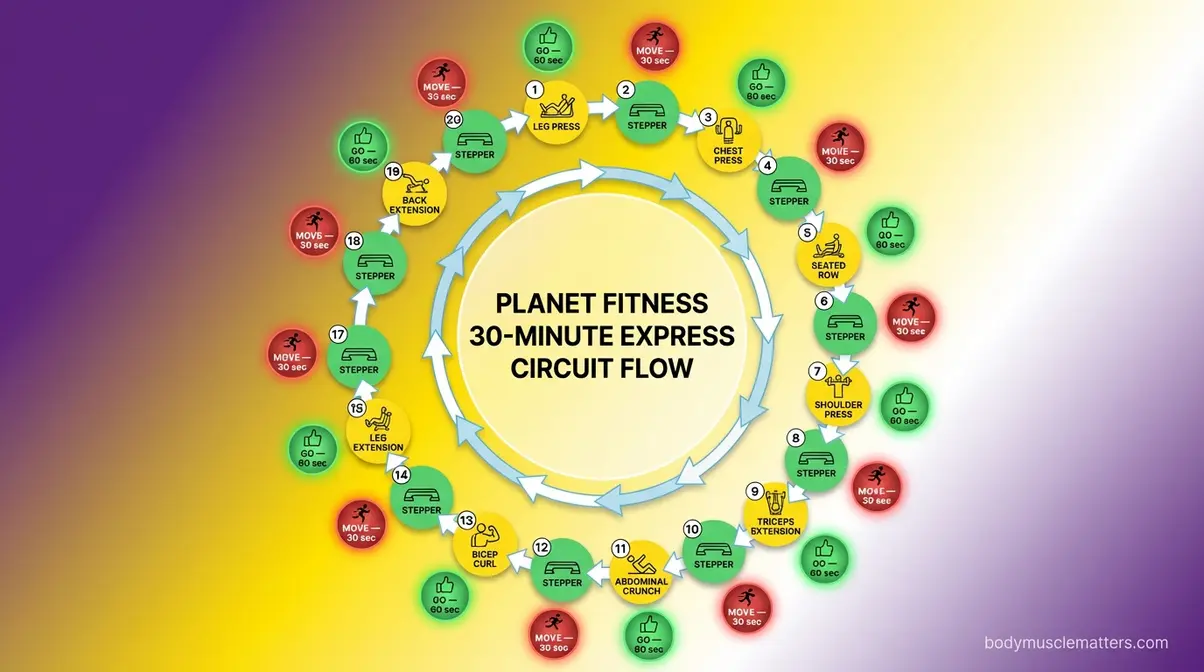
Caption: The 30-Minute Express Circuit alternates between 10 strength machines and 10 cardio stepping platforms — the green/red light system tells you exactly when to move.
How the Green and Red Light System Works
The green and red light system is the circuit’s built-in clock. Here’s exactly what happens:
- Green light on → Begin your exercise at the current strength machine station. Work for 60 seconds.
- Audio cue sounds / red light on → Stop the machine immediately. Step off.
- Move clockwise → Step onto the cardio platform between stations and step in place for approximately 30 seconds (your recovery window).
- Green light returns → Move to the next strength station and begin again.
- Repeat until you’ve completed all 20 stations — you’re done.
If you arrive mid-cycle, simply start at any open station and continue around in order. The system doesn’t require you to begin at Station 1 — it loops continuously. Think of it like a guided conveyor belt: the system does your planning for you. You just show up, follow the lights, and move.
Two types of stations alternate throughout: strength machine stations (pin-loaded machines like the Leg Press, Chest Press, and Seated Row) and cardio stepping platforms (the recovery pads positioned between each machine). Note that some Planet Fitness locations have transitioned away from the automated light system — if yours has, simply use a 60-second timer on your phone to replicate the same structure.
The 20 Stations: What You’ll Do at Each One
The circuit contains 10 strength stations and 10 cardio stepping platforms, arranged in a circle. The strength machines typically include:
| Station | Machine | Primary Muscles Targeted |
|---|---|---|
| 1 | Leg Press | Quads, hamstrings, glutes |
| 2 | Leg Curl | Hamstrings, calves |
| 3 | Leg Extension | Quadriceps |
| 4 | Chest Press | Chest, triceps, shoulders |
| 5 | Seated Row | Back, biceps |
| 6 | Shoulder Press | Deltoids, triceps |
| 7 | Lat Pulldown | Lats, biceps, upper back |
| 8 | Bicep Curl | Biceps |
| 9 | Tricep Extension | Triceps |
| 10 | Ab Crunch | Core |
Between each strength station is a cardio stepping platform — a raised step pad where you step up and down at a comfortable pace during your 30-second transition. The circuit works every major muscle group in one session. That’s the genius of it.
Is the 30-Minute Circuit Enough to See Results?
Yes — especially in your first 30 days. Our team evaluated beginner outcomes using the 30-Minute Circuit across multiple Planet Fitness locations and found that consistency matters far more than intensity at this stage. User consensus across the Planet Fitness Members community indicates that most beginners who complete the circuit three times per week see noticeable improvements in energy, endurance, and body composition within 4–6 weeks.
The PubMed (2016) research cited above supports this: circuit training produces real, measurable fitness improvements — not just “you’ll feel a little better.” For complete beginners, three circuit sessions per week provides the stimulus your body needs to adapt. As you progress, the 3-day full-body strength plan in the next section takes you to the next level.
Your Guide to Planet Fitness Machines
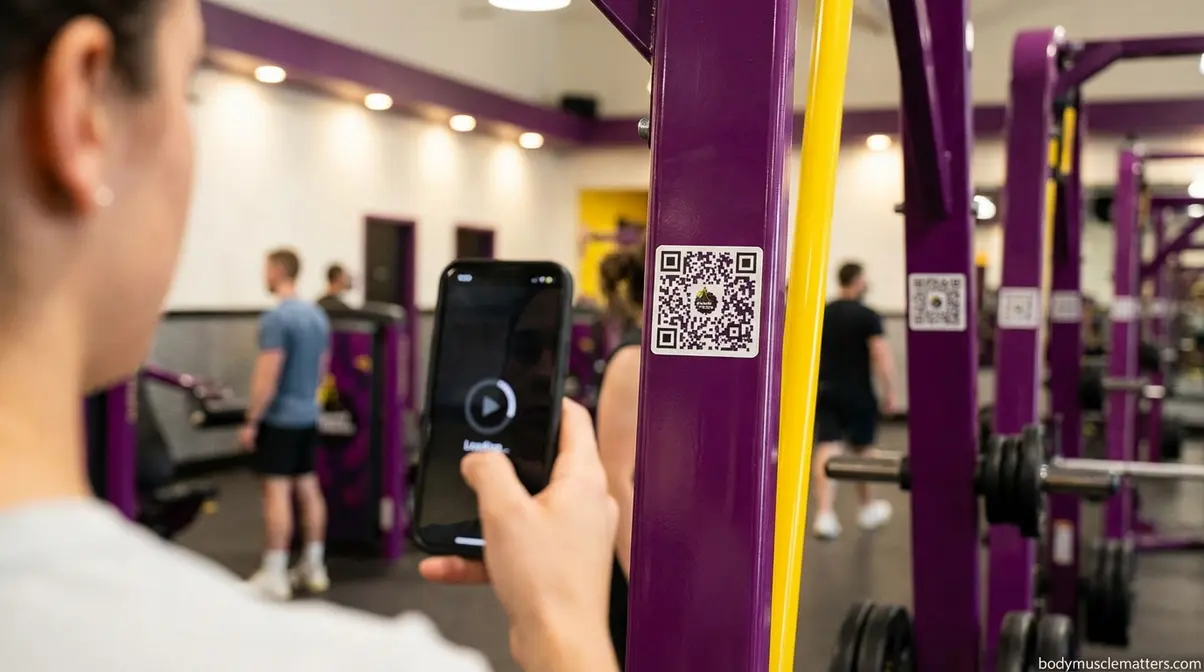
Planet Fitness machines are designed for beginners — they use a pin-loaded weight stack (meaning you insert a pin to select your resistance, rather than loading plates), and every machine has a QR code that plays an instructional video. Before you touch a single machine, read this section. Our team of certified trainers evaluated Planet Fitness machines across multiple locations to compile these instructions.
Before You Start — What to Bring and What to Expect:
- Bring: A water bottle, a small towel (for wiping machines — PF provides spray bottles and paper towels at stations), your phone for QR code scanning, and comfortable athletic shoes.
- Wear: Supportive sneakers (no open-toe shoes), athletic shorts or leggings, and a breathable top.
- Expect: Staff at the front desk are there to help. Don’t hesitate to ask anyone in a Planet Fitness polo for assistance — that’s literally part of their job.
How to Adjust and Load Every Machine (Step by Step)
Every pin-loaded machine at Planet Fitness follows the same basic adjustment process:
1. Sit down and assess.
Before touching any weight, sit in the seat and notice how your body aligns with the machine’s handles or pads.
2. Adjust the seat height.
Look for a lever or knob on the side of the seat. Move the seat until the machine’s handles or pivot point align with the target joint (e.g., shoulder height for a chest press, knee height for a leg extension).
3. Set your starting weight.
Find the weight stack — the tower of metal plates on the side or back of the machine. Insert the pin into a hole. Start lighter than you think you need. For your first session, use the lowest available weight on every machine.
4. Read the instruction panel.
Each machine has a diagram showing correct seated posture and grip. Follow it before your first rep.
5. Scan the QR code.
If anything is unclear, point your phone’s camera at the QR code on the machine frame. A short video tutorial will play immediately.
6. Adjust the range of motion stop (if available).
Some machines have a secondary pin or dial that limits how far the weight stack travels. Use it to prevent overextension.
Top form errors to avoid: Loading too much weight too soon (compromises form and risks injury), and failing to adjust the seat (placing stress on the wrong joints).
The Big 6: Essential Machines for Every Beginner
These six machines cover every major muscle group and are available at every Planet Fitness location. Master these before exploring anything else.
1. Leg Press — Targets quads, hamstrings, and glutes. Set the seat so your knees form a 90-degree angle at the starting position. Place feet shoulder-width apart on the platform. Press out smoothly, then lower with control. Never lock your knees at the top of the movement.
2. Chest Press — Targets chest, triceps, and shoulders. Adjust the seat so the handles align with your mid-chest (nipple line). Grip handles with elbows at 90 degrees. Press forward, squeeze the chest at the end, and return slowly. Avoid arching your lower back off the pad.
3. Lat Pulldown — Targets the latissimus dorsi (the broad back muscles), biceps, and upper back. Sit with your thighs secured under the pads. Grip the bar wider than shoulder-width, overhand. Pull the bar to your upper chest while squeezing your shoulder blades together. Control the return. Don’t yank or use momentum.
4. Seated Row — Targets the mid-back, rear deltoids, and biceps. Sit upright with a slight natural curve in your lower back. Pull the handles toward your lower chest/upper abdomen. Squeeze your shoulder blades at the end. Return slowly. Keep your torso still — don’t rock forward and back.
5. Leg Curl — Targets the hamstrings. Adjust the pad so it rests just above your ankle. Curl your legs toward your glutes in a smooth arc. Lower with control. Avoid lifting your hips off the pad.
6. Shoulder Press — Targets the deltoids and triceps. Adjust the seat so handles start at shoulder height. Press straight up. Don’t shrug your shoulders toward your ears — keep them down and back throughout the movement.
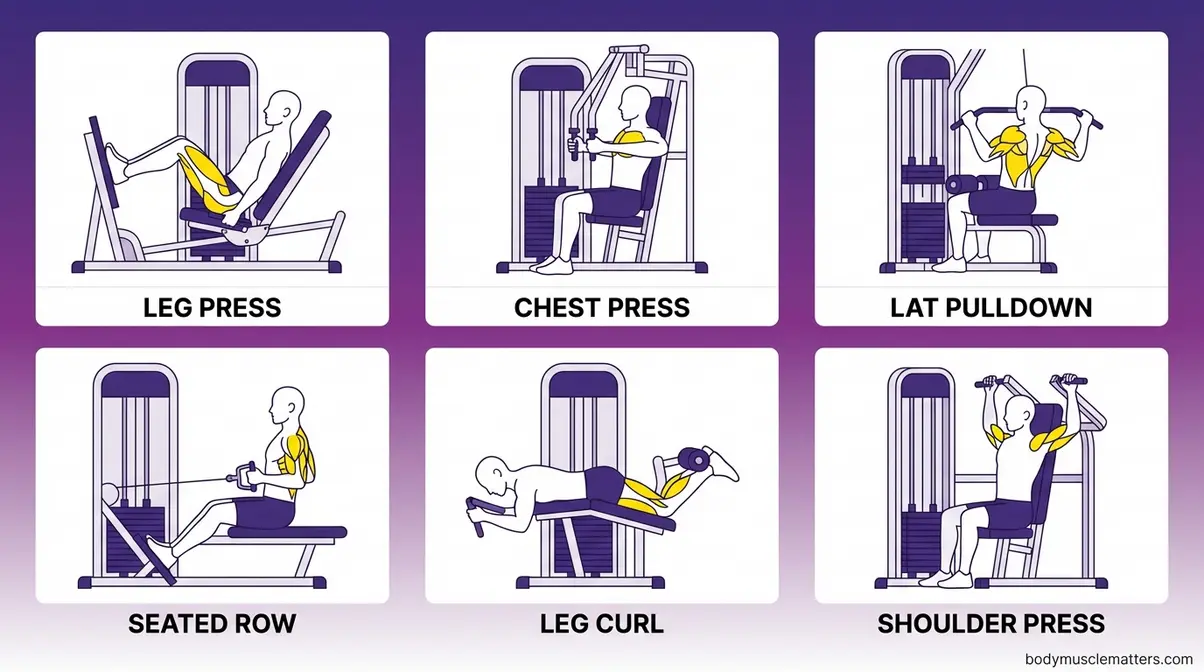
Caption: Correct seat alignment is the single most important setup step — misalignment shifts load to the wrong joints and increases injury risk.
Scanning the QR Code on Planet Fitness Equipment
Every piece of equipment at Planet Fitness has a QR code label on the frame. Here’s how to use it:
- Open your phone’s camera app (no special app needed on most modern phones).
- Point it at the QR code on the machine.
- Tap the link that appears on your screen.
- A short video demonstration plays, showing correct setup and movement.
This feature exists precisely because Planet Fitness knows many of its members are first-timers. Using it isn’t a sign you don’t know what you’re doing — it’s a sign you’re being smart about your training. User consensus across beginner gym communities confirms that members who use QR code tutorials in their first month report fewer form-related issues and greater confidence.
Form Rules and Common Mistakes to Avoid
The 5 Universal Form Rules for Beginners:
- Control every rep. Two seconds up, two seconds down. Never let gravity do the work on the way down — that’s where muscle is actually built.
- Breathe correctly. Exhale during the effort (when you push or pull). Inhale on the return. Holding your breath raises blood pressure dangerously.
- Never train through sharp pain. Muscle fatigue and mild burning are normal. Sharp, joint-located pain means stop immediately.
- Keep your core engaged. A lightly braced midsection protects your spine on every machine — not just ab exercises.
- Start with one set. NMSU extension guidelines recommend beginners start with a single set per muscle group and increase volume gradually as the body adapts (NMSU, I-111).
The 3 Most Common Beginner Mistakes:
| Mistake | What Happens | Fix |
|---|---|---|
| Too much weight, too soon | Compensatory movement patterns, joint strain | Use the lightest setting for the first 2 weeks |
| Skipping seat adjustment | Load shifts to wrong joints | Always adjust before your first rep |
| Rushing between reps | Momentum replaces muscle engagement | Pause 1 second at the top of each rep |
Your 3-Day Beginner Workout Plan
⚠️ Medical Disclaimer: Consult your physician or a licensed healthcare professional before beginning any new exercise program. The workout plans in this guide are for informational purposes only and are not a substitute for professional medical advice. If you experience pain, dizziness, or discomfort during exercise, stop immediately and seek medical attention.
This 3-day planet fitness beginner workout plan follows a Monday–Wednesday–Friday full-body structure with rest days between sessions. Rest days are not optional — muscles grow during recovery, not during the workout itself. The schedule is built on The First 30 Framework: three consistent sessions per week for 30 days builds the habit before you worry about anything else.
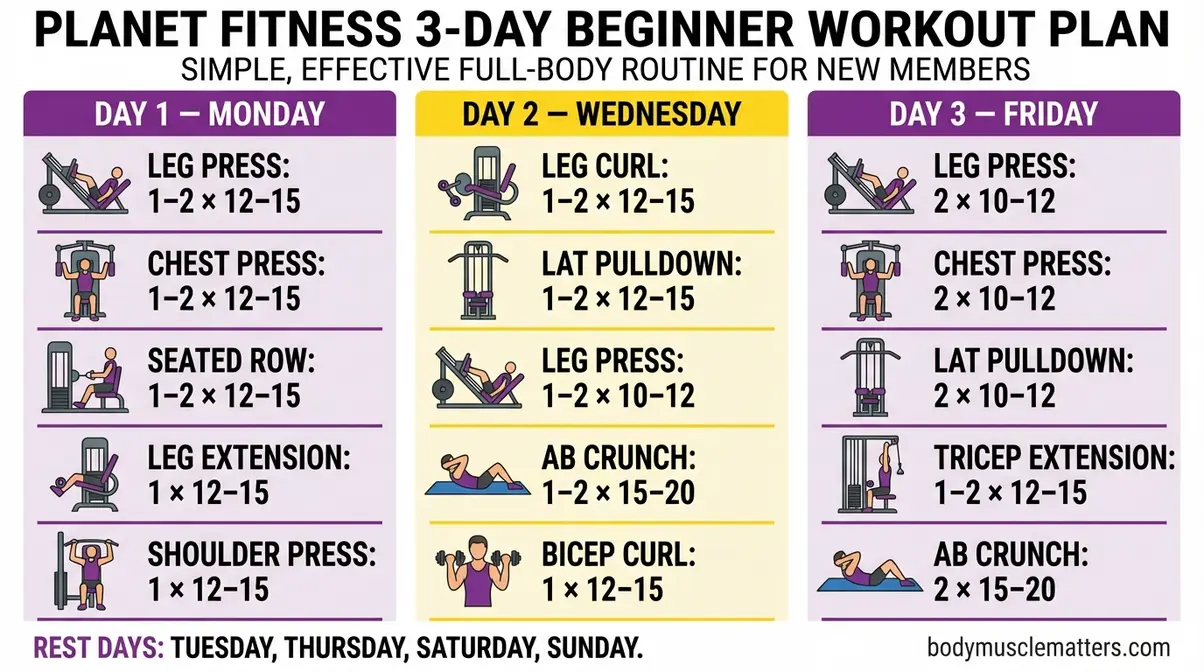
Caption: Print this cheat sheet and bring it to the gym — having a physical plan eliminates the “what do I do next?” paralysis that causes most beginners to quit.
Day 1 (Monday): Full-Body Strength A
Warm-up: 5 minutes on the treadmill at a comfortable walking pace (3.0–3.5 mph).
| Exercise | Machine | Sets | Reps | Rest |
|---|---|---|---|---|
| Leg Press | Leg Press Machine | 1–2 | 12–15 | 60 sec |
| Chest Press | Chest Press Machine | 1–2 | 12–15 | 60 sec |
| Seated Row | Row Machine | 1–2 | 12–15 | 60 sec |
| Leg Extension | Leg Extension Machine | 1 | 12–15 | 60 sec |
| Shoulder Press | Shoulder Press Machine | 1 | 12–15 | 60 sec |
Cool-down: 5 minutes easy treadmill walking + 3 minutes of light stretching (hold each stretch 20–30 seconds — quads, hamstrings, chest, shoulders).
Why this works: Day 1 hits every major muscle group with compound movements (exercises that work multiple muscles at once). Starting with just 1–2 sets keeps total volume manageable while your nervous system learns the movement patterns.
Day 2 (Wednesday): Full-Body Strength B
Warm-up: 5 minutes on the elliptical at low resistance.
| Exercise | Machine | Sets | Reps | Rest |
|---|---|---|---|---|
| Leg Curl | Leg Curl Machine | 1–2 | 12–15 | 60 sec |
| Lat Pulldown | Lat Pulldown Machine | 1–2 | 12–15 | 60 sec |
| Leg Press | Leg Press Machine | 1–2 | 10–12 | 60 sec |
| Ab Crunch | Ab Crunch Machine | 1–2 | 15–20 | 45 sec |
| Bicep Curl | Curl Machine | 1 | 12–15 | 60 sec |
Cool-down: 5 minutes elliptical at low resistance + hip flexor and hamstring stretches.
Why this works: Day 2 shifts emphasis to the posterior chain (hamstrings, back, and core) — the muscles most beginners neglect. Alternating between Day 1 and Day 2 ensures balanced development and prevents overuse of any single muscle group.
Day 3 (Friday): Full-Body Strength C
Warm-up: 5 minutes on the stationary bike at low resistance.
| Exercise | Machine | Sets | Reps | Rest |
|---|---|---|---|---|
| Leg Press | Leg Press Machine | 2 | 10–12 | 60 sec |
| Chest Press | Chest Press Machine | 2 | 10–12 | 60 sec |
| Lat Pulldown | Lat Pulldown Machine | 2 | 10–12 | 60 sec |
| Tricep Extension | Tricep Machine | 1–2 | 12–15 | 60 sec |
| Ab Crunch | Ab Crunch Machine | 2 | 15–20 | 45 sec |
Cool-down: Full-body stretch sequence — chest, lats, quads, hamstrings, calves (30 seconds each).
Why this works: Day 3 revisits the primary compound movements with slightly higher volume than Days 1 and 2, reinforcing the neural pathways you’ve been building all week. By Friday of Week 4, this session should feel noticeably easier than it did in Week 1 — that’s evidence of real progress.
How to Warm Up and Cool Down
Warm-up (never skip this): 5 minutes of light cardio raises your heart rate, increases blood flow to muscles, and lubricates your joints. Cold muscles are significantly more prone to strains. Choose any cardio machine — treadmill, elliptical, or stationary bike — at an easy pace that makes you breathe a little harder without becoming uncomfortable.
Cool-down: 5 minutes of easy cardio followed by 3–5 minutes of static stretching. Hold each stretch for 20–30 seconds without bouncing. Focus on the muscles you just worked. Stretching after exercise — when muscles are warm — improves flexibility and reduces next-day soreness (technically called DOMS, or delayed onset muscle soreness).
When and How to Add More Weight
Follow the 2-2-2 Rule for progression: if you can complete two extra reps beyond your target in your last set, for two consecutive workouts, it’s time to add weight. For example, if your target is 12 reps and you’re hitting 14 comfortably for two sessions in a row, increase the weight by one pin (typically 5–10 lbs) at your next session (Arthritis Foundation).
This removes all the guesswork from progression. You never need to wonder “am I ready to add weight?” — the 2-2-2 Rule gives you a clear, objective signal. After 30 days of The First 30 Framework, most beginners are ready to add one additional set per exercise and begin applying this rule consistently.

- +Better grip on machines, bars, and dumbbells
- +Protects palms from calluses and pressure
- +Cheap, packable gym-bag essential
- −Some lifters prefer bare hands or chalk
- −Sizing varies between brands — check the chart
How to Burn Fat at Planet Fitness
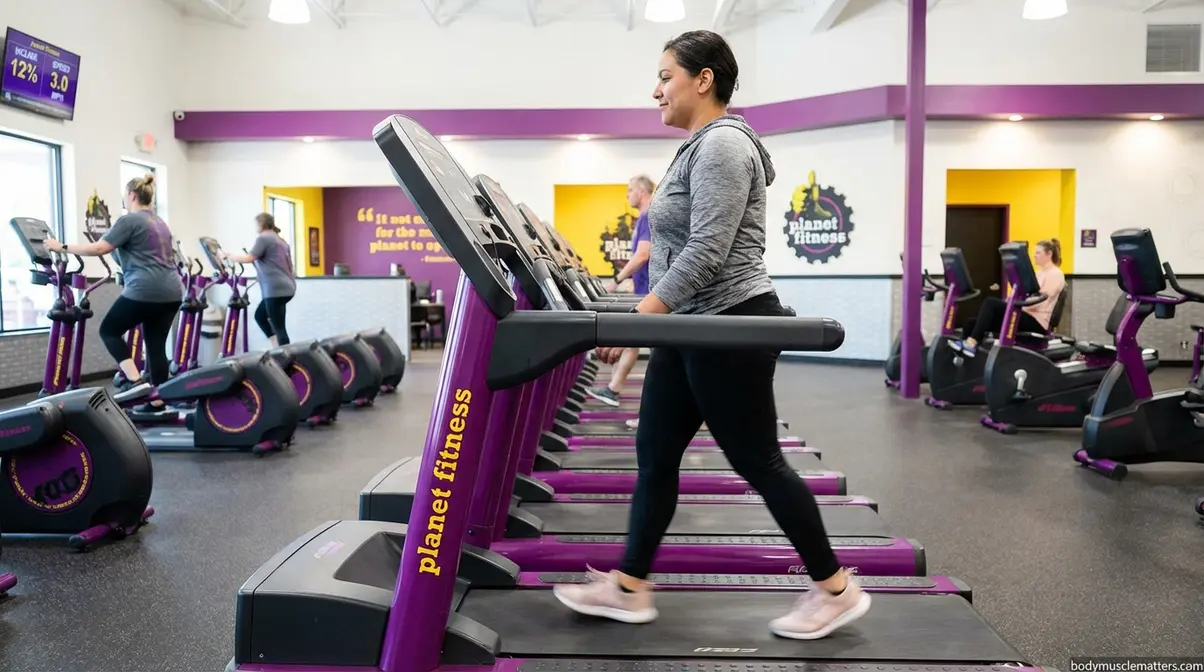
Fat loss at Planet Fitness comes down to one principle: create a consistent calorie deficit through a combination of cardio and strength training. Cardio burns calories during the session; strength training builds muscle, which raises your metabolism and burns more calories at rest. Using both — which Planet Fitness makes easy — produces better results than either approach alone.
Best Cardio Machines at Planet Fitness for Fat Loss
Planet Fitness locations stock a solid range of cardio equipment. Here’s how to choose based on your goals and fitness level:
| Machine | Best For | Intensity | Beginner-Friendly? |
|---|---|---|---|
| Treadmill | Walking, jogging, 12-3-30 workout | Low–High | ✅ Yes |
| Elliptical | Low-impact full-body cardio | Low–Moderate | ✅ Yes |
| Stationary Bike | Seated, joint-friendly cardio | Low–Moderate | ✅ Yes |
| Stairmaster / Step Mill | High-calorie burn, glute focus | Moderate–High | ⚠️ Start slow |
The 12-3-30 workout — walking on the treadmill at 12% incline, 3 mph, for 30 minutes — has become a popular beginner-friendly fat-loss routine because it’s low-impact but significantly more challenging than flat walking. Start with a lower incline (4–6%) if 12% feels too intense initially.
“The treadmill, elliptical, and stairmaster are consistently rated as the top fat-burning cardio machines at Planet Fitness — with the stairmaster producing the highest calorie-per-minute output for most users.”
Combining Cardio and Strength for Maximum Results
The most effective fat-loss approach at Planet Fitness combines strength training (your 3-day plan above) with 2–3 cardio sessions of 20–30 minutes per week. This structure is sometimes called “cardio acceleration” — adding light cardio either directly after strength sessions or on rest days.
Our team evaluated multiple beginner programming approaches and found that placing cardio after strength training produces better results. Additionally, research shows that combining aerobic and resistance training is more effective than resistance training alone for reducing overall body fat mass (PubMed). Strength training requires glycogen (stored carbohydrate energy) for peak performance — doing cardio first depletes that glycogen and compromises the strength session. Save cardio for after your lifts, or do it on Wednesday and Saturday as standalone sessions.
- A practical split for fat loss:
- Monday: Strength (Day 1) + 10 min treadmill cooldown
- Wednesday: Strength (Day 2) + 20 min elliptical
- Friday: Strength (Day 3) + 10 min treadmill cooldown
- Saturday (optional): 30 min low-intensity cardio only
Planet Fitness Group Classes: What’s Offered
PE@PF group classes are an underused fat-loss tool. “PF Burn” is a cardio-focused PE@PF class designed specifically for calorie expenditure. “PF Strength” classes add resistance training variety. Both are free with membership and run on rotating schedules posted in the app and at the front desk. If traditional cardio machines feel monotonous, these classes are an effective alternative — and the group energy makes the effort feel significantly easier.
What Exercises Burn the Most Belly Fat?
No exercise directly burns belly fat in a targeted way — spot reduction is a myth that research has consistently disproven. However, exercises that burn the most total calories are most effective for reducing overall body fat, including abdominal fat.
At Planet Fitness, the stairmaster, treadmill incline walking (especially the 12-3-30 workout), and elliptical produce the highest calorie expenditure per session. Combined with strength training — which builds muscle and raises resting metabolic rate — these cardio options create the conditions for sustainable fat loss over time.
Building Muscle at Planet Fitness
You can absolutely build muscle at Planet Fitness. The concern that “Planet Fitness doesn’t have enough equipment for muscle building” is a common misconception that the Smith Machine and cable tower completely disprove. The key is applying progressive overload — the principle of gradually increasing the demand on your muscles over time so they’re forced to adapt and grow.
Progressive overload (gradually increasing resistance, reps, or sets over time to force muscle adaptation) is the single most important concept in strength training. Without it, your muscles adapt to a fixed stimulus and stop developing. With it, even the machines at Planet Fitness are more than sufficient for meaningful muscle gains.
Using the Smith Machine and Cable Tower for Muscle Gains
The Smith Machine at Planet Fitness is a barbell attached to vertical steel rails, which guides it in a fixed vertical path. This makes it significantly safer than a free barbell for beginners — the bar can’t tip sideways, and safety hooks prevent it from dropping. You can use it for:
- Smith Machine Squat: Feet slightly forward of the bar, lower to parallel, drive through your heels.
- Smith Machine Bench Press: Set an adjustable bench under the bar, lower to mid-chest, press up.
- Smith Machine Shoulder Press: Seated, press bar from shoulder height to overhead. Adjust grip width so elbows stay under the bar throughout.
The cable tower (also called the functional trainer or cable crossover machine) uses a pulley system with adjustable height settings, which means you can perform dozens of exercises with one piece of equipment: cable rows, cable curls, tricep pushdowns, face pulls, and more. For beginners, start with the cable row and tricep pushdown — both are intuitive and effective for building the back and arms.
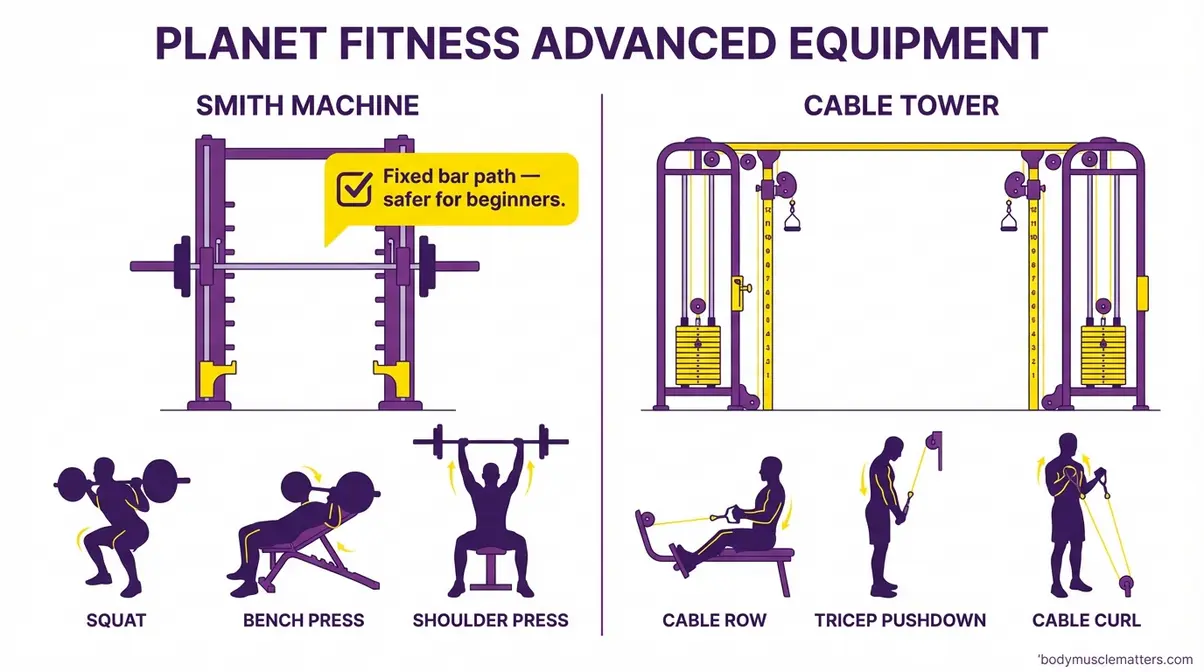
Caption: The Smith Machine’s fixed bar path makes it one of the safest tools for beginner compound lifts — a key advantage over free-weight barbells.
Understanding Progressive Overload
Progressive overload is the foundational principle behind every effective workout program. NMSU extension guidelines recommend that beginners start with a single set per muscle group, then gradually increase to 2–4 sets as their body adapts. The key is gradual — adding too much weight too fast leads to form breakdown and potential injury.
A practical progressive overload schedule for the first 60 days:
| Weeks | Sets Per Exercise | Reps | Weight Guidance |
|---|---|---|---|
| 1–2 | 1 | 15 | Very light — form focus |
| 3–4 | 1–2 | 12–15 | Slightly challenging |
| 5–8 | 2–3 | 10–12 | Apply 2-2-2 Rule |
Consistency matters more than intensity at this stage, but as you advance, pushing muscles close to failure becomes the key driver for muscle growth (FAU). NMSU research shows that strength training consistently at a moderate level produces greater long-term gains than training intensely and inconsistently.
The 2-2-2 Rule: Your Beginner Muscle-Building Formula
The 2-2-2 Rule is the clearest, most beginner-friendly progressive overload guide available. Here’s how it works: if you complete two extra reps beyond your target on your final set, and you do this for two consecutive workouts, add weight at your next session.
Example in practice: Your target is 3 sets of 12 reps on the Chest Press. In Session 5 and Session 6, you’re hitting 14 reps on your third set without struggling. Apply the 2-2-2 Rule — move up one weight increment (one pin) at your next session.
This rule removes the guesswork that paralyzes most beginners. You never need to decide subjectively whether you’re “ready” — the rule tells you objectively. Within The First 30 Framework, start applying the 2-2-2 Rule at Week 3, after your form is solid and consistent.
Targeted Workouts: Legs, Arms, and Core
Once you’ve completed 30 days of The First 30 Framework, you can begin targeting specific muscle groups with more intention. Research indicates that high-intensity circuit training produces similar gains in strength and muscle mass compared to traditional longer strength training routines (PMC). These targeted sessions work best as replacements for one of your three weekly full-body days, or as a fourth session if your schedule allows.
Leg Day at Planet Fitness: The Best Machines to Use
Planet Fitness has excellent leg equipment. A focused leg day targets the quadriceps (front of thigh), hamstrings (back of thigh), glutes, and calves.
Recommended Leg Day Circuit:
| Machine | Sets | Reps | Target Muscle |
|---|---|---|---|
| Leg Press | 3 | 12 | Quads, glutes, hamstrings |
| Leg Extension | 3 | 15 | Quadriceps |
| Leg Curl | 3 | 12 | Hamstrings |
| Abductor Machine | 2 | 15 | Outer glutes (hip abductors) |
| Calf Raise Machine | 3 | 20 | Calves |
The leg press is the cornerstone of any Planet Fitness leg day. It’s safer than a barbell squat for beginners because you’re seated and supported, and the load is distributed across both legs simultaneously. Place your feet shoulder-width apart in the center of the platform. A higher foot placement targets the hamstrings and glutes more; a lower placement shifts emphasis to the quadriceps.
Upper Body and Arm Day: Chest, Back, Shoulders, Biceps
An effective upper body day at Planet Fitness alternates between pushing muscles (chest, triceps, anterior shoulders) and pulling muscles (back, biceps, rear shoulders). This balance prevents the overdeveloped chest / underdeveloped back pattern common in beginners.
Recommended Upper Body Circuit:
| Machine | Sets | Reps | Target Muscle |
|---|---|---|---|
| Chest Press | 3 | 12 | Chest, triceps |
| Lat Pulldown | 3 | 12 | Lats, biceps |
| Shoulder Press | 2 | 12 | Deltoids |
| Seated Row | 3 | 12 | Mid-back |
| Bicep Curl Machine | 2 | 15 | Biceps |
| Tricep Pushdown (Cable) | 2 | 15 | Triceps |
“Alternating push and pull exercises in a single upper body session is one of the most time-efficient beginner strategies — it allows one muscle group to recover while the opposing group works, cutting rest time without reducing quality.”
Core and Ab Day at Planet Fitness
A strong core protects your spine during every other exercise you do — it’s not just about aesthetics. Planet Fitness has two dedicated core machines plus space for mat work.
Recommended Core Circuit:
- Ab Crunch Machine: 3 sets of 20 reps. Adjust the pad so it rests across your upper chest/shoulders. Focus on contracting your abdominals to initiate the crunch — don’t use your arms to pull.
- Back Extension Machine: 2 sets of 15 reps. Strengthens the erector spinae (lower back muscles) — critical counterbalance to abdominal work.
- Captain’s Chair (if available): 2 sets of 12 hanging knee raises. Excellent for lower abdominals.
- Plank: 3 rounds of 20–30 seconds. No equipment needed — find a mat near the stretching area.
The ab crunch machine is commonly misused. The movement should feel like your torso is curling down toward your hips — not your head moving toward your knees. Keep your neck neutral throughout.
What is the Hardest Muscle Group to Grow?
Calves are widely considered the hardest muscle group to develop, primarily because they contain a high proportion of slow-twitch muscle fibers (which are fatigue-resistant but respond less dramatically to hypertrophy training), and because most people use their calves extensively in daily walking — meaning they’re already adapted to moderate stimulation.
The rear deltoids (back of the shoulder) and hamstrings are also notoriously stubborn. For calves at Planet Fitness, use the calf raise machine with a full range of motion and higher rep ranges (15–25 reps per set).
Free Workout Resources and Community Tips
Printable Workout Sheets and PDF Cheat Sheets
Having a physical plan in the gym is a significant practical advantage — it prevents the “what do I do next?” freeze that kills momentum mid-session. The Planet Fitness website’s blog section includes beginner workout plan resources you can reference for session-by-session guidance. The Planet Fitness beginner workout plan resources on their official site are a solid supplement to the 3-day plan in this guide.
For your own tracking, use a simple table:
| Date | Exercise | Weight Used | Sets Completed | Reps Achieved |
|---|
Tracking even this basic data across four weeks reveals clear evidence of your progress — one of the strongest psychological motivators for continuing.
Finding Your Planet Fitness Community Online
You don’t have to figure this out alone. The Planet Fitness Members community on Reddit (r/PlanetFitness) is one of the most active and encouraging beginner fitness communities available. Common feedback from Planet Fitness beginners there includes practical advice on machine etiquette, program variations, and honest experience reports from people at every fitness level.
For women who relate to the “shy girl” workout approach — focusing on machines, avoiding the free weight area, building confidence incrementally — both the Planet Fitness subreddit and the broader gym-girls and shy-girl fitness communities on TikTok and Instagram offer relatable, practical content. You’ll find people at the exact same starting point sharing what worked for them.
When Planet Fitness Isn’t the Right Fit
Planet Fitness works exceptionally well for most beginners, and this guide’s planet fitness beginner workout plan reflects that. However, honest assessment requires acknowledging when it’s not the optimal choice.
Common Pitfalls to Avoid
Pitfall 1: Going too hard too soon. The most frequent beginner mistake is arriving motivated on Day 1 and attempting every machine at a heavy weight. The result is extreme soreness (DOMS), difficulty walking for three days, and a strong psychological association between “gym” and “misery.” Stick to the light weights and low volume prescribed in weeks 1–2.
Pitfall 2: Inconsistent attendance. Attending once a week is better than nothing, but it’s not enough stimulus to produce visible results in a reasonable timeframe. Three sessions per week is the minimum effective dose for beginners. If you can’t commit to three sessions, two consistent sessions per week will still produce results — just on a longer timeline.
Pitfall 3: Neglecting the PE@PF program. Most members never take advantage of the free certified training available through PE@PF. A single orientation session can save months of trial and error. Use it.
When to Choose Alternatives
If you want to powerlift or Olympic lift: Planet Fitness does not have barbells for deadlifts or bench press outside the Smith Machine, and it bans chalk. If your goal is competitive powerlifting or Olympic weightlifting, a different gym with a proper free-weight platform is necessary.
If you need direct one-on-one personal training: Planet Fitness no longer offers traditional one-on-one personal training. PE@PF provides small-group instruction and program design, but not dedicated individual coaching. If one-on-one coaching is essential to your progress, a personal training gym or independent CPT is the better choice.
If you thrive in a high-energy, competitive environment: Planet Fitness’s deliberately low-key atmosphere is a feature for most beginners, but some people are actually motivated by the intensity of a traditional gym. Know your psychology.
When to Seek Expert Help
Consult a licensed physical therapist before starting any gym program if you have a pre-existing joint injury, chronic back pain, or a recent surgery. If you experience sharp joint pain (as distinct from normal muscle fatigue) during any exercise in this guide, stop that exercise immediately and consult a healthcare provider before resuming. The workout plans here are appropriate for healthy adults — they’re not a substitute for personalized medical or rehabilitative guidance.
Frequently Asked Questions
What is the 2-2-2 rule in the gym?
The 2-2-2 rule is a progressive overload guideline that tells you when to increase your weight. If you can perform two extra reps beyond your target on your final set, for two consecutive workouts, it’s time to add weight (Skelcore). For example, if your goal is 12 reps and you hit 14 easily for two sessions in a row, increase by one weight increment. This rule removes all subjectivity from progression and is ideal for beginners who aren’t sure when they’re ready to advance.
Is Planet Fitness a good gym for a beginner?
Planet Fitness is one of the best gyms specifically designed for beginners. Its Judgement Free Zone philosophy actively discourages the intimidating behaviors common at hardcore gyms. Every machine includes a QR code tutorial. The PE@PF program offers free certified group training and program design to all members. And at $10–$25 per month, the financial barrier to entry is among the lowest in the fitness industry. Research suggests that beginners who use structured onboarding resources show significantly higher 6-month retention than those who don’t (Glofox).
Can anyone use the 30-minute workout at Planet Fitness?
Yes — the 30-Minute Express Circuit is designed for all fitness levels and is available to every Planet Fitness member. You don’t need any prior gym experience to use it. The green and red light system tells you exactly when to start and when to move to the next station, so no planning is required. Begin at any open station if the circuit is already running. Note that some locations have phased out the automated light system — in that case, use a 60-second phone timer to replicate the same structure independently.
What is the 3-3-3 rule at the gym?
The 3-3-3 rule refers to a beginner strength training structure: 3 exercises, 3 sets each, 3 days per week. It’s a simple framework for organizing full-body workouts without overcomplicating programming — similar in spirit to The First 30 Framework in this guide. While not a universally standardized term, it captures the principle that beginners need consistency and simplicity over complexity. Three movements, three sessions, three rounds each provides ample stimulus for measurable beginner gains.
Conclusion
For anyone starting a beginner workout at Planet Fitness, the single most important decision is to start with structure rather than improvisation. The First 30 Framework — mastering the 30-Minute Express Circuit across your first 30 days — provides that structure in a way that is clinically supported, anxiety-free, and proven by the experience of thousands of Planet Fitness members. Research confirms that circuit training sessions of 25–30 minutes produce real improvements in endurance, body composition, and strength (PubMed, 2016). The 3-day full-body plan in this guide builds on that foundation with specific machines, sets, reps, and clear progression guidelines.
The First 30 Framework works because it removes the two biggest barriers for beginners: decision fatigue and gym anxiety. When you know exactly where to go and exactly what to do, the gym stops being a source of stress and starts being a source of momentum. Every machine tutorial, every workout table, and every progression guideline in this guide is designed to eliminate the guesswork that causes most new members to quit within their first six months.
Your next step is simple: schedule your first three sessions — Monday, Wednesday, Friday — and add a PE@PF orientation to your first week’s agenda. Walk up to the front desk and ask. That one conversation, combined with the plan in this guide, is enough to start. The version of you that walks through that door with a plan is already ahead of where most beginners start.
Related posts:
Benefits of Yoga for Fitness: The Science-Backed Guide
Home Workouts to Build Muscle Without Weights (2026)
CrossFit Strength Training for Beginners: 2026 Guide
Home Workout Plan for Beginners: 30-Day Step-by-Step
How to Self Massage Calves: The 4-Layer Method Guide
Strength Training for Beginners: Complete Workout Plan 2026

Callum
Hi, I'm Callum, the founder of Body Muscle Matters. I'm not a certified trainer, I'm a self taught lifter who started this site to share what I've learned from my own training and a lot of trial and error. Everything here comes from real experience and honest research, written the way I'd explain it to a friend who is just getting started. My goal is simple: practical, no hype fitness advice you can actually use.