Headaches After Workout: 5 Causes, Relief & Red Flags
You just crushed a tough workout — pull-ups, heavy squats, a hard run — and now a throbbing headache is your reward. Before you panic, here’s what you need to know.
The fear is valid. Some headaches after exercise are dangerous. But the vast majority have simple, fixable causes. The wrong response — pushing through or ignoring it — could mean missing a serious warning sign.
In this guide, you’ll learn the exact causes of headaches after workout, a step-by-step relief protocol, and the specific red-flag symptoms that require emergency care. You’ll work through four sections: causes, prevention and relief, red flags, and recovery timeline.
Before You Read: This guide covers both harmless and potentially dangerous headaches. Even if your headache feels mild, read the Red Flags section — it takes 2 minutes and could matter.
⚕️ Medical Disclaimer: This content is for informational purposes only. It is not a substitute for professional medical advice, diagnosis, or treatment. Never disregard professional medical advice because of something you read here. If you believe you may have a medical emergency — including a sudden severe headache — call 911 immediately.
Headaches after workout are common — most are harmless “primary exertion headaches” caused by dehydration, blood vessel changes, or muscle tension. They typically last 5 minutes to 48 hours (Mayo Clinic, 2024). Understanding The Exercise Headache Spectrum helps you tell a safe headache from a dangerous one in seconds.
- Most common cause: Dehydration and electrolyte loss during intense exercise
- Fastest relief: Stop, cool down, rehydrate with electrolytes, apply a cold compress
- The Exercise Headache Spectrum: Ranges from harmless (primary exertion) to emergency (thunderclap/aneurysm)
- Call 911 if: Headache peaks in under 60 seconds, or comes with vision loss, confusion, or weakness
- Prevention works: A pre-workout checklist covering hydration, warm-up, and breathing eliminates most cases
Why Do You Get Headaches After Working Out?
Most headaches after workout are primary exertion headaches — harmless, short-lived, and caused by predictable physiological triggers (Cleveland Clinic, 2024). According to the Mayo Clinic, they typically resolve within 5 minutes to 48 hours. Once you understand why they happen, you can stop worrying and start fixing the problem.
Think of post-workout headaches on a spectrum. At one harmless end sit primary exertion headaches with simple fixes. At the other end — rare but real — sit dangerous secondary headaches requiring emergency care. This is The Exercise Headache Spectrum, and it’s your mental map for everything in this guide.
Primary Exertion Headaches: What’s Actually Happening in Your Body
A primary exertion headache is a headache triggered purely by physical effort, with no underlying disease. It’s distinct from a secondary headache, which is caused by an underlying condition like a blood vessel problem or brain bleed. The Red Flags section below covers secondary headaches in detail.
Here’s what happens physiologically. During intense exercise, your brain demands more oxygen. Blood vessels dilate (widen) to deliver it — like a garden hose expanding under high pressure. In some people, that rapid dilation creates pressure-driven, pulsating pain. It feels alarming, but the mechanism itself is benign.
PubMed research on primary exercise headaches characterizes these headaches as pulsating pain triggered by physical exertion, requiring careful distinction from dangerous secondary causes (2018). The key reassurance: most exercisers experiencing this pattern have no underlying pathology. For a deeper breakdown of why these headaches occur, see our guide to causes of post-workout headaches.
All post-workout headaches fall somewhere on The Exercise Headache Spectrum — from harmless primary exertion headaches to rare but serious secondary headaches. Knowing where yours sits determines your next action.
Transition: So what triggers the harmless end of the spectrum? Here are the six most common culprits.
The 6 Most Common Triggers of Post-Workout Headaches
Understanding your trigger is the fastest path to relief. Each cause below has a distinct physiological mechanism — and a specific fix.
“There are a lot of overhead movements and straining to finish something like a pull-up can cause strain and inflammation in the neck which can easily lead to…”
— A common experience reported across fitness communities
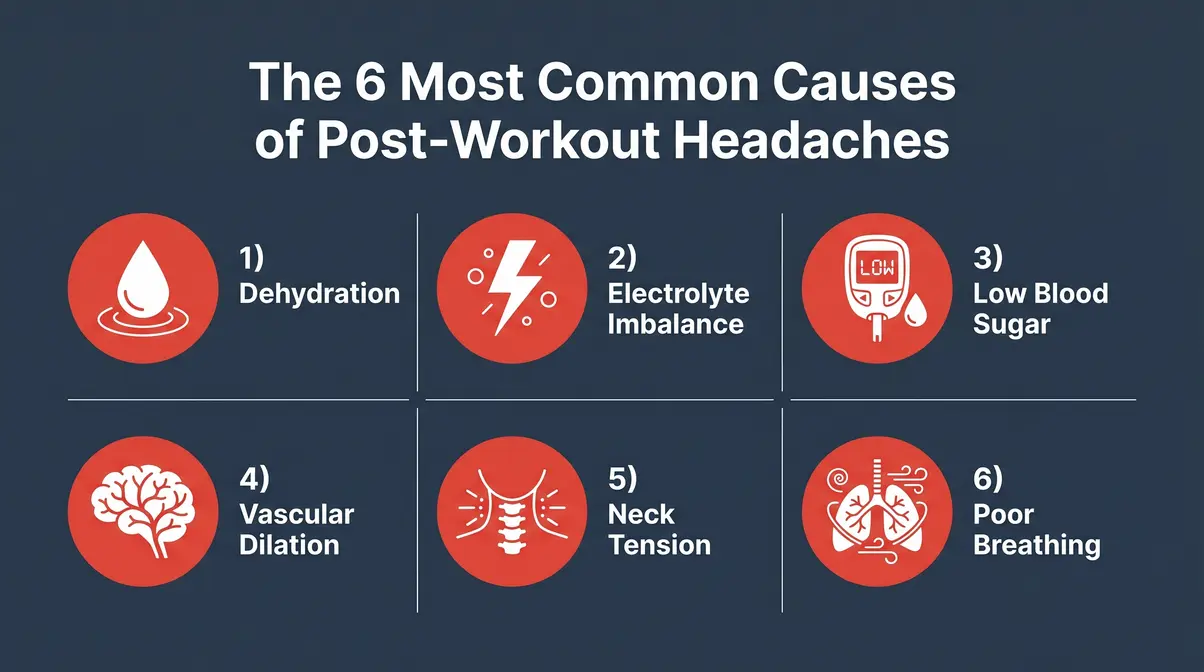
This pattern is familiar to anyone who trains hard. Here are the six triggers behind it:
1. Dehydration
Even mild dehydration — losing just 2% of your body weight in fluid — can cause headaches by reducing blood volume and lowering pressure to the brain. Practical guidance: drink 16–20 oz of water two hours before exercise, then 8 oz every 20 minutes during your session. An NCBI review on dehydration-induced headaches confirms fluid and electrolyte loss during exercise as a primary headache trigger (2010). For more on staying properly fueled, see the role of hydration in preventing headaches.
2. Electrolyte Imbalance (Hyponatremia)
Hyponatremia is a dangerous drop in blood sodium levels. Ironically, drinking too much plain water without replacing sodium can worsen headaches rather than cure them. For workouts over 60 minutes, use an electrolyte drink containing 200–300mg of sodium per serving — not just plain water.
3. Low Blood Sugar (Hypoglycemia)
Hypoglycemia means low blood sugar. Exercise burns glucose rapidly. If you train fasted or skip pre-workout nutrition, blood sugar crashes and triggers head pain. The fix: eat a small carbohydrate snack — a banana, a handful of crackers — 30–60 minutes before training.
4. Vascular Dilation
During intense effort, blood vessels in the brain dilate to supply more oxygen. In some people, this rapid widening triggers a pulsating headache. This is the most purely physiological cause — harder to prevent, but manageable with a proper cool-down. Overworking yourself in high-intensity intervals makes this trigger more likely.
5. Neck Tension and Overexertion
Overhead movements — pull-ups, military press, heavy squats — cause strain and inflammation in the neck muscles. Those tight muscles tug on surrounding structures and refer pain upward into the skull. Poor form accelerates this dramatically. A tension headache (a headache caused by muscle tightness rather than vascular changes) is the most common result of straining to finish a hard set with compromised technique.
6. Poor Breathing Technique
Holding your breath during a heavy lift — the Valsalva maneuver (a technique of forcefully exhaling against a closed airway) performed incorrectly — spikes intracranial pressure (pressure inside the skull) and can trigger head pain immediately. The correct pattern: exhale on exertion (the hardest part of the lift), inhale on the release.
Transition: Now that you know what causes these headaches, let’s address one of the most-asked questions in fitness communities: why does a Coke or coffee sometimes make the pain disappear almost instantly?
Why Does Coke or Coffee Help a Headache After Working Out?
Caffeine is a vasoconstrictor — a substance that narrows blood vessels. During exercise, your brain’s blood vessels dilate (widen), creating pressure and pain. Caffeine reverses this by narrowing those vessels, reducing the pressure and relieving pain. This is the primary reason a Coke or coffee can bring fast relief from a vascular-type post-workout headache.
There’s also a secondary mechanism at work. The sugar in Coke helps if the headache has a hypoglycemic (low blood sugar) component — making it a two-pronged fix. The caffeine handles the vascular pressure; the glucose handles the blood sugar crash. According to MedlinePlus, caffeine’s vasoconstrictive properties are well-documented as a headache-relief mechanism, which is why it’s an active ingredient in several over-the-counter headache medications.
A 12 oz can of Coke contains approximately 34mg of caffeine. A standard cup of coffee contains 80–100mg. Either can work — but water and electrolytes should always come first. There’s an important caveat: caffeine works best for vascular-type headaches. It doesn’t help tension headaches caused by neck and muscle strain, and it can worsen dehydration if overused. Use it as a short-term tool, not a daily prevention strategy.
How to Prevent and Treat Exercise Headaches
Prevention is far more effective than treatment. Sports medicine research consistently shows that the majority of exertion headaches are preventable through proper hydration, nutrition timing, and technique — factors entirely within your control.
Your Pre-Workout Headache Prevention Checklist
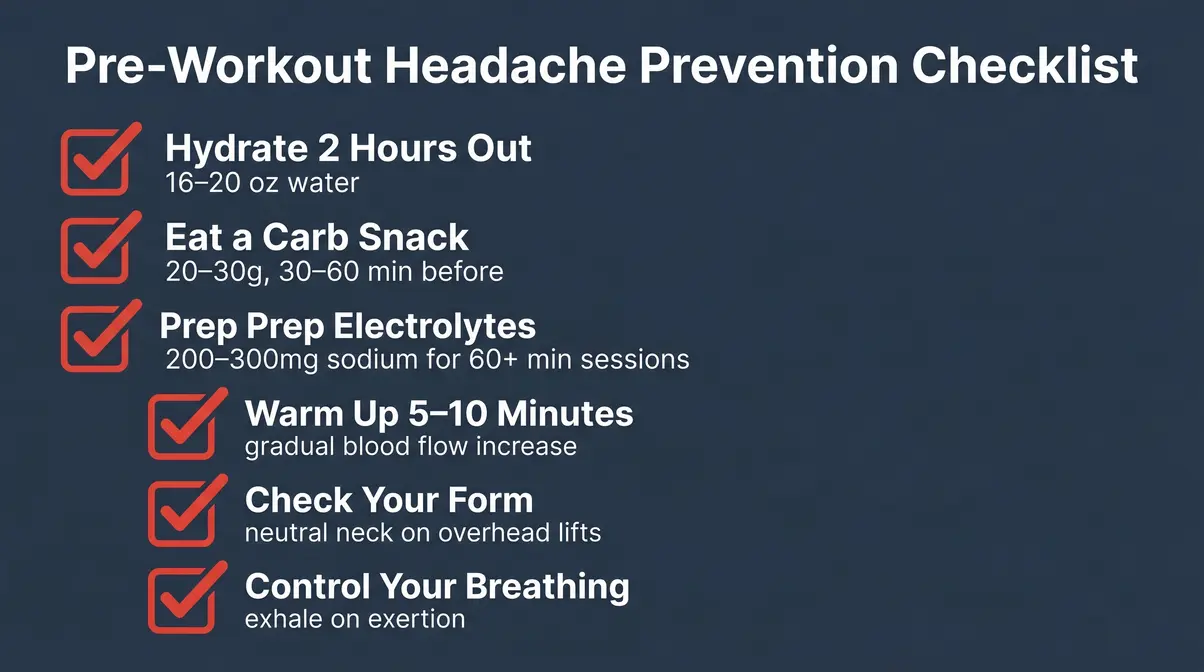
Follow this checklist before every session to eliminate the most common triggers:
- Hydrate 2 hours out. Drink 16–20 oz of water at least two hours before training. Don’t wait until you’re thirsty — thirst is a late indicator of dehydration.
- Eat a small carbohydrate snack. Consume 20–30g of carbohydrates 30–60 minutes before your session to stabilize blood sugar. A banana or a slice of toast works well.
- Prepare electrolytes for long sessions. For workouts over 60 minutes, bring an electrolyte drink with 200–300mg sodium per serving. Plain water alone is insufficient for extended training.
- Warm up for 5–10 minutes. A proper warm-up gradually increases blood flow and gives your blood vessels time to adjust — reducing the shock of sudden dilation.
- Check your form before heavy lifts. Specifically review neck position during overhead movements. A neutral spine and relaxed neck dramatically reduce tension headache risk.
- Practice controlled breathing. Remind yourself: exhale on exertion, inhale on release. Never hold your breath during a maximum effort.
The 5-Step Immediate Relief Protocol
If a headache hits mid-workout or immediately after, follow these steps in order:
- Stop exercising immediately. Continuing to push through increases vascular pressure and worsens the headache. Sit or lie down in a cool, quiet space.
- Cool down actively. Walk slowly for 3–5 minutes rather than stopping dead. Abrupt cessation can cause blood to pool and worsen symptoms.
- Rehydrate with electrolytes. Drink 16–24 oz of an electrolyte solution within the first 15 minutes. If you only have water, drink it — but add a pinch of salt if possible.
- Apply a cold compress. Place an ice pack or cold damp cloth on the back of your neck or forehead for 10–15 minutes. Cold causes vasoconstriction (narrowing of blood vessels), which can reduce vascular headache pain.
- Take an OTC pain reliever if needed. Ibuprofen (an anti-inflammatory medication) or acetaminophen can help for mild-to-moderate cases. Consult your doctor before using these regularly — frequent use of pain relievers can itself cause “rebound headaches.”
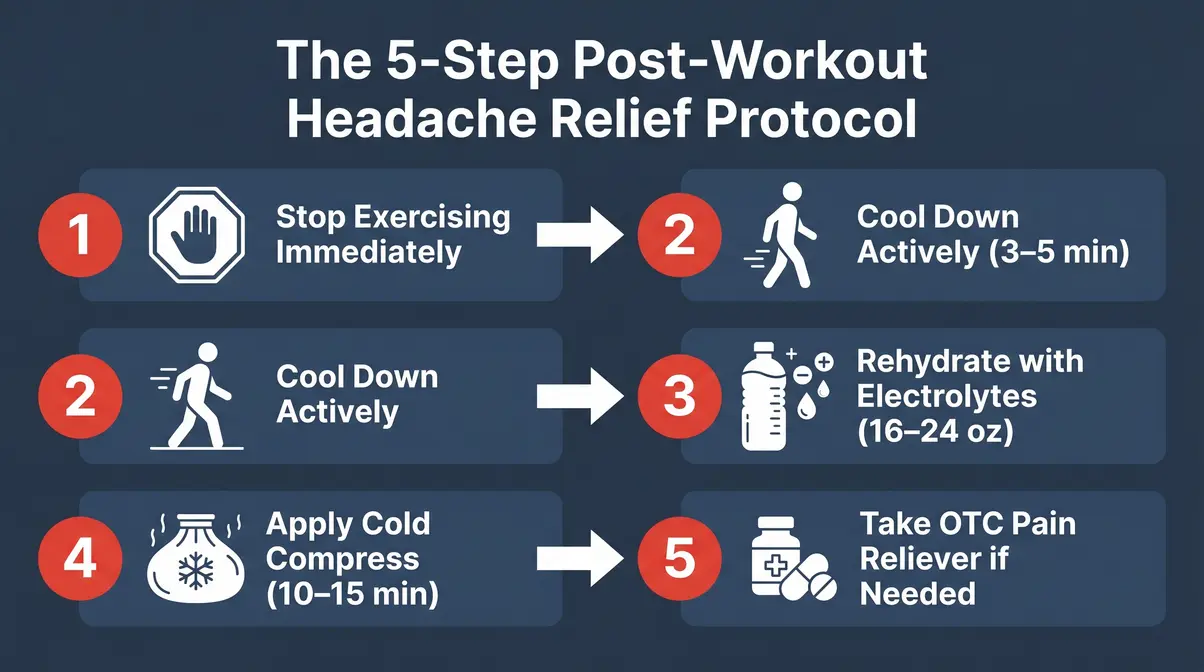
According to the Cleveland Clinic’s guide to exertion headaches, most primary exertion headaches resolve with rest and rehydration within a few hours. If your headache persists beyond 24 hours after following this protocol, consult a healthcare provider.
Common Mistakes That Make Exercise Headaches Worse
Knowing what not to do is just as important as knowing the right protocol.
Mistake 1: Pushing through the pain. Continuing to train while experiencing a headache increases intracranial pressure and can turn a mild headache into a severe one. Always stop.
Mistake 2: Drinking only plain water. Flooding your system with plain water without replacing sodium can dilute your blood sodium levels, worsening hyponatremia-related headaches. Use electrolytes for any session over 60 minutes.
Mistake 3: Skipping the cool-down. Stopping abruptly after intense cardio causes rapid blood pressure changes that aggravate vascular headaches. Always taper down for 3–5 minutes.
Mistake 4: Bad neck position during lifts. Weightlifters who crane their neck upward during squats or deadlifts load the cervical spine (the neck vertebrae) and create the exact tension pattern that causes post-workout headaches. Keep your gaze neutral — look at a spot on the floor about 6 feet ahead.
Mistake 5: Runners ignoring shoulder tension. Runners who carry their shoulders hunched and tight transfer tension directly to the neck. Consciously drop your shoulders every mile and shake out your arms.
Red Flags: When Your Post-Workout Headache Is a Medical Emergency
Most post-workout headaches are benign. But a small number are symptoms of life-threatening emergencies. Knowing the difference takes 60 seconds and can save your life. This section covers the warning signs that demand immediate emergency care — read it even if your headache feels mild.
⚕️ Second Medical Disclaimer: If you experience a sudden, explosive headache during or after exercise — especially one that peaks within 60 seconds — call 911 immediately. Do not drive yourself to the hospital. Do not wait to see if it improves. This symptom may indicate a subarachnoid hemorrhage (bleeding around the brain) and is a life-threatening emergency.
The Thunderclap Headache: The Deadliest Warning Sign
A thunderclap headache is a sudden, explosive headache that reaches maximum intensity within 60 seconds of onset. It’s often described as “the worst headache of my life” — a description that should immediately trigger emergency action.
The most dangerous cause is a subarachnoid hemorrhage (bleeding around the brain), often caused by a ruptured cerebral aneurysm (a bulge in a brain blood vessel that bursts). According to the Mayo Clinic, a thunderclap headache is the hallmark symptom of subarachnoid hemorrhage — and exercise-induced spikes in blood pressure are a known trigger. This is not the gradual, throbbing headache that builds over several minutes. It explodes instantly.
Clinical research indicates that approximately 10–15% of thunderclap headaches presenting in emergency departments are caused by subarachnoid hemorrhage (Mayo Clinic, 2024). The remainder have other serious vascular causes. None are safe to ignore.
What an aneurysm headache feels like: Sudden, explosive onset. Described as a “thunderclap” or “being hit in the back of the head with a bat.” Often accompanied by neck stiffness, sensitivity to light, nausea, and vomiting. It does not gradually build — it is instant and maximal.
The 5 Warning Signs That Require Calling 911 Immediately
If you experience any of these five signs during or after a workout, stop everything and call emergency services:
- Thunderclap onset: Headache reaches maximum severity within 60 seconds — especially if it’s unlike any headache you’ve had before.
- Sudden vision changes: Blurry vision, double vision, or vision loss in one or both eyes alongside a headache.
- Neurological symptoms: Weakness, numbness, or tingling on one side of the body; facial drooping; slurred speech or sudden difficulty speaking.
- Altered consciousness: Confusion, disorientation, loss of consciousness, or extreme drowsiness following a headache.
- Severe neck stiffness: Inability to touch your chin to your chest, combined with headache — a classic sign of meningeal irritation (irritation of the membranes surrounding the brain and spinal cord).
These symptoms align with the FAST acronym used by the American Stroke Association: Face drooping, Arm weakness, Speech difficulty, Time to call 911. For post-workout contexts, add “sudden worst-ever headache” as a fifth trigger.
According to the Mayo Clinic’s guide to exercise headaches, secondary exercise headaches — those caused by underlying conditions — may also involve pain in the back of the head and neck, vomiting, and double vision. Any combination of these symptoms warrants emergency evaluation.
Benign Exertion Headache vs. Emergency Headache: Quick Triage Guide
Use this comparison to assess your headache in real time.
| Feature | Benign Exertion Headache | Emergency Headache |
|---|---|---|
| Onset speed | Gradual (minutes) | Sudden — peaks within 60 seconds |
| Pain quality | Dull ache or throbbing | Explosive, “worst ever” |
| Location | Forehead, temples, or all over | Often back of head/neck |
| Associated symptoms | Mild nausea, fatigue | Vision loss, weakness, confusion |
| Duration | 5 minutes to 48 hours | Persistent, doesn’t improve with rest |
| Response to rest/water | Improves within 30–60 min | No improvement |
| History | Recurs under similar conditions | First occurrence of this type |
| Action | Rest, rehydrate, monitor | Call 911 immediately |
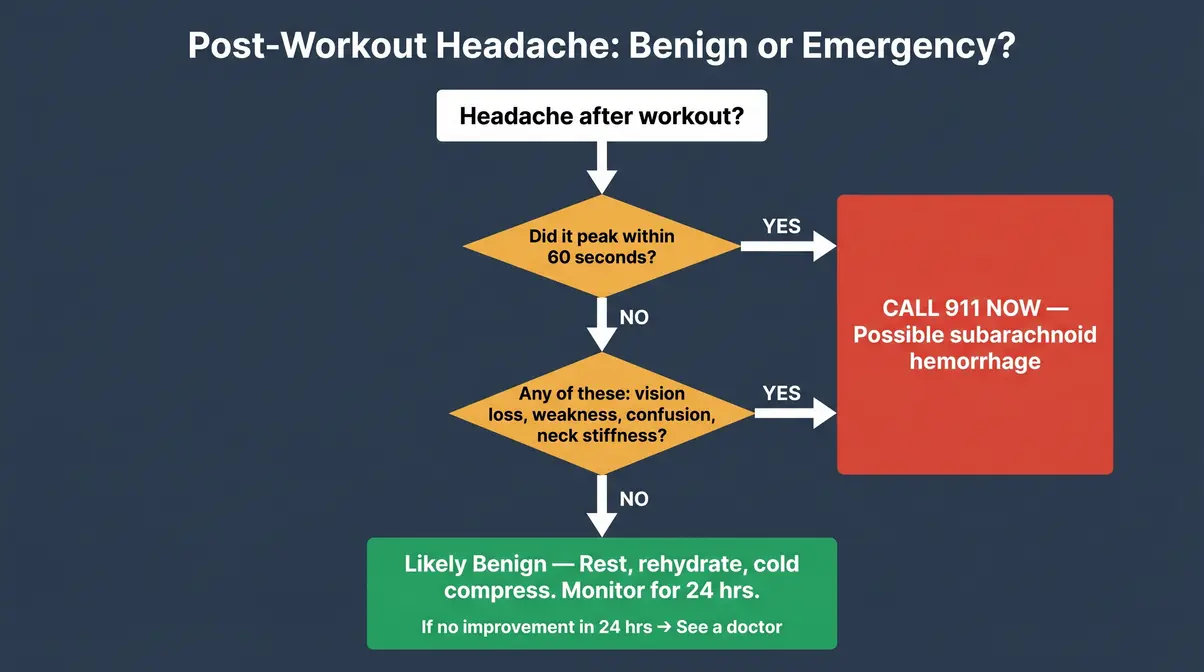
The 5 C’s of headaches — a clinical framework used by some neurologists — include: Character (what it feels like), Course (how it developed), Cause (what triggered it), Comorbidities (other symptoms), and Context (your medical history). Apply this framework when describing your headache to a doctor. If the Character is “explosive” and the Course is “instant,” those two C’s alone justify emergency evaluation.
How Long Do Post-Workout Headaches Last?
The honest answer: it depends on the cause. But most benign exercise headaches follow a predictable timeline — and knowing that timeline helps you stay calm and make smart decisions about when to seek care.
Typical Duration and What Affects Recovery Speed
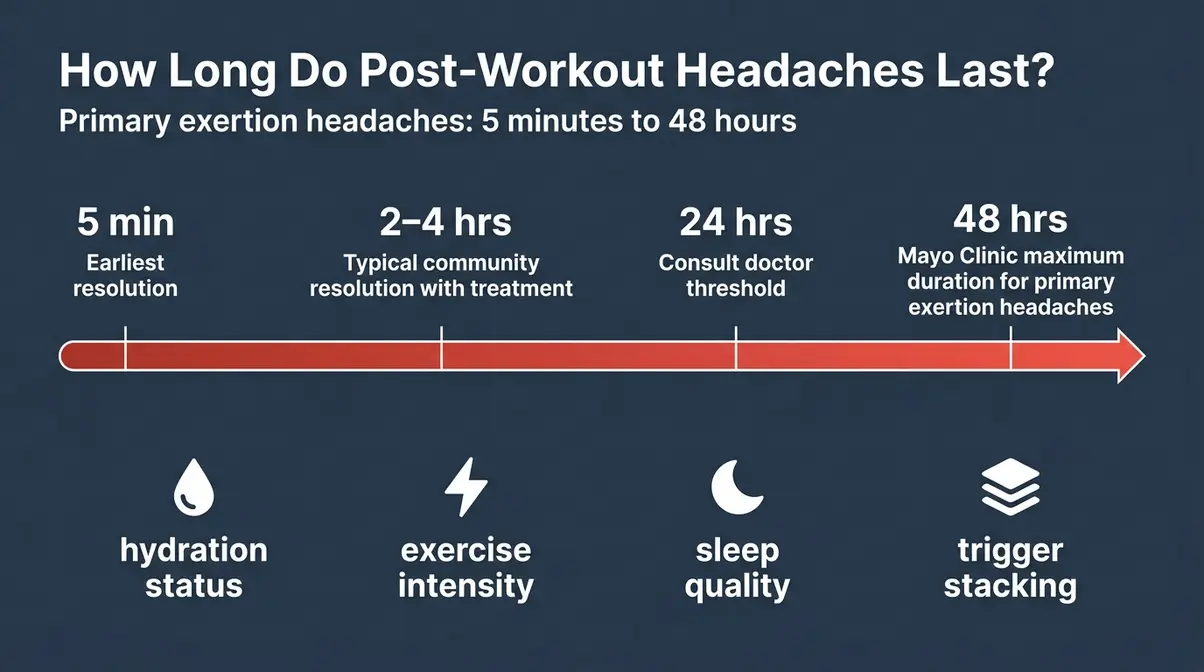
According to the Mayo Clinic, primary exertion headaches typically last anywhere from 5 minutes to 48 hours. Most resolve within 2–4 hours with proper rest and rehydration. The Henry Ford Health blog on exercise-induced headaches notes that duration is closely tied to how quickly the underlying trigger is addressed.
Several factors affect how long your headache lingers:
- Hydration status: Headaches caused by dehydration resolve faster when electrolytes are replaced promptly. Waiting hours to rehydrate extends the recovery window significantly.
- Exercise intensity: Higher-intensity sessions cause more pronounced vascular dilation, which takes longer to normalize. A post-CrossFit headache may last longer than one after a light jog.
- Sleep quality: Poor sleep before a workout amplifies pain sensitivity. A headache that might resolve in 90 minutes on a rested day may persist for 6+ hours when you’re sleep-deprived.
- Trigger stacking: If multiple triggers fire simultaneously — dehydration and poor form and fasted training — the headache will be more severe and longer-lasting.
When to consult a doctor: If a headache persists beyond 24 hours, recurs frequently (more than twice a month), or progressively worsens, consult a healthcare provider. Persistent exertion headaches warrant evaluation to rule out secondary causes.
What the Community Experiences: Real Patterns and Recovery
Across fitness communities — from Reddit’s r/Fitness to CrossFit forums — the pattern is remarkably consistent. Most exercisers report that their first post-workout headache scared them significantly, but turned out to be dehydration or neck tension. The phrase “headache day after workout reddit” is one of the most searched related queries in this topic cluster, suggesting that delayed-onset headaches (those appearing hours after exercise, not during) are extremely common and a major source of anxiety.
The typical community-reported timeline looks like this: headache begins 30–90 minutes post-workout, peaks around 2 hours, and resolves within 4–6 hours with rest, electrolytes, and a light meal. Exercisers who identify and address their primary trigger — usually dehydration or neck tension — report headache frequency dropping dramatically within 2–3 weeks of making targeted adjustments.
Clinical research published in GoodRx’s medical review of post-workout headaches supports this community experience: most primary exertion headaches are self-limiting and respond well to conservative management. The key is consistent prevention rather than reactive treatment.
When to See a Doctor: Limitations and Honest Guidance
Common Pitfalls to Avoid
Pitfall 1: Self-diagnosing as “just dehydration.”
The most dangerous mistake is assuming every post-workout headache is benign. If a headache has any thunderclap features — sudden, explosive, worst-ever — it requires emergency evaluation, not a glass of water and a lie-down.
Pitfall 2: Using caffeine or NSAIDs too frequently.
Taking ibuprofen or aspirin more than 10–15 days per month can cause medication overuse headache (also called “rebound headache”) — a cycle where the painkiller itself triggers headaches. Use pain relievers sparingly and consult a doctor if you need them more than twice a week.
Pitfall 3: Ignoring progressive worsening.
A headache that is slightly worse each time you exercise, or that takes longer to resolve with each occurrence, is a signal to get evaluated — not a pattern to push through.
When to Choose Professional Evaluation Over Home Management
- First-ever thunderclap headache: No exceptions. Go to the emergency room.
- Headache with neurological symptoms: Any combination of headache plus vision changes, one-sided weakness, or speech difficulty requires immediate evaluation.
- Headaches that recur more than twice a month: A sports medicine physician or neurologist can identify secondary causes and offer preventive medication options.
- Headaches that don’t respond to rest and rehydration: If your standard protocol isn’t working after 24 hours, seek care.
When to Seek Expert Help
This guide covers the most common presentations of post-workout headaches. However, it cannot replace individualized medical assessment. Consult a sports medicine physician or neurologist if:
- You have a personal or family history of aneurysm, stroke, or high blood pressure
- You are on blood thinners or cardiovascular medications
- Your headaches began after a head injury or fall during exercise
- You are pregnant — exertional headaches during pregnancy warrant prompt evaluation
Frequently Asked Questions
Is it normal to get headaches after working out?
Yes, post-workout headaches are common and usually benign. Sports medicine research confirms that primary exertion headaches — triggered by physical effort — are one of the most frequently reported exercise-related symptoms. Studies suggest they affect a meaningful percentage of regular exercisers, particularly those training at high intensity. Most resolve within a few hours with rest and rehydration. However, a headache that is sudden, explosive, or accompanied by neurological symptoms is never normal and requires emergency evaluation.
What does a pre-stroke headache feel like?
A pre-stroke or stroke-related headache is typically sudden and severe, often described as the worst headache of a person’s life. Unlike a typical tension headache that builds gradually, it may peak within seconds. It often accompanies other stroke symptoms: facial drooping, arm weakness, slurred speech, or vision changes. According to the American Stroke Association, the FAST acronym (Face, Arms, Speech, Time) captures the core warning signs. If you experience any of these during or after exercise, call 911 immediately — do not wait.
How long do post-workout headaches last?
Primary exertion headaches typically last between 5 minutes and 48 hours (Mayo Clinic, 2024). Most resolve within 2–4 hours when the underlying trigger — dehydration, low blood sugar, or neck tension — is addressed promptly. Factors that extend duration include delayed rehydration, high exercise intensity, poor sleep, and stacked triggers. If your headache persists beyond 24 hours despite rest and rehydration, consult a healthcare provider to rule out secondary causes.
How do you get rid of exercise headaches?
The fastest relief protocol involves five steps: stop exercising immediately, walk slowly for 3–5 minutes to cool down, rehydrate with an electrolyte drink (16–24 oz), apply a cold compress to the neck or forehead for 10–15 minutes, and take an OTC pain reliever like ibuprofen if needed. For vascular-type headaches, a small amount of caffeine (a cup of coffee or a Coke) can accelerate relief through vasoconstriction. Address the root cause — dehydration, nutrition, or form — to prevent recurrence.
What are the 5 C’s of headaches?
The 5 C’s of headaches is a clinical assessment framework used by neurologists to characterize and evaluate headaches: Character (what the pain feels like — throbbing, stabbing, pressure), Course (how it developed — gradual or sudden), Cause (what triggered it — exercise, stress, food), Comorbidities (other symptoms present — nausea, vision changes, weakness), and Context (your medical history and risk factors). When describing a post-workout headache to a doctor, walking through these five dimensions helps them distinguish a benign exertion headache from a serious secondary cause.
What are the 5 warning signs of a mini stroke?
The 5 warning signs of a mini stroke (TIA — transient ischemic attack) are: sudden numbness or weakness in the face, arm, or leg — especially on one side of the body; sudden confusion or trouble speaking; sudden vision problems in one or both eyes; sudden difficulty walking, dizziness, or loss of balance; and sudden, severe headache with no known cause. According to the CDC, TIA symptoms often resolve within minutes to hours but are a serious warning sign of a full stroke. Seek emergency care immediately — TIAs are medical emergencies.
What do aneurysm headaches feel like?
An aneurysm headache is characterized by a sudden, explosive onset — often described as “being hit in the back of the head with a baseball bat.” It reaches maximum intensity within 60 seconds (a thunderclap headache pattern) and is frequently accompanied by neck stiffness, sensitivity to light, nausea, and vomiting. Unlike a typical exertion headache that builds gradually, an aneurysm-related headache is instantaneous and severe. According to the Mayo Clinic, this symptom pattern — especially following exertion — requires immediate emergency evaluation to rule out subarachnoid hemorrhage.
How do you fix a post-workout headache?
Fix a post-workout headache by addressing its root cause immediately. For dehydration: rehydrate with 16–24 oz of an electrolyte drink within 15 minutes of headache onset. For neck tension: apply a cold compress to the back of the neck and perform gentle neck stretches. For low blood sugar: eat a small carbohydrate snack. For vascular headaches: rest in a cool, dark room and consider a small amount of caffeine. If the headache doesn’t improve within 30–60 minutes of these measures, or if any red-flag symptoms appear, seek medical attention.
Why does Coke help headaches?
Coke helps headaches primarily because of its caffeine content. Caffeine is a vasoconstrictor — a substance that narrows blood vessels. During intense exercise, brain blood vessels dilate and create pressure-driven pain. Caffeine reverses this dilation, reducing vascular pressure and relieving pain. A 12 oz Coke contains approximately 34mg of caffeine, enough to trigger mild vasoconstriction. The sugar also helps if the headache has a low blood sugar (hypoglycemia) component — addressing both the vascular and metabolic causes simultaneously. However, water and electrolytes should always be the first line of treatment.
The Bottom Line: Know Your Headache, Protect Your Health
For most exercisers, headaches after workout are a manageable, preventable annoyance — not a medical crisis. Clinical research confirms that primary exertion headaches are driven by dehydration, electrolyte loss, vascular dilation, or neck tension, and the vast majority resolve within hours with proper care. A pre-workout checklist covering hydration (16–20 oz two hours before), electrolytes (200–300mg sodium for sessions over 60 minutes), and breathing technique eliminates most cases before they start.
The Exercise Headache Spectrum is your framework for staying safe. At the harmless end sit primary exertion headaches with predictable triggers and clear fixes. At the dangerous end sit thunderclap headaches and secondary causes that require emergency care. The dividing line is onset speed: gradual and throbbing is almost always benign; sudden and explosive is always an emergency.
Start with the prevention checklist before your next session. If a headache hits, run through the 5-step relief protocol. And if you ever experience a headache that peaks within 60 seconds, comes with vision changes or weakness, or is simply unlike anything you’ve felt before — stop reading, stop rationalizing, and call 911. No workout is worth that risk.
Related posts:
Benefits of Yoga for Fitness: The Science-Backed Guide
Home Workouts to Build Muscle Without Weights (2026)
CrossFit Strength Training for Beginners: 2026 Guide
Home Workout Plan for Beginners: 30-Day Step-by-Step
How to Self Massage Calves: The 4-Layer Method Guide
Strength Training for Beginners: Complete Workout Plan 2026

Callum
Hi, I'm Callum, the founder of Body Muscle Matters. I'm not a certified trainer, I'm a self taught lifter who started this site to share what I've learned from my own training and a lot of trial and error. Everything here comes from real experience and honest research, written the way I'd explain it to a friend who is just getting started. My goal is simple: practical, no hype fitness advice you can actually use.