Importance of Hydration for Exercise: Complete 2026 Guide
Home ›Supplements and Nutrition
⚕️ Medical Disclaimer: The information in this article is for educational purposes only and is not a substitute for professional medical advice, diagnosis, or treatment. Hydration needs vary significantly based on individual health conditions, medications, and fitness levels. Always consult a qualified healthcare provider or registered dietitian before making significant changes to your fluid intake, especially if you have a pre-existing medical condition.
If you’ve ever finished a workout shaking, exhausted, or nursing a cramp that came out of nowhere, dehydration is the most likely culprit. Understanding the importance of hydration for exercise is the first step toward training smarter — not just harder.
Here’s the part most people don’t know: a fluid loss of just 2% of your body weight is enough to measurably impair your strength, speed, and endurance — and most people don’t feel thirsty until they’ve already lost that much (American College of Sports Medicine Position Stand, 2007). That means by the time your body signals for water, your performance has already started to decline.
This guide explains exactly why hydration matters at a physiological level, how to recognize the early warning signs of dehydration, and a step-by-step protocol for before, during, and after your workout. We’ve organized everything using The Hydration Performance Window — a simple three-phase framework that turns vague hydration advice into an exact, repeatable routine.
Recommendations in this guide are drawn from ACSM position stands, peer-reviewed studies, and government health guidelines.
Proper hydration for exercise is not just about drinking water — it’s about drinking the right amount at the right time. A fluid loss of just 2% of body weight can noticeably impair athletic performance before thirst even sets in.
- The Hydration Performance Window has three phases — pre, during, and post — each with specific fluid targets that determine workout success or failure
- Thermoregulation (temperature control) and cardiovascular efficiency both depend directly on adequate fluid levels during physical activity
- Dehydration warning signs include cramps, dizziness, and dark urine — don’t wait until you feel thirsty to act
- ACSM recommends 500 ml (17 oz) of water 2 hours before exercise as your baseline starting point
- Sports drinks only become necessary when exercise exceeds 60–90 minutes
Why Your Body Desperately Needs Water to Exercise
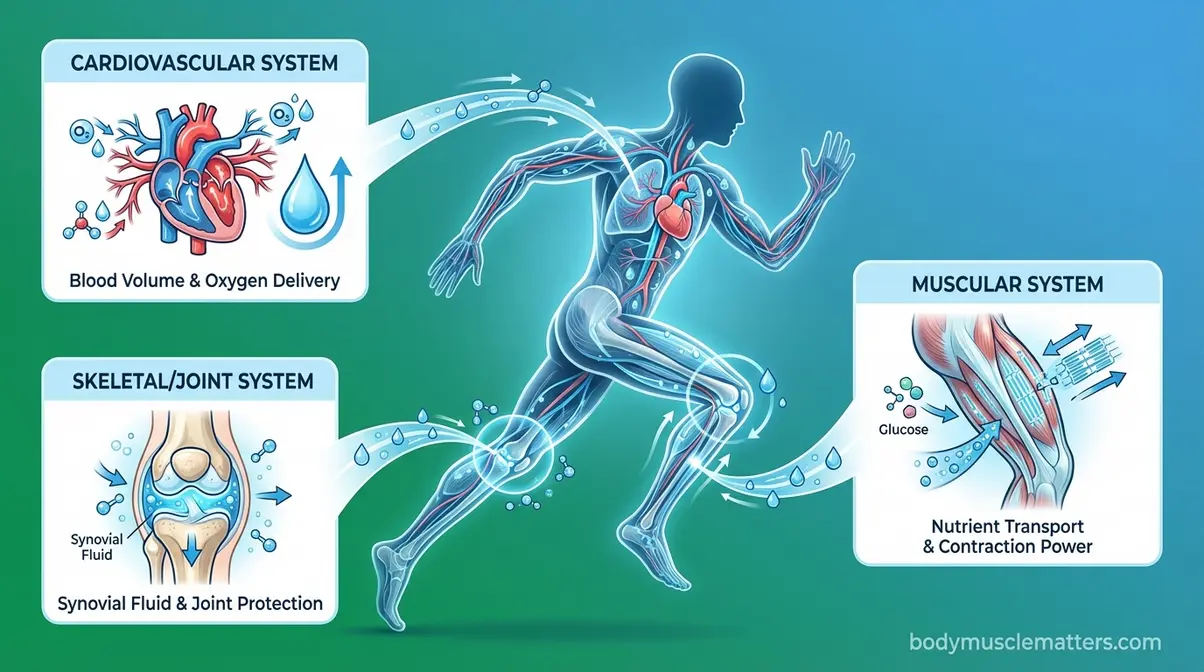
Your body is approximately 60% water — and every system that drives athletic performance depends on keeping it that way. The importance of good hydration for exercise goes far beyond simply quenching thirst: water simultaneously regulates your core temperature, maintains the blood volume needed to deliver oxygen to muscles, and keeps the lubricating fluid in your joints working properly. Neglect any one of these systems, and your workout pays the price.
“Hydration plays an important role in performance, injury prevention, and recovery for athletes engaged in competitive sports.”
— Foundational principle, sports science literature
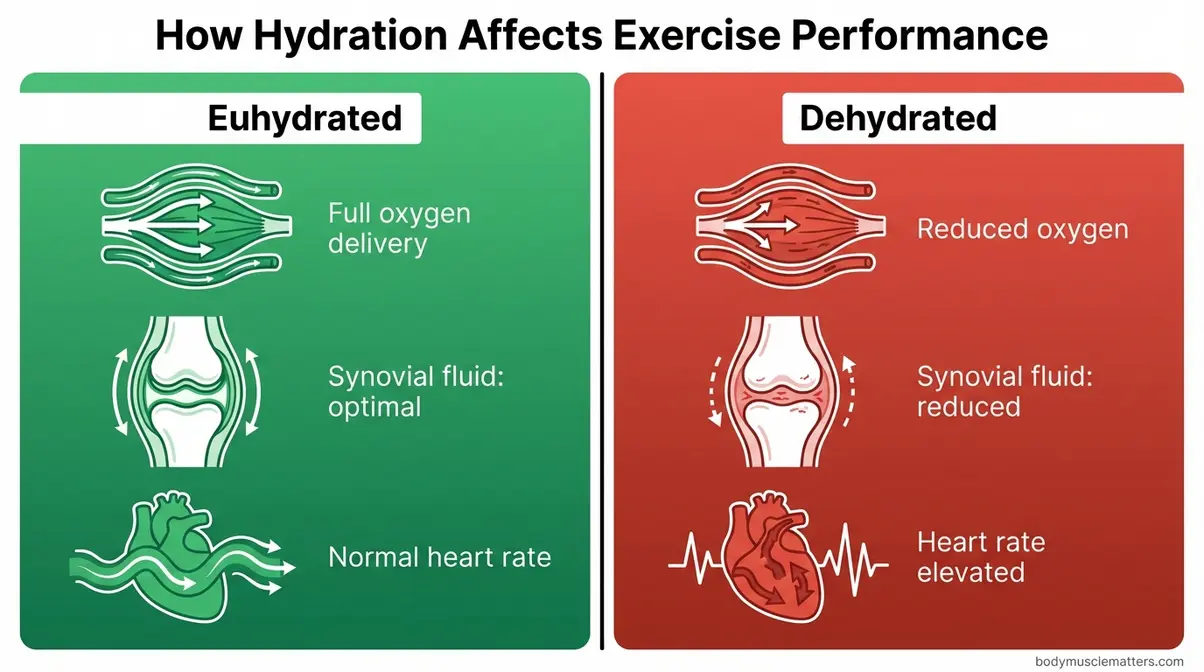
Caption: When your body is in an euhydrated state, all three performance systems — temperature regulation, blood flow, and joint lubrication — function at full capacity.
Water Powers Muscles and Joints
Water is the primary medium for delivering oxygen and nutrients to active muscle tissue. Think of it like a delivery truck: the truck (your blood) needs enough fluid to stay on the road. When fluid levels drop, that delivery slows — and muscles fatigue much faster than they should.
Water also maintains synovial fluid (the lubricating liquid found in your joints), which reduces friction in your knees, hips, and shoulders during movement. According to the Arthritis Foundation, physical movement combined with adequate hydration increases the flow of synovial fluid, which acts as a vital lubricant during physical activity. Dehydration reduces this lubrication, causing joints to feel stiff and raising your injury risk. If you’ve ever felt your knees ache or your shoulders stiffen mid-workout, low synovial fluid from dehydration may be a contributing factor. For more on this connection, see how fluid intake supports muscle recovery.
Proper hydration maintains blood volume, regulates body temperature, and lubricates joints — three systems that directly determine how far and how hard you can train.
Keeping your muscles fueled and your joints lubricated is just the start. Your body also faces a much bigger challenge during exercise: managing heat.
Thermoregulation and Cooling
Thermoregulation (your body’s process of maintaining a stable internal temperature, typically around 98.6°F / 37°C) is one of the most physically demanding tasks your body performs during a workout. When you exercise, your muscles generate heat as a byproduct of energy production. Your body’s primary response is to sweat — and sweating requires fluid.
When you’re dehydrated, your body produces less sweat. That means it struggles to expel heat, your core temperature rises, and your cardiovascular system comes under direct strain. PubMed thermoregulation research — a 2021 comprehensive review — concluded that proper hydration strategies are essential countermeasures that mitigate the rise in internal body temperature during heat-stress exercise. That’s the science behind the practical warning: performance suffers when you’re running hot.
This is also where the concept of the euhydrated state (the condition in which your body’s fluid levels are in optimal balance) becomes critical. The goal isn’t simply “not feeling thirsty.” It’s maintaining that euhydrated state from the moment you warm up to the moment you cool down. Think of sweat as your body’s radiator fluid — if the level drops too low, the engine overheats.
For a visual walkthrough of how dehydration affects your body temperature, watch our short guide:
Your cooling system depends on water. So does the engine that pumps blood to every muscle in your body.
Blood Volume and Efficiency
Blood is approximately 90% water. When you’re dehydrated, blood volume drops and blood thickens — forcing your heart to work significantly harder to pump it to working muscles. For the athlete, this shows up as feeling “winded sooner” than normal. Your perceived effort goes up even though your actual speed or load stays the same.
Sports medicine professionals and coaches use plasma volume as a key hydration indicator, tracking how blood measures shift during training. This is why dehydration isn’t just about comfort — it’s a measurable cardiovascular tax on every set and every step you take.
The euhydrated state is your performance baseline. Every percentage point of fluid you lose below that baseline costs your heart extra effort that should be going toward your actual workout. If your heart is spending extra energy just to circulate thickened blood, there’s less capacity left for athletic performance — and that’s the hidden cost beginners rarely connect to their mid-workout crash.
Now that you understand what water does inside your body, let’s look at what happens when you don’t get enough — and how quickly the consequences add up.
The Hidden Dangers of Exercising Dehydrated
Picture this: you’re 40 minutes into a run. Your legs feel fine, your breathing is steady — and then, without warning, a cramp seizes your calf and you grind to a halt. What just happened? Dehydration during exercise doesn’t announce itself with a loud alarm. It builds quietly through a physiological cascade, and by the time you feel it, your body has already been compromised for several minutes.
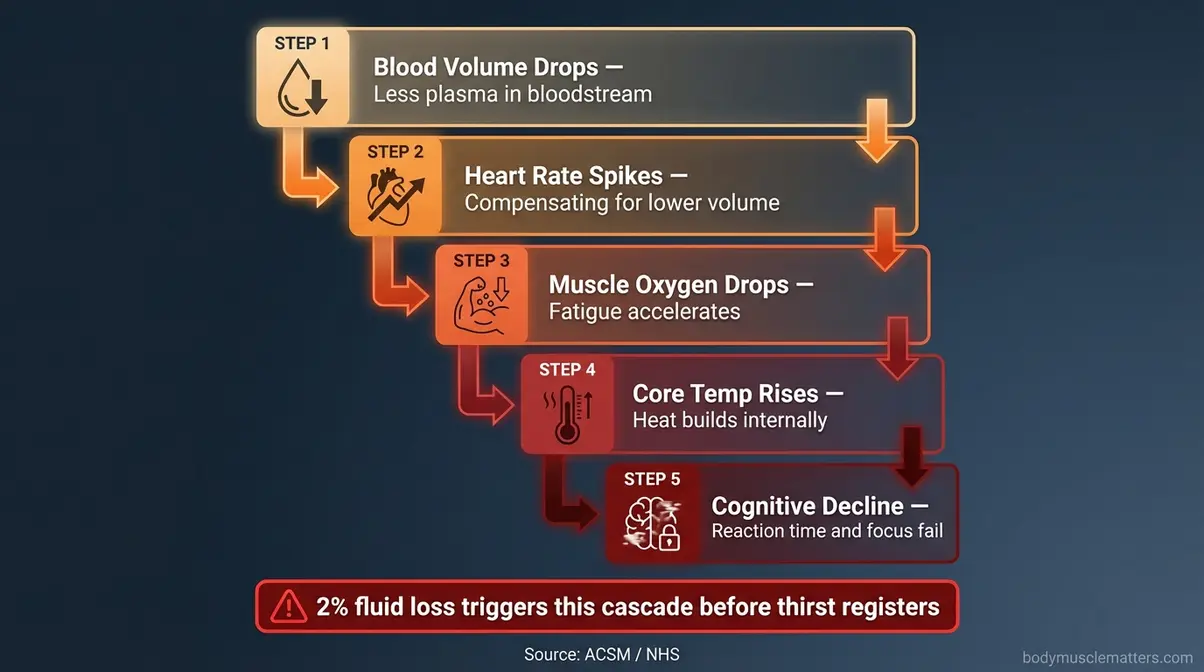
A fluid loss of just 2% of body weight can measurably impair athletic performance — and most people don’t feel thirsty until they’ve already crossed that threshold (ACSM Position Stand, 2007; Korey Stringer Institute, UConn). This is what ignoring the pre-workout phase of The Hydration Performance Window looks like in your body.
The Dehydration Cascade
Dehydration during exercise follows a predictable sequence. Understanding it helps you intervene earlier:
- Blood volume decreases → Less fluid means less plasma in your bloodstream
- Heart rate increases → Your heart compensates by pumping faster to maintain oxygen delivery
- Less blood reaches working muscles → Oxygen and nutrient delivery slows; fatigue accelerates
- Core temperature rises → With less sweat available, heat builds internally
- Cognitive function declines → Reaction time and decision-making deteriorate
The NHS confirms that sweating heavily during intense exercise significantly increases dehydration risk, making continuous fluid replacement critical. Here’s the counterintuitive part: thirst is a lagging indicator. Research published in Comprehensive Physiology (PMC8001428, 2021) found that by the time thirst registers, you’ve typically already lost 1–2% of body weight in fluid. That’s enough to start affecting performance.
The organs that feel this earliest are your cardiovascular system (your heart works measurably harder), your kidneys (which concentrate urine to conserve water), and your muscles (which begin to cramp and weaken). Don’t wait for thirst. By then, the cascade has already begun.
The cascade above has visible, physical warning signs — and learning to recognize them early is what separates a good workout from a dangerous one.
5 Workout Warning Signs
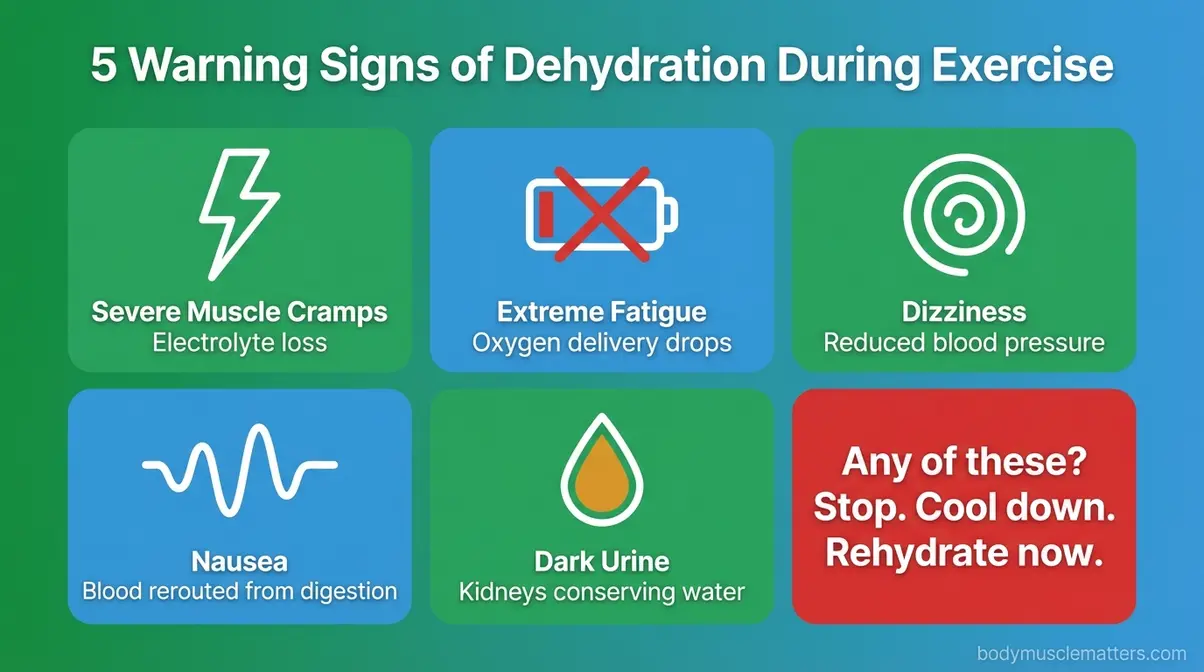
Recognizing the warning signs of dehydration during exercise gives you the window to intervene before the situation escalates. According to MedlinePlus, primary warning signs include dark-colored urine, dizziness, and fatigue — here are the five you need to know:
- Severe muscle cramps (legs or abdomen) — electrolyte loss disrupts nerve signaling to muscles, triggering involuntary contractions
- Extreme fatigue or sudden energy drop — blood is delivering less oxygen to muscles, accelerating the onset of exhaustion
- Dizziness or lightheadedness — reduced blood pressure from lower blood volume causes the head-rushing sensation
- Nausea — your body redirects blood away from the digestive system toward vital organs, causing gastrointestinal distress
- Dark-colored urine or decreased sweating — your kidneys are conserving water, concentrating urine to a deep amber color
If you experience any of these symptoms during a workout, stop exercising immediately, move to a cool area, and begin rehydrating with small, frequent sips of water or an electrolyte drink. This is a YMYL safety priority — do not push through these warning signs.
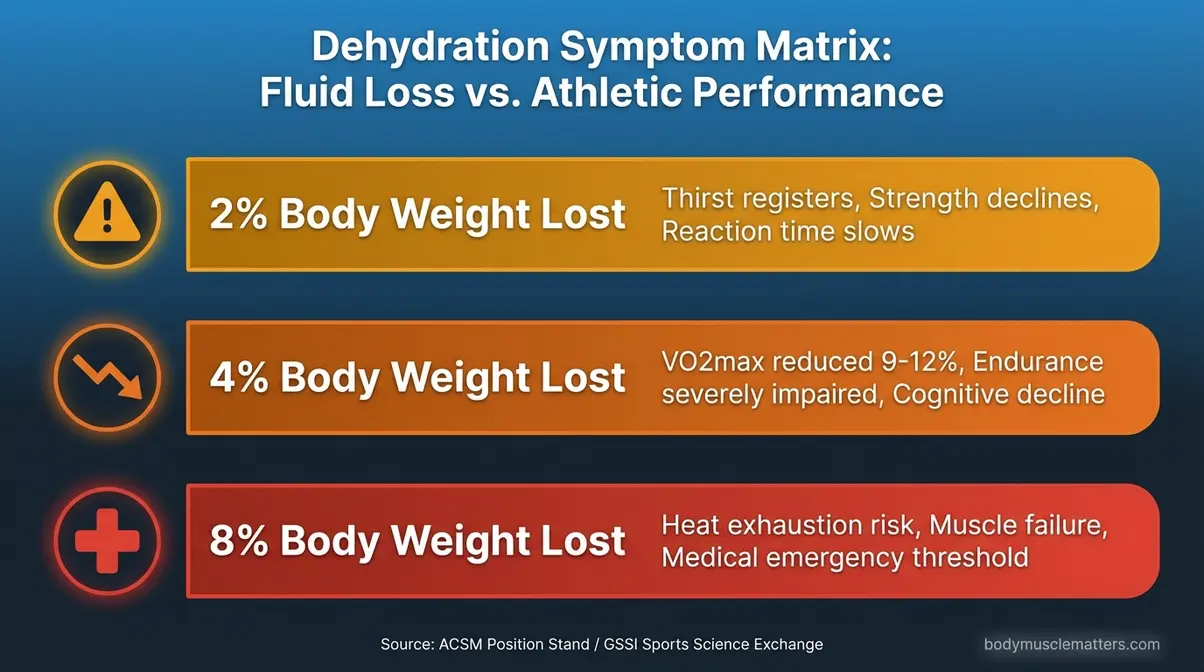
Caption: Research shows a 4% body weight fluid loss can reduce VO2max (your body’s maximum oxygen uptake capacity) by 9–12% — a significant drop in aerobic power (GSSI Sports Science Exchange).
To recognize the physical symptoms of electrolyte loss in more detail, our dedicated guide covers the full spectrum of mineral deficiency signs.
Muscle cramps and fatigue are often the first things you notice — but they’re actually downstream effects of a deeper problem: electrolyte imbalance.
Electrolyte Imbalance Risk
Sweating doesn’t only cost you water. It costs you minerals. An electrolyte imbalance (a disruption in the balance of minerals like sodium, potassium, and magnesium that regulate muscle contractions and nerve signals) occurs because sweat carries these minerals out of your body along with fluid.
According to the Cleveland Clinic, an electrolyte imbalance caused by excessive sweating during exercise can result in muscle spasms, weakness, confusion, and fatigue — symptoms that can escalate quickly if ignored. This is precisely why sports drinks containing sodium and potassium become more effective than plain water for workouts lasting more than 60–90 minutes. The electrolytes in those drinks aren’t marketing fluff; they’re replacing what sweat literally takes from your body.
Now that you know what dehydration looks like and feels like, the logical next question is: what’s the exact protocol to prevent it? That’s where The Hydration Performance Window becomes your most practical tool.
Your Step-by-Step Hydration Protocol
The exact formula for staying hydrated doesn’t start when you pick up your water bottle mid-workout. It starts two hours before. The Hydration Performance Window breaks your exercise hydration into three distinct phases, each with a specific fluid target — and understanding the importance of hydration before, during, and after exercise is what separates athletes who consistently perform from those who consistently hit walls.
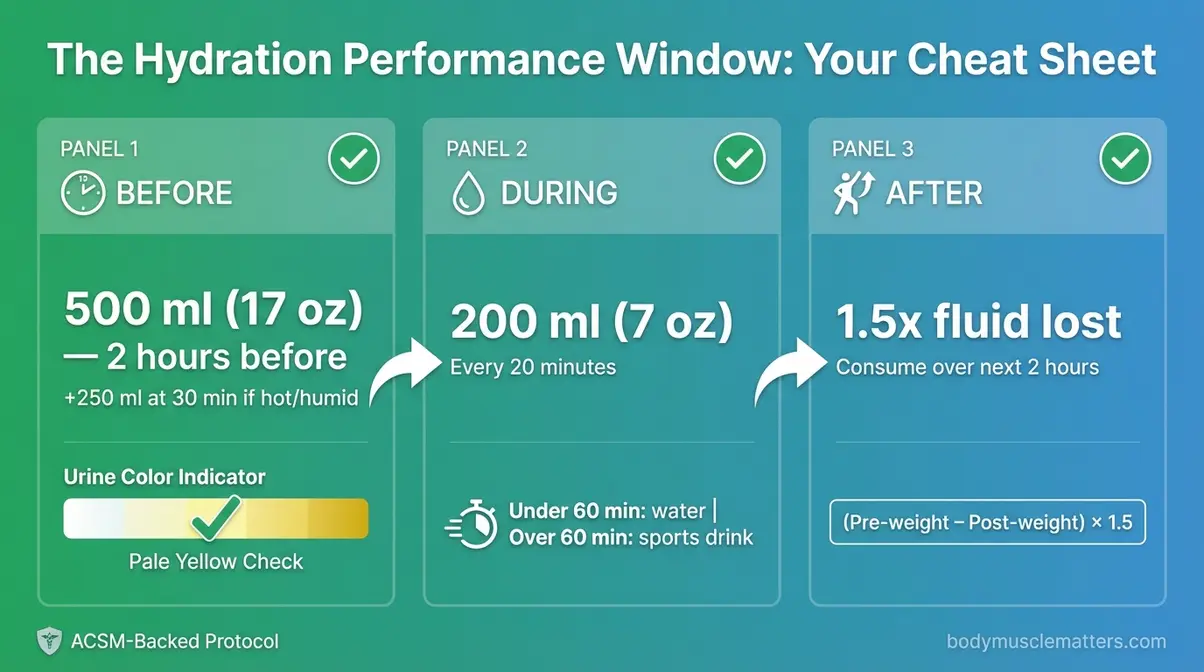
Caption: The Hydration Performance Window maps three evidence-based fluid targets across your workout timeline — use this as your quick-reference guide before every training session.
Pre-Workout Hydration Rules
Starting a workout in a dehydrated state immediately compounds your fluid deficit. The importance of hydration before exercise is that it establishes your baseline — and you can’t out-drink a bad start once the session begins. Explore a practical pre-workout nutrition and hydration framework for additional context on how fluids interact with your pre-training fuel.
According to American College of Sports Medicine guidelines, drinking approximately 500 ml (17 oz) of fluid about 2 hours before exercise promotes adequate hydration and helps you achieve an optimal euhydrated state before training begins. Follow this numbered protocol:
- 2 hours before exercise: Drink 500 ml (17 oz) of water. This gives your kidneys enough time to regulate fluid balance before you start moving.
- 30 minutes before exercise: Drink an additional 250 ml (8 oz) if you tend to sweat heavily or if conditions are warm or humid.
- Check your urine color: Before leaving for the gym, your urine should be pale yellow — like lemonade. If it’s dark amber, drink more before you start.
Environment modifier: In high heat (above 80°F / 27°C) or at altitude (above 8,000 ft / 2,400 m), your fluid loss accelerates. Sports medicine guidance suggests increasing your pre-workout intake by 250–500 ml above baseline to compensate — always adjust based on how heavily you sweat in those conditions.
For a 150 lb (68 kg) person, this pre-workout window means roughly 25 oz of water before arriving at the gym — spread across the 2-hour window, not consumed all at once.
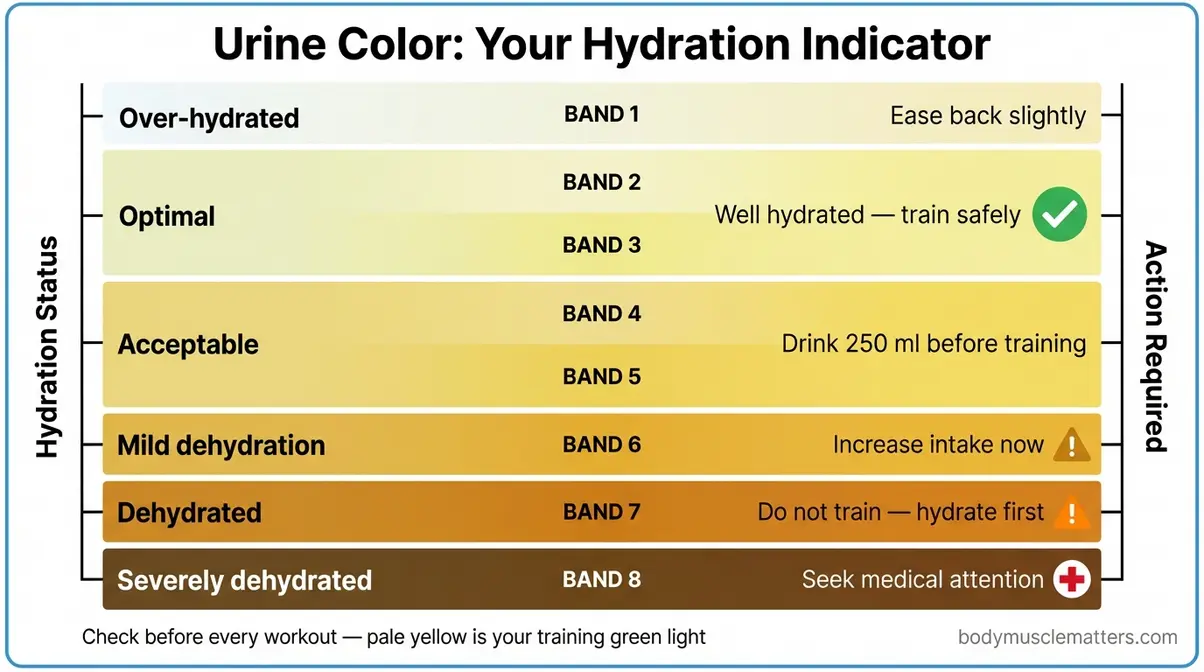
Caption: Pale yellow signals a well-hydrated state. Amber or brown means you need fluid before your session begins — training while dark-urined is a dehydration risk.
Pre-workout hydration sets the foundation. But what happens once you start moving and sweating?
Mid-Workout Fluid Targets
The importance of drinking water during exercise is straightforward: your body is actively losing fluid through sweat and respiration, and performance begins to suffer the moment losses cross the 2% threshold. Don’t wait to feel thirsty — set a timer if you need the reminder.
Follow these guidelines during your session:
- For workouts under 60 minutes: Plain water is sufficient. Drink approximately 200 ml (7 oz) every 20 minutes, according to the Better Health Channel — the Victorian Government’s public health resource. If you don’t have a measuring cup at the gym, think of this as 2–3 large gulps every 20 minutes.
- For workouts exceeding 60–90 minutes: Switch to a sports drink containing sodium and carbohydrates. Plain water alone no longer sufficiently replaces what sweat removes — electrolytes help maintain muscle function, while carbohydrates refuel depleted energy stores.
- Total target for a 45-minute gym session: Aim to consume at least 400–600 ml (14–20 oz) total during the workout.
Practical tip: Thirst is a late-stage signal, not an early warning. By the time you feel it, your performance has already begun declining. Set a phone timer for every 20 minutes during your session — this small habit eliminates the guesswork entirely.
Getting fluid in during your workout is essential. But what you do in the 30–60 minutes after may matter just as much.
Post-Workout Recovery Needs
The importance of drinking water after exercise is often underestimated — most beginners stop thinking about hydration the moment they finish their last set. However, your body’s fluid deficit doesn’t resolve itself at the gym exit.
The post-workout rehydration target: replace approximately 1.5 times (150%) the fluid you lost during exercise. This accounts for continued urinary losses during recovery, which prevent simple 1:1 fluid replacement from being fully effective. The National Athletic Trainers’ Association recommends consuming 25–50% more fluid than actual sweat losses during recovery to restore full hydration within 4–6 hours.
To calculate your personal deficit, use the Sweat Rate Formula:
Sweat Rate (L/hour) = (Pre-exercise weight − Post-exercise weight + Fluid consumed during exercise) ÷ Exercise duration (hours)
For a 70 kg (154 lb) person who finishes a 1-hour run weighing 0.5 kg less, the target is 750 ml of fluid — roughly one and a half standard water bottles — consumed over the next 2 hours. That’s far more manageable than it sounds when you spread it out.
- What to drink post-workout:
- Under 60 minutes: Water works well for recovery.
- Over 60 minutes: Choose a recovery drink containing sodium and carbohydrates to replenish both electrolytes and glycogen. Chocolate milk is a widely cited, affordable option that provides both — many sports nutrition researchers include it as a practical recovery alternative.
Now that you have the exact protocol, let’s clear up some common confusion around the popular hydration rules you’ve probably heard about.
Popular Rules Evaluated
Three hydration rules circulate constantly in fitness culture. Here’s an honest assessment of what each actually means:
The 8×8 Rule — Drink eight 8-ounce glasses of water daily, totaling 64 oz (approximately 2 liters). This is a simple baseline for general daily hydration — not an exercise-specific protocol. For athletes and active individuals, daily needs are significantly higher. Think of the 8×8 rule as your minimum on rest days, not your target on training days.
The 3-3-3 Rule — As a hydration guideline, the 3-3-3 rule (drink 3 cups before, during, and after your workout) is a popular fitness heuristic shared across coaching communities, but it lacks an established peer-reviewed definition from sports science authorities like ACSM or NSCA. Use it as a beginner shortcut if exact measurements feel overwhelming — but understand that individual sweat rates vary widely, and the ACSM-backed protocol in this guide offers more precise, evidence-based targets.
The 10 Gulp Rule — Instead of sipping timidly from your bottle, take 5–10 consecutive gulps each time you drink during exercise, according to Gundersen Health. This ensures a meaningful volume intake per drinking opportunity, which is far more effective than repeated tiny sips that barely replace fluid losses.
Quick assessment: Use the 8×8 rule as a daily baseline, the 3-3-3 rule as a beginner starting structure, and the 10-gulp technique as your practical drinking method during any workout. For the most scientifically grounded results, follow the ACSM-backed numbers in your pre/during/post protocol above.
The protocol above is your roadmap. But like any physical health strategy, hydration isn’t one-size-fits-all — and there are important cautions to understand before changing your habits.
Precautions: When Hydration Fails
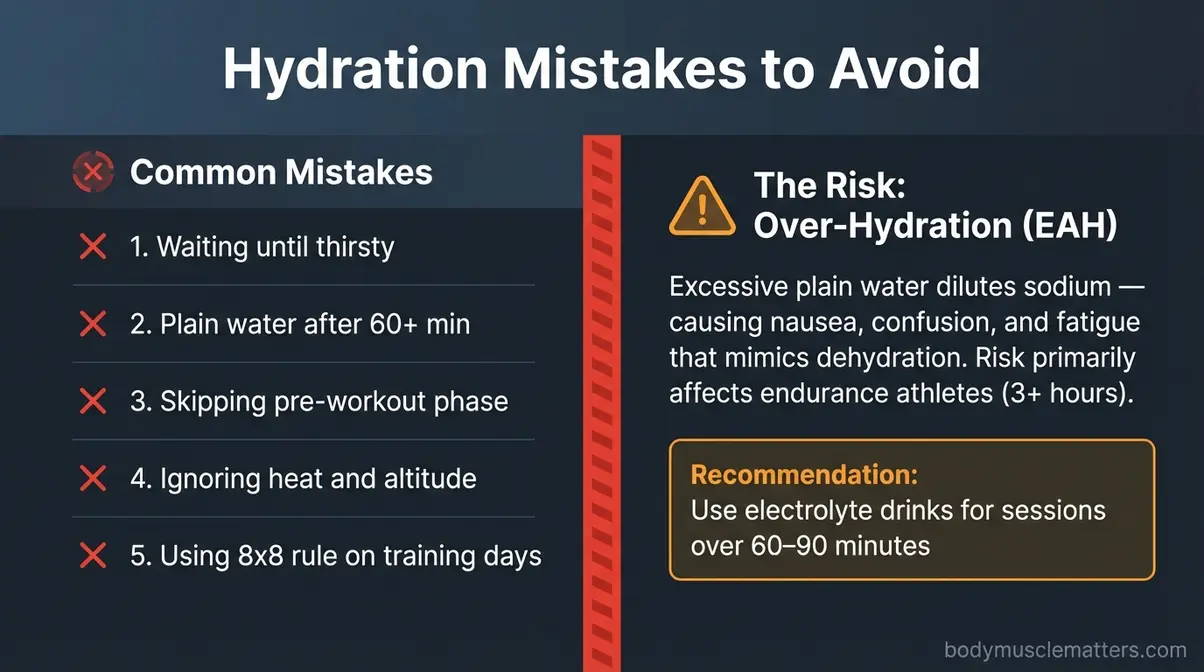
Smart hydration means understanding the edges of the advice, not just the center. Two risks matter most for beginners: making common beginner errors that undermine the protocol, and — less commonly but more seriously — drinking too much plain water during extended effort.
Common Hydration Mistakes to Avoid
Even with the right information, these initial three errors regularly derail beginners:
- Waiting until you’re thirsty — Thirst is a late dehydration indicator, not an early warning. Performance impairment begins well before the sensation of thirst appears.
- Drinking too much plain water during long workouts — After 60–90 minutes, plain water dilutes the electrolytes your muscles need. Switch to a sports drink to maintain sodium and potassium balance.
- Skipping pre-workout hydration — Starting a session already dehydrated means you’re fighting a deficit from the first minute. The pre-workout phase of The Hydration Performance Window exists precisely to prevent this.
Additionally, pay attention to these situational mistakes:
- Over-relying on a single hydration rule — The 8×8 rule is designed for general daily intake, not athletic output. Apply the ACSM protocol on training days.
- Not accounting for environment — Heat and altitude dramatically accelerate fluid loss. Adjust your intake upward in warm, humid, or high-altitude conditions — the same protocol that works in a temperature-controlled gym may be insufficient outdoors in summer.
The Over-Hydration Risk
Hydration advice sometimes overcorrects — and drinking too much plain water carries its own risk. Exercise-Associated Hyponatremia (EAH) is a dangerous condition that occurs when excessive plain water intake dilutes sodium levels in the bloodstream to critically low levels.
The symptoms of EAH mirror dehydration — nausea, headache, confusion, and fatigue — which is why it’s frequently misdiagnosed and why the distinction matters. EAH primarily affects endurance athletes (marathon runners, triathletes) who drink large volumes of plain water during events lasting more than 3–4 hours without replacing electrolytes.
For the recreational exerciser following the ACSM-based protocol in this guide — 200 ml every 20 minutes during exercise, with electrolyte drinks after 60–90 minutes — EAH is not a meaningful risk. However, if you’re training for an endurance event exceeding 3 hours, consult a sports medicine physician about individualized electrolyte needs before race day.
Frequently Asked Questions
Why is it important to be hydrated during exercise?
Staying hydrated during exercise is essential because your body relies on water to regulate temperature, maintain blood pressure, and power muscle contractions. When you sweat, you lose critical fluids and electrolytes that keep these systems running. Without replacement, your core temperature rises, your heart works harder, and your muscles fatigue faster.
What are the 5 warning signs of dehydration?
The five warning signs of dehydration during exercise are: severe muscle cramps, extreme fatigue or sudden energy drop, dizziness or lightheadedness, nausea, and dark-colored urine or reduced sweating. These symptoms appear when fluid loss begins to impair circulation, temperature regulation, and muscle function. Thirst alone is not a reliable early indicator — performance often declines before thirst registers. Dark urine (amber or brown) is one of the most reliable visual indicators of dehydration. If you experience any of these signs, stop exercising, move to a cool environment, and rehydrate immediately with water or an electrolyte drink.
What can happen if you don’t hydrate during exercise?
If you don’t hydrate during exercise, your body loses the ability to cool itself — causing core temperature to rise and increasing the risk of heat exhaustion or heat stroke. Your blood thickens, heart rate increases, and less oxygen reaches active muscles, leading to a rapid drop in strength, speed, and endurance. A fluid loss of just 2% of body weight can trigger these effects before you even feel thirsty (ACSM, 2007).
What is the 8×8 rule of water?
The 8×8 rule of water is a general hydration guideline recommending eight 8-ounce glasses of water per day, totaling 64 ounces (approximately 2 liters). It’s designed as an easy-to-remember baseline for general daily hydration — not as a precise, exercise-specific protocol. Athletes and active individuals typically need significantly more fluid to replace sweat losses during training. The 8×8 rule works best as a minimum starting point on rest days. For exercise days, follow duration-based protocols: 500 ml before, 200 ml every 20 minutes during, and approximately 1.5x your fluid deficit after your workout.
What are 5 benefits of hydration?
The five key benefits of hydration for exercise are: optimal body temperature regulation, improved cardiovascular efficiency, enhanced joint lubrication, sustained cognitive sharpness, and accelerated recovery. Each benefit operates simultaneously, giving a well-hydrated athlete a compounding performance advantage. Studies show that adequate hydration even reduces perceived effort, meaning the same workout feels easier.
What is the 3-3-3 rule for workout?
The 3-3-3 rule for workout hydration is a popular fitness guideline — drink 3 cups (approximately 24 oz / 710 ml) of water before your workout, 3 cups during, and 3 cups after — that circulates widely in coaching communities as a simple framework for beginners. It provides a memorable structure and totals roughly 72 oz of exercise-related fluid intake. It doesn’t account for individual sweat rate variation and lacks an established peer-reviewed source from bodies like ACSM. Use it as a starting framework, not a precise prescription. For more accuracy, apply the ACSM protocol: 500 ml pre, 200 ml per 20 minutes during, and 1.5x sweat loss post-workout.
The Bottom Line on Hydration for Exercise
For anyone who exercises — from casual gym-goers to competitive athletes — the importance of hydration for exercise comes down to three non-negotiables: start hydrated, drink consistently throughout your session, and replace more than you lost when you’re done. Research from the American College of Sports Medicine confirms that a 2% body weight fluid deficit measurably impairs performance, and that a 4% deficit reduces VO2max (your body’s maximum aerobic capacity) by 9–12% (GSSI Sports Science Exchange). At bodymusclematters.com, our recommendations are grounded in these Tier-1 standards — not guesswork.
The Hydration Performance Window gives you a concrete tool to replace that guesswork. Pre, during, and post — each phase has a specific fluid target, and hitting all three eliminates the mid-workout crash that brought you here in the first place. If you’ve ever wondered why you ran out of energy at the 40-minute mark, the answer wasn’t your fitness level. It was your hydration timeline.
Start this week with just the pre-workout phase: drink 500 ml (17 oz) two hours before your next training session and pay attention to how your energy and endurance feel compared to sessions when you skipped it. Then layer in the during- and post-workout phases over the following two weeks. Small, sequential changes build habits that last — and this one pays off from the very first workout.
Related posts:
Best Protein Powder for Muscle Growth: Tested (2026)
Best High Protein Meal Delivery Services 2026: Top 7
Protein Powder Without Artificial Sweeteners: 10 Best Picks
Can You Eat Too Much Protein? Symptoms & Safe Limits
Best Protein Powder for Weight Loss: 10 Expert Picks
What Are Macros? A Plain Guide to Protein, Carbs and Fat

Callum
Hi, I'm Callum, the founder of Body Muscle Matters. I'm not a certified trainer, I'm a self taught lifter who started this site to share what I've learned from my own training and a lot of trial and error. Everything here comes from real experience and honest research, written the way I'd explain it to a friend who is just getting started. My goal is simple: practical, no hype fitness advice you can actually use.