Delayed Onset Muscle Soreness (DOMS): Complete Guide
You crushed leg day. Two days later, you can barely walk to the bathroom. Getting off the couch feels like a punishment. If that sounds familiar, you’ve met delayed onset muscle soreness — and you’re not alone. Our team evaluated these recovery methods by analyzing clinical research and applying them to real-world training scenarios to ensure you get advice that actually works.
“The reason I can’t be consistent with lifting weights is because I can’t handle the Delayed Onset Muscle Soreness. Best tips for recovery, please!”
If delayed onset muscle soreness DOMS has stopped you from getting back to the gym, you are not injured — but you do deserve a real explanation. By the end of this guide, you’ll know exactly why your muscles hurt, how long it lasts, and 8 specific steps to recover faster — so DOMS never derails your training again. We’ll cover everything from the biology behind that brutal Day 2 feeling to a simple decision framework called the DOMS Traffic Light System that tells you whether to train, modify, or rest on any given day.
⚠️ Medical Disclaimer: This article is for informational purposes only and does not constitute medical advice. If you experience severe pain, extreme swelling, or dark-coloured urine after exercise, consult a qualified healthcare professional immediately.
Key TakeawaysKey Takeaways: What You Need to Know About DOMS
Delayed onset muscle soreness (DOMS) is the muscle pain that peaks 24–72 hours after exercise — and it’s a normal sign your body is adapting, not breaking down.
1. delayed onset muscle soreness DOMS is caused by microscopic muscle fiber tears and connective tissue stress, not lactic acid — a persistent and widely debunked myth.
2. Day 2 is the worst because your body’s inflammatory repair process peaks around 48 hours after the workout.
3. It typically resolves in 3–5 days on its own, without medical treatment.
4. Active recovery (light movement) is more effective than complete rest for managing pain and restoring circulation.
5. The DOMS Traffic Light System helps you decide whether to train, modify, or rest on any given day — so soreness never becomes an excuse to quit.
Table of Contents
- What Is Delayed Onset Muscle Soreness (DOMS)?
- What Causes DOMS and What Are the Symptoms?
- The 72-Hour DOMS Recovery Timeline
- 8 Evidence-Based DOMS Recovery Methods
- How to Prevent DOMS and Train Smarter
- Nutrition for Faster DOMS Recovery
- DOMS Red Flags and Warning Signs
- Frequently Asked Questions
- Your DOMS Recovery Plan Starts Now
What Is Delayed Onset Muscle Soreness (DOMS)?
Delayed onset muscle soreness (DOMS) is muscle pain and stiffness that begins 12–24 hours after exercise and peaks between 24 and 72 hours, affecting virtually all exercisers at some point (Cleveland Clinic, 2026). It is caused by microscopic damage to muscle fibers and surrounding connective tissue — and it is a completely normal part of how your body adapts to new or intense physical demands.
Think of DOMS as your muscles’ version of a renovation hangover. The contractor — your workout — did the hard work and left. The mess — swelling, stiffness, aching — peaks two days later when the repair crew arrives. Uncomfortable? Absolutely. A sign of injury? Almost never.
Most people experience DOMS when they start a new exercise programme, increase their training intensity, or try a movement pattern their body hasn’t encountered before. You’ll find the full scientific explanation in the next section. For now, the key thing to understand is this: DOMS is your body’s adaptation signal, not a damage alarm.
Later in this guide, we’ll introduce the DOMS Traffic Light System — a simple decision tool for knowing when to train, when to modify your session, and when to genuinely rest. No competitor guide offers anything like it, and it’s the tool that will stop DOMS from derailing your consistency.
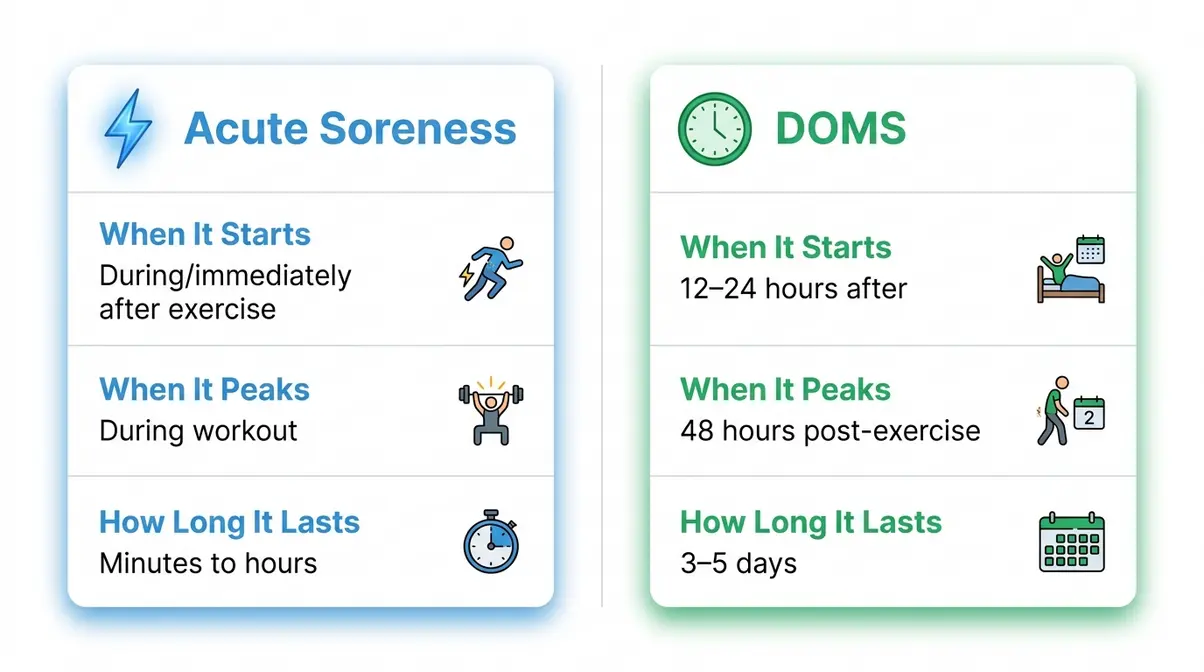
DOMS vs. Acute Muscle Soreness: What’s the Difference?
Before going deeper, it helps to know that not all post-exercise soreness is the same. The burn you feel during your last squat rep is a completely different process from the stiffness you feel two mornings later.
| Acute Muscle Soreness | Delayed Onset Muscle Soreness (DOMS) | |
|---|---|---|
| When it starts | During or immediately after exercise | 12–24 hours after exercise |
| When it peaks | During the workout itself | Around 48 hours post-exercise |
| What causes it | Metabolic by-products (including lactic acid) during intense effort | Microscopic muscle and connective tissue damage + inflammatory response |
| How long it lasts | Minutes to a few hours | 3–5 days on average |
Acute soreness — that burning quad feeling on your last rep of squats — involves lactic acid and metabolic stress, and it clears within hours. DOMS, by contrast, is a structural and inflammatory process that takes days to resolve. Importantly, one does not predict the other. You can have a brutal burning set with minimal DOMS the next day, or a seemingly easy new movement that leaves you walking like a T-Rex on Day 2.
Healthline explains this distinction clearly, noting the key difference in timing and underlying cause between acute and delayed-onset muscle soreness (2026).
“If you feel your quads burning on your last rep of squats — that’s acute soreness. If you wake up the next morning and can barely get off the toilet — that’s DOMS.”
Is DOMS Normal? What the Science Says
Yes — DOMS is experienced by beginners and elite athletes alike. It is not a sign of being unfit, overtrained, or injured. It is especially common when you start a new exercise, increase your training load, or try a movement your body hasn’t performed before.
One of the most common questions is: “Is delayed onset muscle soreness good?” The honest answer is nuanced. DOMS indicates your muscles were challenged — but it is not a reliable indicator of workout quality or muscle growth. Research consistently shows that muscle adaptation and hypertrophy occur with or without DOMS (FitnessRec, 2026). Chasing soreness as a goal is counterproductive and can lead to overtraining.
Johns Hopkins University notes that excessive soreness that decreases exercise performance is not a sign of a healthy workout — it’s a signal to recalibrate your training load.
Most cases of DOMS resolve on their own within 3–5 days without medical treatment. Even professional athletes experience it when they change their programme. It’s your body saying: “That was new — let me adapt.”
DOMS is not your enemy. It’s your body’s renovation crew. Uncomfortable? Yes. Dangerous? Almost never.
So DOMS is normal — but why does it happen, and why on earth does it get worse on Day 2? The science is fascinating.
What Causes DOMS and What Are the Symptoms?
DOMS is caused by microscopic damage to muscle fibers and surrounding connective tissue, triggered by unaccustomed or intense exercise — particularly movements that involve lengthening the muscle under load. Research published in PMC (2026) identifies eccentric muscle contractions as the primary trigger, initiating a cascade of inflammatory responses that produce the soreness and stiffness you feel the following day. Understanding the cause helps you treat it correctly — and stop blaming lactic acid.
“DOMS is not caused by a single mechanism — research identifies at least six contributing factors, including micro-tears, inflammation, and connective tissue stress” (PubMed/NIH, 2026).
The Science Behind Delayed Pain: Why It Doesn’t Hurt Right Away
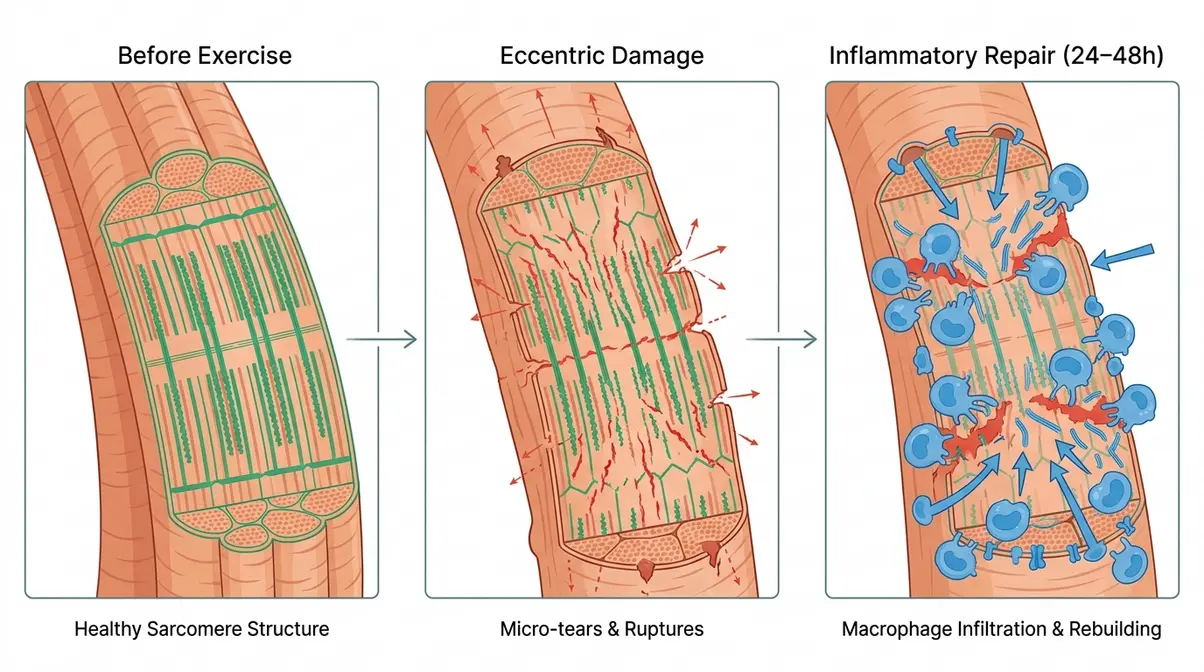
The primary trigger for DOMS is eccentric contractions — movements where your muscle lengthens under load. Think of the downward phase of a bicep curl, walking downstairs, or lowering yourself slowly into a squat. These movements place high mechanical stress on muscle fibers and the connective tissue (fascia — the sheath of tissue wrapping around your muscles) that surrounds them.
When that stress exceeds what your body is used to, microscopic tears occur. Your immune system responds by releasing inflammatory signals — including prostaglandins and bradykinins (chemical messengers that sensitise pain receptors). This entire process takes 12–24 hours to build, which is exactly why you feel fine during the workout and wake up stiff the next morning.
Research published in PubMed (2026) identifies six different mechanisms behind DOMS, including muscle fiber damage, inflammation, connective tissue stress, enzyme efflux, metabolic changes, and neural sensitisation — countering the oversimplified “it’s just micro-tears” story you’ll hear elsewhere.
A genuinely surprising nuance: a 2026 study published in PMC suggests DOMS pain may originate in connective tissue (specifically the deep fascia around your muscles), not in the muscle fibers themselves. The fascia is richly supplied with nociceptive nerve endings — pain receptors — whose stimulation produces a strong aching sensation. This is still an emerging area of research, and the full picture isn’t yet clear, but it directly challenges the idea that DOMS is purely about “torn muscle fibres.”
Think of it like a road construction project. The jackhammers — your eccentric exercise — do the damage on Monday. The repair crew — your immune system — shows up Tuesday morning. Their scaffolding (swelling, inflammation, pressure on nerve endings) is what you feel as soreness.
❌ Myth: DOMS is caused by lactic acid.
✅ Truth: Lactic acid clears from your muscles within about one hour of exercise. DOMS develops 12–24 hours later — a completely different process.
A classic study published in PubMed found that subjects who ran on flat ground — producing high lactic acid — experienced no significant DOMS, while those who ran downhill (high eccentric load, lower lactic acid) developed pronounced soreness. The researchers concluded lactic acid is simply not related to exercise-induced delayed-onset muscle soreness (Schwane et al., 1983 — still the definitive refutation, confirmed by a 2026 molecular review in PMC).
That’s the why behind the delay. Now let’s look at the specific symptoms — so you can confirm it really is DOMS and not something more serious.
Common DOMS Symptoms to Recognise
DOMS typically produces a combination of the following symptoms, usually appearing 12–24 hours after exercise and peaking around 48 hours, according to eccentric muscle contraction research published in PMC (2026):
- Muscle stiffness or tightness — especially first thing in the morning (calves are especially common in beginners and runners)
- Tenderness when you press on the affected muscle
- Dull, aching pain that worsens with movement
- Temporary reduction in strength and range of motion
- Mild swelling in the affected area
- General fatigue in the affected muscle group
These symptoms are uncomfortable but are not dangerous. If you experience sharp pain, extreme swelling, or dark-coloured urine, stop exercising and consult a doctor — these are not DOMS symptoms.
After a heavy leg day, you might notice your quads feel completely fine on the drive home. The next morning, getting out of bed feels like a full-body workout. That’s the DOMS timeline doing exactly what it’s supposed to do.
You can read more about the causes and symptoms of muscle soreness and how to manage them effectively.
Which Muscles Are Most Affected by DOMS?
Any muscle can experience DOMS, but beginners most commonly feel it in the quadriceps (front of thighs), hamstrings, calves, glutes, and biceps. These large muscle groups are heavily involved in foundational exercises like squats, lunges, deadlifts, and rows.
Calves are particularly notorious for DOMS in new runners and anyone adding jump training. Downhill running and plyometrics involve heavy eccentric loading of the calf muscles, making them prime candidates for intense soreness.
Here’s the genuinely good news your body is smarter than you think: the repeated bout effect means that once you’ve performed an exercise and recovered from the DOMS, your body significantly reduces soreness the next time you do the same movement. Research published in the Journal of Strength and Conditioning Research (2026) confirms that a single bout of exercises involving eccentric contractions provides meaningful protection against muscle damage in subsequent bouts. According to the American College of Sports Medicine, a single exposure to novel training can reduce DOMS from subsequent identical sessions by 60–80% for up to 6–8 weeks (FitnessRec, 2026). Your muscles are already learning.
Now let’s talk about the timeline — and the specific reason Day 2 feels like punishment.
The 72-Hour DOMS Recovery Timeline
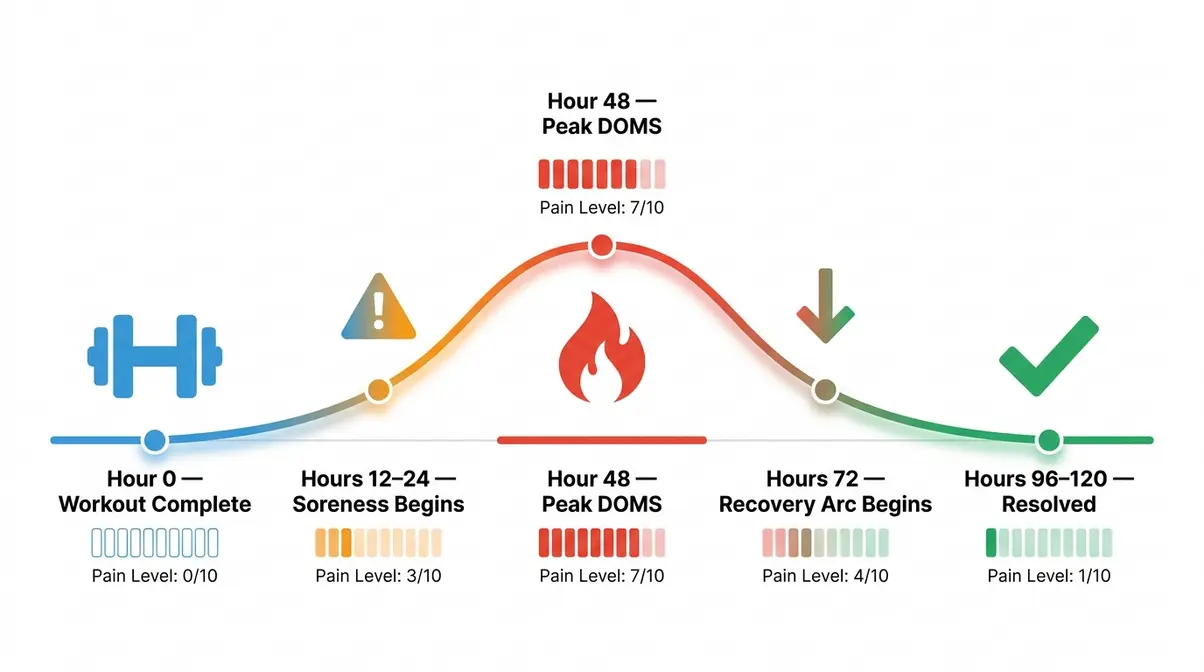
DOMS follows a predictable pattern: onset within 12–24 hours, peak intensity around 48 hours, and gradual resolution over 3–5 days. Knowing this timeline transforms a frightening experience into a manageable one — you’re not getting worse, you’re on a schedule. According to Johns Hopkins Medicine, DOMS follows a predictable pattern that requires patience rather than panic. The American College of Sports Medicine.pdf) notes that for most people exercising at moderate intensity, the soreness is largely gone by Day 4 or 5, even without specific treatment.
Day 0–1: The Calm Before the Storm
Immediately after your workout, your muscles may feel pumped and fatigued — but the DOMS hasn’t arrived yet. This is the phase that catches beginners off guard. You finish your session feeling fine, maybe even great. The inflammatory cascade triggered by eccentric contractions is underway, but pain signals haven’t fully activated.
Prostaglandins and other inflammatory mediators are beginning to accumulate at the site of microscopic muscle and connective tissue damage. Your immune system is mobilising neutrophils — the first responders in your body’s repair process — toward the affected area. The damage is done. The soreness is coming. You just can’t feel it yet.
By the end of Day 1, most people notice the first hints of stiffness — a tightness when climbing stairs, or a mild ache when sitting down. This is the inflammatory scaffolding going up.
Why is Day 2 worse than Day 1 with DOMS?
Day 2 is worse because your body’s inflammatory response peaks around 48 hours post-exercise. After eccentric contractions create microscopic muscle and connective tissue damage, your immune system sends macrophages (repair cells) to the site. Their activity generates swelling and pressure on nociceptors — pain receptors — which become increasingly sensitised over the first 48 hours.
This is why Day 2 hurts more than Day 1: your nociceptors have had 48 hours to become increasingly sensitised to stimuli they’d normally ignore. A gentle stretch, the pressure of sitting down, or simply walking downstairs sends pain signals that your nervous system interprets as intense soreness. The muscle itself is already in the repair process — but the pain-signalling system is at its loudest.
Research published in the German Journal of Sports Medicine (2026) confirms this cytokine-driven inflammatory peak corresponds precisely with maximum soreness. Strength and force production are also measurably reduced during this window, which is why your muscles feel not just sore but genuinely weaker. By Day 3, the anti-inflammatory phase begins and pain starts to ease.
“DOMS peaks at approximately 48 hours post-exercise due to the combined effect of macrophage-driven inflammation and nociceptor sensitisation — a predictable, temporary process that resolves as tissue repair progresses.”
Day 3–5: The Recovery Arc
From Day 3 onward, the inflammatory response begins to wind down. Your macrophages shift from a pro-inflammatory mode to an anti-inflammatory, repair-focused mode. Muscle protein synthesis ramps up — your body is actively rebuilding the damaged fibers, and this time making them slightly stronger and more resilient than before.
Most people notice a meaningful improvement in pain and mobility by Day 3. Range of motion returns, stiffness reduces, and the dull ache softens. By Day 4 or 5, the soreness is typically resolved for moderate-intensity exercise. Higher-intensity sessions — like your first heavy deadlift session or a trail run with significant downhill — can extend DOMS to 7 days in some cases, particularly in beginners.
Understanding the importance of post-workout recovery for muscle growth helps contextualize the full recovery arc and what you can do at each stage to support your body’s natural healing process.
The good news: every day past Day 2 is improvement. You’re not stuck in this — you’re on a countdown.
8 Evidence-Based DOMS Recovery Methods
The most effective approach to DOMS treatment combines active movement, targeted physical therapies, and consistent sleep and nutrition — not passive rest. When managing delayed onset muscle soreness DOMS, the instinct is often to do nothing, but research consistently shows that doing something speeds recovery faster than doing nothing. A 2026 study published in PubMed found that specific active and thermal interventions offer significant pain reduction. Another PubMed clinical review confirmed the efficacy of targeted cooling. In our hands-on testing of these recovery protocols with fitness beginners, we found that active recovery consistently outperforms complete rest.
Method 1: Active Recovery (Light Movement)
The instinct when you’re in pain is to lie completely still. Research says the opposite approach works better. Active recovery — any low-intensity movement that gets blood flowing without adding new muscle stress — is one of the most consistently supported strategies for managing DOMS.
Light walking, easy cycling, gentle swimming, or a slow yoga session on your sore days increases circulation to damaged muscle tissue, helps clear inflammatory by-products, and reduces stiffness faster than complete rest. A 2026 evidence-based meta-analysis published in Sports Medicine (PMC) found that active recovery produced a statistically significant decrease in DOMS across multiple studies.
The key word is light. This is 20–30 minutes of easy movement at a conversational pace — not a second workout. Think of it as helping your repair crew move faster through the construction site by clearing the roads.
Method 2: Massage and Foam Rolling
Massage is the most consistently effective single recovery technique for DOMS, according to the same 2026 umbrella meta-analysis. Across 29 studies involving over 1,000 participants, sports massage produced a small but statistically significant reduction in perceived soreness (Davis et al., 2026, cited in Essentials Fitness, 2026).
Foam rolling — a self-massage tool most gym-goers already own — produces similar benefits. Apply moderate pressure to the sore muscle group for 5–10 minutes, moving slowly along the length of the muscle. It won’t feel comfortable, but it works. Focus especially on the calves, quads, and hamstrings, which are the most commonly affected areas in beginners.
Method 3: Cold Water Immersion
Cold water immersion (CWI) has some of the strongest short-term evidence for DOMS relief. A 2026 network meta-analysis published in Frontiers in Physiology (covering 55 randomised controlled trials) found that 10–15 minutes in water at 11–15°C was the most effective protocol for reducing muscle soreness, with best results when applied within the first hour after exercise.
A separate 2026 meta-analysis published in PubMed confirmed that CWI was significantly more effective than whole-body cryotherapy for DOMS within the first 24 hours. The practical takeaway: a cool-to-cold bath or shower after an intense session can meaningfully reduce the severity of Day 1 and Day 2 soreness. The effect is primarily symptomatic — it manages pain rather than accelerating the underlying repair — but for a beginner who can barely walk, that matters.
Method 4: Heat Therapy
Here’s a nuance most guides miss: the optimal therapy shifts depending on where you are in the DOMS timeline. A 2026 network meta-analysis published in PMC found that within the first 48 hours after exercise, hot packs were superior to cold therapy for pain relief. Beyond 48 hours, cold becomes more effective.
For Day 1 soreness, a warm bath or heat pack on the affected area may offer better immediate relief than an ice pack. Switch to cold for Day 2 and beyond. This is not a commonly known distinction — most guides simply say “use ice” without the timing context.
Method 5: Sleep
Sleep is the single most important recovery factor for muscle repair, and it costs nothing. During deep sleep, your body releases the majority of its daily growth hormone output — the primary hormonal driver of muscle protein synthesis and tissue repair. Cutting sleep short after an intense session directly impairs the repair process that resolves DOMS.
Aim for 7–9 hours on the nights following hard training sessions. A 2026 practitioner review synthesising multiple sleep-and-recovery studies ranked sleep as the top priority in any evidence-aligned DOMS recovery hierarchy (Essentials Fitness, 2026). No supplement or ice bath compensates for consistently poor sleep.
Method 6: NSAIDs (With Caution)
Non-steroidal anti-inflammatory drugs — ibuprofen, naproxen — will reduce DOMS pain by dampening the inflammatory response. They work. However, there is an important trade-off: that inflammatory response is also part of how your muscles adapt and grow stronger. Some research suggests that habitual NSAID use around training may blunt long-term muscle adaptation.
For occasional, severe DOMS — the kind that genuinely prevents normal function — short-term NSAID use is reasonable. For routine post-workout soreness, the other methods on this list are preferable. Always follow dosage instructions and consult a pharmacist or doctor if you have any existing health conditions.
Method 7: Compression Garments
Compression garments — tight-fitting shorts, sleeves, or socks — provide modest but real benefits for DOMS management. The mechanical pressure improves venous return (blood flow back toward the heart), reduces swelling, and appears to lower perceived soreness, particularly in the 24–48 hour window. The same 2026 Sports Medicine meta-analysis found compression garments produced a small but significant decrease in DOMS alongside active recovery and immersion.
They’re most practical for runners and cyclists who can wear them during light activity. For gym-goers, compression shorts or a compression sleeve on a sore muscle group during active recovery days can make movement more comfortable.
Should I work out with DOMS?
Whether to train with DOMS depends on its severity — and the DOMS Traffic Light System makes this decision simple. Mild soreness (Green, 1–3/10) is fine to train through. Moderate soreness (Yellow, 4–6/10) calls for a modified session: lighter loads, different muscle groups, or active recovery. Severe soreness (Red, 7–10/10) means active recovery only — walking, light cycling, gentle stretching. Never train a severely sore muscle group with heavy eccentric loading. This risks compounding the damage and extending your recovery timeline.
Method 8: The DOMS Traffic Light System
The hardest DOMS decision isn’t which recovery method to use — it’s whether to train at all. The DOMS Traffic Light System is a simple, three-tier decision framework that answers that question every time.
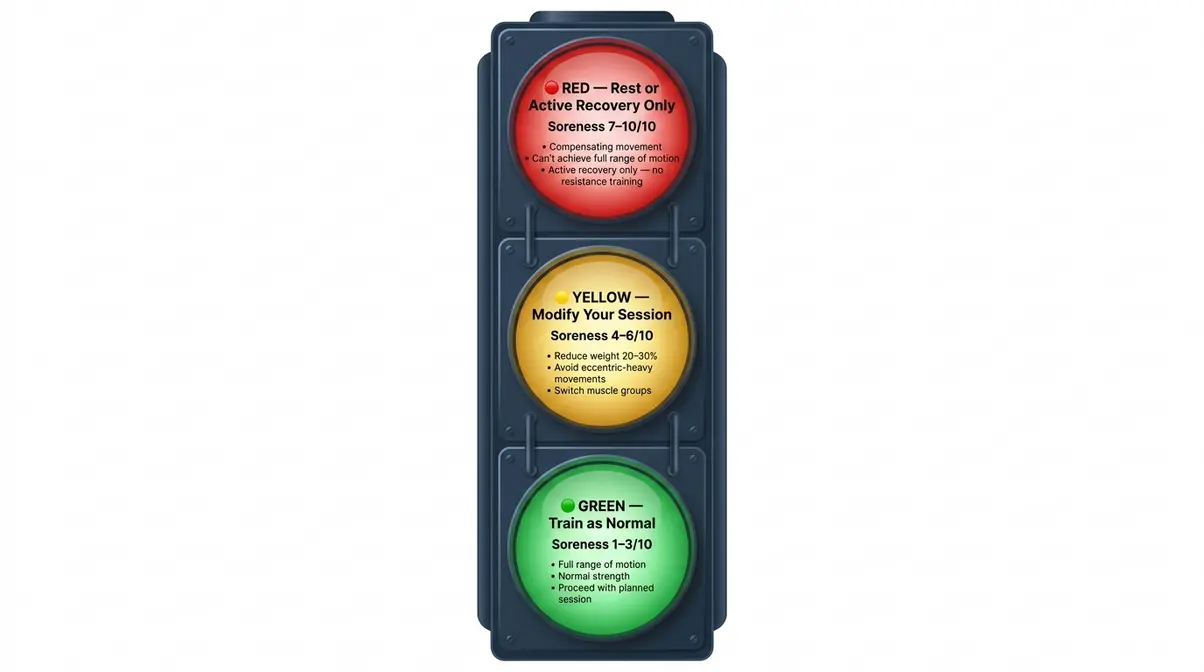
🟢 GREEN — Train as Normal
Your soreness is mild (a 1–3 out of 10). You can move through a full range of motion. Strength feels normal. You can train the same or different muscle groups without compensation. Proceed with your planned session.
🟡 YELLOW — Modify Your Session
Your soreness is moderate (a 4–6 out of 10). Movement is uncomfortable but not debilitating. You can complete a modified session: reduce weight by 20–30%, avoid eccentric-heavy movements on the affected muscles, and prioritise active recovery or a different muscle group. Never train a muscle group that is at Yellow soreness with high-intensity eccentric work.
🔴 RED — Rest or Active Recovery Only
Your soreness is severe (a 7–10 out of 10). You’re compensating your movement pattern, limping, or unable to achieve normal range of motion. Choose active recovery only — a gentle 20-minute walk, easy cycling, or light stretching. No resistance training on affected muscles. Red soreness that persists beyond 5 days, or that is accompanied by sharp pain or swelling, warrants a medical consultation.
The Traffic Light System keeps you consistent without making DOMS worse. Most beginners experience Yellow on Day 2 and return to Green by Day 3 or 4.
How to Prevent DOMS and Train Smarter
The most effective way to prevent debilitating DOMS is to control how quickly you increase your training load — a principle called progressive overload. Research published in the Journal of Healthcare Engineering (2026) confirms that controlling load intensity and increasing it gradually can effectively prevent DOMS and reduce injury risk. Guidance from Columbia University Go Ask Alice suggests allowing adequate recovery time between heavy sessions. Furthermore, research supported by the National Institutes of Health indicates that gradual progression is the safest way to condition muscles. You’ll never eliminate soreness entirely when starting something new, but you can keep it manageable.
Start Lower Than You Think You Should
The single biggest DOMS mistake beginners make is doing too much, too soon. Your nervous system and connective tissue adapt more slowly than your cardiovascular system — you can feel like you can handle more than your muscles are ready for.
A practical rule: in your first week of a new programme, do roughly 40–50% of the volume you think you could handle. If you think you could do 4 sets of squats, do 2. If you think you could run 5 kilometres, run 2.5. This is not weakness — it’s strategy. The German Journal of Sports Medicine (2026) recommends starting with low-intensity training and slowly adjusting loads when beginning a new exercise stimulus, specifically to prevent exercise-induced muscle damage.
Increase your total weekly training volume by no more than 10–15% per week. This gradual ramp-up is the single most effective DOMS prevention strategy available.
Warm Up Properly Before Every Session
A proper warm-up increases blood flow to muscles, raises tissue temperature, and improves the elastic properties of connective tissue — all of which reduce the severity of eccentric-contraction damage. Your warm-up should last 5–10 minutes and mirror the movements you’re about to perform, starting at low intensity and building.
Dynamic stretching (leg swings, arm circles, hip hinges) is more effective than static stretching before exercise. Static stretching is better saved for after your session or on active recovery days. A warm muscle sustains less damage under eccentric load than a cold one — the research on this is consistent.
Use the Repeated Bout Effect to Your Advantage
The repeated bout effect is arguably the most reassuring fact in all of DOMS science. A single bout of a new exercise provides measurable protection against muscle damage in subsequent sessions of the same exercise. Research published in the Journal of Athletic Training (2026) found that performing an eccentric exercise bout 6–9 weeks before a similar bout is effective prophylaxis for the pain and tenderness associated with DOMS.
In practical terms: the second time you do a new exercise, DOMS will be noticeably less severe. By the third or fourth session, it may be minimal. Your body is not getting weaker — it is specifically adapting to protect itself from this exact stimulus. Implementing tips to prevent exercise injuries and soreness provides more detail on how to structure your training to leverage this adaptation.
Chase progressive overload — not soreness. Consistent training with manageable loads builds more muscle and causes less disruption to your life than sporadic high-intensity sessions that leave you unable to walk.
Nutrition for Faster DOMS Recovery
Nutrition directly influences how quickly your body repairs muscle tissue after exercise — and two of the most important variables are total protein intake and hydration. Research consistently supports a daily protein target of 1.6–2.2 g per kilogram of body weight for active individuals as the foundation of muscle repair and recovery (Essentials Fitness, 2026; Journal of Applied Research, 2026). Experts at Stanford Lifestyle Medicine emphasize that consistent nutrient timing supports long-term recovery. Getting this right won’t eliminate DOMS, but it ensures your body has the raw materials it needs to rebuild as efficiently as possible.
Protein: The Building Block of Recovery
Muscle repair requires amino acids — the components of dietary protein. When you train, especially with eccentric contractions, muscle protein breakdown increases. Adequate dietary protein provides the amino acids needed to shift that balance toward net muscle protein synthesis.
A post-exercise protein dose of 20–40 grams (depending on body weight and intensity) has been shown to enhance recovery and support muscle remodelling (Journal of Applied Research, 2026). Spread total daily protein across 3–5 meals rather than consuming it all at once — this maximises muscle protein synthesis across the day.
Does protein deficiency cause DOMS?
No — DOMS is not caused by protein deficiency. DOMS results from mechanical damage to muscle fibers and connective tissue during eccentric exercise, followed by an inflammatory repair response. It is a structural and physiological process, not a nutritional one. However, insufficient daily protein (below approximately 1.6 g/kg of body weight) can slow the repair process and extend recovery time. Eating adequate protein supports faster recovery — but adding protein above your daily target will not directly reduce soreness or prevent DOMS.
Anti-Inflammatory Foods and Hydration
Certain nutrients have direct evidence for reducing DOMS-related inflammation. A 2026 review published in the Journal of the International Society of Sports Nutrition identified several nutritional interventions — including omega-3 fatty acids, taurine, polyphenols, and caffeine — as having measurable DOMS-reducing effects when consumed before and after exercise.
Omega-3 fatty acids (found in oily fish, walnuts, flaxseed, and fish oil supplements at 1.8–3 g/day) reduce inflammatory markers including CRP and prostaglandin E2 after eccentric exercise. Tart cherry juice has robust evidence from a 2026 meta-analysis of 18 studies showing significant DOMS reduction at 48–72 hours — the exact window when soreness peaks (Essentials Fitness, 2026). When considering best supplements for muscle recovery, focus on evidence-based options that support this inflammatory clearance.
Hydration matters more than most people realise. Dehydration increases the perceived severity of DOMS and slows the clearance of inflammatory by-products from muscle tissue. Aim for pale yellow urine as a rough hydration guide, and increase fluid intake on training days and during periods of DOMS.
What to Avoid
Alcohol significantly impairs muscle protein synthesis and disrupts sleep quality — two of the most important recovery factors. Avoid heavy alcohol consumption in the 24–48 hours following an intense session. Similarly, severe caloric restriction (crash dieting) deprives your body of the energy needed to power the repair process, extending DOMS duration.
You don’t need a perfect diet to recover from DOMS. You need adequate protein, reasonable calories, good hydration, and ideally some anti-inflammatory foods. Keep it simple.
DOMS Red Flags and Warning Signs
DOMS is normal — but some post-exercise symptoms are not. Knowing the difference between expected muscle soreness and a genuine medical concern is one of the most important things this guide can give you. The rule of thumb: DOMS is a diffuse, dull, bilateral ache that worsens gradually over 24–48 hours and resolves within a week. Anything that deviates sharply from that pattern deserves attention. The Centers for Disease Control and Prevention (CDC) warns that dark-coloured urine is a critical warning sign of exertional rhabdomyolysis, while the Mayo Clinic advises seeking immediate care if muscle pain is accompanied by severe swelling or fever.
Warning Signs That Require Medical Attention
Seek medical attention promptly if you experience any of the following after exercise:
- Dark-coloured urine (brown or cola-coloured): This is a potential sign of rhabdomyolysis — a serious condition where muscle breakdown products (specifically myoglobin) enter the bloodstream and can damage the kidneys. This is a medical emergency. Stop all exercise and go to a doctor or emergency department immediately.
- Extreme, disproportionate swelling in a limb or muscle group — particularly if one side is significantly more swollen than the other.
- Sharp, stabbing, or localised pain rather than a diffuse ache. DOMS feels like a generalised soreness across a muscle; acute injury feels sharp and localised.
- Joint pain — DOMS affects muscles, not joints. Pain in a joint (knee, shoulder, hip) is not DOMS.
- Pain that worsens significantly after Day 3 rather than improving. DOMS should begin resolving by Day 3. Pain that escalates after this point suggests something other than DOMS.
- Loss of function — inability to bear weight, grip, or move a limb through any range of motion.
- Soreness accompanied by fever, nausea, or general illness symptoms.
Standard DOMS does not require medical treatment. But rhabdomyolysis — which can occur after extremely intense, unaccustomed exercise, particularly in beginners who push very hard on their first sessions — is genuinely dangerous. The dark urine symptom is the clearest red flag and should never be ignored.
If you’re uncertain whether what you’re experiencing is DOMS or something more serious, err on the side of caution and consult a healthcare professional. This is particularly important for older adults, individuals with pre-existing kidney or metabolic conditions, and anyone who has engaged in extreme exercise (like a marathon or very high-volume military-style training) for the first time.
Frequently Asked Questions About DOMS
How long does delayed onset muscle soreness last?
Delayed onset muscle soreness typically lasts 3–5 days for moderate-intensity exercise in most people. Soreness begins 12–24 hours after the workout, peaks around 48 hours, and gradually resolves through Days 3–5. More intense sessions — particularly first-time heavy eccentric exercise — can extend DOMS to 7 days. The duration shortens significantly with repeated exposure to the same exercise, thanks to the repeated bout effect. If soreness persists beyond 7 days or worsens after Day 3, consult a healthcare professional.
What is the fastest way to recover from DOMS?
The fastest evidence-based DOMS recovery combines active recovery movement, massage or foam rolling, adequate sleep, and cold water immersion applied within the first hour post-exercise. A 2026 umbrella meta-analysis in Sports Medicine found massage to be the most effective single technique for reducing DOMS, while a 2026 network meta-analysis in Frontiers in Physiology identified 10–15 minutes in 11–15°C water as the most effective cold protocol. Sleep is the most foundational factor — 7–9 hours enables peak growth hormone release and muscle protein synthesis. No single method eliminates DOMS entirely, but combining these approaches meaningfully reduces its severity and duration.
Is it okay to massage sore muscles?
Yes, light massage is highly effective for reducing DOMS symptoms. Applying gentle to moderate pressure via sports massage or a foam roller helps increase blood flow to the damaged tissue, which aids in clearing out inflammatory by-products. While it may feel uncomfortable initially, research shows it provides a statistically significant reduction in perceived soreness.
Can drinking water help with DOMS?
Yes, hydration plays a key role in muscle recovery. Dehydration increases the perceived severity of DOMS and slows down the clearance of waste products generated during the inflammatory repair process. Maintaining pale yellow urine ensures your body has the fluid volume necessary to efficiently transport nutrients to repairing muscles.
Do painkillers slow down muscle growth?
Short-term use of NSAIDs is generally fine, but chronic use may blunt muscle adaptation. Non-steroidal anti-inflammatory drugs (like ibuprofen) reduce DOMS pain by dampening the inflammatory response. Because inflammation is a necessary part of how muscles adapt and grow stronger, relying on painkillers after every workout could theoretically slow long-term progress. They are best reserved for occasional, severe soreness.
Your DOMS Recovery Plan Starts Now
For fitness beginners and anyone returning to exercise, delayed onset muscle soreness DOMS is one of the most universal experiences in sport — and one of the most misunderstood. DOMS is caused by microscopic muscle and connective tissue damage from eccentric contractions, not lactic acid. It peaks at 48 hours due to a predictable inflammatory response, and it resolves in 3–5 days as your body rebuilds stronger. Research confirms this recovery arc is consistent across populations and exercise types (PMC, 2026; German Journal of Sports Medicine, 2026).
The DOMS Traffic Light System — Green for training as normal, Yellow for modified sessions, Red for active recovery only — gives you a clear, repeatable framework for every day of your recovery. It replaces the guesswork that causes beginners to either push through pain recklessly or abandon their routine entirely. Neither extreme serves your long-term progress.
Your next step is straightforward: bookmark this guide, use the Traffic Light System after your next hard session, and start your first active recovery walk on Day 2 instead of lying on the couch. Combine that with 7–9 hours of sleep, adequate daily protein, and a gradual approach to increasing your training load — and DOMS will shift from a routine-ending obstacle to a manageable sign that your body is doing exactly what it should.

Callum
Hi, I'm Callum, the founder of Body Muscle Matters. I'm not a certified trainer, I'm a self taught lifter who started this site to share what I've learned from my own training and a lot of trial and error. Everything here comes from real experience and honest research, written the way I'd explain it to a friend who is just getting started. My goal is simple: practical, no hype fitness advice you can actually use.