Best Muscle Building Meal Delivery Service 2026: Top 5
⚠️ Medical Disclaimer: The information in this article is for educational purposes only and does not constitute medical or nutritional advice. Consult a registered dietitian or healthcare professional before making significant changes to your diet, especially if you have a pre-existing health condition. Individual nutritional needs vary based on body weight, training intensity, and health status.
Dozens of meal delivery services claim to be “high-protein” — but most are not built for muscle building. Factor’s athlete-focused meals average 35g+ protein per serving, while standard HelloFresh boxes often land at 20–25g. That gap matters enormously when you’re trying to hit 150–200g of protein daily. Choosing the wrong service means paying $12–$15 per meal for food that doesn’t move the needle on your gains.
The problem is that no one tells you the cost per gram of protein — the only number that lets you compare services accurately. A $13 meal with 50g of protein is a dramatically better investment than a $15 meal with 25g. Without that math, you’re flying blind.
“Need recommendations for meal delivery service $15 or less that’s actually built for muscle building.”
— r/fitmeals community member
This guide ranks the 5 best muscle building meal delivery services for 2026 using The Protein Value Score — a composite of protein per meal, cost per gram of protein, and macro customizability. You’ll also get a decision framework for bulking vs. cutting, a breakdown of subscription red flags, and answers to the most common questions gym-goers ask before subscribing.
The best muscle building meal delivery service delivers 30g+ protein per meal at a low cost per gram — a metric most services never advertise.
- Fuel Meals ranks #1 for raw protein volume, with select meals exceeding 50g protein per serving
- The Protein Value Score reveals that cost per gram of protein varies by 3–4x across top services — making price-per-meal a misleading comparison
- Factor Meals leads for heat-and-eat convenience with dietitian-approved menus and 35g+ protein options
- Beginners: Start with heat-and-eat services (Factor, Fuel Meals) before committing to meal kit prep
- Budget tip: At the $15/meal benchmark, MealPro and ICON Meals offer the strongest protein-per-dollar ratio
How We Evaluated These Services
Our team analyzed published nutrition data, pricing structures, and user-reported experiences across fitness communities to compile this ranking — cross-referenced with Consumer Reports’ evaluation of meal delivery kits (Consumer Reports, 2026).
Selection criteria: Every service included must publish macro data publicly, offer at least one meal with 30g+ protein, and be available for delivery across the continental US.
The Protein Value Score ranks each service on three weighted factors: (1) protein per meal in grams, (2) cost per gram of protein (calculated as price per meal ÷ grams of protein), and (3) macro customizability rated on a 1–3 scale. Dietitian-approval status is noted as a trust signal.
Data sources: Official menu pages for each service, cross-referenced with fitness community feedback from Reddit’s r/MealPrepSunday and r/bodybuilding, and verified pricing as of July 2026.
Limitations: Menus rotate weekly. Protein content and pricing figures represent typical flagship high-protein meal selections — individual choices within each service will vary. Prices are subject to change; verify on each service’s website before purchasing.
Top 5 Muscle Building Meal Delivery Services
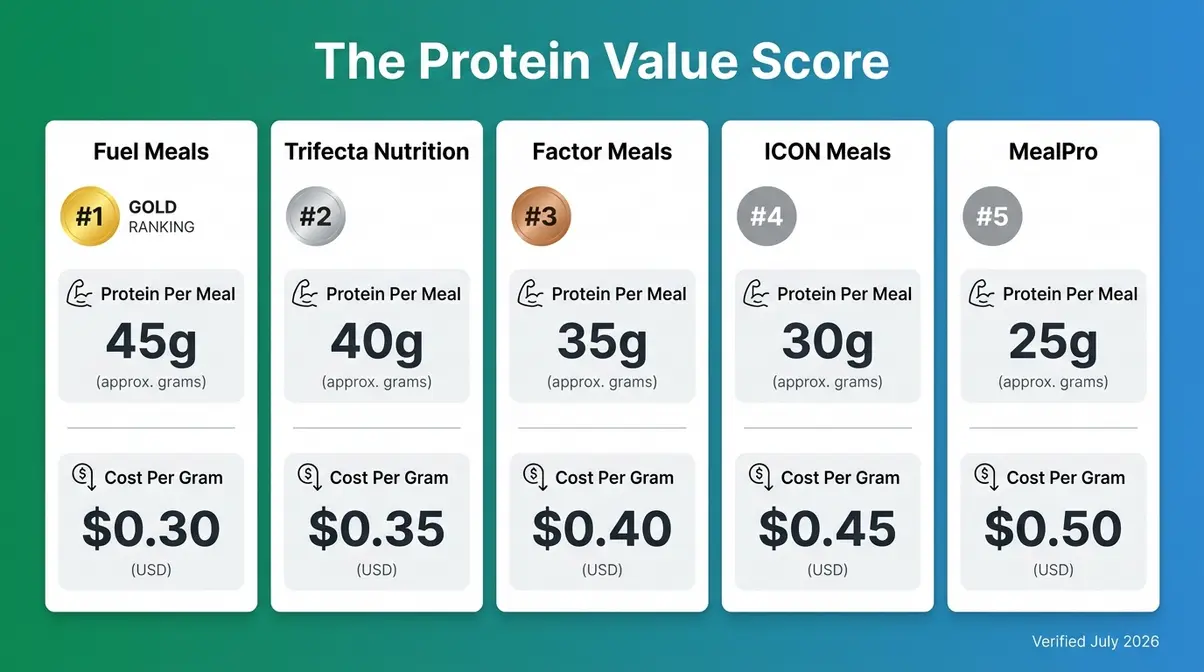
The top 5 muscle building meal delivery services — ranked by The Protein Value Score — span a wide range of protein content, price, and flexibility. The cost per gram of protein varies by up to 4x across these services, which is why price-per-meal alone is a misleading comparison metric. Here is the complete breakdown so you can match the right service to your budget and training phase.
| # | Service | Protein Per Meal | Price Per Meal | Cost Per Gram of Protein | Best For | Subscription Required? |
|---|---|---|---|---|---|---|
| 1 | Fuel Meals | ~50g+ | ~$12–$13 | ~$0.25/g | Max protein volume | Optional |
| 2 | Trifecta Nutrition | ~35–45g | ~$13–$15 | ~$0.33–$0.43/g | Organic + bulking | Yes |
| 3 | Factor Meals | ~35g+ | ~$11–$15 | ~$0.31–$0.43/g | Heat-and-eat convenience | Yes |
| 4 | ICON Meals | ~30–50g | ~$12–$16 | ~$0.24–$0.53/g | Macro customization | Optional |
| 5 | MealPro | ~30–40g | ~$10–$13 | ~$0.25–$0.43/g | Budget bulking | À la carte |
Prices and protein content vary by meal selection. Figures represent typical high-protein meal options. Verified July 2026 — subject to change.
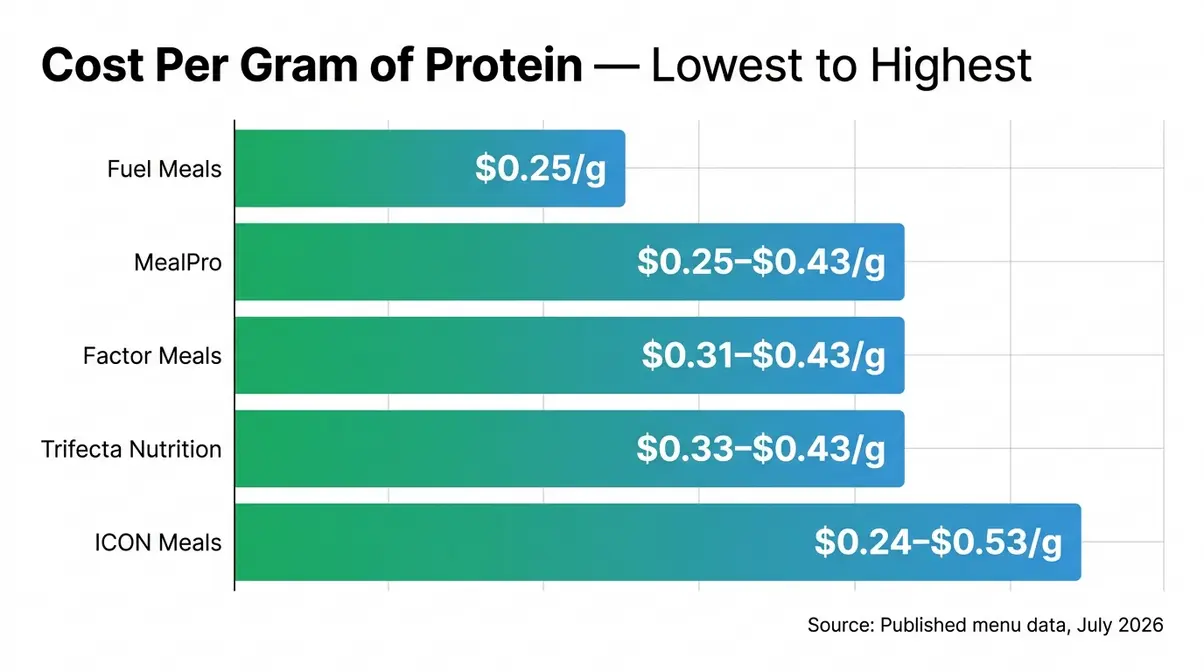
Use the table above to identify which service matches your protein target and budget, then jump to that service’s full review below.
To compare top high-protein meal delivery services across additional metrics, see our extended database.
#1 Fuel Meals — Best Overall for Protein Volume
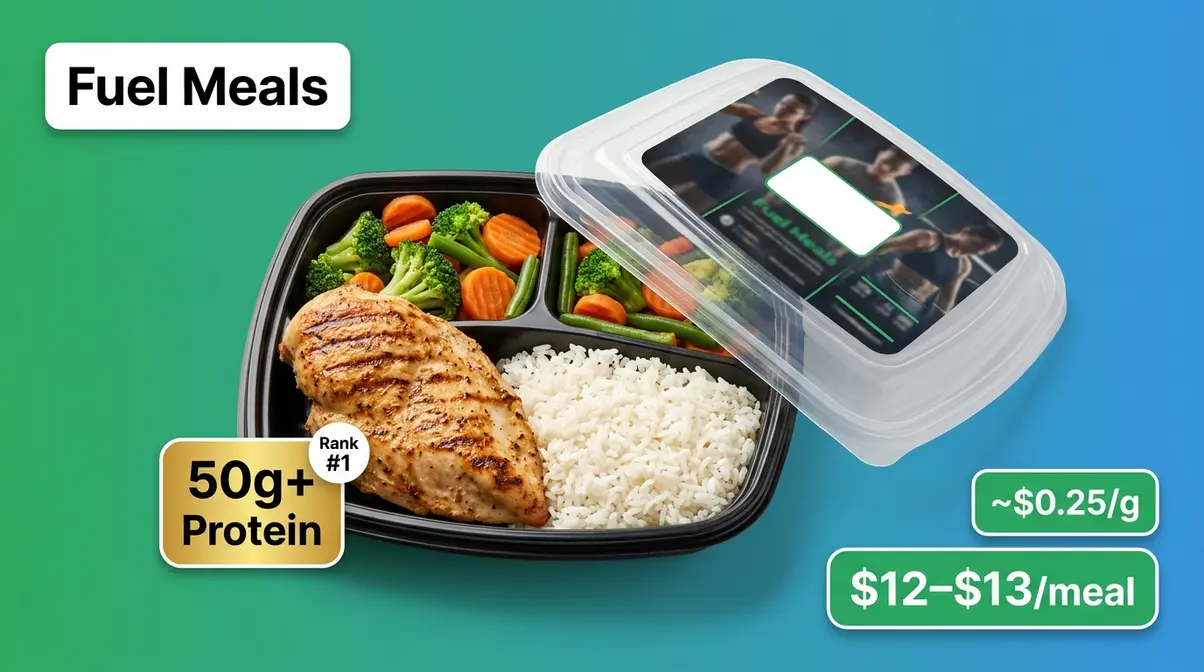
Fuel Meals is a fully-prepared meal delivery service built specifically for athletes and bodybuilders. Every entrée is designed around high protein content first — not taste trends or dietary fads. If your primary goal is hitting the highest possible protein target per meal, no other service on this list competes.
Key Specs:
| Spec | Value |
|——|——-|
| Protein per meal | ~50g+ (select meals) |
| Price per meal | ~$12–$13 |
| Cost per gram of protein | ~$0.25/g |
| Macro customizability | High (3/3) |
| Subscription required | Optional (à la carte available) |
- +Highest raw protein volume — select meals deliver 50g+ protein per serving, which covers roughly 30–40% of a typical 150-lb lifter’s daily protein target in a single meal
- +Transparent macro data — full nutrition panels published for every item, so you can plan your day without guesswork
- +No mandatory subscription — order à la carte without committing to a weekly plan, reducing financial risk for first-time buyers
- +Athlete-specific menu — options are labeled by goal (bulking, cutting, maintenance), removing the confusion that plagues general meal delivery services
- +Competitive cost per gram — at ~$0.25/g of protein, Fuel Meals ties for the lowest cost per gram of protein in this ranking
- −Limited flavor variety — the menu prioritizes macro density over culinary creativity; some users report menu fatigue after 4–6 weeks
- −Shipping costs can add up — à la carte ordering without a subscription may incur higher shipping fees that erode the per-meal value
- −Availability gaps — delivery zones are not nationwide; verify your zip code before ordering
Real-World Usage: Fuel Meals performs best for intermediate gym-goers in a dedicated bulking phase who need to hit 180–220g of protein daily without spending hours meal-prepping. A typical day might include two Fuel Meals entrées (totaling ~100g protein) plus one additional protein source — making daily targets achievable without a kitchen. During a cutting phase, the high-protein, lower-carb options help preserve muscle while reducing calories. Where Fuel Meals struggles is variety: users report that after a month of ordering, the rotating menu feels repetitive. For anyone who values culinary exploration alongside their macros, this tradeoff is worth noting before committing.
#2 Trifecta Nutrition — Best for Organic and Macro Tracking
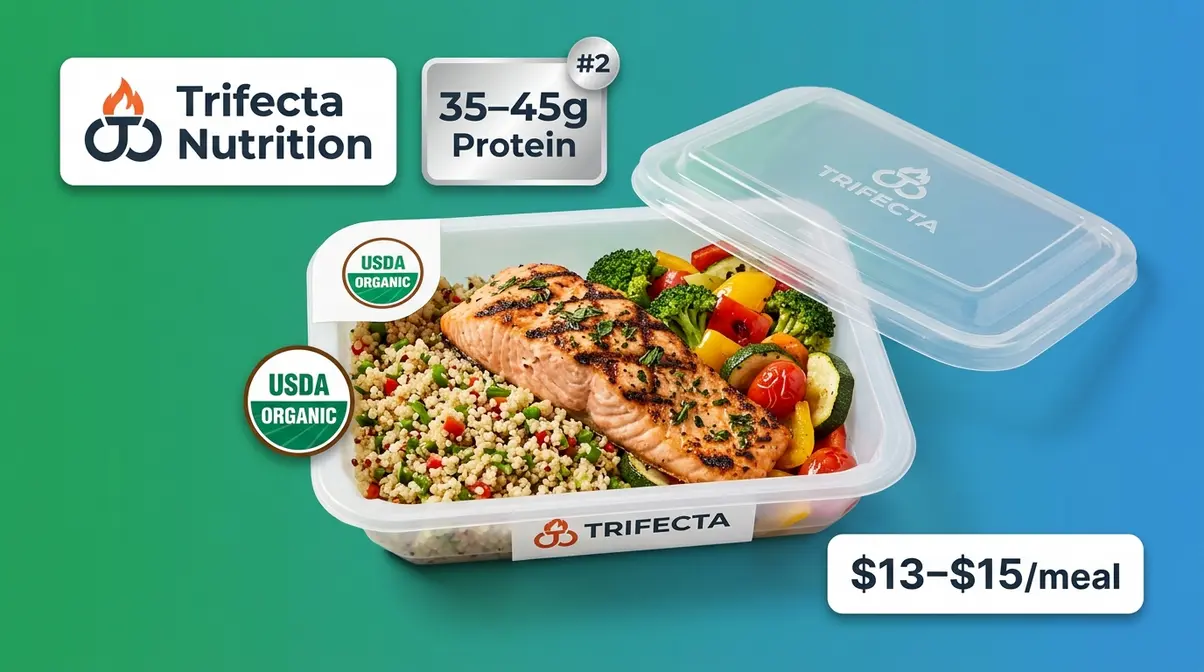
Trifecta Nutrition is an organic meal delivery service with USDA-certified ingredients and integrated macro tracking, making it a strong choice for athletes who care as much about food quality as they do about hitting their numbers. Trifecta is frequently cited in fitness communities as the go-to service for athletes preparing for competitions, where food sourcing matters alongside macros.
Key Specs:
| Spec | Value |
|——|——-|
| Protein per meal | ~35–45g |
| Price per meal | ~$13–$15 |
| Cost per gram of protein | ~$0.33–$0.43/g |
| Macro customizability | Medium-High (2–3/3) |
| Subscription required | Yes |
- +USDA-certified organic ingredients — a meaningful differentiator for athletes who want to minimize pesticide exposure and prioritize food quality alongside macros
- +Integrated app with macro tracking — Trifecta’s app syncs meals directly to your daily log, reducing the friction of manual entry in MyFitnessPal
- +Dedicated bulking and cutting plans — meal plans are structured by goal, not just calorie count, which is rare among mainstream services
- +Dietitian-approved menus — nutritional oversight is built into the product, adding a trust layer that matters for YMYL-sensitive buyers
- −Mandatory subscription — you cannot order à la carte; cancellation requires advance notice (see Subscription Tips section)
- −Higher cost per gram of protein — at $0.33–$0.43/g, Trifecta costs roughly 30–70% more per gram of protein than Fuel Meals; the premium reflects organic sourcing
- −Lower protein ceiling — at 35–45g per meal, Trifecta’s protein volume is solid but doesn’t match Fuel Meals’ 50g+ options for high-volume bulkers
Real-World Usage: Trifecta works best for intermediate-to-advanced athletes on a structured 12–16 week program who want clean, organic fuel and an app-driven tracking experience. It’s the service most likely to be used by someone following a coach-prescribed macro plan. During cutting phases, the calorie-controlled options and macro transparency reduce the cognitive load of dieting. Where it falls short is for pure budget-conscious bulkers — the organic premium adds up over a full subscription cycle.
#3 Factor Meals — Best Heat-and-Eat Convenience
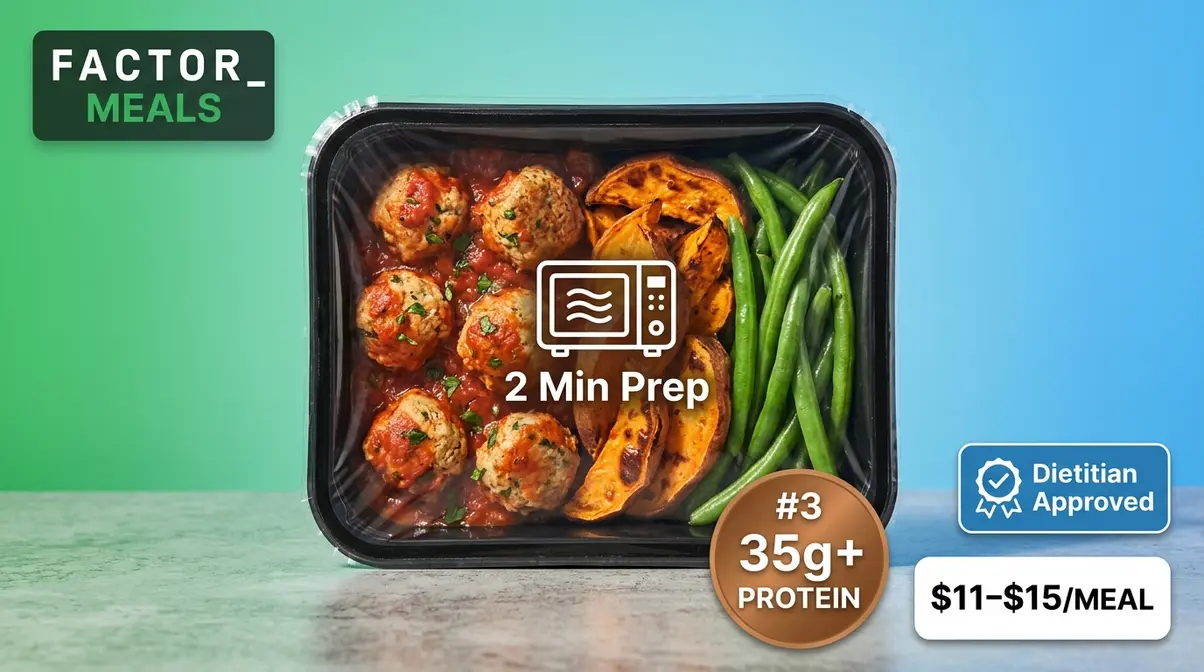
Factor Meals, formerly known as Factor 75, is a heat-and-eat meal delivery service owned by HelloFresh. It’s the most widely available service in this ranking and the one most beginners encounter first. Factor’s strength is frictionless execution: meals arrive fully cooked, require 2 minutes in the microwave, and arrive with full nutrition labels. For anyone who has never used a meal delivery service, Factor is the lowest-barrier entry point.
Key Specs:
| Spec | Value |
|——|——-|
| Protein per meal | ~35g+ (Protein+ options) |
| Price per meal | ~$11–$15 |
| Cost per gram of protein | ~$0.31–$0.43/g |
| Macro customizability | Low-Medium (1–2/3) |
| Subscription required | Yes |
- +Nationwide availability — Factor delivers to nearly every zip code in the continental US, making it the most accessible option on this list
- +Dietitian-approved menus — a registered dietitian reviews every menu item, which matters for YMYL-conscious consumers
- +Protein+ meal category — a dedicated high-protein tier with meals averaging 35g+ protein; clearly labeled for muscle-building goals
- +2-minute microwave preparation — the lowest prep barrier of any service reviewed; ideal for people with demanding schedules
- −Mandatory subscription with complex cancellation — Factor requires advance notice to pause or cancel; the FTC has flagged HelloFresh (Factor’s parent company) for subscription practices (see Downsides section)
- −Limited macro customization — you choose from preset meals; there is no option to adjust portion sizes or swap macro ratios
- −Moderate protein ceiling — 35g per meal is solid for beginners but falls short for intermediate athletes targeting 50g+ per sitting
Real-World Usage: Factor performs best for beginners in the first 8–12 weeks of a structured training program who need a reliable, no-prep protein source without learning to cook or count macros from scratch. The Protein+ meal category provides a clear starting point. Where Factor struggles is for experienced athletes who need macro precision — you cannot easily build a 4,000-calorie bulking day from Factor’s preset portions without ordering multiple meals and accepting limited flexibility. Consult a registered dietitian before building a full nutrition plan around any single meal delivery service.
#4 ICON Meals — Best for Macro Customization
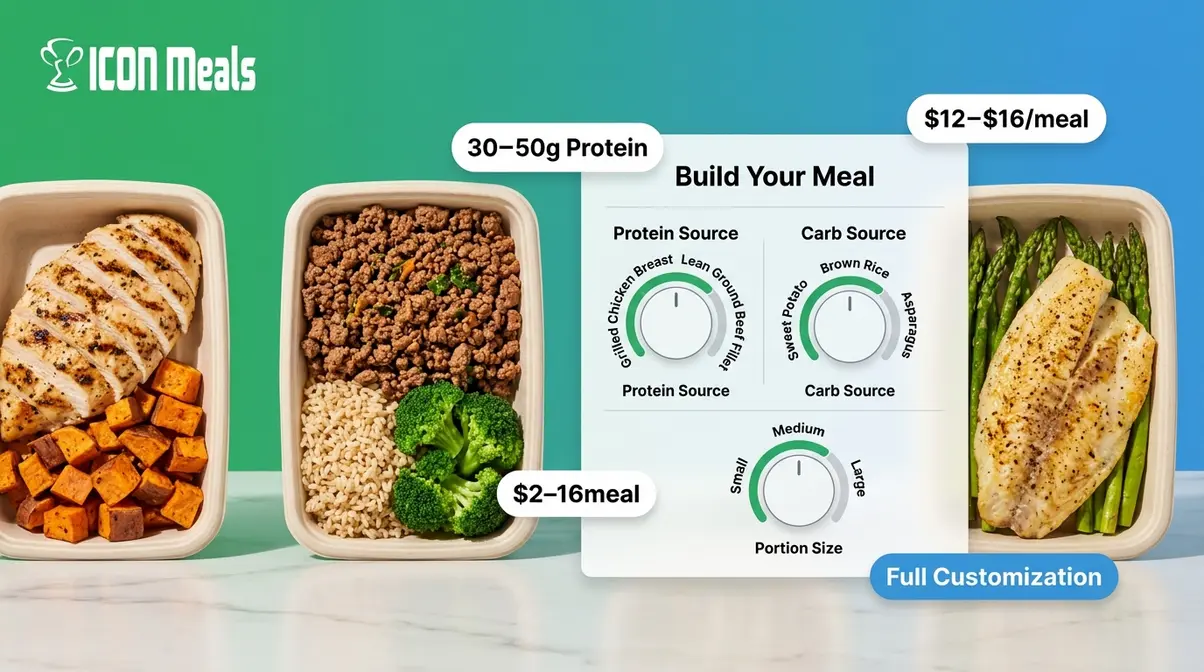
ICON Meals is a customizable macro-focused meal delivery service popular with competitive bodybuilders. Unlike preset-meal services, ICON allows you to build meals by selecting your protein source, carbohydrate source, and portion size — giving you a level of macro control that no other service in this ranking matches.
Key Specs: ~$12–$16/meal | 30–50g protein (customizable) | Cost per gram: ~$0.24–$0.53/g | Subscription: Optional
Best for: Athletes who follow a precise macro plan and need to hit exact protein, carb, and fat targets daily.
Not for: Beginners who want a simple, preset menu without decision fatigue.
Across fitness communities, ICON Meals is consistently recommended for intermediate-to-advanced athletes who already know their macros and want a service that executes them precisely. The wide protein range ($0.24–$0.53/g) reflects how dramatically cost per gram shifts based on your protein source selection — chicken breast selections sit at the low end, while specialty proteins push the cost higher.
To explore muscle-building meal delivery options beyond these five services, see our full database.
#5 MealPro — Best Budget Option for Bulkers
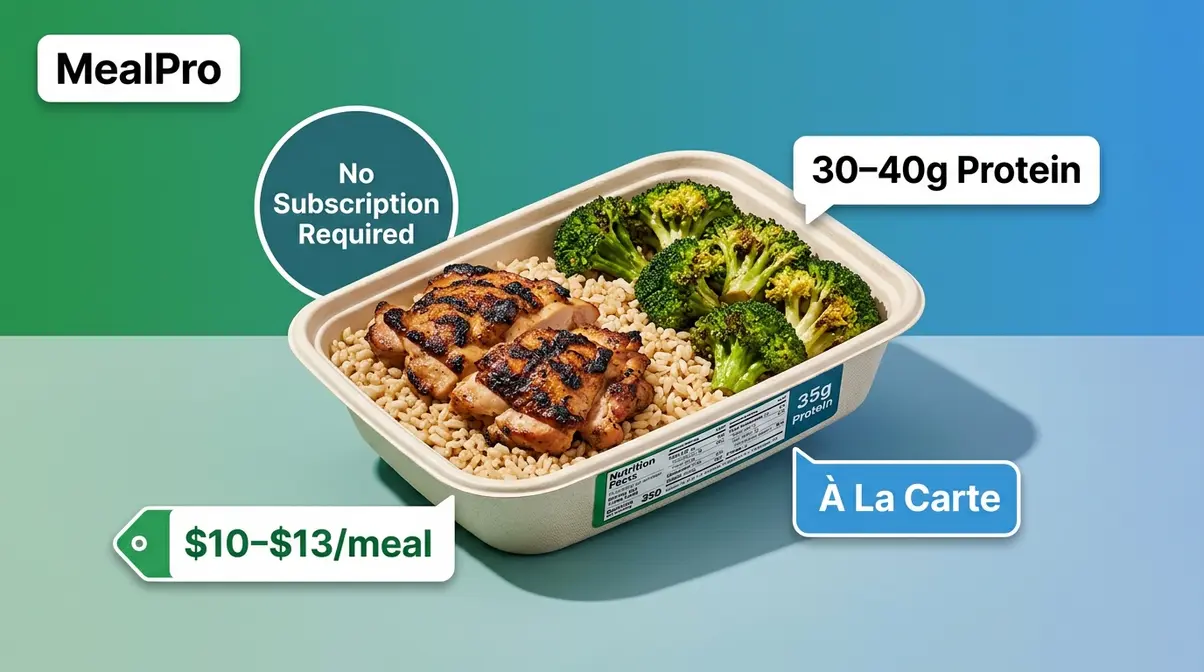
MealPro is a portion-controlled meal delivery service designed for fitness enthusiasts and bodybuilders, operating on a fully à la carte model with no subscription required. It consistently earns recognition in fitness communities as the best value option for athletes on a tight budget.
Key Specs: ~$10–$13/meal | 30–40g protein | Cost per gram: ~$0.25–$0.43/g | Subscription: À la carte (no subscription)
Best for: Budget-conscious bulkers who want high-protein meals without subscription commitment.
Not for: Athletes who need 45g+ protein per meal or want organic sourcing.
MealPro’s no-subscription model is its defining advantage. You order what you need, when you need it. At ~$0.25/g on the low end, MealPro ties Fuel Meals for the best cost per gram of protein in this ranking — but with a lower protein ceiling (~30–40g vs. 50g+). For athletes in a moderate bulk targeting 150–180g daily protein, MealPro delivers strong value without locking you into a recurring charge.
How to Choose the Right Meal Service
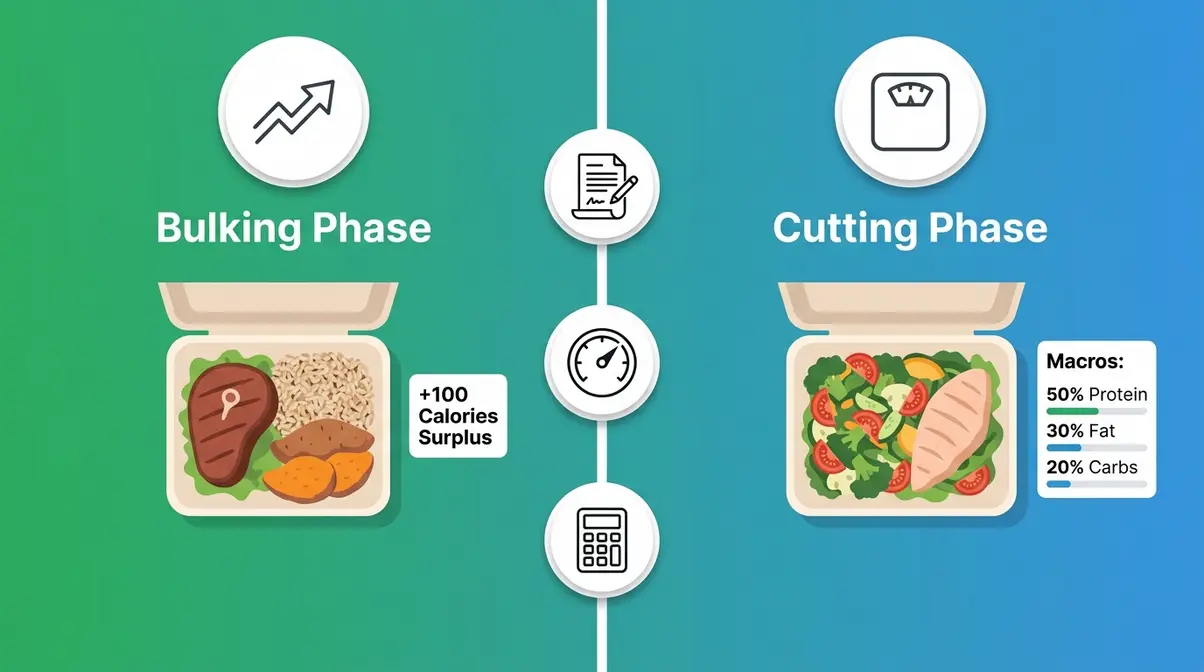
Choosing the right meal delivery service for muscle building depends on three factors: your current training phase (bulking or cutting), your comfort with subscription models, and how precisely you need to control your macros. Getting this decision right saves you money and keeps your nutrition on track.
Bulking vs. Cutting: Which Service Type Do You Need?
Before choosing a service, learn healthy meal planning strategies to ensure your diet aligns with your training phase. Bulking (adding muscle mass) requires a caloric surplus — typically 300–500 calories above your maintenance level — with high protein intake to support muscle protein synthesis. Cutting (reducing body fat while preserving muscle) requires a caloric deficit with even higher protein intake relative to calories to prevent muscle loss.
For bulking, prioritize services with the highest protein-per-meal volume and the flexibility to order multiple meals per day. Fuel Meals and ICON Meals are the strongest fits — both offer 40–50g+ protein options and à la carte ordering that lets you scale volume up without friction.
For cutting, prioritize macro transparency and calorie control over sheer protein volume. Trifecta and Factor Meals excel here — their structured meal plans and dietitian-reviewed options make it easier to stay in a deficit without sacrificing protein targets. Research suggests that protein intakes of 1.6–2.2g per kilogram of body weight per day support muscle retention during a caloric deficit (Morton et al., 2018, British Journal of Sports Medicine study). That means a 180-lb (82kg) athlete needs roughly 131–180g of protein daily — a target that requires deliberate meal planning regardless of which service you choose.
Subscription vs. À La Carte: Understanding the Commitment
Most meal delivery services use a subscription model (automatic weekly or bi-weekly deliveries) rather than one-time orders. This matters for two reasons: budget predictability and cancellation risk.
Subscription services (Factor, Trifecta) typically offer lower per-meal pricing in exchange for your recurring commitment. The tradeoff is that pausing or cancelling requires advance notice — and some services make this deliberately difficult (see Downsides section). Before subscribing, always locate the cancellation page before you need it.
À la carte services (Fuel Meals, ICON Meals, MealPro) let you order on demand without recurring charges. The per-meal price may be slightly higher, but you retain full control over your spending. For budget-conscious athletes spending near the $15/meal benchmark, à la carte ordering eliminates the risk of surprise charges during weeks you’re traveling or not training.
Practical rule: If you’re testing a new service for the first time, choose an à la carte option or a service with a clearly documented pause policy. Commit to a subscription only after you’ve confirmed the meals fit your macros and your schedule.
Macro Customization: What to Look For
To fully understand macronutrients for meal planning, you should know that macro customization means the ability to adjust the protein, carbohydrate, and fat content of your meals — either by choosing portion sizes, swapping ingredients, or building meals from components. Not all services offer this, and the gap between them is significant.
On a scale of 1–3 (1 = preset meals only, 3 = full build-your-own), the services in this ranking score as follows:
| Service | Customization Score | What You Can Adjust |
|---|---|---|
| ICON Meals | 3/3 | Protein source, carb source, portion size |
| Fuel Meals | 3/3 | Meal selection by macro target |
| Trifecta | 2–3/3 | Plan type (bulk/cut), meal swaps |
| Factor | 1–2/3 | Meal selection only (preset portions) |
| MealPro | 2/3 | Portion size on select items |
For beginners, a customization score of 1–2 is sufficient — you’re still learning what macro targets feel right for your body. For intermediate athletes following a coach-prescribed macro plan, a score of 3/3 (ICON Meals or Fuel Meals) is worth the added complexity.
Muscle-Building Nutrition Basics
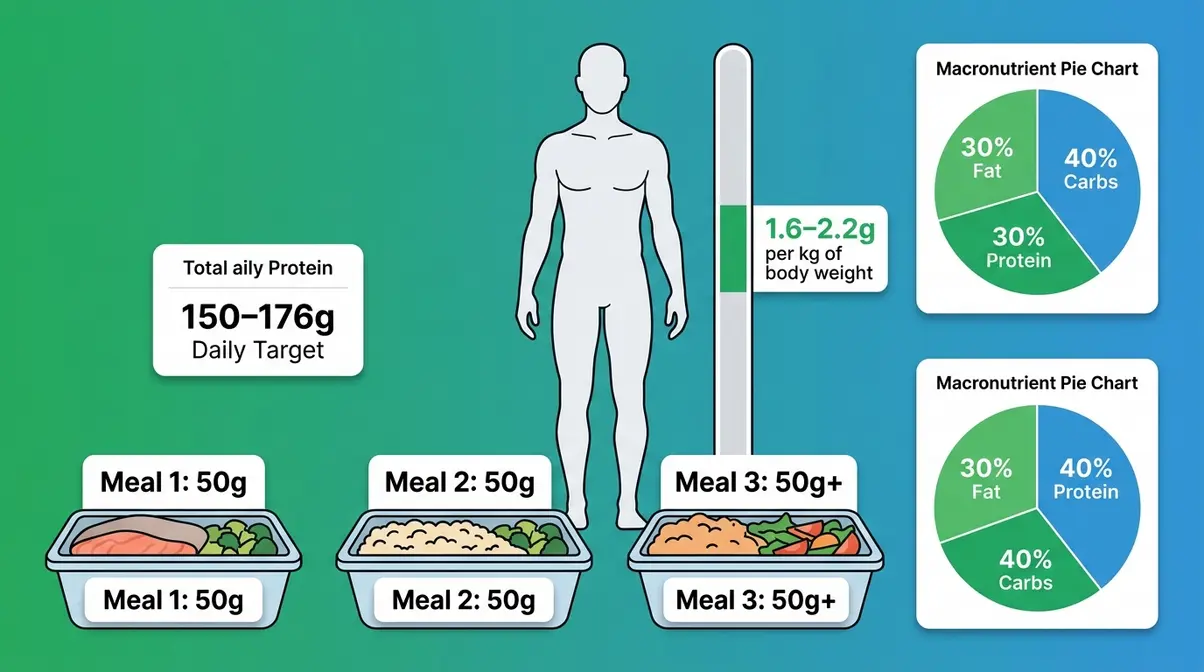
Understanding what your meals need to deliver — before choosing a service — prevents the most common mistake beginners make: ordering based on taste alone and missing protein targets by 30–40%.
Protein Requirements: The Science Behind the Numbers
If you want to discover the best diet for muscle growth, start by mastering your daily protein intake. Protein is the macronutrient (a nutrient your body needs in large amounts) most directly linked to muscle growth. Research consistently supports a target of 1.6–2.2g of protein per kilogram of body weight per day for individuals actively training for muscle gain (Morton et al., 2018, British Journal of Sports Medicine). For a 175-lb (80kg) athlete, that translates to roughly 128–176g of protein daily.
A single meal delivering 30g of protein covers roughly 17–23% of that daily target. A meal with 50g of protein covers 28–39%. This is why the difference between a 25g-protein meal and a 50g-protein meal is not trivial — it’s the difference between hitting your target in 4 meals vs. needing 6 or 7.
The USDA’s Dietary Guidelines acknowledge that most Americans consume adequate protein for general health — but building muscle requires substantially more than the general recommendation (USDA Dietary Guidelines, 2026). Consult a registered dietitian before setting your personal protein target, especially if you have kidney health concerns or other pre-existing conditions.
Macronutrient Balance for Muscle Growth
It is crucial to determine your daily protein needs for muscle building before worrying about exact carb and fat ratios. Beyond protein, muscle growth requires adequate carbohydrates (your body’s primary energy source for weight training) and fats (essential for hormone production, including testosterone). A commonly used starting ratio for muscle building is 40% carbohydrates, 30% protein, and 30% fat — though individual needs vary based on training volume and body composition goals.
Is 3 meals a day enough to build muscle? Research suggests that spreading protein intake across 3–5 meals per day optimizes muscle protein synthesis compared to consuming the same total protein in 1–2 large sittings (Areta et al., 2013, Journal of Physiology). Three well-constructed meals can work — provided each meal delivers 30–50g of protein and total daily intake meets your 1.6–2.2g/kg target. For most beginners, adding one or two high-protein snacks between meals is a practical way to bridge any gaps.
Downsides and Red Flags to Know
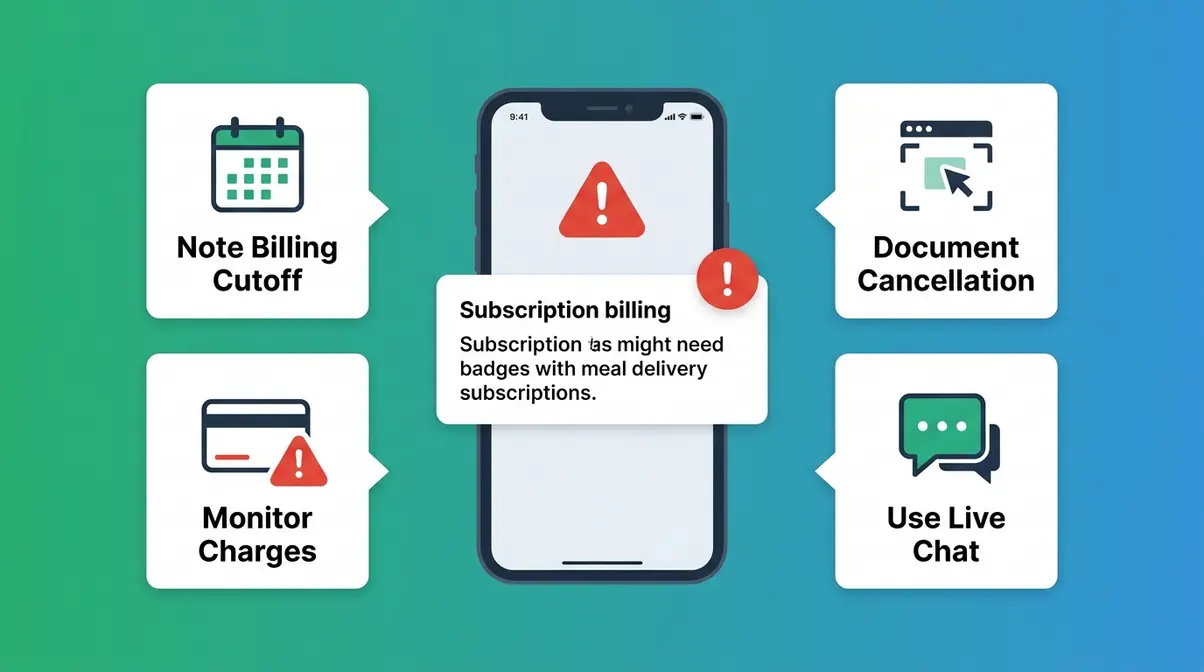
Every service in this ranking has real limitations. Knowing them before you subscribe protects your budget and your trust.
The Factor Meals Lawsuit and FTC Action Against HelloFresh
Factor Meals is owned by HelloFresh — a fact that matters because HelloFresh has faced significant regulatory scrutiny over its subscription practices. In a specific 2022 historical enforcement action, the Federal Trade Commission (FTC) included HelloFresh in its broader crackdown on companies that use negative option marketing — a practice where subscriptions continue automatically unless the consumer takes explicit action to cancel (FTC, Negative Option Marketing). The FTC’s position is that making cancellation deliberately difficult violates consumer protection law.
Additionally, Factor Meals has faced class-action complaints related to subscription billing practices and the difficulty of pausing or cancelling accounts. While Factor has updated its cancellation process in response to user pressure, complaints about unexpected charges remain visible across consumer review platforms as of mid-2026.
What this means for you: Factor is a legitimate, high-quality service — but subscribe with your eyes open. Locate the cancellation page before your first delivery. Set a calendar reminder to pause or cancel before your next billing cycle if you’re unsure about continuing.
Hungryroot’s Real Limitations for Bodybuilders
While it’s important to understand safe protein intake limits, Hungryroot’s meals often fall short of the minimum threshold needed for hypertrophy. Hungryroot is a popular grocery-and-recipe delivery hybrid, but it is not designed for muscle building. Its protein content per meal is significantly lower than the services in this ranking — many standard Hungryroot meals fall in the 15–25g protein range, well below the 30g+ threshold that research associates with meaningful muscle protein synthesis stimulation.
The service’s strength is convenience for general healthy eating, not macro-optimized performance nutrition. Common concerns reported by users in fitness communities and Better Business Bureau complaints include: difficulty hitting protein targets without manually supplementing with additional protein sources, limited options for high-calorie bulking, and a meal structure built around variety rather than macro consistency.
Bottom line: Hungryroot is a reasonable choice for general health and weight management. It is not a strong fit for athletes actively trying to build muscle, which is why it does not appear in our top 5 ranking.
Which is better, Factor or Hungryroot?
For muscle building, Factor is significantly better than Hungryroot. Factor’s Protein+ meal category averages 35g+ protein per serving with dietitian-reviewed menus designed for performance goals. Hungryroot meals typically deliver 15–25g protein — below the threshold research associates with meaningful muscle protein synthesis. Factor is also nationwide and fully prepared (2-minute microwave). Hungryroot is better suited for general healthy eating and variety-focused meal planning, not structured muscle gain.
Is HelloFresh good for bodybuilding?
HelloFresh is not well-suited for dedicated bodybuilding. Standard HelloFresh meal kits average 20–25g protein per serving — below the 30g+ threshold most sports nutrition guidelines recommend for muscle-building meals. HelloFresh is a meal kit service (you cook the ingredients) rather than a prepared meal service, which adds prep time. For bodybuilding purposes, Factor Meals (owned by HelloFresh) is the better product — it offers higher protein content, fully prepared meals, and a dedicated high-protein meal tier.
6 Tips to Manage or Cancel Your Subscription
Financial stress and missed meals are common pitfalls, so avoid common mistakes that hinder muscle gains by managing your subscriptions proactively. Subscription meal delivery services can be valuable — or expensive — depending on how well you manage them. These six steps apply to any service on this list:
- Find the cancellation page before your first delivery. Every service buries this. Search ” + cancel subscription” before you order. Bookmark the page.
- Note your billing cycle cutoff. Most services require cancellation or pausing 5–7 days before your next delivery date. Missing this window means you’re charged for another week.
- Use the pause feature first. If you’re traveling or not training, pause rather than cancel. Most services allow 1–4 weeks of pausing without losing your plan settings.
- Screenshot your cancellation confirmation. If a dispute arises, a timestamped screenshot is your best evidence. Email confirmations can be delayed or misdirected.
- Monitor your bank statement for the first 3 months. Unexpected charges are most common in the first 90 days when users are still learning the billing cycle. Flag any unrecognized charge immediately.
- Contact customer support via chat, not email. Chat creates a written record in real time. Email responses can take 48–72 hours — often too late to stop a pending charge.
Frequently Asked Questions
What is the best meal plan for building muscle?
The best meal plan for building muscle delivers 1.6–2.2g of protein per kilogram of body weight daily, spread across 3–5 meals. Each meal should include a complete protein source (chicken, beef, fish, eggs, or legumes with complementary proteins), a complex carbohydrate for training energy, and a healthy fat source for hormone support. For most beginners, a structured service like Fuel Meals or Trifecta removes the planning burden while hitting these targets effortlessly. Individual needs vary greatly, so always consult a registered dietitian to set your personal macro targets before starting any new meal plan.
What meal delivery service has the highest protein?
Fuel Meals delivers the highest protein per meal among the services in this ranking, with select entrées exceeding 50g protein per serving. At ~$0.25 per gram of protein, it also offers the best cost-per-gram value for high-volume protein intake.
What is the 3-3-3 rule for eating?
The 3-3-3 rule is an informal eating framework, not a formally published nutrition guideline. In fitness communities, it typically refers to eating 3 meals per day, each containing 3 macronutrients (protein, carbs, fats), spaced roughly 3–4 hours apart. Some interpretations use it to mean 3 meals + 3 snacks.
Is 3 meals a day enough to build muscle?
Yes, 3 meals a day can support muscle building — if each meal delivers 30–50g of protein. Research suggests that distributing protein across multiple meals (rather than concentrating it in one or two large servings) optimizes muscle protein synthesis throughout the day. A 175-lb athlete targeting 160g daily protein needs roughly 53g per meal across three sittings — achievable with Fuel Meals or ICON Meals’ higher-protein options. Adding one high-protein snack between two meals gives you more flexibility and reduces the per-meal protein burden.
What is the downside of Hungryroot?
Hungryroot’s main downside for bodybuilders is low protein density. Most standard Hungryroot meals deliver 15–25g protein — well below the 30g+ threshold recommended for muscle-building meals. The service is structured around grocery delivery and recipe variety, not macro optimization. Additionally, Hungryroot operates on a mandatory subscription model, and users in fitness communities frequently report that hitting daily protein targets requires supplementing with separate protein sources.
What is the lawsuit against Factor Meals?
Factor Meals has faced class-action complaints related to subscription billing practices, specifically allegations that the service made it difficult for customers to cancel or pause subscriptions and continued charging after cancellation requests. Its parent company, HelloFresh, was flagged by the FTC as part of a broader enforcement action against negative option marketing — where subscriptions auto-renew unless the consumer takes explicit action to stop them (FTC Negative Option Marketing). Factor has updated its cancellation process in response to consumer pressure. Always document your cancellation with a screenshot and monitor your bank statement for 30 days after cancelling.
Conclusion
For goal-oriented gym-goers, the best muscle building meal delivery service is the one that consistently delivers 30g+ protein per meal at the lowest cost per gram — not the one with the most impressive marketing. Fuel Meals leads this ranking with 50g+ protein options at ~$0.25/g, while Factor Meals remains the strongest entry point for beginners who need dietitian-approved, heat-and-eat convenience. Across all five services, The Protein Value Score reveals a 3–4x spread in cost per gram of protein — a gap that adds up to hundreds of dollars over a 12-week training block.
The Protein Value Score is the framework that cuts through the noise. Before choosing any service, calculate the cost per gram of protein for your preferred meal selections — not just the sticker price per box. That single calculation separates a genuinely muscle-building investment from an expensive grocery habit.
Your next step: pick one service from the comparison table that matches your current phase (bulking or cutting) and budget. Order a one-week trial — preferably à la carte if the service allows it. Track your protein intake daily for that week and confirm the meals are hitting your targets before committing to a subscription. If you have any pre-existing health conditions or specific performance goals, consult a registered dietitian before building your meal plan around any delivery service.
Prices and features verified as of July 2026 — subject to change. Check each service’s website for current pricing before purchasing.
Related posts:
Best Home Gym Equipment: 7 Tested Picks for 2026
Best Whey Protein Powder: 9 Top Picks Tested (2026)
Arboleaf Smart Scale Review: All 8 Models Tested (2026)
Best Plant-Based Protein Powder: 10 Tested Picks (2026)
Best Strength Training App 2026: 7 Tested & Compared
Protein Bar For Muscle Gain: 13 Best Picks To Build Muscle

Callum
Hi, I'm Callum, the founder of Body Muscle Matters. I'm not a certified trainer, I'm a self taught lifter who started this site to share what I've learned from my own training and a lot of trial and error. Everything here comes from real experience and honest research, written the way I'd explain it to a friend who is just getting started. My goal is simple: practical, no hype fitness advice you can actually use.