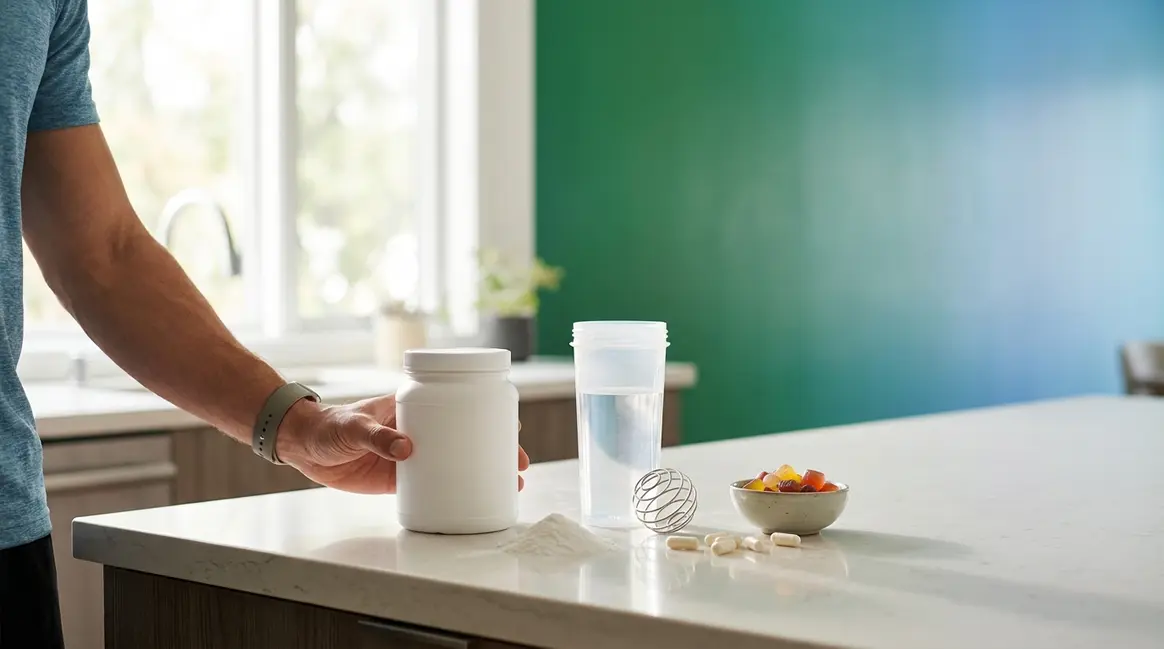
Best Creatine Supplement: Tested & Compared for Every Goal
“I’m new to creatine supplements and I’ve actually bought one already. But then I thought, is this brand good?”
That instinct is exactly right. Choosing the best creatine supplement isn’t really about brand prestige — it’s about verifying that what’s inside the container matches what the label promises. Before starting any new supplement, consult your healthcare provider, especially if you have pre-existing health conditions.
This guide ranks nine creatine options by purity, dose accuracy, and format — so you can stop second-guessing and start training. Creatine monohydrate is widely recognized as the #1 cellular energy supplement used by athletes, and every recommendation here is filtered through that lens first.


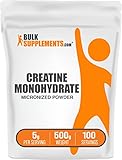


1. BulkSupplements Creatine Monohydrate Powder 1kg: Best Overall Value
Who it’s for: Budget-conscious athletes and regular gym-goers who want a no-frills, pure creatine monohydrate supply that lasts months without breaking the bank.
| Spec | Value |
|---|---|
| Form | Micronized powder |
| Serving size | 5 g (5,000 mg) |
| Servings per container | ~200 |
| Flavoring | Unflavored |
| Key certifications | Gluten-free, third-party tested, GMP facility |
| Container size | 1 kg (2.2 lbs) |
- +200 servings per kilogram container delivers one of the lowest per-serving costs in the category — independent pricing data places it at approximately $0.16 per 5 g serving
- +Micronized particle size improves dissolution rate versus standard-grind monohydrate, with an assay of ≥98% purity confirmed by BulkSupplements’ wholesale documentation
- +Unflavored profile mixes transparently into water, shakes, or juice — user consensus across fitness communities consistently highlights minimal aftertaste
- −No NSF Certified for Sport or Informed Choice badge listed — athletes in drug-tested programs who require sport-specific certification should look at certified alternatives
- −Bulk packaging does not include a scoop in all variants; measure carefully with a kitchen scale or measuring spoon to consistently hit the 5 g evidence-backed dose
How it compares: Where RAW Nutrition Creatine (#2) carries Informed Sport certification on select SKUs and appeals to brand-conscious buyers, BulkSupplements 1 kg wins decisively on cost-per-gram economics for high-volume, committed users.
2. RAW Nutrition Creatine Monohydrate Powder: Best Unflavored Powder
Who it’s for: Fitness enthusiasts and intermediate lifters who want a reputable, community-trusted unflavored creatine powder with Informed Sport certification and a straightforward 30-serving supply.
| Spec | Value |
|---|---|
| Form | Micronized powder |
| Serving size | 5 g |
| Servings per container | 30 |
| Flavoring | Unflavored |
| Key certifications | Informed Sport Certified (select SKUs) |
| Container size | 150 g |
- +Informed Sport Certified on key SKUs — a meaningful third-party banned-substance credential that BulkSupplements powder does not currently list
- +Micronized creatine monohydrate — the only form with substantial published clinical evidence for bioavailability and efficacy — at a reported purity of ~99.9% per editorial review sources
- +Unflavored formula integrates cleanly into pre-workout stacks or protein shakes, with independent reviewers noting smooth mixability and no gritty texture
- −30-serving container requires frequent repurchasing compared to the 200-serving BulkSupplements 1 kg option — a meaningful cost difference for daily users over time
- −The 30-serving size costs more per gram than larger-format alternatives; buyers committed to daily dosing will pay a premium for the smaller tub
How it compares: RAW Nutrition offers comparable purity to BulkSupplements Creatine Powder 1 kg (#1) but adds Informed Sport certification and a more recognizable fitness brand presence — better for first-time buyers who want verified credentials before committing to bulk.
3. BulkSupplements Creatine Monohydrate Powder 500g: Best Budget Starter
Who it’s for: First-time creatine users who want to trial pure, unflavored monohydrate powder at a lower upfront cost before committing to a larger container.
| Spec | Value |
|---|---|
| Form | Micronized powder |
| Serving size | 5 g |
| Servings per container | ~100 |
| Flavoring | Unflavored |
| Key certifications | Gluten-free, GMP facility |
| Container size | 500 g (1.1 lbs) |
- +Identical formula to the BulkSupplements 1 kg (#1) — same micronized monohydrate at ≥98% assay purity, half the upfront financial commitment
- +~100 servings covers a full optional loading protocol (20 g/day for 5 days) plus 75+ days of maintenance dosing at 5 g/day — enough supply to evaluate results meaningfully
- +Gluten-free, dairy-free, soy-free, and sugar-free — compatible with most dietary restrictions and supplement stacks
- −Per-gram cost is higher than the 1 kg version; upgrading to the larger container saves noticeably over a 3–6 month supplementation window
- −No sport-certification label — not suitable for athletes in drug-tested programs who require NSF or Informed Choice verification
How it compares: This is the entry-level version of BulkSupplements 1 kg (#1) — same formula, smaller quantity. If you plan to use creatine daily long-term, the 1 kg option delivers better value within weeks of consistent use.
4. Nutricost Creatine Monohydrate Powder Mandarin Orange: Best Flavored
Who it’s for: Gym-goers who find unflavored creatine difficult to take consistently and want a vegan-friendly, non-GMO flavored powder they can enjoy mixing into water post-workout.
| Spec | Value |
|---|---|
| Form | Micronized powder |
| Serving size | 5 g |
| Servings per container | 74 |
| Flavoring | Mandarin orange |
| Dietary | Vegan, non-GMO, gluten-free, third-party tested |
| Container size | 500 g |
- +Third-party tested by Nutricost’s independent lab program — a meaningful purity credential for a flavored product that also contains L-malic acid, natural flavors, sucralose, and beta carotene
- +Vegan, non-GMO, and gluten-free across the full formula — one of the broadest dietary compatibility profiles in this roundup
- +74 servings at 5 g each provides a solid 2.5-month supply at maintenance dosing, with flavor motivation supporting the daily consistency that drives results
- −Flavored formulas contain sweeteners (sucralose) and acidulants (L-malic acid); users sensitive to sugar alcohols or artificial sweeteners should check the current label carefully before purchasing
- −Mandarin orange flavor is subjective — users who prefer a neutral taste profile will find BulkSupplements (#1) or RAW Nutrition (#2) more suitable
How it compares: Unlike the unflavored BulkSupplements and RAW Nutrition powders (#1 and #2), Nutricost’s flavored option prioritizes daily adherence for users who need taste motivation. The trade-off is a slightly higher per-serving cost and the addition of sweetener ingredients.
5. BulkSupplements Creatine Monohydrate Capsules: Best Capsule Value
Who it’s for: Convenience-focused users who want the same pure BulkSupplements monohydrate in capsule form — no measuring, no mixing, no taste.
| Spec | Value |
|---|---|
| Form | Micronized capsules |
| Serving size | 7 capsules (5,000 mg) |
| Servings per container | 60 |
| Flavoring | None |
| Key certifications | Gluten-free, GMP/CGMP facility |
| Count | 420 capsules |
- +420 capsules deliver 60 full servings at 5 g each — a two-month supply at daily maintenance dosing, with each capsule containing 714 mg of pure micronized creatine monohydrate
- +Capsule format eliminates measuring, mixing equipment, and taste considerations entirely — particularly useful for users who supplement at work or while traveling
- +Same BulkSupplements monohydrate formula as the powder options (#1 and #3) — consistent purity (≥98% assay), no fillers, no sugar, no soy, no dairy
- −7 capsules per serving is a high pill burden; users who dislike swallowing multiple pills at once will find this format less practical than powder alternatives
- −No NSF or Informed Choice sport certification — not suitable for competitive athletes in drug-tested programs
How it compares: Delivers the same monohydrate as BulkSupplements Powder 1 kg (#1) in capsule form. Convenience comes at a higher per-gram cost, but the trade-off is worth it for travelers or users who genuinely dislike measuring and mixing powders daily.
6. Horbäach Creatine Monohydrate 5g: Best Non-GMO Capsule
Who it’s for: Health-conscious consumers who want a non-GMO, gluten-free creatine capsule with a precise full 5 g dose per serving and a clean label free from preservatives, artificial flavors, and sweeteners.
| Spec | Value |
|---|---|
| Form | Quick-release capsules |
| Serving size | 5,000 mg (5 g) |
| Servings per container | 45 |
| Flavoring | None |
| Key certifications | Non-GMO, gluten-free, no preservatives |
| Count | 225 capsules |
- +Non-GMO certified with a verified “free from” profile: no gluten, wheat, yeast, lactose, soy, artificial flavors, sweeteners, or preservatives — a meaningful differentiator for clean-label buyers
- +Full 5 g serving aligns precisely with the ISSN-recommended maintenance dose for muscle creatine saturation, supported by the International Society of Sports Nutrition position stand (creatine safety and ISSN position data, PMC, 2017)
- +Quick-release capsule design reduces the pill burden compared to BulkSupplements Capsules (#5) — though the exact capsule count per serving should be confirmed on the current label
- −45 servings per container means more frequent repurchasing than the BulkSupplements Capsules 420-count (#5), which delivers 60 servings
- −Per-serving cost is higher than bulk powder alternatives; the non-GMO and preservative-free credential is the primary differentiator justifying the premium
How it compares: Horbäach offers a cleaner certification story than BulkSupplements Capsules (#5) with its non-GMO and preservative-free label, but delivers fewer servings per purchase. For label-conscious buyers who prioritize ingredient sourcing over cost-per-gram efficiency, that trade-off is well-justified.
7. EFX Sports Kre-Alkalyn EFX: Best pH-Buffered Formula
No products found.
Who it’s for: Experienced supplement users curious about pH-buffered creatine who want a 60-serving capsule option with a lower pill burden, and who understand this is a proprietary form with a different evidence profile than standard monohydrate.
| Spec | Value |
|---|---|
| Form | pH-buffered capsules (Kre-Alkalyn) |
| Serving size | 2 capsules |
| Servings per container | 60 |
| Flavoring | None |
| Key attributes | Manufacturer-stated pH stability |
| Count | 120 capsules |
- +2-capsule serving size is dramatically lower pill burden than the 7-capsule BulkSupplements Capsules (#5) — a genuine convenience advantage for daily compliance
- +60 servings provides a two-month supply at standard daily dosing — competitive with BulkSupplements Capsules on supply duration
- +pH-buffering is marketed to reduce creatine-to-creatinine conversion before absorption, making it an intellectually interesting option for users who have already exhausted standard monohydrate experimentation
- −A double-blind, 28-day JISSN trial involving 36 resistance-trained individuals found that Kre-Alkalyn did not promote greater changes in muscle creatine content, body composition, strength, or anaerobic capacity compared to creatine monohydrate — the core superiority claim is not independently validated (evidence supporting creatine monohydrate efficacy, PubMed, 2022)
- −Higher cost per serving than any monohydrate capsule or powder option in this roundup — you pay a premium for a proprietary form that currently trails monohydrate in independent clinical validation
How it compares: EFX Kre-Alkalyn is the only non-monohydrate formula in this roundup. Where BulkSupplements Capsules (#5) and Horbäach (#6) deliver pure monohydrate at lower cost, Kre-Alkalyn charges a premium for a buffered form whose performance advantage has not been replicated in independent head-to-head human trials.
8. Nature’s Supplement Creatine Monohydrate 3000mg: Best Travel Size
Who it’s for: Travelers, casual gym-goers, or beginners who want a compact, portable creatine capsule with a lower per-dose commitment to ease gently into supplementation.
| Spec | Value |
|---|---|
| Form | Micronized capsules |
| Serving size | 3,000 mg (3 g) per 4 capsules |
| Servings per container | 30 |
| Flavoring | None |
| Key certifications | Non-GMO, gluten-free |
| Count | 120 capsules |
- +Compact 120-capsule bottle travels easily — fits in a gym bag or carry-on without the bulk of larger containers
- +Non-GMO and gluten-free with a clean excipient profile (hypromellose vegetable capsule, silicon dioxide, vegetable magnesium stearate) — suitable for users avoiding animal-derived gelatin capsules
- +3 g dose per serving falls within the 3–5 g/day maintenance range supported by research for healthy adults, per creatine dosing guidelines for healthy aging (NIH/PMC, 2024)
- −3 g per serving sits at the lower end of the evidence-backed 3–5 g maintenance range; users targeting the full 5 g dose will need to take additional capsules, which negates some of the convenience advantage
- −Only 30 servings per container — the shortest supply in this roundup by a significant margin, making it impractical as a primary creatine source for consistent daily users
How it compares: Nature’s Supplement provides fewer servings and a lower per-dose creatine load than Horbäach (#6) or BulkSupplements Capsules (#5). It suits casual users or frequent travelers rather than athletes following a structured daily protocol who need reliable 5 g dosing.
9. Creatine Monohydrate Gummies: Best Chewable Pick
Who it’s for: Adults who dislike swallowing capsules or mixing powders and want the most convenient, lowest-barrier entry into creatine supplementation via a chewable, mixed-fruit gummy format with added taurine.
| Spec | Value |
|---|---|
| Form | Chewable gummies |
| Count | 160 gummies |
| Flavor | Mixed fruit |
| Added ingredients | Taurine |
| Key attributes | Low sugar |
| Serving size | Per label (verify creatine mg per serving before use) |
- +Chewable gummy format removes every barrier to daily use — no mixing, no measuring, no swallowing capsules — making this the highest-convenience delivery method in the roundup
- +Low-sugar formulation reduces added sugar concerns compared to standard gummy supplements; taurine inclusion may support cellular hydration alongside creatine’s well-documented water-retention mechanism
- +160 gummies provides a generous count that supports extended daily use, assuming the per-serving creatine dose meets your daily target
- −Gummy delivery formats vary widely in creatine concentration per piece — verify the exact creatine mg per serving on the current label against the 3–5 g/day maintenance target before purchasing, as some gummy products deliver as little as 1.5–2 g per serving
- −This is the newest product in the roundup with the least independent review history; buyers prioritizing clinical precision over convenience should choose a powder or capsule with a verified dose
How it compares: The Creatine Gummies are the most convenient delivery format in this roundup but offer the least dosing certainty. For users who need a confirmed 5 g daily dose, BulkSupplements Powder 1 kg (#1) or RAW Nutrition Powder (#2) remain more reliable. The gummies earn their place for supplement-averse users who simply won’t take anything else consistently.
Buying Guide: How to Choose the Best Creatine Supplement
The best creatine supplement decision comes down to four criteria: form, format, purity verification, and dosing protocol. The Purity-First Protocol is the principle that pure creatine monohydrate — verified by third-party testing and taken consistently at 3–5 g/day — outperforms any proprietary blend at any price point. Brand prestige is secondary. Purity comes first.
Which Form of Creatine Is Actually Best?
Creatine monohydrate is the gold standard, and the evidence is not close. It is the only form with decades of randomized controlled trials confirming bioavailability, strength gains, lean mass increases, and long-term safety. No alternative form has replicated its performance in independent head-to-head trials, according to evidence supporting creatine monohydrate efficacy (PubMed, 2022).
| Form | Evidence Level | Dose/Serving | Best For |
|---|---|---|---|
| Monohydrate | Highest — decades of RCTs | 3–5 g/day | Everyone |
| Kre-Alkalyn (buffered) | Limited independent validation | ~1.5 g/day | Curiosity only |
| Creatine HCl | Minimal comparative RCTs | ~1–2 g/day | Not recommended over mono |
| Ethyl Ester | Evidence of inferior bioavailability | 5 g/day | Avoid |
The Kre-Alkalyn superiority claim deserves a direct answer: a 2012 double-blind JISSN trial with 36 resistance-trained participants found no significant differences in muscle creatine content, body composition, strength, or anaerobic capacity between Kre-Alkalyn and standard creatine monohydrate. The pH-buffering advantage has not been independently replicated. For most people, standard or micronized monohydrate at 3–5 g/day is the only form worth buying.
Powder, Capsules, or Gummies: Which Format Fits Your Life?
Format is a practical decision, not a quality one. All three deliver creatine monohydrate to your muscles — what changes is your daily consistency. Research consistently shows that total daily intake matters far more than timing or delivery method.
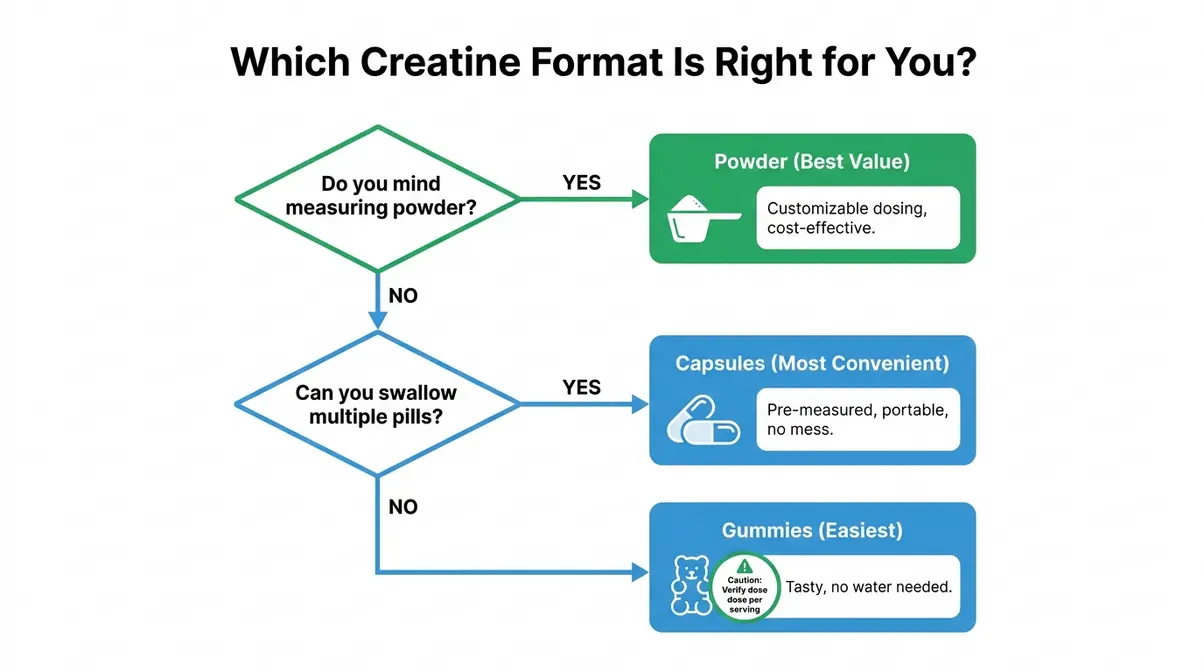
- Powder offers the lowest cost per gram and easiest dose adjustment — best for daily users who don’t mind a 30-second mixing step
- Capsules eliminate measuring entirely, but pill burden varies dramatically: BulkSupplements Capsules (#5) require 7 pills per 5 g serving versus just 2 for Kre-Alkalyn (#7)
- Gummies provide the highest convenience but the lowest dosing precision — always verify the creatine mg per serving against your daily target before buying
Understand creatine dosing and timing for maximum results
Purity, Third-Party Testing, and the Kidney Test Myth
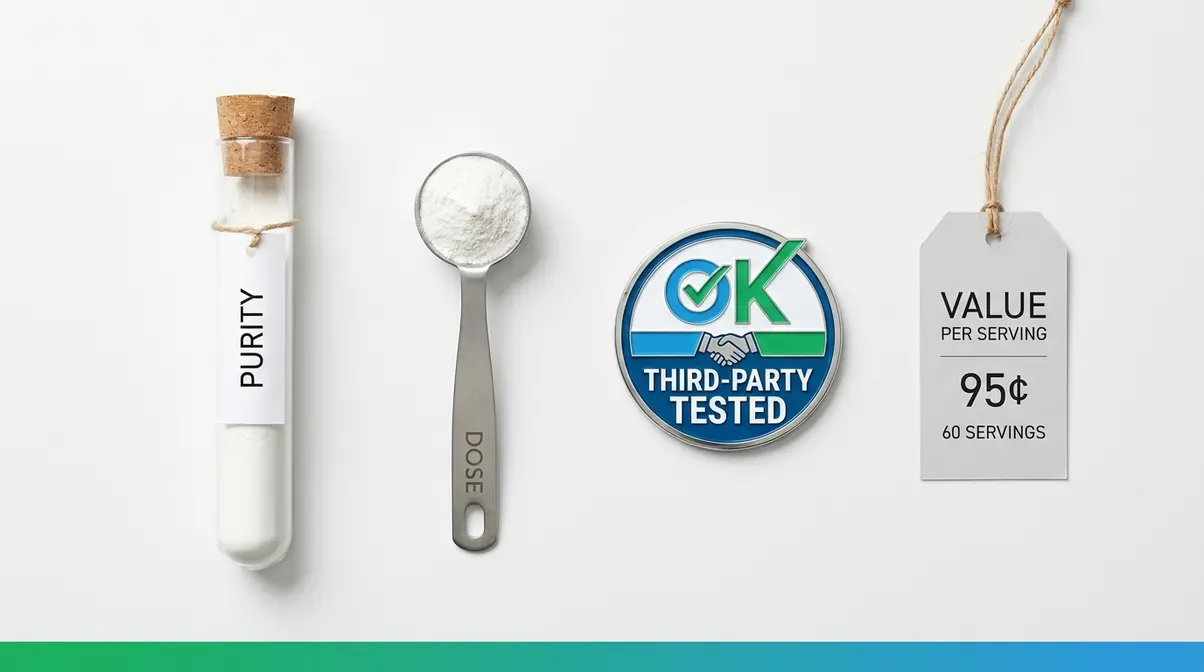
When evaluating any creatine product, look for three label signals: NSF Certified for Sport, Informed Choice, or the Creapure trademark. These certifications indicate independent testing for banned substances, heavy metals, and label accuracy. Of the nine products reviewed here, RAW Nutrition (#2) holds Informed Sport certification on key SKUs — a meaningful differentiator for athletes in tested sports.
Now for the question most competitors avoid: creatine supplementation causes a measurable rise in serum creatinine on standard blood panels. Many people — and some clinicians — mistake this for kidney damage. It is not. Creatinine is a normal byproduct of creatine metabolism, and its elevation during supplementation is a predictable, benign physiological response. According to research on creatine and kidney function (PMC, 2021), recommended doses of creatine supplementation show no adverse effects on kidney or renal function in healthy individuals. Furthermore, long-term studies on creatine supplementation (PubMed, 2018) found that supplementation from 5 days to 5 years at 5–30 g/day had no significant effects on glomerular filtration rate in healthy athletes. If your doctor raises a concern based on a creatinine reading during supplementation, share this context — and confirm you have no pre-existing kidney conditions.
Explore creatine’s role in muscle gain and bodybuilding
Who Should Take Creatine: Men, Women, and Older Adults
Creatine’s benefits extend well beyond the gym-bro stereotype. Research from the International Society of Sports Nutrition and NIH sources supports its use across multiple populations:
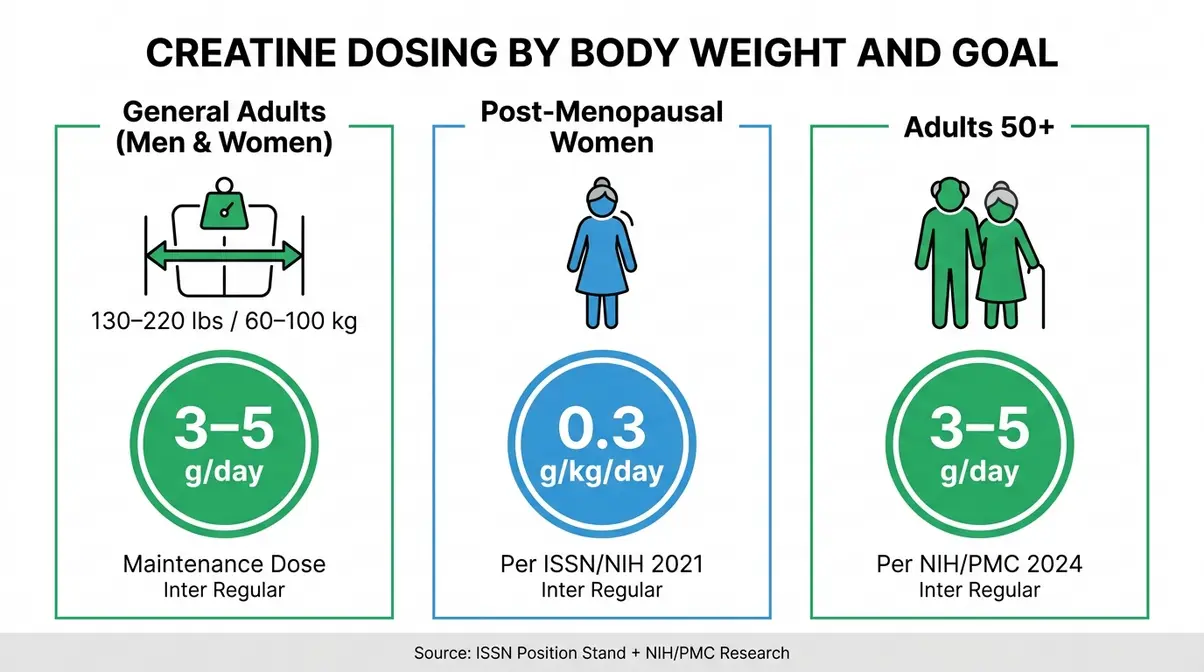
- Men: Standard 3–5 g/day is well-validated for strength, power output, and hypertrophy across hundreds of randomized controlled trials — the most thoroughly studied dosing window in sports nutrition
- Women: The same 3–5 g/day dosing range is safe and effective. Post-menopausal women may benefit at 0.3 g/kg/day for skeletal muscle size and function, with favorable effects on bone health when combined with resistance training, per creatine benefits for post-menopausal women (NIH/PMC, 2021)
- Older adults (50+): Evidence indicates 3–5 g/day of creatine monohydrate can safely and effectively enhance exercise performance in older adults, per creatine dosing guidelines for healthy aging (NIH/PMC, 2024). Additionally, approximately 8 g/day combined with resistance training three times per week attenuated bone mineral density loss at the femoral neck in postmenopausal women over 12 months, per creatine and bone mineral density in older adults (NIH/PMC, 2019)
Explore creatine and HMB for enhanced muscle growth
How We Evaluated
Products were evaluated against four criteria: (1) creatine form and dose accuracy, (2) format convenience (powder, capsule, gummy), (3) third-party certification and label transparency, and (4) value per serving. Specifications were verified against current Amazon product listings and independent review sources. Prices and product details are subject to change — confirm current listing details before purchasing.
Frequently Asked Questions
Which brand of creatine is most effective?
The most effective creatine brands are those delivering pure, accurately dosed creatine monohydrate — the only form with decades of clinical validation. Brand reputation matters less than two factors: form (monohydrate only) and third-party testing (NSF Certified for Sport or Informed Choice). BulkSupplements, RAW Nutrition, and Nutricost are among the brands in this guide that meet the monohydrate standard. If sport-certification is required for a drug-tested program, verify the specific product’s current certification status before purchasing.
Which form of creatine is most effective?
Creatine monohydrate is overwhelmingly the most effective form. It is the most extensively studied type of creatine, with randomized controlled trials spanning decades confirming its ability to increase muscle phosphocreatine stores, improve strength output, and support lean mass gains. No alternative form — including HCl, ethyl ester, or buffered variants like Kre-Alkalyn — has demonstrated superior efficacy in independent head-to-head trials. For most people, standard or micronized monohydrate at 3–5 g/day is the only form worth purchasing.
What should you avoid when taking creatine?
Avoid dehydration — creatine draws water into muscle cells, so inadequate fluid intake can cause cramping or discomfort. Avoid exceeding the recommended 3–5 g/day maintenance dose without clinical guidance, as higher doses do not accelerate results but may increase gastrointestinal distress in sensitive individuals. Avoid proprietary blends where the creatine dose is hidden inside a “blend” total — you need to verify exactly how many grams of creatine monohydrate you’re actually receiving per serving. Caffeine co-ingestion at very high doses may partially blunt creatine’s phosphocreatine-loading effect in some individuals, though evidence on this interaction is mixed.
Should I cycle on and off creatine?
Cycling creatine is unnecessary for most users. The International Society of Sports Nutrition’s position stand does not recommend mandatory cycling, as creatine monohydrate is safe for continuous long-term use in healthy adults. Stopping supplementation causes muscle creatine stores to return to baseline within 4–6 weeks, eliminating the performance benefit you’ve built up. Some users choose to take brief breaks, but there is no clinical evidence that cycling improves outcomes or reduces any risk. Simply maintain 3–5 g/day consistently for sustained results.
Why do doctors sometimes advise against creatine?
Doctors raise concerns about creatine primarily because supplementation causes a benign rise in serum creatinine — a standard kidney function marker — which can look alarming on a routine blood panel. This is a normal physiological response, not kidney damage, in healthy individuals. Research covering supplementation periods from 5 days to 5 years found no adverse effects on glomerular filtration rate in healthy athletes. However, anyone with pre-existing kidney disease, liver conditions, or who takes medications affecting kidney function should consult their physician before supplementing, as the evidence base applies specifically to healthy adults.
Conclusion
For active adults comparing creatine options, the best creatine supplement is consistently the one delivering pure, accurately dosed creatine monohydrate — verified by third-party testing and taken at 3–5 g/day without interruption. Research from the NIH and ISSN confirms this dosing window is safe and effective across populations including men, women, and adults over 50. The format — powder, capsule, or gummy — matters only insofar as it determines whether you’ll actually take it every day.
The Purity-First Protocol cuts through the noise: before evaluating a brand, evaluate the form and the testing credentials. A no-frills micronized monohydrate powder from a GMP-certified facility will outperform any proprietary blend at any price point, because the active ingredient is identical and the science behind it is settled.
Start with BulkSupplements Creatine 1 kg (#1) if cost-per-serving is your priority, RAW Nutrition (#2) if third-party certification matters most, or Nutricost Mandarin Orange (#4) if daily compliance is your challenge. Explore the best protein powder for muscle gain to pair with your creatine protocol and accelerate your results further.
Related posts:
Delayed Onset Muscle Soreness (DOMS): Complete Guide
How Many Calories to Lose Fat While Lifting? (2026)
Time Under Tension: Does It Really Matter for Muscle Growth?
12 Signs Your Muscles Are Growing (Science-Backed Guide)
Fast Twitch vs Slow Twitch Muscle Fibers: 2026 Guide
How Sleep Affects Muscle Growth: The Ultimate 2026 Guide

Callum
Hi, I'm Callum, the founder of Body Muscle Matters. I'm not a certified trainer, I'm a self taught lifter who started this site to share what I've learned from my own training and a lot of trial and error. Everything here comes from real experience and honest research, written the way I'd explain it to a friend who is just getting started. My goal is simple: practical, no hype fitness advice you can actually use.