Incline Dumbbell Press Benefits: Why It Builds Upper Chest
You train your chest consistently — flat bench, cable crossovers, push-ups — yet your upper chest still looks flat. The area just below your collarbone barely exists, and no amount of standard pressing seems to fix it.
That blunt observation captures something real. Without directly targeting the clavicular pecs (the upper portion of the pectoralis major muscle), flat pressing alone leaves a visible gap that undermines an otherwise solid physique. This guide breaks down the science-backed incline dumbbell press benefits, shows you the exact bench angle EMG research recommends, and gives you a step-by-step form guide ready to use at your next session.
⚠️ Fitness Disclaimer: The information in this article is for educational purposes only and does not constitute medical or fitness advice. Consult a qualified healthcare professional or certified personal trainer (CPT) before beginning any new exercise program, especially if you have a history of shoulder, joint, or musculoskeletal issues.
The incline dumbbell press targets the upper chest (clavicular pecs) — the most underdeveloped muscle group in most lifters — and a 30° bench angle maximizes this activation, according to NIH electromyographic research (PMC, 2020).
- Upper chest focus: Targets the clavicular head that flat pressing largely misses
- Shoulder safety: The Shoulder-Safe Press Zone (30°–45°) reduces impingement risk vs. overhead pressing
- Symmetry fix: Unilateral loading corrects left-right strength imbalances
- Greater range of motion: Dumbbells allow a deeper stretch than a barbell for better muscle growth
- Beginner-friendly: No spotter needed — you can safely lower weights to your sides
Incline Dumbbell Press Benefits: The Research
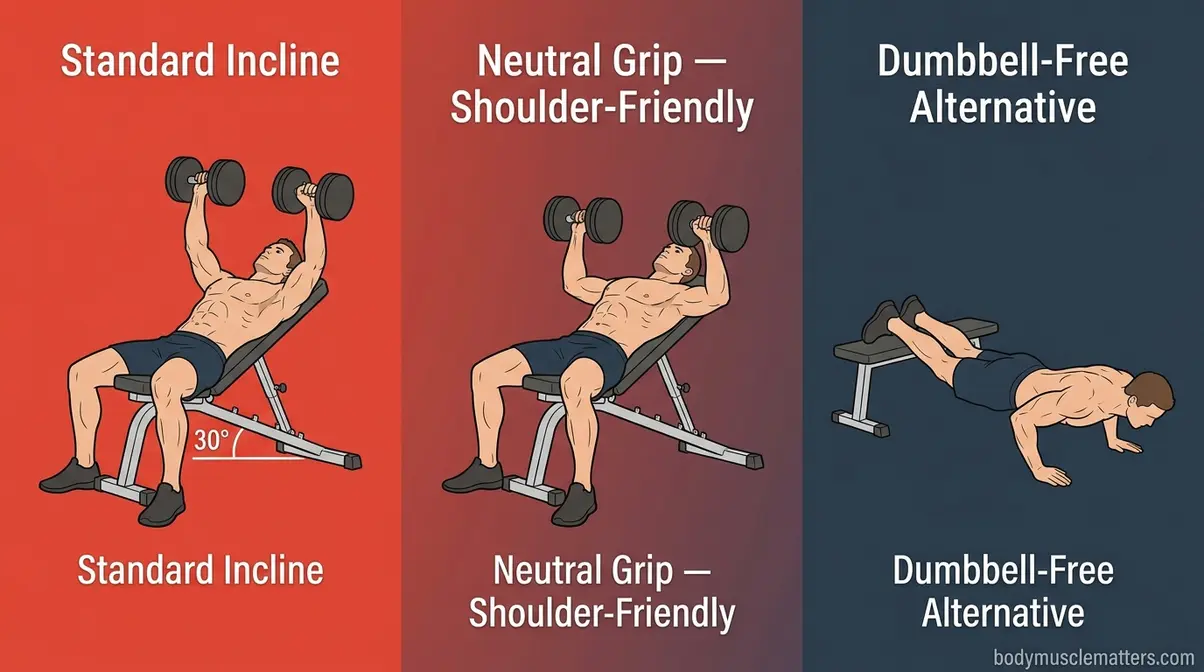
The incline dumbbell press — a chest exercise performed on an angled adjustable bench using free weights — is one of the most efficient upper-body exercises available. Yet most beginner programs bury it under flat bench variations and ignore it entirely. That’s a costly mistake. To fully understand the benefits of the incline dumbbell press, you must look at how it forces the body to adapt under unique angles and stabilization requirements.
A 30° bench incline activates the clavicular (upper) pectoralis major significantly more than a flat bench, according to peer-reviewed EMG research (PubMed, 2015).
Muscles Worked: Upper Chest & Delts
The incline dumbbell press recruits three primary muscle groups simultaneously, each playing a distinct role in pressing mechanics and overall upper-body development.
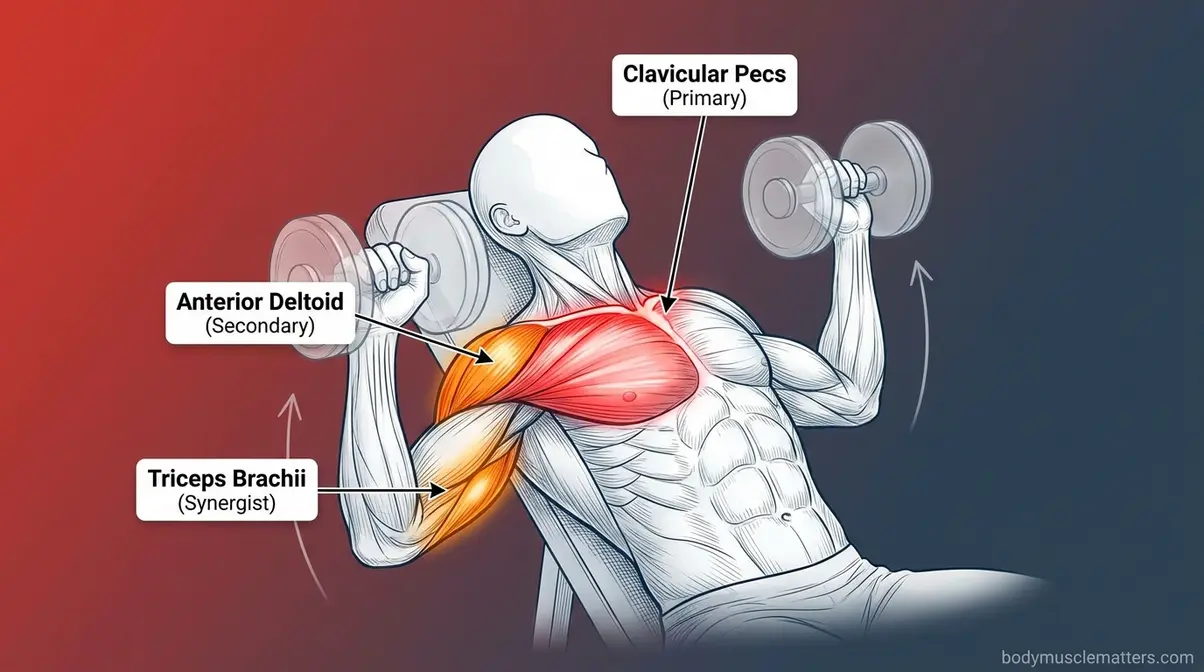
The clavicular head — the upper portion of the pectoralis major muscle — is the primary target. Research published in the Journal of Human Kinetics (PMC, 2020) examined five bench inclinations and found that a 30° angle produced the greatest activation of the upper pectoralis major. What this means for your physique: the upper chest is like the top shelf of a bookcase — without it, the whole structure looks incomplete, no matter how developed the lower portion is.
The anterior deltoid — commonly called the front delt — works as a secondary mover. At incline angles, the front delt contributes more than it does during flat pressing, which is why the incline feels harder on your shoulders when you first attempt it. A 2015 PubMed study found that bench angles of 30° and 45° produced higher mid-contraction activation (122–124% MVIC) compared to flat pressing (98% MVIC), with the difference concentrated in the upper chest and front delt (PubMed, 2015).
The triceps brachii (the three-headed muscle on the back of your upper arm) handles elbow extension throughout every rep. They’re not the focus here, but they’re working hard — which is why incline pressing also builds pressing strength that transfers to other movements like overhead presses and dips.
5 Incline Dumbbell Press Benefits
Here are the five core incline dumbbell press benefits that make this exercise worth prioritizing in your routine:
- Targets the clavicular pecs directly. Flat pressing emphasizes the sternocostal head (the lower, broader portion of the pec). The incline angle shifts demand upward to the clavicular head — the muscle that creates the “shelf” appearance across the top of your chest. EMG research confirms this shift is significant at 30°–45° (PMC, 2020).
- Operates within the Shoulder-Safe Press Zone. The Shoulder-Safe Press Zone is the 30°–45° incline range where upper chest activation peaks while shoulder impingement risk remains low. Angles above 60° begin transferring load to the anterior deltoid and narrow the subacromial space — the gap in the shoulder joint — increasing impingement risk. The incline dumbbell press at 30°–45° keeps you in the safe zone by design.
- Greater range of motion than a barbell. Dumbbells allow each arm to move independently, letting you lower the weights further and achieve a deeper stretch at the bottom of each rep. Research on muscle hypertrophy (growth) consistently shows that training through a full range of motion produces greater muscle development than partial-range movements.
- Corrects left-right strength imbalances. Because each arm works independently, your dominant side cannot compensate for the weaker one — a common problem with barbell pressing. Unilateral loading forces both sides to develop at the same rate, improving symmetry over time. This functional balance translates directly to better athletic performance and injury prevention.
- No spotter required. Unlike a barbell, you can safely drop dumbbells to your sides if you reach failure. This makes the incline dumbbell press one of the most beginner-friendly chest exercises for training alone, allowing you to push closer to muscular failure safely.
Is the Incline Press Enough?
The honest answer: it can be, but it works best as part of a balanced chest program. The incline press may help develop the clavicular pecs more efficiently than almost any other exercise, but the sternocostal head (the sternal ones — the lower, wider portion of the pec) responds better to flat and decline pressing.
Research suggests that alternating between barbell and dumbbell pressing patterns varies the stabilization demands on the pectoralis major, creating a more complete training stimulus (PubMed, 15903389). Because dumbbells require immense micro-adjustments from your rotator cuff and serratus anterior to keep the weights from drifting, they build functional stability that barbells simply cannot replicate. What this means practically: use the incline dumbbell press as your primary upper-chest builder, then add flat pressing for the sternal head. That combination covers the full muscle and produces the most complete, aesthetic upper body.
For beginners, two sessions per week — one incline-focused, one flat-focused — is sufficient to drive meaningful upper chest growth over 8–12 weeks.
How to Do the Incline Dumbbell Press: Step-by-Step
Proper technique is what separates effective upper chest training from shoulder injuries. Follow this framework exactly before adding any significant weight. Learning how to avoid injury when exercising starts with mastering these foundational setup cues.
Before You Start: Equipment and Setup
Estimated time: 5-10 minutes
- Tools/Materials:
- An adjustable bench
- A pair of dumbbells (start lighter than you think)
- A clear rack path
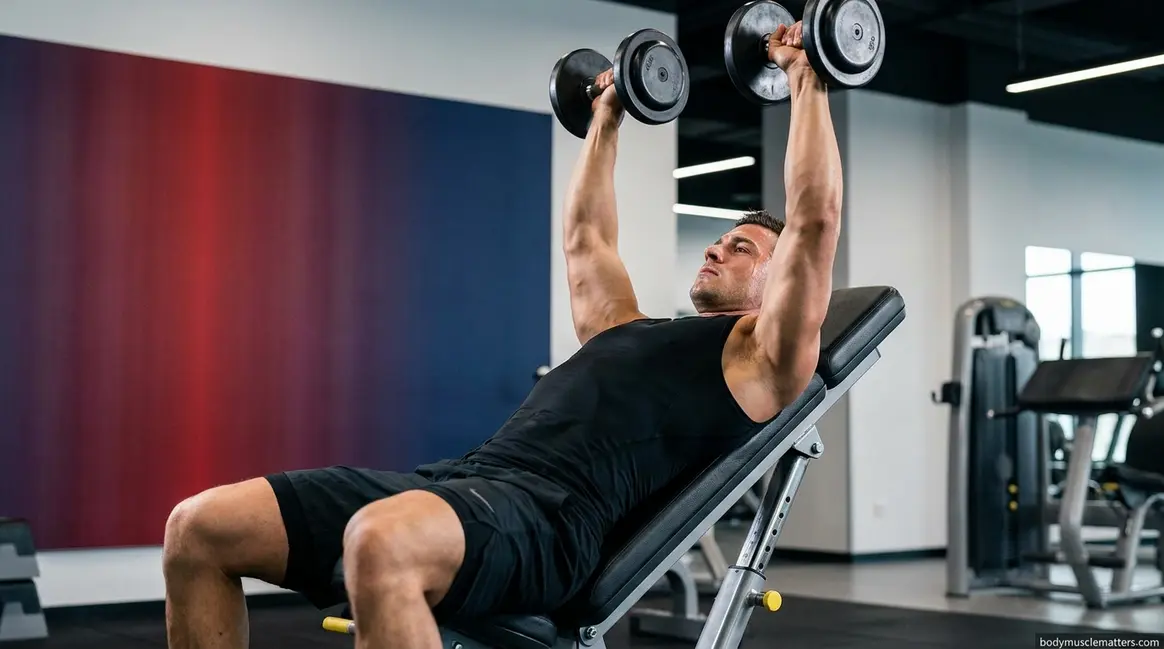
Bench angle: Set the bench to 30°–45°. Most commercial gym benches have fixed notches — aim for the second or third setting from flat. Avoid anything above 60°, which turns the movement into a shoulder press.
Dumbbell selection: For your first session, choose a weight you can press for 12–15 clean reps. This is lighter than your flat bench dumbbells. If you can press 50 lb dumbbells flat, start with 35–40 lb on incline.
Foot position: Both feet flat on the floor. If the bench is too high and your feet dangle, use weight plates as a platform. Foot contact with the floor is critical for stability.
Step-by-Step: How to Perform Each Rep
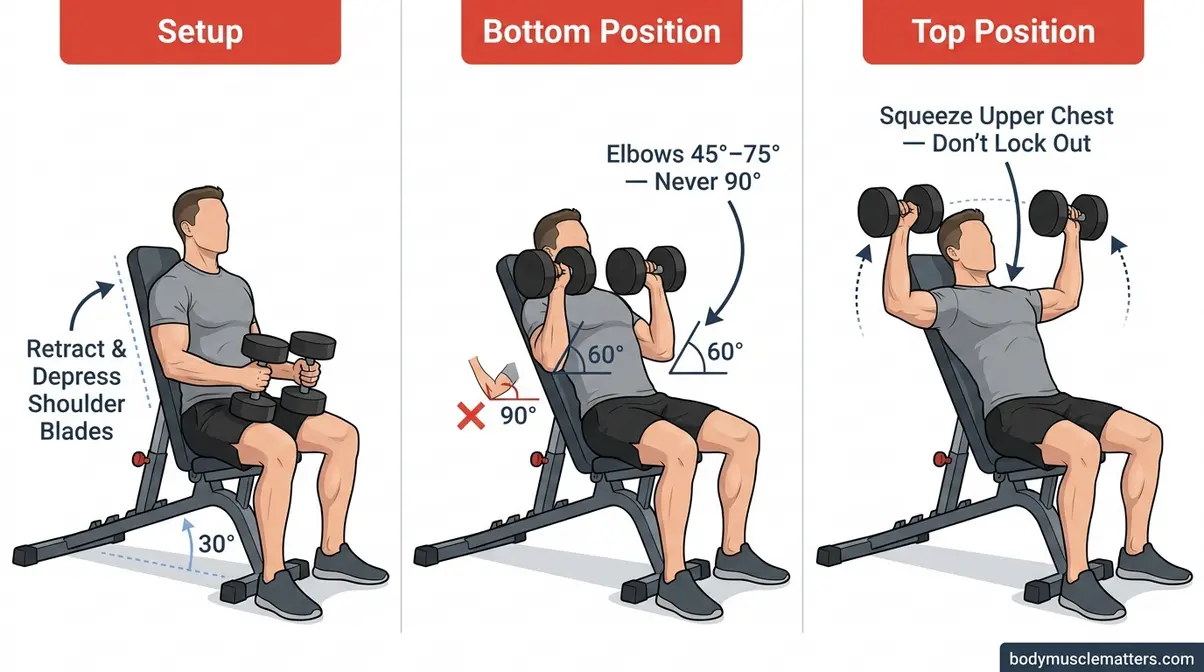
Follow these steps in order:
Step 1: Sit on the inclined bench with dumbbells resting on your thighs.
Use a knee kick to help bring each dumbbell to the starting position at shoulder height. Your palms should face forward (pronated grip).
Step 2: Set your shoulder blades.
Before pressing, retract and depress your scapulae — pull your shoulder blades together and down, as if tucking them into your back pockets. This creates a stable pressing platform and protects the shoulder joint. Hold this position throughout the entire set.
Step 3: Lower the dumbbells in a controlled arc.
Bring them down to chest level — roughly in line with your upper chest — with your elbows at approximately 45°–75° from your torso. Never let your elbows flare out to 90°; that position places maximum stress on the anterior shoulder capsule.
Step 4: Pause briefly at the bottom.
The dumbbells should be at or just below your upper chest level. You should feel a stretch across the clavicular pecs. Do not bounce out of the bottom position — a controlled pause builds more muscle and protects the shoulder.
Step 5: Press the dumbbells upward and slightly inward.
Drive them up and toward each other in a slight arc, stopping just before your elbows lock out. Fully locking out shifts load to the joints instead of the muscle. Squeeze your upper chest at the top of each rep for 1 second.
Step 6: Breathe correctly.
Inhale on the way down, exhale forcefully as you press up. Controlled breathing stabilizes your core and trunk throughout the movement.
Step 7: Lower with control.
Take 2–3 seconds to lower the weight. The eccentric (lowering) phase is where significant muscle damage — and therefore growth — occurs. Dropping the weight fast wastes half the exercise.
The 30° vs. 45° Bench Angle Debate
This is the most important technical question in incline pressing, and it’s one that almost every competitor article completely avoids answering with data.
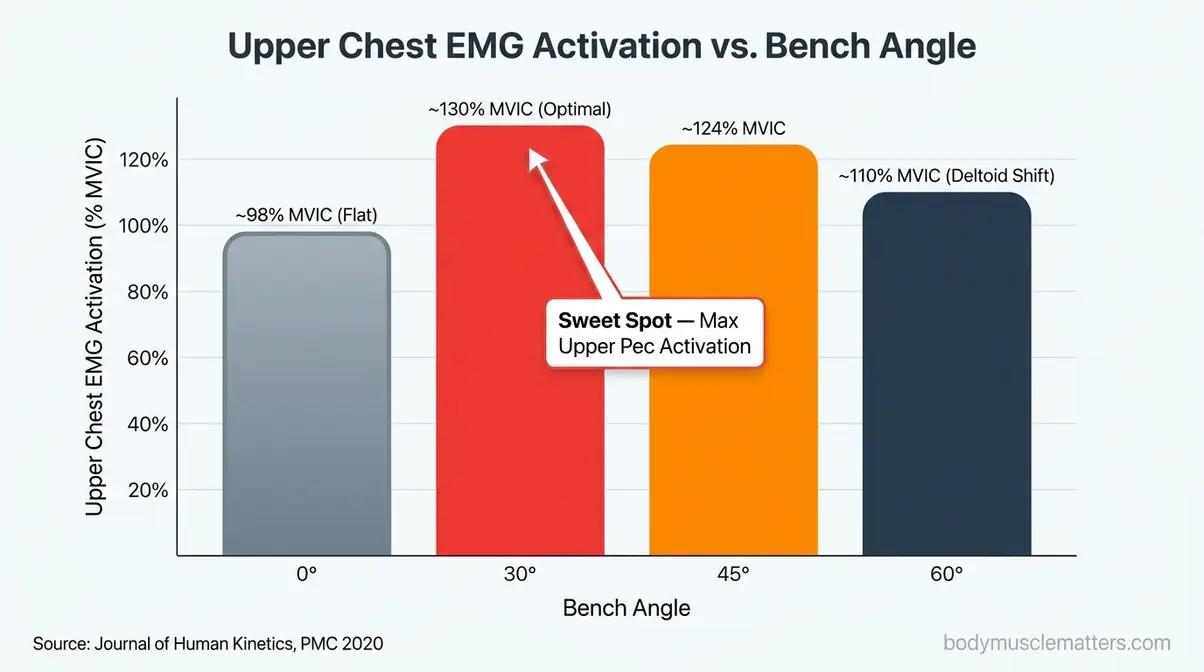
A 2020 NIH study published in the Journal of Human Kinetics examined five bench inclinations and produced a clear finding: a 30° incline produced the greatest activation of the upper pectoralis major, while angles greater than 45° began shifting load to the anterior deltoid rather than adding upper chest work (PMC, 2020).
A separate 2015 PubMed study supports this, showing that 30° and 45° inclines produced comparable upper chest activation — both significantly higher than flat pressing — but that 30° kept front delt involvement lower, preserving more of the stimulus for the clavicular pecs.
The practical verdict: Start at 30° if your goal is maximum upper chest activation with minimum front delt fatigue. Use 45° if you want a harder overall pressing stimulus that challenges both the upper chest and the front delts. Avoid angles above 45° for chest training — they progressively convert the movement into an overhead press variation.
This is the core of The Shoulder-Safe Press Zone: staying between 30° and 45° gives you the highest clavicular pec activation while keeping the shoulder joint in a mechanically safe position.
Common Mistakes to Avoid
Elbows flared too wide. This is the most common form error and the leading cause of shoulder pain during incline pressing. Keep elbows at 45°–75° from your torso — not 90°. Wide elbows maximize anterior shoulder stress while reducing pec activation. A narrower elbow path is both safer and more effective.
Bench angle set too high. Many lifters set the bench at 60° or higher because it “feels more like an upper chest exercise.” EMG research shows the opposite — higher angles shift activation to the front delts and away from the clavicular pecs. If you’re using a 60° bench, you’re doing a shoulder press with extra steps.
Bouncing out of the bottom. Using momentum from the bottom position eliminates the stretch reflex benefit and dramatically increases shoulder impingement risk. Control the descent, pause briefly, then press.
Not retracting the scapulae. Pressing with rounded shoulders removes the stable base your rotator cuff needs to function properly. Poor scapular control is a primary cause of shoulder impingement during pressing movements (Elite HP, 2026).
Going too heavy too soon. The incline dumbbell press requires more shoulder stability than flat pressing. Beginners who load aggressively before mastering the movement pattern consistently develop anterior shoulder pain within 4–6 weeks. Start lighter, build the pattern, then add weight.
Incline Dumbbell Press Variations and Alternatives
Once you’ve mastered the standard incline dumbbell press, these variations can break through plateaus, address different muscle emphases, or work around equipment limitations. If you are following a beginner dumbbell workout plan, these alternatives provide excellent ways to continually challenge your muscles without overtaxing your joints.
Neutral Grip Incline Dumbbell Press
The neutral grip variation uses a hammer grip — palms facing each other — instead of the standard pronated (palms-forward) grip. This small change significantly reduces stress on the anterior shoulder capsule, making it the best incline variation for lifters with a history of shoulder discomfort.
The neutral grip also shifts slightly more emphasis to the long head of the triceps. If your shoulders ache during standard incline pressing but you still want the upper chest benefits, the neutral grip incline dumbbell press is your go-to alternative.
Low Incline Dumbbell Press
The low incline variation — typically set between 15° and 25° — sits between a flat press and a standard incline. Research suggests this angle may offer a favorable balance between upper and lower pec activation, making it useful for lifters who want more upper chest stimulus without fully abandoning sternal head involvement.
The low incline is also easier to stabilize than a 45° press, making it a good entry point for beginners who find the standard incline angle difficult to control.
Incline Chest vs. Shoulder Press
These two exercises look similar but target completely different muscles. The incline chest press (what this article covers) uses a 30°–45° angle with the goal of targeting the clavicular pecs. The incline dumbbell shoulder press typically uses a 75°–90° angle and primarily trains the anterior and medial deltoids.
The key difference is elbow path and intention. In the chest press, elbows move in a controlled arc toward the chest. In the shoulder press, the elbows drive straight up, overhead. Using a chest press angle for shoulder work — or vice versa — reduces effectiveness for both goals.
Best Dumbbell-Free Alternatives
When dumbbells aren’t available, these three exercises cover the same upper chest demand:
- Incline barbell press — The closest direct alternative. Less range of motion but allows heavier loads. Set the bench to 30°–45° and apply the same elbow-angle rules.
- Decline push-up — Elevate your feet on a bench or step (often confused with incline push-ups, elevating the feet actually targets the upper chest). The angle shifts demand toward the clavicular pecs, making this a genuinely effective bodyweight option. Ensure your core stays tight and your hands are placed just outside shoulder width.
- Cable incline fly — Set a cable pulley to the low position, place an incline bench in the middle, and press upward at an incline angle. Cables maintain constant tension throughout the range of motion, which some research suggests may enhance muscle activation at the top of the rep where dumbbells typically lose tension.
What are the top 3 chest exercises?
The top three chest exercises for most lifters are the incline dumbbell press, the flat barbell bench press, and the cable chest fly. The incline dumbbell press targets the clavicular pecs and corrects upper chest underdevelopment. The flat barbell bench press builds overall chest mass and pressing strength through the sternocostal head. The cable chest fly adds constant tension through the full range of motion, enhancing the stretch stimulus for hypertrophy. Together, these three cover the chest comprehensively.
How Much Weight for Incline Dumbbell Press?
One of the most common questions from new lifters: am I lifting enough? Here’s how to benchmark your performance honestly and ensure you are progressing correctly. Applying progressive overload for muscle growth is essential once you move past the beginner phase.
Strength Standards by Experience Level
Based on aggregated performance data from Strength Level and Fitness Volt (2026), here are the incline dumbbell press standards for men (per dumbbell, 1RM equivalent):
| Experience Level | Per Dumbbell (Men) | Per Dumbbell (Women) | What It Means |
|---|---|---|---|
| Beginner | 20–35 lb | 10–20 lb | Stronger than ~5–20% of lifters |
| Novice | 36–55 lb | 21–35 lb | Stronger than ~20–35% of lifters |
| Intermediate | 56–90 lb | 36–55 lb | Stronger than ~50% of lifters |
| Advanced | 91–120 lb | 56–75 lb | Stronger than ~80% of lifters |
| Elite | 120+ lb | 75+ lb | Stronger than ~95% of lifters |
Sources: Strength Level, 2026; Fitness Volt, 2026
Is 70 lbs a Good Incline Dumbbell Press?
Pressing 70 lb dumbbells on the incline is a solid, respectable number that places you firmly in the novice-to-intermediate category. According to Strength Level data (2026), the average male lifter posts an intermediate 1RM of approximately 87 lb per dumbbell — placing 70 lb in the solid novice-to-intermediate range, stronger than roughly 35–45% of male lifters. For women, 70 lb per dumbbell is an advanced lift.
If you’re hitting 70 lb with clean form and full range of motion, your next target is 85–90 lb. Breaking through this plateau often requires micro-loading (using 1.25 lb magnetic add-on weights) or shifting your rep ranges. Try working in the 5-8 rep range for a few weeks to build raw strength before returning to the 8-12 hypertrophy range.
How to Choose Your Starting Weight
A practical rule: your incline dumbbell starting weight should be approximately 70–75% of your flat dumbbell press weight. If you press 50 lb dumbbells flat with good form, start at 35–40 lb on the incline.
Apply progressive overload — add 2.5–5 lb per dumbbell every 1–2 weeks when you can complete your target reps with full control. For hypertrophy (muscle growth), most research supports working in the 8–15 rep range. Beginners should start at the higher end (12–15 reps) to develop the movement pattern before adding load.
Incline Dumbbell Press vs. Flat and Barbell Press
Understanding how the incline dumbbell press fits against other pressing variations helps you build a smarter program — not just a longer one. When selecting compound exercises for strength, knowing the exact biomechanical differences dictates your results.
Dumbbells vs. Barbell for Incline Press
Both tools build upper chest muscle, but they do it differently.
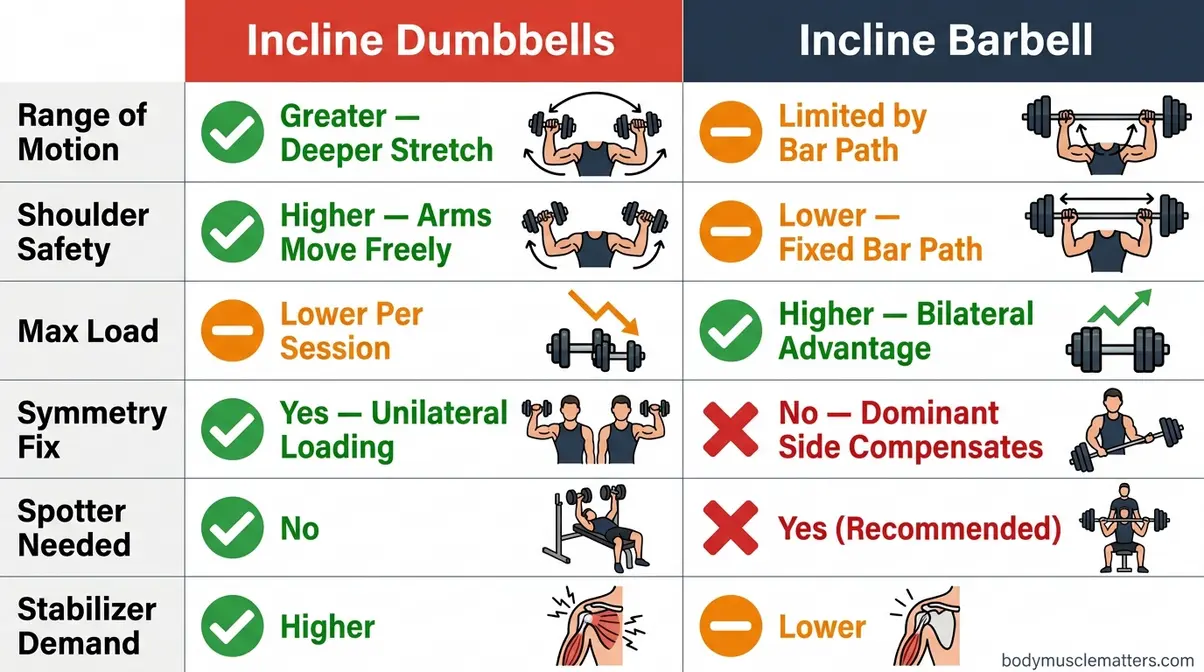
| Factor | Incline Dumbbells | Incline Barbell |
|---|---|---|
| Range of motion | Greater — deeper stretch | Limited by bar path |
| Shoulder safety | Higher — arms move freely | Lower — fixed bar path |
| Max load capacity | Lower per session | Higher — bilateral advantage |
| Symmetry correction | Yes — unilateral | No — dominant side compensates |
| Spotter required | No | Yes (recommended) |
| Stabilizer demand | Higher | Lower |
The stabilizer demand difference matters: alternating between barbell and dumbbell incline pressing varies the stabilization demands on the pectoralis major, creating a more complete training stimulus than using either tool exclusively (PubMed, 15903389). Using both across your training week is the most complete approach.
Incline vs. Flat Press Differences
The flat bench press targets the sternocostal head of the pectoralis major — the lower, broader portion — while the incline press targets the clavicular head (upper portion). Research confirms that flat bench press produces the highest EMG signal for the sternocostal pec, while inclining to approximately 30°–44° maximizes clavicular activation (PMC, 2020).
Neither exercise is superior — they train different parts of the same muscle. A physique built on flat pressing alone develops the lower chest but leaves the upper portion visually incomplete. A program built exclusively on incline pressing neglects the sternal pec and limits overall chest mass.
What is 225 bench equivalent to dumbbell press?
A 225 lb barbell bench press is roughly equivalent to pressing 85–100 lb dumbbells per hand on a flat bench, though this varies by individual. Dumbbells require significantly more stabilizer activation, so most lifters handle 75–80% of their barbell load when switching to dumbbells. On the incline, that number drops further — expect to press approximately 60–75% of your flat barbell max per dumbbell. So a 225 lb flat bencher might expect to incline dumbbell press around 70–80 lb per hand at a comparable effort level.
Which One Should You Prioritize?
For beginners with underdeveloped upper chests, the incline dumbbell press should be your primary chest exercise — placed first in your session when you’re freshest. Follow it with flat pressing for sternal pec coverage. This order takes advantage of The Shoulder-Safe Press Zone concept: starting with incline pressing at 30°–45° when your shoulders are warm and your form is sharpest, then moving to flat work once the upper chest is pre-fatigued.
Advanced lifters can alternate priority — leading with flat one session, incline the next — to ensure balanced development across both heads of the pectoralis major. Many advanced bodybuilders use mesocycles, dedicating 4-6 weeks to dumbbell-focused pressing before switching back to barbell-heavy routines to prevent staleness and joint wear.
Risks and Limitations to Know Before You Start
The incline dumbbell press is one of the safer pressing variations available — but “safer” is not the same as “risk-free.” Here’s an honest look at what can go wrong.
Mistakes Causing Shoulder Pain
Poor scapular control is the most common underlying cause of shoulder pain during pressing. When the shoulder blades don’t retract and depress properly before and during the press, the rotator cuff — the group of four muscles stabilizing the shoulder joint — cannot function optimally. The result is pinching and impingement in the subacromial space (Elite HP, 2026).
Weak rotator cuff muscles compound the problem. When stabilizers fatigue, the larger prime movers — the front delts and pecs — compensate with altered mechanics, increasing injury risk. Supplementary exercises like face pulls, band pull-aparts, and external rotation work can prevent this.
Angles above 45° consistently shift load away from the clavicular pecs and toward the anterior deltoid while narrowing the subacromial space. If you feel shoulder impingement during incline pressing, check your bench angle first — it’s the most common and most overlooked fix.
When to Avoid the Incline Press
The incline dumbbell press is not appropriate for everyone. Consider avoiding it or substituting temporarily if:
- You have an active rotator cuff injury or diagnosis — flat pressing with a neutral grip is generally safer during recovery.
- You experience anterior shoulder pain during the movement despite correcting your form and bench angle — this warrants evaluation by a physiotherapist or sports medicine professional before continuing.
- You’re completely new to resistance training and haven’t yet built basic shoulder stability — start with push-ups and cable chest presses to develop the stabilizer strength the incline press demands.
Consult a certified fitness professional or physician before starting a new exercise program, especially if you have a history of shoulder or joint issues.
Frequently Asked Questions
What are the main incline press benefits?
The incline dumbbell press primarily develops the clavicular pecs — the upper portion of the chest most lifters neglect. Key benefits include upper chest activation at 30°–45° (the highest activation angle per EMG research), greater range of motion than a barbell, unilateral loading that corrects left-right imbalances, and a shoulder-safe pressing angle that reduces impingement risk. For lifters whose upper chest looks flat, these benefits make it one of the most targeted exercises available.
Is incline better at 30 or 45 degrees?
For upper chest activation, 30° is the optimal incline bench angle according to a 2020 NIH study in the Journal of Human Kinetics. At 30°, the clavicular pecs receive maximum EMG activation while front delt involvement stays lower. At 45°, activation remains high but shifts slightly more toward the anterior deltoid. Both angles outperform flat pressing for the upper chest — but if you can only choose one, the research favors 30°.
Is incline dumbbell press enough to grow chest?
The incline dumbbell press can support significant upper chest growth, but it primarily targets the clavicular head. For complete chest development, pair it with flat pressing to also train the sternocostal head (lower chest). Research suggests that varying between dumbbell and barbell pressing patterns creates a more complete stimulus for the pectoralis major than any single exercise alone. Two sessions per week — one incline-focused, one flat-focused — is a practical minimum for beginners.
Can incline press build a bigger chest?
Yes — incline pressing can build a visibly bigger upper chest when performed consistently with progressive overload. EMG research confirms the clavicular head is significantly more active at 30°–45° than during flat pressing, meaning the incline press creates the specific stimulus the upper chest needs to grow. Combine it with adequate protein intake (research supports 0.7–1g per pound of bodyweight), sufficient training volume (10–20 sets per week for the chest), and consistent progressive overload for best results.
What is Sylvester Stallone’s max bench press?
Stallone has reportedly bench pressed around 385 lb at his competitive peak — though this figure comes from interviews and is not independently verified by a competitive powerlifting record. As a fitness reference, it’s worth noting that elite natural male lifters typically max at 300–400 lb on the flat bench. For context, Stallone trained with extremely high volume and frequency during his Rocky and Rambo filming periods, which included significant incline pressing for the upper chest definition his physique became known for.
Make This Your Primary Upper Chest Exercise
The flat bench press is a great exercise. But if your upper chest remains underdeveloped — the common problem that makes a physique look like it’s missing something — flat pressing won’t fix it. The incline dumbbell press benefits are specific: peer-reviewed EMG data confirms the 30°–45° angle activates the clavicular pecs more than any flat pressing variation, while the dumbbell format adds range of motion and eliminates the bilateral compensation problem that lets your dominant side carry the load.
The Shoulder-Safe Press Zone — that 30°–45° sweet spot — is where science and safety align. It’s where the upper chest fires hardest, where the shoulder joint stays protected, and where most lifters see the fastest visible improvement in upper chest fullness and symmetry.
Start here: set the bench to 30°, choose a weight you can control for 12 reps, and focus on scapular retraction and elbow angle before adding any load. Run two incline-focused sessions per week for eight weeks alongside your existing flat pressing. The upper chest responds quickly to direct stimulus — most lifters notice visible improvement within six to eight weeks of consistent incline work.
The research is clear. The technique is straightforward. The only variable left is whether you apply it.
Related posts:
StrongLifts 5x5 for Beginners: Complete Guide 2026
How to Get a Bigger Bum Without Exercise: 3-Tier Guide
What Muscles Does the StairMaster Work? 6 Groups
Olympic Weightlifting vs Powerlifting: 2026 Guide
What Kills Muscle Gains? 7 Proven Saboteurs to Fix Now
Best Strength Training Apps for Women: Top 7 Picks

Callum
Hi, I'm Callum, the founder of Body Muscle Matters. I'm not a certified trainer, I'm a self taught lifter who started this site to share what I've learned from my own training and a lot of trial and error. Everything here comes from real experience and honest research, written the way I'd explain it to a friend who is just getting started. My goal is simple: practical, no hype fitness advice you can actually use.