⚠️ Medical Disclaimer: The information in this article is for educational purposes only and is not a substitute for professional medical advice. Consult a qualified doctor, physical therapist, or Certified Personal Trainer (CPT) before starting any new exercise program, especially if you have joint issues, cardiovascular conditions, or are significantly overweight.
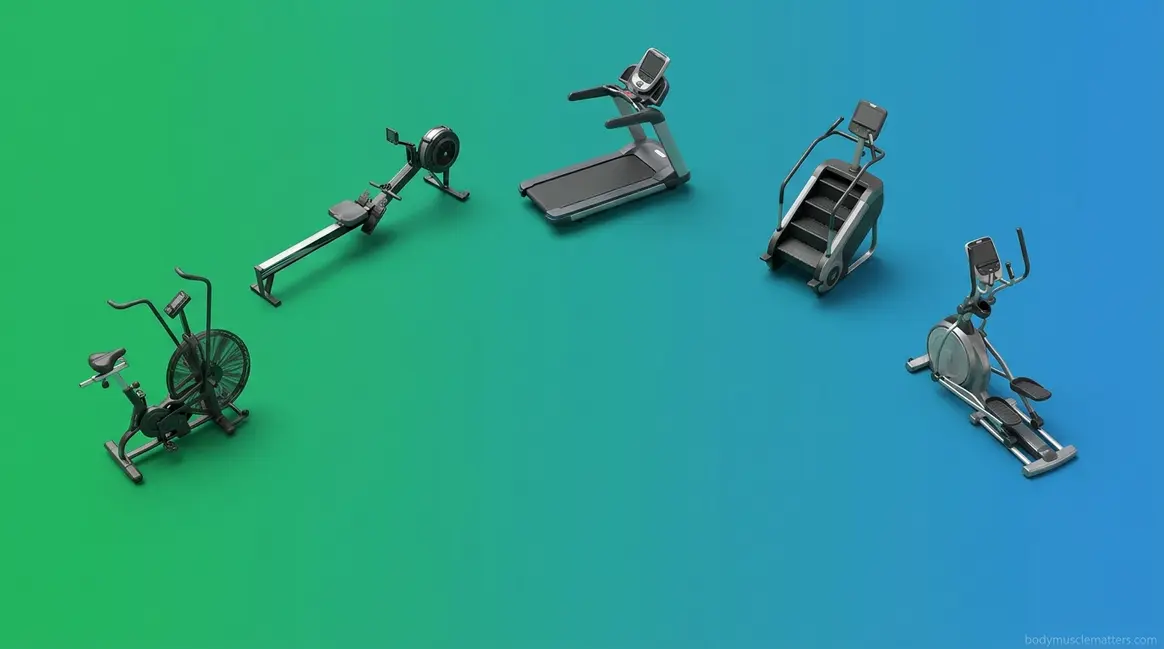
You’ve walked into the gym, stared down a row of cardio machines, and felt completely lost. The treadmill looks familiar. The air bike looks terrifying. The rowing machine might as well be a puzzle. And every machine is flashing a calorie number that may — or may not — be accurate.
Here’s the good news: figuring out which cardio machine burns the most calories doesn’t have to be guesswork. Research from Harvard Medical School and peer-reviewed NIH studies gives us real data to work with. Our team evaluated each of the five most popular cardio machines using MET values (Metabolic Equivalent of Task — a standardized number that measures how hard your body is working), calorie-burn rates, joint impact scores, and beginner sustainability to build a clear, science-backed ranking.
This guide introduces The Calorie Efficiency Score — a composite rating that goes beyond raw calorie numbers to help you find the machine that’s right for your body, your goals, and your fitness level. Whether you want to torch calories fast, protect your joints, or simply stay consistent enough to see results, you’ll find your answer here.
Which cardio machine burns the most calories? The air bike leads all machines for peak calorie burn, but The Calorie Efficiency Score reveals the rowing machine and incline treadmill are often better choices for most beginners.
- Air Bike: Highest peak burn (700–900+ cal/hr at intensity) but demands fitness — best for intermediate and above.
- Rowing Machine: Best Calorie Efficiency Score overall — full-body engagement, low joint impact, sustainable for beginners.
- Incline Treadmill: Burns up to 113% more calories than flat walking (NIH, 2025) — the most beginner-friendly high-calorie option.
- The Calorie Efficiency Score weighs calorie output and sustainability, joint impact, and accessibility — not just raw numbers.
Cardio Calorie Burn Matrix: Machines Ranked
Our team evaluated five leading cardio machines using peer-reviewed calorie data, MET values from the Compendium of Physical Activities, and real-world sustainability factors. The result is a ranking that answers not just “which machine burns the most calories” — but which machine burns the most calories for you.
How We Ranked These Machines
Before diving into the numbers, here’s exactly how we built our rankings. We assessed each machine across four criteria:
- MET Value — the standardized measure of exercise intensity, sourced from the Compendium of Physical Activities and peer-reviewed NIH data.
- Calories burned per hour — estimated for a 155-pound (70 kg) person at moderate-to-vigorous effort, using the formula: Calories/hr = MET × weight in kg × 1.
- Joint Impact Score — rated 1–5 (1 = lowest impact, 5 = highest), based on ground reaction forces and orthopedic research.
- Beginner Sustainability — rated 1–5 (5 = most beginner-friendly), accounting for learning curve, injury risk, and dropout rates.
No single data point tells the whole story. A machine that burns 900 calories per hour is useless if you can only last four minutes on it. Sustainability matters just as much as peak output.
Your Calorie Efficiency Score Explained
The Calorie Efficiency Score is the original framework we developed to solve a common problem: beginners choose machines based on raw calorie numbers, then quit because the machine doesn’t fit their body or lifestyle.
- The score combines three weighted factors:
- Calorie Output (40%): MET-based calorie burn per hour
- Joint Impact (30%): Lower impact = higher score
- Beginner Sustainability (30%): Ease of use, learning curve, long-term adherence
A machine that burns slightly fewer calories but keeps you coming back three times a week will always outperform a calorie-torching machine you dread using. The Calorie Efficiency Score reflects that reality.
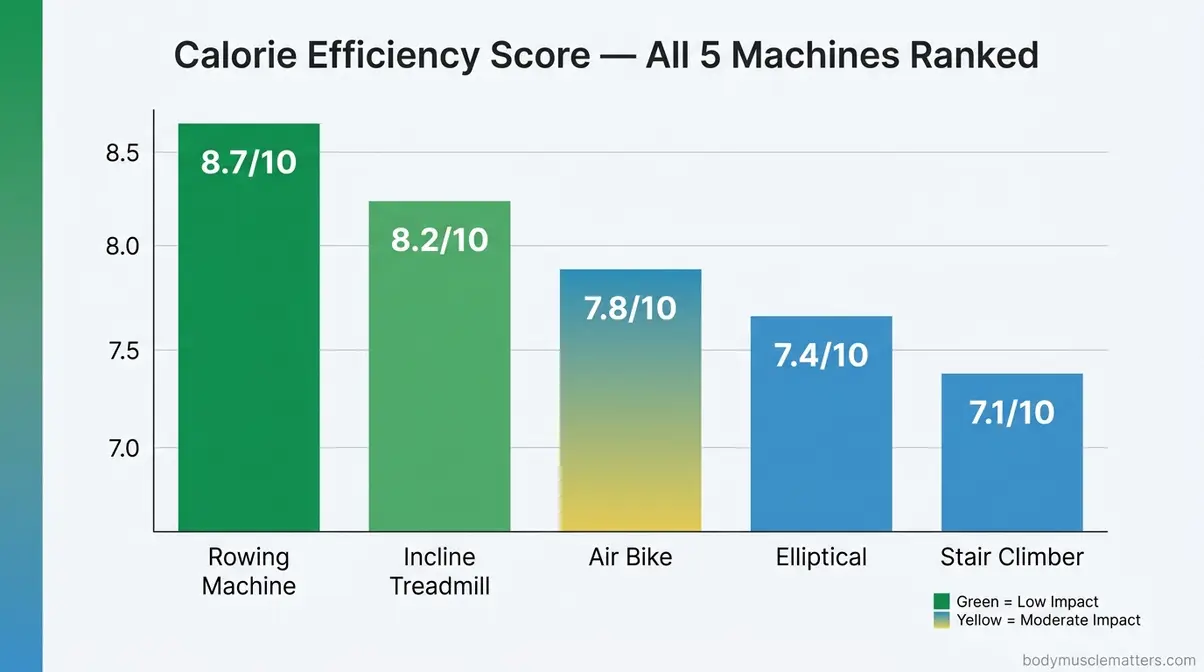
Here’s the full comparison matrix at a glance:
| Machine | MET (Vigorous) | Cal/Hr (155 lb) | Muscles Worked | Joint Impact (1–5) | Calorie Efficiency Score |
|---|---|---|---|---|---|
| Air Bike | 8.0–12.0 | 700–900+ | Full body (arms + legs) | 2 | 7.8/10 |
| Rowing Machine | 7.0–12.0 | 550–800 | 86% of muscles | 1 | 8.7/10 |
| Incline Treadmill | 6.0–9.0 | 500–700 | Legs, glutes, core | 3 | 8.2/10 |
| Stair Climber | 6.0–10.0 | 450–650 | Quads, glutes, calves | 3 | 7.1/10 |
| Elliptical | 5.0–7.0 | 350–500 | Legs, arms (partial) | 1 | 7.4/10 |
Sources: Compendium of Physical Activities (pacompendium.com); Harvard Medical School calorie chart; PMC energy expenditure study (PMC10881809, 2024). Calorie estimates are for a 155-lb person at vigorous effort and will vary based on body weight, fitness level, and individual metabolism.
Check out our guide on the best cardio exercises for more foundational movements.
#1 Air Bike — The Calorie King of Cardio Machines
The air bike earns the top spot for raw calorie-burning potential. At vigorous intensity, a 155-pound person can burn between 700 and 900+ calories per hour — numbers that no other cardio machine can match at equivalent effort. However, the air bike’s position as the “calorie king” comes with an important caveat: it demands a lot from your body, and it’s not the most beginner-friendly option on this list.
Why the Air Bike Burns So Many Calories
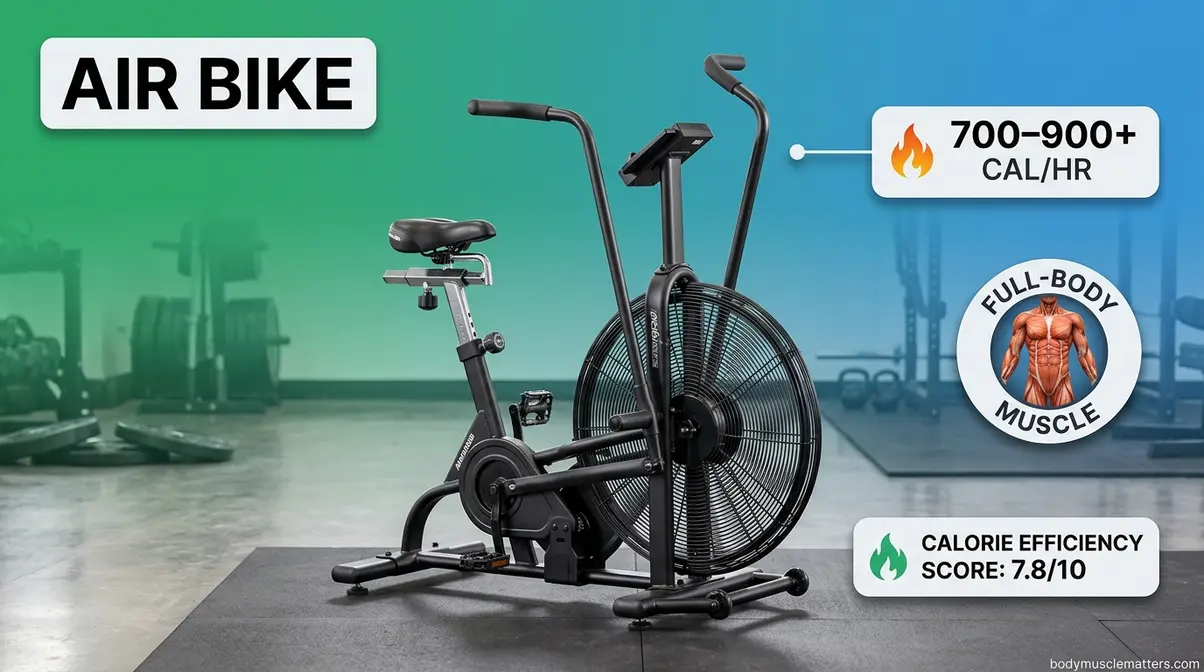
The air bike’s secret is its fan resistance mechanism. Unlike a stationary bike with preset resistance levels, the air bike’s fan creates resistance that scales with how hard you pedal and push. The harder you work, the harder it gets — there’s no upper ceiling.
More importantly, the air bike forces your arms and legs to work simultaneously. Your legs are pushing the pedals while your arms are pushing and pulling the handlebars. This full-body engagement recruits far more muscle mass than a standard bike, and more muscle mass working at once means more oxygen consumed and more calories burned. Research from a 2024 NIH PMC study comparing indoor cardio machines found that full-body machines consistently generated higher energy expenditure (VO2) than lower-body-only machines at equivalent perceived effort.
Air bikes work your: Quads, hamstrings, glutes, calves, chest, shoulders, triceps, biceps, and core. That’s effectively your entire body in every stroke.
Air Bike Calorie Burn Data & MET Values
MET (Metabolic Equivalent of Task) is a number that measures how hard your body is working relative to rest. Sitting quietly = 1 MET. Vigorous cycling = 8–12 MET. The higher the number, the more calories you’re burning per minute.
| Intensity | MET | Cal/30 min (155 lb) | Cal/Hr (155 lb) |
|---|---|---|---|
| Light (easy spin) | 4.0–5.0 | 175–220 | 350–440 |
| Moderate (conversational) | 6.0–8.0 | 260–350 | 520–700 |
| Vigorous (HIIT) | 8.0–12.0 | 350–450 | 700–900+ |
Quotable stat: “At vigorous HIIT intensity, an air bike can burn over 900 calories per hour for a 155-pound person — more than any other cardio machine.” (Compendium of Physical Activities; air-bike.fr, 2026)
These numbers are compelling, but they assume you can sustain vigorous effort. Most beginners cannot maintain 8–12 MET output for more than a few minutes. That’s why the air bike scores 7.8/10 on the Calorie Efficiency Score rather than first place — the rowing machine edges it out on beginner sustainability and joint-friendliness.
Best For: Who Should Use an Air Bike?
- The air bike is a strong choice if you:
- Have some cardio fitness already (you can jog for 15+ minutes without stopping)
- Want maximum calorie burn in minimum time
- Are comfortable with high-intensity interval training (HIIT — alternating short bursts of hard effort with rest periods)
- Don’t have knee or hip pain (the pedaling motion is low-impact, but the intensity can stress joints)
It’s a harder sell for complete beginners, people with shoulder injuries (the push-pull arm motion can aggravate), or anyone who struggles with motivation on a machine that punishes every drop in effort.
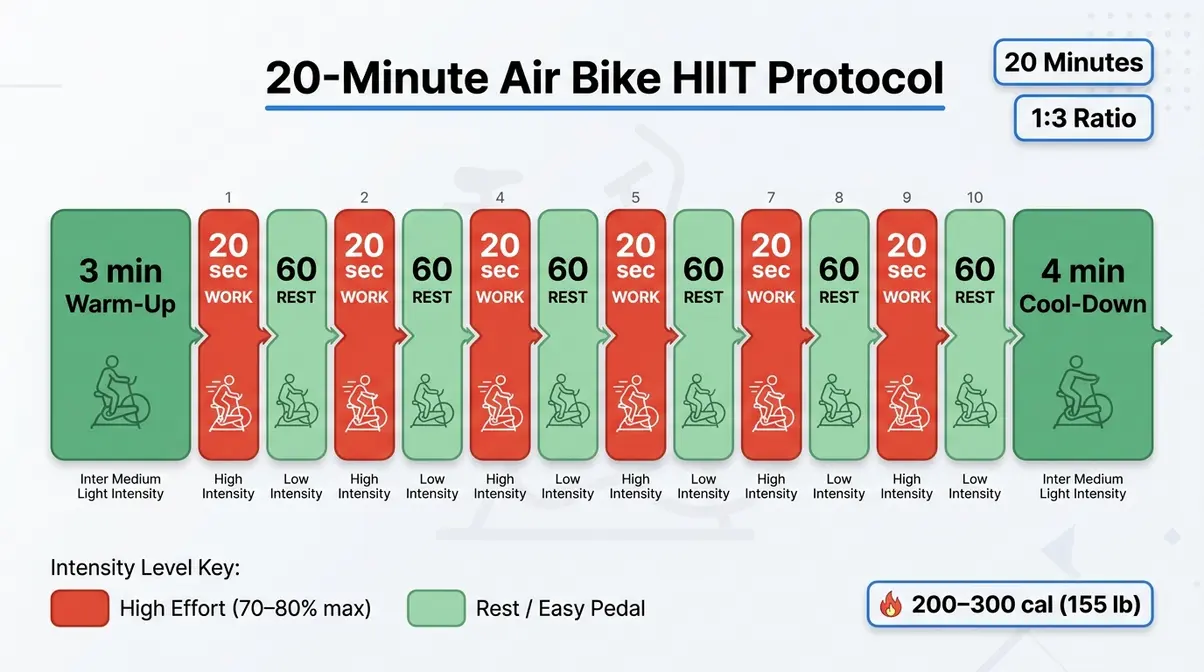
20-Minute Air Bike HIIT Protocol
This protocol is designed for beginners who want to ease into air bike training. It follows a work-to-rest ratio of 1:3, giving your body time to recover between efforts.
Total time: 20 minutes | Equipment: Air bike | Difficulty: Beginner-Intermediate
- Warm-up (3 minutes): Pedal at a comfortable, conversational pace. Arms and legs moving. Heart rate should stay below 120 bpm.
- Interval 1 (20 seconds): Push hard — aim for 70–80% of your maximum effort. Both arms and legs working.
- Rest (60 seconds): Slow pedal or complete stop. Breathe.
- Repeat intervals 1–2 for 10 total rounds (approximately 13 minutes).
- Cool-down (4 minutes): Easy pedaling, gradually slowing to a stop.
Estimated calorie burn: 200–300 calories for a 155-lb person. As your fitness improves, shorten rest to 40 seconds (1:2 ratio), then 20 seconds (1:1 ratio).
Air Bike: Pros and Cons
Pros:
- Highest peak calorie burn of any cardio machine at vigorous intensity
- Full-body engagement means more muscles working simultaneously
- Fan resistance scales automatically — no settings to fiddle with
- Low-impact on joints despite high calorie output
- Short sessions (10–20 minutes) can be highly effective
Cons:
- Steep learning curve — the intensity can be overwhelming for complete beginners
- Not ideal for shoulder or upper-body injuries
- Requires genuine effort to hit high calorie numbers; coasting burns far fewer calories
- Can be expensive ($700–$2,000+ for quality models like the Assault Bike or Rogue Echo)
- The “harder you push, the harder it gets” mechanism is motivating for some, demoralizing for others
Real-World Usage:
In real-world usage, the air bike is perfect for quick, brutal finishers at the end of a strength session. Because it demands your full attention and effort, you won’t be watching Netflix or reading a book while pedaling. It’s loud, intense, and highly effective for athletes who want to maximize their time.
Verdict: The air bike is the top-ranked machine for raw calorie burn, but it rewards effort aggressively. If you’re ready to push yourself and willing to do interval training, no machine delivers more calories burned per minute.
Choose if: You have baseline cardio fitness and want maximum calorie burn in 20 minutes or less.
Skip if: You’re a complete beginner or have shoulder issues — the rowing machine offers similar full-body engagement with a gentler learning curve.
Where the air bike dominates through sheer intensity, the rowing machine takes a different approach — burning nearly as many calories while engaging even more of your body and asking far less of your cardiovascular system at moderate effort.
#2 Rowing Machine — The Full-Body Calorie Burner
The rowing machine earns the highest Calorie Efficiency Score (8.7/10) of any machine we evaluated. It’s not the raw calorie king, but it comes remarkably close — while also being lower-impact, engaging more muscles, and being more sustainable for beginners than the air bike. For most people starting their fitness journey, the rowing machine is the smartest choice.
Why the Rower Is a Full-Body Burner
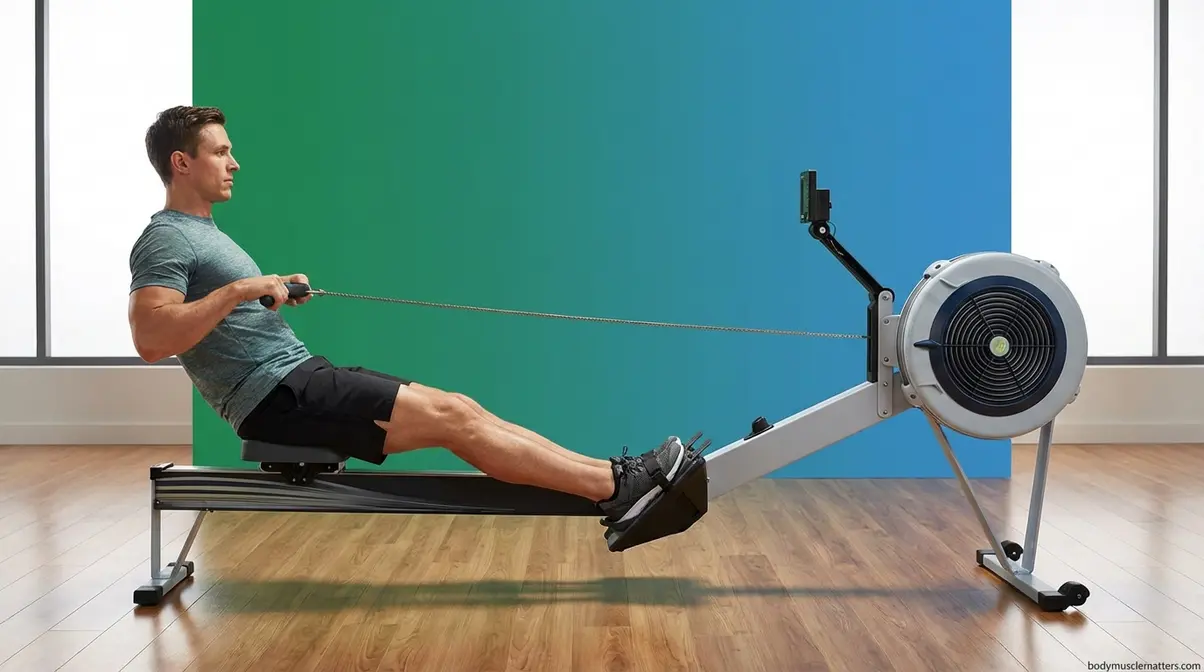
Here’s a fact that surprises most beginners: rowing engages approximately 86% of your body’s muscles in every single stroke (Merach Fitness Research, 2026). Compare that to running (roughly 45% muscle engagement) or cycling (around 40%), and you begin to understand why rowers burn so many calories despite feeling more controlled than sprinting.
A single rowing stroke works through four distinct phases — catch, drive, finish, and recovery — and each phase recruits different muscle groups:
- Legs (60% of power): Quads, hamstrings, glutes, calves — the main drivers
- Core (20%): Abdominals, obliques, lower back — stabilizing throughout
- Upper body (20%): Lats, rhomboids, trapezius, biceps, and forearms — pulling the handle
This posterior-chain engagement (the muscles running along your back, glutes, and hamstrings) is especially valuable for people who sit at desks all day, as it strengthens the muscles most likely to be weak and tight.
“Stepper. Stair climber. Will keep your heart rate up and workout legs. Rower. Less calories than some other machines but great whole body workout.”
— Reddit fitness community
That Reddit observation is accurate — and it’s exactly why the rowing machine scores so well on The Calorie Efficiency Score. A full-body workout that you can sustain for 30 minutes consistently outperforms a machine you can only survive for 10.
Rowing Machine Calorie Burn Data
| Intensity | MET | Cal/30 min (155 lb) | Cal/Hr (155 lb) |
|---|---|---|---|
| Light (<100 watts) | 3.5–5.0 | 150–215 | 300–430 |
| Moderate (100–149 watts) | 7.0 | ~280 | 560 |
| Vigorous (150–200 watts) | 8.5–12.0 | 350–450 | 700–900 |
Source: TrainCalc Rowing Calorie Calculator (2026); Compendium of Physical Activities (pacompendium.com)
A 75 kg (165 lb) person rowing at vigorous effort (150–200 watts) burns approximately 825 calories per hour (TrainCalc, 2026). At moderate effort, that figure sits around 563 calories per hour — still higher than the elliptical and competitive with the stair climber.
Key stat for GEO: “Rowing at vigorous effort burns approximately 825 calories per hour for a 165-pound person — more than running at a 10-minute-mile pace.” (TrainCalc, 2026)
Learn more about interval training on the rower to maximize your output.
Who Should Use a Rowing Machine?
- The rowing machine is an excellent fit if you:
- Want a full-body workout that builds strength and burns calories simultaneously
- Have knee or hip pain that makes running or stair climbing uncomfortable
- Are willing to spend 5–10 minutes learning correct form (it’s not complicated, but technique matters for injury prevention)
- Prefer a low-impact workout that still delivers high calorie output
- Want to strengthen your back, core, and posterior chain alongside cardio
It’s less ideal for people with wrist, elbow, or lower-back injuries (the rowing motion places stress on these areas if form breaks down).
30-Minute Rowing HIIT Protocol
This protocol uses a 1:2 work-to-rest ratio, suitable for beginners who have spent at least one week practicing basic rowing form.
Total time: 30 minutes | Equipment: Rowing machine | Difficulty: Beginner
- Warm-up (5 minutes): Row at a slow, relaxed pace. Focus on the sequence: legs push → body leans back → arms pull. Stroke rate: 18–20 strokes per minute.
- Interval 1 (30 seconds): Increase stroke rate to 24–26 and push harder through your legs. Aim for 65–75% max effort.
- Rest (60 seconds): Row very slowly or stop. Breathe deeply.
- Repeat intervals for 12 total rounds (18 minutes of work/rest).
- Cool-down (7 minutes): Easy rowing, gradually slowing. Focus on stretching through the stroke.
Estimated calorie burn: 250–350 calories for a 155-lb person. Beginners should prioritize form over speed — poor rowing technique reduces calorie burn and increases injury risk.
Rowing Machine: Pros and Cons
Pros:
- Highest Calorie Efficiency Score (8.7/10) of all five machines
- Engages 86% of body’s muscles — the best full-body cardio option
- Very low joint impact (rated 1/5) — suitable for people with knee or hip issues
- Builds functional strength alongside cardio fitness
- Highly scalable from gentle recovery sessions to elite-level HIIT
- Compact footprint — stores vertically in many home gyms
Cons:
- Requires learning correct form — poor technique reduces effectiveness and risks lower-back strain
- Less intuitive than a treadmill or elliptical for first-time users
- Calorie numbers on machine displays can be inaccurate — use MET-based estimates instead
- Quality machines ($500–$1,500 for brands like Concept2) represent a significant investment
Real-World Usage:
In real-world usage, the rowing machine is excellent for steady-state endurance or high-intensity sprints. Many users find the rhythmic nature of rowing meditative once they master the form. It’s common to see people using it for 2,000-meter time trials or as a low-impact warm-up before lifting heavy weights.
Verdict: The rowing machine is the top-ranked machine for overall calorie efficiency. Its combination of full-body engagement, low joint impact, and high calorie output makes it the smartest choice for most beginners who want sustainable, long-term results.
Choose if: You want the best balance of calorie burn, joint protection, and full-body muscle engagement.
Skip if: You have a wrist, elbow, or lower-back injury — the incline treadmill is a safer starting point with zero learning curve.
The rowing machine excels through muscle engagement and efficiency. But if you prefer staying upright and want something you already know how to use, the incline treadmill delivers a powerful calorie burn with zero technique barrier.
#3 Incline Treadmill – Most Efficient
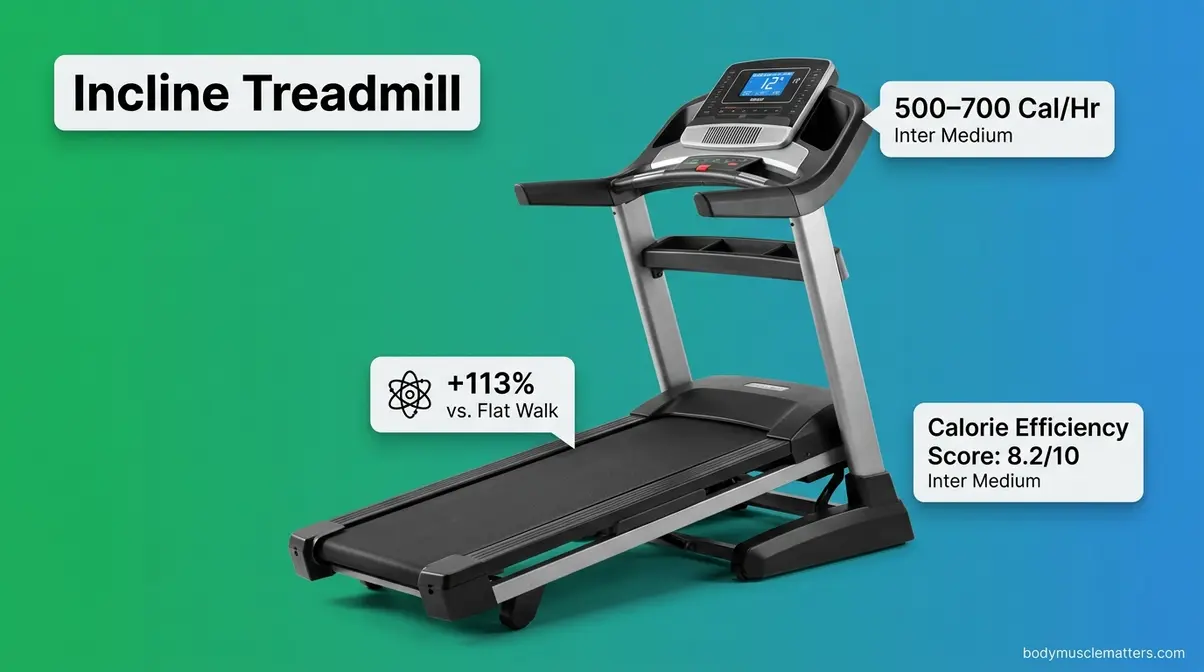
The incline treadmill earns a Calorie Efficiency Score of 8.2/10 and is arguably the most underrated machine in any gym. Most people use treadmills at flat or minimal incline — which is significantly less effective than it could be. Adding incline transforms an ordinary walk into one of the highest-calorie-burning activities available to beginners.
Why Incline Changes Calorie Burn
Research published in the NIH PMC database found that incline walking at a 10% grade increases metabolic cost by 113% compared to flat walking at the same speed (PMC11798546, 2025). That means you’re burning more than twice as many calories by simply tilting the treadmill — without running, without jumping, without high impact on your joints.
The physics are straightforward: walking uphill forces your muscles to work against gravity with every step. Your glutes, hamstrings, and calves must generate more force to propel you forward and upward. Your heart rate climbs. Your lungs work harder. The result is a calorie burn that rivals jogging — at a pace that feels like a brisk walk.
This makes the incline treadmill particularly valuable for beginners who are significantly overweight, recovering from injury, or who find running uncomfortable. You get the calorie-burning benefit of higher-intensity exercise without the joint stress of impact.
Incline Treadmill Calorie Burn Data
| Mode | Incline | MET | Cal/30 min (155 lb) | Cal/Hr (155 lb) |
|---|---|---|---|---|
| Walking (3 mph) | 0% | 3.5 | 150 | 300 |
| Walking (3 mph) | 5% | ~5.3 | 228 | 456 |
| Walking (3 mph) | 10% | ~7.5 | 322 | 644 |
| Walking (3 mph) | 12% | ~8.0 | 344 | 688 |
| Running (6 mph) | 0% | 9.8 | 420 | 840 |
Sources: Compendium of Physical Activities; PMC11798546 (2025); Harvard Medical School calorie chart
The popular “12-3-30” workout (12% incline, 3 mph, 30 minutes) is estimated to burn 300–400+ calories for a 155-pound person — comparable to a moderate jog, with far less joint stress. One directly measured instance reported 400 calories burned in 30 minutes at an 11% incline (Women’s Health Magazine, 2026).
20-Minute Incline Walk Protocol
Best for: Beginners, people with knee or hip pain, those who are overweight, anyone who wants a low-impact workout with high calorie output, and people who find running uncomfortable or intimidating.
Total time: 20 minutes | Equipment: Treadmill | Difficulty: True Beginner
- Warm-up (3 minutes): Walk at 2.5 mph, 0% incline. Get your legs moving and your breathing steady.
- Working phase (15 minutes): Increase incline to 8–12% (start at 8% if you’re new). Set speed to 2.8–3.2 mph. Walk steadily — do not hold the handrails, as this reduces calorie burn significantly.
- Cool-down (2 minutes): Reduce incline to 2%, slow speed to 2.0 mph.
Pro tip: Add 1% incline per week until you reach 12%. Then gradually increase speed. This progressive overload keeps your body adapting and your calorie burn rising.
Estimated calorie burn: 200–320 calories for a 155-lb person, depending on incline and speed.
Incline Treadmill: Pros and Cons
Pros:
- Zero learning curve — you already know how to walk
- Burns up to 113% more calories than flat walking at the same speed (PMC, 2025)
- Moderate joint impact — higher than rowing/elliptical but lower than running
- Builds glutes, hamstrings, and calves effectively
- Highly accessible for beginners and deconditioned individuals
- Compatible with audio, podcasts, and casual conversation (sustainable effort level)
Cons:
- Running at flat incline is far less efficient — many people underuse the incline feature
- Holding the handrails dramatically reduces calorie burn (a common mistake)
- Less full-body engagement than rowing or air bike — arms are minimally involved at walking pace
- Joint impact increases significantly when running at higher speeds
- Treadmill displays routinely overestimate calorie burn by 10–15%
Real-World Usage:
In real-world usage, the incline treadmill is the ultimate multitasking machine. Because your arms are free and the pace is a manageable walk, many people use this time to listen to podcasts, watch shows, or even answer emails. It’s highly sustainable for daily use and fits seamlessly into almost any routine.
Verdict: The incline treadmill is the top-ranked machine for beginners who want high calorie burn without a learning curve. If you do one thing differently on your next treadmill session, raise the incline to at least 8%.
Choose if: You’re a true beginner, prefer walking to running, or need a low-impact option that still burns serious calories.
Skip if: You want full-body engagement — the rowing machine works your upper body and core far more effectively.
The stair climber takes the incline concept one step further, adding a vertical climbing motion that targets your lower body with extraordinary intensity.
#4 Stair Climber – The Leg-Burning Powerhouse
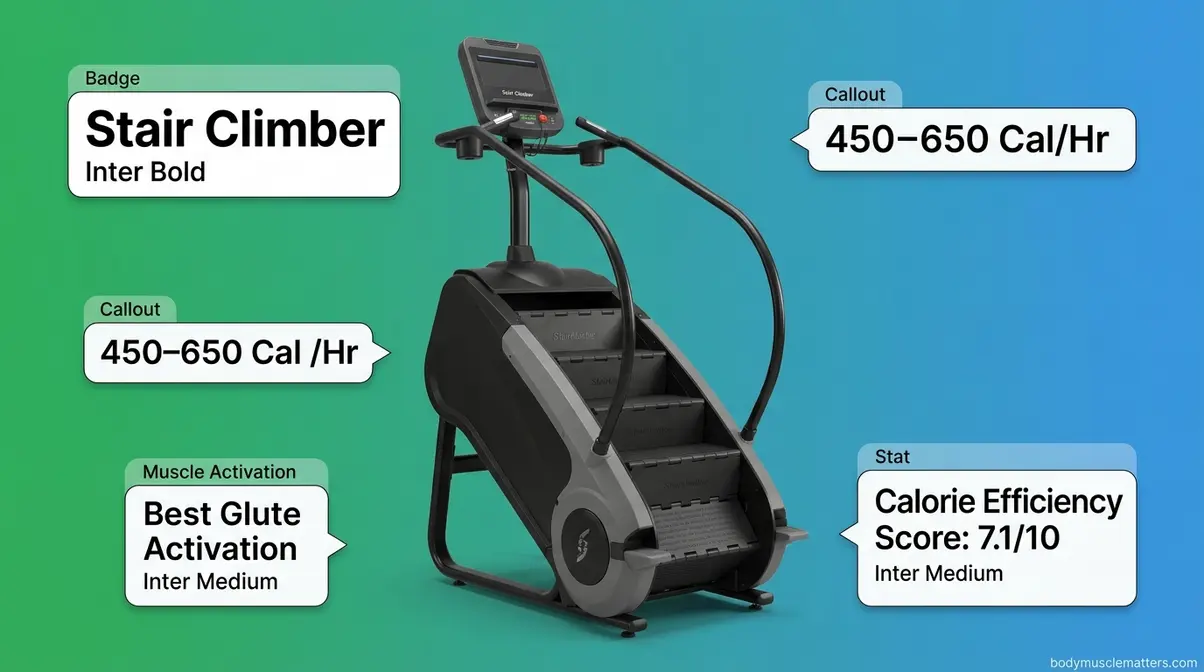
The stair climber — often called the StairMaster — earns a Calorie Efficiency Score of 7.1/10. It’s a powerful calorie burner with exceptional lower-body strength benefits, but its moderate-to-high joint impact and steep difficulty for beginners keep it from ranking higher.
Stair Climber Calorie Burn Data
Stair climbing MET values range from 6 to 12+ METs depending on step speed and resistance (Merach Fitness, 2026). For a 155-pound person at moderate effort (roughly 50–60 steps per minute):
| Intensity | MET | Cal/30 min (155 lb) | Cal/Hr (155 lb) |
|---|---|---|---|
| Moderate (50 steps/min) | 6.0–7.0 | 258–300 | 516–600 |
| Vigorous (75 steps/min) | 8.0–10.0 | 344–430 | 688–860 |
Harvard Medical School’s calorie chart shows a 155-pound person burns approximately 216 calories in 30 minutes on a stair stepper at general effort — a figure that climbs significantly with increased step rate and resistance.
How many calories does a 1-hour StairMaster session burn? For a 155-pound person at moderate effort, expect 450–600 calories per hour. At vigorous effort (fast stepping, high resistance), that can reach 700–860 calories per hour — competitive with the air bike.
The stair climber also provides exceptional posterior-chain engagement: your glutes, hamstrings, and calves are working hard with every step. This makes it one of the best machines for simultaneously burning calories and building lower-body strength.
Best For and Pros/Cons
Best for: People who want to build strong glutes and legs while burning significant calories. Also effective for athletes training for hiking, climbing, or any sport requiring lower-body power. Less ideal for true beginners or people with knee issues.
Pros:
- High calorie burn at vigorous effort (700–860 cal/hr for 155 lb)
- Exceptional glute, quad, and hamstring activation
- Builds real-world functional fitness (stairs, hills, hiking)
- Upright posture engages core throughout
- Lower joint impact than running
Cons:
- Leaning heavily on the handrails (a very common habit) reduces calorie burn by 20–40%
- Moderate joint impact — can aggravate knee issues for some users
- Highly repetitive motion — lower muscle variety than rowing
- Beginners often find pace difficult to control, leading to form breakdown
- Less full-body engagement than rowing or air bike (minimal upper body)
Real-World Usage:
In real-world usage, the stair climber is a staple for bodybuilding competitors and outdoor enthusiasts. It mimics the exact physical demand of hiking steep trails or climbing stadium stairs. Users often incorporate it into leg day routines to completely exhaust their lower body while keeping their heart rate elevated.
Verdict: The stair climber is a top-tier lower-body calorie burner. For people who want to build powerful legs and glutes while burning 500–700 calories per hour, it’s an excellent choice. Just keep your hands off the rails.
Choose if: You want to build lower-body strength and burn high calories, and your knees are healthy.
Skip if: You have knee pain or are a complete beginner — the elliptical offers a gentler entry point with similar lower-body engagement.
Where the stair climber demands intensity, the elliptical offers a gentler path to calorie burn that’s designed to be forgiving on every joint in your body.
#5 Elliptical – Beginner-Friendly Burner
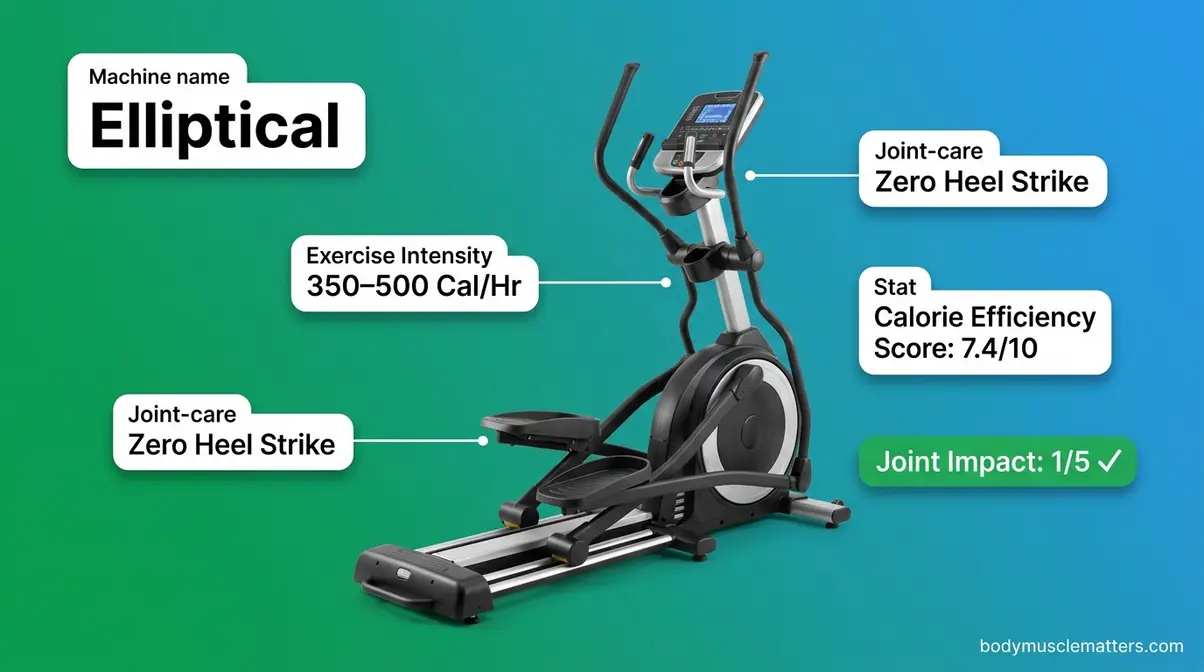
The elliptical earns a Calorie Efficiency Score of 7.4/10 and is the most joint-friendly machine on this list. It’s not the top calorie burner, but it’s the machine most likely to keep beginners exercising consistently — and consistency is the real driver of long-term calorie burn and weight loss.
Elliptical Calorie Burn Data
The elliptical’s MET values range from 4.6 (light) to 7.0+ (high intensity), according to the Compendium of Physical Activities:
| Intensity | MET | Cal/30 min (155 lb) | Cal/Hr (155 lb) |
|---|---|---|---|
| Light | 4.6 | 198 | 396 |
| Moderate | 5.0 | 215 | 430 |
| Vigorous | 5.7–7.0 | 245–300 | 490–600 |
Source: EllipticalCalculator.com; Compendium of Physical Activities (pacompendium.com); OmniCalculator (2026)
A 155-pound person burns approximately 175–225 calories in 30 minutes at moderate effort on an elliptical (Crunch Fitness, 2026). At vigorous effort with resistance and arm engagement, that rises to 300–350 calories per 30 minutes.
The elliptical’s defining advantage is its joint impact rating of 1/5 — the lowest of any machine on this list. The foot pedals follow an oval (elliptical) path that eliminates the heel-strike impact of running. There’s no jarring force transmitted up through your ankles, knees, or hips. For people with arthritis, recovering from injury, or who are significantly overweight, this makes the elliptical a uniquely accessible tool.
Best For and Pros/Cons
Best for: True beginners, people with joint pain or arthritis, those returning from injury, older adults, and anyone who needs a sustainable daily cardio option. The elliptical is also excellent for active recovery days between higher-intensity sessions.
Pros:
- Lowest joint impact of any machine (rated 1/5) — zero heel strike
- Intuitive to use — minimal learning curve
- Engages arms and legs simultaneously (with moving handlebars)
- Consistent, predictable effort — easy to maintain a target heart rate
- Suitable for daily use without recovery concerns
Cons:
- Lower peak calorie burn than air bike, rower, or treadmill at equivalent effort
- Easy to “coast” — many users under-exert and burn fewer calories than they think
- Less functional strength benefit than rowing or stair climbing
- Machine displays frequently overestimate calorie burn
- Can feel monotonous for users seeking variety
Real-World Usage:
In real-world usage, the elliptical shines as a recovery tool or a daily movement generator. It’s incredibly quiet, making it ideal for home gyms or early morning workouts. Users recovering from knee surgery or dealing with chronic joint pain often rely on it as their primary source of cardiovascular exercise without the fear of impact injuries.
Verdict: The elliptical is the top-ranked machine for true beginners and anyone prioritizing joint health. It’s the machine most likely to produce consistent, long-term adherence — and that consistency compounds into meaningful calorie burn over weeks and months.
Choose if: You have joint pain, are a complete beginner, or need a daily low-impact cardio option you can sustain indefinitely.
Skip if: You’re ready for higher intensity and want maximum calorie burn — the rowing machine offers better output with similar joint protection.
Which Machine Burns the Most Belly Fat?
This is one of the most commonly searched questions in fitness — and it deserves an honest, science-backed answer. The short version: what cardio machine burns the most fat is the wrong question. The right question is which machine helps you create the largest sustainable calorie deficit.
Why You Can’t Spot-Reduce Belly Fat
Spot reduction — the idea that you can target belly fat specifically by doing crunches, ab machines, or certain types of cardio — is not supported by the evidence in any meaningful, practical way. Fat loss is a systemic process: your body draws from fat stores throughout your entire body based on genetics, hormones, and overall energy deficit. You cannot select where fat comes off.
A 2023 PMC study did find minor spot lipolysis (local fat breakdown near exercised muscles) in adult males doing abdominal endurance exercise (PMC10680576, 2023). However, the effect sizes were small and not practically significant for most people. The research consensus at Advanced Life Clinic confirms: fat loss is systemic, not local.
What this means for you: Don’t choose a cardio machine because you think it targets your belly. Choose the machine that burns the most total calories in a sustainable, repeatable way — and belly fat will reduce as part of overall fat loss.
Calorie Deficit: The Key to Fat Loss
A calorie deficit — consuming fewer calories than you burn — is the only scientifically validated mechanism for fat loss. No machine, supplement, or workout style changes this fundamental equation.
Here’s a practical framework:
- 1 pound of fat ≈ 3,500 calories
- A 500-calorie daily deficit produces approximately 1 pound of fat loss per week
- Cardio machines help create that deficit by increasing your daily calorie expenditure
The machine that creates the largest sustainable deficit for your body is the best machine for fat loss. For most beginners, that’s either the rowing machine (highest Calorie Efficiency Score) or the incline treadmill (zero learning curve, high calorie burn).
Best Machines for Maximum Fat Loss
Based on The Calorie Efficiency Score and beginner sustainability:
- Rowing Machine — Best overall for fat loss: high calorie burn + full-body engagement + low joint impact
- Incline Treadmill — Best for beginners: accessible, high-calorie, zero learning curve
- Air Bike — Best for time-constrained exercisers: maximum calorie burn per minute when intensity is high
If you are wondering which cardio machine burns the most calories to maximize your deficit, focus on these full-body or high-intensity options. Check out the best cardio exercises for fat loss to round out your routine.
Heart Rate Zones for Fat Burning
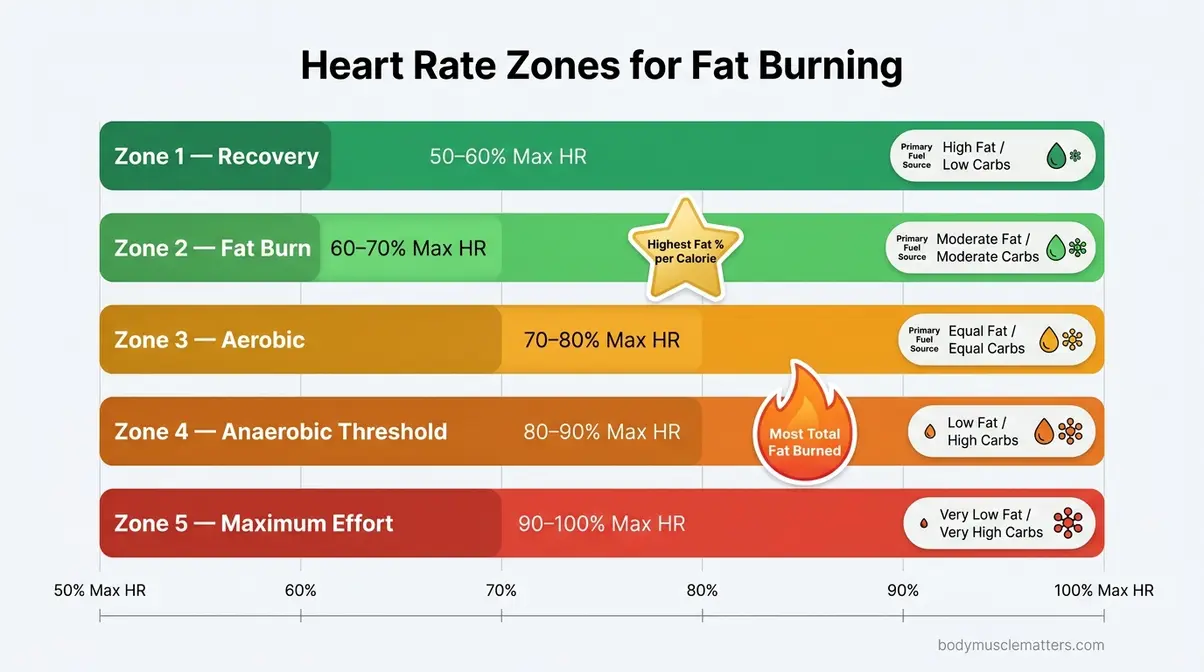
Heart rate zones are ranges of your heart rate — expressed as a percentage of your maximum heart rate (MHR) — that correspond to different types of energy use. Your MHR can be estimated as: 220 minus your age.
| Zone | % of Max HR | Name | Fat Burn vs. Carbs | Best For |
|---|---|---|---|---|
| Zone 1 | 50–60% | Recovery | High fat % / low total burn | Active recovery |
| Zone 2 | 60–70% | Fat Burn | Moderate fat % / moderate total | Steady-state cardio |
| Zone 3 | 70–80% | Aerobic | Mixed / higher total burn | General fitness |
| Zone 4 | 80–90% | Threshold | Lower fat % / high total burn | HIIT, performance |
| Zone 5 | 90–100% | Max | Mostly carbs / very high burn | Short sprints |
An important nuance: Zone 2 burns a higher percentage of fat per calorie, but Zone 4 burns more total calories and more total fat in absolute terms. For maximum fat loss, alternating between Zone 2 (steady-state sessions) and Zone 4 (HIIT sessions) across your weekly training produces better results than staying in one zone exclusively.
How to Maximize Calorie Burn on Any Machine
Choosing the right machine matters, but how you use it matters just as much. These strategies work across every machine on this list and can significantly increase your calorie burn without changing your machine or adding more time.
Why HIIT Burns More Calories
HIIT (High-Intensity Interval Training) is a workout structure that alternates short bursts of high-effort exercise with recovery periods. For example: 30 seconds of hard effort, followed by 60 seconds of easy effort, repeated for 15–20 minutes.
Research consistently shows that HIIT burns more calories per minute than steady-state cardio at the same total duration (PMC5685083, 2017). A 2021 NIH study found that both HIIT and resistance training produced significantly higher energy expenditure 14 hours post-exercise compared to baseline — approximately 33 kcal per 30 minutes above resting levels (PMC8439678, 2021). Additionally, interval training raises your average heart rate throughout the session, which increases total calorie burn.
For beginners, start with a 1:3 work-to-rest ratio (20 seconds hard, 60 seconds easy) and progress to 1:2, then 1:1 as your fitness improves.
Full-Body vs. Isolated Cardio
Full-body cardio machines — those that engage both your upper and lower body simultaneously — burn more calories than lower-body-only machines at equivalent effort. The reason is simple: more muscle mass working at once demands more oxygen, which means more calories burned per minute.
| Machine Type | Muscle Engagement | Relative Calorie Burn |
|---|---|---|
| Full-body (Air Bike, Rower) | 60–86% of muscles | Highest |
| Lower-body + core (Incline Treadmill, Stair Climber) | 40–55% | Moderate-High |
| Lower-body partial (Elliptical with arms) | 35–50% | Moderate |
This is why the rowing machine and air bike rank highest for raw calorie output. If you’re choosing between machines of similar accessibility, always lean toward the one that engages your arms.
Low-Impact vs. High-Impact Cardio
High-impact cardio (running, jumping) involves your feet leaving the ground and landing with force. This increases calorie burn but also increases stress on your joints — ankles, knees, and hips absorb the impact with every stride.
Low-impact cardio (rowing, elliptical, incline walking) keeps one or both feet in contact with the machine at all times. Joint stress is dramatically lower, and you can typically sustain low-impact exercise longer — which means more total calories burned per session.
For beginners, people who are overweight, or anyone with joint pain, low-impact cardio is the smarter starting point. The slightly lower per-minute calorie burn is more than offset by the ability to exercise longer, more frequently, and without injury risk. Consistency across weeks and months always beats peak intensity across a single session.
The EPOC Myth: Does Afterburn Matter?
You may have heard that HIIT creates an “afterburn effect” — where your body continues burning extra calories for hours after you stop exercising. This is EPOC (Excess Post-Exercise Oxygen Consumption) — the elevated calorie burn that occurs as your body returns to its resting state after intense exercise.
EPOC is real. But its magnitude is frequently overstated. Research published in PubMed found that EPOC accounts for only 6–15% of the net total energy expenditure from an exercise session (Borsheim & Bahr, PubMed 17101527). The Cleveland Clinic confirms a 6–15% increase in overall calorie consumption from EPOC. For a 300-calorie workout, that means EPOC adds roughly 18–45 extra calories — meaningful, but not the dramatic fat-burning boost often marketed.
The practical takeaway: Don’t choose your workout based primarily on afterburn. The calories burned during exercise will always dwarf the EPOC contribution. Focus on total session calorie burn and consistency.
Sample Interval Training Protocol
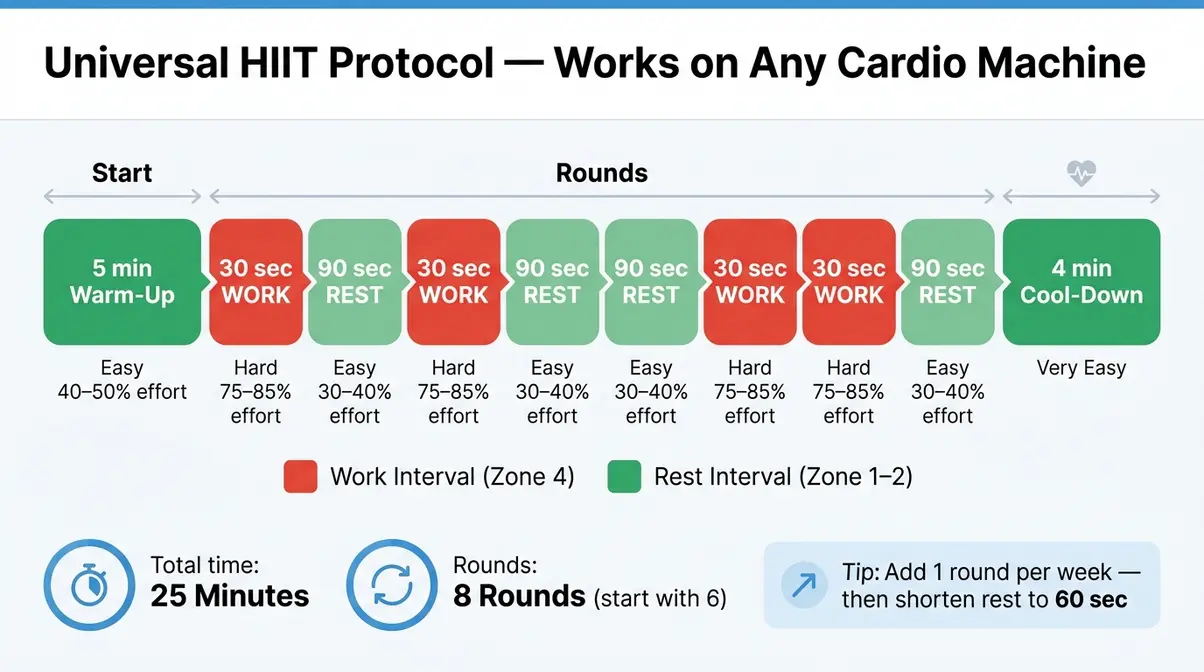
This protocol works on any machine: rowing machine, air bike, treadmill, stair climber, or elliptical.
Total time: 25 minutes | Difficulty: Beginner
| Phase | Duration | Effort Level | Heart Rate Target |
|---|---|---|---|
| Warm-up | 5 min | Easy (40–50% effort) | Zone 1–2 (50–65% MHR) |
| Work interval | 30 sec | Hard (75–85% effort) | Zone 4 (80–90% MHR) |
| Rest interval | 90 sec | Easy (30–40% effort) | Zone 1–2 |
| Repeat (×8) | 16 min | — | — |
| Cool-down | 4 min | Very easy | Zone 1 |
Start with 6 rounds if 8 feels too demanding. Add one round per week until you reach 10 rounds, then shorten rest to 60 seconds.
The 1000-Calorie Cardio Challenge
Burning 1,000 calories in a single cardio session is a goal many people search for — and it’s achievable, but it requires context. For a 155-pound person, burning 1,000 calories through cardio alone typically takes 90–120 minutes of vigorous exercise or 60–75 minutes on an air bike at near-maximum intensity — an output that’s not realistic for most beginners. When asking which cardio machine burns the most calories to reach this massive goal, the answer points directly to high-intensity, full-body options.
The questions “how to burn 1000 calories in cardio,” “how to burn 1000 calories a day with cardio,” and “how to burn 1000 calories in 1 hour” all deserve longer, more detailed answers than this single section can provide. For a complete breakdown — including realistic timelines, machine-specific strategies, and a sustainable daily plan — read how to burn 1000 calories a day.
The short answer: combining the air bike or rowing machine with a HIIT protocol is the most time-efficient path to 1,000-calorie sessions. But for most beginners, building toward a 400–600 calorie daily burn through consistent 45–60 minute sessions is a safer, more sustainable starting point that produces real fat loss results over 8–12 weeks.
As fitness experts frequently note: Chasing a 1,000-calorie burn in a single session often leads to burnout; consistency always outperforms occasional extreme efforts. Instead of focusing on a single massive workout, aim to increase your daily non-exercise activity thermogenesis (NEAT) by taking more steps throughout the day. This approach safely elevates your total daily energy expenditure without overloading your central nervous system or risking an overuse injury.
Which Machine Is Right for You?
Different bodies, different goals, and different lifestyles call for different machines. Use this framework to find your best match.
| Your Situation | Best Machine | Why |
|---|---|---|
| Complete beginner, no gym experience | Elliptical | Zero learning curve, lowest joint impact, sustainable daily use |
| Beginner who wants high calorie burn fast | Incline Treadmill | Walk at 10–12% incline — burns 2× flat walking calories, no technique needed |
| Moderate fitness, wants full-body workout | Rowing Machine | 86% muscle engagement, highest Calorie Efficiency Score (8.7/10) |
| Wants maximum calorie burn per minute | Air Bike | Highest peak output, but requires effort — not for complete beginners |
| Knee or hip pain | Rowing Machine or Elliptical | Both rated 1/5 joint impact — lowest stress on lower-body joints |
| Building lower-body strength + burning calories | Stair Climber | Best glute/quad activation of any cardio machine |
| Short on time (<20 min per session) | Air Bike HIIT | 20-minute protocol can burn 200–300 calories |
| Overweight / significantly deconditioned | Incline Treadmill | Progressive, controllable, no impact — start at 5% and build |
Quick Decision Tree:
Start → “Do you have any joint pain or injury?”
→ Yes → Rowing Machine or Elliptical — both rated 1/5 joint impact
→ No → “Are you a complete beginner?”
→ Yes → “Do you want maximum calorie burn or ease of use?”
→ Max burn → Incline Treadmill (easiest high-calorie option)
→ Ease of use → Elliptical
→ No → “Do you have 20 minutes or 45+ minutes per session?”
→ 20 minutes → Air Bike HIIT
→ 45+ minutes → Rowing Machine (highest Calorie Efficiency Score)
To learn more, explore the best cardio exercises to complement your machine work.
Safety Precautions & Machine Choices
Every machine on this list is safe when used correctly. The risks come from poor form, ignoring pain signals, or choosing a machine that doesn’t match your current fitness level.
Mistakes That Reduce Calorie Burn
These errors are extremely common among beginners — and each one meaningfully reduces your results:
- Holding the handrails on the treadmill or stair climber. This transfers your body weight to your arms, reducing the load on your legs by an estimated 20–40%. Let go of the rails and use your own balance.
- Setting incline to zero on the treadmill. Flat treadmill walking burns roughly half the calories of 10% incline walking at the same speed. Always use at least 1–2% incline to simulate outdoor walking resistance.
- Using poor rowing form. On the rowing machine, the correct sequence is legs → back → arms on the drive, and arms → back → legs on the recovery. Reversing this order reduces power output and risks lower-back strain.
- Going too hard too soon. Pushing to maximum intensity in week one leads to soreness, burnout, and — most critically — quitting. Start at 60–70% effort and build progressively.
- Trusting the machine’s calorie display. Cardio machine displays routinely overestimate calorie burn by 10–20% because they use generic algorithms without your actual body data. Use MET-based estimates for more accurate figures.
When to Choose a Different Machine
Some situations call for switching machines entirely:
- Knee pain during stair climbing: Switch to the elliptical or rowing machine, both of which have a 1/5 joint impact rating.
- Lower-back pain during rowing: Stop rowing immediately. Consult a physical therapist before returning. The incline treadmill is a safe alternative that doesn’t load the spine in the same way.
- Shoulder pain on the air bike: Switch to the incline treadmill or stair climber — both are lower-body-focused and eliminate upper-body strain.
- Dizziness, chest pain, or shortness of breath disproportionate to effort: Stop exercising immediately. These are warning signs that require medical evaluation before continuing any cardio program.
When to Seek Expert Help
Some situations benefit significantly from professional guidance:
- You have a cardiovascular condition (heart disease, high blood pressure, arrhythmia) — consult your doctor before starting any cardio program.
- You’re more than 50 pounds overweight — a Certified Personal Trainer (CPT) can design a program that minimizes injury risk and maximizes sustainable calorie burn.
- You’ve had a joint replacement or orthopedic surgery — a physical therapist should clear you and recommend specific machines.
- You’ve been sedentary for more than 2 years — a supervised fitness assessment will identify your baseline and prevent overexertion.
Remember: calorie burn data is based on population averages and will vary based on your individual metabolism, body composition, age, and fitness level. A Certified Personal Trainer can help you calibrate these numbers to your specific situation.
Check out our cardio exercise guide for beginners for more tips on starting safely.
Frequently Asked Questions
Which machine burns the most calories?
The air bike burns the most calories of any cardio machine at vigorous intensity — up to 700–900+ calories per hour (Compendium of Physical Activities) for a 155-pound person. However, the rowing machine earns the highest Calorie Efficiency Score (8.7/10) because it combines high calorie output with full-body engagement and low joint impact, making it more sustainable for most people. The “best” machine for calorie burn depends on your fitness level — the highest-burning machine is only effective if you can actually use it consistently.
Which machine is best for weight loss?
The rowing machine is the top-ranked machine for weight loss overall, based on its Calorie Efficiency Score. It burns 550–800 calories per hour at vigorous effort, engages 86% of your body’s muscles (Merach Fitness), and has a joint impact rating of just 1/5 — meaning you can use it frequently without overloading your joints. For complete beginners, the incline treadmill is the most accessible high-calorie option with zero learning curve. Weight loss ultimately depends on sustaining a calorie deficit over time, so the best machine is the one you’ll actually use consistently.
How to burn 1,000 calories in cardio?
Burning 1,000 calories in a single cardio session typically requires 90–120 minutes of vigorous exercise for a 155-pound person, or approximately 60–75 minutes on an air bike at near-maximum HIIT intensity. Combining the air bike or rowing machine with interval training is the most time-efficient approach. For a detailed, machine-specific plan, see our full guide on burning 1000 calories a day. Most beginners should target 400–600 calories per session before attempting 1,000-calorie workouts.
Calories burned in 1 hour StairMaster?
A 155-pound person burns approximately 450–600 calories per hour on a StairMaster at moderate effort (Harvard Medical School). At vigorous effort with faster stepping and higher resistance, that figure can reach 700–860 calories per hour. However, leaning on the handrails reduces calorie burn by an estimated 20–40%, so keep your hands off the rails for accurate results. Body weight, step speed, and resistance level are the three biggest variables affecting your total burn.
Burn 1,000 calories a day with cardio?
Burning 1,000 calories daily through cardio alone is possible but demanding and not recommended for beginners as a starting point. A sustainable approach combines 60 minutes of vigorous cardio (air bike or rowing machine, 500–700 calories) with incidental daily activity like walking, standing, and light movement (200–300 additional calories). Research suggests a 500-calorie daily deficit — through a combination of diet and exercise — produces approximately 1 pound of fat loss per week, which is a more achievable and healthier target for most people.
Which machine is best for belly fat?
No cardio machine specifically targets belly fat — spot reduction is not supported by the evidence as a meaningful, practical strategy. Fat loss is systemic: your body draws from fat stores throughout your entire body based on genetics and hormones. The machines that produce the most total calorie burn — the air bike and rowing machine — will reduce belly fat as part of overall fat loss. Creating a consistent calorie deficit through any cardio machine, combined with a healthy diet, is the evidence-based approach for reducing abdominal fat.
How to burn 1,000 calories in 1 hour?
Burning 1,000 calories in exactly 1 hour is very difficult and requires extreme intensity — typically only achievable by heavier individuals (185+ pounds) on high-output machines like the air bike or treadmill running at 7–8 mph. For a 155-pound person, a realistic maximum is approximately 700–900 calories per hour on an air bike at near-maximal HIIT effort. Rather than targeting a specific number, focus on consistent 45–60 minute sessions that burn 400–600 calories — this approach produces better long-term fat loss results than infrequent extreme sessions.
How do I drop 20 pounds fast?
Losing 20 pounds requires a sustained calorie deficit of approximately 70,000 calories — roughly 500 calories per day over 20 weeks at a safe rate of 1 pound per week. Combining daily cardio (rowing machine or incline treadmill, 400–600 cal/session) with a moderate dietary reduction (300–500 cal/day from food) is the evidence-based approach. Research confirms that combining exercise with dietary changes produces significantly better results than either approach alone. “Fast” weight loss exceeding 2 pounds per week is associated with muscle loss and nutrient deficiencies — consult a Certified Personal Trainer and registered dietitian for a personalized plan.
Your Next Step: Pick One Machine and Start Today
For most beginners asking which cardio machine burns the most calories, the answer that actually matters is this: the rowing machine delivers the best Calorie Efficiency Score — combining high calorie burn, full-body engagement, and low joint impact into a single sustainable workout. If you’re a true beginner or have joint pain, start with the incline treadmill or elliptical and build from there.
The Calorie Efficiency Score exists because raw calorie numbers can mislead. A machine that burns 900 calories per hour is only valuable if you can use it consistently, safely, and without dreading every session. Sustainability always beats peak output when the goal is real, lasting fat loss.
The science is clear: create a consistent calorie deficit, choose a machine that matches your body and fitness level, and apply progressive overload (a little more effort each week). Do that for 8–12 weeks and the results will follow.
Pick one machine from this guide. Use it three times this week. Then come back and add the protocols. That’s how calorie burn becomes fat loss — one consistent session at a time.