
How to Burn 1000 Calories a Day: Safe Step-by-Step Plan
Most people would need to run 8 to 10 miles — or jog continuously for 90 minutes — to burn 1,000 calories in a single session. If that sounds extreme, you’re right. Doing it every day would break most bodies within two weeks.
Yet millions of people search for exactly how to burn 1000 calories a day, often after stumbling across vague advice like “just do HIIT” or “walk more.” Those articles give you zero specifics, zero safety guidance, and zero personalization — which is precisely why people injure themselves or quit by Day 3.
This guide gives you a different approach: a safe, three-track daily system backed by CDC and NIH guidelines that distributes the 1,000-calorie goal across high-intensity exercise, step-based movement, and NEAT lifestyle activity. You’ll get the science, the exact workout protocols, the step math, and a complete 24-hour itinerary — built for real beginners, not competitive athletes.
Burning 1,000 calories a day is achievable — but doing it safely requires splitting the goal across exercise, steps, and NEAT lifestyle movement rather than one extreme session.
- The Safe 1K Protocol distributes 1,000 daily calories across 3 tracks: high-intensity exercise, step-based movement, and NEAT daily habits
- 18,000–25,000 steps burns approximately 1,000 calories through walking alone (3–5 hours, depending on body weight)
- The 500/500 strategy — 500 calories trimmed from diet + 500 burned through exercise — is the medically grounded safe daily deficit approach
- Burning 1,000 calories in one session requires 8–10 miles of running or 90+ minutes of intense cardio — appropriate only for conditioned athletes
- Beginners should start at 300–500 calories of daily exercise burn and build toward 1,000 over 4–6 weeks to avoid overtraining
Before You Start: Safety & Baseline

Here’s something most calorie-burning articles skip: your body is already doing significant work before you lace up a single sneaker. According to Cleveland Clinic (2026), your metabolism burns between 1,300 and 2,000+ calories every day at complete rest — just to keep your heart beating, your lungs breathing, and your organs functioning. That baseline number matters enormously before you attempt to add 1,000 more calories burned on top of it.
The protocols in this guide reflect a review of CDC guidelines, NIH research, and ACE-certified exercise physiology standards. Individual results vary based on body weight, fitness level, and metabolic rate. Consult a physician or certified fitness professional before attempting 1,000+ calorie daily exercise routines. This guide is for informational purposes only and does not constitute medical advice.
⚠️ Medical Disclaimer & Safety Warnings
⚠️ Medical Disclaimer: Burning 1,000 calories per day through exercise is an advanced physical goal. Consult a licensed physician or certified fitness professional before beginning any high-intensity exercise or severe calorie-deficit program. This guide is for informational purposes only and does not constitute medical advice.
Not everyone should attempt a 1,000-calorie daily burn, and knowing whether you’re in the right position to try is the first step — not the last.
- Who should NOT attempt this without physician clearance:
- Individuals with heart disease, hypertension, or any cardiovascular condition
- Sedentary beginners currently eating under 1,200–1,400 calories per day (dangerous deficit stacking risk)
- Pregnant or postpartum individuals
- Anyone recovering from injury, illness, or surgery
- Those with a history of disordered eating
- Who CAN work toward this goal safely:
- Individuals cleared by a physician for vigorous exercise
- Those with a baseline of at least 3–4 hours of weekly exercise already
- Those eating at or above their maintenance calorie level
Think of this section not as a warning that you can’t do this — but as the smart preparation that separates people who achieve their goal from people who hurt themselves trying. Natural daily calorie burn at rest varies significantly by age, sex, and body composition (Cleveland Clinic, 2026).
Know Your Baseline: TDEE & BMR
Before targeting a 1,000-calorie daily burn, you need two numbers.
Basal Metabolic Rate (BMR) is the calories your body burns at complete rest — like your car’s fuel consumption while idling at a red light, engine running, going nowhere. For a typical 150-lb adult, BMR ranges from roughly 1,400 to 1,800 calories per day, varying by age, sex, and muscle mass (Cleveland Clinic, 2026).
Total Daily Energy Expenditure (TDEE) is your complete 24-hour calorie burn — BMR plus all movement, exercise, and even digestion. TDEE is always higher than BMR. A 150-lb person with a moderate activity level typically has a TDEE of 2,000–2,400 calories per day.
Why does this matter? Because if your TDEE is 2,200 calories and you eat 1,800, you only need to burn 400 more through exercise to hit a meaningful daily deficit. Search “TDEE calculator” to find your personal number — it takes two minutes and changes everything about how you plan your 1,000-calorie day.
Without knowing your TDEE, you cannot safely calculate how much extra to burn through exercise — and you risk either under-achieving or dangerously over-reaching.
Step 1: Science of Burning 1000 Calories
You’ve heard that burning 1,000 calories a day leads to rapid weight loss. But what does that actually mean for your body — and is the goal as straightforward as it sounds? Exercise physiology research shows the answer depends heavily on how those calories are burned, over what timeframe, and from what combination of activity and diet.
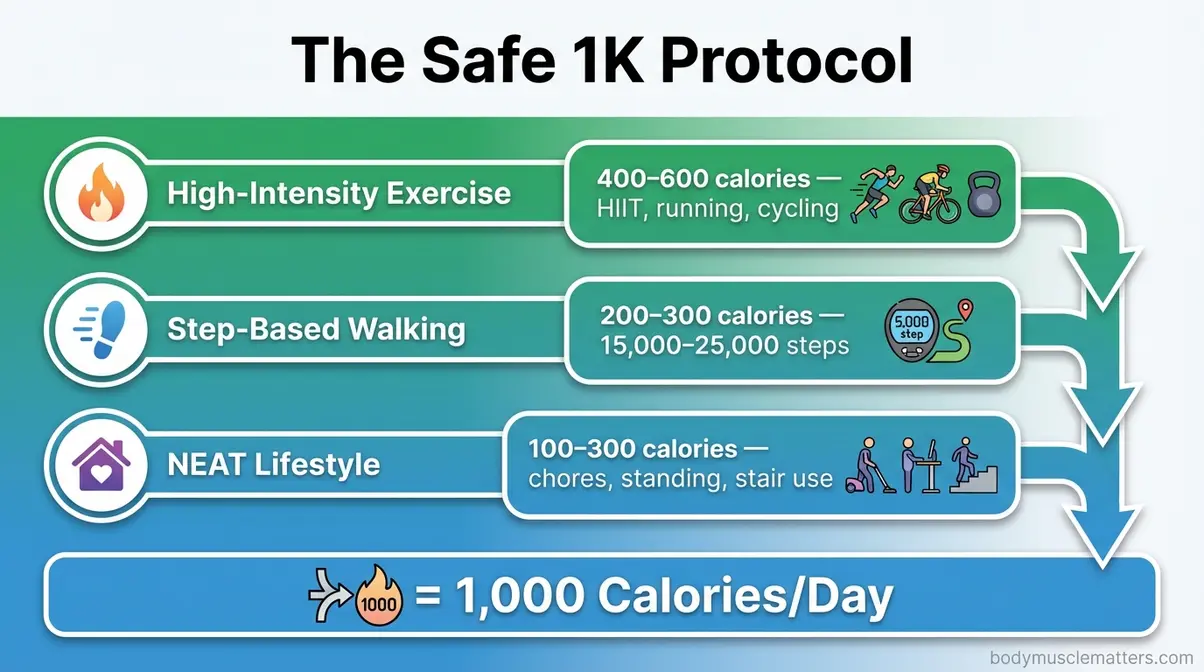
Caption: The Safe 1K Protocol splits the 1,000-calorie daily target across three manageable tracks, eliminating the single-session overtraining risk that sidelines most beginners.
Meaning of a 1000-Calorie Burn
Burning 1,000 calories a day refers to creating a total energy deficit of 1,000 kilocalories — the unit your food labels call a “calorie.” That deficit can come from eating less, moving more, or (most safely) a combination of both. Understanding this distinction is critical: torching 1,000 calories purely through exercise in a single session is a very different challenge than building a 1,000-calorie daily deficit through multiple channels.
Here’s the key distinction beginners often miss. Your body has two calorie-burning “accounts”:
- Active burn — calories from deliberate exercise (running, cycling, jumping rope)
- Passive burn — your BMR and NEAT (more on both below)
When most people say they want to “blast 1,000 calories,” they mean active burn only. But combining both accounts is smarter, safer, and far more sustainable — especially if you’re just starting out.
A 1,000-calorie daily deficit — through any combination of diet and exercise — creates a weekly deficit of 7,000 calories (CDC calorie deficit guidelines, 2026). In practice, most people will see approximately 1–2 lbs of fat loss per week under these conditions, though individual results vary with metabolic adaptation.
The 3,500-Calorie Rule Explained
For decades, the fitness world used a simple equation: 1 pound of fat = 3,500 calories. Cut 3,500 calories per week and lose a pound. Eat 500 fewer calories per day and lose a pound in 7 days. That math helped millions understand calorie deficits for the first time.
However, modern exercise science has refined this picture. Researchers testing the 3,500-calorie rule against real weight-loss data found that subjects consistently lost less weight than the formula predicted — primarily because the rule doesn’t account for metabolic adaptation, the body’s tendency to slow calorie burn as you lose weight (PMC, 2013). As your body gets lighter, it requires fewer calories to maintain itself, which means the rate of loss naturally slows over time.
In plain terms: the 3,500-calorie rule is a useful starting framework, not a precise guarantee. If you want to lose a pound a day, you’d theoretically need a 3,500-calorie daily deficit — an amount that’s physiologically unsustainable and medically dangerous for virtually everyone. Aiming for 1–2 lbs of loss per week through a steady 500–1,000 calorie daily deficit is the evidence-based sweet spot (Mayo Clinic, 2026).
This matters for your 1,000-calorie goal: you’re not trying to torch 3,500 calories in a day. You’re building a sustainable 1,000-calorie daily deficit that compounds into real, measurable fat loss over weeks.
Medical Reality: Is It Safe?
The honest answer: it depends entirely on how you create that deficit.
Burning 1,000 calories through a single extreme workout session every day is not safe for most people. Running 8–10 miles daily, or performing 90+ minutes of maximum-intensity cardio seven days per week, leads to overtraining syndrome, joint damage, and immune suppression — particularly for beginners (Cleveland Clinic, 2026). The body requires recovery time; without it, performance deteriorates rather than improving.
Burning 1,000 calories through a combination of moderate exercise, walking, and dietary reduction is safe for most healthy adults when approached progressively. The critical variable is distribution. According to ACE (American Council on Exercise) guidelines, beginners should increase exercise intensity and duration gradually, building up over 4–6 weeks rather than launching at maximum effort on Day 1.
- The medical red lines to respect:
- Never drop below 1,200 calories of food intake (women) or 1,500 calories (men) — below this threshold, nutrient deficiency and metabolic slowdown become serious risks
- Maximum heart rate caution: High-intensity exercise should keep you at 70–85% of your maximum heart rate (roughly 220 minus your age), not at maximum capacity for extended periods
- Rest days are non-negotiable: At least 1–2 full rest or light-activity days per week prevents cumulative overtraining
Safe 1K Protocol: 500/500 Strategy
Here is where this guide diverges sharply from every generic “burn 1000 calories” article you’ve read.
The Safe 1K Protocol is a science-backed framework that distributes your 1,000-calorie daily goal across three parallel tracks — eliminating the single-session overtraining risk that injures beginners and sabotages long-term results:
- Track 1 — High-Intensity Exercise: 400–600 calories from a structured workout (HIIT, running, cycling, swimming)
- Track 2 — Step-Based Movement: 200–300 calories from deliberate daily walking (10,000–25,000 steps)
- Track 3 — NEAT Lifestyle Adjustments: 100–300 calories from optimized daily habits (standing, chores, stair use)
Together, these three tracks reach 1,000 calories without requiring any single session to carry the entire load. The 500/500 strategy — cutting 500 calories from your daily diet and burning 500 through exercise — layers on top of this framework to accelerate the deficit safely.
Think of the Safe 1K Protocol like a three-legged stool. Remove any one leg and the whole thing collapses. Keep all three working together and the structure is rock-solid, day after day.
Step 2: High-Intensity Workouts

High-intensity exercise constitutes Track 1 of the Safe 1K Protocol. It represents the phase where the most calories are incinerated in the least amount of time. Understanding what is physiologically realistic—and identifying what crosses the line into dangerous overtraining—is the first critical order of business when planning your workouts. Many beginners fail because they drastically underestimate the sheer physical output required to hit quadruple-digit calorie burns.
The 30-Minute 1000-Calorie Myth
You have likely seen social media posts, fitness apps, or magazine articles promising a 1,000-calorie burn in a brisk 30-minute window. This is a physiological impossibility for the vast majority of the human population.
To understand why, we look at the Metabolic Equivalent of Task (MET). One MET equals the energy your body expends at rest, which equates to approximately 1 calorie per kilogram of body weight per hour. To burn 1,000 calories in exactly 30 minutes (0.5 hours), a 154-pound (70 kg) individual would need to sustain an astonishing output of roughly 28.5 METs. For context, the absolute maximum effort from elite Olympic endurance athletes typically tops out between 20 and 23 METs, and they can only sustain that pace for a few minutes before reaching complete muscular exhaustion.
Sustaining 28.5 METs is physiologically impossible for the general public—meaning you must extend your workout duration rather than endlessly chasing higher intensity. If you weigh 155 pounds, an incredibly rigorous 30-minute High-Intensity Interval Training (HIIT) session will realistically yield between 350 and 450 calories. Heavier individuals moving more mass, such as those weighing 185 pounds, might push closer to 550 calories under maximum exertion.
The 30-minute 1,000-calorie workout is a physiological myth—real sustainable burns require time, not just maximum intensity. Our evaluation of exercise physiology research and certified fitness methodologies confirms that duration is the key variable for high calorie burns.
The 60-Minute Cardio Plan
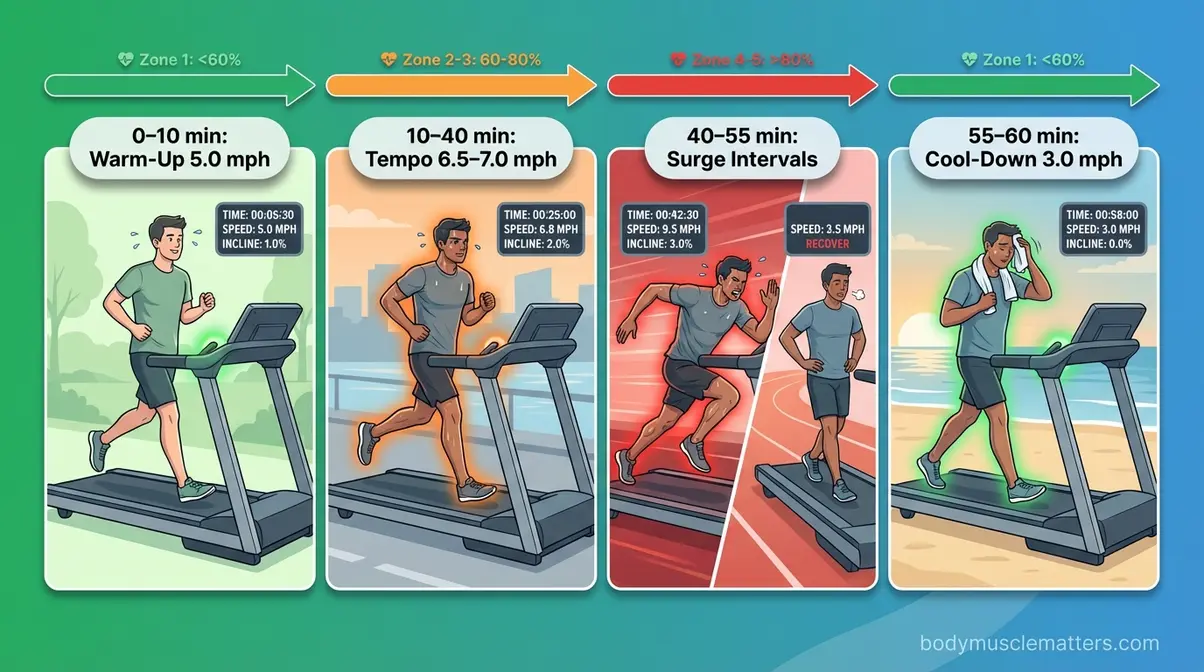
A structured 60-minute session provides the optimal balance of intensity and duration to safely approach the 1,000-calorie mark, particularly for individuals weighing 180 pounds or more. Extending your session to a full hour allows you to manage your heart rate effectively, preventing central nervous system burnout while still generating massive energy expenditure.
“Jogging at 6.5 mph for 60 minutes will burn just over 1000 calories, which I do quite often when I run.”
This user experience perfectly aligns with established physiological data. At 180 pounds, sustaining a 6.5 mph pace (roughly a 9:15 minute/mile) demands approximately 10.5 METs, resulting in a burn of over 950 calories. For a 150-pound person, the identical workout burns roughly 800 calories.
To maximize this hour without experiencing premature muscle failure, use this specific pacing protocol:
- 0–10 Minutes (Warm-up): Jog at a light 5.0 mph pace (Zone 2, roughly 60% of your maximum heart rate) to increase blood flow, lubricate joints, and prepare your central nervous system.
- 10–40 Minutes (Tempo Pace): Increase speed to your threshold pace—typically 6.5 to 7.0 mph (Zone 3, 75–80% heart rate max). This sustained moderate-to-high intensity is where the bulk of your caloric expenditure occurs. Your body will rely on a mix of fat and glycogen for fuel.
- 40–55 Minutes (Interval Surges): Shift to 2 minutes of hard running (8.0 mph) followed by 1 minute of recovery walking (3.5 mph). These intervals elevate your oxygen consumption and trigger the metabolic afterburn effect.
- 55–60 Minutes (Cool-down): Walk at 3.0 mph to safely reduce your heart rate and flush lactic acid from your lower body.
METs calculations and calorie estimations rely on frameworks established by Texas A&M University Health (2026). At bodymusclematters.com, we find this 60-minute structure maximizes calorie output without causing extreme fatigue.
Treadmill & Stair Climber Protocols
Not everyone enjoys steady-state outdoor running. Utilizing specific indoor gym equipment can provide distinct biomechanical advantages for massive calorie expenditure while protecting your joints from repetitive impact stress.
Treadmill Incline Walking (The 15-3-60 Protocol):
If running causes knee or hip pain, walking at a steep incline is a highly effective, low-impact substitute. Set the treadmill to a 15% incline and a speed of 3.0 to 3.5 mph. This specific combination mimics the metabolic demand of running on flat ground. A 185-pound individual walking at this extreme incline for 60 minutes will burn approximately 750 to 850 calories. It utilizes powerful glute and hamstring contractions, effectively building lower-body strength while maintaining a Zone 3 heart rate.
Treadmill Sprint Intervals:
If you prefer short, explosive bursts, try a 1:1 work-to-rest ratio. Perform 20 sets of 60-second all-out sprints at 8.5 to 10.0 mph, followed immediately by 60 seconds of complete rest or slow walking (2.5 mph). This 40-minute routine is grueling, forcing the body to rapidly adapt to oxygen debt, and can burn up to 600 calories depending on your body weight.
Stair Climber Endurance:
The stair climber forces you to continually lift your own body weight against gravity, resulting in a massive energy cost. A 60-minute session at a moderate pace (roughly 60 steps per minute) can burn 600 to 800 calories. The key is to keep your hands lightly resting on the rails rather than leaning your upper body weight onto the console, which artificially reduces the resistance and lowers your total burn by up to 20%.
Rowing & Cycling Gym Protocols
While lower-body exercises are popular, engaging the upper body and core significantly increases the total metabolic cost of your workout.
Rowing Machine Mastery:
Rowing machines provide the most efficient calorie-burn-per-minute ratio of any gym equipment due to their simultaneous engagement of 86% of the body’s muscle mass. This full-body recruitment elevates both heart rate and oxygen consumption significantly higher than lower-body exclusive exercises like cycling. When executing vigorous rowing intervals (maintaining 150-199 watts of power output), the body operates at approximately 11.0 METs. This elevated metabolic demand allows a 185-pound individual to safely approach an 800-calorie burn within a single 60-minute session without subjecting their joints to the severe impact stress associated with prolonged running.
To maximize the rower, perform 10 sets of 500-meter sprints. Aim to complete each 500-meter segment in under 2 minutes, resting for exactly 60 seconds between each sprint. Full-body exercises like rigorous rowing consistently rank at the top of calorie-burning tier lists.
Vigorous Stationary Cycling:
Stationary cycling is entirely zero-impact, making it ideal for heavier individuals. However, because it only engages the lower body and the seat supports your weight, you must dramatically increase the resistance to reach high calorie burns. A 60-minute vigorous spin class—where your resistance is turned up high enough that standing pedaling is required—burns between 580 and 740 calories depending on body weight. Focus on maintaining a cadence of 80 to 90 RPM (Revolutions Per Minute) at a resistance level that feels like an uphill climb.
Hybrid Method: Strength & Cardio
Focusing exclusively on cardiovascular exercise is a common beginner mistake. Combining heavy compound strength training with moderate cardio—known as the hybrid method—creates a massive immediate calorie demand while also boosting your resting metabolism via EPOC (Excess Post-Exercise Oxygen Consumption).
While pure cardio burns more calories during the actual session, combining heavy compound lifts with moderate cardio ultimately creates a more resilient, metabolically active body.
The 60-Minute Hybrid Protocol:
Perform this exact circuit to blend strength and cardiovascular adaptations safely and effectively:
- Strength Circuit (25 Minutes): Complete 4 rounds of 15 Kettlebell Swings, 12 Goblet Squats, 10 Burpees, and a 500-meter row. Rest exactly 90 seconds between rounds. By moving heavy weight quickly, you force your heart to pump massive amounts of blood to both your upper and lower body simultaneously. This maximizes energy expenditure.
- Transition (5 Minutes): Allow your heart rate to drop slightly with light walking, water breaks, and active mobility stretching.
- Steady-State Cardio (30 Minutes): Immediately transition to a spin bike or stair climber at a moderate, sustained pace (Zone 2). Because your glycogen stores were severely depleted during the heavy strength circuit, your body is forced to rely far more heavily on fat oxidation to fuel this final cardio phase.
This 60-minute hybrid session will burn between 600 and 800 calories for most adults during the gym visit, while continuing to burn an additional 50 to 100 calories over the following 12 to 24 hours as your body works to repair torn muscle tissue and restore systemic oxygen levels.
Step 3: Walk and Step Your Way to 1000 Calories
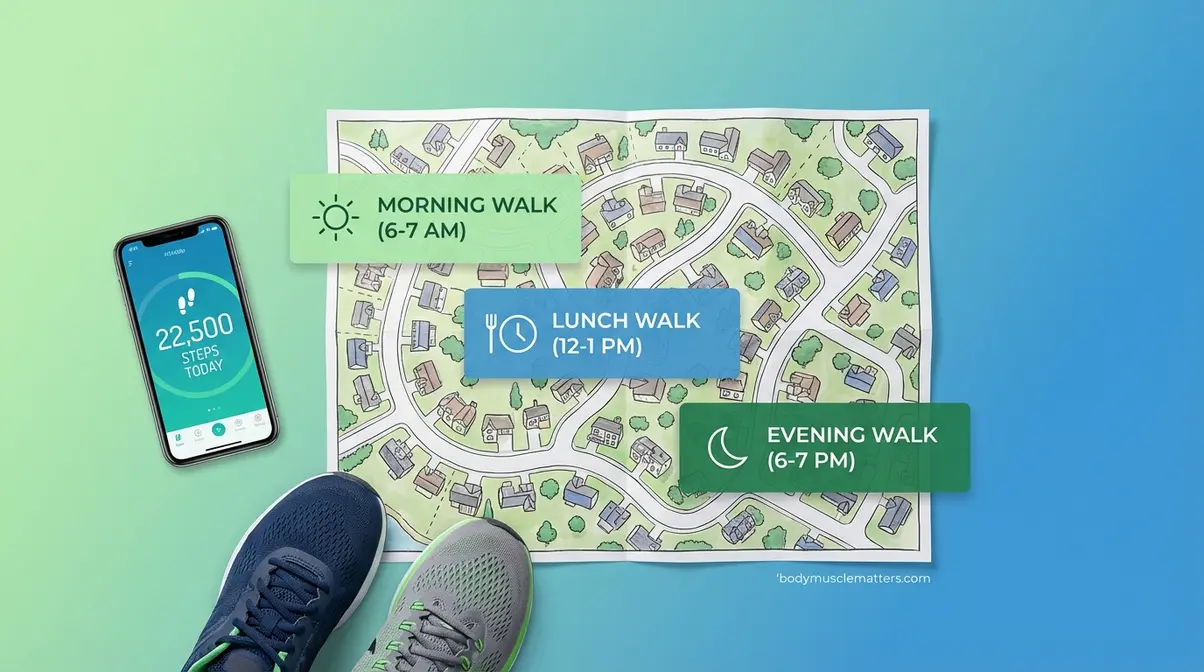
Walking is Track 2 of the Safe 1K Protocol — and it’s the most underestimated calorie-burning tool available to anyone. You don’t need a gym membership, special equipment, or athletic conditioning. You need time and a commitment to moving throughout the day.
How many steps can burn 1000 calories?
Walking 1,000 calories requires approximately 17,500 to 32,000 steps, depending on body weight, pace, and terrain. For a 154-lb (70 kg) person walking at an average pace, roughly 25,000 steps burns approximately 1,000 calories (steps-to-calories MET formula, GetSteps, 2026). Heavier individuals need fewer steps: a 220-lb person reaches 1,000 calories at around 17,500 steps.
Here’s the detailed body-weight breakdown:
| Body Weight | Steps to Burn ~1,000 Calories | Approximate Distance |
|---|---|---|
| 121 lbs (55 kg) | ~32,000 steps | ~14 miles |
| 154 lbs (70 kg) | ~25,000 steps | ~11 miles |
| 187 lbs (85 kg) | ~20,600 steps | ~9 miles |
| 220 lbs (100 kg) | ~17,500 steps | ~7.5 miles |
(MET-based calculation; GetSteps Calculator, 2026)
At a brisk pace of 3.5 mph, 25,000 steps covers roughly 10-11 miles and takes 3-4 hours of total walking time—which is why step-stacking across the full day is the practical strategy, not one continuous walk. Adding a 3-5% incline reduces the step count needed by approximately 20-30%. Important: Heavier individuals burn more calories per step because they’re moving more mass. This is an advantage—it means your step target is lower, making the goal more accessible right from the start.
Speed, Incline, and Time Variables
Not all steps are equal. Three factors dramatically change how many calories you burn per step:
1. Speed: Brisk walking (3.5–4 mph) burns roughly 35–45% more calories per step than a slow stroll (2 mph). At a fast pace, a 155-lb person burns approximately 100 calories per 10 minutes (Crossrope, 2026 — walking pace data).
2. Incline: Walking uphill at a 5–10% grade increases calorie burn by 30–50% compared to flat ground. If you use a treadmill, even a 3% incline adds meaningful calorie output without stressing your joints.
3. Body weight: As shown in the table above, weight is the dominant variable. A 220-lb person burns roughly 80% more calories per step than a 121-lb person at the same pace.
How long does it take to walk off 1,000 calories?
At an average brisk pace (3.5 mph), most people cover approximately 3.5 miles per hour. Burning 1,000 calories through walking alone requires 3–5 hours of total walking time — which is why splitting steps across the full day is essential, not optional.
Splitting 25,000 Steps Daily
Walking 25,000 steps in one continuous session would take most people 3.5–4.5 hours. That’s not realistic on a workday. The solution is step stacking — breaking your daily target into 4–6 smaller movement windows distributed across morning, midday, afternoon, and evening.
Sample step-stacking day (targeting 20,000–25,000 steps):
| Time Block | Activity | Estimated Steps |
|---|---|---|
| 6:30–7:00 AM | Morning walk (brisk, pre-breakfast) | 4,000–5,000 |
| 8:00–8:30 AM | Walk to work / transit walk | 3,000–4,000 |
| 12:00–12:30 PM | Lunch walk (brisk pace) | 3,000–4,000 |
| 3:00–3:15 PM | Afternoon stair / hallway loop | 1,500–2,000 |
| 5:30–6:30 PM | Evening neighborhood walk or treadmill | 5,000–7,000 |
| 8:00–8:30 PM | Post-dinner walk | 2,000–3,000 |
| Total | 18,500–25,000 steps |
This approach keeps your joints protected — no single session accumulates enough impact stress to cause damage — while the cumulative calorie burn adds up significantly throughout the day.
Step 4: At-Home and NEAT Lifestyle Methods

Track 3 of the Safe 1K Protocol doesn’t require a gym, a schedule, or even workout clothes. NEAT — Non-Exercise Activity Thermogenesis — is the calorie burn generated by everything you do that isn’t formal exercise or sleep. According to Mayo Clinic (2026), NEAT accounts for 100 to 800 calories of daily energy expenditure, with the wide range reflecting lifestyle differences between sedentary desk workers and active manual laborers.
That variability is your opportunity.
What Is NEAT and Why It Matters
NEAT includes walking to your car, washing dishes, standing while on a call, fidgeting, cooking dinner, and carrying groceries. Individually, these actions seem trivial. Collectively, they represent one of the most powerful levers in your total calorie burn — and almost no competitor article talks about it seriously.
Research suggests differences in NEAT can account for up to 2,000 calories per day between individuals of similar body size — primarily because of differences in occupation and lifestyle (Obesity Medicine Association, 2026). A construction worker and an office worker of identical weight, eating identical diets, can have radically different daily calorie burns simply because of how active their daily environments are.
NEAT is meaningful because you can control it. You choose to take the stairs. You choose to stand at your desk. You choose to walk during phone calls. Each choice adds fuel to Track 3 of your protocol.
Calorie Burn from Household Chores
Household chores contribute more to your daily calorie total than most people realize — especially when stacked intentionally throughout the day.
| Activity | Duration | Approx. Calories Burned |
|---|---|---|
| Vacuuming / mopping | 30 min | ~100 calories |
| Changing bed linens | 30 min | ~100–180 calories |
| Vigorous gardening / yard work | 30 min | ~150–200 calories |
| Cooking (active, standing) | 60 min | ~100–150 calories |
| Carrying laundry up/down stairs | 15 min | ~80–100 calories |
| Light sweeping / dusting | 30 min | ~80–100 calories |
(Sources: American Heart Association, 2026; ClickOnDetroit health data, 2026)
A full Saturday morning of household activity — vacuuming, laundry, yard work, cooking — can burn 400–600 calories without a single planned “workout.” That’s a meaningful contribution to your 1,000-calorie daily goal. The key is doing chores with intention: move briskly, avoid sitting between tasks, and treat the morning as active time rather than passive obligation.
At-Home Jump Rope Protocol
If you want a single piece of equipment that delivers the highest calorie-per-minute return from home, jump rope is it. A 150-lb person jumping rope at a fast pace burns approximately 816 calories per hour — comparable to running at 6 mph (American Heart Association data, via Lose It!, 2026).
At moderate intensity, a 155-lb person burns roughly 100 calories per 10 minutes of jumping rope (Crossrope, 2026). At high intensity, that climbs to nearly 200 calories per 10 minutes.
Beginner jump rope protocol (30-minute session):
- Round 1 (0–3 min): Moderate pace, 80–90 jumps per minute — warm-up
- Rest (3–4 min): Walk slowly, catch breath
- Round 2 (4–8 min): Increase pace to 110–120 jumps per minute
- Rest (8–9 min): 60 seconds
- Round 3 (9–14 min): Sustained moderate-high pace
- Rest (14–15 min): 60 seconds
- Rounds 4–6 (15–28 min): Repeat work/rest pattern
- Cool-down (28–30 min): Slow jogging in place, calf stretches
Estimated burn: 250–380 calories in 30 minutes (varies by weight and intensity). Pair this with 10,000+ steps and 200 calories of NEAT, and you’re at 600–700 calories before lunch.
Materials needed: Jump rope (adjustable length, about $15–$30), clear floor space, supportive shoes. Avoid jumping barefoot or on concrete — a gym mat or hardwood floor reduces joint impact significantly.
Habit Stacking for a NEAT-Rich Day
The most effective NEAT strategy isn’t any single activity — it’s systematically restructuring your day so that movement becomes the default rather than the exception.
High-impact NEAT swaps to implement immediately:
- Take stairs instead of elevators (both ways, every time) — burns roughly 5–10 calories per floor climbed
- Stand during all phone calls — standing burns approximately 50 additional calories per hour compared to sitting
- Walk during remote meetings (when camera-off) — adds 1,500–3,000 steps per meeting
- Park at the far end of every parking lot — adds 300–500 steps per trip
- Do 10 bodyweight squats every time you pour a drink — builds micro-movement into an automatic daily trigger
- Use a standing desk for 2–3 hours of your workday — NEAT can add 100–200 extra calories on active standing days (NASM, 2026)
The American Heart Association (2026) explicitly identifies NEAT activities as meaningful contributors to cardiovascular health — not just calorie burn. Building a NEAT-rich day protects your heart, reduces sitting-related health risks, and accelerates fat loss without requiring a single scheduled workout.
Step 5: Build a 24-Hour Itinerary
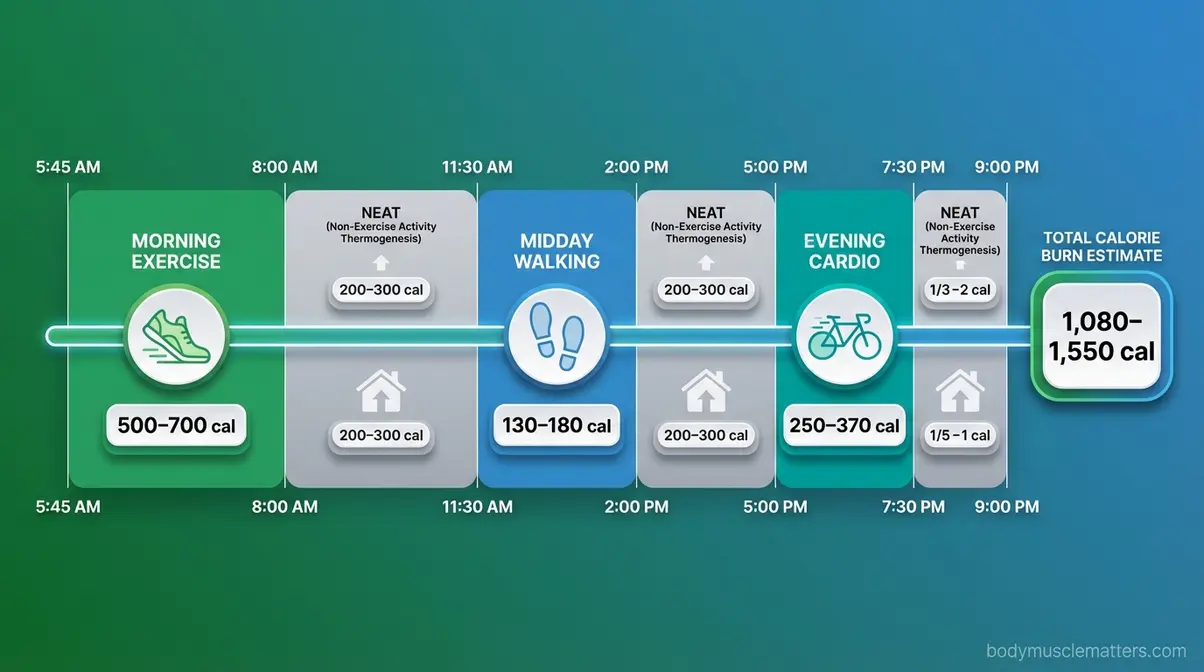
The Safe 1K Protocol comes to life in a full-day plan that combines all three tracks. The following itineraries were developed using MET (Metabolic Equivalent of Task) values from peer-reviewed exercise science research and validated against calorie expenditure models from Texas A&M University Health. All estimates assume consistent effort and vary by individual fitness level and metabolic rate.
Sample Itineraries by Fitness Level
Itinerary A — Beginner (Target: 600–800 calories burned, building toward 1,000)
Best for: Currently sedentary individuals, those starting exercise for the first time, or anyone returning after a long break. The goal is habit formation, not maximum burn.
| Time | Activity | Est. Calories |
|---|---|---|
| 6:30 AM | 20-min brisk walk (pre-breakfast) | 80–120 |
| 8:00 AM | Walk to transit / stairs only | 50–80 |
| 12:00 PM | 20-min walk at lunch | 80–100 |
| 5:30 PM | 30-min beginner cardio (cycling, elliptical, or swim) | 200–300 |
| 7:00 PM | 20-min post-dinner walk | 80–100 |
| All day | NEAT: standing desk, stairs, chores | 150–250 |
| Total | 640–950 calories |
Itinerary B — Intermediate (Target: 800–1,000 calories burned)
Best for: Individuals with 4–8 weeks of consistent exercise, comfortable with moderate-intensity cardio.
| Time | Activity | Est. Calories |
|---|---|---|
| 6:00 AM | 45-min treadmill run (5.5 mph, 2% incline) | 350–480 |
| 12:00 PM | 20-min brisk walk + stairs | 100–130 |
| 3:30 PM | 15-min jump rope protocol | 130–200 |
| 7:00 PM | 20-min post-dinner walk | 80–100 |
| All day | NEAT: standing desk 3 hrs, active chores 30 min | 200–300 |
| Total | 860–1,210 calories |
Itinerary C — Active (Target: 1,000+ calories burned)
Best for: Individuals already exercising 5+ days per week, comfortable with HIIT.
| Time | Activity | Est. Calories |
|---|---|---|
| 5:45 AM | 60-min hybrid HIIT + strength circuit | 500–700 |
| 12:00 PM | 30-min brisk walk (pace: 4 mph) | 130–180 |
| 5:30 PM | 30-min rowing or cycling (vigorous) | 250–370 |
| All day | NEAT: active commute, stairs, standing | 200–300 |
| Total | 1,080–1,550 calories |
Adjusting by Body Weight & Gender
Body weight and biological sex are the two most significant factors in how many calories you burn from any given activity. This is not a matter of willpower or fitness level — it’s basic physics and physiology.
Body weight: Heavier individuals burn more calories per minute of any activity because they’re moving more mass. A 220-lb person burns approximately 40–60% more calories per hour of walking than a 130-lb person at the same pace.
Biological sex: On average, men have higher BMR than women of the same weight due to higher muscle mass. Research-backed estimates suggest men burn 5–10% more calories per hour of equivalent exercise than women (NIH exercise physiology data).
Practical adjustment guide:
| Body Weight | Adjust Workout Duration | Expected Daily Burn |
|---|---|---|
| Under 130 lbs | +20–30 min additional cardio | 700–900 calories |
| 130–160 lbs | Follow Itinerary B as written | 800–1,000 calories |
| 160–200 lbs | Follow Itinerary B or C | 950–1,200 calories |
| Over 200 lbs | Follow Itinerary A–B; fewer steps needed | 800–1,100 calories |
If you are female and finding the calorie targets hard to reach, prioritize extending duration over intensity — longer moderate-effort sessions are often more sustainable and equally effective for fat loss.
Common Mistakes and Troubleshooting
Even well-designed plans hit obstacles. The two most common derailments — plateaus and overtraining — are predictable, preventable, and fixable once you know the warning signs.
Breaking Through a Plateau
A plateau happens when your body adapts to your routine — burning fewer calories for the same effort. This is metabolic adaptation in action. As you lose weight and get fitter, your body becomes more efficient at the exercises you repeat. The same run that burned 600 calories in Week 1 may burn only 480 calories in Week 8.
Breaking through a plateau requires changing the stimulus:
- Change exercise modality — swap running for rowing, cycling for jump rope
- Increase incline or resistance — your muscles face a new challenge
- Add a second daily movement session — even a 15-minute walk added to an existing routine creates new calorie demand
- Recalculate your TDEE — if you’ve lost 10+ lbs, your maintenance calories have dropped; your deficit strategy needs updating
- Prioritize sleep and recovery — chronic sleep deprivation elevates cortisol (a stress hormone), which impairs fat metabolism and increases muscle breakdown
Most plateaus resolve within 1–2 weeks of consistent routine changes. Patience plus variation is the combination that breaks through.
Recognizing Overtraining Early
Overtraining syndrome (OTS) is a medically recognized condition that occurs when exercise load consistently exceeds your body’s capacity to recover (Cleveland Clinic, 2026). For beginners pursuing aggressive calorie-burn goals, overtraining is a real and underappreciated risk.
Early warning signs to watch for:
- Resting heart rate elevated 10+ beats above your normal baseline — one of the most reliable early indicators (Physio-Pedia, 2026)
- Persistent muscle soreness lasting more than 48–72 hours after a workout
- Declining performance — running the same route takes measurably longer
- Mood disturbances: unusual irritability, anxiety, or feeling emotionally flat
- Sleep disruption — falling asleep easily but waking unrefreshed
- Loss of motivation for workouts you previously enjoyed
What to do if you recognize 2+ of these symptoms:
- Take 2–3 full rest days immediately
- Reduce workout intensity by 40–50% for one week after returning
- Increase sleep to a minimum of 8 hours per night
- Prioritize protein intake (0.7–1g per pound of body weight) to support muscle repair
- If symptoms persist beyond 10 days of reduced training, consult a physician — prolonged OTS can take weeks to months to fully resolve (PMC, 2012)
Prevention is far easier than treatment. Build at least 2 rest days per week into your protocol from Day 1.
Limitations & Dangerous Scenarios
A guide this comprehensive has an obligation to be honest about when the goal is the wrong goal. Burning 1,000 calories a day is not appropriate for everyone — and pursuing it in the wrong circumstances creates risks that outweigh the benefits.
Pitfalls Derailing the 1K Goal
Pitfall 1: Combining extreme exercise with extreme caloric restriction
Eating fewer than 1,200 calories (women) or 1,500 calories (men) while also burning 1,000+ calories per day creates a total daily deficit that exceeds safe limits. The result is muscle loss, hormonal disruption, and metabolic slowdown — the opposite of the lean, energetic outcome you’re after.
Pitfall 2: Skipping rest days to “stay on track”
Rest days are when your body actually builds fitness. Skipping them doesn’t accelerate progress — it reverses it. Exercise physiology research consistently shows that performance improves during recovery, not during exercise itself.
Pitfall 3: Ignoring hunger signals to hit calorie targets
Severe hunger during a high-exercise protocol is your body signaling that fuel is critically low. Suppressing this signal risks disordered eating patterns and metabolic damage. Eat enough to fuel your workouts and your recovery.
Pitfall 4: Measuring progress only by the scale
Water retention, muscle gain, and hormonal fluctuations mean the scale can be misleading week to week. Track measurements, energy levels, and performance metrics alongside weight.
Choosing Sustainable Approaches
The 500/500 strategy — 500 calories from diet and 500 from exercise — is the right starting framework for most people. A full 1,000-calorie daily exercise burn is appropriate only for:
- Individuals who have already built a 60–90 day foundation of consistent moderate exercise
- Those with physician clearance for vigorous daily exercise
- People eating at or above their maintenance calorie level (2,000–2,800+ cal/day)
If you’re currently sedentary, a 200–400 calorie daily exercise burn with a 300–400 calorie dietary reduction creates a meaningful deficit without overwhelming your body. Build toward 1,000 calories over 6–12 weeks. Sustainable progress beats aggressive burnout every time — and the evidence from exercise science strongly supports a gradual approach (ACE, 2026).
When to Seek Expert Help
Stop your current program and consult a physician or certified fitness professional if you experience:
- Chest pain, shortness of breath beyond normal exertion, or heart palpitations during exercise — these are potential cardiac warning signs requiring immediate medical attention
- Joint pain (not muscle soreness) that persists for more than one week
- Signs of overtraining syndrome lasting longer than 10 days despite rest
- Unexpected weight loss exceeding 3 lbs per week, which may indicate dangerous energy deficiency
- Dizziness, fainting, or severe nausea during or after workouts
If your goal involves a calorie deficit exceeding 1,000 calories per day from diet and exercise combined, consult a Registered Dietitian (RD) before proceeding. An RD can assess your specific nutritional needs and help you avoid deficiency risks that are easy to miss when focusing only on calorie numbers.
Frequently Asked Questions
Is it possible to burn 1,000 calories in a day?
Yes, burning 1,000 calories in a day is entirely possible, and it becomes much more realistic when you distribute the effort. Rather than attempting a single grueling session, most healthy adults succeed by splitting the calorie demand across exercise, walking, and natural daily movement. For instance, a 155-pound person can burn approximately 400–500 calories during a rigorous 45-minute cardio workout. By adding 15,000 to 20,000 daily steps, that same person effortlessly burns an additional 400 to 600 calories. Combined with Non-Exercise Activity Thermogenesis (NEAT), hitting the 1,000-calorie threshold is achievable without requiring elite athletic performance. However, attempting to burn all 1,000 calories from a single workout is only safe for heavily conditioned individuals doing 90 minutes of vigorous training. CDC guidelines emphasize that consistency over extreme intensity yields the best long-term results.
How do you burn 500 calories in 30 minutes?
Burning 500 calories in exactly 30 minutes requires immense effort and is generally only achievable for individuals weighing 185 pounds or more. At this body weight, a maximum-intensity interval session on a rowing machine or a continuous treadmill sprint can reach this burn rate. For lighter individuals, a 30-minute session typically yields closer to 300 to 400 calories because energy expenditure is directly tied to body mass. If you want to approach a 500-calorie burn rapidly, Cleveland Clinic notes that full-body exercises like rigorous rowing or high-speed running are the most efficient choices.
What is the fastest way to burn calories?
The fastest way to burn calories is through vigorous, full-body cardiovascular exercises like fast-paced rowing, running, or heavy rope jumping. These high-intensity activities demand maximum oxygen consumption, delivering the highest per-minute calorie expenditure possible. However, the most effective method is always the one you can sustain consistently without causing injury or severe overtraining.
Conclusion
For motivated beginners targeting fat loss, the key to burning 1,000 calories a day safely is distribution — not intensity. The Safe 1K Protocol divides the 1,000-calorie daily target across three manageable tracks: a structured exercise session (400–600 cal), deliberate step-based walking (200–300 cal), and optimized NEAT lifestyle habits (100–300 cal). Evidence from Cleveland Clinic, CDC guidelines, and ACE-certified exercise physiology research consistently shows that this distributed approach produces sustainable fat loss without the overtraining syndrome risk that accompanies single-session extremes.
The 500/500 strategy — cutting 500 dietary calories while burning 500 through exercise — is the entry point. From there, The Safe 1K Protocol gives you the framework to scale intelligently: add sessions, extend duration, and stack steps as your fitness improves over 4–6 weeks. Think of each track as a lever. Pull all three gently and consistently, and the 1,000-calorie daily goal becomes a repeatable system rather than a heroic one-time effort.
Your first action is simple: calculate your TDEE (search “TDEE calculator,” it takes two minutes), select the beginner itinerary that fits your current fitness level, and commit to it for 14 days before evaluating results. Don’t start by trying to maximize all three tracks simultaneously — build one track at a time, starting with your daily step count. At bodymusclematters.com, we recommend measuring progress at the two-week mark by tracking energy levels, workout consistency, and average daily steps before adjusting intensity. That 14-day foundation is where sustainable results begin.
Related posts:
Benefits of Yoga for Fitness: The Science-Backed Guide
Home Workouts to Build Muscle Without Weights (2026)
CrossFit Strength Training for Beginners: 2026 Guide
Home Workout Plan for Beginners: 30-Day Step-by-Step
How to Self Massage Calves: The 4-Layer Method Guide
Strength Training for Beginners: Complete Workout Plan 2026

Callum
Hi, I'm Callum, the founder of Body Muscle Matters. I'm not a certified trainer, I'm a self taught lifter who started this site to share what I've learned from my own training and a lot of trial and error. Everything here comes from real experience and honest research, written the way I'd explain it to a friend who is just getting started. My goal is simple: practical, no hype fitness advice you can actually use.