Benefits of a Spotter in the Gym: Lift Safer & Stronger
⚠️ Safety Disclaimer: The exercises and techniques in this guide involve heavy loads and carry real injury risk. Always start with light weights to master your form before adding load. Consult a certified personal trainer (CPT) or strength and conditioning specialist (CSCS) before attempting heavy lifts or advanced techniques like forced reps or training to failure.
A single spotter can increase your total bench press output by 11% — not because they’re lifting the bar for you, but because of what their presence does to your brain (PubMed bench press study, Sheridan et al., 2019). Without one, you’re leaving measurable performance on the table and taking on risks the U.S. Consumer Product Safety Commission links to fatal injuries at the bench press.
Understanding the full benefits of a spotter in the gym changes how you train. This guide covers the science behind the performance gains, exactly which lifts demand a spotter, how to spot correctly (and how to ask for one without the awkwardness), and the advanced techniques — forced reps, negatives, true failure — that are simply off-limits without a qualified training partner.
The benefits of a spotter in the gym go far beyond catching a failed rep — research shows The Spotter Effect boosts bench press output by 11% while simultaneously reducing perceived effort (PubMed, 2019).
- Safety net: A spotter cuts your injury risk nearly in half — 8.9% vs. 17.8% in unsupervised settings (PMC, 2023)
- The Spotter Effect: Their psychological presence boosts self-efficacy and lowers Rating of Perceived Exertion (RPE) — you lift more without feeling like you’re working harder
- Form feedback: Real-time coaching cues catch technique breakdowns you can’t see yourself
- Advanced access: Forced reps, negative reps, and true failure training require a spotter to execute safely
- Confidence multiplier: Knowing someone has your back lets you attempt weights you’d normally skip
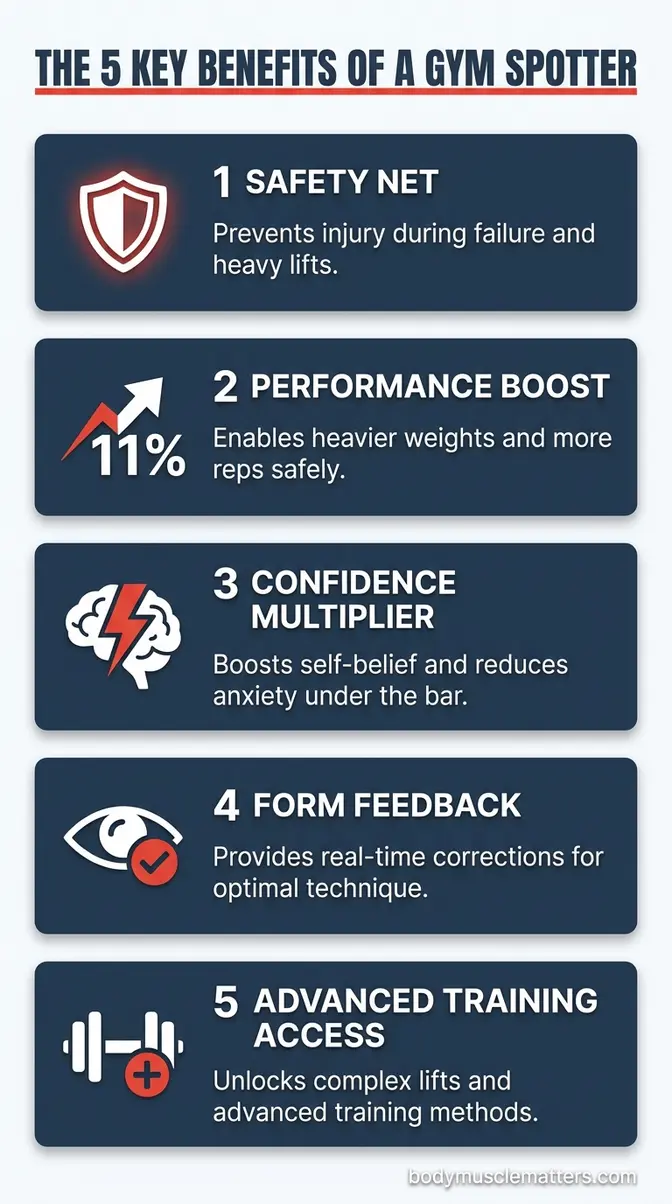
The infographic above summarizes all five benefits — we’ll break each one down with the science behind it.
Why a Gym Spotter Transforms Your Training
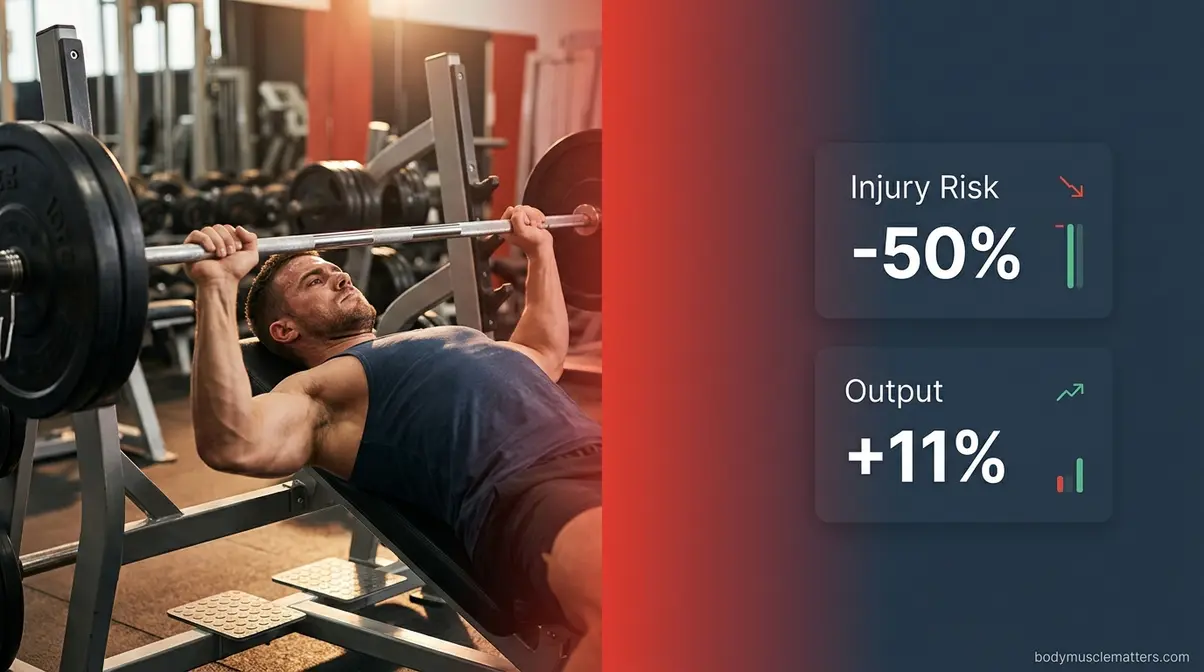
The benefits of a spotter in the gym are threefold: physical safety, measurable performance enhancement, and psychological confidence. These don’t work in isolation — they compound each other into what researchers and strength coaches recognize as a measurable performance multiplier. Here’s what the science actually shows.
Most lifters think a spotter is only useful when they’re about to fail a rep. The data tells a different story. The benefit begins before the bar moves — the mere presence of a qualified spotter changes your neurological output. That’s The Spotter Effect: the measurable physical and psychological performance enhancement that occurs when a qualified spotter is present, combining reduced RPE, increased self-efficacy, and mechanical safety into a single training multiplier.
The fundamental benefits of a gym spotter are supported by peer-reviewed evidence that most lifters — and almost every competitor article — never cite. Let’s fix that.
How a Spotter Prevents Injury
A gym spotter’s most obvious role is also its most quantifiable. NIH injury rate research from a 2023 survey of weight-training athletes found an 8.9% injury rate in supervised lifting settings versus 17.8% in unsupervised settings — supervised training essentially cuts your injury risk in half. That differential isn’t coincidence; it’s the direct result of having an experienced set of eyes watching every rep.
The safety case becomes even more urgent with free-weight barbell exercises. When a heavy bench press rep fails, a solo lifter has no reliable escape route — the barbell is pinned across the chest with no safety mechanism. The U.S. Consumer Product Safety Commission has documented fatalities from this exact scenario. A spotter eliminates that risk completely.
Beyond catching catastrophic failures, a spotter’s proactive safety role is underappreciated. They watch for form breakdown — knees caving on a squat, bar path drifting on bench — before it becomes a failed rep. Imagine you’re on rep 8 of a heavy squat set. Your spotter spotted your knees caving inward three reps earlier and calls it. That’s not interference; that’s injury prevention in action.
Science Behind the 11% Gain
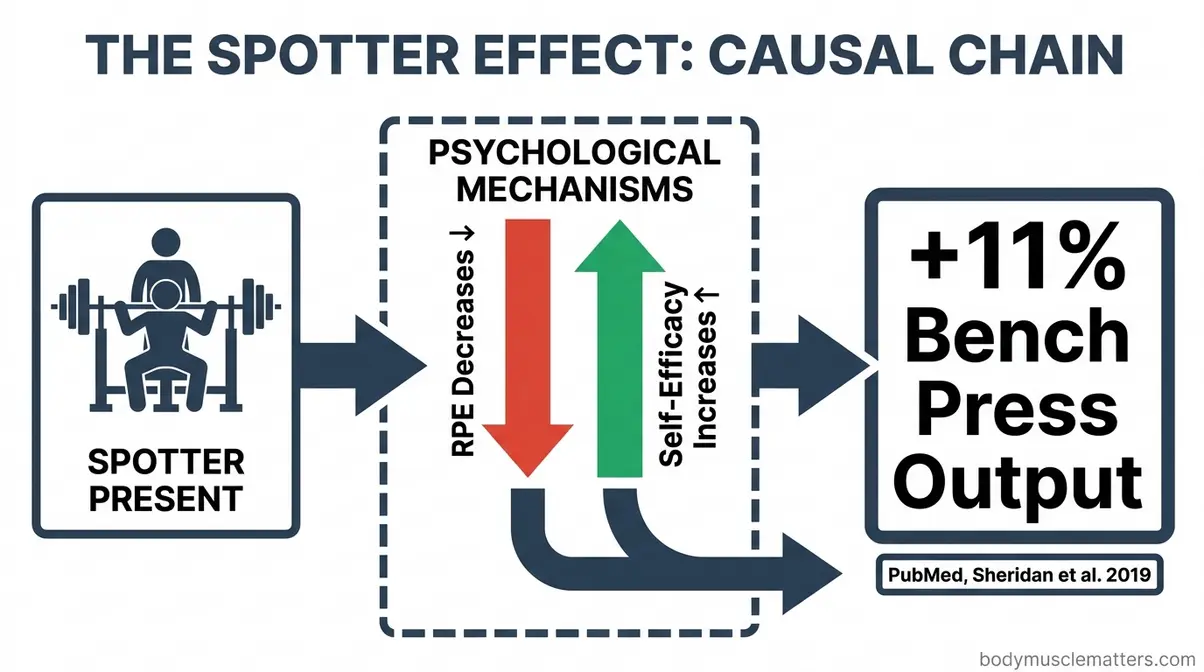
Why are spotters so important? Because their impact starts in your head before it ever reaches your muscles. A controlled study published in the Journal of Strength and Conditioning Research (Sheridan et al., 2019) tested 12 recreationally trained men performing bench press sets to failure at 60% of their one rep max. With a spotter visibly present, participants lifted 11% more total weight and completed significantly more reps — while simultaneously reporting lower Rating of Perceived Exertion (RPE, the 1-10 scale measuring how hard a set feels).
“The presence of a gym spotter increases total bench press output by 11% while simultaneously reducing the lifter’s perceived effort” (PubMed bench press study, Sheridan et al., 2019).
Two psychological mechanisms drive this. First, self-efficacy — your belief in your own ability to complete a lift successfully — rises when you know help is available. Second, RPE drops because the brain downregulates its protective fatigue signals when it perceives the risk as manageable. You’re not cheating the effort; you’re removing artificial psychological brakes. The bar gets heavier. The gains get real.
Feedback and Breaking Plateaus
What do spotters do at the gym beyond catching bars? They act as real-time coaches. A good spotter calls out cues mid-set: “drive your elbows in,” “brace harder,” “one more.” These aren’t just motivational — they’re biomechanical corrections that compound over weeks of training.
For intermediate lifters hitting a plateau, this feedback is often the missing variable. You can’t watch your own bar path. You can’t feel your hips shifting asymmetrically. A spotter can. Research from the IDEA Fitness Journal confirms that the performance gains from spotter presence correlate directly with increased self-efficacy — and that confidence carries forward into subsequent training sessions, not just the set where the spotter was present.
The result: you attempt heavier weights sooner, accumulate more training volume at higher intensities, and break through plateaus that would otherwise stall your progress for months.
Which Lifts Demand a Spotter (And Why)
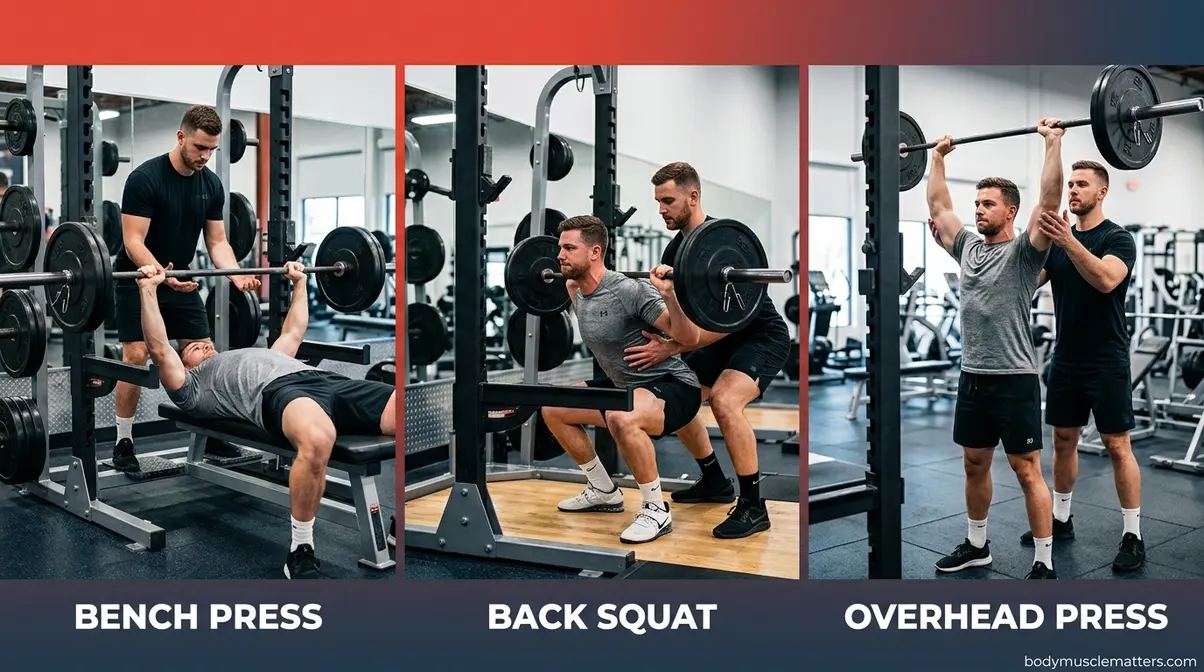
Not every exercise carries the same risk profile. A spotter is genuinely essential for certain free-weight barbell movements and significantly beneficial for others. Knowing the difference helps you use a spotter strategically — and ask for one with confidence.
Bench Press: The Highest-Risk Lift
The barbell bench press is the exercise most associated with gym injuries requiring emergency care. When a heavy rep fails, the bar descends toward the lifter’s chest or throat with no safe bail-out option on a standard flat bench without safeties. The CPSC has documented asphyxia deaths from this specific failure mode. This isn’t a remote risk — it’s a predictable mechanical outcome when training near your one rep max without a spotter.
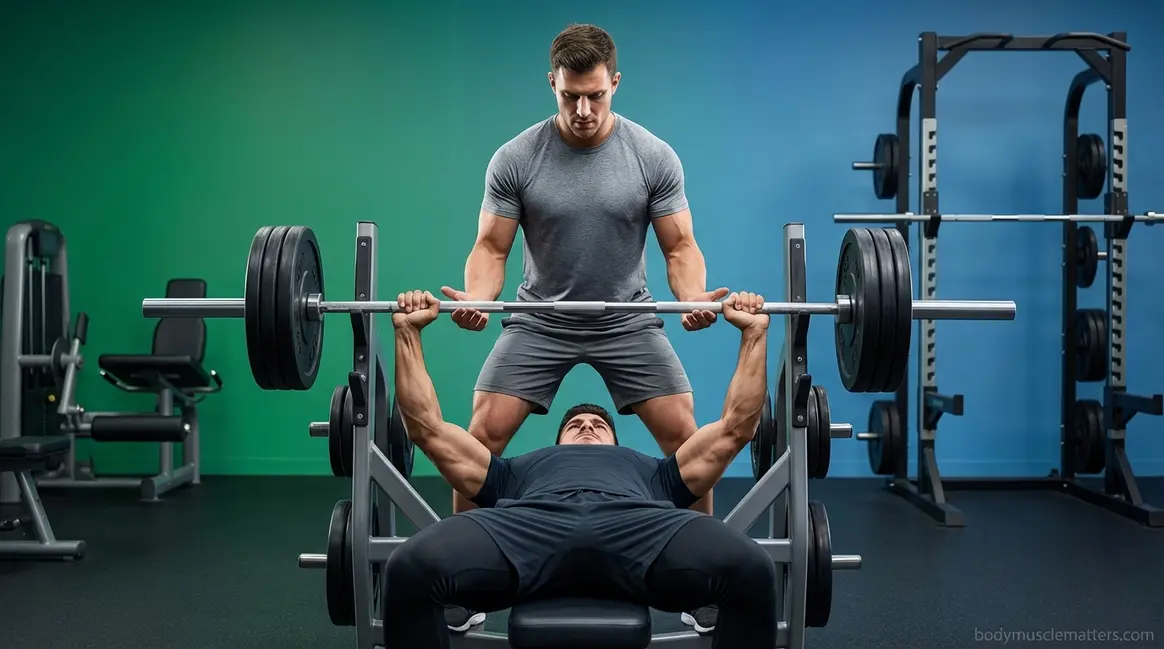
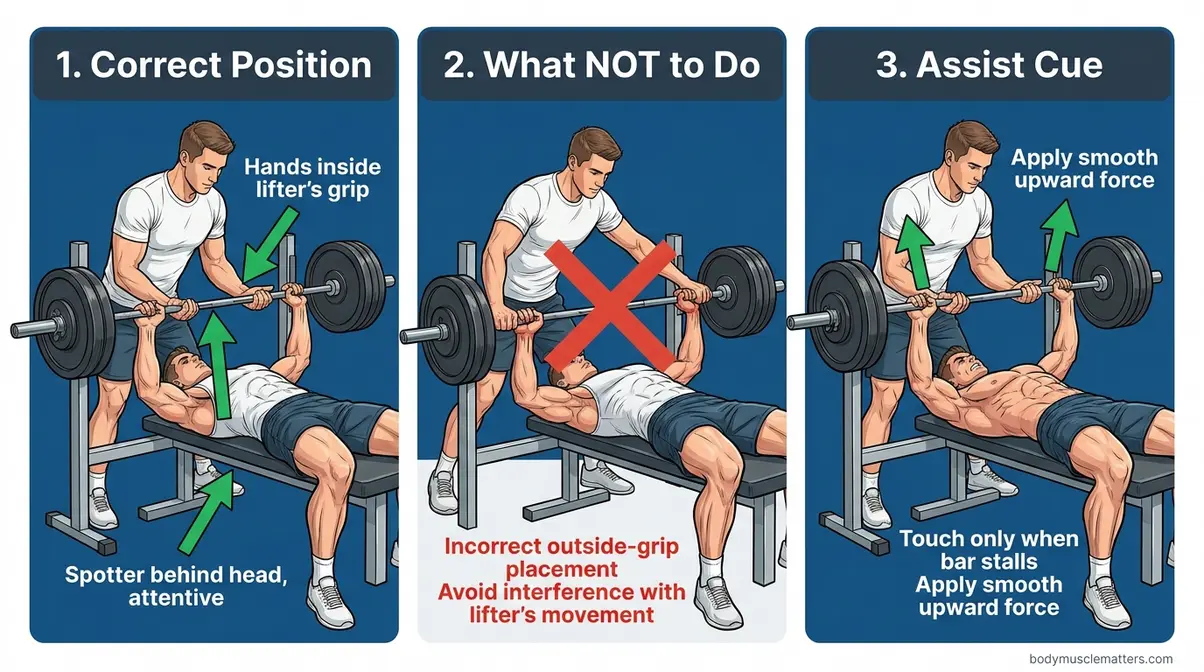
Correct bench press spotting requires the spotter to stand directly behind the lifter’s head, hands positioned inside the lifter’s hands (not outside, not hovering at the center of the bar). The spotter touches the bar only when it stops moving upward or when the lifter calls for help. Pre-set communication — how many reps, whether you want a liftoff assist, what word means “take it” — eliminates confusion under load.
Back Squat: When to Ask for Help
The back squat presents a different failure dynamic. When a squat rep fails near the bottom, the lifter risks being trapped under the bar with no leverage to recover. Safety bars in a power rack solve this problem — but many commercial gym setups don’t have them dialed in, and some lifters train in open floor space.
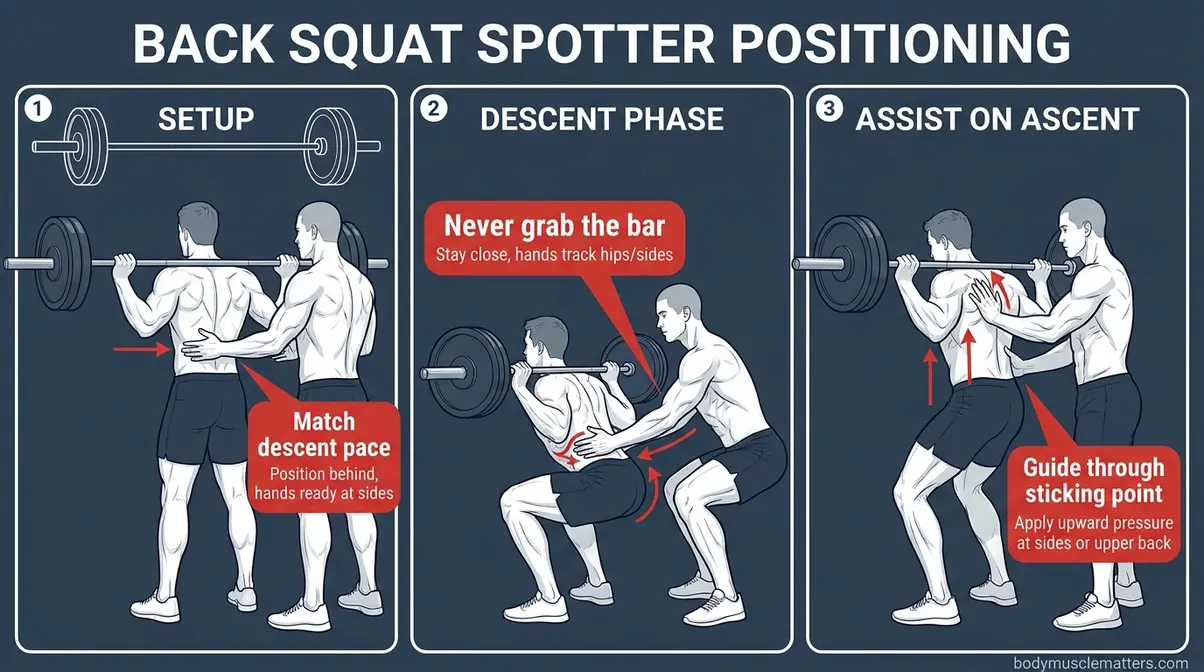
A spotter on the squat typically positions themselves directly behind the lifter, hands lightly touching the lifter’s sides or hips (not the bar), ready to assist the ascent if the rep stalls. The key cue: the spotter should match the lifter’s descent pace and never allow their own body position to pull the lifter off their line. According to Garage Gym Reviews’ spotting guide, squats above 85% of your one rep max on a competition-style bar without rack safeties are the clearest use case for a mandatory spotter. Before attempting these loads, ensure you understand proper squat form for heavy lifts.
Overhead Press and Dumbbell Exercises
The overhead press (OHP) is lower-risk than bench or squat because a failed rep allows the lifter to lower the bar to the front rack position. However, training to failure on OHP with near-maximal loads still benefits from a spotter positioned behind and slightly to the side, hands near the lifter’s elbows — not the bar — ready to assist the lockout.
Dumbbell exercises — incline press, shoulder press, heavy flyes — require a different spotting approach. The spotter assists at the lifter’s wrists, not the dumbbells themselves, providing just enough upward force to keep the rep moving without redirecting the load path. Heavy dumbbell exercises are often where gym-goers most need a spot and least think to ask for one.
Proper Spotting Technique and Etiquette
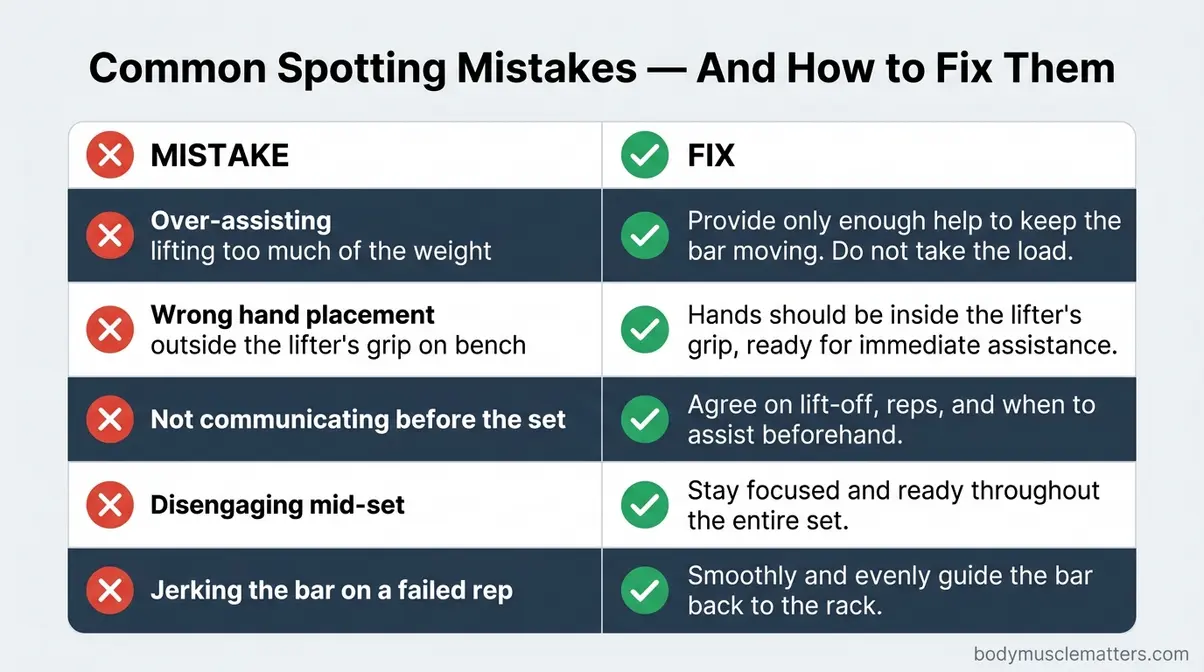
Spotting well is a skill. Done badly, a spotter either lets a dangerous rep continue too long or yanks the bar at the first sign of struggle, robbing the lifter of a legitimate rep. Done right, it’s seamless — the lifter barely notices the assist until the set is over.
What to Say Before the Set
Good spotting starts before a single rep happens. Before the set, establish these four things:
- How many reps the lifter is attempting (so you know when “failure” is a planned grind vs. an emergency)
- Whether they want a liftoff on bench press (some lifters prefer to unrack themselves)
- What word or signal means “take the bar” — “help,” “take it,” or a simple tap are common
- How much assistance they want — some lifters want just enough to keep the rep moving; others want a full bail
Across lifting communities, the consistent advice mirrors what coaches say in practice: “If coaches are busy, don’t hesitate to ask someone you think can spot you, or someone stronger than you.” Asking for a spot is standard gym etiquette — not an imposition. Most experienced lifters are happy to help, which aligns with NC State University’s gym safety guidelines.
Hand Placement and Assistance
The cardinal rule of spotting: use minimal assistance. Your job is to keep the rep moving, not to lift the weight for the lifter. Too much help kills the gains — the lifter misses the stimulus they came for. In fact, over-assisting is one of the most common weight room blunders that can really hurt a lifter’s progress.
For bench press: hands inside the lifter’s grip, not touching the bar unless the rep stalls. For squat: hands lightly at the lifter’s sides or upper back, moving with them. For dumbbell press: assist at the wrists, symmetrically, so you don’t alter the movement path. Stay engaged throughout the full set — a rep can fail at any point, not just at the sticking point.
How to React When a Rep Fails
When a rep genuinely fails — the bar stops moving up, the lifter’s form collapses, or they call for help — your response determines whether this is a safe training experience or an injury.
On bench press: Apply upward force smoothly and guide the bar back to the rack. Don’t jerk. Don’t let the bar drift toward the lifter’s face or neck. Keep your back neutral throughout — you’re lifting too.
On squat: Apply upward pressure at the lifter’s hips or upper back, helping them reach the sticking point and complete the ascent. If full failure occurs, guide them toward the safety bars or help them controlled-lower to the floor.
After any failed rep: Check in verbally. “You good?” A failed rep isn’t a crisis — it’s data. The lifter now knows their actual limit.
Advanced Techniques Only Possible With a Spotter
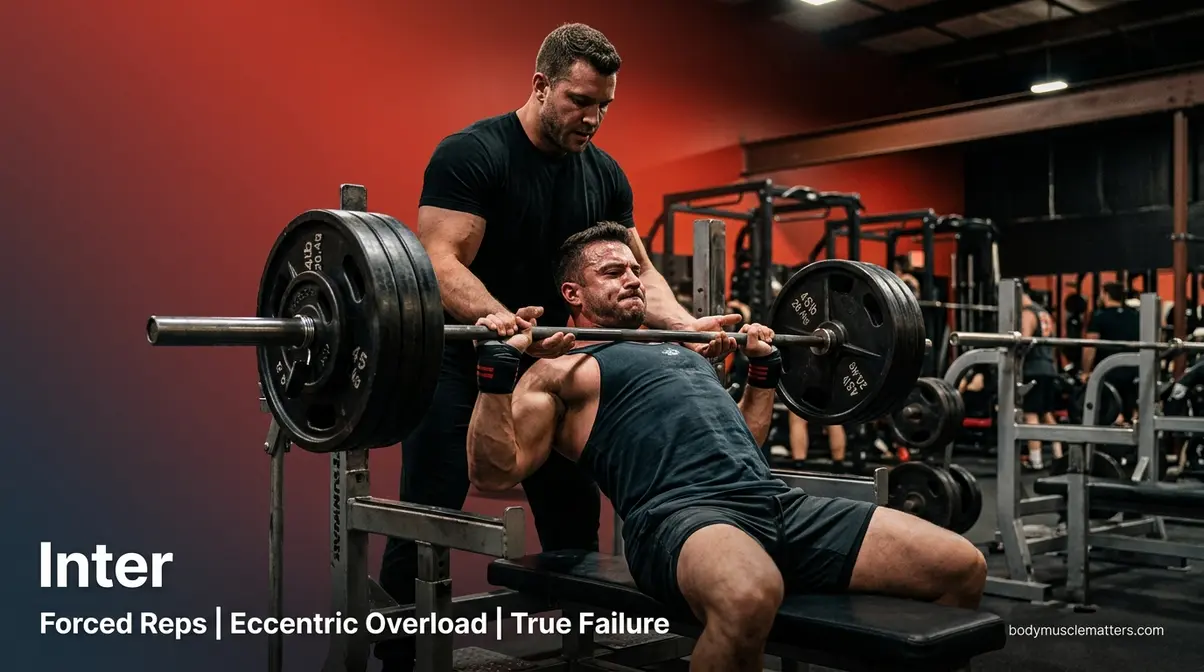
This is where the benefits of a spotter in the gym shift from safety to performance multiplication. The Spotter Effect compounds when you unlock training methods that are physically impossible — or genuinely dangerous — to attempt alone. These techniques are for intermediate-to-advanced lifters who have solid form and a trusted training partner.
Forced Reps for Sticking Points
Forced reps extend a set past the point of muscular failure. You complete your last unassisted rep, the spotter provides just enough assistance to move the bar through your sticking point, and you grind out 2-3 additional reps that would be impossible solo. Research cited by Breaking Muscle’s forced reps analysis shows forced reps stimulate additional hypertrophy volume beyond what standard failure training produces, and separate data indicates they can boost growth hormone levels up to three times higher than ending a set at failure alone.
The key execution rule: the spotter provides the minimum force needed to keep the rep moving. If they’re doing 40% of the work, it’s not a forced rep — it’s a partner lift. Target 2-3 forced reps per set, maximum, and use them sparingly (1-2 sets per session) to avoid overreaching.
Eccentric Overloading Method
Eccentric loading — the lowering phase of a rep — generates more mechanical tension and muscle damage than the concentric (lifting) phase. Research shows eccentric-focused training can increase strength by 20–60% compared to concentric-only protocols (Transparent Labs, referencing Hollander et al., 2007). The catch: to overload the eccentric phase meaningfully, you need loads above your concentric one rep max — which means you physically cannot lift the bar without help.
Here’s how it works with a spotter:
- Load the bar to 105–120% of your one rep max
- Your spotter helps you lift the bar to the top position (the concentric phase)
- You lower it under control over 3–5 seconds (the eccentric phase — you’re doing this alone)
- Your spotter helps you return to the top
- Repeat for 3–5 reps
Eccentric overloading is demanding — expect significant delayed onset muscle soreness (DOMS) after your first session. Use it 1–2 times per week maximum on any given movement, and only after you’ve mastered standard form.
Training to True Failure: The Safe Way
Training to failure — taking a set to the point where another rep is mechanically impossible — is one of the most effective stimuli for both strength and hypertrophy. It’s also one of the riskiest things to attempt alone on a barbell exercise. With a spotter, true failure becomes a controlled event rather than a potential emergency.
The protocol is straightforward: perform your set until you cannot complete another rep without form breakdown. Your spotter watches for the failure signal (bar slowing dramatically, form collapsing) and takes the bar immediately. No grinding through dangerous positions. No ego. Just clean failure at the actual physiological limit. This is training to failure done right — and it’s only safe with someone who knows what they’re watching for.
When You Don’t Need a Spotter
A balanced perspective matters here. Not every exercise requires a spotter, and knowing the difference makes you a smarter, more self-sufficient lifter.
Exercises That Are Safe to Do Solo
The following movements have natural bail-out options or load profiles that make solo training safe at most intensities:
- Deadlifts: You can drop the bar at any point. No spotter needed.
- Romanian deadlifts and hip hinges: Same bail-out logic applies.
- Cable and machine exercises: The weight stack stops; there’s no pin-trap risk.
- Dumbbell curls, lateral raises, and isolation movements: Loads are manageable and failure is just dropping the dumbbells.
- Bodyweight exercises: Pull-ups, dips, push-ups — natural failure is safe.
As Wikipedia’s weight training spotting entry) notes, spotting is specifically relevant to free-weight barbell and dumbbell exercises where a failed rep can trap the lifter under the load.
Alternatives Without a Spotter
Sometimes the gym is empty, your training partner cancelled, and you still want to push heavy. If you are practicing proper gym etiquette for a confident workout, practical alternatives include:
- Power rack with safety bars: Set the safeties just below your lowest range of motion. This replaces a spotter for bench press and squat — not perfectly, but effectively for most failure scenarios.
- Smith machine: Offers built-in safety hooks. Lower specificity than free weights, but useful for solo high-intensity work.
- Reduce load, increase reps: Training at 70–75% of your one rep max to higher rep ranges (12–15) generates comparable hypertrophy stimulus with far lower failure risk.
- Resistance bands as pseudo-safeties: Looped around the power rack and bar, bands can catch a failed bench press rep. Niche, but effective.
Frequently Asked Questions
What do spotters do at the gym?
A gym spotter stands by during a set to assist if a rep fails or becomes dangerous. Their role includes monitoring form throughout the set, providing minimal upward force when a rep stalls, and guiding the bar back to the rack if the lifter calls for help. Beyond physical safety, research shows their mere presence increases self-efficacy and reduces RPE — boosting performance before a single rep is attempted (PubMed, 2019). Good spotters also provide real-time coaching cues during the set.
Why are spotters so important?
Spotters are important because they simultaneously reduce injury risk and increase training output. Supervised weightlifting settings show an 8.9% injury rate versus 17.8% in unsupervised settings (PMC, 2023) — nearly half the risk. On the performance side, a visible spotter increases bench press output by 11% while lowering perceived exertion. For advanced techniques like forced reps and eccentric overloading, a spotter isn’t optional — these methods are physically impossible and unsafe to attempt alone.
Do I tip my gym spotter?
No — tipping your gym spotter is not standard practice or expected. Spotting is a normal part of gym culture and reciprocity is the social currency: if someone spots you today, you offer to spot them. A genuine “thank you” and an offer to return the favor is the appropriate response. If a personal trainer spots you as part of a paid session, that’s already compensated through their fee. Tipping would actually be unusual enough to create awkwardness.
What is not allowed in the gym?
Most gyms prohibit behaviors that compromise safety or etiquette, including dropping weights without bumper plates, using equipment without re-racking, filming others without consent, and performing exercises in high-traffic areas without adequate space. Relevant to spotting: many gyms discourage lifting near your maximum without a spotter or safety equipment — some facilities explicitly require it for heavy barbell work. Check your specific gym’s posted rules, as policies vary.
What is the 3-3-3 rule at the gym?
The 3-3-3 rule is an informal gym guideline, not an official standard. It typically refers to limiting rest periods to 3 minutes, maintaining 3 feet of personal space around others, and re-racking weights within 3 minutes of finishing a set. Some coaches apply it differently — for example, 3 warm-up sets before working sets. The rule isn’t universally defined, so its meaning depends on the context where you encountered it.
Do 90% quit the gym after 3 months?
The “90% quit in 3 months” figure is widely repeated but lacks a single verified source. What research does confirm is significant attrition: studies on exercise adherence consistently show that roughly 50% of people who start a new exercise program drop out within the first 6 months (American College of Sports Medicine data). The causes are well-documented — unrealistic expectations, lack of social support, and insufficient progress feedback. Having a consistent training partner — including a regular spotter — is one of the most reliable predictors of long-term gym adherence.
The Spotter Effect Is Your Training Edge
The science is unambiguous: a qualified gym spotter reduces your injury risk by nearly half, adds 11% to your measurable performance output, and unlocks advanced training techniques that no solo lifter can safely access. That’s not a marginal benefit — that’s a structural advantage built into every session where The Spotter Effect is in play.
The Spotter Effect works because it operates on three levels simultaneously: mechanical safety removes the fear of catastrophic failure, reduced RPE removes the psychological brake on effort, and real-time form feedback removes the technical errors compounding silently over months of training. Remove any one of those three, and you’re leaving progress on the table.
Start with one session this week. Pick one heavy compound lift — bench, squat, or overhead press — and ask someone stronger than you for a spot. Communicate clearly before the set, push to an intensity you’d normally avoid alone, and notice the difference. That’s the entry point. From there, forced reps and eccentric overloading will be waiting when you’re ready. Find a training partner today and start lifting safer.
Related posts:
Benefits of Yoga for Fitness: The Science-Backed Guide
Home Workouts to Build Muscle Without Weights (2026)
CrossFit Strength Training for Beginners: 2026 Guide
Home Workout Plan for Beginners: 30-Day Step-by-Step
How to Self Massage Calves: The 4-Layer Method Guide
Strength Training for Beginners: Complete Workout Plan 2026

Callum
Hi, I'm Callum, the founder of Body Muscle Matters. I'm not a certified trainer, I'm a self taught lifter who started this site to share what I've learned from my own training and a lot of trial and error. Everything here comes from real experience and honest research, written the way I'd explain it to a friend who is just getting started. My goal is simple: practical, no hype fitness advice you can actually use.