Healthy Meal Planning for Muscle Building: Proven 7-Day Plan
Home ›Supplements and Nutrition
Most muscle-building meal plans fail for one of three reasons: they ignore your actual calorie targets, they repeat the same five meals until you hate them, or they assume you have two hours to cook every night. The result? You eat inconsistently, stall on your gains, and eventually give up on clean eating altogether.
Across fitness communities, the consistent feedback is that food boredom is the #1 reason meal plans fail — not lack of motivation or access to a gym. As one experienced lifter put it:
“Eat lean fresh meat, fish and stay away from pork. Make vegetables at least once a day and stay away from sugar.”
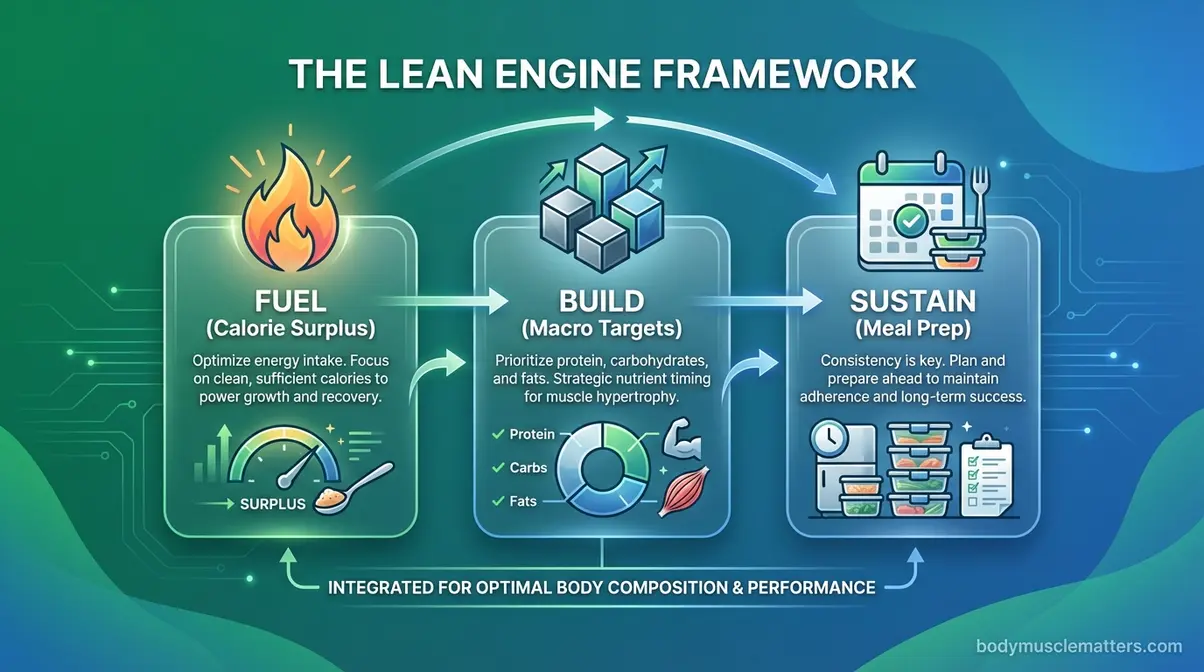
That principle works. The problem is turning it into a repeatable weekly system. That’s exactly what healthy meal planning for muscle building is designed to solve. By the end of this guide, you’ll have a complete 7-day muscle-building meal plan with exact macro breakdowns, a categorized grocery list, and batch-prep strategies — so you can build lean muscle consistently, even on a budget and a busy schedule. This guide follows The Lean Engine Framework — a three-pillar system covering how to Fuel (calorie surplus), Build (macro targets), and Sustain (meal prep systems) your muscle-building nutrition.
Healthy meal planning for muscle building requires a slight calorie surplus (10–20% above maintenance), a 25–30% protein macro target, and a repeatable weekly prep system — the three pillars of The Lean Engine Framework.
- Calorie surplus: Aim for 10–20% above your maintenance calories to fuel lean muscle growth without excess fat gain (PubMed, 2026)
- Protein target: Consume 0.7–1g of protein per pound of body weight daily, prioritizing chicken, fish, eggs, and Greek yogurt
- Meal prep: Batch-cook proteins and grains once per week to eliminate daily decision fatigue and prevent food boredom
- Budget-friendly: Building lean muscle is achievable on approximately $8–$10/day using staple ingredients like oats, eggs, brown rice, and bulk chicken (USDA Food Plans)
- Plant-based: Tofu and tempeh are effective 1-to-1 swaps for animal protein in every meal in this plan
The Science Behind Lean Muscle Nutrition
The Lean Engine Framework is a three-pillar muscle nutrition system — Fuel (calorie surplus), Build (macro targets), and Sustain (meal prep) — designed to replace guesswork with a repeatable weekly structure. Most meal plans address one pillar but ignore the other two: they give you a protein target but no prep system, or a meal plan with no macro context. This section covers the Fuel and Build pillars — the calorie and macro science you need before the 7-day plan makes sense.
Research from PMC confirms what experienced coaches have observed for years: when energy surpluses exceed the 5–15% range, faster rates of body mass gain primarily serve to increase fat accumulation rather than muscle thickness or strength (PMC/Sports, 2026). That finding reframes the entire approach to lean bulking — precision beats excess, every time.
Calculating Your Calorie Surplus
A calorie surplus is the practice of consuming more calories than your Total Daily Energy Expenditure (TDEE) — the total number of calories your body burns each day through activity, digestion, and basic biological functions. Without this surplus, your body lacks the raw energy required to synthesize new muscle tissue, regardless of how hard you train.
The critical insight most people miss is that bigger is not better. Research on the effects of large calorie surpluses confirms that faster rates of body mass gain from larger surpluses primarily increase the rate of fat accumulation, rather than significantly augmenting muscle thickness or strength (PubMed, 2026). A calorie surplus of 10–20% above maintenance is the optimal range for lean muscle gain — larger surpluses primarily increase fat accumulation, not muscle thickness. Think of this as your “precision window.”
Here’s how to apply the formula:
- Male example: A 175-pound man training 4 days per week likely has a maintenance of approximately 2,400–2,600 calories. A 15% surplus puts his daily target at roughly 2,760–2,990 calories.
- Female example: A 135-pound woman training 3–4 days per week typically maintains at 1,800–2,000 calories. A 15% surplus brings her daily target to approximately 2,070–2,300 calories.
These are illustrative starting points — your actual TDEE depends on age, height, activity level, and metabolic rate. Use an online TDEE calculator to establish your personal baseline before applying the surplus.
Once you know your calorie target, the next question is how to divide those calories across protein, carbs, and fats — and the answer matters more than most people realize.
Optimal Macro Ratio for Lean Bulking
Your macro targets — the ratio of protein, carbohydrates, and fats in your diet — determine not just how much muscle you build, but how efficiently your body uses every calorie you consume. For lean bulking, registered dietitians and sports nutrition researchers consistently point to a similar framework.
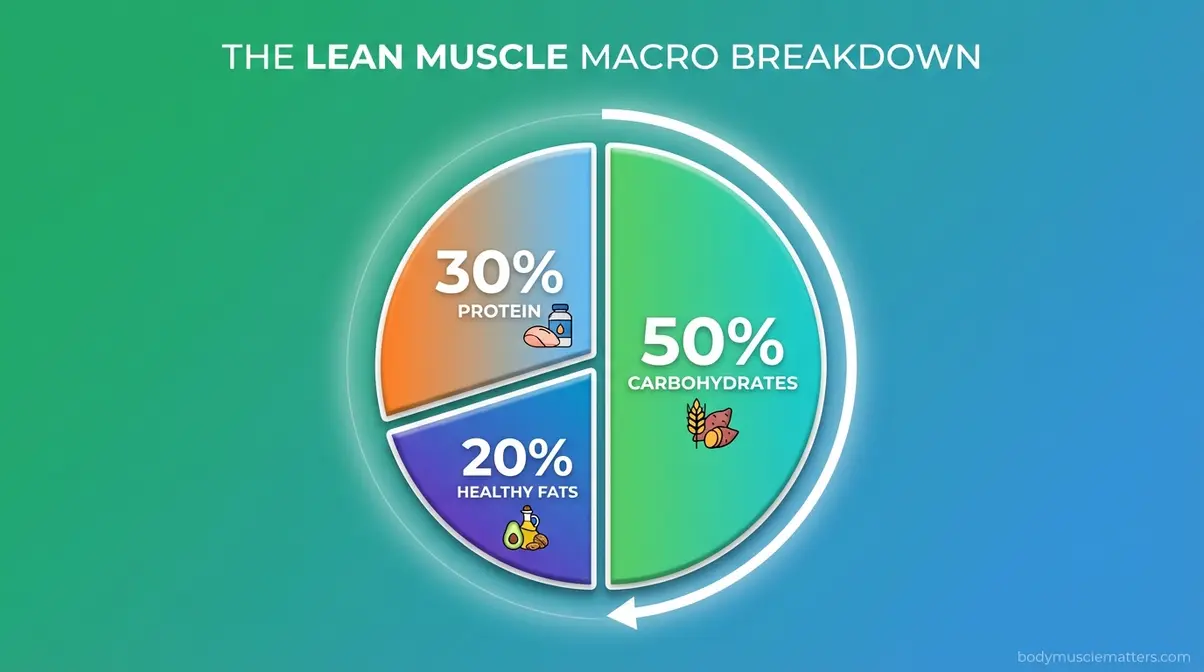
Macronutrient ratios for bodybuilding research suggests that optimal bodybuilding diets consist of 55–60% carbohydrates, 25–30% protein, and 15–20% fat (PubMed, 2026). For practical lean bulking — where the goal is muscle gain with minimal fat — a slightly higher fat target of 20–25% better supports hormonal health, particularly for women. That gives us a working ratio of 25–30% protein / 45–50% carbohydrates / 20–25% healthy fats.
Nutritional recommendations for physique athletes support a protein intake range of 1.8 to 2.7 g/kg of body weight to optimize skeletal muscle mass (PMC/NIH, 2026). At 2,500 calories, that translates to:
| Macronutrient | % of Calories | Grams (2,500 cal) | Role |
|---|---|---|---|
| Protein | 25–30% | 156–188g | Muscle repair and synthesis |
| Carbohydrates | 45–50% | 281–313g | Workout fuel, glycogen replenishment |
| Healthy Fats | 20–25% | 56–69g | Hormone production (testosterone, estrogen) |
Glycogen — the stored form of carbohydrate in your muscles — is your primary fuel source during resistance training. Without adequate carbohydrate intake, glycogen stores deplete, performance drops, and recovery slows. Fats support hormone production, including the testosterone and estrogen levels relevant to both male and female muscle-building physiology.
As the chart below illustrates, protein makes up roughly one-quarter of your daily caloric intake on a lean bulking plan — significant, but not the dominant macronutrient.
For a deeper dive into calculating your personal macro targets, see our guide on understanding your daily macronutrient targets.
The ratio tells you what to eat. Protein timing tells you when to eat it — and the difference can significantly affect how much of that protein your muscles actually use.
Optimal Protein Timing
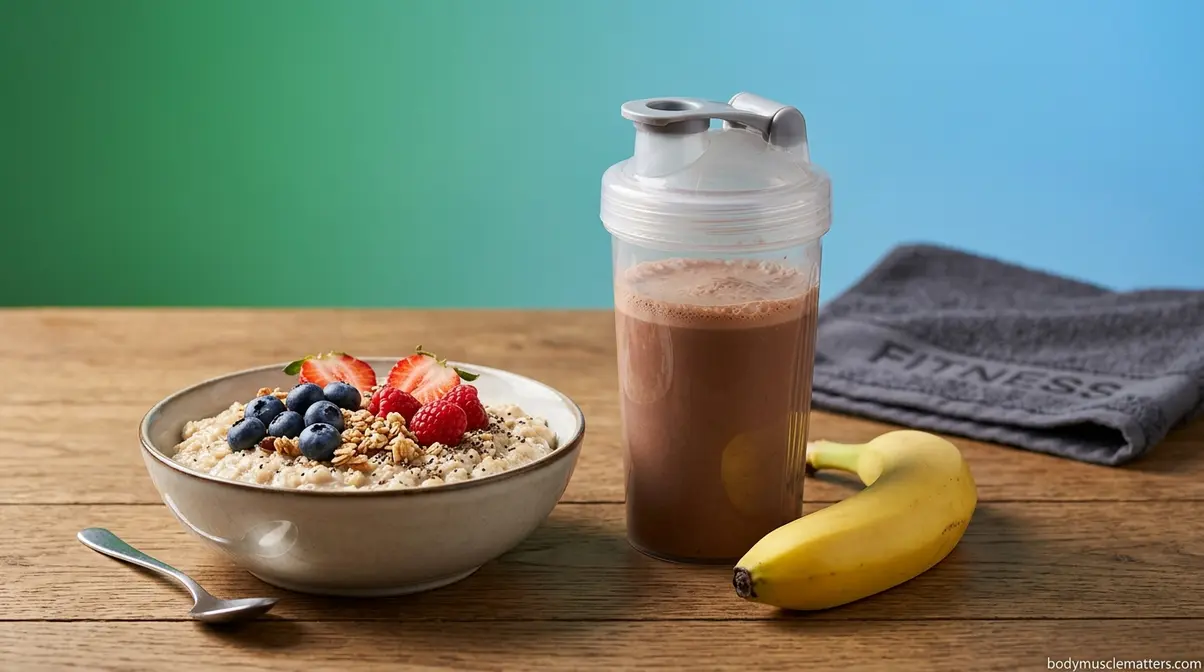
Protein timing — strategically distributing your protein intake around training sessions — maximizes muscle protein synthesis throughout the day. Per MSU Extension guidelines for protein intake, physically active individuals should consume 1.2 to 2.0 grams of protein per kilogram of body weight (MSU Extension). In practical terms:
- A 175-pound (79 kg) man needs approximately 95–158g of protein daily
- A 135-pound (61 kg) woman needs approximately 73–122g daily
To calculate your exact daily protein needs, use the 0.7–1g per pound of body weight guideline as your working range.
- Pre-workout nutrition (60–90 minutes before training):
- Eat complex carbohydrates — oats, brown rice, or sweet potato — to fuel performance
- Include 20–30g of protein (eggs, Greek yogurt, or a small chicken portion)
- Keep fat intake moderate before training — high-fat meals slow gastric emptying
- Post-workout nutrition (within 30–60 minutes after training):
- Consume fast-digesting carbohydrates — banana or white rice — to replenish glycogen
- Include 25–40g of protein to initiate muscle protein synthesis
- A practical example: Greek yogurt + banana + optional protein shake
Simple timing template: Pre-workout (90 min before): Oats + 2 eggs. Post-workout (within 30 min): Greek yogurt + banana + protein shake (optional).
These protein targets apply to the general population — but women have distinct hormonal and physiological factors that can shift these numbers meaningfully.
Female-Specific Macro Adjustments
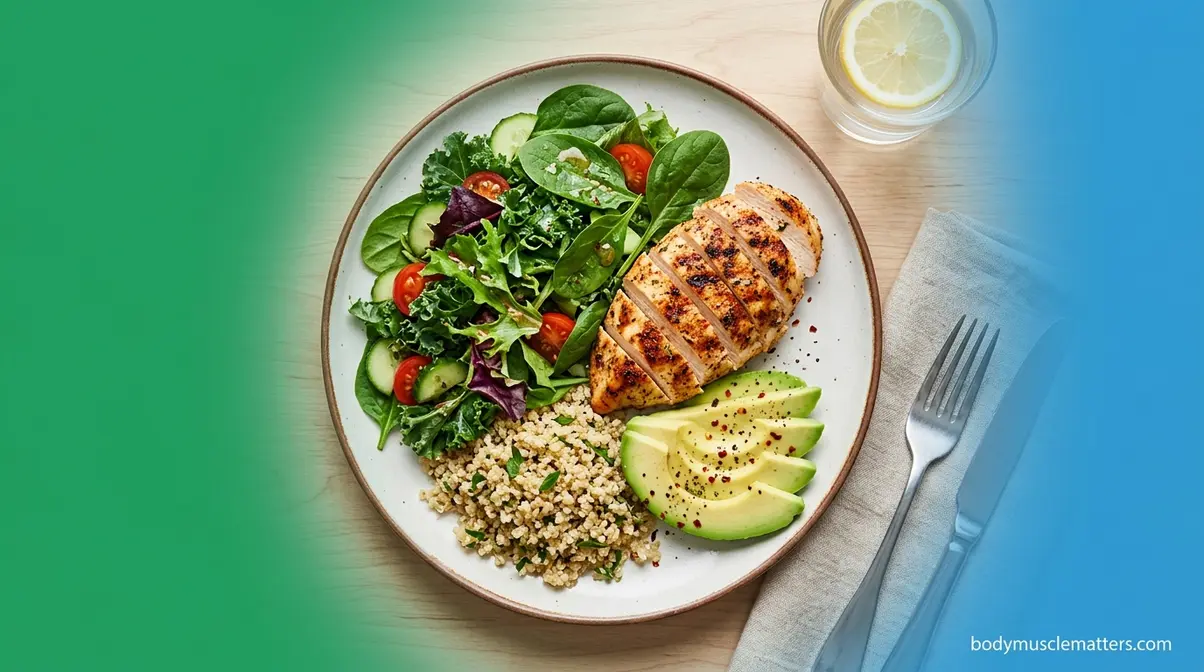
Building lean muscle as a woman follows the same fundamental principles — surplus, macro ratio, protein timing — but the numbers look different, and no competitor in this space addresses that gap directly.
Women generally require fewer total calories at baseline. A 130-pound woman training four times per week typically maintains at 1,800–2,100 calories, compared to 2,400–2,700 for a man of similar height and activity level. Applying the 10–20% surplus to that lower base puts her lean bulk target at approximately 2,000–2,300 calories daily.
A systematic review on protein intake for muscle mass indicates that a high daily protein ingestion of 1.6 g/kg or more may be necessary to maximize lower body muscle strength and lean body mass gains (PubMed, 2026). For women, fat intake should remain at the higher end of the 20–25% range to support estrogen regulation and hormonal health — dropping fat too low can disrupt the menstrual cycle and impair recovery.
Practical reference: Male vs. Female lean bulk targets
| Male (175 lbs) | Female (135 lbs) | |
|---|---|---|
| Maintenance calories | ~2,500 | ~1,900 |
| Lean bulk target (+15%) | ~2,875 | ~2,185 |
| Daily protein target | ~175g | ~135g |
| Fat intake target | 20–25% of calories | 20–25% (higher end) |
One additional consideration: hormonal fluctuations during the menstrual cycle can affect energy levels and appetite. Some registered dietitians recommend adjusting carbohydrate intake slightly upward during the luteal phase (days 15–28) to support energy and mood. This is a nuanced, individual strategy — discuss it with an RD before implementing.
Women with PCOS, hormonal imbalances, or other underlying health conditions should consult a Registered Dietitian before adjusting caloric targets.
With your calorie surplus calculated and your macro targets set, you have the science. Now you need the system — a ready-to-use, 7-day muscle-building meal plan that puts these numbers into practice.
Your 7-Day Muscle-Building Meal Plan
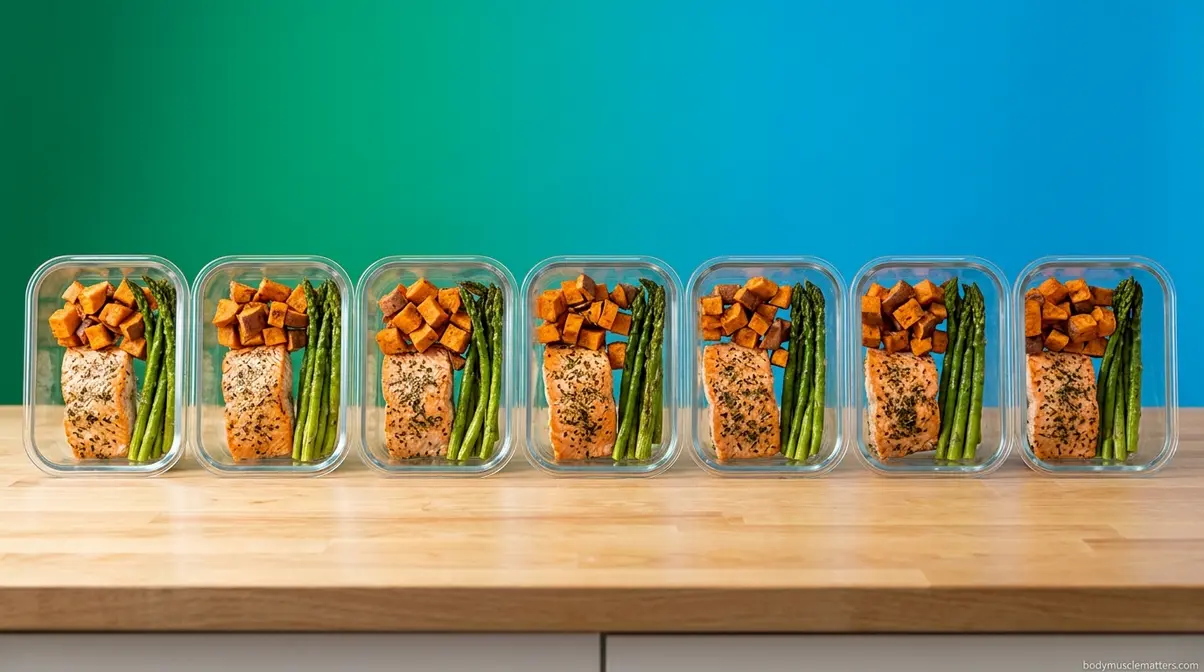
This section is the practical application of healthy meal planning for muscle building — the Sustain layer of The Lean Engine Framework in action. The plan provides two caloric tiers per day: a male tier (~2,500 cal) and a female tier (~1,900 cal), with daily macro breakdowns for protein, carbs, and fats. Every meal uses real, accessible ingredients from a single grocery list, and every animal protein has a 1-to-1 plant-based swap detailed in the next section.
Meal prep is the operational backbone of this plan. Without it, even the best meal plan collapses under the weight of daily decision fatigue.
How to Customize This Plan
Lean bulking is the default goal of this plan — a controlled calorie surplus designed to maximize muscle gain while minimizing fat accumulation. But not every reader starts from the same place. Here’s how to adapt:
| Goal | Caloric Strategy | Protein Target |
|---|---|---|
| Lean Bulk | +10–20% above TDEE | 0.7–1g/lb body weight |
| Body Recomposition | Maintenance calories (0% surplus) | 1g/lb body weight |
| Aggressive Bulk | +20–25% above TDEE | 0.7–1g/lb body weight |
If you’re plant-based: Every animal protein in this plan has a direct swap in H2 #4. Check that section before you shop.
If you’re a woman: Use the female caloric tier (~1,900 cal) shown in the meal plan table. Protein portions stay the same — reduce carb-heavy sides by approximately 20–25% to hit your calorie target.
Body recomposition — building muscle while simultaneously losing fat — is possible for beginners and those returning after a training break. For this goal, eat at maintenance with 1g/lb protein and prioritize resistance training consistency. For personalized guidance, see the RD consultation note in the Limitations section.
For practical meal planning and grocery shopping tips beyond this plan, our expanded resource covers seasonal variations and budget adjustments.
With your caloric target in hand, here is your complete 7-day muscle-building meal plan — with exact macro totals for each day.
The 7-Day Muscle-Building Meal Plan
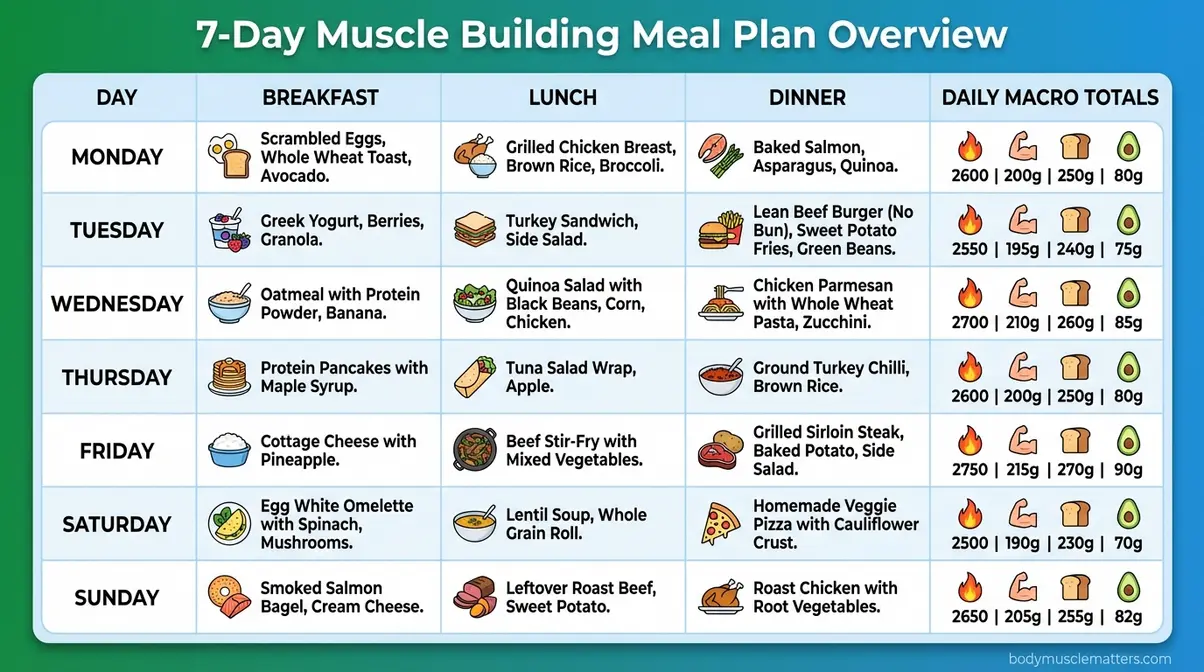
This healthy meal planning approach for muscle building provides two caloric tiers per day, so both male and female readers can use the same table without separate plans. Macro values are calculated using USDA FoodData Central nutritional data. Individual results will vary based on exact ingredient brands and portion sizes — verify with a nutrition calculator (Cronometer or MyFitnessPal) before making this your long-term baseline.
Day 7 is intentionally a “Flex Day” with a +100–150 calorie allowance above the standard target. This small variation prevents metabolic adaptation and makes room for a social meal — a nuance no top competitor includes in their plans.
| Day | Breakfast | Lunch | Dinner | Snacks | ~Protein | ~Cal (M/F) |
|---|---|---|---|---|---|---|
| Day 1 Chicken & Rice | 3 scrambled eggs + ½ cup oats + 1 banana | Grilled chicken breast (5 oz) + ¾ cup brown rice + steamed broccoli | Baked salmon (5 oz) + 1 medium sweet potato + asparagus | Greek yogurt (6 oz) + handful almonds | ~165g | ~2,500/~1,900 |
| Day 2 Turkey & Quinoa | Greek yogurt parfait (6 oz) + ½ cup berries + ¼ cup granola | Ground turkey (5 oz) + ¾ cup quinoa + mixed greens salad | Turkey meatballs (5 oz) + 1½ cups whole-wheat pasta + marinara | Cottage cheese (½ cup) + apple slices | ~160g | ~2,480/~1,880 |
| Day 3 Fish Focus | ½ cup overnight oats + 1 scoop protein powder + 1 tbsp chia seeds | Tuna salad wrap (5 oz tuna, whole-wheat tortilla) + spinach | Tilapia (5 oz) + ¾ cup brown rice + sautéed kale | 2 hard-boiled eggs + 2 rice cakes | ~155g | ~2,450/~1,860 |
| Day 4 Egg & Legume | 4-egg veggie omelette + 2 slices whole-wheat toast | Lentil soup (1.5 cups) + 1 slice whole-grain bread | Chicken thighs (5 oz, skinless) + roasted sweet potato + green beans | Edamame (½ cup) + optional protein shake | ~150g | ~2,420/~1,840 |
| Day 5 Budget Day | ½ cup oats + 1 tbsp peanut butter + 1 banana | Canned tuna (5 oz) + ¾ cup brown rice + frozen mixed veg | Bulk chicken breast (5 oz) + ½ cup black beans + salsa | 2 hard-boiled eggs + 1 low-fat string cheese | ~148g | ~2,400/~1,820 |
| Day 6 Variety Day | Protein pancakes (½ cup oats + 2 eggs + 1 banana, blended) | Shrimp stir-fry (5 oz) + ¾ cup brown rice + bok choy | Lean beef sirloin (4 oz) + roasted potato + side salad | Cottage cheese (½ cup) + mixed nuts (1 oz) | ~162g | ~2,520/~1,900 |
| Day 7 Flex Day | Smoothie bowl (1 scoop protein + ½ cup frozen berries + ½ cup oats + 1 cup almond milk) | Grilled chicken wrap (4 oz) + avocado + tomato | Reader’s choice — maintain 0.7–1g/lb protein, flex on carbs/fats | Dark chocolate (1 oz, 70%+) + Greek yogurt (6 oz) | ~155g | ~2,600/~2,000 |
Every meal plan is only as good as the grocery list behind it. Here is everything you need to buy — organized by macronutrient category.
Essential Muscle-Building Grocery List
These clean eating staples cover every ingredient in the 7-day plan, organized by macronutrient category for efficient shopping. The USDA Thrifty Food Plan estimates monthly food costs for a single adult at $247–$309 — approximately $57–$71/week or $8–$10/day (USDA Food Plans). This grocery list aligns with the lower end of that range when you buy proteins and grains in bulk.
- Proteins:
- Chicken breast (family pack, 3–5 lbs — freeze in individual portions)
- Salmon fillets (fresh or frozen)
- Tilapia (fresh or frozen)
- Canned tuna (5 oz cans, pack of 6–10)
- Ground turkey (1–2 lbs)
- Eggs (1–2 dozen)
- Greek yogurt (32 oz container)
- Cottage cheese (16 oz)
- Shrimp (1 lb, frozen)
- Lean beef sirloin (1 lb)
- Complex Carbohydrates:
- Rolled oats (large container)
- Brown rice (5 lb bag — highest ROI bulk purchase)
- Quinoa (1 lb)
- Whole-wheat pasta (1 lb)
- Whole-wheat tortillas (pack of 8)
- Sweet potatoes (3–4 medium)
- Black beans (2–3 cans)
- Lentils (dried, 1 lb)
- Bananas (1 bunch)
- Mixed berries (fresh or frozen)
- Healthy Fats:
- Almonds (8 oz bag)
- Mixed nuts (8 oz bag)
- Natural peanut butter (16 oz)
- Avocado (2–3)
- Olive oil (16 oz)
- Dark chocolate, 70%+ (2 oz bar)
- Vegetables & Produce:
- Broccoli, asparagus, green beans (fresh or frozen — frozen cuts cost 30–50% less with equal nutritional value)
- Spinach, kale, mixed greens (pre-washed bags save prep time)
- Bok choy, tomatoes
- Low-sodium salsa
This grocery list costs approximately $55–$75 per week for one person, depending on your region and whether you buy in bulk — approximately $8–$11/day, consistent with USDA Thrifty Food Plan benchmarks (USDA).
Need more high-protein breakfast ideas beyond what’s in this plan? Browse our collection of quick and healthy high-protein meal ideas for 25 additional options.
The meal plan gives you the what. The next section gives you the how — batch cooking, flavor rotation, and storage strategies that make this plan sustainable beyond week one.
Meal Prep Strategies for Clean Eating
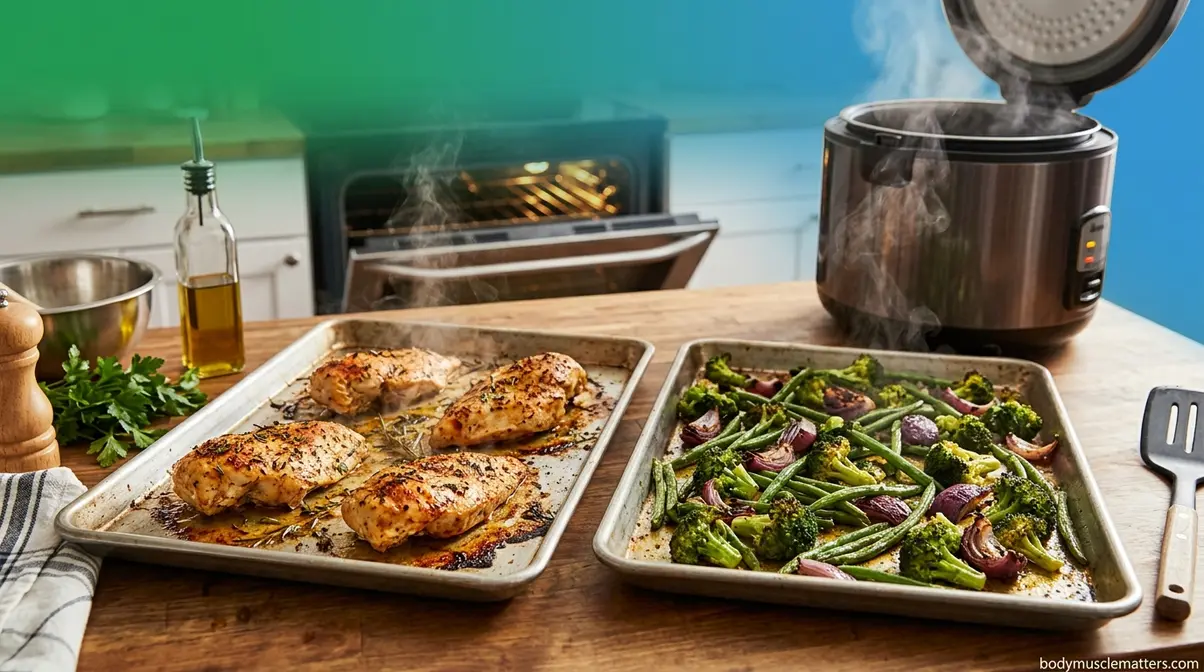
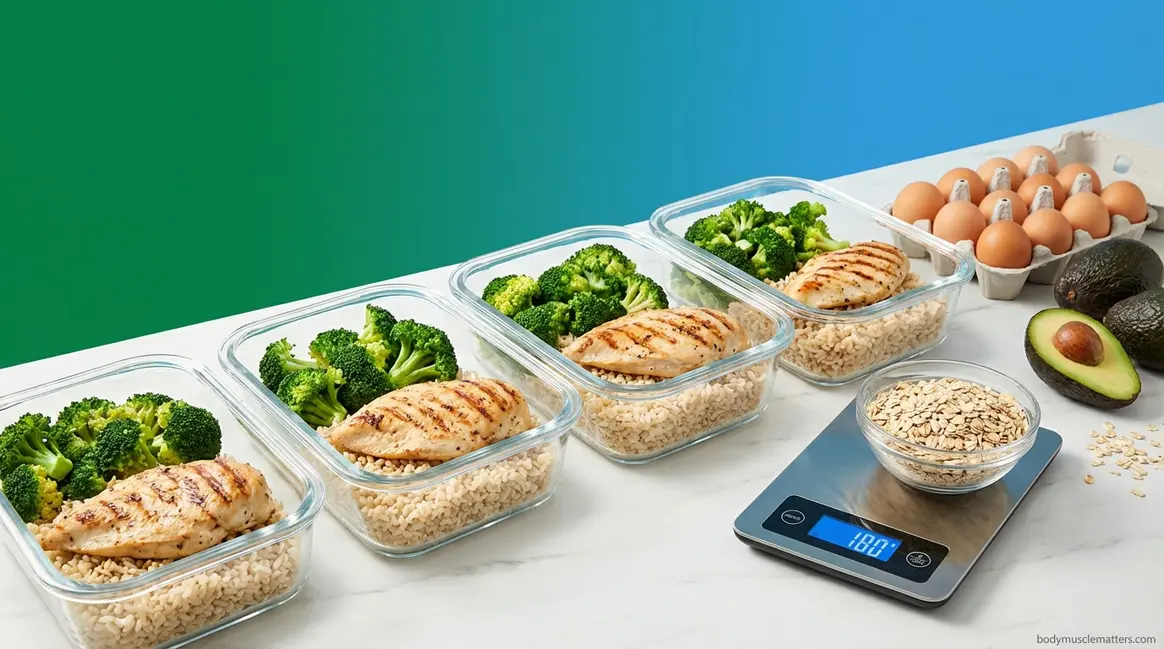
Picture Monday morning: your fridge is stocked with five days of portioned proteins, pre-cooked grains, and chopped vegetables. Dinner takes four minutes. Now contrast that with the alternative — opening an empty fridge at 7 pm after a long workday, ordering takeout, and watching your macro targets evaporate. The difference between those two scenarios is one 90-minute session on Sunday.
Batch cooking — preparing large quantities of protein and grains in a single weekly session — is the Sustain pillar of The Lean Engine Framework in practice. It’s the operational system that keeps the 7-day plan running week after week, not just during week one. According to the Harvard Nutrition Source meal prep guide, planning meals and batch cooking in advance helps individuals adhere to healthy eating guidelines while reducing reliance on processed foods (Harvard T.H. Chan School of Public Health). That adherence gap — between knowing what to eat and actually eating it — is where most muscle-building meal plans collapse.
Batch Cooking for Five Days
Meal prep doesn’t require culinary skill — it requires a system. The dietitian-approved meal prep checklist from Ohio State University Wexner Medical Center confirms that effective prep strategies include washing and chopping produce, cooking whole grains, and preparing proteins ahead of time (Ohio State University Wexner Medical Center). Here is a six-step Sunday workflow that covers all proteins and grains for the week:
Step 1: Preheat the Oven
Season 2–3 lbs of chicken breast with olive oil, salt, pepper, and garlic powder. Place on a rimmed baking sheet.
Step 2: Start Brown Rice Simultaneously
Cook 4 cups of dry brown rice in a rice cooker or stovetop pot — this runs in the background while everything else cooks.
Step 3: Boil the Eggs
Place 6–8 eggs in boiling water for 12 minutes, then transfer to an ice bath for easy peeling. These cover snacks for three days.
Step 4: Bake the Chicken
Bake chicken 20–25 minutes until internal temperature reaches 165°F. While chicken rests, start Step 5.
Step 5: Roast the Vegetables
Roast 2 lbs of mixed vegetables (broccoli, asparagus, green beans) on a second sheet pan at 400°F for 20–25 minutes with olive oil and seasoning.
Step 6: Portion into Containers
One protein + one carb + one vegetable per container. Refrigerate up to 4 days; freeze remaining portions for days 5–7.
Total active time: approximately 90 minutes. That single session significantly reduces daily meal preparation time for the rest of the week — and eliminates the decision fatigue that leads to takeout.
Batch cooking solves the time problem. But eating the same chicken and rice every day for five days is a fast path to food boredom — the #1 reason people abandon meal plans.
Flavor Rotation to Beat Boredom
Food boredom is not a willpower problem — it’s a systems problem. The solution isn’t buying different proteins every week (expensive and prep-intensive). It’s using the same batch-cooked chicken breast with five completely different flavor profiles, so Monday’s dinner and Friday’s dinner taste like different meals.
Five spice profiles that work with any batch-cooked protein:
- Mediterranean: Oregano, lemon zest, garlic, olive oil drizzle, optional feta crumble
- Asian-inspired: Low-sodium soy sauce, fresh ginger, sesame oil, sliced green onion
- Mexican: Cumin, chili powder, fresh lime juice, cilantro, salsa topping
- BBQ: Smoked paprika, garlic powder, onion powder, 1 tbsp sugar-free BBQ sauce
- Indian-inspired: Turmeric, cumin, coriander, low-fat yogurt marinade (apply before reheating)
Applying a spice blend takes 60 seconds and adds zero meaningful calories. For sauce variety without macro damage, keep these on hand: hot sauce (0–5 cal/tbsp), yellow mustard (5 cal/tbsp), salsa (10–15 cal/tbsp), and fresh lemon juice (4 cal/tbsp). Avoid creamy dressings (120–160 cal/tbsp) and teriyaki sauce (40–60 cal/tbsp, high sugar) — both can quietly double the caloric density of a meal.
Weekly rotation example: Monday = Mediterranean chicken, Tuesday = Asian chicken, Wednesday = Mexican chicken, Thursday = BBQ chicken, Friday = Indian chicken. Same prep, five different eating experiences.
With flavor rotation keeping meals interesting, the last piece of your prep system is knowing exactly how long your food stays safe and fresh.
Proper Storage for Freshness
Improper storage is one of the most common meal prep mistakes — it leads to food waste, spoiled proteins, and in serious cases, foodborne illness. Use this reference table, based on USDA food safety guidelines, before you put anything in the fridge or freezer.
| Food Type | Refrigerator | Freezer |
|---|---|---|
| Cooked chicken breast | 3–4 days | 2–6 months |
| Cooked ground turkey | 3–4 days | 2–3 months |
| Cooked salmon / fish | 3–4 days | 2–3 months |
| Cooked brown rice / quinoa | 4–6 days | 6 months |
| Hard-boiled eggs | 1 week (in shell) | Not recommended |
| Cooked vegetables | 3–5 days | 8–12 months |
| Greek yogurt (unopened) | Per package date | Not recommended |
Container guidance: Use glass or BPA-free plastic containers with airtight lids. Label each container with the prep date. Allow cooked proteins to cool to room temperature before refrigerating — but refrigerate within 2 hours of cooking to prevent bacterial growth. Storage timelines are based on USDA food safety guidelines. When in doubt, discard.
Your meal plan is set, your prep system is in place, and your storage is sorted. Now — what if you’re working with a tight budget, or you’re eating plant-based? The next section has you covered.
Plant-Based Swaps and Budget Hacks
Can you really build lean muscle on $8 a day? Yes — and the evidence supports it. The USDA Thrifty Food Plan benchmarks single-adult food costs at $57–$71/week, or roughly $8–$10/day. With strategic ingredient selection and bulk purchasing, hitting your muscle-building macro targets within that range is genuinely achievable. The same staples that make this plan budget-friendly also happen to be the most effective foundation for plant-based adaptations.
Building Muscle on $8-$10 a Day?
Yes — building lean muscle on $8–$10/day is achievable with the right staple foods. Clean eating on a lean muscle budget starts with prioritizing high-protein, low-cost staples and buying in volume. The USDA Thrifty Food Plan benchmarks single-adult grocery costs at $57–$71/week, which aligns with this target. The eight foods below deliver the highest protein-per-dollar ratio available in most U.S. grocery stores:
| Food | Approx. Cost/Serving | Protein/Serving |
|---|---|---|
| Eggs (1 large) | ~$0.25–$0.35 | 6g |
| Canned tuna (5 oz) | ~$1.00–$1.50 | 25g |
| Chicken breast (4 oz, bulk pack) | ~$1.00–$1.50 | 26g |
| Oats (1 cup dry) | ~$0.15–$0.25 | 10g |
| Brown rice (1 cup dry) | ~$0.10–$0.20 | 5g |
| Black beans (½ cup canned) | ~$0.25–$0.40 | 7g |
| Lentils (½ cup dry) | ~$0.20–$0.30 | 9g |
| Greek yogurt (6 oz) | ~$0.80–$1.20 | 17g |
Prices are approximate U.S. averages as of the current year, based on USDA Economic Research Service data. Prices vary by region and retailer.
Three budget hacks that cut costs without cutting protein:
- Buy chicken breast in family packs (3–5 lbs) and freeze in 4–5 oz individual portions. Per-ounce cost drops by 20–30% compared to single-pack pricing.
- Replace fresh fish with canned tuna or canned salmon three days per week. Nutritional profile is comparable; cost is roughly 60–70% lower.
- Use frozen vegetables instead of fresh. Frozen produce is harvested at peak ripeness and flash-frozen — nutritional value is equivalent to fresh, at 30–50% lower cost.
- Day 5 cost breakdown (the designated $8 budget day in the plan):
- Breakfast (oats + peanut butter + banana): ~$0.80
- Lunch (canned tuna + brown rice + frozen veg): ~$2.00
- Dinner (bulk chicken + black beans + salsa): ~$2.50
- Snacks (2 hard-boiled eggs + string cheese): ~$1.00
- Estimated daily total: ~$6.30–$7.50
These budget staples also happen to be the most versatile for plant-based swaps — here’s how to substitute every animal protein in the 7-day plan without sacrificing your muscle-building targets.
Best Plant-Based Protein Swaps?
Building lean muscle on a plant-based diet is entirely achievable, but it requires more strategic food selection than an omnivorous approach. Tofu, tempeh, and edamame are the most effective plant-based protein substitutes for muscle building because they are complete proteins containing all nine essential amino acids. A study on vegan diets in bodybuilders found that vegan bodybuilders may experience difficulties in reaching their necessary protein needs while undergoing a caloric deficit (PubMed, 2026). Research indicates that vegan bodybuilders may experience difficulties reaching necessary protein needs during a caloric deficit — making strategic food selection and portion adjustment essential for plant-based muscle building. That challenge is real — but it’s solvable with the swap chart below.
| Animal Protein | Plant-Based Swap | Protein Adjustment |
|---|---|---|
| Chicken breast (4 oz, 26g protein) | Firm tofu (6 oz, 26g protein) | Increase portion by ~50% |
| Ground turkey (4 oz, 22g protein) | Tempeh (4 oz, 21g protein) | 1:1 swap |
| Salmon (4 oz, 25g protein) | Edamame (1 cup, 17g) + hemp seeds (3 tbsp, 10g) | Combine sources |
| Eggs (3 eggs, 18g protein) | Scrambled tofu (½ cup, ~20g protein) | 1:1 swap |
| Greek yogurt (6 oz, 17g protein) | Soy yogurt (6 oz, 6–10g protein) | Add 3 tbsp hemp seeds |
A note on amino acid completeness: Animal proteins are complete — they contain all nine essential amino acids your muscles need for protein synthesis. Many plant proteins are incomplete. Soy-based foods (tofu, a complete plant protein derived from soybeans; tempeh, a fermented soy product with higher protein density than tofu; and edamame) are notable exceptions. For non-soy swaps, combine complementary sources — rice + beans, for example — to ensure complete amino acid coverage.
- Day 1 with all plant-based swaps applied:
- Breakfast: Scrambled tofu (½ cup) + ½ cup oats + 1 banana
- Lunch: Firm tofu (6 oz, baked) + ¾ cup brown rice + steamed broccoli
- Dinner: Edamame (1 cup) + hemp seeds (3 tbsp) + sweet potato + asparagus
- Snacks: Soy yogurt (6 oz) + hemp seeds + handful almonds
Whether you’re eating plant-based or on a budget, the plan works. But even the best plan has limits — and knowing when to adjust course (or call in a professional) is the mark of a smart, sustainable approach.
Common Mistakes and When to Consult a Professional
Every structured muscle-building meal plan carries common failure points — and no competitor in this space provides a troubleshooting guide to help you navigate them. This section covers the four most frequent pitfalls and the specific circumstances where professional guidance moves from optional to essential.
Common Meal Planning Pitfalls
Recognizing these mistakes early can save weeks of stalled progress:
- Eating too large a calorie surplus. Scenario: You’re eating 500–1,000 calories above maintenance, reasoning that “more fuel means more muscle.” What goes wrong: research on the effects of large calorie surpluses shows that larger surpluses primarily increase rates of fat gain rather than significantly augmenting muscle thickness or strength (PubMed, 2026). How to avoid it: stick to the 10–20% precision window established in the calorie surplus section above.
- Under-eating protein on plant-based plans. Scenario: You swap chicken for tofu without adjusting portion size, assuming a 1:1 volume replacement is sufficient. What goes wrong: insufficient total amino acids impair muscle protein synthesis, slowing hypertrophy (the process of muscle fiber growth). How to avoid it: use the swap chart in the Plant-Based section and track total daily protein grams, not just meal-by-meal swaps.
- Skipping post-workout nutrition. Scenario: You train hard but don’t eat for 2+ hours afterward. What goes wrong: delayed glycogen replenishment slows recovery and reduces the anabolic window for muscle protein synthesis. How to avoid it: prepare your post-workout snack in advance — Greek yogurt and a banana from the grocery list takes 30 seconds to assemble.
- Ignoring the flavor rotation system. Scenario: You batch-cook everything on Sunday and eat identical meals Monday through Friday. What goes wrong: food boredom sets in within 10–14 days, and plan abandonment follows. Across fitness communities, this is the most cited reason people revert to irregular eating. How to avoid it: implement the five-spice-profile rotation from the Meal Prep section — same prep time, dramatically different eating experience.
Seeking Professional Guidance
This plan is designed for healthy adults with intermediate fitness experience. Several specific circumstances call for personalized guidance from a Registered Dietitian or licensed healthcare provider:
- You have an underlying health condition — diabetes, kidney disease, cardiovascular disease, or thyroid disorders all affect how your body processes macronutrients. Generic calorie targets may be inappropriate or harmful.
- You’re experiencing hormonal irregularities — for women, this includes disrupted menstrual cycles, PCOS, or thyroid imbalances. Caloric restriction or surplus can significantly affect hormonal health in these cases.
- You’re not seeing results after 4–6 weeks — if you’re following the plan consistently and your body composition isn’t changing, a professional assessment can identify metabolic, hormonal, or adherence factors that a general guide cannot address.
- You’re interested in body recomposition — simultaneously losing fat and gaining muscle requires careful calibration of calories and protein. A Registered Dietitian can personalize this beyond what a general plan provides.
Consult a qualified healthcare provider or Registered Dietitian before making significant changes to your diet, particularly if you have underlying health conditions.
Frequently Asked Questions
Calories Needed for Lean Muscle?
Most adults need 10–20% above their maintenance calories to support lean muscle growth without significant fat accumulation. For a 175-pound man training four days per week, that typically means 2,600–2,900 calories daily. For a 135-pound woman with similar activity, the range is roughly 2,000–2,300 calories. Research confirms that surpluses larger than 15% primarily increase fat gain rather than muscle thickness (PMC/Sports, 2026). Use an online TDEE calculator to find your personal maintenance baseline before applying the surplus.
Daily Protein for Lean Muscle?
The current evidence-based recommendation for muscle building is 0.7–1g of protein per pound of body weight daily (or 1.2–2.0 g/kg). For a 175-pound man, that’s approximately 122–175g of protein per day. For a 135-pound woman, roughly 95–135g. MSU Extension guidelines for protein intake confirm that physically active individuals should target 1.2–2.0 g/kg to support muscle adaptation (MSU Extension). Prioritize high-quality sources — chicken breast, eggs, Greek yogurt, salmon, and tofu — distributed across three to four meals.
Meal Prep on a Limited Schedule?
A single 90-minute batch cooking session on Sunday covers all proteins and grains for the full week. The six-step workflow in this guide — bake chicken, cook rice, boil eggs, roast vegetables, and portion into containers — runs multiple items simultaneously to minimize active time. According to the Harvard Nutrition Source, batch cooking in advance helps individuals adhere to healthy eating guidelines while reducing reliance on processed foods (Harvard T.H. Chan School of Public Health). Prepping on Sunday eliminates daily cooking on weeknights and removes the decision fatigue that leads to takeout.
Building Muscle Requires a System
For motivated, health-conscious adults, the gap between knowing nutrition principles and consistently applying them is almost never about information — it’s about structure. Healthy meal planning for muscle building, when built around a repeatable framework, removes the daily decisions that drain willpower and derail progress. Research confirms that a 10–20% calorie surplus optimizes lean muscle gain, that 0.7–1g of protein per pound of body weight supports muscle protein synthesis, and that batch cooking measurably improves dietary adherence (PMC/Sports, 2026; MSU Extension; Harvard Nutrition Source). The best approach combines all three: precise fueling, optimal macro targets, and a weekly prep system that runs on autopilot.
The Lean Engine Framework — Fuel, Build, Sustain — exists because addressing one pillar without the others is why most muscle-building meal plans fail. A calorie surplus without macro awareness leads to fat gain. Perfect macros without a prep system collapse under daily time pressure. A meal plan without flavor rotation dies in week two from food boredom. The three pillars work together, and this guide has given you all three.
Your next step is straightforward: shop the grocery list this week, run the Sunday batch cooking session once, and follow the 7-day plan for seven days. Assess how your energy, recovery, and body composition respond. For personalized adjustments — especially if you have health conditions, hormonal factors, or specific body composition goals — consult a Registered Dietitian before making this your long-term nutrition strategy.
Related posts:
Best Protein Powder for Muscle Growth: Tested (2026)
Best High Protein Meal Delivery Services 2026: Top 7
Protein Powder Without Artificial Sweeteners: 10 Best Picks
Can You Eat Too Much Protein? Symptoms & Safe Limits
Best Protein Powder for Weight Loss: 10 Expert Picks
What Are Macros? A Plain Guide to Protein, Carbs and Fat

Callum
Hi, I'm Callum, the founder of Body Muscle Matters. I'm not a certified trainer, I'm a self taught lifter who started this site to share what I've learned from my own training and a lot of trial and error. Everything here comes from real experience and honest research, written the way I'd explain it to a friend who is just getting started. My goal is simple: practical, no hype fitness advice you can actually use.