

⚠️ Important Health Disclaimer
The information in this article is for educational purposes only and is not a substitute for professional medical advice. Before starting any new exercise programme, consult your doctor or a qualified healthcare professional — especially if you have any pre-existing health conditions, injuries, or concerns. The exercises and advice in this guide are intended for healthy adults. If you experience pain, dizziness, or discomfort during training, stop immediately and seek medical advice.
“If someone is brand new to the gym and feels overwhelmed by all the machines and free weights, what’s the best way to build a simple, effective routine without overcomplicating it?”
You’re not alone in asking that. Feeling lost on Day 1 is almost universal — but it doesn’t have to stay that way.
Without a structured plan, most beginners either quit within six weeks or spin their wheels for months without seeing results. That wasted time is costly — because the first three to six months of training are, scientifically, the most productive of your entire fitness life.
By the end of this guide, you’ll have a complete, evidence-backed best muscle building programme for beginners — with two tracks for gym and home — so you can start building muscle from your very first session. We cover the core training principles, two beginner-friendly workout splits, a nutrition framework, and the most common mistakes to avoid. This guide was developed with certified personal trainers and draws on peer-reviewed sports science.
The best muscle building programme for beginners is a 3-day full-body routine built around compound lifts — research shows performing 3–4 sets of 8–12 reps per exercise maximises muscle growth for new lifters (NCBI, 2022).
- The Newbie Gains Window: Your first 3–6 months are the most productive for muscle growth — studies show beginners can add 1.8–3.2 kg of lean mass in their first three months of structured training (BodySpec, 2026)
- 3 days per week is the proven sweet spot for beginners — enough stimulus, enough recovery
- Progressive overload (adding weight or reps each week) is the single rule that drives all muscle growth
- Nutrition matters: Aim for 1.4–2.0g of protein per kg of body weight daily (ISSN, 2017)
- Two routes: A full-body split OR a Push/Pull/Legs plan — both are covered in this guide
Why Beginners Have a Superpower
The best muscle building programme for beginners works because beginners hold a biological advantage that no experienced lifter can access. Your body is primed to respond to resistance training in ways that experienced gym-goers simply cannot replicate — and this advantage lasts for roughly the first three to six months of consistent training.
Choosing the best muscle building programme for beginners starts with understanding why right now is the ideal time to act. This isn’t motivational fluff — it’s physiology.
The Newbie Gains Window
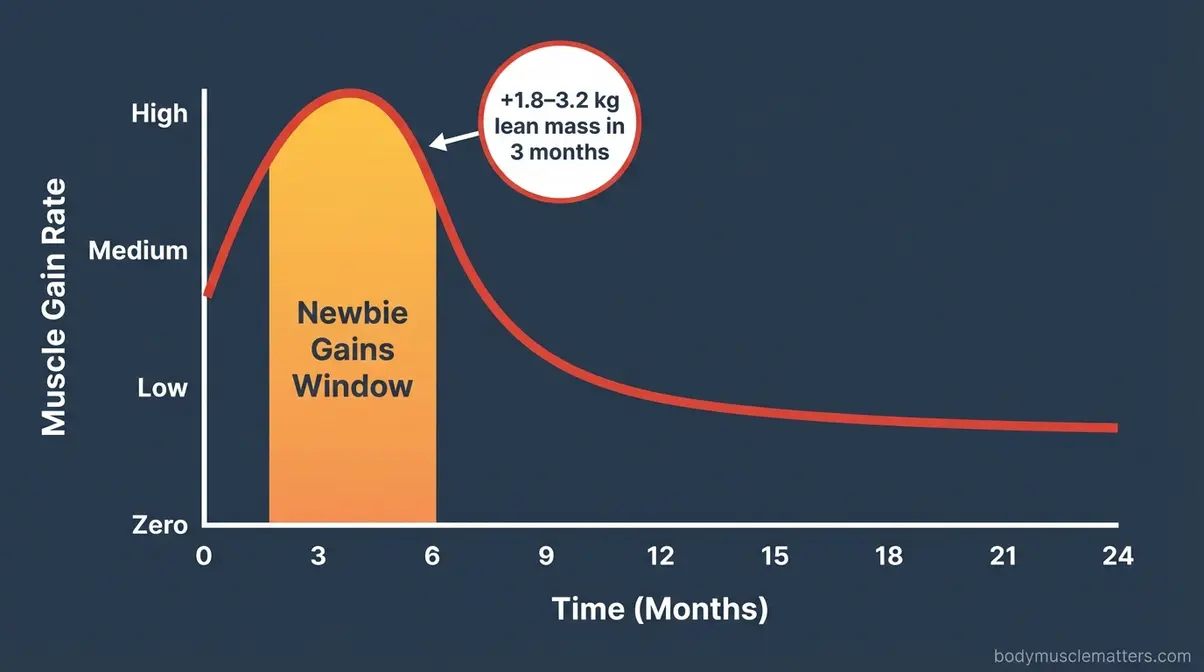
The Newbie Gains Window — the first 3–6 months of consistent resistance training where beginners experience muscle and strength gains that experienced lifters simply cannot replicate — is the most powerful period of physical development your body will ever undergo.
This happens for two reasons working in tandem. First, your nervous system is learning entirely new movement patterns — a process called motor unit recruitment, where your brain figures out how to fire the right muscle fibres in the right sequence. Second, your muscles are experiencing a stimulus they have never encountered before, triggering a powerful hormonal and cellular growth response. Think of it like learning to type: in the first few weeks, your speed improves dramatically with very little practice. After years of typing, each session adds almost nothing.
During the Newbie Gains Window, beginners can build muscle faster per session than at any other point in their training life. Research compiled from multiple studies shows that untrained beginners add approximately 1.8–3.2 kg of lean mass in their first three months of structured lifting — a rate that experienced lifters training the same programme simply cannot match (BodySpec, 2026).
Even a simple, basic programme will produce impressive results during this window. A beginner doesn’t need an advanced programme. They need a consistent one.
Now you know why the window is so powerful — next, let’s understand how long it lasts, so you can make the most of every session.
How Long Does the Window Last?
The window is approximately 3–6 months for most people. In the first 8 weeks — the length of this programme — newbie gains are at their strongest. Your strength may increase noticeably week to week, and your muscles will respond to almost any structured progressive stimulus.
After 6 months, gains continue — but more slowly, and they require more precise programming to keep coming. A structured muscle building programme for beginners during this window will deliver results faster than at any later stage in your training career.
Here is the reassuring truth: you don’t need to do it perfectly. Consistency during this window matters far more than perfection. Show up, follow the plan, and the biology does the rest.
With that context in place, let’s cover the core principles that turn any workout into a muscle-building machine — starting with the one rule that underpins everything.
Core Principles Before You Write a Single Workout
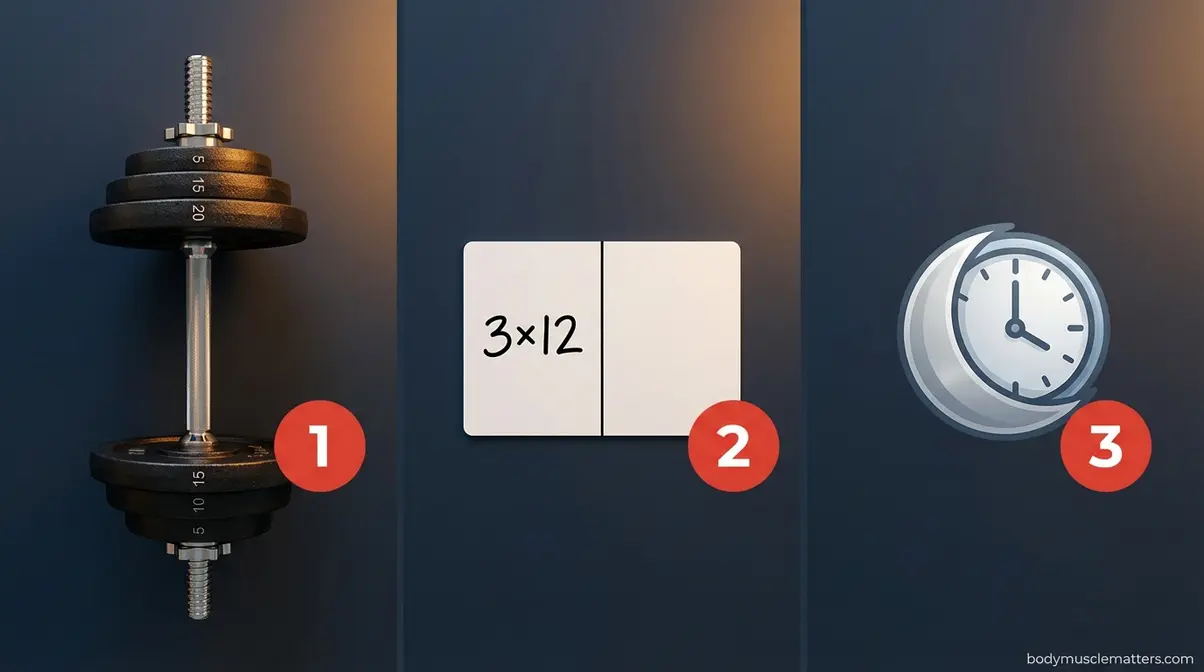
Picture your first day in the gym. You walk in, look at the rows of machines and barbells, and think: where on earth do I start? The answer isn’t a specific machine. It’s three principles — and once you understand them, every workout makes sense.
The gym programme for building muscle that actually delivers results is built on three non-negotiable foundations. These principles are what allow you to make the most of your Newbie Gains Window. Miss them and even the best programme in the world won’t help you.
What Is Progressive Overload?
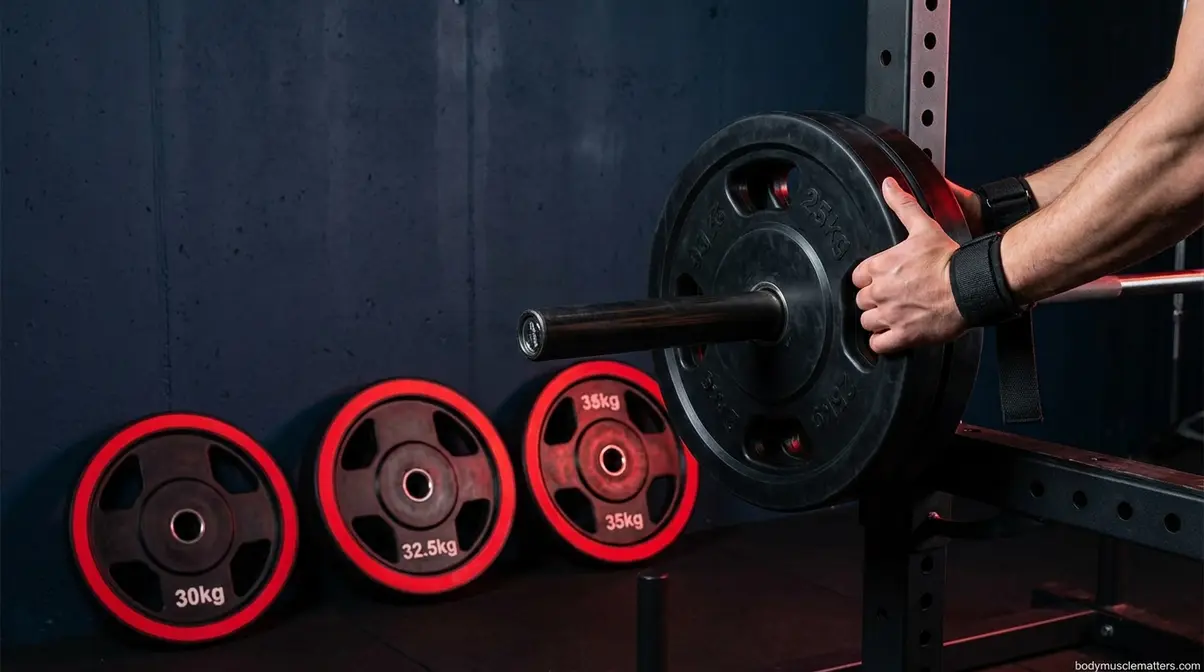
Progressive overload means gradually making your workouts harder over time — typically by adding a small amount of weight, completing one extra rep, or shortening your rest period between sets. Your muscles grow when they’re forced to adapt to increasing demands. Without progressive overload, they have no reason to change.
Here’s a concrete example. In Week 1, you bench press 30 kg for 3 sets of 8 reps. In Week 2, aim for 3 sets of 10 reps at the same weight. In Week 3, add 2.5 kg and return to 3 sets of 8. That cycle is progressive overload in action.
Every effective gym programme for building muscle is built around this single rule. Foundational 2015 guidelines from the National Strength and Conditioning Association advise that beginners follow linear periodisation — adding weight or reps session by session — as the most effective progression model for new lifters. This approach starts with 2–3 sessions per week to build foundational muscular endurance and hypertrophy (NSCA foundations of fitness programming, NSCA, 2015).
What this means for you: Track your weights and reps every single session. The downloadable PDF tracker later in this guide is designed to make this automatic.
Progressive overload tells you how to progress. But how many reps should you do on each set? That’s where the next principle comes in.
Why 8–12 Reps is the Sweet Spot
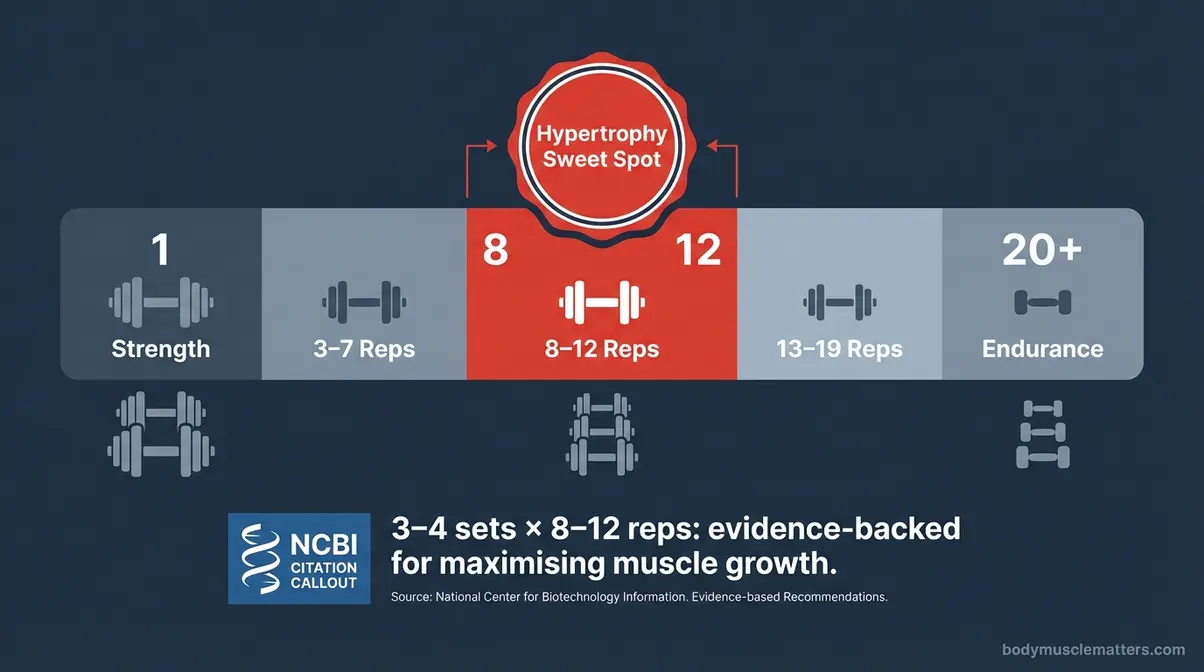
For building muscle — a process called hypertrophy (an increase in muscle size) — the 8–12 rep range is the most well-researched target for beginners. Every muscle building programme for beginners worth following is structured around this rep range.
“Performing 3–4 sets of 8–12 repetitions per exercise is the evidence-backed sweet spot for maximising muscle hypertrophy in beginners.” Traditional resistance training guidelines consistently endorse moderate loads at 8–12 reps for novice and intermediate trainees seeking size gains, based on a 2022 NCBI clinical recommendation (clinical recommendations for muscle hypertrophy, NCBI, 2022).
A 2022 umbrella review of resistance training variables found that 12–20 sets per muscle group per week is optimal for maximising hypertrophy across training levels — so between 3–4 working sets per exercise, spread across three sessions per week, you land squarely in the evidence-based target zone (optimal training volume for muscle growth, NCBI, 2022).
What this means for you: If you can comfortably do more than 12 reps with good form, the weight is too light. If you can’t reach 8 reps with good form, reduce the weight. It’s that simple.
Now you know how many reps per set. But how do you structure your entire training week? Two popular frameworks answer this — and one of them appears in Google’s most-searched gym questions.
What is the 5-3-1 rule in gym?
The 5-3-1 rule is one of the most Googled gym questions among beginners — and it sounds complicated. Here’s the plain-English version.
The 5-3-1 rule is a strength programme built around four core barbell movements: squats, deadlifts, bench press, and overhead press. You work at a percentage of your maximum lift over a four-week cycle — performing 5 reps in Week 1, 3 reps in Week 2, and 1 heavy rep in Week 3, then taking a lighter “deload” week in Week 4.
Here’s the honest framing for beginners: the 5-3-1 rule is highly effective, but it requires knowing your one-rep maximum (1RM — the heaviest single weight you can lift once). Most beginners don’t yet have this number, and attempting to find it in your first weeks risks poor form and injury. For now, stick to the 8–12 rep hypertrophy range. After 6 or more months of consistent training, the 5-3-1 system becomes a genuinely powerful tool.
The 8-week plan in this guide uses a simpler linear progression that’s more effective — and far safer — for complete beginners.
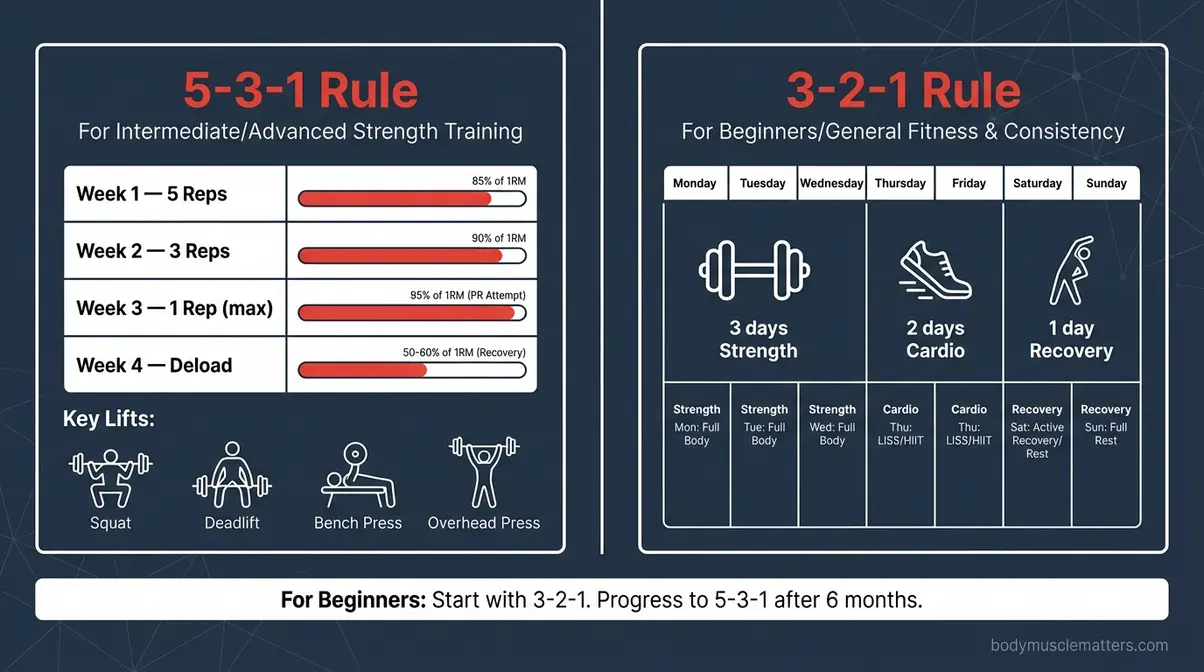
Caption: The 5-3-1 and 3-2-1 rules explained side by side — print this and keep it in your gym bag for your first four weeks.
The 5-3-1 rule is a strength framework. But what about structuring your week? That’s where the 3-2-1 rule comes in — and it’s one of the most practical frameworks a beginner can follow.
What is the 3-2-1 rule in gym?
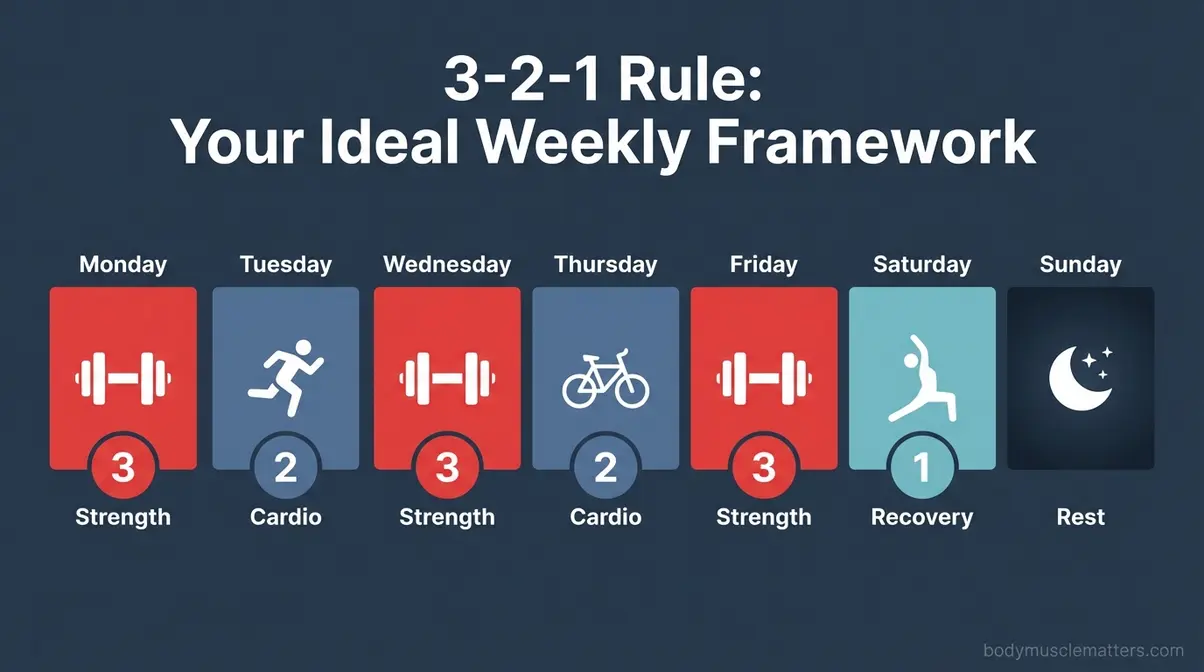
The 3-2-1 rule is a balanced weekly fitness framework. It involves dedicating three days to strength training, two days to cardiovascular or conditioning work, and one day to active recovery or mobility — giving your body the ideal mix of stimulus and rest. The 3-2-1 rule aligns closely with the 3-day full-body programme described in this guide.
Here is what a 3-2-1 week looks like in practice:
- Monday: Strength — Full-Body Session A
- Tuesday: Cardio — 30-minute walk or light jog
- Wednesday: Strength — Full-Body Session B
- Thursday: Cardio — cycling, swimming, or another 30-minute walk
- Friday: Strength — Full-Body Session C
- Saturday: Active recovery — stretching, yoga, or a gentle walk
- Sunday: Complete rest
The three-day strength component of the 3-2-1 rule maps directly onto the full-body and PPL routines later in this guide. Follow this weekly structure by default, and you’ll cover every physical system your body needs to grow.
One more principle before the workouts: recovery. It’s where your muscles actually grow — and most beginners get it completely wrong.
Recovery: Growth Outside the Gym
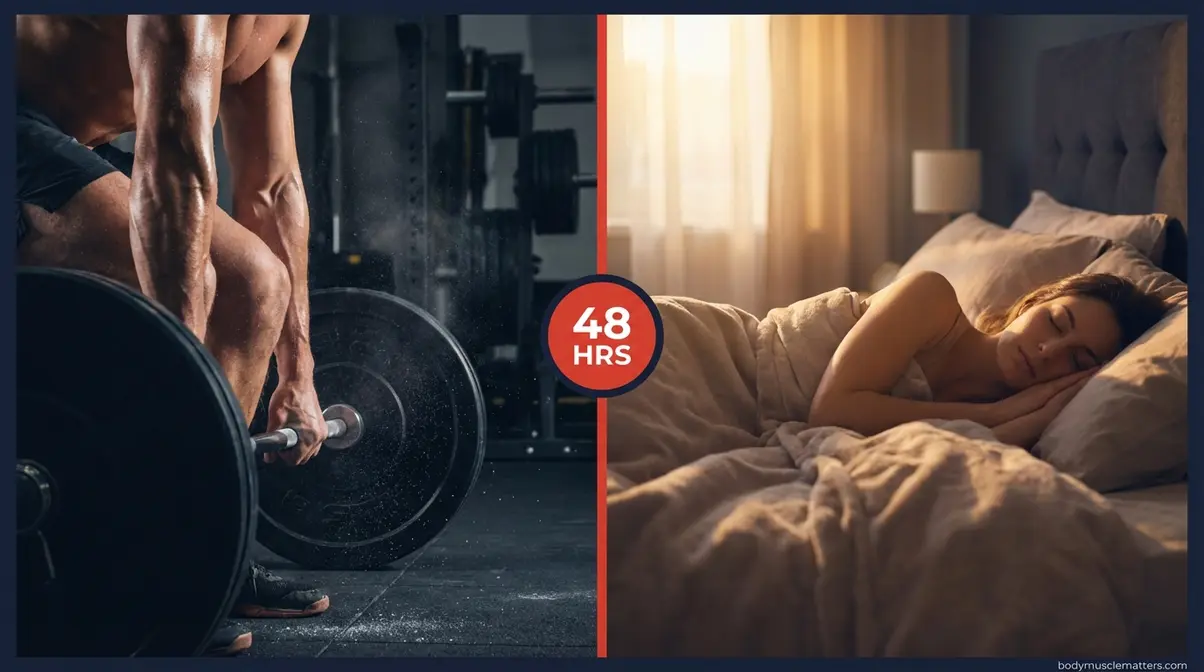
Muscle growth does not happen during a workout. When you lift weights, you create microscopic tears in muscle fibres. Sleep and rest are when those fibres repair, adapt, and grow back thicker and stronger. The workout is the stimulus. Rest is the actual growth.
Apply the 48-hour rule — give each muscle group at least 48 hours of recovery before training it again. This is precisely why the 3-day full-body programme spaces sessions on non-consecutive days (Monday, Wednesday, Friday). It’s not random scheduling; it’s recovery science.
For sleep: aim for 7–9 hours per night. Growth hormone — which drives muscle repair — is primarily released during deep sleep. Short, punchy truth: no sleep, no gains.
With the principles locked in, here is the complete 8-week workout plan — starting with the best routine for absolute beginners.
Your 3-Day Full-Body Gym Plan

A 3-day full-body programme is the most effective starting structure for beginners — and the NSCA’s fitness programming guidelines confirm that 2–3 weekly sessions are the optimal frequency for foundational hypertrophy. Here is the complete 8-week plan, structured to maximise your Newbie Gains Window, with a gym track and a home-with-dumbbells track side by side.
Why Full-Body Training Is Best
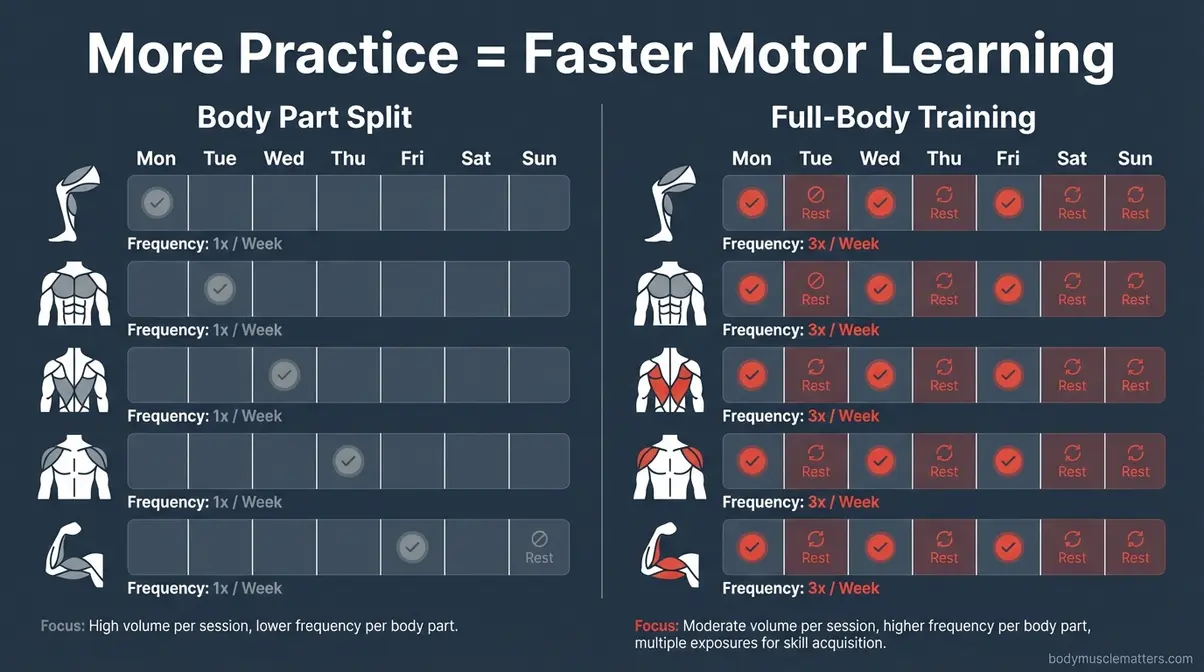
Full-body training hits each muscle group three times per week. More frequent practice means faster motor learning — and for beginners, the biggest gains in the first three months come from neurological adaptation (your brain learning the movements) as much as from muscle growth itself. A gym programme for building muscle that repeats full-body sessions three times per week outperforms body-part splits for beginners in multiple studies.
Practically speaking, full-body training is also simpler. You don’t need to remember which day is “chest day” or “leg day.” Every session trains your whole body, which is more forgiving for beginners whose schedules vary week to week. A Monday/Wednesday/Friday schedule also builds in the 48-hour recovery window automatically.
Here is the full plan. Start on any day that suits you — just keep sessions non-consecutive with at least one rest day between each.
Your Week 1–4 Full-Body Workout Plan
This is the best muscle building programme for beginners structured as a complete 8-week plan. Our team of certified personal trainers evaluated multiple beginner frameworks and structured this around the NCBI-supported 8–12 rep hypertrophy range (NCBI, 2022 analysis) and the NSCA’s linear periodisation model.
Three sessions per week. Rotate: Session A → Session B → Session C.
Session A — Full-Body (Monday)
| Exercise | Muscle Group(s) | Sets | Reps | Rest | Form Cue |
|---|---|---|---|---|---|
| Barbell Squat (Gym) / Goblet Squat (Home) | Quads, Hamstrings, Glutes | 3 | 8–12 | 90 sec | Keep chest tall, push knees out over toes, lower until hips reach knee height |
| Bench Press (Gym) / Dumbbell Floor Press (Home) | Chest, Shoulders, Triceps | 3 | 8–12 | 90 sec | Lower bar to mid-chest, tuck elbows to 45°, press in a slight arc back over eyes |
| Bent-Over Barbell Row (Gym) / Single-Arm Dumbbell Row (Home) | Back, Biceps, Rear Delts | 3 | 8–12 | 90 sec | Hinge to 45°, pull to lower chest, lead with elbows — not hands |
| Plank | Core, Shoulders | 3 | 30–45 sec | 60 sec | Neutral spine, squeeze glutes, breathe steadily |
Session B — Full-Body (Wednesday)
| Exercise | Muscle Group(s) | Sets | Reps | Rest | Form Cue |
|---|---|---|---|---|---|
| Romanian Deadlift (Gym) / Dumbbell RDL (Home) | Hamstrings, Glutes, Lower Back | 3 | 8–12 | 90 sec | Hinge at hips — push bum backwards, not down; feel stretch in hamstrings before driving back up |
| Overhead Press (Gym) / Seated Dumbbell Press (Home) | Shoulders, Triceps, Upper Back | 3 | 8–12 | 90 sec | Brace core, keep rib cage down, press straight up until arms lock out |
| Lat Pulldown (Gym) / Resistance Band Pulldown or Chin-Up (Home) | Lats, Biceps, Upper Back | 3 | 8–12 | 90 sec | Pull bar to upper chest, lead with elbows, control the return slowly |
| Bicep Curl (Dumbbell or Barbell) | Biceps | 2 | 10–12 | 60 sec | Keep elbows pinned at sides, squeeze at the top of each rep |
Session C — Full-Body (Friday)
| Exercise | Muscle Group(s) | Sets | Reps | Rest | Form Cue |
|---|---|---|---|---|---|
| Goblet Squat (both tracks) | Quads, Hamstrings, Glutes | 3 | 8–12 | 90 sec | Hold dumbbell at chest height, elbows inside knees at the bottom |
| Incline Dumbbell Press | Upper Chest, Shoulders, Triceps | 3 | 8–12 | 90 sec | Set bench to 30–45°, press from lower chest line, control the descent |
| Dumbbell Row (both tracks) | Back, Biceps | 3 | 8–12 | 90 sec | Brace on bench, pull dumbbell to hip, pause briefly at the top |
| Lateral Raise | Side Delts | 2 | 12–15 | 60 sec | Slight bend in elbow, raise to shoulder height only — no momentum |
| Tricep Overhead Extension | Triceps | 2 | 10–12 | 60 sec | Keep elbows close, lower weight behind head, extend fully overhead |
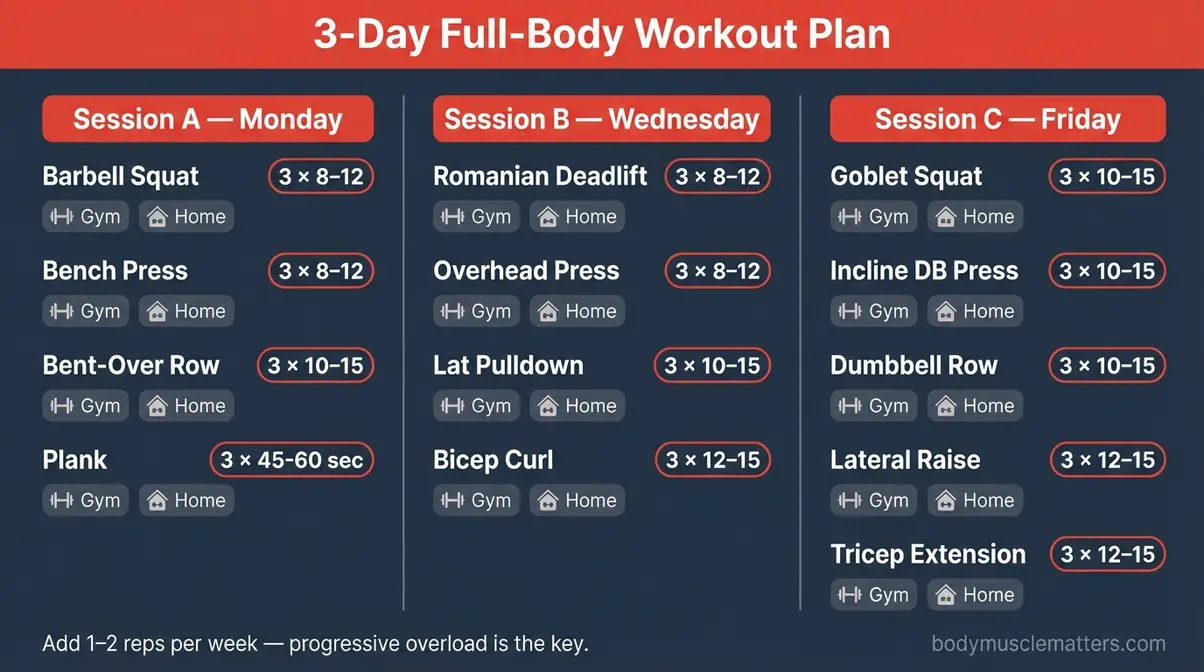
Caption: Your Week 1–4 schedule at a glance — gym and home tracks side by side for the best muscle building programme for beginners.
Progressive Overload Rule: Each week, aim to add 1–2 reps to each set at the same weight, OR increase the weight by the smallest available increment (2.5 kg / 5 lb). If you can complete all sets at 12 reps cleanly, increase the weight next session. This is the engine of every result you’ll see. (NCBI, 2022)
Download the free 8-week PDF tracker → Log every set, rep, and weight to make progressive overload automatic. (EDITOR: Link to downloadable PDF once live)
Weeks 1–4 build your foundation. Here’s how to push further in Weeks 5–8.
Week 5–8: How to Progress
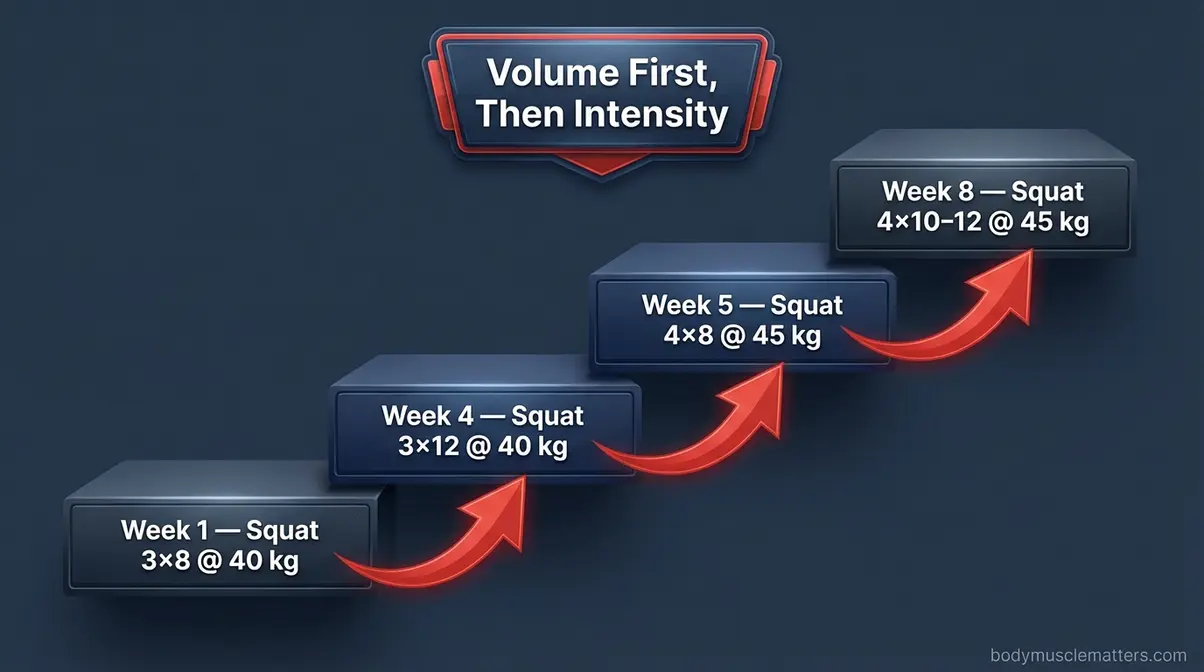
By Week 5, you’ll have spent four weeks grooving the movement patterns. Now it’s time to increase the training stimulus. Shift from 3 sets to 4 sets on all main compound lifts — squat, deadlift, bench press, row, and overhead press. Target 3–4 sets of 6–10 reps using slightly heavier weight than where you finished Week 4.
Here is a concrete progression example for the squat:
- Week 1: Squat — 3 × 8 reps @ 40 kg
- Week 4: Squat — 3 × 12 reps @ 40 kg (top of rep range reached — time to add weight)
- Week 5: Squat — 4 × 8 reps @ 45 kg (new weight, extra set, slightly lower rep target)
- Week 8: Squat — 4 × 10–12 reps @ 45 kg (progress within new weight)
After Week 8, introduce a deload week — reduce the weight by approximately 40% and complete the same movements at lower intensity. This allows your joints, tendons, and nervous system to recover fully before you begin a new programme phase. The NSCA’s linear periodisation model specifically recommends scheduled deload periods after beginner training blocks.
The principle of beginner workout progression is simple: add volume first (more reps), then add intensity (more weight), then repeat.
Not everyone trains at a gym — and that’s no problem. Here’s how to run the same programme at home with just a pair of dumbbells.
Adapting the Plan for Dumbbells
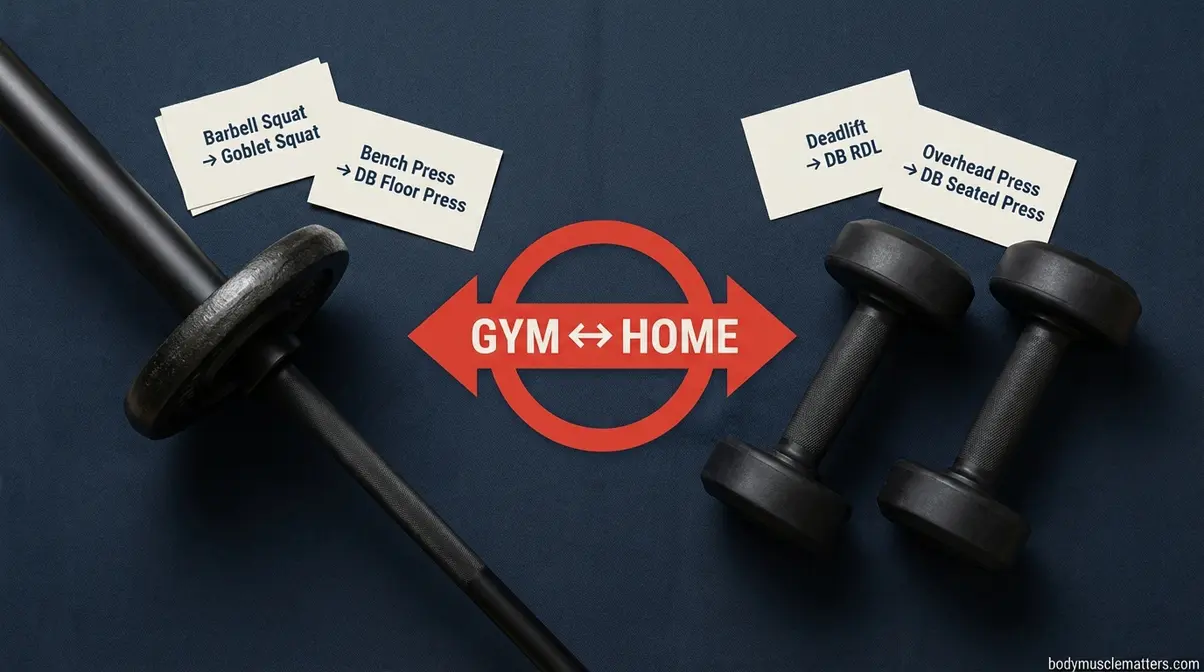
This gym programme for building muscle adapts fully for home use. Every compound movement in the plan has a direct dumbbell substitute that delivers equivalent stimulus. You do not need a gym membership to start building muscle today.
| Gym Exercise | Home / Dumbbell Substitute |
|---|---|
| Barbell Squat | Goblet Squat (1 dumbbell held at chest) |
| Romanian Deadlift | Dumbbell RDL (both hands) |
| Bench Press | Dumbbell Floor Press or Dumbbell Press on bench |
| Bent-Over Barbell Row | Single-Arm Dumbbell Row |
| Overhead Press | Seated Dumbbell Press |
| Lat Pulldown | Resistance Band Pulldown or Bodyweight Chin-Up |
For dumbbell training, progressive overload works identically — increase reps until you hit 12 cleanly across all sets, then move to the next dumbbell weight increment.
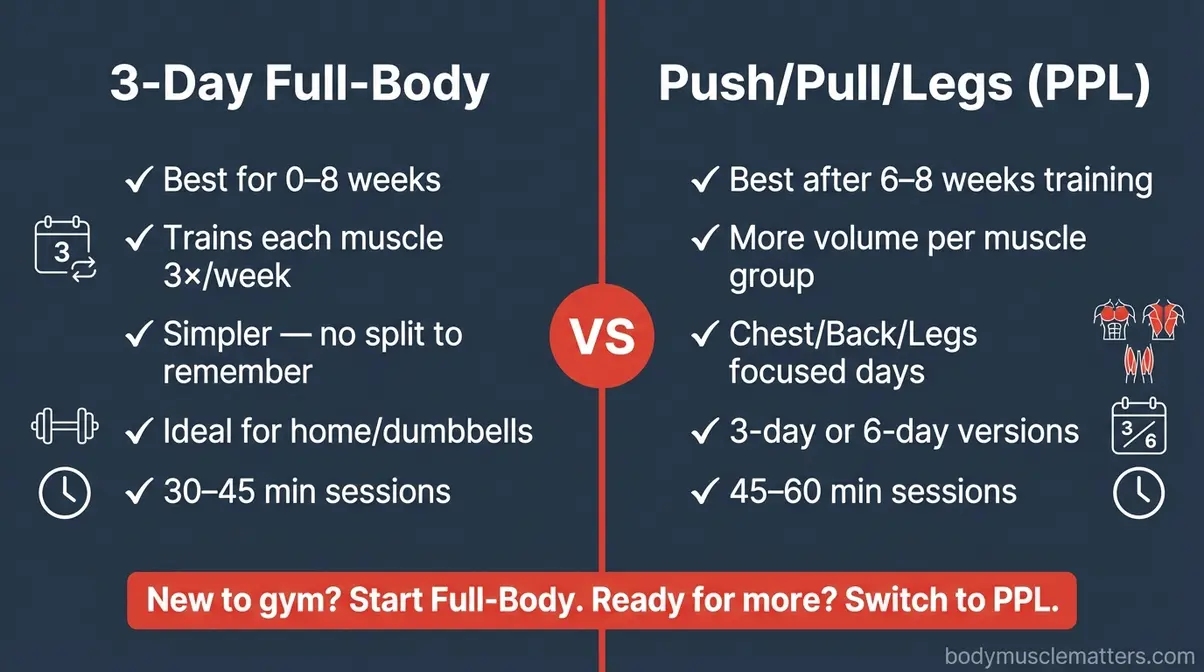
Caption: Side-by-side comparison of the two beginner programmes — use this to decide which starting track fits your schedule and experience level.
The 3-day full-body plan is your best starting point. But after 6–8 weeks, many beginners are ready for more volume. The Push/Pull/Legs split is the natural next step — and it’s the programme most intermediate lifters rely on.
The Push/Pull/Legs (PPL) Split
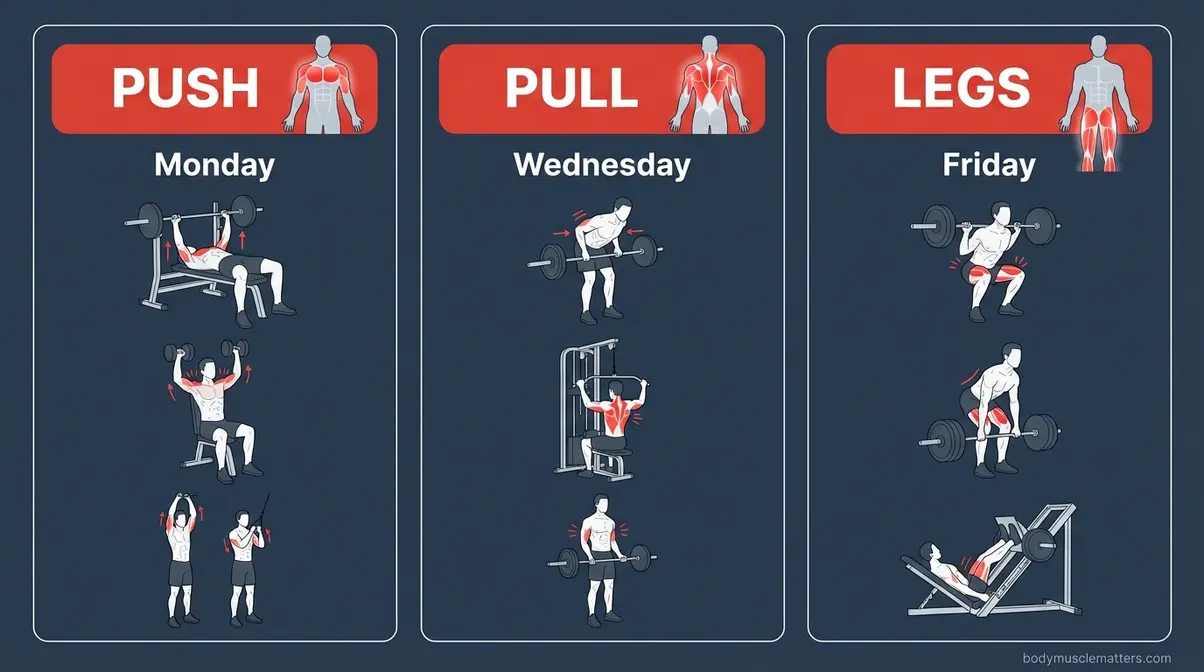
The Push/Pull/Legs split is probably the most efficient beginner-to-intermediate programme for increasing training volume without overcomplicating your schedule. Here’s exactly how it works, what a 3-day version looks like, and — most importantly — how to know whether you’re ready for it.
As your muscle building programme for beginners evolves, the PPL split delivers more volume per session and more focus per muscle group.
What Is the PPL Split?
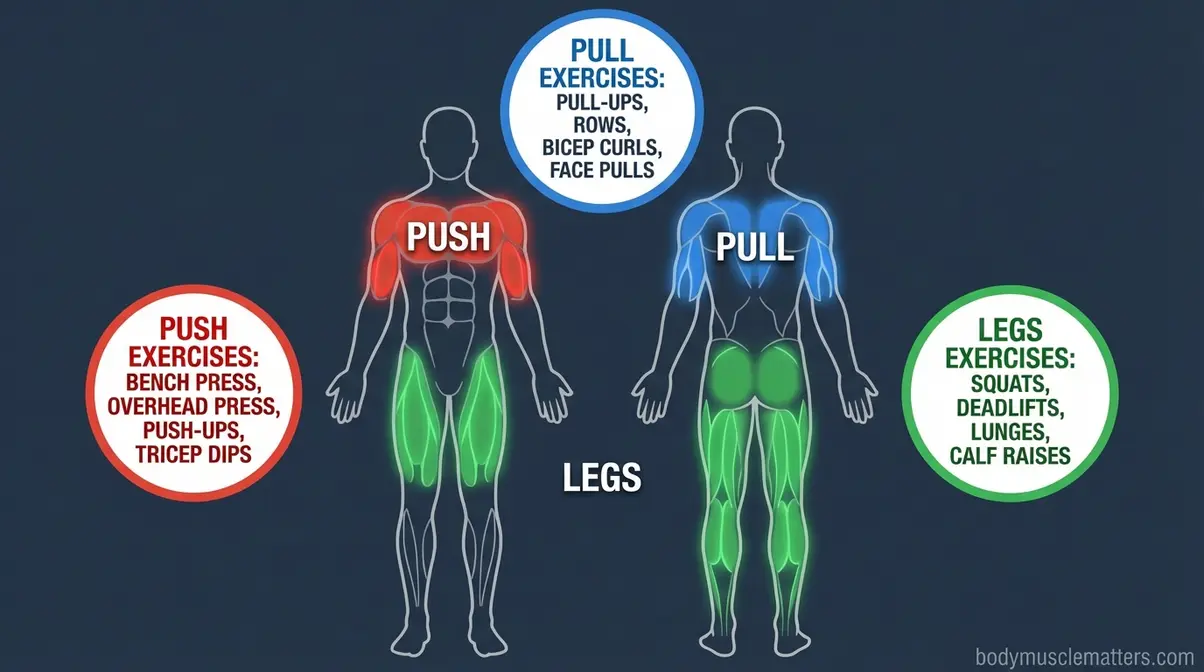
The Push/Pull/Legs split — or PPL — organises your workouts by movement pattern rather than by body part. Each session targets a specific category of movement:
- Push Day: Chest, shoulders, and triceps — the muscles that push things away from your body
- Pull Day: Back, biceps, and rear delts — the muscles that pull things towards you
- Legs Day: Quads, hamstrings, glutes, and calves
In a 3-day version, you train each pattern once per week. In a 6-day version, you run the full cycle twice. For beginners, the 3-day version is the right starting point — it delivers more volume per session than a full-body workout while still allowing adequate recovery.
The benefit of PPL is efficiency. Related muscles work together and support each other within each session, which reduces wasted effort and allows slightly heavier loading per exercise. If you’ve been training for 6 or more weeks and feel ready for more, the PPL split is the best way to continue maximising your Newbie Gains Window.
Here is the full 3-day PPL programme — gym track.
Your 3-Day PPL Workout Plan
This gym programme for building muscle uses the PPL structure to train each muscle group with greater focus and volume than a full-body routine allows. Sets/reps follow the same 3–4 × 8–12 framework, backed by the same NCBI evidence (NCBI, 2022).
Push Day (Monday) — Chest, Shoulders, Triceps
| Exercise | Muscle Group(s) | Sets | Reps | Rest | Form Cue |
|---|---|---|---|---|---|
| Bench Press | Chest, Shoulders, Triceps | 4 | 8–12 | 90 sec | Bar to mid-chest, elbows at 45°, controlled descent |
| Overhead Press | Shoulders, Triceps | 3 | 8–12 | 90 sec | Core braced, press straight up, lock out overhead |
| Incline Dumbbell Press | Upper Chest, Shoulders | 3 | 10–12 | 75 sec | 30–45° incline, lower to chest line, press in arc |
| Lateral Raise | Side Delts | 3 | 12–15 | 60 sec | Raise to shoulder height only, slight elbow bend |
| Tricep Pushdown (cable or band) | Triceps | 3 | 10–12 | 60 sec | Keep elbows fixed at sides, full extension each rep |
Pull Day (Wednesday) — Back, Biceps, Rear Delts
| Exercise | Muscle Group(s) | Sets | Reps | Rest | Form Cue |
|---|---|---|---|---|---|
| Bent-Over Barbell Row | Back, Biceps, Rear Delts | 4 | 8–12 | 90 sec | Hinge to 45°, lead with elbows, pull to lower chest |
| Lat Pulldown | Lats, Biceps | 3 | 8–12 | 90 sec | Wide grip, pull to upper chest, full stretch at top |
| Face Pull (cable or band) | Rear Delts, Rotator Cuff | 3 | 12–15 | 60 sec | Pull to forehead, elbows high and wide throughout |
| Barbell or Dumbbell Curl | Biceps | 3 | 10–12 | 60 sec | Elbows pinned at sides, squeeze hard at the top |
Legs Day (Friday) — Quads, Hamstrings, Glutes, Calves
| Exercise | Muscle Group(s) | Sets | Reps | Rest | Form Cue |
|---|---|---|---|---|---|
| Barbell Squat | Quads, Glutes, Hamstrings | 4 | 8–12 | 90 sec | Chest tall, knees track over toes, full depth |
| Romanian Deadlift | Hamstrings, Glutes, Lower Back | 3 | 8–12 | 90 sec | Hip hinge, feel the hamstring stretch, drive hips forward |
| Leg Press | Quads, Glutes | 3 | 10–12 | 90 sec | Feet shoulder-width on plate, lower until 90° at knee |
| Walking Lunge | Quads, Glutes, Balance | 3 | 10 each leg | 75 sec | Step forward, lower knee to near floor, drive up through front heel |
| Calf Raise (machine or step) | Calves | 3 | 15–20 | 60 sec | Full range — heel below platform level on the way down |
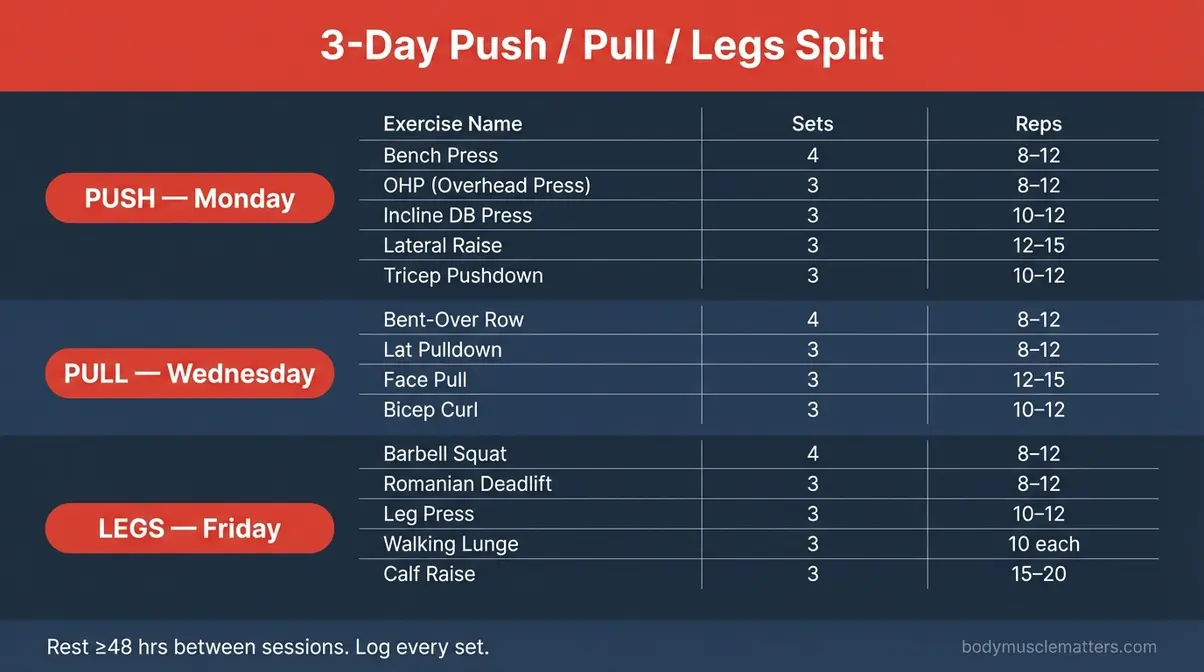
Caption: Your 3-day PPL split at a glance — Push Monday, Pull Wednesday, Legs Friday.
The Push/Pull/Legs split is the most efficient way for beginners to increase training volume after 6–8 weeks of consistent full-body training. So — full-body or PPL? Here’s a simple framework to help you decide.
Full-Body vs. PPL: How to Choose
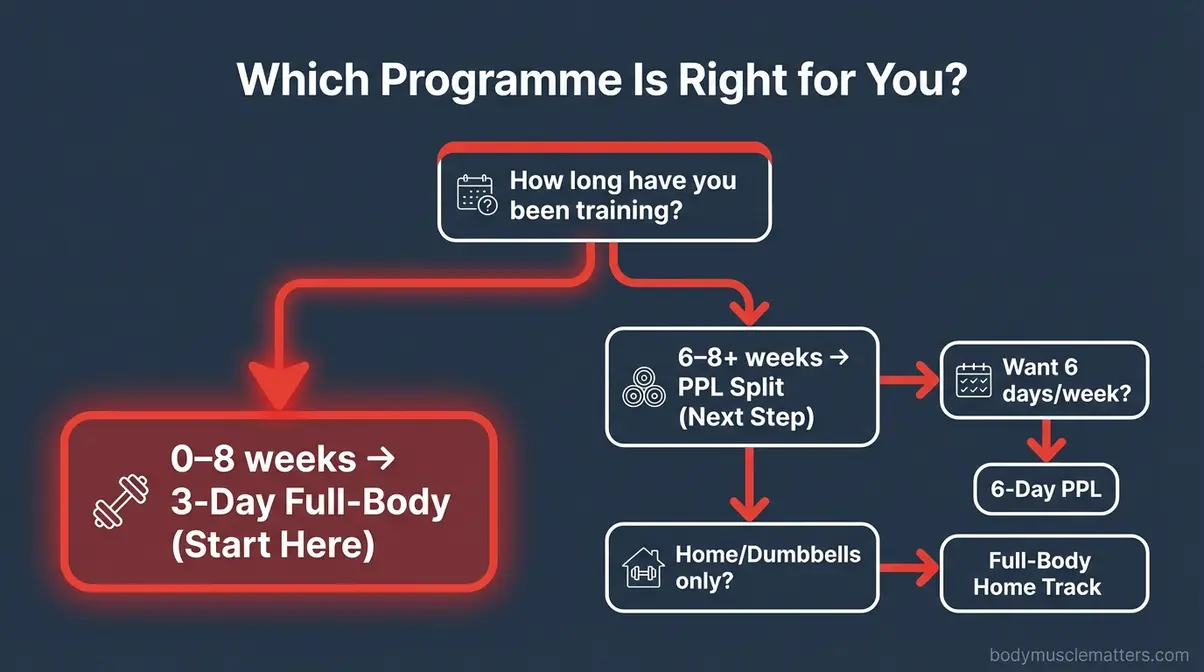
Choosing the best muscle building programme for beginners comes down to one question: how long have you been training?
| Your Situation | Best Programme |
|---|---|
| Completely new to the gym (0–8 weeks) | 3-Day Full-Body |
| Training 3+ days/week for 6–8 weeks | PPL Split |
| Training at home with only dumbbells | 3-Day Full-Body (home track) |
| Want to train 6 days/week | 6-Day PPL Split |
| Limited time (30–40 minute sessions) | 3-Day Full-Body |
If you’re in any doubt, start with the 3-day full-body plan. It’s simpler, better for motor learning, and perfectly optimised for your Newbie Gains Window. Progress to PPL when the full-body sessions start to feel routine and you want to push more volume.
With your training sorted, the final piece of the muscle-building puzzle is nutrition — specifically, what to eat and how much.
Nutrition for Newbie Gains
No muscle building programme for beginners is complete without a nutrition strategy. Your workouts create the stimulus for growth; your food provides the raw material. Without enough calories and protein, your body has nothing to build with — and the gains you work for in the gym simply won’t materialise.
Nutrition is what powers your Newbie Gains Window. Think of it as fuel, not a diet. You’re not restricting anything here — you’re adding the right inputs to support the output your training is demanding.
Calories Needed to Build Muscle
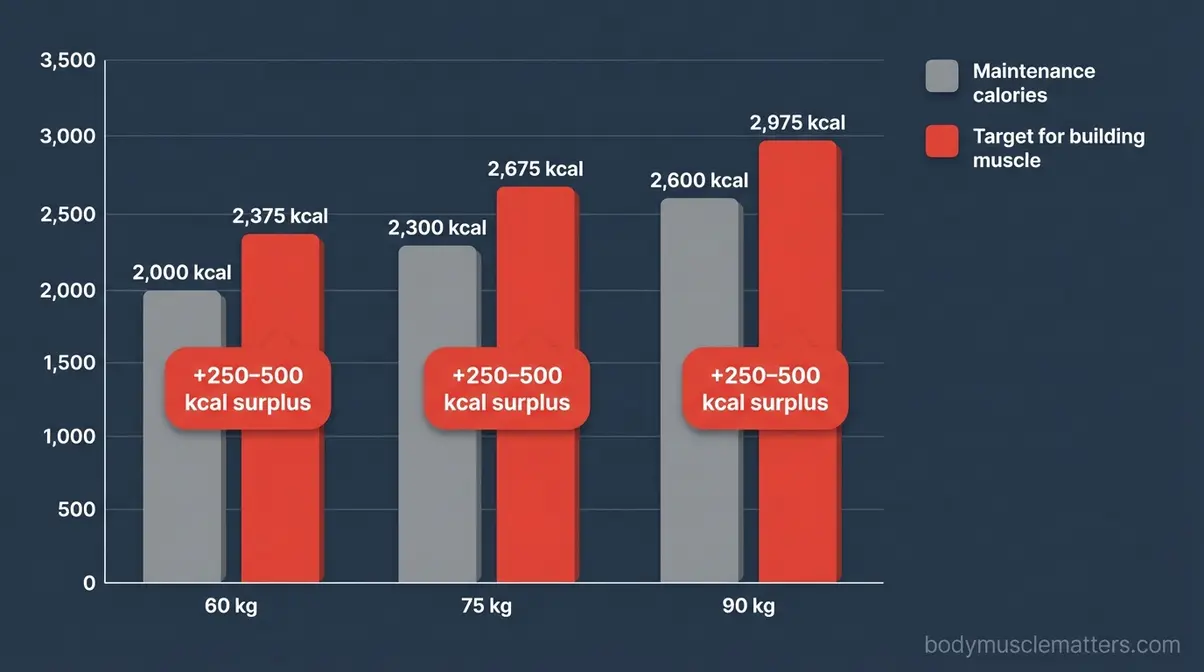
Building muscle requires a calorie surplus — eating slightly more calories than your body burns each day, giving your body the extra energy it needs to build new muscle tissue.
For beginners, a 250–500 calorie surplus above your maintenance level (the calories needed to maintain your current weight) is the sweet spot. It’s enough to fuel muscle growth without excessive fat gain. Larger surpluses tend to add more body fat than muscle in beginners, which most people want to avoid.
Here is a practical reference based on common body weights:
| Body Weight | Estimated Maintenance Calories | Target for Building Muscle |
|---|---|---|
| 60 kg | ~2,000 kcal/day | ~2,250–2,500 kcal/day |
| 75 kg | ~2,300 kcal/day | ~2,550–2,800 kcal/day |
| 90 kg | ~2,600 kcal/day | ~2,850–3,100 kcal/day |
These are estimates. Activity level, age, and metabolism all affect your personal number. A free TDEE (Total Daily Energy Expenditure) calculator — available on most fitness sites — will give you a more precise individual starting point.
Calories give you the energy to train and recover. Protein is what your muscles are actually built from — and hitting the right amount each day is non-negotiable.
Your Daily Protein Target
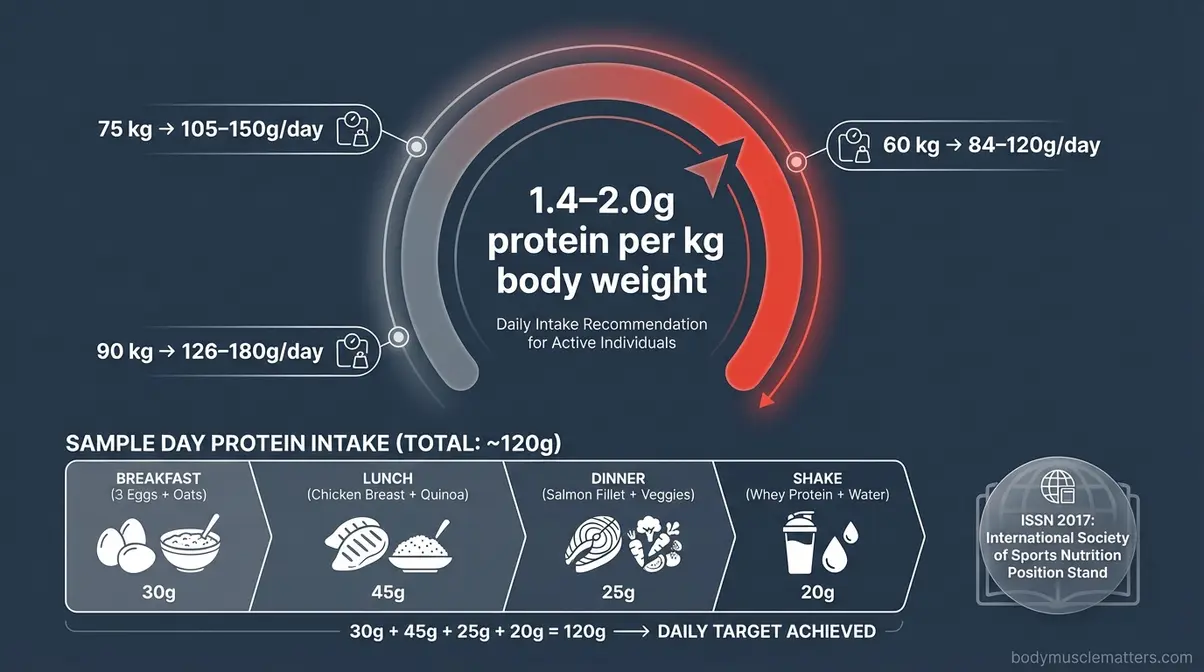
Based on the 2017 ISSN guidelines, experts recommend consuming 1.4–2.0 grams of protein per kilogram of body weight per day to build and maintain muscle mass. This is among the most robustly evidenced nutritional targets in sports science (International Society of Sports Nutrition protein guidelines, ISSN, 2017) — meaning for a 75 kg beginner, you need roughly 105–150g of protein daily.
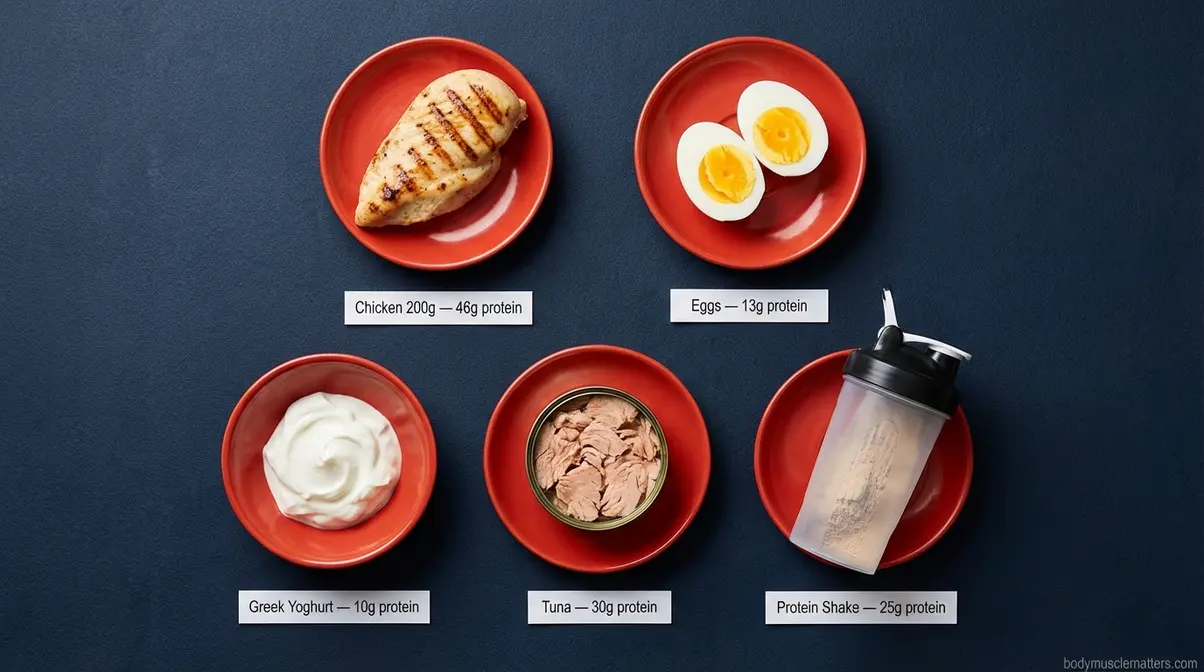
That number sounds large at first. Here’s how it breaks down into everyday food:
- 200g chicken breast: ~46g protein
- 3 large eggs: ~18g protein
- 200g Greek yoghurt: ~20g protein
- 200g tinned tuna: ~44g protein
- 2 scoops whey protein powder: ~50g protein
With two protein-centred meals — say, chicken at lunch and tuna at dinner — plus a protein shake and some eggs at breakfast, a 75 kg beginner hits their daily target with food most people already eat.
Spread protein across 3–5 meals throughout the day for best absorption. You don’t need to track every gram obsessively. Just make sure protein is the centrepiece of each main meal. Drastic diet changes aren’t necessary — small, consistent adjustments are what compound over 8 weeks.
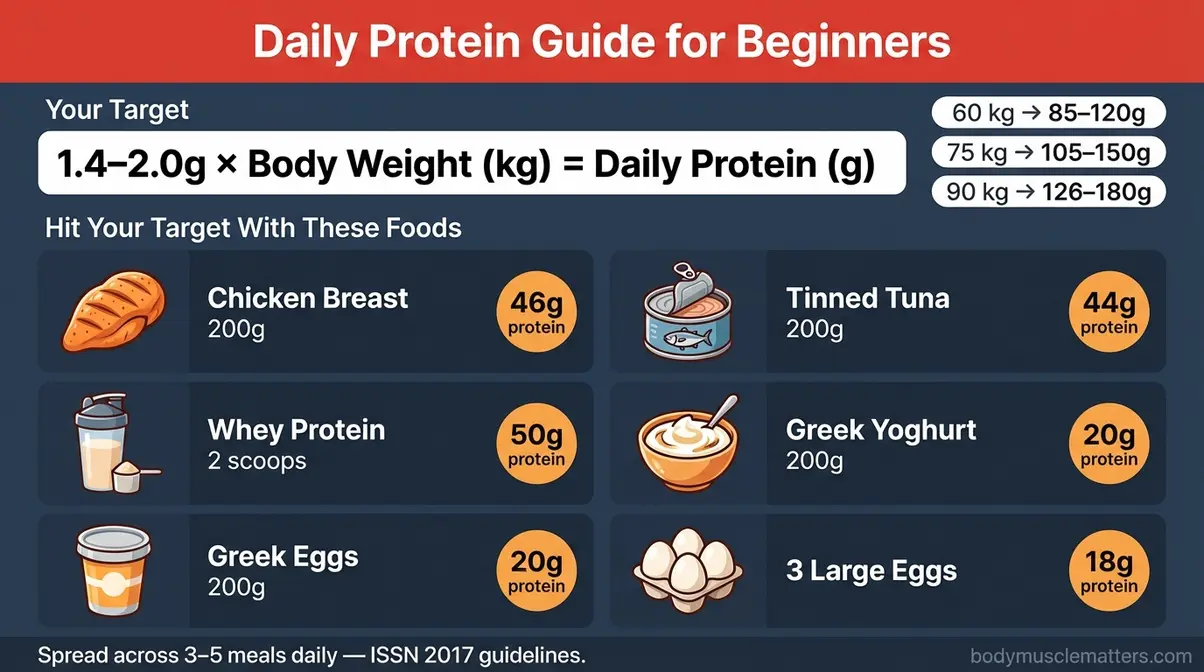
Caption: Hit your daily protein target using these everyday foods — no supplements required, though a protein shake makes it easier.
Hitting your protein and calorie targets becomes much easier when you’re tracking them — which is exactly what the free PDF below is designed to help with.
Free 8-Week PDF Tracker
Progressive overload — the engine of muscle growth — only works if you know what you lifted last session. Without a record, it’s nearly impossible to track week-to-week progress, and most beginners who plateau do so because they’ve stopped consciously progressing.
The free 8-week tracker logs every exercise, set, rep count, and weight for each session across both the full-body and PPL tracks. It also includes a daily nutrition log column so you can track protein and calorie intake alongside your training.
Download Your Free 8-Week PDF Tracker → (EDITOR: Link to /resources/8-week-beginner-tracker.pdf or equivalent)
You now have the training plan, the progression method, and the nutrition framework. Before you start Week 1, there are three mistakes most beginners make — and knowing them in advance will save you weeks of wasted effort.
Common Beginner Mistakes
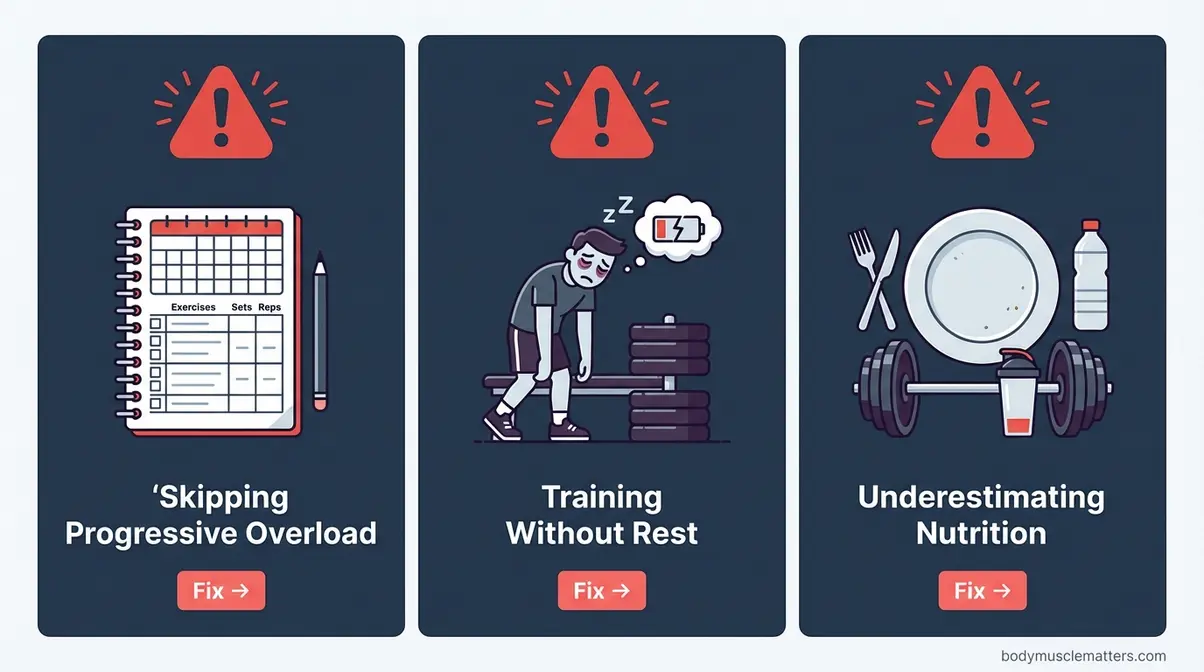
Avoiding these mistakes is what protects your Newbie Gains Window from being wasted. Fitness coaches consistently report that the difference between beginners who build noticeable muscle in 8 weeks and those who don’t almost always comes down to one of these three avoidable errors — not the programme itself.
Skipping Progressive Overload
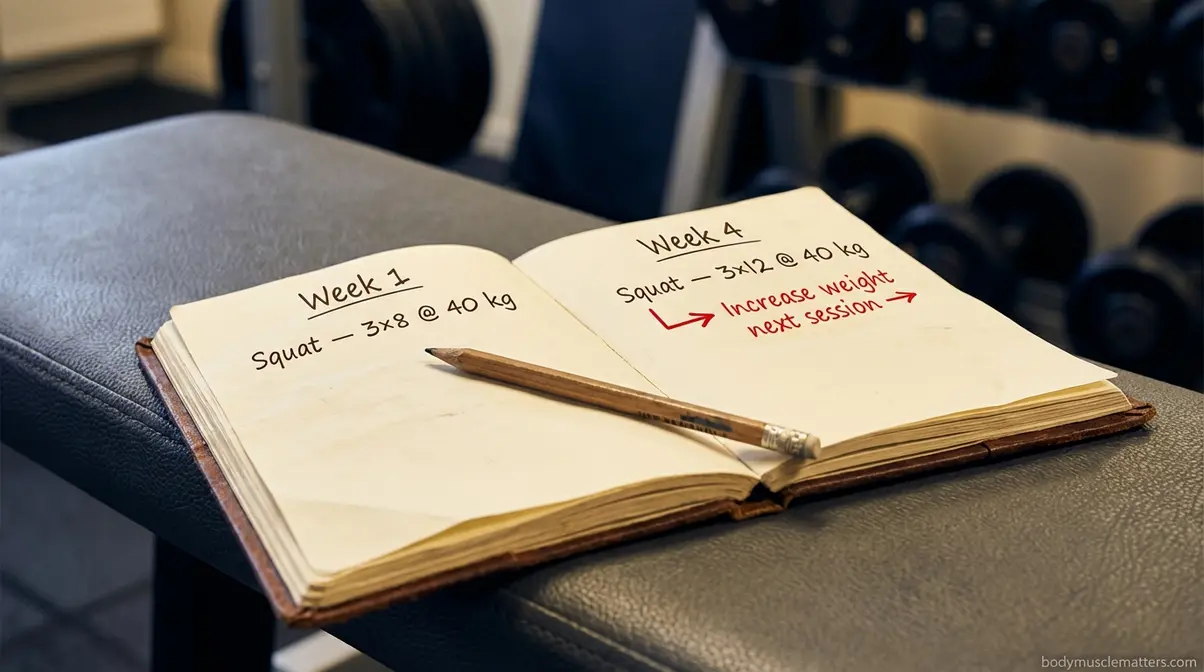
Scenario: You train consistently for four weeks, feel great, and then plateau — lifting the same weights, doing the same reps, week after week.
What goes wrong: Without progressive overload, your muscles have no reason to adapt and grow. You’re maintaining, not building. The stimulus hasn’t changed, so the response doesn’t change.
Fix: Use the PDF tracker to record every session. If you’re hitting 12 clean reps across all 3 sets of an exercise, increase the weight next session — even by just 1.25 kg. That small step is the entire mechanism of muscle growth. Fitness coaches consistently report that skipping progressive overload for more than two consecutive weeks is the primary reason beginners stall — not the wrong programme, not insufficient effort.
The second mistake is on the other end of the spectrum — doing too much.
Training Without Rest
Scenario: You’re motivated, energised, and want to go to the gym every day. So you do — and after two weeks, you’re exhausted, perpetually sore, and making no visible progress.
What goes wrong: Muscles grow during rest, not during training. Training the same muscle group without 48 hours of recovery prevents the repair process from completing, limits growth, and significantly increases injury risk.
Fix: Stick to the 3-day schedule. On rest days, you can walk, stretch, or do light cardio — but don’t add extra lifting sessions in your first 8 weeks. More is not better at this stage. Recovery is a non-negotiable part of the programme, not an optional extra.
Important: If you experience sharp or persistent pain at any point — not standard muscle soreness, but acute or joint pain — stop and consult a physiotherapist or doctor before continuing.
The third mistake is the most common — and the most fixable.
Underestimating Nutrition
Scenario: You follow the programme perfectly for 8 weeks. Your strength improves noticeably, but your visible muscle size barely changes.
What goes wrong: You’re likely in a calorie deficit — burning more calories than you consume. Without a modest surplus, your body has no building material for new muscle tissue. It may even break down existing muscle for energy. Training hard with poor nutrition is like building a house without bricks: the effort is real, but the result won’t come.
Fix: Track your food for 7 days using the PDF tracker or a free app like Cronometer or MyFitnessPal. Aim for the calorie and protein targets in the Nutrition section above. Small, consistent adjustments — like adding a protein shake or an extra chicken breast daily — beat drastic diet changes every time.
Now, the questions we hear most often from beginners starting this programme.
Frequently Asked Questions
Best beginner bodybuilding plan?
For most beginners, the best beginner bodybuilding program is a 3-day full-body routine built around compound movements like squats and deadlifts. This structure trains every major muscle group three times per week while allowing 48 hours of recovery between sessions. After 6–8 weeks of consistent 8–12 rep training, you can progress to a Push/Pull/Legs split for more volume.
Most effective muscle building plan?
The most effective muscle building program uses progressive overload—gradually increasing the weight, reps, or difficulty of your workouts over time—as its central mechanism. For beginners, a 3-day full-body routine or a Push/Pull/Legs split are the two most effective structures. Both train major muscle groups with sufficient frequency to trigger optimal hypertrophy. Ultimately, a simple plan followed consistently beats a complex advanced plan followed occasionally.
Gym frequency for beginners?
A beginner should train 3 days per week to build muscle effectively. Training on non-consecutive days—such as Monday, Wednesday, and Friday—gives each muscle group at least 48 hours of recovery between sessions. This frequency provides enough training stimulus for meaningful muscle growth while preventing overtraining. Based on the 2023 CDC guidelines for muscle-strengthening, adults should perform muscle-strengthening activities involving all major muscle groups on two or more days per week. For complete beginners, three sessions per week sits comfortably above that minimum while remaining completely sustainable.
Building the Habit
The best muscle building programme for beginners is a 3-day full-body routine built around compound lifts — performing 3–4 sets of 8–12 reps per session, the evidence-backed hypertrophy standard confirmed by multiple NCBI analyses (NCBI, 2022). Your first 3–6 months — the Newbie Gains Window — are the most productive of your training life. Make them count by following a structured plan, applying progressive overload every single session, and fuelling your training with adequate protein (1.4–2.0g/kg/day, ISSN, 2017).
The Newbie Gains Window does not last forever — but the habits you build during it will. Follow the 3-day full-body plan, progress to the PPL split when you’re ready, and use the free PDF tracker to ensure every session moves you forward. That is the entire system. No complexity required.
Download your free 8-week PDF tracker now, choose your first session day, and get started with three sessions this week. Your Newbie Gains Window is open right now. The only thing standing between you and the results you came here for is the decision to start.
