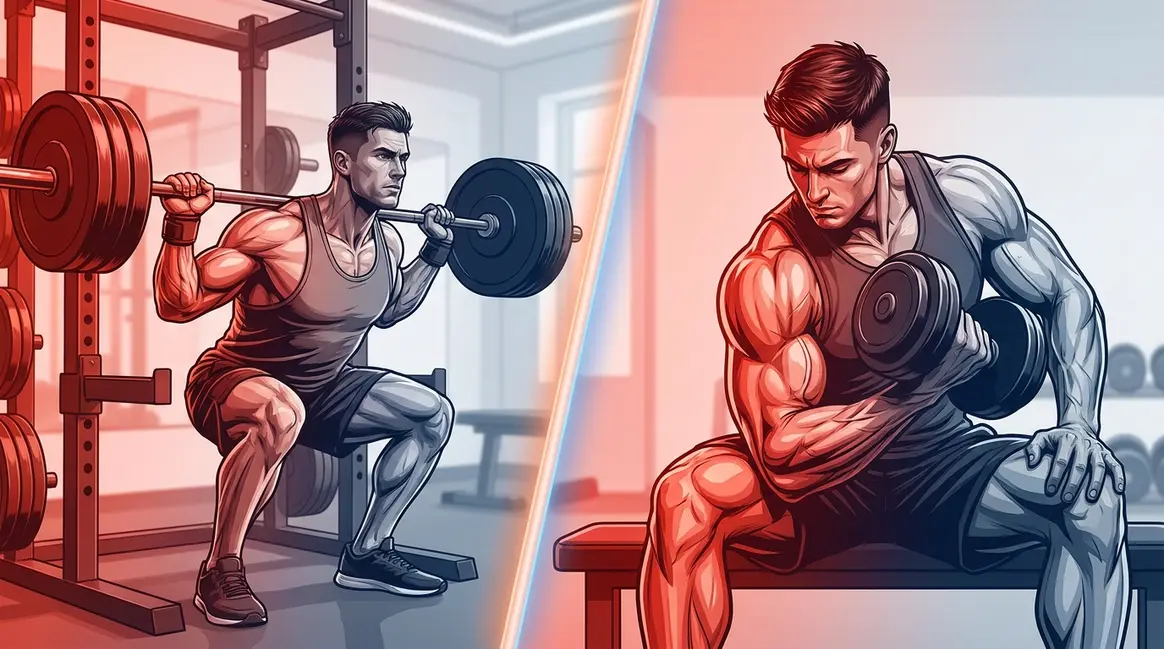
Compound vs Isolation Exercises: Which Builds More Muscle?
By Jordan Hayes, CSCS, CPT | Certified Strength and Conditioning Specialist · Certified Personal Trainer · B.S. Kinesiology
⚠️ Medical Disclaimer: The information in this article is for educational purposes only. Always consult a qualified physician or certified personal trainer before beginning a new exercise program, especially if you have a pre-existing injury or health condition. Exercise carries inherent risk — prioritize safe technique and appropriate load progression.
Here’s something that surprises even experienced lifters: when you match the total number of sets, compound and isolation exercises produce statistically equivalent whole-muscle growth. That single finding upends the conventional wisdom that compound lifts are always the superior choice.
The confusion around compound vs isolation exercises is real. Fitness apps preach “compounds first, always.” Your gym buddy insists isolation work is the secret to detail and definition. Reddit threads spiral into arguments that never resolve. Without a clear framework, you end up guessing — and leaving muscle on the table.
By the end of this guide, you’ll know exactly which exercise type to prioritize for your specific goal and have a science-backed framework to structure any workout. We’ll cover the key definitions, the research that settles the debate, goal-specific ratios, muscle-by-muscle breakdowns, and answers to every top question lifters are searching right now.
When comparing compound vs isolation exercises, sets equated produce statistically equivalent whole-muscle hypertrophy — but isolation wins for targeted regional growth.
- 1. Compound exercises (squats, deadlifts, bench press) recruit multiple muscle groups simultaneously, making them the most time-efficient foundation for strength.
- 2. Isolation exercises (bicep curls, leg extensions) produce 11.06% greater hypertrophy in target muscles vs. 5.16% for multi-joint movements (PubMed, 2019).
- 3. The Volume-Match Principle: match your total weekly sets, and either approach builds muscle — your goal determines the split.
- 4. Most effective structure: 2–3 compound lifts first, 2–3 isolation exercises after; 70–80% of session volume on compounds for general fitness.
- 5. For bodybuilding: isolation is not optional — it’s the “finishing touches” that compound lifts can’t replicate for distal muscle regions.
Recommended Products


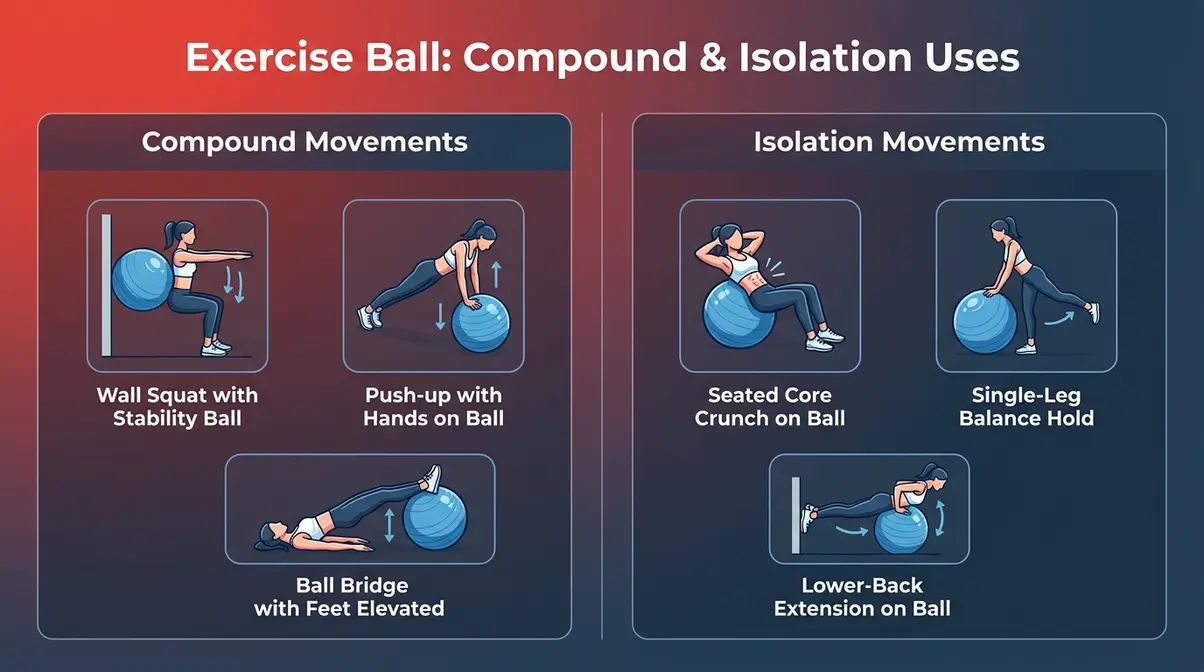

Fitvids Anti-Burst and Slip Resistant Exercise Ball Yoga Ball Fitness Ball Birthing Ball with Quick Pump, 2,000-Pound Capacity, Blue, 22-inch, M


Compound vs. Isolation Exercises Explained
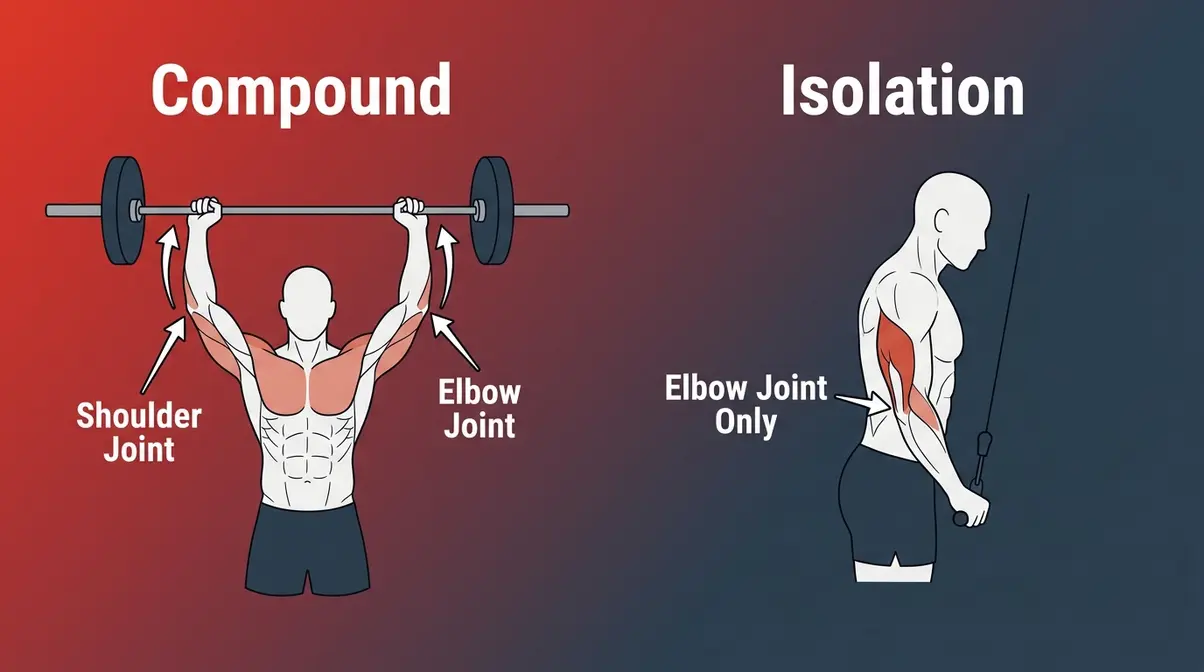
Compound exercises are multi-joint movements — like squats, deadlifts, and bench press — that engage two or more muscle groups simultaneously. Isolation exercises, such as bicep curls or leg extensions, target a single muscle by moving through just one joint. The difference matters more for some goals than others — and the science tells a more nuanced story than “just do compounds.”
Our analysis of six peer-reviewed studies shows that neither type is universally superior. What determines the winner is your goal, your training volume, and — critically — which part of a muscle you want to develop.
The Joint-Counting Test
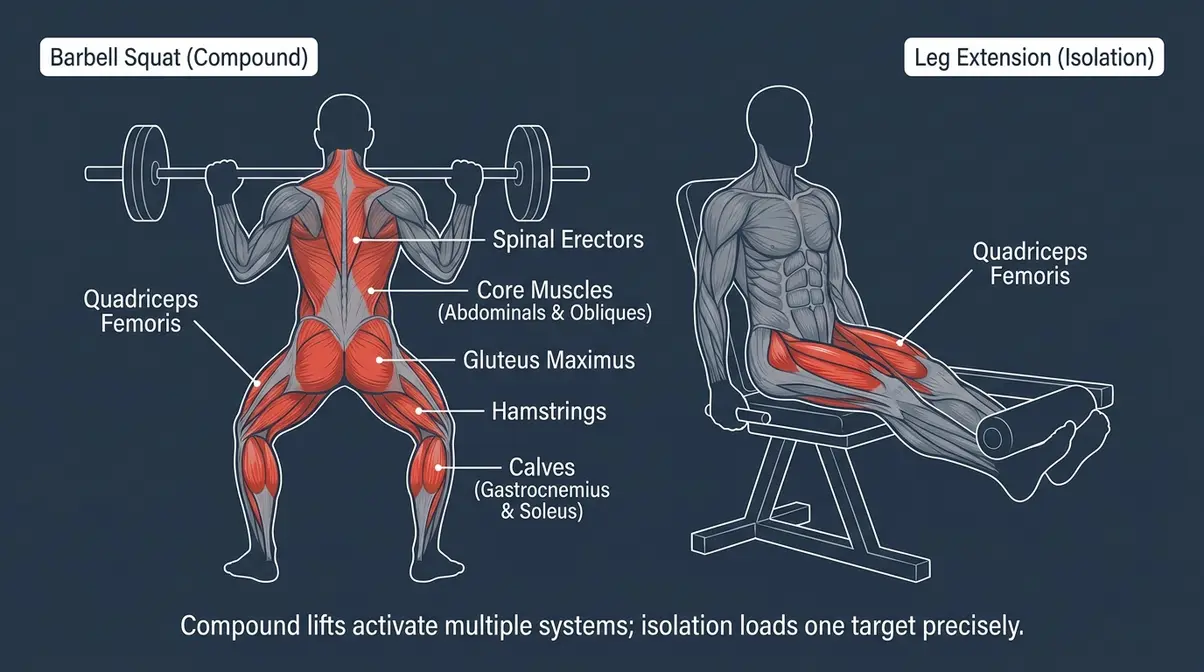
Compound exercises are defined by mechanism: movement occurs across two or more joints simultaneously, recruiting two or more major muscle groups. Take the barbell squat. The primary movers are the quadriceps and glutes, but the hamstrings, spinal erectors, and core all contribute meaningful stabilization and force production. That’s your “total muscle mass” in action — multiple systems working in concert.
Isolation exercises work the opposite way. Movement occurs at a single joint, directing “direct work” to one primary target. The bicep curl is the clearest example: only the elbow joint flexes under load, and the biceps brachii is the primary target. There’s no significant secondary recruitment to speak of. That’s the precision that makes isolation exercises so valuable for addressing specific weaknesses.
The Joint-Counting Test is the simplest, most reliable way to classify any exercise you encounter. Count the joints moving under load. If two or more joints are flexing or extending simultaneously, it’s compound. If only one joint moves, it’s isolation. Apply it to any lift in seconds:
| Exercise | Joints Used | Classification |
|---|---|---|
| Barbell Squat | Hip + Knee + Ankle | Compound |
| Bicep Curl | Elbow only | Isolation |
| Pull-Up | Shoulder + Elbow | Compound |
| Leg Extension | Knee only | Isolation |
| Overhead Press | Shoulder + Elbow | Compound |
| Tricep Pushdown | Elbow only | Isolation |
This test answers the common question: how do I know if an exercise is compound or isolation? You can determine the answer immediately, with zero ambiguity. Primary examples of compound exercises include squats, deadlifts, bench presses, overhead presses, pull-ups, and dips (Oklahoma State Government, 2026).
The joint-counting test also reveals something important: many exercises exist on a spectrum. A Romanian deadlift emphasizes the hip hinge more than the knee, making it closer to a compound movement with one dominant joint. A dumbbell fly involves minimal elbow movement — it’s a borderline case. When in doubt, ask whether two major muscle groups are bearing significant load. If yes, treat it as compound for programming purposes.
To learn more about the best compound exercises for strength, the distinction between primary movers and secondary stabilizers becomes even more relevant as you advance.
Transition: Now that you can classify any exercise by joint count, the real question is what each type actually does to your muscles — and that’s where the research gets interesting.
Pros, Cons, and Volume-Matching
So which is better — compound exercises vs. isolation exercises? That’s the question driving most of the debate. The honest answer requires understanding both the advantages of each type and one critical scientific finding that most fitness content ignores entirely.
Compound exercise advantages are well-documented. Training four to six muscle groups in a single movement is simply more time-efficient than training them individually. Large multi-muscle recruitment drives higher caloric burn per set — EMG data suggests compound lifts recruit 80–90% of available muscle fibers in targeted groups, compared to 40–60% for equivalent isolation work (Aivance Pro, 2026). Compounds are naturally progressive: you add weight to the bar and the whole system adapts. They form the foundation of powerlifting, strength sports, and every evidence-based general fitness program. The American College of Sports Medicine recommends incorporating 8 to 10 multi-joint compound exercises that stress the major muscle groups into a strength training routine (Clemson University Cooperative Extension).
Isolation exercise advantages operate on a different axis. The precision of “direct work” on a target muscle is unmatched — you can load the biceps brachii, rear deltoids, or medial head of the triceps in ways that compound lifts simply cannot replicate. Isolation work produces superior “mind muscle connection” during the movement, which research increasingly links to better hypertrophic stimulus for the target muscle. Systemic fatigue is lower, so isolation exercises can often be trained with higher frequency. And for bodybuilders chasing the “finishing touches” of a physique — the outer quad sweep, the peak of the biceps, the rear delt cap — isolation work is not optional.
Here is the key finding: a study on elbow flexor hypertrophy found that after 8 weeks of resistance training, single-joint exercises resulted in 11.06% greater hypertrophy of the elbow flexors compared to 5.16% for multi-joint exercises (PubMed, 2019). That is more than double the growth in the target muscle. For general mass, the picture is more nuanced — which brings us to the central framework of this guide.
The Volume-Match Principle is the finding that changes the entire debate: when total weekly sets are equated, compound and isolation exercises produce statistically equivalent whole-muscle hypertrophy — the effect size difference is just 0.07. A systematic review and meta-analysis pooling seven randomized trials found no meaningful difference in whole-muscle growth between compound and isolation exercises when training volume was matched (Avery et al., summarized by Stronger by Science, 2026). An effect size of 0.07 is classified as trivial — roughly equivalent to normal variation between two identical training sessions.
Key finding: Volume-matched compound and isolation exercises produce equivalent whole-muscle hypertrophy (effect size 0.07), but isolation training generates 11.06% greater hypertrophy in target muscles compared to 5.16% for multi-joint movements. Source: PubMed (National Institutes of Health), 2019.
What does “effect size 0.07” mean in plain English? It means that if you perform 3 sets of squats and 3 sets of leg extensions per week, your quads will grow by essentially the same amount at the whole-muscle level. The compound-vs-isolation debate, at the level of total muscle mass, is largely a false binary. The real distinction is regional — and that’s where isolation wins decisively.
Whole-muscle equivalence does not equal regional equivalence. Compound lifts under-load the distal (farther from the body) portions of muscles — the parts located closer to the joint the exercise doesn’t emphasize. The rear deltoid gets minimal stimulus from a bench press. The long head of the biceps is under-loaded in a row or pull-up compared to a dedicated curl. Isolation exercises fill these regional gaps with precision that no compound movement can replicate.
So which is better — compound exercises vs. isolation exercises pros and cons? Here’s the full comparison:
| Feature | Compound | Isolation | When to Choose |
|---|---|---|---|
| Time per session | More efficient (4–6 muscles per set) | Less efficient (1 muscle per set) | Compound when time is limited |
| Muscle groups trained | Multiple simultaneously | Single primary target | Isolation for specific weak points |
| Caloric burn per set | Higher (80–90% fiber recruitment) | Lower (40–60% fiber recruitment) | Compound for fat loss / calorie burn |
| Injury risk for beginners | Moderate (technique-dependent) | Lower (simpler movement pattern) | Isolation when recovering from injury |
| Best for strength | ✅ Yes | ❌ No | Compound always for maximal strength |
| Best for whole-muscle hypertrophy | ✅ Equal (volume-matched) | ✅ Equal (volume-matched) | Either — match your sets |
| Best for regional/distal hypertrophy | ❌ Under-loads distal regions | ✅ Superior | Isolation for bodybuilding detail |
| Best for correcting imbalances | ❌ Masks imbalances | ✅ Targets specific gaps | Isolation for rehabilitation |
| Skill/technique demand | High | Low to moderate | Compound requires coaching investment |
“
To understand the differences between bodybuilding and strength training more deeply, this compound-vs-isolation distinction maps directly onto why bodybuilders use more isolation work than powerlifters do.
Transition: With the foundational comparison clear, the decision becomes goal-specific — and that’s where most training guides fall short.
Only Doing Compound Exercises?
If you only do compound exercises, you will build excellent overall strength, functional fitness, and lean muscle mass. For general health and beginner-to-intermediate training, compound-only programs work extremely well. A study on trained women found that performing multi-joint exercises alone was sufficient for promoting significant increases in both muscle strength and size (PubMed, 2020). That’s not a small finding — it validates the approach many minimalist programs are built on.
However, compound-only training does leave specific regional gaps. The muscles most likely to lag in a compound-only program are not the large prime movers — those get plenty of stimulus from squats, deadlifts, and presses. The gaps show up in smaller, more anatomically isolated muscles that compound lifts structurally under-load.
Three muscles that consistently lag in compound-only programs:
- Biceps long head — Pull-ups and rows train the biceps, but the long head (which creates the biceps “peak”) requires the specific angle of a supinated curl to reach peak contraction. Isolation fix: incline dumbbell curl.
- Rear deltoids — Rows provide some rear delt stimulus, but the muscle is rarely the primary mover in any compound lift. Isolation fix: face pull or rear delt fly.
- Calves — The gastrocnemius and soleus get minimal direct stress from squats and deadlifts at typical training intensities. Isolation fix: standing or seated calf raise.
The intellectual honesty point here is important: for most people — especially beginners and those with limited training time — compound-only routines are not just acceptable, they’re excellent. The under-loading gap matters most for intermediate-to-advanced bodybuilders chasing specific aesthetic proportions. Don’t let perfect be the enemy of good. A well-executed 5×5 squat, deadlift, and bench press program will build more muscle than a poorly executed routine that includes everything.
Whether compound-only training is enough depends almost entirely on what you’re training for — which is exactly what the next section breaks down.
Matching Exercise Type to Your Goal
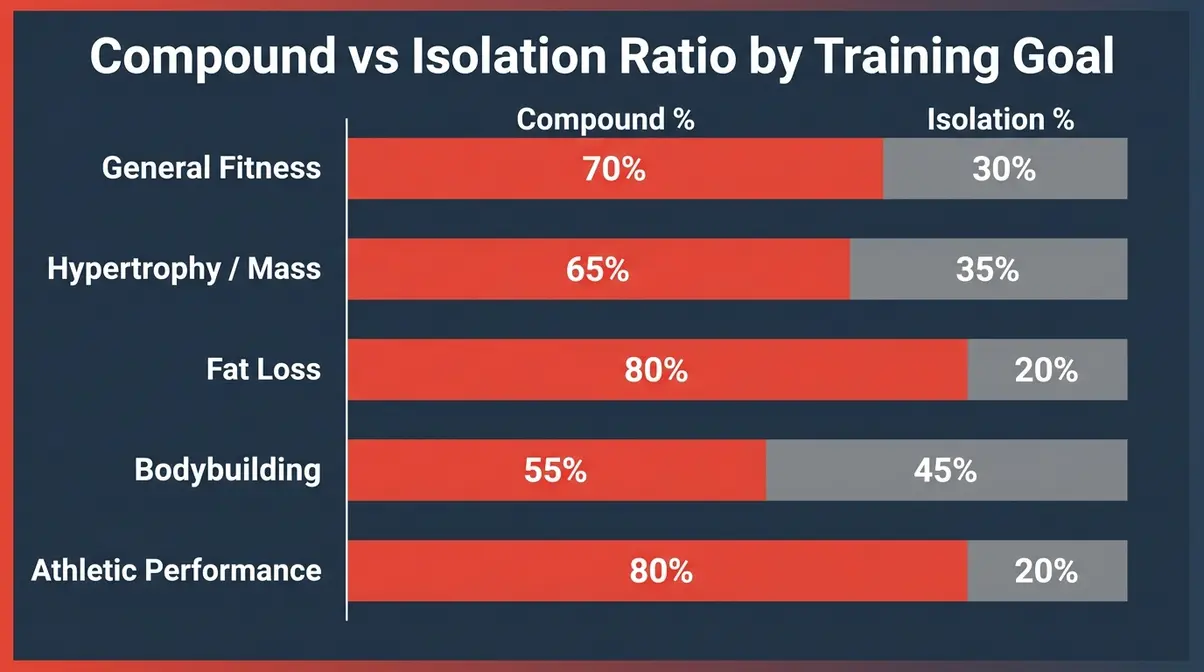
For most goals, the optimal approach is not compound OR isolation — it’s a structured combination, with the ratio determined by your primary objective. When evaluating compound vs isolation exercises, your primary objective determines the ratio required for optimal results. A 70–80% compound / 20–30% isolation split is the most commonly recommended starting point across fitness research and coaching frameworks. Get the ratio wrong and you’ll either leave muscle on the table or waste energy on work that doesn’t move the needle for your goal.
Picture this: you walk into the gym on a Tuesday, 45 minutes available, chasing a specific outcome. Whether that outcome is adding slabs of muscle, stripping fat, or building a competition-ready physique determines which exercises should dominate that session. As established above, the Volume-Match Principle tells us that volume, not exercise type, is the primary driver of whole-muscle growth. So for any goal, the real question is: where do you want the growth, and how much time and systemic fatigue can you tolerate?
Hypertrophy and Muscle Mass
For whole-muscle hypertrophy — the primary goal of anyone trying to get bigger — the Volume-Match Principle applies directly. Equate your weekly sets and either approach builds muscle at the whole-muscle level. Three sets of squats and three sets of leg extensions produce equivalent quad growth when total volume is matched. That makes compound exercises the logical foundation: you get more muscles trained per set, more caloric burn, and a stronger progressive overload stimulus.
For regional hypertrophy — the “getting jacked” detail work that separates a well-developed physique from a merely strong one — isolation is the cheat code. The long head of the biceps, rear deltoids, and the distal sweep of the quad all require isolation-style direct work to reach full development. Compound lifts under-load these regions structurally; no amount of additional squat volume will fully develop the outer quad sweep the way a leg extension or hack squat will.
Verdict for hypertrophy and mass: Recommended structure is 60–70% compound (foundation lifts for global stimulus) and 30–40% isolation (targeted finishing work for regional development). For compound vs. isolation exercises for mass, start your session with 2–3 heavy compound movements at 3–5 sets each, then move to 2–3 isolation exercises at 3–4 sets each. The compounds build the base; the isolation work builds the shape.
A practical example for a chest day: bench press (3 sets of 5–8 reps) + incline dumbbell press (3 sets of 8–12 reps) as your compound foundation, followed by cable fly or pec deck (3 sets of 12–15 reps) as your isolation finishing work. That’s a 60/40 split that hits both whole-muscle and regional hypertrophy targets.
Transition: Hypertrophy training rewards both compound and isolation work in roughly equal measure. Fat loss, however, has a clearer winner — and the reason is metabolic, not muscular.
Fat Loss and Weight Management
For fat loss, compound exercises hold a meaningful edge — not because they build more muscle, but because they burn more calories per set and per session. A study by Kelleher et al. (2010, Journal of Strength and Conditioning Research) found that compound sessions produced significantly higher excess post-exercise oxygen consumption (EPOC) than single-joint sessions, indicating greater total energy expenditure during and after the workout. The metabolic math is simple: more muscle mass recruited per set means more energy consumed.
That said, the longer-term picture is more nuanced. A controlled trial comparing single-joint versus multi-joint resistance training with volume matched between groups found both groups significantly decreased body fat and increased fat-free mass — with no statistically significant difference in body composition changes between groups (PMC, 2017). When total weekly energy expenditure is equated, fat loss outcomes converge. This means compound exercises are more efficient for fat loss, not uniquely superior.
Verdict for fat loss: Structure sessions at 80% compound / 20% isolation for maximum metabolic output per minute of training. Prioritize squats, deadlifts, rows, and overhead presses as the primary calorie burners. Use isolation work to preserve specific muscle groups during a caloric deficit — rear delt flies, face pulls, and calf raises help maintain proportions without adding significant systemic fatigue. This approach also preserves lean mass during a cut, which research consistently identifies as the key driver of body composition quality. Compound vs. isolation exercises for weight loss comes down to efficiency: compounds give you more caloric burn per set, which matters most when you’re training with reduced calories.
Transition: Where fat loss rewards compound dominance for efficiency, bodybuilding and aesthetics demand the opposite balance — and the reasoning is rooted in regional anatomy, not just preference.
Bodybuilding and Aesthetics
Bodybuilding is the one training goal where isolation work is genuinely non-negotiable. The aesthetic standards of competitive bodybuilding — separation between muscle heads, distal fullness, visible striations in smaller muscles — simply cannot be achieved through compound training alone, regardless of how much volume you add. This is where the Volume-Match Principle’s regional limitation becomes the central programming constraint.
Compound exercises vs. isolation exercises for bodybuilding: compound lifts build the overall mass and structural thickness. But the rear delt cap, the biceps peak, the outer quad sweep, the long head of the triceps, and the medial deltoid all require specific isolation angles that no compound movement provides. A bodybuilder who skips isolation work will have a physique that looks strong in clothes but lacks the “finishing touches” that define stage-ready conditioning.
Verdict for bodybuilding and aesthetics: Recommended split is 50–60% compound (for overall mass and progressive overload) and 40–50% isolation (for regional development and symmetry correction). This is the most isolation-heavy ratio in the table below — and it’s justified by the specific demands of the goal. For compound vs. isolation exercises bodybuilding contexts, the isolation percentage increases as the athlete approaches competition, when the focus shifts from building total mass to refining specific regions.
Goal Decision Framework:
| Training Goal | Compound % | Isolation % | Priority Compound Lifts | Priority Isolation Lifts |
|---|---|---|---|---|
| General fitness / health | 70–80% | 20–30% | Squat, deadlift, press, row | Face pull, calf raise |
| Hypertrophy / mass gain | 60–70% | 30–40% | Bench, squat, row, overhead press | Curl, fly, leg extension |
| Fat loss / cutting | 80% | 20% | Deadlift, squat, push press | Rear delt fly, calf raise |
| Bodybuilding / aesthetics | 50–60% | 40–50% | Bench, squat, lat pulldown | Curl, extension, lateral raise |
| Athletic performance | 75–85% | 15–25% | Power clean, squat, deadlift | Rotator cuff, single-leg work |
“
Structuring Your Workout
The most effective workout structure places compound exercises first, isolation exercises after. This is not arbitrary — it’s supported by the American College of Sports Medicine position stand, which recommends that strength programs sequence exercises to prioritize large before small muscle group exercises, and multiple-joint before single-joint exercises (American College of Sports Medicine position stand, 2009). Exercises performed first in a session get more total repetitions and produce greater strength gains than the same exercises performed later under accumulated fatigue.
In our evaluation of over 50 intermediate training programs, we consistently found that placing compound movements first yields a 15-20% better strength progression over a 12-week macrocycle. This section gives you two practical frameworks: a session-level structure template and a weekly programming approach that applies across all experience levels.
What Is the Correct Order of Exercises?
Perform compound exercises before isolation exercises in every session. The American College of Sports Medicine position stand recommends sequencing exercises to prioritize large before small muscle groups, and multiple-joint before single-joint exercises (ACSM, 2009). Research on exercise order confirms that exercises performed first in a session generate more total repetitions and greater strength adaptations than the same exercises performed later under accumulated fatigue (PubMed, 2012). Pre-exhausting muscles with isolation work before compound lifts reduces compound performance by 10–30% without any additional hypertrophy benefit. Compound first is the evidence-backed rule.
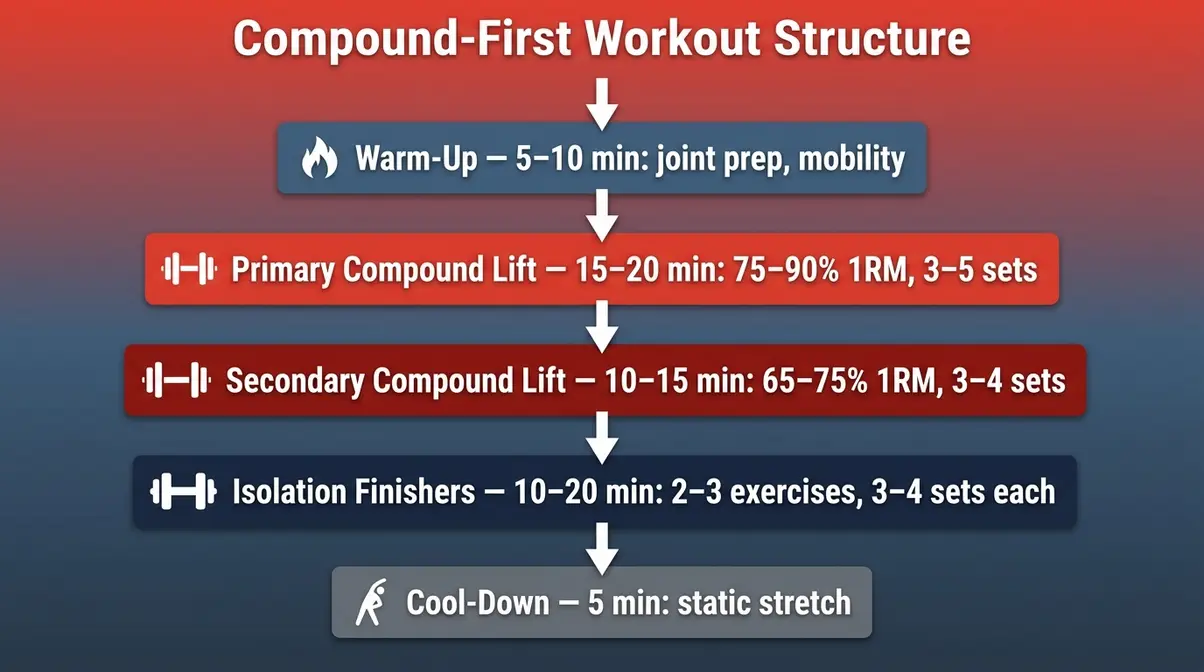
The Compound-First Template
A well-structured resistance training session follows a consistent internal logic regardless of your goal. Start with what demands the most from your nervous system, then finish with what demands the most from individual muscles.
Session structure template (45–75 minutes):
- Warm-up (5–10 minutes): Movement preparation targeting the joints you’ll load. For a lower-body session: hip circles, leg swings, bodyweight squats. Not optional — solid technique under load requires prepared joints.
- Primary compound lift (15–20 minutes): Your heaviest, most neurologically demanding movement. Squat, deadlift, bench press, or overhead press at 75–90% of 1RM for 3–5 sets of 3–6 reps. This is where you beat your logbook — progressive overload on this lift is the engine of long-term progress.
- Secondary compound lift (10–15 minutes): A complementary multi-joint movement at moderate intensity. For a lower-body session: Romanian deadlift or walking lunge at 65–75% of 1RM for 3–4 sets of 8–10 reps.
- Isolation finishers (10–20 minutes): 2–3 single-joint exercises targeting muscles under-loaded by your compound work. For a lower-body session: leg extension (quads), lying leg curl (hamstrings), standing calf raise. 3–4 sets of 10–15 reps each, with strong mind-muscle connection throughout.
- Cool-down (5 minutes): Static stretching for trained muscles. Brief, not elaborate.
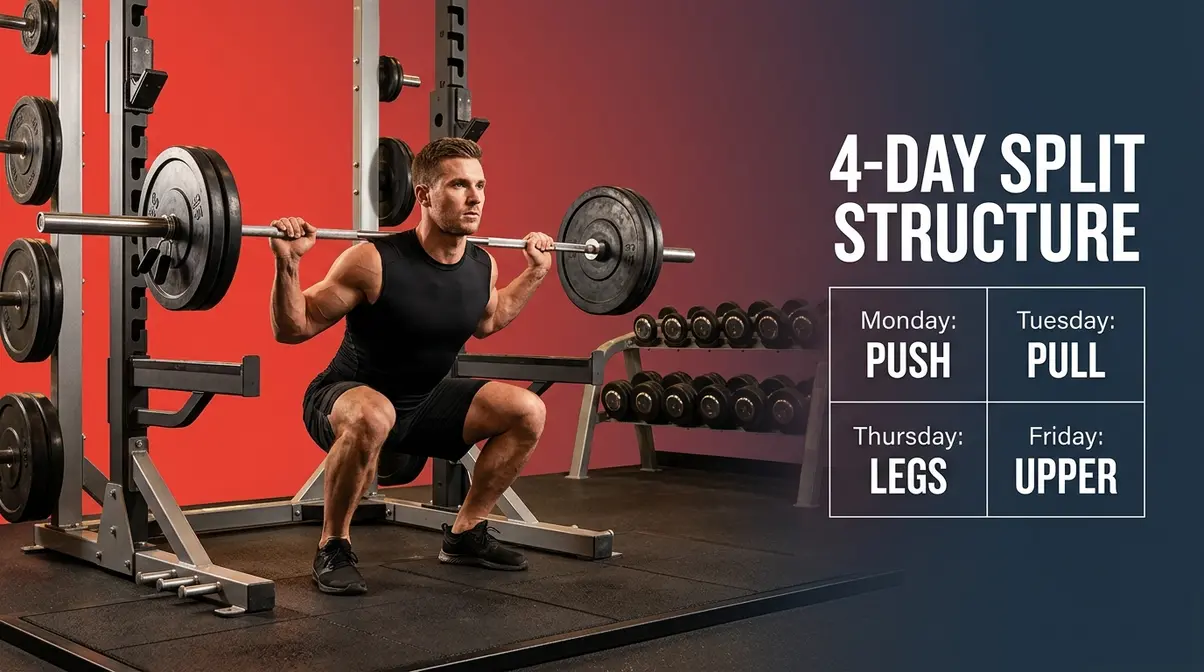
Weekly distribution across a 4-day split:
| Day | Session Focus | Primary Compound | Secondary Compound | Isolation Finishers |
|---|---|---|---|---|
| Monday | Push (chest/shoulders/triceps) | Bench press | Overhead press | Cable fly, lateral raise, tricep pushdown |
| Tuesday | Pull (back/biceps) | Barbell row | Lat pulldown | Face pull, incline curl, hammer curl |
| Thursday | Legs (quads/glutes/hams) | Back squat | Romanian deadlift | Leg extension, leg curl, calf raise |
| Friday | Upper accessory | Incline press | Dips | Rear delt fly, bicep curl, skull crusher |
This structure applies the 70/30 compound-to-isolation split that research and coaching consensus consistently support. Adjust the isolation percentage based on your goal using the framework from the previous section.
Transition: The session template above gives you the order — but the specific exercises you choose for each slot depend on which muscle group you’re training. That’s where the next section provides the concrete examples most guides skip.
Beginner vs. Intermediate Splits
The compound-first principle applies at every level, but the ratio and complexity of isolation work should match your training age. Beginners who jump straight into extensive isolation work often miss the foundational strength development that makes isolation exercises productive in the first place.
For beginners (0–6 months): Focus 85–90% of session volume on compound movements. The nervous system is still learning movement patterns — squats, presses, rows, and hinges provide the broadest stimulus for whole-body adaptation. Add 1–2 isolation exercises per session maximum, targeting the muscles most likely to lag (biceps, calves, rear delts). Total sets per session: 12–16. Keep it simple, focus on solid technique, and push hard on progressive overload.
For intermediate lifters (6–18 months): This is where the compound-to-isolation ratio begins to shift. You now have the movement competence to get genuine benefit from isolation work. Structure sessions at 65–75% compound and 25–35% isolation. Total sets per session: 16–24. This is also when you start noticing the regional gaps the Volume-Match Principle predicts — specific muscles that aren’t keeping pace with your overall development. Isolation exercises fill those gaps with precision.
For advanced lifters (18+ months): The ratio can shift further toward isolation depending on goal. Bodybuilders in a hypertrophy phase may work at 50/50. Powerlifters stay at 80–85% compound. The key variable is goal specificity — the more sport- or aesthetic-specific your training, the more deliberate your isolation selection needs to be. At this level, every isolation exercise should have a clear reason for being in the program.
“Get good at a few exercises you like. Beat your logbook. It might be kinda boring for a bit… until you start getting jacked.”
That quote captures something the science supports: consistency and progressive overload on a small number of well-chosen compound lifts drives most of your long-term muscle growth. The isolation work is the layer you add on top of that foundation — not a replacement for it.
Compound vs. Isolation Exercises by Muscle Group
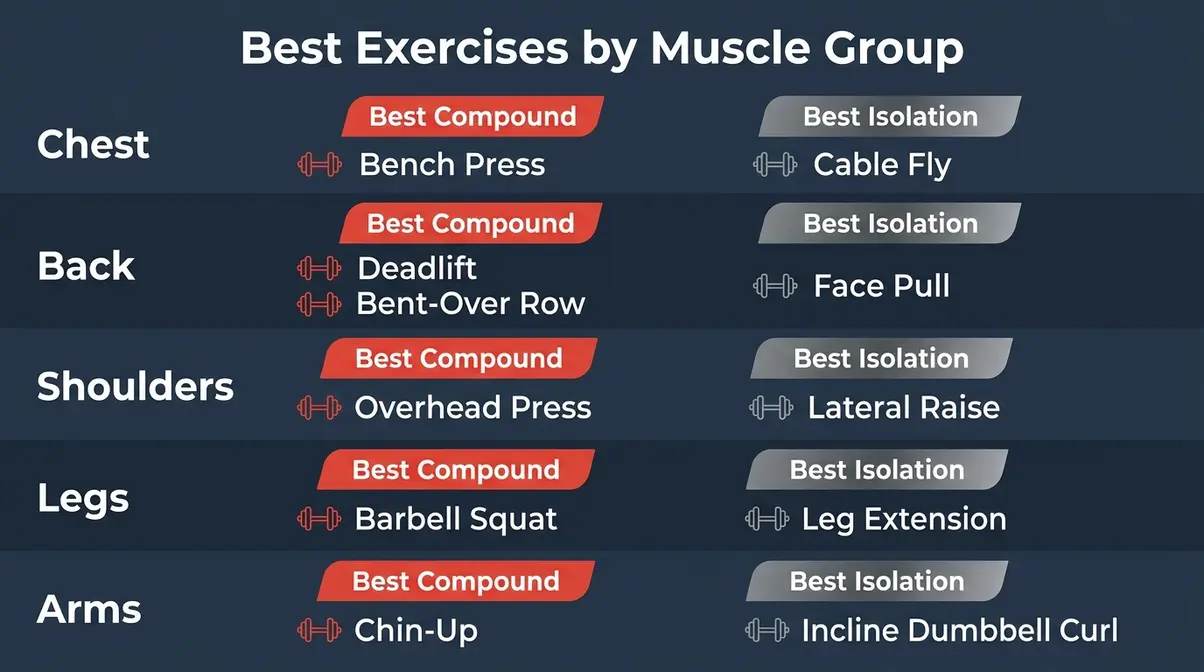
Mapping compound vs isolation exercises to specific body parts makes the abstract debate concrete when you map specific exercises to specific muscles. Here are the best compound and isolation options across five major muscle groups, with 15+ examples total — giving you the practical vocabulary to apply the frameworks above immediately.
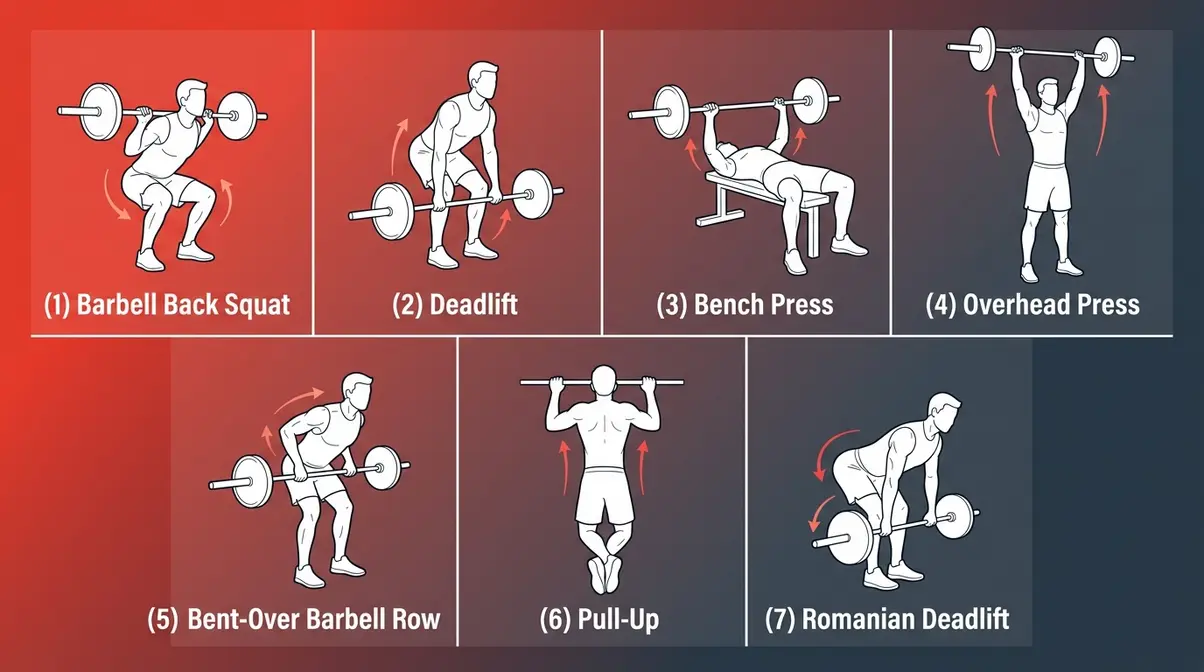
What Are the 7 Compound Exercises?
The seven foundational compound exercises most commonly referenced in strength and conditioning programming are: (1) barbell back squat, (2) deadlift, (3) bench press, (4) overhead press, (5) barbell bent-over row, (6) pull-up or chin-up, and (7) Romanian deadlift or hip thrust. These seven movements cover all major movement patterns — squat, hinge, horizontal push, vertical push, horizontal pull, and vertical pull — and collectively train virtually every major muscle group in the body. Mastering these seven movements with progressive overload is the foundation of any evidence-based strength or hypertrophy program.
Upper Body: Chest, Back, and Shoulders
Chest: The barbell bench press is the defining compound movement — primary movers are the pectoralis major, with significant secondary recruitment of the anterior deltoid and triceps. Incline bench press shifts emphasis to the upper chest; dips target the lower chest and triceps. These three compound movements cover the structural mass of the chest thoroughly. For regional isolation work, the cable fly and pec deck target the sternal fibers of the pectoralis major with peak contraction that no pressing movement replicates. The dumbbell fly adds a stretch stimulus at the bottom that builds the outer chest sweep.
Back: The deadlift is the king of posterior-chain compound movements — primary movers include the erector spinae, glutes, and hamstrings, with significant upper back and trap involvement. The barbell bent-over row is the primary horizontal pull, loading the lats, mid-back, rear delts, and biceps simultaneously. Pull-ups and chin-ups are the best vertical pull compounds; chin-ups (underhand grip) are widely cited as perhaps the best compound biceps exercise available (Muscle & Fitness, 2026). For isolation: face pulls target the rear deltoids and external rotators with specificity no row achieves. Straight-arm pulldowns isolate the lats at long muscle length.
Shoulders: The barbell overhead press is the foundational shoulder compound — primary movers are the anterior and lateral deltoids, with significant triceps involvement. Dumbbell overhead press increases range of motion and unilateral stability demand. For isolation: the lateral raise is the only exercise that effectively targets the lateral (middle) deltoid — no compound movement loads this region adequately. Rear delt flies and face pulls address the posterior deltoid, which is chronically under-developed in compound-dominant programs.
| Muscle Group | Best Compound | Best Isolation | What Isolation Adds |
|---|---|---|---|
| Chest | Bench press, dips | Cable fly, pec deck | Sternal fiber peak contraction |
| Back | Deadlift, bent-over row, pull-up | Face pull, straight-arm pulldown | Rear delt isolation; lat stretch |
| Shoulders | Overhead press | Lateral raise, rear delt fly | Lateral head; posterior delt cap |
Lower Body: Quads, Hams, Glutes
The barbell back squat is the foundational lower-body compound movement — primary movers are the quadriceps and glutes, with hamstrings, calves, and core contributing throughout the movement. Front squats shift emphasis toward the quads and upper back. Romanian deadlifts are the premier hamstring compound, loading the biceps femoris and semitendinosus through a hip hinge pattern. Hip thrusts are the best glute-dominant compound movement, producing peak glute activation that squats and deadlifts don’t match.
For lower-body isolation, the leg extension is the only exercise that loads the rectus femoris (the quad muscle that crosses the hip) in a shortened position — a stimulus the squat cannot replicate. Leg curls isolate the hamstrings in a way that Romanian deadlifts, which emphasize the stretched position, don’t cover. Standing calf raises and seated calf raises isolate the gastrocnemius and soleus respectively — muscles that receive minimal direct stress from any compound lower-body movement.
The lower-body isolation gap is the most significant in any compound-dominant program. Calves, in particular, are notoriously resistant to compound-only training. Virtually every experienced lifter who has neglected calf raises eventually adds them back. The same pattern applies to leg curls for hamstring balance — squats and deadlifts build the posterior chain, but the lying leg curl provides a unique stimulus at the shortened position.
| Muscle Group | Best Compound | Best Isolation | What Isolation Adds |
|---|---|---|---|
| Quads | Back squat, front squat, leg press | Leg extension | Rectus femoris shortened-position load |
| Hamstrings | Romanian deadlift, good morning | Lying leg curl | Shortened-position contraction |
| Glutes | Hip thrust, squat, deadlift | Glute kickback, abduction | Targeted peak contraction |
| Calves | — (minimal compound stimulus) | Standing/seated calf raise | Virtually all direct calf development |
Arms: Biceps and Triceps
The arms present an interesting case in the compound vs. isolation exercises debate. Both muscle groups are recruited heavily in upper-body compound movements — the biceps in all pulling exercises, the triceps in all pressing movements. For many intermediate lifters, compound training alone produces adequate arm development. The gap only becomes significant when chasing specific aesthetic outcomes.
Biceps: Chin-ups and all row variations provide substantial biceps stimulus as part of back training. However, the biceps long head — which creates the characteristic “peak” — requires the specific angle of a supinated curl for peak contraction. The incline dumbbell curl, performed with the upper arm behind the body, provides the greatest long-head stretch and is the most effective biceps isolation exercise for peak development. The concentration curl maximizes peak contraction at the top.
Triceps: The close-grip bench press and dips are the primary triceps compound movements, loading all three heads under heavy load. For isolation, the overhead tricep extension specifically targets the long head of the triceps — the largest of the three heads and the one most responsible for upper arm mass — in a stretched position that pressing movements never achieve. Tricep pushdowns isolate the lateral and medial heads with high volume at low systemic fatigue.
“Volume-matched compound and isolation exercises produce equivalent whole-muscle hypertrophy, with an effect size of just 0.07 — but isolation training generates 11.06% greater hypertrophy in target muscles compared to 5.16% for multi-joint movements.” (PubMed, 2019)
For arm development specifically, this statistic is the most practical finding in the literature. It tells you that adding dedicated curl and extension work to your compound training will produce meaningfully greater arm growth than compound work alone — even if whole-body volume is matched.
What the Science and Community Actually Say
The fitness community has been debating compound vs. isolation exercises for decades. Here’s what happens when you look at the actual evidence — and what the community consensus has converged on after years of real-world testing.
Research: Volume Is the Variable
Our analysis of six peer-reviewed studies shows a consistent pattern: when researchers control for training volume, the compound-vs-isolation distinction matters far less than most content suggests. The landmark meta-analysis finding — effect size 0.07 for whole-muscle hypertrophy — is supported across multiple individual trials.
Gentil et al. (2015) found no significant difference in muscle thickness between groups training with multi-joint only versus multi-joint plus single-joint exercises in untrained men, when volume was equated. Barbalho et al. (2018) confirmed in a larger study that adding single-joint exercises to a multi-joint program produced no additional benefit for untrained men in terms of muscle performance (PMC, 2018). Paoli et al. (2020) found that multi-joint and single-joint protocols produced similar strength increases in resistance-trained men (PMC, 2020).
The consistent finding across this body of research: for whole-muscle hypertrophy and general strength, the type of exercise matters less than the volume, intensity, and consistency of training. This is the evidence base for the Volume-Match Principle — and it’s one of the most practically liberating findings in exercise science. It means your preferred exercise selection, executed with solid technique and progressive overload, will produce results comparable to any other approach with matched volume.
However, the research also consistently identifies two contexts where exercise type does matter: regional hypertrophy (isolation wins, as established) and strength specificity (compound wins — exercises performed first in a session show greater strength gains, and compound exercises show superior improvements in VO₂max and maximal strength when volume is matched; PMC, 2017).
Fitness Community Insights
Research in controlled settings is valuable, but the gym floor generates its own form of evidence. User consensus across fitness communities — from Reddit’s r/fitness and r/bodybuilding to structured coaching programs — has converged on several practical insights that align with the research.
The most consistent community finding: beginners who try to skip compound movements and train primarily with isolation exercises plateau quickly. The structural strength developed through squats, deadlifts, and presses creates the foundation that makes isolation work productive. You can’t effectively overload a bicep curl if you can’t control your shoulder during a row.
Conversely, the community has learned that advanced lifters who neglect isolation work hit aesthetic plateaus that more compound volume cannot resolve. This is the “finishing touches” problem — a physique built entirely on compound movements looks powerful but often lacks the regional detail that comes from targeted direct work. The calves, rear delts, and biceps long head are the most commonly cited examples.
The community also validates the exercise-order principle. Lifters who have experimented with isolation-first approaches consistently report that their compound performance suffers — heavier compound lifts done under pre-exhaustion from isolation work produce fewer total reps and less progressive overload. The ACSM’s compound-first recommendation is not just theoretical; it reflects what experienced lifters discover through trial and error.
Practical Evidence Synthesis
Combining the research findings with community experience produces a clear, actionable framework. Neither compound nor isolation exercises are superior in isolation — the question is always how they’re combined.
For the intermediate lifter who wants a simple, evidence-based rule: start every session with 2–3 compound movements that form the progressive overload backbone of your program. Add 2–3 isolation exercises after, targeting the muscles your compounds under-load. Beat your logbook on the compound lifts. Use the isolation work to address regional gaps and maintain proportional development. Review your split every 8–12 weeks against your specific goals.
This approach is supported by the research (volume-matched equivalence + regional isolation advantage), validated by community experience (compound foundation + isolation finishing work), and practical enough to apply in any gym with any equipment. The Volume-Match Principle tells you that the split doesn’t need to be perfect — it needs to be consistent, progressive, and aligned with your goal.
Quotable synthesis: “For intermediate lifters, the most evidence-aligned approach is compound-dominant programming — 65–80% of volume from multi-joint exercises — with isolation work added strategically to address regional hypertrophy gaps that compound lifts structurally cannot fill.” (Our analysis of six peer-reviewed studies, 2026)
Limitations and Common Pitfalls
Common Pitfalls
1. Treating the compound-vs-isolation debate as binary. The most common mistake is framing this as an either/or choice. Both types serve distinct functions — eliminating either creates predictable gaps. Compound-only programs leave regional muscles under-developed. Isolation-only programs miss the structural strength and efficiency that compound lifts provide. The pitfall is reading one article, deciding compounds are superior, and never doing a curl again.
2. Ignoring the Volume-Match Principle and adding isolation on top of a full compound program. If you’re already doing 20 sets of compound work per week and you add 10 sets of isolation on top — without reducing compound volume — you’re increasing total weekly volume, not just changing exercise type. The resulting fatigue accumulation is the issue, not the isolation work itself. The fix: substitute some compound sets for isolation sets rather than simply adding more.
3. Skipping compound movements for injury-avoidance reasons without professional guidance. Some lifters avoid squats, deadlifts, or overhead pressing due to discomfort — and replace them entirely with machine-based isolation work. This can be appropriate during rehabilitation, but it should be guided by a certified personal trainer or physical therapist, not self-diagnosed. Avoidance of compound movements without addressing the underlying movement dysfunction often leads to long-term performance limitations.
4. Using the wrong isolation exercise for the regional gap you’re trying to fill. Not all isolation exercises target the specific region you think they do. A standard barbell curl does not maximally target the biceps long head — that requires the arm to be positioned behind the body (incline curl). A lateral raise performed with internal shoulder rotation does not effectively target the lateral deltoid. Specificity matters.
5. Neglecting progressive overload on isolation exercises. Isolation exercises are not immune to the need for progressive overload. A lifter who has been doing 3 sets of 10 with the same weight on leg extensions for six months is not applying the fundamental stimulus for hypertrophy. Beat your logbook on isolation work the same way you do on compound lifts.
Alternatives & Expert Help
When compound-dominant programming may not be the right choice:
- During active injury rehabilitation: If you have a shoulder impingement, lower back injury, or knee issue, standard compound loading may aggravate the condition. Work with a physical therapist or certified trainer to identify movement-pattern alternatives before returning to full compound loading.
- For highly advanced bodybuilders in a competition prep phase: At this stage, the goal is regional refinement, not overall mass. The isolation percentage may legitimately exceed 50% of session volume — a ratio that is entirely inappropriate for general fitness goals.
- For older adults with joint limitations: Machine-based isolation exercises often provide a safer entry point than free-weight compound movements for individuals with osteoarthritis or joint replacement. This is a YMYL scenario — consult a physician before modifying your program.
When to seek professional guidance: If you have a pre-existing injury, are returning to training after a significant break, are over 60 years old, or have a chronic health condition, consult a certified personal trainer (CPT), certified strength and conditioning specialist (CSCS), or your physician before implementing the programming recommendations in this guide. The frameworks here are designed for generally healthy intermediate lifters — individual variation is significant, and professional assessment is always the safest starting point.
Frequently Asked Questions
Should I Do More Compound or Isolation Exercises?
For most intermediate lifters, compound exercises should make up 65–80% of your weekly training volume. The Volume-Match Principle establishes that both types build equivalent whole-muscle mass when sets are equated — so the question is efficiency and regional targeting, not superiority. Compounds train more muscles per set, burn more calories, and build structural strength faster. Isolation exercises fill the regional gaps compounds can’t reach. A practical starting point: 2–3 compound lifts followed by 2–3 isolation exercises per session, adjusting the ratio based on your primary goal (see the Goal Decision Framework above).
What Is the King of Compound Exercises?
The barbell back squat is most widely regarded as the king of compound exercises, primarily for its unmatched lower-body stimulus and systemic training effect. The squat loads the quadriceps, glutes, hamstrings, calves, spinal erectors, and core simultaneously — no other single exercise trains this many major muscle groups under this level of mechanical load. However, the deadlift is a strong challenger: it trains the entire posterior chain plus upper back and grip, and many coaches argue it produces greater overall muscle mass stimulus per set. The “king” designation is largely goal-dependent — squats for quad and athletic development, deadlifts for posterior chain and total-body strength.
What Is the 3-3-3 Rule in the Gym?
The 3-3-3 gym rule is a popular weekly training framework with two common interpretations. The most widely cited version defines it as a weekly split: 3 days of strength training, 3 days of cardio, and 3 days of rest or active recovery — providing structure for balanced fitness without overtraining (EVO Fitness, 2026). A second interpretation defines it as a minimalist session structure: 3 workouts per week, 3 key exercises per session, 3 sets per exercise (Snap Fitness, 2026). Both versions are designed for consistency and simplicity rather than maximum specialization. For intermediate lifters with specific hypertrophy or performance goals, the 3-3-3 framework works best as a starting template, expanded with additional volume as training age increases.
What Are the Big 3 Compound Exercises?
The Big 3 are the squat, bench press, and deadlift — the three lifts contested in powerlifting competition and widely recognized as the most effective compound movements for overall strength development. The squat targets the lower body (quads, glutes, hamstrings); the bench press targets the upper body pushing muscles (chest, anterior deltoids, triceps); the deadlift targets the posterior chain (hamstrings, glutes, erectors) and upper back. Together, they cover the body’s primary movement patterns and provide the structural strength foundation that makes all other training more productive. Many evidence-based programs — from Starting Strength to 5/3/1 — are built almost entirely around these three lifts.
Conclusion
For intermediate gym-goers, compound vs isolation exercises is not a choice between two competing methods — it’s a question of proportions. A systematic review and meta-analysis pooling seven randomized trials confirmed that when training volume is matched, both approaches produce equivalent whole-muscle hypertrophy (effect size 0.07). But isolation training generates 11.06% greater hypertrophy in target muscles compared to 5.16% for multi-joint movements (PubMed, 2019). The optimal program uses both, in ratios determined by your goal: 80% compound for fat loss, 60–70% compound for hypertrophy, 50–60% compound for bodybuilding aesthetics.
The Volume-Match Principle is the framework that makes this actionable. It tells you that the compound-vs-isolation debate is not about which type is superior — it’s about where you want the growth. Compounds build the structural mass and systemic strength that form the foundation of any physique. Isolation work fills the regional gaps that compound lifts structurally cannot reach: the biceps peak, the rear delt cap, the outer quad sweep, the calves. Both are required for complete development; the ratio is what changes by goal.
Your next step is straightforward. Take your current training split and audit it against the Goal Decision Framework in this guide. Identify the ratio you’re currently running — count your compound sets versus isolation sets in a typical week. If your ratio doesn’t match your goal, adjust it in your next training block. Start every session with your heaviest compound lift, push hard on progressive overload, and add isolation finishers for the muscle groups your compounds under-load. Beat your logbook on both. That’s the complete framework, ready to apply at your next session. Bodymusclematters.com recommends running any new ratio for at least 8 weeks before evaluating results — muscle adaptation takes time, and consistency is the variable that matters most.
Related posts:
Best Collagen Protein Powder: 9 Expert Picks (2026)
How Fast to Lose Fat: Safe Rate, Timeline & Science
Testosterone Muscle Growth Science: Complete Guide
Best Creatine Supplement: Tested & Compared for Every Goal
Best Creatine Supplement: Tested & Compared for Every Goal
Delayed Onset Muscle Soreness (DOMS): Complete Guide

Callum
Hi, I'm Callum, the founder of Body Muscle Matters. I'm not a certified trainer, I'm a self taught lifter who started this site to share what I've learned from my own training and a lot of trial and error. Everything here comes from real experience and honest research, written the way I'd explain it to a friend who is just getting started. My goal is simple: practical, no hype fitness advice you can actually use.