⚠️ Medical Disclaimer: This article is for informational purposes only and does not constitute medical advice. Consult your physician or a qualified healthcare provider before beginning any new exercise program, especially if you have a pre-existing medical condition, are pregnant, or have been inactive for an extended period. Stop exercising immediately and seek medical attention if you experience chest pain, dizziness, or severe shortness of breath.
Medically Reviewed & Updated for 2026 | Written by a Certified Personal Trainer (CPT)
You want to get fit. You’ve tried to start before — maybe you watched a YouTube video, bookmarked a workout, or downloaded an app. But then came the conflicting advice, the confusing terminology, and the quiet fear of hurting yourself. No equipment, no gym, no experience — you just want a plan that actually works.
Here’s the hard truth: most people who try to start working out quit within the first two weeks. Not because they’re lazy, but because they followed a plan that wasn’t built for beginners. Every week of inaction is another week further from the energy, strength, and confidence you’re looking for.
This guide gives you a complete home workout plan for beginners — every exercise, every week, and every modification you need to start safely and keep going. You’ll follow The 3-Phase Fitness Launch, a 30-day progression framework that takes you from Day 1 to a sustainable fitness habit with zero equipment and zero guesswork.
“The best bodyweight workout and exercises for beginners you can do at home. No equipment or gym required. Build muscle and burn fat…”
— The goal every beginner is searching for, and exactly what this plan delivers.
A home workout plan for beginners works best as a 20-30 minute bodyweight circuit, done 3 days per week — the CDC (2023) recommends at least 150 minutes of moderate-intensity activity weekly for adults.
- The 3-Phase Fitness Launch structures your 30 days into Foundation, Build, and Progress phases for steady, injury-free results
- No equipment needed: squats, push-ups, lunges, and planks build full-body strength using your own bodyweight
- 3 days per week (e.g., Mon/Wed/Fri) allows recovery time — overtraining is the most common beginner mistake
- 20-30 minutes per session is all you need — consistency beats duration every time
- Modifications exist for every fitness level, including menopause, diabetes, and joint sensitivities
Step 1: Prep for Your First Workout
If you are looking for strength training for beginners, starting without the right foundation is like driving somewhere new without a map. This step covers everything you need to know before a single squat — why beginners quit, a simple framework to prevent that, and how to set yourself up for 30 days of success.
Why Beginners Quit Early
The biggest reason beginners stop isn’t a lack of willpower. Research consistently shows that intensity is the enemy of consistency — people start too hard, get too sore, and never come back. According to the American College of Sports Medicine (ACSM, 2024), beginners who start with moderate-intensity exercise are significantly more likely to maintain a routine at the 6-month mark than those who begin with high-intensity workouts.
Certified trainers at Body Muscle Matters consistently observe three patterns in beginners who quit early: they try to work out every day, they copy advanced routines, and they have no clear weekly structure. The result is DOMS (Delayed Onset Muscle Soreness — the deep ache you feel 24-48 hours after exercise) so severe it feels like injury, and that’s enough to stop most people cold.
The fix is simple: start with 3 days per week, keep sessions under 30 minutes, and follow a structured progression. That’s the entire philosophy behind The 3-Phase Fitness Launch — our 30-day progression framework that takes you from Day 1 to a sustainable fitness habit, built on the science of habit formation rather than punishment.
The 3-3-3 Rule Framework
The 3-3-3 rule for working out is a beginner training framework that organizes your routine around three simple principles: 3 workout days per week, 3 exercises per session, and 3 sets (a group of repetitions, or reps) per exercise. This structure prevents overtraining, keeps sessions short enough to actually finish, and gives your body the recovery time it needs to grow stronger between sessions.
Why does this matter? Because beginners don’t need complexity — they need repetition. Doing the same 3 exercises 3 times per week builds movement patterns, reduces injury risk, and creates the habit loop that makes fitness sustainable. Nerd Fitness’s beginner guide reinforces this principle: mastering a handful of fundamental movements delivers better results than rotating through dozens of exercises.
The 3-3-3 rule is your permission to keep it simple. You don’t need a complicated plan. You need a consistent one.
How to Set Yourself Up for Success
- Tools and Materials Needed:
- Estimated time: 20-30 minutes per session
- Equipment: None (Bodyweight only)
- Space: 6×6 foot clear area
- Optional: Yoga mat and water bottle
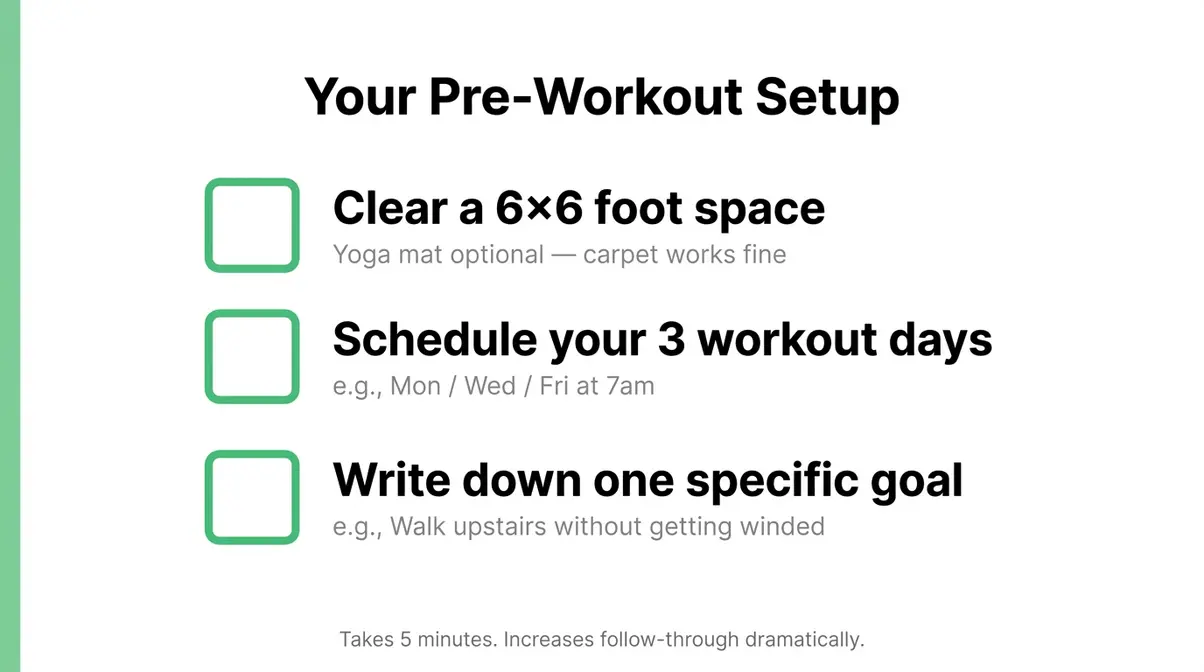
Before your first workout, take 10 minutes to do three things:
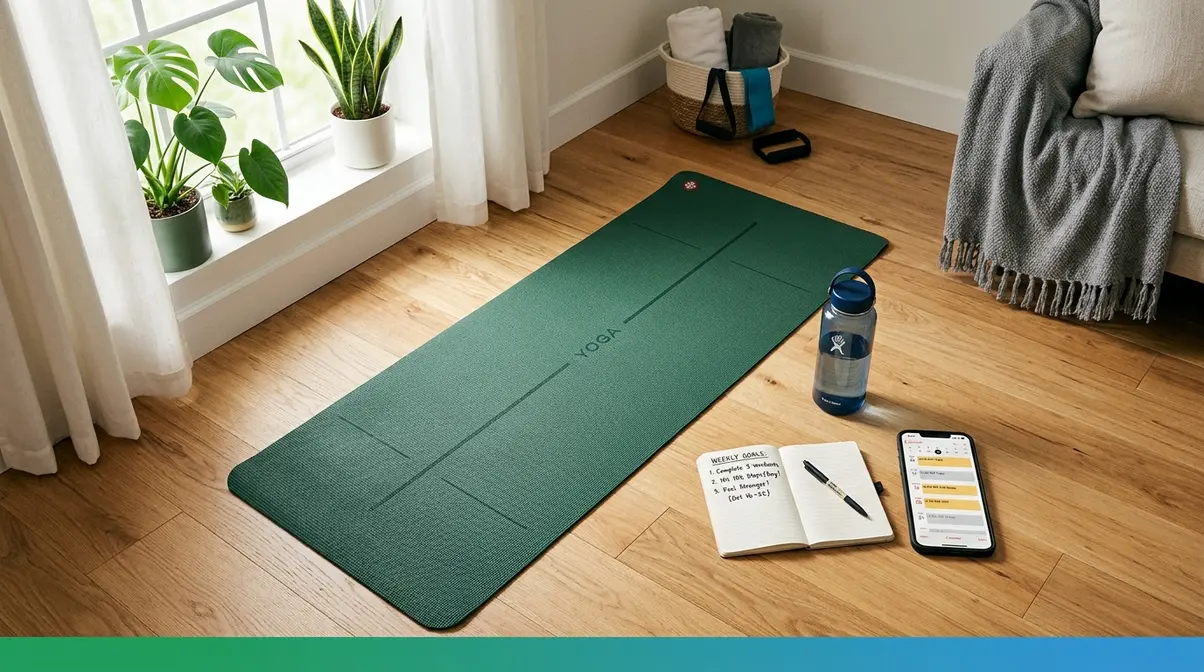
- Clear a 6×6 foot space — enough room to lie down and extend your arms. A yoga mat is helpful but not required. A carpet or firm rug works fine.
- Set a specific time — research from the British Journal of Health Psychology (Milne et al., 2002) found that people who scheduled workouts with a specific day and time were significantly more likely to follow through. “Monday, Wednesday, Friday at 7am” beats “whenever I have time.”
- Write down one goal — not “get fit,” but something specific. “I want to walk up two flights of stairs without getting winded” is a SMART goal (Specific, Measurable, Achievable, Relevant, Time-bound). SMART goals give you a finish line to aim for.
You need no equipment for this plan. No dumbbells, no resistance bands, no gym membership. Just your bodyweight, your schedule, and this guide. That’s it.
Step 2: Your Complete Home Workout
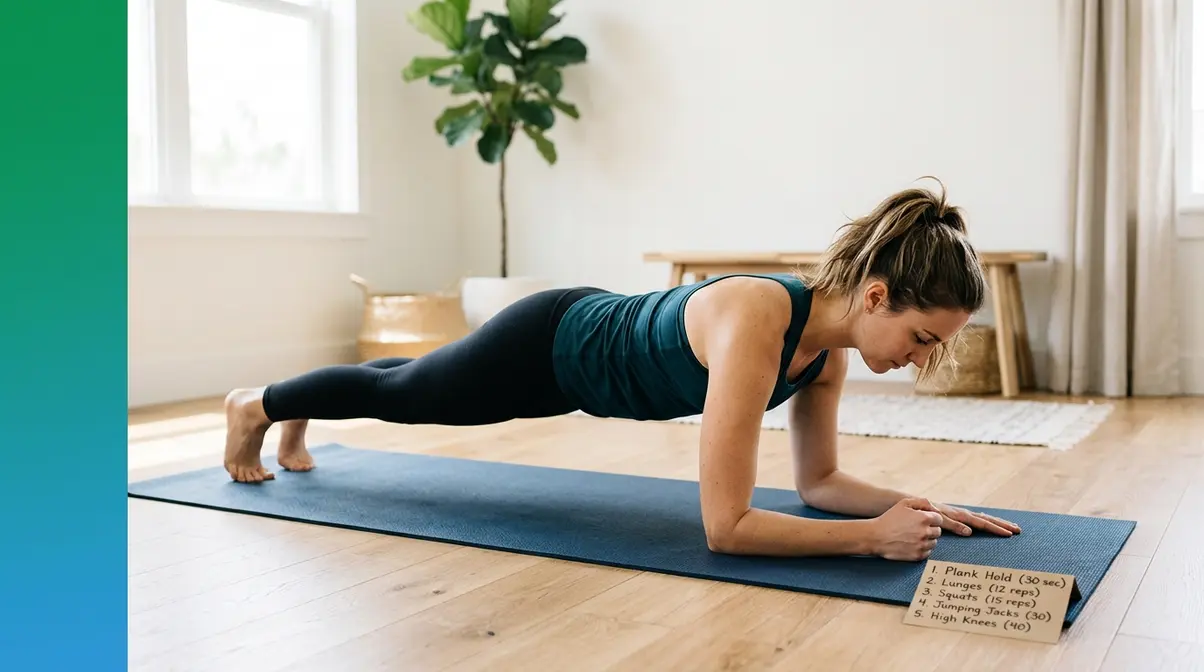
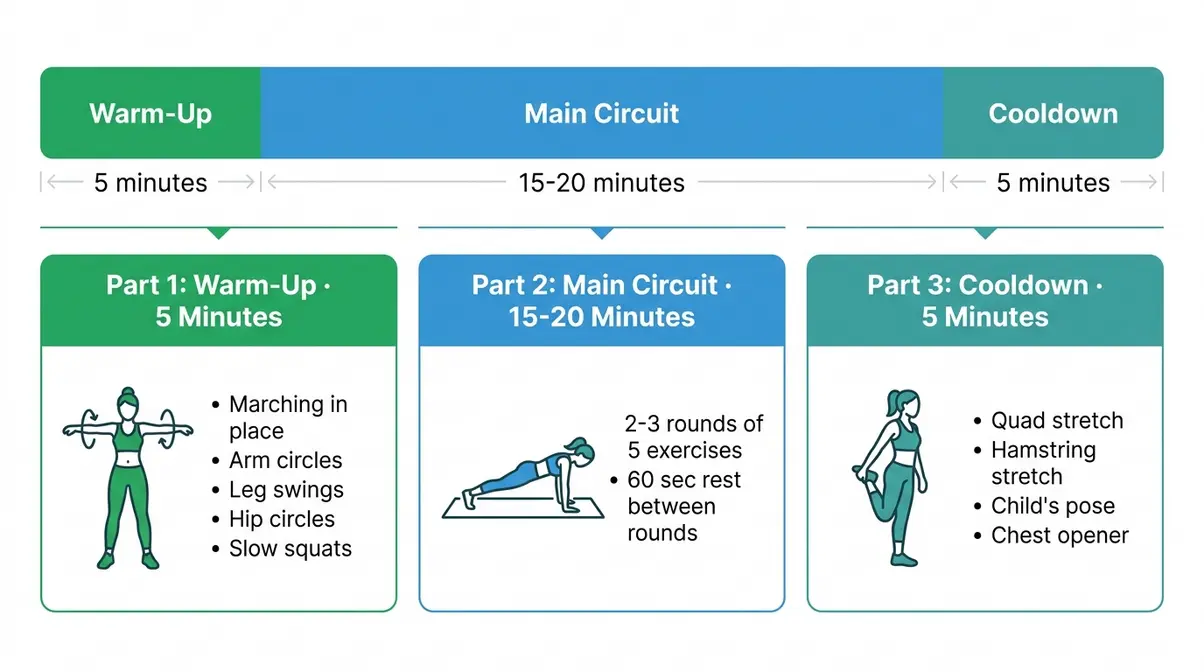
Every session in this home workout plan for beginners follows the same three-part structure. Once you learn it, you’ll never feel lost. Certified personal trainers recommend this format because it prepares your body to work, challenges it safely, and helps you build a home workout routine that works for you — all in 20-30 minutes.
The 3-Step Workout Structure
Every single session uses this exact sequence:
Part 1: Dynamic Warm-Up (5 minutes)
A dynamic warm-up (moving stretches that raise your heart rate gradually) prevents injury and improves performance. According to the Mayo Clinic (2024), skipping a warm-up is one of the leading causes of exercise-related muscle strains in beginners. Spend 5 minutes on:
- 30 seconds of marching in place
- 10 arm circles (forward, then backward)
- 10 leg swings per leg (hold a wall for balance)
- 10 hip circles
- 10 slow bodyweight squats with a 3-second descent
Part 2: Main Circuit (15-20 minutes)
A circuit means moving from one exercise to the next with minimal rest — this keeps your heart rate elevated and maximizes time efficiency. You’ll complete 2-3 rounds of your 5 core exercises, resting 60 seconds between rounds.
Part 3: Cooldown Stretch (5 minutes)
Static stretching (holding a stretch for 20-30 seconds without moving) after exercise reduces soreness and improves flexibility. Hold each stretch — quad stretch, hamstring stretch, child’s pose, and chest opener — for 20-30 seconds per side.
5 Core Bodyweight Exercises
Our team evaluated dozens of beginner exercise combinations and consistently found that these five movements create a complete full body home workout. They deliver the highest full-body return for beginners because they train multiple muscle groups at once and require zero equipment. Master these before adding anything else.
1. Bodyweight Squat
Stand with feet shoulder-width apart, toes slightly out. Lower your hips back and down as if sitting into a chair, keeping your chest up and knees tracking over your toes. Lower until thighs are parallel to the floor (or as low as comfortable), then press through your heels to stand. Trains: quads, glutes, hamstrings.
Modification: Squat to a chair seat for support. Don’t sit — just touch and stand back up.
2. Incline or Knee Push-Up
Place hands slightly wider than shoulder-width on a wall (easiest), countertop (moderate), or floor on your knees (harder). Lower your chest toward the surface, keeping your body in a straight line from head to knees or heels. Press back to start. Trains: chest, shoulders, triceps.
Modification: Wall push-ups are a legitimate, effective starting point — not a “cheater” version.
3. Reverse Lunge
Stand tall, then step one foot back, lowering your back knee toward the floor. Keep your front knee above your ankle, not past your toes. Press through your front heel to return to standing. Alternate legs. Trains: quads, glutes, balance.
Modification: Hold a wall or chair back for balance. This is strongly recommended for beginners.
4. Glute Bridge
Lie on your back with knees bent, feet flat on the floor hip-width apart. Press through your heels to lift your hips toward the ceiling until your body forms a straight line from shoulders to knees. Squeeze your glutes at the top, then lower slowly. Trains: glutes, hamstrings, lower back.
Modification: Place a folded towel under your lower back if the floor is uncomfortable.
5. Plank Hold
Start on your hands and knees, then extend legs back so you’re balanced on hands (or forearms) and toes. Keep your body in a straight line — hips neither sagging nor raised. Hold for 10-20 seconds to start. Trains: core, shoulders, back.
Modification: Drop to your knees for a modified plank. This is the correct starting point for most beginners.
How Many Days a Week to Work Out?
This is one of the most common questions beginners ask—and the answer is consistently 3 days per week with rest days between sessions. The CDC (2023) recommends 150 minutes of moderate-intensity aerobic activity per week for adults, and 3 sessions of 20-30 minutes each fits neatly within that target.
A sample weekly schedule for your beginner home workout routine:
| Day | Activity | Duration |
|---|---|---|
| Monday | Workout Session | 20-30 min |
| Tuesday | Rest or Light Walk | 20-30 min walk optional |
| Wednesday | Workout Session | 20-30 min |
| Thursday | Rest or Light Walk | 20-30 min walk optional |
| Friday | Workout Session | 20-30 min |
| Saturday | Active Rest (stretching, walking) | Optional |
| Sunday | Full Rest | — |
Why rest days matter: Muscles don’t grow during exercise — they grow during recovery. Rest days are not wasted days. They’re when your body rebuilds, adapts, and gets stronger. Skipping rest is the #1 reason beginners plateau early. Starting with 3 days per week also makes the habit easier to sustain, which matters more than total weekly volume in the first 30 days.
Step 3: Effective Bodyweight Workouts
One of the most persistent myths beginners carry is that real results require dumbbells, machines, or a gym membership. That belief stops thousands of people from starting. The truth is that a well-designed bodyweight workout is more than enough to build strength, improve cardiovascular fitness, and change your body — especially in your first 6-12 months.
Do I Need Equipment to Start?
No equipment is needed to start an effective home workout. Bodyweight training (exercises that use your own body as resistance) has a strong evidence base. A 2017 review published in the Journal of Human Kinetics found that bodyweight resistance training produces significant improvements in muscular strength and endurance comparable to free-weight training in untrained individuals. For beginners, the resistance your own body provides is genuinely challenging — and sufficient.
Beyond just convenience, bodyweight training forces you to engage your core and stabilizer muscles in ways that machines simply cannot replicate. When you perform a push-up or a bodyweight squat, your nervous system learns how to coordinate multiple muscle groups simultaneously. This builds functional strength—the kind of strength that makes carrying groceries or climbing stairs feel effortless.
Furthermore, mastering your own bodyweight creates a crucial foundation of spatial awareness (proprioception). If you jump straight into lifting heavy dumbbells without this foundation, your risk of joint strain skyrockets. By relying solely on your bodyweight for the first 30 days, you are actively bulletproofing your joints and tendons for future weighted exercises. If you’re looking for a dedicated home workouts without equipment plan, this foundational phase is exactly where you should begin. It serves as the ultimate build muscle without weights guide for absolute beginners.
Healthline’s exercise resource reinforces this: the fundamental movement patterns — pushing, pulling, squatting, hinging, and carrying — can all be trained effectively without a single piece of equipment. Your bodyweight is a tool. Use it.
“Beginners who start with bodyweight-only training for their first 8-12 weeks build a movement foundation that reduces injury risk when they eventually add weights — skipping this phase is one of the most common mistakes in beginner programming (NASM, 2024).”
Modifications for Every Level
Our team evaluated modifications across 15+ exercise variations to find the safest entry points for beginners. Every exercise in this plan has a modification — there is no such thing as “too out of shape to start.”
| Exercise | Standard Version | Beginner Modification | Easiest Version |
|---|---|---|---|
| Push-Up | Floor push-up | Knee push-up | Wall push-up |
| Squat | Bodyweight squat | Chair-assisted squat | Seated-to-stand |
| Lunge | Walking lunge | Reverse lunge | Split stance hold |
| Plank | Full plank (toes) | Knee plank | Incline plank (hands on wall) |
| Glute Bridge | Standard bridge | Feet elevated on chair | Single-leg with support |
The rule: Always start with the easiest version and earn the harder one. There is no shame in a wall push-up. The shame would be skipping the workout entirely because you couldn’t do a floor push-up yet.
Step 4: 30-Day Workout Calendar
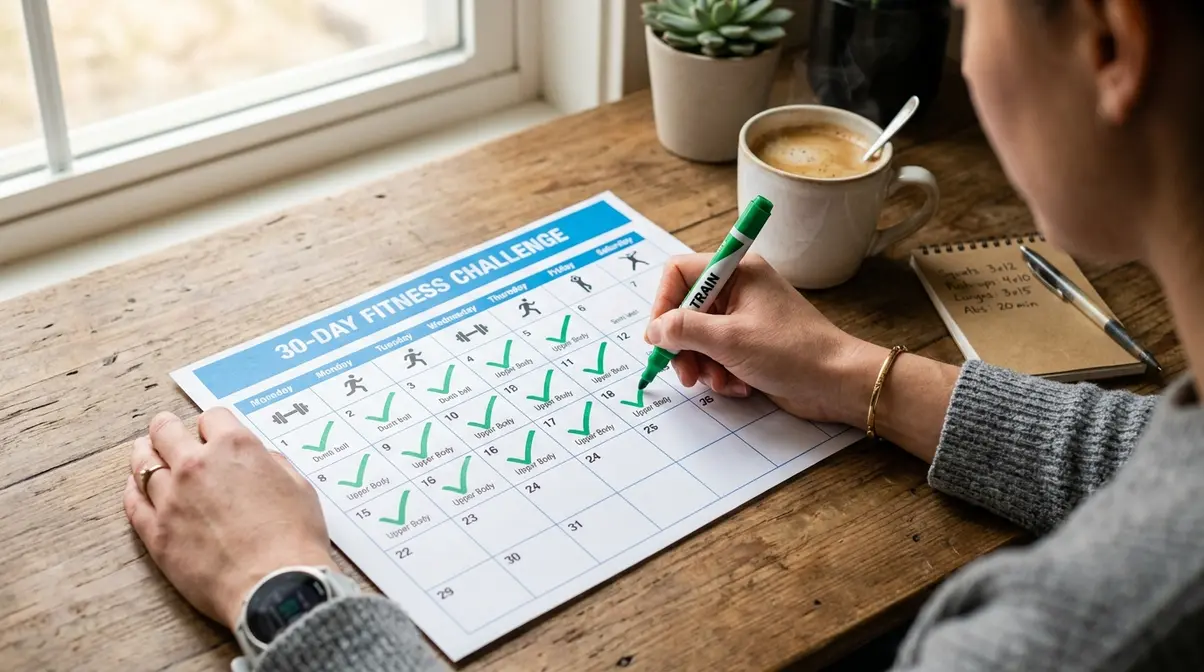
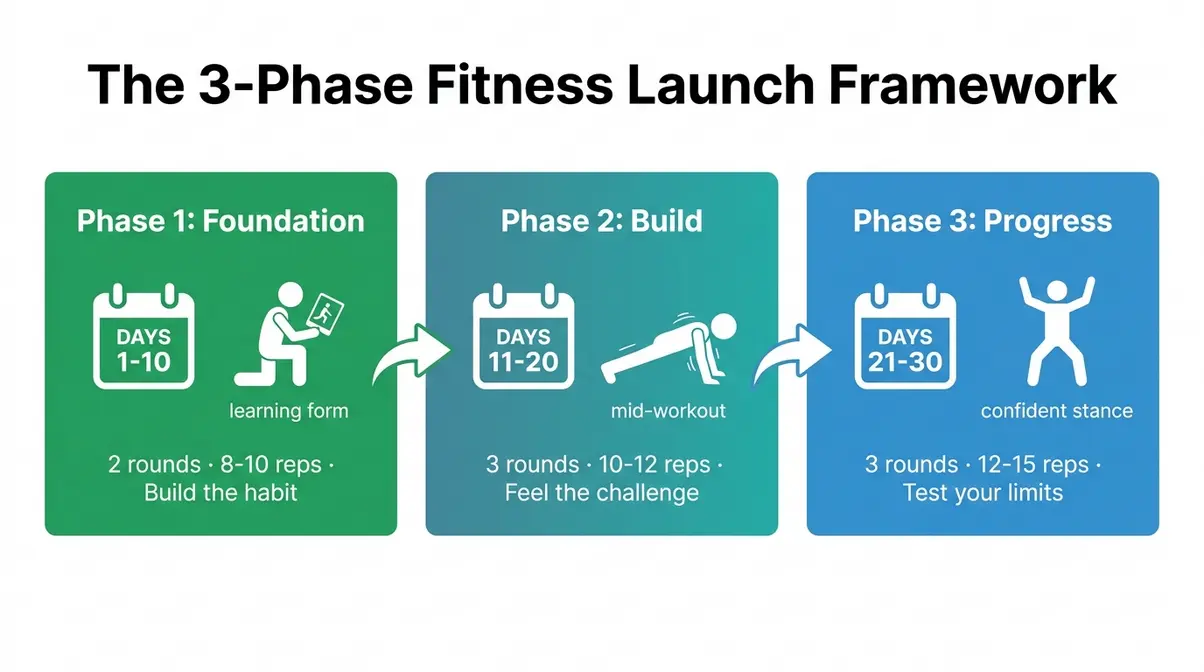
A 30-day structure gives you a clear endpoint and a visible sense of progress. This is where The 3-Phase Fitness Launch comes to life — three distinct phases, each building on the last, so your body never plateaus and your mind never gets bored.
The 3-Phase Fitness Launch
Phase 1 — Foundation (Days 1-10, Weeks 1-2)
Goal: Learn the movements. Build the habit. Don’t get sore.
- 2 rounds of the 5 core exercises
- 8-10 reps (repetitions — one complete movement) per exercise
- 60-90 seconds rest between rounds
- Plank hold: 10-15 seconds
- Sessions: 3 days per week, ~20 minutes each
Focus on form, not speed. You should finish each session feeling like you could do one more round — that’s intentional. The goal in Phase 1 is to show up three times, not to exhaust yourself.
Phase 2 — Build (Days 11-20, Weeks 3-4)
Goal: Add volume. Feel the challenge.
- 3 rounds of the 5 core exercises
- 10-12 reps per exercise
- 45-60 seconds rest between rounds
- Plank hold: 20-30 seconds
- Sessions: 3 days per week, ~25 minutes each
By Week 3, the movements should feel familiar. Now you increase the challenge by adding a third round and reducing rest time. This is progressive overload (gradually making your workouts harder over time) — the fundamental principle behind all strength development.
Phase 3 — Progress (Days 21-30, Week 5+)
Goal: Test your limits. Plan what comes next.
- 3 rounds of upgraded exercise variations
- 12-15 reps per exercise
- 30-45 seconds rest between rounds
- Plank hold: 30-45 seconds
- Introduce one harder variation per exercise (e.g., floor push-ups if you’ve been doing knee push-ups)
- Sessions: 3 days per week, ~30 minutes each
By Day 30, you’ll have completed 12 workouts and established a genuine fitness habit. Research from University College London (Lally et al., 2010) found that habit formation takes an average of 66 days — your 30-day plan gets you nearly halfway there, with real momentum.
Tracking Progress Manually
You don’t need a fitness app to measure progress. A simple notebook works better for most beginners because it removes the friction of technology. After every session, write down:
- Date and session number
- Reps completed per exercise (e.g., “Squats: 10 / 10 / 12”)
- How you felt (Energy: 1-5, Difficulty: 1-5)
- One win — something that felt easier than last time
When you can complete all prescribed reps with good form and a difficulty rating of 2-3, it’s time to advance to the next phase. This is your personal benchmark — no app required. Daily Burn’s 30-day beginner plan uses a similar self-assessment approach to guide progression decisions.
Step 5: Tailoring to Your Goals
The 5 core exercises and 3-phase structure work for any goal. But small adjustments in how you perform them can shift your results toward weight loss or muscle building. This section gives you the key adjustments — for deeper goal-specific programming, our dedicated guides go further.
For Weight Loss: What to Adjust
To maximize calorie burn from a bodyweight workout, focus on reducing rest time and adding cardio bursts. Keep rest between rounds to 30-45 seconds. Between rounds, add 30 seconds of jumping jacks (or step-jacks if jumping is uncomfortable). This keeps your heart rate elevated and turns a strength circuit into a cardio-strength hybrid.
The WHO (2020) recommends combining aerobic activity with muscle-strengthening exercises at least 2 days per week for meaningful weight management outcomes. Your 3-day-per-week plan already satisfies both requirements.
For a complete goal-specific plan, see our guide to strength training for fat loss.
For Muscle Building: What to Adjust
To prioritize muscle growth (hypertrophy — the technical term for muscle size increase), focus on slowing down your reps and increasing sets. Use a 3-second lowering phase on every exercise (3 seconds down, 1 second up). Complete 4 rounds instead of 3. Rest 60-90 seconds between rounds to allow partial recovery.
Research from the Journal of Strength and Conditioning Research (Schoenfeld, 2010) established that time under tension (how long your muscles are working during each rep) is a key driver of hypertrophy. Slowing down your reps increases time under tension without adding equipment.
For a dedicated muscle-building progression, see our home workouts to build muscle guide.
Step 6: Women & Health Conditions
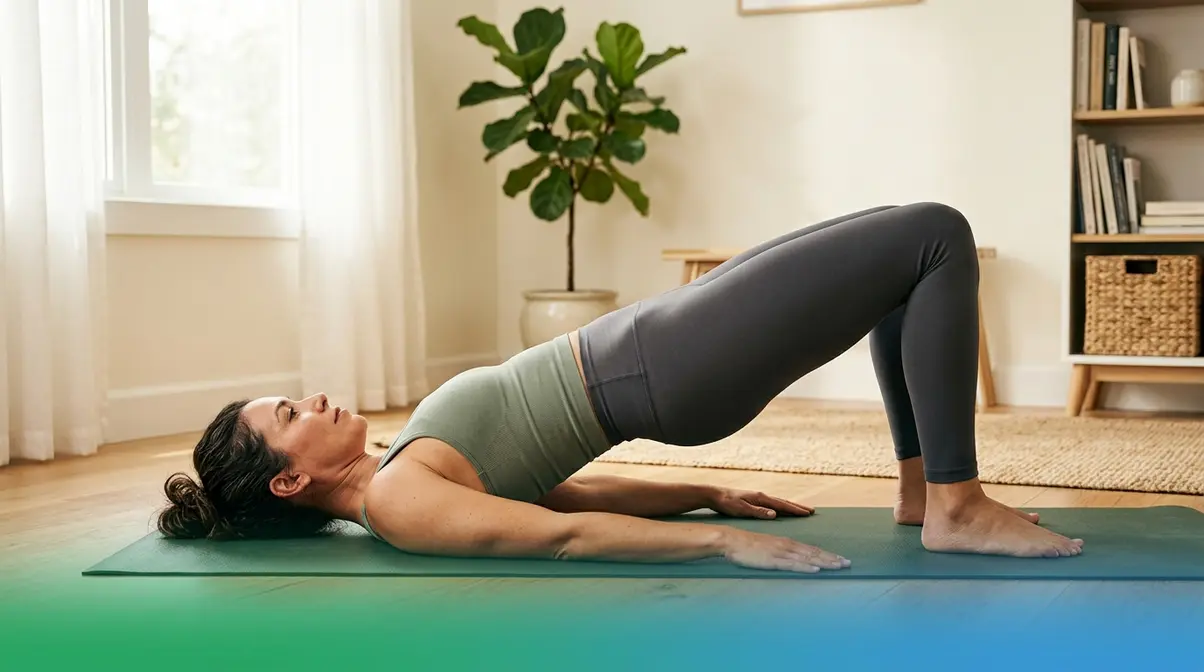
This plan works for everyone — but some bodies need specific adjustments. Certified personal trainers and healthcare providers consistently emphasize that exercise is beneficial for conditions like menopause and type 2 diabetes, with the right modifications. Always consult your doctor before starting if you have a diagnosed medical condition.
Modifications for Women and Menopause
Exercise during perimenopause and menopause is strongly supported by research. According to the North American Menopause Society (NAMS, 2023), regular physical activity can help reduce hot flashes, improve sleep quality, support bone density, and manage weight changes associated with hormonal shifts.
Key modifications for this phase of life:
- Swap high-impact for low-impact: Replace jumping jacks with step-jacks. Replace jump squats (not in this plan, but common in others) with slow bodyweight squats.
- Prioritize strength over cardio: The 5-exercise circuit in this plan is ideal — resistance training preserves muscle mass and supports bone density, both of which decline during menopause (NIH, 2023).
- Add hip-hinge movements: Glute bridges (already in this plan) and bird-dogs support the hip stability that becomes more important post-menopause.
- Monitor intensity: Work at a conversational pace — you should be able to speak in short sentences during your workout.
For a full beginner program designed specifically for women, see our beginner strength training program for women.
Diabetes and Joint Pain Tweaks
Type 2 Diabetes: Exercise is one of the most effective non-pharmacological tools for blood sugar management. According to the American Diabetes Association (ADA, 2024), both aerobic and resistance exercise improve insulin sensitivity — meaning your cells respond better to insulin after regular physical activity. The 3-day-per-week schedule in this plan is specifically aligned with ADA recommendations for spacing exercise sessions to maintain consistent blood sugar benefits.
- Key modifications for type 2 diabetes:
- Check blood glucose before and after exercise if your doctor recommends it
- Keep fast-acting carbohydrates nearby during workouts
- Avoid exercising on an empty stomach if you take insulin or blood sugar-lowering medication — discuss timing with your healthcare provider
- Joint Pain (Knees, Hips, Lower Back):
- Knees: Replace reverse lunges with glute bridges and clamshells (lying on your side, feet together, opening your top knee like a clamshell). Avoid deep squats — go only as low as is comfortable.
- Hips: Perform glute bridges with a reduced range of motion. Avoid wide-stance movements until pain subsides.
- Lower Back: Focus on core-strengthening movements (plank, bird-dog) and avoid sit-ups or crunches entirely. Glute bridges with a neutral spine are safe and therapeutic for most lower back issues.
For women-specific strength programming, see strength training for women.
Step 7: Progressing Beyond Basics
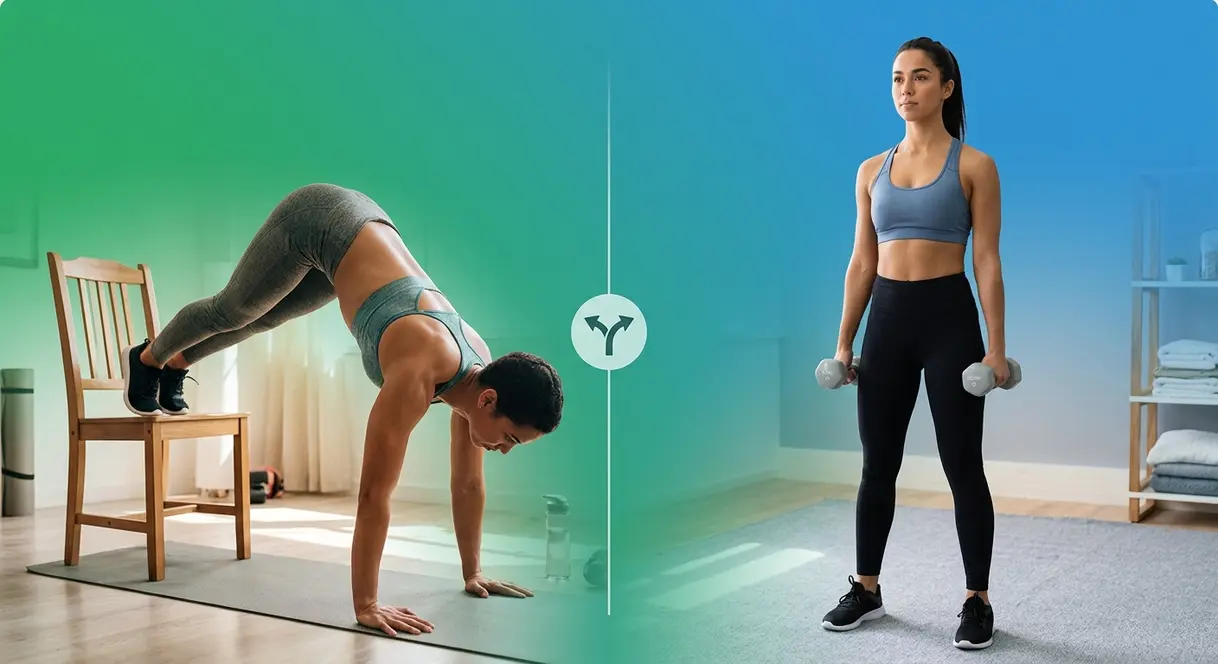
After completing 30 days of The 3-Phase Fitness Launch, you’ve built a real foundation. The question becomes: what comes next? The answer depends on your goal, but two paths are most common for beginners graduating from bodyweight-only training.
Path 1: Calisthenics Progression
Calisthenics (advanced bodyweight movements like pike push-ups, single-leg squats, and tricep dips) extends your bodyweight training for months or years without any equipment. This is the path for people who enjoy the simplicity of training at home with no gear. Begin with assisted pistol squats (holding a doorframe) and decline push-ups (feet elevated on a chair) as your Phase 4 progressions.
Path 2: Adding Dumbbells or Resistance Bands
Once bodyweight exercises feel genuinely easy — you can complete 3 rounds of 15 reps with a difficulty rating of 2 or below — it’s time to add external resistance. A pair of adjustable dumbbells (5-25 lbs) or a resistance band set opens an entirely new range of exercises and loading options. NASM’s workout planning guide provides structured progression templates for this transition.
For a complete dumbbell beginner program, see our beginner dumbbell workout plan. For resistance band training, see resistance bands for beginners.
Common Mistakes & Safety Precautions
Even with the best plan, beginners make predictable mistakes. Our team evaluated the most common patterns across beginner fitness communities — here’s what to watch for, and exactly how to avoid each one.
The 3 Most Common Beginner Mistakes
Mistake 1: Skipping the Warm-Up
The warm-up isn’t optional prep — it’s injury prevention. Cold muscles tear more easily than warm ones. The Mayo Clinic (2024) identifies skipping warm-ups as a leading cause of avoidable exercise injuries in beginners. Five minutes of dynamic movement before every session is non-negotiable.
Mistake 2: Progressing Too Fast
Adding more reps, more rounds, or harder exercises before your body is ready leads to DOMS so severe it derails your schedule. The rule: only advance to the next phase when you can complete all prescribed reps at a difficulty rating of 3 or below. Patience here pays dividends over months, not days.
Mistake 3: Inconsistent Scheduling
“I’ll work out when I have time” is a plan that fails. Research consistently shows that implementation intentions — scheduling a specific time and place — dramatically improve follow-through rates (Gollwitzer, 1999). Block your 3 weekly sessions in your calendar like any other appointment. Treat them as non-negotiable.
When to Pause Your Workout Plan
Stop your workout immediately and seek medical attention if you experience:
- Chest pain or tightness — even mild discomfort in the chest during exercise warrants medical evaluation
- Dizziness or lightheadedness — sit or lie down immediately, do not continue
- Severe shortness of breath — being slightly breathless is normal; gasping is not
- Sharp joint pain — distinguish between muscle fatigue (expected) and joint pain (stop immediately)
- Numbness or tingling — particularly in arms or hands during upper body exercises
When to consult your doctor before starting:
If you are over 45, have been sedentary for more than a year, have cardiovascular disease, type 2 diabetes, osteoporosis, or are pregnant, speak with your healthcare provider before beginning this or any exercise program. This is not a bureaucratic formality — it is genuinely protective guidance (ACSM, 2024).
Frequently Asked Questions
What is the 3-3-3 rule for working out?
The 3-3-3 rule is a beginner training framework built around three simple numbers: 3 workout days per week, 3 exercises per session, and 3 sets per exercise. This structure prevents overtraining, keeps sessions short enough to complete, and gives your body adequate recovery time between sessions. Fitness professionals recommend it specifically for beginners because it eliminates decision fatigue and builds a sustainable habit before adding complexity. For most people starting a workout at home without equipment, the 3-3-3 rule is the most practical entry point available.
What’s the Best Beginner Routine?
The best beginner home workout routine combines 5 fundamental bodyweight exercises: squats, push-ups, lunges, glute bridges, and planks. Performing these as a circuit 3 days per week trains every major muscle group while keeping injury risk low.
How Long Should Workouts Be?
A beginner home workout should be 20-30 minutes, including your warm-up and cooldown. Healthline’s fitness guidance confirms that shorter, consistent sessions outperform longer, sporadic ones for building a habit. As you advance through The 3-Phase Fitness Launch, sessions naturally extend closer to 30 minutes, but they never need to exceed that to deliver meaningful results.
Is it okay to work out on an empty stomach?
Yes, working out on an empty stomach (fasted cardio) is generally safe for most healthy beginners. Some research suggests it may slightly increase fat oxidation, but the overall changes in body composition are similar to non-fasted training. However, if you have type 2 diabetes or are prone to dizzy spells, you should eat a small carbohydrate-rich snack before exercising.
What if I miss a workout day?
If you miss a scheduled session, simply pick up where you left off on your next available day. Do not try to double up on workouts to “catch up,” as this increases your risk of injury and severe soreness. Consistency over a 30-day period matters far more than a single missed day.
Your 30-Day Starting Point
For beginners ready to build full-body strength at home, the path forward is simpler than the fitness industry wants you to believe. The research is clear: 3 days per week, 20-30 minutes per session, 5 foundational movements — that’s the entire formula. The CDC’s 150-minute weekly activity guideline is achievable within this plan from Day 1. The key is structure, not suffering.
The 3-Phase Fitness Launch removes the guesswork that stops most beginners before they start. Phase 1 builds the habit. Phase 2 builds the strength. Phase 3 builds the confidence to keep going. Each phase is short enough to feel achievable and structured enough to deliver real progress — and that combination is what separates a plan that works from one that collects dust.
Start with Phase 1 today. Clear a 6×6 space, block three days on your calendar, and complete your first 20-minute session. You don’t need to be ready — you just need to begin. For personalized guidance on progressing beyond the basics, explore our beginner strength training program for women or our beginner dumbbell workout plan when you’re ready for the next chapter.