What to Eat Before a Workout: The 3-3-3 Rule Guide
Home ›Supplements and Nutrition
⚕️ Medical Disclaimer: The information in this guide is for educational purposes only and does not constitute medical or nutritional advice. Consult a registered dietitian or physician before making changes to your diet, especially if you have diabetes, a gastrointestinal condition, or other health concerns. Individual nutritional needs vary.
You’re mid-workout, legs burning, energy draining — and it has nothing to do with your fitness level or how much sleep you got. In most cases, it comes down to what you ate (or didn’t eat) in the hours before you started.
Working out on the wrong fuel doesn’t just feel terrible in the moment. It actively slows your results, because your body starts breaking down muscle for energy when it can’t find carbohydrates. Knowing what to eat before a workout — and precisely when to eat it — is one of the highest-leverage changes a beginner can make.
In this guide, you’ll learn exactly what to eat before a workout with specific foods, exact timing windows, and a beginner-friendly framework called the Pre-Workout 3-3-3 Rule — covering everything from 30-minute snacks to full pre-workout meals, morning fasted training, evening sessions, goal-specific macros, and what to eat after you’re done.
Before You Begin: What You Need
Estimated Time: 15–20 minutes
- Tools and Materials:
- A reliable timing system (watch or phone) to track your pre-workout window
- Easy-to-digest carbohydrates (e.g., bananas, oats, rice cakes)
- Lean protein sources (e.g., Greek yogurt, protein powder)
- A water bottle for proper hydration
Before stepping through the eight steps, here are the three terms you’ll see throughout this guide. You don’t need to memorize these — just keep them in mind as you follow the steps.
- Macronutrients: Carbohydrates, protein, and fat — the three energy sources found in all food. Think of them as three grades of fuel at a gas station: each burns differently and at different speeds.
- Glycogen: The stored form of carbohydrates your muscles burn during exercise. Think of it as your body’s emergency fuel reserve — a tank that empties during training and needs to be refilled.
- Digestion window: The time your body needs to convert food into usable energy. A ripe banana takes roughly 30 minutes; a full steak-and-potato meal takes 3–4 hours.
How We Compiled This Guide: All nutrition recommendations here are drawn from Tier 1 and Tier 2 peer-reviewed sources — including PubMed, the American College of Sports Medicine (ACSM), the Academy of Nutrition and Dietetics, and the National Institutes of Health — as well as the 2026 Dietary Guidelines for Americans. No advice in this article replaces personalized guidance from a registered dietitian.
Now that you understand the basics, let’s start with the single most important variable in pre-workout nutrition: timing.
Step 1: Pre-Workout Timing Window
What you eat before a workout — and when you eat it — determines whether you have energy to burn or hit a wall at minute twenty. Figuring out what and when to eat before a workout is simpler than most articles make it seem: it comes down to three clear windows, each with its own food rules.
Best Foods Before a Workout at a Glance:
- Banana: fast energy, 30 min out
- Oatmeal + protein powder: 1–2 hours out
- Greek yogurt + berries: 1–2 hours out
- Whole-grain toast + egg: 2–3 hours out
- Pretzels or granola bar: 30 min emergency fuel
- Rice cakes + peanut butter: 1 hour out
- Fruit smoothie: 30–45 min out
Eating a carbohydrate-and-protein combination 2–3 hours before a workout gives your digestive system enough time to convert food into ready fuel — without diverting blood flow away from working muscles (Academy of Nutrition and Dietetics, 2021).
What to Eat 30 Mins Before?
Eat fast-digesting, low-fat, low-fiber carbohydrates within 30 minutes of your workout. What to eat 30 minutes before a workout is the most searched pre-workout timing question, and the physiological reason is simple: as your workout begins, blood redirects from your gut to your working muscles. If your stomach is still digesting something heavy, you’ll feel sluggish, crampy, or nauseous.
- Best 30-minute options:
- Ripe banana (specifically ripe — ripening converts resistant starch into fast-absorbing sugars; a ripe banana is the most practical choice)
- Plain pretzels or a small handful of dates
- A small fruit smoothie without added protein powder
- A plain granola bar with under 5g of fat
A macronutrient timing research review published in PubMed Central found that carbohydrate timing within 75 minutes of exercise shows no significant difference in endurance performance — meaning you have more flexibility than you might think. If you forgot to eat and you’re 30 minutes from your workout, grab a banana or a handful of pretzels. Nothing more complex than that.
If you have a full hour before your workout, you have room for something more substantial — a combination that gives you both immediate and sustained energy.
1 Hour: Carbs + Light Protein
What to eat an hour before a workout opens the door to a small, balanced snack — moderate carbohydrates plus a light protein source.
Sixty minutes gives your stomach enough time to begin breaking down protein without causing cramps. Protein at this stage also begins muscle-protection signaling before training even starts. Keep fat low at this window — save avocado and nut butters for the 2–3 hour window.
- Good 1-hour combinations:
- Oatmeal + a scoop of Greek yogurt
- Rice cakes + a thin spread of almond butter
- A piece of fruit + a hard-boiled egg
- Toast + scrambled egg whites
For portion size: a snack at this window should be roughly 200–300 calories for most beginners — not a full meal.
If you have 2–3 hours, you’ve hit the sweet spot — enough time for a full, satisfying meal that fuels every part of your workout.
2-3 Hours: Full Pre-Workout Meal
With 2 hours before a workout, you’re in the optimal window for a complete, balanced plate. The Academy of Nutrition and Dietetics recommends fueling the body pre-workout nutrition timing one to four hours prior to exercise, making the 2–3 hour window the practical midpoint for most people (AND, 2021).
This is the only window where fat is genuinely acceptable pre-workout. There’s enough digestion time to handle it. Still, keep fat to a moderate amount — roughly a thumb-sized portion.
- Full meal examples for this window:
- Brown rice + grilled chicken breast + roasted vegetables
- Whole-grain pasta + lean turkey mince + a light tomato sauce
- Sweet potato + salmon fillet + steamed broccoli
And here’s a community favorite that nails the balance of immediate and sustained energy:
“Oatmeal with protein powder plus half an avocado and a dash of honey mixed in will give you both short and long-term energy to power through your workout.”
For weight loss goals, this can be a calorie-controlled version of the same plate — Step 5 covers goal-specific portions in detail.
Now that you know the windows, here’s a simple way to remember exactly what belongs in each one.
The Pre-Workout 3-3-3 Rule
The Pre-Workout 3-3-3 Rule is a beginner-friendly framework built around three questions you ask before every session. Instead of memorizing a nutrition textbook, you just need these:
- 3 Timing Windows:
- 2–3 hours out → Full meal (carbs + protein + small fat)
- 1 hour out → Light snack (carbs + light protein)
- 30 minutes out → Simple carbs only (fast-digesting, low fat, low fiber)
- 3 Macronutrients in Order of Priority:
- Carbohydrates — always the foundation of pre-workout fuel
- Protein — muscle protection, add when timing allows
- Fat — optional, only in the 2–3 hour window
- 3 Food Categories to Always Avoid:
- High-fat foods (slow digestion, diverts blood flow)
- High-fiber foods (digestive discomfort during exercise)
- High-sugar processed foods (quick energy spike followed by a crash)
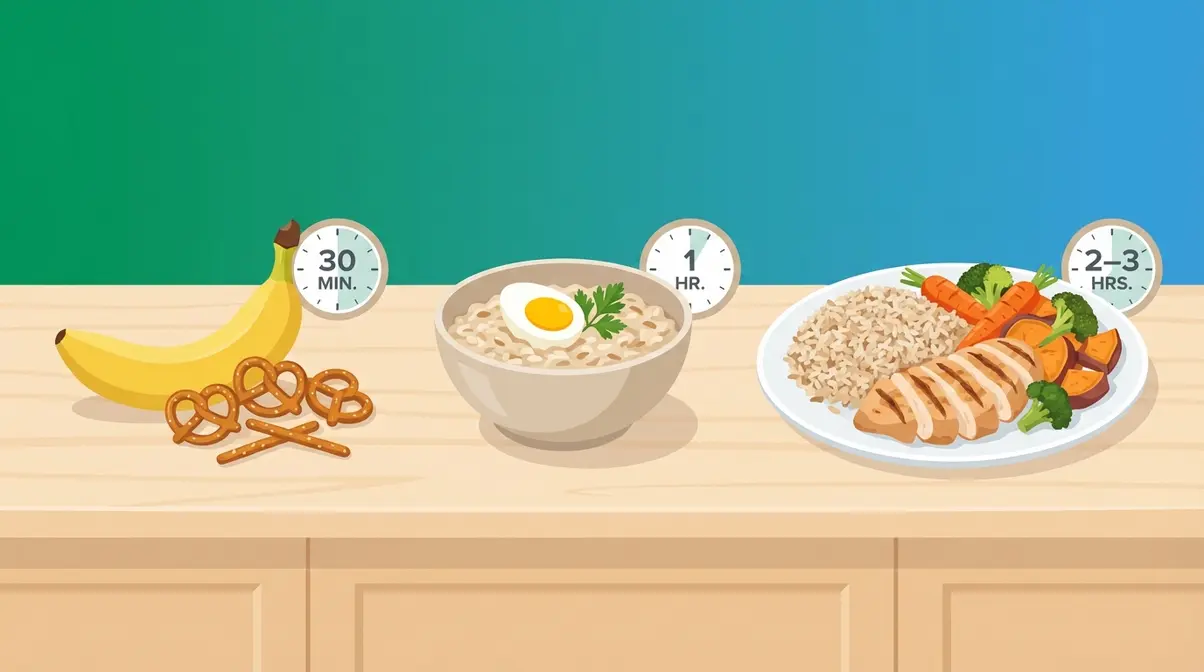
The infographic below shows how the Pre-Workout 3-3-3 Rule maps to your schedule.
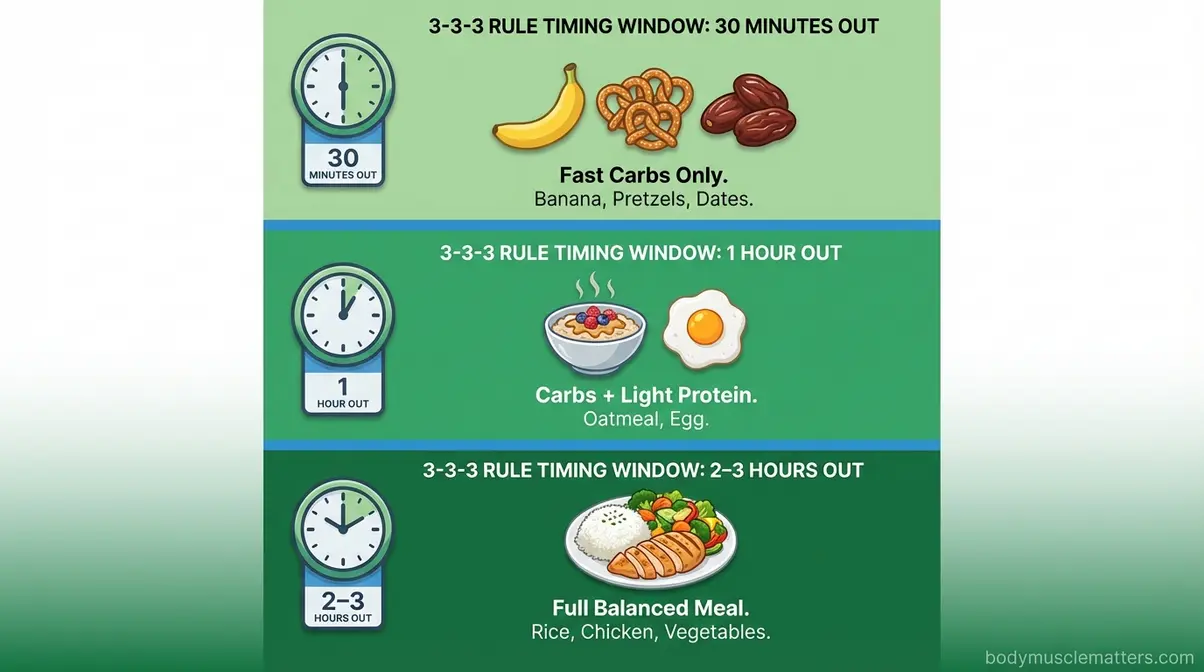
Caption: The Pre-Workout 3-3-3 Rule maps your timing window to the right food type — eliminating the guesswork before every session.
You know the timing. Now let’s fill those windows with the right foods — starting with what goes on your plate and why.
Step 2: Build Your Pre-Workout Plate
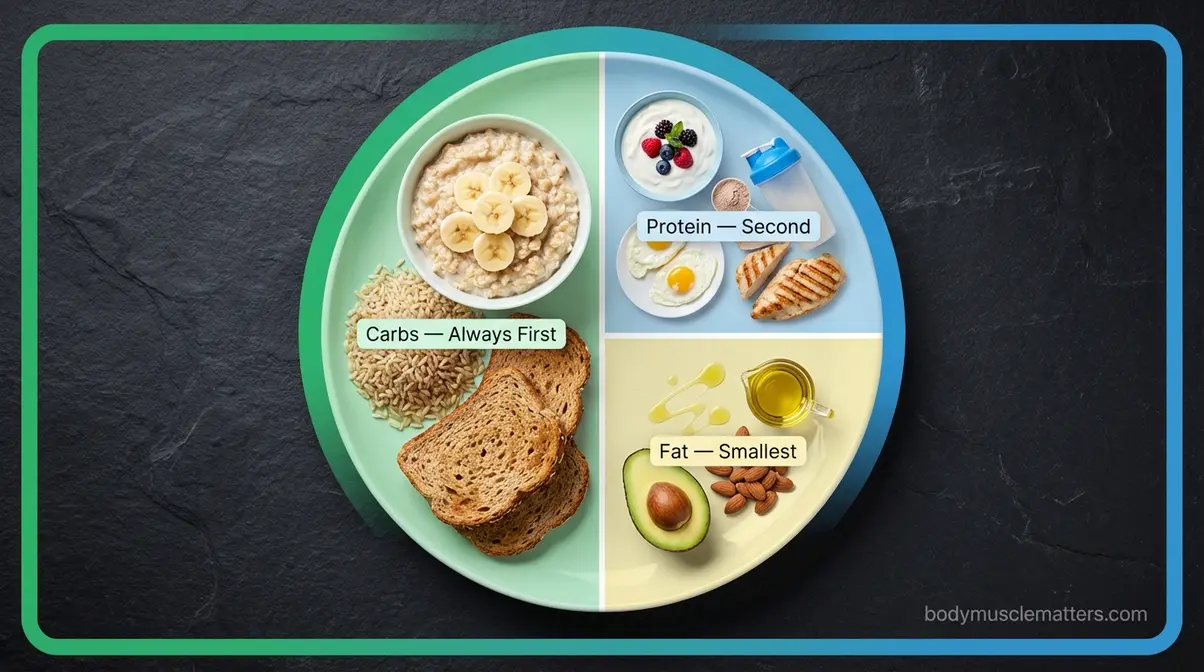
A quick note from the fitness community before diving into the food lists. Experienced gym-goers consistently find that the best pre-workout meals are both personally enjoyable and strategically balanced — not just “healthy by definition.” You’re more likely to fuel consistently when the food actually tastes good.
Remember the 3-3-3 Rule — carbohydrates come first, protein second, fat last. Here’s what each category looks like in your kitchen.
Best Carbs to Eat Before Exercise
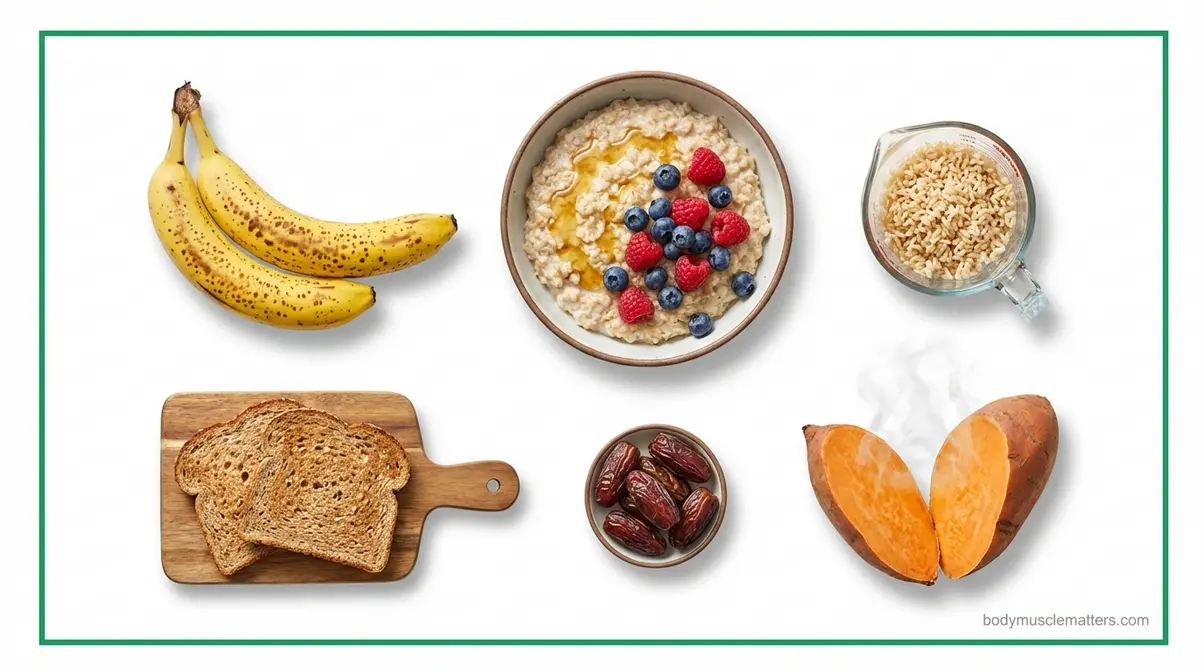
Is a banana good before a workout? Yes — and specifically within 30–60 minutes, a banana is one of the smartest choices you can make. Its natural sugars (fructose and glucose) absorb into the bloodstream quickly, providing fast fuel right when your muscles need it. A ripe banana works better than an unripe one because the ripening process converts resistant starch into fast-absorbing sugar.
- Simple vs. complex carbs — the spark vs. log difference:
- Simple carbs are like a quick spark — they burn fast. Examples: banana, fruit juice, white rice, pretzels, dates.
- Complex carbs are like a log on a fire — they burn slow and steady. Examples: oatmeal, brown rice, whole-grain bread, sweet potato.
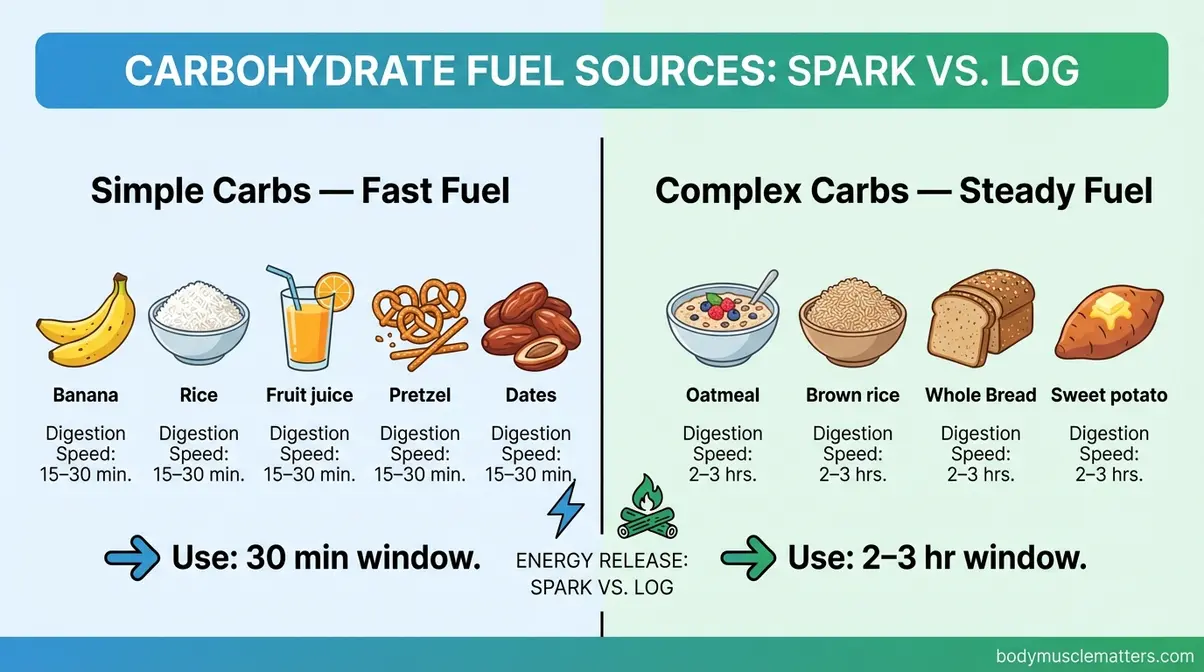
Caption: Simple carbs (left) fuel fast workouts within 30 minutes; complex carbs (right) are ideal for the 2–3 hour window.
As Cleveland Clinic notes, easily digested carbohydrates like bananas, apples, or oranges are recommended for pre-workout snacks to prevent gastrointestinal distress. If you’re 30 minutes out, a banana is your best friend. If you have 2 hours, a bowl of oatmeal with honey and berries is a near-perfect choice.
Carbs give you the fuel. But protein is what protects your muscles from being broken down during training — here’s how much you actually need.
Protein to Protect Your Muscles
What to eat before a workout to build muscle starts with one insight most beginners miss: protein before training protects what you already have as much as it builds new muscle.
The 2026 Dietary Guidelines for Americans recommend 1.2–1.6g of protein per kilogram of body weight daily for active individuals (Dietary Guidelines for Americans, 2026). A pre-workout meal should contribute approximately 0.3g/kg of that daily target. For a 70kg (154 lb) person, that’s roughly 20g of protein in the pre-workout window.
- Best pre-workout protein sources (fastest to slowest digesting):
- Protein shake or powder (fastest — 30–60 min window compatible)
- Greek yogurt (high-protein, moderate digestion speed)
- Cottage cheese (similar to Greek yogurt; pairs well with fruit)
- Egg whites or whole eggs
- Lean turkey or chicken breast (best for 2–3 hour window only)
Avoid slow-digesting proteins — fatty red meat, full-fat dairy, processed deli meats — close to training. According to ACSM sports nutrition guidelines, consuming carbohydrates and protein before a workout encourages muscle protein synthesis and minimizes breakdown — meaning you don’t have to choose between fueling for energy and protecting your muscles (ACSM).
“Oatmeal with protein powder plus half an avocado and a dash of honey mixed in will give you both short and long-term energy to power through your workout.”
One macronutrient is conspicuously absent from most pre-workout windows — fat. Here’s why you should mostly keep it small before you train.
Fat: Keep It Small Before Training
Fat is not the enemy — but it’s the slowest macronutrient your body digests. A high-fat meal before exercise diverts blood flow to your gut for extended digestion, competing directly with your working muscles. The result: sluggishness, bloating, and reduced output.
The rule: In the 30-minute and 1-hour windows, keep fat under 5–8g total. In the 2–3 hour window, a moderate amount is fine — think half an avocado, a small handful of nuts, or a drizzle of olive oil. That’s enough to support satiety and steady energy without slowing digestion.
- Quick fat reference:
- ✅ Half an avocado (2–3 hour window) — ~11g healthy fat, adequate digestion time
- ✅ One tablespoon of almond butter (1-hour window) — ~9g fat, borderline acceptable
- ❌ Bacon and eggs (30-minute window) — too much fat, too slow to digest
- ❌ A burger or fried food (any window) — saturated fat slows gastric emptying significantly
Step 3: Adapt for Morning Workouts

Morning workouts present a unique challenge. If your alarm goes off at 5 a.m. and your gym session starts at 5:45, the standard “eat 2–3 hours before” advice simply doesn’t fit. Here’s what the research actually says — and what to do instead.
Fasted Training: What Research Says
Can you workout on an empty stomach? Yes — but the trade-off depends on your goal and your workout type.
A 2016 meta-analysis in the British Journal of Nutrition — covering 27 studies and 273 participants — found that aerobic exercise performed in a fasted state induces higher fat oxidation (fat burning during the session) than exercise in a fed state (Gonzalez & Betts, British Journal of Nutrition, 2016). However, a 2018 review published in Sports Medicine found that pre-exercise feeding enhances performance in prolonged aerobic exercise, while the fat-burning advantage of fasting doesn’t translate into greater fat loss over time (Aird et al., Sports Medicine, 2018).
- What this means in plain English:
- Fasted cardio burns more fat during the session, but total fat loss over weeks is similar to fed training.
- For high-intensity workouts — HIIT, heavy lifting, interval training — fasted exercise can hurt performance, because your body needs glycogen (stored carbs) to sustain explosive effort.
- For light-to-moderate cardio (a 30–45 minute walk or easy bike ride), fasted training is a valid and practical option, especially for early risers who genuinely cannot eat first.
The key question isn’t “fed or fasted?” — it’s “what kind of workout am I about to do?”
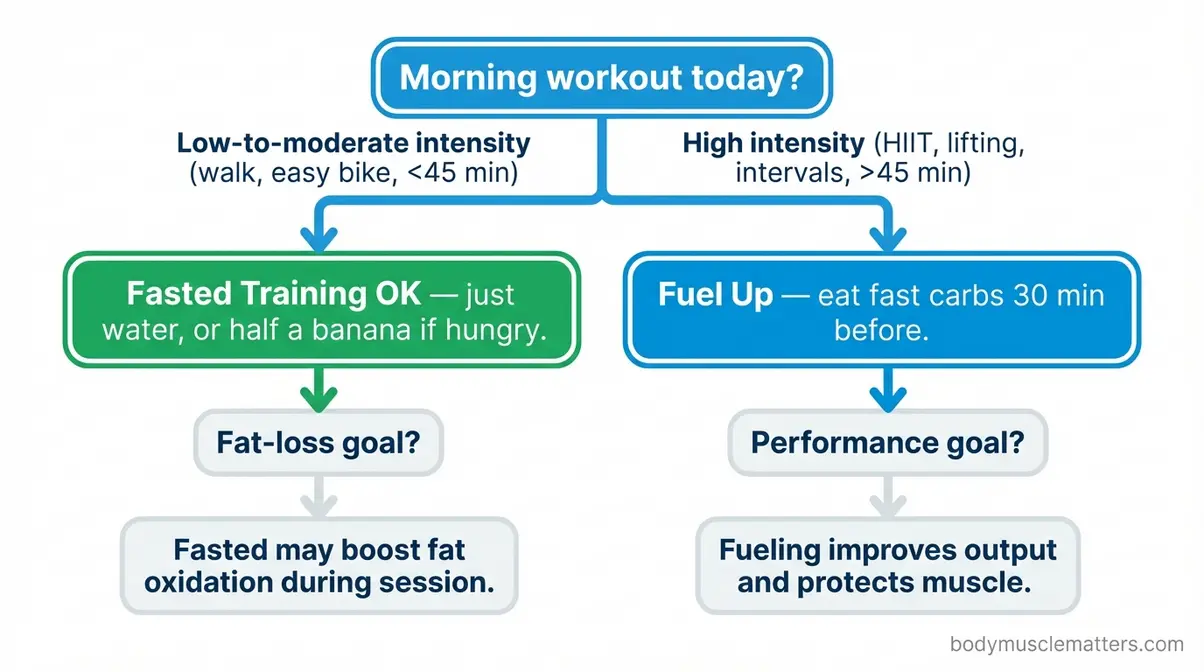
Caption: Use this chart to decide whether fasted or fueled training suits your 5 a.m. session — intensity and goal are the deciding factors.
Quick Fuel for Early Risers (5 a.m.)
What to eat before a 5 a.m. workout comes down to one constraint: minimal stomach volume, maximum digestibility. Many people experience nausea when eating too much too early. The goal is the smallest effective amount of fast fuel — not a full breakfast.
- Practical options for early morning training:
- Half a banana + 6 oz water (simplest; 13–15g fast carbs, minimal GI risk)
- A medjool date or two (quick natural sugar, very easy to digest)
- 4–6 oz of a fruit-based smoothie (without protein powder or nuts at this window)
- A small rice cake with a thin spread of jam
- A few sips of a sports drink if solid food causes nausea
If your early workout is under 45 minutes and low-to-moderate intensity, training with just water is a reasonable choice — particularly if eating anything before exercise causes you digestive discomfort. Fitness communities consistently report that the biggest mistake in early morning training is eating too much, too fast — not too little.
For a more complete morning meal (if you can wake up 90 minutes before your session), the 1-hour window options from Step 1 apply directly: oatmeal + egg whites, or Greek yogurt + berries.
Step 4: Fuel Evening & Night Sessions
Evening workouts come with their own timing puzzle — dinner is either too far away or too close, and eating a full meal at 8 p.m. raises concerns about sleep quality and calorie timing.
Timing Your Evening Pre-Workout Snack
What to eat the night before a workout is less important than what you eat in the 1–3 hours before your actual evening session. Whether your workout is at 6 p.m. or 9 p.m., the same three windows from the 3-3-3 Rule apply.
The challenge for evening exercisers: a typical dinner schedule (6–7 p.m.) followed by a 7:30–8:30 p.m. workout puts you in the 1–2 hour window — which calls for a lighter, carb-forward plate rather than a heavy dinner. According to Mayo Clinic, eating a healthy balanced meal at least one hour before exercise is appropriate for evening sessions, with attention to portion size and fat content (Mayo Clinic, 2026).
- Practical evening timing plan:
- Workout at 6:30 p.m.: Eat a moderate lunch at 1–2 p.m.; have a light pre-workout snack (banana + Greek yogurt) around 5 p.m.
- Workout at 8 p.m.: Eat dinner at 5:30–6 p.m. (full balanced meal); top up with a small carb snack (rice cake, piece of fruit) around 7:30 p.m. if needed.
- Workout at 9:30 p.m.: Keep the pre-workout snack minimal — a banana or a handful of pretzels — so post-workout food before bed isn’t excessive.
Light Options to Protect Sleep
What to eat before a late-night workout should not sabotage your recovery. Heavy, high-fat, or high-protein meals close to bedtime increase the time your body spends digesting rather than repairing muscle tissue during sleep.
- Smart late-evening pre-workout choices:
- A small bowl of cereal with low-fat milk (fast-digesting, light on the stomach)
- A banana + a glass of water
- A handful of pretzels or plain crackers
- Half a cup of applesauce + a small scoop of protein powder blended in water
After your late workout, resist a large post-workout meal if sleep is within 60–90 minutes. A glass of chocolate milk or a small Greek yogurt covers protein and carb recovery needs without overloading digestion before sleep.
Step 5: Match Macros to Your Goal
Pre-workout nutrition isn’t one-size-fits-all. Whether your primary goal is weight loss or building muscle, the foods you choose and the portions you eat should reflect that goal. The 3-3-3 Rule applies to both — the proportions shift.
Eat Before a Workout for Weight Loss
The most common fear among weight-loss-focused beginners: “If I eat before the gym, won’t I just burn off what I just ate?” This is a reasonable question — and it’s based on a misconception.
Eating before training doesn’t cancel your calorie deficit. It allows you to train harder and longer, which increases total calories burned during and after the session. Research consistently shows that exercisers who train fueled outperform fasted training peers in total output — meaning more muscle engagement, more calories burned, and less muscle loss over time.
- Weight loss pre-workout strategy:
- Focus on volume: choose foods high in water content (fruit, vegetables) for satiety with fewer calories
- Keep total pre-workout snack under 150–200 calories for the 30-minute to 1-hour window
- Prioritize carbs + lean protein; skip fat at every window except 2–3 hours
- Example (30 min window): one medium banana (90 calories) + black coffee
- Example (1-hour window): ½ cup oats + ½ cup berries + ¼ cup low-fat Greek yogurt (~180 calories)
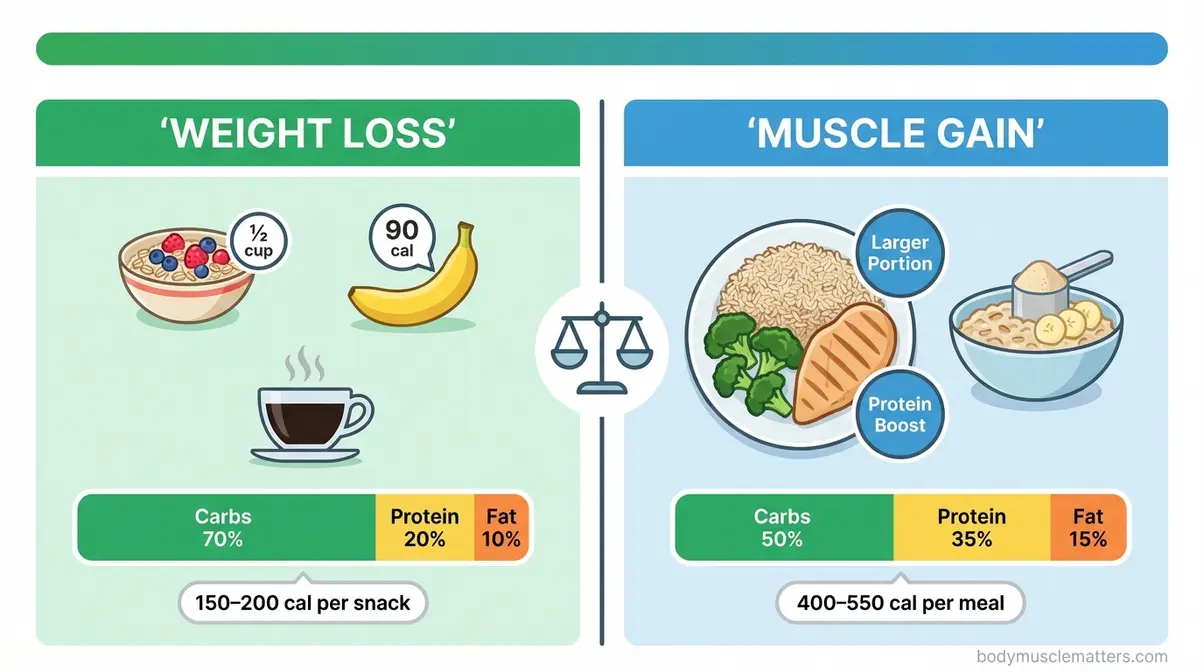
Caption: Portion size and macronutrient ratio shift based on your primary training goal — but carbohydrates remain the foundation in both cases.
For weight loss specifically, the HSS Health Library pre-workout guidance recommends keeping pre-workout snacks moderate in calories while ensuring enough carbohydrates to sustain the session intensity (Hospital for Special Surgery, 2023).
Eat Before a Workout to Build Muscle
What to eat before a workout to gain muscle requires a different emphasis: more total calories, higher protein, and a deliberate carbohydrate base to protect muscle tissue during training.
The 2026 Dietary Guidelines recommend 1.2–1.6g of protein per kilogram of body weight per day for active individuals (Dietary Guidelines for Americans, 2026). For muscle gain specifically, aim toward the higher end of that range — 1.4–1.6g/kg. Your pre-workout meal should contribute about 0.3–0.4g/kg of that daily protein target.
- Muscle-gain pre-workout examples (2–3 hour window):
- 1 cup brown rice + 150g grilled chicken breast + 1 cup roasted vegetables (~500–550 calories, 40g+ protein)
- 1 cup oatmeal + 1 scoop protein powder + ½ banana + a dash of honey (~400 calories, 30g protein)
- Whole-grain wrap + 3 egg whites + spinach + hummus (~350 calories, 28g protein)
- For the 1-hour window:
- Cottage cheese + fruit + a drizzle of honey (~200 calories, 20g protein)
- Greek yogurt + granola + half a banana (~250 calories, 17–20g protein)
The key difference from weight-loss fueling: muscle-gain sessions require more total fuel, not just different food types.
Step 6: Customize by Workout Type
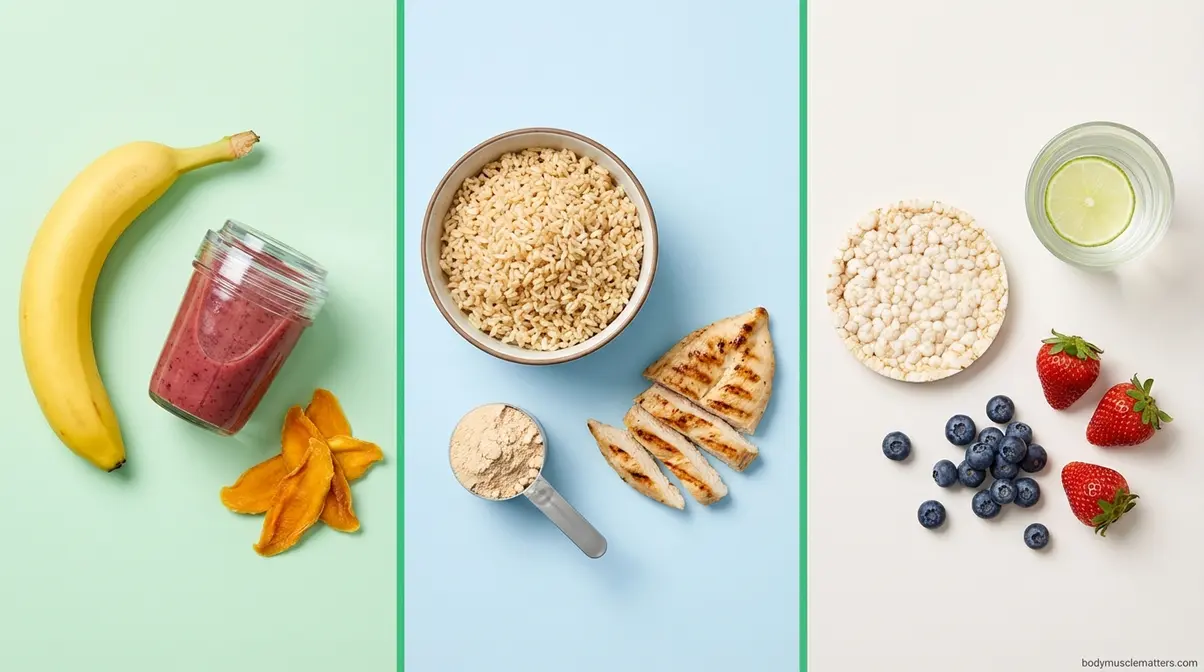
Cardio, lifting, and yoga place very different demands on your body. The same banana-and-oatmeal combo that works for a treadmill run might not be ideal before a yoga flow. Here’s how to match your pre-workout plate to your specific session.
Cardio & HIIT: Easy-to-Digest Carbs
What to eat before a HIIT workout is a surprisingly winnable question — the answer is simpler than most people expect. HIIT (High-Intensity Interval Training) burns through glycogen rapidly, so your primary fuel is carbohydrates. The challenge: you also need food that clears your stomach fast, because high-intensity movement with a full gut causes nausea.
- HIIT and cardio pre-workout strategy:
- 30 min window: ripe banana, a small sports drink, or a handful of dried mango
- 1 hour window: oatmeal + berries, or a small smoothie with fruit + a scoop of protein
- 2–3 hour window: whole-grain toast + egg + fruit; brown rice + chicken (lighter portion than a strength day)
Keep fat to an absolute minimum on HIIT days. Even a moderate amount of fat can cause stomach cramping during high-intensity intervals. Fitness communities consistently report that the combination of high fat + high intensity is one of the most common causes of mid-workout nausea.
Strength Training: Carbs + Protein
Strength sessions demand more from your muscles than your cardiovascular system — and that means protein plays a bigger role in your pre-workout meal than it does for cardio.
A PubMed systematic review confirmed that combining carbohydrates with protein before resistance exercise stimulates muscle protein synthesis and reduces muscle breakdown during training — a finding absent from nearly all competitor content in this space (ACSM Sports Nutrition, via PubMed). For beginners doing their first months of lifting, this combination is especially important: your muscles are more responsive to protein during this early adaptation phase.
- Pre-strength training plate (2–3 hour window):
- Brown rice (1 cup) + grilled chicken (150g) + roasted sweet potato (½ cup)
- Whole-grain pasta + turkey mince + light tomato sauce
- Quinoa + hard-boiled eggs + steamed vegetables
- Pre-strength snack (1-hour window):
- Rice cakes + almond butter (1 tbsp) + a banana
- Greek yogurt + granola + honey
- Protein shake + a medium apple
UCLA Health recommends a carbohydrate and protein combination before strength training specifically for muscle preservation — not just performance (UCLA Health).
Yoga & Low-Intensity: Keep It Light
What to eat before hot yoga is a different question from what to eat before lifting. In a heated yoga room, your body is managing both physical exertion and thermoregulation — meaning your digestive system has even less spare capacity. Too much food before yoga causes a very specific kind of discomfort: a full, heavy feeling that makes forward folds and twists genuinely unpleasant.
- Pre-yoga guidance:
- Eat nothing in the 30 minutes immediately before class if you tend toward digestive discomfort
- In the 1-hour window: a piece of fruit, a small rice cake, or 4–6 oz of a light smoothie
- In the 2–3 hour window: a light, low-fat meal — rice + steamed vegetables + tofu or egg is ideal
- Avoid cruciferous vegetables (broccoli, cauliflower, cabbage) before yoga — their high fiber content can cause gas and bloating during twisting movements
For general low-intensity exercise (walking, swimming, casual cycling), your pre-workout fuel requirements are minimal. A light snack or even just water may be all you need for sessions under 45 minutes.
Step 7: Foods to Avoid Before Workouts
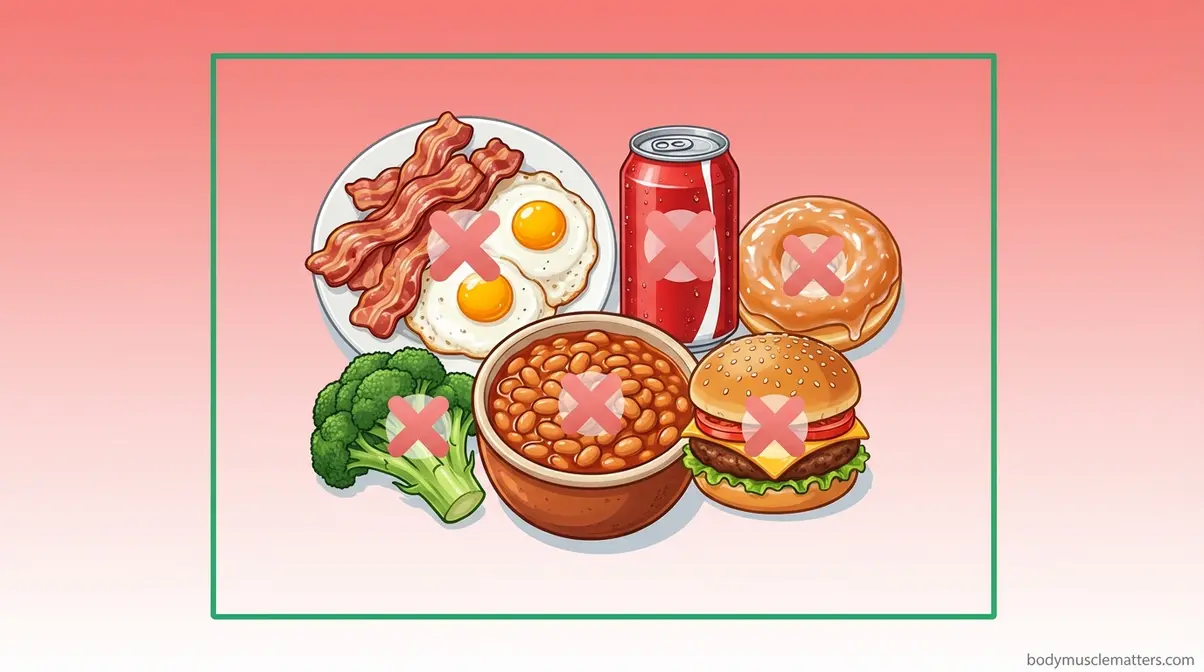
Just as important as knowing what to eat is knowing what to skip. These food categories consistently cause digestive discomfort, energy crashes, or reduced performance — regardless of your fitness level.
What Foods Should I Avoid Before?
Avoid high-fat, high-fiber, and high-sugar processed foods before any workout. What not to eat before a workout starts with these categories because they slow your digestive system at exactly the wrong time.
High-fat foods — fried items, fatty red meat, full-fat dairy, creamy sauces — require extended gastric emptying. When your body is still processing fat as your workout begins, blood flow stays in your gut rather than reaching your muscles. The result: reduced performance and sluggishness.
High-fiber foods — raw cruciferous vegetables like broccoli, beans, lentils, bran cereals — ferment in the large intestine and can cause gas, bloating, and cramping during exercise. The Cleveland Clinic specifically flags high-fiber vegetables and legumes as foods to avoid in the pre-workout window.
- Common foods to avoid before training:
- Full breakfast: bacon + eggs + cheese + toast with butter
- Salad heavy in raw broccoli, cauliflower, or cabbage
- Bean-based dishes (chili, hummus, lentil soup)
- Creamy pasta sauces or pizza
- High-fiber granola bars with 8g+ fiber
Sugary Foods: The Energy Crash Trap
Heavily sugary processed foods — candy, regular soda, pastries, frosted cereals, energy drinks high in sugar — cause a rapid blood glucose spike followed by an insulin-driven crash. That crash often lands directly in the middle of your workout.
Here’s the mechanism in plain English: processed sugar hits your bloodstream fast, triggering insulin release. Insulin rapidly clears the sugar from your blood — dropping your glucose level below where it started. The result is the familiar mid-session wall: sudden fatigue, mental fog, and the feeling that your legs simply won’t cooperate.
This is distinct from the fast-digesting natural sugars in a banana or dates. Natural fruit sugars come packaged with water, micronutrients, and small amounts of fiber that moderate the absorption rate and prevent the sharp crash.
- Avoid before exercise:
- Regular soda or sweetened energy drinks
- Candy, gummy bears, or pure sugar products
- Frosted pastries, donuts, or Pop-Tarts
- Sugary breakfast cereals
Tips If You Ate the Wrong Thing
Sometimes life happens — you grabbed the wrong food on the way to the gym, or dinner ran late and was heavier than planned. Here’s how to manage the situation without skipping your session.
- Practical recovery steps:
- Wait it out: If possible, add 15–20 minutes before you begin. Even a short walk can help gastric emptying.
- Start with low intensity: Begin your warm-up at 50% effort — a light jog rather than sprinting, light weights rather than your working weight.
- Prioritize hydration: Drink 8–12 oz of water before starting. Hydration supports digestion and helps move food through your system.
- Skip the ab-focused work: If you’re bloated or uncomfortable, move core-intensive or inverted exercises to the end of your session (or skip them entirely that day).
- Lower your intensity ceiling: If discomfort persists after 10 minutes of exercise, reduce to 60–70% of your planned intensity. One sub-optimal session will not affect your progress.
Step 8: Post-Workout Nutrition Loop
What you eat after training is the second half of the fueling equation. Getting your pre-workout nutrition right sets you up for a strong session — but post-workout nutrition is where recovery and adaptation actually happen.
Immediate Post-Workout Recovery
A 2024 review published in PMC (Emerging Perspectives on Post-Exercise Recovery Nutrition) confirmed that consuming protein and carbohydrates within the anabolic window — 30 minutes to two hours post-exercise — significantly enhances muscle protein synthesis and glycogen replenishment (PMC, 2024). Missing this window consistently will slow your recovery and reduce the gains from each session.
- The post-workout window in practice:
- Ideal timing: Eat within 30–45 minutes after finishing your workout
- Minimum viable: Eat within 2 hours if a full meal isn’t immediately available
- What to prioritize: 20–40g of protein + 1–1.2g of carbohydrates per kilogram of body weight
- Hydration: Replace fluid lost during exercise — a useful starting target is 16–24 oz of water for every pound of body weight lost during training
For context: a 70kg person should aim for roughly 25–30g of protein and 70–84g of carbohydrates in their post-workout meal. That’s a chicken breast + a cup of rice, or a large Greek yogurt + a banana + a handful of granola.
Best Post-Workout Meal Combos
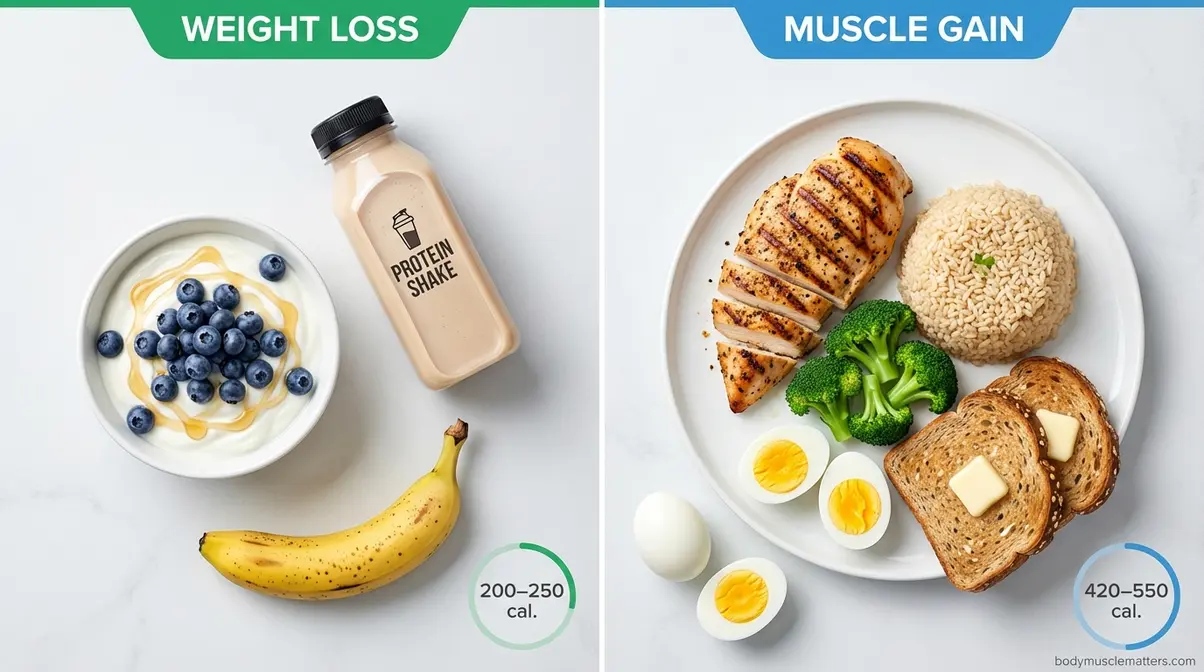
What to eat after a workout to lose weight and what to eat after a workout to gain muscle have more in common than most people expect. The macronutrient combination is the same — protein + carbohydrates. The calorie total is what shifts.
- Post-workout meals for weight loss:
- Greek yogurt (plain, 2%) + blueberries + a drizzle of honey (~200 calories, 17–20g protein)
- Cottage cheese + sliced peaches + a handful of almonds (~220 calories, 25g protein)
- A protein shake (whey or plant-based) + a medium banana (~200–250 calories, 25g protein)
- Post-workout meals for muscle gain:
- 150g grilled chicken breast + 1 cup brown rice + steamed broccoli (~450 calories, 40g+ protein)
- 3 whole eggs + 2 egg whites scrambled + 2 slices whole-grain toast + avocado (~420 calories, 35g protein)
- Tuna + whole-grain crackers + a large apple + a glass of low-fat milk (~400 calories, 38g protein)
According to the Cleveland Clinic, post-workout protein rebuilds muscle fibers while carbohydrates restore glycogen stores depleted during exercise — the two work in combination, not in isolation (Cleveland Clinic).
Common Mistakes and How to Fix Them
Understanding what to eat before a workout is half the battle. Knowing which habits undermine your efforts — even when you think you’re doing everything right — is the other half.
Common Pre-Workout Pitfalls
1. Eating too much, too close to your workout.
The most common beginner mistake. A large meal 20–30 minutes before training guarantees digestive discomfort. Fix: eat your last full meal at least 2 hours before, and use the 30-minute window only for small fast-fuel snacks.
2. Relying on coffee alone.
Caffeine provides alertness but no glycogen. Training on black coffee with no food is essentially fasted training — fine for light cardio, problematic for HIIT or lifting. Fix: pair your coffee with a banana or a few dates.
3. Using high-sugar sports drinks as a meal replacement.
Sports drinks are designed to top up electrolytes during long sessions, not replace a pre-workout meal. Their sugar content can spike and crash blood glucose quickly. Fix: use sports drinks during sessions over 60–90 minutes in duration; use real food before training.
4. Skipping pre-workout nutrition entirely “to lose weight.”
Working out in a deep energy deficit consistently leads to muscle breakdown, poor performance, and slower fat loss over time. Fix: eat a small, calorie-conscious snack before every session — even 90 calories from a banana is enough for a 30-minute lift.
5. Not adjusting for workout type.
A heavy pasta dinner before a 9 p.m. yoga class is very different from the same meal before a 9 a.m. run. Fix: use the 3-3-3 Rule and the workout-type guidance in Step 6 to tailor every pre-workout meal to the specific session ahead.
When to Adjust Your Approach
If you have diabetes, a gastrointestinal condition such as IBS or Crohn’s, thyroid issues, or a history of disordered eating, the general guidelines in this article need personalized modification. The timing, portion sizes, and food types that work for healthy beginners may not be appropriate for your specific situation.
- When to consult a registered dietitian:
- Blood sugar swings significantly before or after exercise
- Persistent nausea, cramping, or GI distress despite adjusting food timing
- You’re training for a specific sport or competition
- Weight loss stalls despite consistent training and what appears to be appropriate fueling
The American Diabetes Association provides specific guidance for exercisers managing blood glucose — if you have diabetes or prediabetes, their resource is your first reference point before applying any general pre-workout nutrition advice (ADA, 2024).
Frequently Asked Questions
What is the best thing to eat?
The best pre-workout food is a combination of fast-to-moderate carbohydrates and a light protein source, eaten 1–2 hours before training. Oatmeal with a scoop of protein powder and a banana covers both macronutrients effectively. For a simpler option, Greek yogurt with berries or whole-grain toast with an egg are equally strong choices. The “best” option also depends on your timing window — a banana alone is ideal at 30 minutes out, while a full brown rice and chicken plate is excellent at 2–3 hours.
Can I workout on an empty stomach?
Yes, but the trade-off depends on your workout intensity and goal. A 2016 meta-analysis in the British Journal of Nutrition found that fasted aerobic exercise increases fat oxidation during the session — but does not produce greater fat loss over time compared to fueled training (Gonzalez & Betts, 2016). For low-to-moderate intensity cardio under 45 minutes, fasted training is a viable option. For HIIT, heavy lifting, or any session over 60 minutes, fueling beforehand will meaningfully improve performance and protect muscle tissue.
What should I drink before a workout?
Water is your primary pre-workout drink — aim for 16–20 oz in the hour before exercise (Mayo Clinic, 2026). Black coffee or green tea 30–60 minutes before training can improve alertness and may enhance performance at moderate doses. Avoid high-sugar sports drinks as a pre-workout drink (they’re designed for use during longer sessions, not before). Avoid alcohol entirely before training — it impairs coordination, dehydrates you, and suppresses muscle protein synthesis. If you experience nausea from solid food before early morning workouts, a small fruit-based smoothie can serve as both fuel and hydration.
Putting It All Together
For fitness beginners, what to eat before a workout comes down to one principle: carbohydrates fuel your session, protein protects your muscles, and timing determines how well both of those things actually work. A 2024 PMC review confirmed that consuming protein and carbohydrates within the post-exercise window significantly enhances muscle protein synthesis — but the pre-workout foundation makes that recovery possible (PMC, 2024).
The Pre-Workout 3-3-3 Rule makes this concrete: three timing windows, three macronutrients in priority order, and three food categories to always avoid. Apply it before every session and you eliminate the guesswork that causes energy crashes, digestive discomfort, and frustrating plateaus.
Your next step is simple: before your next workout, identify which timing window applies to you and pick one food combination from that window’s list in Step 1 or Step 2. Use it consistently for two weeks. At bodymusclematters.com, we recommend trialing any new pre-workout nutrition protocol for 14 sessions before adjusting — that’s enough data to know whether it’s working for your body and your schedule.
If you have a medical condition, diabetes, or specific dietary needs, consult a registered dietitian before changing your pre-workout nutrition plan. The framework above is a starting point — your optimal fuel is ultimately personal.
Related posts:
Best Protein Powder for Muscle Growth: Tested (2026)
Best High Protein Meal Delivery Services 2026: Top 7
Protein Powder Without Artificial Sweeteners: 10 Best Picks
Can You Eat Too Much Protein? Symptoms & Safe Limits
Best Protein Powder for Weight Loss: 10 Expert Picks
What Are Macros? A Plain Guide to Protein, Carbs and Fat

Callum
Hi, I'm Callum, the founder of Body Muscle Matters. I'm not a certified trainer, I'm a self taught lifter who started this site to share what I've learned from my own training and a lot of trial and error. Everything here comes from real experience and honest research, written the way I'd explain it to a friend who is just getting started. My goal is simple: practical, no hype fitness advice you can actually use.