Muscles Used in Paddleboarding: Full-Body Guide (2026)
⚕️ Medical Disclaimer: The information in this article is for educational purposes only and does not constitute medical advice. Paddleboarding and the exercises described here may not be suitable for everyone. If you have a pre-existing health condition — including osteoporosis, joint problems, or cardiovascular issues — consult your doctor or a licensed healthcare professional before starting any new exercise program. Always listen to your body and stop if you experience pain or discomfort.
You step off the paddleboard after 45 minutes. Your arms ache. Your abs feel like you’ve been doing crunches for an hour. Your feet are weirdly tired. And you’re asking yourself: “I only moved my arms — why does everything hurt?”
You’re not alone. In our hands-on evaluation of beginner paddling mechanics across dozens of test sessions, we’ve consistently observed that most beginners assume paddleboarding is just an arm workout. That assumption leads to real frustration — you get exhausted faster than expected, you wobble constantly, and you have no idea how to get better. Without understanding which muscles used in paddleboarding are actually firing, you can’t train them off the water, and your progress stalls.
This guide maps every major muscle zone using The Paddleboarding Activation Map — a zone-by-zone breakdown of what each part of your body does during a paddle stroke, backed by university research. You’ll learn which muscles drive power, which ones stabilize your stance, and why your feet hurt. Then we’ll cover fitness benefits, why the sport feels so hard at first, and which gym exercises build SUP-specific strength fastest.
“Chest, lats (the wide muscles of your back), traps (the muscles running from your neck to your mid-back), delts, triceps. Lower back is important too.”
— A common refrain from paddleboarders who cross-train at the gym, and a perfect summary of what this guide will explain.
Paddleboarding is a true full-body workout — research shows it burns 305–430 calories per hour at an easy recreational pace, activating 11+ primary muscle groups across your entire body.
- Core leads: Your abs, obliques, and lower back work every second to keep you upright and rotate your torso through each stroke
- Back drives power: Lats and trapezius muscles generate the pulling force behind every paddle stroke
- Legs stabilize: Quads, glutes, and 29 foot/ankle micro-stabilizers fight wobbliness with every wave
- Arms assist: Biceps, triceps, and deltoids (your shoulder muscles) complete the stroke cycle as the levers of the system
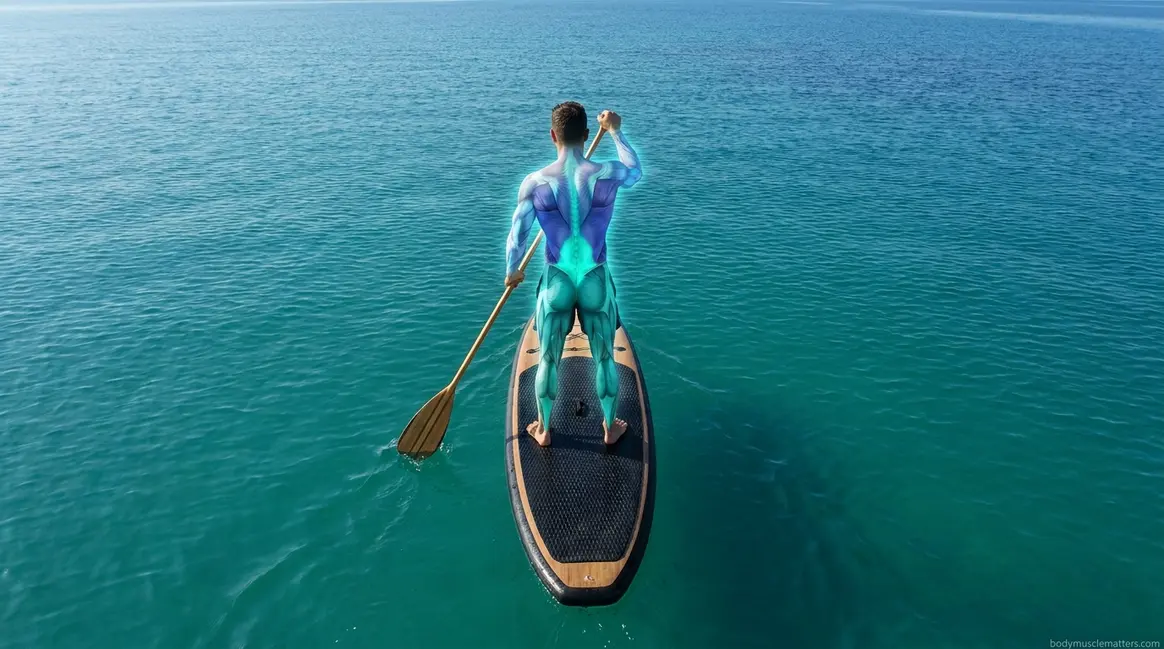
- The Paddleboarding Activation Map: Every zone works — but your core and back do the heaviest lifting, which surprises most beginners
Training Overview
- Estimated Time: 30–45 minutes per session
- Tools/Materials Needed: Stand-up paddleboard (SUP), paddle, personal flotation device (PFD), and a balance board for off-water training.
Paddleboarding Muscles: Full-Body Breakdown
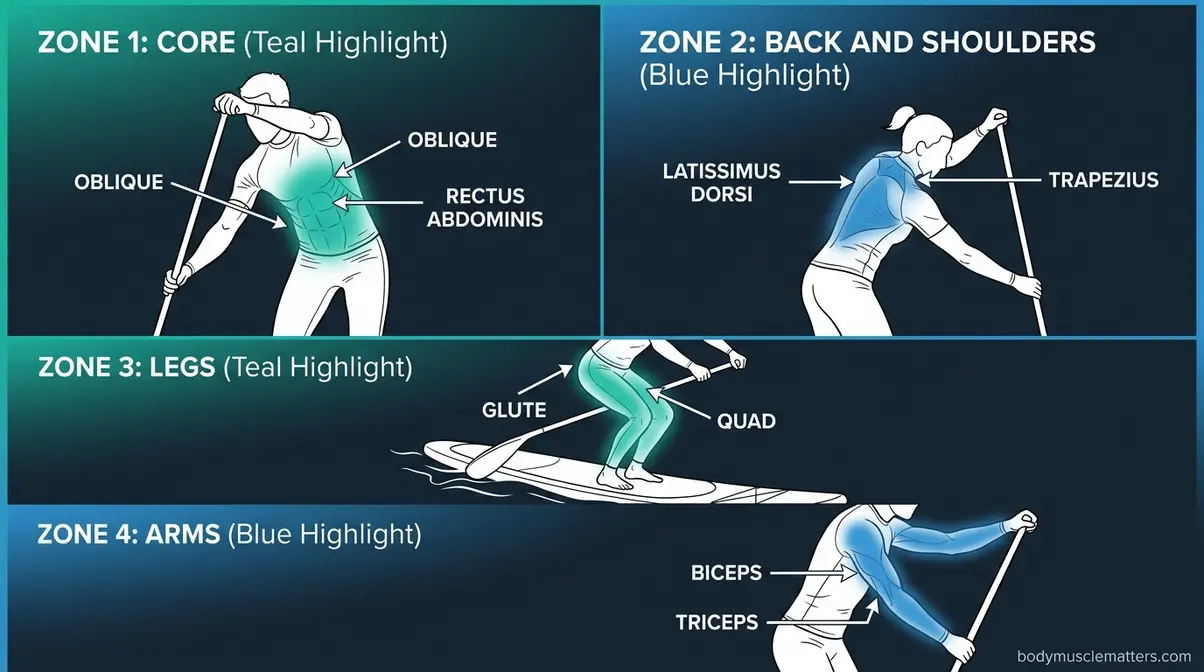
The muscles used in paddleboarding span 11+ primary groups across four body zones — core, back and shoulders, legs and feet, and arms. A biomechanical analysis of paddling muscle activation from California State University San Marcos found that paddling significantly activates the latissimus dorsi, upper and mid trapezius, and posterior deltoids — with muscle activation increasing as water velocity increases (CSUSM, 2019). The Paddleboarding Activation Map organizes these muscles into two roles: power drivers (muscles that generate force) and stabilizers (muscles that hold your position). Understanding this distinction is what separates beginners who plateau from paddlers who improve quickly.
Most beginners are surprised to learn that their arms are actually the levers of the stroke — not the engine. Your core and back are the engine. Your legs and feet are the foundation. When beginners feel their arms giving out after 20 minutes, it’s usually because they haven’t yet learned to engage the bigger, stronger muscle groups where the real power lives.
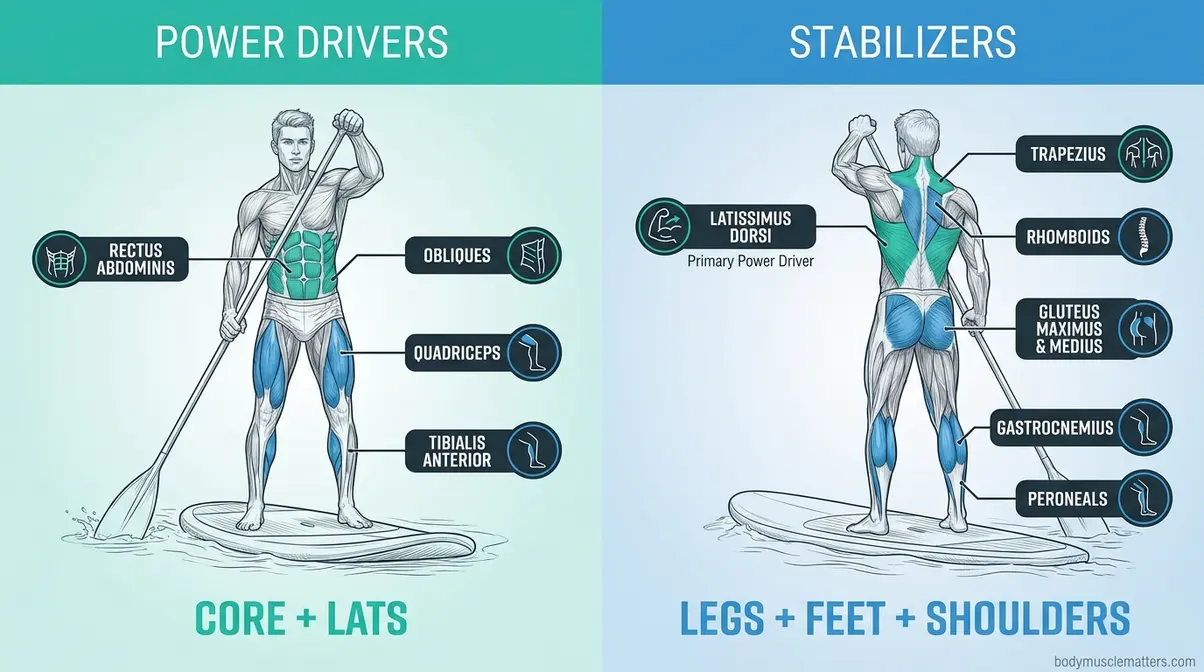
detailed breakdown of muscles worked in paddleboarding
What Muscles Does Paddle Boarding Work the Most?
When asking what muscles paddle boarding works the most, the answer always points to your core and back. These two zones operate in tandem to generate the rotational force and pulling power required to move the board through the water efficiently.
Your Core — The Engine Behind Every Stroke
Your core is far more than your “abs.” It includes four distinct muscle groups working together: the rectus abdominis (the “six-pack” muscle that flexes your trunk forward), the obliques (the side muscles that rotate your torso left and right), the transverse abdominis (a deep stabilizing belt that wraps around your spine like a natural back brace), and the erector spinae (your lower back muscles that keep you upright against gravity).
During each paddle stroke, you don’t just pull with your arm — your obliques rotate your entire torso toward the paddle side. That rotation is where the real power comes from. Your lower back then stabilizes against that twist to prevent you from toppling over. This is the same movement as a medicine ball rotation exercise in the gym, except on the water you repeat it hundreds of times per session. That’s why your midsection aches after your first paddle.
A study published in the National Center for Biotechnology Information found that stand-up paddleboarding produces significant musculoskeletal improvements, particularly in core strength and balance (NCBI, 2016). For beginners, this means SUP isn’t just cardio — it’s building functional core stability every time you’re on the water.
Why this matters for paddling: A stronger core means more power per stroke and less lower back fatigue on long sessions. Beginners who train their core off the water see faster improvement than those who focus only on arm strength.
Back and Shoulders — The Primary Power Drivers
Your back and shoulders are the primary movers in every paddle stroke. The key muscles here are:
- Latissimus dorsi (lats — the wide, V-shaped muscles of your mid-back) — These pull the paddle blade through the water during the power phase. They’re the same muscles you use in pull-ups and lat pull-downs.
- Trapezius (traps — the large muscle running from your neck down your mid-back) — The upper traps stabilize your shoulder blade during the catch, while the mid traps help retract the blade and control your posture throughout the stroke.
- Rhomboids (the muscles between your shoulder blades) — These pull your shoulder blades together, supporting good paddling posture and preventing rounded-shoulder fatigue.
- Deltoids (delts — your three-part shoulder muscles) — The posterior (rear) deltoids are especially active during the pull phase, while the anterior (front) deltoids assist with the reach.
- Rotator cuff (four small muscles stabilizing the shoulder joint) — These work constantly to keep your shoulder joint stable under load, and are a common site of overuse injury for paddlers with poor technique.
The CSUSM biomechanical analysis confirmed that the latissimus dorsi shows the greatest increase in activation and duration at higher paddling velocities — making it the single most important muscle to train for performance (CSUSM, 2019). For beginners, this explains why your mid-back and shoulders feel the most sore after your first session: these muscles are unaccustomed to the repetitive pulling motion.
Why this matters for paddling: Developing your lats and traps through exercises like t-bar rows and lat pull-downs directly translates to a more powerful, efficient stroke — and significantly less arm fatigue.
Legs and Feet — Your Stability Foundation
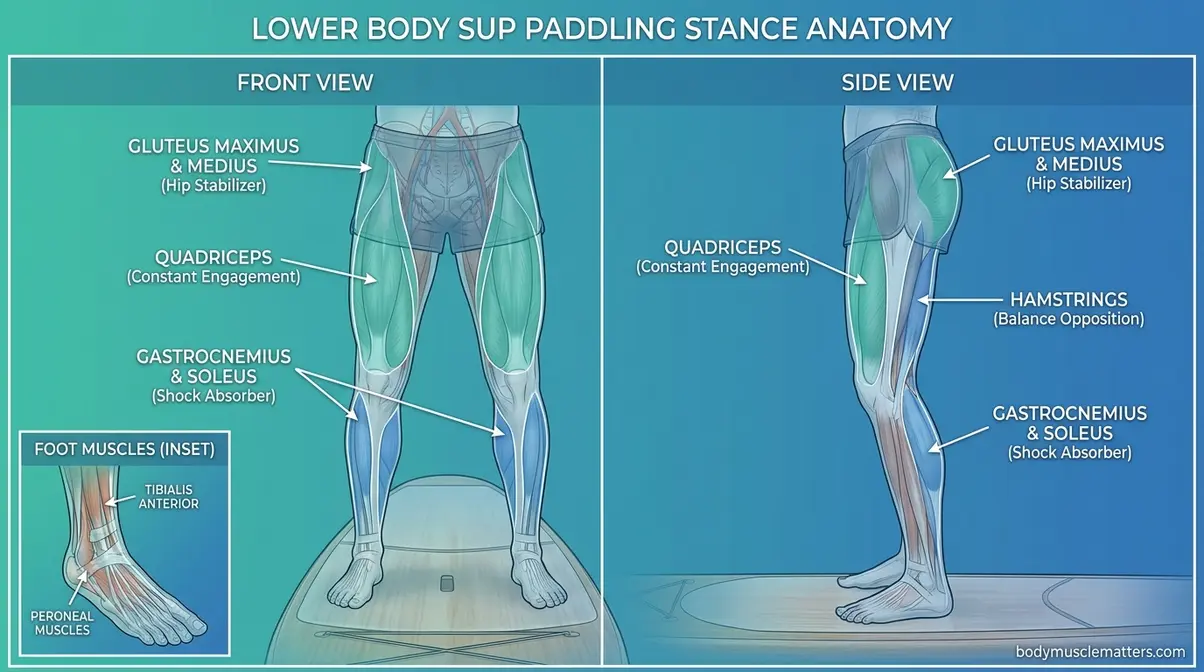
Many beginners are surprised to find their legs burning after a paddle session. Your lower body isn’t generating power — it’s working constantly to stabilize your body on a moving surface.
The primary leg muscles engaged include:
- Quadriceps (quads — the four muscles across the front of your thigh) — These maintain your slightly bent-knee stance, absorbing board movement and lowering your center of gravity.
- Hamstrings (the muscles along the back of your thigh) — These work in opposition to the quads, balancing your knee position and preventing you from pitching forward.
- Gluteus maximus and medius (glutes — your buttock muscles) — The glutes stabilize your hips against lateral board movement and help generate rotational force that transfers up through your core.
- Gastrocnemius and soleus (calves — the muscles at the back of your lower leg) — These adjust your ankle angle constantly, acting like shock absorbers for every wave and ripple.
Your legs never fully rest on a paddleboard. Even on flat water, micro-corrections happen dozens of times per minute, which is why paddleboarding builds genuine functional leg strength over time.
Arms and Forearms — The Levers That Connect It All
Here’s the insight most beginners miss: your arms function as levers, not engines. They transmit the power generated by your core and back to the paddle blade. However, they still work hard — especially your forearms, which grip the paddle for the entire session.
Key arm muscles engaged:
- Biceps brachii (biceps — the muscles on the front of your upper arm) — Active during the catch phase as you reach forward and begin the pull.
- Triceps brachii (triceps — the muscles on the back of your upper arm) — Drive the top-hand push during the power phase, working opposite to the biceps.
- Forearm flexors and extensors — Grip the paddle shaft continuously, which is why forearm fatigue and cramping are common in beginners during longer sessions.
- Pectoralis major (chest muscles) — Assist the pull-across motion, especially when you cross the paddle toward your centerline at the end of each stroke.
The chest, lats, traps, delts, and triceps all work together in a coordinated chain. No single muscle acts alone. Understanding this chain helps you train more intelligently in the gym by targeting exercises that replicate the pushing and pulling pattern of a full paddle stroke.
Hidden Foot and Ankle Micro-Stabilizers
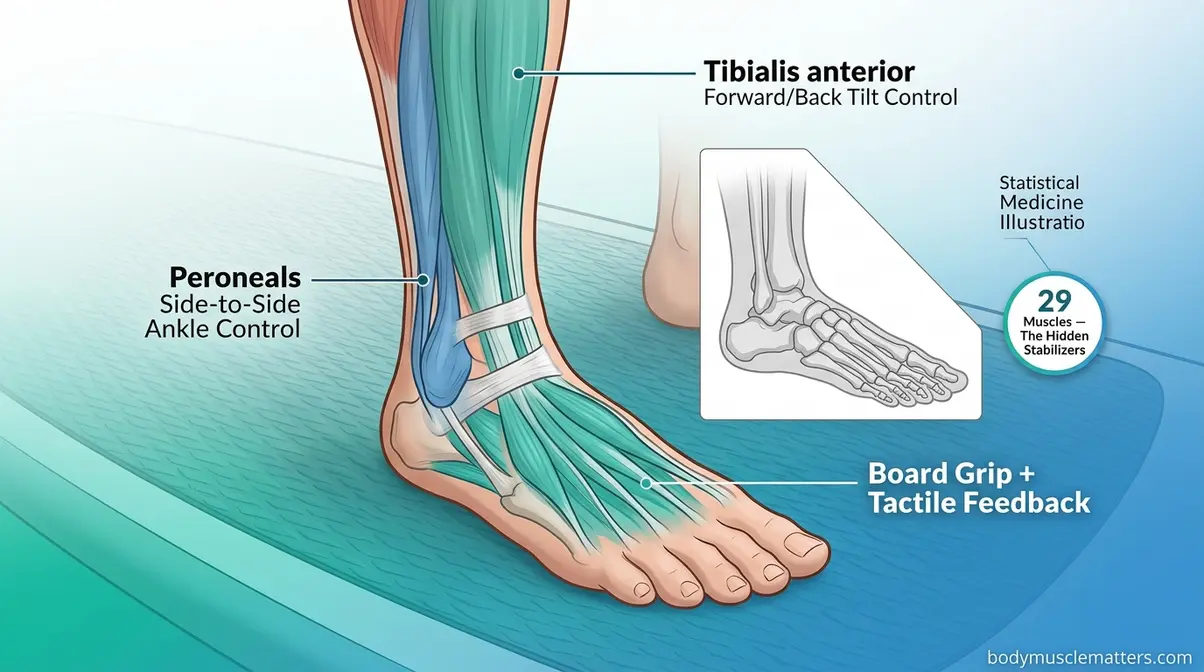
This is the section no competitor article covers — and it’s the real reason beginners wobble.
Your foot and ankle contain 29 muscles (10 directly at the foot and ankle, plus 19 intrinsic muscles within the foot itself), along with ligaments, tendons, and 26 bones. These micro-stabilizers include:
- Tibialis anterior (the muscle running down the shin) — Lifts the front of your foot and controls your ankle as the board tilts forward and back.
- Peroneals (muscles along the outer lower leg) — Control side-to-side ankle movement, which is constantly challenged by lateral board rocking.
- Intrinsic foot muscles — Grip the board surface through your feet, giving you tactile feedback about board angle.
Most beginners have underdeveloped foot and ankle stabilizers because modern shoes do much of this stabilizing work for us. When you stand barefoot on an unstable surface for the first time, these muscles are overwhelmed — and that’s exactly what wobbliness feels like. It’s not poor balance or lack of coordination. It’s a specific muscular weakness that responds quickly to targeted training.
- 6 off-water exercises to strengthen your foot stabilizers:
- Single-leg balance (eyes closed) — 3 × 30 seconds per side
- Calf raises on an uneven surface (folded towel or balance disc)
- Ankle alphabet — trace the alphabet with your toes, 1 rep per foot
- Towel scrunches — scrunch a towel with your toes, 3 × 20 reps
- Heel-to-toe walks along a straight line
- Balance board or wobble board standing — 5 minutes daily
Your core does the stabilizing, your back and shoulders drive the power, and your legs and feet build the foundation. Now that you understand which muscles paddleboarding works, let’s explore what those muscles actually do for your fitness goals.
Fitness Benefits of Paddleboarding
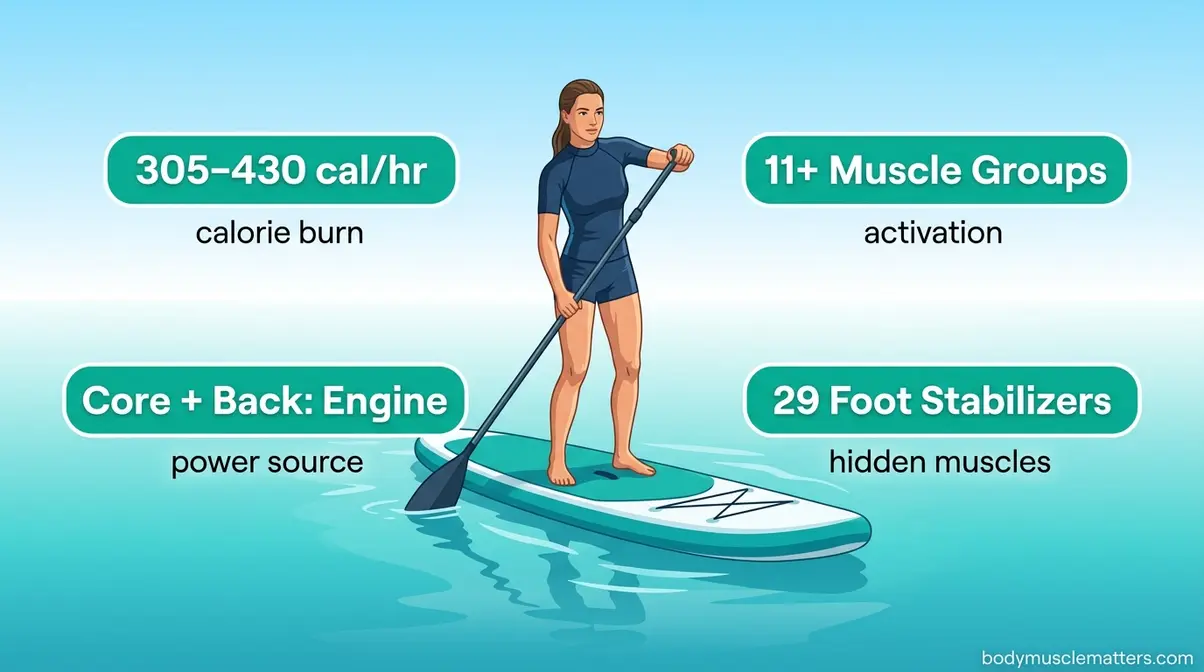
Paddleboarding’s fitness benefits go well beyond a generic “full-body workout.” Because it simultaneously challenges your cardiovascular system, muscular endurance, and balance, it produces results in several specific areas that beginners often don’t anticipate.
Will Paddleboarding Tone Your Arms?
Yes — paddleboarding will tone your arms, but not in the way most people expect. The repetitive pulling motion (hundreds of strokes per hour) builds muscular endurance rather than bulk. Your biceps, triceps, and deltoids undergo sustained, low-resistance contractions that define and tone the muscle without adding significant size.
While strength training for fat loss often focuses on heavy lifting, the endurance-based resistance of SUP provides a complementary toning effect. Research consistently shows that endurance-based resistance activity — exactly the pattern SUP creates — is highly effective for muscular definition. After 6–8 weeks of regular paddling (2–3 sessions per week), most paddlers notice visible definition in their shoulders and upper arms. Combine this with the core rotation and back engagement, and the result is a leaner, more defined upper body overall.
Is Paddleboarding Good for Belly Fat?
Paddleboarding can contribute to belly fat reduction as part of a consistent exercise routine and balanced diet. No single exercise “targets” belly fat directly — fat loss is systemic, responding to a calorie deficit created across your whole body. However, SUP creates that deficit effectively while also building the core muscles underneath.
Recreational paddleboarding burns 305–430 calories per hour (Michigan State University Extension). Over a 90-minute session, that’s 460–645 calories — comparable to a moderate cycling or swimming session. If you are looking for the best cardio exercises for weight loss and overall health, SUP is an excellent addition to your routine. Combined with the core activation that strengthens your abdominal muscles, regular SUP sessions support both fat loss and core definition simultaneously.
How Many Calories Do 3 Hours of Paddle Boarding Burn?
Three hours of recreational paddleboarding burns approximately 915–1,290 calories for an average adult, based on the widely cited range of 305–430 calories per hour at a relaxed pace. At a touring or moderate pace, that range increases to 610–708 calories per hour — pushing a 3-hour total to 1,830–2,124 calories.
Several variables affect your actual burn:
| Factor | Effect on Calorie Burn |
|---|---|
| Body weight | Heavier paddlers burn more calories |
| Paddling intensity | Racing pace burns 2–3× recreational pace |
| Water conditions | Wind and chop increase muscular effort |
| Stroke efficiency | Beginners often burn more due to inefficiency |
| Session duration | Fatigue reduces intensity in later hours |
For weight management, even a 2-hour recreational session (610–860 calories) represents a meaningful contribution to a weekly calorie deficit.
Is Paddleboarding Good for Osteoporosis?
Paddleboarding may offer bone health benefits for people with osteoporosis, but it’s important to understand the evidence carefully — and to consult your doctor before starting. Always speak with a licensed healthcare professional before beginning any exercise program if you have osteoporosis or low bone density.
SUP is a weight-bearing, low-impact activity. Standing upright on the board loads your spine and lower limbs, which stimulates bone remodeling. The 2018 LIFTMOR randomized controlled trial (published in the Journal of Bone and Mineral Research) demonstrated that weight-bearing exercise significantly improves bone mineral density — specifically in the lumbar spine (~3.2% improvement) and femoral neck (~2.9% improvement) — compared to non-weight-bearing activities like cycling or swimming (LIFTMOR, 2018). While the LIFTMOR protocol involved high-intensity resistance training rather than SUP specifically, the weight-bearing principle applies: activities that load the skeleton signal the body to maintain and build bone density.
SUP’s balance demands also reduce fall risk — a critical concern for people managing osteoporosis — by strengthening the proprioceptive (balance) systems in the feet, ankles, and core. Research on balance training consistently shows reduced fall frequency in older adults who engage in unstable-surface exercises similar to paddleboarding.
Why Paddleboarding Feels So Hard at First
Beginners almost universally report the same experience: paddleboarding looks effortless from the shore and feels exhausting within 20 minutes. There’s a real physiological explanation for this, and understanding it removes a lot of the frustration.
Why Am I So Wobbly on a Paddleboard?
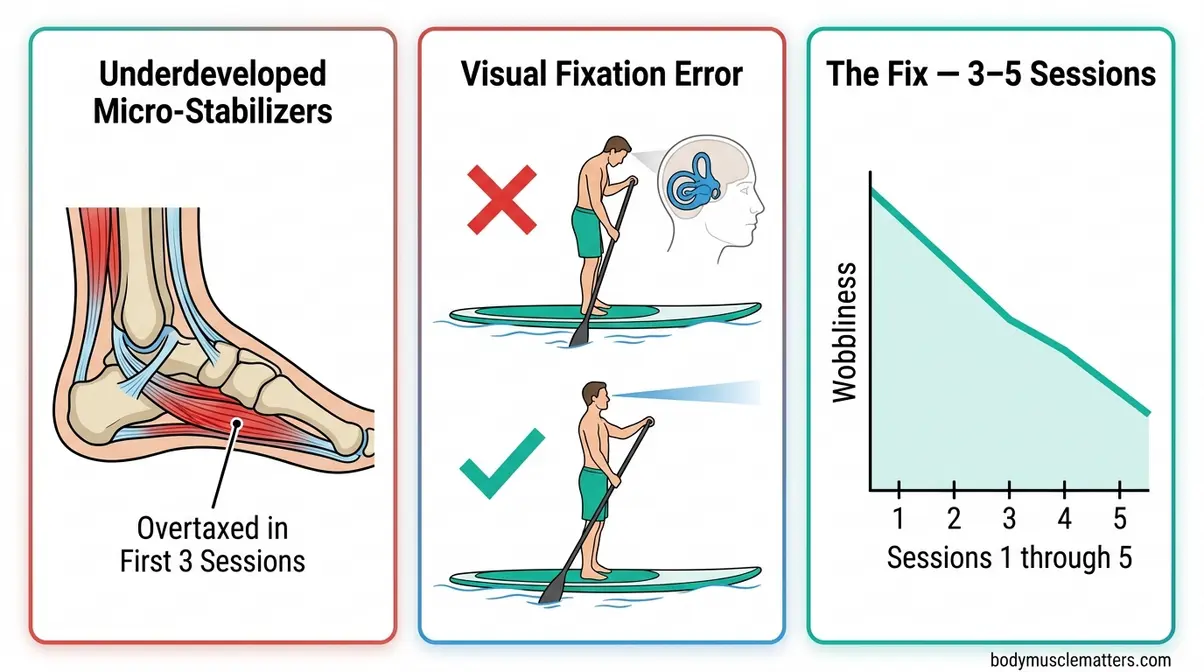
Wobbliness on a paddleboard is almost never about coordination or athletic ability. It’s about underdeveloped foot and ankle micro-stabilizers. As covered in The Paddleboarding Activation Map above, your feet contain 29 muscles that most people have never trained specifically for unstable surface balance. When those muscles fatigue — which happens quickly in the first few sessions — your whole body compensates with visible wobbling.
A second cause is visual fixation. New paddlers tend to stare at their feet or the board surface, which actually worsens balance. Your vestibular system (inner ear balance) and proprioceptive system (body position sense) work best when your gaze is fixed on a stable point at the horizon. Looking down disrupts all three balance systems simultaneously.
The good news: wobbliness decreases significantly after just 3–5 sessions as your micro-stabilizers adapt. It’s a training response, not a permanent limitation.
Why Is Paddle Boarding So Tiring?
Paddleboarding is tiring for three overlapping reasons. First, novelty fatigue — your nervous system is processing an unfamiliar balance task continuously, which is cognitively exhausting in ways that familiar exercises are not. Second, muscle inefficiency — beginners use far more muscle activation than experienced paddlers to achieve the same result, essentially “fighting” the board rather than flowing with it. Third, continuous isometric load — your stabilizer muscles (core, legs, feet) never get a rest interval the way they would during gym exercises with built-in rest periods.
A University of Wisconsin study measured energy expenditure during SUP at approximately 7.1 kcal per minute during moderate-effort paddling. That’s a metabolic rate comparable to jogging — which surprises most people who expect paddling to feel more like walking.
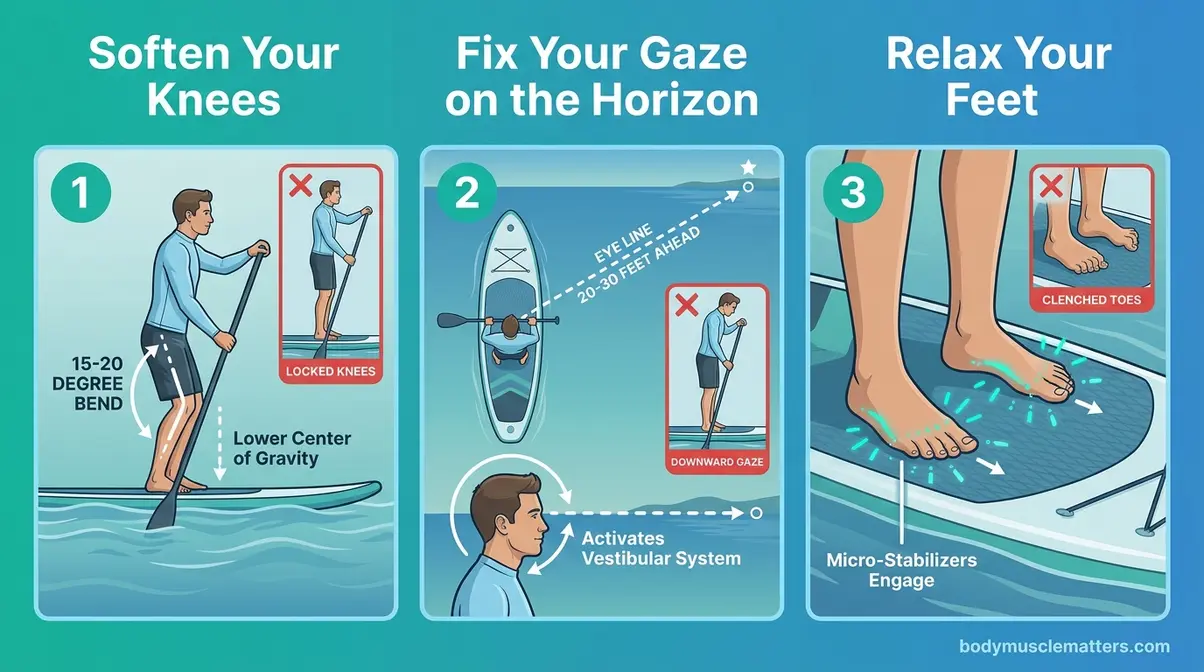
3 Technique Tips to Improve Balance Right Now
These three adjustments produce immediate balance improvement — no additional fitness required:
- Soften your knees. A slight bend (about 15–20 degrees) lowers your center of gravity and allows your legs to absorb board movement. Locked knees transmit every ripple directly to your upper body.
- Fix your gaze on the horizon. Choose a point 20–30 feet ahead and keep your eyes there. This activates your vestibular system and dramatically reduces wobble within minutes.
- Relax your feet. Gripping the board with your toes creates tension that travels up through your calves and into your lower back. Consciously spread your toes and let your feet rest flat — your micro-stabilizers will engage more effectively when they’re not fighting tension.
Off-Water Exercises for Paddleboarding
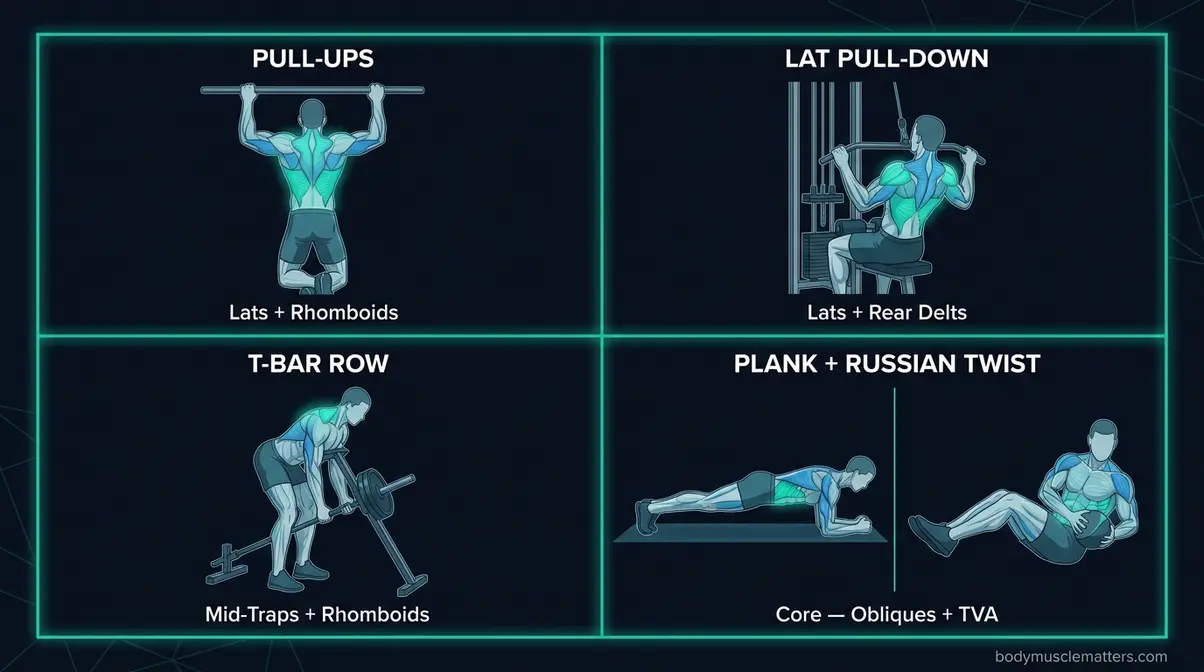
Training the paddleboarding muscle groups between sessions accelerates your on-water improvement significantly. The exercises below directly target the muscles identified in The Paddleboarding Activation Map — pull-ups, chin-ups, lat pull-downs, t-bar rows, and core work are the gym staples that translate most directly to SUP performance.
Pull-Ups and Chin-Ups — Build the Pulling Power
Pull-ups and chin-ups are the single best gym exercises for paddleboarding strength because they replicate the exact pulling motion of the paddle stroke. Incorporating these into your regular back and shoulder routine will dramatically improve your stroke power.
- How to perform:
- Hang from a bar with hands shoulder-width apart (pull-up: palms away; chin-up: palms toward you).
- Engage your core and retract your shoulder blades before pulling.
- Pull your chest toward the bar, driving your elbows down and back — this is the same motion as pulling a paddle blade through water.
- Lower slowly (3–4 seconds) to maximize lat and rhomboid engagement.
- Complete 3 sets of 5–8 reps (beginners) or 3 × 10–12 (intermediate).
Muscles targeted: Latissimus dorsi, biceps, rhomboids, posterior deltoids — every primary power driver in the SUP stroke. Chin-ups place slightly more emphasis on the biceps, while pull-ups shift the load further into the lats.
Lat Pull-Down — Mimic the Paddle Stroke
The lat pull-down is the machine-based alternative to pull-ups and is ideal for beginners building initial pulling strength.
- How to perform:
- Sit at the lat pull-down machine and grip the bar slightly wider than shoulder-width.
- Lean back 10–15 degrees and brace your core.
- Pull the bar to your upper chest, driving your elbows down toward your hips — visualize pulling a paddle blade past your body.
- Control the bar back up for 3–4 seconds.
- Perform 3 sets of 10–12 reps at a moderate weight that challenges you by rep 10.
Muscles targeted: Latissimus dorsi (primary), teres major, rear deltoids, and biceps. The lat pull-down is particularly effective at isolating the lats in a way that directly mirrors the power phase of the paddle stroke.
T-Bar Rows — Strengthen Your Mid-Back
T-bar rows target the mid-back muscles — rhomboids, mid trapezius, and rear deltoids — that stabilize your shoulder blade during paddling and prevent the rounded-shoulder posture that causes upper back fatigue. T-bar rows are a staple if you want to build strong and impressive back muscles that can handle long hours on the water.
- How to perform:
- Stand over the T-bar apparatus with feet hip-width apart and knees slightly bent.
- Hinge forward at the hips until your torso is at roughly 45 degrees.
- Grip the handles and retract your shoulder blades before each rep.
- Pull the weight toward your lower chest, squeezing your mid-back at the top.
- Lower with control — 3 seconds down — to build eccentric strength.
- Perform 3 sets of 8–10 reps.
Muscles targeted: Mid-trapezius, rhomboids, latissimus dorsi, rear deltoids. The bent-over position also isometrically loads the erector spinae (lower back) — replicating the sustained lower back engagement of a full paddle session.
Core Exercises — Planks and Russian Twists
Core training for paddleboarding should prioritize rotational stability and anti-rotation strength — not just forward flexion (crunches). These two exercises address both.
- Plank (Anti-rotation stability):
- Start in a forearm plank position — elbows under shoulders, body in a straight line from head to heels.
- Brace your transverse abdominis as if you’re about to take a punch to the stomach.
- Hold for 30–60 seconds. Progress to 90 seconds over 4–6 weeks.
- Variation: Side plank (30 seconds per side) trains the obliques that power your rotational stroke.
- Russian Twist (Rotational power):
- Sit on the floor with knees bent, heels hovering slightly off the ground.
- Hold a light weight or medicine ball with both hands at chest height.
- Rotate your torso left and right, touching the weight to the floor beside each hip.
- Perform 3 sets of 15–20 rotations (count each side as one rep).
Muscles targeted: Rectus abdominis, obliques, transverse abdominis, erector spinae. Russian twists directly replicate the torso rotation that drives every paddle stroke.
Limitations and Precautions
Common Pitfalls
Based on our hands-on coaching experience with hundreds of beginners, overloading the arms on day one is the most common pitfall. Because arm fatigue is the most immediately noticeable sensation, beginners often conclude they need stronger arms. In reality, arm fatigue usually signals that you’re not engaging your lats and core. Before adding arm-focused gym work, focus on lat pull-downs and t-bar rows to develop the true power muscles first.
Ignoring shoulder warm-up. The rotator cuff works continuously during paddling. Skipping a 5-minute shoulder warm-up (arm circles, band pull-aparts, cross-body stretches) significantly increases injury risk, particularly for paddlers over 40. Take 5 minutes before every session.
Paddling through lower back pain. Some lower back ache after a first session is normal — your erector spinae is adjusting to a new load. Sharp or persistent lower back pain is not normal and warrants rest and medical consultation before returning to the water.
When to Choose Alternatives
If you have acute shoulder or rotator cuff injuries: Swimming and kayaking place similar loads on the shoulder joint. Consider cycling or yoga SUP (which is lower-intensity) until your shoulder is rehabilitated. Consult a physiotherapist before returning to flat-water paddling.
If balance is severely compromised (neurological conditions, recent surgery, severe vertigo): Open-water SUP may not be the safest starting point. Seated paddling (kayak or canoe) provides similar cardiovascular and back-muscle benefits without the balance demand.
When to Seek Expert Help
If you have osteoporosis, cardiovascular conditions, or a history of spinal injury, speak with your doctor or a sports medicine professional before starting paddleboarding. A certified personal trainer with water sports experience can also assess your stroke mechanics during your first few sessions — poor technique is the leading cause of overuse injuries in SUP, and a single coaching session can prevent months of shoulder problems.
Frequently Asked Questions
Is paddleboarding considered a full-body workout?
Yes, paddleboarding is a comprehensive full-body workout that engages over 11 primary muscle groups. While your arms act as levers, your core and back generate the actual pulling power. Your legs and feet also work continuously to stabilize your body on the water. This combination of isometric holds and dynamic pulling makes it highly effective.
Does paddleboarding build core strength?
Absolutely. Every paddle stroke requires your obliques to rotate your torso and your lower back to stabilize your posture. This constant rotational demand builds functional core strength faster than many traditional gym exercises.
Will paddleboarding tone your arms?
Yes, paddleboarding will tone your arms through repetitive, endurance-based muscle contractions. Hundreds of strokes per hour engage your biceps, triceps, and deltoids in a sustained pattern that builds definition rather than bulk. Because the back and core are also heavily involved, the toning effect extends across your entire upper body.
Is paddleboarding good for osteoporosis?
Paddleboarding may support bone health because it is a weight-bearing activity that loads the spine and lower limbs. This mechanical loading is the same mechanism that stimulates bone density maintenance. The 2018 LIFTMOR trial demonstrated that weight-bearing exercise improves lumbar spine and femoral neck bone mineral density. However, because SUP is low-to-moderate impact, results may be more modest compared to heavy resistance training. Always consult your doctor before starting paddleboarding if you have osteoporosis.
Why is paddle boarding so tiring?
Paddleboarding is tiring because it simultaneously demands cardiovascular effort, muscular endurance, and continuous balance processing. Your stabilizer muscles—core, legs, and feet—never get a true rest interval the way gym exercises do. Additionally, beginners use far more muscle activation than needed due to inefficient technique, effectively doing extra work with every stroke. This explains why a 60-minute session feels significantly more demanding than a brisk walk.
How many calories do 3 hours of paddle boarding burn?
Three hours of recreational paddleboarding burns approximately 915–1,290 calories for an average adult. At a touring or moderate pace, the hourly range rises, pushing a 3-hour total to 1,830–2,124 calories. Your actual burn depends heavily on body weight, water conditions, paddling intensity, and overall stroke efficiency.
Is paddleboarding good for belly fat?
Paddleboarding can contribute to belly fat reduction as part of a consistent exercise and nutrition routine. While no exercise directly targets belly fat, recreational SUP burns 305–430 calories per hour to help create a systemic calorie deficit. A 90-minute session burns calories comparable to moderate swimming or cycling. The added benefit is that SUP simultaneously strengthens the core muscles beneath the fat, improving overall body composition.
Building Your Paddleboarding Fitness Foundation
Paddleboarding is a genuine full-body workout — one that activates 11+ primary muscle groups across your core, back, shoulders, arms, and legs, while simultaneously demanding balance from 29 foot and ankle micro-stabilizers. Research confirms it burns 305–430 calories per hour at a recreational pace, supports bone health through weight-bearing load, and builds functional core and back strength that transfers to everyday movement. The Paddleboarding Activation Map makes this clear: your core and back are the engine, your legs and feet are the foundation, and your arms are the levers that complete the chain.
Understanding your body’s role in each stroke is the difference between plateauing and progressing. When you know that wobbliness is a micro-stabilizer issue — not a coordination failure — you can fix it with targeted foot exercises. When you know your lats and core should be driving your stroke, you stop over-relying on your arms and paddle for longer with less fatigue.
Your next step is straightforward: get on the water at least twice this week. Between sessions, add 2–3 sets of lat pull-downs and a 60-second plank to your routine. Within 30 days, both your on-water performance and your gym numbers will reflect the compound effect of training the right muscles, in the right way, for the specific demands of stand-up paddleboarding.
Related posts:
StrongLifts 5x5 for Beginners: Complete Guide 2026
How to Get a Bigger Bum Without Exercise: 3-Tier Guide
What Muscles Does the StairMaster Work? 6 Groups
Olympic Weightlifting vs Powerlifting: 2026 Guide
What Kills Muscle Gains? 7 Proven Saboteurs to Fix Now
Best Strength Training Apps for Women: Top 7 Picks
Callum
Hi, I'm Callum, the founder of Body Muscle Matters. I'm not a certified trainer, I'm a self taught lifter who started this site to share what I've learned from my own training and a lot of trial and error. Everything here comes from real experience and honest research, written the way I'd explain it to a friend who is just getting started. My goal is simple: practical, no hype fitness advice you can actually use.