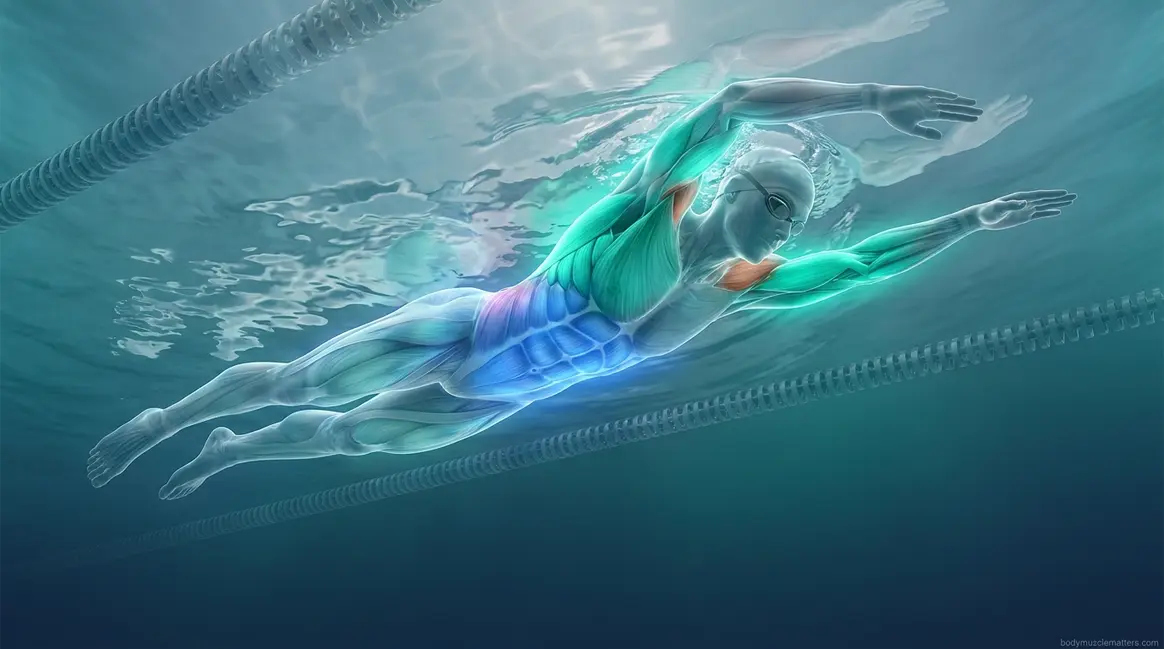
Muscles Used in Freestyle Swimming: The Real Breakdown
Most swimmers finish a lap feeling their shoulders burning — but they couldn’t name a single muscle responsible. That gap between effort and understanding is exactly what holds most swimmers back from improving their stroke.
Without knowing which muscles drive your freestyle, you can’t train them deliberately. You can’t protect them from overuse. And you can’t fix the technique faults that quietly build into swimmer’s shoulder over weeks and months. You’re essentially swimming blind.
This guide changes that. You’ll learn exactly which muscles are used in freestyle swimming, how they activate across every phase of your stroke, and how to train each one with 8 targeted dryland exercises. To build this guide, our team reviewed biomechanical studies from the National Institutes of Health, electromyographic (EMG) research published in PubMed, and coaching resources from U.S. Masters Swimming (USMS). We’ll cover the key muscle groups, break down activation phase by phase, compare freestyle to other strokes, and flag the injury risks that most guides ignore.
Freestyle swimming is a full-body workout — your upper body generates over 70% of propulsive force while your core and legs provide the stability that makes that power possible (PMC, 2026).
- Lats and deltoids are the primary propulsive muscles, powering the pull and push phases of every stroke
- The rotator cuff stabilizes your shoulder joint through 12+ distinct muscle activations per stroke cycle (PubMed, 1992)
- Your core (abs, obliques, erector spinae) controls body rotation and prevents energy-wasting drag
- The Freestyle Power Chain — from catch to recovery — is the sequential activation pattern that separates efficient swimmers from tired ones
- 8 targeted dryland exercises in this guide train each link in the chain for injury prevention and speed
No products found.
No products found.
No products found.
What Muscles Are Used in Freestyle Swimming?
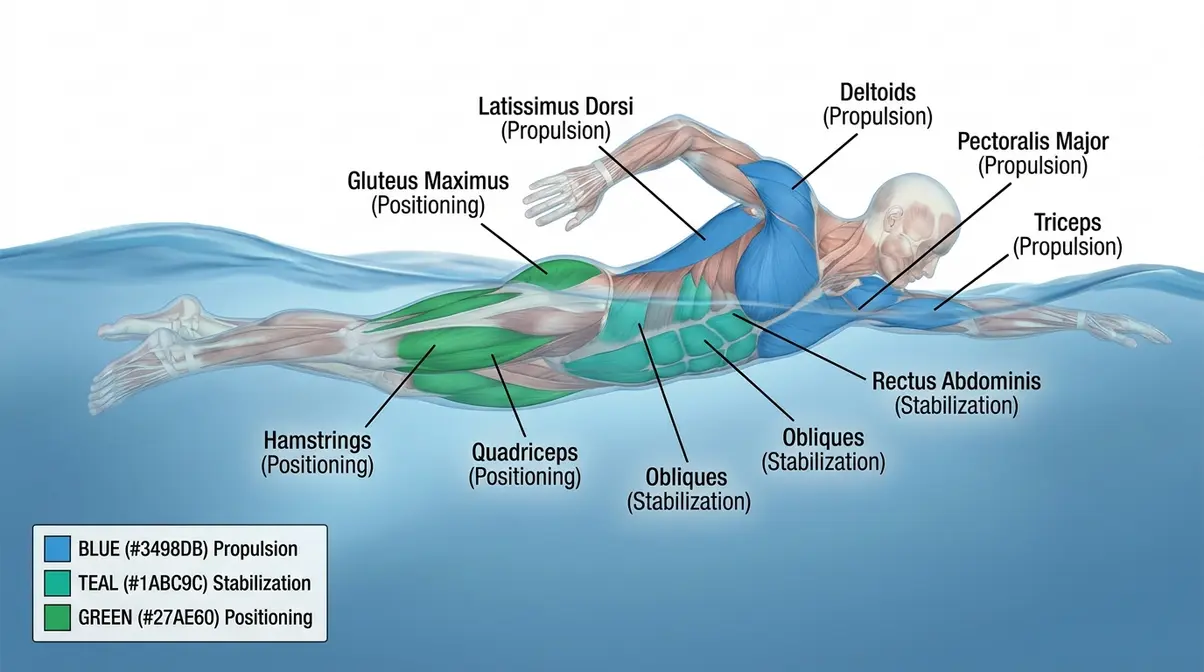
Freestyle swimming recruits muscles across your entire body — but not all of them equally. Biomechanical research published in PMC (2026) confirms that over 70% of total propulsive force in front crawl originates from upper-limb action, with your core and legs providing the stability platform that lets that force translate into forward speed. Understanding the primary muscles used in freestyle swimming and their distribution helps you train smarter, not just harder.
Think of it as a chain. Your large back and shoulder muscles generate the raw power. Your core links that power to your body rotation. Your legs maintain your horizontal position in the water. Every link matters — and a weak link anywhere costs you speed and increases injury risk.
The Upper Body: Your Primary Propulsion Engines
Your upper body is the engine room of your freestyle stroke. The key players are:
Latissimus dorsi (lats) — the large, wing-shaped muscles spanning your mid-to-lower back. These are your single biggest propulsive muscles. They drive your arm from the catch position all the way through the pull and push phases, pulling your body forward through the water.
Deltoids — the three-headed muscle capping your shoulder. The anterior (front) deltoid fires during the entry and early catch. The posterior (rear) deltoid activates during recovery. Why this matters: weak or imbalanced deltoids are a primary cause of poor hand entry and stroke inefficiency.
Pectoralis major (pecs) — your chest muscle. It works alongside the lats during the pull phase, adding inward force as your arm crosses your body’s centerline. Think of it as the lats’ supporting partner.
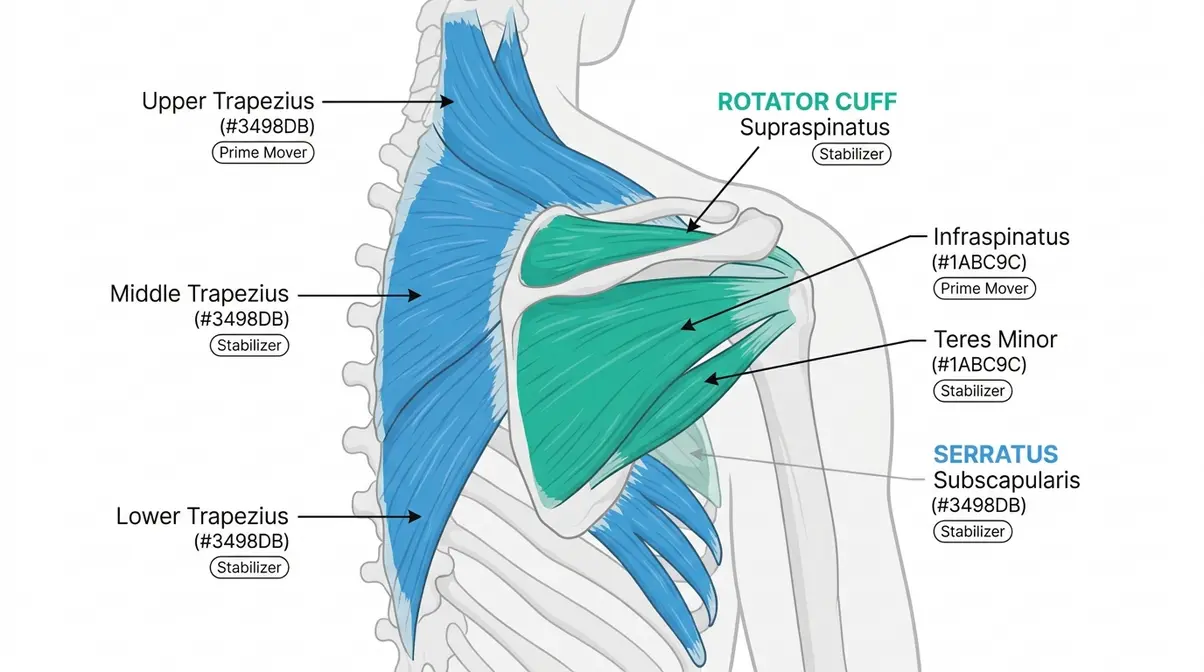
Rotator cuff — a group of four muscles (supraspinatus, infraspinatus, teres minor, subscapularis) that stabilize your shoulder joint. An EMG analysis published in PubMed (1992) identified 12+ distinct muscle activations per stroke cycle at the shoulder alone. The rotator cuff doesn’t generate big propulsive force — but it keeps your shoulder joint centered and safe during every single stroke.
Triceps — the muscle on the back of your upper arm. It straightens your elbow during the push phase, adding the final thrust at the end of each pull. Many beginner swimmers lose power here by bending the elbow too early.
As one swimmer’s anatomy resource describes it:
“The swimmer engages their shoulder muscles (deltoids and rotator cuff), the middle back muscles (trapezius) and the muscles around their rib cage (serratus anterior)…”
This description captures the layered nature of upper-body muscle recruitment in freestyle — it’s never just one muscle working alone. The physio-pedia resource on freestyle swimming provides a useful clinical breakdown of these activation patterns for readers who want to explore further.
The Core: Your Stroke’s Stabilizing Foundation
Your core is the often-overlooked middle link in The Freestyle Power Chain. It doesn’t pull you through the water directly — but without it, your upper body power leaks away into wasted body roll and drag.
The key core muscles in freestyle include:
Rectus abdominis — your “six-pack” muscles. They resist excessive arching of your lower back, keeping your body flat and streamlined in the water.
Obliques (internal and external) — these muscles control your body rotation. In freestyle, your body should rotate roughly 45–60 degrees side to side with each stroke. Your obliques drive that rotation. Without strong obliques, your rotation becomes either too flat (losing power) or too excessive (creating drag).
Erector spinae — the long muscles running parallel to your spine. They maintain your back’s neutral position and prevent your hips from sinking — the single biggest drag-creator for beginner swimmers.
Serratus anterior — the finger-like muscles wrapping around your ribcage. They stabilize your shoulder blade (scapula) against your ribcage during the catch phase. Weak serratus anterior muscles are directly linked to shoulder impingement in swimmers.
Strong core muscles reduce drag by keeping your body in a streamlined position. They also protect your lower back from the repetitive rotational forces generated by thousands of strokes per training session.
The Lower Body: Balance and Supplemental Drive
Your legs play a supporting role in freestyle — but an important one. The flutter kick contributes roughly 10–30% of forward propulsion (with the higher end seen in sprinters), while its primary function is maintaining your body’s horizontal alignment.
Quadriceps (quads) — the large muscles on the front of your thigh. They power the downward kick, the propulsive phase of the flutter kick.
Hamstrings — the muscles on the back of your thigh. They control the upward recovery of your leg after the downward kick.
Glutes (gluteus maximus and medius) — your hip muscles. They stabilize your hip position and contribute to the power of the downward kick. Weak glutes often show up as sinking hips — a dead giveaway in beginner swimmers.
Hip flexors — these muscles lift your leg for the upward kick phase. Tight hip flexors (common in people who sit at desks all day) can restrict kick range and cause hip sinking.
A common beginner mistake: trying to kick harder to go faster. Research from USMS coaching resources shows that an efficient six-beat kick (six kicks per arm cycle) is primarily about balance and body position — not propulsion. For most recreational swimmers, a relaxed, ankle-driven flutter kick is far more efficient than a forceful, knee-driven kick.
Does freestyle swimming build muscles?
Yes — freestyle swimming builds functional muscle across your back, shoulders, chest, and core. The resistance of water provides constant load on your muscles throughout every stroke, stimulating hypertrophy (muscle growth) in the lats, deltoids, and pecs particularly. Research suggests that regular swimming builds lean muscle mass and improves muscular endurance more effectively than many land-based cardio activities. However, because water supports your body weight, swimming builds less lower-body muscle than running or cycling — for leg-focused development, combine swimming with dryland strength training.
Freestyle Muscle Groups: Upper, Core, and Legs
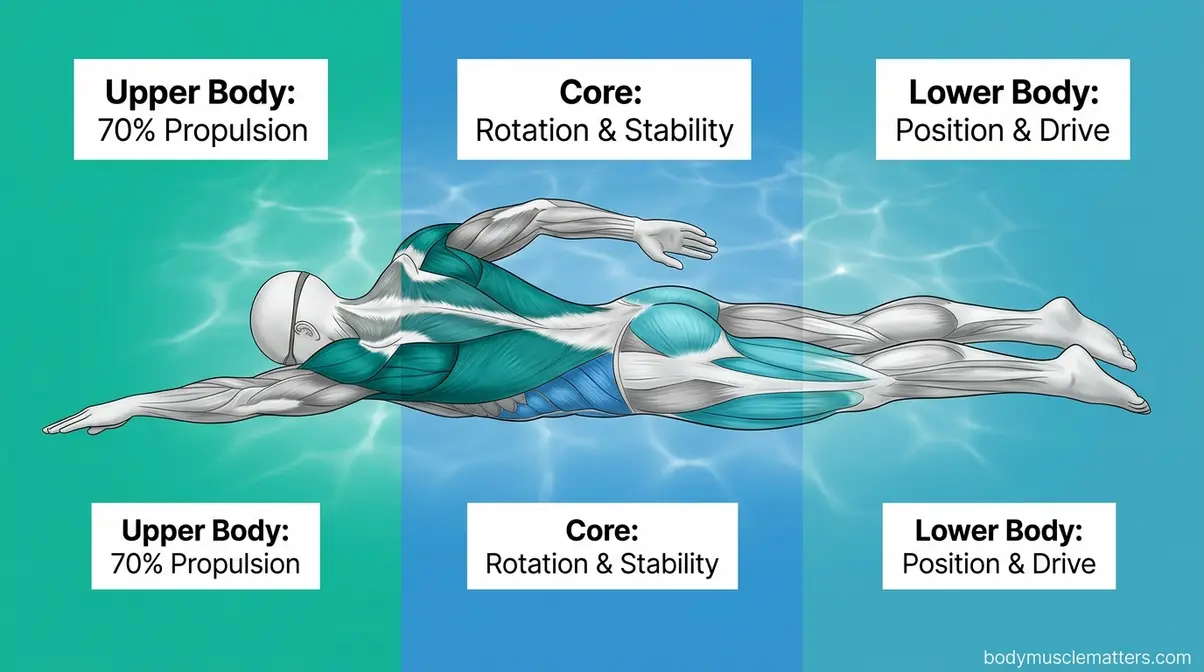
Now that you understand the overall picture, let’s go deeper into each region. This is where you’ll find the specific detail you need to understand your training and protect your body.
Shoulder Muscles Used in Freestyle Swimming
The shoulder is the most complex — and most vulnerable — joint in freestyle. Understanding the shoulder muscles used in freestyle swimming helps you both maximize power and avoid the most common swimming injury.
The primary shoulder movers:
- Anterior deltoid: Drives arm entry and early catch. Fires hard as your hand enters the water in front of your head.
- Posterior deltoid: Controls arm recovery above the water. Pulls your elbow high during the recovery phase.
- Subscapularis (rotator cuff): Internally rotates your arm during the pull — the most powerful rotator cuff muscle in freestyle.
- Infraspinatus and teres minor (rotator cuff): Externally rotate and stabilize the shoulder during recovery and entry.
- Supraspinatus (rotator cuff): Holds your upper arm bone (humerus) in the shoulder socket throughout every phase.
The shoulder stabilizers:
- Trapezius (upper, middle, lower): Controls your shoulder blade position. The middle and lower trapezius are critical for scapular stability — and they’re typically undertrained in swimmers.
- Serratus anterior: Protracts (pushes forward) your shoulder blade during the catch. EMG studies show that swimmers with shoulder pain display significantly altered serratus anterior activation patterns compared to pain-free swimmers (PubMed, 2026).
- Rhomboids: Retract the shoulder blade during recovery. Weak rhomboids contribute to rounded-shoulder posture that worsens stroke mechanics.
Why this matters for injury prevention: Research published in NIH PMC (2026) found that shoulder pain affects 47–52% of competitive swimmers at some point in their careers. The pull-through phase — when shoulder impingement risk is highest — accounts for a significant portion of the stroke cycle. Understanding which muscles stabilize your shoulder during this phase is the first step toward protecting it.
Core Muscles — The Hidden Power Source
Your core is The Freestyle Power Chain’s most underappreciated link. Most swimmers train their lats and deltoids. Few deliberately train the core muscles that allow those larger muscles to work efficiently.
The full core picture in freestyle:
| Core Muscle | Primary Role in Freestyle | What Happens Without It |
|---|---|---|
| Rectus abdominis | Resists lower back arch | Hips sink, drag increases |
| External obliques | Drive body rotation right | Flat stroke, lost power |
| Internal obliques | Drive body rotation left | Flat stroke, lost power |
| Erector spinae | Maintain spinal extension | Hunched position, drag |
| Serratus anterior | Stabilize shoulder blade | Shoulder impingement risk |
| Transverse abdominis | Intra-abdominal pressure | Unstable torso, energy leak |
The transverse abdominis (TVA) deserves special mention. It’s the deepest abdominal muscle — think of it as a corset wrapping your midsection. It creates the intra-abdominal pressure that makes your torso rigid. A rigid torso transfers power from your arm pull directly into forward momentum. A soft torso absorbs that power like a wet sponge.
How to know if your core is the weak link: If your hips sink progressively during a long set, or if you feel your lower back tightening after 400+ meters, your core endurance is limiting your stroke — not your fitness or arm strength.
Leg Muscles Used in Freestyle Swimming
The leg muscles used in freestyle swimming are often misunderstood. Many beginners either kick too hard (wasting energy) or barely kick at all (losing body position). The truth lies in understanding what the flutter kick is actually for.
The flutter kick breakdown:
- Downbeat (propulsive phase):
- Quadriceps extend the knee, driving the foot downward
- Hip flexors (iliopsoas) initiate the leg lift for the next downbeat
- Glutes stabilize the hip throughout
- Upbeat (recovery phase):
- Hamstrings flex the knee, bringing the heel upward
- Glutes continue hip stabilization
- Ankle plantar flexors (calf muscles) point the foot for reduced drag
The ankle factor: Ankle flexibility is a major determinant of kick efficiency. Swimmers with stiff ankles — common in runners who transition to swimming — generate significantly more drag during the kick. Flexible ankles allow the foot to act like a fin, producing forward force rather than braking force.
Training insight: For distance freestyle, a two-beat kick (two kicks per arm cycle) conserves energy by reducing leg fatigue. For sprinting, a six-beat kick adds propulsion. Most recreational swimmers benefit from practicing both — knowing when to switch is a key skill.
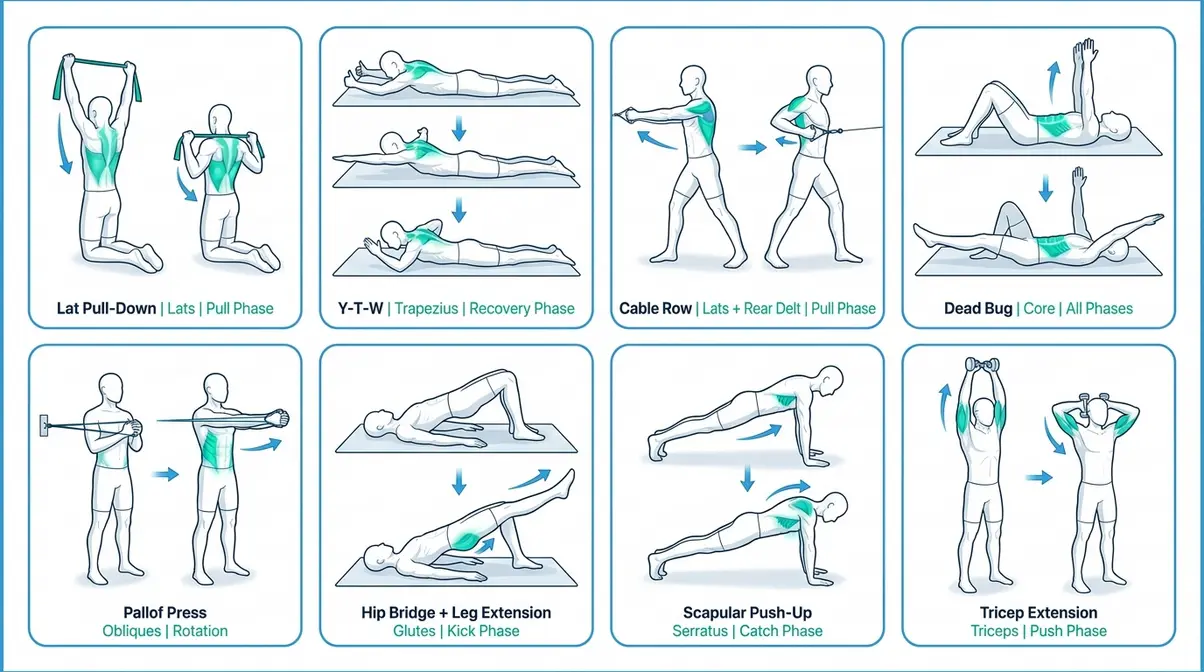
8 Dryland Exercises to Strengthen Your Freestyle Muscles
These 8 exercises target every link in The Freestyle Power Chain. Competitors’ guides average just 2 dryland exercises. This is the comprehensive approach your stroke deserves.
Perform this circuit 2–3 times per week on non-consecutive days. Start with 2 sets of 10–12 reps for each exercise before progressing.
Exercise 1: Lat Pull-Down (or Resistance Band Pull-Down)
Targets: Latissimus dorsi, teres major
- Attach a resistance band to a high anchor point (or use a lat pull-down machine)
- Grip the band with both hands, shoulder-width apart, palms facing away from you
- Sit or kneel with your chest tall and your core braced
- Pull your hands down toward your upper chest, driving your elbows toward your hips — mimic the pull phase of your stroke
- Slowly return to the start position over 3 seconds
Why this matters: Your lats are your single biggest propulsive muscle. Strengthening them directly translates to a more powerful pull phase.
Exercise 2: Prone Y-T-W (Shoulder Stability Trio)
Targets: Lower trapezius, middle trapezius, rhomboids, posterior deltoid
- Lie face-down on a mat or stability ball, arms hanging toward the floor
- Raise both arms into a “Y” shape (thumbs up) — hold 2 seconds, lower slowly. That’s one rep.
- Raise both arms into a “T” shape (thumbs up) — hold 2 seconds, lower slowly.
- Raise both arms into a “W” shape (elbows bent, thumbs back) — hold 2 seconds, lower slowly.
- Complete all three positions for 1 set
Why this matters: The middle and lower trapezius are chronically undertrained in swimmers. Strengthening them directly counteracts the muscle imbalances that cause swimmer’s shoulder.
Exercise 3: Single-Arm Cable Row (Freestyle Pull Simulation)
Targets: Latissimus dorsi, rhomboids, posterior deltoid, biceps
- Set a cable machine to chest height (or anchor a resistance band at chest level)
- Stand sideways to the anchor, feet shoulder-width apart
- Reach forward with your outside arm and grip the cable
- Pull your elbow back past your hip in a straight line — mimicking the pull-through phase of your stroke
- Rotate your torso slightly toward the anchor as you pull (simulating body rotation)
- Return slowly and repeat
Why this matters: This exercise trains the pull motion in a position that closely mirrors your actual stroke mechanics — including the body rotation component.
Exercise 4: Dead Bug (Core Anti-Rotation)
Targets: Transverse abdominis, rectus abdominis, obliques
- Lie on your back with your arms pointing toward the ceiling and your knees bent at 90 degrees (tabletop position)
- Brace your core firmly — press your lower back into the floor
- Slowly lower your right arm overhead and your left leg toward the floor simultaneously
- Stop just before your lower back lifts off the floor
- Return to start, then repeat on the opposite side (left arm, right leg)
Why this matters: The dead bug trains your core to resist unwanted movement — exactly what it must do during each arm pull to prevent energy leaking into body sway.
Exercise 5: Pallof Press (Anti-Rotation Core Stability)
Targets: Obliques, transverse abdominis, erector spinae
- Anchor a resistance band at chest height
- Stand sideways to the anchor, feet shoulder-width apart
- Hold the band at your chest with both hands
- Press your hands straight out in front of you — resist the band’s pull to the side
- Hold for 2 seconds, then return to your chest
- Complete all reps facing one direction, then switch sides
Why this matters: This exercise directly trains your obliques to control body rotation — the same job they perform during every freestyle stroke cycle.
Exercise 6: Hip Bridge with Leg Extension (Kick Strength)
Targets: Glutes, hamstrings, hip flexors
- Lie on your back with knees bent and feet flat on the floor
- Drive your hips toward the ceiling into a bridge position
- Hold the bridge and extend your right leg straight out, parallel to the floor
- Hold 2 seconds, return the foot to the floor, then lower your hips
- Alternate legs each rep
Why this matters: Strong glutes maintain your hip position in the water. This exercise specifically trains the hip stability needed for an efficient flutter kick.
Exercise 7: Scapular Push-Up (Serratus Anterior Activation)
Targets: Serratus anterior, lower trapezius
- Start in a standard push-up position (or modified on your knees)
- Keep your arms completely straight throughout this exercise
- Let your chest sink toward the floor by pinching your shoulder blades together
- Then push the floor away, spreading your shoulder blades wide — feel your ribcage rise
- That spreading motion is your serratus anterior working
Why this matters: The serratus anterior stabilizes your shoulder blade during the catch phase. EMG research shows altered serratus activation in swimmers with shoulder pain (PubMed, 2026) — this exercise specifically targets that weakness.
Exercise 8: Tricep Overhead Extension (Push-Phase Finisher)
Targets: Triceps brachii (long, lateral, and medial heads)
- Hold a dumbbell or resistance band overhead with both hands
- Keep your upper arms close to your head, elbows pointing forward
- Lower the weight behind your head by bending your elbows
- Press back to the start position by straightening your elbows
Why this matters: Your triceps complete the push phase — the final thrust of each arm pull. Many swimmers lose 15–20% of their stroke’s power by bending the elbow too early and cutting the push phase short.
Muscle Activation Across the 4 Phases of the Freestyle Stroke
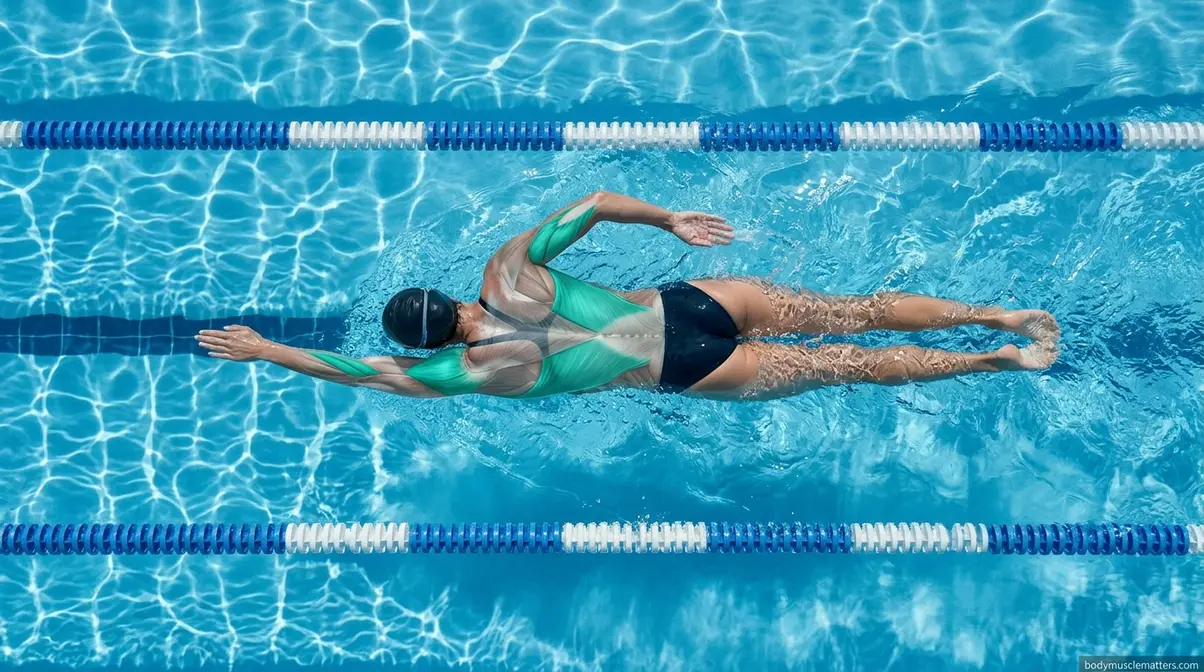
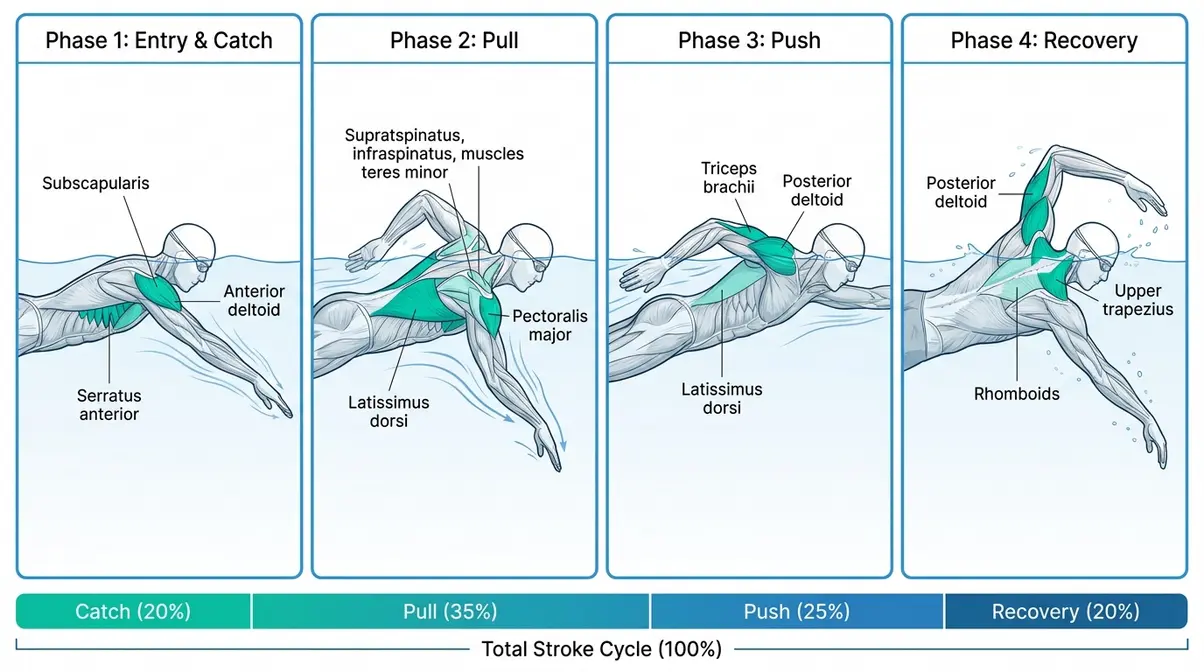
Understanding the muscles used in freestyle swimming becomes far more actionable when you map them to your actual stroke. The Freestyle Power Chain isn’t a single simultaneous contraction — it’s a precise sequence of activations that flows through four distinct phases. Knowing this sequence lets you identify exactly where your stroke is breaking down.
Phase 1 — The Entry and Catch
The entry and catch phase begins the moment your hand enters the water and ends when your arm reaches maximum reach forward. This phase sets up everything that follows — a poor catch makes an efficient pull impossible.
Muscles firing:
- Serratus anterior: Protracts your shoulder blade forward, extending your reach
- Anterior deltoid: Controls the angle of your hand entry
- Subscapularis: Internally rotates your arm into the catch position
- Core (obliques, TVA): Stabilizes your torso as your body rotates toward the entering arm
The critical biomechanical event here is the stretch-shortening cycle in your lats. As your arm reaches forward at full extension, your lats are stretched under tension. Like a loaded spring, they store elastic energy that dramatically amplifies the force of your pull. This is why reaching long into your catch — rather than shortening your stroke — generates more power with less muscular effort.
A clinical study published in PubMed (1992) identified distinct EMG activation patterns across the shoulder girdle during the catch phase, confirming that the shoulder stabilizers must fire before the prime movers can generate safe, effective force. In practical terms: if your shoulder stabilizers (rotator cuff, serratus anterior) are weak or fatigued, your catch mechanics deteriorate — and injury risk rises.
Phase 2 — The Pull
The pull phase is the primary power-generating phase of your stroke. It runs from maximum catch depth through to your arm reaching a position directly beneath your shoulder.
Muscles firing (in sequence):
- Latissimus dorsi — initiates the pull, driving your elbow back and down
- Pectoralis major — adds adduction force as your arm crosses toward your body’s midline
- Anterior deltoid — contributes to arm depression through the pull arc
- Biceps brachii — maintains elbow bend at approximately 90 degrees for optimal force application
- Rotator cuff (all four muscles) — stabilizes the shoulder joint continuously throughout
Research published in NIH PMC (PMC3438875) found that shoulder pain affects 47–52% of elite swimmers and 27% of recreational swimmers — with the pull phase representing the period of highest impingement risk. The reason: at maximum shoulder internal rotation (which occurs mid-pull), the supraspinatus tendon passes through a narrow space beneath the acromion bone. Fatigue or poor mechanics compress this space further.
The 14.4% impingement window: Biomechanical analysis indicates that a meaningful portion of the freestyle stroke cycle places the shoulder in a position where impingement is possible. This is not a reason to avoid swimming — it’s a reason to train your rotator cuff stabilizers deliberately so they can protect that space under fatigue.
Phase 3 — The Push
The push phase runs from your arm directly beneath your shoulder to the point where your hand exits the water near your hip. Many beginner swimmers cut this phase short — finishing the stroke near the waist rather than the hip — and lose a significant portion of each stroke’s propulsive force.
Muscles firing:
- Triceps brachii: Extends the elbow from ~90 degrees to full extension — this is the primary driver of the push phase
- Latissimus dorsi: Continues driving the arm backward toward the hip
- Posterior deltoid: Assists with arm extension and prepares for recovery
- Wrist flexors: Maintain a firm, flat hand position for maximum force against the water
The power leak problem: When your elbow bends past 90 degrees too early in the pull phase, your triceps must generate force from a mechanically disadvantaged position. The result is a push phase that starts late and finishes weak. Strengthening your triceps (Exercise 8 in the dryland section) directly addresses this common inefficiency.
Phase 4 — The Recovery
The recovery phase is the only part of your stroke that happens above the water. Your arm travels from hip exit back to hand entry, preparing for the next catch. Many swimmers treat this as a passive phase — it’s not.
Muscles firing:
- Posterior deltoid: Initiates arm lift from the hip, driving the elbow high
- Upper trapezius: Elevates the shoulder to clear the arm from the water
- Rhomboids: Control shoulder blade retraction during the high-elbow recovery
- Rotator cuff (infraspinatus, teres minor): Externally rotate the arm as it swings forward — this is when over-rotation or “thumb-first” entry patterns develop
Swimmer’s shoulder prevention starts here. Research published in NIH PMC (PMC3438875) identifies the recovery phase as a key contributor to shoulder impingement when arm mechanics are poor. A high-elbow recovery — where your elbow leads, not your hand — reduces impingement risk by maintaining the shoulder in a less compressed position. Coaches consistently report that correcting recovery mechanics alone resolves shoulder discomfort in many recreational swimmers.
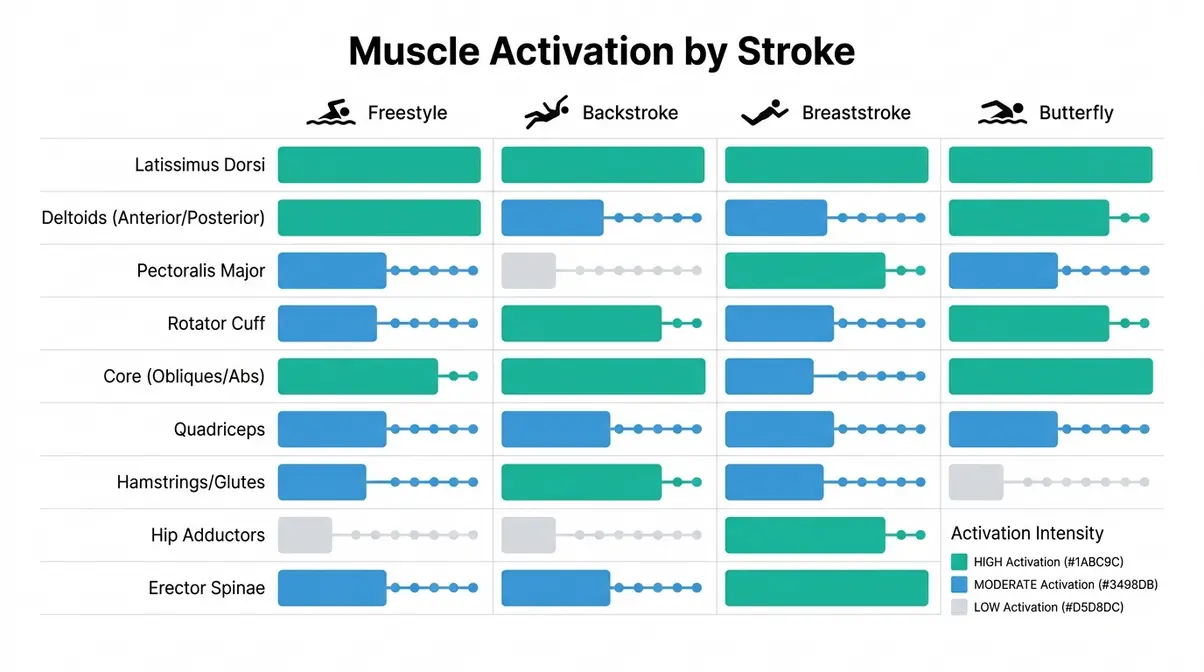
Freestyle vs. Other Swimming Strokes: Muscle Comparison
Understanding how freestyle compares to other strokes helps you make smarter training decisions—especially if you want to maximize the benefits of freestyle swimming, cross-train, or rehab a shoulder.
Muscles Used in Swimming Backstroke
Backstroke uses many of the same muscles as freestyle — but with a critical difference in position. Because you’re face-up, your body mechanics shift significantly.
- Primary backstroke muscles:
- Latissimus dorsi: Still the prime mover, but now pulling your arm from overhead toward your hip in the opposite direction
- Posterior deltoid: Becomes a primary driver (vs. a recovery muscle in freestyle)
- Biceps brachii: More active than in freestyle due to the arm’s supinated (palm-up) position
- Quadriceps: The flutter kick is similar to freestyle, but the downbeat direction reverses
Key difference from freestyle: Backstroke dramatically reduces shoulder impingement risk because the arm never crosses in front of the body in the vulnerable internal rotation position. This makes backstroke an excellent cross-training option when managing shoulder discomfort. Coaches from USMS coaching guidelines frequently recommend alternating freestyle and backstroke sets for swimmers with early-stage shoulder issues.
Muscles Used in Swimming Breaststroke
Breaststroke is the most unique stroke biomechanically — and the only one where the legs contribute more propulsive force than in freestyle.
- Primary breaststroke muscles:
- Pectoralis major: The dominant arm muscle — the wide sweeping arm motion is primarily a chest exercise
- Hip adductors (inner thigh): Power the whip kick’s squeeze phase — these muscles are barely used in freestyle
- Quadriceps: Drive the kick extension
- Glutes: Provide hip extension at the end of the kick
Key difference from freestyle: Breaststroke is significantly easier on the shoulders (no overhead reaching or internal rotation under load). However, it places greater stress on the knees — particularly the medial collateral ligament — due to the external hip rotation of the whip kick. Swimmers with knee issues should approach breaststroke cautiously.
Muscles Used in Butterfly Swimming
Butterfly is the most demanding stroke in terms of total muscular effort. It’s essentially freestyle with both arms moving simultaneously and a dolphin kick replacing the flutter kick.
- Primary butterfly muscles:
- Latissimus dorsi: Both lats fire simultaneously — double the load compared to freestyle
- Pectoralis major: Drives the arm pull with both arms at once
- Erector spinae and lumbar extensors: The dolphin kick requires powerful undulation through the spine — these muscles work far harder than in freestyle
- Core (all muscles): The wave-like body motion demands continuous core engagement
Key difference from freestyle: Butterfly generates the highest peak shoulder load of any stroke. A 2026 study published in PMC found that muscle coordination patterns in butterfly showed greater bilateral symmetry demands on the shoulder girdle compared to freestyle — meaning both sides must work equally, with no alternating pattern to allow micro-recovery.
Which Stroke Works the Most Muscles? (Comparison Table)
| Stroke | Upper Body Load | Core Demand | Leg Contribution | Shoulder Stress | Best For |
|---|---|---|---|---|---|
| Freestyle | High (lats, deltoids, pecs) | High (rotation) | Low–Moderate (10–30%) | Moderate–High | Efficiency, speed, volume |
| Backstroke | High (lats, posterior deltoids) | Moderate | Low–Moderate | Low | Shoulder recovery, posture |
| Breaststroke | Moderate (pecs, biceps) | Low–Moderate | High (adductors, quads) | Low | Knee rehab caution, beginners |
| Butterfly | Very High (bilateral lats, pecs) | Very High | Moderate (dolphin kick) | Very High | Power, full-body conditioning |
The takeaway: Butterfly works the most total muscle mass and generates the highest peak loads. But freestyle offers the best combination of full-body engagement, manageable shoulder stress, and sustainable training volume — which is why it’s the foundation of almost every competitive and recreational swim program.
Swimmer’s Shoulder and Common Risks: Protecting Your Body
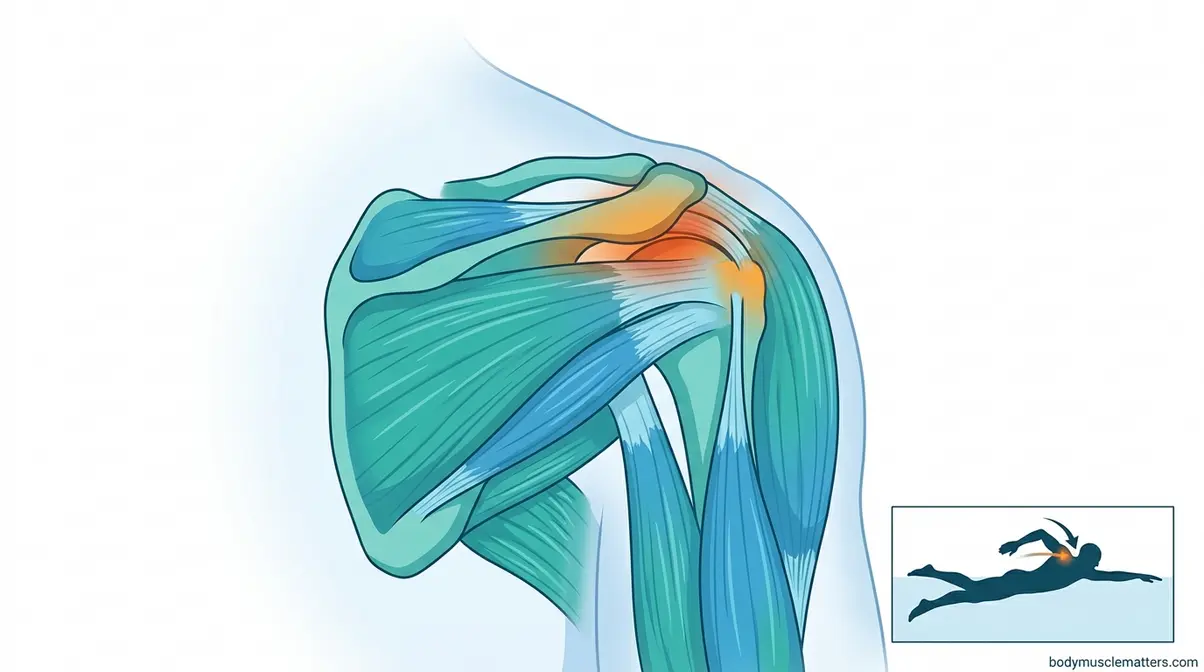
Knowing your muscles is only half the equation. Knowing how they break down — and when to act — is what keeps you in the water long-term. Research published in NIH PMC found that shoulder pain affects between 40–91% of swimmers at some point in their careers, depending on training volume and level. That wide range reflects a crucial truth: swimmer’s shoulder is largely preventable with the right approach.
Common Pitfalls and Muscle Imbalances
Pitfall 1: Undertrained posterior chain
Most swimmers naturally develop stronger anterior (front) muscles — pecs, anterior deltoids, biceps — from the pull phase. The posterior muscles (lower trapezius, rhomboids, posterior deltoid, external rotators) lag behind. This imbalance pulls your shoulders forward, compresses the supraspinatus tendon, and sets up impingement. The fix: include Exercises 2 (Y-T-W) and 3 (Single-Arm Row) in every dryland session.
Pitfall 2: Dropped elbow during the catch
When your elbow drops below your wrist in the catch phase, your lats can’t engage efficiently — you’re essentially pushing water down instead of back. The serratus anterior and subscapularis must work harder to compensate. Over thousands of strokes, this compensation pattern overloads the rotator cuff. The fix: focus on a high-elbow catch position with your fingertips pointing toward the pool floor.
Pitfall 3: Crossover hand entry
Entering your hand across your body’s centerline (rather than in line with your shoulder) forces your arm into internal rotation immediately — right at the start of the catch, when impingement risk is already elevated. Coaches consistently report this as one of the most common stroke faults in recreational swimmers. The fix: aim to enter your hand directly in front of your shoulder, thumb-side slightly down.
Pitfall 4: Neglecting the push phase
Finishing your stroke at the waist instead of the hip shortens your effective stroke length and shifts more work onto your shoulder. The triceps (Exercise 8) and posterior deltoid must make up for the lost momentum with increased effort per stroke. The fix: consciously drive your hand back to your hip before initiating recovery.
Pitfall 5: Rapid yardage increases
Research from PubMed (2026) identified high acute-to-chronic workload ratio as a leading risk factor for shoulder injury in competitive swimmers. Increasing your weekly yardage by more than 10% in a single week dramatically elevates injury risk — regardless of your current fitness level.
When to Modify Your Training Approach
Not every swimmer should follow the same training approach. Here are specific scenarios where modifying your freestyle training is the smarter move:
If you have existing shoulder pain: Switch to backstroke for 2–4 weeks. Backstroke maintains cardiovascular fitness and lat strength while removing the shoulder impingement position. Add Exercises 1, 2, and 7 from the dryland program.
If you’re a runner transitioning to swimming: Your hip flexors and ankle plantar flexors are likely stiff from years of running mechanics. Prioritize ankle flexibility work and hip flexor stretching before increasing your kick intensity. Stiff ankles generate braking force — the opposite of propulsion.
If you’re returning from a shoulder injury: Reduce total yardage by 40–50% and rebuild gradually. Focus on technique over volume. The NIH PMC swimmer’s shoulder resource (PMC3438875) recommends progressive loading with emphasis on posterior chain strengthening before returning to full training.
When to Seek Professional Guidance
Some situations genuinely require expert input — not just a guide like this one.
- See a sports medicine physician or orthopedic specialist if:
- Shoulder pain persists beyond 2 weeks despite rest and modified training
- You experience pain during the recovery phase (above the water), not just the pull-through
- You notice clicking, catching, or sharp pain at a specific point in your stroke arc
- Pain radiates down your arm or into your neck
- Work with a certified swim coach if:
- You’ve read this guide and still can’t identify where your stroke is breaking down
- You’re logging 10,000+ meters per week without structured periodization
- You’ve had two or more shoulder injuries in a 12-month period
Across swimming communities, coaches consistently report that most recreational swimmers benefit far more from one technique session with a qualified coach than from months of additional yardage. Technique faults that load the wrong muscles don’t self-correct with more swimming — they compound.
Frequently Asked Questions
What muscles do you use while swimming freestyle?
Freestyle swimming recruits muscles across your entire body, with over 70% of propulsive force coming from the upper body (PMC, 2026). Your primary movers are the latissimus dorsi (lats), deltoids, and pectoralis major. Your rotator cuff stabilizes the shoulder joint through every stroke. Your core — including the obliques, rectus abdominis, and transverse abdominis — controls body rotation and maintains a streamlined position. Your quadriceps, hamstrings, and glutes drive the flutter kick and maintain your body’s horizontal alignment in the water.
What is the 80/20 rule in swimming?
The 80/20 rule means 80% of your training should be at low intensity and 20% at high intensity. Also called polarized training, this approach is well-established in endurance sports research. In swimming, it means approximately 4 out of every 5 sessions should be easy aerobic work — conversational pace, low heart rate — while 1 session involves genuine high-intensity effort such as sprint intervals. The rationale: low-intensity work builds your aerobic base and allows recovery, while high-intensity work stimulates performance adaptations. Doing too much in the “moderate” middle zone leads to chronic fatigue without the full benefits of either end of the spectrum.
Is swimming good for high blood pressure?
Swimming may help reduce blood pressure — but consult your doctor before using it as a treatment strategy. A 12-week study of moderate-intensity swimming found a reduction in systolic blood pressure of approximately 9 mmHg in participants (PMC, 2026). A 2026 study published in PMC found that high-intensity interval swimming improved cardiovascular endurance markers in older adults. The water’s hydrostatic pressure may also support blood vessel function. However, these findings should not replace medical advice. If you have high blood pressure or a cardiovascular condition, speak with your physician before beginning any new exercise regimen — including swimming.
Will swimming change my body shape?
Regular freestyle swimming will change your body composition over time — particularly in your upper back, shoulders, and core. Swimmers tend to develop a characteristic V-taper: broader shoulders, a stronger upper back, and a leaner midsection from the continuous core engagement each stroke requires. Research suggests that swimming reduces body fat percentage and builds lean muscle mass when combined with appropriate nutrition. The degree of visible change depends on frequency, intensity, and diet. Recreational swimmers (3–4 sessions per week) can expect noticeable improvements in posture, shoulder width, and core definition within 8–12 weeks of consistent training.
The Full Picture: Building Your Freestyle Power Chain
Freestyle swimming is one of the most complete full-body workouts available — but only if you understand what’s actually working beneath the surface. Upper-body muscles generate over 70% of your propulsive force (PMC, 2026), with your lats and deltoids as the primary engines. Your core transfers that power efficiently through body rotation. Your legs maintain the streamlined position that lets everything else function. Research from NIH PMC confirms that shoulder pain affects 40–91% of swimmers at some point — making anatomical knowledge not just interesting, but genuinely protective.
The Freestyle Power Chain is the framework that ties it all together. From the elastic energy loaded during the catch phase, through the lat-driven pull, the triceps-powered push, and the rotator cuff-controlled recovery — every link matters. Weak serratus anterior muscles compromise your catch. Undertrained triceps cut your push phase short. Poor core engagement turns your body into a sieve that leaks power on every stroke.
Your next step is simple: pick two or three of the 8 dryland exercises in this guide and add them to your next non-swim training day. Start with the Y-T-W (Exercise 2) for posterior chain balance and the Dead Bug (Exercise 4) for core stability — these address the two most common weak links in recreational swimmers. After 4 weeks, return to this guide and assess which phase of your stroke feels different. That feedback loop — understanding your anatomy, training it deliberately, and noticing the change in the water — is how good swimmers become great ones.
Related posts:
StrongLifts 5x5 for Beginners: Complete Guide 2026
How to Get a Bigger Bum Without Exercise: 3-Tier Guide
What Muscles Does the StairMaster Work? 6 Groups
Olympic Weightlifting vs Powerlifting: 2026 Guide
What Kills Muscle Gains? 7 Proven Saboteurs to Fix Now
Best Strength Training Apps for Women: Top 7 Picks

Callum
Hi, I'm Callum, the founder of Body Muscle Matters. I'm not a certified trainer, I'm a self taught lifter who started this site to share what I've learned from my own training and a lot of trial and error. Everything here comes from real experience and honest research, written the way I'd explain it to a friend who is just getting started. My goal is simple: practical, no hype fitness advice you can actually use.