22 Best Stretches for Flexibility and Mobility (All Levels)
You’ve read ten articles about stretching and left more confused than when you started. Too many exercises, no clear priority order, and absolutely no way to know what actually works for a complete beginner.
“What is the ‘Squat, Bench, Deadlift, Pull up and Dips’ of flexibility exercises that are going to give some good balanced results if practiced and progressed?”
⚠️ Medical Disclaimer: The exercises in this guide are for general informational purposes only and do not constitute medical advice. Before starting any new exercise routine, consult your physician or a licensed physical therapist — especially if you have existing injuries, joint pain, or chronic conditions. Stop any stretch immediately if you feel sharp pain, numbness, or joint discomfort.
That’s the question this guide answers directly. Most beginners either skip stretching entirely or cycle through random YouTube videos with no measurable progress — staying stiff for years because no one gave them a clear foundation.
In this guide, you’ll find 22 of the best stretching exercises for flexibility — organized from absolute beginner to advanced — with step-by-step instructions, hold times backed by clinical research, and specific modifications if you’re over 50 or extremely stiff. This guide focuses on general flexibility for everyday movement and fitness. It does not cover sport-specific athletic training or injury rehabilitation — consult a physical therapist for those needs. We cover the science first, then the full-body exercise library, a beginner routine, targeted leg stretches, 50+ modifications, and advanced techniques — finishing with a safety guide and FAQs.
Key Actionable Stretches — The Flexibility Five
The 5 foundational stretches that deliver the most balanced, full-body flexibility gains for beginners: Downward Dog, Pigeon Pose, Cat-Cow, Seated Forward Fold, and Child’s Pose. A 2024 PubMed study found flexibility gains begin with as little as 4 minutes per stretching session (PubMed, 2024).
- Hold time: 30–60 seconds per stretch (clinical standard)
- Frequency: Minimum twice weekly; daily for faster gains
- Never: Stretch cold muscles or bounce in a position
- Beginners 50+: Chair-modified versions available in Section 5
Stretching Basics: Types, Benefits, and How Long
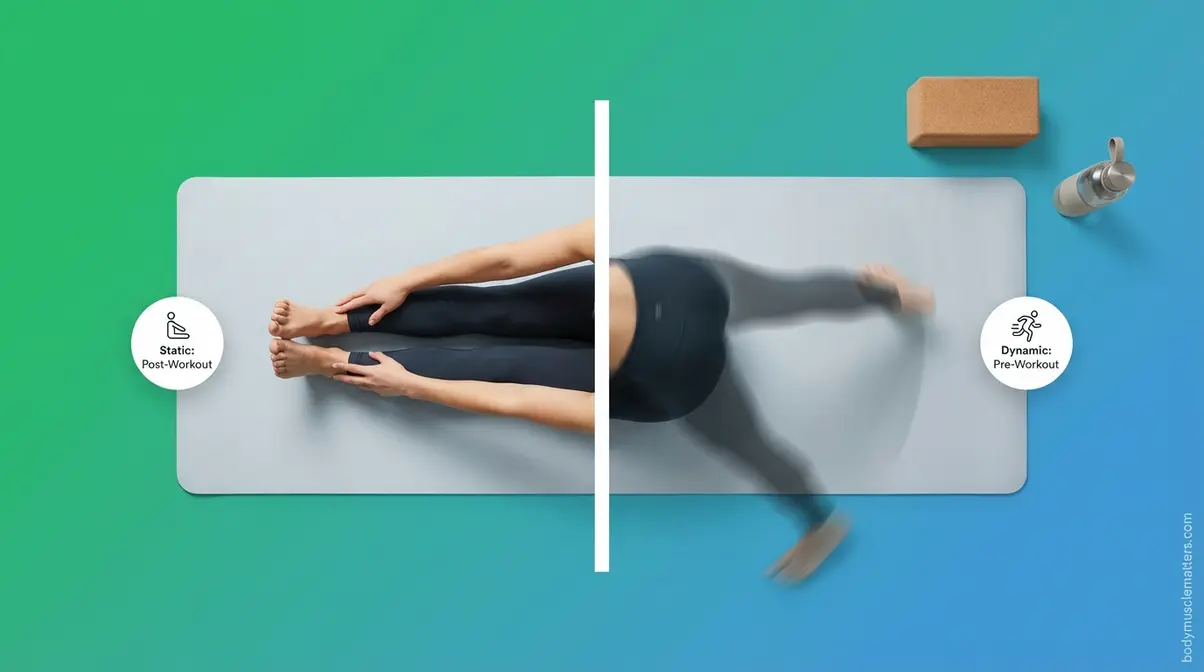
Flexibility is your muscles’ and joints’ ability to move through their full range of motion. Most beginners make the mistake of confusing warm-up stretching with flexibility-building stretching — they’re different techniques used at different times. A structured protocol of static holds practiced daily for 6+ weeks can meaningfully increase your range of motion, according to a 2025 expert consensus published in the Journal of Sport and Health Science (Warneke et al., 2025).
Understanding which type of stretching does what is the difference between real progress and spinning your wheels for months.
What Type of Stretching is Best?
Flexibility exercises are important for joint health, injury prevention, and quality of everyday movement — but only when you use the right technique at the right time. Here’s what each type does:
| Type | When to Use | Hold Time |
|---|---|---|
| Static | After exercise or as a dedicated flexibility session | 20–60 seconds |
| Dynamic | Before exercise as a warm-up | No hold — controlled movement |
| Ballistic | Avoid (beginners and most adults) | Not recommended |
Static stretching is the technique of holding a position still for 20–60 seconds. You hold a position without moving, feeling a gentle pull in the muscle. This is your primary tool for building flexibility over time. Sitting and reaching toward your toes for 30 seconds is a classic example. This is what the best stretching exercises for flexibility are built on.
Dynamic stretching involves controlled movements that take your joints through their full range of motion — think leg swings, hip circles, and arm rotations before a workout. These prepare your body for exercise but are NOT the primary flexibility builder. Use them before you run, lift, or play a sport.
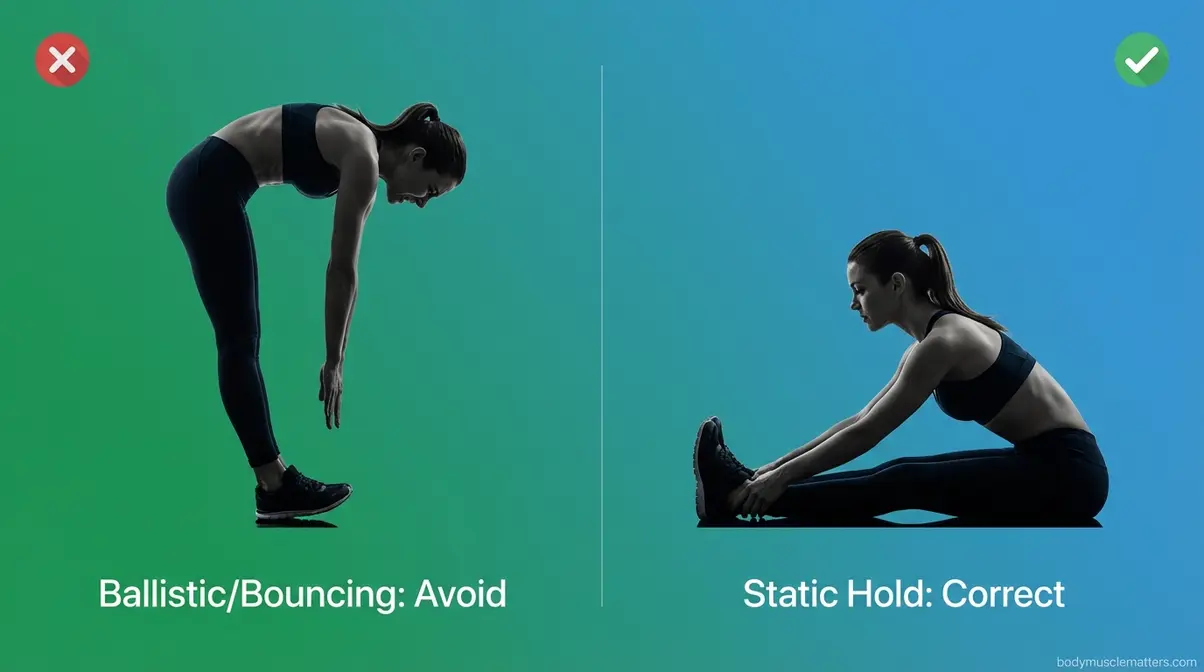
Ballistic stretching is a bouncing technique not recommended for most people. Bouncing in a stretch can cause micro-tears in muscle fibers. You’ll see some athletes use it in specific sports contexts — skip it entirely until a physical therapist or coach guides you personally.
Long-established research on PNF stretching shows that advanced stretching techniques significantly increase range of motion compared to traditional static holds for experienced practitioners — but for beginners, static stretching is safer and equally effective (NIH, 2013).
Now that you know the types, the most important rule of all is the one that prevents injury — and it applies to every single stretch in this guide.
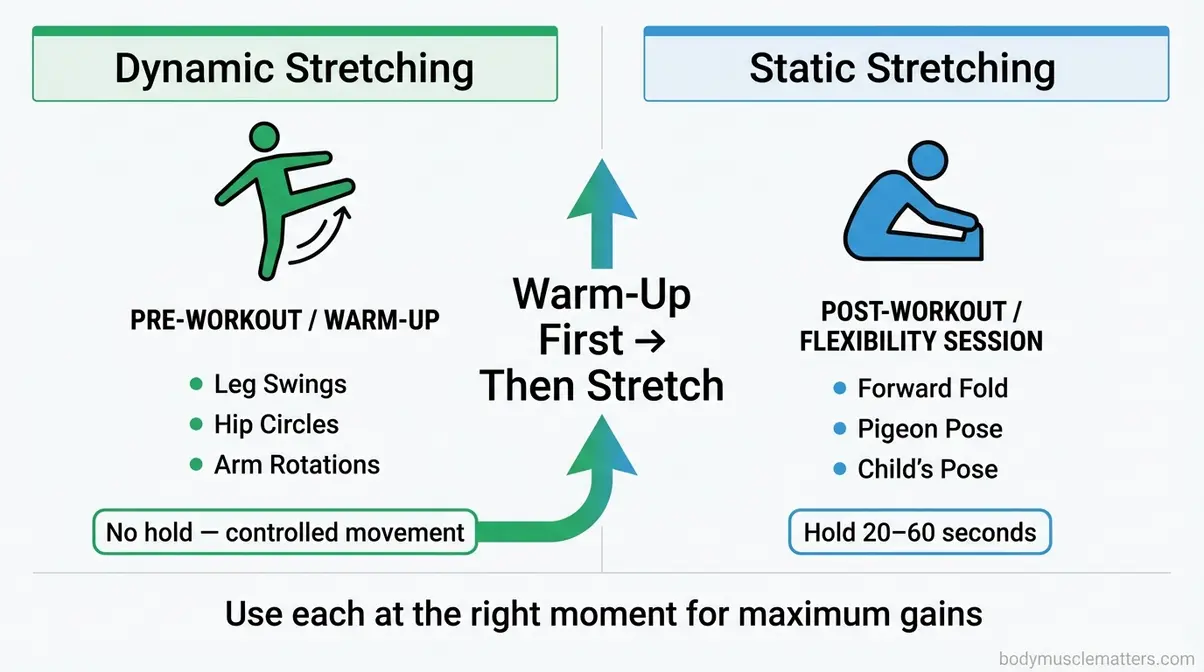
Caption: Static stretching builds lasting flexibility; dynamic stretching prepares your body for activity. Use each at the right moment.
What Is the Golden Rule?
The golden rule for stretching is that it should never cause pain — only gentle tension. A gentle pull or mild tension is correct; sharp pain means stop immediately. If it hurts, ease off, adjust your position, or skip that stretch for today.
Beginners often confuse “uncomfortable” with “effective.” These are not the same thing. Mild tension — around a 3-4 out of 10 on a discomfort scale — means you’re working the muscle. At 7-8 out of 10, you’re risking a strain. Ease back until the sensation drops to that gentle, productive range.
Always warm up before deep stretching. Cold muscles tear more easily than warm ones. A 5-minute walk, light jog, or a round of arm circles before you stretch protects your tendons and makes each stretch more effective. American Heart Association guidelines on flexibility confirm that flexibility exercises help the body move and bend more easily — and they’re most effective when performed on warmed-up muscles (American Heart Association).
With those rules in place, the next logical question is: how much time do you actually need to commit to see results?
Is 20 Mins of Stretching Enough?
For general health and reducing everyday stiffness, 10–20 minutes of daily stretching is effective. Harvard Health and the Cleveland Clinic both recommend daily flexibility work in this range for most adults.
For chronic, lasting flexibility gains — the kind where you genuinely feel and move differently — the 2025 Delphi expert consensus recommends performing daily static stretching for more than 15 minutes per day per muscle group over a period of at least 6 weeks. Importantly, this is cumulative across muscles in a session, not 15 minutes on a single stretch. The expert consensus on daily stretching duration makes this the most authoritative protocol available to date (NIH, 2025).
The research-backed minimum: A 2024 study on optimal stretching volume found that flexibility improves with as little as 4 minutes per session and 10 minutes per week — excellent news for beginners who can’t commit to long sessions (PubMed, 2024). A 2024 PubMed study found that just 4 minutes per stretching session and 10 minutes per week is sufficient to begin improving flexibility — no hour-long gym sessions required.
Here’s what that looks like in practice: 5 stretches × 60 seconds each = 5 minutes total. Three sessions per week = 15 minutes per week. That’s enough to begin seeing measurable changes in your range of motion.
Now that you understand the types, let’s go through each of the 22 best stretching exercises for flexibility — starting with The Flexibility Five and the complete full-body library.
The 14 Best Full-Body Stretching Exercises
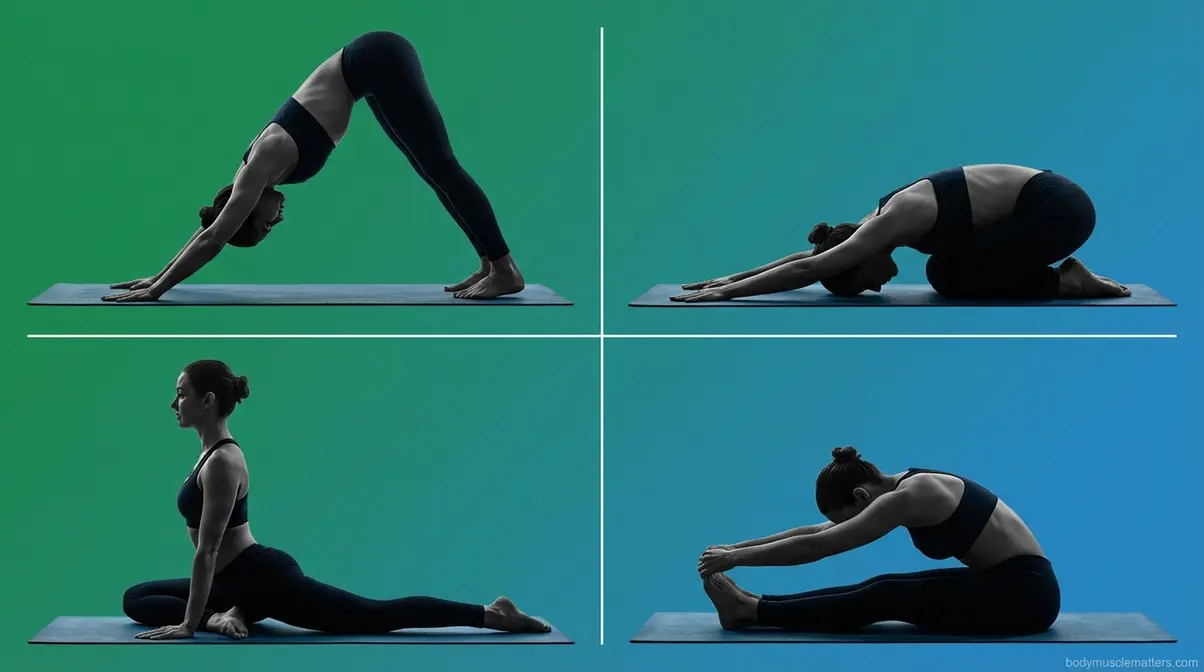
The Flexibility Five are the five exercises in this library that every beginner should prioritize — they function as the “Squat, Bench, Deadlift” of flexibility training. Just as those three lifts build a complete strength foundation, The Flexibility Five build a complete mobility foundation. The full library of 14 covers every major muscle group from your calves to your upper back. For each exercise, you’ll find the targeted muscle (in plain English), numbered steps, hold time, and a modification if you’re very stiff.
How We Selected These 14 Exercises: These stretches were selected based on (1) frequency of citation across Tier 1 clinical sources — Mayo Clinic, Harvard Health, and Cleveland Clinic — (2) coverage of all major muscle groups including the spine, hips, hamstrings, shoulders, and calves, and (3) suitability for beginners without equipment. Physical therapist-reviewed guidance validated the step-by-step instructions and hold-time recommendations.
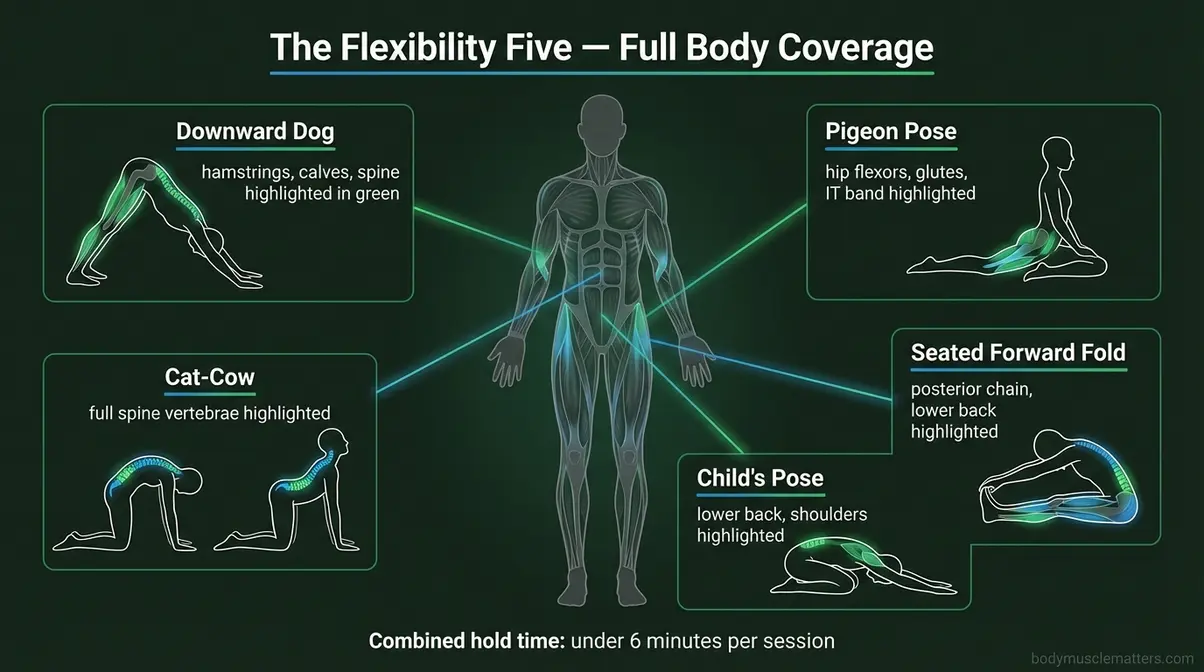
Caption: The Flexibility Five target every major muscle group in a single session — less than 6 minutes of combined hold time.
The five highest-impact stretches for full-body flexibility are Downward Dog, Pigeon Pose, Cat-Cow, Seated Forward Fold, and Child’s Pose — targeting every major muscle group with a combined hold time of under 6 minutes per session (UC Davis Health, 2024).
Upper Body and Spine Stretches
These five stretches form the core of every best-in-class flexibility program. Together, they are The Flexibility Five — your mandatory foundation. Master these before adding the exercises that follow.
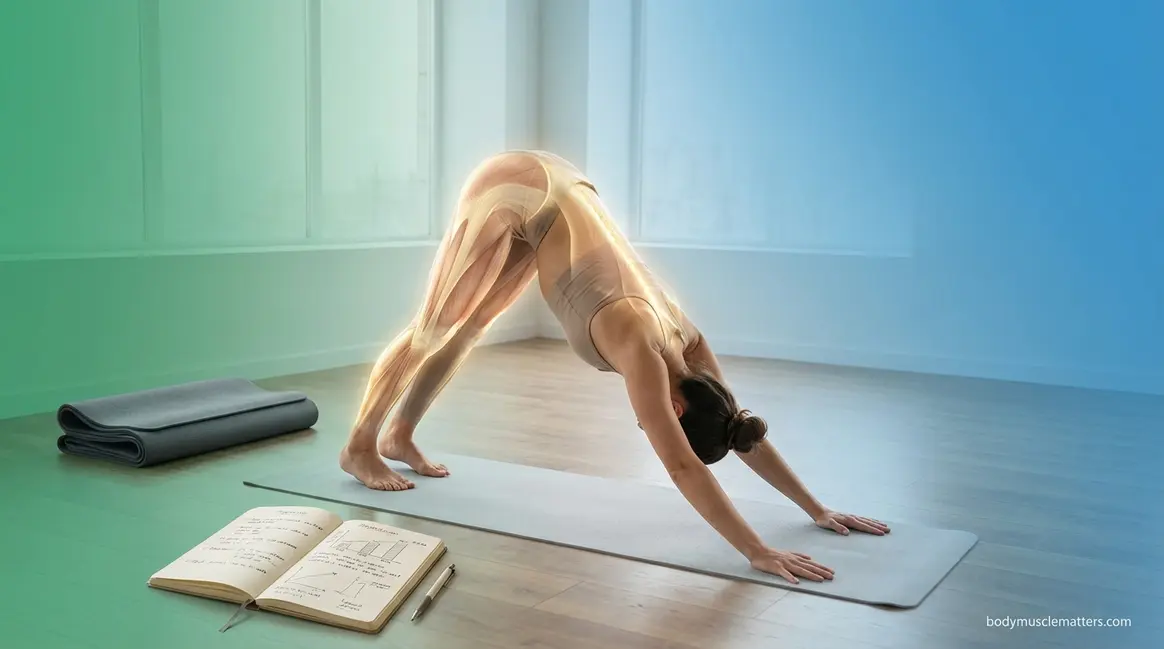
Exercise 1: Downward Dog (Flexibility Five #1)
This targets your hamstrings (the muscles along the back of your thigh), your calves, and your spine simultaneously — making it the single most efficient full-body stretch for beginners.
- Start on hands and knees, wrists under shoulders.
- Tuck your toes under and push your hips up and back until your body forms an inverted V shape.
- Keep your knees slightly bent if your hamstrings feel very tight.
- Hold 30–60 seconds, breathing steadily.
Modification for stiff beginners: Keep a generous bend in both knees — the goal is length through your spine, not straight legs. The hamstrings will open over time.
Exercise 2: Cat-Cow (Flexibility Five #2)
This two-part spinal mobility movement targets every vertebra from your neck to your tailbone. It’s especially valuable for desk workers whose spines stiffen in a fixed position for hours.
- Start on hands and knees, wrists directly under shoulders, knees under hips.
- Inhale: drop your belly toward the floor, lift your tailbone and chin gently (Cow position).
- Exhale: round your spine toward the ceiling, tuck your chin to chest (Cat position).
- Move slowly through 5–10 full cycles.
Note: This is the only exercise in this guide where you don’t hold — the controlled movement itself is the stretch.
Exercise 3: Child’s Pose (Flexibility Five #3)
Child’s Pose, a gentle resting stretch for the lower back, hips, and shoulders, doubles as a recovery position between more demanding stretches.
- Kneel on the floor and sit back toward your heels.
- Reach your arms forward on the ground, forehead resting down.
- Hold 30–60 seconds, breathing into the lower back.
- Walk hands left, then right, for an additional side-body stretch.
Modification: Place a folded pillow between your thighs and calves if your hips don’t reach your heels — this is extremely common for very stiff beginners.
Exercise 4: Cobra (Flexibility Five #4)
This targets your abdominals, chest, and spine in extension (backward bending). It counteracts the forward-hunched posture most people develop from sitting.
- Lie face-down on the floor, hands placed under your shoulders.
- Press gently into your hands to lift your chest off the floor.
- Keep elbows slightly bent — do NOT lock out your arms.
- Hold 20–30 seconds.
Modification: Keep your elbows on the ground for “Sphinx” pose if full Cobra feels too intense. This is just as effective for beginners.
Exercise 5: Thread the Needle (Flexibility Five #5)
This targets your thoracic spine (upper back) and the muscles around your shoulder blades — areas that tighten dramatically from computer use and phone scrolling.
- Start on hands and knees.
- Slide your right arm under your body along the floor, shoulder reaching toward the mat.
- Let your right ear rest on the floor. Hold 30–45 seconds.
- Return to center, then repeat on the left side.
Beginner note: Rest your head on the floor — don’t strain your neck muscles trying to hold it up.
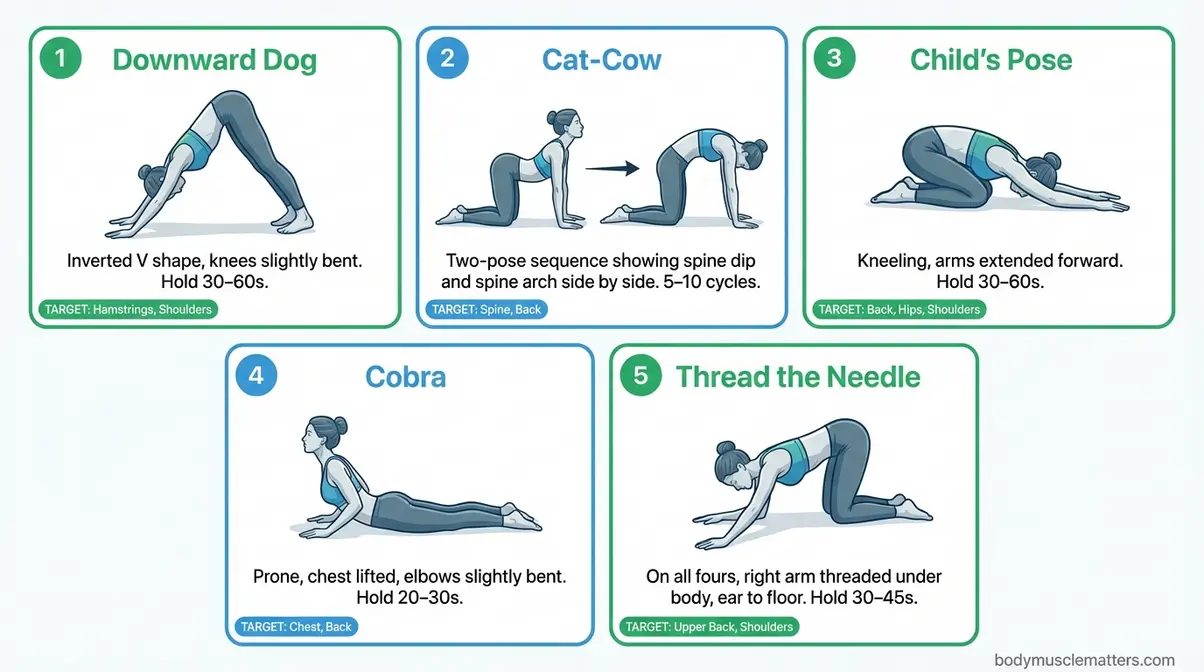
Caption: Exercises 1–5 address the spine, upper back, and posterior chain — the muscle groups most affected by prolonged sitting.
Experts recommend stretching twice weekly to see noticeable improvements in flexibility, with daily practice accelerating results (UC Davis Health, 2024).
Those are The Flexibility Five — your mandatory foundation. Now add exercises 6–14 to target your hips and lower body.
Hip and Lower Body Stretches
Your hips are the body’s mobility center. Tightness here creates a chain reaction — lower back pain, knee discomfort, and reduced stride length. These six stretches address that directly.
Exercise 6: Pigeon Pose
Pigeon Pose, one of the most effective hip-opener stretches in yoga, targets your hip flexors (front of the hip), glutes (back of the hip), and the IT band (the connective tissue running down the outer thigh).
- From Downward Dog, bring your right knee forward toward your right wrist.
- Extend your left leg straight back behind you.
- Lower your hips toward the floor as much as comfortable.
- Walk your hands forward and hold 45–60 seconds. Repeat on the left side.
Modification for stiff hips: Place a folded blanket or firm pillow under your right hip for support. This is not cheating — it’s proper form for anyone with limited hip rotation.
Exercise 7: Low Lunge (Crescent Lunge)
This targets your hip flexors and quadriceps (the front of your thigh) — muscles that shorten dramatically when you sit for long periods and contribute to lower back pain.
- Step your right foot forward between your hands, lowering your left knee to the floor.
- Shift your hips forward slowly until you feel a stretch at the front of your left hip.
- Option: raise both arms overhead to deepen the stretch.
- Hold 30–45 seconds, then switch sides.
Key point: The stretch belongs in the BACK hip and thigh — not your front knee. If your front knee hurts, check that it stays directly over your ankle, not pushed forward past your toes.
Exercise 8: Bridge Pose
This stretch targets your hip flexors from the front and strengthens your glutes (the muscles in your rear) simultaneously — making it one of the most efficient moves for people with lower back pain from sitting.
- Lie on your back, knees bent, feet flat on the floor hip-width apart.
- Press your feet into the floor and lift your hips toward the ceiling.
- Squeeze your glutes firmly at the top.
- Hold 20–30 seconds, or pulse up and down 10 times for a more active variation.
Modification: Lift only a few inches off the floor if your lower back feels sensitive — even a small lift engages the target muscles.
Exercise 9: Happy Baby
This targets your inner groin and hip rotators — a combination rarely addressed by standard stretching routines. It requires no flexibility to begin, making it ideal for very stiff beginners.
- Lie on your back and draw both knees toward your chest.
- Open your knees wide toward your armpits.
- Grip the outer edges of your feet, or hold your calves if your feet are out of reach.
- Gently pull your knees toward the floor on either side of your torso. Hold 30–45 seconds.
“Very stiff” modification: Hold your thighs instead of your feet — you’ll achieve the same hip-opening effect.
Exercise 10: Figure Four (Supine Piriformis Stretch)
This targets the piriformis muscle, a deep glute muscle that sits beneath the larger glutes and is a common source of hip and lower back pain in people who sit all day. If you’ve ever had what feels like a deep ache in one side of your rear, this stretch may provide immediate relief.
- Lie on your back, knees bent, feet flat.
- Cross your right ankle over your left thigh.
- Flex your right foot (point toes toward your knee — this protects the knee joint).
- Draw both legs toward your chest until you feel a stretch deep in the right glute. Hold 30–60 seconds, then switch sides.
Note: This is the gentlest glute stretch — start here before attempting Pigeon Pose if you’re very stiff.
Exercise 11: Butterfly (Seated Groin Stretch)
The Butterfly stretch targets your inner thighs and groin — areas that contribute to hip mobility and healthy knee tracking during walking and stair climbing.
- Sit on the floor with the soles of your feet pressed together.
- Hold your feet with both hands.
- Gently press your knees toward the floor using your elbows.
- Keep your spine tall — avoid rounding your lower back. Hold 30–45 seconds.
Progression: The closer your heels are to your body, the more intense the stretch. Move heels closer gradually over weeks — not in a single session.
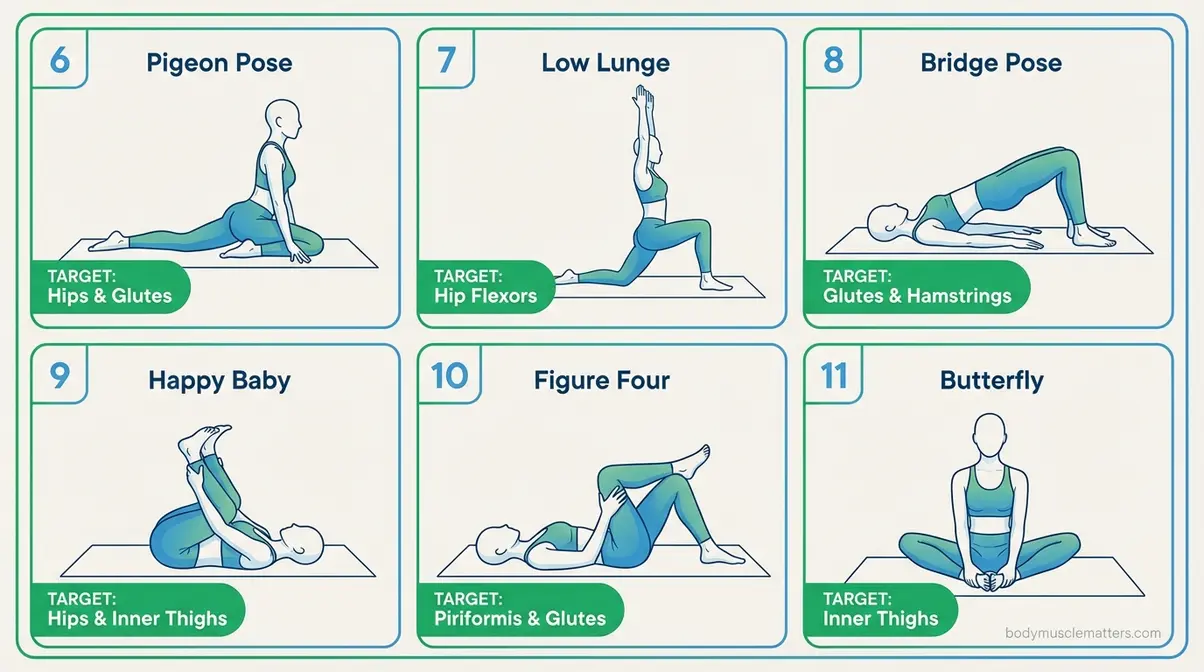
Caption: Hip tightness is the most common driver of lower back pain in desk workers. Exercises 6–11 address every angle of hip mobility.
With your spine and hips covered, the final group targets your posterior chain — the full-length muscles from hamstrings to lower back that affect nearly every movement you make.
Full-Chain and Compound Stretches
These three stretches work multiple connected muscle groups at once, giving you the highest-ROI moves for total-body flexibility after you’ve covered The Flexibility Five.
Exercise 12: Seated Forward Fold
This targets your entire posterior chain — hamstrings, calves, and lower back — in a single movement. It’s the most thorough single-stretch test of overall flexibility.
- Sit on the floor with legs extended straight in front of you.
- Flex your feet, pointing toes toward your face.
- Reach your hands toward your feet — or as far as comfortable without rounding your lower back aggressively.
- Hold 30–60 seconds. Breathe into the tightness.
Modification: Loop a towel or resistance band around your feet and hold the ends. This keeps your spine long without requiring hamstring flexibility you haven’t yet built.
Exercise 13: Legs Up the Wall
This targets your hamstrings, calves, and lower back through passive decompression — gravity does the work for you. It’s ideal as a recovery stretch at the end of a session.
- Sit sideways next to a wall.
- Swing your legs up the wall as you lower your back to the floor.
- Let gravity gently pull your legs toward the wall — no muscular effort needed.
- Hold 1–3 minutes. This is a recovery stretch, not an active one.
Note: Safe for all fitness levels, including people with very stiff hamstrings. The wall provides all the resistance — your job is simply to relax.
Exercise 14: Seated Spinal Twist
This targets your thoracic spine rotation (upper back turning ability), your obliques (side trunk muscles), and your IT band simultaneously — making it a highly efficient compound move.
- Sit with both legs extended straight in front of you.
- Cross your right foot over your left thigh and plant it flat on the floor.
- Twist your torso to the right, placing your left elbow against your right knee for leverage.
- Hold 30–45 seconds, then switch sides.
Modification: Sit on a folded blanket if your hips lift off the floor during the twist — elevation levels the pelvis and makes the rotation more effective.
You now have 14 full-body exercises covering every major muscle group. Next, let’s organize the beginner-friendly moves into a structured routine you can start today.
A Beginner’s First Flexibility Routine
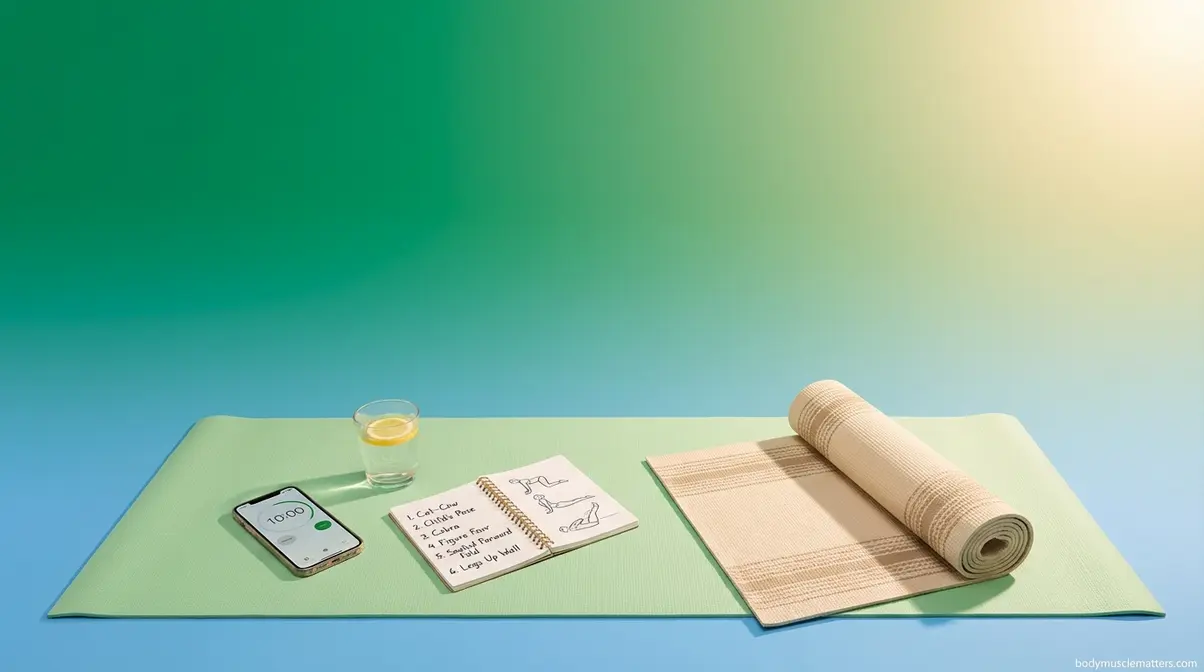
The hardest part of any new routine is getting started without feeling overwhelmed. This section cuts through that by giving you a specific sequence, a clear time commitment, and a week-by-week plan that prevents you from overdoing it.
Your 10-Minute At-Home Sequence
You don’t need a gym, a mat (though it helps), or any equipment. This sequence uses six of the 14 exercises above in an order that flows logically from standing to floor-based positions.
Your daily sequence — do this 3–5 times per week:
| Order | Exercise | Hold / Reps | Target |
|---|---|---|---|
| 1 | Cat-Cow | 8 slow cycles | Spine warm-up |
| 2 | Child’s Pose | 45 seconds | Lower back + hips |
| 3 | Cobra | 30 seconds × 2 | Spine extension |
| 4 | Figure Four | 45 seconds each side | Deep glutes |
| 5 | Seated Forward Fold | 45 seconds | Hamstrings + back |
| 6 | Legs Up the Wall | 2 minutes | Full-body recovery |
Total time: approximately 10 minutes. Clinical guidance indicates this volume — around 10 minutes per week spread across multiple sessions — is sufficient to begin building measurable flexibility changes (PubMed, 2024).
For very stiff beginners: reduce each hold to 20–30 seconds and stay with this six-stretch sequence for the first two weeks before expanding to the full library.
How to Progress Week by Week
Rushing progression is the single most common mistake beginners make. Physical therapists recommend adding no more than one new stretch per week and increasing hold times gradually — not all at once.
A simple 4-week progression framework:
- Week 1–2: The six-stretch sequence above, 3× per week, 20–30 second holds
- Week 3–4: Add Downward Dog and Thread the Needle. Increase holds to 45 seconds. Move to 4× per week.
- Week 5–6: Add Pigeon Pose and Butterfly. Full 10-stretch session, 5× per week. Holds at 45–60 seconds.
- Week 7+: Introduce the leg-targeted stretches in Section 4 and evaluate readiness for advanced techniques in Section 6.
Progress feels slow in weeks 1–4. That’s normal. The neurological adaptations that allow lasting flexibility changes take 4–6 weeks to establish (NIH, 2025). Where Harvard Health’s ideal stretching routine is clear: the biggest gains come from consistent practice, not occasional intense sessions.
Leg Flexibility: 4 Targeted Stretches
Tight legs are one of the most common physical complaints — and one of the most directly solvable. These four exercises to improve flexibility in the legs go deeper on hamstrings, hip flexors, and calves than the full-body library above.
Hamstring Stretches: Standing and Seated
Your hamstrings are the group of muscles running along the back of your thigh. They are among the first muscles to tighten from prolonged sitting and among the last to open up with stretching — which means consistency here pays significant dividends.
Exercise 15: Standing Hamstring Stretch
- Stand tall and step your right foot forward about 12 inches.
- Keep that right leg straight and flex the foot (toes toward your shin).
- Hinge forward at your hips — not your waist — until you feel a pull behind the right thigh.
- Rest hands on your left thigh for support. Hold 30–45 seconds, switch sides.
Modification for very stiff hamstrings: Place your extended foot on a low step or chair instead of the floor. This reduces the angle and makes the stretch immediately more accessible.
Exercise 16: Seated Single-Leg Hamstring Stretch
- Sit on the floor and extend your right leg straight.
- Bend your left knee and rest the sole of your left foot against your right inner thigh.
- Lean forward over the right leg, reaching toward your right foot.
- Hold 30–60 seconds, then switch sides.
Note: The “lean” comes from your hips hinging forward, not your spine rounding forward. Keeping your back flat is more important than reaching further.
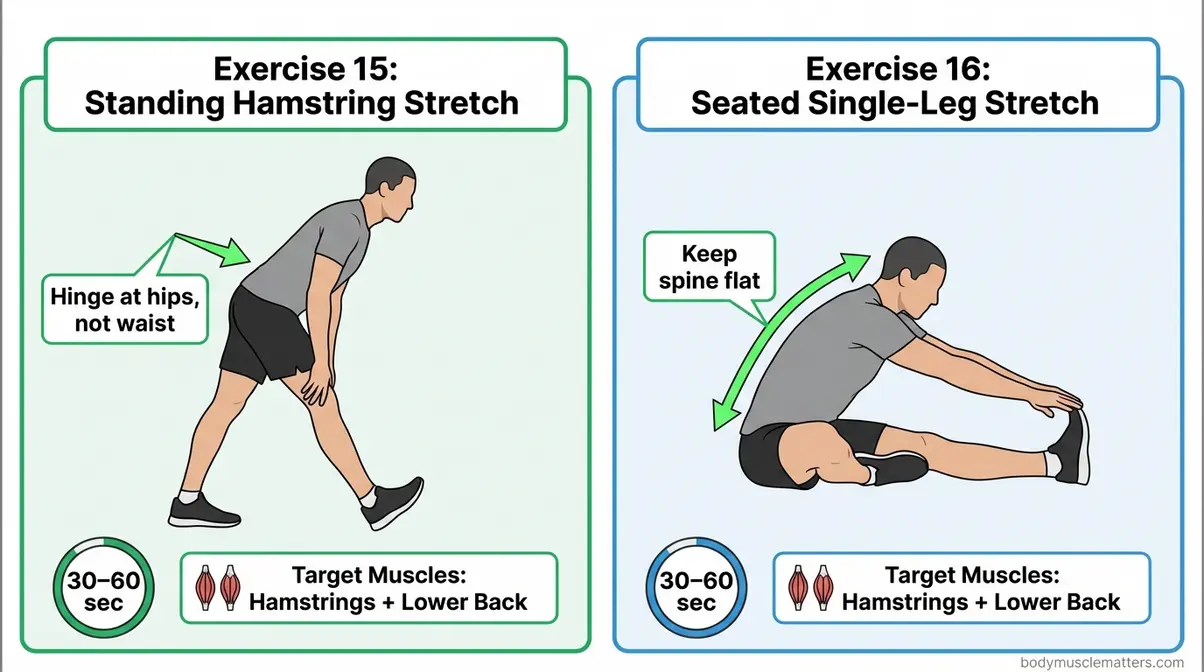
Caption: Hamstring length directly affects lower back health — tight hamstrings pull on the pelvis and compress the lumbar spine.
Hip and Quad Stretches
Exercise 17: Standing Quadriceps Stretch
Your quadriceps are the four muscles at the front of your thigh. They tighten from both sitting and from repetitive forward movement like walking and running.
- Stand near a wall for balance if needed.
- Bend your right knee and bring your right heel toward your right glute.
- Hold your right ankle with your right hand — keep both knees together.
- Stand tall, hips forward. Hold 30 seconds each side.
Modification: Loop a towel or strap around your ankle if reaching the foot is difficult. This is a common adaptation for beginners with tighter quads.
Exercise 18: Calf and Achilles Stretch
Your calves (back of the lower leg) and the Achilles tendon (the thick cord above your heel) shorten from high-heeled shoes, prolonged sitting, and walking on flat surfaces without full ankle extension.
- Face a wall and place both hands on it for support.
- Step your right foot back about two feet, heel pressed firmly to the floor.
- Keep your back leg straight for the gastrocnemius muscle (the large visible calf muscle); bend the knee slightly for the soleus (the deeper calf underneath).
- Hold 30–45 seconds in each variation, then switch legs.
The Mayo Clinic’s stretching guidance consistently recommends calf stretches for adults managing general stiffness and improving lower-body mobility (Mayo Clinic).
Stretching After 50 and 60
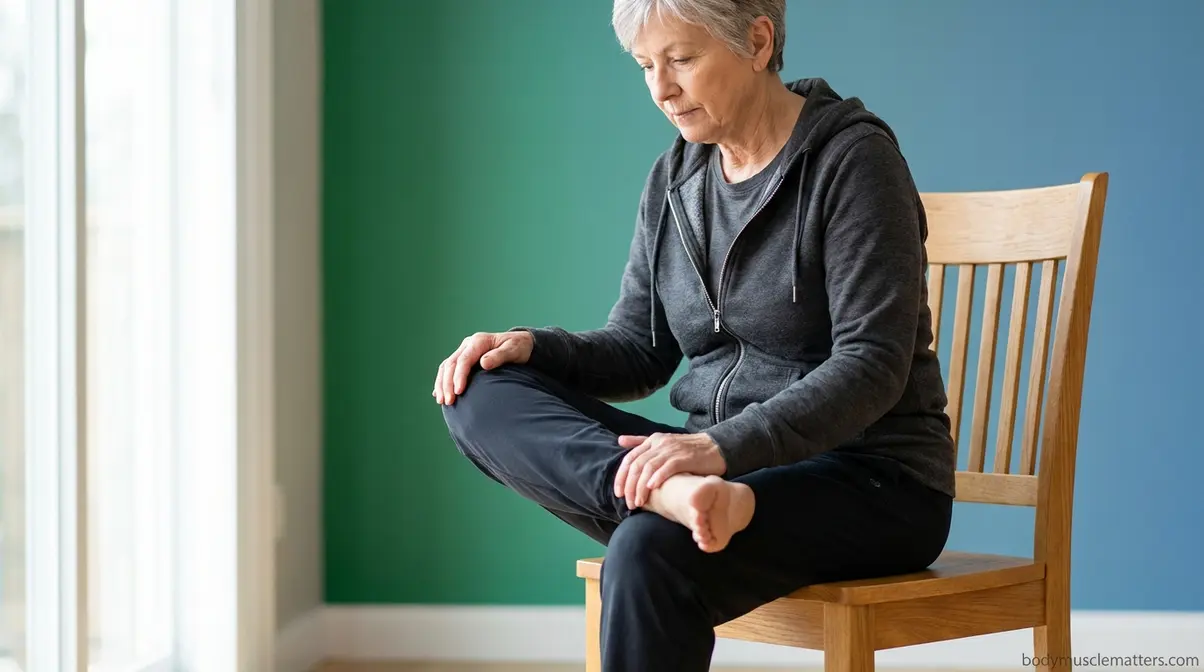
Flexibility doesn’t have to decline irreversibly with age. Research consistently shows that older adults retain the ability to improve their range of motion through structured stretching — at any age.
Can You Regain Flexibility After 50?
Yes — and research is clear on this. A study published in PMC (NIH) tracking adults aged 55–86 found that older adults who participated in regular exercise programs maintained significantly better flexibility than sedentary peers, even over a 5-year period (PMC, 2013). While people typically lose approximately 6 degrees of range of motion per decade after age 50, this decline can be substantially slowed or reversed with consistent training.
An 8-week program of combined flexibility and resistance training improved sit-and-reach scores in older adults — meaning measurable gains are possible in less than two months. Flexibility after 60 is still highly trainable, though progress may be slower and modifications more important than they are at 30.
Consult your physician before starting this or any stretching program if you have osteoporosis, artificial joints, recent surgery, or cardiovascular conditions.
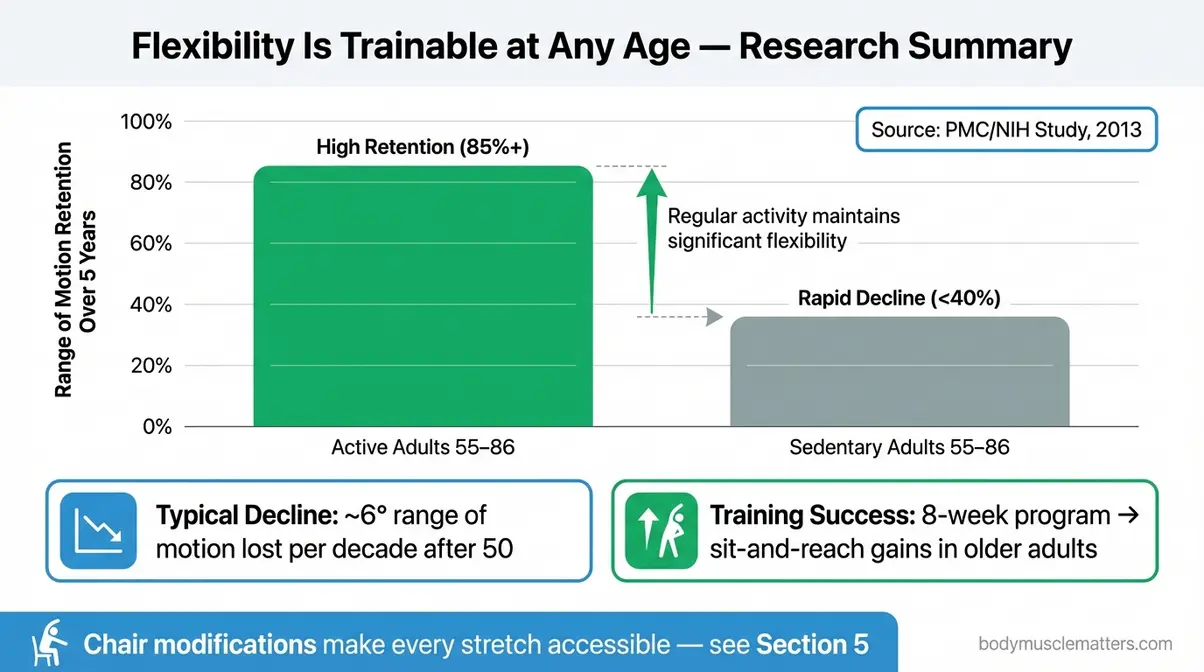
Caption: A 5-year NIH study confirmed that regular exercise preserves flexibility in adults aged 55–86, even as sedentary peers declined.
3 Low-Impact Stretches for Aging Joints
These three exercises to improve flexibility are selected specifically for their joint-friendliness — low load, high range of motion, and easy modification for seniors.
Exercise 19: Knee-to-Chest Stretch
This targets your lower back and hip flexors gently, without requiring any balance or floor-to-standing transitions.
- Lie on your back, both knees bent.
- Draw your right knee toward your chest with both hands.
- Keep your left foot flat on the floor.
- Hold 20–30 seconds. Switch sides.
Modification for joint sensitivity: Clasp your hands behind your thigh rather than over your shin — this reduces pressure on the knee joint itself.
Exercise 20: Double-Knee Torso Rotation
This improves thoracic spine rotation and releases tension in the lower back — the two most common sites of stiffness in adults over 50.
- Lie on your back, both knees bent, feet flat.
- Let both knees slowly drop to one side toward the floor.
- Keep your shoulders flat on the ground — the rotation is in your lower spine only.
- Hold 20–30 seconds, return center, then drop to the other side.
Exercise 21: Seated Hip Flexor Stretch
- Sit on the edge of a firm chair.
- Slide your right leg backward off the chair until your right foot rests on the floor behind you.
- Sit tall and feel the stretch at the front of your right hip.
- Hold 20–30 seconds, then switch sides.
Physical therapist-reviewed guidance consistently identifies hip flexor tightness as the primary driver of lower back pain in sedentary older adults — this stretch directly addresses that pattern.
Chair-Assisted Modifications Guide
Zero competitors provide this information. Chair modifications make every floor-based stretch accessible to adults who cannot get down to or up from the floor safely.
| Floor Stretch | Chair Version |
|---|---|
| Seated Forward Fold | Sit at chair edge, both legs extended, reach toward shins |
| Figure Four | Sit upright, cross ankle over opposite thigh, lean slightly forward |
| Butterfly | Sit at chair edge, soles of feet together, let knees fall open |
| Child’s Pose | Sit and drape upper body forward over thighs, arms hanging down |
| Pigeon Pose | Use seated Figure Four — cross ankle over thigh, hinge forward |
Hold time for seniors: Clinical guidance specifically recommends 30-second holds for older adults as the effective minimum for joint mobility improvements. The Cleveland Clinic’s flexibility training guidance supports chair-based exercise as equally effective for flexibility in older adults who cannot safely perform floor exercises (Cleveland Clinic).
Advanced Flexibility: Progressing Beyond Basics
Signs You’re Ready to Progress
Rushing to advanced techniques is the “weekend warrior trap” of flexibility training — attempting too much too soon after a period of no practice, leading to injury that sets you back weeks. Physical therapists identify three clear signals that your body is ready for more:
- You can hold all five of The Flexibility Five for 60 seconds without sharp discomfort.
- Your range of motion has visibly increased — you can reach 3–5 inches further in a forward fold than when you started.
- You’ve completed at least 4–6 weeks of consistent practice (minimum 3× per week).
If you meet all three criteria, the techniques below will accelerate your progress significantly. If not, more time in the beginner and intermediate library is the most efficient path forward.
3 Advanced Stretching Methods
These are the techniques used by athletes, dancers, and people pursuing specific advanced goals like full splits or high kicks. They are effective — and they carry higher injury risk if applied incorrectly.
Technique 1: PNF Stretching (Proprioceptive Neuromuscular Facilitation)
PNF stretching, a technique that uses muscle contraction to deepen a stretch, is the most effective advanced method for rapidly increasing range of motion. Long-established research on PNF stretching confirms it increases range of motion significantly beyond traditional static holds for trained individuals (NIH, 2013).
- How it works (contract-relax method):
- Move into a static stretch and hold for 10 seconds.
- Isometrically contract the stretched muscle for 6–10 seconds — push gently against resistance without moving (against your hand, a partner’s hand, or a wall).
- Relax fully and exhale.
- Move deeper into the stretch for 20–30 seconds.
Safety requirement: Always warm up thoroughly before PNF. Do not use maximal effort during the contraction phase — 50–70% effort is sufficient and safer. PNF is most safely performed with a trained partner or physical therapist.
Technique 2: Extended Holds (2–5 Minutes)
For muscle groups with deep, chronic tightness — particularly the hip flexors and hamstrings — holding static stretches for 2–5 minutes allows connective tissue (fascia) to begin releasing, not just the muscle fibers. This is distinct from standard 30–60 second holds. Use a timer. Breathe steadily throughout.
Technique 3: Loaded Stretching
Loaded stretching involves holding a stretch position under light resistance — for example, performing a Romanian deadlift with light dumbbells to deepen the hamstring stretch under load. This is an advanced technique from sports science that combines strength training and flexibility simultaneously. Attempt only with proper coaching.
Avoiding the Weekend-Warrior Trap
The fastest route to flexibility is the most consistent route — not the most intense. Adding one new technique per week, gradually increasing hold times by 5–10 seconds every 1–2 weeks, and never stretching to the point of sharp pain are the three rules that separate people who build lasting flexibility from those who spend weeks recovering from preventable strains.
If you miss a week, return to 70% of your previous intensity — not 100%. Cold, unprepared tissues from a detraining period need gradual re-introduction to demand.
How to Stretch Safely: Common Mistakes to Avoid
Physical therapist-reviewed guidance identifies these as the most common — and most preventable — errors that slow flexibility progress and cause injury.
5 Common Stretching Mistakes
Mistake 1: Stretching Cold Muscles
Stretching without warming up is the leading cause of flexibility-related muscle strains. A 5-minute walk or light movement before deep stretching raises tissue temperature and makes muscles more pliable. Cold muscles are like cold rubber bands — they snap more easily under tension.
Mistake 2: Bouncing (Ballistic Stretching)
Bouncing in a stretch activates the stretch reflex — a protective contraction that makes the muscle tighten rather than lengthen. This directly counteracts what you’re trying to achieve and increases the risk of micro-tears. Hold still and breathe.
Mistake 3: Holding Your Breath
Breath-holding triggers the sympathetic nervous system (fight-or-flight mode), which increases muscle tension. Exhale into each stretch and maintain slow, steady breathing throughout. Your muscles will release significantly more when you breathe properly.
Mistake 4: Ignoring Pain Signals
Discomfort and pain are not the same. Discomfort (3–4 out of 10) is productive. Pain (7–10 out of 10) — especially sharp, stabbing, or joint-localized pain — is a signal to stop immediately. Pushing through pain causes injury, not progress.
Mistake 5: Stretching Only When Injured or Stiff
Many people stretch reactively — only when something hurts. Clinical guidance from the American Heart Association supports proactive daily stretching as far more effective than reactive stretching for building lasting flexibility. Waiting until you’re in pain means you’re already behind.
Stretches to Modify or Avoid
Some stretches widely promoted in fitness culture carry meaningful risk for beginners, seniors, or people with specific conditions.
Standing Toe Touch (with locked knees): Hyperextending the knees under hamstring load strains ligaments. Maintain a slight bend in both knees, always.
Full Neck Circles: Rolling the head in a full circle compresses cervical vertebrae at the back of the neck. Instead, do gentle side-to-side and ear-to-shoulder neck stretches with controlled movement.
Aggressive Spinal Twists with Momentum: Twisting the spine quickly, or using momentum to deepen a twist, risks disc injuries. All spinal rotation should be slow, controlled, and breath-led.
What to do instead: For every risky stretch, there is a safer alternative. The Figure Four replaces aggressive piriformis twisting. The Cobra replaces unsupported backbends. Thread the Needle replaces neck-straining shoulder openers.
Frequently Asked Questions
What are 5 stretches to improve flexibility?
The five most effective stretches for overall flexibility are Downward Dog, Pigeon Pose, Cat-Cow, Seated Forward Fold, and Child’s Pose — collectively called The Flexibility Five. Together, they cover your hamstrings, calves, spine, hips, lower back, and shoulders in a single session. Physical therapists frequently cite this combination because it addresses the full body without requiring equipment. Hold each for 30–60 seconds. A 2024 study on optimal stretching volume confirms these volumes produce measurable flexibility improvements with as little as 4 minutes per session (PubMed, 2024).
What is the best exercise for flexibility?
Downward Dog is widely considered the most efficient single exercise for full-body flexibility because it simultaneously targets your hamstrings, calves, spine, and shoulders in one position. For hip-specific flexibility — the most common area of tightness in desk workers — Pigeon Pose is the most targeted option. Clinical sources including UC Davis Health recommend combining both for comprehensive results. If you can only do one stretch today, make it Downward Dog.
What type of stretching is best for improving flexibility?
Static stretching — holding a position still for 20–60 seconds — is the primary method for building lasting flexibility. Dynamic stretching (controlled movements before exercise) improves mobility temporarily but does not produce the chronic tissue changes that static holds do over weeks. Long-established research confirms that both contract-relax PNF techniques and standard static holds increase range of motion, with PNF showing faster acute gains for advanced practitioners (NIH, 2013). For beginners, static stretching is both safer and equally effective.
Is 20 minutes of stretching a day enough?
Yes — 20 minutes of daily stretching is more than sufficient for meaningful flexibility gains for most adults. The 2024 PubMed research found improvements begin with as little as 4 minutes per session and 10 minutes per week (PubMed, 2024). However, the 2025 Delphi expert consensus recommends more than 15 minutes of daily static stretching per muscle group over 6+ weeks for chronic flexibility gains — longer than many people practice. Twenty minutes covers most muscle groups adequately when sessions are structured and consistent.
What is the golden rule for stretching?
The golden rule for stretching is that it should never cause pain — only gentle tension. A sensation of mild pulling at a 3–4 out of 10 discomfort is effective. Sharp, stabbing, or burning pain at a 7 or above means you must ease off immediately. Always warm up with 5 minutes of light movement before deep stretching — cold muscles carry a significantly higher risk of strain. The American Heart Association guidelines on flexibility echo this consistently across their exercise recommendations.
Can you regain flexibility after 50?
Yes — flexibility is highly trainable at any age, including after 50 and 60. Research tracking adults aged 55–86 found that regular exercise programs maintained significantly better flexibility than sedentary peers over a multi-year period (PMC, 2013). While range of motion naturally declines approximately 6 degrees per decade after age 50, an 8-week structured flexibility program produced measurable improvements in older adults. Start with chair-modified versions of any floor-based stretch (see Section 5) and hold each for 30 seconds minimum. Consult your physician before starting if you have joint replacements or cardiovascular conditions.
How do you get more flexible quickly?
The fastest safe route to improved flexibility is daily static stretching with progressively longer holds, combined with PNF technique after 6 weeks of baseline practice. Research shows flexibility gains begin within the first 4-week period of consistent practice — not months. Doing 4 minutes of focused stretching daily produces measurable results; doing 10 minutes per session accelerates those gains. Avoid extreme or aggressive methods early on — overstretching untrained tissue causes strains that set progress back by weeks. The expert consensus on daily stretching duration confirms consistency over intensity (NIH, 2025).
What will 10 minutes of daily stretching do to your body?
Ten minutes of daily stretching improves range of motion, reduces muscle soreness, decreases lower back discomfort, and supports joint health over time. The 2024 PubMed study specifically found that 10 minutes per week (roughly 2 minutes per session if spread across 5 days) produces measurable flexibility improvements — so 10 minutes per day is well above the research minimum (PubMed, 2024). Over 6+ weeks, daily stretching reduces resting muscle tension, improves posture, and increases the ease of everyday movements like bending, reaching, and climbing stairs.
Building a Flexibility Practice That Lasts
For complete beginners and chronically stiff adults, the research is clear: the best stretching exercises for flexibility are the ones you actually do consistently. A 2024 PubMed meta-analysis confirmed that improvements in range of motion are maximized at 4 minutes per session and 10 minutes per week — remarkably accessible targets that remove the “I don’t have time” barrier entirely. The foundation is The Flexibility Five (Downward Dog, Pigeon Pose, Cat-Cow, Seated Forward Fold, and Child’s Pose), covering every major muscle group in under 6 minutes per session.
The Flexibility Five Framework works because it does for mobility what the Squat, Bench, and Deadlift do for strength — it gives you a non-negotiable core that anchors your entire practice. Every other exercise in this guide builds on that foundation: targeted leg stretches deepen specific patterns, the 50+ modifications make the practice accessible at any age, and PNF and extended holds accelerate gains once your tissues are prepared. The framework removes guesswork from a topic that has overwhelmed beginners for decades.
Start with the 10-minute beginner sequence in Section 3 — today, not tomorrow. Three sessions in your first week is enough. Add one new stretch per week from there. If you’re over 50, use the chair modifications in Section 5 until floor-based versions feel comfortable. And if you ever feel sharp pain during a stretch, stop immediately and consult a physical therapist before continuing — no flexibility goal is worth an injury that sidelines you for weeks.
Related posts:
Benefits of Yoga for Fitness: The Science-Backed Guide
Home Workouts to Build Muscle Without Weights (2026)
CrossFit Strength Training for Beginners: 2026 Guide
Home Workout Plan for Beginners: 30-Day Step-by-Step
How to Self Massage Calves: The 4-Layer Method Guide
Strength Training for Beginners: Complete Workout Plan 2026
Callum
Hi, I'm Callum, the founder of Body Muscle Matters. I'm not a certified trainer, I'm a self taught lifter who started this site to share what I've learned from my own training and a lot of trial and error. Everything here comes from real experience and honest research, written the way I'd explain it to a friend who is just getting started. My goal is simple: practical, no hype fitness advice you can actually use.