Muscles That Help You Run Faster: Glutes and Hamstrings
Most runners train their legs like a single unit — squats, lunges, more miles. Yet research confirms that over 70% of muscle activity during a sprint is concentrated in the upper leg, and the specific muscles doing the work shift dramatically as your speed increases (PubMed, 2017). Train the wrong muscles in the wrong way, and you’re essentially pressing the gas pedal with the parking brake on.
That wasted effort shows up as “leaking energy” — that feeling where you’re working hard but the clock barely moves. You push through another week of training, your legs are sore, and your pace is exactly the same. The plateau is real, and it’s frustrating.
By the end of this guide, you’ll know exactly which muscles that help you run faster are most critical, how to train each one with specific exercises and exact rep ranges, and how to apply that strength through efficient mechanics. This guide covers five areas: powerhouse muscles → stabilizing muscles → 12 exercises → running technique → speed benchmarks.
⚠️ Disclaimer: The information in this guide is for educational purposes only and does not constitute medical or professional fitness advice. The exercises described carry inherent injury risk. Consult a qualified healthcare professional, physical therapist, or certified strength and conditioning coach before starting any new exercise program — especially if you have a history of injury, joint pain, or cardiovascular conditions. Individual results will vary.
The muscles that help you run faster fall into three velocity-specific roles — powerhouses, stabilizers, and energy transmitters — and training all three with exact protocols delivers measurably faster times.
- Glutes and hamstrings are the primary engines of sprinting speed, driving hip extension with every stride
- Your core and hip flexors act as the power transfer system — weak stability means “leaking energy” on every step
- The Speed-Specific Muscle Matrix categorizes muscles by speed role, so you train smarter, not just harder
- 12 exercises with exact rep ranges (like Hip Thrusts at 60–80% 1RM) are covered in this guide — far more than the 3 generic exercises most guides offer
- Technique matters as much as strength: ground contact time and arm swing mechanics determine how much of your muscle power actually translates to speed
The Powerhouse Muscles That Drive Running Speed
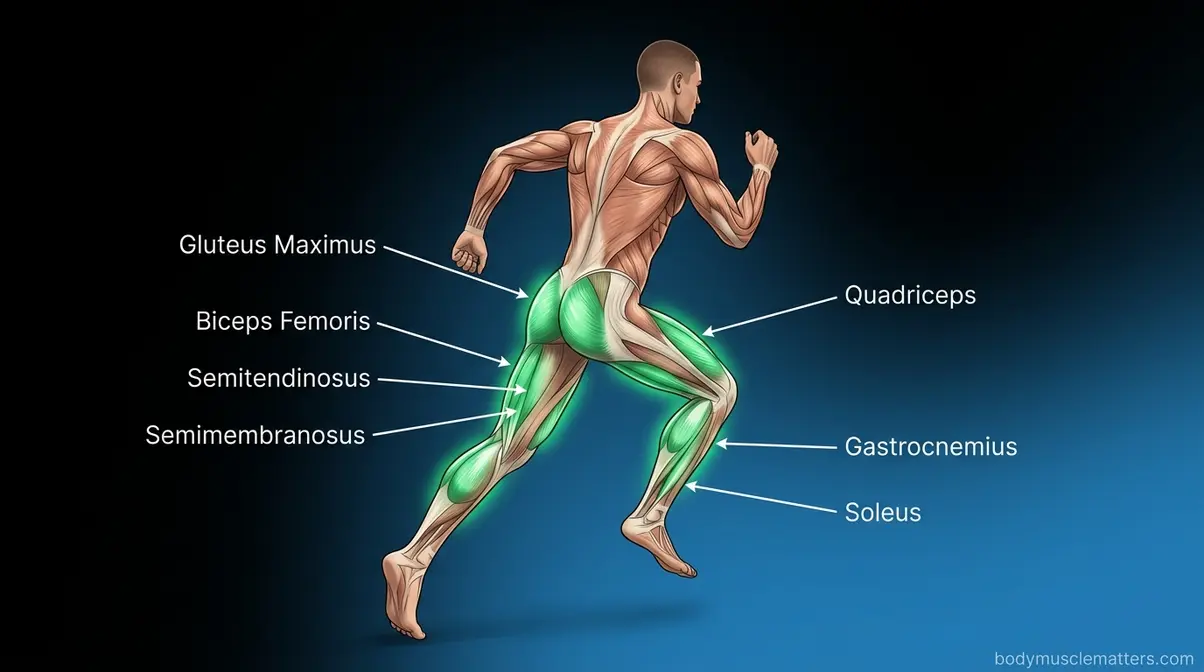
The primary muscles that help you run faster are the gluteus maximus, hamstrings, quadriceps, and calves — but they don’t all contribute equally at every speed. Research from the University of Massachusetts found that at sprinting speeds, the gluteus maximus and hamstrings are primarily responsible for limiting maximum velocity. At jogging pace, your calves do most of the propulsive work. As speed climbs, your posterior chain (the muscles along the back of your body) takes over.
Understanding this velocity-specific shift is the foundation of the Speed-Specific Muscle Matrix — a three-category framework that classifies running muscles by their speed-specific role:
- Stabilizers — active at all speeds, preventing energy leaks (core, glute medius)
- Accelerators — dominant at medium-to-high speeds (gluteus maximus, hamstrings)
- Energy Transmitters — critical at low-to-medium speeds (calves, ankle plantar flexors)
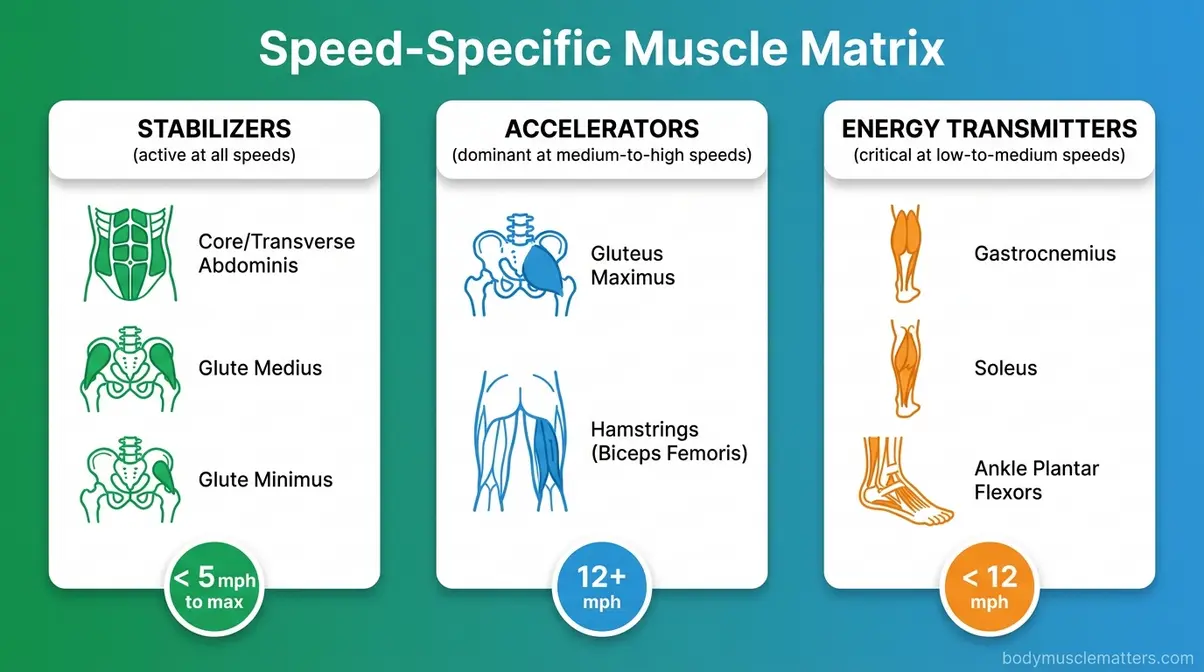
Most training programs treat all leg muscles as equal contributors. They’re not. Knowing which category each muscle belongs to tells you exactly how to train it for speed.
What Makes a Muscle a “Speed Muscle”?
A muscle earns its place in the speed category based on one thing: how much force it produces relative to your running velocity. Biomechanics research distinguishes between muscles that generate propulsive force (pushing you forward) and those that primarily absorb shock (slowing you down safely). Both are necessary, but only propulsive muscles directly increase your pace.
Speed muscles share three characteristics. First, they produce large amounts of force very quickly — a quality called rate of force development (RFD), meaning how fast a muscle can go from relaxed to maximum contraction. Second, they contain a high proportion of fast-twitch (Type II) muscle fibers, which are built for explosive, powerful contractions. Third, they work in coordinated sequences with neighboring muscles, not in isolation.
So, does muscle strength help you run faster? Yes — but only the right muscles trained in the right way. A 2026 study in the Journal of Sports Sciences confirmed that plyometric training enhanced sprint performance by increasing fast-twitch muscle fiber activation. Raw strength without speed-specific training produces diminishing returns. Learn more about running performance training on trainadapt.com.
Gluteus Maximus: Forward Propulsion
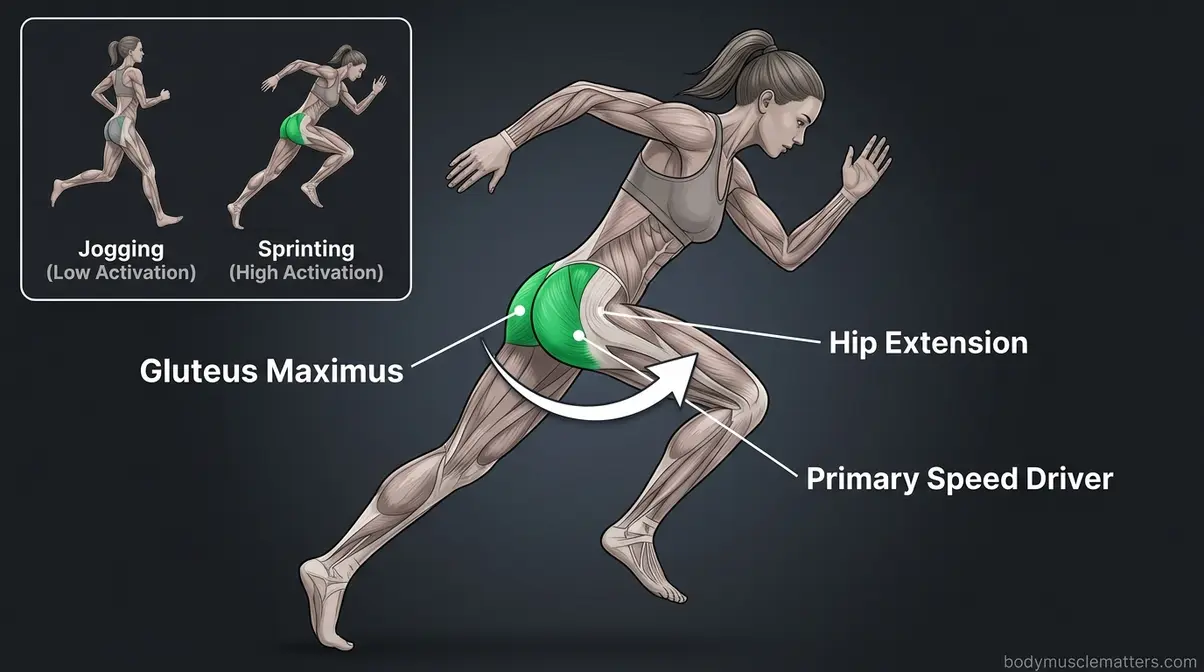
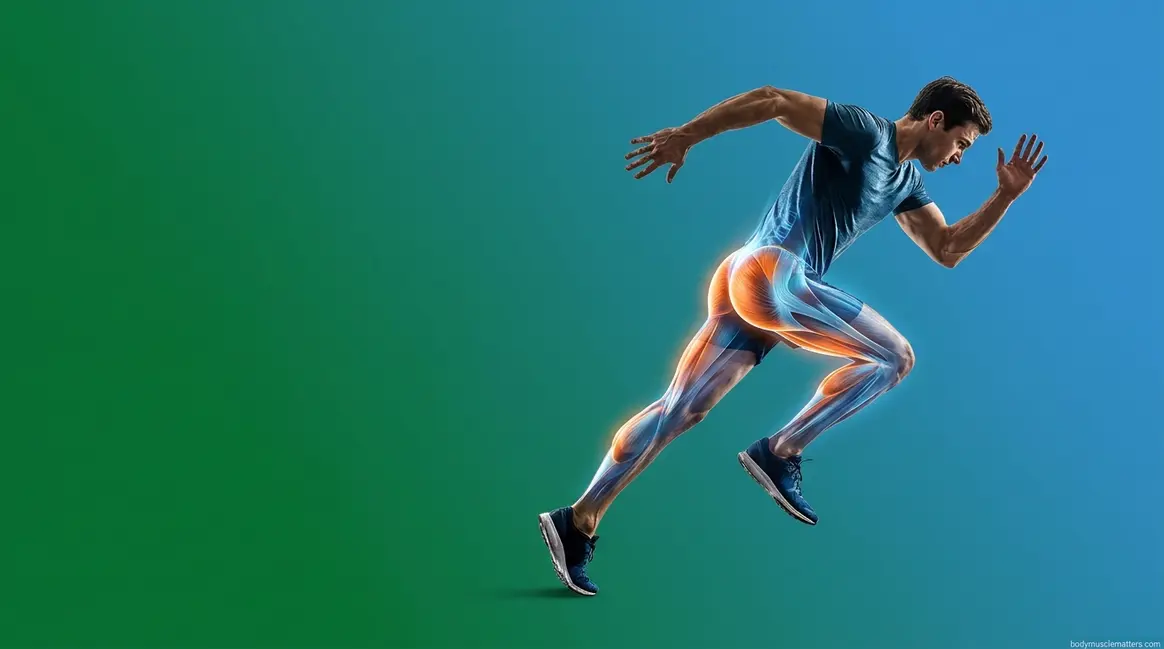
The gluteus maximus — the largest muscle in your body and the primary driver of hip extension (the movement of pushing your leg behind your body) — is the single most important muscle for sprinting speed. At slow jogging speeds, it contributes relatively little. But as you approach top-end velocity, it becomes the dominant force producer.
University of Massachusetts computer simulations of sprinting biomechanics confirmed that the gluteus maximus is primarily responsible for limiting maximum speed. Think of it as your car engine: idle in traffic and the engine barely works, but floor the accelerator and it takes over completely.
Why this matters for your speed: If your glutes are weak or underdeveloped, your hamstrings and lower back compensate — leading to fatigue, injury risk, and a hard ceiling on how fast you can run. Developing your gluteus maximus through targeted hip extension exercises is the single highest-leverage move for most amateur runners.
Hamstrings: Brakes That Launch You
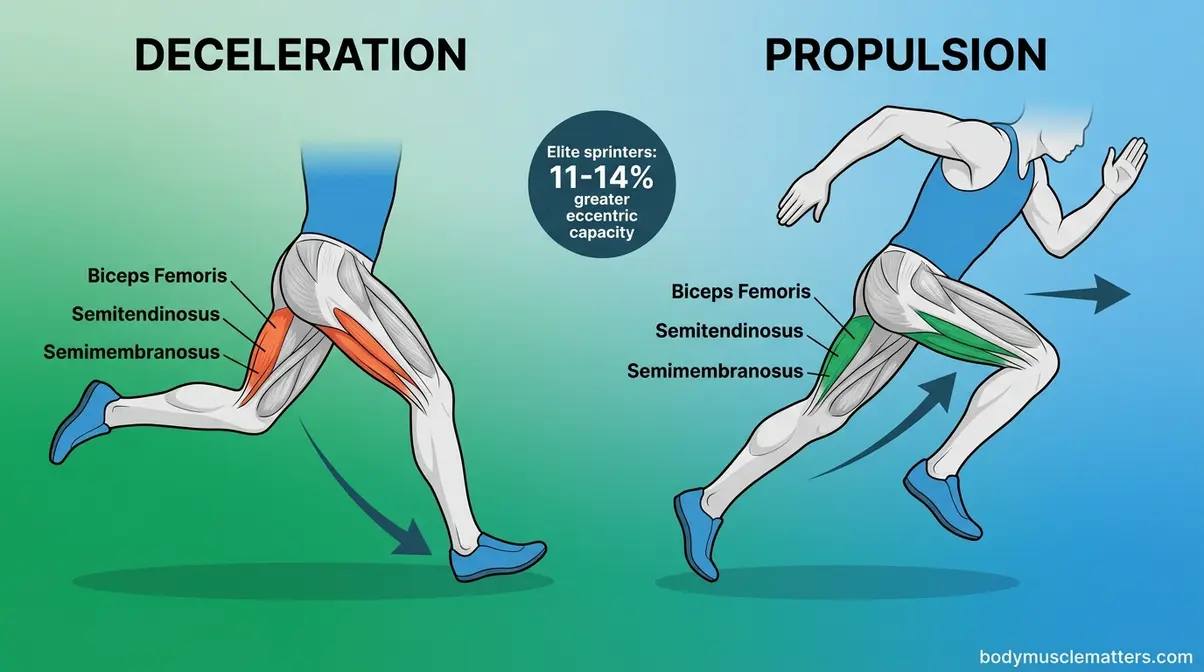
The hamstrings — a group of three muscles (biceps femoris, semitendinosus, semimembranosus) running along the back of your thigh — perform a counterintuitive double role. They decelerate your swinging leg just before foot strike, then immediately switch to generating propulsive force as you push off.
A 2026 study from DSHS Köln found that fast thigh angular motion and eccentric hamstring strength (strength during lengthening) are both strongly correlated with sprint performance. Faster sprinters showed 11–14% greater eccentric hamstring capacity than slower counterparts. This means your hamstrings need to be strong not just when shortening (like in a leg curl) but also when absorbing force — a quality you specifically train with Nordic curls and Romanian deadlifts.
Why this matters for your speed: Weak hamstrings are the most common speed limiter in recreational runners. They’re also the most frequently injured muscle in sprinting. Strengthening them eccentrically is both a performance and injury-prevention priority.
Quadriceps: Knee Drive Shock Absorbers
The quadriceps — the four-muscle group at the front of your thigh — handle two jobs simultaneously. They absorb the impact of foot strike (preventing your knee from buckling) and then extend your knee to drive your body forward. This combination makes them essential for both acceleration and stride efficiency.
At medium running speeds, the quads are active for roughly 60% of the stance phase (the time your foot is on the ground). They also work in coordination with your glutes during the push-off phase, amplifying the power your hips generate. Research shows that strength training improves running economy — meaning you use less energy at the same pace — with the quadriceps playing a central role (Runner’s World, 2026).
Why this matters for your speed: Strong quads reduce ground contact time, which is one of the most reliable predictors of running speed. The faster you can stiffen and push off, the faster you move.
Calves: Your Built-In Springs
The gastrocnemius and soleus — the two muscles that form your calf complex — function like biological springs. They store elastic energy as your foot lands and release it explosively as you push off. This stretch-shortening cycle happens in roughly 150–200 milliseconds — faster than a conscious muscle contraction is even possible.
At slower running speeds, the ankle plantar flexors (your calves) are actually the dominant propulsive muscles. As speed increases, the glutes and hamstrings take over, but the calves remain critical for that explosive takeoff and quicker ground contact that defines efficient sprinting mechanics.
Why this matters for your speed: Ankle stiffness — the ability of your calf complex to store and return elastic energy — is a key predictor of stride efficiency. Runners with stiffer ankles (in the functional sense) waste less energy with each step and maintain higher speeds with less effort. Healthline’s overview of running muscles confirms the calf complex as a central contributor to running performance.
What Muscles Help You Sprint Faster?
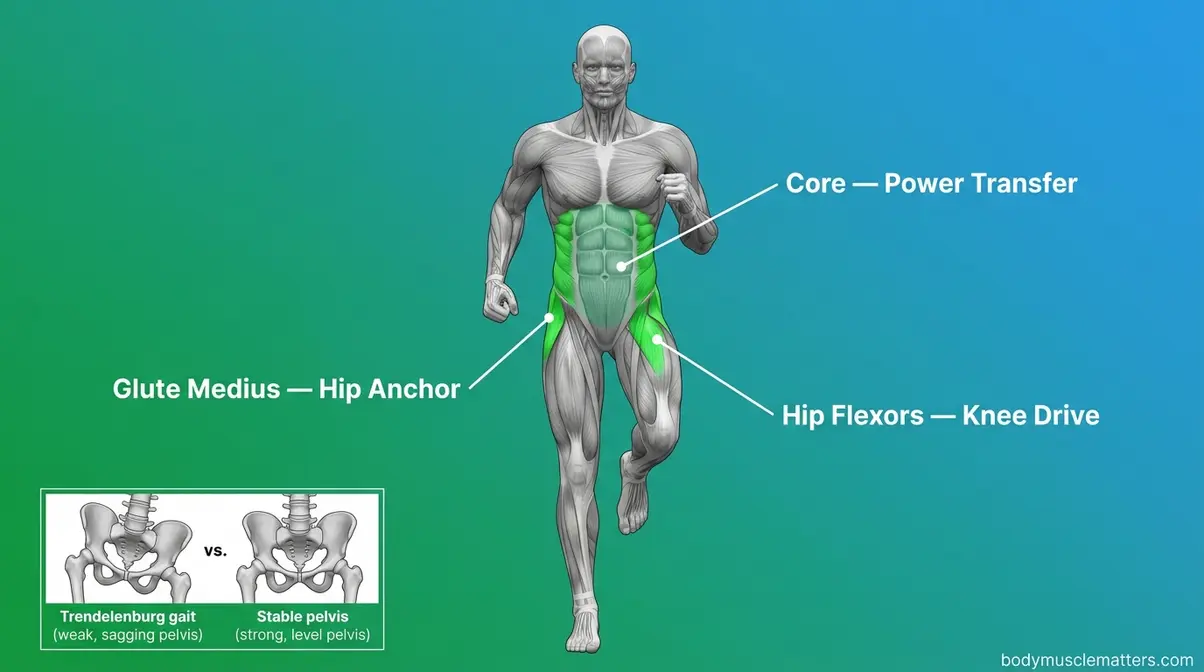
Sprinting speed depends most on the gluteus maximus and hamstrings, which dominate at high velocities. University of Massachusetts computer simulations of sprinting confirmed these two muscle groups as the primary limiters of maximum sprint speed. Your calves contribute through elastic energy storage and return, while your hip flexors control knee drive frequency. The key distinction: at jogging speeds, your calves and ankle muscles do most of the propulsive work. As you approach sprinting pace, the glutes and hamstrings take over as the dominant force producers.
The Stabilizing Muscles That Keep You Efficient
Stabilizing muscles don’t generate your top speed directly — but they determine how much of your power actually reaches the ground. Think of them as the power transfer system: your engine (glutes, hamstrings) can produce enormous force, but if the chassis (core, hips) is unstable, that energy leaks out with every stride. A 2026 systematic review in Frontiers in Physiology found that core muscle strength contributes significantly to change-of-direction speed — a direct indicator of neuromuscular coordination during fast running.
Core Muscles: The Power Transfer System
Your core — encompassing the transverse abdominis (your deepest abdominal layer), internal and external obliques, and the muscles surrounding your spine — doesn’t generate speed. It transfers it. Every time your glutes fire, the force travels through your pelvis and spine before reaching the ground. A weak core means that force dissipates rather than propels you forward.
Research from a 2026 PMC systematic review confirms that core training effectively improves foundational athletic qualities including sprint speed, particularly over 10–20 meter distances. Runners with strong cores maintain upright posture at high speeds, which keeps their body in the optimal position for forward propulsion. When your core fatigues and your posture collapses, you’re essentially “leaking energy” with every step.
Why this matters for your speed: You’ve probably seen runners whose hips swing wildly side to side as they fatigue. That’s core instability in action — and every degree of lateral sway is energy that isn’t going forward.
Hip Flexors: Knee Drive and Stride
Your hip flexors — primarily the iliopsoas (ill-ee-oh-SO-as), a muscle running from your lower spine to your upper thigh — control how aggressively your knee drives upward with each stride. Higher knee drive creates a longer, more powerful stride cycle and positions your foot for a more efficient ground contact.
Weak or tight hip flexors are one of the most common hidden speed drivers that recreational runners overlook. When they fatigue, your stride shortens, your knee drive drops, and your pace slows — even if your glutes and quads are still strong. Hip flexor strength and mobility work together: a strong but inflexible hip flexor can actually limit stride length by restricting the range of motion available to your leg.
Why this matters for your speed: Elite sprinters demonstrate significantly greater hip flexion velocity (how fast the knee drives upward) compared to recreational runners. This is a trainable quality — and one that directly lengthens your stride without overstriding.
Glute Medius & Minimus: Hip Anchors
The gluteus medius and gluteus minimus — two smaller glute muscles on the outer hip — are responsible for keeping your pelvis level as you run on one leg during each stride. Every time your foot is in the air, these muscles fire to prevent your opposite hip from dropping.
When they’re weak, your pelvis tilts with each stride (called a Trendelenburg gait), creating a chain reaction: your IT band tightens, your knee tracks inward, and your calf is forced to compensate. The result is both injury risk and wasted energy. A 2026 study from Running Physio found that hip and core exercises reduced running injury prevalence by 39% compared to a stretching-only control group — with pelvic stability as a key mechanism.
Why this matters for your speed: Lateral hip instability may be the most overlooked reason experienced runners hit a plateau. You can have powerful glutes and hamstrings and still “leak energy” laterally if the glute medius isn’t doing its job. Nike’s running muscles guide highlights hip stability as a critical component of efficient running form.
Upper Body: Arms and Shoulders
Your arms, shoulders, and breathing muscles are not passengers — they’re active contributors to forward propulsion. The latissimus dorsi (the large muscle of your upper back), deltoids (shoulders), and pectorals (chest) all work in opposition to your legs. When your right leg drives forward, your left arm swings back — this counterbalancing action is what keeps your torso from rotating excessively.
Your respiratory muscles — primarily the diaphragm and intercostals (the muscles between your ribs) — also contribute to running economy. Research shows that respiratory muscle fatigue can limit performance at high intensities even before your legs give out. Inefficient arm swing forces your torso to compensate, creating rotational energy that leaks sideways instead of driving you forward.
Why this matters for your speed: Tight shoulders and a hunched upper back are common culprits in energy leakage. A relaxed, efficient arm swing at 90 degrees amplifies your leg drive — it doesn’t just balance it.
12 Exercises for Speed Strength
How to Read This Exercise Guide
These 12 exercises were selected based on three criteria: (1) direct evidence linking the movement to speed-specific muscle development, (2) applicability to runners without elite gym access, and (3) appropriate loading for beginner-to-intermediate athletes. Our team evaluated exercises across peer-reviewed biomechanics literature and certified coaching programs to prioritize movements with the highest transfer to running performance.
- Estimated Time: 30–45 minutes per session
- Tools and Materials Needed:
- Barbell and weight plates
- Dumbbells
- Resistance bands
- Plyometric box or flat bench
- Padded mat
- How to use this section:
- Sets × Reps are listed for each exercise
- % 1RM means percentage of your one-rep maximum (the most you can lift for a single rep). If you don’t know your 1RM, use a weight that feels challenging by the last 2–3 reps of each set.
- Rest between sets is listed where critical — don’t skip it for power exercises
- Perform strength exercises 2–3 times per week, on non-consecutive days
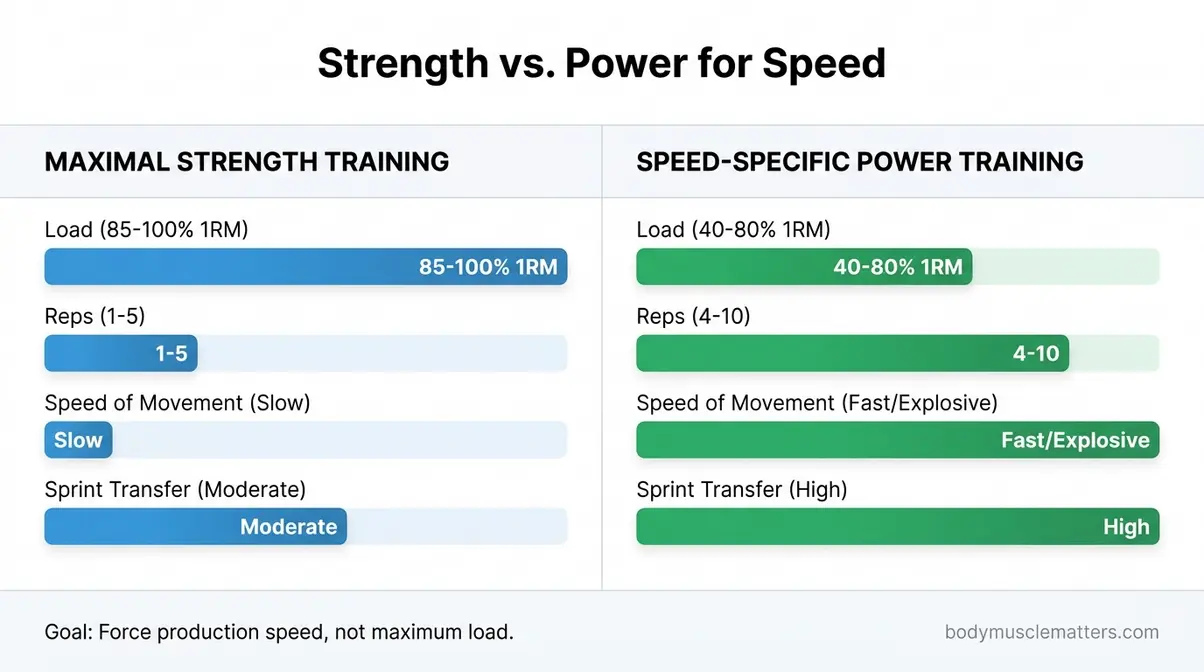
“Upping your deadlift from say 150lbs to 300lbs is likely to make you faster. Going from 300 to like 450 might make you slower.”
This quote from the running community captures the programming philosophy here exactly. The goal isn’t maximum strength — it’s speed-specific strength. You’re training your muscles to produce force quickly and efficiently, not to move maximal loads slowly. Load matters, but so does velocity of movement.
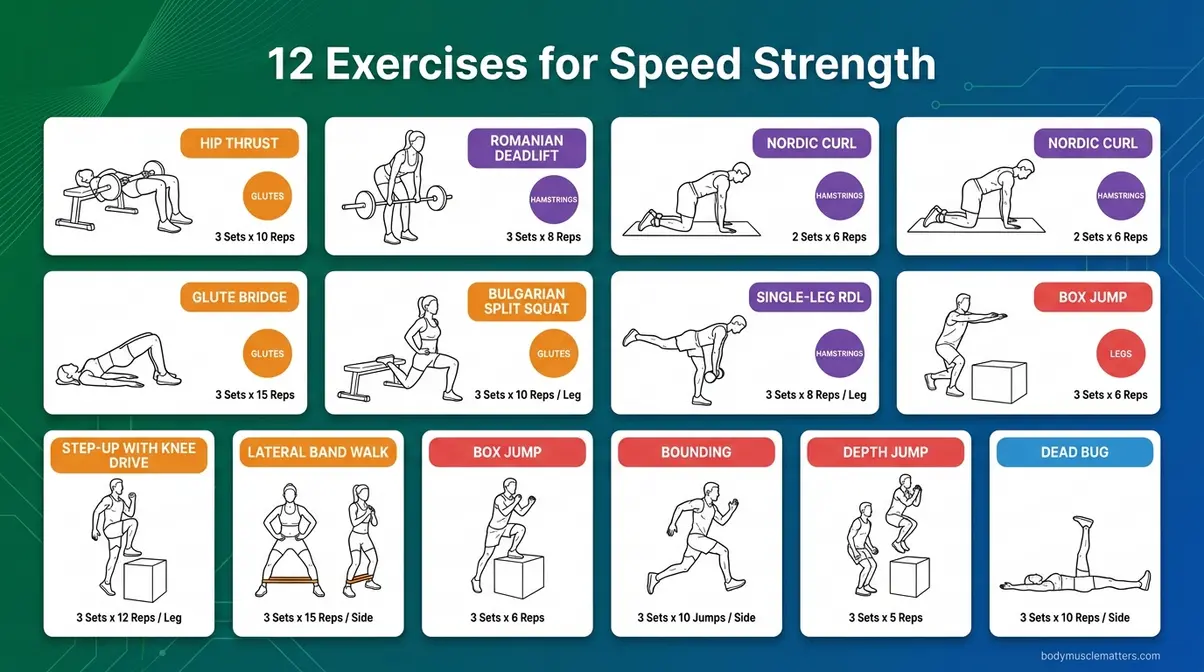
Posterior Chain Exercises
These exercises target your Accelerators — the glutes and hamstrings that dominate at medium-to-high speeds. A 2026 PeerJ analysis found that barbell hip thrust training produces moderate acute improvements in sprint performance (effect size = 0.55) via post-activation enhancement of the gluteus maximus.
Exercise 1: Barbell Hip Thrust
- Sit on the floor with your upper back against a flat bench, feet flat, knees bent at 90 degrees
- Place a barbell across your hips (use a pad for comfort)
- Drive your hips upward by squeezing your glutes until your body forms a straight line from shoulders to knees
- Hold the top position for 1 second, then lower slowly (3-second descent)
- Keep your chin tucked — don’t hyperextend your lower back
Loading: 3–4 sets × 6–10 reps at 60–80% 1RM | Rest: 2–3 minutes
Exercise 2: Romanian Deadlift (RDL)
- Stand with feet hip-width apart, holding a barbell or dumbbells in front of your thighs
- Hinge at your hips (push them back, not down), keeping your back flat
- Lower the weight until you feel a strong stretch in your hamstrings (typically just below the knee)
- Drive your hips forward to return to standing — don’t use your lower back to pull up
Loading: 3 sets × 8–12 reps at 65–75% 1RM | Rest: 90 seconds
Exercise 3: Nordic Hamstring Curl
- Kneel on a padded surface with your ankles secured (under a barbell, partner-held, or using a Nordic curl machine)
- Keeping your body straight from knee to shoulder, lower your torso toward the floor as slowly as possible
- Use your hands to catch yourself at the bottom, then push back to the start
- As you get stronger, reduce how much you use your hands
Loading: 2–3 sets × 4–6 reps (progress to 8 reps over 6–8 weeks) | Rest: 2 minutes
This is one of the most evidence-supported exercises for eccentric hamstring strength — the exact quality associated with faster sprint speeds in the 2026 DSHS Köln research.
Exercise 4: Glute Bridge (bodyweight or loaded)
- Lie on your back with knees bent, feet flat on the floor hip-width apart
- Press through your heels and squeeze your glutes to lift your hips off the floor
- Hold for 2 seconds at the top, then lower slowly
- For added load, place a dumbbell or barbell across your hips
Loading: 3 sets × 12–15 reps (bodyweight) or 10–12 reps (loaded) | Rest: 60 seconds
Single-Leg Power Exercises
Single-leg exercises are critical because running is a single-leg sport — every stride, you’re propelling your entire body weight from one foot. These movements expose and correct strength imbalances that bilateral (two-legged) exercises mask. Trainadapt.com’s speed training research hub identifies single-leg strength as a key differentiator between recreational and competitive runners.
Exercise 5: Bulgarian Split Squat
- Stand 2 feet in front of a bench, facing away from it
- Place your rear foot on the bench behind you, laces down
- Lower your back knee toward the floor, keeping your front shin as vertical as possible
- Drive through your front heel to return to the start position
- Complete all reps on one side before switching
Loading: 3 sets × 8–10 reps per leg at 60–70% 1RM (or challenging dumbbells) | Rest: 90 seconds
Exercise 6: Single-Leg Romanian Deadlift
- Stand on one leg, holding a dumbbell in the opposite hand
- Hinge forward at the hip, extending your free leg behind you for balance
- Lower the dumbbell toward the floor, keeping your back flat and hips square
- Drive through the standing heel to return to upright
Loading: 3 sets × 8–10 reps per leg (moderate weight — prioritize balance and control) | Rest: 90 seconds
Exercise 7: Step-Up with Knee Drive
- Stand in front of a knee-height box or step
- Step up with one foot, driving your opposite knee upward aggressively as you stand on the box
- Lower yourself slowly and under control — don’t just drop down
- The knee drive at the top mimics the hip flexion pattern of sprinting
Loading: 3 sets × 10 reps per leg (bodyweight first, add dumbbells when form is solid) | Rest: 60 seconds
Exercise 8: Lateral Band Walk
- Place a resistance band around your ankles or just above your knees
- Stand with feet hip-width apart, slight bend in your knees
- Step sideways 10–12 steps in one direction, then return
- Keep tension in the band throughout — don’t let your feet come together
Loading: 3 sets × 10–12 steps each direction (medium-to-heavy band) | Rest: 45 seconds
This exercise directly targets the glute medius and minimus — your hip stability anchors — making it one of the highest-return exercises for runners prone to lateral energy leakage.
Explosive Plyometric Drills
Plyometrics train your fast-twitch muscle fibers — the ones responsible for explosive takeoff and quicker ground contact. The Journal of Sports Sciences confirmed that plyometric training enhances sprint performance by increasing fast-twitch muscle fiber activation. Do these exercises with maximum intent: the goal is speed of movement, not just completing reps.
Exercise 9: Box Jump
- Stand facing a box or platform 18–24 inches high
- Dip slightly into a quarter squat, swinging your arms back
- Explode upward, driving your arms forward and landing softly on the box with both feet
- Step down (don’t jump down) and reset fully before the next rep
- Key cue: Land as quietly as possible — this trains tissue tolerance and landing mechanics
Loading: 3–4 sets × 4–6 reps | Rest: 2–3 minutes (full recovery between sets — power output requires it)
Exercise 10: Bounding (Alternating Long Jumps)
- Start jogging at a comfortable pace
- Exaggerate each stride into a long, powerful bound — pushing off one foot and reaching forward with the opposite knee
- Focus on maximum horizontal distance per bound (not height)
- Cover 20–30 meters per set, walking back to recover
Loading: 4–5 sets × 20–30 meters | Rest: 90–120 seconds
Bounding directly trains the stretch-shortening cycle of the calves and hamstrings — the same mechanism that drives stride efficiency during fast running.
Exercise 11: Depth Jump
- Stand on a box 12–18 inches high
- Step off (don’t jump off) and land on both feet
- The instant your feet contact the ground, jump upward as explosively as possible
- Minimize the time between landing and takeoff — this trains your rate of force development
Loading: 2–3 sets × 4–6 reps | Rest: 2–3 minutes | Note: Only attempt after 4–6 weeks of box jumps. This is an advanced drill.
Core and Stability Work for Runners
Common Mistake Warning: Most runners who do “core work” focus on crunches — a movement that has almost no transfer to running. Running requires your core to resist rotation and lateral bending, not to flex your spine. These exercises train the patterns that actually matter.
Exercise 12: Dead Bug
- Lie on your back, arms pointing straight up toward the ceiling, knees bent at 90 degrees (tabletop position)
- Slowly lower your right arm overhead and extend your left leg toward the floor simultaneously
- Keep your lower back pressed firmly into the floor throughout — this is the entire point
- Return to the start and repeat on the opposite side
Loading: 3 sets × 8–10 reps per side | Rest: 60 seconds
Additional Core Exercises (Included in the 12-exercise framework):
- Pallof Press (anti-rotation core):
- Attach a resistance band to a fixed point at chest height
- Stand sideways to the anchor, holding the band at your chest with both hands
- Press your hands straight out in front of you, resisting the rotational pull of the band
- Hold for 2 seconds, return to chest, repeat
Loading: 3 sets × 10–12 reps per side | Rest: 60 seconds
Troubleshooting Common Mistakes:
| Mistake | What Goes Wrong | Fix |
|---|---|---|
| Hip thrusting too heavy too soon | Lower back takes over, glutes don’t fire | Drop to 50% 1RM, focus on squeezing glutes at the top |
| Rushing plyometric rest periods | Power output drops 30–40% per set | Full 2–3 minutes between sets — quality over quantity |
| Neglecting eccentric control | Injury risk spikes, hamstring strength gains are halved | Count 3 seconds on every lowering phase |
| Only training bilaterally | Strength imbalances remain hidden | Alternate: one bilateral session, one single-leg session per week |
| Skipping stability work | Energy leaks laterally, speed ceiling stays low | Treat band walks and dead bugs as non-negotiable, not optional finishers |
How Do I Increase My Sprint Speed?
Increase sprint speed by combining three training types: heavy posterior chain strength work (hip thrusts, Romanian deadlifts, Nordic curls), explosive plyometric drills (bounding, box jumps, depth jumps), and structured speed intervals (10-20-30 method or sprint repeats). Strength builds your force production ceiling; plyometrics develop your rate of force development; speed work teaches your nervous system to apply both quickly. Aim for 2 strength sessions, 1 plyometric session, and 1–2 speed sessions per week — with 48–72 hours of recovery between sessions targeting the same muscle groups.
Running Technique for Efficiency
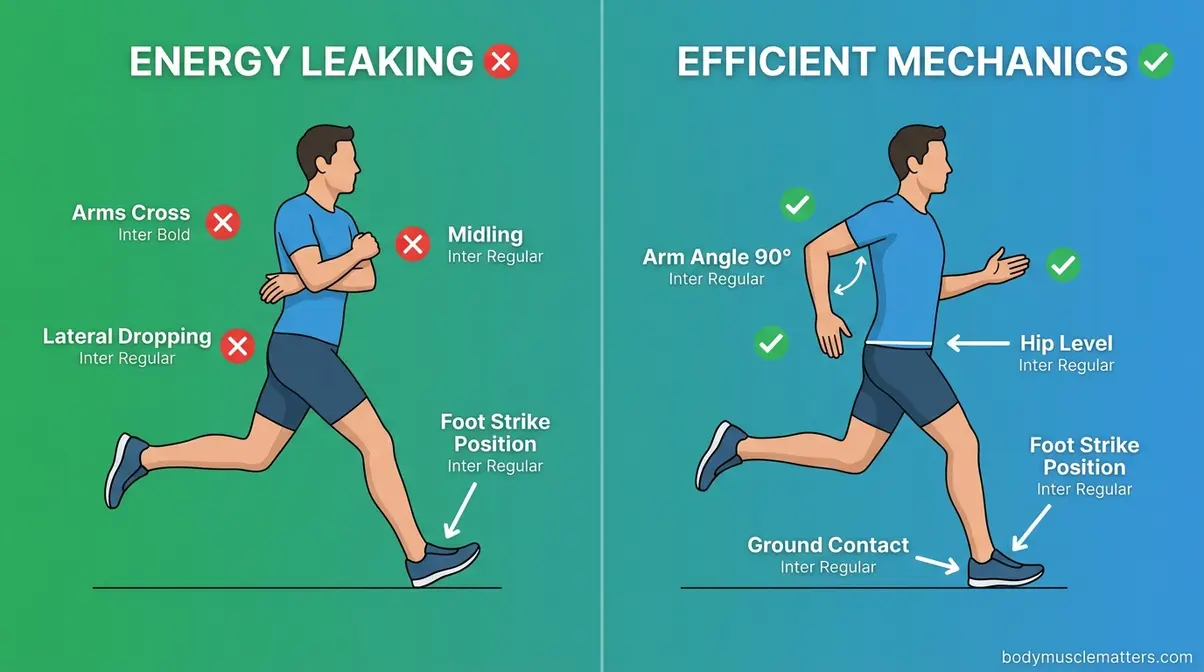
Building strong speed muscles is necessary — but not sufficient. Biomechanics research consistently shows that technique determines how much of your muscle power actually translates into speed. Two runners with identical strength profiles can differ by 10–15% in running speed based purely on mechanical efficiency. The goal of this section is to close that gap.
Ground Contact & Stride Frequency
Ground contact time (GCT) — the duration your foot stays on the ground with each step — is one of the most reliable predictors of running speed. Elite sprinters spend approximately 80–100 milliseconds in contact with the ground. Recreational runners typically spend 200–300 milliseconds. Every extra millisecond is time you’re not moving forward.
Shorter GCT is a product of two things: strong, stiff ankle and calf complex (your Energy Transmitters), and high stride frequency. Research from PMC (NIH) confirms that faster runners achieve higher stride frequencies without sacrificing stride length — they don’t choose one over the other. The practical target for most runners is a cadence of 170–180 steps per minute. If you’re well below this, increasing your stride rate (without shortening your stride) is often the fastest route to a faster pace.
How to improve: Run with a metronome app set to your target cadence. Focus on “quick feet” — light, fast contacts rather than heavy, slow pushes. Your calf complex and ankle stiffness will improve with the plyometric drills in the previous section.
Arm Swing and Upper Body Mechanics
Efficient arm swing is a force multiplier, not a passive movement. Your arms should swing in opposition to your legs — left arm forward when right leg drives forward. The mechanics: elbows bent at approximately 90 degrees, hands relaxed (imagine holding a potato chip without crushing it), and swing from the shoulder, not the elbow.
A common energy leak is crossing your arms across your body’s midline. This creates counter-rotation in your torso, forcing your core muscles to work overtime to stabilize — energy that could be driving you forward. Another mistake is letting your elbows drop below 90 degrees as you fatigue, which shortens the lever arm and reduces the momentum transfer to your legs.
The full-body coordinated movement principle: Your arm swing doesn’t just balance your legs — it actively contributes to your stride rate. Research shows that restricting arm swing reduces running economy and increases energy cost at the same pace. A powerful, rhythmic arm drive can increase your turnover rate without any additional leg effort.
Stride Length vs. Stride Frequency
Most recreational runners try to run faster by taking longer strides. This is the wrong instinct. Overstriding — landing with your foot far in front of your center of mass — acts as a brake with every step. It increases ground contact time, increases injury risk, and actually slows you down.
The evidence-based approach: increase speed by increasing stride frequency first, then allow stride length to grow naturally as your hip flexors and glutes become stronger. Research confirms that elite runners achieve higher speeds through both metrics simultaneously — but beginners who chase stride length before developing the necessary hip flexor strength and posterior chain power typically overstride and get injured.
Practical cue: Focus on landing with your foot beneath your hips, not in front of them. Your stride length will increase naturally as your glutes and hip flexors get stronger through the exercises in this guide.
Muscle Activation at Various Speeds
This is the core insight of the Speed-Specific Muscle Matrix — and it’s what most guides miss entirely. Muscle activation patterns shift fundamentally as your pace increases. Understanding this shift tells you how to train for the specific speed you’re targeting.
| Speed Zone | Dominant Muscles | Primary Role | Training Focus |
|---|---|---|---|
| Easy jog (< 8 min/mile) | Calves, soleus, quads | Energy return, shock absorption | Endurance, tissue tolerance |
| Tempo pace (6–8 min/mile) | Quads, hip flexors, glute medius | Stride length, stability | Strength endurance, hip mobility |
| Fast/race pace (< 6 min/mile) | Gluteus maximus, hamstrings | Hip extension power, propulsion | Heavy hip thrusts, RDLs, plyometrics |
| Sprint (< 5 min/mile) | Gluteus max, hamstrings, fast-twitch fibers | Maximum rate of force development | Explosive drills, depth jumps, bounding |
Training only at easy-jog effort means you’re never fully recruiting your Accelerators — the gluteus maximus and hamstrings that dominate at fast speeds. This is why strength training and speed-specific drills are essential even for distance runners who rarely sprint.
Running Speed Benchmarks: How Fast Is Fast?
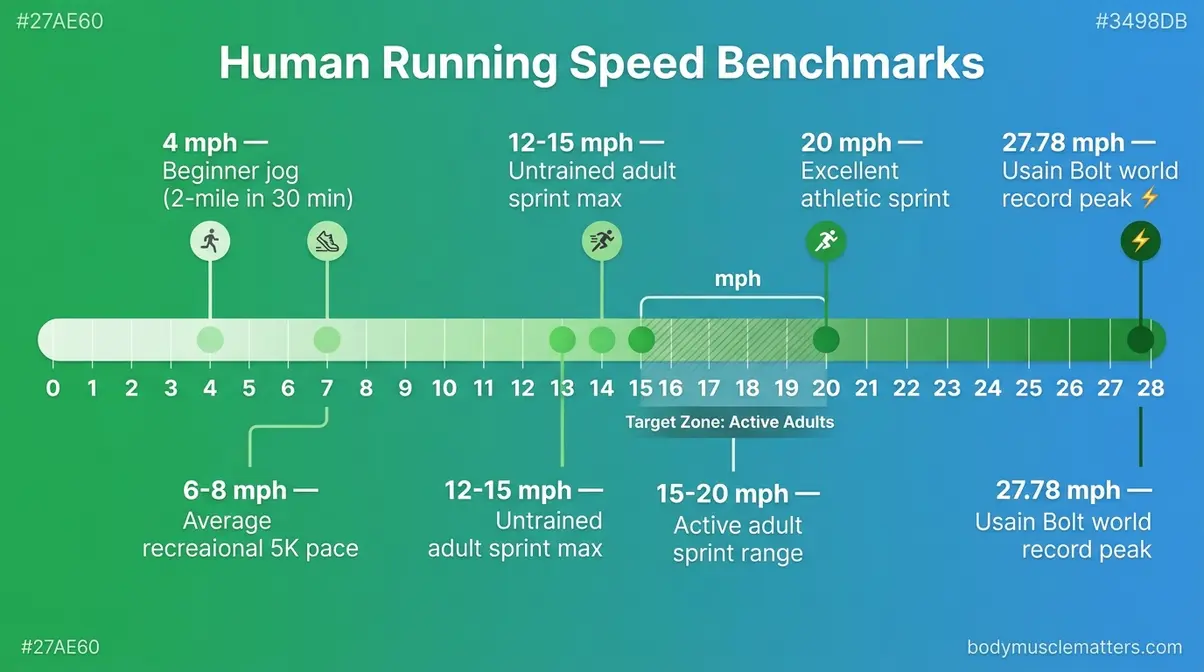
Context matters. Before you can set meaningful speed goals, you need to know where typical human running speeds actually fall — and what the research says about speed limits and training thresholds. This section answers the most common benchmark questions directly.
What Is the Average Human Sprint Speed?
The average human sprint speed for a physically active adult is approximately 15–20 mph (24–32 km/h) over short distances. Untrained individuals typically top out closer to 12–15 mph. The average non-competitive adult completing a 5K runs at roughly 6–8 mph — far below their sprint potential.
These numbers vary significantly by age, sex, training history, and body composition. Men typically sprint 10–15% faster than women at comparable fitness levels. Speed declines measurably after age 40, primarily due to reductions in fast-twitch muscle fiber mass — a loss that targeted strength and plyometric training can substantially slow. Marathon Handbook’s sprint speed database provides a useful breakdown by age group and fitness level.
Is 20 mph a Good Sprint Speed?
Yes — 20 mph is an excellent sprint speed that places you well above the average for recreational athletes. To put it in context: most non-elite adults max out around 14–15 mph. Physically active adults with some training can reach 18–20 mph. Only well-trained sprinters and athletes consistently exceed 20 mph.
For reference, Usain Bolt’s peak speed during his world-record 100-meter sprint was 27.78 mph (44.72 km/h) — a figure so far beyond normal human performance that it required a combination of elite genetics, fast-twitch fiber dominance, and over a decade of specialized training. A 20 mph sprint represents genuine athletic achievement for the vast majority of runners.
The 10-20-30 Training Rule Explained
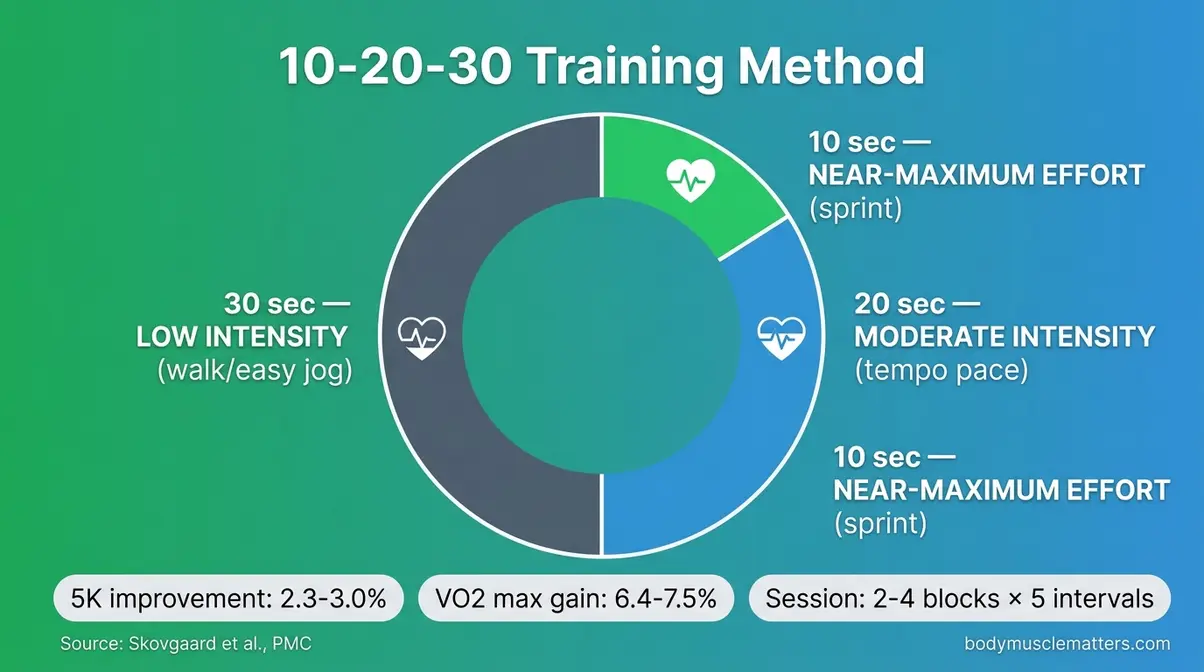
The 10-20-30 training method is a structured interval approach where each 1-minute cycle consists of: 30 seconds at low intensity → 20 seconds at moderate intensity → 10 seconds at near-maximum effort. Runners repeat this cycle 5 times per block, with 2–4 blocks per session.
A 2026 study published in PMC (Skovgaard et al., 2026) found that six weeks of 10-20-30 training improved 5K performance by 2.3–3.0% and increased VO2 max (the maximum rate at which your body can use oxygen during exercise) by 6.4–7.5% — even when participants only reached 80% of their maximum effort during the sprint intervals. This is significant because it means you don’t need to go all-out every rep to see substantial speed and fitness gains. See the full study at PMC.
The 10-20-30 method works because the 10-second sprint interval is long enough to recruit fast-twitch muscle fibers and elevate heart rate to 85–96% maximum, but short enough to allow quality effort across multiple reps. It’s one of the most accessible speed-development protocols for beginner-to-intermediate runners.
Could a Human Ever Run 35 mph?
Almost certainly not. The current biomechanical ceiling for human sprinting is approximately 27–28 mph, based on Usain Bolt’s peak recorded speed of 27.78 mph. Reaching 35 mph would require force production rates that exceed what human musculoskeletal tissue can structurally support.
Research on human speed limits suggests the constraint isn’t muscle power alone — it’s the rate at which the nervous system can cycle the legs and the tensile strength of tendons and bones under extreme load. At 27+ mph, ground contact time drops below 80 milliseconds and ground reaction forces exceed 3.5 times body weight. Increasing speed beyond this point would require either a fundamental change in human anatomy or significant biomechanical assistance. So while 35 mph makes for a compelling hypothetical, it remains outside the boundaries of what human tissue can safely achieve.
Limitations and Alternative Approaches
Common Pitfalls
Pitfall 1: Progressing load before mastering form. The 12 exercises in this guide are effective precisely because they target specific muscle recruitment patterns. Rushing to heavier loads before those patterns are ingrained turns speed-specific training into generic strength training — and dramatically increases injury risk. Spend at least 3–4 weeks at bodyweight or light load before adding significant resistance.
Pitfall 2: Ignoring recovery between sessions. Speed-specific strength training — especially plyometrics and heavy hip thrusts — requires 48–72 hours of recovery before repeating the same muscle groups. Training these exercises on consecutive days doesn’t accelerate progress; it stalls it. Consult a certified sports physiotherapist or strength coach before starting this program if you’re uncertain about managing recovery.
Pitfall 3: Training strength without running speed work. Stronger muscles improve your speed potential. But that potential only converts to actual speed when you practice running fast. Strength sessions should complement, not replace, structured speed work (strides, tempo runs, or 10-20-30 intervals).
Pitfall 4: Neglecting ankle stiffness. The calf complex and ankle plantar flexors are frequently undertrained in beginner programs. Single-leg calf raises and bounding drills are not optional finishers — they directly develop the elastic energy return that defines stride efficiency.
When to Choose Alternatives
If you’re recovering from a knee injury: Bulgarian split squats and depth jumps place significant load on the patellar tendon. In this case, substitute single-leg glute bridges and lateral band walks, which develop posterior chain and hip stability with minimal knee stress. Work with a physical therapist to determine appropriate loading.
If you’re a pure distance runner (marathon/ultramarathon focus): The heavy loading protocols (60–80% 1RM) in this guide are optimized for speed development. Distance runners may benefit more from strength endurance protocols (3 sets × 15–20 reps at 40–50% 1RM) that build tissue tolerance without excessive muscle mass.
If you have limited gym access: Most of the plyometric and single-leg exercises in this guide require no equipment. Prioritize Nordic curls (using a couch or partner), bounding, and lateral band walks as your core program.
When to Seek Expert Help
Consult a certified sports physiotherapist or strength and conditioning coach if: (1) you experience pain — not discomfort — during any of these exercises, (2) you have a history of hamstring strains, IT band syndrome, or patellar tendinopathy, or (3) you’re preparing for a competitive event and want a periodized program tailored to your race schedule. The exercises here are evidence-based starting points — not a substitute for individualized assessment.
Frequently Asked Questions
Which muscles build running speed?
Prioritize your gluteus maximus and hamstrings — the two muscles research consistently identifies as the primary limiters of maximum running speed. After those, target your quadriceps (for shock absorption and knee drive), calves (for elastic energy return), and core (for power transfer). A 2026 study from DSHS Köln confirmed that eccentric hamstring strength correlates significantly with sprint velocity — runners with 11–14% greater eccentric hamstring capacity consistently ran faster. The Speed-Specific Muscle Matrix in this guide categorizes all key muscles by their velocity-specific role, helping you prioritize based on your target pace.
Does running build leg muscle mass?
Running primarily builds muscular endurance rather than significant mass, especially at slower speeds. However, high-intensity sprinting and the targeted plyometric exercises in this guide can stimulate fast-twitch muscle fiber growth. If your goal is substantial hypertrophy, you will need to incorporate heavy resistance training alongside your running routine.
How long to see speed improvements?
Most runners begin to see measurable speed improvements within 6 to 8 weeks of consistent speed-specific strength training. This timeline allows for both neuromuscular adaptations—where your brain learns to recruit muscle fibers more efficiently—and actual physiological changes in muscle strength. Consistency with the 10-20-30 method and plyometrics is key to these rapid gains.
Is a 20 mph sprint good?
Yes — 20 mph is an excellent sprint speed that exceeds the average for most recreational and even many trained athletes. The average physically active adult peaks at 15–20 mph, while untrained individuals typically top out around 12–15 mph according to Marathon Handbook. Usain Bolt’s world-record peak speed was 27.78 mph — a figure requiring elite genetics and specialized training. If you’re hitting 20 mph, you’re performing at the upper end of the recreational athlete range. Focus on the posterior chain strength exercises in this guide to push beyond that ceiling.
What is the 10-20-30 running rule?
The 10-20-30 rule is an interval training method where each 1-minute cycle consists of 30 seconds easy, 20 seconds moderate, and 10 seconds near-maximum effort. A 2026 PMC study by Skovgaard et al. found that six weeks of this protocol improved 5K times by 2.3–3.0% and VO2 max by 6.4–7.5% — even at only 80% sprint effort. It works because the 10-second sprint segment recruits fast-twitch muscle fibers and elevates heart rate to 85–96% of maximum. Beginners should start with 2 blocks of 5 intervals per session, twice weekly.
What muscle is hardest to grow?
The calves (gastrocnemius and soleus) are widely considered the hardest muscles to develop, due to their high proportion of slow-twitch fibers and the fact that they’re constantly loaded during everyday walking. For runners, the soleus — the deeper calf muscle — is particularly stubborn because it requires specific training (bent-knee calf raises) rather than standard straight-leg variations. High training frequency (4–5 sessions per week), heavy loading, and slow eccentric phases may help. However, for running speed specifically, ankle stiffness and elastic energy return matter more than calf muscle size.
Is a 30-minute 2-mile jog good?
A 2-mile jog in 30 minutes (15-minute mile pace, or 4 mph) is a reasonable starting point for beginners but is below average for most recreational runners. The average recreational runner completes a mile in 9:30–11:00 minutes, which would put 2 miles at 19–22 minutes. That said, “good” depends entirely on your baseline fitness, age, and goals. If you’re returning from a long break or just starting out, 30 minutes for 2 miles is a valid starting point. The strength and plyometric work in this guide can help you progress toward a 10–12 minute pace within 8–12 weeks of consistent training.
Could a human run 35 mph?
No — 35 mph is almost certainly beyond human biomechanical limits. The current recorded peak human sprint speed is 27.78 mph, achieved by Usain Bolt at the 2009 World Championships. At that velocity, ground contact time drops below 80 milliseconds and ground reaction forces exceed 3.5 times body weight — values that approach the structural limits of human tendons and bones. Reaching 35 mph would require force production rates that human musculoskeletal tissue cannot safely sustain, regardless of training. The more realistic frontier for elite humans is a modest improvement beyond Bolt’s record — perhaps 28–29 mph under ideal conditions.
What Strong Muscles Do for Speed
For ambitious runners who’ve been training hard without seeing faster times, the answer is almost always the same: the right muscles, trained the right way. The muscles that help you run faster — your glutes, hamstrings, calves, core, and hip flexors — each play a velocity-specific role, and training them with that role in mind is what separates a generic fitness program from a genuine speed-development system. A 2026 PMC study confirmed that structured strength and interval training can improve 5K performance by 3% and VO2 max by over 7% in just six weeks — results that generic mileage accumulation rarely delivers.
The Speed-Specific Muscle Matrix gives you a framework to stop guessing. Identify which category your weakest muscles fall into — Stabilizers, Accelerators, or Energy Transmitters — and prioritize accordingly. Runners who leak energy laterally need more glute medius work. Runners who plateau at tempo pace need heavier hip thrusts and Nordic curls. Runners who feel slow off the line need explosive plyometrics. The system works because it matches the training stimulus to the biomechanical demand.
Start this week with two of the posterior chain exercises (hip thrusts and Romanian deadlifts) and one plyometric drill (bounding). Run at least one speed-focused session using the 10-20-30 method. Give it eight weeks of consistent effort before evaluating. The bodymusclematters.com team recommends tracking your pace at the same effort level every two weeks — the progress will be visible, and it will keep you honest about what’s working. Your speed ceiling is higher than you think — you just need the right muscles pulling you toward it.
Ultimately, transforming your running performance requires patience and precision. By integrating the Speed-Specific Muscle Matrix into your routine, you stop wasting energy on generic workouts and start building the targeted power necessary for true acceleration. Commit to the process, track your metrics diligently, and watch your sprint times drop.
Related posts:
Benefits of Yoga for Fitness: The Science-Backed Guide
Home Workouts to Build Muscle Without Weights (2026)
CrossFit Strength Training for Beginners: 2026 Guide
Home Workout Plan for Beginners: 30-Day Step-by-Step
How to Self Massage Calves: The 4-Layer Method Guide
Strength Training for Beginners: Complete Workout Plan 2026

Callum
Hi, I'm Callum, the founder of Body Muscle Matters. I'm not a certified trainer, I'm a self taught lifter who started this site to share what I've learned from my own training and a lot of trial and error. Everything here comes from real experience and honest research, written the way I'd explain it to a friend who is just getting started. My goal is simple: practical, no hype fitness advice you can actually use.