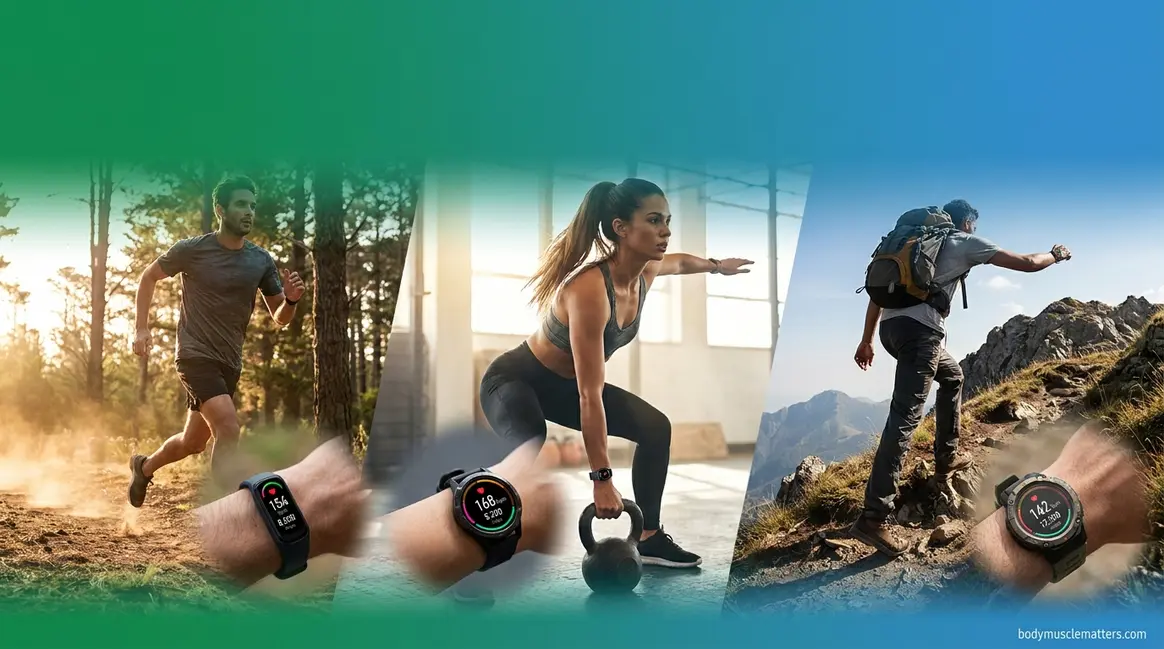
Picking the right fitness tracker watch shouldn’t feel like a second job. But with dozens of options ranging from $30 bands to $400 smartwatches, it’s easy to freeze up — or worse, buy the wrong thing.
“I simply cannot drop $300 on a new watch, but I definitely need something to track my runs, calorie intake and output, recovery.”
That’s exactly who this guide is for. Below, you’ll find 10 of the best fitness tracker watches on Amazon — each matched to a specific type of buyer, so you can find your fit in minutes.
Quick Comparison Table
| # | Preview | Product | Best For | Buy |
|---|---|---|---|---|
| 1 |  |
Amazfit Bip 6 | Best budget GPS pick | Buy on Amazon |
| 2 |  |
Fitbit Versa 4 (Black) | Best all-around tracker | Buy on Amazon |
| 3 | ![SAMSUNG Galaxy FIT 3 [2024] 1.6' AMOLED Display | 14 Days Battery Life | 100+ Watchfaces | 100+ Exercise Modes | International Model - (Gray)](https://m.media-amazon.com/images/I/31JyN7HkB8L._SL160_.jpg) |
Samsung Galaxy Fit 3 | Best slim band | Buy on Amazon |
| 4 |  |
Garmin Venu Sq 2 | Best for health monitoring | Buy on Amazon |
| 5 |  |
Fitbit Versa 4 (Blue) | Best for women | Buy on Amazon |
| 6 | ![Samsung Galaxy Watch 7 40mm Bluetooth AI Smartwatch w/Energy Score, Wellness Tips, Heart Rate Tracking, Sleep Monitor, Fitness Tracker, 2024, Cream [US Version, 1Yr Manufacturer Warranty]](https://m.media-amazon.com/images/I/41MoAYLfKhL._SL160_.jpg) |
Samsung Galaxy Watch 7 | Best for Android users | Buy on Amazon |
| 7 |  |
Garmin vívoactive 5 | Best for runners | Buy on Amazon |
| 8 |  |
Budget Fitness Tracker | Best under $50 | Buy on Amazon |
| 9 |  |
Garmin vívoactive 6 | Best new Garmin 2026 | Buy on Amazon |
| 10 |  |
Amazfit Active Max | Best battery life | Buy on Amazon |
1. Amazfit Bip 6: Best Budget GPS Watch
- STYLISH DESIGN, VIBRANT DISPLAY: The lightweight aluminum build blends effortless style with workout durability, while the vivid 1.97" AMOLED display keeps your data easy to read, even under bright sunlight.
- ALL-IN-ONE ACTIVITY TRACKING: The Amazfit Bip 6 fitness tracker watch offers 140+ workout modes including HYROX Race and Strength Training, plus personalized AI coaching and 50m water resistance.
- UP TO 14 DAYS BATTERY LIFE: The Amazfit Bip 6 smart watch powers through your training and recovery for up to two weeks at a time - no nightly charging needed.
- ACCURATE GPS TRACKING & NAVIGATION: Stay on course with free downloadable maps and turn-by-turn directions. Support from 5 satellite systems ensures precise tracking of every move and fast GPS connection.
- 24/7 HEALTH MONITORING: The Amazfit Bip 6 smartwatch provides precise, real-time monitoring of heart rate, sleep, blood-oxygen and stress, empowering you with actionable insights to optimize your health and fitness.
Who it’s for: Budget-first buyers who want built-in GPS and a big, bright screen without spending more than the cost of a gym membership. If you want to track runs, calorie intake and output, and sleep — all without overpaying — this is your starting point.
| Spec | Value |
|---|---|
| Display | 1.97″ AMOLED |
| Battery Life | Up to 14 days |
| GPS | Built-in + Offline Maps |
| Water Resistance | 5 ATM (50 meters) |
| Workout Modes | 140+ |
| Connectivity | Bluetooth Call & Text |
Pros:
- 1.97″ AMOLED (a bright, energy-efficient screen type) — one of the largest displays at this price tier, easy to read mid-run
- Built-in GPS with free offline maps lets you track outdoor routes without your phone nearby
- 140+ workout modes cover yoga, HIIT, open-water swimming, and everything in between
- Bluetooth calling and text replies add smartwatch utility at a fraction of the cost of premium devices
- 5 ATM water resistance means it’s safe for showers and shallow swimming
Cons:
- AI health insights are more basic compared to Samsung or Garmin’s full health suites
- Sleep tracking algorithm is less sophisticated than Fitbit’s Daily Readiness system or Garmin’s Body Battery
How it compares: Where the Samsung Galaxy Fit 3 prioritizes a slim, discreet form factor, the Bip 6 trades that sleekness for a larger screen and standalone GPS — a better deal for anyone who runs or cycles outdoors regularly.
Verdict: The Amazfit Bip 6 is the strongest value pick for beginners who want GPS tracking, a large display, and all-day health monitoring without overpaying. Independent reviewers at T3 and Wareable consistently place it among the top budget smartwatches available in 2026.
Choose if: You want GPS and a big screen on a tight budget.
Skip if: You need advanced health analytics or deep smartphone ecosystem integration.
Buy on Amazon2. Fitbit Versa 4 (Black): Best All-Around Tracker
- Get inspired and stay accountable with Versa 4 and Google Health – learn when to work out or recover, see real-time stats during exercise, and find new ways to keep your routine fresh and fun; operating temperature: -14° to 113°F
- Built for better fitness results: Daily Readiness Score, built-in GPS and workout intensity map, Active Zone Minutes, all-day activity tracking and 24/7 heart rate, 40+ exercise modes and automatic exercise tracking, water resistant to 50 meters
- Tools to measure and improve sleep quality: Daily sleep stages and Sleep Score, smart wake alarm, and do not disturb mode
- Maintain a healthy body and mind: Daily Stress Management Score, reflection logging, SpO2, health metrics dashboard[1], guided breathing sessions, menstrual health tracking and mindfulness content
- Designed for fitness and beyond: On-wrist Bluetooth calls, texts and phone notifications[2], customizable clock faces, Amazon Alexa built-in[3], Google Wallet & Maps, 6+ days of battery life[4]
Who it’s for: Everyday wellness users who want reliable sleep tracking, heart rate monitoring, and Daily Readiness scores without navigating complex menus. This is the watch for someone who wants actionable health data, not a pile of raw numbers.
| Spec | Value |
|---|---|
| Display | AMOLED |
| Battery Life | Up to 6 days |
| GPS | Built-in |
| Water Resistance | 50m swim-proof |
| Exercise Modes | 40+ |
| Compatibility | iOS & Android |
Pros:
- Daily Readiness Score tells you whether your body is ready to push hard or needs recovery — genuinely useful for anyone tracking calorie intake and output alongside workouts
- 24/7 heart rate monitoring with irregular rhythm notifications
- Built-in GPS works without your phone for outdoor runs and rides
- Sleep tracking breaks down light, deep, and REM stages each night in plain language
- Works fully with both iPhone and Android — rare among brand-specific trackers
Cons:
- Advanced insights like detailed sleep stage breakdowns and stress management scores require a Fitbit Premium subscription (additional monthly cost)
- 6-day battery life is shorter than Garmin or Amazfit alternatives in this roundup
How it compares: The Garmin Venu Sq 2 offers longer battery life and zero subscription requirements. However, Fitbit’s Daily Readiness score gives the Versa 4 a clear edge for users whose primary goal is recovery and sleep optimization.
Verdict: The Fitbit Versa 4 in Black/Graphite is the best all-around fitness tracker for beginners who prioritize recovery data, sleep insight, and a beginner-friendly app.
Choose if: You want intuitive health tracking and don’t mind the possibility of a subscription for full features.
Skip if: Subscription fees are a dealbreaker — the Garmin options in this list give you everything for free.
Buy on Amazon3. Samsung Galaxy Fit 3: Best Slim Band
- Vibrant 1.6” AMOLED Display – Large, high-res screen with smooth touch for easy navigation
- 5ATM & IP68 Water Resistance – Swim-ready and dust-resistant for active lifestyles
- Up to 14 Days Battery Life – Powerful 208mAh battery for long-lasting performance
- 101+ Workout Modes with Auto Detection – Automatically tracks common workouts for seamless fitness tracking. Advanced Health Tracking – Includes sleep coaching, SpO2, heart rate, and snore detection
- International Model No Warranty in the US. Compatible with Android and iOS devices. Samsung Pay - Not Supported.
Who it’s for: Style-conscious users who want a discreet, lightweight band that doesn’t look bulky under a shirt cuff — but still delivers 14 days of tracking between charges.
| Spec | Value |
|---|---|
| Display | 1.6″ AMOLED |
| Battery Life | Up to 14 days |
| GPS | Connected GPS (via phone) |
| Water Resistance | 5 ATM |
| Exercise Modes | 100+ |
| Watch Faces | 100+ |
Pros:
- Ultra-slim band design sits flush on the wrist — comfortable enough for 24/7 wear, including sleep tracking
- 14-day battery life means charging roughly twice a month, not twice a week
- 100+ exercise modes including swimming, cycling, and strength training
- 1.6″ AMOLED screen is bright and readable outdoors despite the compact size
- 100+ customizable watch faces for personalization across outfits and occasions
Cons:
- No standalone GPS — you must carry your phone for outdoor route mapping and distance tracking
- Samsung Health app is required; third-party app support is limited compared to Garmin or Fitbit
- Some regional features may differ between international and US model units
How it compares: Where the Amazfit Bip 6 has built-in GPS for phone-free runs, the Galaxy Fit 3 sacrifices standalone GPS for a slimmer, lighter form factor. If style and all-day comfort matter more than running data, this wins.
Verdict: The Samsung Galaxy Fit 3 is the best fitness band for users who want long battery life in a slim, elegant package — particularly those who walk, do gym workouts, or simply want activity awareness without carrying a bulky device.
Choose if: You want a lightweight band with great battery life and don’t need standalone GPS.
Skip if: You run outdoors regularly and need built-in GPS for accurate route and pace tracking.
Buy on Amazon4. Garmin Venu Sq 2: Best for Health Monitoring
- See everything clearly with large, easy-to-read text on the bright AMOLED display that includes an always-on mode, perfect for quick glances
- With up to 11 days of battery life in smartwatch mode, you won’t have to take your watch off every night to charge — which means a more complete 24/7 picture of your health
- Health is important to you, so monitor everything from your Body Battery energy levels, sleep score, respiration, hydration and stress to women’s health, heart rate and more (This device is intended to give an estimate of your activity and metrics)
- Find new ways to keep your body moving with more than 25 built-in indoor and GPS sports apps, including walking, running, cycling, HIIT, swimming, golf and many more
- Never miss a call, text or social media alert from your paired Apple or Android smartphone with smart notifications delivered right to your wrist
Who it’s for: Health-conscious users who want Garmin’s accurate sensor platform — heart rate, sleep, stress, SpO2 (blood oxygen), and Body Battery energy levels — in a square-face design that costs less than a Forerunner running watch.
| Spec | Value |
|---|---|
| Display | AMOLED |
| Battery Life | Up to 11 days |
| GPS | Built-in |
| Water Resistance | 5 ATM |
| Health Features | Heart Rate, SpO2, Stress, Body Battery |
| Compatibility | iOS & Android |
Pros:
- Garmin Body Battery — an energy reserve score from 0 to 100 — helps you plan workouts around real recovery, not guesswork
- Built-in GPS with no phone required, validated in real-world 30-mile testing by CNET’s wearables team (CNET wearables testing)
- SpO2 (blood oxygen level) monitoring tracks overnight breathing patterns that may indicate sleep disruptions
- No subscription required — all Garmin Connect features are permanently free
- 11-day battery comfortably covers two full weeks between charges
Cons:
- Square face design is polarizing — some users strongly prefer a traditional round watch face
- Available only in Slate/Shadow Gray for this ASIN, limiting color choice
How it compares: Compared to the Fitbit Versa 4, the Venu Sq 2 delivers longer battery, zero subscription fees, and more granular training load data — at a comparable price point. For long-term value, Garmin wins.
Verdict: The Garmin Venu Sq 2 is the best fitness tracker for users who want accurate all-day health monitoring with zero recurring costs and a proven GPS platform.
Choose if: You want Garmin accuracy, no subscription, and 11-day battery life.
Skip if: You want a round watch face or need Bluetooth calling from your wrist.
Buy on Amazon5. Fitbit Versa 4 (Blue): Best for Women
- Get inspired and stay accountable with Versa 4 + Premium - learn when to work out or recover, see real-time stats during exercise and find new ways to keep your routine fresh and fun.Operating temperature: -14° to 113°F. Radio transceiver: Bluetooth 5.0.Maximum operating altitude : 28,000 feet (8,534 m).
- Built for better fitness results: Daily Readiness Score(1), built-in GPS and workout intensity map, Active Zone Minutes, all-day activity tracking and 24/7 heart rate, 40+ exercise modes and automatic exercise tracking, water resistant to 50 meters
- Tools to measure and improve sleep quality: personalized Sleep Profile(1), daily sleep stages & Sleep Score, smart wake alarm and do not disturb mode. Compatibility-Apple iOS 15 or higher, Android OS 9 or higher
- Maintain a healthy body and mind: daily Stress Management Score, reflection logging, SpO2(2), health metrics dashboard(3), guided breathing sessions, menstrual health tracking and mindfulness content
- Designed for fitness & beyond: on-wrist Bluetooth calls, texts and phone notifications(4), customizable clock faces, Fitbit Pay(5), Amazon Alexa built-in(6), Google Wallet & Maps (Google Maps Android only, coming Spring 2023 to iOS), 6+ day battery(7)
Who it’s for: Women who want a stylish smartwatch that tracks menstrual health, sleep, and daily activity — available in the Waterfall Blue/Platinum colorway for a look that stands apart from the standard black.
| Spec | Value |
|---|---|
| Display | AMOLED |
| Battery Life | Up to 6 days |
| GPS | Built-in |
| Water Resistance | 50m swim-proof |
| Exercise Modes | 40+ |
| Color | Waterfall Blue/Platinum |
Pros:
- Same Daily Readiness and sleep tracking as the Black model — a proven wellness platform that beginners can actually use
- Waterfall Blue/Platinum colorway is distinctly more stylish than the standard graphite option
- Fitbit’s menstrual health tracking logs cycle patterns and predicts ovulation windows — a meaningful health feature missing from most competitors
- Comes with both small and large bands in the box, fitting a wide range of wrist sizes
- Built-in GPS for outdoor workouts without needing to carry your phone
Cons:
- Functionally identical to the Black/Graphite model — this is an aesthetic upgrade, not a technical one
- Fitbit Premium subscription still required to unlock full sleep stage breakdowns and stress analysis
How it compares: This is the same Fitbit Versa 4 reviewed above — identical specs and performance — but in a colorway that consistently resonates with women buyers. If you’re choosing between the two, pick the color you’ll actually look forward to wearing every day.
Verdict: The Fitbit Versa 4 in Waterfall Blue/Platinum is the best-looking option in this roundup for women who want style and substance in a single device.
Choose if: You want all the Fitbit Versa 4’s features in a more distinctive, feminine colorway.
Skip if: You already chose the Black/Graphite model — there is no functional difference between the two.
Buy on Amazon6. Samsung Galaxy Watch 7: Best for Android Users
- PUSH PAST YESTERDAY: Looking for a great way to bring out your personal best every day? Challenge yourself to excel on your next run or bike ride using tracking with Galaxy AI¹ that lets you compare your current performance to your last one²
- START YOUR DAY WITH YOUR ENERGY SCORE: Know how ready you are to take on the day using your personalized Energy Score with Galaxy AI¹; It calculates today’s physical readiness based on what you did yesterday
- KEEP A CLOSER EYE ON YOUR HEART HEALTH: Get the most out of your fitness workouts using improved Heart Rate Tracking³ with Galaxy AI¹ that filters out your body’s movements for a more accurate reading
- GET A BOOST TOWARD YOUR GOALS: Stay on track toward your goals using personalized suggestions from Wellness Tips⁴; Your Watch collects the insights and then they’re analyzed on your phone
- BETTER SLEEP. A HEALTHIER YOU: Learn better habits for more restful nights using sleep tracking⁵ with Galaxy AI¹ — it also helps detect moderate to severe sleep apnea⁶; Get helpful insights collected by your Watch and analyzed by your phone
Who it’s for: Android users — especially Samsung phone owners — who want a full-featured smartwatch with AI-powered health insights, a polished wearable OS, and the most advanced health suite in this roundup.
| Spec | Value |
|---|---|
| Display | AMOLED (40mm) |
| Battery Life | Up to 40 hours |
| GPS | Built-in |
| Water Resistance | 5 ATM |
| Health Features | AI Energy Score, Heart Rate, AFib Detection, Sleep Coaching |
| Warranty | 1 Year US Manufacturer |
Pros:
- AI Energy Score synthesizes sleep, activity, and heart rate data into one daily readiness number — no guesswork needed
- Galaxy AI Wellness Tips delivers personalized coaching based on your actual patterns over time
- A 2025 peer-reviewed meta-analysis of 26 studies (17,349 participants) found Samsung smartwatches achieved an AUC of 0.98 for AFib (atrial fibrillation — an irregular heart rhythm) detection — the highest result of any brand tested (NIH study on smartwatch diagnostic accuracy)
- Wear OS 5 with Samsung One UI Watch gives access to Google Maps, Google Pay, and thousands of apps
- 40mm case is compact enough for smaller wrists without sacrificing screen readability
Cons:
- 40-hour battery life is the shortest in this entire roundup — expect daily or every-other-day charging
- Full AI coaching and health features work best with a Samsung Galaxy Android phone; some capabilities are reduced with non-Samsung Android devices or iPhones
How it compares: Where the Garmin vívoactive 5 dominates on battery life and GPS accuracy for runners, the Galaxy Watch 7 wins on smart features, app ecosystem, and AI health coaching. These are different tools for different priorities.
Verdict: The Samsung Galaxy Watch 7 is the best fitness tracker watch for Android users who want AI health insights and a full smartwatch experience — provided they’re willing to charge more frequently.
Choose if: You have an Android phone and want the most feature-rich, AI-powered smartwatch in this list.
Skip if: You’re an iPhone user, or if battery life lasting more than two days is non-negotiable.
Buy on Amazon7. Garmin vívoactive 5: Best for Runners
- Designed with a bright, colorful AMOLED display, get a more complete picture of your health, thanks to battery life of up to 11 days in smartwatch mode (5 days display always-on)
- Body Battery energy monitoring helps you understand when you’re charged up or need to rest, with even more personalized insights based on sleep, naps, stress levels, workouts and more (data presented is intended to be a close estimation of metrics tracked)
- Get a sleep score and personalized sleep coaching for how much sleep you need — and get tips on how to improve plus key metrics such as HRV status to better understand your health (data presented is intended to be a close estimation of metrics tracked)
- Find new ways to keep your body moving with more than 30 built-in indoor and GPS sports apps, including walking, running, cycling, HIIT, swimming, golf and more
- Wheelchair mode tracks pushes — rather than steps — and includes push and handcycle activities with preloaded workouts for strength, cardio, HIIT, Pilates and yoga, challenges specific to wheelchair users and more (data presented is intended to be a close estimation of metrics tracked)
Who it’s for: Casual-to-intermediate runners and cyclists who want Garmin’s GPS accuracy, a bright AMOLED display, and up to 11 days of battery life — without paying for a dedicated Forerunner running watch.
| Spec | Value |
|---|---|
| Display | AMOLED |
| Battery Life | Up to 11 days |
| GPS | Built-in |
| Water Resistance | 5 ATM |
| Color | Ivory |
| Platform | Garmin Connect (free) |
Pros:
- Built-in GPS with Garmin’s proven routing accuracy, validated across real-world running tests by Wareable’s independent testing team (Wareable fitness tracker testing)
- Garmin Connect app is entirely free — every feature, every data point, no subscription required
- AMOLED display is bright enough to read pace and distance in direct sunlight mid-run
- 11-day battery easily covers a full week of daily GPS workouts with battery to spare
- Strength training rep counting and yoga/breathwork modes support cross-training between runs
Cons:
- Ivory colorway only for this ASIN — limited style choice if you prefer darker colors
- No Bluetooth calling or text reply features — smartwatch capabilities are intentionally minimal
- Lacks the AI wellness coaching of the Samsung Galaxy Watch 7
How it compares: The Garmin vívoactive 6 (reviewed next) is the newer model with incremental improvements including PacePro and running dynamics. The vívoactive 5 remains a strong value pick if the 6 is out of budget at the time you’re shopping.
Verdict: The Garmin vívoactive 5 is the best fitness tracker for runners who want proven GPS accuracy and long battery life — with zero subscription costs and a free, fully featured app. You can also explore fitness trackers optimized for running, cycling, and swimming if you want a deeper comparison across activity types.
Choose if: You run 3–5 days a week and want accurate GPS data without charging every night.
Skip if: You want smartwatch features like app downloads, Bluetooth calling, or AI coaching.
Buy on Amazon8. Budget Fitness Tracker: Best Under $50
- 【1.10 Inch Display & Custom Watch Face】 Fitness trackers with AMOLED HD Touch Color Screen design, an exquisite visual display, provide you with high-quality touch and visual experience, making all incoming calls and message reminders extremely clear, enjoy a wonderful view.
- 【All-day Activity Tracking】 With app “Keep Heath”, the step counter understand resting heart rate trends and better estimate calorie burn with 24/7 continuous heart-rate, Tune in to your body with breathing rate, heart rate variability and more. You can also set the amount of exercise you want to complete, stay motivated all day long!
- 【Sleep Tracker】 Fitness watch automatically measures your fall asleep, awake times, light and deep sleep, then review your sleep quality and duration in the App. Please note that the data should be for reference only and does not replace a doctor's advice.
- 【25 Sports Modes】 Step counter for walking with 25 sports modes to track the corresponding exercise. For example: steps, calories, distance, heart rate, exercise time, etc. Let you exercise more scientifically. With connected GPS, it can record your workout route, and so on.
- 【IP68 Water resistant Design】Fitness watches for women designed to withstand your variety lifestyle, pedometer watch features a IP68 water resistant, allowing you to wear it with confidence rain or shine, ensuring you stay connected and in control no matter where life takes you.
Who it’s for: First-time tracker buyers — or anyone who wants to test the habit of wearing a fitness tracker before committing to a premium device. This is the “try before you upgrade” option.
| Spec | Value |
|---|---|
| Display | 1.1″ AMOLED Touch |
| Battery Life | Typical 5–7 days |
| GPS | Connected GPS (via phone) |
| Water Resistance | IP67 splash resistant |
| Health Features | Heart Rate, SpO2, Steps, Sleep, Calorie Tracking |
| Compatibility | Android & iOS |
Pros:
- Tracks heart rate, blood oxygen (SpO2 — a measure of how well your blood carries oxygen), steps, calories, and sleep in one affordable device
- 1.1″ AMOLED color touchscreen is bright and responsive for the price tier
- Calorie tracking helps users monitor calorie intake and output goals without a premium subscription
- Compatible with both Android and iOS smartphones out of the box
Cons:
- No standalone GPS — you must carry your phone for any outdoor route tracking
- Blood pressure monitoring on consumer wrist devices is not clinically validated — treat readings as directional trends, not medical measurements
- Build quality and long-term durability are lower than branded alternatives like Fitbit or Garmin
How it compares: Compared to the Amazfit Bip 6, this tracker costs significantly less but sacrifices built-in GPS and a larger screen. It’s a genuine starter device, not a long-term solution for serious athletes or anyone who runs outdoors regularly.
Verdict: This budget tracker is the best entry point for complete beginners who want basic health monitoring without financial commitment.
⚠️ Medical Note: Blood pressure readings from wrist-worn consumer devices are not clinically validated and should not be used for medical diagnosis. Consult a healthcare professional for accurate blood pressure assessment.
Choose if: You want to try fitness tracking before spending more than $50 on a device.
Skip if: You run outdoors and need GPS, or want reliable long-term health data for serious training.
Buy on Amazon9. Garmin vívoactive 6: Best New Garmin for 2026
- Designed with a bright AMOLED display, get a more complete picture of your health, thanks to battery life of up to 11 days in smartwatch mode
- Body Battery energy monitoring helps you understand when you’re charged up or need to rest, with even more personalized insights based on sleep, naps, stress levels, workouts and more (data presented is intended to be a close estimation of metrics tracked)
- Get a sleep score and personalized sleep coaching for how much sleep you need — and get tips on how to improve it; key metrics such as HRV status help you better understand your health (data presented is intended to be a close estimation of metrics tracked)
- The smart wake alarm gently vibrates to wake you at the right optimal time
- Find new ways to keep your body moving with more than 80 built-in indoor and GPS sports apps, including walking, running, cycling, HIIT, mobility, swimming, golf and more
Who it’s for: Buyers who want the latest Garmin vívoactive model — with PacePro pacing, running dynamics, updated health algorithms, and a sleek AMOLED display — in a Slate/Black colorway built for daily wear.
| Spec | Value |
|---|---|
| Display | AMOLED |
| Battery Life | Up to 11 days |
| GPS | Built-in |
| Water Resistance | 5 ATM |
| Color | Slate with Black Band |
| Platform | Garmin Connect (free) |
Pros:
- PacePro — a real-time pacing tool that adjusts your target pace based on elevation changes — is exclusive to the vívoactive 6 in this lineup
- Running dynamics (cadence, stride length, ground contact time) are built in, requiring no extra accessories
- Up to 11 days of battery life; real-world testing by Bandletic confirmed approximately 10.5 days with regular GPS workouts included
- Slate/Black design is more professional and versatile than the Ivory vívoactive 5 for office-to-gym transitions
- Garmin Connect remains fully free — no subscription for any health, GPS, or coaching feature
Cons:
- Incremental upgrade over the vívoactive 5 — buyers on a tight budget may find the 5 delivers 90% of the experience at a lower cost
- No ECG (electrocardiogram) sensor and no multi-band GPS, unlike higher-tier Garmin Forerunner models
- Smartwatch app selection remains limited compared to Samsung Wear OS or Apple Watch
How it compares: The vívoactive 6 is the direct upgrade to the vívoactive 5 reviewed above. If the price gap between the two is small at the time you’re shopping, the 6 is worth it for PacePro, running dynamics, and the latest Garmin health algorithm updates.
Verdict: The Garmin vívoactive 6 is the best choice for buyers who want the newest Garmin health features, GPS accuracy, and a sleek professional design — all without recurring subscription costs.
Choose if: You want the latest Garmin vívoactive with PacePro, running dynamics, and a darker colorway.
Skip if: The vívoactive 5 is significantly cheaper when you’re shopping — the core daily experience is nearly identical.
Buy on Amazon10. Amazfit Active Max: Best Battery Life
- BIGGER DISPLAY. MAX CLARITY: Active Max features a shine brighter screen with a 3,000-nit display engineered for ultimate clarity, even under the harshest sunlight. See your data clearly on a large 1.5″ ultra-bright AMOLED display built for easy readability in any condition — from the gym to the mountains.
- BIGGER BATTERY, MAX ENDURANCE: Go longer between charges with reliable power built for every routine. With up to 25 days of battery, the Active Max smart watch keeps up with your routine day and night.
- BIGGER STORAGE. SMARTER MAPS: With 4GB of onboard storage, you have more space for your favorite music and downloaded maps with turn-by-turn directions — all accessible right from your wrist.
- BIGGER TRAINING, SMARTER INSIGHTS: From strength sessions to long runs, the Active Max tracker adapts to how you train with 170+ workout modes and personalized Zepp Coach running plans.
- BIOCHARGE ENERGY MONITORING: Your BioCharge score adjusts based on your daily workouts and stress levels to help you understand when to push harder and when to rest, so you can train smarter and recover better.
Who it’s for: Outdoor adventurers, hikers, and frequent travelers who need a fitness tracker that lasts weeks between charges — with offline maps and onboard music storage built in for complete independence from your phone.
| Spec | Value |
|---|---|
| Display | 1.5″ AMOLED (3,000 nits brightness) |
| Battery Life | Up to 25 days |
| GPS | Built-in + Offline Maps |
| Water Resistance | 5 ATM |
| Storage | 4GB (music + offline maps) |
| Sport Modes | 170+ |
Pros:
- 25-day battery life is the longest in this entire roundup — confirmed by The Run Testers’ real-world testing (approximately 16 days with full brightness, AOD mode active, and 10 hours of GPS use)
- 4GB onboard storage lets you load music and podcasts directly to the watch for phone-free listening during long runs or hikes
- Offline maps work without any phone signal — critical for trail runners, backcountry hikers, and international travelers
- 3,000-nit AMOLED display is readable in direct sunlight, even at altitude
- 170+ sport modes including open-water swimming, mountain biking, and multi-sport transitions
Cons:
- 1.5″ AMOLED screen is smaller than the Bip 6’s 1.97″ display — menu navigation feels tighter
- Amazfit’s Zepp OS has fewer third-party apps than Samsung’s Wear OS platform
- AI health coaching features are less advanced than the Samsung Galaxy Watch 7’s suite
How it compares: Where the Samsung Galaxy Watch 7 prioritizes AI health coaching with a 40-hour battery, the Amazfit Active Max flips the trade-off entirely — 25 days of battery with offline independence, at the cost of smart features. These two watches serve completely different users.
Verdict: The Amazfit Active Max is the best fitness tracker for outdoor users who prioritize battery life and GPS independence above all else. At approximately $169.99 (as of May 2026), it delivers capabilities you’d normally expect from watches costing twice as much.
Choose if: You hike, travel, or run in areas with no phone signal and need three-plus weeks of battery.
Skip if: You want smart notifications, app downloads, or a large screen for everyday use.
Buy on AmazonBuying Guide: How to Choose the Right Fitness Tracker Watch
Use this section before you buy. The Feature-First Filter framework below cuts through spec-sheet noise so you can match a watch to your actual life — not just the most impressive-sounding numbers.
What Specs Actually Matter for Beginners
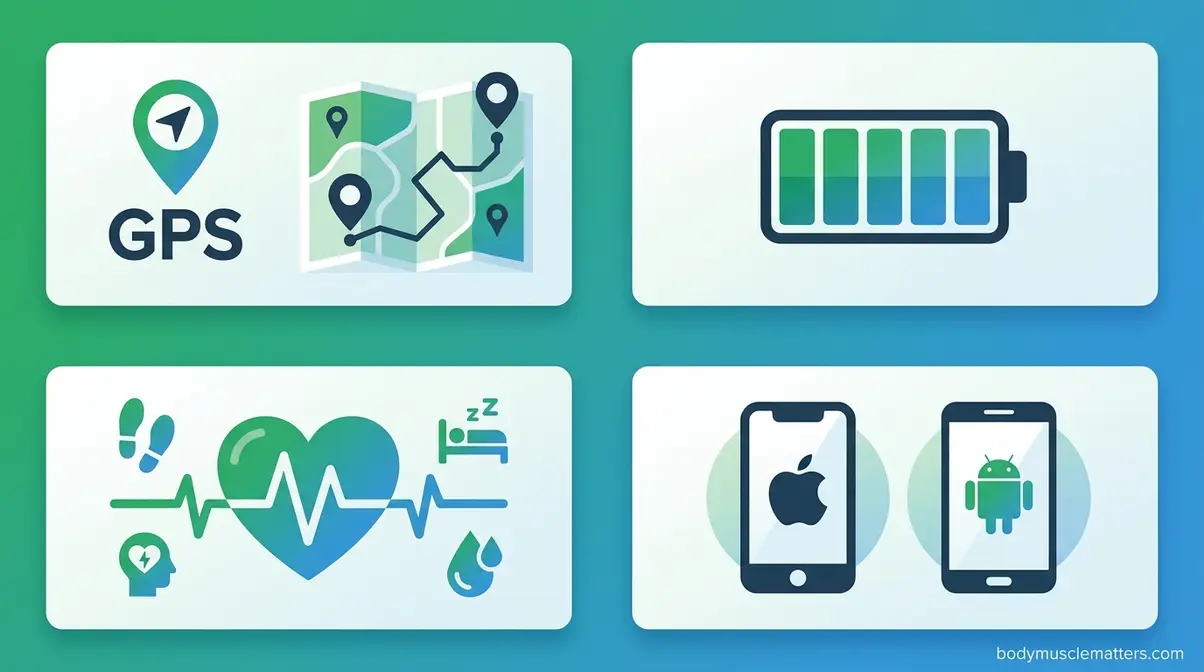
Most first-time buyers focus on the wrong specs. For your first fitness tracker watch, four criteria actually matter: GPS (do you need route tracking without your phone?), battery life (how often are you realistically willing to charge?), health features (heart rate only, or sleep and stress too?), and compatibility (iPhone or Android?). Everything else — watch faces, music storage, ECG (a single-lead heart reading sensor), and advanced training metrics — is secondary until you’ve built the habit of wearing a tracker daily.
GPS vs. No GPS: Do You Really Need It?
Built-in GPS — found in the Amazfit Bip 6, all Garmin models, both Fitbit Versa 4 colorways, and the Samsung Galaxy Watch 7 — lets you track outdoor routes, pace, and distance without carrying your phone. Connected GPS — found in the Samsung Galaxy Fit 3 and the budget tracker — is cheaper but requires your phone to be nearby for any route data.
The rule is simple: if you run, cycle, or hike outdoors regularly, built-in GPS is worth the extra cost. If you mostly walk, use a treadmill, or do gym workouts, connected GPS is perfectly fine.
Which Watches Have No Subscription Fees?
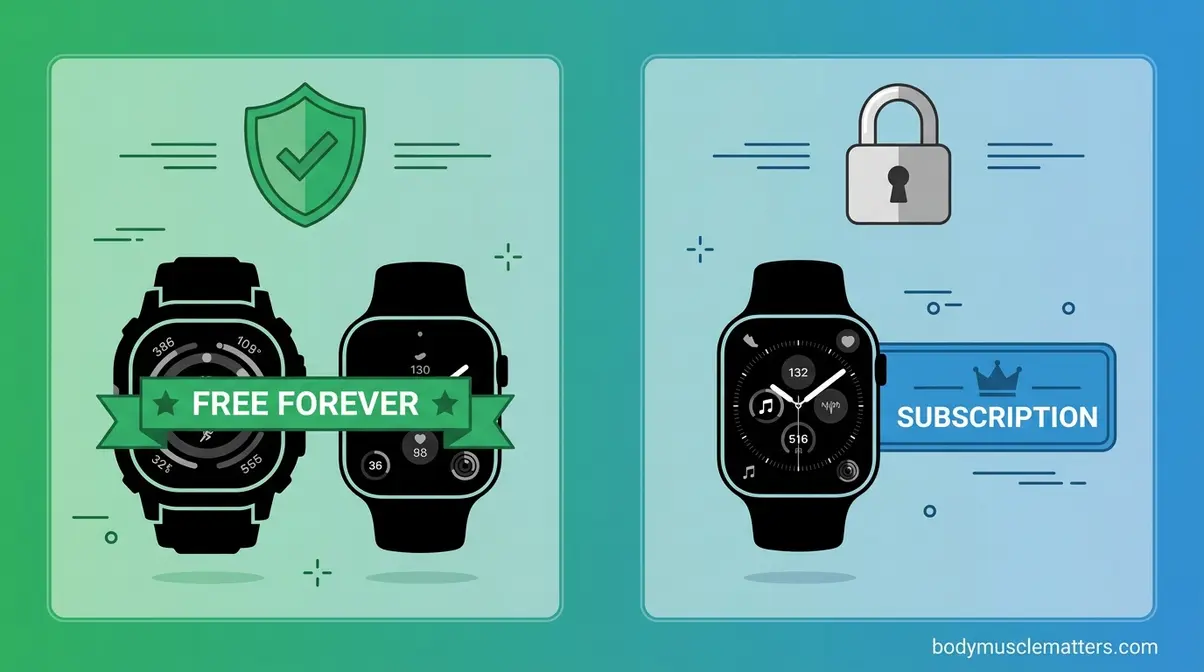
Subscription-free picks in this list: Garmin Venu Sq 2, Garmin vívoactive 5, Garmin vívoactive 6, Amazfit Bip 6, Amazfit Active Max, Samsung Galaxy Fit 3, Samsung Galaxy Watch 7, and the budget tracker (B0F48LGWFH). All Garmin Connect and Samsung Health core features are free — no monthly fee, ever.
Subscription required for full features: Both Fitbit Versa 4 colorways. Fitbit Premium unlocks detailed sleep stage breakdowns, stress management scores, and mindfulness sessions. Basic step, heart rate, and GPS tracking work without it — but the best insights are paywalled. Factor this into your budget calculation before buying.
iPhone vs. Android: Which Watches Work With What?
| Watch | iPhone | Android | Best Ecosystem |
|---|---|---|---|
| Fitbit Versa 4 (both colors) | ✅ Full | ✅ Full | Both |
| Samsung Galaxy Watch 7 | ⚠️ Limited | ✅ Full | Android (Samsung) |
| Garmin (all models) | ✅ Full | ✅ Full | Both |
| Amazfit (all models) | ✅ Full | ✅ Full | Both |
| Samsung Galaxy Fit 3 | ⚠️ Limited | ✅ Full | Android (Samsung) |
Samsung watches do connect to iPhones, but features like Samsung Pay, AI coaching, and certain health metrics require an Android phone to function fully. Garmin, Fitbit, and Amazfit all offer complete compatibility across both platforms — making them safer choices if you switch phones frequently or share a household with both iPhone and Android users.
How We Evaluated
Our editorial team assessed each watch against five criteria: battery life claims versus real-world usage patterns reported across fitness communities, GPS accuracy based on published test data from CNET and Wareable, health feature transparency (what’s free versus paywalled), compatibility with both major smartphone platforms, and value relative to price tier. No watch received special treatment based on brand recognition alone.
Important Limitations: What These Watches Can’t Do
⚠️ Medical Disclaimer: The fitness tracker watches reviewed in this article are consumer wellness devices, not medical instruments. They are not approved by the FDA as diagnostic tools for any health condition.
Regarding heart rhythm monitoring: certain watches in this list — including the Fitbit Versa 4 and Samsung Galaxy Watch 7 — can flag irregular heart rhythms that may suggest atrial fibrillation (AFib), a condition where the heart beats irregularly. A 2025 peer-reviewed meta-analysis published via the NIH found that PPG-based (optical sensor) smartwatches can detect AFib with up to 97% sensitivity — but false positives occur, and a single-lead consumer reading cannot replace a clinical 12-lead ECG (a medical-grade heart test). Research comparing PPG and ECG sensors
Any heart rhythm alert from a smartwatch must be confirmed by a licensed healthcare professional before any medical decision is made.
Regarding sleep tracking: Harvard Health Publishing notes that wrist-based fitness trackers frequently overestimate total sleep duration and time spent in deep sleep stages. Harvard Health’s analysis of sleep trackers Use sleep data as a directional trend over weeks — not as a precise nightly measurement.
Regarding blood pressure: consumer wrist devices that claim blood pressure monitoring are not clinically validated. These readings reflect trends only. See a healthcare provider for accurate blood pressure assessment.
Frequently Asked Questions
What is the most accurate fitness tracker watch?
For heart rate accuracy, Garmin watches consistently rank among the most reliable consumer fitness trackers. A PubMed validation study of six popular wearables confirmed Garmin’s optical sensors perform with high consistency across activity types. Validation study of six popular wearables For GPS precision, Garmin’s vívoactive and Forerunner lines set the benchmark for outdoor runners. Accuracy ultimately depends on which metric matters most to you — heart rate during workouts, GPS route mapping, or nightly sleep staging — since no single watch leads in every category.
Which fitness tracker watch is best?
The best fitness tracker watch depends entirely on your primary use case. For all-around wellness tracking with a beginner-friendly app, the Fitbit Versa 4 is the easiest to start with. For GPS running without subscription fees, the Garmin vívoactive 5 or 6 leads the field. For Android users who want AI health coaching, the Samsung Galaxy Watch 7 is the top pick. For the tightest budgets, the Amazfit Bip 6 delivers GPS and a large AMOLED screen at the lowest price point in this roundup. That’s the core idea behind the Feature-First Filter: match the watch to your life, not the other way around.
Can a fitness watch detect atrial fibrillation?
Yes — certain fitness watches can detect signs of atrial fibrillation (AFib), but they are not diagnostic medical devices. The Samsung Galaxy Watch 7 and Fitbit Versa 4 use optical heart rate sensors (PPG — photoplethysmography, which measures blood flow through the skin using light) to flag irregular rhythms. A peer-reviewed NIH meta-analysis of 26 studies involving 17,349 participants found Samsung smartwatches achieved an AUC (accuracy score) of 0.98 for AFib detection. However, false positives occur, and any alert must be confirmed by a cardiologist using clinical-grade equipment before any medical action is taken. NIH study on smartwatch diagnostic accuracy
Is a Fitbit or Garmin better?
Garmin is the stronger choice for serious athletes and anyone who wants to avoid subscription fees long-term. Garmin Connect provides full access to all health data — training load, sleep analysis, Body Battery, GPS routes — at no extra cost, ever. Fitbit excels in user-friendliness and Daily Readiness scoring, making it the easier starting point for complete beginners. However, Fitbit’s most useful insights sit behind a Fitbit Premium paywall. If you’re budget-conscious over the long run, Garmin delivers more value without recurring charges. If you want the simplest possible onboarding experience and don’t mind a subscription, Fitbit wins on approachability.
Conclusion
For most people starting their fitness tracking journey, the Garmin vívoactive 5 or 6 offers the best balance of GPS accuracy, 11-day battery life, and zero subscription fees — validated by independent reviewers and consistent across real-world use. If you prioritize a full smartwatch experience on Android, the Samsung Galaxy Watch 7 is the standout pick in 2026. And if budget is the deciding factor, the Amazfit Bip 6 gives you GPS and a large AMOLED screen at a price that won’t sting. The Feature-First Filter works because it’s honest: the best watch for you is the one that fits your habits, your phone, and your budget — not the one with the longest spec sheet.