
To maximize muscle growth, train each muscle group 2 to 3 times per week, aiming for 10–20 total working sets per week depending on your experience level. This principle — which determines how often to train a muscle group for growth — is backed by current research and separates lifters who make consistent gains from those who spin their wheels for months.
The problem is that most beginners either overtrain — hammering the same muscle every day until it breaks down — or undertrain — visiting each muscle group once a week and barely scratching the surface of what’s needed for growth. Both mistakes produce the same frustrating result: little to no progress despite real effort in the gym.
In this guide, you’ll learn exactly how often to train each muscle group, which workout split matches your experience level, and how to structure your recovery so your muscles actually grow between sessions. We’ll walk through four concrete steps covering training frequency, workout splits, weekly volume, and recovery planning — all grounded in Tier 1 research from PubMed and NCBI.
To maximize muscle growth, train each muscle group 2 to 3 times per week — research shows this frequency produces measurably better hypertrophy (muscle growth) than once-a-week training.
- The 48-Hour Rule: Muscle protein synthesis peaks within 36–48 hours post-workout — your next session should hit that muscle before this window closes
- Weekly volume: Aim for 10–20 working sets per muscle group per week — fewer than 4 sets produces minimal growth stimulus
- Your split matters: Beginners thrive on Full Body 3x/week; advanced lifters do better on Push/Pull/Legs 6x/week
- Rest days are required: Muscles grow during the 48–72 hours of recovery, NOT during the workout itself
Prerequisites and Important Notes
What This Guide Covers
- Before diving into the steps, here is what you need to know and prepare:
- Estimated Time: 15-20 minutes to read and plan your training split.
- Tools & Materials: Resistance training equipment (a gym membership, dumbbells, or a barbell set) and a notebook or app to track your workouts.
This guide is written for beginners and intermediate lifters with zero to two years of consistent resistance training (structured exercise using weights, machines, or barbells to build strength and muscle). If you have been lifting consistently for less than two years, this guide applies directly to you.
Competitive athletes and professional bodybuilders have specialized needs that go beyond what’s covered here. Bodyweight training follows similar frequency principles, though volume recommendations differ slightly.
Medical and Fitness Disclaimer
⚠️ Disclaimer: Always consult a qualified physician or certified personal trainer before starting a new exercise or resistance training program. This guide provides general educational information based on published research and does not constitute personalized medical or fitness advice. If you have existing injuries, chronic conditions, or health concerns, discuss any training frequency recommendations with a healthcare provider before beginning.
With that in mind, let’s start with the most important concept in all of resistance training: how often your muscles actually need to be stimulated to grow.
Step 1: Determine Your Optimal Training Frequency
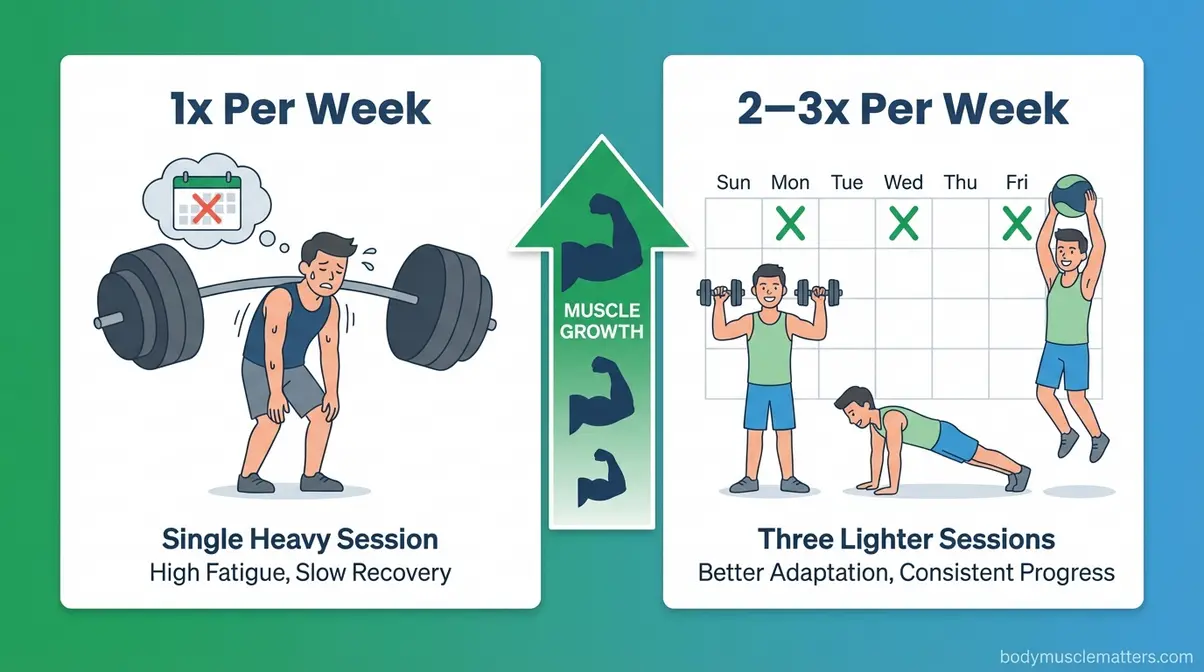
To maximize muscle growth, train each muscle group 2 to 3 times per week — this is the scientifically supported frequency that produces optimal hypertrophy (the scientific term for muscle growth). A meta-analysis of 10 controlled studies found that higher training frequency produced measurably greater muscle growth than once-per-week training when total weekly volume was equated (Schoenfeld et al., 2016). Understanding why this works — not just accepting it — will help you build a schedule you actually stick to.
What Is Muscle Protein Synthesis?
Muscle Protein Synthesis, or MPS, is the biological process your body uses to repair the microscopic tears in muscle fibers caused by resistance training — and it is this repair process that makes muscles bigger and stronger. When you lift weights, you create controlled damage at the cellular level. MPS is the construction crew that arrives to rebuild those fibers larger than before.
Here’s the key timing: MPS spikes within one to two hours of training and remains significantly elevated for 36 to 48 hours before returning to baseline (PMC, 2024). That elevated window is your growth opportunity. If you wait seven days to train that muscle again, you waste five or more days of potential growth stimulus.
This is what we call The 48-Hour Rule: your next training session should stimulate that muscle group before the MPS window has fully closed — typically within 48 to 72 hours. This single biological fact is what makes 2 to 3 times per week the optimal training frequency target.
Think of MPS like a window of opportunity. After you train, that window opens. After 48 hours, it starts to close. Training 2 to 3 times per week means you hit the muscle while the window is still open — capturing the full growth stimulus from each session.
The diagram below illustrates how your MPS window opens and closes after each training session.
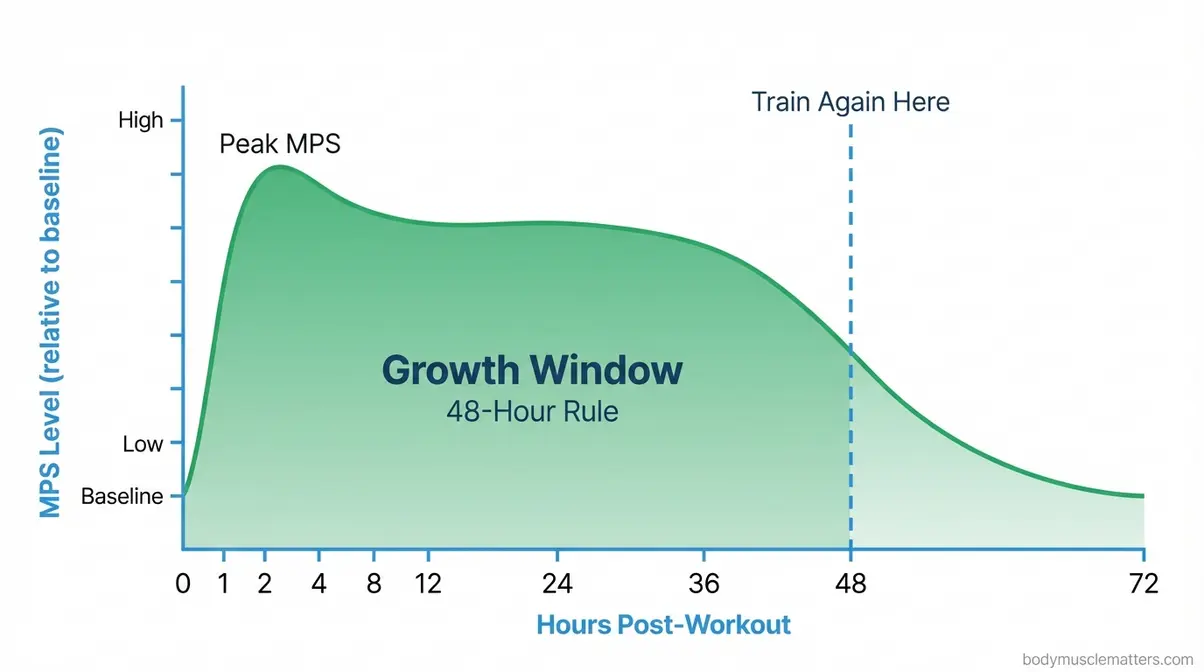
Caption: MPS rises sharply within 1–2 hours of training and stays elevated for up to 48 hours — the biological window that makes training frequency matter for muscle growth.
how muscle protein synthesis drives hypertrophy
Research confirms a single bout of resistance exercise can sustain measurable increases in MPS up to 48 hours post-exercise in the postabsorptive state (post-exercise muscle protein synthesis rates — NCBI, 2024).
Science of Training 2-3 Times Weekly
In 2016, researcher Brad Schoenfeld analysed 10 controlled studies comparing training muscles once, twice, or three times per week. The finding was clear: higher training frequency produced greater muscle growth when total weekly volume — the total number of sets performed — was the same (Schoenfeld et al., 2016).
Many trusted coaches and authors have recommended a different approach:
“Mike Matthews says to work each muscle group once every 5–7 days, and the program that’s outlined works each major muscle group once per week.”
This approach can work — especially for complete beginners — because any structured training is better than none. But the research shows that splitting your weekly sets across 2 to 3 sessions produces better results than cramming them all into one day.
The key variable is total weekly sets, not the number of sessions. If you do 15 sets for your chest in one session (bro split style — a bro split being a program where each muscle is trained only once a week on a dedicated day), spreading those 15 sets across 3 sessions of 5 sets each typically produces greater growth.
Concrete example: One-day bro split: 15 chest sets on Monday. Two-day split: 7 chest sets Monday + 8 chest sets Thursday. Exercise physiologists and resistance training researchers consistently favour the second approach when overall volume is equated (Schoenfeld et al., 2016).
“Training each muscle group 2–3 times per week produces measurably greater hypertrophy than once-a-week training when weekly volume is equated (Schoenfeld et al., 2016).”
With the science established, the practical question becomes: how does this translate to your schedule, based on where you are in your training journey?
Training Frequency by Experience
How often to train each muscle group depends significantly on your training age — how many years you have trained consistently. Here are four specific frequency targets, each matched to an experience level.
Beginner (0–1 year lifting): Train each muscle group 3 times per week. The optimal split is Full Body 3x/week — for example, Monday, Wednesday, and Friday. A sample week looks like this: Monday (Full body: squats, rows, bench press, shoulder press, deadlift); Wednesday (Full body: Romanian deadlift, incline press, lat pulldown, lateral raise); Friday (Full body: leg press, dumbbell bench, cable row, Arnold press). Start at 10 to 12 working sets per muscle group per week.
Intermediate (1–3 years consistent training): Train each muscle group twice per week. The optimal split is Upper/Lower 4x/week — Upper on Monday and Thursday, Lower on Tuesday and Friday. Weekly volume target: 12 to 16 sets per muscle group.
Advanced (3+ years consistent training): Train each muscle group 2 to 3 times per week at higher volume per session. The optimal split is Push/Pull/Legs 6x/week, hitting each muscle twice weekly. Weekly volume target: 16 to 22 sets per muscle group.
Age 40+ Lifters: Frequency stays at a maximum of twice per week per muscle group. Recovery requires closer to 72 hours between sessions for the same muscle group compared to 48 hours for younger lifters. Recommended option: Full Body 2x/week or Upper/Lower 4x/week with reduced per-session volume. See Step 4 for detailed age-related recovery guidance.
| Experience Level | Training Age | Frequency Per Muscle | Recommended Split | Weekly Sets Per Muscle |
|---|---|---|---|---|
| Beginner | 0–1 year | 3x/week | Full Body 3x | 10–12 |
| Intermediate | 1–3 years | 2x/week | Upper/Lower 4x | 12–16 |
| Advanced | 3+ years | 2–3x/week | Push/Pull/Legs 6x | 16–22 |
| Age 40+ | Any | 2x/week (max) | Full Body 2x or Upper/Lower | 10–16 |
“
Now that you know how often to train each muscle group, the next step is choosing which workout split best fits your schedule and experience level.
Step 2: Choose Your Workout Split

Choosing the wrong workout split is one of the most common reasons beginners stop seeing progress after their first few weeks. The three main split options — Full Body, Upper/Lower, and Push/Pull/Legs — each produce excellent results, but only when matched to the right experience level and lifestyle.
The infographic below compares all three splits at a glance — use it to identify which column matches your training experience before reading the detailed breakdown.
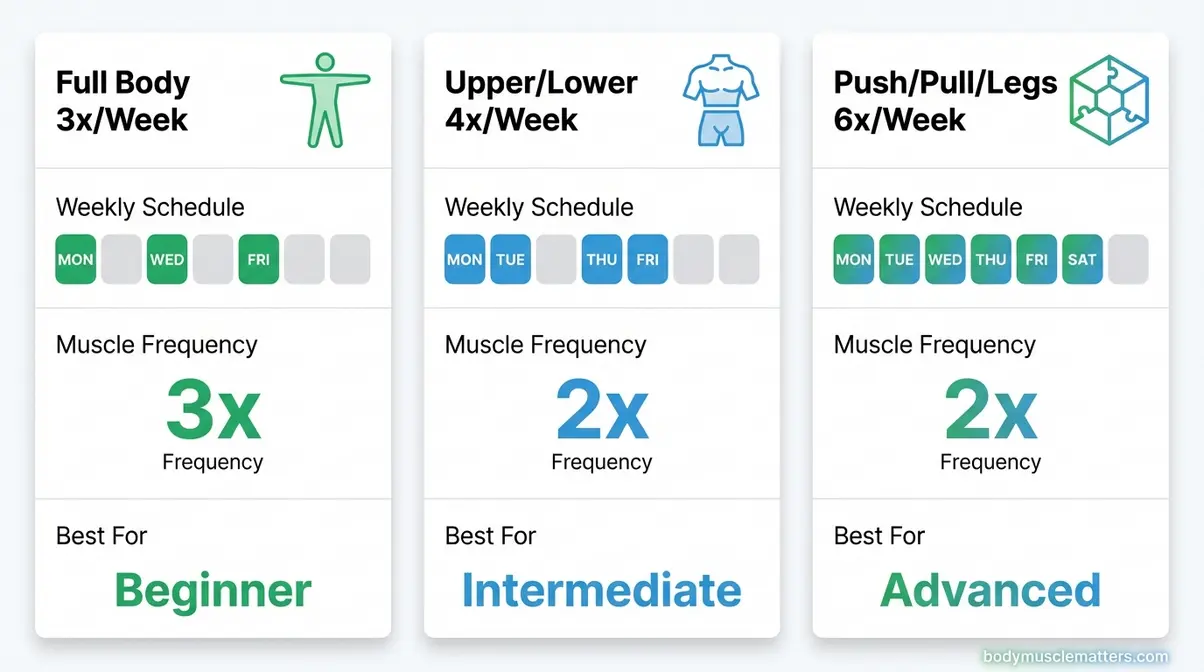
Caption: Each split trains muscles at a different frequency — the right choice depends on your training age, schedule, and recovery capacity.
Full Body Split for Beginners
A Full Body split means you train all major muscle groups — chest, back, legs, shoulders, and arms — in each single session, then rest for 48 hours before training again. It is the most beginner-friendly structure available because it aligns perfectly with the 2 to 3x weekly frequency recommendation supported by the research.
Example Workout Week — Beginner Full Body 3x/Week:
- Monday: Squat, Bench Press, Bent-Over Row, Shoulder Press, Bicep Curl, Tricep Pushdown
- Wednesday: Romanian Deadlift, Incline Press, Lat Pulldown, Lateral Raise, Hammer Curl, Overhead Extension
- Friday: Leg Press, Dumbbell Bench, Cable Row, Arnold Press, EZ Bar Curl, Close-Grip Press
- Tuesday, Thursday, Saturday, Sunday: Rest or active recovery (walking, light stretching)
Each muscle gets stimulated 3 times per week — perfectly aligned with The 48-Hour Rule. Beginners also benefit from high neural stimulus frequency (training your nervous system to recruit muscle fibers efficiently), which accelerates motor pattern learning. This neural adaptation is the main driver of “newbie gains” in the first 3 to 6 months of training.
Callout: This split works with just 3 days in the gym per week. If you can only commit to 3 training days, start here — full stop.
“Full Body training three times per week gives each muscle group the 48-hour recovery window it needs while delivering the frequency stimulus shown to maximize beginner hypertrophy.”
Once you have 12 to 18 months of consistent full body training, the Upper/Lower split unlocks the next level of growth.
Upper/Lower for Intermediates
An Upper/Lower split divides your training into two categories: upper-body sessions (chest, back, shoulders, biceps, and triceps) and lower-body sessions (quads, hamstrings, glutes, and calves). You alternate between them across 4 training days, giving each muscle group exactly 72 hours of recovery — slightly beyond The 48-Hour Rule’s minimum, which is ideal as you add more volume per session.
Example Workout Week — Intermediate Upper/Lower 4x/Week:
- Monday: Upper Body A — horizontal push/pull focus (Bench Press, Barbell Row, Dips, Seated Cable Row)
- Tuesday: Lower Body A — quad-dominant (Back Squat, Leg Press, Walking Lunges, Leg Extension)
- Wednesday: Rest (intentional — this mid-week rest day is not a mistake, it is a requirement)
- Thursday: Upper Body B — vertical push/pull focus (Overhead Press, Lat Pulldown, Arnold Press, Face Pull)
- Friday: Lower Body B — hip-hinge dominant (Romanian Deadlift, Hip Thrust, Leg Curl, Calf Raises)
- Saturday, Sunday: Rest or active recovery
Note for intermediate lifters: Wednesday is an intentional rest day. Many lifters feel guilty skipping a mid-week session — but that recovery time is exactly what allows Thursday and Friday to be productive. Guilt-free rest is part of the plan.
This split is particularly effective for lifters moving from 10–12 to 12–16 weekly sets per muscle group without stretching individual sessions longer than 60 to 75 minutes.
For lifters with 3+ years of consistent training who want maximum growth stimulus, the Push/Pull/Legs split takes frequency and volume to their peak.
Push/Pull/Legs for Advanced Lifters
Push/Pull/Legs, or PPL, organizes training by movement pattern rather than muscle group. Push days target chest, shoulders, and triceps; Pull days target back and biceps; Leg days target quads, hamstrings, and glutes. Running this structure 6x/week means each muscle group is trained twice per week — hitting the upper end of the optimal frequency range.
Example Workout Week — Advanced PPL 6x/Week:
- Monday: Push A (Bench Press, Overhead Press, Lateral Raises, Tricep Dips)
- Tuesday: Pull A (Deadlift, Pull-Ups, Cable Rows, Bicep Curls)
- Wednesday: Legs A (Back Squats, Leg Press, Romanian Deadlift, Calf Raises)
- Thursday: Push B (Incline Press, Arnold Press, Cable Flyes, Overhead Extensions)
- Friday: Pull B (Rack Pulls, Lat Pulldown, Face Pulls, Hammer Curls)
- Saturday: Legs B (Front Squats, Hip Thrust, Leg Curl, Tibialis Raises)
- Sunday: Full rest
Notice that every effective split — Full Body, Upper/Lower, and PPL — respects The 48-Hour Rule: no muscle is trained again until at least 48 hours have passed from its previous session.
Advanced lifters using PPL often accumulate 16 to 22 sets per muscle group per week, hitting the upper range of the optimal volume zone. For more on setting up an effective push/pull/legs split, including exercise selection and progressive overload strategies, see our dedicated guide.
⚠️ Warning: The PPL split is demanding. Six training days per week requires excellent sleep, nutrition, and recovery management. Do NOT attempt this split in your first one to two years of training — it will likely produce more fatigue than growth.
“A Push/Pull/Legs split trains each muscle group twice per week across 6 sessions — one of the most time-efficient approaches for advanced lifters seeking maximum hypertrophy.”
Before choosing your split, you may have encountered popular gym rules like the 3-3-3 rule or the 5-3-1 method. Here’s what these actually mean and how they fit into the frequency framework.
Decoding the 3-3-3, 5-3-1 & 2-2-2 Rules
Three popular named methods appear frequently in beginner fitness searches. Each represents a different programming philosophy — and each fits differently within the frequency science covered above.
The 3-3-3 Rule describes a balanced weekly training structure: 3 strength training sessions, 3 cardio sessions, and 3 active recovery days. This gives muscles the approximately 48-hour recovery window recommended by The 48-Hour Rule while maintaining cardiovascular fitness alongside muscle-building work. For beginners with general fitness goals — not just muscle growth — it is a solid, manageable starting structure.
The 5-3-1 Method, developed by strength coach Jim Wendler, is a strength-focused program built around four main lifts: the squat, bench press, deadlift, and overhead press. Each training week cycles through three intensity waves — 5 reps at moderate weight, 3 reps at heavier weight, and a final set of 1 or more reps at near-maximum effort. It is not primarily a hypertrophy program. The 5-3-1 method is designed to build progressive strength over months, making it better suited for intermediate lifters with a specific strength goal than for beginners focused on muscle size.
The 2-2-2 Rule is a minimalist training approach: 2 full-body workouts per week, 2 exercises per muscle group, and 2 working sets per exercise. It is excellent for very busy individuals as a maintenance or beginner starter program. However, 4 total working sets per muscle per week sits at the very low end of the minimum effective dose — enough to maintain or begin growing muscle, but below the 10 to 12 sets optimal for beginners.
| Method | Best For | Sessions/Week | Muscle Frequency |
|---|---|---|---|
| 3-3-3 Rule | Beginners with cardio goals | 3 strength + 3 cardio | 2–3x per muscle |
| 5-3-1 Method | Intermediate strength focus | 4 (main lifts) | 1x per lift |
| 2-2-2 Rule | Busy beginners, maintenance | 2 | 2x per muscle |
Understanding the right frequency and split is only half the equation. The other half is knowing exactly how many sets to perform each week — without tipping into counterproductive territory.
Step 3: Calculate Your Weekly Training Volume
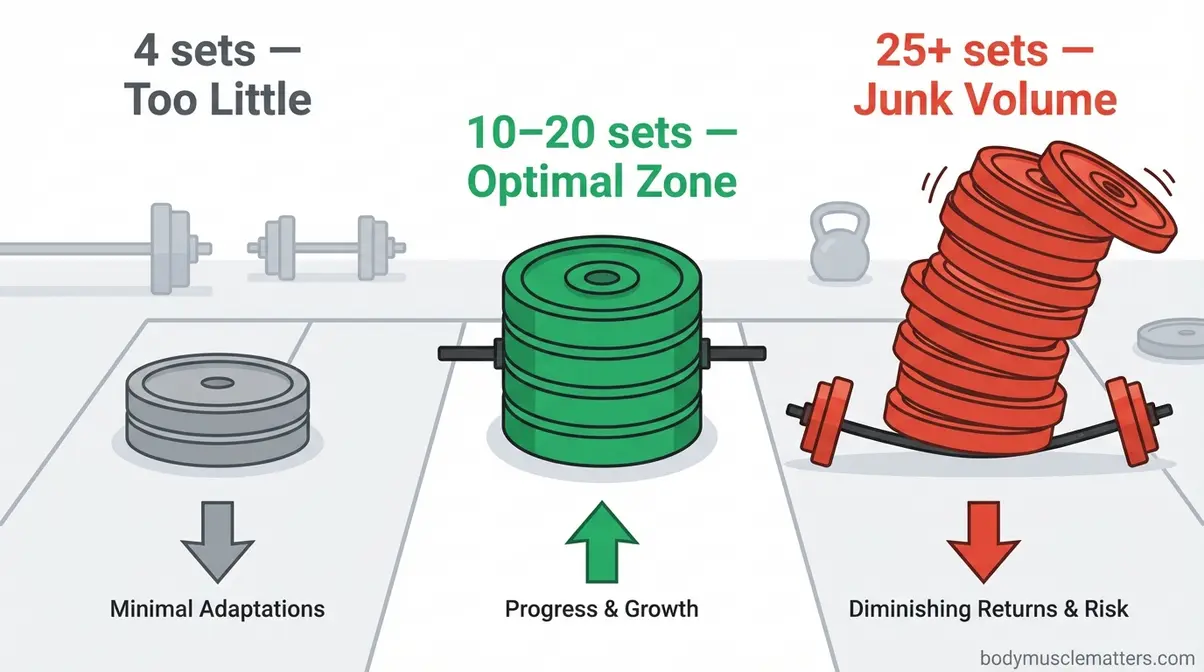
Most beginners assume more is always better in the gym. If 10 sets built some muscle, surely 30 sets will build three times as much. Research is clear that this is not true — and understanding exactly why will save you months of wasted effort in the gym.
The chart below shows why both ends of the volume spectrum underdeliver — too few sets produce minimal stimulus, while too many sets produce so much fatigue that recovery cannot keep pace.
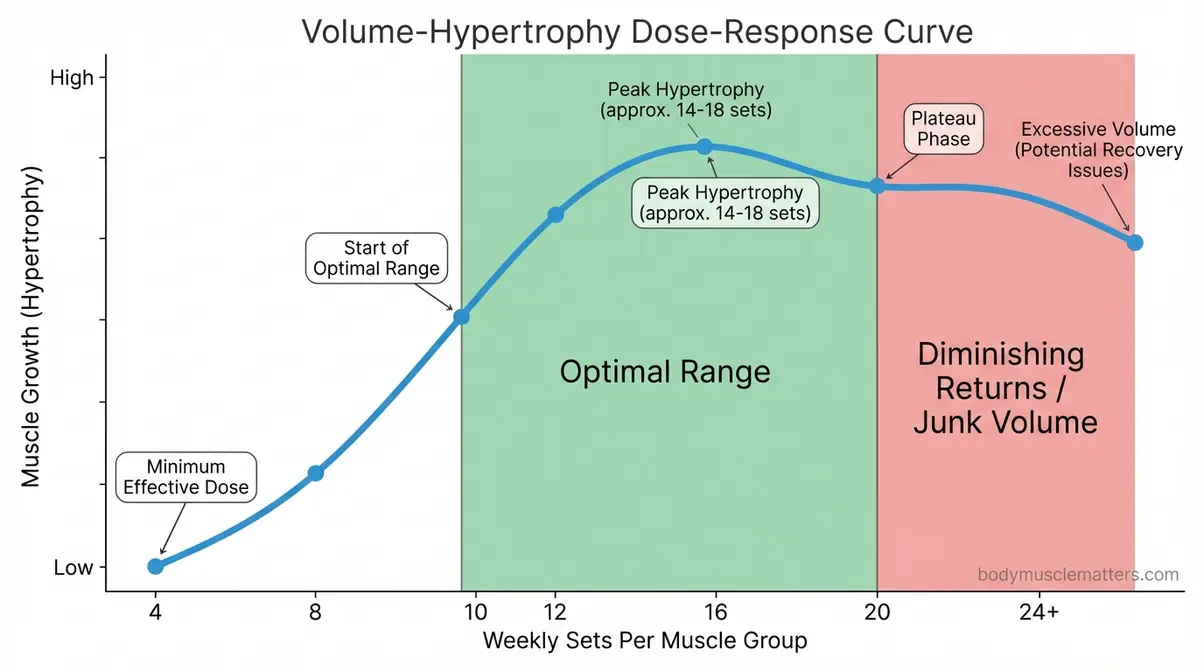
Caption: The dose-response curve for muscle growth peaks between 10–20 weekly sets — both undertraining and excessive volume deliver diminishing returns.
Minimum Effective Dose of Weekly Sets
A working set is a set performed at genuine effort — typically within one to five reps of failure. This does NOT include warm-up sets, which are performed at lighter weights to prepare your joints and nervous system. Only working sets count toward your weekly volume total.
Research shows that performing at least 4 working sets per muscle group per week is the floor needed to maintain or begin building muscle (minimum effective training volume — NCBI, 2021). Below 4 sets per week per muscle, the growth signal is too weak to produce reliable hypertrophy. Above that floor, more sets produce more growth — up to a point.
A 2022 umbrella review of 14 meta-analyses confirmed that 12 to 20 weekly sets per muscle is the optimal range for most trained individuals, with returns beginning to diminish beyond 20 sets per week (Frontiers in Sports and Active Living, 2022).
Here is the optimal range broken down by experience level:
- Beginners: 10–12 working sets per muscle group per week
- Intermediate: 12–16 working sets per muscle group per week
- Advanced: 16–22 working sets per muscle group per week
Practical example: A beginner doing a Full Body 3x/week split should aim for approximately 3 to 4 sets of chest exercises per session. Three sessions × 4 sets = 12 total weekly chest sets. That sits squarely in the sweet spot.
When you stay within the 10 to 20 set window, your muscles can recover within The 48-Hour Rule’s window. Exceed 20 sets regularly, and recovery bleeds past 48 to 72 hours — pushing your next session back and disrupting your entire frequency plan.
For a deeper look at the relationship between volume and results, see our guide on avoiding junk volume to optimize muscle gains.
What Is Junk Volume and How to Avoid It
Junk volume refers to sets that feel like work but produce no meaningful muscle growth stimulus. This happens in two distinct ways.
Scenario 1 — Sets that are too easy: You perform 5 sets of bicep curls with a weight you could lift 25 times. Your biceps are barely challenged. These count as volume on paper, but they generate almost no hypertrophic signal. The muscle is not working hard enough to trigger meaningful repair and growth.
Scenario 2 — Sets performed under excessive fatigue: You are in your eighth exercise of a two-hour session. Your form is deteriorating, your performance has dropped noticeably, and you are generating 30% less force than in your first sets. More volume at this point actively impairs recovery rather than building muscle.
Research confirms that the relationship between volume and hypertrophy is dose-responsive — not linear — and that excessive volume quickly leads to diminished returns (dose-response: volume and hypertrophy — NCBI, 2019).
The junk volume test: Apply this quick check to any set. If you could add 5 or more reps to your set without significant difficulty, the weight was too light — junk volume. If your form broke down noticeably in the final 2 reps due to fatigue, you were too far into a fatigued state to produce quality muscle stimulus.
Use this test at your very next workout session. Aim for every set to land in the zone between “genuinely challenging” and “technically sound to the last rep.”
One final concept beginners often get wrong when counting their weekly sets: the difference between direct and indirect volume — and how it changes the math significantly.
Counting Direct vs. Indirect Volume
Not all volume is created equal — and if you count your weekly sets incorrectly, you may unknowingly push a muscle group into overtraining while thinking it’s barely worked.
Direct volume refers to sets where the target muscle is the primary mover. Bench press sets equal direct chest volume. Bicep curls equal direct bicep volume.
Indirect volume refers to sets where the target muscle is a secondary contributor — working hard, but not as the prime mover. The bench press, for example, heavily recruits your front deltoids and triceps. Every chest pressing set adds indirect training volume to those muscles.
Here is why this matters: if you perform 12 dedicated tricep sets AND 12 chest sets per week, your triceps may be receiving 20 or more total volume units per week (12 direct + approximately 8 indirect from chest pressing). That could push your triceps into the overtraining zone even though your dedicated tricep work looked conservative on paper.
| Exercise | Direct Muscle | Indirect Muscles |
|---|---|---|
| Bench Press | Chest | Front Delts, Triceps |
| Pull-Up | Lats (Back) | Biceps, Rear Delts |
| Back Squat | Quads | Glutes, Hamstrings |
| Overhead Press | Shoulders | Triceps, Upper Traps |
You do not need to memorize every muscle’s synergist relationships. Instead, apply a simple rule: for any exercise that heavily involves a secondary muscle, count it as roughly half a direct set for that secondary muscle. Keep your total — direct plus half of indirect — within the 10 to 20 weekly set range.
Even the most optimally designed training plan fails without proper recovery. In Step 4, you’ll learn why rest days are the most underrated tool in muscle building — and how to know when you’ve crossed the line into overtraining.
Step 4: Plan Your Recovery and Rest Days
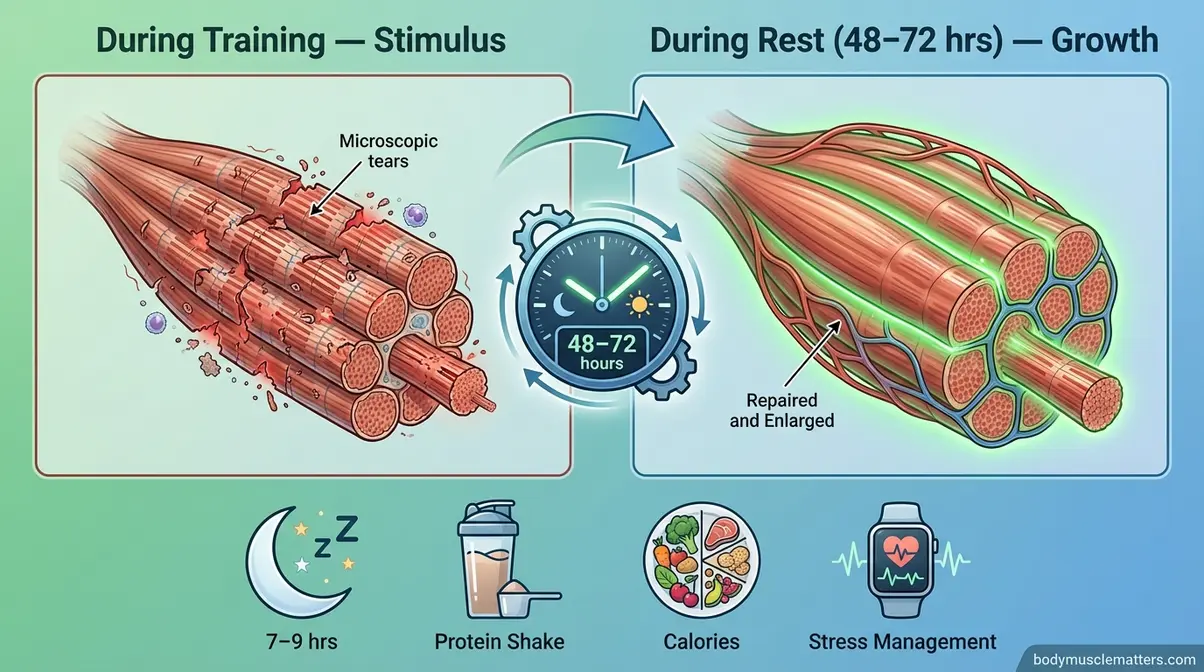
Recovery is not passive. It is the active, biological phase where muscle growth actually happens. Understanding this changes how you think about rest days — from something you feel guilty about, to something you protect as carefully as your training sessions.
Do Muscles Grow on Rest Days?
Yes — muscles grow primarily on rest days, not during training. The workout delivers the stimulus: microscopic damage to muscle fibers that signals the body to rebuild stronger. Muscle protein synthesis — the repair and rebuilding process — then remains elevated for 36 to 48 hours post-exercise (NCBI, 2024). Adequate sleep, protein intake, and reduced physical stress during this window are what convert the training stimulus into actual muscle growth. Skipping or shortening rest days cuts this process short and reduces the return on your training investment.
Research from 2024 examining recovery in resistance training confirms that insufficient recovery between sessions — specifically less than 48 hours — compromises the hypertrophic adaptations the workout was designed to produce (PMC, 2024). Health authorities worldwide recommend resistance training sessions be performed approximately 48 to 72 hours apart for precisely this reason (PMC, 2018).
“Muscles grow during the 48–72 hours of rest after training — not during the workout itself. Rest days are when the biological work of hypertrophy is completed.”
What does adequate recovery actually require? Four factors drive post-workout muscle repair:
- Sleep: 7 to 9 hours per night is the minimum for optimal MPS and hormonal recovery
- Protein intake: Research consistently supports 1.6 to 2.2 grams of protein per kilogram of body weight per day for muscle building
- Caloric sufficiency: Muscles cannot grow in a severe caloric deficit — fuel the repair process
- Stress management: Chronically elevated cortisol (the stress hormone) directly suppresses MPS and muscle repair
Training hard is only one part of the equation. Recovery completes it.
How Age Affects Recovery & Frequency
One of the most significant gaps in popular fitness content is age-specific recovery guidance. The reality is that recovery timelines change meaningfully as you get older — and your training schedule should reflect that.
From your 20s into your mid-30s: MPS responds robustly to training, and 48 hours between sessions for the same muscle group is generally sufficient. The 2 to 3x per week frequency recommendation applies at full intensity.
From your late 30s into your 40s and beyond: Recovery capacity begins to decline. Research from 2025 reviewing heavy strength training in older adults confirms that 2 to 3 training sessions per week with at least 48-hour recovery periods between sessions for the same muscle is optimal — and that attempting higher frequency without adequate recovery produces inferior results in this age group (PMC, 2025). A 2025 functional training review also found that 2 sessions per week showed clinically significant benefits for adults over 40 (PMC, 2025).
Practically, this means:
- Age 40–55: Aim for each muscle group twice per week maximum. Allow 72 hours (not just 48) between sessions for the same muscle. Reduce per-session volume by 10 to 20% compared to what you might do at 25.
- Age 55+: Full body 2x per week with an emphasis on recovery quality — sleep, protein, and active rest — often outperforms higher frequency approaches in this age group.
- At any age: If soreness from a previous session has not resolved before your next training day for that muscle, add one more rest day. Your body is signalling incomplete recovery.
Example Age 40+ Schedule (Full Body 2x/Week):
- Monday: Full Body (6–8 exercises, 3 sets each, moderate load)
- Thursday: Full Body (same structure, different exercise variations)
- Tuesday, Wednesday, Friday, Saturday, Sunday: Rest or low-intensity activity (walking, yoga, swimming)
This respects the 72-hour recovery window that research indicates older muscles require — without sacrificing the twice-weekly frequency shown to maintain and build muscle in adults over 40.
What Are Signs of Overtraining?
Key signs of overtraining include persistent performance decline, fatigue that does not improve with rest, elevated resting heart rate, disrupted sleep, and mood changes such as irritability or loss of motivation. Research identifies these as hallmark symptoms of overtraining syndrome (PMC, 2024). Additional indicators include chronic joint or tendon soreness (not just muscle soreness), more frequent illness, and loss of appetite. If you experience 3 or more of these symptoms simultaneously for more than one week, reduce your training volume by 50%, prioritize sleep and nutrition, and allow a full deload week before returning to normal training intensity.
Overtraining syndrome (OTS) is a maladaptive response to excessive exercise without adequate recovery — and it produces the exact opposite of what you are training for. Research from 2025 describes OTS as involving impaired performance alongside multisystem dysfunction across endocrine, nervous, and immune systems (PMC, 2025).
The challenge is that overtraining does not always feel like “too much.” It often masquerades as a motivation slump, minor illness, or just “a bad week.” Recognizing and identifying the signs of overtraining early is critical for consistent muscle growth.
Overtraining Warning Checklist — Check for any 3 or more of the following:
- ☐ Performance is declining across two or more consecutive weeks (weights you previously lifted easily now feel heavier)
- ☐ Persistent muscle soreness that does not resolve within 72 hours of a session
- ☐ Elevated resting heart rate (more than 5 beats per minute above your normal morning rate)
- ☐ Sleep disruption — difficulty falling asleep, staying asleep, or waking unrefreshed despite sufficient hours
- ☐ Mood changes — unusual irritability, low motivation, or a sense of dread before training
- ☐ Increased frequency of illness (colds, infections) — a sign of suppressed immune function
- ☐ Decreased appetite or unintentional weight loss
- ☐ Joints or tendons feel chronically sore rather than the muscles themselves
A 2024 review of overtraining syndrome found that these symptoms — particularly fatigue, decreased performance, altered mood, and immune dysfunction — are the hallmark cluster that distinguishes OTS from normal training soreness (PMC, 2024).
If you check 3 or more boxes: Take a full deload week (reduce volume by 50% and intensity by 30%), prioritize sleep and nutrition, and reassess your split before returning to normal training load. If symptoms persist beyond two weeks despite rest, consult a physician.
Caption: Experiencing 3 or more of these symptoms simultaneously is a clear signal to reduce training volume and prioritize recovery.
What Should You Not Do at the Gym?
The most damaging mistake at the gym is training the same muscle group on consecutive days without a 48-hour recovery window. Additional common errors include skipping progressive overload (adding more challenge over time), accumulating junk volume instead of quality working sets, training through sharp joint pain rather than muscle fatigue, and skipping planned rest days because you “feel fine.” Each of these disrupts the biological growth cycle — muscle protein synthesis requires uninterrupted recovery to complete the repair process that produces hypertrophy.
Even with the right frequency, split, and volume in place, three specific mistakes consistently derail beginners. Resistance training research and exercise physiology consensus point to these patterns repeatedly as the most common causes of stalled progress.
Mistake 1: Training Consecutive Days
The mistake: Doing a heavy chest session on Monday, then returning to bench pressing on Tuesday because “chest day was fun” or “I didn’t feel sore.”
Why it fails: Absence of soreness does not mean recovery is complete. Muscle protein synthesis and structural repair continue for 36 to 48 hours regardless of how you feel. Training the same muscle the next day cuts the MPS window short and introduces new damage before previous damage has been repaired. You are not building on your last session — you are interrupting it.
The fix: Respect The 48-Hour Rule. At minimum, always leave 48 hours between sessions targeting the same muscle group. If you trained chest on Monday, the earliest your next chest session should be is Wednesday.
Mistake 2: Lacking Progressive Overload
The mistake: Performing 20 sets per muscle group every week at the same weights and rep ranges for months — and wondering why progress has stalled.
Why it fails: Volume without progressive overload (gradually increasing the challenge over time — by adding weight, reps, or sets) quickly becomes junk volume. Your muscles adapt to a given stimulus within 2 to 4 weeks. After that, the same training produces the same body — not a bigger one. More sets without increasing the demand produce fatigue, not growth.
The fix: Every 2 to 4 weeks, increase the challenge by adding 2.5 to 5 kg to a primary lift, adding 1 to 2 additional working sets, or increasing your working rep range by 2 reps before resetting the weight higher. Track your sessions — you cannot progressively overload what you cannot measure.
Mistake 3: Skipping Rest Days
The mistake: Feeling good on a scheduled rest day and deciding to train anyway — or shortening a rest day to add an extra session.
Why it fails: Overtraining syndrome develops gradually, not acutely. You feel fine right up until you don’t — and by the time performance drops noticeably, you may already be weeks into a suppressed recovery state. Research identifies inadequate recovery as a pro-inflammatory environment that leads to fatigue, immune dysfunction, and stalled adaptation (PMC, 2025). Feeling fine on a rest day means the recovery is working — not that you can skip it.
The fix: Treat rest days as non-negotiable training sessions. Schedule them in advance. Use them for active recovery — walking, light stretching, mobility work — rather than additional gym sessions. Protect the recovery window as fiercely as you protect your training sessions.
Frequently Asked Questions
What is the 3-3-3 rule at the gym?
The 3-3-3 rule is a weekly training structure: 3 strength sessions, 3 cardio sessions, and 3 active recovery days. This balanced approach ensures each muscle group receives the twice-weekly stimulus research links to optimal hypertrophy. Strength sessions typically target major muscle groups on alternating days (Monday, Wednesday, Friday), while cardio fills the gaps. For beginners with general fitness goals, the 3-3-3 rule provides a sustainable, structured entry point without overloading recovery capacity.
How Often to Train for Muscle Growth?
Train each muscle group 2 to 3 times per week for maximum muscle growth. A landmark meta-analysis of 10 studies found that higher training frequency produced greater hypertrophy than once-per-week training when total weekly volume was equated (Schoenfeld et al., 2016). Beginners should start at 3x per week using a Full Body split. Intermediate lifters typically do best with 2x per week via an Upper/Lower split. The key is accumulating 10 to 20 working sets per muscle per week across those sessions.
What is the 5-3-1 rule?
The 5-3-1 method is a strength-focused program built around four compound lifts: the squat, bench press, deadlift, and overhead press. Developed by strength coach Jim Wendler, each training week cycles through three intensity waves — sets of 5 reps at moderate load, sets of 3 reps at heavier load, and a final set of 1 or more reps at near-maximum effort. It is a progressive strength system, not primarily a hypertrophy program. Beginners pursuing muscle size are better served by a Full Body or Upper/Lower split before considering 5-3-1.
What is the 2-2-2 rule in the gym?
The 2-2-2 rule is a minimalist training method: 2 full-body workouts per week, 2 exercises per muscle group, and 2 working sets per exercise. This produces approximately 4 working sets per muscle per week — sitting right at the minimum effective dose threshold identified in research (NCBI, 2021). It is an effective maintenance or starter program for very busy individuals. However, it produces slower muscle growth than the recommended 10 to 12 weekly sets for beginners. Use it to establish the habit, then scale up as your schedule allows.
When Does Age Stop Muscle Growth?
There is no age at which muscle growth becomes impossible. Research published in 2025 confirms that adults over 65 can achieve measurable strength and muscle gains through structured resistance training — the adaptations simply require more recovery time and appropriate loading (PMC, 2025). Sarcopenia (age-related muscle loss) accelerates without resistance training, making it more critical — not less — as you age. Adults over 40 should train each muscle group twice per week with 72-hour recovery windows between sessions for the same muscle group, as detailed in Step 4 of this guide.
Limitations to These Recommendations
Common Pitfalls to Avoid
Pitfall 1 — Applying advanced volume to a beginner schedule. The 16 to 22 sets per muscle per week recommended for advanced lifters will produce overtraining in someone with under a year of training. Always match volume to your experience level, not to what you read in a high-level lifting forum.
Pitfall 2 — Ignoring indirect volume. As covered in Step 3, compound movements like bench press, squats, and rows simultaneously train multiple muscle groups. A beginner who counts only their dedicated arm exercises as “arm volume” may be accumulating far more total tricep and bicep stimulus than intended — leading to stalled recovery without understanding why.
Pitfall 3 — Treating the 2-3x frequency as the goal rather than the tool. The frequency recommendation exists to keep you within the MPS window. If life requires you to train 2x per week for a period — travel, illness, workload — that is still effective. Consistency over weeks and months matters more than perfection in any given week.
When to Choose Alternative Approaches
If you are managing an active injury: The frequency and volume recommendations in this guide assume healthy joints and muscles. Injured individuals should follow their physical therapist or sports medicine physician’s return-to-training protocol — standard programming does not apply during rehabilitation.
If you are a competitive athlete in-season: Strength and conditioning coaches for competitive athletes periodize volume and frequency around sport demands, competition schedules, and recovery windows that differ substantially from the general recommendations here.
If you have less than 30 minutes available per session: A modified 2-2-2 approach or abbreviated full body circuit may be more appropriate than attempting a full split program. Consistency with a shorter protocol outperforms sporadic adherence to a comprehensive one.
When to Seek Expert Help
Consult a certified personal trainer (CPT) or sports medicine professional if: you experience joint or tendon pain (not muscle soreness) that persists beyond 72 hours; you are over 60 with no prior resistance training history and want individualized programming; or you are returning to training after surgery, injury, or an extended break of more than six months. The general guidelines here are a strong foundation — but specific physical histories benefit from individualized assessment.
Conclusion
For beginners and intermediate lifters, the answer to how often to train a muscle group for growth is clear: 2 to 3 times per week per muscle group, accumulating 10 to 20 working sets per week, distributed across an appropriate split for your experience level. Research from the Schoenfeld 2016 meta-analysis — confirmed by subsequent post-2022 volume research — consistently supports this frequency range as the most reliable driver of hypertrophy for general training populations.
The 48-Hour Rule is the single principle that makes all of these recommendations coherent. Muscle Protein Synthesis stays elevated for 36 to 48 hours after each training session — that biological clock determines your optimal training schedule, split choice, weekly volume, and recovery timing. Build your entire program around this window, and the frequency, volume, and rest recommendations in this guide become self-explanatory rather than arbitrary rules to follow blindly.
Your next step is concrete: choose the split that matches your experience level from Step 2, calculate your weekly sets using the ranges in Step 3, and commit to a 4-week trial of your chosen schedule before making any adjustments. If in doubt, start conservative — 10 weekly sets per muscle on a Full Body 3x/week plan — and build from there. Always consult a qualified physician or certified personal trainer before beginning a new exercise program if you have any health concerns. Check out our other guides to discover the exact exercises and nutritional strategies that pair perfectly with your new workout frequency.