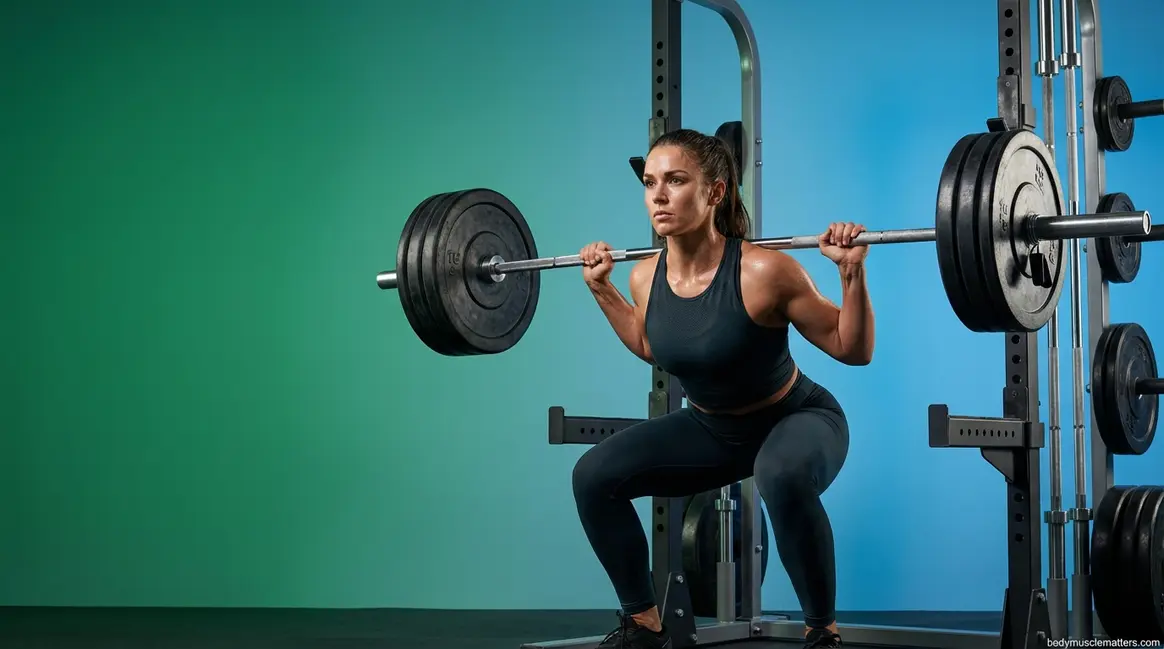
You finish a hard hour of weight lifting, glance at your smartwatch, and it reads 180 calories. That can’t be right — you’re sweating, your legs are shaking, and you gave it everything. Here’s the truth: that number tells less than half the story.
The frustration is real. Calorie trackers weren’t built for weight training. They’re optimized for steady-state cardio — which means every lifting session you log is underreported by a significant margin. So if you’ve been judging your workouts by what your wrist says, you’ve been flying blind.
By the end of this guide, you’ll have exact calorie estimates based on your body weight and intensity, understand the afterburn effect that keeps your metabolism elevated for hours, and know exactly why your fitness tracker is lying — so you can stop guessing and start optimizing. We’ll cover session calorie data, what drives the numbers up or down, the science of post-workout burn, fat loss strategy, and the truth about wearable trackers.
Weight lifting burns 180–500 calories per hour depending on your body weight and intensity — but that’s only Phase 1 of your total burn.
- Phase 2 (EPOC): Your body keeps burning extra calories for 14–72 hours after lifting
- Compound lifts (squats, deadlifts) burn 40–60% more per session than isolation machines
- Your smartwatch may underreport weight lifting calorie burn by up to 93%
- The Two-Phase Burn framework shows why lifting outperforms cardio for long-term fat loss
Calorie Burn By The Numbers

Weight lifting — also called resistance training or strength training — burns approximately 180–500 calories per hour, with your body weight and session intensity as the two biggest drivers. A 155-pound person lifting at moderate intensity burns roughly 216 calories in 30 minutes, according to Harvard Health Publishing data published in 2021. That number is just the starting point: the type of exercises you choose and how hard you push can double or halve it.
“For a one hour workout approx the calories burn can range from 250-500. It all depends on the intensity.”
— Fitness community member, r/naturalbodybuilding
That quote captures something important. The range is wide because “weight lifting” spans everything from slow machine curls to all-out barbell circuits. The table below gives you specific numbers by duration and body weight — so you can move from guessing to knowing.
This data covers Phase 1 of your total burn: the calories used during the session itself. Phase 2 — the afterburn effect — is where weight lifting truly separates itself from cardio. More on that in H2 #3. First, here’s your personalized reference.
Calorie Burn by Duration and Body Weight
The table below uses a MET (Metabolic Equivalent of Task — a unit measuring how much energy an activity uses compared to sitting still) value of 5.0 for moderate resistance training, based on guidelines published in 2024 by the CDC. The formula is: Calories = MET × weight (kg) × time (hours). A higher MET means more intensity, and a heavier body burns proportionally more calories doing the same work.
Moderate-Intensity Lifting (MET 5.0) — General Weight Training with Rest Periods
| Duration | 125 lb (57 kg) | 155 lb (70 kg) | 185 lb (84 kg) | 215 lb (98 kg) |
|---|---|---|---|---|
| 10 min | 48 cal | 58 cal | 70 cal | 82 cal |
| 20 min | 95 cal | 117 cal | 140 cal | 163 cal |
| 30 min | 143 cal | 175 cal | 210 cal | 245 cal |
| 45 min | 214 cal | 263 cal | 315 cal | 368 cal |
| 60 min | 285 cal | 350 cal | 420 cal | 490 cal |
Vigorous-Intensity Lifting (MET 6.0) — Circuit-Style or Heavy Compound Work with Short Rests
| Duration | 125 lb (57 kg) | 155 lb (70 kg) | 185 lb (84 kg) | 215 lb (98 kg) |
|---|---|---|---|---|
| 30 min | 171 cal | 210 cal | 252 cal | 294 cal |
| 60 min | 342 cal | 420 cal | 504 cal | 588 cal |
Calculations based on MET formula per Texas A&M AgriLife Extension and 2024 CDC physical activity guidelines. Moderate = working sets with 60-90 second rests; vigorous = compound circuits with 30-45 second rests.
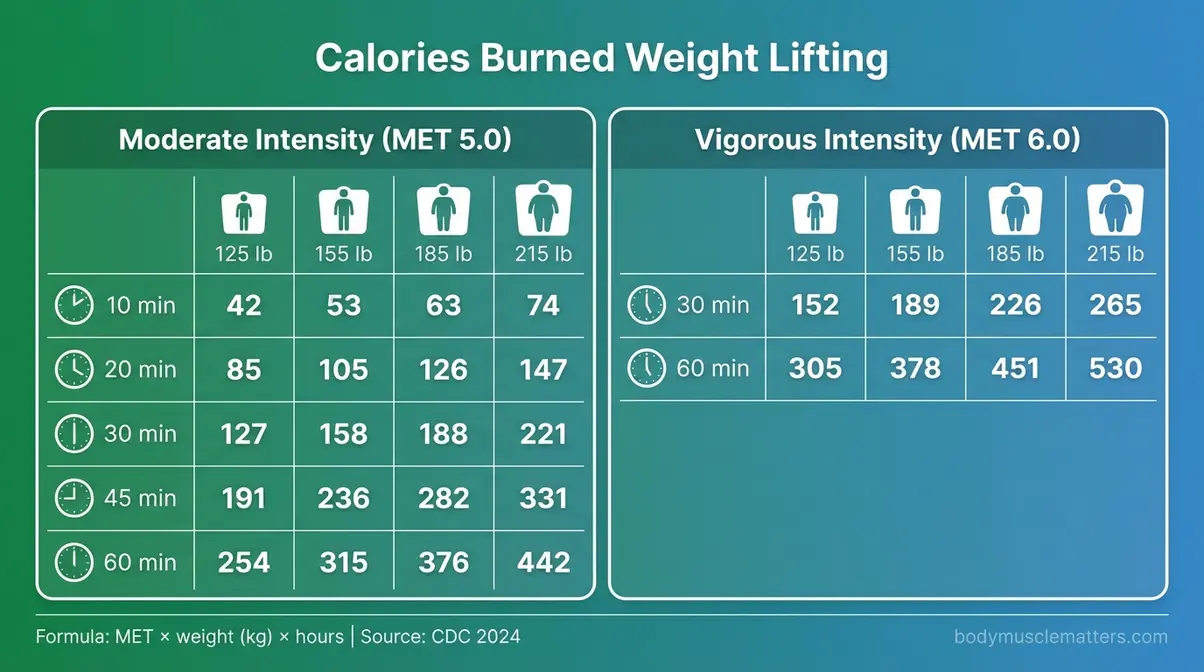
Caption: Calorie estimates for moderate and vigorous weight lifting across 4 body weight categories and 5 session lengths — use this as your personalized reference before tracking by wristwatch alone.
A 155-pound person doing 30 minutes of moderate lifting burns roughly as many calories as a 20-minute brisk walk — but weight lifting builds muscle that keeps burning calories after you stop, which is the part your tracker never shows you.
These numbers assume everyone lifts the same way. In reality, what exercises you choose and how hard you push matters far more than the clock — and that’s where the calorie gap between lifters really opens up.
Calories Burned in 30 Minutes of Lifting
How many calories does 30 minutes of weight lifting burn? At moderate intensity (MET 5.0), a 125-pound person burns roughly 143 calories, while a 215-pound person burns approximately 245 calories — a difference driven entirely by body mass doing the same workout.
Switch to heavy compound lifting with 45-second rest periods and that same 30 minutes can push 20–30% higher for the same person, since the MET value rises with intensity, according to guidelines published in 2024 by the CDC. A 155-pound person at vigorous intensity burns around 210 calories in 30 minutes versus 175 at moderate — a meaningful gap that adds up across a week.
Thirty minutes of weight lifting is a realistic, effective session length for most beginners. Rather than trying to add more time, focus on 3–4 compound exercises performed with proper form. A simple but effective 30-minute structure: barbell squat, bench press, bent-over row, overhead press — each 3 sets × 8 reps with 60-second rests. That’s a complete session. The standard formula for calculating METs confirms that one MET equals approximately 1 calorie per kilogram of body weight per hour — which is why body weight, not just effort, drives the numbers so significantly (Texas A&M AgriLife Extension).
If 30 minutes is your current session length, you’re doing well. Now let’s see what an hour of lifting unlocks — and why the calorie math changes more than you’d expect.
Calories Burned in 60 Minutes of Lifting
How many calories does an hour of weight lifting burn? Across a full 60 minutes at moderate intensity, estimates range from approximately 285 calories for a 125-pound person to 490 calories for a 215-pound person (based on data published in 2021 by Harvard Health). That’s a 205-calorie swing from the same workout, explained purely by body mass.
Intensity pushes the upper range higher. A circuit-style session with compound lifts and 30-second rests can reach 400–590 calories for a 185–215 lb person — but this also triggers a significantly larger afterburn effect, which we cover next.
Most beginners won’t sustain truly vigorous effort for a full hour. A realistic 60-minute session includes a warm-up, working sets, and rest intervals — which typically lands in the moderate-intensity range. That’s still productive and worth tracking accurately.
Here’s the practical math: a consistent 60-minute moderate lifting session three times per week creates roughly 1,050 calories of session-level burn per week (at 155 lb). Assuming the commonly cited 3,500-calorie equivalent for one pound of fat, that’s approximately 1 pound every 3–4 weeks from session calories alone — before factoring in EPOC. So far, we’ve covered the calories your session burns while you’re actually in the gym. But there’s a second reason lifting beats cardio for long-term calorie burn — and it starts the moment you put down the bar. First, let’s understand why not all lifting sessions are created equal.
Why Calorie Burns Vary So Much
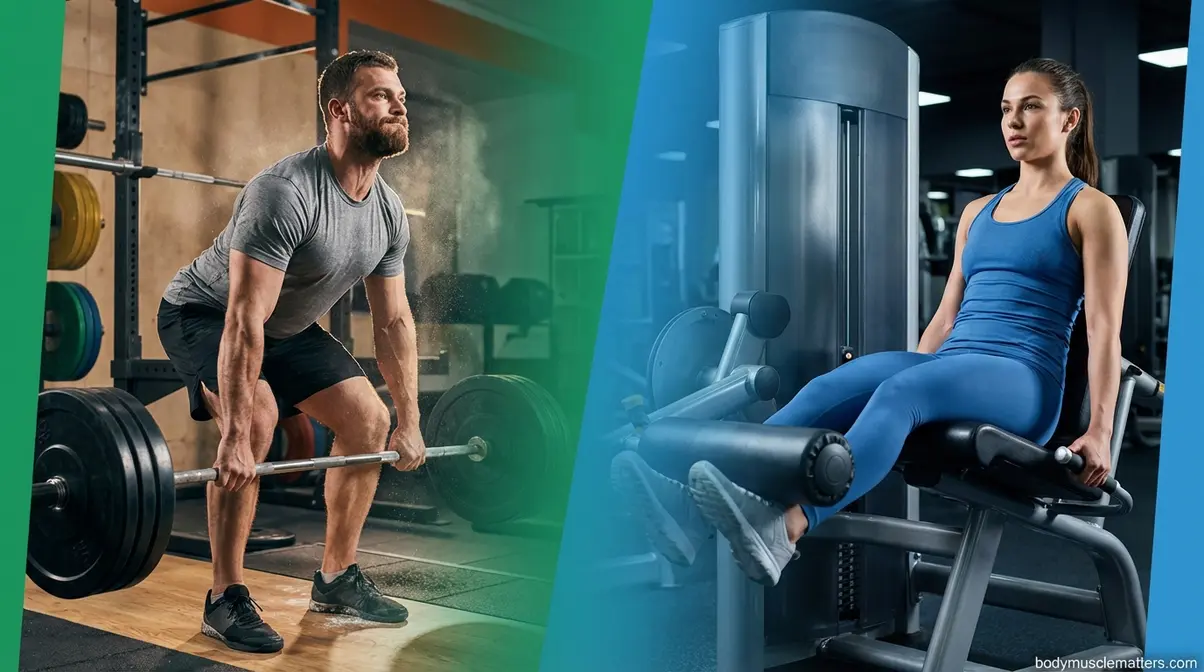
Two people can do the same 60-minute workout and burn vastly different calorie totals because of three key variables: body weight, exercise selection, and rest interval length. The CDC classifies moderate physical activity at 3–5.9 METs and vigorous activity at 6.0 METs or more — and most weight lifting sessions span this entire range within a single hour (CDC guidelines on vigorous activity intensity, based on guidelines published in 2024 by the CDC). Understanding these variables lets you design a session that burns significantly more calories without spending more time in the gym.
What Are METs and Why They Matter
METs — Metabolic Equivalents of Task — measure how much energy an activity uses compared to sitting at rest. Think of MET as your exercise’s intensity rating. A MET of 1.0 is sitting still. Weight lifting at moderate effort is approximately MET 5.0 — meaning you’re burning five times more energy per minute than at rest.
The formula in plain language: Calories = body weight in kg × MET value × hours of exercise. A 70 kg (155 lb) person lifting at MET 5.0 for 30 minutes = 70 × 5.0 × 0.5 = 175 calories. The same formula for a 57 kg (125 lb) person = 57 × 5.0 × 0.5 = 143 calories. Same workout, same effort, 32-calorie difference — that’s body mass at work.
This approach is more accurate than what most tracker apps use. Fitness apps typically assign a flat calorie-per-minute rate regardless of your body weight. The MET method, per the standard formula for calculating METs (Texas A&M AgriLife Extension), personalizes the estimate to your mass — which is why the tables above show such wide ranges across body weights.
Now that you understand the MET framework, here’s where your exercise choices make the biggest difference in your calorie burn.
Compound vs. Isolation Calories
Compound lifts — exercises like squats and deadlifts that work multiple joints and muscle groups at once — carry significantly higher MET values than isolation exercises — movements like bicep curls or leg extensions that target a single muscle group. That gap translates directly into more calories burned per minute.
Barbell compound exercises like squats carry MET values approximately 40–60% higher than machine isolation exercises for the same time spent lifting — a calorie differential that accumulates significantly across a full session.
| Exercise | Type | MET Value | ~Cal Burned (30 min, 155 lb) |
|---|---|---|---|
| Barbell Back Squat | Compound | ~5.5–7.0 | ~192–245 cal |
| Leg Extension Machine | Isolation | ~3.0–3.5 | ~105–122 cal |
| Barbell Deadlift | Compound | ~6.0–8.0 | ~210–280 cal |
| Seated Leg Curl Machine | Isolation | ~3.0–3.5 | ~105–122 cal |
| Barbell Bench Press | Compound | ~4.5–5.5 | ~157–192 cal |
| Cable Crossover / Fly | Isolation | ~3.0–3.5 | ~105–122 cal |
MET ranges derived from the Compendium of Physical Activities (Ainsworth et al.) and CDC physical activity classifications. Calorie values calculated using MET formula (155 lb / 70 kg, 30 minutes).
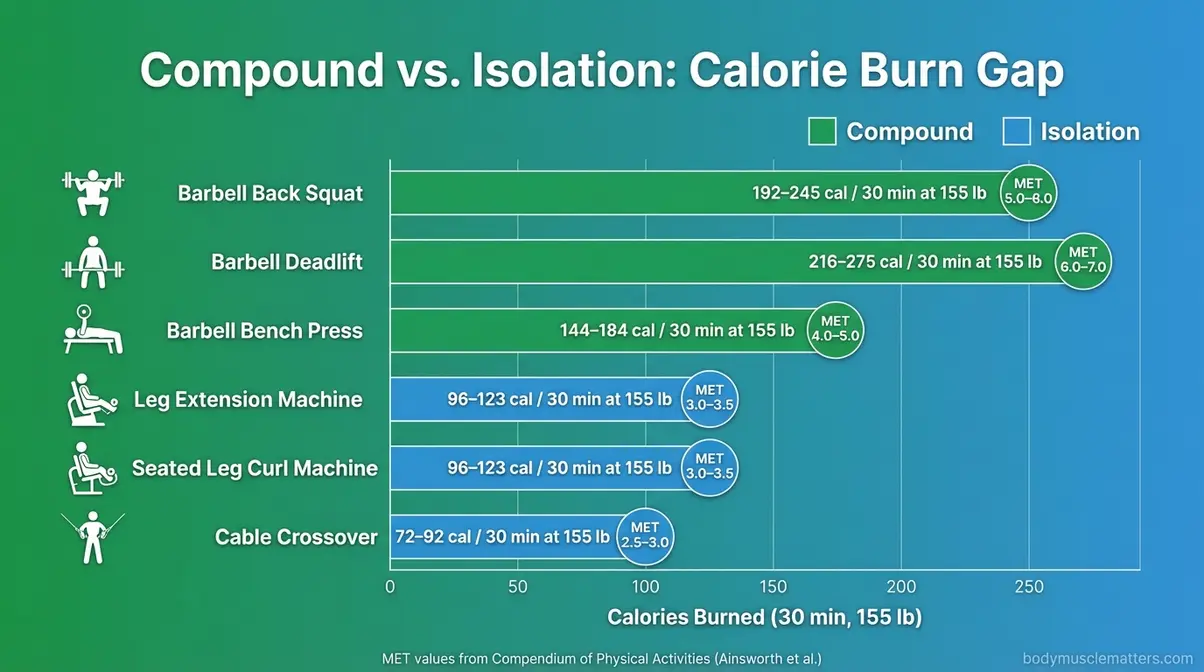
Caption: Compound movements like the deadlift can burn twice as many calories per 30 minutes as isolation machines — a gap that compounds across an entire training session.
On average, a compound-focused session burns 40–60% more calories than the same duration of isolation-only work. This is why a squat-and-deadlift session beats 30 minutes on the leg press machine — and why the best beginner programs prioritize compound movements. Compound lifts don’t just improve Phase 1 burn; they also generate a larger Phase 2 afterburn effect, which you’ll see in the next section.
So compound movements win on calories burned per session. But does lifting heavier weight automatically mean more calories? The answer is more nuanced than most guides suggest.
Does Lifting Heavy Burn More Calories?
Lifting heavier isn’t automatically more calories — it’s the combination of weight, effort level, and rest intervals that drives calorie burn. Shorter rest periods (30–60 seconds) keep your heart rate elevated and push the MET value higher, which matters more than the absolute load on the bar.
Heavy strength protocols — think 5 sets × 3 reps at 90% of your maximum — involve long rest periods (2–4 minutes) between sets. That drops the session’s average MET closer to 4.0. A hypertrophy protocol — 4 sets × 12 reps at 70% of max with 60-second rests — maintains a higher MET throughout and burns more calories within the session itself. The strength protocol, however, builds more neural strength and muscle over time, which raises your Resting Metabolic Rate. It’s a trade-off, not a flaw.
Per CDC guidelines on vigorous activity intensity, vigorous-intensity activity hits 6.0+ METs — the range reached during heavy compound lifting with minimal rest (based on guidelines published in 2024 by the CDC). If maximizing session calorie burn is your priority right now, use weights that challenge you in the 8–12 rep range with 45–60 second rests. This is the sweet spot for maximizing both session calories and the afterburn effect described in the next section.
You now have a clear picture of Phase 1 — the calories burned during your session. Now let’s talk about Phase 2: the reason serious lifters say weight training outperforms cardio for fat loss, even when session calorie numbers look lower.
How Lifting Burns Calories Long After

Weight lifting triggers a two-phase calorie burn — the session itself (Phase 1) and a post-workout metabolic elevation (Phase 2) that lasts for hours to days. Research published in 2021 in PubMed Central shows that both resistance training and high-intensity interval training produce significantly elevated energy expenditure for at least 14 hours post-exercise — approximately 33 kcal per 30-minute interval above baseline (based on a 2021 study in PubMed Central). This Phase 2 burn is invisible to most trackers and absent from most calorie calculators, which means the data tables above represent only a portion of your true total expenditure.
What Is EPOC (The Afterburn Effect)?
EPOC — Excess Post-Exercise Oxygen Consumption — is your body’s recovery process after a demanding workout. To repair muscle fibers, restore energy stores, and clear metabolic waste, your body keeps consuming oxygen and burning calories at an elevated rate for hours after you stop lifting.
Think of it like a car engine after a long drive. Even after you park and turn off the ignition, the engine stays warm and keeps burning fuel as it cools down. Your muscles work exactly the same way — the harder the session, the longer and hotter the engine runs.
This is where “The Two-Phase Burn” framework becomes essential for understanding weight lifting’s true calorie impact:
- Phase 1 is your session burn — the 285–490 calories per hour shown in the tables above.
- Phase 2 is the post-session burn — EPOC plus your elevated resting metabolism from increased muscle mass. Together, these represent your total calorie cost of lifting.
Most calorie discussions only cover Phase 1. How the afterburn effect works, according to the Cleveland Clinic, is that EPOC represents the extra oxygen and calories your body burns to recover and refuel after a demanding workout session. That recovery process is real, measurable, and significantly undervalued by mainstream calorie tracking tools.
That’s what EPOC is. But the question most people actually want answered is: how many extra calories does it add? The research has a specific answer — and it’s more nuanced than fitness influencers suggest.
How Much Extra Does EPOC Actually Burn?
The afterburn effect is real — and it’s quantified. Research on the afterburn effect of resistance training published in 2021 in PubMed Central found that both resistance training and high-intensity circuit protocols produced significantly elevated energy expenditure 14 hours post-exercise — approximately 33 kcal per 30-minute window above resting baseline, compared to a resting baseline of 30 kcal/30 min. That elevated state continues for up to 72 hours in higher-intensity sessions.
Across the available evidence, EPOC from resistance training typically adds 6–15% to your total session calorie expenditure, according to research published in 2025 by ACE Fitness. For a session that burns 300 calories, that’s an additional 18–45 calories in the hours after — with higher-intensity, compound-focused sessions producing the largest EPOC effects. The clinical comparison of caloric expenditure comparing resistance and aerobic exercise found specific energy expenditure rates that confirm weight lifting’s post-exercise metabolic advantage (from a study published in 2014 in PubMed).
The elevated burn typically peaks within the first hour post-workout and gradually decreases over 14–72 hours, depending on session intensity, total muscle mass involved, and overall fitness level. A high-volume compound session — squats, deadlifts, rows — produces a larger EPOC window than a low-volume machine session.
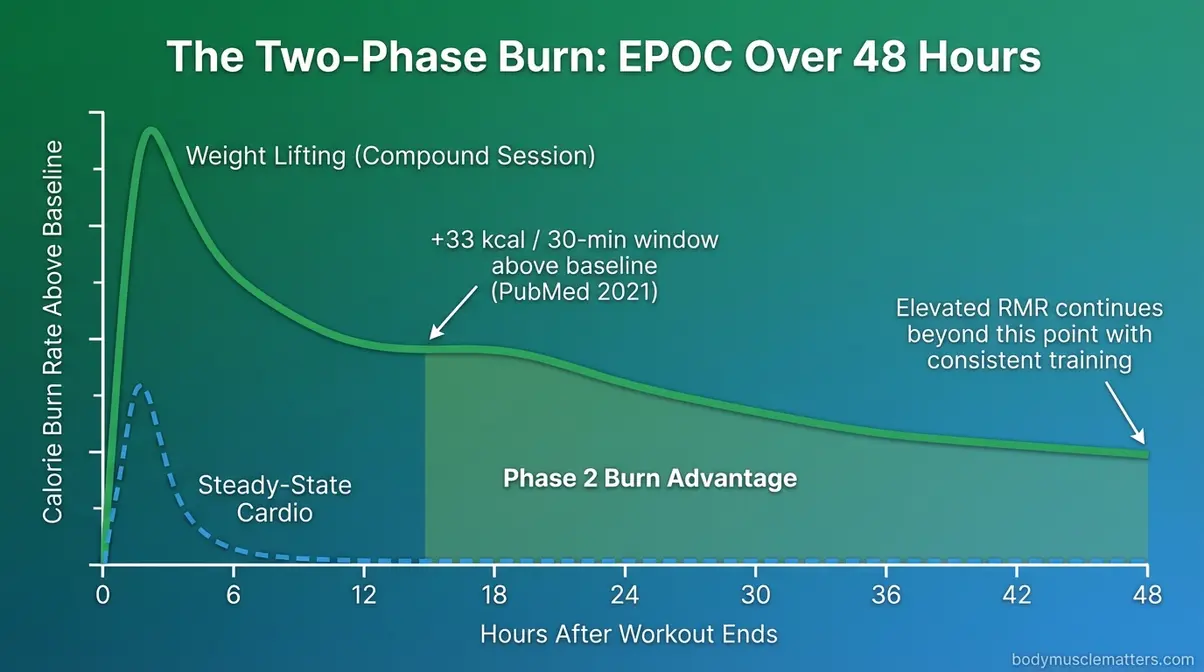
Caption: EPOC from a vigorous lifting session can remain measurably elevated for 24–48 hours — the Phase 2 burn that no smartwatch captures.
This means a 60-minute lifting session doesn’t end when you leave the gym. Your body continues burning at an elevated rate while you eat dinner, watch TV, and sleep — a Phase 2 benefit that cardio simply does not match at equivalent intensities.
EPOC explains the immediate afterburn. But weight lifting has a second, even more powerful long-term effect on your metabolism — one that compounds over months and years.
Muscle Mass and Your Daily Calorie Burn
Your Resting Metabolic Rate (RMR) — the number of calories your body burns just to keep your organs functioning — accounts for roughly 60–75% of your total daily calorie expenditure. It keeps running whether you’re training or not. Strength training directly increases this baseline number.
Research summarized by ACE Fitness indicates that each pound of fat-free mass (including muscle) burns approximately 8–15 calories per day at rest. Add 5 pounds of muscle through consistent lifting and you burn roughly 40–75 extra calories daily — every day, without stepping into a gym. A related study found strength training increased participants’ RMR by approximately 7–9% (FoundMyFitness, citing resistance training research). That’s a meaningful, compounding metabolic advantage that builds over months of consistent training.
This is the compound interest of The Two-Phase Burn. Phase 1 is what you burn today. Phase 2 — EPOC plus your elevated RMR from growing muscle — is what keeps paying out weeks and months from now, whether you’re lifting that day or not.
The practical implication: two people with identical body weight, age, and weekly session duration can have meaningfully different total weekly calorie burns if one has been lifting consistently for six months and carries more muscle. The session calories look the same; the Phase 2 dividends don’t.
Will Lifting Weights Help You Lose Belly Fat?
Weight lifting does contribute to fat loss, including belly fat — but not through the mechanism most people expect. The scientific evidence is clear: you cannot direct your body to burn fat from a specific area by exercising that area. Fat loss is systemic. However, what lifting can do — and does very effectively — is create the caloric deficit and hormonal environment that drives fat loss across your whole body, including the abdomen.
The Myth of Spot Reduction
Spot reduction — the belief that you can shrink a specific body part by exercising it — remains largely unsupported by evidence, despite its enduring popularity. Research from the University of Sydney published in 2023 confirms that targeting weight loss to a specific area through localized exercise does not reliably produce localized fat loss.
The physiology explains why: when your body needs energy, it draws from fat stores systemically based on genetics, hormones, and overall energy balance — not from the muscle closest to the fat deposit. A thousand crunches don’t selectively pull calories from your belly. They build the abdominal muscles underneath the fat, which may improve the appearance of the area but won’t remove the fat itself.
For visceral fat — the deep abdominal fat around organs that carries the highest health risk — research consistently shows that total-body resistance training combined with a caloric deficit is among the most effective interventions. Weight lifting raises your total calorie burn through both Phase 1 and Phase 2 mechanisms, which is what actually creates the conditions for belly fat reduction over time.
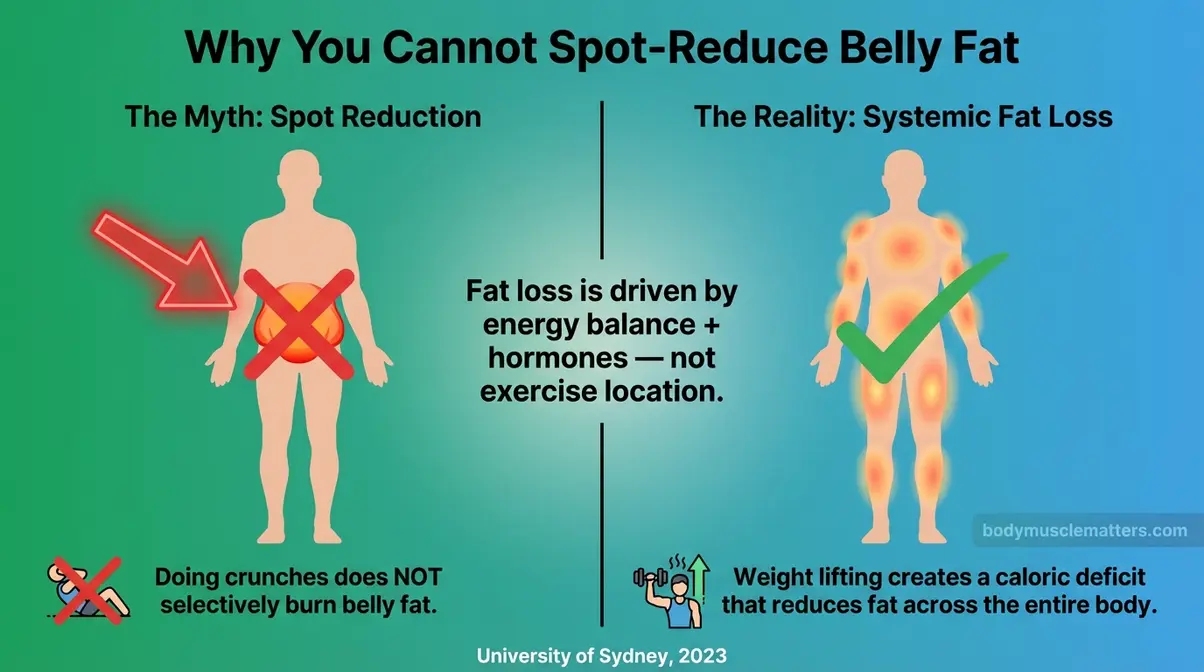
Caption: Fat loss follows a systemic pattern driven by hormones and energy balance — weight lifting accelerates that process across the whole body, including the abdomen.
Lifting vs. Cardio for Long-Term Fat Loss
This is one of the most common questions in fitness communities, and the answer depends on your time horizon. For immediate session calories, cardio wins. A 155-pound person burns approximately 423 calories in 60 minutes of cycling versus approximately 350 calories lifting at moderate intensity, according to data published by Harvard Health. Cardio looks better on the day’s log.
But over weeks and months, lifting builds the muscle mass that raises your RMR — creating a 24/7 metabolic advantage that cardio doesn’t deliver. A recent 2026 analysis of strength training data confirmed that the EPOC from strength training is substantial and clinically relevant for weight management over time. Cardio burns calories during the session and stops. Lifting burns during, after (EPOC), and continuously (RMR) — a compounding advantage that grows the longer you lift.
The most effective approach for long-term fat loss combines both: use compound lifting as your metabolic foundation and add cardio for session calorie volume. But if you can only choose one, the evidence tilts toward lifting for anyone playing a long game.
Why Your Fitness Tracker Gets It Wrong
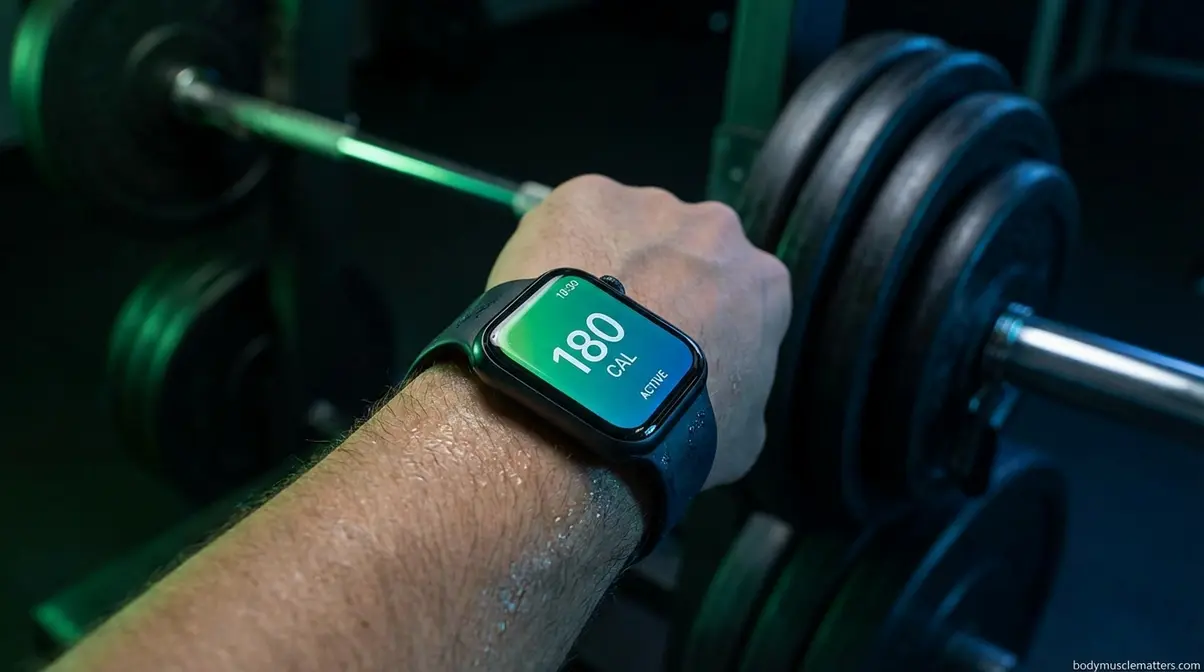
Your smartwatch is useful. For heart rate during steady-state cardio, it’s reasonably accurate — research shows most devices achieve heart rate errors under 5% in controlled conditions (from a landmark study published in 2017 by Stanford Medicine). For calorie burn during weight lifting, it’s a different story entirely. The algorithms inside commercial wearables were not built with resistance training in mind, and the error rates reflect that.
What Stanford Research Found
A landmark study from the Stanford University School of Medicine evaluated seven popular wrist-worn fitness trackers — including the Apple Watch, Fitbit Surge, and Samsung Gear S2 — across 60 participants of varying sizes and fitness levels. None of the devices met acceptable accuracy thresholds for calorie measurement. The best-performing device (Apple Watch) showed a 27% average error rate. The worst showed a 93% error rate (from findings published in 2017 by Stanford Medicine).
That means the 180-calorie reading from your watch after a hard session could reflect a true burn anywhere between roughly 130 and 350 calories — an enormous range that makes the data nearly useless for precise calorie management. The study’s lead researchers concluded that heart rate tracking “performed far better than we expected,” but that calorie estimation remained fundamentally unreliable across all devices tested.
The core problem: smartwatches estimate calorie burn using heart rate patterns and movement algorithms calibrated primarily to walking, running, and cycling. Weight lifting involves irregular motion, breath-holding during heavy sets (the Valsalva maneuver), and variable rest periods — none of which translate cleanly into the tracker’s calorie model. The result is systematic underreporting for every lifting session you log.
Gym Community Reports vs. Clinical Estimates
This isn’t just a laboratory finding. Across fitness forums and Reddit communities — including discussions in r/naturalbodybuilding and r/fitness — the consistent report is that tracker readings for weight training sessions feel meaningfully low compared to perceived effort and post-session hunger cues. Community members frequently note readings of 150–250 calories for sessions that clinical MET-based estimates place at 300–450 calories for the same body weight and duration.
The keyword search term “how many calories does weight lifting burn reddit” reflects a specific frustration: people don’t trust their devices and are looking for peer validation alongside science. Both the community experience and the clinical data point to the same conclusion — MET-based calculations like the table in this article are more reliable references than wearable outputs for strength training.
The practical fix: Use your tracker for heart rate trends and session consistency, not calorie totals for lifting workouts. Instead, use the MET-based table above to estimate session calories, then add 6–15% for your EPOC window. That’s a more honest, evidence-informed picture of what your body actually spent.
Limitations, Caveats, and When to Seek Help
Common Pitfalls
Trusting tracker data for calorie deficits. If you’re trying to lose weight and using your smartwatch’s lifting calorie readout to justify your food intake, you may be overestimating your burn by up to 50% or more for resistance training sessions. Use MET tables as your primary reference.
Assuming more time always means more calories. A focused 30-minute compound session can burn more calories than a distracted 60-minute machine circuit, because MET values depend on intensity — not duration. Quality of effort matters more than the clock.
Ignoring rest periods in the MET calculation. The MET values and calorie tables in this article assume active lifting time. If your 60-minute “session” includes 25 minutes of checking your phone between sets, your actual calorie burn will be closer to the 30-minute estimate.
Expecting spot reduction. If you’re lifting specifically to shrink your belly, understand that fat loss is systemic. You’ll lose fat across your whole body — including the abdomen — but you cannot control the sequence.
When to Choose Alternatives
If your primary goal is maximum immediate calorie burn per session: Cardio — particularly vigorous cycling or running — produces higher acute calorie expenditure than moderate weight lifting for most people. Consider a hybrid program that uses lifting for muscle and metabolic adaptation, plus cardio sessions for higher session-level burn.
If you’re dealing with joint pain during compound movements: Machine-based isolation work and low-impact alternatives (cable exercises, resistance bands) are more appropriate until you’ve addressed the underlying issue with a physical therapist or sports medicine physician.
When to Seek Expert Help
If you have cardiovascular disease, diabetes, osteoporosis, or recent joint surgery, consult a physician or certified exercise physiologist before adopting a weight lifting program. Exercise prescription for medical conditions requires individualized assessment beyond what any general guide can provide. A certified personal trainer (CPT) can design a program appropriate to your current strength and mobility baseline.
Frequently Asked Questions
How many calories do you burn lifting weights?
Weight lifting burns approximately 143–490 calories per 30–60 minute session, depending on body weight, session length, and intensity. A 155-pound person burns roughly 175 calories in 30 minutes at moderate intensity and approximately 350 calories in a full hour. Circuit-style sessions with compound lifts and short rest periods push the upper end of those ranges. These figures reflect only Phase 1 of your burn — the afterburn effect (EPOC) adds another 6–15% in the hours that follow, according to research published in 2025 by ACE Fitness.
Will I lose belly fat if I lift weights?
Yes — weight lifting supports belly fat loss, but not through spot reduction. You cannot direct your body to burn fat from a specific area. Fat loss is systemic: it happens across your whole body based on energy balance and hormones. What lifting does do is build muscle that raises your resting metabolic rate, increase session calorie burn, and trigger EPOC — all of which create the caloric deficit needed to reduce total body fat, including visceral abdominal fat. The most effective approach combines lifting with a moderate caloric deficit.
Is 3 days of heavy lifting enough?
For most beginners and intermediate lifters, 3 days of compound-focused lifting per week is highly effective. Three weekly sessions with compound movements — squats, deadlifts, bench press, rows — provide sufficient stimulus for muscle growth and metabolic adaptation. Research consistently shows that 2–4 resistance training sessions per week produce significant improvements in strength, body composition, and RMR. More is not always better; recovery between sessions is when muscle repair (and EPOC) occurs. If calorie burn is your goal, adding one or two light cardio sessions on rest days can supplement without compromising recovery.
How to tell if muscle is overtrained?
Signs of overtraining include persistent soreness lasting more than 72 hours, declining performance across multiple sessions, disrupted sleep, and elevated resting heart rate. Occasional muscle soreness 24–48 hours after a session is normal DOMS (delayed onset muscle soreness). But if you’re consistently performing worse on lifts you’ve done before, feeling exhausted rather than energized after workouts, or experiencing mood changes and increased injury frequency, you may be overtrained. The fix is typically a deload week — reducing training volume and intensity by 40–60% — before returning to normal programming. If symptoms persist beyond two weeks of reduced training, consult a sports medicine physician.
Will 2 weeks off ruin gains?
Two weeks off will not significantly damage your strength or muscle mass. Research on muscle memory shows that trained individuals retain strength adaptations — including neural efficiency and muscle fiber size — for significantly longer than two weeks. You may notice a temporary drop in endurance and some strength loss from reduced neural drive, but this returns quickly once training resumes. Most studies suggest meaningful muscle loss requires 3–4 weeks of complete inactivity, not two. Focus instead on maintaining protein intake during the break and returning gradually with slightly reduced loads.
Conclusion
Weight lifting burns 180–500 calories per session depending on your body weight and intensity — but the complete picture requires understanding both phases of your burn. Phase 1 (session calories) is what your tracker shows. Phase 2 (EPOC plus elevated RMR from increased muscle mass) is what your tracker misses entirely, representing an additional 6–15% of session calorie expenditure in the hours after training, and a compounding daily metabolic advantage that accumulates with every month you lift consistently (according to research published in 2025 by ACE Fitness). Together, these phases explain why weight training consistently outperforms cardio for sustainable, long-term fat loss.
The Two-Phase Burn framework gives you a more complete lens for evaluating your workouts. When your watch shows a discouraging 200 calories after an hour of hard lifting, remember that number reflects only half of what your body actually spent — and ignores the days-long metabolic elevation that follows a quality compound session. Use the MET-based table in this guide as your real reference point.
Your next step: pick three compound lifts — squat, deadlift, and bench press or row — and commit to three sessions per week for the next four weeks. Track your session intensity by rest period length (target 45–60 seconds between sets), not by what your smartwatch reports. At the end of four weeks, you’ll have built the metabolic foundation that makes The Two-Phase Burn work for you — and you’ll have a much clearer, more accurate picture of how hard you’re actually working.