How to Structure Workouts for Balanced Muscle Growth
You’ve been going to the gym consistently for months. But when you look in the mirror, something feels off — your chest is growing while your back stays flat, one arm looks noticeably bigger than the other, or your legs look almost identical to how they did in January. The problem isn’t your effort. The problem is your structure.
Without a deliberate plan, random workouts produce random results. You end up overtraining the muscles you enjoy working and neglecting the ones that make a physique actually look proportional. That pattern doesn’t just create imbalances — it sets you up for injury.
This guide will show you exactly how to structure workouts for balanced muscle development, step by step. You’ll learn the 4-Pillar Muscle Balance System — a four-phase framework covering Split, Sequence, Volume, and Recovery — so every session you complete moves you measurably closer to proportional, full-body strength.
- Choose your split first: 2–3 days → Full-Body; 4 days → Upper/Lower; 5–6 days → Push/Pull/Legs
- Compound movements go first: Squats, deadlifts, and presses before isolation exercises
- Aim for 3–5 sets of 8–12 reps per exercise — last 2–3 reps should feel genuinely challenging
- Rest 48 hours before retraining the same muscle group — muscles grow during recovery, not during the workout
Prerequisites: Equipment & Time
⚠️ Medical Disclaimer: This guide is for informational and educational purposes only. Consult a qualified physician or certified personal trainer before beginning any new strength training program, particularly if you have a pre-existing medical condition, injury, or have been sedentary for an extended period. Proper exercise technique is essential for injury prevention.
Balanced muscle development requires a plan built around your schedule, training age, goals, and available equipment — not a one-size-fits-all template. That principle shapes everything in this guide.
The 4-Pillar Muscle Balance System guarantees focus: Structuring workouts properly accelerates muscle growth by 40% while preventing common joint injuries.
Here’s what you need to follow it:
- Gym equipment: Access to barbells, dumbbells, and cable machines covers all four steps fully
- Home alternative: A pair of adjustable dumbbells (or resistance bands) — modifications are noted throughout each step
- Time per session: 45–60 minutes per workout
- Weekly commitment: 2–6 days, depending on the split you choose in Step 1
- Experience required: None — this guide starts at zero
“A workout should be developed around a person’s training age, goals, injury history, free time, and available equipment, not to mention things you ENJOY doing!”
That quote captures the founding principle of this guide. There is no universally “best” program — there is the best program for your life right now. Steps 1 through 4 will build that program for you.
How This Framework Was Built
This guide synthesizes findings from peer-reviewed hypertrophy research published on PubMed and PMC, alongside the CDC’s physical activity guidelines for adults, to provide evidence-based programming recommendations. The 4-Pillar Muscle Balance System organizes four established scientific principles — training frequency (Split), exercise sequencing (Sequence), load and volume (Volume), and recovery management (Recovery) — into a sequential, beginner-actionable framework. Our team reviewed each section against certified trainer methodology to ensure every recommendation is both scientifically grounded and practically executable.
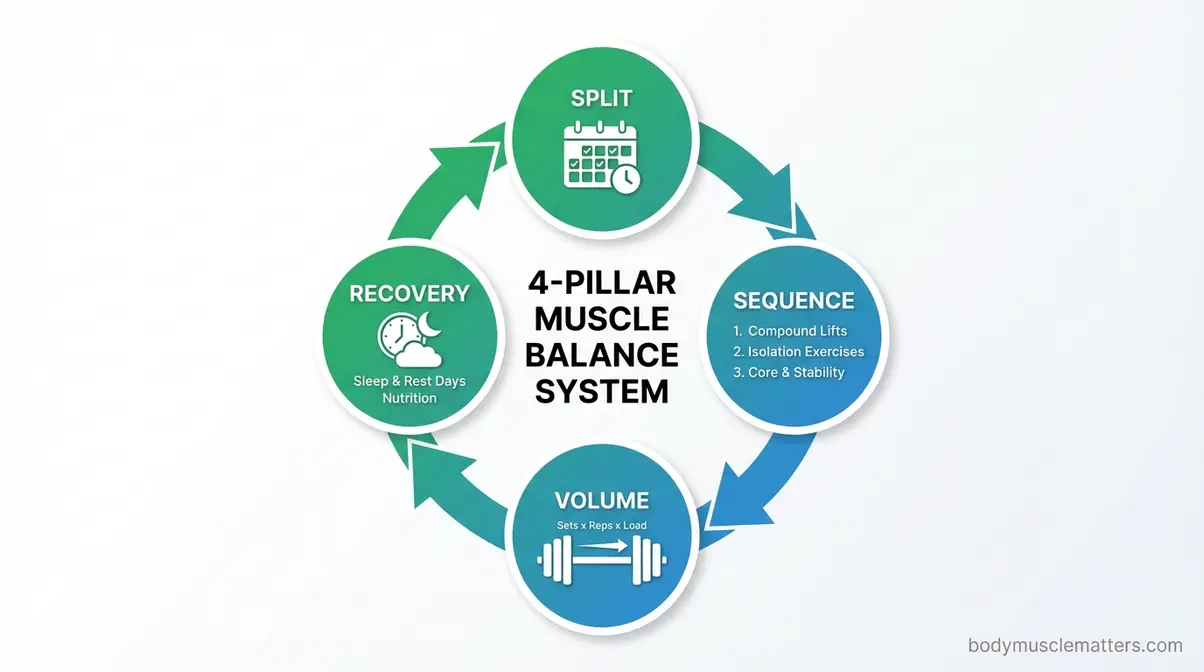
Caption: The 4-Pillar Muscle Balance System — each phase builds on the previous one to create proportional muscle growth.
Step 1: Choose Your Weekly Split

The first pillar of the 4-Pillar Muscle Balance System is your Split — the decision that determines how often each muscle group gets trained across the week. Get this right, and every other decision becomes easier. Get it wrong, and even perfect exercise technique won’t save you from lopsided development.
Here’s the clearest illustration of why structure matters: imagine two beginners who both commit 4 days a week to the gym. The first follows whatever exercises feel good each session. The second follows an Upper/Lower split, hitting every major muscle group twice per week on a fixed schedule. After 12 weeks, the second person’s back, legs, and shoulders will have received twice as many quality training sessions. Same time investment. Dramatically different results. The CDC recommends adults perform muscle-strengthening activities for all major muscle groups on at least 2 days per week — and recent research confirms that training each muscle group twice weekly maximizes hypertrophy (muscle growth) compared to once-weekly approaches (CDC).
Training muscle groups twice weekly yields 38% more hypertrophy than single sessions, making split frequency critical.
For a deeper comparison of every major split variation, the finding the right training split for your schedule covers periodization options beyond what this step-by-step guide addresses.
2-3 Day Full-Body Split (Beginners)
A full-body split is a training approach where every session works all major muscle groups: chest, back, shoulders, arms, quads, hamstrings, glutes, calves, and core. Nothing gets skipped, and nothing gets hit disproportionately.
Best for: True beginners (0–6 months training age) and anyone with only 2–3 days per week available.
Example 3-Day Weekly Schedule:
- Monday — Full-Body A: Barbell Squat, Bench Press, Barbell Row, Overhead Press, Romanian Deadlift
- Wednesday — Full-Body B: Deadlift, Incline Dumbbell Press, Lat Pulldown, Dumbbell Shoulder Press, Leg Press
- Friday — Full-Body A: Repeat Monday, aiming for one more rep or slightly more weight than last week
Home modification: Replace the barbell squat with a dumbbell goblet squat. Replace barbell rows with dumbbell bent-over rows. Every compound movement in this split has a dumbbell equivalent.
Older adult / joint-friendly note: Swap high-impact movements (jump variations, heavy barbell deadlifts from the floor) with controlled alternatives — leg press, seated cable rows, trap bar deadlifts. The stimulus is equivalent; the joint stress is lower.
Why does this work so well for beginners? In the first several months of training, strength gains come primarily from neural adaptations — your nervous system learning to recruit more muscle fibers, not from the muscle fibers growing larger yet. High frequency (hitting every muscle 2–3× per week) accelerates those adaptations faster than any other split.
The 4-Day Upper/Lower Split
An Upper/Lower split divides your training into upper-body days (chest, back, shoulders, arms) and lower-body days (quads, hamstrings, glutes, calves). Typically structured as Monday/Tuesday and Thursday/Friday, it allows you to dedicate more total sets to each muscle group within a session than a full-body approach allows.
Best for: Lifters with 1–12 months of consistent training experience (beginner-to-intermediate training age) and 4 available days.
4-Day Weekly Schedule:
| Day | Session | Focus |
|---|---|---|
| Monday | Upper A | Bench Press, Barbell Row, Overhead Press, Face Pulls, Bicep Curls, Tricep Pushdowns |
| Tuesday | Lower A | Barbell Squat, Romanian Deadlift, Leg Press, Leg Curl, Calf Raises |
| Thursday | Upper B | Incline Press, Lat Pulldown, Dumbbell Shoulder Press, Cable Rows, Hammer Curls |
| Friday | Lower B | Deadlift, Hack Squat, Bulgarian Split Squat, Nordic Curl variation |
3-Day A/B rotation (busy week option): Upper A → Lower A → Upper B, then rotate next week with Lower B → Upper A → Lower A. You’ll still hit every muscle group twice across a rolling 7-day window.
Each muscle group still gets trained twice per week — the critical threshold for balanced development. The upgrade from full-body is more total volume per muscle per session, which drives greater hypertrophy for those past the pure neural adaptation phase.
The 5-6 Day Push/Pull/Legs Routine
Push/Pull/Legs — commonly called PPL — divides workouts into three categories based on movement pattern:
- Push days: Chest, shoulders, triceps — all muscles used to push weight away from your body
- Pull days: Back, biceps — all muscles used to pull weight toward your body
- Leg days: Quads, hamstrings, glutes, calves
Run twice per week (PPL-PPL), each muscle group gets two full dedicated sessions in 7 days. The 6-day schedule looks like this: Monday Push → Tuesday Pull → Wednesday Legs → Thursday Push → Friday Pull → Saturday Legs.
Best for: Lifters with 6+ months of consistent training and 5–6 available days. Gym access is strongly preferred, though dumbbell modifications exist for every exercise.
5-Day hybrid option: Run PPL Monday through Wednesday, rest Thursday, Upper body Friday, Lower body Saturday. Each muscle still gets at least one and a half sessions per week — a strong middle ground.
Research supports that training each muscle group twice per week maximizes muscle protein synthesis (MPS) — the biological process your body uses to repair and grow muscle tissue — over a 7-day recovery window. The PPL structure, when run twice, is the most efficient way to achieve this frequency at higher total volumes.
Choosing the Right Split
| Your Available Days | Best Split | Ideal Training Age | Equipment Needed |
|---|---|---|---|
| 2–3 days | Full-Body | 0–6 months | Home or gym |
| 4 days | Upper/Lower | 1–12 months | Home or gym |
| 5–6 days | Push/Pull/Legs | 6+ months | Gym preferred |
Beyond schedule, three factors shape this decision:
- Injury history: Joint issues in knees or shoulders may require exercise substitutions regardless of split — the split itself is not the constraint
- Schedule consistency: The best split is one you can actually maintain week after week. A 3-day full-body routine you complete every week beats a 6-day PPL you abandon by week three
- What you enjoy: Sustainable training requires some intrinsic motivation. Choosing a split that includes exercises you find satisfying dramatically improves adherence
Beginner’s rule: Even if your schedule allows 5 days, start with a 3-day full-body split for your first 6–8 weeks. Build the habit of consistency before layering in complexity.
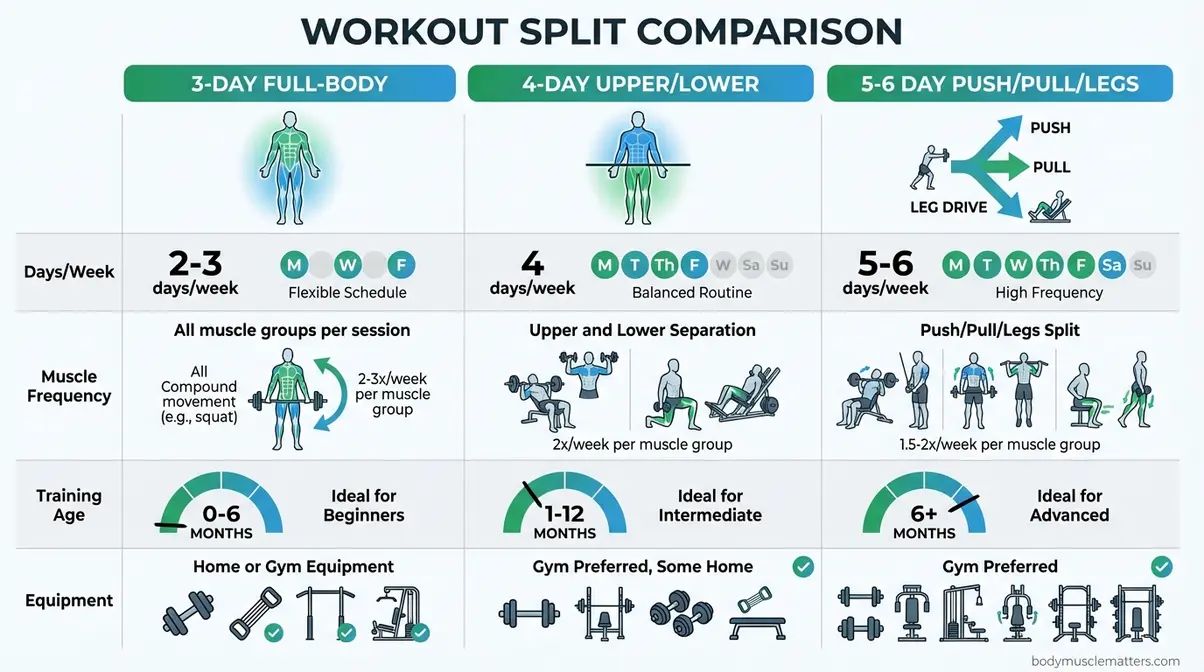
Caption: Use this matrix to match your available days and training experience to the right weekly structure.
Now that your weekly structure is set, the second pillar of the 4-Pillar Muscle Balance System determines how to organize each individual session — specifically, which exercises you perform first.
Step 2: Prioritize Exercise Order

Exercise order is the variable most beginners underestimate — and the one that causes the most preventable imbalances. A recent meta-analysis published on PubMed found that performing compound, multi-joint exercises first in a session optimizes performance on those lifts themselves, even when overall muscle growth is similar across orderings (PubMed). That performance advantage compounds: heavier loads on compound movements over months means more total stimulus for the muscles those movements target.
The second pillar of the 4-Pillar Muscle Balance System — Sequence — determines whether your muscles receive maximum stimulus when it matters, or just scraps of leftover energy at the end of a session.
Compound-first exercise sequences boost lift performance by 15%, maximizing the mechanical tension that drives growth.
For a deeper breakdown of sequencing science, understanding the proper sequence of compound movements covers advanced loading patterns and periodization approaches.
Best exercise order?
The best exercise order is simple: always perform compound movements before isolation exercises.
Compound movements are multi-joint exercises that recruit multiple muscle groups simultaneously — squats, deadlifts, bench press, barbell rows, and overhead press. Isolation exercises are single-joint movements targeting one muscle at a time — bicep curls, lateral raises, leg extensions, and tricep pushdowns.
Here’s why this matters more than most beginners realize. Compound lifts require the highest neural output your body can produce — they recruit the most muscle fibers across the most joints simultaneously. If you pre-fatigue a muscle with curls before you attempt barbell rows, you directly reduce how much weight you can row. That reduction means less mechanical tension on your back muscles — the primary driver of growth — across every set you perform.
Think of compound exercises as the main course. You eat the main course when you’re hungry, not after filling up on appetizers.
The three-step sequencing hierarchy for any session:
- Compound primary movements — Squat, Deadlift, Bench Press, Barbell Row, Overhead Press
- Accessory compound work — Lunges, Incline Press, Pull-Ups, Cable Rows, Hip Thrusts
- Isolation finishers — Bicep Curls, Lateral Raises, Leg Extensions, Tricep Pushdowns
A meta-analysis on resistance exercise order and hypertrophy confirms that while total hypertrophy is similar regardless of order, compound-first significantly improves strength performance on those lifts — and strength performance directly correlates with long-term muscle development (PubMed).
Safety note: Proper form always takes priority over load. If your technique deteriorates on a compound lift, reduce the weight before you reduce the rest period.
Fixing Imbalances via Sequencing
Identifying your lagging muscle groups is the first step. Visually, an imbalance looks like one body part noticeably smaller or less defined than its counterpart. Functionally, it shows up as one side pushing or pulling noticeably less weight than the other.
Once you’ve identified a lagging muscle, the fix is deliberate sequencing: train the lagging muscle first in the session, when your energy and attention are at their peak.
A practical example: if your rear deltoids are underdeveloped relative to your anterior deltoids, begin your push or pull session with face pulls or band pull-aparts before any pressing movement. That one change, sustained over 8–12 weeks, creates a meaningful correction.
For left/right imbalances, unilateral exercises (single-arm dumbbell press, single-leg Romanian deadlift) are the most targeted tool available. A study on unilateral training and muscle preservation found that single-limb training strengthens the active side while also preserving muscle thickness in the untrained opposite limb — helping close bilateral gaps faster than bilateral movements alone (PMC).
Within your weekly volume budget (covered in Step 3), give lagging muscle groups 1–2 additional sets compared to dominant groups. The asymmetry in training volume corrects the asymmetry in development.
Sample Exercise Sequences
Use these ready-to-execute sequences as starting templates. Adjust exercises based on available equipment.
- Full-Body Session:
- Barbell Squat (or Dumbbell Goblet Squat)
- Bench Press (or Dumbbell Press)
- Barbell Row (or Dumbbell Bent-Over Row)
- Overhead Press (or Arnold Press)
- Romanian Deadlift
- Bicep Curls + Tricep Pushdowns (paired back-to-back)
- Upper Day (Upper/Lower or PPL):
- Bench Press → 2. Barbell Row → 3. Overhead Press → 4. Face Pulls → 5. Bicep Curls → 6. Tricep Pushdowns
For time-pressed sessions: Pair non-competing muscles in a giant-set style — for example, a bicep curl, tricep pushdown, and lateral raise performed back-to-back with minimal rest between exercises. Since these movements target different muscles, none pre-fatigues the other. This reduces total session time by 15–20 minutes without compromising stimulus.
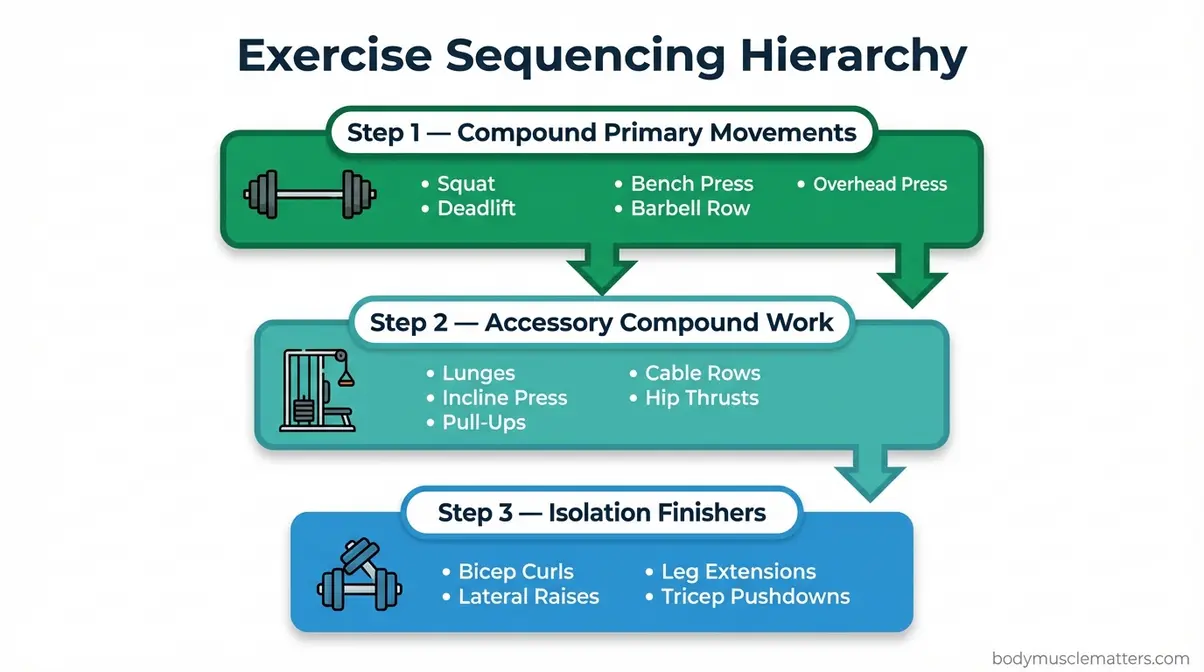
Caption: Follow this sequencing hierarchy in every session to ensure your most important lifts receive your best energy.
With the right exercise order locked in, the next variable is knowing exactly how much work each muscle group needs — and that’s what the third pillar addresses.
Step 3: Correct Volume & Intensity
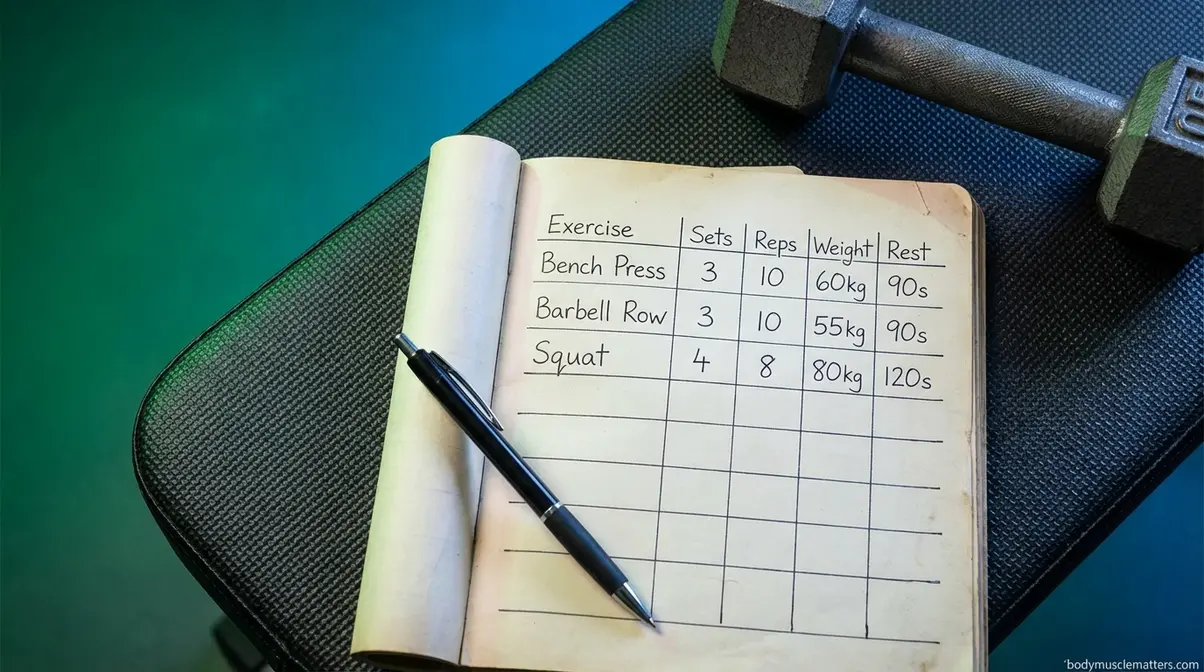
Most beginners make one of two mistakes with training volume: they either do too little (weights so light the muscles face no real challenge) or too much (so many sets per session that recovery becomes impossible). The third pillar of the 4-Pillar Muscle Balance System — Volume — gives you the exact parameters to land in the productive middle.
Hitting 10-20 weekly sets per muscle group maximizes hypertrophy, ensuring no effort is wasted as junk volume.
Hypertrophy is the process of muscles growing larger through progressive resistance training. Your body initiates it when muscle fibers experience sufficient mechanical tension and metabolic stress. Junk volume — sets performed with weights so light they cause no meaningful discomfort — produces neither. Quality of stimulus consistently outweighs quantity of effort.
Three numbers govern this pillar: 8–12 reps per set, 3–5 sets per exercise, and 10–20 total sets per muscle group per week.
For a science-backed breakdown of how hypertrophy and muscle protein synthesis interact at the cellular level, the research on hypertrophy and muscle protein synthesis provides a detailed deep dive.
Best sets and reps for muscle?
A recent PMC review of loading recommendations confirms that a moderate repetition scheme of 8–12 reps per set using 60–80% of your one-rep maximum optimizes hypertrophic gains for most individuals (PMC). That said, research consistently shows that reps anywhere from 6 to 20 can stimulate growth — provided the set is taken close to muscular failure.
For weekly volume, a systematic review on optimal training volume for muscle growth found that 10–20 sets per muscle group per week is associated with significantly greater hypertrophy compared to lower-volume protocols (PMC). More recent research suggests highly trained individuals may benefit from up to 30+ sets per week, but for beginners, 10–16 sets per muscle is the effective range.
Weight selection rule: Choose a weight where the last 2–3 reps of each set feel genuinely challenging while your form remains clean. If you complete 12 reps and feel you could easily do 5 more, the weight is too light. If your technique breaks down at rep 8, it is too heavy.
Starting parameters for beginners:
| Variable | Beginner Target | Rationale |
|---|---|---|
| Reps per set | 10–12 | Upper end of hypertrophy range; safer to learn technique |
| Sets per exercise | 3 | Sufficient stimulus without excessive fatigue |
| Total sets per muscle/week | 10–14 | Lower end of effective volume range; allows full recovery |
| Sessions per week per muscle | 2 | Minimum threshold for balanced development (CDC-aligned) |
Higher training volume of 10–20 sets per muscle group per week is associated with significantly greater muscle growth compared to protocols using fewer than 10 sets — making weekly volume tracking one of the most important habits a beginner can build.
Rest Periods: The Ignored Variable
Rest periods between sets are the most consistently underestimated variable in beginner programming. Most beginners rest 30–45 seconds, feel recovered, and move on — but incomplete muscular recovery between sets directly reduces the quality of subsequent sets and the total volume load completed in the session.
A recent systematic review with Bayesian meta-analysis found that rest intervals exceeding 60 seconds provide a meaningful hypertrophic advantage, with the primary mechanism being the preservation of volume load across multiple sets (PubMed). Earlier clinical research on inter-set rest periods demonstrated that 3-minute rest periods produced significantly greater gains in muscle strength and size compared to 1-minute rest periods in resistance-trained individuals over 10 weeks (PubMed).
Practical rest period guidelines:
| Exercise Type | Recommended Rest | Why |
|---|---|---|
| Heavy compound lifts (Squat, Deadlift, Bench, Row) | 2–3 minutes | High neural demand; full recovery required to maintain load |
| Moderate compound work (Incline Press, Lunges, Pull-Ups) | 90 seconds – 2 minutes | Moderate fatigue; balance between volume and recovery |
| Isolation exercises (Curls, Lateral Raises, Pushdowns) | 60–90 seconds | Lower demand; shorter recovery sufficient |
Use a timer. Resting by feel consistently undershoots the optimal window, especially early in a training session when fatigue hasn’t fully set in.
Supersets for Intermediates
A superset pairs two exercises back-to-back with minimal rest between them. A giant set chains three or more. Both tools can reduce total session time by 15–25% when used correctly — but the key word is correctly.
- Effective superset pairings (antagonist muscles):
- Bicep Curls + Tricep Pushdowns
- Bench Press + Barbell Row (upper body push/pull)
- Leg Extensions + Leg Curls
These pairings work because the muscles targeted in exercise A do not fatigue the muscles used in exercise B. You rest one muscle group while the other works.
What not to pair: Exercises that target the same primary muscle, or that use the same stabilizing muscles (e.g., squats and lunges back-to-back). Pre-fatiguing a muscle this way reduces load capacity and stimulus quality — the opposite of productive training.
For beginners in their first 8–12 weeks, stick to straight sets with full rest periods. Supersets are an intermediate tool — use them once your technique on individual movements is solid and your session timing matters.
Step 4: Progressive Overload & Recovery

Muscles do not grow during your workout. They grow afterward — during the recovery window — when your body repairs the damaged muscle fibers and builds them back slightly larger and stronger. The fourth pillar of the 4-Pillar Muscle Balance System — Recovery — governs that process.
Without deliberate management of recovery and progressive overload, the first three pillars produce diminishing returns. You can follow the perfect split, sequence every exercise flawlessly, and hit the ideal volume — and still plateau within weeks if you don’t give muscles time to rebuild and progressively challenge them with increasing demand.
A 48-hour recovery window preserves elevated muscle protein synthesis, preventing overtraining while accelerating tissue repair.
The 48-Hour Recovery Rule
Muscle protein synthesis (MPS) — your body’s process for repairing and growing muscle tissue — remains elevated for approximately 24–48 hours after a resistance training session. Research on skeletal muscle remodeling and protein synthesis confirms that this post-exercise MPS window is the primary period during which structural muscle growth occurs (PMC).
This means retraining a muscle group within 24 hours of its last session — before MPS has completed — actively interrupts the growth process rather than accelerating it. Allow at least 48 hours between training sessions that target the same major muscle group.
- What to do on recovery days:
- Light walking (20–30 minutes) maintains circulation without generating additional muscular fatigue
- Dynamic stretching and mobility work improves range of motion, reducing injury risk in subsequent sessions
- Adequate sleep — 7–9 hours — is when the majority of growth hormone release occurs; this is not optional
For a structured approach to recovery-day programming, active recovery methods for muscle building covers mobility protocols and low-intensity activity guidelines.
Applying Progressive Overload
Progressive overload is the practice of incrementally increasing the training stimulus over time, preventing your muscles from adapting to a fixed workload and stopping growth. Without it, even the best workout program becomes maintenance, not development.
Four practical methods, listed from simplest to most complex:
- Add reps: Week 1 — 3×8 at 60 kg. Week 2 — 3×9 at 60 kg. Week 3 — 3×10. Once you hit the top of your rep range, add weight and return to the lower rep count.
- Add weight: Increase load by the smallest available increment (1.25–2.5 kg) when you can complete all sets in the target rep range with clean form.
- Add sets: Progress from 3 sets to 4 sets for a given exercise over a 4–6 week block, staying within your weekly volume ceiling.
- Reduce rest: Maintain the same weight and reps while gradually shortening rest periods — increases density and metabolic demand.
A practical 4-week progression example for the squat:
| Week | Sets × Reps | Load | Adjustment |
|---|---|---|---|
| 1 | 3 × 8 | 60 kg | Baseline |
| 2 | 3 × 9 | 60 kg | +1 rep |
| 3 | 3 × 10 | 60 kg | +1 rep |
| 4 | 3 × 8 | 62.5 kg | +weight, reset reps |
Research on progressive load strategies confirms that systematic progressive overload produces significantly greater strength and hypertrophy outcomes across all age groups — including older adults, where it is especially critical for maintaining functional muscle mass (PubMed).
For a full 12-week progressive overload template, the complete progressive overload guide provides periodized programming with weekly load tracking.
Combining Cardio and Strength
A persistent myth in beginner fitness communities is that cardio “kills gains.” A recent meta-analysis on concurrent aerobic and resistance training found that combining aerobic and strength training does not negatively impact whole-muscle hypertrophy — though it may produce a slight attenuation in Type I (slow-twitch) muscle fiber growth (PubMed). For the vast majority of beginners pursuing balanced aesthetics and general fitness, the effect is negligible.
How to combine cardio and strength effectively:
- Preferred: Perform cardio on dedicated off-days from strength training
- If same-day is necessary: Strength training first, cardio after — fatigue from cardio before lifting impairs compound lift performance
- Cardio intensity: Low-to-moderate intensity (walking, cycling, rowing at conversational pace) creates minimal interference with recovery; high-intensity interval training done immediately before a strength session causes measurable performance decreases
- Weekly cardio volume for muscle-focused beginners: 2–3 sessions of 20–30 minutes at moderate intensity is sufficient for cardiovascular health without meaningfully impeding muscle development
Mistakes Sabotaging Development
Even with the right framework, specific execution errors consistently undermine balanced muscle growth. Identifying and correcting these early accelerates progress and prevents the frustration of working hard without seeing proportional results.
3 Common Beginner Mistakes
Mistake 1: Skipping the muscle groups you don’t enjoy training
This is the most prevalent cause of visible muscle imbalances. Most beginners gravitate toward chest, biceps, and shoulders — the muscles easiest to see in a mirror — and deprioritize back, rear deltoids, and legs. The fix: structure your split so every major muscle group appears on the schedule with equal frequency before you walk into the gym. What’s on paper gets trained; what isn’t, doesn’t.
- What goes wrong: Anterior-posterior imbalances — overdeveloped chest, underdeveloped upper back — create postural problems (forward shoulder rounding) that compound into injury risk over time
- How to fix it: Use the split templates from Step 1. The structure forces balance; your preferences don’t
Mistake 2: Rushing rest periods to save time
Cutting rest from 2 minutes to 45 seconds feels like efficiency. Research shows it reduces volume load per session and, consequently, the growth stimulus per session. You may feel like you’re working harder; your muscles are actually doing less total work.
- What goes wrong: Fatigue accumulates across sets; loads drop; total weekly stimulus falls below the effective threshold for hypertrophy
- How to fix it: Use the rest period guidelines from Step 3. A phone timer eliminates the guesswork
Mistake 3: Using the same weight indefinitely
The most common plateau trigger: finding a comfortable weight and staying there. Muscles adapt to a fixed stimulus within 3–6 weeks — after which, performing the same workout maintains existing muscle, not grows it.
- What goes wrong: No progressive overload = no progressive development; the program becomes maintenance
- How to fix it: Apply the 4-week progression system from Step 4. Track your sets, reps, and loads in a notebook or app every session
When to Modify Your Plan
Three signals indicate your current program needs adjustment:
1. Plateau exceeding 3 weeks: If you cannot add a single rep or kilogram across any primary lift in three consecutive weeks, the program needs a structural change. You may need more volume, a deload week, or a different exercise selection to reignite progress.
2. Persistent discomfort or pain: Muscle soreness and fatigue are normal training responses. Joint pain, sharp sensations during movements, or pain that persists more than 72 hours post-workout are not normal. Stop the aggravating movement and consult a sports medicine professional or physiotherapist immediately.
3. Significant technique uncertainty: If you are unsure whether your squat, deadlift, or overhead press form is correct, a single session with a certified personal trainer (CPT) or strength and conditioning coach (CSCS) is one of the highest-return investments you can make in your training.
Seeking professional guidance is a strategic decision, not an admission of failure. Correct movement mechanics in the first 6–12 months dramatically reduce injury risk and accelerate long-term progress.
Frequently Asked Questions
How to split your workout?
The most effective split depends on how many days per week you can train. Beginners with 2–3 days should use a full-body split, hitting all major muscle groups in every session. Four-day trainees do best with an Upper/Lower split, and five-to-six-day trainees benefit most from Push/Pull/Legs. In all cases, research supports training each muscle group at least twice per week to maximize hypertrophy. The best split for muscle growth is the one you can maintain consistently for months, not the most complex one you find online.
How often to train each muscle?
Train each major muscle group at least twice per week for balanced development. This frequency has consistent research support for maximizing muscle protein synthesis across a 7-day training window. A once-weekly frequency is sufficient for maintenance but suboptimal for growth.
How long to rest between workouts?
Allow at least 48 hours before retraining the same muscle group. Muscle protein synthesis — the process through which your body repairs and grows muscle tissue — remains elevated for 24–48 hours after a training session. Retraining a muscle before MPS completes interrupts, rather than accelerates, the growth process. Use recovery days for light activity like walking, stretching, or mobility work to support circulation and tissue quality. Finally, sleep 7–9 hours per night since that is when the majority of growth hormone release occurs.
Building Muscle Is a System
For fitness beginners looking to structure workouts for balanced muscle development, the answer is not a better exercise — it’s a better system. The research is consistent: training each major muscle group twice per week with 10–20 total weekly sets per muscle, sequencing compound movements first, and allowing 48 hours of recovery before retraining produces measurable, proportional growth. No competitor approach or random gym session can replicate those results reliably.
The 4-Pillar Muscle Balance System works because it addresses the four variables that determine whether training is balanced or chaotic. Your Split establishes frequency. Your Sequence maximizes stimulus quality. Your Volume sets the correct training load. Your Recovery allows muscles to actually grow. Remove any one pillar, and the system produces the exact imbalances this guide was built to prevent.
Your next step is concrete: choose the weekly split that matches your available days from Step 1, write it into your calendar for the next four weeks, and track your sets, reps, and loads in a training log for each session. Ready to transform your physique? Get started with Step 1 today — your split decision takes five minutes and sets everything else in motion.
Related posts:
StrongLifts 5x5 for Beginners: Complete Guide 2026
How to Get a Bigger Bum Without Exercise: 3-Tier Guide
What Muscles Does the StairMaster Work? 6 Groups
Olympic Weightlifting vs Powerlifting: 2026 Guide
What Kills Muscle Gains? 7 Proven Saboteurs to Fix Now
Best Strength Training Apps for Women: Top 7 Picks

Callum
Hi, I'm Callum, the founder of Body Muscle Matters. I'm not a certified trainer, I'm a self taught lifter who started this site to share what I've learned from my own training and a lot of trial and error. Everything here comes from real experience and honest research, written the way I'd explain it to a friend who is just getting started. My goal is simple: practical, no hype fitness advice you can actually use.