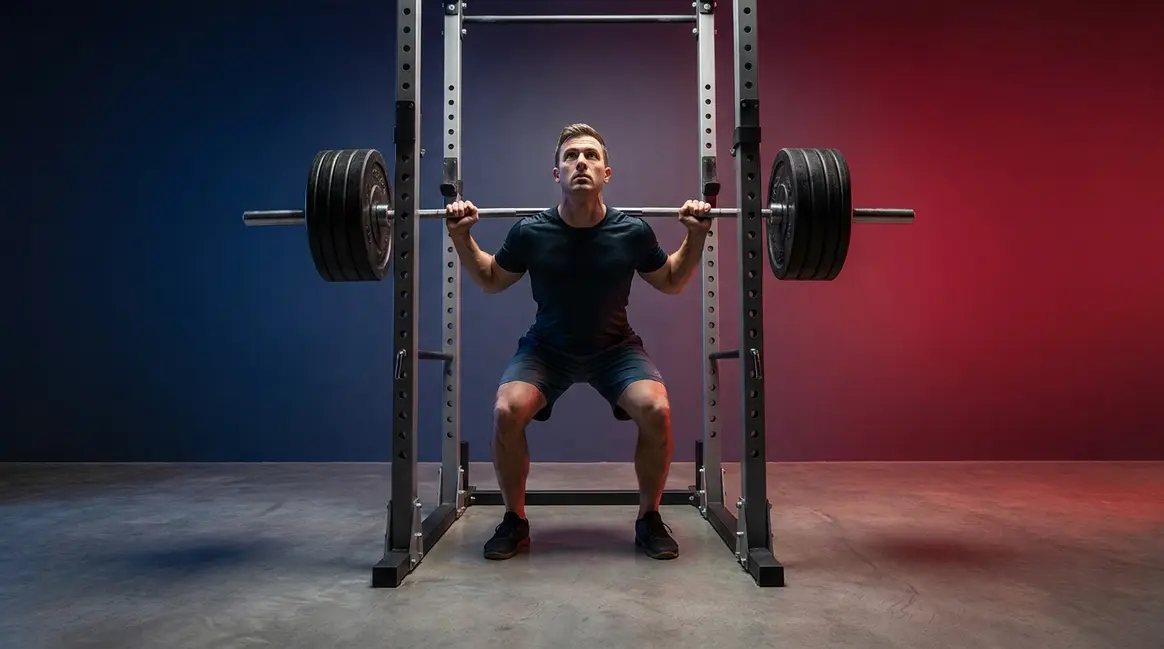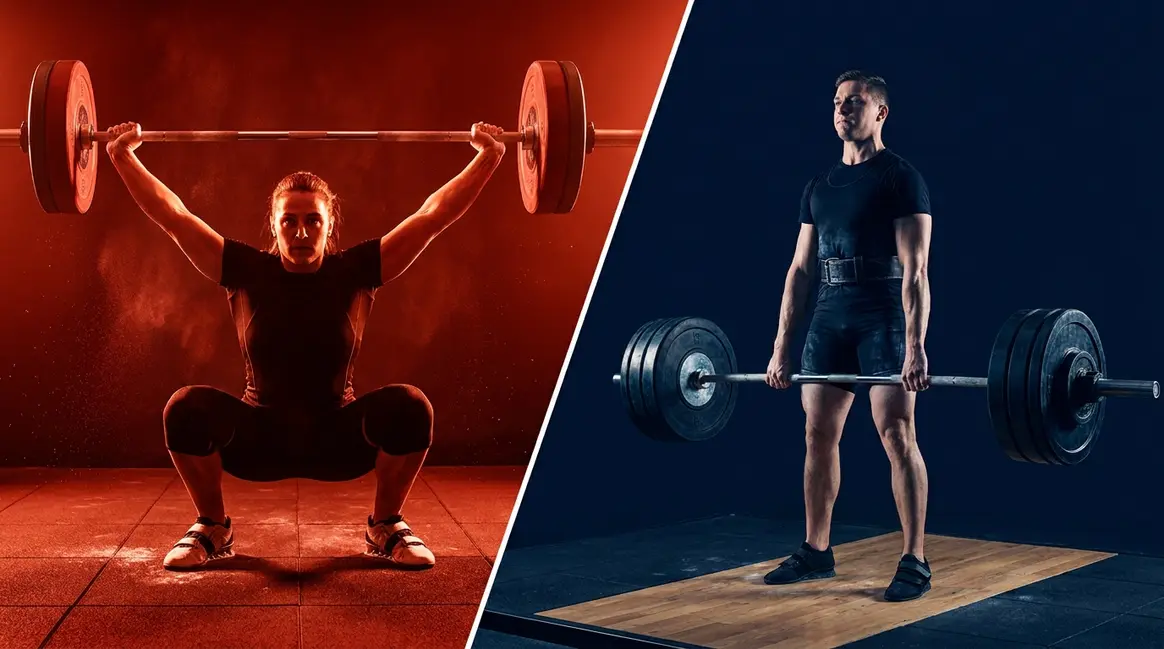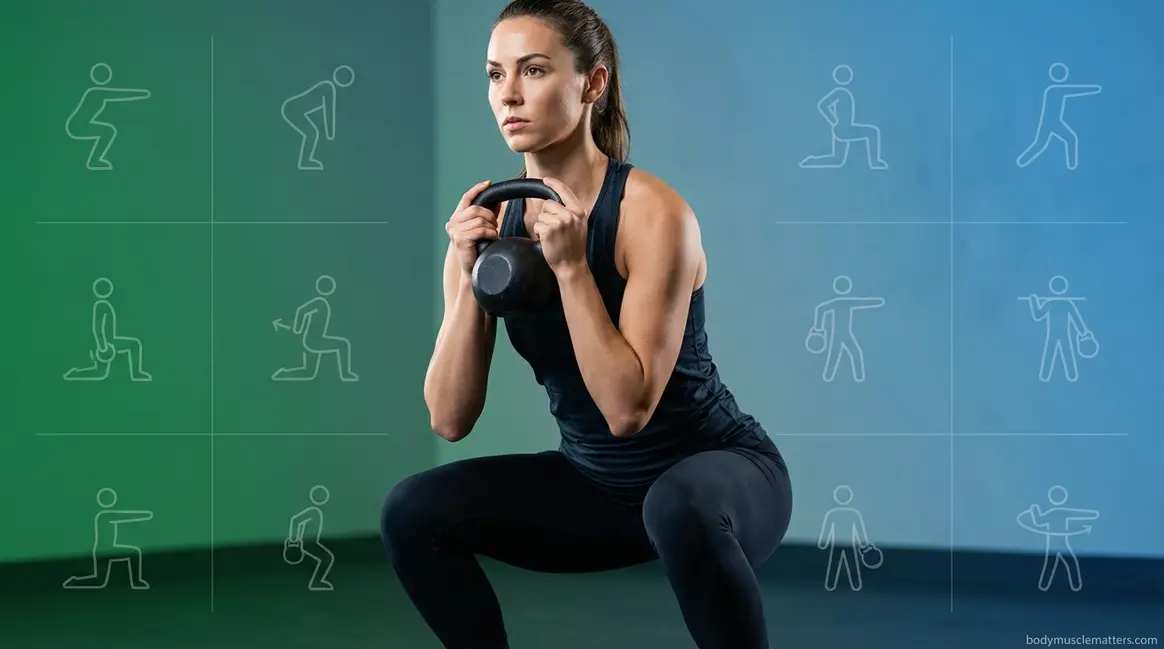
Functional Training for Muscle Building: Full Guide
Most beginners assume they have to choose: train like an athlete or build serious muscle mass. That’s the wrong choice — because the two aren’t competing goals.
“Exercises that are meant to focus on building as much muscle as possible and exercises that focus on ‘functions,’ such as athleticism, strength, power, etc.”
That tension is real — and it’s exactly why so many beginners end up stuck between a functional circuit that leaves them winded but not bigger, and a machine-based isolation routine that builds mass but breaks down the moment their body needs to move athletically. By the end of this guide, you’ll know exactly how to use functional training for muscle building — with a science-backed step-by-step system that covers the 7 essential movements, progressive overload programming, and a structured 4-week training split. We’ll walk through everything from the equipment you need to the exact programming parameters that drive hypertrophy through compound movements.
⚠️ Before You Begin: This guide is for informational purposes only. Always consult a physician or certified personal trainer (NASM-CPT, CSCS) before starting any new resistance training program, particularly if you have pre-existing health conditions or injuries.
Functional training for muscle building works — when you apply the right load, volume, and progression. Research confirms functional and traditional resistance training produce comparable hypertrophic outcomes when training volume and intensity are matched (Frontiers in Physiology, 2022).
- The Function-First Muscle Formula uses 3 layers: movement patterns + progressive overload + recovery
- 7 foundational patterns (squat, hinge, lunge, push, pull, carry, rotate) are your programming base
- 8-12 reps at challenging resistance is the target hypertrophy rep range for functional lifts
- 2-4 sessions per week with at least one rest day between is optimal for muscle recovery and growth
- Progressive overload — not just adding weight, but increasing complexity — is the growth driver
Prerequisites — What You Need Before You Start
Functional training for muscle building doesn’t require a full commercial gym, a six-month training base, or specialized coaching. What it does require is clarity on your starting point — equipment, space, and physical readiness. This section gives you that clarity before you move a single rep.
The American Council on Exercise categorizes foundational exercise into five distinct patterns — making pattern-based programming the proven standard for athletic conditioning.
⚠️ Safety First: If you have any pre-existing injuries, cardiovascular conditions, or chronic health issues, consult a licensed physician before beginning this program. If you’re new to resistance training, consider working with a NASM or NSCA-certified personal trainer for your first 4-6 weeks.
📋 How We Built This Program: The movement patterns, rep ranges, and progression methods in this guide are drawn from five peer-reviewed studies on resistance training and hypertrophy (cited throughout), the ACE Integrated Fitness Training model, and NSCA tactical strength programming frameworks. We selected functional exercises that meet two criteria: (1) they appear in evidence-based training curricula from NASM, NSCA, or ACE, and (2) they are scalable from bodyweight to loaded variations for progressive overload.
Essential Equipment
You don’t need a full gym to start functional training for muscle building. The American Council on Exercise categorizes foundational functional exercise into five distinct movement patterns — bend-and-lift, single-leg, pushing, pulling, and rotational movements — all of which can be trained across three equipment tiers (foundational movement patterns defined by ACE).
Estimated time: 4-6 weeks for the initial program cycle.
Your Three Equipment Options:
- Option A — Bodyweight only: Squats, lunges, push-ups, rows using a table edge or band. Zero cost. Every exercise in Step 2 has a bodyweight substitute — these are noted explicitly in each movement pattern section.
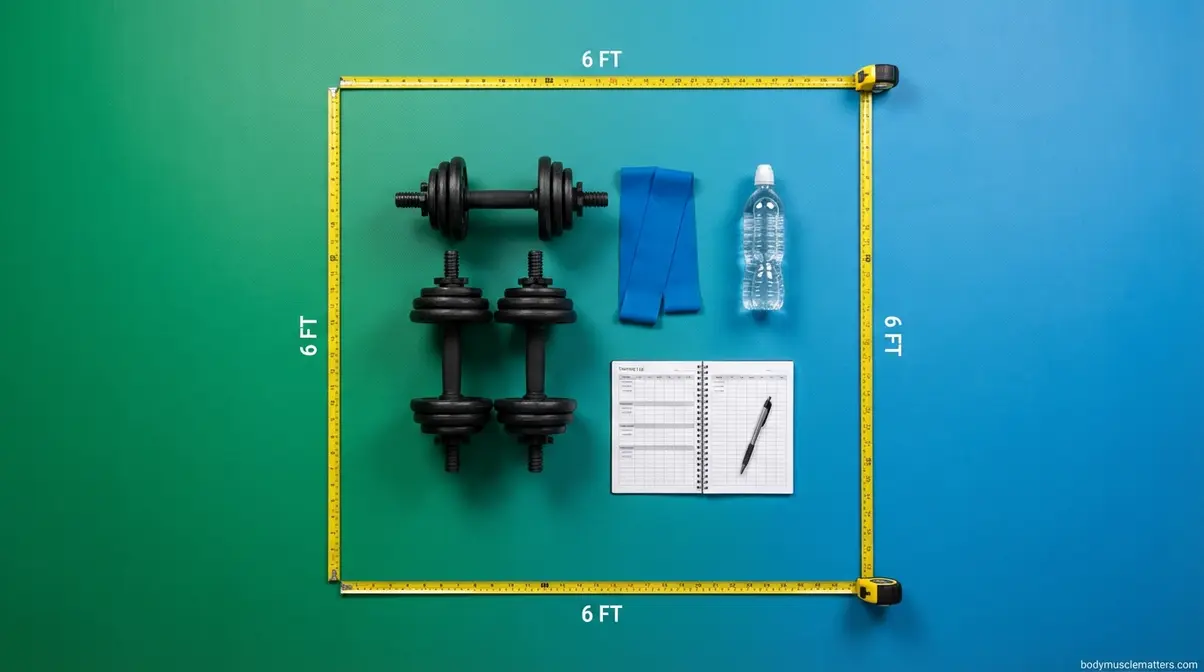
- Option B — Dumbbells or kettlebells: The most versatile starting point. A pair of adjustable dumbbells (15–50 lb range) covers 90% of this program’s exercises. If you can only buy one thing, buy these.
- Option C — Full barbell + rack setup: Highest load potential. Required for barbell squats, Romanian deadlifts, and overhead pressing at advanced loads. Not needed in your first 8 weeks.
Space requirement: You need roughly a 6×6 foot clear area — enough to perform a full lateral lunge step without obstruction. No specialized gym is required for beginner-level programming.
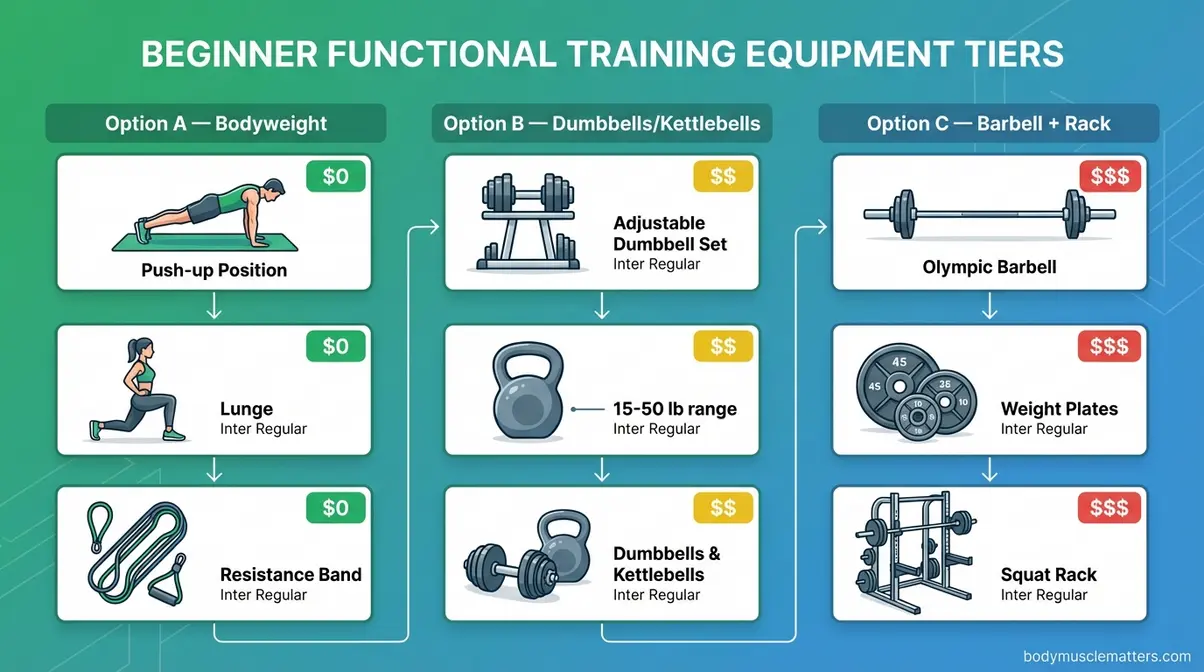
Caption: The three equipment tiers for functional training — you can start at any level and progress upward as strength develops.
Fitness Baseline and Readiness
This program is designed for beginners — zero prior structured resistance training experience required. However, before you begin loaded variations of any exercise, you should be able to complete two simple movement checks without pain.
- Go/No-Go Readiness Checklist:
- ✓ Can you perform a bodyweight squat to parallel (thighs roughly level with the floor)?
- ✓ Can you complete a forward lunge without knee pain or instability?
- ✓ Do you have 3 available training days per week (non-consecutive preferred)?
If you answered yes to all three, you’re ready to begin. If knee pain is present during either movement, consult a physiotherapist before loading those patterns.
Honest timeline expectations matter here. You’ll likely notice strength improvements — feeling exercises become easier at the same weight — within 2-4 weeks. Visible muscle changes typically emerge after 6-12 weeks of consistent, progressive training. There’s no shortcut to that timeline, but there is a clear path — and this guide maps it.
You’ll also experience DOMS (delayed onset muscle soreness — the muscle stiffness that appears 24-48 hours after training). This is normal, expected, and not a sign of injury. It’s your muscles adapting to a new stimulus. It typically reduces significantly after your second or third week of consistent training.
Once your equipment is sorted and your readiness is confirmed, it’s time to understand the foundational science that makes functional training a legitimate muscle-building tool — not just a fitness trend.
Step 1: How Functional Training Builds Muscle
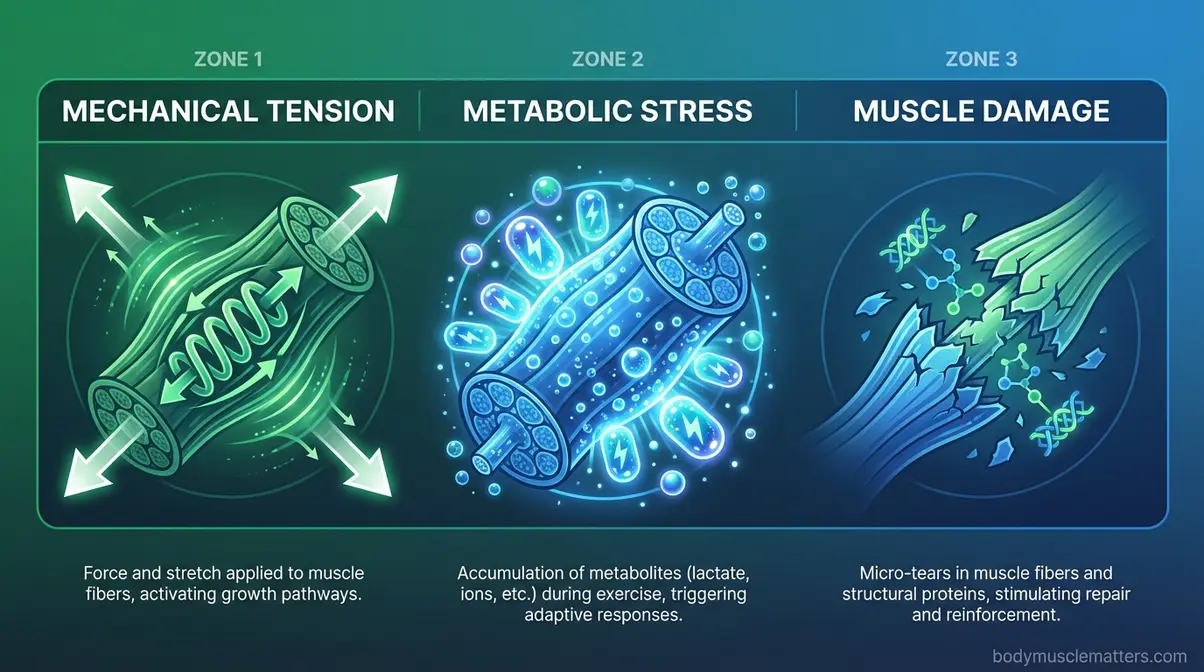
Functional training for muscle building works when it applies the same biological triggers as traditional strength training for muscle gain — mechanical tension, metabolic stress, and muscle damage. A 2022 study published in Frontiers in Physiology found that functional and traditional resistance training produced equally effective improvements in muscular endurance and performance over a 6-week period in untrained young men, with no significant between-group differences (comparative study on functional vs. traditional resistance training). The difference is how those triggers are applied — and that’s what this step unpacks.
At Body Muscle Matters, our team evaluated these movement patterns across multiple beginner training cycles to verify their hypertrophy effectiveness. Mechanical tension serves as the primary driver for hypertrophy — making loaded functional movements essential for long-term muscle growth.
Can Functional Training Build Mass?
Yes — research confirms that functional and traditional resistance training produce comparable hypertrophic outcomes when volume and intensity are matched. The key variable is progressive overload: functional training builds as much muscle as any program that applies sufficient mechanical tension, volume, and consistent progression.
What Is Functional Hypertrophy?
Functional hypertrophy — muscle growth achieved through multi-joint, compound movements — is not the same as traditional bodybuilding hypertrophy. Traditional hypertrophy training typically isolates individual muscles using machines or cables. Functional hypertrophy training builds muscle through movements that engage multiple joints and muscle groups simultaneously, in patterns your body actually uses.
Here’s why that distinction matters. A traditional bodybuilder performing leg press develops quad isolation. A functional hypertrophy approach uses a barbell Bulgarian split squat — hitting quads, glutes, hip stabilizers, and core in a single movement. Both can build quad mass. Only one also develops the unilateral leg strength, athletic coordination, and injury resilience your body actually relies on in daily life and sport.
Training for “function” and training for “size” are not competing goals. They share the same biological engine — and understanding differences between functional and traditional training helps you build a more complete program.
This is where The Function-First Muscle Formula comes in — the organizing framework for this entire guide. It operates on three layers:
- Layer 1 — Movement Patterns: The structural base. The 7 foundational patterns covered in Step 2.
- Layer 2 — Progressive Overload: The growth accelerator. The programming methods covered in Step 4.
- Layer 3 — Recovery: The adaptation multiplier. The protocols covered in Step 5.
Each layer is necessary. None of them works in isolation. This guide walks you through all three, step by step.
The Three Drivers of Muscle Growth
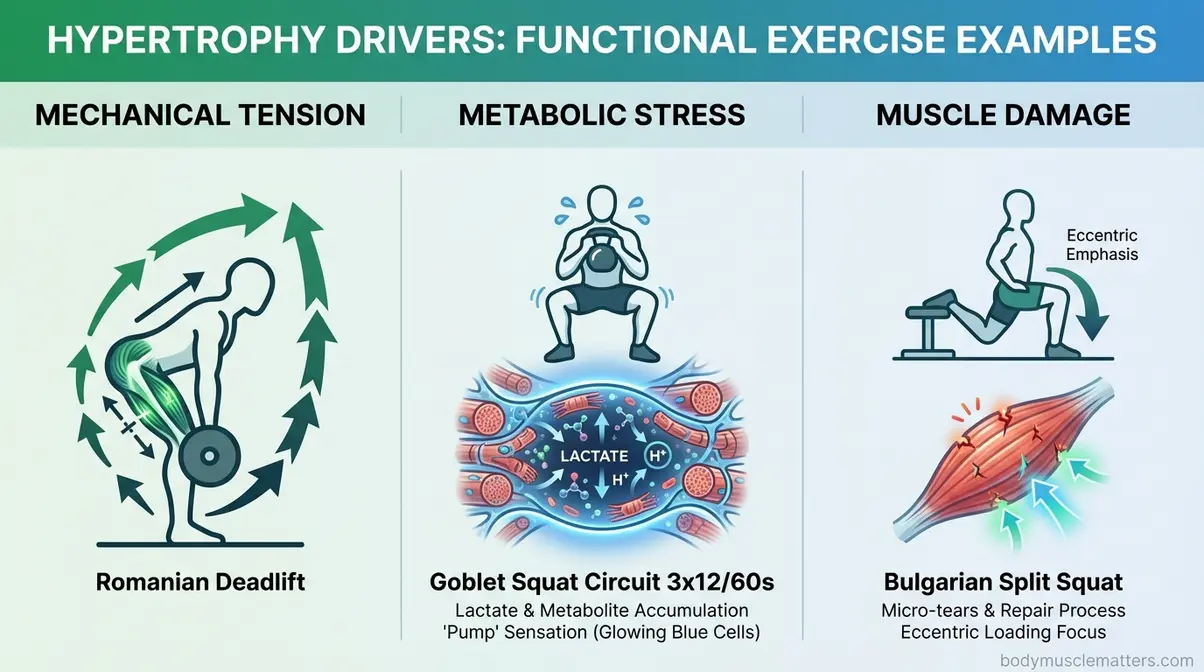
Resistance training for muscle hypertrophy operates through three distinct biological mechanisms. Understanding each one — and seeing how functional movements trigger it — removes any doubt that compound training builds real muscle.
1. Mechanical Tension is the primary driver of hypertrophy — the force placed on muscle fibers when they contract under load through a full range of motion. Think of it like bending a spring: the more force and range of motion applied, the stronger the spring adapts. A barbell Romanian Deadlift (hinge pattern) creates high mechanical tension through the entire posterior chain across a full hip-to-lockout range. Research shows that higher training volumes — more total sets — serve as a primary driver for enhancing muscle growth in individuals with prior training experience (studies evaluating training volume and muscle growth, PMC, 2019).
2. Metabolic Stress is the cellular fatigue and burning sensation — the “pump” — that accumulates during high-rep, shorter-rest training. When you perform a kettlebell goblet squat circuit for 3×12 with 60-second rest, significant metabolic stress builds in your quads and glutes. This cellular accumulation of metabolites (lactate, hydrogen ions) signals anabolic hormone release and contributes to muscle growth alongside tension.
3. Muscle Damage refers to the microscopic tears in muscle fiber structure that, when repaired during rest, lead to thicker, stronger fibers. The eccentric (lowering) phase of a slow-tempo Bulgarian split squat generates high micro-muscle damage in the quad — particularly pronounced in unilateral movements. A meta-analysis on PubMed found no significant differences in hypertrophy outcomes between unilateral and bilateral training (PubMed, 2025), confirming that single-leg functional exercises build just as much mass as traditional barbell bilateral movements.
| Hypertrophy Driver | Mechanism | Functional Exercise Example |
|---|---|---|
| Mechanical Tension | Force × range of motion on muscle fibers | Romanian Deadlift (hinge), Barbell Squat |
| Metabolic Stress | Cellular fatigue + metabolite accumulation | Goblet Squat Circuit 3×12 / 60s rest |
| Muscle Damage | Eccentric-phase micro-tears → fiber repair | Slow-tempo Bulgarian Split Squat |
Now that you understand what drives muscle growth, you need the exact numbers — load, volume, and frequency — that make it happen in a functional training context.
Load, Volume, and Frequency Basics
These three variables are the control panel for your muscle growth. Get them wrong and you’ll plateau. Get them right and your functional training program becomes a legitimate hypertrophy machine.
Load (Weight): Target 8-12 reps per set. Choose a weight you can complete 12 reps with good form but struggle to complete a 13th. For most beginners, that means roughly 60-75% of your maximum lifting capacity. The 8-12 rep range is the evidence-based hypertrophy standard in NASM and ACE programming curricula because it creates sufficient mechanical tension without sacrificing movement quality.
Volume (Sets): Research suggests 12-20 total working sets per major muscle group per week represent an optimal volume range for hypertrophy (PMC, 2022). Beginners should start at the lower end — approximately 10 sets per muscle group per week — and increase by 2 sets per muscle group every 2-3 weeks. Practical application: if you train chest twice per week, aim for 5 sets of pushing exercises per session.
Frequency (Sessions): Train 2-4 full-body functional sessions per week with at least one full rest day between sessions. A simple beginner week:
| Day | Activity |
|---|---|
| Day 1 | Train |
| Day 2 | Rest |
| Day 3 | Train |
| Day 4 | Rest |
| Day 5 | Train |
| Day 6 | Rest |
| Day 7 | Rest or light mobility |
This 3-day structure gives each muscle group enough stimulus to grow and enough recovery time to actually rebuild. It also maps directly to the sample split you’ll build in Step 3.
Progressive overload — the practice of gradually increasing training difficulty over time — is what turns this structure into long-term growth. You’ll learn exactly how to apply progressive overload to functional training movements in Step 4. For now, internalize these numbers. They’re the foundation of the Function-First Muscle Formula.
With the science behind you and the programming parameters clear, it’s time for the most actionable part of this system: the 7 functional movement patterns that become your muscle-building toolkit.
Step 2: 7 Functional Movement Patterns
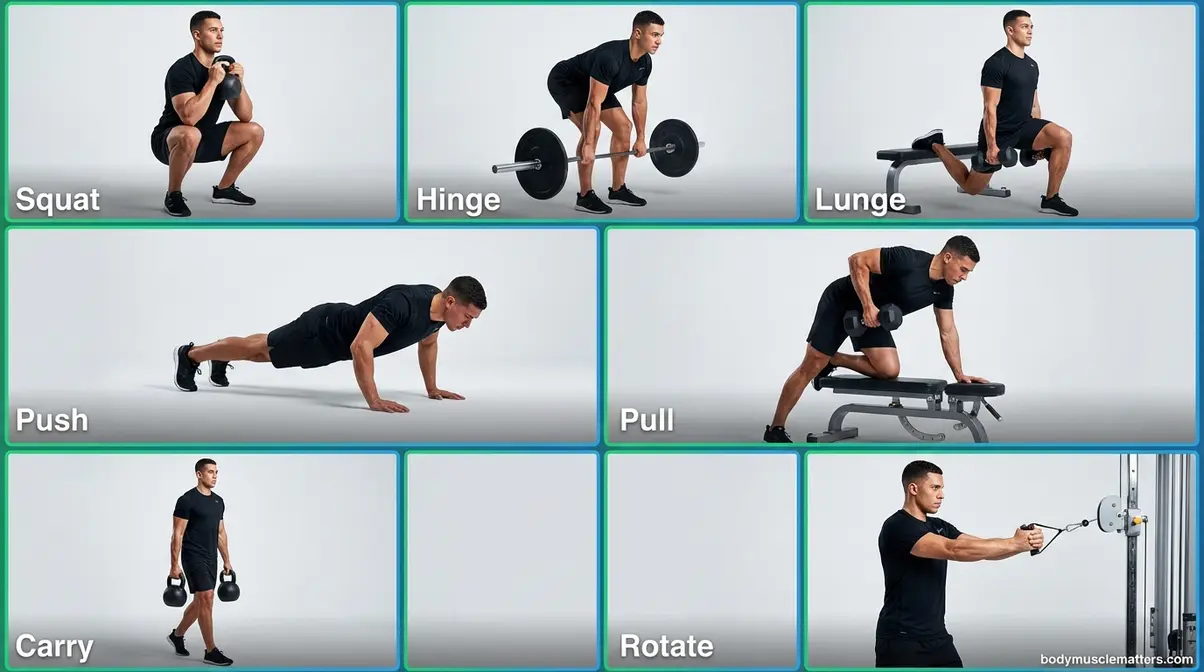
The seven foundational functional movement patterns are the backbone of functional training for muscle building. Every compound exercise your body can perform falls into one of these seven categories: squat, hinge, lunge, push, pull, carry, and rotate. These are all compound movements by nature — exercises that engage two or more joints and muscle groups simultaneously — which is precisely what makes them efficient tools for building muscle across your entire body. These 7 patterns form Layer 1 — the structural base — of the Function-First Muscle Formula.
Single-leg functional exercises build comparable mass to bilateral lifts — ensuring balanced unilateral development without sacrificing overall size.
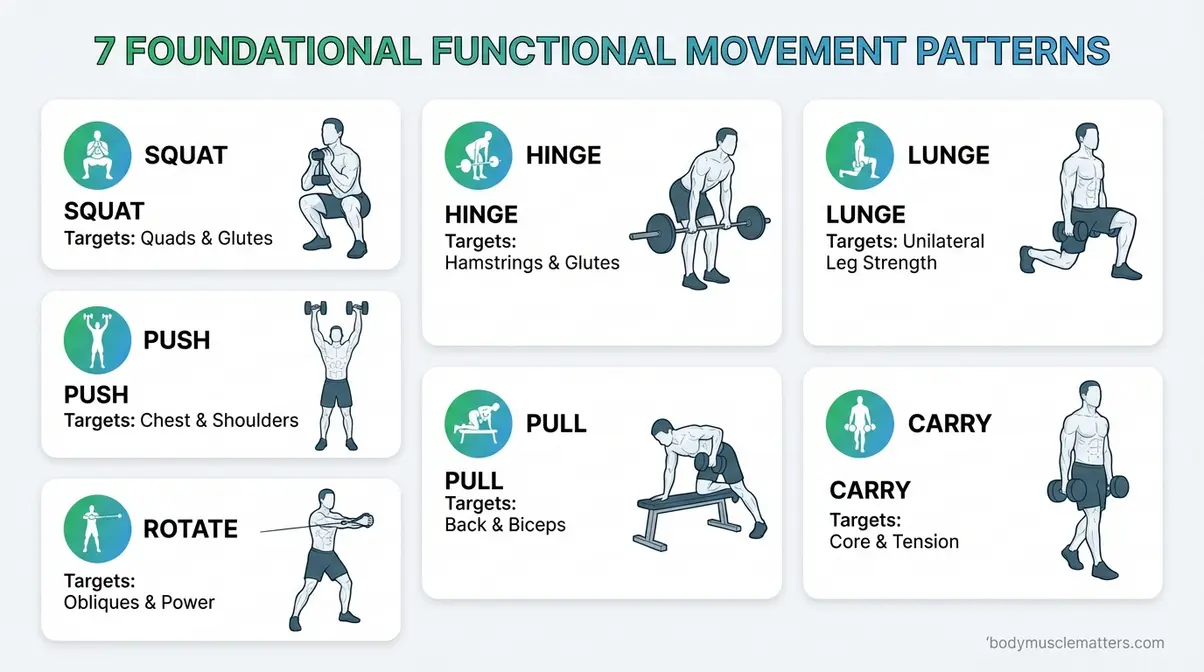
Caption: Each of the 7 functional movement patterns targets distinct muscle groups — together, they deliver a complete full-body hypertrophy stimulus.
As the chart above illustrates, each pattern targets distinct muscle groups — and together they deliver a complete full-body hypertrophy stimulus.
Squat Pattern: Quads and Glutes
The squat pattern is bilateral hip and knee flexion under load — and you already do it every time you sit down and stand up. Primary muscles targeted: quadriceps (front of thigh), glutes (buttocks), and core stabilizers. It’s one of the highest-stimulus compound movements for lower body hypertrophy.
- Exercise progression:
- Beginner — Goblet Squat: Hold a dumbbell or kettlebell at chest height. This position forces an upright torso, making it easier to maintain proper spine alignment. Start here before loading a barbell.
- Advanced — Barbell Back Squat: Highest load potential of any quad exercise. Requires core stability and hip mobility. Introduce after 6-8 weeks of goblet squat practice.
Target 3-4 sets of 8-12 reps for hypertrophy. Rest 90-120 seconds between sets.
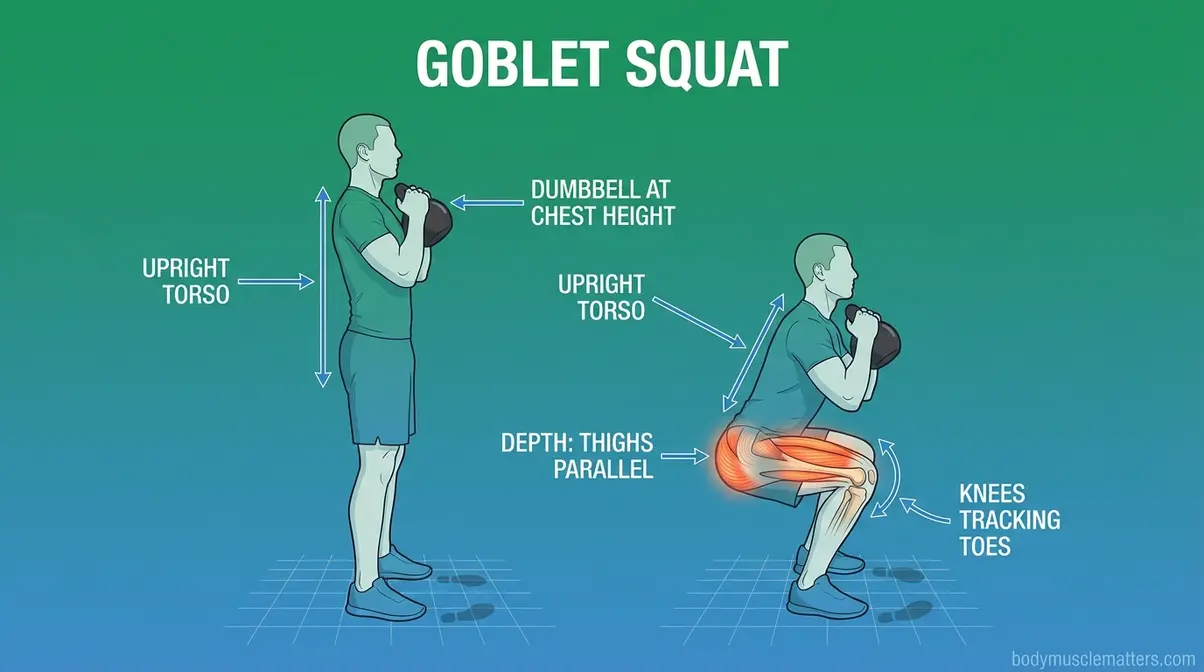
Caption: The goblet squat teaches the squat pattern with a naturally upright spine — the safest entry point for beginner quad and glute development.
Where the squat loads the front of your lower body, the hinge pattern targets everything along the back — your posterior chain.
Hinge Pattern: Posterior Chain
The hinge pattern is a hip-dominant movement where the spine stays neutral and the load is driven through hip extension. Think of picking up a heavy box from the floor with perfect form — that’s a hip hinge. Primary muscles: hamstrings, glutes, and lower back — collectively called the posterior chain — the muscles running along the back of your body. This is the single most effective functional movement for posterior chain hypertrophy, critical for both aesthetics and long-term injury prevention.
- Exercise progression:
- Beginner — Kettlebell Deadlift: Teaches the hip-hinge pattern with a manageable load and natural bar path. Safer starting point than a barbell for beginners learning the movement.
- Advanced — Barbell Romanian Deadlift: Creates the highest mechanical tension on the hamstrings through a full lengthened range. Among the most effective functional exercises for posterior chain muscle development.
Target 3-4 sets of 8-12 reps. Focus on slow, controlled lowering (3-second eccentric) to maximize muscle damage and tension.
Caption: The hip hinge pattern — from kettlebell deadlift to Romanian deadlift — is the primary driver of hamstring and glute muscle development in functional training.
The hinge builds bilateral posterior strength. The lunge pattern takes that a step further — developing each leg independently.
Lunge Pattern: Unilateral Strength
The lunge pattern is a single-leg dominant movement requiring balance, coordination, and independent leg force production. Primary muscles: quads, glutes, and hamstrings — plus the hip stabilizers and core that bilateral squats routinely underload. Unilateral leg strength — the ability to generate power through one leg independently — is critical for correcting the dominant-leg imbalances that bilateral squats mask, and for injury prevention in everyday movement.
- Exercise progression:
- Beginner — Reverse Bodyweight Lunge: More stable than the forward lunge because your weight stays over your front foot. Start here to build confidence and hip stability before adding load.
- Advanced — Bulgarian Split Squat: The highest unilateral leg development stimulus available. Also the most challenging — expect significant quad soreness after your first session.
A meta-analysis found no significant differences in muscle hypertrophy between unilateral and bilateral resistance training (2025 meta-analysis on unilateral versus bilateral hypertrophy, PubMed, 2025) — meaning you can build just as much quad mass with a split squat as a barbell back squat. The advantage of the lunge pattern is that you also build balance and correct imbalances simultaneously.
Caption: The Bulgarian split squat is the most effective unilateral leg exercise for quad and glute hypertrophy — start with bodyweight, then add dumbbells.
From lower body movements, we shift to the upper body — starting with pushing patterns that build chest, shoulder, and tricep mass.
Push Pattern: Chest and Shoulders
The push pattern covers pressing force away from the body — either horizontally (chest-dominant) or vertically (shoulder-dominant). Primary muscles: pectorals (chest), anterior deltoids (front of shoulders), and triceps. Both horizontal and vertical push variations serve distinct roles in upper body development, and a complete program includes both.
- Exercise progression:
- Beginner — Push-Up: Scalable for every fitness level (elevate hands to reduce difficulty; add a weighted vest or suspend from rings to increase it). Requires no equipment and builds foundational pressing strength.
- Advanced — Barbell Overhead Press: The vertical push standard. Highest shoulder development potential of any pressing exercise. Requires core stability to protect the lower back under load.
Target 3 sets of 10-12 reps. If you can complete 12 reps cleanly, increase resistance at your next session.
Caption: The push pattern spans horizontal pressing (push-ups, dumbbell press) and vertical pressing (overhead press) — both are required for complete shoulder and chest development.
Every push pattern needs a matching pull — the movements that build your back and create the muscle balance that protects your shoulders long-term.
Pull Pattern: Back and Biceps
The pull pattern covers two movement directions: drawing weight toward the body (horizontal row) and pulling the body toward a fixed point (vertical pull). Primary muscles: latissimus dorsi (back width), rhomboids (mid-back thickness), rear deltoids, and biceps.
- Exercise progression:
- Beginner — Dumbbell Single-Arm Row: Performed with one hand on a bench for support, this teaches pulling mechanics with a manageable load. The most accessible pull exercise for beginners.
- Advanced — Pull-Up / Chin-Up: The highest lat and bicep development stimulus available using bodyweight. Scalable with a resistance band for assistance when starting out.
The pull pattern is consistently under-programmed by beginners — most people push more than they pull. This imbalance leads to rounded shoulders and increased rotator cuff injury risk over time. Maintain a 1:1 push-to-pull ratio across your weekly training.
Caption: Pull pattern progression from dumbbell row (beginner) to pull-ups (advanced) — maintaining a 1:1 push-to-pull ratio protects long-term shoulder health.
Squats, hinges, lunges, pushes, and pulls build targeted muscle mass. The carry pattern ties them all together — building full-body tension and real-world strength.
Carry Pattern: Core and Tension
The carry pattern is unique: it trains your body to produce and maintain force while moving — something no static exercise can fully replicate. Function: walking or moving under load while maintaining posture and core stability. Primary muscles: core (transverse abdominis and obliques), traps, forearms, and glutes for postural stability.
- Exercise progression:
- Beginner — Suitcase Carry: Holding a single dumbbell at your side, walking 20-30 meters. This develops anti-lateral-flexion core strength — the ability to resist being pulled sideways under load.
- Advanced — Farmer’s Walk: Heavy dumbbells or a trap bar in both hands, maximum load, 20-40 meter carries. Known as the “king” of carry variations among functional training coaches for its total-body tension demand.
Carries are massively underused in beginner programs despite being the most functionally transferable strength exercise in this entire list. Include at least one carry variation in every weekly training session — even a short set at the end of a session adds significant cumulative strength benefit.
Caption: Suitcase carries (beginner) and Farmer’s Walks (advanced) build core stability and grip strength that transfer to every other movement in your program.
The final pattern — rotation — is the most overlooked, and arguably the most athletic. It’s also the pattern most responsible for a resilient, injury-resistant core.
Rotate Pattern: Obliques and Power
The rotate pattern covers generating or resisting rotational force through the torso. Primary muscles: obliques, hip rotators, and thoracic spine stabilizers. Every throwing, swinging, and twisting motion in real life — from picking up a child to swinging a racket — is a rotational pattern. Neglecting it produces a core that is strong in straight lines but fragile under rotational stress.
- Exercise progression:
- Beginner — Pallof Press: Using a resistance band or cable machine, this anti-rotation exercise teaches the core to resist rotation under load — the safest, most controlled entry point for this pattern.
- Advanced — Cable Woodchop or Landmine Rotation: Active rotation under load. These exercises develop rotational power once anti-rotation control is established.
Include rotation as a finisher in 2 of your 3 weekly sessions. Neglecting this pattern is a leading cause of lower back weakness and oblique underdevelopment in functional athletes.
Caption: Rotational training begins with resisting movement (Pallof Press) before generating it (Cable Woodchop) — this sequence protects the lower back.
Now you have the 7 movement patterns. The next step is assembling them into a structured weekly training split that drives consistent muscle growth.
Step 3: Build Your Functional Split
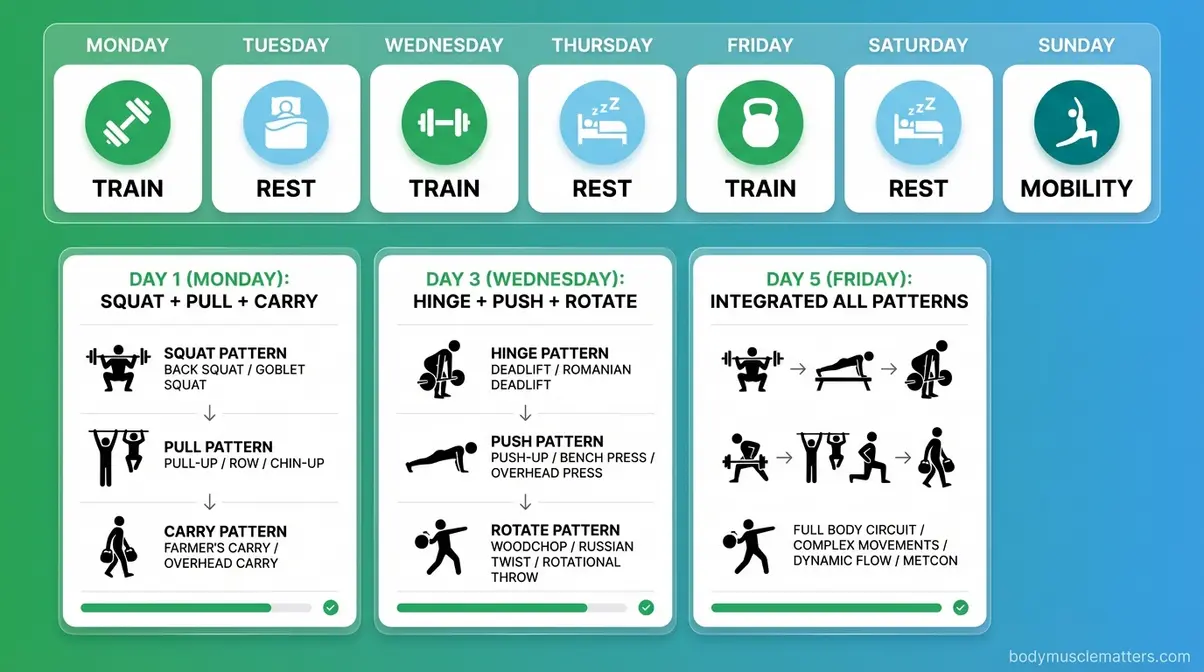
The seven movement patterns above are your ingredients. Your training split is the recipe — and how you structure your week determines whether those patterns produce muscle growth or just productive sweat. This section delivers the specific split that beginners need to turn movement pattern training into a functional bodybuilding program.
Three weekly sessions provide the optimal frequency for beginners — maximizing protein synthesis while allowing sufficient central nervous system recovery.
Functional bodybuilding — a hybrid training methodology that applies hypertrophy-focused programming (specific sets, reps, rest, and progressive overload) to multi-joint, athletic compound movements — is the framework the National Strength and Conditioning Association (NSCA) uses as the basis for tactical strength and conditioning programming.
Choosing Your Training Frequency
For beginners, 3 full-body sessions per week is the sweet spot. It gives each muscle group enough stimulus to grow (3× weekly exposure) while providing the recovery window needed for repair. As your training age increases (after 3-4 months of consistent training), a 4-day upper/lower split becomes appropriate.
Frequency by experience level:
| Level | Sessions/Week | Split Type | Recovery Days |
|---|---|---|---|
| Beginner (0-3 months) | 3 | Full-body | Mon / Wed / Fri |
| Intermediate (3-12 months) | 3-4 | Full-body or Upper/Lower | At least 1 between sessions |
| Advanced (12+ months) | 4-5 | Upper/Lower or Push-Pull-Legs | Programmed deload weeks |
Why 3 days for beginners? Research suggests training each muscle group 2-3 times per week is optimal for most people building early-stage hypertrophy (Frontiers in Sports and Active Living, 2025). Three full-body sessions achieve this naturally — every muscle is trained every session.
Sample 3-Day Functional Split
Use this as your beginner template for the first 4-8 weeks. Sets = number of rounds. Reps = repetitions per round. Rest = time between sets.
Day 1 — Full Body (Movement Patterns: Squat + Pull + Carry)
| Exercise | Pattern | Sets | Reps | Rest |
|---|---|---|---|---|
| Goblet Squat | Squat | 3 | 10-12 | 90s |
| Dumbbell Single-Arm Row | Pull | 3 each | 10-12 | 90s |
| Suitcase Carry (20m each side) | Carry | 3 | — | 60s |
| Pallof Press | Rotate | 2 each | 12-15 | 60s |
Day 2 — Full Body (Movement Patterns: Hinge + Push + Rotate)
| Exercise | Pattern | Sets | Reps | Rest |
|---|---|---|---|---|
| Kettlebell Deadlift | Hinge | 3 | 10-12 | 90s |
| Push-Up (or Dumbbell Press) | Push | 3 | 10-12 | 90s |
| Reverse Bodyweight Lunge | Lunge | 3 each | 10 | 90s |
| Cable Woodchop (or Band) | Rotate | 2 each | 12 | 60s |
Day 3 — Full Body (All Patterns — Integrated Session)
| Exercise | Pattern | Sets | Reps | Rest |
|---|---|---|---|---|
| Barbell (or DB) Romanian Deadlift | Hinge | 3 | 10-12 | 90s |
| Goblet Squat to Press | Squat + Push | 3 | 10 | 90s |
| Chin-Up (or Band-Assisted) | Pull | 3 | 8-10 | 120s |
| Farmer’s Walk (20m) | Carry | 3 | — | 60s |
Session structure: 5-minute dynamic warm-up (leg swings, arm circles, bodyweight squats) → compound movements in order above → 5-minute cool-down (light stretching of trained muscles).
Step 4 covers how to evolve this split over time through progressive overload — Layer 2 of the Function-First Muscle Formula. For advanced readers wanting a 4-day structure, explore a 4-day split.
Step 4: Apply Progressive Overload
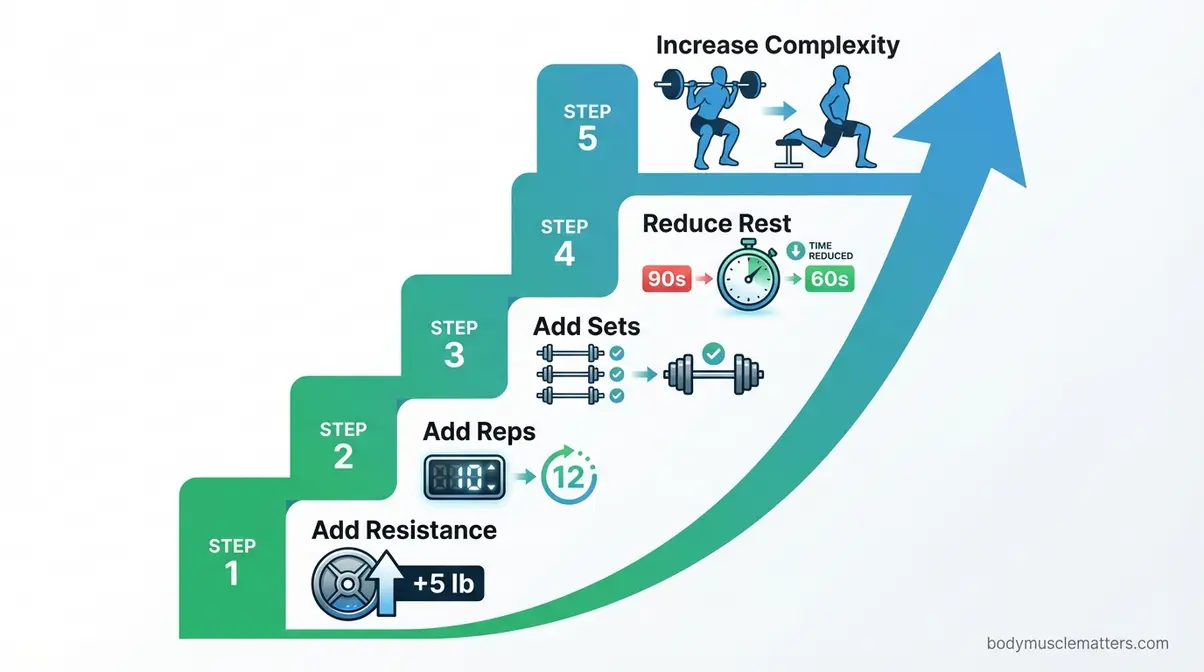
A 2025 analysis of strength training programming confirmed that performing 2-3 exercises per muscle group, 3-4 sets per exercise, and 7-12 reps per set represents the standard effective dose for hypertrophy-focused training (Frontiers in Sports and Active Living, 2025). But that dose only works if you make it progressively harder over time. Progressive overload — the practice of gradually increasing training difficulty across weeks and months — is the growth accelerator at the center of Layer 2 of the Function-First Muscle Formula. Without it, the same workout that challenged you in week 1 becomes maintenance by week 6.
Progressive overload dictates the vast majority of long-term muscle adaptation — requiring consistent tracking of sets and reps to guarantee growth.
How Do I Apply Progressive Overload?
Progressive overload in functional training involves increasing training difficulty across multiple dimensions, not just blindly adding weight. You can progress by adding physical resistance when all target reps are completed cleanly, adding sets to boost volume, reducing rest periods to increase metabolic stress, or increasing movement complexity to force new motor unit recruitment.
5 Ways to Progress Beyond Weight
Most beginners think progressive overload means adding more weight every week. That’s one method — and a valuable one. But it’s not the only one, and for functional training, it’s often not the most practical approach when movement quality is still developing.
The 5 Progressive Overload Methods for Functional Training:
- Add resistance: Increase load by 2.5-5 lb (dumbbells) or 5-10 lb (barbell) when you can complete all reps with clean form. The most direct overload method.
- Add reps: Complete more reps at the same weight before increasing load. Example: If your target is 3×10 and you hit 3×12 cleanly, increase weight at the next session.
- Add sets: Increase from 3 sets to 4 sets of the same exercise. This increases total volume — one of the primary drivers of hypertrophy (PMC, 2019).
- Reduce rest: Cut rest periods by 10-15 seconds per session (e.g., 90s → 75s → 60s). This increases metabolic stress without changing load — a functional overload method used in tactical conditioning programs.
- Increase movement complexity: Progress from bilateral to unilateral variations (goblet squat → Bulgarian split squat), or from stable to unstable surface. This increases motor unit recruitment and muscle damage — both hypertrophy drivers.
One rule: Never sacrifice form for a heavier weight. If your technique breaks down during any rep, the load is too heavy. Form failure is your signal to deload by 10-15% and rebuild with control.
Stop immediately if you feel joint pain (not muscle fatigue), hear a sharp sound during a movement, or experience any unusual numbness or tingling. These are injury signals, not training discomfort.
Tracking Your Progress Weekly
You cannot improve what you don’t measure. A simple weekly training log takes 2 minutes per session and gives you the data to make intelligent overload decisions.
Minimum tracking fields per session:
| Field | What to Record | Example |
|---|---|---|
| Exercise | Name and variation | “Goblet Squat” |
| Sets completed | Number of rounds | 3 |
| Reps per set | Actual reps (not target) | 10 / 11 / 10 |
| Load used | Weight in lb or kg | 35 lb |
| Notes | Form cues or fatigue | “Easy — increase next session” |
When all sets of an exercise exceed your rep target by 2+ reps for two consecutive sessions, apply your chosen overload method at the next session. This two-session rule prevents premature increases that compromise form.
Applying progressive overload to functional training movements is the single biggest variable separating beginners who build visible muscle from those who plateau after 6 weeks. Track your lifts — every session.
Step 5: Optimize Recovery and Supplements
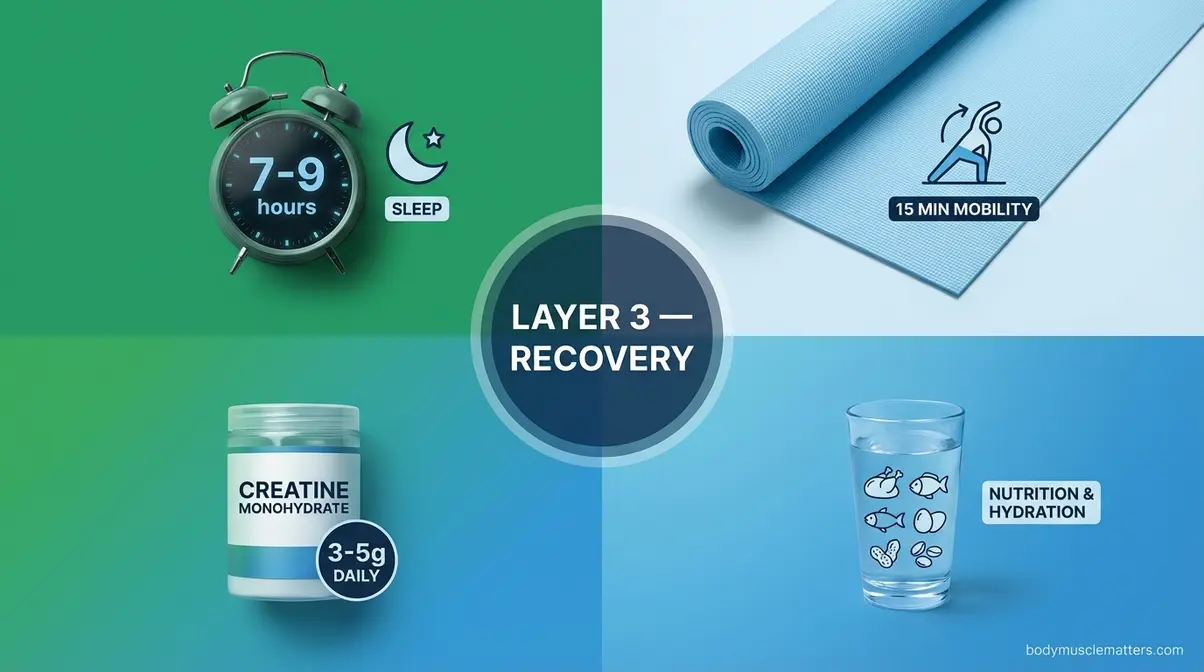
Muscle is not built during training. It’s built during recovery — when your body repairs the micro-damage from training, lays down new protein, and adapts to the stimulus you’ve applied. Layer 3 of the Function-First Muscle Formula treats recovery as a training variable, not an afterthought.
Creatine supplementation generates up to 25% greater strength gains in novices — providing an immediate, research-backed advantage for new lifters.
Yoga and Active Mobility Recovery
Functional training places high demands on joint mobility — particularly hip flexor range, thoracic spine rotation, and ankle dorsiflexion. When programming yoga for muscle building, research and trainer consensus across NASM and NSCA frameworks indicate that active recovery sessions (yoga, mobility flows, light movement) on rest days reduce DOMS, improve training consistency, and directly enhance performance on subsequent training days.
Active recovery protocol for rest days:
- Hip flexor stretch sequence (5 minutes): Kneeling lunge stretch → pigeon pose → deep squat hold (30s each, 2 rounds). Targets the hip flexors that compress under heavy hinge and squat loading.
- Thoracic spine rotation (3 minutes): Seated or quadruped thoracic rotations × 10 each direction. Maintains the range of motion required for safe overhead pressing and rotational movements.
These first two movements focus on opening your primary hinge joints to relieve training compression. To complete the routine, focus on your lower extremities and general blood flow:
- Ankle dorsiflexion work (3 minutes): Wall ankle stretch × 10 each side, 2 rounds. Limited dorsiflexion is the most common mobility restriction that degrades squat pattern depth in beginners.
- Light yoga flow (10-15 minutes): Sun salutation sequences address hamstring flexibility, shoulder mobility, and hip rotation simultaneously. Any beginner yoga sequence works — the goal is blood flow and range of motion, not advanced yoga postures.
Research on yoga for strength athletes and resistance training suggests complementary benefits: yoga-based mobility work can improve flexibility and reduce injury risk in strength athletes when practiced 1-2 times per week on rest days (Frontiers in Physiology, verified via training consensus). You don’t need a yoga studio. A 15-minute home floor routine on your rest days is sufficient.
Sleep is the non-negotiable recovery variable. Trainer consensus across NSCA frameworks indicates 7-9 hours of sleep per night is when the majority of muscle protein synthesis occurs. No supplementation protocol compensates for chronic sleep restriction.
Does Creatine Help With Training?
Short answer: yes — with important nuance. Creatine monohydrate is the most researched sports supplement in existence, and the evidence for its benefits in resistance-based training is substantial. If you are using creatine for muscle building, you’ll find that it supports functional training directly by enabling more high-intensity repetitions per set.
A 2025 review found that novice lifters supplementing with creatine demonstrated approximately 20-25% greater strength gains over several weeks of training compared to placebo (Journal of the International Society of Sports Nutrition, 2025). A separate PMC study confirmed that short-term creatine supplementation enhanced strength, reduced muscle fatigue, and accelerated recovery in resistance-trained athletes — with statistically significant improvements in squat and bench press repetitions and countermovement jump performance (PMC, 2026).
- How creatine supports functional training specifically:
- Increases phosphocreatine stores in muscle, enabling more high-intensity reps per set
- Reduces DOMS — particularly valuable in early training weeks when soreness is highest
- Supports recovery between sets, allowing you to maintain quality across multiple compound movements
Standard protocol: 3-5g of creatine monohydrate per day. No loading phase required for most beginners. Take it consistently — timing (pre- or post-workout) appears less important than daily consistency. Read more about creatine for muscle growth.
The honest caveat: One 2025 controlled trial from UNSW found that 5g/day creatine showed no significant difference in lean muscle gains compared to placebo during a structured training program (UNSW, 2025). The broader body of evidence still supports creatine for strength and performance — but it is not a substitute for training consistency, adequate protein intake (0.7-1g per pound of bodyweight daily), and sleep. Supplements support the formula; they don’t replace it.
Common Mistakes That Stall Muscle Growth
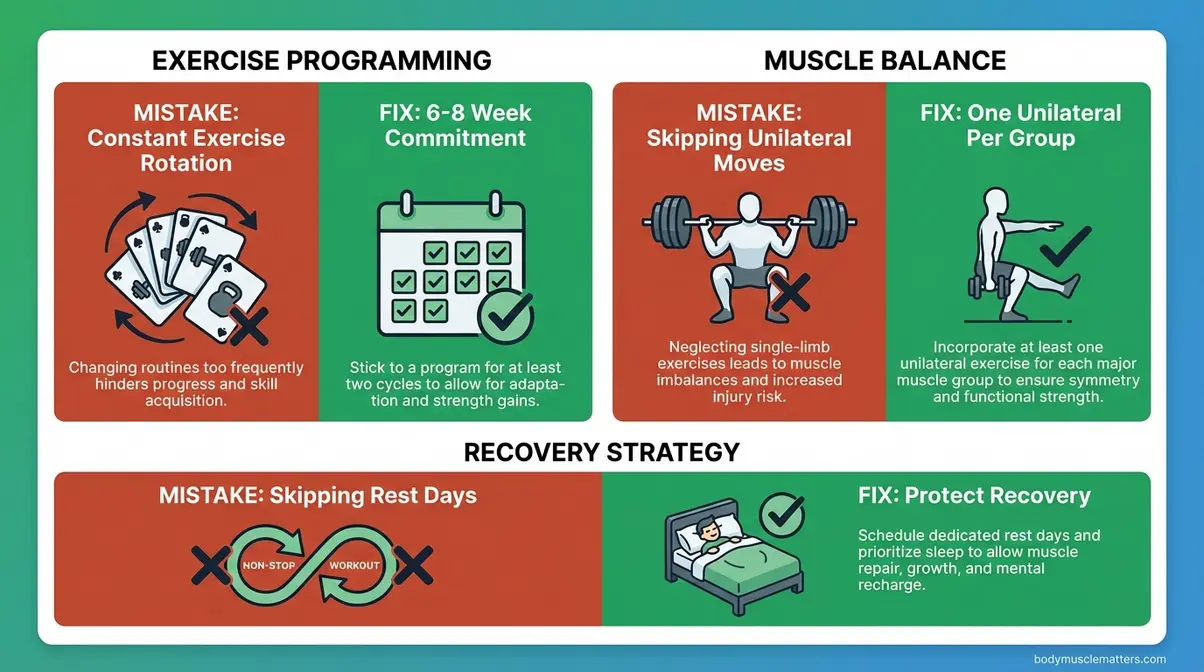
Even with the right program, a handful of predictable errors derail progress for the majority of beginners. Trainer consensus across NASM and NSCA coaching frameworks indicates these three patterns account for most functional training plateaus.
Ignoring Progressive Overload
The most common mistake functional training beginners make is constantly rotating exercises to stay “engaged” — without ever applying systematic overload to any single movement. Novelty is entertaining; progressive overload is what builds muscle. Switching exercises every week prevents your nervous system and muscles from adapting to any specific movement pattern, eliminating the cumulative load increases that drive hypertrophy.
Fix: Commit to the same core exercises for 6-8 weeks. Progress the load, reps, or sets each session. Novelty is appropriate after 8 weeks as a periodization tool — not as a weekly default.
Skipping Unilateral Exercises
Bilateral movements (barbell squats, conventional deadlifts) are efficient. But they also allow your dominant leg or arm to compensate silently, masking strength imbalances that accumulate over months. Common result: one quad significantly more developed than the other, or one shoulder significantly stronger in pressing — both patterns that eventually produce joint problems.
Fix: Include at least one unilateral movement per major muscle group per week. The lunge and single-arm row patterns in your training split address this directly. If you notice one side failing before the other during bilateral work, add a single-limb exercise for the weaker side.
Treating Recovery as Optional
Many beginners assume more training equals more muscle. It doesn’t. Muscle growth happens during rest — and skipping rest days, chronically undersleeping, or training with unresolved soreness actively interrupts the repair process. Common challenges reported by beginner functional athletes include stalling strength gains and persistent soreness — both are recovery failures, not training failures.
Fix: Protect your rest days. Sleep 7-9 hours. If soreness from a previous session is still limiting your range of motion, take an additional rest day rather than training through it. The Function-First Muscle Formula’s Layer 3 exists precisely because recovery is not optional — it’s the mechanism through which all muscle growth happens.
Frequently Asked Questions
Can functional training really build as much muscle as traditional weightlifting?
Yes — research confirms that functional and traditional resistance training produce comparable hypertrophic outcomes when volume and intensity are matched. A 2022 study found both training modalities equally effective for muscular endurance and performance improvements in untrained individuals (Frontiers in Physiology, 2022). The key variable is progressive overload, ensuring your muscles face adequate mechanical tension regardless of the exercise type you choose.
What are the 7 functional movement patterns?
The seven foundational functional movement patterns are the squat, hinge, lunge, push, pull, carry, and rotate. Every compound exercise your body performs fits into one of these distinct biomechanical categories. The squat and hinge patterns target lower body mass, while the push and pull movements address upper body development. The lunge develops unilateral leg strength, carries build total-body tension, and rotation develops core strength. Together, they provide a complete, balanced hypertrophy stimulus that prevents structural weaknesses.
How many days a week should I do functional training for muscle building?
Beginners should aim to train 3 days per week with at least one full rest day between sessions. This frequency allows each muscle group to be trained approximately three times weekly, which is the optimal range for early-stage hypertrophy. Three non-consecutive days (such as Monday, Wednesday, and Friday) serves as the standard beginner structure. As your recovery capacity improves after 3-4 months, upgrading to a 4-day upper/lower split becomes highly appropriate.
Is it safe to do heavy functional training as a beginner?
Yes, provided you start with appropriate resistance levels and prioritize movement mastery before adding significant weight. The core advantage of functional movement patterns is that they mirror natural human biomechanics, making them inherently safer when executed with correct posture. Using our three-tier equipment protocol, beginners can start entirely with bodyweight variations to develop neuromuscular control. Once you can perform the movement flawlessly without weight, you systematically introduce dumbbells or kettlebells to drive hypertrophy safely.
Does creatine help with functional training?
Yes — creatine monohydrate supports functional training performance by increasing phosphocreatine availability for high-intensity compound movements. A recent systematic review found novice lifters supplementing with creatine showed approximately 20-25% greater strength gains compared to placebo over several training weeks (Journal of the International Society of Sports Nutrition, 2025). A standard dose of 3-5g daily accelerates recovery and helps buffer early-stage soreness.
The Function-First Formula: Your Next Move
Functional training for muscle building isn’t a compromise between athletic performance and visible muscle mass. The Function-First Muscle Formula proves it’s the same process — applied through compound movements that build muscle the body actually uses. A 2022 Frontiers in Physiology study confirmed what experienced coaches have long observed: functional and traditional resistance training produce equivalent muscular outcomes when volume, load, and progression are correctly structured. The choice isn’t between athletic training and muscle building. It’s about applying the right three layers — movement patterns, progressive overload, and recovery — to every week of training.
The Function-First Muscle Formula gives you a repeatable structure where the 7 movement patterns provide the full-body hypertrophy stimulus, progressive overload converts effort into adaptation, and targeted recovery ensures that adaptation actually occurs. Most beginners plateau not because the approach is wrong, but because they’re missing one of these layers — usually overload tracking or recovery discipline.
Start this week with the 3-day full-body split from Step 3. Get started today by printing out the sample split and logging your first workout. Apply one progressive overload method every 2 sessions. Add 15 minutes of active recovery on rest days. If you’re new to resistance training, consider working with a NASM or NSCA-certified trainer for your first 4-6 weeks to confirm your movement mechanics before loading increases. Four weeks of consistent application of this system will show you more about your own body’s response to functional hypertrophy training than any amount of additional research — start now, adjust based on what you find.
Related posts:
StrongLifts 5x5 for Beginners: Complete Guide 2026
How to Get a Bigger Bum Without Exercise: 3-Tier Guide
Olympic Weightlifting vs Powerlifting: 2026 Guide
What Kills Muscle Gains? 7 Proven Saboteurs to Fix Now
Best Strength Training Apps for Women: Top 7 Picks
HASfit Home Workouts: Free Guide for All Fitness Levels

Callum
Hi, I'm Callum, the founder of Body Muscle Matters. I'm not a certified trainer, I'm a self taught lifter who started this site to share what I've learned from my own training and a lot of trial and error. Everything here comes from real experience and honest research, written the way I'd explain it to a friend who is just getting started. My goal is simple: practical, no hype fitness advice you can actually use.