Commercial Gym vs Private Gym: Which Is Worth It? (2026)
Home ›Fitness Accessories and Technology
Research from the National Institutes of Health found that 63% of new gym members abandon their fitness activities before the third month (NIH PubMed, 2026). The gym itself — the wrong choice of gym — is often why.
You signed up for a low monthly membership fee, but somehow you’re still paying for a gym you never use. The crowded equipment, the restrictive contracts, the waiting — it all adds up to what we call the Friction Tax: the hidden cost of choosing the wrong gym environment, measured not just in dollars, but in lost time, broken consistency, and abandoned goals.
In this guide, you’ll learn exactly how the commercial gym vs private gym debate breaks down on cost, environment, and long-term results — so you can make a confident decision that actually sticks. We cover the core differences, the real numbers behind the fees, what the experience feels like inside each gym type, and a personal fit framework to match you to the right option.
When comparing a commercial gym vs private gym, commercial gyms offer low monthly fees ($10–$50/month) and broad equipment access, while private gyms charge a premium ($100–$300+/month) for personalized coaching and distraction-free environments.
- Cost gap is real but deceptive: Commercial gym hidden fees — initiation, cancellation, upsells — can add $200–$600/year to the sticker price.
- Environment drives consistency: An estimated 50% of new gym members quit within the first six months, with intimidation and overcrowding as leading causes (HFA Benchmarking Report, 2026).
- The Friction Tax: Choosing the wrong gym costs more than money — it costs your time, your consistency, and your progress.
- Best for beginners on a budget: Commercial gyms. Best for results-focused, accountability-driven individuals: private gyms.
- The 3-3-3 rule (3 sessions/week, 3 movements, 3 sets) works in either gym — but your environment determines whether you actually show up.
- Estimated Time: 15-20 minutes
- Tools/Materials Needed:
- Your current monthly fitness budget
- A list of your non-negotiable workout equipment
- 1-2 target workout times (e.g., 6 AM or 5 PM)
What Is a Commercial Gym vs. a Private Gym?
A commercial gym vs private gym comes down to one fundamental difference: who they’re built for. Commercial gyms serve thousands of members at a low monthly fee by relying on volume. Private gyms — also called private training studios or boutique gyms — serve a limited membership at a premium price, with personalized coaching and focused programming. Understanding this distinction is the foundation of every other comparison in this guide.
Our analysis of real-world gym membership data and pricing structures — across both commercial chains and independent private studios — reveals that the sticker price rarely tells the full story. The business model behind each gym type shapes everything: the crowds, the coaching, the contracts, and ultimately, whether you keep showing up.
What’s the difference between a private and commercial gym?
A commercial gym is a large, open-access facility serving thousands of members at a low monthly fee ($10–$50/month), while a private gym is a membership-limited facility (50–200 members) charging a premium ($100–$300+/month) for personalized coaching and focused programming. Commercial gyms profit from volume — most members pay without attending regularly. Private gyms profit from outcomes — they need members to see results and stay. The practical difference shows up in coaching availability, crowd levels, contract terms, and long-term adherence rates. For beginners, the coaching access at private gyms often justifies the higher price.
What Is a Commercial Gym?
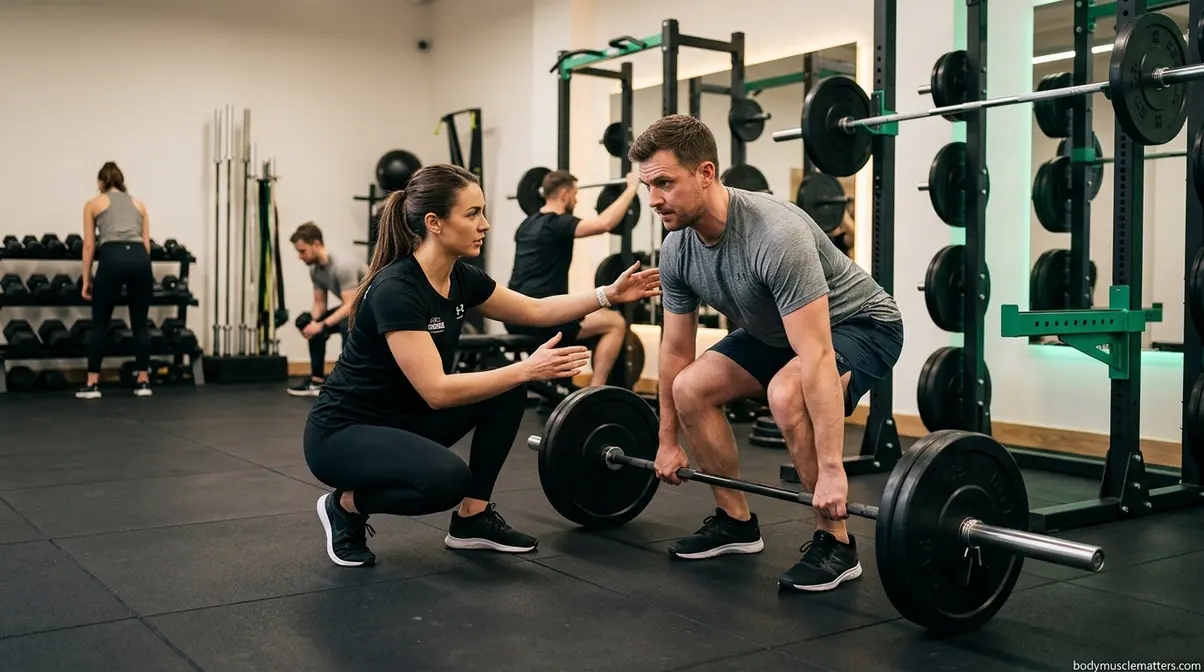
A commercial gym is a large-scale fitness facility open to the general public for a low monthly fee — typically $10–$50/month as of 2026. These facilities serve high member volumes, often 1,000 or more members per location. You’ve likely seen them: Planet Fitness, 24 Hour Fitness, LA Fitness, and Anytime Fitness are some of the most recognizable names in the U.S.
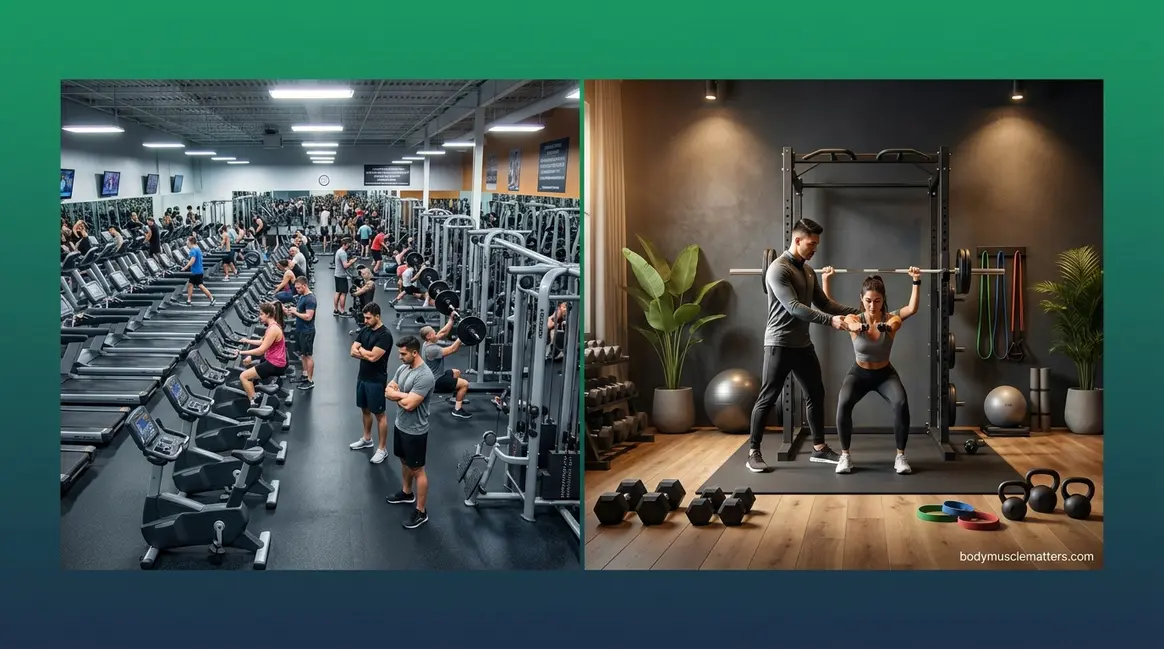
Walk into a commercial gym and you’ll find a broad range of equipment: cardio machines (treadmills, ellipticals, stationary bikes), resistance machines, free weights, and — at larger chains — group fitness studios, locker rooms, and sometimes pools or saunas. The equipment variety is wide, but depth in any one specialty area can be limited.
The business model is straightforward: commercial gyms make money through volume. They sign up as many members as possible at a low monthly fee and profit, in part, because most members don’t show up consistently — reducing equipment wear and facility crowding. Planet Fitness alone reported approximately 20.8 million members across 2,896 clubs as of early 2026 (Planet Fitness Investor Relations, 2026). That scale is only possible because the model assumes most members pay without attending regularly.
Picture a Monday evening at Planet Fitness: the cardio section is packed, a line forms for the squat racks, and the locker room is standing-room-only. That experience is by design, not by accident.
Now that you know what a commercial gym is, here’s what separates a private gym — and why the difference matters more than the price tag suggests.
What Is a Private Gym?
A private gym — also called a private training studio or boutique gym — is a smaller, membership-limited facility (typically 50–200 members maximum) that charges a premium monthly fee ($100–$300+/month) in exchange for personalized coaching, specialized programming, and a focused community.
Examples include a local CrossFit box (a type of private gym focused on group functional fitness), a private personal training studio, or a boutique fitness studio like Orangetheory or F45. Some are run by a single strength coach with a dedicated facility built around one training style.
The environment is intentionally different. Fewer members means shorter — or zero — wait times for equipment. Coaches know your name and your goals. The training space is designed for a specific fitness focus rather than trying to serve everyone at once. A morning session at a private strength training studio might have just 8 members, a coach adjusting your deadlift form in real time, and zero competition for equipment.
The business model is also fundamentally different from a commercial gym. Private gyms make money through outcomes. They charge a premium because they need each member to see results and stay — their revenue depends on retention, not volume. This is why the service feels more tailored and personalized.
With both gym types defined, here’s a side-by-side look at the 7 areas where they differ most — starting with the one that surprises most beginners: the true cost.
The 7 Core Differences at a Glance
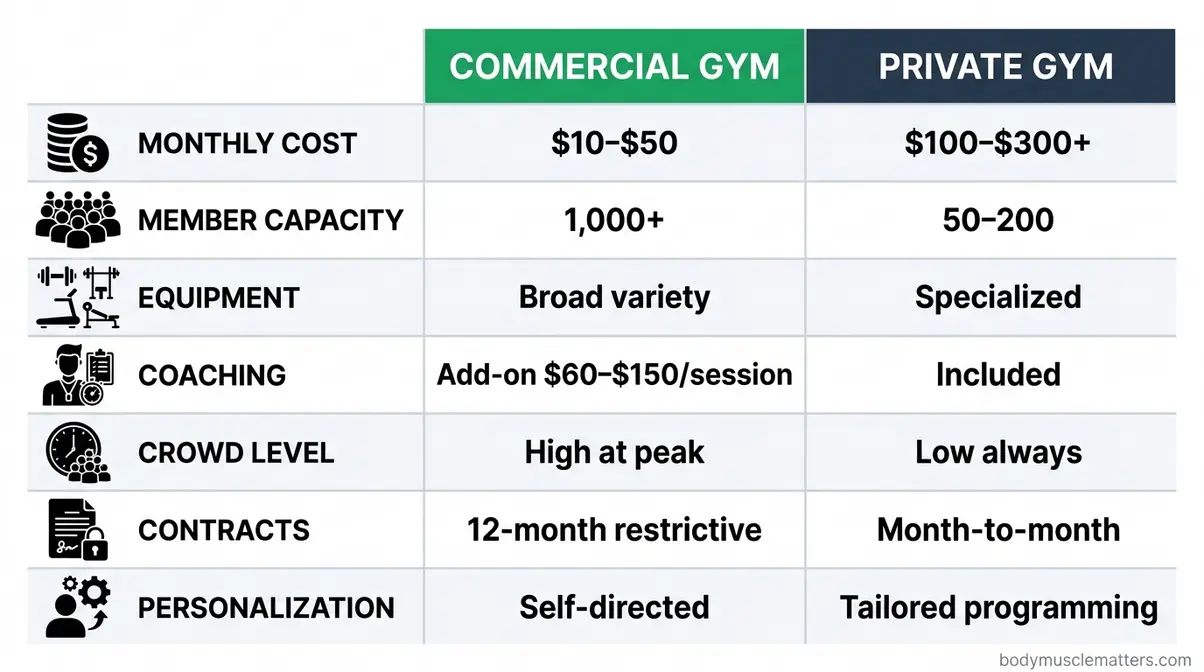
Here’s a quick summary of the core differences between a commercial vs. private gym before we dig into each one in depth.
| Feature | Commercial Gym | Private Gym |
|---|---|---|
| Monthly Cost | $10–$50/month | $100–$300+/month |
| Member Capacity | 1,000+ members | 50–200 members |
| Equipment Variety | Broad (cardio, machines, free weights) | Specialized (goal-specific) |
| Coaching Included | No (optional add-on, $60–$150/session) | Yes (built into membership) |
| Crowd Level | High (especially peak hours) | Low (limited members) |
| Contract Terms | Often 12-month; restrictive cancellation | Varies; often month-to-month |
| Personalization | Low (self-directed) | High (tailored programming) |
As of May 2026, typical pricing ranges are based on national averages across major U.S. markets.
The coaching cost row is the most important one for beginners to understand. A commercial gym’s $10/month looks like an obvious deal — until you realize that any personalized guidance costs extra. Personal training at commercial gyms typically runs $60–$150 per session. Add just 8 sessions per month and your “cheap” gym costs $670/month. A private gym at $200/month with coaching built in? That’s $200/month. The math changes everything — and that gap is the Friction Tax in financial form.
The Business Model Behind Each Gym Type
We expected the price difference to be the main story. What we found is that the business model is the real story — and understanding it protects you from making a costly mistake.
Commercial gyms don’t thrive because they’re well-run fitness destinations. They thrive because most of their members don’t show up. An estimated 67% of gym memberships go unused or are rarely used, with only 18–20% of members attending three or more times per week (Glofox, 2026). This isn’t a bug in the commercial gym model — it’s the feature. Low attendance means lower operating costs, less equipment wear, and higher profit margins.
Private gyms operate on the opposite logic. A private gym with 80 members charging $200/month generates $16,000/month. They cannot afford high churn — so they invest in results. Coaches track your progress, adjust your programming, and notice when you miss a session. Their financial survival depends on your success.
This is where “The Friction Tax” enters the picture. The Friction Tax is the hidden, cumulative cost — in time, motivation, and consistency — that builds up when your gym environment creates barriers to showing up. A commercial gym’s low price can mask a high Friction Tax: waiting for equipment, feeling intimidated by crowds, struggling to cancel a restrictive contract. A private gym’s higher price may carry a very low Friction Tax: no waits, personal accountability, a coach who knows your name.
“A private gym makes sense when the friction of a commercial gym is actually costing you something — your time, your consistency, your ability to do the workout.”
Understanding the business model helps explain the next major difference: what the experience actually feels like when you walk through the door.
Atmosphere, Crowds, and Culture
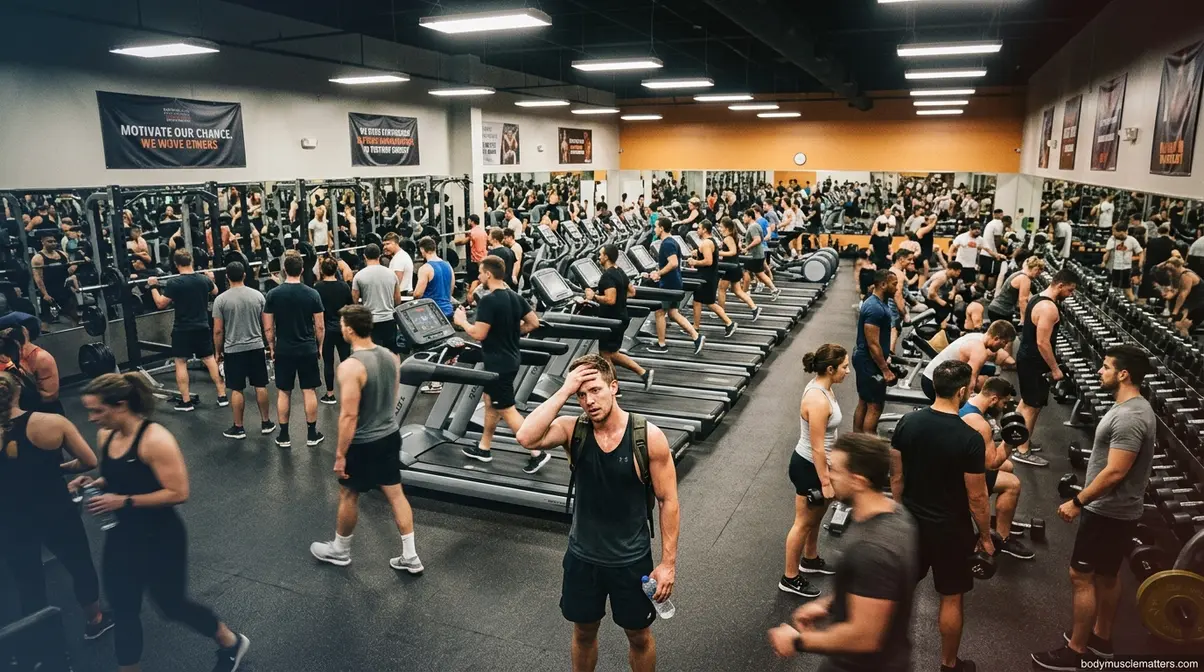
The atmosphere inside a gym directly determines whether you keep going. Research consistently links environment-related discomfort — crowding, intimidation, and lack of belonging — to early membership cancellation. A 2026 national survey found that intimidation and overcrowding are among the top reasons gym members cancel (Athletech News, 2026). Before you choose between a commercial and private gym, you need to know what you’re actually walking into.
What a Commercial Gym Feels Like During Peak Hours
Commercial gyms are designed for throughput, not comfort. During peak hours — typically 5–8 PM on weekdays and 9–11 AM on weekends — the experience can feel less like a workout and more like navigating a crowded airport. Popular machines have informal wait queues. The free weight section gets loud. Locker rooms fill up fast.
This isn’t an exaggeration. The commercial gym model depends on high member volume, so facilities are built to handle large numbers — but not necessarily to make each visit feel smooth. Wait times for specific equipment during peak hours can add 10–20 minutes to a workout, which compounds into hours of wasted time per month. That’s the Friction Tax showing up on your schedule.
For some people, the energy of a busy gym is motivating. For others — especially beginners — it’s the primary reason they stop going. Knowing which type you are before you sign a 12-month contract matters enormously.
The Private Gym Experience: Focused and Distraction-Free
Step into a private gym or boutique studio and the contrast is immediate. With membership capped at 50–200 members, the facility rarely feels crowded. Equipment is available when you need it. The environment is quieter, more purposeful, and built around a specific fitness focus — whether that’s strength training, functional fitness, or sport-specific conditioning.
The community dynamic is also different. In a private gym with fewer members, you’re likely to know the people training alongside you. Coaches remember your goals, your injury history, and your schedule. That accountability — someone noticing when you don’t show up — is one of the most powerful adherence tools in fitness. Research from Smart Health Clubs shows that members who work with personal trainers are twice as likely to renew their memberships (Smart Health Clubs, 2026).
The distraction-free environment of a private gym also means your focus stays on training. No one is filming TikToks next to your squat rack. No ambient chaos. Just work.
Gym Intimidation: The Psychological Factor
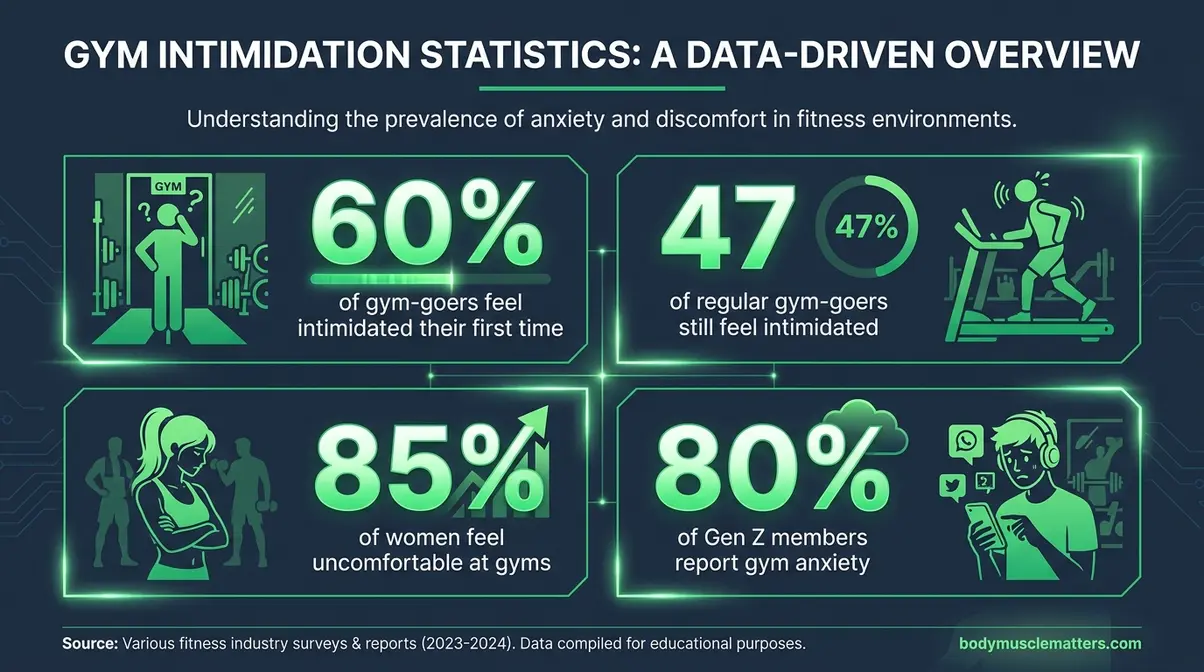
Gym intimidation — sometimes called “gymtimidation” — is more common than most people admit, and it has real consequences for consistency. According to research compiled by Muscle and Brawn, 60% of gym-goers feel intimidated working out for the first time, and 47% of regular gym-goers still report feeling intimidated entering the gym (Muscle and Brawn, 2026). A separate survey found that 85% of women and 80% of Gen Z members feel uncomfortable or anxious at gyms (Levity, 2026).
Commercial gyms — with their open floor plans, mirror-lined walls, and high foot traffic — tend to amplify these feelings. The fitness-focused culture of some commercial gyms can feel unwelcoming to beginners who are still learning the basics. This isn’t universal, but the data suggests it’s common enough to factor into your decision.
Private gyms, by contrast, tend to create tighter-knit communities where newcomers are actively coached rather than left to figure things out alone. The smaller member count reduces social pressure. A coach correcting your form feels supportive rather than embarrassing when it happens in a room of 8 people rather than 80.
Gym intimidation is not a personality weakness — it’s a documented barrier to adherence that the right gym environment can significantly reduce. If intimidation has stopped you from going before, this factor alone may justify the premium of a private gym. If you are navigating gym environments and overcoming gym anxiety, the right choice can make all the difference.
Why do 67% of people with gym memberships never go?
An estimated 67% of gym memberships go unused because the gap between intention and action is wider than most people expect (Glofox, 2026). The primary drivers include inconvenient gym hours or location, intimidating environments, lack of a clear workout plan, and the absence of accountability. This is precisely what the Friction Tax framework measures: when the barriers to going are higher than the motivation to go, inaction wins. Commercial gyms are particularly vulnerable to this dynamic because their model doesn’t require members to show up. Private gyms — with coaches who notice absences and programming that removes decision fatigue — structurally reduce the conditions that cause non-attendance.
Cost, Contracts, and Hidden Fees Compared
The monthly fee you see advertised is rarely the monthly fee you actually pay. When comparing a commercial gym vs. private gym on cost, the sticker price comparison is almost always misleading. Our review of real gym membership pricing structures across major U.S. chains reveals a consistent pattern: commercial gyms use low entry prices to attract members, then recoup revenue through a layered fee structure that most people don’t see coming.
Commercial Gym Pricing: Low Entry, Hidden Costs
Commercial gyms advertise aggressively on their low monthly membership fee — and that number is real. Planet Fitness starts at $10/month. LA Fitness runs around $30–$35/month. 24 Hour Fitness ranges from $30–$50/month depending on location and tier. But the advertised fee is just the beginning.
Here’s what you actually pay at most commercial gyms:
| Fee Type | Typical Range | When You Pay |
|---|---|---|
| Monthly Membership | $10–$50/month | Every month |
| Initiation Fee | $50–$200 | One-time, at signup |
| Annual Maintenance Fee | $30–$50 | Once per year |
| Personal Training (optional) | $60–$150/session | As used |
| Cancellation Fee | $50–$200+ | If you exit early |
| Guest Pass Fees | $5–$15/visit | As used |
Pricing verified as of May 2026. Sources: Rit Fit Sports, 2026; Swing Sesh, 2026.
The initiation fee (a one-time charge to join the gym) alone can add $50–$200 to your first year. The cancellation policy (the rules for ending your membership) at many commercial gyms requires 30–60 days’ notice and charges a fee equal to one or two months’ dues if you exit a 12-month contract early. These restrictive contracts are one of the most common complaints about commercial gyms — and a direct source of Friction Tax.
A realistic first-year cost at a mid-tier commercial gym ($30/month) including an initiation fee of $99 and an annual fee of $40 comes to approximately $500 — not $360. That’s 39% more than the advertised price before you add a single personal training session.
Private Gym Pricing: Higher Upfront, More Transparent
Private gyms and boutique studios typically charge $100–$300+/month, and that number often includes what commercial gyms charge extra for: coaching, programming, and a personalized experience. Some private training studios offer tiered pricing — semi-private training (2–4 people) at $150–$200/month, fully private training at $250–$400/month.
The pricing is higher, but it tends to be more transparent. Many private gyms operate on month-to-month memberships with no long-term contracts and no surprise annual fees. You know exactly what you’re paying — and you know exactly what you’re getting.
The disadvantage of a private gym on cost is real: the barrier to entry is higher. For someone on a tight budget, $200/month may not be accessible regardless of the value it delivers. That’s a legitimate constraint — and one we address directly in the decision framework below.
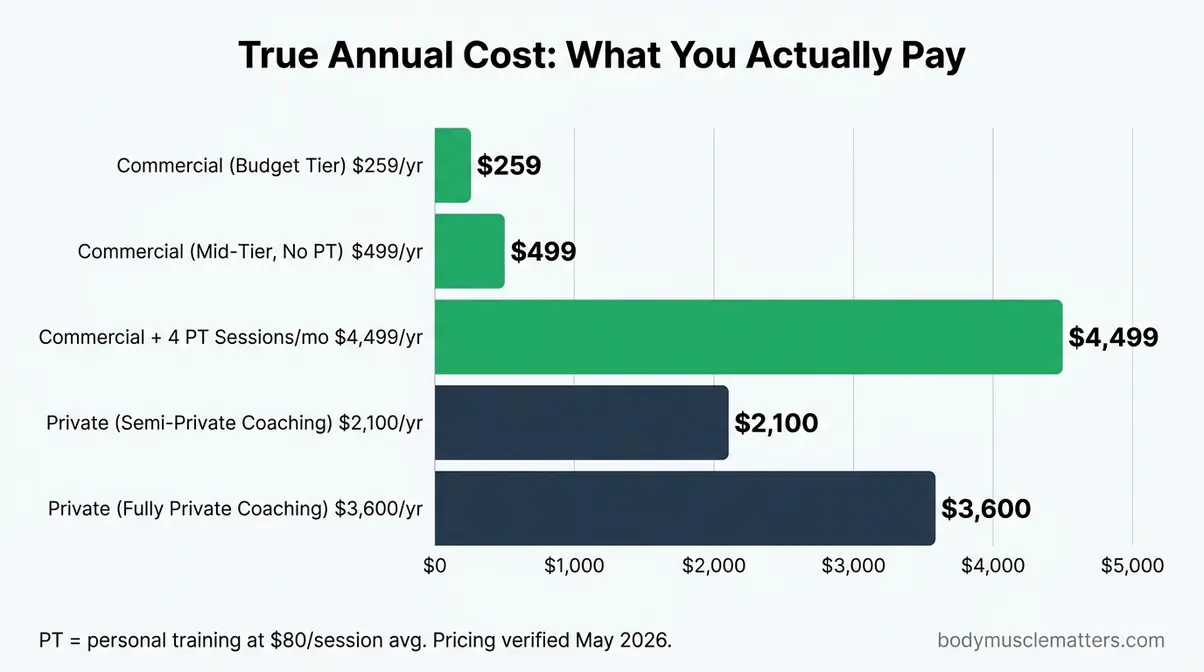
The True Annual Cost: A Side-by-Side Breakdown
Let’s run the real numbers for five scenarios, because the “commercial gym is cheaper” assumption deserves scrutiny.
| Scenario | Monthly Fee | Annual Extras | Annual Total |
|---|---|---|---|
| Commercial gym (budget tier) | $10/mo | $99 initiation + $40 annual fee | $259/yr |
| Commercial gym (mid-tier, no PT) | $30/mo | $99 initiation + $40 annual fee | $499/yr |
| Commercial gym + 4 PT sessions/mo | $30/mo | $99 initiation + $320/mo PT | $4,499/yr |
| Private gym (semi-private coaching) | $175/mo | None (month-to-month) | $2,100/yr |
| Private gym (fully private coaching) | $300/mo | None (month-to-month) | $3,600/yr |
Pricing verified as of May 2026. PT = personal training at $80/session average.
The math is striking. A commercial gym with even modest personal training ($80/session, 4 sessions/month) costs more annually than a mid-range private gym with coaching built in. The question isn’t “is a private gym expensive?” — it’s “what are you actually comparing?”
As for the PAA question “Is $300 a month a lot for a personal trainer?” — in isolation, yes. But if that $300/month is a private gym membership with coaching included, it’s often competitive with, or cheaper than, adding personal training to a commercial gym membership. Context matters.
Commercial Gym vs. Local or Bodybuilding Gym
Not every gym fits neatly into the “commercial” or “private” category. The commercial gym vs. local gym and commercial gym vs. bodybuilding gym comparisons deserve their own treatment — because the right gym for your goals may not be a national chain or a boutique studio. It may be the independent gym two miles away, or the powerlifting facility your colleague mentioned. Here’s how these options stack up.
Commercial Gym vs. Local Independent Gym
A local independent gym sits between commercial and private on most dimensions. Think of it as a neighborhood gym — independently owned, not part of a national chain, often with 200–600 members and pricing in the $30–$75/month range. These gyms are common in smaller cities, suburban areas, and neighborhoods that haven’t been overtaken by franchise chains.
The key differences from a commercial gym:
- Community feel: Staff often know members by name. The environment tends to be less anonymous than a Planet Fitness or 24 Hour Fitness.
- Equipment: Local gyms frequently carry more specialized equipment — heavier free weights, specialty bars, platforms — because their membership base tends to be more serious about training.
- Flexibility: Contracts at independent gyms are often more negotiable. Month-to-month options are common.
- Group fitness: Larger commercial chains win here — they offer more class variety and schedule density than most independent gyms.
For budget-conscious beginners who want more community than a commercial chain provides but can’t afford a private studio, a local independent gym can be the right middle ground. The Friction Tax at a well-run local gym is often lower than at a commercial chain — fewer members means less crowding — without the premium price of a fully private facility.
According to the Health and Fitness Association’s 2026 report, 81 million Americans belonged to a gym, studio, or fitness facility in 2026 — an all-time high. That growth has been driven in part by independent studios and local gyms filling gaps that large commercial chains don’t address.
Commercial Gym vs. Bodybuilding or Powerlifting Gym
A bodybuilding or powerlifting gym is a type of private or semi-private gym focused specifically on strength sports and physique training. These facilities prioritize heavy iron over cardio machines — you’ll find multiple squat racks, deadlift platforms, specialty bars (safety squat bars, cambered bars, trap bars), and chalk. You won’t find treadmill banks or group yoga classes.
Commercial gyms — even well-equipped ones — rarely match this depth of strength-specific equipment. Policies at many commercial chains (Planet Fitness famously discourages “gymtimidation” and limits heavy free weight use) can actively work against serious strength training goals.
If your goal is powerlifting, Olympic weightlifting, or competitive bodybuilding, a commercial gym is likely the wrong tool. A dedicated strength gym — often priced at $50–$150/month, landing between commercial and fully private pricing — provides the equipment, culture, and coaching context your training requires. For those understanding specialized training approaches like bodybuilding and strength training, a standard facility might not suffice.
Which Training Style Fits Your Goals?
Before choosing any gym type, get clear on your training goal. Here’s a simple framework:
| Goal | Best Gym Type | Why |
|---|---|---|
| General fitness, weight loss | Commercial or local gym | Broad equipment, affordable, flexible hours |
| Strength training, muscle building | Local gym, bodybuilding gym, or private | Specialized equipment, coaching, culture |
| Sport-specific conditioning | Private gym or CrossFit box | Programmed coaching, community accountability |
| Group fitness classes | Commercial gym (large chain) | Class variety and scheduling density |
| Maximum personalization | Private training studio | 1-on-1 or semi-private coaching built in |
Your goal determines your gym. Choosing a gym that doesn’t match your training style is one of the most common — and most avoidable — sources of Friction Tax.
Which Gym Is Right for You? A Personal Fit Guide
The right gym is the one you’ll actually use. That sounds obvious, but most people choose a gym based on price or proximity — not based on their personality, their goals, or the environment they need to stay consistent. This section gives you a direct framework for making that call. We also cover the trending 3-3-3 rule and why your gym environment determines whether it works for you.
Pros and Cons of Commercial Gyms
- Pros of Commercial Gyms:
- Low monthly cost ($10–$50/month) makes fitness accessible on nearly any budget
- Wide equipment variety — cardio, machines, free weights, and often group fitness classes
- Flexible hours — many commercial chains are open 24/7 or close to it
- Multiple locations — national chains allow you to work out while traveling
- No commitment required — some tiers offer month-to-month options with no initiation fee during promotions
- Cons of Commercial Gyms:
- Hidden fees — initiation fees ($50–$200), annual maintenance fees ($30–$50), and restrictive cancellation policies add real cost
- Crowded peak hours — wait times for popular equipment during 5–8 PM can add 10–20 minutes to every session
- No coaching included — self-directed training without guidance leads to slower progress and higher injury risk for beginners
- High dropout rates — 50% of new commercial gym members quit within six months (HFA, 2026)
- Intimidation factor — open floor plans and high traffic can feel overwhelming for newcomers
Pros and Cons of Private Gyms
- Pros of Private Gyms:
- Coaching included — personalized programming and form correction are built into the membership price
- Distraction-free environment — limited membership means no crowding, no waits, and focused training sessions
- Higher retention rates — boutique gyms achieve 70–80% annual retention, compared to roughly 60% for commercial gyms (Smart Health Clubs, 2026)
- Community accountability — coaches and fellow members notice when you miss a session
- Transparent pricing — fewer surprise fees; month-to-month options are common
- Cons of Private Gyms:
- Higher monthly cost ($100–$300+/month) is a genuine barrier for budget-constrained individuals
- Limited equipment variety — specialized gyms may not have the full range of equipment a beginner wants to explore
- Smaller class schedules — fewer session times may not suit irregular work schedules
- Niche culture — a CrossFit box or powerlifting gym may feel culturally specific and unwelcoming to those outside that training style
- Fewer locations — traveling with a private gym membership is difficult; most are single-location facilities
Best For: Matching Your Profile to the Right Gym
Use this decision framework to match your situation to the right gym type:
| Your Profile | Best Choice | Why |
|---|---|---|
| Tight budget, flexible goals | Commercial gym | $10–$30/month covers the basics; explore what you enjoy |
| Beginner needing guidance | Private gym or boutique studio | Coaching prevents injury and builds habits faster |
| Self-motivated, experienced lifter | Commercial gym or local gym | You don’t need coaching; you need equipment access |
| Accountability-dependent | Private gym | Coach-led structure reduces dropout risk significantly |
| Specific sport/strength goal | Bodybuilding gym or CrossFit box | Specialized equipment and culture match the training |
| Intimidation is a real concern | Private gym | Smaller community, coached environment reduces anxiety |
| Travels frequently | Commercial gym (national chain) | Multi-location access is a practical advantage |
The Friction Tax framework makes this decision clearer. If the barriers at a commercial gym — the crowds, the lack of guidance, the intimidating environment — are likely to cause you to stop going within three months, the “cheaper” option is actually more expensive in the long run. A $200/month private gym you attend consistently for 12 months costs $2,400/year. A $30/month commercial gym you abandon after 90 days — plus the initiation fee and cancellation penalty — may cost $400 for zero fitness progress.
The 3-3-3 Rule and Long-Term Gym Adherence
The 3-3-3 rule is one of the most widely shared training frameworks in 2026. In its most popular form, it means: 3 gym sessions per week, 3 key compound movements per session, 3 sets each (Snap Fitness, 2026). The appeal is simplicity — no complicated programming, no decision fatigue, just a repeatable structure that builds the habit of showing up.
An alternative version defines 3-3-3 as: 3 days of strength training, 3 days of cardio, and 3 days of active recovery per week — a balanced split that aligns with the CDC’s recommendation of 150+ minutes of moderate activity per week (EVO Fitness, 2026).
Both versions work. The variable is not the rule — it’s the environment. Research on exercise adherence consistently shows that environmental friction is the primary predictor of whether people maintain workout habits. Members who work with personal trainers are twice as likely to renew their memberships, and group class participation boosts retention by 56% over solo training (Smart Health Clubs, 2026).
In a commercial gym, the 3-3-3 rule requires self-direction. You must navigate peak-hour crowds, manage equipment availability, and hold yourself accountable with no external support. In a private gym or boutique studio, the 3-3-3 structure is often built into the programming — your coach manages it for you.
The 3-3-3 rule is a great framework. Pair it with the right gym environment, and it becomes a consistency engine. In the wrong environment, even the best framework breaks down under the weight of friction.
Limitations: When Choices Backfire
Even with the right framework, both gym types carry real risks. Knowing them in advance keeps you from making a costly mistake.
Common Pitfalls to Avoid
Pitfall 1: Signing a long-term commercial gym contract without reading the cancellation policy.
Many commercial gym contracts require 30–60 days’ notice to cancel and charge a fee equal to one or two months’ dues for early termination. If you move, get injured, or simply stop going, you may keep paying for months. Always request the cancellation policy in writing before signing. Ask: “What exactly do I pay if I cancel in month 3?”
Pitfall 2: Choosing a private gym based on price alone without evaluating coaching quality.
A private gym charges a premium because coaching is the core value proposition. If the coaching is generic, inconsistent, or misaligned with your goals, you’re overpaying for a less-crowded version of a commercial gym. Before joining, attend a trial session and evaluate whether the coach actually adapts to your level and goals.
Pitfall 3: Assuming a commercial gym’s equipment variety matches your specific training needs.
Broad equipment variety does not mean deep equipment variety. A commercial gym may have 20 treadmills and 3 squat racks — a ratio that works for cardio-focused members but frustrates strength trainers. Audit the specific equipment you plan to use before committing.
Pitfall 4: Underestimating the Friction Tax of peak-hour crowding.
If your only available workout window is 6–7 PM on weekdays, a commercial gym’s crowding problem will affect you every single session. Test your target gym during your actual workout window — not during a quiet midday visit — before signing up.
When to Choose an Alternative
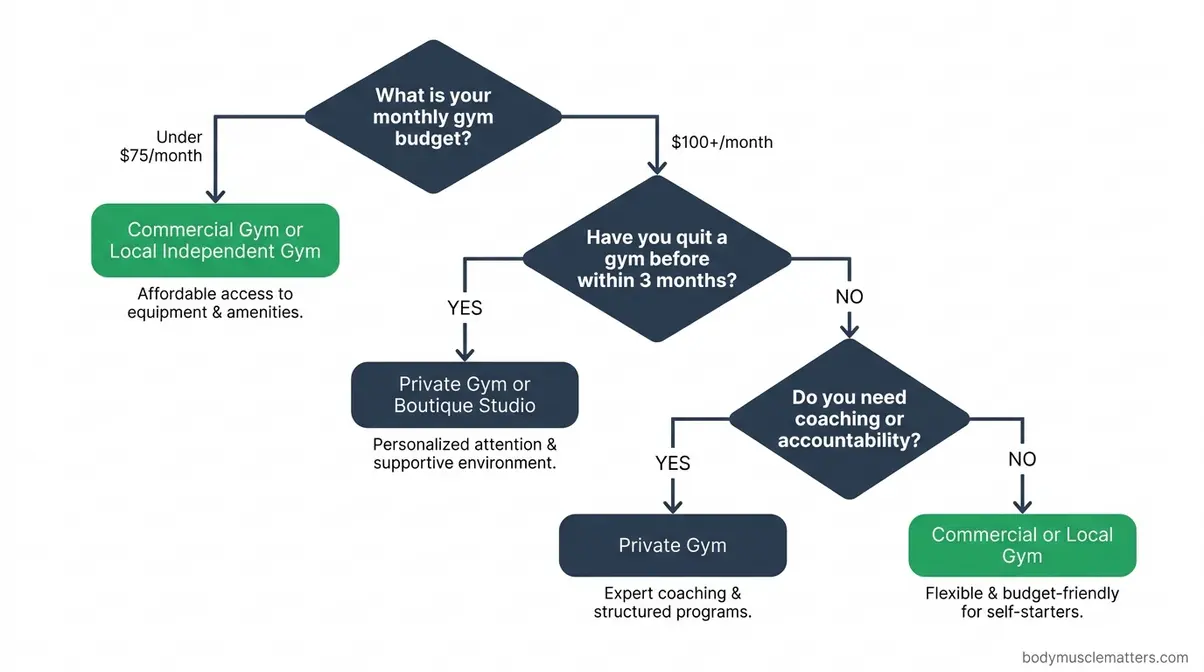
Choose if: You want community feel and more flexible contracts at a mid-range price ($30–$75/month), but a fully private gym is outside your budget. Local gyms often offer the best of both worlds for intermediate exercisers.
Choose if: Your budget is under $75/month, you’re still exploring what type of training you enjoy, or you travel frequently and need multi-location access. A commercial gym is the right starting point for most absolute beginners.
Choose if: You’ve tried a commercial gym and quit within three months, you have a specific goal that requires coaching (strength, sport-specific, weight loss with accountability), or gym intimidation has been a real barrier to consistency in the past.
When to Seek Expert Help
Some decisions go beyond gym type selection. Consult a certified personal trainer or fitness professional if you’re returning to exercise after an injury, managing a chronic health condition, or have a specific performance goal (competitive sport, body composition change, rehabilitation). A gym environment is only one variable — programming quality and medical clearance matter equally. Always consult a healthcare professional before starting a new fitness program.
Frequently Asked Questions
What is the 3-3-3 rule at the gym?
The 3-3-3 rule is a simple training framework: 3 gym sessions per week, 3 compound movements per session, and 3 sets of each exercise. The goal is to eliminate decision fatigue and build a consistent habit without overcomplicating your routine. Common movements include squats, push-ups, and rows. Both versions work well in either gym type — but your environment determines whether you consistently show up to execute the rule (Snap Fitness, 2026).
What are the disadvantages of a private gym?
The primary disadvantage of a private gym is cost — monthly fees of $100–$300+ are a genuine barrier for budget-constrained individuals. Beyond price, private gyms offer limited equipment variety, fewer class times, and often a single location. However, for members who need accountability and coaching, these trade-offs are often worth the premium, or a local independent gym at $30–$75/month can serve as a practical middle ground.
Is $300 a month a lot for a personal trainer?
In isolation, $300/month for a personal trainer is on the lower end of the market. Individual personal training sessions typically run $60–$150 each (Rit Fit Sports, 2026), meaning $300/month covers only 2–5 sessions. However, if that $300/month is a private gym membership with coaching built in, it’s often a strong value. A commercial gym at $30/month plus 4 personal training sessions at $80 each costs $350/month. This is significantly more than the private gym alternative. The key question isn’t whether $300/month is a lot, but what you’re comparing it to and whether the coaching quality justifies the investment.
What muscle is hardest to grow?
Calves are widely considered the most difficult muscle group to develop, primarily because they are composed predominantly of slow-twitch muscle fibers that are highly fatigue-resistant and require high training volume and frequency to stimulate growth. Forearms and rear deltoids are also frequently cited as stubborn muscle groups. The gym environment affects this indirectly: in a private gym with a coach, you’re more likely to receive programming that addresses lagging muscle groups systematically. In a commercial gym, self-directed training often underemphasizes difficult muscle groups. Consistent, progressive overload — regardless of gym type — is the primary driver of growth in any muscle.
Is 3 hours at the gym okay?
Three hours at the gym is generally unnecessary and potentially counterproductive for most people. For most gym-goers, 45–75 minutes of focused, quality training outperforms 3 hours of unfocused work. If your sessions run 3 hours, the most likely cause is excessive rest periods, socializing, or waiting for equipment.
What is the 3-3-3 rule in gym? (Alternative interpretation)
Some fitness communities define the 3-3-3 gym rule as a weekly training split: 3 days of strength training, 3 days of cardio, and 3 days of active recovery. This version aligns well with the CDC’s physical activity guidelines of 150 minutes of moderate aerobic activity and 2 days of strength training per week. Both interpretations share the same core principle: simplicity drives consistency.
Making Your Final Decision
For budget-conscious beginners exploring the commercial gym vs private gym question, the data points in one direction: your environment is not a secondary consideration — it is the primary driver of whether you succeed. An estimated 50% of new gym members quit within six months (HFA, 2026), and the leading causes — intimidation, crowding, lack of support — are all environment variables, not willpower failures.
The Friction Tax framework reframes the decision. The right gym is not the cheapest gym — it’s the gym with the lowest total cost, including the hidden cost of friction. A $10/month commercial gym membership you use twice then abandon costs more than a $200/month private gym you attend three times a week for a year. The math is straightforward once you include consistency in the calculation.
Every gym comparison in this guide — cost, environment, contracts, training style, and adherence — points back to the same question: which option reduces your specific Friction Tax? For self-motivated, budget-conscious individuals with clear goals and no intimidation concerns, a commercial gym or local independent gym is the right starting point. For anyone who has previously quit a gym within three months, needs coaching to make progress, or finds crowded environments demotivating, the premium of a private gym is not a luxury — it’s an investment in actually getting results.
Start by identifying your biggest friction point. Is it cost? Choose a commercial gym and commit to 90 days. Is it intimidation or lack of guidance? Invest in a trial session at a private gym or boutique studio before dismissing the price. Is it accountability? The 3-3-3 rule in a coached environment may be the most efficient path to consistency you’ve tried. Take one concrete step this week — visit both a commercial gym and a private studio in your area during your actual workout window. The right choice will become obvious faster than any comparison guide can make it.
Prices verified as of May 2026. Consult a healthcare professional before starting a new fitness program.
Related posts:
Best Protein Tracker App: Tested & Compared for 2026
Best Muscle Building App 2026: 7 Expert-Tested Picks
How to Use Resistance Bands for Beginners: Full Guide
Best Food Tracking App for Beginners: Top 5 of 2026
Best Home Workout App 2026: Top 10 Tested & Ranked
Gym Equipment Names and Uses: A Beginner Guide

Callum
Hi, I'm Callum, the founder of Body Muscle Matters. I'm not a certified trainer, I'm a self taught lifter who started this site to share what I've learned from my own training and a lot of trial and error. Everything here comes from real experience and honest research, written the way I'd explain it to a friend who is just getting started. My goal is simple: practical, no hype fitness advice you can actually use.