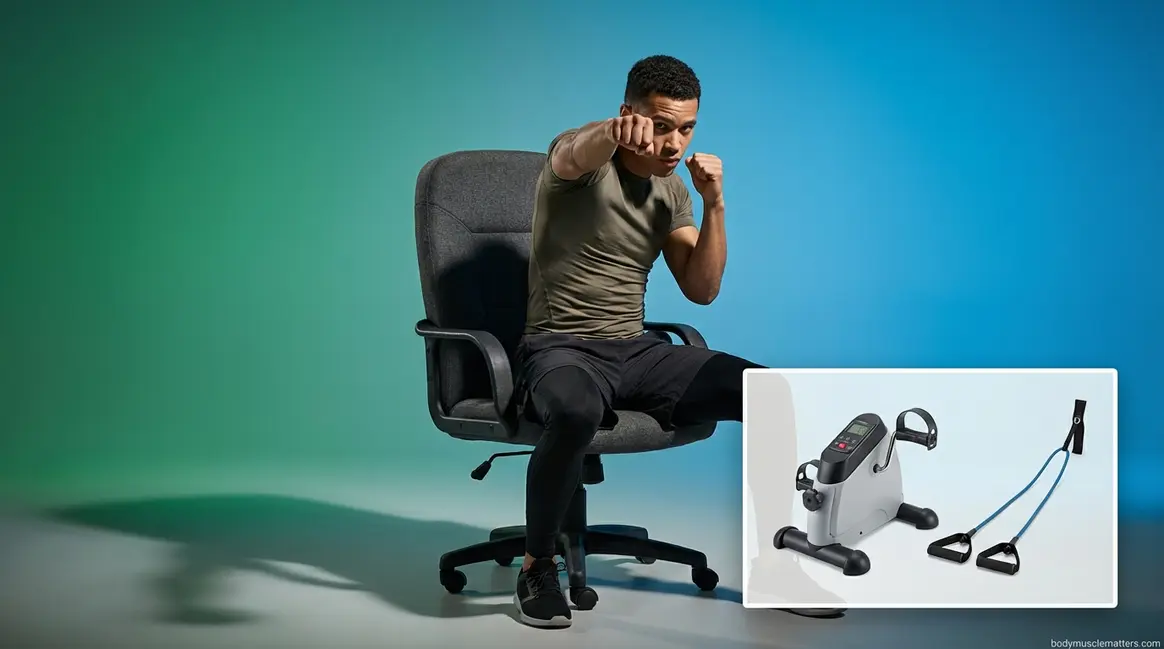
Your legs are out of commission — injured, brutally sore, or simply not cooperating — and suddenly every cardio routine you know assumes you have two working legs. Running, cycling, jumping jacks: all off the table. Every day without cardio feels like your aerobic fitness is quietly draining away, and that fear of losing your momentum is completely valid.
Here’s what most guides won’t tell you: cardio without using legs is not a workaround. It is a scientifically legitimate method of maintaining cardiovascular fitness, and your upper body has everything it needs to do the job. In this guide, you will learn exactly how to keep your heart rate up — and your fitness on track — using 15 upper-body cardio exercises that require zero leg involvement. We start with the science, cover safe training rules for injuries, then walk through every exercise step-by-step.
Key Takeaways: Cardio Without Using Your Legs
Yes — upper-body cardio without legs is scientifically valid and can meet your weekly fitness goals. Research shows arm-based exercises can reach 70–85% of maximum heart rate (PubMed, 2019).
- No equipment needed: Seated shadow boxing and arm circles work immediately at home
- Best gym option: Arm ergometers and seated battle ropes deliver the highest intensity
- Injury or soreness: Always get medical clearance before starting — then start low, build slow
- The Upper Engine Framework: Your upper body can sustain full cardiovascular training on its own — choose the right exercises at the right intensity
⚠️ Medical Disclaimer: This article is for informational purposes only and is not a substitute for professional medical advice, diagnosis, or treatment. If you have a leg injury, chronic condition, or are recovering from surgery, consult your doctor or licensed physical therapist before starting any exercise routine.
Can You Do Cardio Without Your Legs?
Yes, you can do effective cardio without using your legs at all. Exercises like arm ergometers (hand-powered stationary cycling machines), seated shadow boxing, and battle ropes elevate your heart rate into the cardiovascular training zone — between 60 and 85 percent of your maximum heart rate — without any lower-body movement. The CDC recommends 150 minutes of moderate aerobic activity per week for adults, including those with disabilities (CDC, 2026), and this is fully achievable through upper-body exercise alone.
Why Upper Body Cardio Actually Works
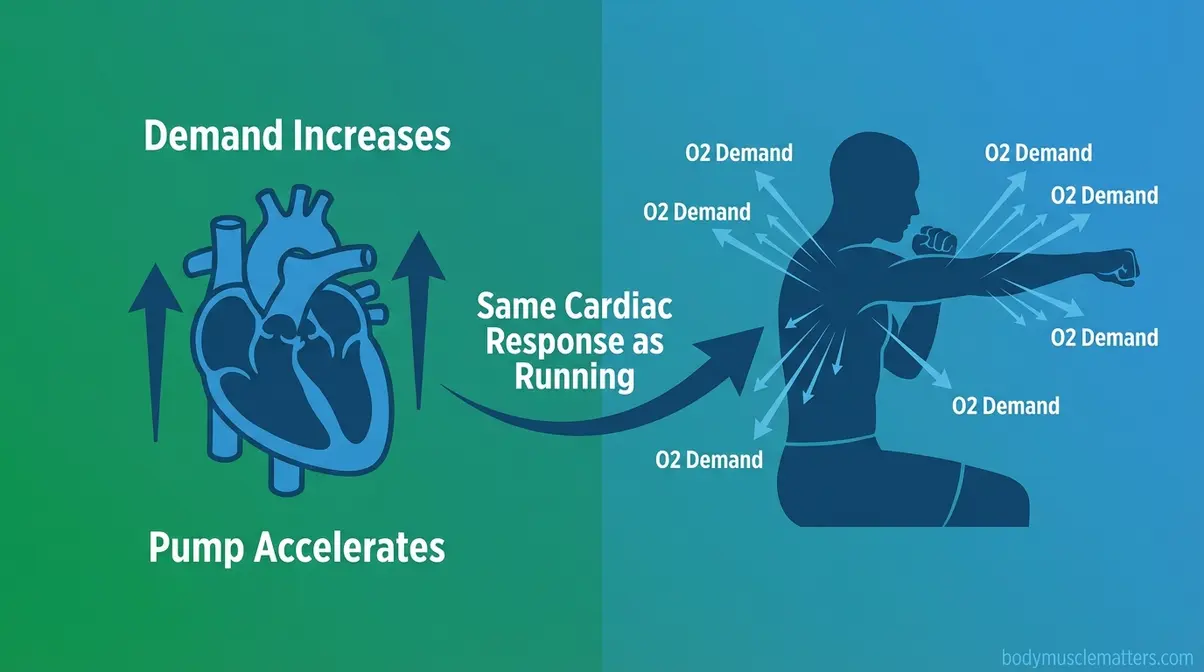
Your heart does not know which muscles are calling for oxygen — it only knows that demand has increased and it needs to pump faster. When your arms, shoulders, chest, and back work hard, they consume oxygen rapidly. That demand triggers the same cardiovascular response as running or cycling.
Think of your heart as a pump that responds to pressure. Push on your legs, the pump accelerates. Push on your arms and shoulders with enough intensity, and the pump accelerates just the same. Your upper body’s major muscle groups — shoulders, chest, back, and arms — together represent a substantial portion of your total body muscle mass, enough to generate real cardiac demand when trained at the right intensity.
Cardiovascular adaptations during upper body exercise are well-documented in clinical research: dynamic upper-body exercises produce measurable cardiovascular training benefits. The maximum oxygen uptake ceiling is somewhat lower than leg-based exercise — but it is still far better than no exercise at all, and it is more than sufficient to improve and maintain aerobic fitness (PubMed, 1989).
Now that you know why it works, here is what research specifically says about how hard you can actually push — because the numbers may surprise you.
What Research Says About Intensity
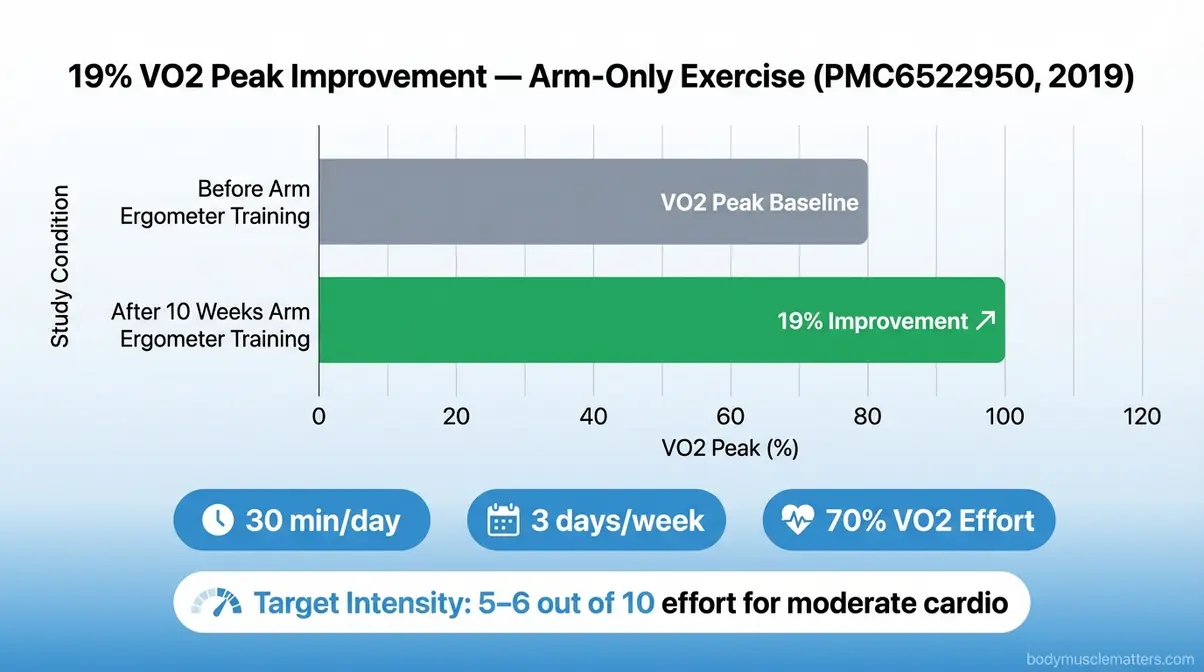
VO2 max is a measure of how efficiently your body uses oxygen during exercise — it is one of the best indicators of cardiovascular fitness. Upper-body exercise does develop VO2 max. The ceiling is somewhat lower than what legs produce, but the training adaptation is real and clinically meaningful.
A key study found that ten weeks of arm crank ergometry training — 30 minutes per day, three days per week at 70% VO2 peak — produced a 19% improvement in relative VO2 peak in participants (PMC6522950, PubMed, 2019). That is a significant aerobic gain from arm-only exercise. Separately, sprint-intensity arm interval training has shown promising results for enhancing cardiorespiratory fitness in recent research (JMIR Formative Research, 2026).
Cardio exercise without using legs can also satisfy the NHLBI’s and CDC’s 150-minutes-per-week recommendation for cardiovascular health. Adults with chronic conditions or disabilities who are able should aim for at least 150 minutes of moderate-intensity aerobic activity per week — achievable entirely through upper-body exercise modalities (CDC physical activity guidelines for adults with disabilities, CDC, 2026).
To match moderate intensity, aim for an effort level of 5–6 out of 10 during arm-based cardio — where you can still hold a short conversation, but your heart is clearly working.
The Upper Engine Framework
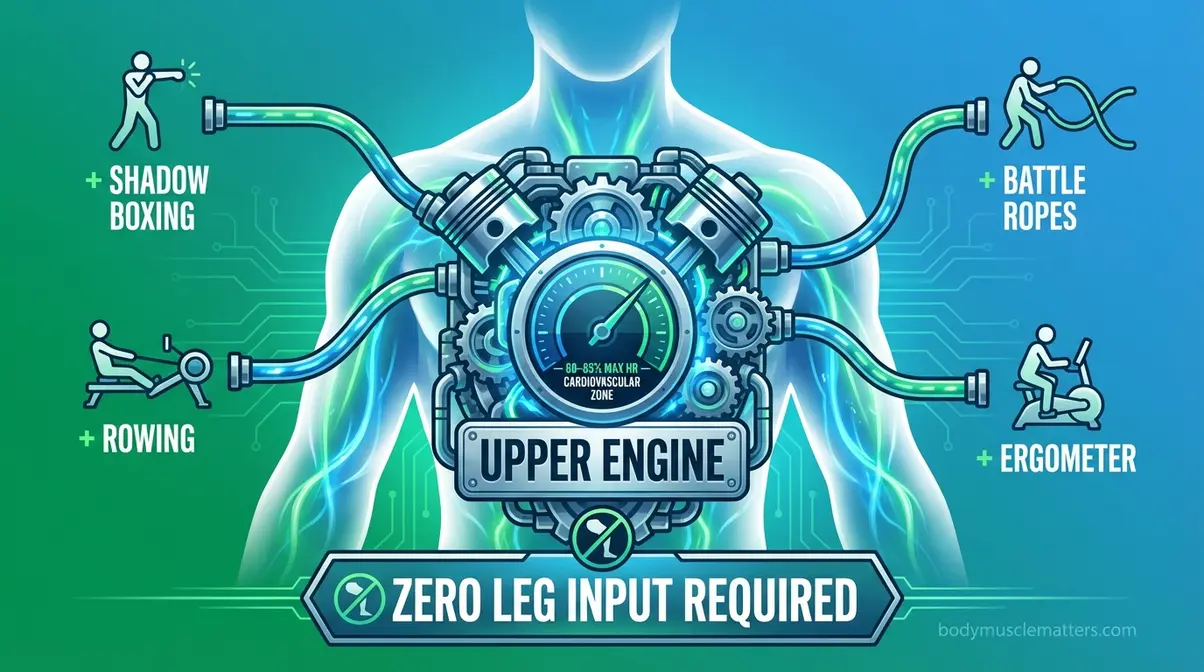
The Upper Engine Framework — the core idea behind this guide — is simple: your upper body is a complete cardiovascular engine. Feed it enough intensity — the right exercises, the right pace, the right duration — and it will drive your heart rate, burn calories, and build aerobic fitness without your legs contributing a single contraction.
Two variables make it work. First, choose exercises that engage large upper-body muscle groups simultaneously (not just bicep curls). Second, maintain sufficient intensity: aim for an effort level of 6–8 out of 10, or a heart rate of 60–85% of your maximum. Shadow boxing for 20 minutes at a rapid pace is not a light workout — your shoulders, chest, core, and arms are all working hard. That collective demand is what makes the Upper Engine run. Ways to do cardio without using legs become far more intuitive once you understand that your goal is simply to load those upper muscle groups consistently.
Before you start any of the 15 exercises in this guide, there is one important topic to address: is it actually safe to exercise if your legs are injured or sore?
Exercising Safely With a Leg Injury or Sore Legs
Adults recovering from leg injuries can safely maintain cardiovascular fitness through upper-body exercise — the CDC’s 150 min/week aerobic activity guideline remains achievable without any leg involvement (CDC, 2026). However, “safely” is the operative word. The right approach depends on whether your legs are injured (a structural problem that hasn’t healed) or simply sore from your last workout. These two situations call for very different responses.
Green-Light Rules for Leg Injuries
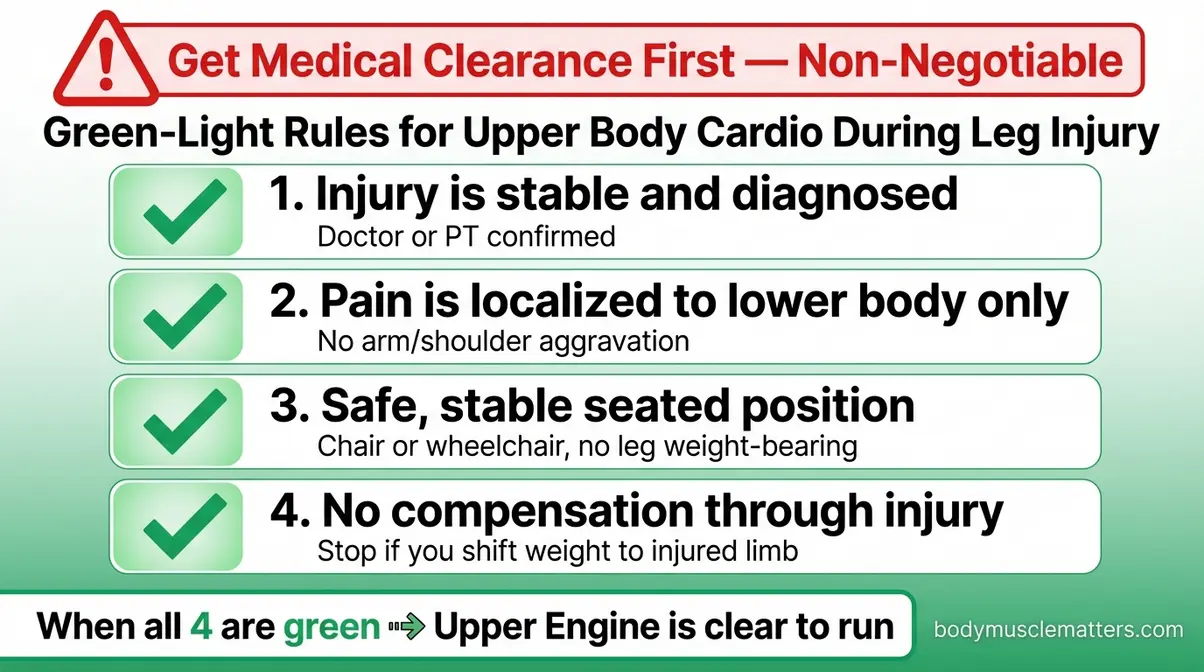
How to do cardio when you have a leg injury starts with one non-negotiable step: get clearance from your doctor or physical therapist before beginning any new exercise routine. A physical therapist is a licensed healthcare professional who specializes in movement rehabilitation — and they can tell you exactly what is and is not safe for your specific injury.
Once you have clearance, these four criteria indicate you are in the green zone for upper-body cardio:
- Your injury is stable and diagnosed. You know what the injury is (sprain, fracture, post-surgical recovery) and a medical professional has confirmed your upper body is unaffected.
- Your pain is localized to the lower body. If movement of your arms, shoulders, or trunk does not aggravate the injury site, upper-body exercise is generally appropriate.
- You can maintain a safe position. You can sit securely in a chair or wheelchair without depending on the injured leg for balance or weight-bearing.
- You are not compensating through the injury. If any exercise causes you to brace, twist, or shift weight into the injured area, stop and modify.
The Cleveland Clinic confirms that upper-body exercise — including bench press variations, rows, curls, and shoulder raises — is appropriate for individuals with foot and leg injuries, provided the injured limb is not loaded (Cardio and strength workouts with an injured foot, Cleveland Clinic, 2026). For additional protocols, see our Guide to Training with Lower Body Injuries. The Upper Engine Framework is especially useful here: the lower engine is in the repair shop, but the upper engine can safely run at full capacity.
What to Do When Your Legs Are Just Sore
DOMS — delayed onset muscle soreness, the aching feeling in muscles 24–48 hours after a tough workout — is not an injury. It is a normal physiological response to muscle stress, and it resolves on its own within a day or two. Sore legs from leg day do not mean your heart or upper body need rest.
If your legs are sore but structurally sound, you can do cardio if legs are sore by simply keeping the lower body out of the equation entirely. Seated shadow boxing, arm ergometers, and resistance band rows place zero demand on tired leg muscles. Active recovery through upper-body cardio may even help reduce overall soreness by improving circulation — though current evidence is modest on this point, so do not count on it as a guarantee.
Start at a lower intensity than usual on sore days — aim for effort level 5–6 rather than 7–8 — and listen to how your body responds.
Warning Signs: When to Stop
Stop your workout immediately and contact a healthcare professional if you experience any of the following:
- Sharp, shooting, or radiating pain in the injured area during or after upper-body exercise
- Increased swelling or heat at the injury site following a session
- Numbness or tingling anywhere in the affected limb
- Dizziness, chest pain, or shortness of breath disproportionate to your effort level
- Visible deformity or a sensation that something has “given way” in the injury site
These are not warning signs to push through. They are signals that your body needs professional evaluation, not more exercise. When in doubt, stop and call — that is always the right decision.
How We Selected These Exercises
Our team evaluated these exercises using published sports medicine research and aggregated feedback from fitness communities including Reddit r/Fitness, r/WeightLossAdvice, and r/bodyweightfitness. Each exercise was assessed against three criteria: (1) zero mandatory leg involvement, (2) documented ability to elevate heart rate into the cardiovascular training zone (60–85% HRmax), and (3) accessibility — meaning it could be performed seated, in a wheelchair, or at home with minimal equipment. Exercises meeting all three criteria were included.
6 No-Equipment At-Home Cardio Exercises
These six exercises require no gym, no machine, and no investment. All you need is a sturdy chair and, for one exercise, a pair of light dumbbells. This is where the Upper Engine Framework meets everyday reality — proof that how to do cardio without using legs does not require a specialist facility.
Exercise #1 — Seated Shadow Boxing
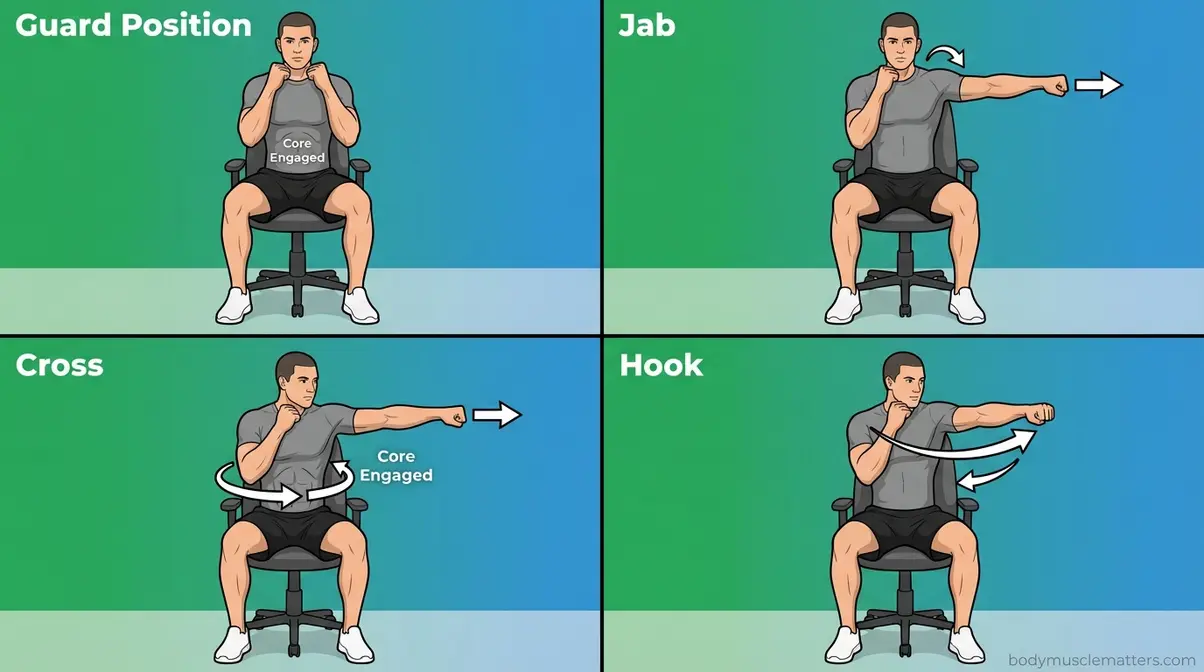
Caption: Seated shadow boxing engages shoulders, chest, and core simultaneously — delivering real cardiovascular intensity from a chair.
Intensity: Moderate–High | Equipment: Chair only
Shadow boxing — throwing punches in the air against an imaginary opponent — is one of the most effective forms of non-weight-bearing cardio available. When you are seated, your core stabilizes every punch, adding abdominal engagement to the shoulder and arm work. At a sustained rapid pace, heart rate climbs quickly into the aerobic zone.
- Step-by-step instructions:
- Sit upright on a sturdy chair, feet flat on the floor (or resting comfortably if injured), hands raised in a guard position at chin height.
- Throw a straight jab with your lead hand, extending fully and snapping back quickly.
- Follow with a cross from your opposite hand — rotate your torso slightly as you punch for core engagement.
- Add hooks (sideways punches) and uppercuts as you grow comfortable.
- Aim for 30-second rounds at maximum speed, followed by 15 seconds of rest.
- Work up to 8–10 rounds continuously.
Why this works: The rapid, explosive arm movements demand sustained oxygen delivery to your shoulders and chest — elevating heart rate into the cardiovascular training zone within 60–90 seconds of sustained effort.
Exercise #2 — Chair Aerobics
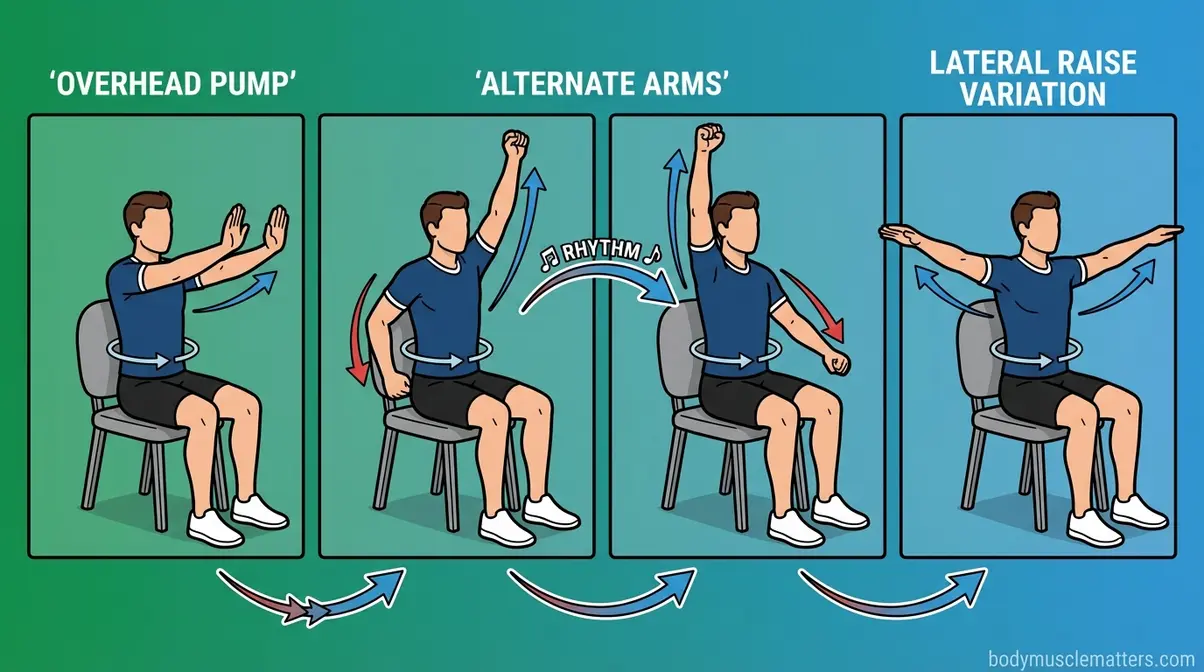
Caption: Seated arm pumps mimic the rhythm of marching or running — all from a chair, with no leg involvement required.
Intensity: Low–Moderate | Equipment: Chair only
Chair aerobics — structured rhythmic arm movements performed while seated — represent the most accessible form of cardio without using legs. No equipment is needed, no fitness background is required, and the pace can be adjusted from very easy to genuinely challenging. For a full routine, try our 15-Minute Seated Upper Body Circuit.
- Step-by-step instructions:
- Sit tall in a firm chair, spine straight, core lightly engaged.
- Raise both arms to shoulder height in front of you, elbows slightly bent.
- Begin alternating an overhead pumping motion — right arm pushes up, left arm pulls down, then switch — like marching with your arms.
- Increase speed gradually over 60 seconds until you reach your target effort (5–7 out of 10).
- Add lateral raises, front raises, and wide-arm circles to vary the stimulus.
- Continue for 20–30 minutes, resting 30 seconds every 5 minutes if needed.
Why this works: Sustained rhythmic arm movement keeps your heart rate continuously elevated without any single movement being too demanding — ideal for beginners or those early in injury recovery.
Exercise #3 — Arm Circles and Windmills
Intensity: Low | Equipment: Chair or standing (supported)
Arm circles and windmills are the gentlest entry point in this list — but do not let that fool you. Performed at speed, with maximum range of motion, they activate the rotator cuff, deltoids, and upper back in a way that accumulates meaningful cardiovascular stimulus over time.
- Step-by-step instructions:
- Extend both arms straight out to your sides at shoulder height.
- Make small, controlled circles forward — gradually increasing circle size over 20 seconds.
- Reverse direction for 20 seconds, making large backward circles.
- Transition to windmills: swing one arm forward and one arm backward in opposite large arcs simultaneously.
- Alternate between circles and windmills every 30 seconds.
- Continue for 10–15 minutes at a pace that keeps effort at 4–6 out of 10.
Why this works: The continuous rotational demand on shoulder stabilizers creates muscular fatigue and sustained oxygen demand — more challenging than it looks at moderate speed.
Exercise #4 — Seated Dumbbell Punching
Intensity: Moderate–High | Equipment: 1–3 kg dumbbells (light)
User consensus from Reddit fitness communities confirms that seated dumbbell punching is one of the most satisfying cardio alternatives for people with lower-body limitations. As one community member described it:
“Boxing with small dumbbells. You can be seated and throw punches using your core for stabilizing. It’s a great cardio/core exercise.”
The added weight of a light dumbbell (1–3 kg) increases the resistance on every punch, turning a moderate effort into a high-demand cardio session.
- Step-by-step instructions:
- Hold one light dumbbell in each hand, seated in a stable chair with feet flat.
- Raise hands to guard position — fists near cheekbones, elbows bent.
- Throw a controlled jab with your lead hand, fully extending and retracting.
- Follow with a cross — opposite hand, rotating your torso into the punch for core engagement.
- Maintain a pace of approximately 60–80 punches per minute.
- Work for 30–40 seconds, rest 20 seconds, repeat for 8–12 rounds.
Why this works: The dumbbell’s resistance increases muscle fiber recruitment in each punch — the same heart rate benefits as shadow boxing, but with greater strength stimulus.
Exercise #5 — Seated Band Rows
Intensity: Moderate | Equipment: Resistance band (light to medium)
Resistance bands cost under $15 and are the single most accessible piece of exercise equipment for people with mobility limitations. Seated rows engage your back, biceps, and rear shoulders — large muscle groups capable of generating serious cardiovascular demand when reps are kept continuous and fast-paced.
- Step-by-step instructions:
- Sit tall on a chair and loop a resistance band around a fixed anchor point at chest height — or wrap it around the soles of your feet if your injury permits.
- Hold one end of the band in each hand, arms extended forward, slight bend in elbows.
- Pull both handles toward your ribcage simultaneously, squeezing your shoulder blades together at the end of each rep.
- Return slowly (2 seconds back), then row again immediately.
- Aim for 15–20 continuous reps, rest 20 seconds, repeat for 4–6 sets.
- Increase speed once form is solid — faster rows elevate heart rate further.
Why this works: The large back muscles used in rowing are among the upper body’s biggest — engaging them continuously produces a cardiovascular response comparable to shadow boxing at moderate intensity.
Exercise #6 — Seated Ball Slams
Intensity: High | Equipment: Cushion (home adaptation) or medicine ball (gym)
Medicine ball slams are a gym staple for high-intensity cardio. When adapted for seated use with a soft cushion, they become accessible at home while still delivering explosive upper-body power and a rapid heart rate spike.
- Step-by-step instructions:
- Hold a sofa cushion or light medicine ball with both hands at chest level while seated.
- Raise the cushion or ball overhead, fully extending your arms and engaging your core.
- Slam it down forcefully toward your lap or the floor in front of you.
- Catch it (or pick it up), return to start, and immediately repeat.
- Perform 10 slams per set, rest 30 seconds, complete 5–6 sets.
- Increase speed and power progressively as your fitness improves.
Why this works: The explosive overhead-to-downward motion recruits your core, lats, triceps, and shoulders in a rapid sequence — producing a metabolic spike that mirrors high-intensity interval training.
6 High-Intensity Equipment Cardio Options
When you have access to gym equipment — or are willing to invest in one key tool — the Upper Engine Framework runs at full throttle. These six exercises represent the highest-intensity options for cardio without using legs, and several are used by elite athletes and physical rehabilitation programs alike.
Exercise #7 — Arm Ergometer (Hand Bike)
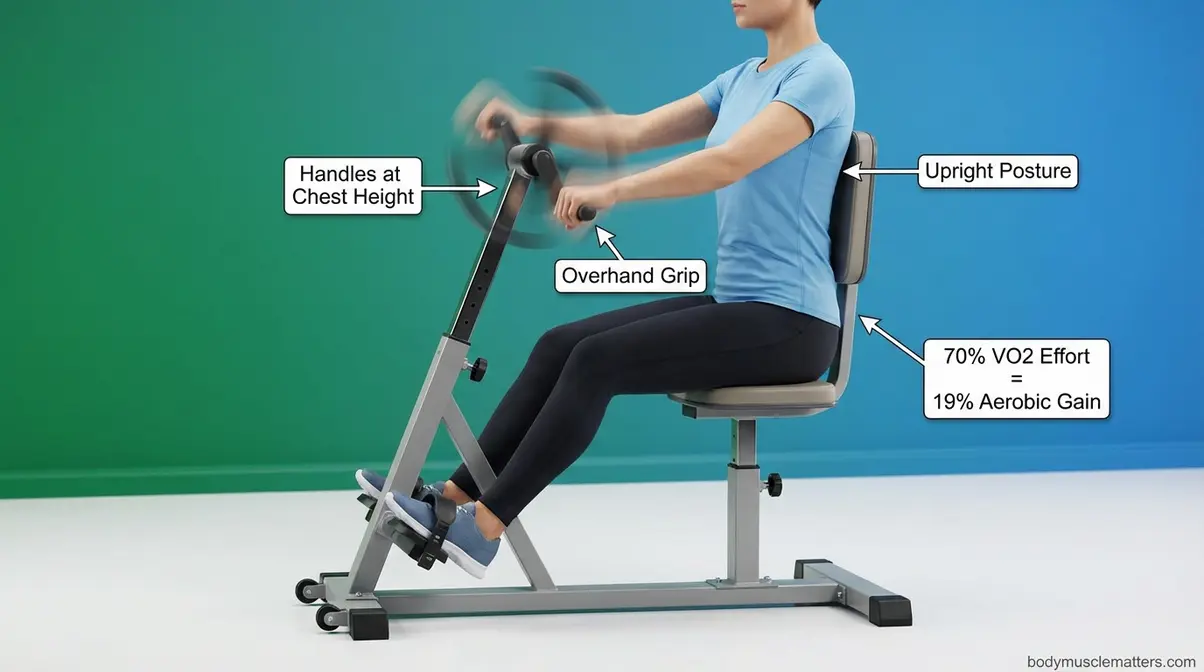
Caption: The arm ergometer — a hand-powered stationary cycling machine — is the gold standard for sustained upper-body cardiovascular training.
Intensity: Moderate–Very High | Equipment: Arm ergometer machine (gym or specialist purchase)
An arm ergometer is a hand-powered stationary cycling machine — essentially a bicycle you pedal with your arms. It is the most extensively researched tool for upper-body cardiovascular fitness and the clinical gold standard for non-weight-bearing cardio in rehabilitation settings. If you are asking what cardio you can do with no legs, this is the single most effective answer.
The PMC6522950 study (PubMed, 2019) found that 10 weeks of arm ergometer training — 30 minutes per day, three days per week at 70% VO2 peak — produced a 19% improvement in aerobic capacity in participants. Peak power output also increased from 40 to 54 watts. These are real, clinically meaningful fitness gains from arm-only exercise.
- Step-by-step instructions:
- Adjust the machine so the crank handles are at chest height when you are seated.
- Grip both handles with a comfortable overhand grip, elbows slightly bent.
- Begin cranking at a slow pace (50–60 rpm) for a 3-minute warm-up.
- Increase resistance and pace to reach your target effort (6–7 out of 10 for moderate, 8–9 for vigorous).
- Maintain your pace for 20–30 minutes, adjusting resistance to stay in your target heart rate zone.
- Cool down for 3–5 minutes by reducing resistance and speed gradually.
Why this works: Sustained circular arm cranking recruits nearly all major upper-body muscle groups continuously — producing cardiovascular demand comparable to moderate cycling.
Choose Arm Ergometer if: You need the most clinical, research-backed option for sustained cardio during leg injury recovery.
Skip Arm Ergometer if: You do not have gym access — seated shadow boxing or resistance band rows deliver comparable beginner-level stimulus at home.
Exercise #8 — Battle Ropes (Seated)
Caption: Seated battle rope waves recruit core and upper-body muscles simultaneously — classified as vigorous-intensity exercise in published research.
Intensity: High–Very High | Equipment: Battle ropes (gym or home anchor)
Battle ropes — thick, heavy ropes anchored to a wall or post — are typically a standing exercise. Performed from a chair, they become one of the most effective seated cardio options available. For more techniques, see our Battle Ropes Guide. A 2018 PubMed study (PMID 30335722) specifically examined metabolic responses to a battle rope protocol performed in a seated position and concluded that “battling ropes may be a low-cost, accessible option to improve cardiovascular endurance for individuals who cannot stand or move their lower extremities” (PubMed, 2018). Additional research published in PMC found that seated boxing and battle rope exercises recruit significant trunk muscle activity, making them effective for core conditioning simultaneously (PMC10795558, 2026).
- Step-by-step instructions:
- Sit squarely in a sturdy chair facing the rope anchor point, feet flat and secure.
- Grip one end of each rope, hands at hip level, elbows slightly bent.
- Begin alternating waves — lift the right rope while lowering the left, then switch, creating a continuous ripple pattern.
- Maintain rapid, controlled alternating motion for 30 seconds.
- Rest 45 seconds, then repeat.
- Complete 8–10 rounds, working up to 15-second sprints with shorter rests as fitness improves.
Why this works: The constant wave motion demands sustained power from your forearms, biceps, shoulders, and core — pushing heart rate rapidly into the vigorous zone (~51% VO2 max at moderate effort, research suggests).
Choose Battle Ropes if: You have access to a gym with ropes and want the highest cardiovascular intensity from a seated position.
Skip Battle Ropes if: You are early in injury recovery or a beginner — start with seated shadow boxing first to build baseline upper-body endurance.
Exercise #9 — Pull Buoy Swimming
Intensity: Moderate–High | Equipment: Pool + pull buoy float (under $15)
A pull buoy is a foam float you place between your thighs to keep your legs elevated and stationary. With your legs neutralized, you swim using your arms and upper body only — a stroke-driven cardiovascular session that completely isolates the upper engine. This is aqua jogging’s calmer cousin: still upper-body focused, but sustained and rhythmic rather than explosive.
Swimming is well-documented as a high-calorie exercise — a 155-pound person can burn approximately 300–400 calories per hour at moderate intensity, even before accounting for the additional upper-body focus required when legs are removed from the equation (Calories Burned HQ, 2026).
- Step-by-step instructions:
- Enter the pool using pool steps, a ramp, or assistance if your injury requires.
- Place the pull buoy between your upper thighs, squeezing it lightly to hold it in position.
- Begin swimming freestyle, focusing entirely on your arm pull — long, powerful strokes from entry through full extension.
- Keep your kick absent or minimal — let the buoy do the floating work.
- Swim continuously for 20–30 minutes, resting at the wall every 4–6 lengths if needed.
- Progress by increasing distance per session or adding brief sprint lengths.
Why this works: Swimming’s resistance against water multiplies the cardiovascular demand on your arms and shoulders — heart rate climbs faster than in comparable dry-land exercises at the same perceived effort.
Choose Pull Buoy Swimming if: You have pool access and your injury permits water immersion — this is one of the highest-output, joint-friendly options on this list.
Skip Pull Buoy Swimming if: Your injury involves an open wound, or your doctor has restricted water exposure — choose the arm ergometer instead.
Exercise #10 — Upper-Body Rowing
Intensity: Moderate–High | Equipment: Rowing machine (gym)
A standard rowing machine activates legs, back, and arms together. When you fix your feet loosely (or not at all) and drive entirely through your arms and upper back, you create a sustained pulling-based cardio session that engages your lats, rhomboids, biceps, and rear shoulders — the same muscles targeted by resistance band rows, but with adjustable resistance and smooth continuous motion.
- Step-by-step instructions:
- Sit on the rower, sliding seat toward the front. If your injury prevents bending the knees, keep legs extended and brace them passively.
- Grip the handle with both hands, arms extended, sitting tall.
- Pull the handle to your lower ribcage using only your arms and upper back — avoid pushing with your legs or shifting your seat.
- Extend arms back to start, immediately pulling again.
- Set resistance at level 4–6 to begin. Maintain a steady 20–24 strokes per minute.
- Row for 15–20 minutes, increasing resistance as fitness improves.
Why this works: Upper-body rowing with the lower body passive still engages enough muscle mass to push heart rate into the moderate-to-vigorous training zone — and the smooth, low-impact movement is gentle on most injury types.
Choose Rowing Machine if: You want a structured gym-based session and prefer a smooth, controlled motion over explosive movements.
Skip Rowing Machine if: Your injury affects your lower trunk or makes seated compression uncomfortable — arm ergometers or battle ropes are better alternatives.
Exercise #11 — Handcycling
Intensity: Moderate–Very High | Equipment: Handcycle (outdoor) or handcycle attachment
Handcycling — propelling a three-wheeled cycle using your arms — is an outdoor or indoor upper-body cardio option that brings the freedom of cycling without leg involvement. It is widely used in para-athletics, adaptive sports programs, and recreational recovery, and offers something no gym machine replicates: the cardiovascular benefits of sustained outdoor effort plus the psychological lift of moving through space.
Many modern gyms carry stationary handcycle machines. Outdoor handcycles can be rented at adaptive sports centers or purchased, with entry-level options available from approximately $300–$800.
- Step-by-step instructions:
- Position the handcycle so the cranks are at chest height when you are comfortably seated.
- Grip the handles and begin cranking at a comfortable pace to warm up (3 minutes).
- Increase pace to reach your target effort: 5–6 out of 10 for moderate, 7–8 for vigorous.
- Maintain your pace for 20–45 minutes, adjusting gear resistance as needed.
- Cool down with 3–5 minutes of easy cranking.
- Progress by increasing duration or resistance each week.
Why this works: Sustained handcycling maintains continuous upper-body muscular engagement — unlike interval-based exercises, it builds aerobic base endurance over longer sessions, making it one of the best long-term tools in the Upper Engine Framework.
Choose Handcycling if: You want outdoor exercise during recovery, or you enjoy sustained steady-state cardio rather than interval training.
Skip Handcycling if: You need immediate access with no budget — seated shadow boxing or chair aerobics are free alternatives.
Exercise #12 — SkiErg (Upper Body)
Caption: The SkiErg’s double-cable downward pull mirrors cross-country skiing — one of the most complete upper-body cardio options in any gym.
Intensity: High–Very High | Equipment: SkiErg machine (gym)
The SkiErg — a vertical cable machine that mimics the double-pole motion of cross-country skiing — is one of the most complete upper-body cardio machines available and one of the least understood by people with lower-body limitations. Performed standing, it engages core heavily. Performed seated (wheelchair or chair alongside the machine), it isolates the upper body while still producing vigorous cardiovascular demand.
- Step-by-step instructions:
- Position your chair directly in front of the SkiErg handles. Sit close enough to reach the handles at full overhead extension.
- Grip both handles overhead, arms fully extended, core engaged.
- Pull both handles downward simultaneously in a powerful arc — finishing with hands near your hips.
- Control the return slowly, allow handles to rise back to overhead.
- Immediately pull down again — aim for 20–30 pulls per minute.
- Work in 30-second intervals at maximum effort, with 30 seconds of rest. Complete 8–10 rounds.
Why this works: The double-arm pull motion recruits your lats, triceps, abs, and shoulders in every rep. The SkiErg’s flywheel resistance means the harder you pull, the harder you work — making it infinitely scalable for any fitness level.
Choose SkiErg if: You want the highest-output gym-based seated cardio option and your gym has one available.
Skip SkiErg if: Your gym does not carry a SkiErg — battle ropes or the arm ergometer are excellent substitutes.
Exercises #13-15 – Bonus Options Worth Knowing
If you are looking for more variety, consider these three additional options that target different training modalities:
| Exercise | Equipment | Intensity | Best For | Accessibility |
|---|---|---|---|---|
| #13 — Upper-Body Rowing (Kayak Paddle Simulation) | Resistance bands | Moderate | Home training, beginners | Wheelchair-friendly |
| #14 — Aqua Jogging (Pool Float Belt, Arms Only) | Pool + belt | Moderate | Rehab-stage recovery | Excellent for joint sensitivity |
| #15 — Seated Punches on Punching Bag | Punching bag, gloves | High | Boxing enthusiasts, stress relief | Needs bag at correct seated height |
How to Choose the Right Leg-Free Cardio for You
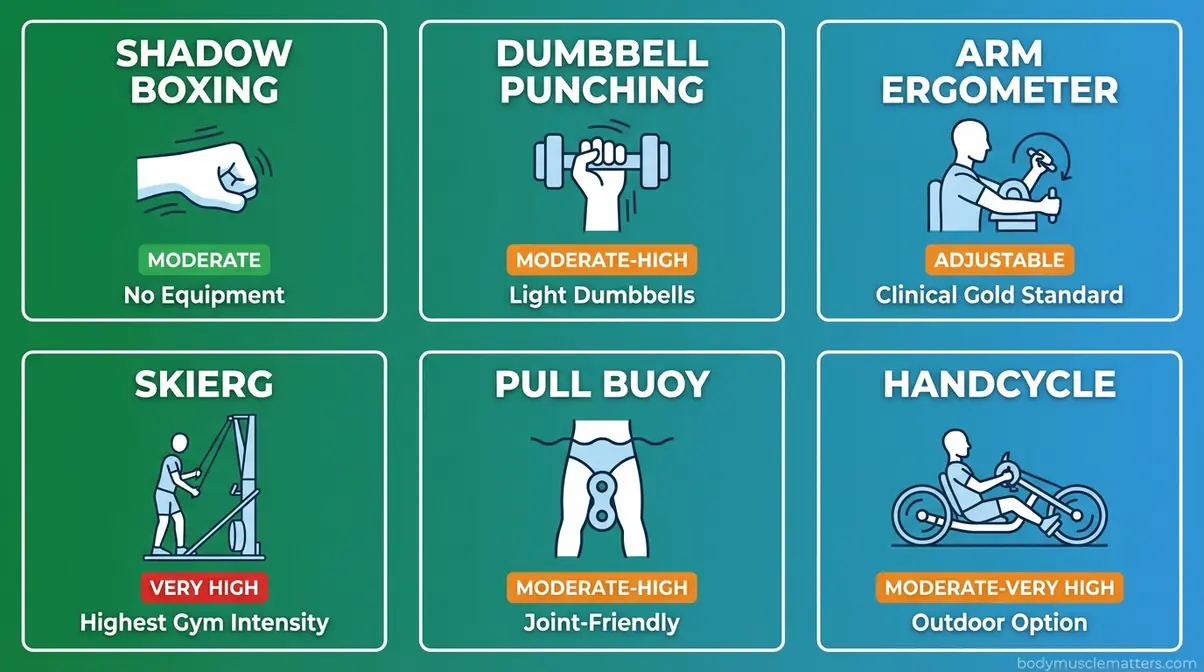
The best exercise is the one you will actually do. Use this decision matrix to match your situation to the right starting point:
| Your Situation | Best Starting Exercise | Why | Intensity Level |
|---|---|---|---|
| No equipment at home, complete beginner | Seated Shadow Boxing (#1) | Zero setup, immediate results, scalable pace | Moderate |
| Have light dumbbells at home | Seated Dumbbell Punching (#4) | Adds resistance without complexity | Moderate–High |
| Gym access, want clinical-level cardio | Arm Ergometer (#7) | Research-backed 19% VO2 improvement in 10 weeks | Adjustable |
| Gym access, want highest intensity | SkiErg or Battle Ropes (#8, #12) | Highest heart rate output of any seated option | High–Very High |
| Pool access, joint-sensitive recovery | Pull Buoy Swimming (#9) | Water reduces joint stress while arms work hard | Moderate–High |
| Want outdoor exercise during recovery | Handcycling (#11) | Fresh air, sustained aerobic base-building | Moderate–Very High |
Caption: Use this decision tree to find your best starting exercise based on what you have available today.
A note on progression: Start at the lowest intensity option that matches your current situation. Once you can sustain 20 continuous minutes at a moderate effort (5–6 out of 10), move up one intensity level. The Upper Engine Framework works best when you build aerobic base before pushing for maximum output.
What Real People Say About No-Leg Cardio
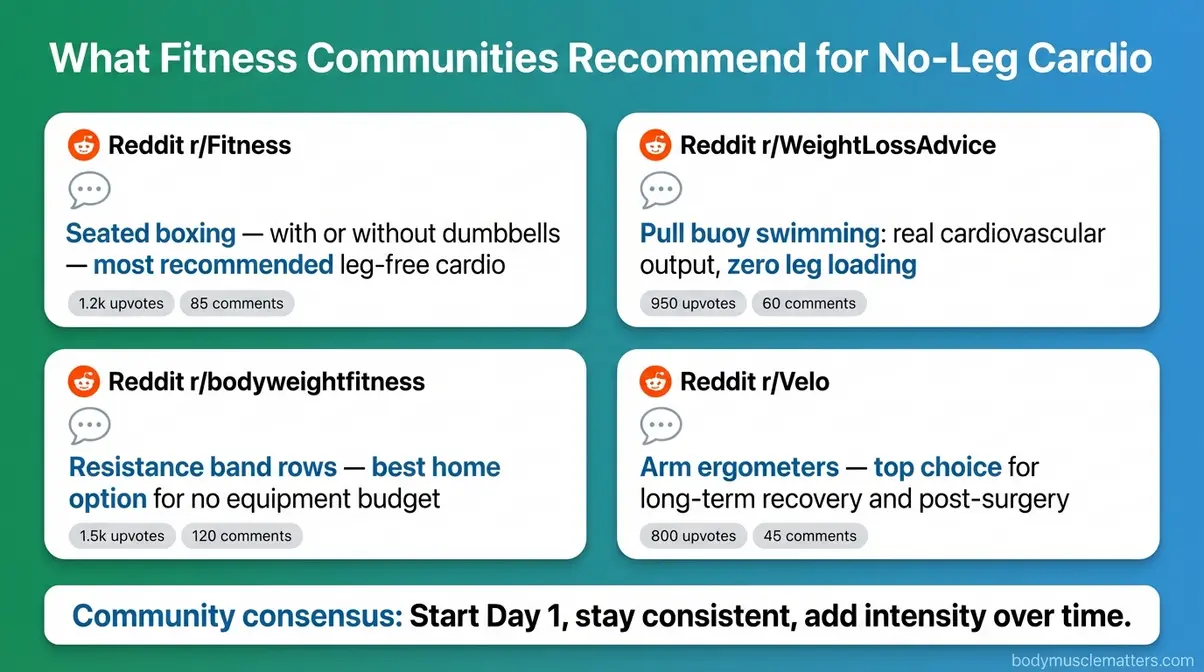
Fitness advice from community members who have navigated leg injuries or limitations firsthand often carries more practical weight than any training guide. Our team reviewed discussions across Reddit r/Fitness, r/WeightLossAdvice, r/bodyweightfitness, and r/Velo to surface what people with real lower-body constraints are doing — and what is actually working.
What Fitness Communities Recommend
User consensus from Reddit fitness communities confirms that seated boxing — both with and without dumbbells — is the most frequently recommended leg-free cardio by people who have tested it under real injury conditions. Pull buoy swimming comes up consistently for those with pool access, praised specifically for its ability to deliver real cardiovascular output without any leg loading.
Arm ergometers earn high marks from community members in longer-term recovery (post-surgery, chronic conditions), while resistance band rows are the most recommended home option for people with no equipment budget. Battle ropes appear frequently in discussions among gym-goers who want high intensity — though community feedback notes they require a confident grip and stable seated position to use safely.
Common concerns reported by people recovering from leg injuries include the fear that upper-body-only exercise “doesn’t count” as real cardio — a concern the physiology research in this guide directly addresses.
Putting Community Advice Into Practice
The most actionable pattern in community discussions is this: start with what you have, do it consistently, and add intensity over time. People who recovered their cardio fitness during leg injuries consistently report that beginning on Day 1 of their restriction — rather than waiting until the injury healed — made a significant difference in how quickly their overall fitness returned.
Caption: The Upper Engine Framework: your shoulders, chest, back, and arms contain enough total muscle mass to sustain a full cardiovascular training stimulus.
Start your first session today. Choose one exercise from the no-equipment list, set a timer for 20 minutes, and complete as many intervals as you can manage. That session is real cardio. Your aerobic base will thank you for it.
Common Mistakes and When to See a Doctor
4 Common Mistakes Beginners Make
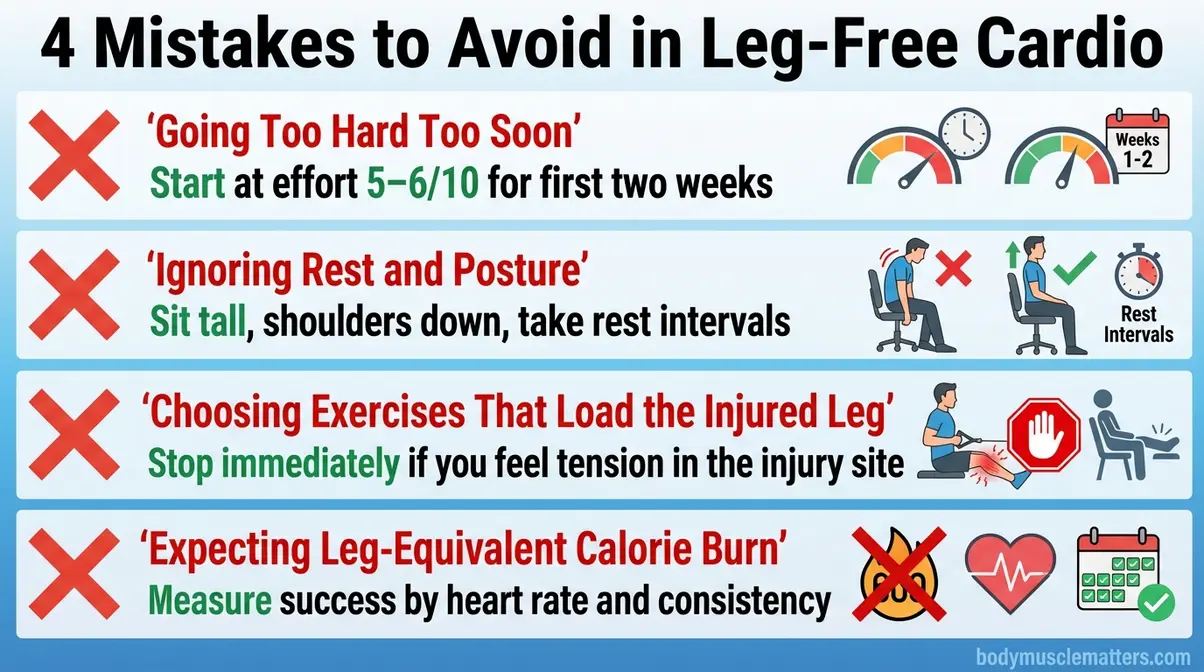
Mistake 1: Going too hard, too soon. Upper-body muscles fatigue faster than legs in cardio contexts because they are smaller and less adapted to sustained aerobic effort. Starting at 80–90% intensity in week one leads to shoulder soreness, burnout, and discouragement. Begin at effort level 5–6 for the first two weeks.
Mistake 2: Ignoring rest and range of motion. Seated exercises create postural demands — hunching, forward head position — that can cause neck and shoulder strain if you do not consciously sit tall and take rest intervals. Keep your spine long and shoulders down throughout every exercise.
Mistake 3: Choosing exercises that secretly load the injured leg. Some exercises that appear upper-body-only still require the leg to stabilize or brace. Any exercise where you feel tension, bracing, or compensatory weight shift in the injured limb should be stopped immediately and modified.
Mistake 4: Expecting leg-equivalent calorie burn from day one. Upper-body cardio burns real calories, but the energy expenditure at equivalent duration is generally lower than leg-based exercise because fewer total muscle fibers are engaged. Set realistic expectations, increase duration before increasing intensity, and measure success by heart rate and consistency — not just calories.
When Upper-Body Cardio Isn’t Enough
Upper-body cardio works best as a temporary substitute or supplement during lower-body restriction. It is not a permanent replacement for full-body exercise if your legs are healthy. Once your injury has resolved and your doctor or physical therapist clears you for weight-bearing, transitioning back to integrated full-body movement — even gradually — will produce better long-term cardiovascular outcomes.
Additionally, if your cardiovascular goal is sport-specific (training for running performance, for example), upper-body cardio maintains aerobic base but does not replicate the neuromuscular patterns required for your specific activity. Work with a sports physiotherapist on a return-to-sport plan that integrates both.
Signs You Need Professional Help
Contact your doctor or a licensed physical therapist if:
- Pain in your injury site increases during or after upper-body sessions (even if you are not loading the injury directly)
- You experience dizziness, heart palpitations, or chest discomfort during any session
- You have been exercising around an injury for more than two weeks without a formal medical assessment
- Your injury has not improved — or has worsened — after a week of rest
- You are unsure whether your diagnosis permits exercise at all
This is not medical advice — it is a guide to help you think clearly about when to stop guessing and start asking a professional. For YMYL decisions involving physical injury and health, that conversation with a qualified clinician is always the right move.
Frequently Asked Questions
Cardio With a Leg Injury?
The safest approach to cardio with a leg injury starts with a medical clearance conversation with your doctor or physical therapist before beginning any routine. Once cleared, choose exercises that place zero load on the injured limb — seated shadow boxing, arm ergometers, and resistance band rows are the most accessible starting points. Focus on upper-body muscle groups only, sit securely in a stable chair or wheelchair, and stop immediately if you feel any pain at the injury site. Start at a low intensity (effort 5/10) and build duration before intensity. The CDC recommends 150 minutes per week of moderate aerobic activity — even during injury recovery, this target remains achievable through upper-body methods alone (CDC, 2026).
Cardio Without Moving Legs?
Yes — cardio without moving your legs is scientifically valid and physiologically effective. Your heart responds to oxygen demand placed on any large muscle group, not exclusively your legs. Arm-based exercises like hand cycling, seated battle ropes, and shadow boxing elevate heart rate into the cardiovascular training zone (60–85% HRmax) without any leg movement. Research confirms that arm crank ergometry — 30 minutes, three days per week for 10 weeks — produces a 19% improvement in aerobic capacity (PMC6522950, PubMed, 2019). Your upper body contains enough total muscle mass to sustain a full cardiovascular training stimulus independently.
What cardio can I do with no legs?
The best options for cardio with no leg involvement are arm ergometers, seated shadow boxing, pull buoy swimming, seated battle ropes, handcycling, and the SkiErg. For home workouts with no equipment, seated shadow boxing and chair aerobics (seated arm pumps) are immediately accessible. For gym-goers, the arm ergometer is the most research-backed option, while the SkiErg delivers the highest per-session cardiovascular intensity. All 15 exercises in this guide require zero leg involvement and can be performed from a chair or wheelchair.
Cardio When You Can’t Use Legs?
Start with seated exercises that engage your largest upper-body muscle groups — shoulders, back, and chest — rather than arm isolation exercises. A good beginner sequence: 5 minutes of seated arm pumps to warm up, followed by 4 rounds of 30 seconds shadow boxing with 20 seconds rest, then 3 sets of resistance band rows. That 20-minute session keeps your heart rate in the moderate aerobic zone throughout. As fitness improves, add dumbbell punching, battle ropes, or the arm ergometer to increase intensity. Consistency matters more than intensity when starting — three sessions per week beats one maximal effort.
How do you burn fat without using legs?
Fat burning during leg-free cardio follows the same principle as any exercise: sustained elevated heart rate over time creates a caloric deficit. Upper-body cardio like seated shadow boxing, arm ergometers, and pull buoy swimming burns real calories — swimming alone burns 300–400 calories per hour at moderate intensity for a 155-pound person (Calories Burned HQ, 2026). The key is duration: aim for 20–30 continuous minutes per session at effort level 6–7 out of 10. Combine consistent cardio sessions with appropriate nutrition, and fat loss follows the same metabolic rules as any other training format.
Cardio If Your Legs Are Sore?
When your legs are sore from DOMS — delayed onset muscle soreness from a previous workout — upper-body cardio is a smart, safe choice. DOMS is not an injury; it is a temporary recovery state, and your cardiovascular system and upper body are not affected. Seated shadow boxing, resistance band rows, and arm ergometer sessions place zero demand on sore leg muscles while still delivering a complete cardiovascular stimulus. Reduce your target intensity slightly on sore days (aim for effort 5–6 rather than 7–8), and you may find that improved circulation from light exercise helps your legs feel better afterward.
What is the 3-3-3 rule for cardio?
The 3-3-3 rule for cardio is an informal guideline suggesting 3 sessions per week, 3 exercises per session, and 3 sets or rounds per exercise — a simple structure to build cardiovascular habit without overwhelm. For leg-free cardio, a 3-3-3 session might look like: 3 rounds of seated shadow boxing + 3 rounds of resistance band rows + 3 rounds of seated arm pumps, performed three times per week. It is not a formally published clinical protocol, but community consensus across fitness forums describes it as a useful framework for beginners to build consistency before increasing complexity or intensity.
Start Your First Upper Engine Session Today
For anyone dealing with a leg injury, aggressive DOMS, or a longer-term mobility limitation, cardio without using legs is not a compromise — it is a legitimate cardiovascular training method backed by published sports medicine research. Your upper body can reach 70–85% of maximum heart rate through arm-based cardio alone — more than enough to meet weekly aerobic fitness guidelines (PubMed, 2019). The 150-minutes-per-week target set by the CDC remains fully achievable without any leg involvement.
The Upper Engine Framework gives you a practical mental model for this: your shoulders, chest, back, and arms function as a complete cardiovascular engine when loaded at the right intensity. Whether you choose seated shadow boxing, an arm ergometer, or pull buoy swimming depends on your equipment and access — but the physiological result is the same: an elevated heart rate, a working cardiovascular system, and fitness momentum that keeps building while your legs recover.
Your first session can happen today. Pick one exercise from the no-equipment list, set a 20-minute timer, and start. Consult your doctor or physical therapist first if you have an active injury — then come back and work through this guide step by step. Your aerobic base does not have to wait.