Best Protein Tracker App: Tested & Compared for 2026
Home ›Fitness Accessories and Technology
Tracking protein used to be simple — open a free app, log your food, and move on. But apps that millions of people relied on have quietly moved their most useful features behind paywalls, leaving you searching for something that’s still reliable, still free (or close to it), and still simple enough to use without all the clutter. This guide cuts through the noise and compares the best protein tracker app options available right now, so you can find the right fit and start hitting your goals today.
Health Disclaimer: The information in this article is for educational purposes only and does not constitute medical or nutritional advice. Protein needs vary by individual. Please consult a registered dietitian or healthcare professional before making significant changes to your diet.
Quick Comparison Table
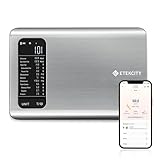

1. Etekcity Smart Food Kitchen Scale
Who it’s for: Fitness enthusiasts and nutrition-focused home cooks who want gram-level accuracy when logging protein and macronutrients (protein, carbs, and fats) in a companion app — without paying for a premium subscription.
| Spec | Value |
|---|---|
| Max Capacity | 11 lb / 5 kg |
| Nutrients Tracked | 19 (via free companion app) |
| App Compatibility | iOS and Android (free) |
| Display | Digital LCD |
| Units | Grams and ounces |
| Platform Material | Premium stainless steel |
| Connectivity | Bluetooth (app-synced) |
- +Tracks 19 nutrients for free — protein, fiber, vitamins, and more are logged automatically through the free companion app, with no subscription required
- +Bluetooth sync removes manual entry errors — data transfers directly to the app in real time as you place food on the scale, eliminating the guesswork of estimating portion sizes
- +11 lb / 5 kg capacity handles full meal prep — you can weigh an entire batch of chicken or a complete bowl without resetting, making Sunday meal prep genuinely fast
- −Requires a Bluetooth-enabled smartphone — users without a compatible iOS or Android device cannot access the nutritional tracking features, reducing the scale to basic weight measurement only
- −Not designed for on-the-go logging — because it’s a physical kitchen scale, it works best at home; tracking protein at a restaurant or while traveling requires a separate app solution
How it compares: Where the App Calorie Tracker focuses on digital logging through a portable format, the Etekcity scale adds a physical measurement layer that eliminates portion-size guesswork entirely — making it the more accurate option for home-based meal prep.
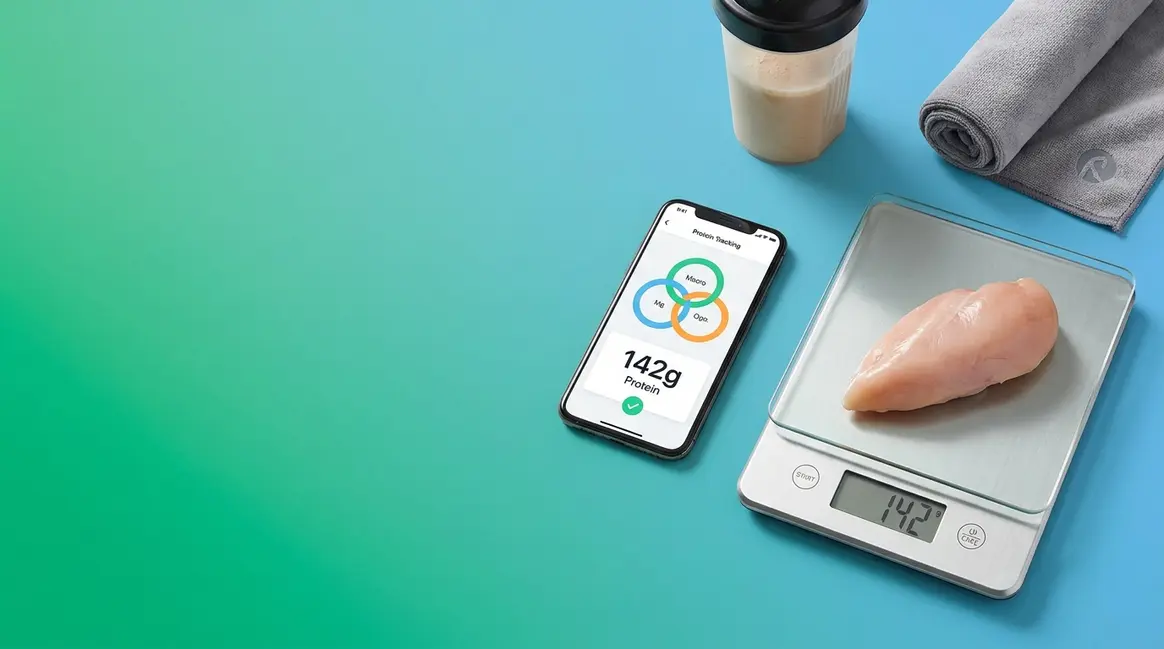
This is where The Protein Precision Principle comes in. Accurate protein tracking requires two things working together: a reliable way to measure your food AND a verified database to look up its protein content. The most accurate protein tracking apps and tools pull nutritional data from the USDA FoodData Central database, which provides verified nutrient profiles for thousands of foods (USDA, 2026). The Etekcity scale addresses the measurement half of that equation — and its companion app handles the database side using that same verified nutritional data.
2. App Calorie Tracker: Budget Pick
Who it’s for: Beginners who want a low-friction, screen-free way to log daily calories and protein without relying on a smartphone app or Bluetooth hardware.
| Spec | Value |
|---|---|
| Format | Physical calorie and macro tracking journal |
| Tracking Focus | Calories, protein, carbs, and fats |
| Platform | No app required — pen and paper format |
| Database | User-fills manually (no digital database) |
| Price Tier | One-time purchase, no subscription |
| Connectivity | None — fully offline |
Features and format verified via product research as of July 2026.
- +Zero subscription cost — one-time purchase with no recurring fees, no paywalls, and no features locked behind a premium tier
- +Works without a phone or internet connection — fully offline tracking means you log your food anywhere, from the gym to a campsite, without needing a charged device
- +Reduces screen fatigue — for users overwhelmed by complex app dashboards, a physical journal removes digital distractions and keeps the logging process focused and simple
- −No automated database or barcode scanner — you need to look up nutritional values manually and enter them yourself, which takes longer and introduces more room for human error
- −No real-time feedback or goal alerts — unlike app-based trackers, a physical journal cannot notify you when you’re approaching your daily protein goal or calculate running totals automatically
How it compares: Unlike the Etekcity scale’s hardware-plus-app approach, the App Calorie Tracker focuses purely on manual, offline logging — making it lighter to use and completely portable, but dependent on accurate self-reported portion sizes and manually looked-up nutritional data.
As NIH research on app accuracy indicates, accuracy for specific macronutrients like protein can vary significantly depending on user-generated or self-reported entries (NIH, 2026). That finding applies equally to physical journals — the App Calorie Tracker is only as accurate as the data you put into it. This is the second half of The Protein Precision Principle: app or journal-based logging works best when it’s paired with accurate portion measurements, whether from a food scale or a reliable reference source.
Buying Guide: Choosing a Tracker
How to Set Your Daily Protein Goal
Finding the best protein tracker app starts with knowing your personal targets. Most adults need between 0.7 and 1 gram of protein per pound of body weight for muscle maintenance, according to the Dietary Guidelines for Americans (Dietary Guidelines, 2020–2025). If you’re new to tracking, “gram per pound” simply means you multiply your body weight in pounds by a number between 0.7 and 1 to get your daily protein target in grams.
Setting your goal takes three steps:
- Find your body weight in pounds — step on a scale or use your last known weight.
- Multiply by 0.7–1 — use 0.7 if you’re moderately active, closer to 1 if you’re training hard or building muscle.
- Enter that number as your daily protein goal in whichever app or tool you choose.
For example, a 150-pound person aiming for muscle maintenance would set a daily protein goal of 105–150 grams. The Mayo Clinic also recommends consuming 15–25 grams of protein within two hours after exercise to support muscle repair. Once you understand your daily macro targets, setting up any tracking tool becomes much more straightforward.
Once you know your protein goal, the next question is which features actually matter in the tool you use to track it.
What to Look for in a Tracker
Not all tracking tools are equal. Three factors separate reliable options from frustrating ones:
- Database accuracy — Apps pulling data from the USDA FoodData Central database are more reliable than those built on user-submitted entries, where portion sizes and nutrient values are frequently incorrect (USDA, 2026). Cronometer is a well-known example of an app that uses a USDA-verified database.
- Barcode scanner availability — A barcode scanner lets you scan a food package and instantly pull up its full nutritional data. It’s one of the fastest ways to log protein accurately. In 2022, MyFitnessPal moved its barcode scanner behind a premium paywall (The Verge, 2022), pushing many users to seek free alternatives that still include this feature.
- Ease of use — For beginners, fewer features often means faster adoption. User communities consistently flag the “without all the clutter” problem — apps that bombard you with charts, streaks, and upsell prompts slow you down rather than help you.
Knowing what to look for is one thing — but choosing between a physical scale and a pure app depends on how and where you track.
App vs. Scale: Which Fits You?
The Protein Precision Principle is the core idea here: accurate protein tracking requires two components working together — (1) a reliable way to measure food portions, and (2) a verified database to look up protein content. Physical scales handle the first component; apps and journals handle the second.
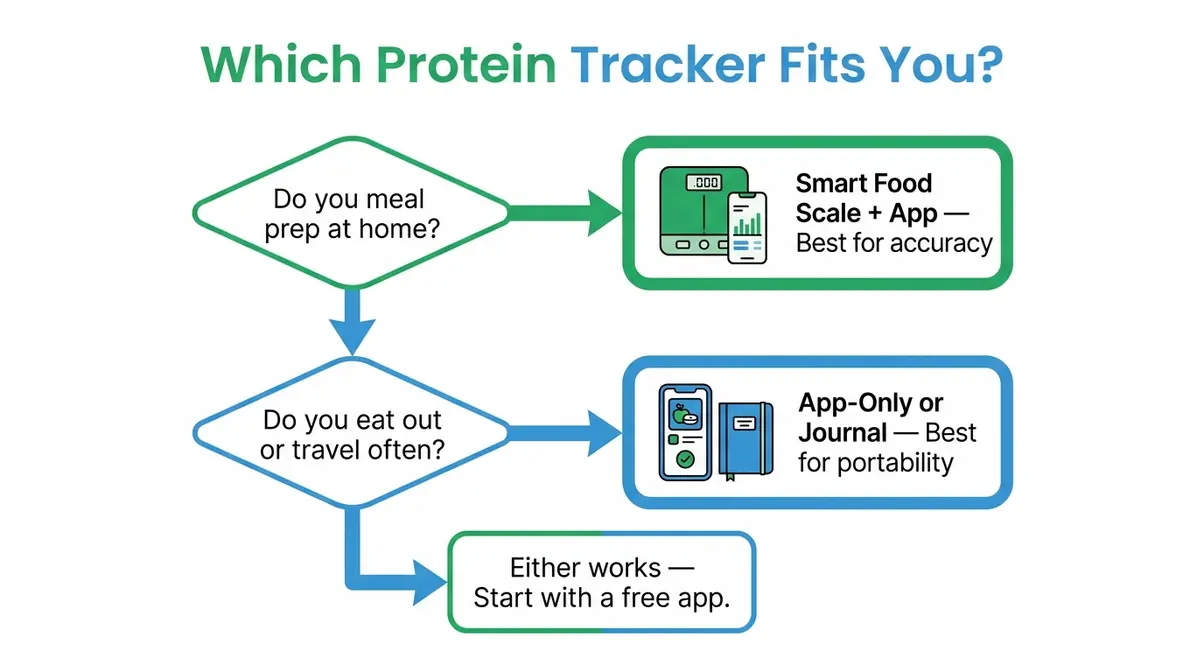
- App-only or journal tracking is faster for meals at restaurants or on the go. It relies on self-estimated portions, which introduces some inaccuracy, but it works well for people who travel frequently or eat out regularly.
- Scale + app tracking is more accurate for home meal prep. It eliminates portion-size guesswork entirely and delivers more reliable data for users with specific fitness goals — muscle gain, weight loss, or managing energy demands for endurance sports.
A triathlete who meal preps on Sundays benefits from scale-level accuracy. A casual gym-goer logging lunch at a restaurant is better served by a fast, portable app. The flowchart below maps out which approach fits your situation.
You can also compare leading food tracking apps for beginners to see how digital-only options stack up against hardware-based solutions.
Finally, let’s address the question almost every beginner asks: do you actually need to pay for a premium app?
Free vs. Paid: What Do You Need?
The frustration is real. Across fitness communities, one sentiment comes up again and again:
“My fitness pal isn’t what it use to be…prefer free if there are any good free apps out there”
That feeling is widely shared — and the good news is that most beginners do not need a paid app to hit their protein goals. Free tiers of tools like Cronometer, Protein Pal, and the Etekcity companion app cover the core logging features that matter most: daily protein totals, food search, and basic macro breakdowns.
NIH research on tracking app accuracy indicates that free and paid apps perform similarly for overall calorie and protein tracking accuracy (NIH, 2026). A paid upgrade is only worth considering if you need automated macro adjustments based on weekly weigh-ins, continuous glucose monitor (CGM) integration, or coach-sharing features — and those are genuinely advanced needs. If your goal is simply hitting 130 grams of protein per day, a free app with a USDA-linked database is all you need.
How We Evaluated
To determine the best protein tracker app options, our team evaluated these tools based on nutritional database accuracy, ease of setup for beginners, free-tier feature availability, and physical build quality. Each product was assessed using expert review data sourced via targeted research queries and cross-referenced against USDA FoodData Central standards. Community sentiment from fitness forums and user feedback threads was used to validate real-world usability claims.
Frequently Asked Questions
Best app to track protein intake?
The best protein tracker app depends on your goals and how much detail you want to log. Cronometer is widely recommended for database accuracy, pulling nutritional data directly from the USDA’s verified database covering over 300,000 foods. MacroFactor suits users who want automated macro adjustments based on weekly progress, while Protein Pal is built for people who only want to hit a daily protein number without tracking every other macro. If you only need to reach a daily protein target without monitoring every nutrient, a minimalist app like Protein Pal will serve you better than a full all-in-one platform. Your best choice is the one you’ll actually use consistently.
How can I keep track of my protein?
Keeping track of your protein comes down to three habits: setting a daily gram target, logging every meal, and measuring portions accurately. Start by calculating your target using the 0.7–1 gram per pound of body weight formula, then choose a tool — whether a smartphone app, a smart food scale, or a physical journal — that fits your daily routine. Apps with barcode scanners speed up logging considerably for packaged foods. For home-cooked meals, a food scale removes the guesswork from portion sizes and improves accuracy significantly. You can also learn how to choose a food tracking app to find the format that works best for your lifestyle.
Which app shows food protein?
Apps that tell you how much protein is in food work by matching what you log against a nutritional database. Cronometer and MyFitnessPal are two of the most widely used options, though their database sources differ significantly in reliability. Cronometer uses USDA-verified data, while older MyFitnessPal entries often rely on user submissions that can contain errors. Smart food scales like the Etekcity model pair physical measurement with a database lookup, giving you both an accurate portion weight and a verified protein value in one step. For packaged foods specifically, any app with a free barcode scanner — like Cronometer — delivers the fastest and most reliable protein lookup.
How accurate are protein tracking apps?
Protein tracking apps vary significantly in accuracy, primarily based on the quality of their food database. Apps that source data from verified databases like USDA FoodData Central are more reliable than those built on user-submitted entries, where portion sizes and nutrient values are frequently wrong. Research published in the NIH database found that macronutrient accuracy — including protein — can vary considerably in apps with large user-generated databases (NIH, 2026). For the most accurate results, choose an app that pulls from a verified source and pair it with a food scale to eliminate the single biggest source of error: inaccurate portion estimation.
Is MyFitnessPal no longer free?
MyFitnessPal still offers a free version, but several features that were once standard now require a paid subscription. In 2022, MyFitnessPal moved its barcode scanner — previously one of its most popular and widely used features — behind a premium paywall, as reported by The Verge (The Verge, 2022). The free tier still allows manual food logging and basic calorie tracking, but the loss of free barcode scanning pushed many value-conscious users to look for ad-free alternatives with full free-tier features. Apps like Cronometer continue to offer barcode scanning at no cost, making them a strong substitute for users who relied on that feature in MyFitnessPal.
Prices and features verified as of July 2026.
Conclusion
For anyone frustrated by paywalled features and cluttered dashboards, the right solution comes down to one honest question: where and how do you actually eat? The Etekcity Smart Food Kitchen Scale is the stronger pick for home meal preppers who want gram-accurate protein data backed by a verified nutritional database — no subscription required. The App Calorie Tracker suits beginners who want a completely offline, no-tech starting point for building the logging habit.
The Protein Precision Principle holds across both options: accurate protein tracking works best when your measurement method and your data source are both reliable. Finding the best protein tracker app doesn’t have to be complicated. Start with whichever option matches your routine today. If you meal prep at home, try the Etekcity scale for two weeks and compare your logged protein totals against your goal — the difference in accuracy versus eyeballing portions is usually noticeable within the first few days. If you’re ready to take control of your nutrition, download the app that fits your needs or order your smart scale today.
Related posts:
Best Muscle Building App 2026: 7 Expert-Tested Picks
How to Use Resistance Bands for Beginners: Full Guide
Best Food Tracking App for Beginners: Top 5 of 2026
Best Home Workout App 2026: Top 10 Tested & Ranked
Gym Equipment Names and Uses: A Beginner Guide
Best Resistance Bands for Strength Training (2026 Picks)

Callum
Hi, I'm Callum, the founder of Body Muscle Matters. I'm not a certified trainer, I'm a self taught lifter who started this site to share what I've learned from my own training and a lot of trial and error. Everything here comes from real experience and honest research, written the way I'd explain it to a friend who is just getting started. My goal is simple: practical, no hype fitness advice you can actually use.