What Does PR Mean in the Gym? All 6 Types Explained
You’re at the gym, minding your own business, when someone pumps their fist and yells: “New PR!” You nod and smile — but what does PR actually mean in the gym?
Gym culture has its own language. PR. 1RM. PB. If you don’t know the code, it’s easy to feel like you’re on the outside looking in before you’ve even started. The good news? Understanding what PR means in the gym takes about two minutes — and once you get it, you’ll never feel lost on the gym floor again.
By the end of this guide, you’ll know exactly what PR means, all six types of PRs you can set, and how to safely chase your first one — so you can stop nodding and start celebrating your own milestones. We’ll cover the definition, the full PR Spectrum framework, a safety-first testing protocol, and how to track every record you break.
PR stands for Personal Record — the best performance you’ve ever achieved in a specific exercise or fitness metric. Every athlete, from beginners to pros, tracks PRs to measure progress.
- PR = Personal Record: Your best-ever performance in any gym metric — weight, reps, time, or distance
- 6 PR types exist: Strength, Repetition, Volume, Time, Cardiovascular, and Form — together called The PR Spectrum
- PR ≠ 1RM: A 1RM (One-Rep Max) is one specific type of PR — but PRs go far beyond a single heavy lift
- The PR Spectrum framework helps you identify which type of PR to chase next based on your training level
- Tracking PRs is the single most reliable way to measure gym progress over time
What Does PR Mean in the Gym?
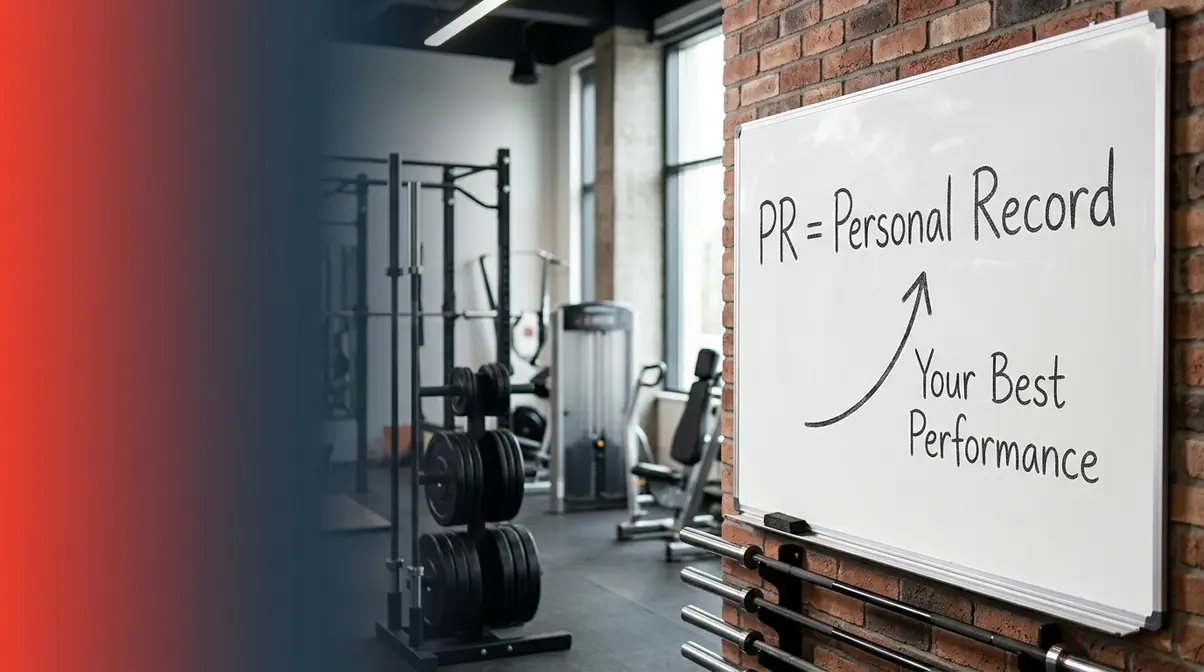
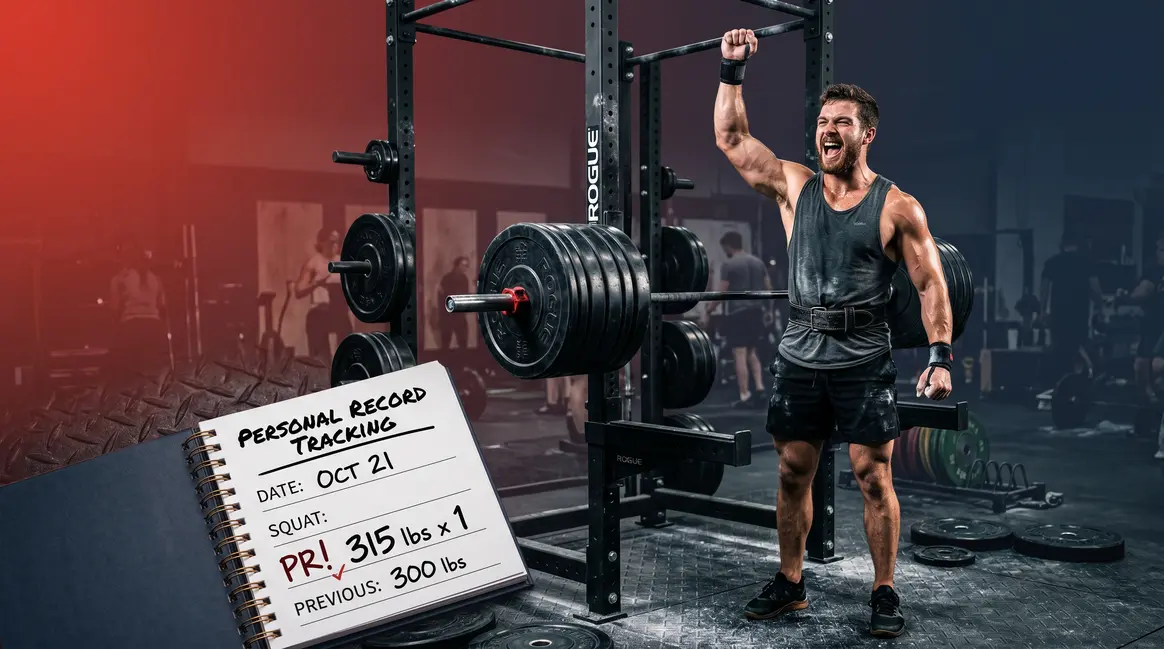
PR stands for Personal Record — it’s the best performance you have ever achieved in a specific exercise or fitness metric. “Performance” means whatever you’re measuring: the heaviest weight you’ve lifted, the most reps you’ve completed, or the fastest time you’ve recorded. A PR is entirely personal — it compares you only to your past self, not to anyone else in the gym.
That last part matters more than most beginners realize. Knowing what does PR mean in the gym isn’t just about learning a term — it’s about understanding that your progress is your own competition.
In the gym, PRs are treated as a badge of honor. When someone announces a new PR, they’re not bragging about beating a stranger — they’re celebrating a measurable, personal win. The 1RM (One-Rep Max — the maximum weight you can lift for a single repetition) is considered the gold standard for assessing muscle strength in non-laboratory situations (NIH/PubMed Central, 2013). But as you’re about to discover, strength is just one piece of the puzzle.
Here’s how one gym community member put it:
“PR — Personal Record — It means the best weight you have lifted for 1 rep. Again mainly used for compounds.”
That captures the most common use perfectly. Compounds (multi-joint movements like squats, deadlifts, and bench press) are where most gym-goers first think about PRs. But the reality is much bigger than one heavy lift.
A PR is a personal competition with yourself — not a comparison to anyone else in the gym.
This is where most beginner guides stop. We’re just getting started. What does PR mean in weightlifting specifically? It means the heaviest single lift you’ve achieved. But what does PR mean in sports more broadly? It means any measurable performance milestone — and that’s exactly what we call The PR Spectrum — a framework covering all six distinct types of personal records you can set. Our complete guide to personal records in the gym explores this in even greater depth.
But first, let’s clear up three terms that trip up almost every beginner.
PR, PB, and 1RM: What’s the Difference?
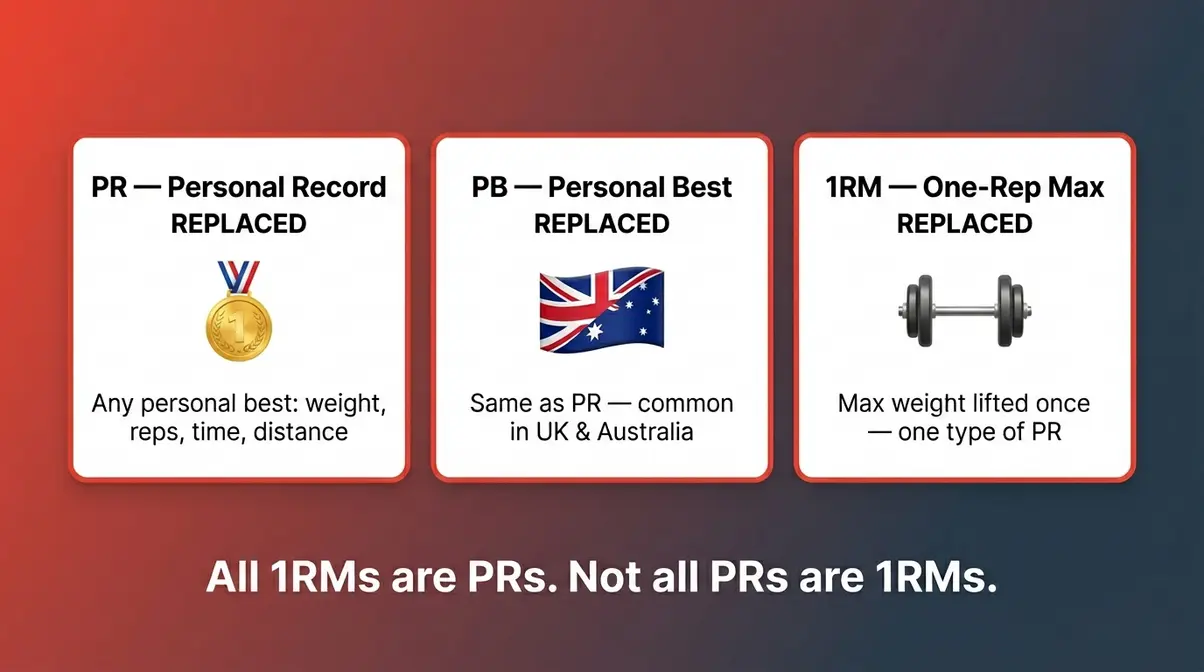
These three terms get mixed up constantly. Here’s exactly what each one means:
1RM (One-Rep Max) is the maximum weight you can lift for exactly one repetition with good form. It’s one specific type of PR. If your 1RM bench press is 100 kg, that means 100 kg is the most you can lift once. Research on the relationship between submaximal weights and repetition maximums confirms that your 1RM is a foundational strength benchmark — but it’s just one benchmark among many (PubMed, 2026).
PB (Personal Best) means exactly the same thing as PR. The term is simply more common in the UK, Australia, and in running and athletics communities. If a British gym-goer says “new PB,” an American gym-goer would say “new PR.” Same achievement, different vocabulary.
The key relationship to memorize: All 1RMs are PRs. Not all PRs are 1RMs. PR is the broader category — 1RM is one specific measurement within it. In weightlifting specifically, your 1RM is the most celebrated PR. But across all of fitness, PRs cover far more ground.
| Term | Full Name | What It Measures | Common In |
|---|---|---|---|
| PR | Personal Record | Any personal best — weight, reps, time, distance | US, Canada, general gym culture |
| PB | Personal Best | Same as PR | UK, Australia, running communities |
| 1RM | One-Rep Max | Maximum weight lifted once | Powerlifting, strength training |
Now that you know the difference, let’s look at why tracking your PR is one of the most powerful things you can do as a gym beginner.
Why PR Is Your Most Important Metric
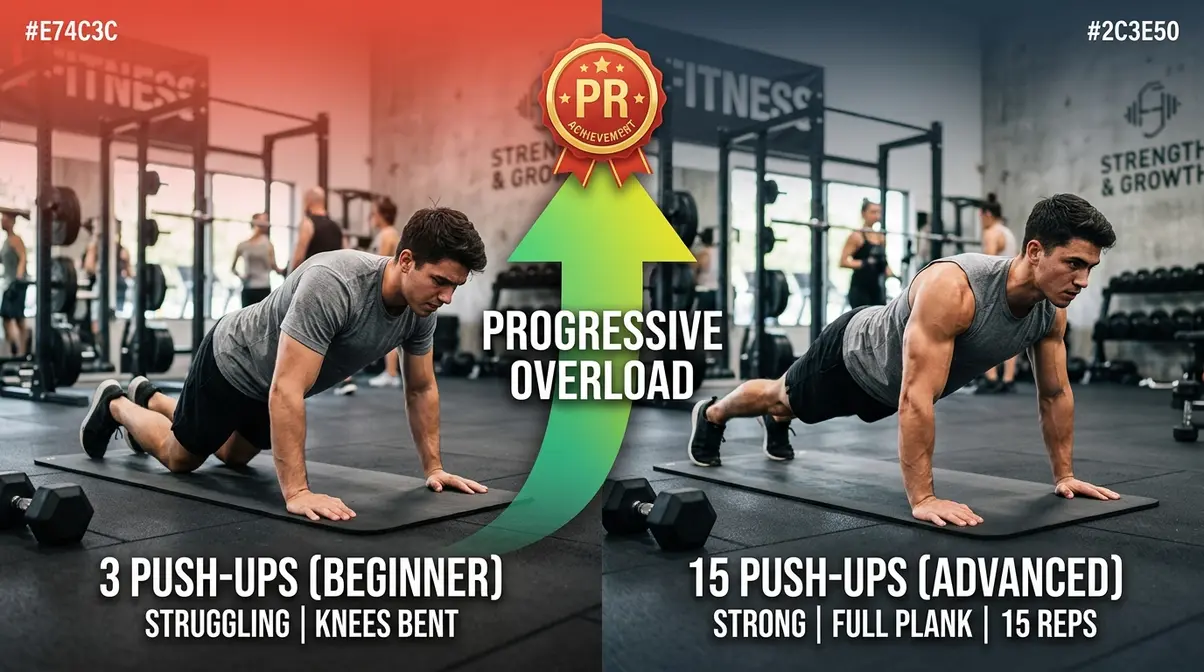
Your muscles grow when you challenge them beyond what they’ve done before. A PR is proof that you’ve done exactly that. This is called progressive overload — the principle of gradually increasing the demands you place on your body to force it to adapt and get stronger. Research published in 2026 found that progression through either load or repetitions produced comparable strength and muscle gains in untrained individuals (PubMed, 2026).
Many beginners say they “feel stronger” but don’t know by how much. A PR gives you a number. Numbers don’t lie.
PRs aren’t just a gym thing — across sports, tracking personal bests is how athletes at every level measure growth. Each PR is a milestone worth celebrating. You earned it through effort, consistency, and showing up when you didn’t feel like it.
Here’s a concrete example: say you could only do 3 push-ups when you started. Three months later, you do 15. That’s a new PR — and proof your training is working. No gym equipment, no 1RM, no spotter required.
Understanding what a PR is and why it matters is step one. Step two is knowing the six different types of PRs you can actually set — and that’s where most beginners are genuinely surprised.
The 6 Types of Gym PRs: The PR Spectrum
In the gym, PR covers six distinct types of personal records — what we call The PR Spectrum. The six types are: Strength, Repetition, Volume, Time, Cardiovascular, and Form. Together, they give you a complete picture of your fitness progress — far beyond any single heavy lift. Beginners should note: you don’t need to chase all six at once. Start with Repetition and Form PRs before attempting Strength (1RM) PRs. That progression keeps you safe and builds the foundation you need.
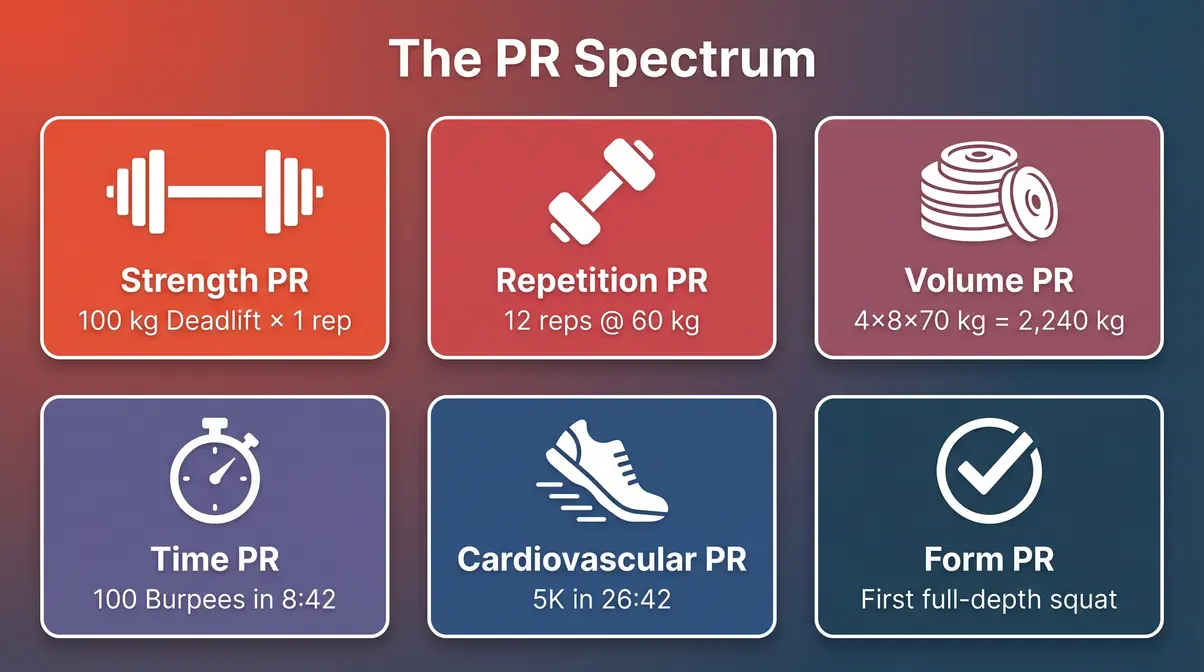
Here’s a quick overview before we go deeper:
- Strength PR — Heaviest weight lifted for one rep (1RM)
- Repetition PR — Most reps completed at a given weight
- Volume PR — Most total weight moved in a single session
- Time PR — Fastest completion of a set workout
- Cardiovascular PR — Best endurance performance (distance, pace, time)
- Form PR — First time performing an exercise with perfect technique
Strength PR (1RM)
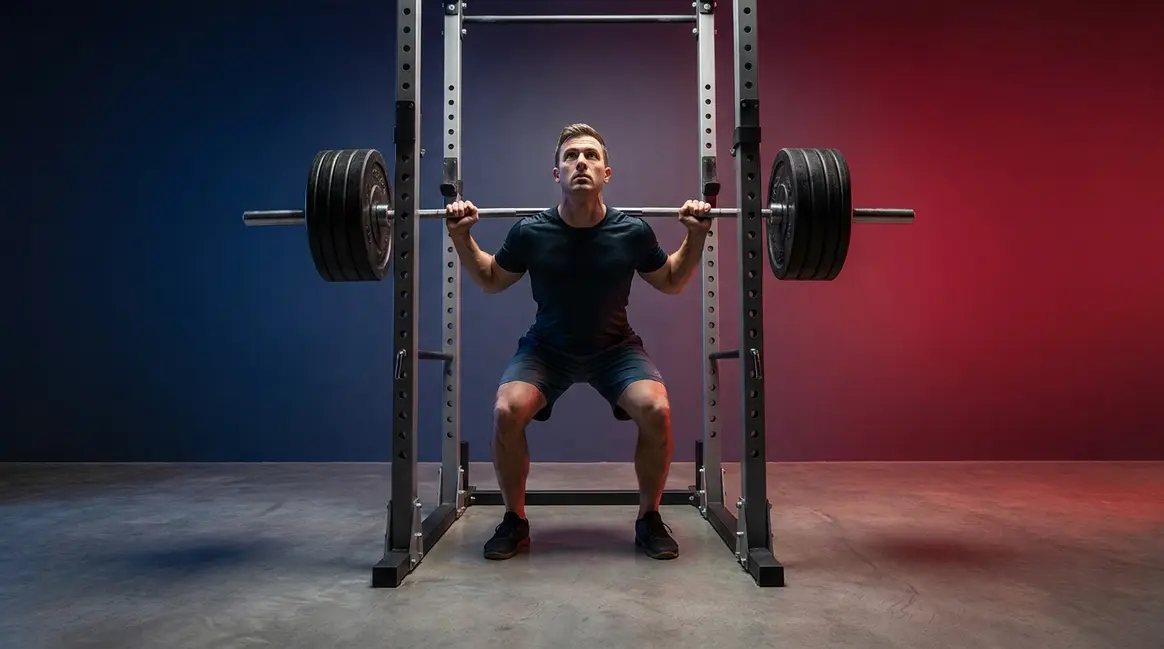
A Strength PR is the maximum weight you can lift for one complete repetition with good form. This is what most people mean when they say “PR” in weightlifting. Your 1RM squat, bench press, or deadlift are the classic examples.
What Does PR Mean in Weightlifting?
In weightlifting specifically, a PR almost always refers to your 1-Rep Max (1RM) on core compound lifts like the squat, bench press, or deadlift. It is the absolute maximum weight you can successfully lift for a single repetition.
The 1RM test is considered the gold standard for assessing muscle strength in non-laboratory settings (NIH/PubMed Central, 2013) — but beginners should start with repetition or volume PRs before attempting a true 1RM. Working in the 1–5 rep range at 80–100% of your 1RM is most effective for pure strength development, according to strength and conditioning research.
How to track it: Record the exercise name, the weight lifted, and the date. Example: “Bench Press 1RM — 80 kg — March 14, 2026.”
What this looks like in practice: If your previous best bench press was 75 kg for one rep, and today you successfully lift 77.5 kg once with full control, you’ve just set a new Strength PR.
Repetition PR
A Repetition PR (also called a Rep PR) is the most reps you’ve ever completed at a specific weight. This answers one of the most common beginner questions: how many reps is a PR? The answer — any number, as long as it’s your personal best at that load.
For example: if you’ve previously done 8 reps of 60 kg on the squat, and today you manage 10 reps at the same weight, that’s a new Repetition PR. The NSCA (National Strength and Conditioning Association) recognizes that submaximal repetition testing (like a 10RM — the maximum weight you can lift for 10 reps) is a safer and more accessible entry point for newer lifters than a true 1RM test.
How to track it: Record the exercise, the weight, and the new rep count. Example: “Squat — 60 kg — 10 reps (previous best: 8 reps).”
What this looks like in practice: A beginner who goes from 5 pull-ups to 8 pull-ups has set a Repetition PR — no added weight required.
Volume PR
A Volume PR is the most total weight you’ve moved in a single training session for a specific exercise or overall workout. Volume is calculated by multiplying sets × reps × weight.
This is one of the most overlooked PRs in gym culture — zero major competitors discuss it — but it’s one of the most meaningful for intermediate lifters building muscle.
How to track it: Add up your total volume at the end of a session. Example: 4 sets × 8 reps × 70 kg = 2,240 kg total volume. If that’s your highest ever for that exercise in one session, it’s a Volume PR.
What this looks like in practice: You didn’t add weight to the bar today, but you completed an extra set. Your total volume climbed — and that counts.
Time PR
A Time PR is your fastest completion of a specific workout, circuit, or exercise challenge. Think: how fast can you finish 100 kettlebell swings, or complete a specific CrossFit WOD (Workout of the Day)?
Time PRs reward efficiency and conditioning. They’re especially motivating for people who respond better to racing the clock than chasing heavier weights.
How to track it: Record the workout name and your completion time. Example: “100 Burpees — 8 minutes 42 seconds — February 2, 2026 (previous best: 9 minutes 15 seconds).”
What this looks like in practice: You completed the same 20-minute circuit in 17 minutes. New Time PR — and proof your fitness is improving.
Cardiovascular PR
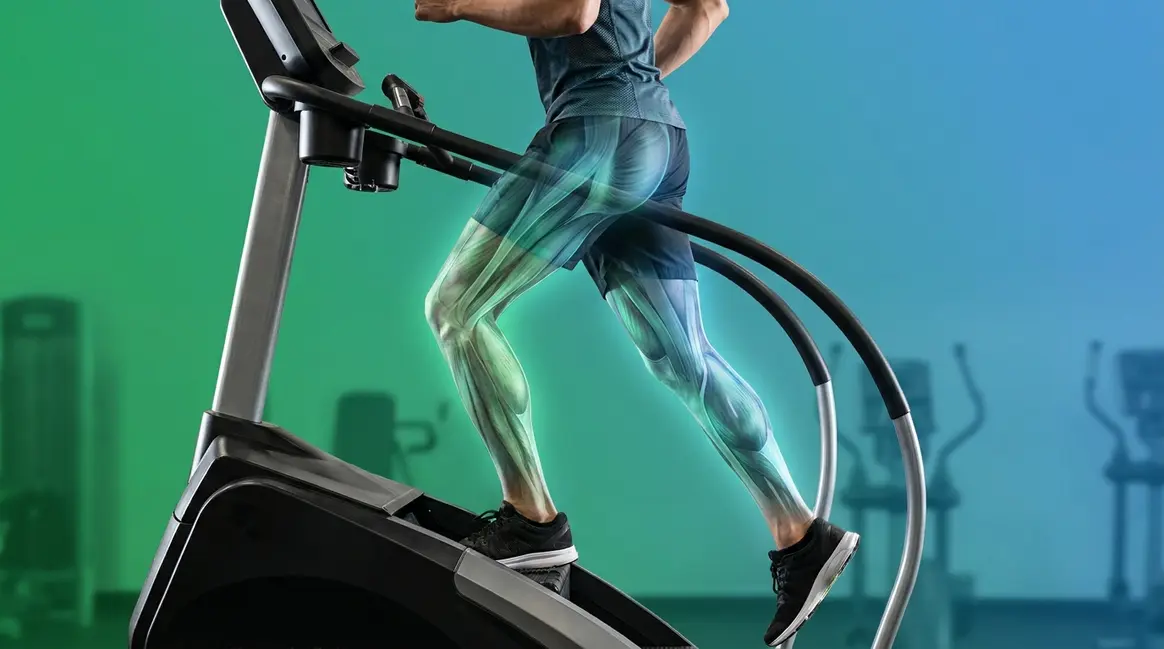
A Cardiovascular PR covers your best endurance performance — fastest 5K run, longest distance cycled, most calories burned in a rowing session, or fastest mile time. This is what PR means in running: your best-ever time over a set distance.
What Does PR Mean in Running?
In running, a PR means your personal best time for a specific race distance. A runner who finishes a 5K in 28 minutes for the first time, then later finishes in 26 minutes, has set a new Cardiovascular PR. The same logic applies to cycling, swimming, rowing, and any other cardio discipline.
How to track it: Log the activity, distance, and time. Example: “5K Run — 26:42 — April 5, 2026 (previous best: 28:15).”
What this looks like in practice: Your treadmill pace that once felt brutal now feels manageable. When you hold it longer than ever before, that’s a Cardiovascular PR.
Form PR
A Form PR is the first time you perform an exercise with technically correct, full-range-of-motion form. No other beginner guide discusses this PR type — but fitness professionals consistently rank it as one of the most important milestones for new gym-goers.
Why it matters: Lifting heavier with bad form increases injury risk dramatically. Achieving perfect form on a squat, deadlift, or overhead press is a genuine personal record — one worth logging and celebrating.
How to track it: Note the exercise and the date you first achieved clean form. Video yourself (with permission in your gym) and compare to a certified coaching reference. Example: “First full-depth squat with neutral spine — January 20, 2026.”
What this looks like in practice: You’ve been squatting for three weeks with your heels rising. Today, for the first time, you hit full depth with flat feet and a neutral back. Form PR. That milestone protects your knees for years to come.
| PR Type | What It Measures | Example | How to Track |
|---|---|---|---|
| Strength | Max weight × 1 rep | 100 kg deadlift, 1 rep | Exercise + weight + date |
| Repetition | Max reps at set weight | 12 reps @ 60 kg squat | Exercise + weight + reps |
| Volume | Total weight moved per session | 4×8×70 kg = 2,240 kg | Sets × reps × weight |
| Time | Fastest workout completion | 100 burpees in 8:42 | Workout + time |
| Cardiovascular | Best endurance performance | 5K in 26:42 | Activity + distance + time |
| Form | First technically correct rep | First full-depth squat | Exercise + date achieved |
How to Safely Test a New PR
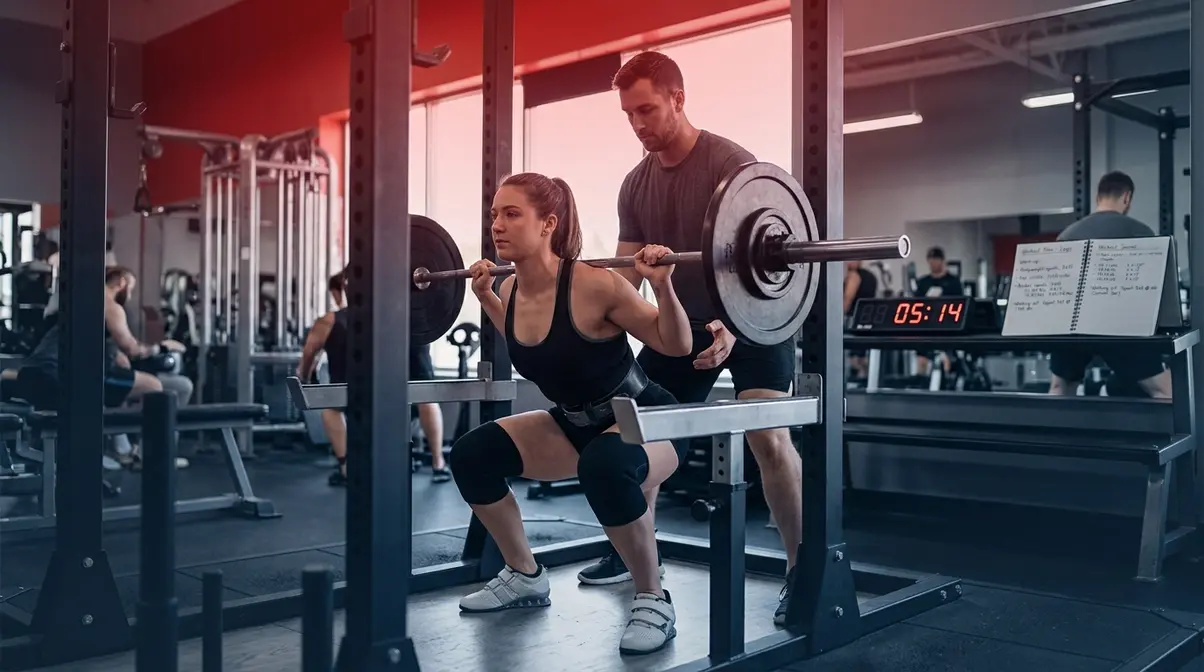
⚠️ Safety Disclaimer: Attempting a maximal lift — especially a 1RM — carries real injury risk if done without preparation. Fitness professionals and certified trainers strongly recommend consulting a qualified personal trainer or sports medicine professional before testing a new Strength PR, particularly if you are new to the gym, returning from injury, or have any underlying health condition. The guidance below reflects best practices from certified strength and conditioning specialists, but it does not replace professional supervision.
Testing a new PR is exciting. It’s also the moment when most beginner injuries happen — because enthusiasm outpaces preparation. The good news is that a structured approach makes PR testing both safe and effective.
Before You Test: The Essential Warm-Up
Estimated Time: 15-20 minutes
- Tools and Materials Needed:
- Barbell, dumbbells, or chosen equipment
- Weight plates (various sizes)
- Gym timer or stopwatch
- Workout journal or tracking app
You’ll need: A working knowledge of the exercise you’re testing, at least 4–6 weeks of consistent training at submaximal weights, and 15–20 minutes for a proper warm-up.
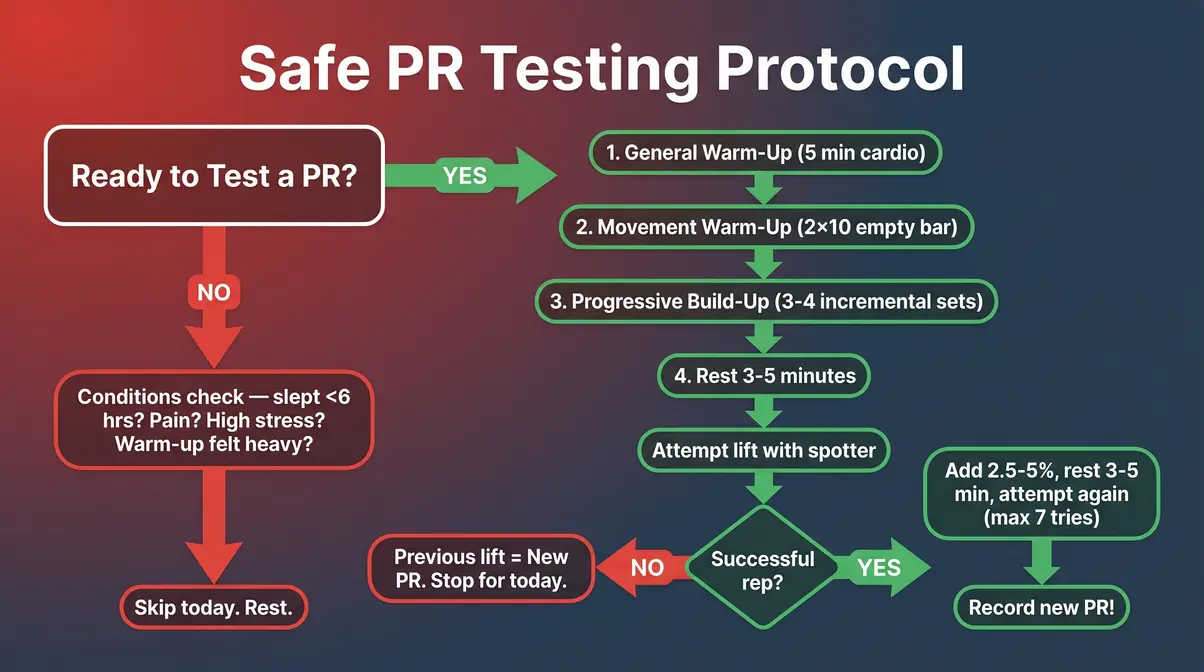
A proper warm-up does two things: it raises your core body temperature and primes your nervous system for heavy effort. Skipping it is the single most common mistake beginners make before PR attempts.
Follow these steps:
- General warm-up (5 minutes): Light cardio — treadmill, rowing machine, or jumping jacks. Get your heart rate to a moderate level.
- Movement-specific warm-up (5 minutes): Perform the exercise you’re testing with an empty bar or very light weight. Do 2 sets of 10 reps. Focus entirely on form.
- Progressive build-up (5–8 minutes): Increase the weight in 3–4 incremental jumps, doing fewer reps each time. Example for a 100 kg squat target:
- Set 1: 50 kg × 5 reps
- Set 2: 70 kg × 3 reps
- Set 3: 85 kg × 2 reps
- Set 4: 95 kg × 1 rep (then rest 3 minutes before the PR attempt)
- Rest adequately: Take 3–5 minutes of rest between warm-up sets. Fatigue before your PR attempt defeats the purpose.
Expected outcome: You should feel warm, loose, and ready — not tired. If you feel drained after your warm-up, you’ve done too much. Scale back.
The AMRAP Method: A Safer Way to Test
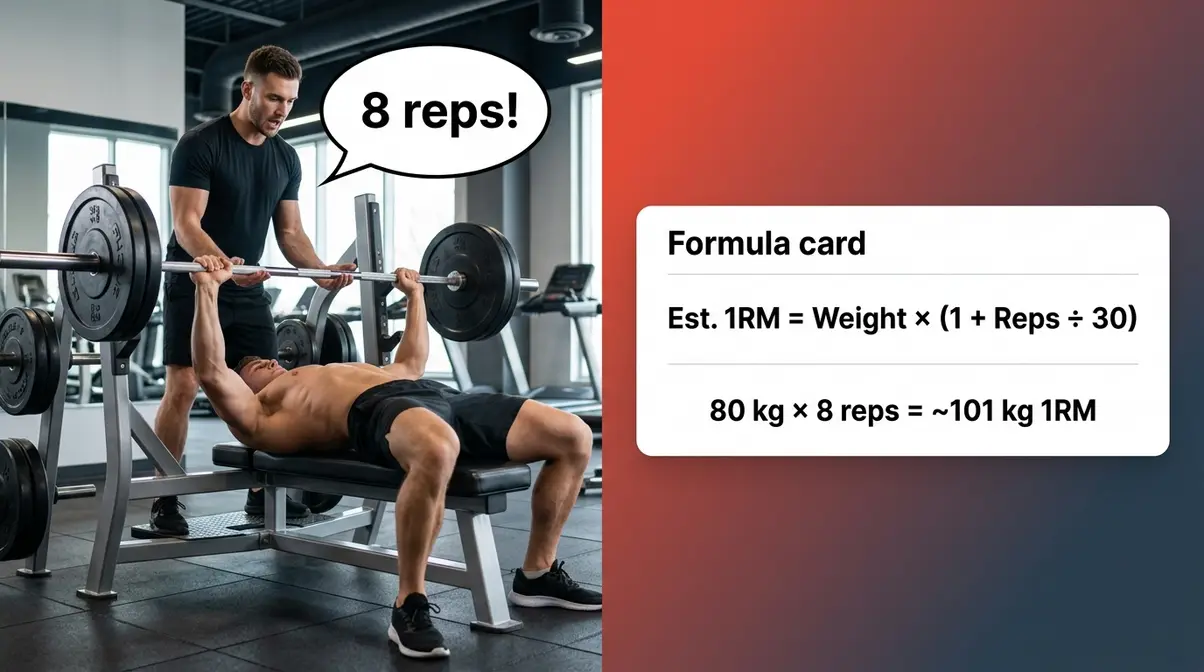
AMRAP stands for “As Many Reps As Possible.” Instead of attempting a true 1RM (which carries the highest injury risk), you lift a moderate weight for as many reps as you can manage with good form — then use a formula to estimate your 1RM.
This approach is endorsed by the NSCA as a safer alternative for novice lifters. The standard estimation formula is:
Estimated 1RM = Weight × (1 + Reps ÷ 30)
- Example: You lift 80 kg for 8 reps.
- 1 + (8 ÷ 30) = 1 + 0.267 = 1.267
- 80 × 1.267 = ~101 kg estimated 1RM
This means you can set a meaningful Strength PR without ever putting a truly maximal load on your body. For beginners, fitness professionals recommend using the AMRAP method exclusively for the first 6–12 months of training.
How to track it: Record the exercise, the weight used, the reps completed, and the estimated 1RM. Example: “Bench Press AMRAP — 70 kg × 10 reps — Est. 1RM: ~93 kg — March 1, 2026.”
Your Step-by-Step PR Testing Protocol
Once you’ve warmed up, here’s the protocol certified trainers use for direct 1RM testing. The NSCA recommends achieving your 1RM within 3–7 attempts, with full rest between each.
- Choose your starting weight: Begin at 90–95% of your expected 1RM (based on your AMRAP estimate or recent training).
- Attempt the lift: Perform one full repetition with strict form. Have a spotter present for all barbell exercises.
- Rest 3–5 minutes: Full recovery between attempts is non-negotiable.
- Increase by 2.5–5%: If successful, add a small increment and attempt again.
- Stop after a failed attempt: If you fail a rep with good form, your previous successful lift is your new PR. Do not attempt again in the same session.
- Record everything: Note the weight, date, conditions (sleep, nutrition, stress), and how the lift felt.
| Setting | Recommended Value | Why |
|---|---|---|
| Rest between attempts | 3–5 minutes | Full ATP (energy) recovery |
| Max attempts per session | 3–7 | Beyond 7, fatigue distorts results |
| Weight increment | 2.5–5% per attempt | Prevents overshooting |
| Spotter present | Always (barbell lifts) | Safety for failed reps |
How to Track Your PRs and Keep Breaking Them
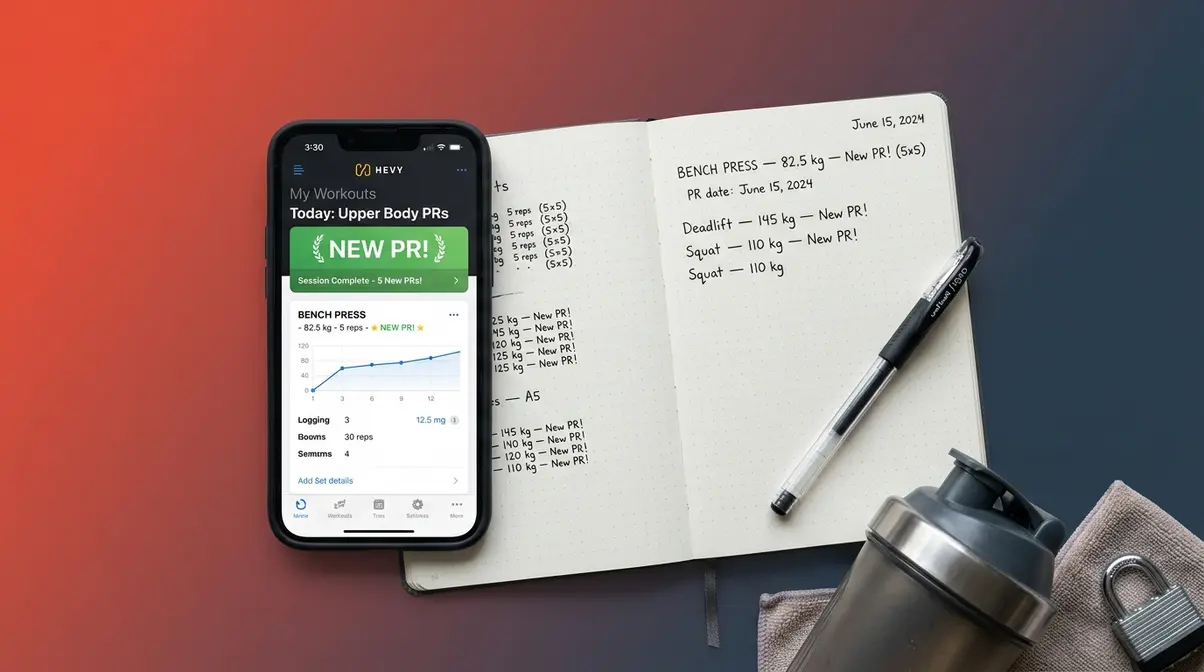
Tracking your PRs transforms vague effort into measurable progress. The PR Spectrum gives you six distinct metrics to follow — and consistent logging is what turns those metrics into a roadmap for long-term improvement. Fitness professionals recommend logging PRs immediately after each session while the details are fresh.
What to Record After Every PR Attempt
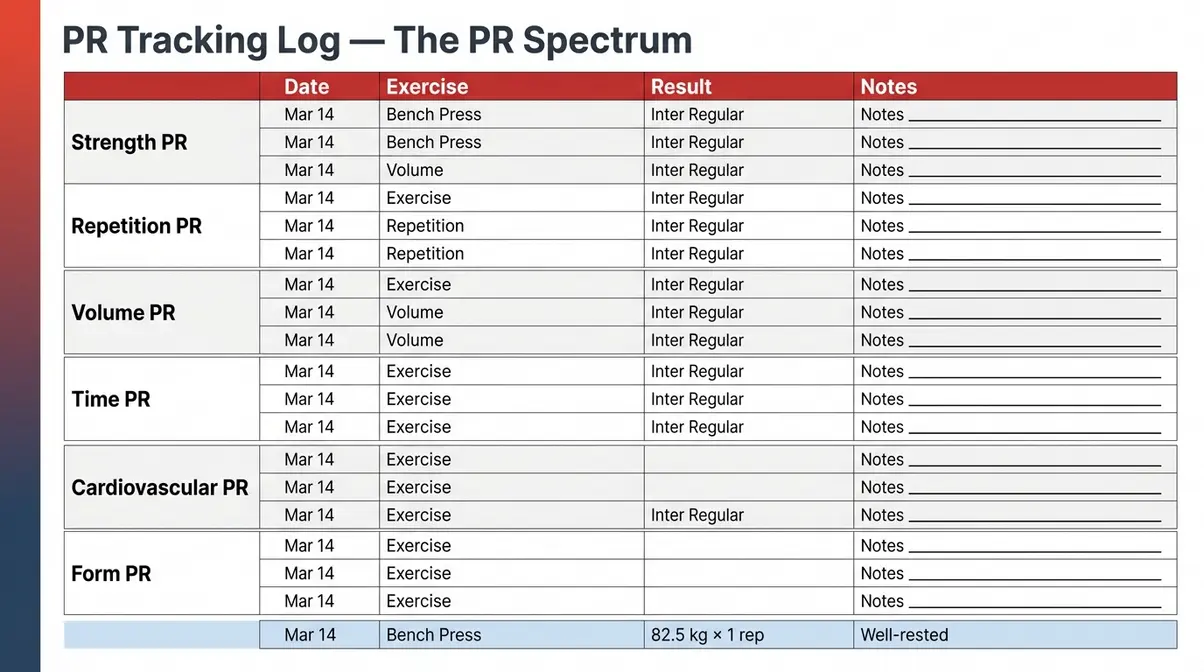
Whether you broke a record or came close, log these five data points immediately after your session:
- Exercise name: Be specific — “Barbell Back Squat,” not just “Squat”
- PR type: Which of the six PR Spectrum categories does this fall under?
- Performance data: Weight, reps, time, distance — whatever the metric is
- Date: Essential for tracking rate of progress over weeks and months
- Conditions: Brief note on sleep, nutrition, and energy level — helps you understand what drives your best performances
Example log entry:
| Date | Exercise | PR Type | Result | Notes |
|---|---|---|---|---|
| Mar 14, 2026 | Bench Press | Strength | 82.5 kg × 1 rep | Well-rested, good warm-up |
| Mar 21, 2026 | Squat | Repetition | 70 kg × 12 reps | Previous best: 10 reps |
| Mar 28, 2026 | Deadlift | Form | First clean lockout | Filmed for review |
The Best Apps for Tracking Gym PRs
A notebook works. But dedicated apps make PR tracking faster, smarter, and more motivating — especially when they automatically flag a new PR the moment you log it.
Based on evaluations of the top workout tracking apps in 2026, here are three worth using:
Hevy (Free / Pro at ~$23.99/year) — Rated 4.9/5 on both the App Store and Google Play, Hevy is the top-rated gym logger for strength training. It automatically detects new PRs as you log sets, shows visual progression charts, and lets you share records socially for accountability. Best for beginners who want automatic PR detection without manual calculation.
Strong (Free / Premium available) — A minimalist option built for fast, no-friction logging. Strong tracks your PR history per exercise and shows clear progression graphs. Best for lifters who want speed over features.
Strava (Free / Subscription available) — The gold standard for Cardiovascular PR tracking. Strava automatically records your fastest segments, best 5K times, and longest rides. Best for runners, cyclists, and anyone focused on endurance PRs.
| App | Best For | PR Auto-Detection | Cost |
|---|---|---|---|
| Hevy | Strength + all gym PRs | Yes | Free / ~$23.99/yr |
| Strong | Fast, simple logging | Yes | Free / Premium |
| Strava | Cardio + endurance PRs | Yes | Free / Subscription |
What Does PR Mean Outside the Gym?
If you searched “what does PR mean” and landed here, you might be asking about a completely different context. PR is one of the most overloaded acronyms in the English language. Outside the gym, it carries two major meanings — and knowing the difference saves a lot of confusion. Understanding these distinctions ensures you don’t mix up fitness milestones with corporate communications.
PR in Business: Public Relations
In business, PR stands for Public Relations — the strategic management of how a company or individual communicates with the public, media, and stakeholders. A PR professional (or PR agency) crafts press releases, manages media relationships, handles crisis communications, and shapes brand reputation.
Unlike marketing, which focuses primarily on driving direct sales and revenue, public relations is entirely focused on earned media and long-term trust. If your boss says “we need to work on our PR,” they almost certainly mean public relations — not squats. The two uses of the acronym share nothing beyond the letters.
- Common business PR activities include:
- Writing and distributing press releases to news outlets
- Managing journalist and media relationships for favorable coverage
- Coordinating product launch announcements and press events
- Handling reputational crises and issuing public statements
- Organizing community outreach programs
PR in Media: Managing Public Perception
In media and entertainment, PR refers to the same public relations discipline — but applied specifically to celebrities, public figures, athletes, and media properties. A film studio’s PR team manages premiere coverage and red carpet events. A pop star’s PR team handles interview strategy, brand partnerships, and reputation management.
What does PR mean in media? It means the deliberate shaping of public perception through earned media (press coverage), social media strategy, and controlled messaging. When an actor “gives a PR answer” in an interview, it means their response was carefully crafted to protect their image rather than express a candid, potentially controversial opinion. PR teams work tirelessly behind the scenes to ensure their clients maintain a positive public image.
The gym PR and the media PR have one thing in common: both represent your best performance in your field. Beyond that, the meanings diverge entirely.
Common Mistakes When Chasing a New PR
Understanding what does PR mean in the gym is one thing. Avoiding the pitfalls that derail beginners is another. Fitness professionals and certified trainers consistently flag two mistakes above all others.
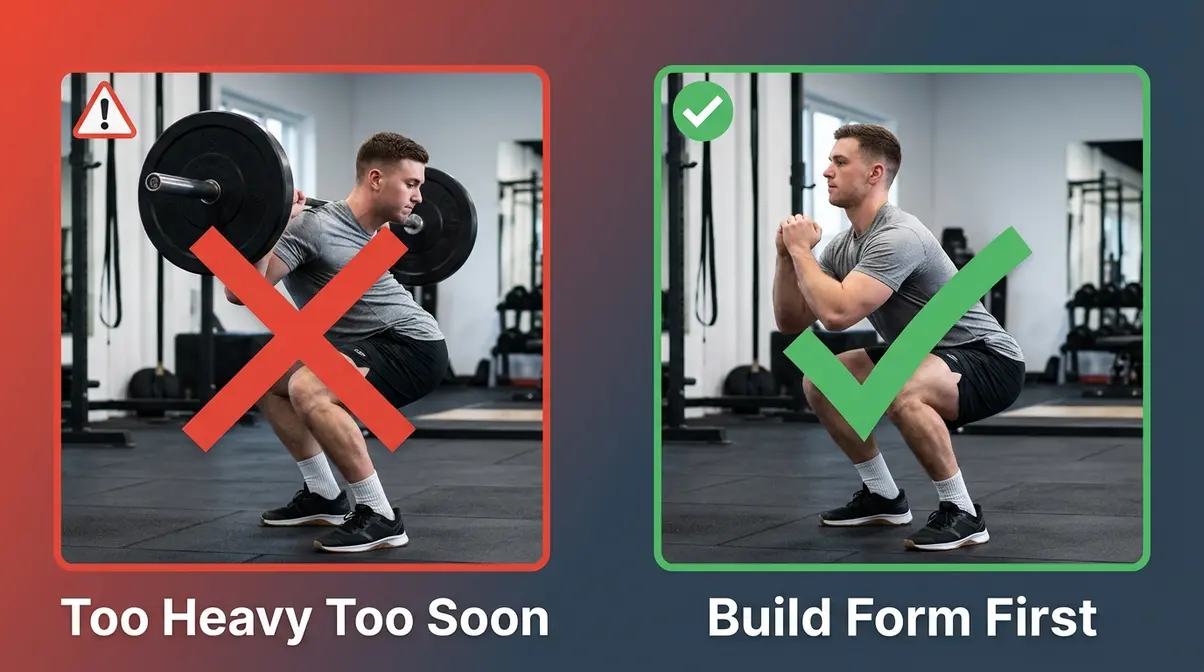
Going Too Heavy Too Soon
The most dangerous PR mistake is attempting a 1RM before you’ve built the technical foundation to support it. Beginners often feel strong after a few good sessions and immediately want to test their absolute maximum. The problem: technique breaks down under maximal loads, and that’s when injuries happen.
Specific scenario: A beginner who’s been squatting for six weeks attempts a 1RM with a forward lean and rounded lower back. The weight moves — but so does the vertebral alignment. Lower back injuries from this pattern are among the most common gym injuries in new lifters.
How to avoid it: Follow the AMRAP method for your first 6–12 months. Build your technique PR before you chase your Strength PR. NASM guidelines recommend increasing training load by no more than 10% per week to allow safe, gradual adaptation.
When to choose an alternative: If you’ve been training consistently for less than 12 weeks, skip direct 1RM testing entirely. Use the AMRAP estimation method and focus on Repetition and Form PRs instead — you’ll build the same strength foundation with far less risk.
When to Skip a PR Attempt
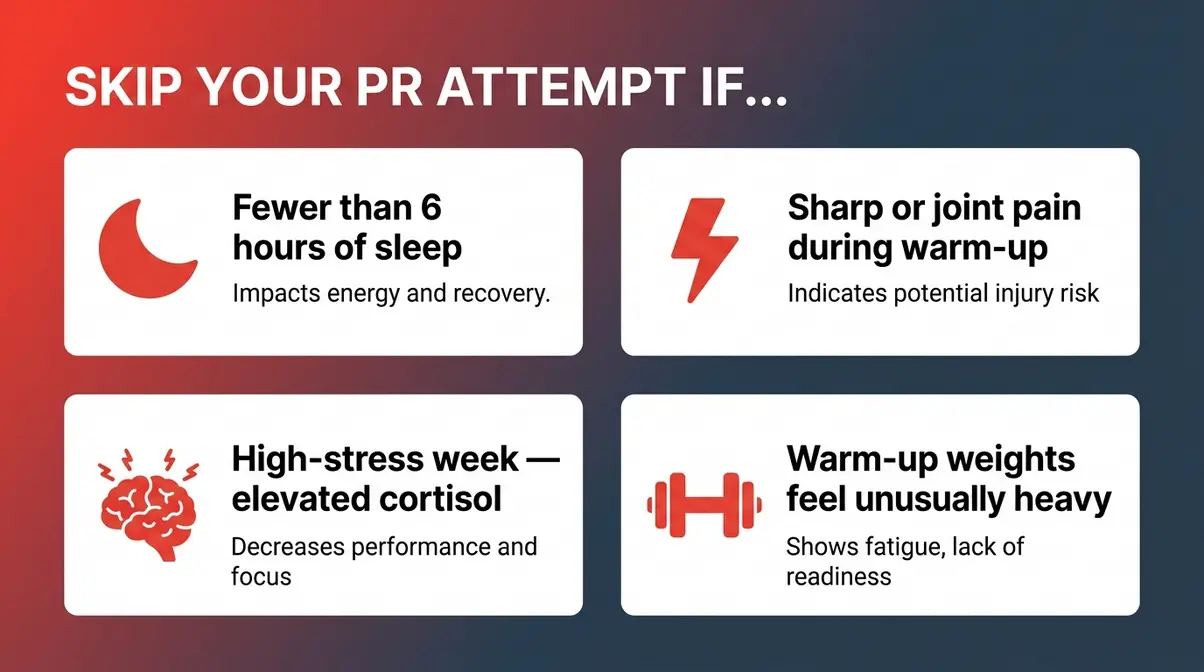
Not every session is a PR session. Certified trainers advise skipping a PR attempt entirely when any of these conditions apply:
- You slept fewer than 6 hours the night before — sleep deprivation reduces peak strength output by up to 8–10%, meaning your PR attempt reflects fatigue, not your true capacity
- You’re feeling unusual pain — soreness is normal, sharp or joint pain is not. Pain during warm-up sets is a hard stop signal
- You’ve had a high-stress week — elevated cortisol (the stress hormone) actively suppresses strength performance
- Your warm-up feels off — if your moderate warm-up weights feel heavier than usual, your body is telling you something. Listen to it
The professional guidance: Consult a certified personal trainer or sports medicine professional if you’re unsure whether it’s safe to attempt a new PR — especially if you have a history of joint issues, previous injuries, or a chronic health condition. A single session with a qualified professional can save months of recovery time.
Frequently Asked Questions
How Many Reps Is a PR?
A PR can be any number of reps — there’s no minimum or maximum. A Repetition PR is simply your best-ever rep count at a specific weight. If you’ve previously done 8 reps of 60 kg on the bench press and today you complete 9, that’s a new PR. You can also set a PR at 1 rep (a Strength/1RM PR), 20 reps, or any number in between. The NSCA recognizes that a 10RM test — your maximum reps at a given load — is a particularly useful benchmark for newer lifters. Any personal best at any rep count qualifies.
What Is a PR in a 5K?
A 5K PR is your fastest-ever time for a 5-kilometer run — a Cardiovascular PR in The PR Spectrum framework. If your first 5K took 35 minutes and your next one takes 32 minutes, you’ve set a new 5K PR. PR in running means the same thing as PR in the gym: your personal best over a specific distance or course. Most runners track their PR for standard race distances: 5K, 10K, half marathon, and marathon. Apps like Strava automatically record and flag new running PRs as you complete them.
Difference Between a PR and a 1RM?
A 1RM (One-Rep Max) is one specific type of PR — not a synonym for it. Your 1RM is the maximum weight you can lift for exactly one repetition with good form. A PR is the broader category: it includes Strength PRs (like a 1RM), but also Repetition PRs, Volume PRs, Time PRs, Cardiovascular PRs, and Form PRs. Think of it this way: all 1RMs are PRs, but not all PRs are 1RMs. A runner’s 5K personal best is a PR. A beginner’s first 10 consecutive push-ups is a PR. Neither involves a 1RM. The 1RM is the most celebrated gym PR — but it’s just one of six.
What Is the 3-3-3 Rule in the Gym?
The 3-3-3 rule in the gym refers to a strength training rep scheme — 3 sets of 3 reps at a near-maximal weight. It’s used primarily for strength development, typically at 85–95% of your 1RM (PubMed). The low rep count allows heavy loading without excessive fatigue, making it a popular protocol for experienced lifters working toward a new Strength PR. For beginners, fitness professionals generally recommend starting with higher rep ranges (8–12 reps) before progressing to lower rep, heavier-weight protocols like 3-3-3. It’s not a universal gym rule — it’s one specific training method among many.
Your PR Journey Starts With One Record
For gym beginners, understanding what does PR mean in the gym is the first step toward training with real purpose. A PR — Personal Record — is the best performance you’ve ever achieved in any fitness metric. Research confirms that tracking measurable progress, including submaximal repetition records and volume milestones, produces comparable strength and muscle gains to pure 1RM training (PubMed, 2026). The most effective approach combines consistent logging, gradual progressive overload, and smart PR selection based on your current training level.
The PR Spectrum gives you six distinct categories to chase — Strength, Repetition, Volume, Time, Cardiovascular, and Form — so you’re never stuck waiting for the one day you feel strong enough to attempt a 1RM. Every session is an opportunity to set a new record in at least one category. That’s not a small insight — it’s a complete reframe of how to measure your own progress.
Start today. Pick one exercise you’ve been doing consistently. Check your recent logs (or your memory). Write down your best performance in that exercise. That number is your current PR. Your only job now is to beat it — on your terms, at your pace, competing only with yourself.
Related posts:
StrongLifts 5x5 for Beginners: Complete Guide 2026
How to Get a Bigger Bum Without Exercise: 3-Tier Guide
What Muscles Does the StairMaster Work? 6 Groups
Olympic Weightlifting vs Powerlifting: 2026 Guide
What Kills Muscle Gains? 7 Proven Saboteurs to Fix Now
Best Strength Training Apps for Women: Top 7 Picks

Callum
Hi, I'm Callum, the founder of Body Muscle Matters. I'm not a certified trainer, I'm a self taught lifter who started this site to share what I've learned from my own training and a lot of trial and error. Everything here comes from real experience and honest research, written the way I'd explain it to a friend who is just getting started. My goal is simple: practical, no hype fitness advice you can actually use.