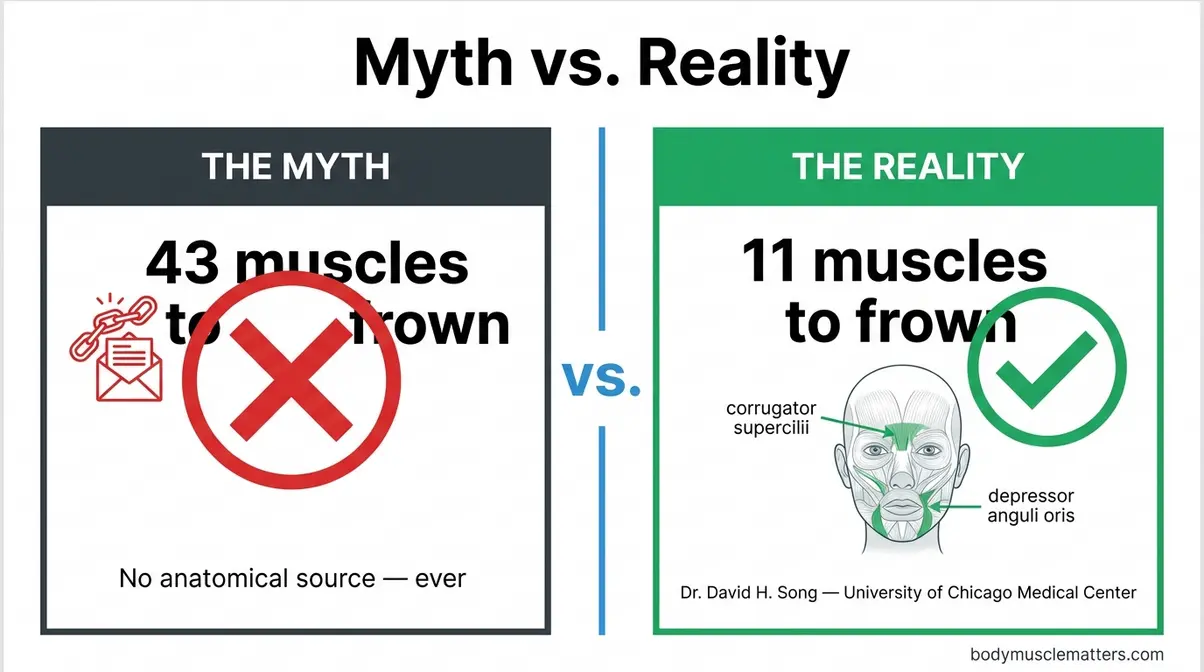
You have probably seen the claim floating around chain emails, motivational posters, and social media: it takes 43 muscles to frown and only 17 to smile. Open the right inbox and you might find something like this:
Here is the problem: nobody agrees on the number. Online, you will find figures ranging from 6 to 17 to 43 to 72 — and some sources even claim 113. So how many muscles does it take to frown, really?
The honest answer, backed by clinical anatomy, is approximately 11 muscles. A full Duchenne smile uses about 12. The “43 muscles to frown” claim has no basis in anatomical research. This guide names every muscle involved, explains why the myth persists, and covers the science of why smiling feels easier — even when the muscle counts are nearly identical.
A typical frown uses approximately 11 muscles — not 43. A full Duchenne smile uses about 12. The famous “43 muscles to frown” claim is a myth with no clinical backing. Here’s what the anatomy actually shows:
- The 43-Muscle Fallacy: No study confirms 43 muscles for a frown; clinical anatomy points to approximately 11 key muscles, according to analyses citing NIH StatPearls
- Smiling vs. Frowning: The muscle counts are nearly identical — roughly 11 vs. 12 — making the popular saying doubly misleading
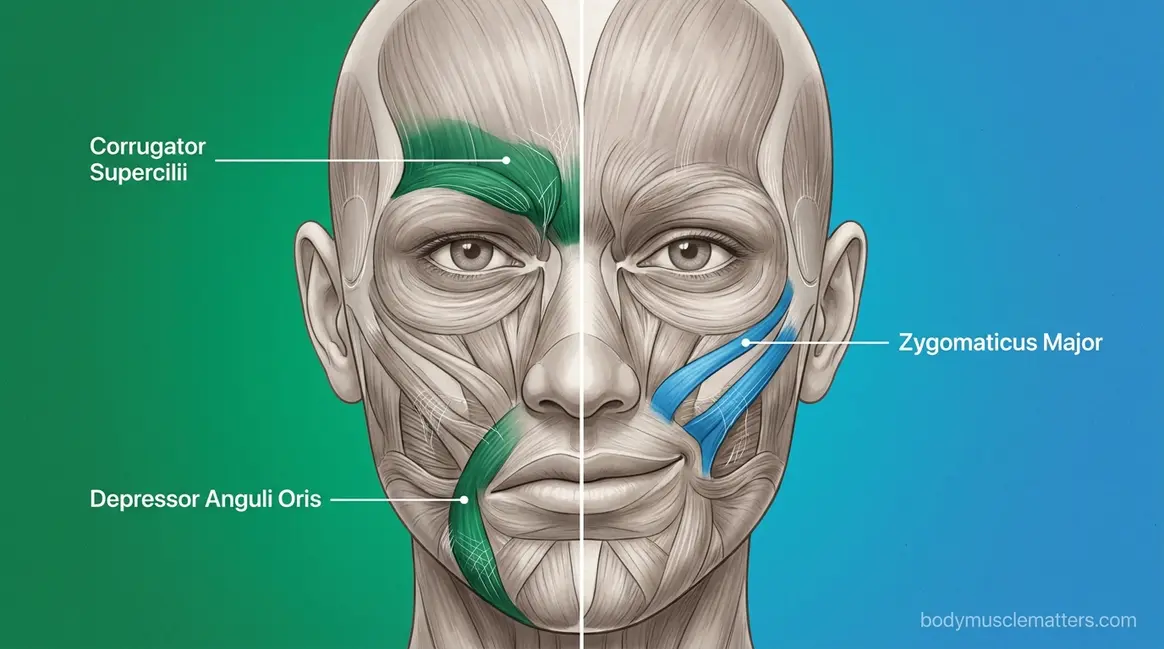
- Key Frown Muscles: The corrugator supercilii and depressor anguli oris do most of the heavy lifting in a frown
- Why It Feels Harder to Frown: Social conditioning and the facial feedback hypothesis, not raw muscle count, explain the difference in effort
How Many Muscles Does It Take to Frown?
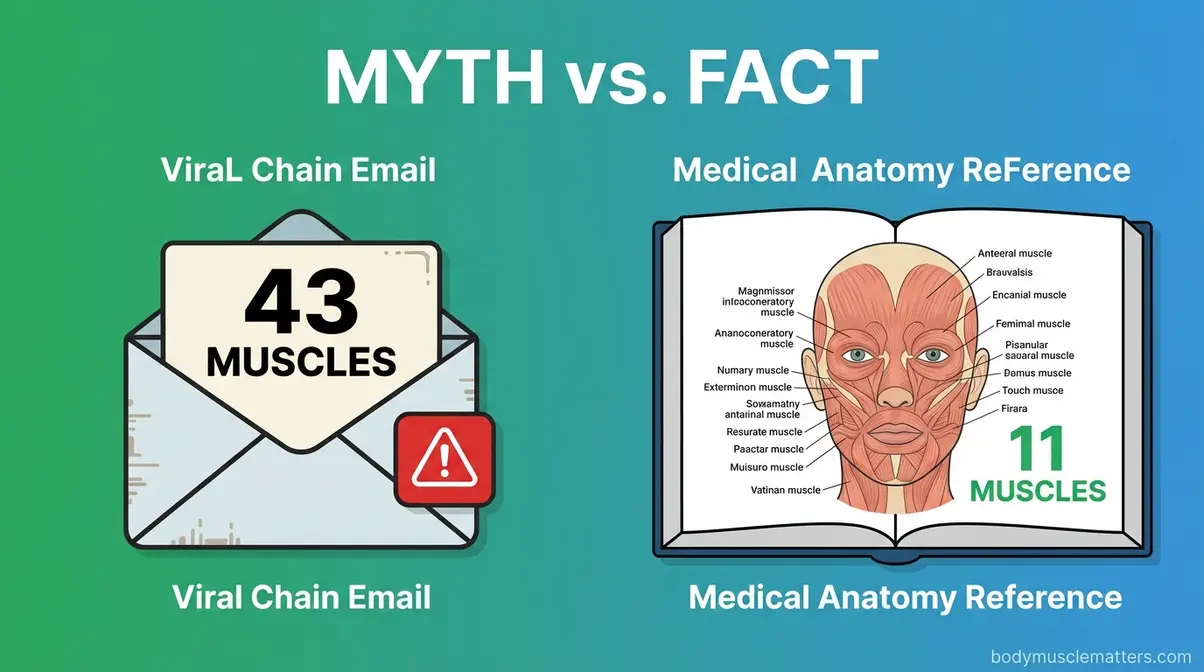
A typical frown uses approximately 11 facial muscles — and that number is based on anatomical research, not a chain email. The human face contains roughly 43 muscles total, according to anatomy of facial muscles described in NIH StatPearls (2026). However, no single expression activates all of them at once. The question of how many muscles used to frown comes down to which muscles fire during the specific movement of pulling your brows down and your mouth corners downward.
One important clarification before the list: bones do not frown. Facial expressions are created entirely by muscles — striated muscles that attach directly to your skin and pull it in different directions. If you have ever heard someone ask “how many bones does it take to frown,” the answer is zero. Bones provide the scaffold; muscles do the expressive work.
How many muscles do I use when I frown?
Anatomical studies confirm that frowning activates approximately 11 facial muscles, with the corrugator supercilii acting as the primary driver of the expression (NIH StatPearls, 2026). Here are the key players:
- Corrugator supercilii — the muscle responsible for pulling your eyebrows together and creating the “furrowed brow” look. Think of it as the “angry eyebrows” muscle. Facial EMG research confirms it is the most consistently activated muscle during frowning (PMC, 2026).
- Procerus — the procerus is a small, pyramid-shaped muscle at the top of the nose that pulls the skin between your eyebrows downward, creating the nose-bridge wrinkle you see in a deep scowl.
- Depressor supercilii — pulls the eyebrows downward toward the nose, working alongside the corrugator to deepen the brow furrow.
- Orbicularis oculi (medial portion) — the orbicularis oculi (or-bik-yoo-LAIR-is OK-yoo-lie) is the ring-shaped muscle surrounding your eye. During a frown, its inner portion tightens, narrowing the eye opening.
- Depressor anguli oris — the depressor anguli oris (dee-PRESS-or ANG-yoo-lie OR-is) is the muscle that pulls the corners of your mouth downward into a frown. It is the most visible driver of the classic “sad mouth” shape.
- Depressor labii inferioris — pulls the lower lip downward, adding depth to a full frown or grimace.
- Mentalis — the mentalis (men-TAY-lis) wrinkles the chin and pushes the lower lip upward, contributing to the “pouty” or “sulking” look.
- Platysma — a broad, flat muscle that spans the neck and lower jaw. It tightens the neck and jawline area during intense negative expressions.
- Zygomaticus minor — normally associated with a partial smile, this muscle is held in tension during a frown, actively resisting upward movement of the lip corners.
- Levator labii superioris alaeque nasi — a long-named muscle (leh-VAY-tor LAY-bee-eye soo-PEER-ee-OR-is al-EE-kwee NAY-zee) that flares the nostrils and raises the upper lip, most noticeable during intense or disgusted expressions.
- Buccinator — the buccinator (BUK-sin-ay-tor) tenses the cheek in some definitions of a full frown, particularly when the expression involves clenching or sustained muscular effort.
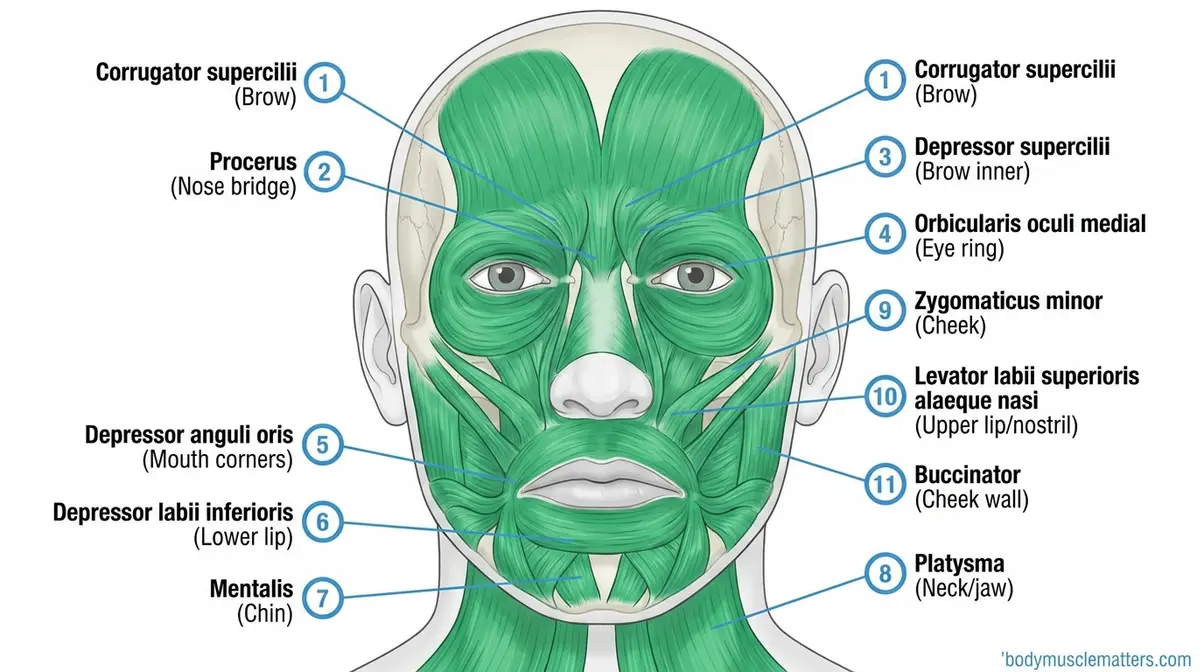
A typical frown activates approximately 11 facial muscles, with the corrugator supercilii acting as the primary driver of the expression (anatomy of facial muscles, NIH StatPearls, 2026).
Why Do Muscle Counts Vary?
Across anatomy sources, the consensus is that a simple frown — just a brow furrow — may activate as few as 6 muscles. A full, open-mouthed grimace can recruit 11 or more. This is the key reason you see such wildly different numbers online.
Researchers define “frowning” differently. Some measure only the minimal brow contraction needed to express displeasure. Others include the full cascade of muscles involved in an intense, whole-face negative expression. Neither definition is wrong — they are measuring different things. When the brief says “11 muscles,” it refers to a complete, recognizable frown involving both brow depression and mouth-corner lowering, which is the most clinically relevant definition.
The number 43, however, does not correspond to any recognized definition of a frown. It roughly equals the total number of facial muscles in the human face — meaning whoever coined the phrase may have simply confused “muscles in the face” with “muscles used to frown.” That confusion is exactly what The 43-Muscle Fallacy describes: the persistent, clinically unsupported claim that frowning requires 43 facial muscles, a number that appears in chain emails and social media posts but has no basis in anatomical research.
Now that you know which muscles do the work, you might be wondering where the “43” figure actually came from — and why it has been repeated for decades.
The “43 Muscles to Frown” Myth — Debunked
The “43 muscles to frown” claim is one of the most durable pieces of misinformation in popular science. Contrary to popular belief, no peer-reviewed study, anatomy textbook, or clinical analysis has ever confirmed this number. So where did it come from — and why does it keep spreading?
Origin of the 43-Muscle Myth
The most widely cited debunking of the 43-muscle myth comes from Cecil Adams writing for The Straight Dope (2004), who consulted plastic surgeon Dr. David H. Song of the University of Chicago Medical Center. Song’s analysis found that a frown requires approximately 11 muscles and a genuine Duchenne smile requires about 12 — making the famous motivational saying not just exaggerated, but anatomically backward.
The “43 muscles” figure appears to originate from a conflation of two separate facts: the total number of muscles in the human face (roughly 43, per Cleveland Clinic) and the number of muscles used in a frown. At some point, someone — or multiple someones — confused the total inventory with the active count for a single expression. The resulting “fun fact” spread through chain letters, motivational posters, and eventually social media, where it continues to circulate today as though it were a documented fact.
The problem is amplified by the numbers varying wildly depending on the source. Some chain letters say 43 to frown and 17 to smile. Others say 62 to frown and 26 to smile. Still others reverse the ratio entirely. No two versions agree, which is itself strong evidence that none of them are based on actual measurement.
Smiling vs. Frowning Effort
This is one of the most searched questions about facial expressions — and the answer surprises most people. According to Dr. Song’s analysis, as reported by Live Science, smiling and frowning require nearly the same number of muscles: approximately 12 for a genuine Duchenne smile and 11 for a standard frown.
That means the popular saying — “it takes more muscles to frown, so smile!” — is based on a false premise. Smiling does not require dramatically fewer muscles. The motivational logic collapses when you look at the actual anatomy.
However, there is a nuanced version of the question that is more interesting: does it take more effort to frown than to smile? That question has a more complex answer involving neuroscience and habit — which we will explore in a later section.
Smile vs. Frown: The Real Numbers
Here is a side-by-side comparison based on anatomical analysis:
| Expression | Primary Muscles Used | Total Approximate Count | Key Muscles |
|---|---|---|---|
| Standard frown | Corrugator supercilii, depressor anguli oris, procerus + supporting muscles | ~11 | Corrugator supercilii, depressor anguli oris |
| Duchenne smile (genuine) | Zygomaticus major, orbicularis oculi + supporting muscles | ~12 | Zygomaticus major, orbicularis oculi |
| Non-Duchenne smile (social) | Zygomaticus major alone + minor supporters | ~6–8 | Zygomaticus major |
| Intense grimace | Full facial recruitment | ~17–20+ | All of the above |
| Popular myth (frown) | N/A — no anatomical basis | “43” | Not verified |
The takeaway is clear: smiling and frowning are muscularly comparable. The “43 muscles” figure is off by a factor of four.
How Many Muscles Does It Take to Smile?
If the frown count surprises you, the muscles involved in smiling are equally interesting. The answer to how many muscles does it take to smile depends heavily on the type of smile you are producing.
The Key Muscles Behind Your Smile
A genuine smile — the kind that reaches your eyes — is called a Duchenne smile, named after French neurologist Guillaume Duchenne, who studied facial expressions in the 1860s. According to iMotions and confirmed by PMC research (2026), a Duchenne smile involves two primary muscles working together:
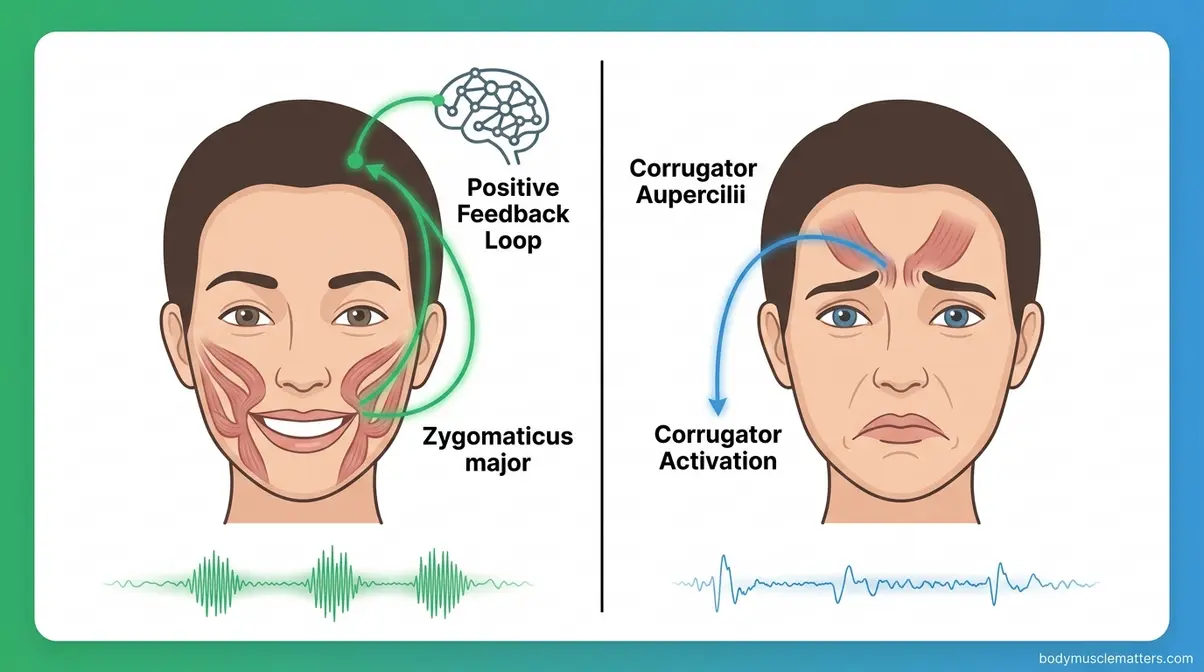
- Zygomaticus major — the zygomaticus major (zy-go-MAT-ik-us MAY-jor) is the main smiling muscle. It runs from your cheekbone (the zygomatic arch) down to the corner of your mouth, pulling it upward and outward. This is the muscle responsible for the characteristic “smile shape.”
- Orbicularis oculi — the same ring-shaped muscle that participates in frowning also creates the eye-crinkling effect in a genuine smile. When this muscle activates around the outer eye, it produces the “crow’s feet” effect that distinguishes a real smile from a polite social one.
Supporting muscles — including the levator labii superioris, zygomaticus minor, and risorius — bring the total for a full Duchenne smile to approximately 12 muscles. A polite or “social” smile that does not reach the eyes may use only 6 to 8.
So does it take 13 muscles to smile? Not exactly. The number 13 appears in some sources but is not a standard clinical count. The most consistent anatomical estimate for a genuine smile is 12 muscles.
What Makes a Duchenne Smile Different?
The Duchenne smile is significant because it is the only type of smile that involves involuntary muscle activation. You can consciously flex your zygomaticus major — that is how you “pose” for a photo. However, you cannot voluntarily activate your orbicularis oculi in the same way. That muscle fires automatically when you feel genuine positive emotion.
This is why people can tell the difference between a real smile and a fake one, even without knowing why. A genuine Duchenne smile uses 12 muscles and involves an involuntary eye-muscle response that cannot be consciously faked (PMC, 2026). A posed smile uses fewer muscles and lacks the orbicularis oculi activation — which is exactly why staged photos often look slightly “off.”
Research using facial electromyography (EMG) — a technique that measures tiny electrical signals in muscles — consistently identifies the zygomaticus major as the primary positive-affect muscle and the corrugator supercilii as the primary negative-affect muscle (WSU Media Mind Lab). These two muscles are essentially the “happiness dial” and the “frown dial” of your face.
Why Does Smiling Feel Easier Than Frowning?
If smiling and frowning use nearly the same number of muscles, why does smiling feel so much more natural for most people? The answer has nothing to do with muscle count — and everything to do with your brain and your social history.
Why is it harder to frown than smile?
From birth, smiling is one of the first social behaviors humans develop. Infants begin producing social smiles between 6 and 8 weeks of age, long before they can walk, talk, or intentionally frown. This early, repeated activation of the zygomaticus major and orbicularis oculi literally trains the neural pathways associated with smiling — making them faster, more automatic, and less effortful over time.
Frowning, by contrast, tends to be a reactive expression — something that happens in response to pain, frustration, or concentration. It is less rehearsed, less socially reinforced, and therefore neurologically less “practiced.” The muscles themselves are not weaker; the neural signal is simply less well-worn. This is why professional actors often find sustained frowning more tiring than sustained smiling — not because of the muscles, but because of the unfamiliar neural demand.
Additionally, research using facial EMG shows that corrugator supercilii activity accumulates with repeated frowning — creating temporary residual tension between the eyebrows — while smiling produces a feedforward inhibition that actually suppresses corrugator activity before the zygomaticus even fires (PMC, 2026). In other words, smiling and frowning actively compete at the neurological level, and smiling has a head start.
The Facial Feedback Hypothesis
Beyond neuroscience, there is a powerful psychological explanation: the facial feedback hypothesis. This theory, rooted in the work of Charles Darwin and William James and supported by decades of modern research, states that your facial expressions do not just reflect your emotions — they also influence them.
According to a multi-lab test published in PMC (2026), when participants were prompted to produce smiling expressions, they reported higher ratings of positive emotion compared to neutral or frowning expressions. The physical act of smiling — even a deliberate one — sends feedback signals to the brain that nudge emotional state in a positive direction.
Frowning produces the opposite effect. Research published in PMC (2026) found that repeated frowning creates temporary wrinkles between the eyebrows caused by cumulative corrugator supercilii activation — and participants who frown frequently report higher baseline negative affect scores. The facial feedback hypothesis suggests that your face is not just showing your mood — it is actively shaping it, which may be one reason humans evolved to find smiling easier and more rewarding than frowning.
This also explains the Botox research that has attracted significant scientific attention: when corrugator supercilii activity is blocked by Botox injections, some patients report reductions in depression symptoms — not because of cosmetic changes, but because the physical inability to frown reduces the feedback loop between facial expression and negative emotion.
The 43-Muscle Fallacy is, in part, sustained by this psychological asymmetry. Because frowning feels like more effort, people accept the claim that it requires more muscles. The feeling is real; the anatomy is not.
How Many Muscles Does It Take to Do Other Things?
Frowning and smiling are not the only facial actions people wonder about. Here is a quick-reference guide to the muscle counts behind other common expressions and actions.
Crying, Laughing, and Talking
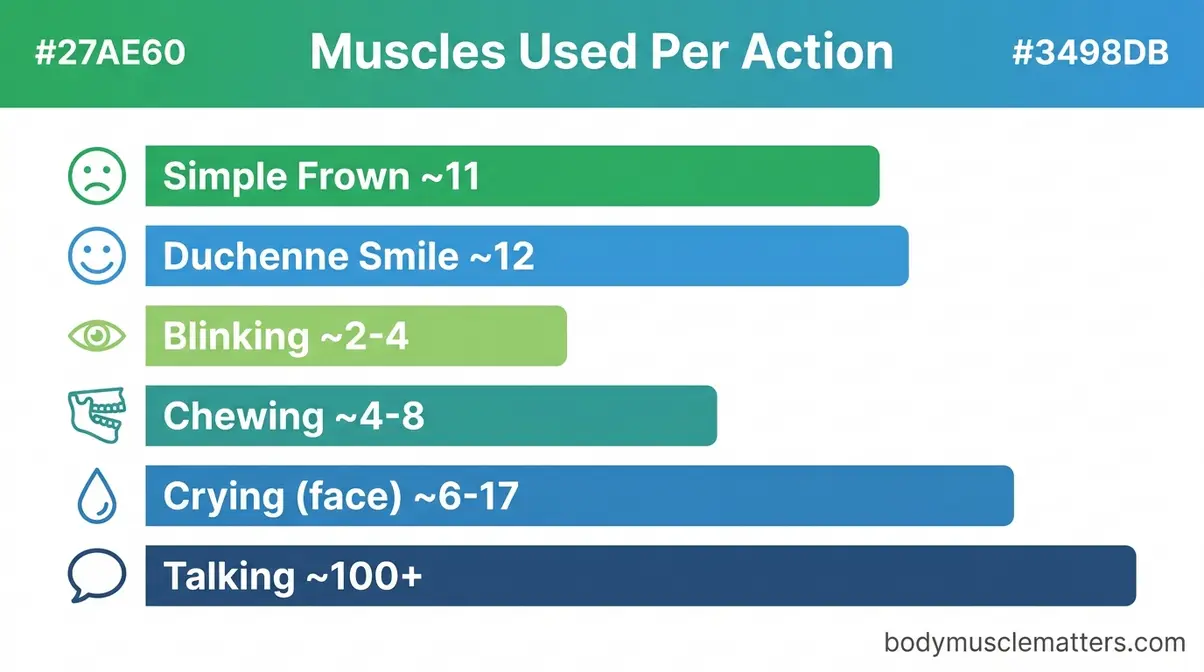
Crying involves a cascade of facial muscles working together — including the orbicularis oculi (which squints the eye), the corrugator supercilii (which furrows the brow), the mentalis (which creates the “chin wobble”), and the depressor anguli oris (which pulls the mouth corners down). A full crying expression recruits many of the same muscles as frowning, plus the lacrimal gland response that produces tears. Estimates for the muscular component of crying range from 6 to 17 muscles depending on intensity, though no single clinical standard exists for this count.
Laughing is more muscular than most people realize. A genuine laugh recruits the zygomaticus major (pulling the mouth up), the orbicularis oculi (crinkling the eyes), the risorius (pulling the mouth corners back), and multiple muscles of the diaphragm and abdomen for the respiratory component. Full-body laughter can involve dozens of muscles across the face, torso, and even limbs — making it one of the most physically demanding common expressions.
Talking is a highly complex muscular task. Speech requires the coordinated action of the orbicularis oris (which purses and shapes the lips), the buccinator (which controls cheek tension), the tongue muscles (including the genioglossus, the largest tongue muscle), the muscles of the soft palate, and the laryngeal muscles controlling the vocal cords. Producing a single word can activate 100 or more muscles across the face, throat, and respiratory system — far more than any facial expression alone.
Blinking is one of the simplest facial actions: it primarily involves the orbicularis oculi (to close the eye) and the levator palpebrae superioris (to reopen it) — just 2 main muscles per eye, or 4 if you count both eyes simultaneously.
Chewing recruits the masseter (the powerful jaw-closing muscle you can feel by clenching your teeth), the temporalis (a fan-shaped muscle at the temple), the medial and lateral pterygoids (internal jaw muscles), and the buccinator for keeping food between the teeth. A full chewing cycle uses approximately 4 to 8 muscles depending on the food’s resistance.
| Action | Estimated Muscles | Primary Muscle(s) |
|---|---|---|
| Simple frown | ~11 | Corrugator supercilii, depressor anguli oris |
| Duchenne smile | ~12 | Zygomaticus major, orbicularis oculi |
| Blinking | ~2–4 | Orbicularis oculi, levator palpebrae superioris |
| Chewing | ~4–8 | Masseter, temporalis, pterygoids |
| Crying (face only) | ~6–17 | Corrugator, depressor anguli oris, mentalis |
| Laughing (full body) | ~dozens | Zygomaticus major + diaphragm + abdominals |
| Talking (single word) | ~100+ | Orbicularis oris, tongue muscles, laryngeal muscles |
The pattern here is revealing: the more a physical action involves the whole body or respiratory system, the more muscles it recruits. A frown, by comparison, is a relatively contained, localized expression — which is another reason the “43 muscles” figure was always implausible.
A Note on Limitations: Why Counts Vary
Anatomy is not as tidy as a numbered list suggests. Exact muscle counts for any facial expression vary across researchers, textbooks, and clinical sources for several legitimate reasons.
Common Reasons for Variation
First, individual anatomy differs. Some people have slightly different muscle configurations — for example, a bifid (split) zygomaticus major muscle, which occurs in roughly 30% of people and can cause dimples when smiling. Second, researchers define expressions differently. A “frown” in one study may mean only a brow furrow; in another, it may include a full mouth-corner depression and chin wrinkle. These different definitions yield different muscle counts, and neither is wrong.
Third, the boundary between “active” and “passive” muscle engagement is blurry. Some muscles stabilize the face during an expression without being the primary movers. Whether you count stabilizers alongside active contractors changes the total.
When to Seek Expert Guidance
If you are researching facial muscle anatomy for medical, clinical, or therapeutic purposes — such as evaluating facial paralysis, planning reconstructive surgery, or assessing neurological conditions — the counts in this article are a general educational reference, not a clinical tool. For those applications, consult the full NIH StatPearls facial muscle tables, peer-reviewed facial EMG literature, or a qualified anatomist or neurologist.
The 11-muscle count for frowning and 12-muscle count for a Duchenne smile represent the best available synthesis of anatomical research, consistent with sources including NIH StatPearls and the analysis popularized by Dr. David H. Song. However, you may encounter counts of 6 to 17 in other credible sources — all within the range of legitimate anatomical variation.
Frequently Asked Questions
Are 17 muscles used to smile?
The “17 muscles to smile” figure is a popular saying, not a clinical measurement. Anatomical analyses consistently find that a genuine Duchenne smile uses approximately 12 muscles, while a frown uses around 11 (Live Science). The number 17 appears in chain emails and motivational content but has no documented anatomical source. For a minimal, “polite” smile that does not engage the eye muscles, the count may be as low as 6 to 8 — still not 17.
Does it take 43 muscles to frown?
No — the “43 muscles to frown” claim is a myth with no clinical basis. The number 43 is approximately equal to the total number of muscles in the human face (Cleveland Clinic), not the number activated during a frown. Analysis by Dr. David H. Song (University of Chicago Medical Center), as cited by The Straight Dope (2004), found that a standard frown uses approximately 11 muscles. This confusion between total facial muscles and expression-specific muscles is at the heart of The 43-Muscle Fallacy.
Why can I smile but not frown?
Difficulty frowning while smiling freely is a neurological phenomenon, not a muscular one. Smiling activates a feedforward inhibition of the corrugator supercilii — the primary frown muscle — before the zygomaticus major even fires (PMC). This means smiling and frowning are neurologically competitive: the brain suppresses one to enable the other. People who report difficulty frowning in certain situations may be experiencing strong positive emotional states, social conditioning, or — in clinical cases — conditions like facial nerve palsy that affect specific muscle groups.
Can smiling cause fatigue?
Sustained smiling for extended periods would cause muscular fatigue in the zygomaticus major and orbicularis oculi, similar to holding any muscle in sustained contraction. However, genuine smiling is intermittent rather than continuous — the muscles relax between expressions. Voluntarily holding a forced smile for 24 hours would be uncomfortable and could cause soreness, but it would not cause lasting muscle damage in healthy individuals. Research on smile frequency focuses more on its emotional benefits than its physical limits.
The Real Answer — And Why It Matters
The next time someone forwards you a chain email claiming it takes 43 muscles to frown, you have the anatomy to push back. A typical frown uses approximately 11 facial muscles — with the corrugator supercilii, procerus, and depressor anguli oris doing the primary work. A genuine Duchenne smile uses about 12. The famous “43 muscles” figure confuses the total number of muscles in the human face with the number active during a single expression — and that confusion has been circulating as a “fun fact” for decades.
The 43-Muscle Fallacy matters beyond trivia. When popular science gets anatomy wrong, it erodes trust in genuine health information. Understanding that smiling and frowning require nearly the same muscular effort — and that the felt difference comes from neuroscience, social conditioning, and the facial feedback hypothesis — gives you a more accurate model of how your own face works. Repeated frowning does accumulate corrugator muscle tension and can reinforce negative emotional feedback loops, per PMC (2026). Smiling, even deliberately, can nudge mood through the same feedback mechanism. The effect is real; the muscle-count mythology around it was not.
If you want to explore the facial feedback hypothesis further, the multi-lab research published in PMC (2026) is an excellent starting point. And if you are ever handed a motivational poster claiming frowning is a 43-muscle workout, you now have the science to smile — with just 12 of yours — and set the record straight.