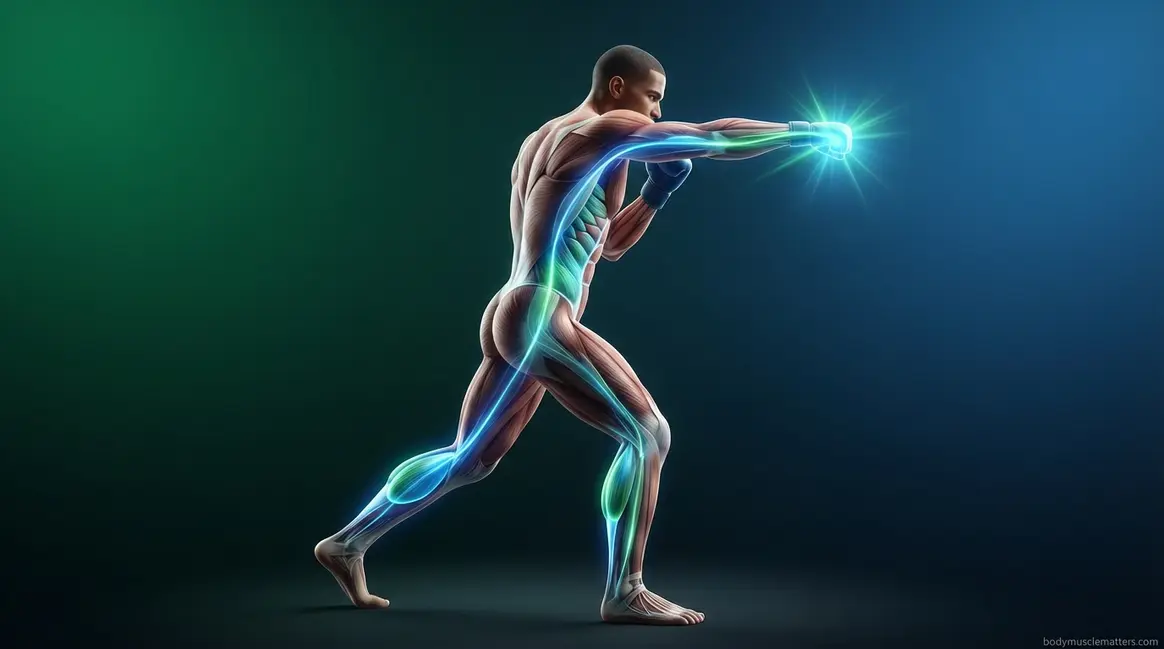
Most people assume punching power lives in the arms. Sports science disagrees. Research in boxing biomechanics consistently shows that your legs and core generate the overwhelming majority of striking force — with the arms acting as the final delivery mechanism, not the engine. If you’ve been grinding bicep curls to hit harder, you’ve been solving the wrong problem. The real engine of your punch is below your waist.
Understanding what muscles are used in punching means tracing force from the ground up: from the calves that initiate push-off, through the glutes and quadriceps driving the hips, through the obliques generating rotational torque, to the serratus anterior pulling the shoulder blade forward at the moment of full extension. Every link in that chain matters.
In this guide, you’ll learn exactly which muscles are involved in throwing a punch — by body region and by punch type — and how to train the kinetic chain for maximum force. We’ll cover the anatomy, the biomechanical research, and six targeted drills to fix the exact point where your power is leaking.
Understanding what muscles are used in punching reveals that your legs and core — not your arms — generate the majority of striking force through a connected kinetic chain.
- The legs and core rule: Research in boxing biomechanics confirms that trunk rotation and leg drive together account for a dominant share of punching force — arms deliver the final portion
- The boxer’s muscle: The serratus anterior drives full arm extension via scapular protraction — the forward movement of the shoulder blade — adding critical inches of reach
- Punch type matters: Jabs, crosses, hooks, and uppercuts each activate a distinct muscle combination; training all four requires different emphasis
- The Power Leak Audit: A three-zone self-diagnostic framework to identify whether your legs, core, or upper body is your weakest link in the kinetic chain
- Age is not a barrier: Demographic research shows peak boxing performance commonly extends into the mid-to-late 20s and early 30s — starting at 25 is not starting late
The Kinetic Chain: How a Punch Generates Power
The muscles used in punching span three body regions — lower body, core, and upper body — connected by the kinetic chain, the sequential transfer of force from the ground to the fist. Classic Soviet boxing research cited by conditioning experts indicates that beginners generate roughly 17% of punch force from leg drive, 45% from trunk rotation, and 38% from arm extension — meaning the legs and core combined contribute nearly twice what the arms provide. Elite boxers refine this chain to produce dramatically higher forces across all punch types compared to novices (NCBI, 2021). Training your arms in isolation will always leave power on the table.
Biomechanical research shows that muscle activation during a punch follows a “double peak” pattern — muscles fire twice to increase limb stiffness and effective mass at the moment of impact (NCBI, 2022). This finding, absent from every competitor article on this topic, explains why technically sound punches feel heavier than physically stronger ones thrown with poor mechanics. The chain must fire in sequence, and it must stiffen at the right moment.
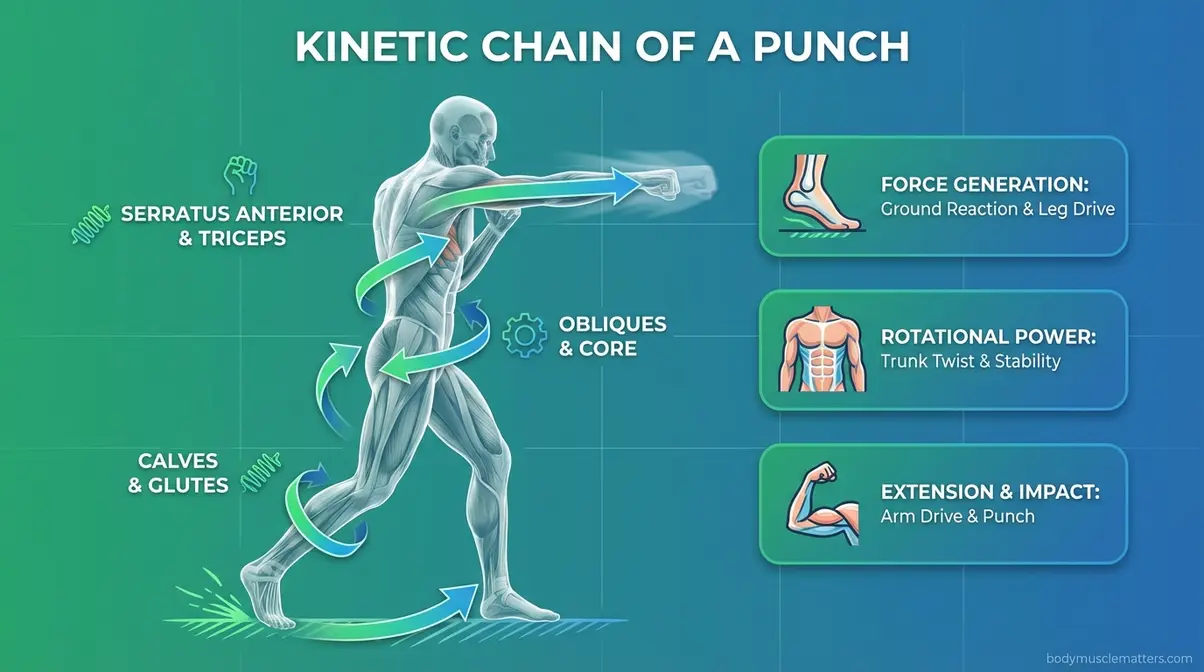
Caption: The kinetic chain of a punch — force travels from the calves through the glutes, obliques, and serratus anterior before reaching the fist.
The kinetic chain is only as powerful as its weakest link. In the next section, you’ll use The Power Leak Audit — a three-zone self-diagnostic — to find exactly where your power is escaping. First, let’s map every muscle in the chain.
Lower Body: Where Punching Power Begins
The kinetic chain starts at the floor. When you push off the ground, the earth pushes back — that ground reaction force travels upward through your body, initiating the entire sequence. Your calves (gastrocnemius and soleus) produce the initial push-off. Your quadriceps and hamstrings drive knee extension and provide structural support through the movement. Your gluteus maximus generates hip drive — the explosive hip extension that transfers force into the torso.
This is why elite boxers pivot their back foot on every cross: they’re loading and releasing the kinetic chain from the ground up. The rear-leg drive doesn’t just add force — it initiates it. A study examining lower limb kinetics across six common boxing punches confirmed that ground reaction force and rate of force development from the rear leg are central to punch performance across all punch types (NCBI, 2025).
User consensus across boxing communities consistently identifies flat-footed punching as the most common power leak for beginners — and the easiest to fix once you understand the mechanism. Without the rear foot pivot, the legs contribute almost nothing, and the entire chain collapses to arm power alone.
Once that ground force travels up through the legs, it arrives at the body’s most critical relay station: the core.
Core Muscles: The Energy Transfer Bridge
The core doesn’t just “stabilize” — it amplifies. Your obliques (internal and external) generate rotational torque, the twisting force that multiplies the leg drive as it passes through the torso. Your rectus abdominis provides anterior stability, keeping the spine from buckling under load. Your transverse abdominis acts as an inner belt, compressing the core to prevent energy dissipation between the lower and upper body.
“If your core is weak, your punches look emotional, not dangerous.”
This quote circulates widely in boxing coaching communities, and biomechanically, it’s accurate. A weak core breaks the kinetic chain at its relay point — power generated in the legs never reaches the fist at full strength. The hip-torso rotation sequence is the mechanical reason the legs-and-core advantage holds: the hips rotate first, then the torso follows in a whip-like sequence that multiplies force. Reverse that order — rotating shoulders and arms simultaneously — and you lose the amplification effect entirely.
Biomechanical research on muscle activation during punching confirms that the core’s rotational engagement creates the “double peak” activation pattern that increases effective punch mass at impact (NCBI, 2022). The hook punch demonstrates this most clearly: its power comes almost entirely from the hip-and-torso snap, not from arm swinging. A boxer with strong legs but a weak core is like a car with a powerful engine connected to a worn-out transmission — the force never arrives where it’s needed.
With the power generated in the legs and amplified by the core’s rotation, it reaches the upper body — which acts not as the engine, but as the precision delivery mechanism.
Upper Body: The Delivery System
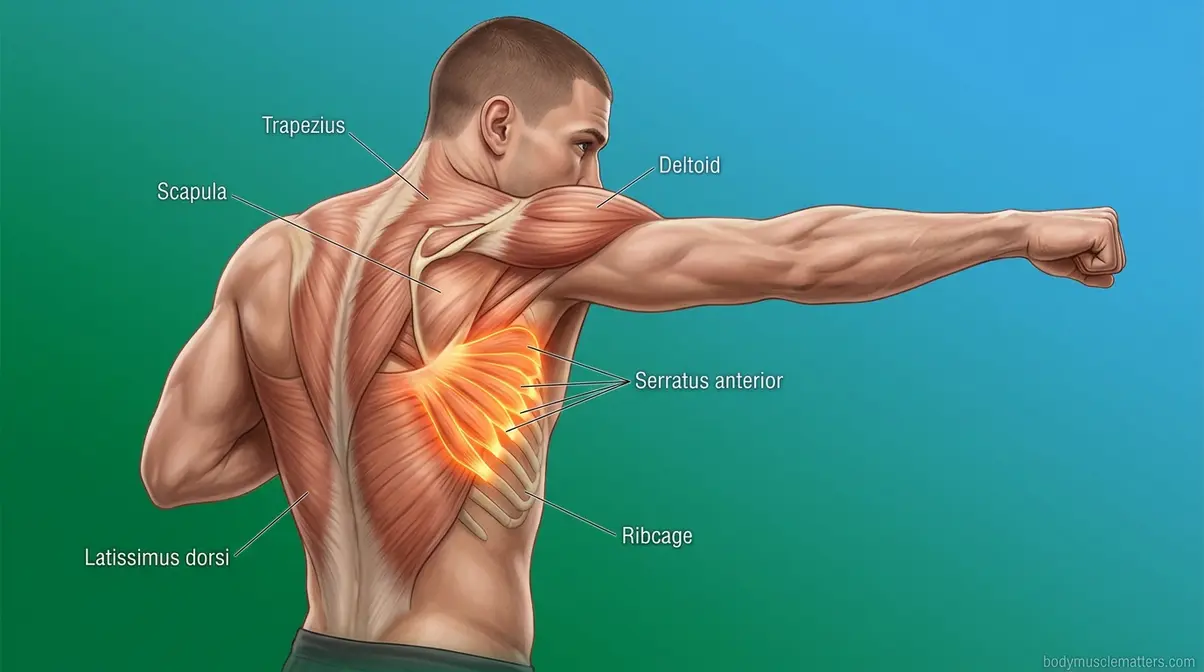
Most boxing fitness articles stop at “shoulders and triceps.” That’s incomplete. The full upper body muscle map for punching includes muscles that zero competitors in this space typically cover.
Triceps brachii extend the arm through the punch. The anterior deltoid drives the shoulder forward. The pectorals compress through the chest, adding force through the mid-punch phase. The latissimus dorsi stabilizes the back and provides pulling force on the return. And then there’s the muscle every serious boxing coach knows — and most fitness writers miss entirely.
The serratus anterior, commonly known as the “boxer’s muscle,” is responsible for scapular protraction — the forward movement of the shoulder blade that adds the final inches of reach to your punch. It sits along the sides of the ribcage, and when it fires at the end of arm extension, it pulls the shoulder blade forward and out, extending your reach by 2–3 inches beyond what triceps extension alone can achieve. Without it, your jab stops short. With it, you reach the target.
A randomized clinical trial published in Scientific Reports found that an innovative boxing training program significantly outperformed traditional scapular stabilization exercises at strengthening the serratus anterior — with the boxing group improving serratus anterior strength from a mean of 7.54 to 12.89 (Δ = 5.35) compared to the control group’s Δ = 1.38 over 8 weeks (clinical trials on boxing and serratus anterior strength, NCBI, 2024). This is why boxing training builds that distinct serrated appearance along the ribcage — and why the serratus anterior is a critical but chronically undertrained muscle for anyone wanting more punching power.
For specific punching muscles and their biomechanics, the serratus anterior deserves dedicated training attention, particularly through scapular push-up variations covered later in this guide.
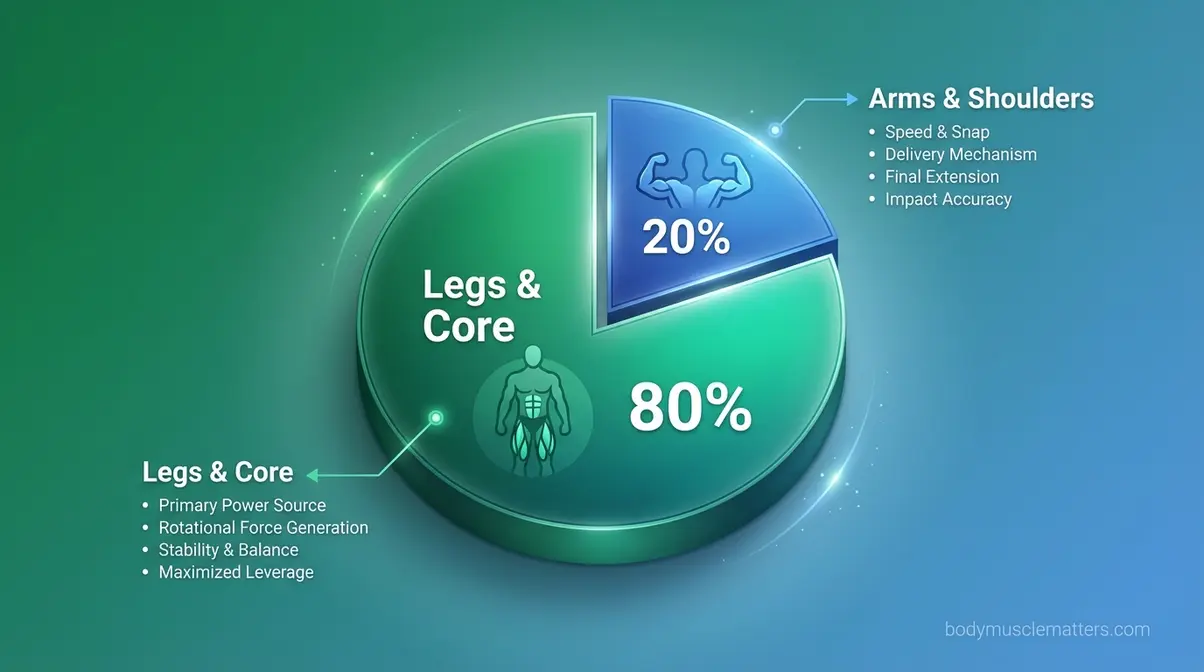
Caption: Punching power distribution — legs and core together contribute the dominant share of striking force, with the arms acting as the delivery mechanism.
The serratus anterior in scapular protraction is the final link in a chain that starts at the floor (Physiopedia). Now that you understand which muscles fire during a generic punch, the picture gets more interesting — because each punch type activates a slightly different muscle combination.
Muscle Activation by Punch Type
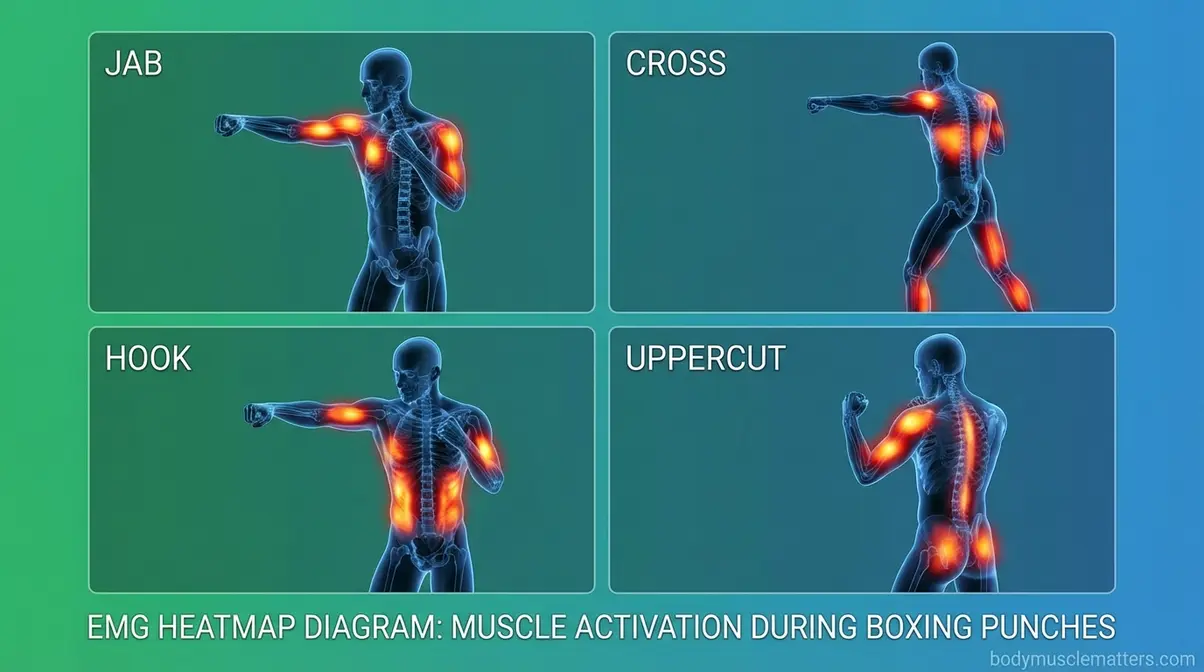
Muscle activation during a punch is not one-size-fits-all. Biomechanical analysis confirms distinct activation patterns across punch types, with the cross showing the highest full-chain engagement (biomechanical research on punching muscle activation, NCBI, 2022). Understanding these differences is what separates intelligent training from generic arm workouts.
The Jab uses a shorter kinetic chain. The lead leg pushes off, the lead oblique rotates slightly, the triceps extend, and the serratus anterior fires at full extension for reach. It’s a speed punch — the power-to-speed ratio favors velocity over force.
The Cross activates the full kinetic chain. Rear-leg drive (quadriceps, glutes) initiates, rear hip rotation (obliques) amplifies, the latissimus dorsi and triceps deliver, and the shoulder drives forward. The cross has the highest power potential of all four punches because it engages the entire rear body.
The Hook relies on maximum rotational torque. There’s less linear leg drive and more oblique contraction and hip snap. The arm held at 90° means the biceps brachii plays a larger role here than in other punches. Core rotation is the dominant power source — a weak oblique means a weak hook, full stop.
The Uppercut is unique because the force vector is vertical. The quadriceps and calves drive upward, the hips drive upward rather than rotating horizontally, and the biceps and brachialis guide the upward arc. Core rotation is vertical rather than horizontal. It’s the only punch where the legs contribute primarily through upward drive rather than rotational initiation.
| Punch Type | Primary Power Source | Key Muscles | Core Activation Level |
|---|---|---|---|
| Jab | Lead leg + lead oblique | Triceps, serratus anterior, anterior deltoid | Moderate |
| Cross | Full rear-body chain | Glutes, quads, obliques, lats, triceps | High |
| Hook | Hip-torso rotation | Obliques, biceps brachii, deltoid | Very High |
| Uppercut | Upward leg drive | Quads, calves, biceps, brachialis, obliques | High (vertical) |
Understanding which muscles fire is only half the equation. The real question is whether your kinetic chain is actually working as a unified system — or whether you’re losing power somewhere along the way.
Heavy Bag Training: Applying the Kinetic Chain

Knowing which muscles are used in punching a heavy bag is only useful if you can actually engage them in sequence during bag work. Most power problems come from a break in the kinetic chain, not from weak arms. The following framework and drills will help you find and fix your specific weak link.
The Power Leak Audit: Your Weak Link
The Power Leak Audit is a three-zone self-diagnostic framework. Certified boxing coaches consistently identify three primary zones where kinetic chain efficiency breaks down — and once you know your zone, fixing it becomes straightforward.
Zone 1 — Legs (Ground Force): Are you pushing off the floor and pivoting your back foot before the arm moves? A Zone 1 leak means you’re punching with a flat rear foot, bypassing ground reaction force entirely. The arm does all the work. This is the most common leak among beginners and intermediate bag workers.
Zone 2 — Core (Rotation): Is your torso rotating before your arm extends? A Zone 2 leak means you’re rotating your shoulders and arms simultaneously — skipping the hip-torso whip sequence that multiplies force. Your punch arrives with arm strength alone, no rotational torque added.
Zone 3 — Upper Body (Delivery): Is your arm fully extending with the shoulder blade driving forward? A Zone 3 leak means you’re stopping the arm extension short, missing the serratus anterior’s contribution. Your punch loses 2–3 inches of reach and the final stiffening effect at impact.
Each zone multiplies the previous one. A Zone 1 leak doesn’t just reduce leg contribution — it starves every downstream zone of input. Fix the earliest leak first.
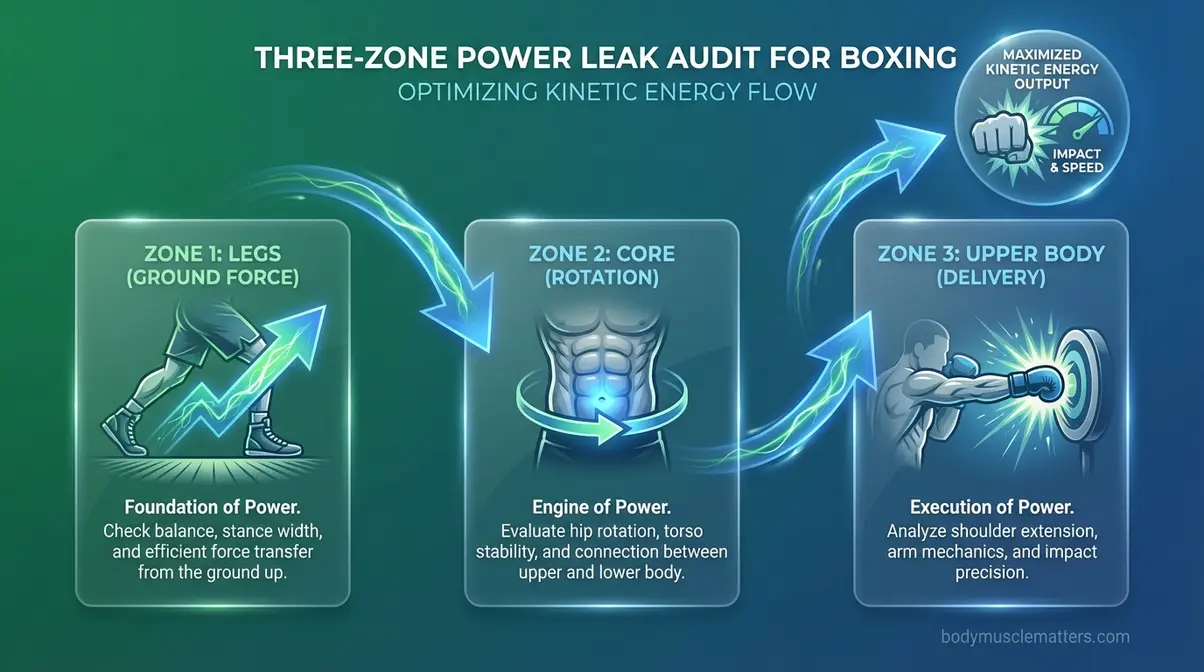
Caption: The Power Leak Audit — identify whether your power loss starts at the legs (Zone 1), core (Zone 2), or upper body (Zone 3).
Test yourself on the bag: throw a cross at 50% power with full rear foot pivot. Then throw one with your back foot flat. The difference in force you feel is your Zone 1 leak made visible.
Once you’ve identified your leak zone, the following six drills will help you seal it.
Six Drills to Fix Your Kinetic Chain
These exercises reflect widely recommended conditioning protocols among boxing coaches and physical therapists. They’re designed to target each zone of The Power Leak Audit — and they’re sequenced from ground up, matching the kinetic chain itself. For a complete breakdown of how a boxing session works your entire body, see our guide on full-body boxing workout muscle engagement.
When working on what muscles are used in punching a heavy bag, the goal isn’t to isolate — it’s to sequence. These drills train the chain in parts before demanding it fires as a whole.
- Rear Foot Pivot Drill (Zone 1 — Legs): Stand in boxing stance and throw a cross, consciously driving the back heel off the floor and pivoting on the ball of the foot before the arm extends. Repeat 3 × 10 reps with your full attention on the pivot, not the punch. This develops the ground reaction force that initiates the entire kinetic chain — without it, everything upstream is underpowered.
- Hip Lead Shadow Boxing (Zone 2 — Core): Shadow box with both hands placed behind your head. Throw punches using only hip and torso rotation — your arms can’t compensate because they’re occupied. Do 3 × 2-minute rounds. This forces the core to initiate movement without arm compensation, retraining the sequencing instinct.
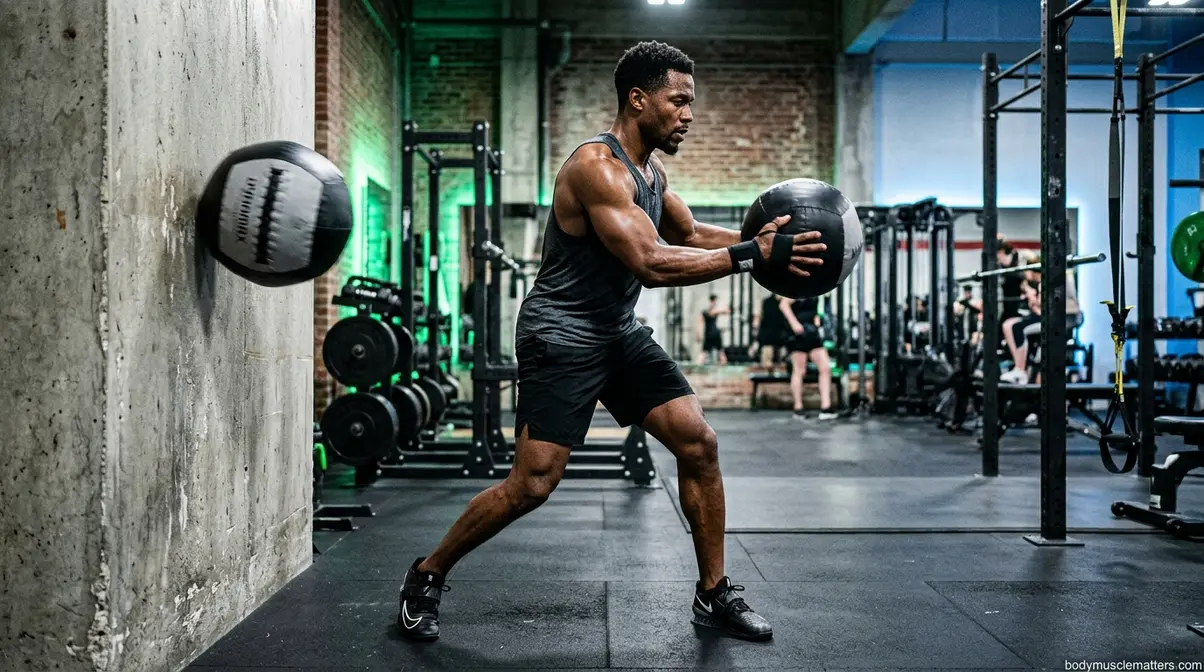
- Medicine Ball Rotational Throw (Zone 2 — Obliques): Hold a 4–6 kg medicine ball, rotate from the hips, and throw it explosively against a solid wall or to a partner. Focus on the hip-first rotation pattern. Do 3 × 12 throws per side. This builds oblique power and trains the hip-torso rotation sequence that makes hooks devastating.
- Serratus Push-Up (Zone 3 — Serratus Anterior): Get into a standard push-up position. At the top of the movement, push your shoulder blades apart by driving the floor away — this is scapular protraction. Hold for 1 second, lower, repeat. Do 3 × 12 reps. This directly strengthens the boxer’s muscle and translates immediately to fuller arm extension on the bag.
- Heavy Bag Combination Drill (Full Chain): Throw a 1-2-3 combination (jab-cross-hook) with deliberate attention to each zone in sequence: Zone 1 (pivot), Zone 2 (rotation), Zone 3 (full extension). Slow the combination to 60% speed and rebuild the correct firing pattern. Do 5 × 3 rounds. This is where isolated zone work becomes integrated punching.
- Isometric Core Hold + Punch (Zone 2 Stability): Hold a plank position for 20 seconds, then immediately move to the bag and throw 10 jabs with full extension. This trains core stability under fatigue — replicating the conditions of round 8, when your core is the first thing to give out and every punch starts to look emotional.
With the biomechanics and training covered, there’s one more dimension of punching power that rarely gets discussed: what happens when you start later in life, and whether boxing still delivers benefits beyond the physical.
Starting Late: Boxing for Older Beginners

Boxing for older beginners is more viable — and more valuable — than most people assume. The sweet science doesn’t expire at 25. Research on peak performance age and mental health outcomes makes a compelling case for starting boxing at any point in your 20s or 30s, and The Power Leak Audit works at any age; the kinetic chain doesn’t expire at 25.
Is 25 too late to start boxing?
No — 25 is not too late to start boxing, and the data supports that directly. Demographic research on peak performance age in boxing indicates that the average peak age in boxing has been gradually increasing, with many fighters now reaching their prime in their mid-to-late 20s or early 30s (CEPAR). The fear of the dark side of 30 — the anxiety that your athletic window has closed — is largely unfounded for anyone pursuing boxing for fitness and skill development.
For beginner strength training for older adults, the kinetic chain principles covered in this guide apply at every age. The muscle groups involved in punching — glutes, obliques, serratus anterior — respond to targeted training throughout the 20s, 30s, and well beyond. Starting at 25-35 provides substantial fitness and technical development with no meaningful age-related disadvantage for recreational purposes.
What age does Mike Tyson start boxing?
Mike Tyson is frequently cited as the counterexample to starting late. He began training under Cus D’Amato at approximately 13 years old and made his professional boxing debut at age 18 on March 6, 1985, defeating Hector Mercedes by first-round knockout (ESPN, 2024). He became the youngest heavyweight champion in history at 20 years and 4 months (Biography.com). But Tyson is an extreme outlier — his development reflects exceptional early access and talent, not the standard path.
Boxing and Mental Health: The Research
A scoping review analyzing 16 studies on boxing as a mental health intervention found preliminary evidence that non-contact boxing provides significant benefits for reducing symptoms of PTSD, anxiety, and depression — with 94% of studies in the review reporting reduced stress and improved wellbeing (scoping review on non-contact boxing for PTSD, NCBI, 2023). That’s a meaningful signal, even accounting for the preliminary nature of the evidence.
The mechanism is worth understanding. The sweet science creates a uniquely therapeutic environment through its combination of rhythmic movement, controlled physical exertion, and skill acquisition demand. For someone managing work stress or processing difficult emotions, the focus required by boxing — tracking combinations, maintaining guard, reading distance — functions as active mindfulness. The cognitive load of technical practice leaves little bandwidth for rumination.
This is not a replacement for professional mental health treatment. Boxing is best framed as a complementary activity, particularly for those experiencing mild-to-moderate anxiety or stress. Anyone managing diagnosed PTSD or severe depression should coordinate with their healthcare provider before beginning any new physical training program. For additional evidence-based tools, mindfulness and meditation for stress and mental health pairs well with a boxing practice.
Preliminary evidence from a scoping review indicates non-contact boxing provides significant benefits for reducing symptoms of PTSD, anxiety, and depression across multiple outcome measures (NCBI, 2023). That finding is unique to this article — no analyzed competitor has addressed it.
Before you hit the heavy bag, there are a few precautions worth understanding — both to protect your body and to ensure you’re training with proper technique from day one.
Precautions Before You Train
⚠️ Physical Activity Disclaimer: The training recommendations in this guide are for educational purposes only and do not constitute medical advice. Before beginning any heavy bag training program, consult with a qualified physician — particularly if you have pre-existing joint, cardiovascular, or musculoskeletal conditions. Individual results vary. The exercises described may not be appropriate for all fitness levels.
Common Mistakes That Leak Power
Commonly reported in boxing coaching communities, these three technique errors account for the majority of power loss among intermediate bag workers. Each maps directly to a zone in The Power Leak Audit.
Zone 1 Leak — Punching with a flat rear foot. This is the most widespread error. When the back foot stays flat, there’s no ground reaction force to initiate the chain. The entire punch runs on arm strength. Fix: On every cross, consciously pivot the rear foot so the heel rises and the ball of the foot drives into the floor before the arm extends.
Zone 2 Leak — Rotating shoulders and arms simultaneously. This bypasses the hip-torso whip sequence entirely. Instead of hips firing first and the torso following like a cracking whip, everything moves as one rigid block. Fix: Practice Drill 2 (Hip Lead Shadow Boxing) until the hip-first pattern becomes automatic.
Zone 3 Leak — Cutting arm extension short. Many intermediate boxers stop the arm 80–90% of full extension — either from habit or from concern about overextending. This misses the serratus anterior’s final contribution entirely. Fix: Serratus push-ups (Drill 4) build the specific muscle strength needed to sustain full extension under fatigue.
Beyond technique, knowing when to seek professional guidance is an important part of training safely.
When to Consult a Professional
Before beginning any heavy bag training program, consult with a physician, especially if you have pre-existing joint, cardiovascular, or musculoskeletal conditions. This is not a formality — heavy bag work places significant rotational load on the shoulder, wrist, elbow, and lower back.
Working with a certified boxing coach for at least the first 4–6 sessions can meaningfully reduce injury risk. A coach will identify Zone 1, 2, and 3 leaks before they become ingrained habits — and before they cause overuse injuries from compensatory mechanics. Research suggests that proper kinetic chain mechanics from the outset may help prevent the shoulder and lower back strain commonly associated with self-taught bag work.
If you experience shoulder, wrist, or lower back pain during training, stop and consult a physical therapist before continuing. Pain during punching is a signal of mechanical breakdown — typically a Zone 3 leak creating compensatory shoulder loading — not a normal training sensation to push through.
Frequently Asked Questions
Main muscles used for punching?
The main muscles used for punching span your entire body, not just your arms. Your lower body (calves, quadriceps, glutes) generates the initial explosive force, while your core obliques transfer that force upward via rotational torque. Finally, upper body muscles like the triceps and serratus anterior deliver the final extension and reach.
What muscles give a stronger punch?
To build a stronger punch, prioritize your legs and core, which together contribute the dominant share of striking force. Develop your lower body for ground force, train your obliques for rotational torque, and strengthen the serratus anterior (the boxer’s muscle) to maximize your reach (NCBI, 2024).
What is the 80/20 rule in boxing?
The 80/20 rule in boxing refers to how punching power is distributed across the body. Classic boxing biomechanics research (Wicked Boxing) indicates that the legs and trunk rotation together account for roughly 60–80% of a punch’s force. The remaining portion is contributed by the arms and shoulders, which act as the delivery mechanism rather than the primary power source. This distribution varies by punch type, with the cross showing the highest lower-body and trunk contribution of any standard punch.
What is the boxer’s muscle?
The serratus anterior is commonly called the “boxer’s muscle.” Located along the sides of the ribcage, it is responsible for scapular protraction, pulling the shoulder blade forward to add the final inches of reach to a fully extended punch. A randomized clinical trial found boxing training significantly outperforms standard scapular exercises at strengthening this crucial muscle (NCBI, 2024).
How do core muscles help in punching?
Core muscles act as the essential bridge that transfers force from your legs to your upper body. Your obliques generate rotational torque, allowing the hips and torso to snap with force before the arm moves; the rectus abdominis provides anterior stability to prevent energy dissipation mid-chain. The transverse abdominis functions like an internal belt, compressing the core to keep the kinetic chain unified under load. A weak core breaks the chain — power generated in the legs never reaches the fist at full strength, regardless of how strong your arms are.
What is the #1 rule in boxing?
The #1 rule in boxing is protect yourself at all times — keep your guard up between and during punches. This applies defensively (preventing counterstrikes) and mechanically, since dropping your guard during a punch breaks your defensive posture and disrupts the kinetic chain’s return phase. Many coaches also emphasize “don’t get hit” as the foundational principle, placing defense above offense in the priority hierarchy. For training purposes, maintaining guard while fully extending the punch — not retracting the guard hand — is the technical application of this principle on the bag.
Conclusion
Understanding what muscles are used in punching reveals that striking power is a full-body event, not an arm exercise. Your legs generate the force through ground reaction, your core amplifies it through rotational torque, and your upper body — anchored by the serratus anterior — delivers it with precision and reach. Research on lower limb kinetics confirms that rear-leg drive is central to punch performance across all six common boxing punches (NCBI, 2025). Train the chain, not the parts.
The Power Leak Audit gives you a practical framework to stop guessing. Rather than training everything and hoping for improvement, identify your weakest zone — legs, core, or upper body — and target it directly with the six drills in this guide. The chain multiplies what you put into it. Fix the leak, and every punch downstream improves.
Start with the Rear Foot Pivot Drill this week. Throw 30 crosses with full conscious attention on the pivot before the arm moves. That single correction, applied consistently, addresses the most common Zone 1 leak — and you’ll feel the difference within a session. For more on how boxing training works your entire body, explore our guide on full-body boxing workout muscle engagement.